If you are a schoolkid of the right age, you can’t wait to lose a baby tooth. In many cultures, there is a ritual surrounding it, like the tooth fairy, a mouse who trades your tooth for a gift, or burying the tooth somewhere significant. But in 1958, a husband and wife team of physicians wanted children’s teeth for a far different purpose: quantifying the effects of nuclear weapons testing on the human body. A young citizen scientist (State Historical Society of Missouri) Louise and Eric Reiss, along with some other scientists, worked with Saint Louis University and the Washington School of Dental Medicine to collect and study children’s discarded teeth. They were looking for strontium-90, a nasty byproduct of above-ground nuclear testing. Strontium is similar enough to calcium that consuming it in water and dairy products will leave the material in your bones, including your teeth.
The study took place in the St. Louis area, and the results helped convince John F. Kennedy to sign the Partial Nuclear Test Ban Treaty.
They hoped to gather 50,000 teeth in a year. By 1970, 12 years later, they had picked up over 320,000 donated teeth. While a few kids might have been driven by scientific altruism, it didn’t hurt that the program used colorful posters and promised each child a button to mark their participation.
Children’s teeth were particularly advantageous to use because they are growing and are known to readily absorb radioactive material, which can cause bone tumors.
Scale
A fair trade for an old tooth? (National Museum of American History) You might wonder just how much nuclear material is floating around due to bombs. Obviously, there were two bombs set off during the war, as well as the test bombs required to get to that point. Between 1945 and 1980, there were five countries conducting atmospheric tests at thirteen sites. The US, accounting for about 65% of the tests, the USSR, the UK, France, and China detonated 504 nuclear devices equivalent to about 440 megatons of TNT.
Well over 500 bombs with incredible force have put a lot of radioactive material into the atmosphere. That doesn’t count, too, the underground tests that were not always completely contained. For example, there were two detonations in Mississippi where the radiation was contained until they drilled holes for instruments, leaving contaminated soil on the surface. Today, sites like this have “monuments” explaining that you shouldn’t dig in the area.
Of course, above-ground tests are worse, with fallout affecting “downwinders” or people who live downwind of the test site. There have been more than one case of people, unaware of the test, thinking the fallout particles were “hot snow” and playing in it. Test explosions have sent radioactive material into the stratosphere. This isn’t just a problem for people living near the test sites.
Results
By 1961, the team published results showing that strontium-90 levels in the teeth increased depending on when the child was born. Children born in 1963 had levels of strontium-90 fifty times higher than those born in 1950, when there was very little nuclear testing.
The results were part of the reason that President Kennedy agreed to an international partial test ban, as you can see in the Lincoln Presidential Foundation video below. You may find it amazing that people would plan trips to watch tests, and they were even televised.
In 2001, Washington University found 85,000 of the teeth stored away. This allowed the Radiation and Public Health Project to track 3,000 children who were, by now, adults, of course.
Sadly, 12 children who had died from cancer before age 50 had baby teeth with twice the levels of the teeth of people who were still alive at age 50. To be fair, the Nuclear Regulatory Commission has questioned these findings, saying the study is flawed and fails to account for other risk factors.
And teeth don’t just store strontium. In the 1970s, other researchers used baby teeth to track lead ingestion levels. Baby teeth have also played a role in the Flint Water scandal. In South Africa, the Tooth Fairy Project monitored heavy metal pollution in children’s teeth, too.
[Big Clive] picked up a tiny heater for less than £8 from the usual sources. Would you be shocked to learn that its heating capacity wasn’t as advertised? No, we weren’t either. But [Clive] treats us to his usual fun teardown and analysis in the video below.
A simple test shows that the heater drew about 800 W for a moment and drops as it heats until it stabilizes at about 300 W. Despite that, these units are often touted as 800 W heaters with claims of heating up an entire house in minutes. Inside are a fan, a ceramic heater, and two PCBs.
The ceramic heaters are dwarfed by metal fins used as a heat exchanger. The display uses a clever series of touch sensors to save money on switches. The other board is what actually does the work.
[Clive] was, overall, impressed with the PCB. A triac runs the heaters and the fan. It also includes a thermistor for reading the temperature.
You can learn more about the power supply and how the heater measures up in the video. Suffice it to say, that a cheap heater acts like a cheap heater, although as cheap heaters go, this one is built well enough.
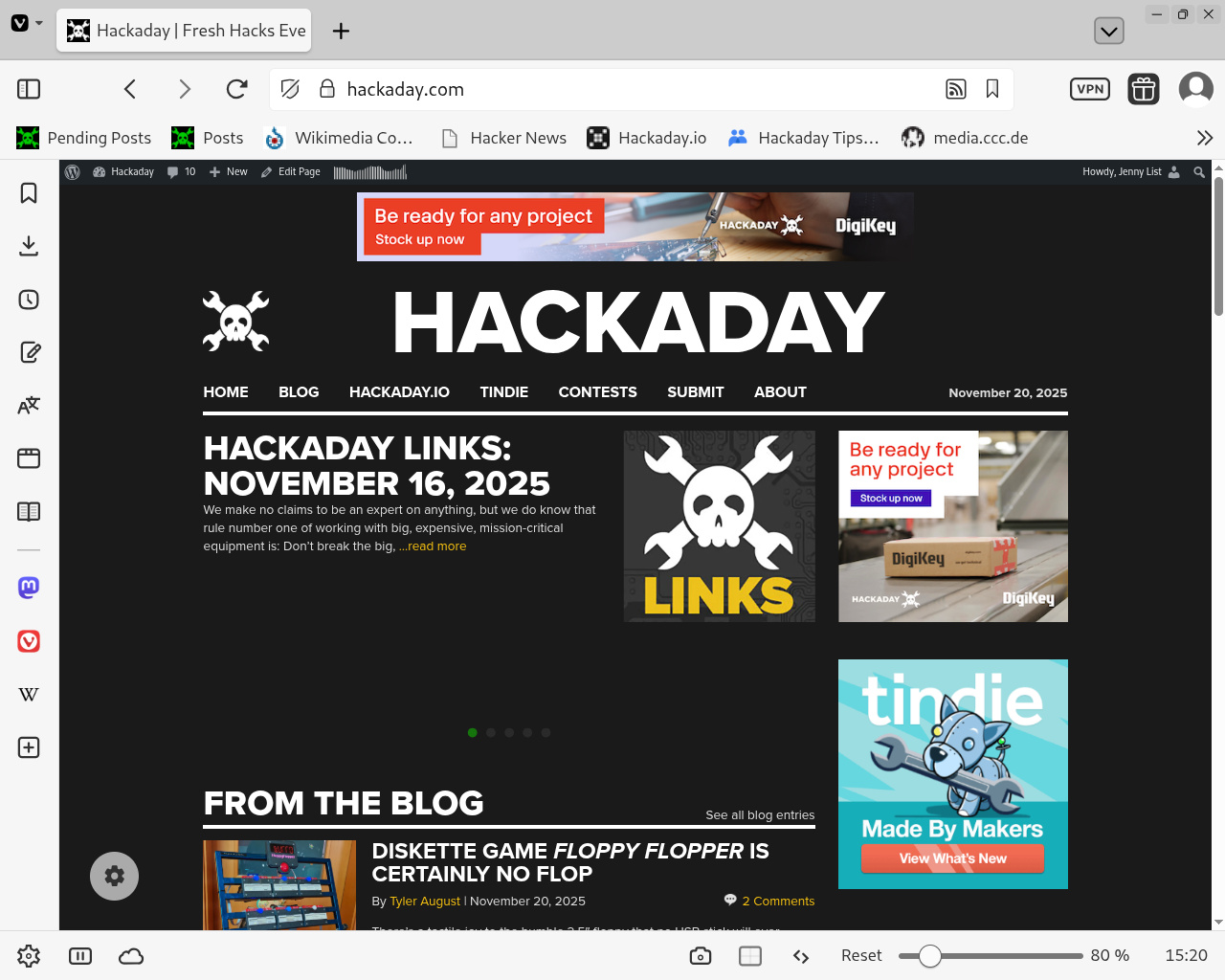
It’s been twenty-three years since the day Phoenix was released, the web browser that eventually became Firefox. I downloaded it on the first day and installed it on my trusty HP Omnibook 800 laptop, and until this year I’ve used it ever since. Yet after all this time, I’m ready to abandon it for another browser. In the previous article in this series I went into my concerns over the direction being taken by Mozilla with respect to their inclusion of AI features and my worries about privacy in Firefox, and I explained why a plurality of browser engines is important for the Web. Now it’s time to follow me on my search for a replacement, and you may be surprised by one aspect of my eventual choice.
Where Do I Go From Here?
It’s Hackaday, in Ladybird! (Ooof, that font.) Happily for my own purposes, there are a range of Firefox alternatives which fulfill my browser needs without AI cruft and while allowing me to be a little more at peace with my data security and privacy. There’s Chromium of course even if it’s still way too close to Google for my liking, and there are a host of open-source WebKit and Blink based browsers too numerous to name here.
In the Gecko world that should be an easier jump for a Firefox escapee there are also several choices, for example LibreWolf, and Waterfox. In terms of other browser engines there’s the extremely promising but still early in development Ladybird, and the more mature Servo, which though it is available as a no-frills browser, bills itself as an embedded browser engine. I have not considered some other projects that are either lightweight browser engines, or ones not under significant active development. It’s Hackaday, in Servo! Over this summer and autumn then I have tried a huge number of different browsers. Every month or so I build the latest Ladybird and Servo; while I am hugely pleased to see progress they’re both still too buggy for my purposes. Servo is lightning-fast but sometimes likes to get stuck in mobile view, while Ladybird is really showing what it’s going to be but remains for now slow-as-treacle. These are ones to watch, and support.
I gave LibreWolf and Waterfox the most attention over the summer, both of which after the experience I’d describe as like Firefox but with mildly annoying bugs. The inability to video conference reliably is a show-stopper in my line of work, and since my eyesight is no longer what it once was I like my browsers to remember when I have zoomed in on a tab. Meanwhile Waterfox on Android is a great mobile browser, right up until it needs to open a link in another app, and fails. I’m used to the quirks of open-source software after 30+ years experimenting with Linux, but when it comes to productivity I can’t let my software disrupt the flow of Hackaday articles.
The Unexpected Choice
It’s Hackaday, in Vivaldi! It might surprise you after all this open-source enthusiasm then, to see the browser I’ve ended up comfortable with. Vivaldi may be driven by the open-source Blink engine from Chromium and Chrome, but its proprietary front end doesn’t have an open-source licence.
It’s freeware, or free-as-in-beer, and I think the only such software I use. Why, I hear you ask? It’s an effort to produce a browser like Opera used to be in the old days, it’s European which is a significant consideration when it comes to data protection law, and it has (so far) maintained a commitment to privacy while not being evil in the Google motto sense.
It’s quick, I like its interface once the garish coloured default theme has been turned off, and above all, it Just Works. I have my browser back, and I can get on with writing. Should they turn evil I can dump them without a second thought, and hope by then Ladybird has matured enough to suit my needs.
It may not be a trend many of us particularly like, but here in 2025 there’s a sense that the browser has reduced our computers almost to the status of a terminal. It’s thus perhaps the most important piece of software on the device, and in that light I hope you can understand some of the concerns levelled in this series. If you’re reading this from Firefox HQ I’d implore you to follow my advice and go back to what made Firefox so great back in the day, but for the rest of you I’d like to canvass your views on my choice of a worthy replacement. As always, the comments are waiting.
Python has become one of the most popular programming languages out there, particularly for beginners and those new to the hacker/maker world. Unfortunately, while it’s easy to get something up and running in Python, it’s performance compared to other languages is generally lacking. Often, when starting out, we’re just happy to have our code run successfully. Eventually, though, performance always becomes a priority. When that happens for you, you might like to check out the nifty tips from [Evgenia Verbina] on how to make your Python code faster.
Many of the tricks are simple common sense. For example, it’s useful to avoid creating duplicates of large objects in memory, so altering an object instead of copying it can save a lot of processing time. Another easy win is using the Python math module instead of using the exponent (**) operator since math calls some C code that runs super fast. Others may be unfamiliar to new coders—like the benefits of using sets instead of lists for faster lookups, particularly when it comes to working with larger datasets. These sorts of efficiency gains might be merely useful, or they might be a critical part of making sure your project is actually practical and fit for purpose.
It’s worth looking over the whole list, even if you’re an intermediate coder. You might find some easy wins that drastically improve your code for minimal effort. We’ve explored similar tricks for speeding up code on embedded platforms like Arduino, too. If you’ve got your own nifty Python speed hacks, don’t hesitate to notify the tipsline!
Il periodo di transizione successivo alla fine del supporto per Windows 10 è diventato particolarmente evidente, alla luce del crescente interesse per sistemi operativi alternativi.
Mentre gli utenti continuano a cercare alternative ai loro ambienti familiari, una delle distribuzioni Linux più incentrate su Windows ha inaspettatamente ricevuto notevole attenzione. Gli sviluppatori di Zorin OS hanno riferito che la nuova versione del loro sistema ha registrato una domanda straordinaria in poche settimane. Il team di Zorin OS ha annunciato che Zorin OS 18 ha superato il milione di download in circa un mese. Secondo la telemetria, oltre tre quarti degli installer sono stati scaricati da dispositivi Windows.
Questa cifra non garantisce un’adozione realmente diffusa, ma riflette il crescente interesse per le alternative in un momento in cui l’aggiornamento a Windows 11 sta suscitando preoccupazione in molti. Secondo i creatori del sistema, la nuova versione è progettata per essere il più intuitiva possibile per coloro che non sono pronti a cambiare completamente il proprio modo di lavorare.
Zorin OS 18 presenta un’interfaccia riprogettata, che combina elementi di Windows 11 con accenti visivi di macOS, oltre ad animazioni e gestione delle finestre aggiornate. Il sistema ora offre un layout delle finestre avanzato che funziona senza moduli aggiuntivi e consente una gestione flessibile dell’area di lavoro. Gli sviluppatori sottolineano la loro attenzione nel rendere l’ambiente più veloce e reattivo, pur mantenendo un’esperienza utente familiare.
Oltre alle modifiche esterne, la distribuzione ha ampliato il supporto per le applicazioni web. Gli utenti possono installare servizi come Office 365, Teams, Google Docs o la versione web di Photoshop come programmi autonomi con le proprie icone. Le funzionalità cloud più diffuse, tra cui OneDrive, sono integrate direttamente nel file system, semplificando la transizione da Windows. Anche la compatibilità con le applicazioni Windows classiche è stata migliorata: Wine rimane la base, ma le impostazioni sono state ottimizzate per consentire l’esecuzione di più programmi senza necessità di configurazione manuale. Con l’ascesa del gaming su Linux, grazie all’impegno di Valve, questo approccio è diventato più attuale che mai.
L’aggiornamento aggiunge anche funzionalità essenziali per il lavoro quotidiano. Il file manager ora offre una ricerca rapida in tutte le directory, risparmiando tempo durante la navigazione. Il supporto per le connessioni remote tramite RDP è integrato nel sistema ed è rivolto agli utenti che necessitano di connettersi a computer Windows. Il sottosistema audio è ora basato su PipeWire, migliorando la qualità e riducendo la latenza durante l’utilizzo dell’audio Bluetooth. Poiché questa build è stata designata come versione a lungo termine, riceverà aggiornamenti fino al 2029.
L’aumento di interesse per Zorin OS è evidente nel contesto della fine del supporto di Windows 10. I severi requisiti hardware di Windows 11, i servizi in background, i continui dibattiti sulla privacy e le controverse funzionalità basate sull’intelligenza artificiale hanno portato a un notevole affaticamento degli utenti. In questo contesto, il download di centinaia di migliaia di copie di Zorin OS dimostra un desiderio significativamente più forte di esplorare alternative.
Linux non è ancora leader nei sistemi operativi desktop, ma la tendenza generale sta cambiando. Lo sviluppo della piattaforma SteamO , il rafforzamento del segmento gaming e le distribuzioni rivolte ai principianti stanno incoraggiando sempre più utenti a sperimentare.
Mentre Microsoft conta su una transizione graduale per tutti i rimanenti utenti di Windows 10 a Windows 11, le statistiche di Zorin OS suggeriscono uno scenario diverso: un graduale passaggio di alcuni utenti ad altri.
Dopo una serie di atti intimidatori che si sono verificati negli ultimi mesi a Reggio Calabria, il Coordinamento di Libera chiama a raccolta le cittadine e i cittadini reggini per partecipare all’iniziativa “La libertà non ha pizzo - Festa della REsi…
Le Comunità energetiche rinnovabili (Cer) sono “la rappresentazione di come la finanza debba tradursi in economia, cioè non essere solo nell’interesse di pochi che accumulano ricchezze private, ma deve distribuire sul territorio tale da rendere econo…
Way Experience e Genesi, in collaborazione con il Sacro Convento di San Francesco di Assisi, presentano "Con Francesco", un nuovo progetto culturale e tecnologico di respiro internazionale dedicato alla figura e alla vita di San Francesco d’Assisi (1…
Otto discorsi (cinque discorsi e tre saluti) in Turchia, tutti in inglese, e otto discorsi (sei discorsi e due saluti) in Libano, in inglese quelli civili e in francese quelli legati alle celebrazioni liturgiche.
Esce oggi "Maria", il 32° volume della collana Accènti de La Civiltà Cattolica. "Nella lettera enciclica Ad Coeli Reginam - si legge in una nota di presentazione -, papa Pio XII parla di Maria come Madre del Capo, Madre dei membri del Corpo mistico, …
Age verification is a short-sighted, ineffective and dangerous way to protect young people form online harms. It is disproportionate when better alternatives are available, straightforward and rewarding to circumvent, and structurally impacts more people than it aims to protect.
Every Thursday of the week, Bastian’s Night is broadcast from 21:30 CET.
Bastian’s Night is a live talk show in German with lots of music, a weekly round-up of news from around the world, and a glimpse into the host’s crazy week in the pirate movement.
25 novembre 2025, ore 16:00 – Aula Malagodi della Fondazione Luigi Einaudi, Via della Conciliazione, 10 – Roma A 150 anni dalla nascita di Luigi Einaudi Saluti introduttivi Andrea Cangini, Segretario generale Fondazione Luigi Einaudi Interverranno Emma Galli, Università di Roma “La Sapienza” Enrico Graziani, Università di Roma “La
@Notizie dall'Italia e dal mondo L'esercito del Sudan respinge la proposta di tregua di Washington, considerandola favorevole alle Forze di Supporto Rapido e agli Emirati Arabi che le sostengono L'articolo SUDAN. L’esercito respinge la proposta di tregua di Washington, la guerra continua proviene da Pagine Esteri.
Spesso leggo di cellulari o altri dispositivi con sistema operativi differenti dai soiliti Android o iPhone, il problema è che oggi siamo talmente interconnessi che per decidere per il loro acquisto (il cui prezzo non è quasi mai alla portata di tutti) bisognerebbe provarli, averli in mano per un giorno o due e testarli sul campo, magari non proprio l'ultimo modello, quello che si vorrebbe acquistare, basterebbe il modello precedente per testarne le potenzialità. Se si fanno acquisti alternativi e poi non ci si trova bene perchè le nostre esigenze sono diverse da ciò che possono offrire si ha un bel danno economico e anche una delusione che ne impedisce il diffondersi perchè se si è contenti dell'acquisto se ne parla bene, in caso contrario i prodotti vengono stroncati e si reca danno a chi crede onestamente nelle alternative.
L’Unione europea rilancia la propria agenda sulla difesa approvando il nuovo European defence industry programme (Edip), un passo che mira a rendere più solida la produzione militare e a rafforzare il rapporto con l’Ucraina. La decisione del Parlamento arriva in un momento in cui
@Notizie dall'Italia e dal mondo Nuove forniture da SOURCE e Marom Dolphin segnano l’ennesimo ampliamento dei contratti italiani con l’industria militare israeliana. L'articolo Armi e appalti: l’Italia mantiene aperto il canale con l’industria militare israeliana
@matz avevo scaricato Element, poi quando venne il momento di attivare il profilo e tutto non funzionava: ho dovuto eliminarla e riscaricare "Eement X", che immagino siano sempre loro ma con un altro nome. Forse @filippodb sa spiegare meglio.
@DarioZanette @matz matrix è sicuramente il sistema di messaggistica più usato nel fediverso dagli sviluppatori, oltre che da mozilla, però l'app element non è il massimo. Meglio element x o fluffy chat.
Xmpp, passato il momento di comprensione della cifratura nello scambio di messaggi, mi funzia bene. Ci son gruppi attivi (uno in cui ci scambiamo vocali - ma cantati - giusto per prenderli in giro) e comincio ad avere amici che arrivano ad usarlo.
@Simon Perry @Dario Zanette anche io ho xmpp, usando bastone e carota ci ho trascinato con successo mezza famiglia, mentre per gli amici appassionati di software libero non c'è stato bisogno del bastone 😀
come client le persone con cui interagisco usano soprattutto:
* conversations su android * dino-im su pc per chi vuole qualcosa di semplice * gajim su pc per chi vuole qualcosa che faccia anche il caffé * credo che qualche contatto di contatti usi monal sugli iCosi * profanity per i nerd che vogliono l'interfaccia testuale 😁
(e per chi smanetta coi pc l'opzione self¹-hosting è più che fattibile, la metterei al livello di difficoltà, di impegno e di requisiti hardware di “self-hostare un sito statico su una vps”)
(¹ meglio ancora community-hosting, in cui lo smanettone hosta, e fornisce account ai parenti e amici stretti)
@valhalla @DarioZanette Ciao, hosto già Matrix e vorrei hostarmi anche un server XMPP così da essere compatibile con entrambi i mondi. Mi servirebbe però una app per android che non faccia da fornitore di unifiedpush ma da client (uso già ntfy per unifiedpush), hai qualcosa da consigliarmi? Grazie 😁
@andreabont Anch'io ho una mia istanza Synapse per matrix, ma la uso (quasi) solo come ponte, manovrando il mio account matrix da xmpp, grazie a #slidgeslidge.im/
Per quanto riguarda unified-push, io al momento uso sia uno che l'altro. Volendo puoi disabilitare la funzione distributor di Conversations, semplicemente configurando nelle impostazioni l'account di ricezione a "Nessuno (disattivato)"
@valhalla questa é splendida, devo ricordarmela per la prossima volta che qualcuno si lamenta che al sw libero x manca la cosa y rispetto al sw proprietario/monopolistico z @DarioZanette @andreabont @perry
@andreabont parziale rettifica: io non uso ntfy, ma next-push come distributor, che ha come controparte server una estensione Nextcloud: "UnifiedPush Provider". Ho notato che in presenza di più distributor alcuni client (es: Tusky ) spesso chiedono quale usare (Conversations o NextPush).
Riguardo al server #xmpp nel tuo caso (mi par di capire che ti piaccia smanettare) consiglio vivamente Prosody "puro", che è enormemente flessibile. @valhalla è espertissima al riguardo, ha pubblicato un'ottima guida trueelena.org/computers/howto/… e di recente ha anche fatto una presentazione su questo alla debian conference video.resolutions.it/w/36GwQJt… .
Il video è molto lungo, ma il succo sul perché @snikket_im è importante è qui: peertube.debian.social/w/jVMWV… . Tra l'altro questo frammento ha che fare con la nota di @andreabont sul suo blog: «ogni utente ha un indirizzo che serve per aggiungerlo ai contatti, ma a differenza di Element non ho trovato la gestione tramite server di identità che lo associno a e-mail o cellulare, quindi per aggiungere un utente è necessario conoscere il suo indirizzo.» @dashohoxha @DarioZanette @perry @valhalla
Aggiungo solo la mia personale esperienza (come al solito @valhalla dice prima e meglio di me le cose essenziali). Ho messo su in quattro e quatr'otto un server #xmpp allo stato dell'arte grazie a @snikket_im, che è sostanzialmente un @prosodyim precotto. Lì ci sono le persone care e gli amici che ci vogliono stare. Se volete tenere il server a casa basta anche un raspberry, Prosody è leggero. Ah, ho server anche al lavoro e per la mia associazione, @linuxtrent .
una precisazione: livello di di impegno ecc. di “self-hostare un sito statico su una vps prima che arrivassero i crawler delle AI a rovinare la vita anche lì”
Telegram benché sia insicura e benché appartenga a un disadattato pericoloso è oggettivamente un'ottima app, leggera, versatile, ergonomica, con funzionalità intelligenti e in continuo miglioramento da 10 anni a questa parte.
X è un'app tecnologicamente ridicola, vecchia, in costante peggioramento e che è inutile anche per avere visibilità: l'unico valore aggiunto che dà è la copertura istantanea delle news.
Tesla è una casa automobilistica in crisi che non innova nulla da 10 anni
questa è la russia. quelli che si lamentavano di come secondo loro i russi venivano trattati in ucraina. anche se comunque la cosa più grave rimane il rapimento e l'indottrinamento di bambini. anime perse 🙁
è un po' che penso che trump vada a cerare gli scarti... purché siano amici suoi naturalmente. la fedeltà prima di tutto. che poi è come fanno i dittatori. e anche il motivo per cui alla fine le dittature sono segnate. alla fine l'efficienza delle dittature è propaganda di stato.
L’evoluzione delle tecnologie digitali sta ridisegnando anche le infrastrutture su cui si regge la cooperazione militare occidentale e la Nato ne sta facendo un punto centrale della propria agenda. La decisione di adottare una soluzione cloud sviluppata da Google rientra in questo processo e
@Politica interna, europea e internazionale Tutti i Paesi membri dell’Unione Europea sono obbligati a riconoscere i matrimoni tra due cittadini dello stesso sesso, contratti legalmente in un altro Stato membro: è quanto stabilito dalla Corte di giustizia dell’Ue, chiamato ad esprimersi sul caso di due cittadini
@Notizie dall'Italia e dal mondo Il movimento sciita vorrebbe rispondere al grave attacco subito, ma rischia di offrire a Israele il pretesto per rilanciare la sua campagna massiccia di bombardamenti aerei che nel 2024 ha ucciso migliaia di libanesi L'articolo LIBANO. Assassinio
Incontro "Violenza di genere", 26 novembre Sesto Fiorentino (FI)
Con l'RSU FIOM-CGIL della mia azienda abbiamo organizzato un evento che esce un po' dalle tematiche "classiche" di cui si occupa una RSU.
L'incontro in questione si terrà mercoledì 26 novembre, alle 9:00 (mattina), alla Casa del Popolo di Querceto (Sesto Fiorentino, FI) e si intitola "Violenza di genere - Ragioni culturali e psicologiche, effetti sulle vittime, il supporto offerto dai servizi territoriali".
E' stato organizzato in collaborazione con il Centro Antiviolenza Artemisia di Firenze e vedrà la partecipazione di una delle loro psicologhe, la dott.ssa Eleonora Bartoli.
L’associazione Artemisia illustrerà le ragioni socio-culturali della violenza di genere, gli effetti sulle vittime, cercherà di fornire degli strumenti per riconoscere questo tipo di violenza e i servizi presenti sul territorio per il sostegno delle donne in quanto vittime e per gli uomini in quanto attori di tale violenza.
Se condividete magari riusciamo a raggiungere qualche persona in più.
Segnalato dal calendario eventi di Linux Italia e pubblicato sulla comunità Lemmy @GNU/Linux Italia Davvero si puo giocare usando Linux? Linux è considerato un sistema per nerd e programmatori troppo lontano dal mondo gaming... O forse no? In questa chiacchierata con Marco Valenti parleremo dello stato
Segnalato dal calendario eventi di Linux Italia e pubblicato sulla comunità Lemmy @GNU/Linux Italia Serata di spippolamento furioso indetta con l'obiettivo di garantire la connessione a IPv6 al server del FLUG. Con il FLUG e giomba








marcoboccaccio
in reply to Simon Perry • • •Simon Perry likes this.
informapirata ⁂ reshared this.
Simon Perry
in reply to marcoboccaccio • •@marcoboccaccio
Idem per me, sono inorridito quando ho visto quello che ci girava dentro, mi è bastato quello.
informapirata ⁂ reshared this.
Vico
in reply to Simon Perry • • •Simon Perry likes this.
Dario Zanette
in reply to Simon Perry • • •infatti, sto cercando anche io di smettere, ma è difficile uscire da un giro quando tuttə stanno li e nessunə sta altrove.
Hai app di messaggistica che non siano Whatsapp o Telegram?
Simon Perry likes this.
Simon Perry
in reply to Dario Zanette • •@Dario Zanette
Conosco solo element, che però è ancora un po' acerbo. Spero migliori in fretta, perché mi sembra il più promettente, ma ovviamente posso sbagliare.
Se qualcuno ha da suggerirne altre, ben vengano.
Meglio di Telegram comunque anche signal.
matz
in reply to Simon Perry • • •Per cominciare: conversations su android scaricato da fdroid.
like this
Simon Perry e pollo like this.
informapirata ⁂ reshared this.
Dario Zanette
in reply to matz • • •@matz
io pure ho Elements, ma praticamente nessuno dei miei contatti è li. Sigh.
Devo fare un po' di proselitismo, lo so...
Simon Perry likes this.
Simon Perry
in reply to Dario Zanette • •@Dario Zanette
Ma riesci ad aprirlo? A me su android dava un sacco di problemi, ad ogni apertura chiedeva l'autenticazione e la verifica sul server.
Forse usavo il provider sbagliato, non so.
Però in queste condizioni a me non viene voglia di pubblicizzarlo.
Piuttosto in attesa che le cose migliorino tornerei ai vecchi SMS, che saranno criticabili finché vuoi, ma funzionano.
@matz
Dario Zanette
in reply to Simon Perry • • •Forse @filippodb sa spiegare meglio.
Simon Perry
in reply to Dario Zanette • •@Dario Zanette
Penso che stiamo parlando della stessa cosa.
@filippodb ⁂ @matz
filippodb ⁂
in reply to Simon Perry • • •Simon Perry likes this.
Simon Perry
in reply to filippodb ⁂ • •@filippodb ⁂
Io li avevo provati entrambi, e mi piacevano.
Probabilmente avevo scelto il provider sbagliato; ad ogni avvio chiedeva la decriptazione dei dati, ma solo su android.
Booooh.
@Dario Zanette @matz
matz
in reply to Dario Zanette • • •ho provato Matrix ma non mi sembrava adatto.
Xmpp, passato il momento di comprensione della cifratura nello scambio di messaggi, mi funzia bene.
Ci son gruppi attivi (uno in cui ci scambiamo vocali - ma cantati - giusto per prenderli in giro) e comincio ad avere amici che arrivano ad usarlo.
informapirata ⁂ reshared this.
Simon Perry
in reply to matz • •@Matteo Zenatti
Fortunello!
Posso sapere quale client per android usi?
@Dario Zanette
Elena ``of Valhalla''
in reply to Simon Perry • • •@Simon Perry @Dario Zanette anche io ho xmpp, usando bastone e carota ci ho trascinato con successo mezza famiglia, mentre per gli amici appassionati di software libero non c'è stato bisogno del bastone 😀
come client le persone con cui interagisco usano soprattutto:
* conversations su android
* dino-im su pc per chi vuole qualcosa di semplice
* gajim su pc per chi vuole qualcosa che faccia anche il caffé
* credo che qualche contatto di contatti usi monal sugli iCosi
* profanity per i nerd che vogliono l'interfaccia testuale 😁
(e per chi smanetta coi pc l'opzione self¹-hosting è più che fattibile, la metterei al livello di difficoltà, di impegno e di requisiti hardware di “self-hostare un sito statico su una vps”)
(¹ meglio ancora community-hosting, in cui lo smanettone hosta, e fornisce account ai parenti e amici stretti)
like this
pollo e Simon Perry like this.
reshared this
matz, pollo, Oblomov, Simon Perry, BB, la_r_go* e informapirata ⁂ reshared this.
Andrea Bontempi
in reply to Elena ``of Valhalla'' • • •Elena ``of Valhalla''
in reply to Andrea Bontempi • • •@Andrea Bontempi @Dario Zanette @Simon Perry sorry, non uso android¹ per cui non saprei dire
magari @Roberto Resoli ne sa di più?
¹ il client mobile che uso io è dino-im su modian, ma è perché mi voglio del male 😁
Roberto Resoli
in reply to Elena ``of Valhalla'' • • •oppure perchè ti vuoi *molto* bene 😉 ?
@andreabont Anch'io ho una mia istanza Synapse per matrix, ma la uso (quasi) solo come ponte, manovrando il mio account matrix da xmpp, grazie a #slidge slidge.im/
Per quanto riguarda unified-push, io al momento uso sia uno che l'altro. Volendo puoi disabilitare la funzione distributor di Conversations, semplicemente configurando nelle impostazioni l'account di ricezione a "Nessuno (disattivato)"
@DarioZanette @perry
slidge.im — Gateways from XMPP to Other Networks
slidge.imElena ``of Valhalla'' likes this.
Elena ``of Valhalla''
in reply to Roberto Resoli • • •reshared this
Roberto Resoli, Sabrina Web 📎, Cinciallegra e Sicofante reshared this.
Roberto Resoli
in reply to Elena ``of Valhalla'' • • •Elena ``of Valhalla'' likes this.
Roberto Resoli
in reply to Roberto Resoli • • •@andreabont parziale rettifica: io non uso ntfy, ma next-push come distributor, che ha come controparte server una estensione Nextcloud: "UnifiedPush Provider". Ho notato che in presenza di più distributor alcuni client (es: Tusky ) spesso chiedono quale usare (Conversations o NextPush).
@DarioZanette @perry @valhalla
Elena ``of Valhalla'' likes this.
Roberto Resoli
in reply to Roberto Resoli • • •Riguardo al server #xmpp nel tuo caso (mi par di capire che ti piaccia smanettare) consiglio vivamente Prosody "puro", che è enormemente flessibile. @valhalla è espertissima al riguardo, ha pubblicato un'ottima guida trueelena.org/computers/howto/… e di recente ha anche fatto una presentazione su questo alla debian conference video.resolutions.it/w/36GwQJt… .
@DarioZanette @perry
Modern XMPP Server - Elena ``of Valhalla'' Homepage
www.trueelena.orgRoberto Resoli
in reply to Roberto Resoli • • •Su @snikket_im e #XMPP invece (avvertenza: autopromozione) qualche tempo fa io e @dashohoxha abbiamo fatto questo seminario/laboratorio peertube.debian.social/w/jVMWV…
@andreabont @DarioZanette @perry @valhalla
Elena ``of Valhalla'' likes this.
Roberto Resoli
in reply to Roberto Resoli • • •like this
Giacomo Tesio e Elena ``of Valhalla'' like this.
Giacomo Tesio reshared this.
Roberto Resoli
in reply to Elena ``of Valhalla'' • • •Aggiungo solo la mia personale esperienza (come al solito @valhalla dice prima e meglio di me le cose essenziali). Ho messo su in quattro e quatr'otto un server #xmpp allo stato dell'arte grazie a @snikket_im, che è sostanzialmente un @prosodyim precotto. Lì ci sono le persone care e gli amici che ci vogliono stare. Se volete tenere il server a casa basta anche un raspberry, Prosody è leggero. Ah, ho server anche al lavoro e per la mia associazione, @linuxtrent .
@DarioZanette @perry
Elena ``of Valhalla'' likes this.
Roberto Resoli
in reply to Roberto Resoli • • •@valhalla @snikket_im @prosodyim @linuxtrent @DarioZanette @perry
XMPP-IT Italian Community
www.xmpp-it.netDario reshared this.
Simon Perry
in reply to Roberto Resoli • •@Roberto Resoli
Grazie mille per le dritte, penso che mi saranno molto utili!
Roberto Resoli
in reply to Simon Perry • • •Simon Perry
in reply to Roberto Resoli • •@Roberto Resoli
Certo che si, voleva essere un "mi"
azerttyu
in reply to Roberto Resoli • • •Elena ``of Valhalla''
in reply to Elena ``of Valhalla'' • • •@Dario Zanette @Simon Perry
una precisazione: livello di di impegno ecc. di “self-hostare un sito statico su una vps prima che arrivassero i crawler delle AI a rovinare la vita anche lì”
(inserire lamentele qui)
Otttoz
in reply to Simon Perry • • •Simon Perry likes this.
Simon Perry
in reply to Otttoz • •Giusto?
informapirata ⁂
in reply to Simon Perry • • •Telegram benché sia insicura e benché appartenga a un disadattato pericoloso è oggettivamente un'ottima app, leggera, versatile, ergonomica, con funzionalità intelligenti e in continuo miglioramento da 10 anni a questa parte.
X è un'app tecnologicamente ridicola, vecchia, in costante peggioramento e che è inutile anche per avere visibilità: l'unico valore aggiunto che dà è la copertura istantanea delle news.
Tesla è una casa automobilistica in crisi che non innova nulla da 10 anni