
Un nuovo carro tedesco per il fianco orientale della Nato. Ecco il Leopard 2A8
@Notizie dall'Italia e dal mondo
La Germania compie un nuovo passo nel rafforzamento della propria postura di difesa e di quella della Nato con la presentazione ufficiale della nuova versione del carro armato Leopard, denominata “2A8”. Il mezzo, sviluppato dal consorzio europeo (a trazione tedesca) Knds e svelato
Notizie dall'Italia e dal mondo reshared this.
Dagli Stati Uniti all’Europa, l’industria della Difesa al bivio tra passato e futuro
@Notizie dall'Italia e dal mondo
C’è un filo che negli ultimi anni sta attraversando l’industria della Difesa in Occidente, un filo che con il tempo si è trasformato in una crepa e che oggi assomiglia a una vera e propria faglia. Non è una frattura improvvisa né il risultato di un
Notizie dall'Italia e dal mondo reshared this.
L’UE lancia l’industria bellica continentale con la benedizione dei socialisti
@Notizie dall'Italia e dal mondo
Con un voto trasversale, il parlamento europeo approva l'Edip, un programma di finanziamento dell'industria militare europea diretto a diminuire la dipendenza di Bruxelles dagli Stati Uniti e a potenziare la produzione di armi
L'articolo L’UE lancia
Notizie dall'Italia e dal mondo reshared this.
HashJack: quando un cancelletto nell’URL inganna l’IA nel browser
@Informatica (Italy e non Italy 😁)
C’è una nuova, sottile minaccia che sfrutta uno dei simboli più innocui del web – il cancelletto (hashtag) “#” – per aggirare le difese di sicurezza e manipolare gli assistenti IA integrati nei browser. Si chiama HashJack, ed è stata identificata dai ricercatori di Cato Networks come
Informatica (Italy e non Italy 😁) reshared this.
A che serve cambiare ora la legge elettorale? Meloni e i suoi all’assalto di Costituzione e Mattarella
@Giornalismo e disordine informativo
articolo21.org/2025/11/a-che-s…
Se la destra ha vinto le Regionali, come dicono loro, perché mai la
Nicola Pizzamiglio likes this.
reshared this
Incontro sulla violenza di genere, bilancio
Dunque, sono partito con l'organizzazione questa primavera.
Ho contattato diverse associazioni che si occupano di violenza di genere, una mi ha risposto e ha messo a disposizione una psicologa delle loro (che arrivava da fuori Firenze). Ho contattato un sindacato della scuola perché facessero arrivare la notizia a qualche insegnante/dirigente scolastico nel tentativo di coinvolgere gli studenti (scelta sbagliatissima perché non hanno fatto assolutamente nulla, la prossima volta contatterò direttamente i rappresentanti degli studenti). Ho prenotato la sala alla casa del popolo. Come RSU abbiamo convocato un'assemblea dei lavoratori di 4 ore in modo che la gente potesse partecipare senza prendere permessi o ferie. Ho fatto la locandina. Stamattina mi sono alzato alle 6:30 per andare lì a preparare la sala (sistemazione PC per fare un video, impianto amplificazione, sistemazione sedie, ecc.).
Risultato: 10 persone (su più di 150 dipendenti della mia azienda).
E niente...
Poliversity - Università ricerca e giornalismo reshared this.
La Gran Bretagna si propone come garante armato della pace in Ucraina
@Notizie dall'Italia e dal mondo
“Waddle, Gobble & Volodymyr” è la battuta che circola a Washington. I primi due sono i tacchini che, come è ormai tradizione alla vigilia della festa del Ringraziamento, hanno ricevuto la grazia del presidente americano.Metaforicamente, il terzo graziato dal tycoon è il presidente
Notizie dall'Italia e dal mondo reshared this.
La nuova difesa Ue? Passa dai distretti italiani. Parla Donazzan
@Notizie dall'Italia e dal mondo
Un jolly chiamato distretti. L’Italia lo offre come modello di sviluppo al macro tema della difesa europea, dopo che nel marzo 2024 la Commissione ha pubblicato una proposta di regolamento sul programma per l’industria europea della difesa e sul quadro di misure per garantire la
Notizie dall'Italia e dal mondo reshared this.
A breach shows people are making AI porn of ordinary people at scale; X exposes the location of its biggest MAGA grifters; and how we contributed to the shut down of a warrantless surveillance program.#Podcast


Podcast: A Massive Breach Reveals the Truth Behind 'Secret Desires AI'
We start this week with Sam's piece about a massive leak of an AI chatbot, and how it showed that people were taking ordinary women’s yearbook photos and using them to make AI porn. After the break, Jason explains how a recent change on X exposed a bunch of grifters all around the world. In the subscribers-only section, we talk about how our reporting contributed to the shut down of a warrantless surveillance program.
playlist.megaphone.fm?e=TBIEA9…
Listen to the weekly podcast on Apple Podcasts,Spotify, or YouTube. Become a paid subscriber for access to this episode's bonus content and to power our journalism. If you become a paid subscriber, check your inbox for an email from our podcast host Transistor for a link to the subscribers-only version! You can also add that subscribers feed to your podcast app of choice and never miss an episode that way. The email should also contain the subscribers-only unlisted YouTube link for the extended video version too. It will also be in the show notes in your podcast player.
youtube.com/embed/UgOtR_bDft4?…
1:23 - Intro - Please, please do our reader survey
3:57 - Story 1 - Massive Leak Shows Erotic Chatbot Users Turned Women’s Yearbook Pictures Into AI Porn
30:05 - Story 2 - America’s Polarization Has Become the World's Side Hustle
49:39 - Story 3 - Airlines Will Shut Down Program That Sold Your Flights Records to GovernmentThe 404 Media Podcast
Tech News Podcast · Updated Weekly · Welcome to the podcast from 404 Media where Joseph, Sam, Emanuel, and Jason catch you up on the stories we published this week. 404 Media is a journalist-owned digital media company exploring the way …Apple Podcasts

Old tech, new vulnerabilities: NTLM abuse, ongoing exploitation in 2025

Just like the 2000s
Flip phones grew popular, Windows XP debuted on personal computers, Apple introduced the iPod, peer-to-peer file sharing via torrents was taking off, and MSN Messenger dominated online chat. That was the tech scene in 2001, the same year when Sir Dystic of Cult of the Dead Cow published SMBRelay, a proof-of-concept that brought NTLM relay attacks out of theory and into practice, demonstrating a powerful new class of authentication relay exploits.
Ever since that distant 2001, the weaknesses of the NTLM authentication protocol have been clearly exposed. In the years that followed, new vulnerabilities and increasingly sophisticated attack methods continued to shape the security landscape. Microsoft took up the challenge, introducing mitigations and gradually developing NTLM’s successor, Kerberos. Yet more than two decades later, NTLM remains embedded in modern operating systems, lingering across enterprise networks, legacy applications, and internal infrastructures that still rely on its outdated mechanisms for authentication.
Although Microsoft has announced its intention to retire NTLM, the protocol remains present, leaving an open door for attackers who keep exploiting both long-standing and newly discovered flaws.
In this blog post, we take a closer look at the growing number of NTLM-related vulnerabilities uncovered over the past year, as well as the cybercriminal campaigns that have actively weaponized them across different regions of the world.
How NTLM authentication works
NTLM (New Technology LAN Manager) is a suite of security protocols offered by Microsoft and intended to provide authentication, integrity, and confidentiality to users.
In terms of authentication, NTLM is a challenge-response-based protocol used in Windows environments to authenticate clients and servers. Such protocols depend on a shared secret, typically the client’s password, to verify identity. NTLM is integrated into several application protocols, including HTTP, MSSQL, SMB, and SMTP, where user authentication is required. It employs a three-way handshake between the client and server to complete the authentication process. In some instances, a fourth message is added to ensure data integrity.
The full authentication process appears as follows:
- The client sends a NEGOTIATE_MESSAGE to advertise its capabilities.
- The server responds with a CHALLENGE_MESSAGE to verify the client’s identity.
- The client encrypts the challenge using its secret and responds with an AUTHENTICATE_MESSAGE that includes the encrypted challenge, the username, the hostname, and the domain name.
- The server verifies the encrypted challenge using the client’s password hash and confirms its identity. The client is then authenticated and establishes a valid session with the server. Depending on the application layer protocol, an authentication confirmation (or failure) message may be sent by the server.
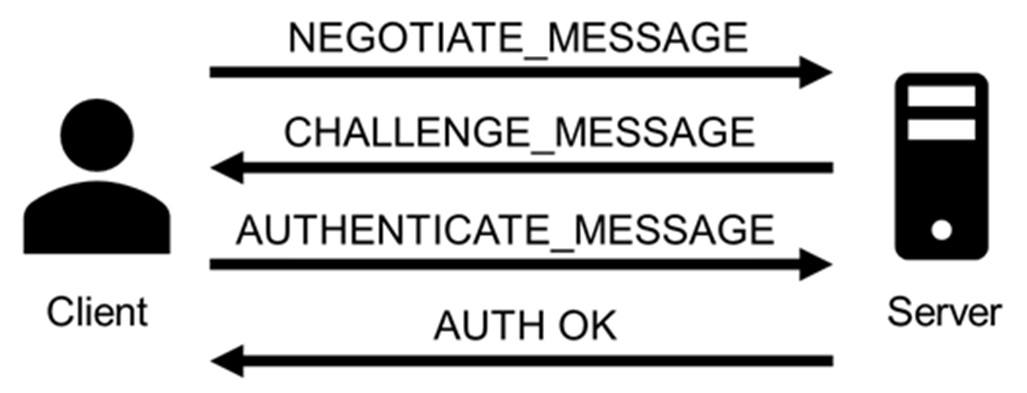
Importantly, the client’s secret never travels across the network during this process.
NTLM is dead — long live NTLM
Despite being a legacy protocol with well-documented weaknesses, NTLM continues to be used in Windows systems and hence actively exploited in modern threat campaigns. Microsoft has announced plans to phase out NTLM authentication entirely, with its deprecation slated to begin with Windows 11 24H2 and Windows Server 2025 (1, 2, 3), where NTLMv1 is removed completely, and NTLMv2 disabled by default in certain scenarios. Despite at least three major public notices since 2022 and increased documentation and migration guidance, the protocol persists, often due to compatibility requirements, legacy applications, or misconfigurations in hybrid infrastructures.
As recent disclosures show, attackers continue to find creative ways to leverage NTLM in relay and spoofing attacks, including new vulnerabilities. Moreover, they introduce alternative attack vectors inherent to the protocol, which will be further explored in the post, specifically in the context of automatic downloads and malware execution via WebDAV following NTLM authentication attempts.
Persistent threats in NTLM-based authentication
NTLM presents a broad threat landscape, with multiple attack vectors stemming from its inherent design limitations. These include credential forwarding, coercion-based attacks, hash interception, and various man-in-the-middle techniques, all of them exploiting the protocol’s lack of modern safeguards such as channel binding and mutual authentication. Prior to examining the current exploitation campaigns, it is essential to review the primary attack techniques involved.
Hash leakage
Hash leakage refers to the unintended exposure of NTLM authentication hashes, typically caused by crafted files, malicious network paths, or phishing techniques. This is a passive technique that doesn’t require any attacker actions on the target system. A common scenario involving this attack vector starts with a phishing attempt that includes (or links to) a file designed to exploit native Windows behaviors. These behaviors automatically initiate NTLM authentication toward resources controlled by the attacker. Leakage often occurs through minimal user interaction, such as previewing a file, clicking on a remote link, or accessing a shared network resource. Once attackers have the hashes, they can reuse them in a credential forwarding attack.
Coercion-based attacks
In coercion-based attacks, the attacker actively forces the target system to authenticate to an attacker-controlled service. No user interaction is needed for this type of attack. For example, tools like PetitPotam or PrinterBug are commonly used to trigger authentication attempts over protocols such as MS-EFSRPC or MS-RPRN. Once the victim system begins the NTLM handshake, the attacker can intercept the authentication hash or relay it to a separate target, effectively impersonating the victim on another system. The latter case is especially impactful, allowing immediate access to file shares, remote management interfaces, or even Active Directory Certificate Services, where attackers can request valid authentication certificates.
Credential forwarding
Credential forwarding refers to the unauthorized reuse of previously captured NTLM authentication tokens, typically hashes, to impersonate a user on a different system or service. In environments where NTLM authentication is still enabled, attackers can leverage previously obtained credentials (via hash leakage or coercion-based attacks) without cracking passwords. This is commonly executed through Pass-the-Hash (PtH) or token impersonation techniques. In networks where NTLM is still in use, especially in conjunction with misconfigured single sign-on (SSO) or inter-domain trust relationships, credential forwarding may provide extensive access across multiple systems.
This technique is often used to facilitate lateral movement and privilege escalation, particularly when high-privilege credentials are exposed. Tools like Mimikatz allow extraction and injection of NTLM hashes directly into memory, while Impacket’s wmiexec.py, PsExec.py, and secretsdump.py can be used to perform remote execution or credential extraction using forwarded hashes.
Man-in-the-Middle (MitM) attacks
An attacker positioned between a client and a server can intercept, relay, or manipulate authentication traffic to capture NTLM hashes or inject malicious payloads during the session negotiation. In environments where safeguards such as digital signing or channel binding tokens are missing, these attacks are not only possible but frequently easy to execute.
Among MitM attacks, NTLM relay remains the most enduring and impactful method, so much so that it has remained relevant for over two decades. Originally demonstrated in 2001 through the SMBRelay tool by Sir Dystic (member of Cult of the Dead Cow), NTLM relay continues to be actively used to compromise Active Directory environments in real-world scenarios. Commonly used tools include Responder, Impacket’s NTLMRelayX, and Inveigh. When NTLM relay occurs within the same machine from which the hash was obtained, it is also referred to as NTLM reflexion attack.
NTLM exploitation in 2025
Over the past year, multiple vulnerabilities have been identified in Windows environments where NTLM remains enabled implicitly. This section highlights the most relevant CVEs reported throughout the year, along with key attack vectors observed in real-world campaigns.
CVE-2024‑43451
CVE-2024‑43451 is a vulnerability in Microsoft Windows that enables the leakage of NTLMv2 password hashes with minimal or no user interaction, potentially resulting in credential compromise.
The vulnerability exists thanks to the continued presence of the MSHTML engine, a legacy component originally developed for Internet Explorer. Although Internet Explorer has been officially deprecated, MSHTML remains embedded in modern Windows systems for backward compatibility, particularly with applications and interfaces that still rely on its rendering or link-handling capabilities. This dependency allows .url files to silently invoke NTLM authentication processes through crafted links without necessarily being open. While directly opening the malicious .url file reliably triggers the exploit, the vulnerability may also be activated through alternative user actions such as right clicking, deleting, single-clicking, or just moving the file to a different folder.
Attackers can exploit this flaw by initiating NTLM authentication over SMB to a remote server they control (specifying a URL in UNC path format), thereby capturing the user’s hash. By obtaining the NTLMv2 hash, an attacker can execute a pass-the-hash attack (e.g. by using tools like WMIExec or PSExec) to gain network access by impersonating a valid user, without the need to know the user’s actual credentials.
A particular case of this vulnerability occurs when attackers use WebDAV servers, a set of extensions to the HTTP protocol, which enables collaboration on files hosted on web servers. In this case, a minimal interaction with the malicious file, such as a single click or a right click, triggers automatic connection to the server, file download, and execution. The attackers use this flaw to deliver malware or other payloads to the target system. They also may combine this with hash leaking, for example, by installing a malicious tool on the victim system and using the captured hashes to perform lateral movement through that tool.
The vulnerability was addressed by Microsoft in its November 2024 security updates. In patched environments, motion, deletion, right-clicking the crafted .url file, etc. won’t trigger a connection to a malicious server. However, when the user opens the exploit, it will still work.
After the disclosure, the number of attacks exploiting the vulnerability grew exponentially. By July this year, we had detected around 600 suspicious .url files that contain the necessary characteristics for the exploitation of the vulnerability and could represent a potential threat.
BlindEagle campaign delivering Remcos RAT via CVE-2024-43451
BlindEagle is an APT threat actor targeting Latin American entities, which is known for their versatile campaigns that mix espionage and financial attacks. In late November 2024, the group started a new attack targeting Colombian entities, using the Windows vulnerability CVE-2024-43451 to distribute Remcos RAT. BlindEagle created .url files as a novel initial dropper. These files were delivered through phishing emails impersonating Colombian government and judicial entities and using alleged legal issues as a lure. Once the recipients were convinced to download the malicious file, simply interacting with it would trigger a request to a WebDAV server controlled by the attackers, from which a modified version of Remcos RAT was downloaded and executed. This version contained a module dedicated to stealing cryptocurrency wallet credentials.
The attackers executed the malware automatically by specifying port 80 in the UNC path. This allowed the connection to be made directly using the WebDAV protocol over HTTP, thereby bypassing an SMB connection. This type of connection also leaks NTLM hashes. However, we haven’t seen any subsequent usage of these hashes.
Following this campaign and throughout 2025, the group persisted in launching multiple attacks using the same initial attack vector (.url files) and continued to distribute Remcos RAT.
We detected more than 60 .url files used as initial droppers in BlindEagle campaigns. These were sent in emails impersonating Colombian judicial authorities. All of them communicated via WebDAV with servers controlled by the group and initiated the attack chain that used ShadowLadder or Smoke Loader to finally load Remcos RAT in memory.
Head Mare campaigns against Russian targets abusing CVE-2024-43451
Another attack detected after the Microsoft disclosure involves the hacktivist group Head Mare. This group is known for perpetrating attacks against Russian and Belarusian targets.
In past campaigns, Head Mare exploited various vulnerabilities as part of its techniques to gain initial access to its victims’ infrastructure. This time, they used CVE 2024-43451. The group distributed a ZIP file via phishing emails under the name “Договор на предоставление услуг №2024-34291” (“Service Agreement No. 2024-34291”). This had a .url file named “Сопроводительное письмо.docx” (translated as “Cover letter.docx”).
The .url file connected to a remote SMB server controlled by the group under the domain:
document-file[.]ru/files/documents/zakupki/MicrosoftWord.exe
The domain resolved to the IP address 45.87.246.40 belonging to the ASN 212165, used by the group in the campaigns previously reported by our team.
According to our telemetry data, the ZIP file was distributed to 121 users, 50% of whom belong to the manufacturing sector, 35% to education and science, and 5% to government entities, among other sectors. Of all the targets, 22 users interacted with the .url file.
To achieve their goals at the targeted companies, Head Mare used a number of publicly available tools, including open-source software, to perform lateral movement and privilege escalation, forwarding the leaked hashes. Among these tools detected in previous attacks are Mimikatz, Secretsdump, WMIExec, and SMBExec, with the last three being part of the Impacket suite tool.
In this campaign, we detected attempts to exploit the vulnerability CVE-2023-38831 in WinRAR, used as an initial access in a campaign that we had reported previously, and in two others, we found attempts to use tools related to Impacket and SMBMap.
The attack, in addition to collecting NTLM hashes, involved the distribution of the PhantomCore malware, part of the group’s arsenal.
CVE-2025-24054/CVE-2025-24071
CVE-2025-24071 and CVE-2025-24054, initially registered as two different vulnerabilities, but later consolidated under the second CVE, is an NTLM hash leak vulnerability affecting multiple Windows versions, including Windows 11 and Windows Server. The vulnerability is primarily exploited through specially crafted files, such as .library-ms files, which cause the system to initiate NTLM authentication requests to attacker-controlled servers.
This exploitation is similar to CVE-2024-43451 and requires little to no user interaction (such as previewing a file), enabling attackers to capture NTLMv2 hashes and gain unauthorized access or escalate privileges within the network. The most common and widespread exploitation of this vulnerability occurs with .library-ms files inside ZIP/RAR archives, as it is easy to trick users into opening or previewing them. In most incidents we observed, the attackers used ZIP archives as the distribution vector.
Trojan distribution in Russia via CVE-2025-24054
In Russia, we identified a campaign distributing malicious ZIP archives with the subject line “акт_выполненных_работ_апрель” (certificate of work completed April). These files inside the archives masqueraded as .xls spreadsheets but were in fact .library-ms files that automatically initiated a connection to servers controlled by the attackers. The malicious files contained the same embedded server IP address 185.227.82.72.
When the vulnerability was exploited, the file automatically connected to that server, which also hosted versions of the AveMaria Trojan (also known as Warzone) for distribution. AveMaria is a remote access Trojan (RAT) that gives attackers remote control to execute commands, exfiltrate files, perform keylogging, and maintain persistence.
CVE-2025-33073
CVE-2025-33073 is a high-severity NTLM reflection vulnerability in the Windows SMB client’s access control. An authenticated attacker within the network can manipulate SMB authentication, particularly via local relay, to coerce a victim’s system into authenticating back to itself as SYSTEM. This allows the attacker to escalate privileges and execute code at the highest level.
The vulnerability relies on a flaw in how Windows determines whether a connection is local or remote. By crafting a specific DNS hostname that partially overlaps with the machine’s own name, an attacker can trick the system into believing the authentication request originates from the same host. When this happens, Windows switches into a “local authentication” mode, which bypasses the normal NTLM challenge-response exchange and directly injects the user’s token into the host’s security subsystem. If the attacker has coerced the victim into connecting to the crafted hostname, the token provided is essentially the machine’s own, granting the attacker privileged access on the host itself.
This behavior emerges because the NTLM protocol sets a special flag and context ID whenever it assumes the client and server are the same entity. The attacker’s manipulation causes the operating system to treat an external request as internal, so the injected token is handled as if it were trusted. This self-reflection opens the door for the adversary to act with SYSTEM-level privileges on the target machine.
Suspicious activity in Uzbekistan involving CVE-2025-33073
We have detected suspicious activity exploiting the vulnerability on a target belonging to the financial sector in Uzbekistan.
We have obtained a traffic dump related to this activity, and identified multiple strings within this dump that correspond to fragments related to NTLM authentication over SMB. The dump contains authentication negotiations showing SMB dialects, NTLMSSP messages, hostnames, and domains. In particular, the indicators:
- The hostname localhost1UWhRCAAAAAAAAAAAAAAAAAAAAAAAAAAAAwbEAYBAAAA, a manipulated hostname used to trick Windows into treating the authentication as local
- The presence of the IPC$ resource share, common in NTLM relay/reflection attacks, because it allows an attacker to initiate authentication and then perform actions reusing that authenticated session
The incident began with exploitation of the NTLM reflection vulnerability. The attacker used a crafted DNS record to coerce the host into authenticating against itself and obtain a SYSTEM token. After that, the attacker checked whether they had sufficient privileges to execute code using batch files that ran simple commands such as whoami:
%COMSPEC% /Q /c echo whoami ^> %SYSTEMROOT%\Temp\__output > %TEMP%\execute.bat & %COMSPEC% /Q /c %TEMP%\execute.bat & del %TEMP%\execute.bat
Persistence was then established by creating a suspicious service entry in the registry under:
reg:\\REGISTRY\MACHINE\SYSTEM\ControlSet001\Services\YlHXQbXO
With SYSTEM privileges, the attacker attempted several methods to dump LSASS (Local Security Authority Subsystem Service) memory:
- Using rundll32.exe:
C:\Windows\system32\cmd.exe /Q /c CMD.exe /Q /c for /f "tokens=1,2 delims= " ^%A in ('"tasklist /fi "Imagename eq lsass.exe" | find "lsass""') do rundll32.exe C:\windows\System32\comsvcs.dll, #+0000^24 ^%B \Windows\Temp\vdpk2Y.sav fullThe command locates the lsass.exe process, which holds credentials in memory, extracts its PID, and invokes an internal function of comsvcs.dll to dump LSASS memory and save it. This technique is commonly used in post-exploitation (e.g., Mimikatz or other “living off the land” tools). - Loading a temporary DLL (BDjnNmiX.dll):
C:\Windows\system32\cmd.exe /Q /c cMd.exE /Q /c for /f "tokens=1,2 delims= " ^%A in ('"tAsKLISt /fi "Imagename eq lSAss.ex*" | find "lsass""') do rundll32.exe C:\Windows\Temp\BDjnNmiX.dll #+0000^24 ^%B \Windows\Temp\sFp3bL291.tar.log fullThe command tries to dump the LSASS memory again, but this time using a custom DLL. - Running a PowerShell script (Base64-encoded):
The script leverages MiniDumpWriteDump via reflection. It uses the Out-Minidump function that writes a process dump with all process memory to disk, similar to running procdump.exe.
Several minutes later, the attacker attempted lateral movement by writing to the administrative share of another host, but the attempt failed. We didn’t see any evidence of further activity.
Protection and recommendations
Disable/Limit NTLM
As long as NTLM remains enabled, attackers can exploit vulnerabilities in legacy authentication methods. Disabling NTLM, or at the very least limiting its use to specific, critical systems, significantly reduces the attack surface. This change should be paired with strict auditing to identify any systems or applications still dependent on NTLM, helping ensure a secure and seamless transition.
Implement message signing
NTLM works as an authentication layer over application protocols such as SMB, LDAP, and HTTP. Many of these protocols offer the ability to add signing to their communications. One of the most effective ways to mitigate NTLM relay attacks is by enabling SMB and LDAP signing. These security features ensure that all messages between the client and server are digitally signed, preventing attackers from tampering with or relaying authentication traffic. Without signing, NTLM credentials can be intercepted and reused by attackers to gain unauthorized access to network resources.
Enable Extended Protection for Authentication (EPA)
EPA ties NTLM authentication to the underlying TLS or SSL session, ensuring that captured credentials cannot be reused in unauthorized contexts. This added validation can be applied to services such as web servers and LDAP, significantly complicating the execution of NTLM relay attacks.
Monitor and audit NTLM traffic and authentication logs
Regularly reviewing NTLM authentication logs can help identify abnormal patterns, such as unusual source IP addresses or an excessive number of authentication failures, which may indicate potential attacks. Using SIEM tools and network monitoring to track suspicious NTLM traffic enhances early threat detection and enables a faster response.
Conclusions
In 2025, NTLM remains deeply entrenched in Windows environments, continuing to offer cybercriminals opportunities to exploit its long-known weaknesses. While Microsoft has announced plans to phase it out, the protocol’s pervasive presence across legacy systems and enterprise networks keeps it relevant and vulnerable. Threat actors are actively leveraging newly disclosed flaws to refine credential relay attacks, escalate privileges, and move laterally within networks, underscoring that NTLM still represents a major security liability.
The surge of NTLM-focused incidents observed throughout 2025 illustrates the growing risks of depending on outdated authentication mechanisms. To mitigate these threats, organizations must accelerate deprecation efforts, enforce regular patching, and adopt more robust identity protection frameworks. Otherwise, NTLM will remain a convenient and recurring entry point for attackers.
cyrboost reshared this.
MicroCAD Programs CAD

We love and hate OpenSCAD. As programmers, we like describing objects we want to 3D print or otherwise model. As programmers, we hate all the strange things about OpenSCAD that make it not like a normal programming language. Maybe µCAD (or Microcad) is the answer. This new entry in the field lets you build things programmatically and is written in Rust.
In fact, the only way to get it right now is to build it from source using cargo. Assuming you already have Rust, that’s not hard. Simply enter: cargo install microcad. If you don’t already have Rust, well, then that’s a problem. However, we did try to build it, and despite having the native library libmanifold available, Rust couldn’t find it. You might have better luck.
You can get a feel for the language by going through one of the tutorials, like the one for building a LEGO-like shape. Here’s a bit of code from that tutorial:
use std::geo2d::*;
use std::ops::*;
const SPACING = 8mm;
op grid(columns: Integer, rows: Integer) {
@input
.translate(x = [1..columns] * SPACING, y = [1..rows] * SPACING)
.align()
}
sketch Base(
columns: Integer,
rows: Integer,
width: Length,
height: Length
) {
thickness = 1.2mm;
frame = Frame(width, height, thickness);
struts = Ring(outer_d = 6.51mm, inner_d = 4.8mm)
.grid(columns = columns-1, rows = rows-1);
frame | struts;
}
There are proper functions, support for 2D sketches and 3D objects, and even a VSCode extension.
Will you try it? If we can get it to build, we will. Meanwhile, there’s always OpenSCAD. Even TinkerCAD can do some parametric modeling.
There’s Nothing Backwards About This Laser Cut Retrograde Clock

It’s clock time again on Hackaday, this time with a lovely laser-cut biretrograde clock by [PaulH175] over on Instructables. If you’ve never heard of a ‘biretrograde clock,’ well, we hadn’t either. This is clearly a form of retrograde clock, which unlike the name implies doesn’t spin backwards but oscillates in its motion– the hands ‘go retrograde’ the same way the planets do.
The oscillating movement is achieved via a pair of cams mounted on the hour and minute shafts of a common clock mechanism. As the shafts (and thus cams) turn, the minute and hour arms are raised and drop. While that could itself be enough to tell the time, [Paul] goes one further and has the actual hands on pivots driven by a gear mechanism on the cam-controlled arms. You might think that that extra reversal is what makes this a ‘biretrograde clock’ but in the clockmaker’s world that’s just saying it’s a retrograde clock with two indicators: in this case, minute and second.
It’s a fairly rare way to make a clock, but we’ve seen one before. That older project was 3D printed, which might be more your speed; if you prefer laser-cutting, though, [Paul]’s Instructable includes SVG files. Alternatively, you could take a different approach and use voltmeters to get the same effect.
lasciate che le figuracce vengano a me

lasciate che le figuracce vengano a me
Sono andato a scuola scalzo nessuno mi aveva detto dei compiti da fare a casa e non avevo neppure una scusa, alla lavagna non sapevo co...ordinariafollia

Famiglia nel bosco, Nordio: "Se profili disciplinari interverrò". Avvocato rimette mandato
Leggi su Sky TG24 l'articolo Famiglia nel bosco, Nordio: 'Se profili disciplinari interverrò'. Avvocato rimette mandatoRedazione Sky TG24 (Sky TG24)
Simulazioni di Phishing: 5 consigli per evitare falsi positivi dal CERT-AgID
Sempre più amministrazioni avviano simulazioni di campagne di phishing per misurare la capacità dei propri dipendenti di riconoscere i messaggi sospetti. Quando queste attività coinvolgono strutture pubbliche, può succedere che i messaggi vengano inopportunamente segnalati ai CERT istituzionali come se fossero illecite.
Senza qualche accorgimento tecnico per evidenziare la natura simulata dell’attività, la campagna può essere interpretata come un’operazione malevola vera e propria, con il rischio che anche i CERT censiscano gli indicatori della simulazione nelle blacklist operative.
Il CERT-AgID, propone dei suggerimenti che derivano dall’esperienza in materia maturata sul campo.
Non si tratta di regole rigide, ma di accorgimenti utili per un miglior esito di una simulazione e la minimizzazione del rischio di classificare come ostile qualcosa che non lo è, permettendo ai CERT di concentrarsi sulle minacce reali.

1. Inserire un commento nel codice HTML della pagina
Aggiungere un breve commento nel codice HTML, visibile solo a chi lo ispeziona, aiuta chi analizza la pagina a capire che si tratta di un test legittimo. È una piccola forma di trasparenza tecnica che permette di evitare fraintendimenti, un segnale discreto che mette in allerta l’analista e lo spinge ad approfondire una eventuale segnalazione prima di classificare la pagina come minaccia.
2. Lasciare visibili le informazioni del WHOIS
Non oscurare il WHOIS del dominio usato per la campagna. Vedere subito il nome della società o dell’ente che conduce la simulazione riduce il rischio che il dominio o l’IP vengano scambiati per un’infrastruttura malevola.
3. Informare preventivamente i CERT istituzionali
Una comunicazione essenziale ai CERT istiuzionali che probabilmente potrebbero essere allertati aiuta a evitare segnalazioni di falsi positivi. Possono bastare poche informazioni come:
- domini e IP utilizzati (opzionalmente il numero di telefono in caso di smishing)
- periodo previsto della simulazione
- eventuale tipo di target
Non serve descrivere nei dettagli lo scenario, ma solo poche ed essenziali informazioni sono sufficienti permettere ai CERT di riconoscere i relativi indicatori.
4. Usare un file security.txt sul dominio
Avere un file security.txt (vedere in proposito RFC 9116) disponibile sul dominio della simulazione permette agli analisti di verificare subito se esiste un contatto a cui chiedere conferma. Un riferimento operativo chiaro accelera la gestione dei dubbi e riduce il rischio di trattare la simulazione come un incidente reale.
5. Informare l’utente dopo l’inserimento delle credenziali
Dopo che l’utente inserisce le credenziali o avvia un download, si può scegliere di mostrare subito una pagina che chiarisce che si tratta di una simulazione. Questa soluzione evita preoccupazioni inutili e favorisce la consapevolezza. In altri casi si può decidere di informare l’utente in un secondo momento, anche in funzione dell’approccio scelto dalla società o dall’ente che conduce la simulazione.
L'articolo Simulazioni di Phishing: 5 consigli per evitare falsi positivi dal CERT-AgID proviene da Red Hot Cyber.


EU-Rat einigt sich zur Chatkontrolle: Schlimmster Giftzahn gezogen, aber weiterhin gefährlich
netzpolitik.org/2025/eu-rat-ei…

🔥 Peter 🌍✊anti-fascist reshared this.

Cosa insegnano le rivelazioni sui colloqui tra Pechino e Washington sull’Ucraina
Una cosa è ritenere che l’amministrazione statunitense faccia il gioco della Russia, un’altra è vederlo scritto nero su bianco. LeggiPierre Haski (Internazionale)
Uganda: il land grabbing è una nuova minaccia per i pastori della Karamoja
@Notizie dall'Italia e dal mondo
Indice Il land grabbing è oggi una delle minacce principali per le comunità di pastori seminomadi della Karamoja, regione nel nord-est dell’Uganda. Se fino a oggi i conflitti interni alla regione erano principalmente legati a razzie di bestiame e scontri armati, oggi lo
Notizie dall'Italia e dal mondo reshared this.
Frontex und Europol: Zwei EU-Agenturen sollen bei der Drohnenabwehr helfen
netzpolitik.org/2025/frontex-u…

Deficienze artificiali. Ecco come le forze armate cinesi si addestrano ad ingannare l’IA
@Notizie dall'Italia e dal mondo
Non solo facilitatore, ma anche strumento per complicare e nascondere. Oltre alle già note applicazioni militari dell’Intelligenza Artificiale, principalmente riguardanti la facilitazione nello svolgimento di vari processi all’interno di un
Notizie dall'Italia e dal mondo reshared this.
i lettori di Oggettistica non sanno trattenere la gioia: mobilizon.it/events/48fe58dd-a…
chi vuole, chi può, si unisca ai lettori di Oggettistica questo sabato, a Roma, alle 17:30 presso la Biblioteca Pagliarani in via M. Bragadin 122b.

29 novembre: OGGETTISTICA, di Marco Giovenale, allo Spazio Pagliarani, con Massimiliano Manganelli
A Roma, sabato 29 novembre, alle ore 17:30, presso la Biblioteca Pagliarani (via M. Bragadin 122 b) presentazione del libro di prose in prosa di Marco Giovenale OGGETTISTICA (Tic Edizioni) letture dell'autore e interventi critici di Massimiliano M…mobilizon.it
reshared this
Ribellarsi alla violenza degli uomini sulle donne è un modo anche per lottare contro le mafie
@Giornalismo e disordine informativo
articolo21.org/2025/11/ribella…
Ribellarsi alla violenza praticata dagli uomini sulle donne è un modo per continuare la lotta
Giornalismo e disordine informativo reshared this.
la soluzione (che non è una “soluzione” ma un modo di viversi le cose, la vita) potrebbe semmai consistere nel [...] -> noblogo.org/differx/con-tutti-…
#social #fediverso #socialgeneralisti #mainstream #noblogo #noblogs #wordpress #archive #mastodon #friendica #kofi
reshared this
freezonemagazine.com/rubriche/…
Londra, Royal Festival Hall, 20 febbraio 2004: Brian Wilson, davanti ad una platea di tremila persone, presenta la première di SMILE, l’album perduto, il Santo Graal della musica popolare americana. Oltre al compositore e autore dei testi Van Dyke Parks, nel pubblico sono presenti Paul McCartney e George Martin a chiudere plasticamente il cerchio dell’epoca […]
L'articolo
Il Chiapas celebra, il Messico si incrina: l’EZLN compie 42 anni mentre le destre cavalcano il malcontento
@Notizie dall'Italia e dal mondo
Le celebrazioni zapatiste coincidono con una protesta nazionale eterogenea che rivela le fragilità della presidenza Sheinbaum.
L'articolo Il Chiapas celebra, il Messico si incrina: l’EZLN
Notizie dall'Italia e dal mondo reshared this.
Oltre il danno, la beffa: pur con la nuova sentenza della Corte di Giustizia Europea, due cittadinə italianə che hanno contratto un'unione civile, hanno un unico modo per vedersi sposati: "divorziare" in Italia e contrarre un nuovo matrimonio all'estero in un Paese civile.
Ma vi rendete conto quanto siamo indietro? Quanto pesa la nostra arretratezza culturale nelle vite dei cittadini?
Nel podcast non ne parlo per ora, ma prima o poi lo farò, perché cose come questa mi spingono a lasciare l'Italia al pari delle malattie che sopporto. Ed è tutto dire.
Mi sono trasformato, col tempo, in una di quelle persone che dicono che non c'è futuro qui. Ma mi sembra inevitabile.
reshared this

Simon Perry likes this.
Mi mandano in bestia queste cose. E più di tutto l'ipocrisia, raccontarci quotidianamente che siamo il Paese più bello del mondo, e cazzate simili.
Poi mancano i diritti fondamentali.
‘I’ll find you again, the only thing that doesn’t cross paths are mountains.’ In a game about loot, robots, and betrayal, all a raider has is their personal reputation. This site catalogues it.#News #Games
Arc Raiders ‘Watchlist’ Names and Shames Backstabbing Players
A new website is holding Arc Raiders players accountable when they betray their fellow players. Speranza Watchlist—named for the game’s social hub—bills itself as “your friendly Raider shaming board,” a place where people can report other people for what they see as anti-social behavior in the game.In Arc Raiders, players land on a map full of NPC robots and around 20 other humans. The goal is to fill your inventory with loot and escape the map unharmed. The robots are deadly, but they’re easy to deal with once you know what you’re doing. The real challenge is navigating other players and that challenge is the reason Arc Raiders is a mega-hit. People are far more dangerous and unpredictable than any NPC.
playlist.megaphone.fm?p=TBIEA2…
Arc Raiders comes with a proximity chat system so it’s easy to communicate with anyone you might run into in the field. Some people are nice and will help their fellow raider take down large robots and split loot. But just as often, fellow players will shoot you in the head and take all your stuff.In the days after the game launched, many people opened any encounter with another human by coming on the mic, saying they were friendly, and asking not to shoot. Things are more chaotic now. Everyone has been shot at and hurt people hurt people. But some hurts feel worse than others.
Speranza Watchlist is a place to collect reports of anti-social behavior in Arc Raiders. It’s creation of a web developer who goes by DougJudy online. 404 Media reached out to him and he agreed to talk provided we grant him anonymity. He said he intended the site as a joke and some people haven’t taken it well and have accused him of doxxing.
I asked DougJudy who hurt him so badly in Arc Raiders that he felt the need to catalog the sins of the community. “There wasn’t a specific incident, but I keep seeing a lot (A LOT) of clips of people complaining when other players play dirty’ (like camping extracts, betraying teammates, etc.)”
He thought this was stupid. For him, betrayal is the juice of Arc Raiders. “Sure, people can be ‘bad’ in the game, but the game intentionally includes that social layer,” he said. “It’s like complaining that your friend lied to you in a game of Werewolf. It just doesn’t make sense.”
Image via DougJudy.
That doesn’t mean the betrayals didn’t hurt. “I have to admit that sometimes I also felt the urge to vent somewhere when someone betrayed me, when I got killed by someone I thought was an ally,” DougJudy said. “At first, I would just say something like, ‘I’ll find you again, the only thing that doesn’t cross paths are mountains,’ and I’d note their username. But then I got the idea to make a sort of leaderboard of the least trustworthy players…and that eventually turned into this website.As the weeks go on and more players join the Arc Raiders, its community is developing its own mores around acceptable behavior. PVP combat is a given but there are actions some Raiders engage in that, while technically allowed, feel like bad sportsmanship. Speranza Watchlist wants to list the bad sports.
Take extract camping. In order to end the map and “score” the loot a player has collected during the match, they have to leave the map via a number of static exits. Some players will place explosive traps on these exits and wait for another player to leave. When the traps go off, the camper pops up from their hiding spot and takes shots at their vulnerable fellow raider. When it works, it’s an easy kill and fresh loot from a person who was just trying to leave.
Betrayal is another sore spot in the community. Sometimes you meet a nice Raider out in the wasteland and team up to take down robots and loot an area only to have them shoot you in the back. There are a lot of videos of this online and many players complaining about it on Reddit.
www.speranza-watchlist.com screenshot.
Enter Speranza Watchlist. “You’ve been wronged,” an explanation on the site says. “When someone plays dirty topside—betraying trust, camping your path, or pulling a Rust-Belt rate move—you don’t have to let it slide.”When someone starts up Arc Raiders for the first time, they have to create a unique “Embark ID” that’s tied to their account. When you interact with another player in the game, no matter how small the moment, you can see their Embark ID and easily copy it to your clipboard if you’re playing on PC.
Players can plug Embark IDs into Speranza Watchlist and see if the person has been reported for extract camping or betrayal before. They can also submit their own reports. DougJudy said that, as of this writing, around 200 players had submitted reports.
Right now, the site is down for maintenance. “I’m trying to rework the website to make the fun/ satire part more obvious,” DougJudy said. He also plans to add rate limits so one person can’t mass submit reports.
He doesn’t see the Speranza Watchlist as doxxing. No one's real identity is being listed. It’s just a collection of observed behaviors. It’s a social credit score for Arc Raiders. “I get why some people don’t like the idea, ‘reporting’ a player who didn’t ask for it isn’t really cool,” DougJudy said. “And yeah, some people could maybe use it to harass others. I’ll try my best to make sure the site doesn’t become like that, and that people understand it’s not serious at all. But if most people still don’t like it, then I’ll just drop the idea.”
Speranza Watchlist — Check Raider Reputation in Arc Raiders
Report betrayals, rat tactics, and toxic behavior in Arc Raiders. Search any Embark ID to see a raider’s record before trusting them topside.Speranza Watchlist
SIRIA. Proteste sulla costa: gli alawiti chiedono il federalismo
@Notizie dall'Italia e dal mondo
Resta l'incertezza in Siria, divisa tra promesse di riforme e timori di un rinnovato autoritarismo. Intanto cresce il sostegno occidentale al presidente autoproclamato Sharaa
L'articolo SIRIA. Proteste sulla costa: gli alawiti chiedono il federalismo proviene da Pagine Esteri.
Notizie dall'Italia e dal mondo reshared this.
Fine vita: solo “costi” morali
@Giornalismo e disordine informativo
articolo21.org/2025/11/fine-vi…
Nello splendido “Per grazia ricevuta”, di e con Nino Manfredi, il mentore del protagonista, uomo colto, laico e libertario, in fin di vita chiede il prete e bacia il crocifisso. L’insostenibilità dell’esito porta Nino a lanciarsi da uno strapiombo; sopravvive e si grida al miracolo.
Giornalismo e disordine informativo reshared this.
Paola Caridi, Sudari. Elegia per Gaza. Feltrinelli 2025
@Giornalismo e disordine informativo
articolo21.org/2025/11/paola-c…
“E’ in un sussurro l’incontro”, si legge così in esergo a “ Sudari” di Paola Caridi e con un filo di voce sembra iniziare l’elegia per Gaza, un canto funebre che si snoda sommesso, ma implacabile nel denunciare
Giornalismo e disordine informativo reshared this.
reshared this
Un'idea per rialzare le teste chine dai telefoni
estelinux.serviziliberi.it/uni…
Segnalato dall'Internet User Group di #Este e pubblicato sulla comunità Lemmy @GNU/Linux Italia
#Este
Circa un mese fa mi sono trovato nell'ennesima libreria mentre passeggiavo annoiato in
GNU/Linux Italia reshared this.
Un anno nel Fediverso: la calma che ti cambia la testa. Il post di @Michela
E no, il Fediverso non è povero di contenuti.È che, quando smetti di essere schiava degli algoritmi, ti accorgi che l’80% della roba mainstream è solo rumore dopaminico.
Rapido, inutile, martellante.Su PixelFed, invece, quasi tutto merita almeno un rallentamento, uno sguardo vero.
È una sensazione precisa:
uscire da una distopia sociale senza neppure accorgersi di esserci vissuti dentro per anni.
michiyospace.altervista.org/un…
Per avere altri aggiornamenti sul Fediverso, segui il gruppo @Che succede nel Fediverso?

Un anno nel Fediverso: la calma che ti cambia la testa - LandEscape
Avevo già accennato a questa cosa mesi fa, ma ora – dopo quasi un anno dentro il Fediverso – posso parlarne con molta più chiarezza.Quando sono arrivata su PixelFed, la mia prima reazione è stata l’ansia.Michela (Blog di michiyospace)
reshared this
Here is the archived video of our FOIA Forum about how to do reporting on Flock.#FOIAForum
Here's the Video for Our Seventh FOIA Forum: Flock
The FOIA Forum is a livestreamed event for paying subscribers where we talk about how to file public records requests and answer questions. If you're not already signed up, please consider doing so here.Recently we had a FOIA Forum where we focused on our reporting about Flock. This includes how to file public records requests for audit logs, footage, and other ideas for FOIAing surveillance companies.
We showed subscribers how we got the records behind that story, the specific request language was used, tips for turning records into articles, and much more.
Check out all of our FOIA Forum archives here.
This post is for subscribers only
Become a member to get access to all content
Subscribe now

It'll take just a minute and help 404 Media figure out how to grow sustainably.
Itx27;ll take just a minute and help 404 Media figure out how to grow sustainably.#Announcements
Please, please do our reader survey
Because we run 404 Media on Ghost, an open source and privacy-forward stack, we actually know very little about who reads 404 Media (by design). But we’re hoping to learn a bit more so we can figure out how people are discovering our work, what our readers do, and what other projects people might want us to launch in the future. If you want to cut to the chase: here is a link to our very short survey we would really, really appreciate you filling out. You can do it anonymously and it should take around a minute. If you want to know more on the why, please read below!As we said, Ghost doesn’t collect much data about our readers. The little info we do have shows broadly that most of our readers are in the U.S., followed by Europe, etc. But we don’t have a great idea of how people first learn about 404 Media. Or whether people would prefer a different format to our daily newsletter. Or what industries or academic circles our readers are in.
This information is useful for two main reasons: the first is we can figure out how people prefer to read us and come across our work. Is it via email? Is it articles posted to the website? Or the podcast? Do more people on Mastodon read us, or on Bluesky? This information can help us understand how to get our journalism in front of more people. In turn, that helps inform more people about what we cover, and hopefully can lead to more people supporting our journalism.
The second is for improving the static advertisements in our email newsletters and podcasts that we show to free members. If it turns out we have a lot of people who read us in the world of cybersecurity, maybe it would be better if we ran ads that were actually related to that, for example. Because we don’t track our readers, we really have no idea what products or advertisements would actually be of interest to them. So, you voluntarily and anonymously telling us a bit about yourself in the survey would be a great help.
Here is the survey link. There is also a section for any more general feedback you have. Please help us out with a minute of your time, if you can, so we can keep growing 404 Media sustainably and figure out what other projects readers may be interested in (such as a physical magazine perhaps?).
Thank you so much!
Who is reading 404 Media?
Take this survey powered by surveymonkey.com. Create your own surveys for free.www.surveymonkey.com


Il #25novembre si celebra in tutto il mondo la Giornata internazionale per l'eliminazione della...
Il #25novembre si celebra in tutto il mondo la Giornata internazionale per l'eliminazione della violenza contro le #donne. Numerose sono state le iniziative del #MIM con le scuole e alle quali ha partecipato il Ministro Giuseppe Valditara.

Ministero dell'Istruzione
Il #25novembre si celebra in tutto il mondo la Giornata internazionale per l'eliminazione della violenza contro le #donne. Numerose sono state le iniziative del #MIM con le scuole e alle quali ha partecipato il Ministro Giuseppe Valditara.Telegram
Luca Sironi
in reply to simona • • •simona likes this.
simona
in reply to Luca Sironi • •