
Watertight and Wireless in One Go: The DIY Sea Scooter
![[Ben] at workbench with 3D-printed sea scooter](https://poliverso.org/photo/link/333125 "[Ben] at workbench with 3D-printed sea scooter")
To every gadget, tool, or toy, you can reasonably think: ‘Sure I could buy this… but can I make it myself?’ And that’s where [Ben] decided he could, and got to work. On a sea scooter, to be exact.
This sea scooter was to be a fully waterproof, hermetically sealed 3D-printed underwater personal propulsion device, with the extreme constraint that the entire hull and mechanical interfaces are printed in one go. No post-printing holes for shafts, connectors, or seals. It also meant [Ben] needed to embed all electronics, motor, magnetic gearbox, custom battery pack, wireless charging, and non-contact magnetic control system inside the print during the actual print process.
As [Ben] explains, both Bluetooth and WiFi ranges are laughable once underwater. He elegantly solves this with a reed-switch-based magnetic control system. The non-contact magnetic drive avoids shaft penetrations entirely. Power comes from a custom 8S LiFePO₄ pack, charged wirelessly through the hull. Lastly, everything’s wrapped in epoxy to make it as watertight as a real submarine.
The whole trick of ‘print-in-place’ is that [Ben] pauses the builder mid-print, and drops in each subsystem like a secret ingredient. Continuing, he tweaks the printer’s Z-offset, and onwards it goes. It’s tense, high-stakes work; a 14-hour print where one nozzle crash means binning hundreds of dollars’ worth of embedded components.
Still, [Ben] took the chance, and delivered a cool, fully packed and fully working sea scooter. Comment below to discuss the possibilities of building one yourself.
youtube.com/embed/6IO8PidCOrc?…
Arrestato in Colombia il narcotrafficante Federico Starnone, anche grazie alla rete anti-'Ndrangheta I-CAN di Interpol

Si tratta di un latitante 44enne, ricercato dalle autorità italiane per i reati di associazione a delinquere finalizzata al traffico internazionale di sostanze stupefacenti con le aggravanti connesse a due distinti tentativi di importazione di ingenti quantitativi di cocaina dal Sudamerica.
E' ritenuto legato alla 'Ndrangheta. E' stato catturato in un appartamento nel quartiere residenziale di Cali.
A carico di Starnone è stata già emessa una sentenza di condanna a 5 anni e mezzo per reati di droga. L'uomo è stato catturato dalla polizia colombiana mentre si trovava in un appartamento nel quartiere residenziale nel capoluogo del dipartimento Valle del Cauca.

Essenziale l'apporto del progetto INTERPOL Cooperation Against ‘Ndrangheta (I-CAN).
Si tratta di un'iniziativa lanciata dall'Italia e dall'INTERPOL nel gennaio 2020 per contrastare la minaccia globale rappresentata dalla ‘Ndrangheta, come noto un'organizzazione criminale transnazionale altamente organizzata e potente.
Finanziato dal Dipartimento della Pubblica Sicurezza italiano, il progetto mira a rafforzare la cooperazione internazionale tra forze di polizia sfruttando le capacità dell'INTERPOL di condividere intelligence, competenze e best practice, trasformando così le informazioni in arresti e smantellando le reti criminali.
Avviato a Reggio Calabria l'obiettivo principale del progetto è stato - da subito - quello di istituire un sistema globale di allerta precoce contro questo "nemico invisibile". I-CAN opera attraverso una rete di paesi pilota, che inizialmente includevano Australia, Argentina, Brasile, Canada, Colombia, Francia, Germania, Italia, Svizzera, Stati Uniti e Uruguay, che si è espanso a 13, tra cui Austria, Belgio e Spagna.
Il progetto facilita operazioni coordinate transfrontaliere, come dimostrato dall'operazione globale del 2020 che ha portato all'arresto di sei latitanti legati alla 'Ndrangheta in Albania, Argentina e Costa Rica, con conseguente sequestro di 400 kg di cocaina e smantellamento del clan Bellocco. Le operazioni successive hanno continuato a dare risultati, tra cui l'arresto nel 2023 di un latitante di 16 anni, Edgardo Greco, in Francia, con il supporto di I-CAN.
Il progetto si è evoluto oltre la sua fase iniziale, con iniziative in corso tra cui la Conferenza I-CAN del 2022 a Roma, che ha riunito le forze dell'ordine di 14 paesi per definire una strategia unitaria contro la 'Ndrangheta, oggi considerata un'entità criminale "silenziosa e pervasiva" che si infiltra nelle economie legittime attraverso la corruzione e il riciclaggio di denaro.
Il successo del progetto si basa su una combinazione di condivisione di intelligence, coordinamento internazionale e utilizzo di strumenti analitici avanzati per esplorare dati provenienti da diverse fonti, consentendo indagini transnazionali. Il suo quadro continua a sostenere gli sforzi in corso, tra cui il progetto I-FORCE, incentrato sulla cooperazione regionale nell'Europa orientale e sudorientale.
#ndrangheta #ican #interpol #iforce
reshared this
Compliant Contacts: Hacking Door Locks with Pen Springs

As you may have guessed given our name, we do love hacks around here, and this one is a great example of making some common, everyday things work in uncommon ways. [Nathan] sent in his hack to detect the door lock position in his basement.
Having a house that dates back to the 1890s, much of it was not very conducive to using off-the-shelf home automation devices. [Nathan] wanted a way to check the status of the basement deadbolt. He went about putting together a custom sensor using some spare parts, including a spare BeagleBone Black, and some springs from a ballpoint pen. Going full MacGyver, [Nathan] used springs from a ballpoint pen to craft a compliant contact for his sensor.
The pair of springs sat in the door frame and came in contact with the deadbolt; given they are springs, the exact position of the sensor was not very sensitive, as if too close it would just compress the springs slightly more. The springs were wired to the BeagleBone Black’s GPIO, acting as a switch to sense when there was conductivity between the springs through the deadbolt.
This wasn’t just a plug-it-in-and-it-works type of project, mind you; the BeagleBone Black was over 15 ft away from the sensors, lending plenty of opportunity for noise to be introduced into the lines. To combat this, [Nathan] created an RC filter to filter out all the high-frequency noise picked up by his sensor. Following the RC filter, he added in some code to handle the debounce of the sensor, as the springs have some inherent noise in them. Thanks [Nathan] for sending in your resourceful hack; we love seeing the resourcefulness of reusing things already on hand for other purposes. Be sure to check out some of the other repurposed components we’ve featured.
Building A Trash Can Reverb

These days, if you want a reverb effect, you just dial up whatever software plugin most appeals to you and turn the dials to taste. However, [Something Physical] specialises in… physical things… and thus built a reverb the old fashioned way. Using a trashcan, of course.
The concept is simple enough—the method of operation is exactly the same as any old plate reverb. Audio is played through a speaker connected to the plate (or trashcan), causing it to vibrate. The sound is then picked up at another point on the plate (or trashcan) with some kind of microphonic pickups, amplified, and there you have your reverb signal.
Given it’s built around a piece of street furniture, [Something Physical] has dubbed this the Street-Verb. It uses a class D amp to drive a speaker with a bolt stuck to it. The bolt is then put in contact with the trashcan itself to transfer the vibration. A pair of piezo elements are used as the pickups, run through a preamps built with a humble BC109C transistor. Since there are two pickups, the Street-Verb is effectively a stereo reverb unit, though the input is only mono. [Something Physical] set up the speaker driver and pickups to be easily movable, and was able to test the device with all kinds of street furniture, like gates and street signs, but the trashcan ‘verb setup is by far the most compelling.
We’ve featured other plate reverb builds before, too, albeit less garbage-themed. Video after the break.
youtube.com/embed/J2e8JIxW1g4?…
Neon Bulbs? They’re a Gas!

When you think of neon, you might think of neon signs or the tenth element, a noble gas. But there was a time when neon bulbs like the venerable NE-2 were the 555 of their day, with a seemingly endless number of clever circuits. What made this little device so versatile? And why do we see so few of them today?
Neon’s brilliant glow was noted when William Ramsay and Morris Travers discovered it in 1898. It would be 1910 before a practical lighting device using neon appeared. It was 1915 when the developer, Georges Claude, of Air Liquide fame, received a patent on the unique electrodes suitable for lighting and, thus, had a monopoly on the technology he sold through his company Claude Neon Lights.
However, Daniel Moore in 1917 developed a different kind of neon bulb while working for General Electric. These bulbs used coronal discharge to produce a red glow or, with argon, a blue glow. This was different enough to earn another patent, and neon bulbs found use primarily as indicator lamps before the advent of the LED. However, it would also find many other uses.
How It Worked
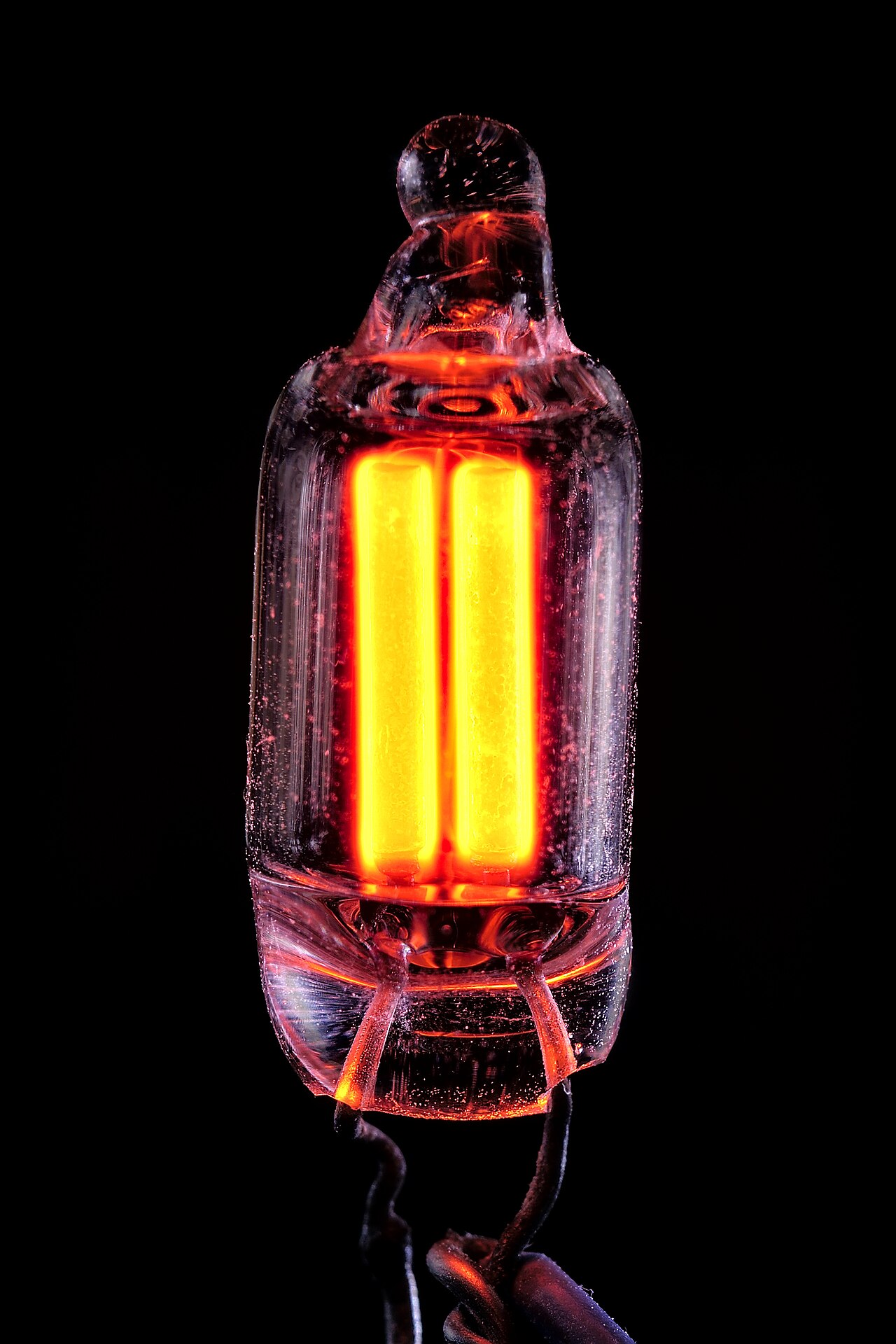
There are two electrodes within, an anode and a cathode. When a DC voltage excites the bulb sufficiently, a glow forms around one electrode. AC makes both electrodes glow alternately. The striking voltage changes based on ambient light or radioactive exposure, as well as the bulb’s gas mix and pressure.
Until the strike voltage occurs, the bulb is effectively an open circuit. When it does strike, however, the resistance goes down and will sustain even at a lower voltage. Like an LED, current limiting is essential, or the bulb will burn out. The NE-2, arguably the most common neon bulb, triggers at 90 V, nominally, and will conduct until the voltage drops to about 60 V.
So It Lights Up?
The lighting up is good, but you do need a lot of voltage to get it going. The bulb will easily light up from 120 V line voltage, for example. But the really interesting property is that the bulbs, when glowing, exhibit negative resistance. That is, as current increases, voltage decreases.
You can also make the bulbs operate in a bistable mode, where they can work in logic circuits. They weren’t common, but some bulbs had special features for logic use. These bulbs were not made to glow necessarily, and sometimes had a third wire used as a control electrode.
Since the gas inside the tube can ionize, neon bulbs can also detect things like light, microwaves, or heavy electrostatic fields. They can even pick up audio.
What Could You Do?
Of course, the normal application was to use the devices as a lamp, like you’d use an LED today. Power pilot lights were common. Special neon lights looking like digits form the basis of nixie tubes.
Another neat display trick was the “blown fuse” indicator. Fuse holders often had neon bulbs in them that connected across the fuse terminals. In normal operation, the voltage across the fuse was practically zero, so the bulb stayed dark. But if the fuse blew, you’d have 120 V across the bulb, which would then light up. A high-value resistor prevented any significant current from flowing.
By far the most common non-lighting use was as a part of a relaxation oscillator. Consider a circuit with a resistor and a capacitor, but the capacitor has a neon bulb across it. The capacitor will charge until it hits the neon bulb’s trigger voltage. The bulb will light and discharge the capacitor until it drops below the holding voltage for the bulb. Then the process starts over. You could use neons to make a clock.
Long History

[E. Norbert Smith] wrote about the “1001” uses for the NE-2 — probably not an exaggeration, but [Smith] didn’t get that many in the article — in a 1965 Elementary Electronics magazine article.
The circuits he shows include a 50 V regulated power supply. (Regulators weren’t held to the same standard in those days as we would expect now.) Need 150 V? Use three of them. Or put them in parallel to improve regulation performance.
Some of the circuits are probably not useful if you aren’t building with tubes. And, of course, if you aren’t building with tubes, you are less likely to have the high voltages you need, so there is that.
He also covers the classic self-indicating fuse and the relaxation oscillator. Of course, if you can make one neon bulb blink, you can also make two blink alternately. Blink it fast enough and you can make a code practice oscillator with just a few parts and a 90 V battery.
If you wondered how neon bulbs could handle logic, that same article will answer that question, too. Just be aware that a logic 1 is 10 V — not a problem — but a logic 0 is -10 V. The nice thing about demonstrating logic circuits with neon bulbs is that you don’t need a logic probe or scope to see the state of the machine.
There were many other ways to use these bulbs. Since the trigger voltage was stable, you could use it as a voltage indicator if you coupled it with a voltage divider. In fact, many cheap AC socket testers still work this way. A typical circuit for a capacitor checker could be found in “36 Time Tested Circuits,” a book from Popular Electronics.
The capacitor is hooked up to the AC line via some 470 kΩ resistors. If you connect a capacitor to it, the neon bulb should light up. If not, it is open. When you push the button, you switch to DC, and you should be able to see one side of the neon bulb dim. If it doesn’t dim or doesn’t go all the way off, the capacitor is shorted or leaky. Supposedly, you could get a feel for the value of the capacitor by how long it took half of the bulb to go out. Makes you appreciate your digital capacitance meter, right?
Why Gone?
Why do you so rarely see neon bulbs today? They are still around, but the number of circuits you have where you have the requisite 100 V or so to drive them is not what it used to be. On top of that, as an indicator, an LED is usually a far better choice.
If you want negative resistance, your choices are less obvious. Some special diodes present a negative resistance in certain operating regimes, and you can coax the behavior from some transistors. However, as a matter of practicality, today, you’d probably just use an active switch and be done with it, especially for an oscillator circuit. Then again, if you really want an oscillator, as we are always reminded, you can do it with a 555, among other methods.
We have no doubt that [Smith] was right. There are probably at least 1,001 different uses, but you get the idea. Did you use an NE-2 for something interesting? Let us know about it in the comments. Still want more neon bulb circuits? We’ve seen plenty.
End Of The Eternal September, As AOL Discontinues Dial-Up

If you used the internet at home a couple of decades or more ago, you’ll know the characteristic sound of a modem connecting to its dial-up server. That noise is a thing of the past, as we long ago moved to fibre, DSL, or wireless providers that are always on. It’s a surprise then to read that AOL are discontinuing their dial-up service at the end of September this year, in part for the reminder that AOL are still a thing, and for the surprise that in 2025 they still operate a dial-up service.
There was a brief period in which instead of going online via the internet itself, the masses were offered online services through walled gardens of corporate content. Companies such as AOL and Compuserve bombarded consumers with floppies and CD-ROMs containing their software, and even Microsoft dipped a toe in the market with the original MSN service before famously pivoting the whole organisation in favour of the internet in mid 1995. Compuserve was absorbed by AOL, which morphed into the most popular consumer dial-up ISP over the rest of that decade. The dotcom boom saw them snapped up for an exorbitant price by Time Warner, only for the expected bonanza to never arrive, and by 2023 the AOL name was dropped from the parent company’s letterhead. Over the next decade it dwindled into something of an irrelevance, and is now owned by Yahoo! as a content and email portal. This dial-up service seems to have been the last gasp of its role as an ISP.
So the eternal September, so-called because the arrival of AOL users on Usenet felt like an everlasting version of the moment a fresh cadre of undergrads arrived in September, may at least in an AOL sense, finally be over. If you’re one of the estimated 0.2% of Americans still using a dial-up connection don’t despair, because there are a few other ISPs still (just) serving your needs.
#Trump e #Putin al caminetto

Trump e Putin al caminetto
L’appuntamento è per il 15 Agosto in Alaska e sarà il primo del secondo mandato di Trump alla Casa Bianca. Il fatto che vi sarà un incontro è di per sé un fatto positivo, quando le due superpotenze nucleari dialogano il mondo intero respira meglio.www.altrenotizie.org
Il ritorno dell’autorizzazione a procedere rafforzerà le tutele degli eletti nelle Camere
@Politica interna, europea e internazionale
L'articolo Il ritorno dell’autorizzazione a procedere rafforzerà le tutele degli eletti nelle Camere fondazioneluigieinaudi.it/il-r…
Anduril accelera nell’Indo-Pacifico. Nuovi accordi con Taiwan e Corea del Sud
@Notizie dall'Italia e dal mondo
Dopo America ed Europa, Anduril ha messo gli occhi anche sull’Indo-Pacifico. L’emerging tech Usa, leader nel comparto dell’IA applicata alla difesa, ha recentemente concluso due accordi che pongono le basi della sua futura espansione in estremo oriente. Da un lato
QUANDO L’INTELLIGENZA ARTIFICIALE INIZIA A GIOCARE CON LA CYBERSICUREZZA…
@Informatica (Italy e non Italy 😁)
Mai sentito parlare di RunSybil? Si tratta di una startup fondata da chi era il primo ricercatore sulla sicurezza di OpenAI...
L'articolo QUANDO L’INTELLIGENZA ARTIFICIALE INIZIA A GIOCARE CON LA CYBERSICUREZZA… proviene da GIANO NEWS.
#TECNOLOGIA


Ministero dell'Istruzione
#NoiSiamoLeScuole, con i fondi del #PNRR finalizzati alla costruzione di nuove scuole sono stati demoliti e sono in corso di ricostruzione due istituti in Sicilia e uno in Lombardia.Telegram
Terre rare, gli Usa puntano a estrarle e raffinarle in casa. Ecco come
@Notizie dall'Italia e dal mondo
Il rafforzamento dell’ecosistema della Difesa Usa non passa solamente per l’assegnazione di nuove commesse, ma anche dal consolidamento di una filiera interamente radicata sul territorio nazionale. Il Dipartimento della Difesa statunitense ha infatti concesso il primo prestito
Mario Pacchiarotti likes this.
freezonemagazine.com/articoli/…
La ripubblicazione di un album, a mio avviso fondamentale nella definizione delle coordinate di quello che è l’Indie Rock oggi, partendo proprio da quello che è stato, è un evento che non andrebbe sottovalutato da chi ama “perdersi” nei meandri di un genere, sì conosciuto, ma che, per dimensioni, scelte di pubblicazioni, spesso difficilissime da […]
L'articolo Heatmiser – Mic City Songs proviene
La
GAZA. Attacco aereo all’ospedale Shifa: ucciso il giornalista Anas al Sharif di Al Jazeera
@Notizie dall'Italia e dal mondo
Uccisi sette palestinesi tra cui due reporter della televisione del Qatar e due cameraman
pagineesteri.it/2025/08/11/med…
GLOBAL SUMUD FLOTILLA. A fine agosto e inizio settembre decine di imbarcazioni salperanno per Gaza
@Notizie dall'Italia e dal mondo
Prima dalla Spagna e poi dal Nordafrica gli attivisti di 44 paesi proveranno a rompere il blocco navale israeliano di Gaza e a portare aiuti umanitari ai civili palestinesi. A bordo ci sarà ancora Greta
Pace tra Armenia e Azerbaigian. Il passo falso di Mosca e i timori dell’Iran
@Notizie dall'Italia e dal mondo
L'intesa firmata a Washington favorisce l'Azerbaigian, la Turchia e gli Stati Uniti, che rimettono piede nel cortile di casa russo. Teheran teme e denuncia la manovra a tenaglia
L'articolo Pace tra Armenia e Azerbaigian. Il passo falso di Mosca e i timori dell’Iran proviene da Pagine
Israele ha ucciso l'intera troupe di Al Jazeera a Gaza City, inclusi giornalisti e cameraman:
Reporter: Anas Al-Sharif
Reporter: Muhammad Qariqa
Cameraman: Ibrahim Zahir
Cameraman: Moamen Aliwa
Autista: Muhammad Nofal

FREE ASSANGE Italia
Israele ha ucciso l'intera troupe di Al Jazeera a Gaza City, inclusi giornalisti e cameraman: Reporter: Anas Al-Sharif Reporter: Muhammad Qariqa Cameraman: Ibrahim Zahir Cameraman: Moamen Aliwa Autista: Muhammad NofalTelegram
Ma Gianluca likes this.
Gazzetta del Cadavere reshared this.
Vendo due Pilette lavabo 1"1/4 in ABS – nuove, compatibili universali - Questo è un post automatico da FediMercatino.it

Prezzo: 7 Euro
Vendo due Pilette lavabo 1"1/4 in ABS – nuove, compatibili universali
💡 Caratteristiche tecniche:
Materiale: ABS, resistente agli urti e alla corrosione
Diametro: 1"1/4 (standard per lavabi domestici)
Finitura: bianca
Marca: Sensea
Compatibilità: universale per lavabi bagno e bidet con foro standard
Condizione: nuove, mai montate, ancora imballate, complete di aste saltarello.
📦 Prezzo: € 7.00 per entrambe
📍 Disponibilità: ritiro a mano a Palermo o spedizione in tutta Italia (spese a carico
rag. Gustavino Bevilacqua reshared this.


Il tribunale di Torino ha condannato la questura della città e il ministero dell'Interno per le file davanti all'ufficio immigrazione - Il Post
https://www.ilpost.it/2025/08/10/torino-condanna-questura-ministero-interno-file-ufficio-immigrazione/?utm_source=flipboard&utm_medium=activitypubPubblicato su News @news-ilPost

Poliversity - Università ricerca e giornalismo reshared this.

Caro spiaggia in Toscana: ombrellone e insalata a pranzo – Il racconto: «Una spesa folle»
Lo scrittore Matteo Grimaldi, aquilano ma fiorentino d’adozione, in vacanza a Baratti: «Lo avete capito perché la gente non spende?»di Paolo Federighi (Il Tirreno)
Nicola Pizzamiglio likes this.
Mio racconto brevissimo scritto per Minuti Contati, link originale.
Pecunia non olet
Adam entrò in ufficio, appese il soprabito e si accostò al mobile bar per un drink.
«Non dovresti bere nelle tue condizioni» disse una voce calda alle sue spalle.
Si voltò di scatto: c’era una ragazza bionda in un elegante tubino bianco sul divano. Sorrideva.
«Come sei entrata? Chi sei?»
«È inutile agitarsi, vado dove voglio e di nomi ne ho tanti. Sono qui per un affare.»
Lui tirò fuori il cellulare e chiamò la sicurezza, il telefono rimase muto.
«Dovresti ascoltarmi» commentò la donna.
Adam fece per andare verso la porta ma si bloccò, non c’era nessuna porta. Lei si alzò, aveva un corpo da mozzare il fiato.
«Chi diavolo sei?» chiese confuso.
Lei rise divertita: «L’hai detto. Mettiti comodo e ascolta la mia proposta.» Lo spinse sulla vicina poltrona.
«Tu sei ricco Adam, uno dei più ricchi del mondo, eppure non ti servirà, tra poco morrai e perderai ogni cosa.»
«Lo so questo, è il nostro destino.»
«Non proprio. Dovrai morire, lo ammetto, ma in quanto al denaro, ti offro la possibilità di portarne parte con te nell’aldilà.»
Adam rise forte: «Vorrai dire all’inferno!»
«Ah, l’inferno, sei così sicuro di meritarlo?»
«Ci puoi giurare» rispose ridendo «quello mi tocca di sicuro.»
La donna sorrise: «Inferno, paradiso, sono solo parole, il luogo dove finirai non è troppo diverso da questo: meglio essere ricchi che altrimenti.» Sollevò la gonna e si sedette sulla scrivania. «La mia offerta è questa: lascerai la somma che vorrai a una fondazione che io ti indicherò, in questo mondo, e noi te ne faremo avere un decimo nell’aldilà.»
«E tu credi che io abbocchi a un’imbroglio del genere? Proprio io?»
Lei gli mise in mano un biglietto. «I dati per la donazione, pensaci, non tutti hanno questa possibilità.» Lui abbassò lo sguardo per leggerlo, quando lo rialzò la donna non c’era più.
«Cavolo…» mormorò, ma andò a riporlo nel soprabito. Quando si voltò in mezzo alla stanza c’era un’altra donna, bruna, sui quaranta, con un tailleur scuro molto elegante e sobrio.
«Non ti fidare di quella, ti frega» disse la nuova arrivata.
Adam si guardò intorno, forse era il cancro a causargli quelle allucinazioni. Gli restava poco.
«Certo che non mi fido, non si portano soldi all’inferno.»
«Bravo!» esclamò lei soddisfatta. «Devi farle con la gente giusta queste cose. Se ti affidi a noi, non solo garantiamo un trasferimento di denaro doppio, ma assicuriamo anche il passaggio in paradiso.»
«Cosa?»
«Ma certo! Perché con la donazione giusta, con un gesto di generosità vera, noi possiamo assicurarti il perdono.»
«Il perdono?»
«Assicurato!»
Adam sentiva la testa pulsare, non stava affatto bene.
«Questo non è corretto» il grido veniva dalle sue spalle, si girò, era di nuovo la bionda. Furiosa.
«Gli affari sono affari» ribatté la bruna.
Le due si presero per i capelli.
Adam quasi sorrise vedendole avvinghiate, non era più sicuro di quale delle due fosse il demone e quale l’angelo.
Non ha importanza, in ogni caso è troppo tardi – pensò, con un filo di rimpianto, mentre spirava.
like this
reshared this
Qualcuno ha visto il PD?
Quel partito ha la caratteristica di riuscire a sparire completamente dalla scena per mesi, per anni, tra un'elezione (persa) e l'altra.
O governa, e sappiamo come, o sparisce completamente dalla circolazione.
Poliversity - Università ricerca e giornalismo reshared this.
"Soltanto il 35,5% delle persone intervistate ha detto di essere «preoccupata» dalla situazione umanitaria a Gaza, mentre il 61,5% ha detto di non esserlo per niente, o solo in minima parte. L’80% ha detto di ritenere che l’IDF sia un esercito «morale»".
La manifestazione a Tel Aviv contro il piano per occupare la città di Gaza - Il Post
https://www.ilpost.it/2025/08/10/tel-aviv-protesta-occupazione-gaza-netanyahu/?utm_source=flipboard&utm_medium=activitypubPubblicato su News @news-ilPost
La manifestazione a Tel Aviv contro il piano per occupare la città di Gaza
Decine di migliaia di persone hanno protestato contro il governo di Netanyahu per chiedere la fine della guerra e la liberazione degli ostaggiIl Post

Poliversity - Università ricerca e giornalismo reshared this.
Ecco come la Cina spende e spande sull’hi-tech
L'articolo proviene da #StartMag e viene ricondiviso sulla comunità Lemmy @Informatica (Italy e non Italy 😁)
Il boom di investimenti (senza profitti) della Cina. Estratto dalla rassegna stampa sul canale Telegram di Giuseppe Liturri.
ATTENTI! WHOFI VI IDENTIFICA… SEMPRE
@Informatica (Italy e non Italy 😁)
La identificazione e re-identificazione di una persona (Re-ID), ovvero la capacità di riconoscere la stessa persona attraverso diverse telecamere, inquadrature, angolazioni, o sequenze video è un'attività complessa che può rivelarsi utile sia nella videosorveglianza che nelle applicazioni forensi e di sicurezza. Tuttavia, i
masmg reshared this.

Salvare politica dal ricatto mediatico-giudiziario. Se non ora quando?
@Politica interna, europea e internazionale
L'articolo Salvare politica dal ricatto mediatico-giudiziario. Se non ora quando? proviene da Fondazione Luigi Einaudi.
Max - Poliverso 🇪🇺🇮🇹
Unknown parent • •@Otttoz
Beh immagino che chi non ha votato PD si stia godendo i nipotini del duce esattamente come chi ha votato il PD si sarà goduto il suo supporto agli stupratori della guardia costiera libica, il suo jobs act, la sua delegittimazione delle ONG che salvano vite in mare, ecc.
Però quelli del PD in effetti alla manifestazione del 25 aprile partecipano convintamente, cantano "bella ciao" quindi posso capire che qualcuno li consideri migliori di quegli altri.
Comunque la mia domanda era: ma questi "migliori" dove sono finiti? Che fanno? Stanno aspettando le prossime elezioni per tornare a riproporsi come quelli che vanno votati perché gli altri sono peggiori?