
[2026-01-12] Presentazione "La scimmia" di Matteo Cateni @ NextEmerson
Presentazione "La scimmia" di Matteo Cateni
NextEmerson - Via di Bellagio 15, zona Castello - Firenze
(lunedì, 12 gennaio 20:30)
Talk in con Matteo Cateni, autore, attore e militante Livornese; la chiacchierata sarà sulla sua esperienza detentiva tra Ecuador e Rebibbia, il degrado delle strutture penali, il disagio emotivo della detenzione e le difficoltà di reinserimento, specialmente dopo le pene più lunghe.

Dalle 20.30 cena benefit
21 30 Talk in
[2026-01-16] Alfredo Garcia, Orrendo Subotnick, Flashover @ NextEmerson
Alfredo Garcia, Orrendo Subotnick, Flashover
NextEmerson - Via di Bellagio 15, zona Castello - Firenze
(venerdì, 16 gennaio 21:30)
La Repubblica Popolare del R’n’R carica il 2026 con:

- Alfredo Garcia (Toscana Garage Freaks)
- Orrendo Subotnick (Pisa Punk’n’Roll)
- Flashover (Casentino Hard 90’s)
dischivolanti.ch/en/article/mu…
Venerdì 16 gennaio, ore 21:30 al Next Emerson, Via di Bellagio 15, Firenze
[2026-01-17] Buck the wall - krump @ Csa Next-Emerson
Buck the wall - krump
Csa Next-Emerson - Via di Bellagio 15
(sabato, 17 gennaio 18:00)
18:00 proiezione "rize" (documentario sul krump + talk)

20:00 cena popolare
21:30 sessione di krump
Cos'è il krump?
Il krumping o krumpin' è una forma di danza nata presso la comunità afro-americana del sud di Los Angeles in California e si può definire come una forma relativamente nuova di danza "urbana".
[2026-01-31] 🔥 RUDIES BUT GOODIES 🎂 Special Edition 37 anni CSA Intifada! @ CSA Intifada
🔥 RUDIES BUT GOODIES 🎂 Special Edition 37 anni CSA Intifada!
CSA Intifada - Via XXV Aprile, Ponte a Elsa
(sabato, 31 gennaio 19:00)
Serata imperdibile....🔥 RUDIES BUT GOODIES 🎂 Special Edition 37 anni CSA Intifada! Una notte reggaeggiante! sound system, Resistenza e cibo strabono!

Sabato 31 gennaio una notte speciale al CSA Intifada di Empoli.
Un evento che unisce Persone, storie, lotte, musica, sound system, vinili, cucina bio e Resistenza,
per festeggiare come si deve 37 anni di spazio liberato e autogestito.
🕖 Open dalle ore 19:00
🎶 Dopo cena ingresso gratuito fino alle 23:00
💥 Dalle 23:00 ingresso a offerta libera (graditi 3€)
🔥 BIG PARTY NIGHT 🔥
🔊 SOUL ROCKERS SOUND SYSTEM
Con il suo impianto originale e potente che viaggia dentro e fuori i confini italiani,
porta nella dance il suono jamaicano originale:
ska, rocksteady, early reggae, roots & dub.
👉 Rigorosamente solo vinili originali 45”💣.
🎤 SPECIAL GUEST · DOC MURDOC (London 🇬🇧)
Toaster della scena reggae londinese,
voce potente e tradizione UK sound system🔥.
🎧 FOLLOTHEVIBES✊️
Compagno e resident DJ del CSA Intifada,
selezioni profonde, militanti e autentiche.
🍽 Special food by MB ECO CUCINA LAB😋
Cucina stagionale con prodotti del territorio tra radici siciliane e tradizioni Toscana.
👉 Cena con prenotazione consigliata!!!
✊ CSA INTIFADA🇵🇸
Sono 37 anni di occupazione.
Il CSA Intifada continua a vivere come spazio liberato e autogestito,
laboratorio sociale e politico fatto di progettualità, solidarietà, concerti,
palestra popolare, gruppo di acquisto e sede sindacale COBAS.
Un luogo attraversato da tre generazioni di occupanti, protagoniste di lotte ambientali, studentesche e sociali:
dal nucleare a Genova 2001, dal Chiapas zapatista al Rojava,
fino alla solidarietà con la Palestina, portata avanti dal 1988 fino alle mobilitazioni e raccolte fondi contro il genocidio in corso.
✊ SOSTENIAMO I CENTRI SOCIALI E GLI SPAZI LIBERATI🔥
🔥 QUE VIVA ASKATASUNA 🔥
📍 CSA Intifada👉
Via 25 Aprile – Ponte a Elsa (Empoli)
instagram.com/p/DTKkt5ripB7/?i…
[2026-01-17] Niño One man band @ spazio Nino, Pinerolo
Niño One man band
spazio Nino, Pinerolo - via Midana
(sabato, 17 gennaio 20:30)
Niño One man band night

Sabato 17 gennaio
Dalle 20:30:
MANDURIA (Milano surf n'trash&roll)
VIOLINO BANFI (Piossasco cow punk)
FABIO BALMAS (Pinerolo half man band)
[2026-01-14] Sportello Psicologico sui Traumi dei Migranti @ Via Web (Whatsapp, Skype)
Sportello Psicologico sui Traumi dei Migranti
Via Web (Whatsapp, Skype) - Sardegna, Alghero
(mercoledì, 14 gennaio 08:00)
La guerra in Ucraina ha messo in risalto quanti migranti fuggono da tutti i teatri di guerra in giro per il mondo. Il Centro Culturale ResPublica, di Alghero, col sostegno del Centro Culturale Sa Domo De Totus, di Sassari, ha arricchito lo Sportello di Ascolto Psicologico via web con le tecniche psicologiche mirate all'elaborazione dei traumi. Gratuitamente, con lo psicoterapeuta Gian Luigi Pirovano 3804123225

[2026-01-07] Corteo dalla Palestina al Venezuela @ https://arcibrescia.it/2026/01/07/corteo-dalla-palestina-al-venezuela/
Corteo dalla Palestina al Venezuela
arcibrescia.it/2026/01/07/cort… - arcibrescia.it/2026/01/07/cort…
(mercoledì, 7 gennaio 11:33)
Corteo dalla Palestina al VenezuelaSabato 10 gennaio Ore 15 Metro S Faustino No al sionismo, no alla guerra imperialista, no al fascismo, no al colonialismo.
[2026-01-14] Mambo strambo @ Laboratorio Giù dall'Arca
Mambo strambo
Laboratorio Giù dall'Arca - via nicolò dall'arca 43/f
(mercoledì, 14 gennaio 19:30)

Mambo strambo
Mercoledì 14 gennaio
di e con
Vincenzo Durante
è uno sConcerto di racconti e canti ideocomici, scritto ed interpretato da Vincenzo Durante che chiude una trilogia sulle fragilità creative.
Uno spettacolo originale di teatro/canzone musicato dal vivo con samples, tromba, armoniche e oggetti sonori
Vincenzo Durante è un Musicista, Psichiatrologo e Cantastorie del popolo, suona la tromba di mattina nei parchi di periferia, di sera con l’Orchestra Rosichino, i Bantubeat e la Bologna Balkan Street, agli orari più impensabili con la Bandaroncati e di notte in riva al mare nelle spiagge deserte.
Usa le arti come cura dell’anima e come Azione critica e pacifista.
ingresso con tessera ARCI - ARCIGAY E UISP
Apertura tesseramento e convivialità ore 19,30
Inizio live dopo
Contributo artistico libero
Un’élite eversiva si è impadronita dei governi di quasi tutti i Paesi occidentali. I suoi emissari nei governi considerano i propri cittadini come nemici da estinguere mediante pandemie, guerre, carestie e criminalità. Sono decenni che i globalisti orgogliosamente rivendicano la paternità dei progetti di depopolamento, nel silenzio complice della stampa mainstream e di tutte le istituzioni civili e religiose. E se i crimini della farsa psicopandemica e le frodi dell’emergenza climatica sono ormai innegabili, appare ormai evidente che il comparto da eliminare è proprio quello dell’agroalimentare, oggi troppo parcellizzato e quindi poco controllabile a livello globale.
Il Mercosur è un trattato di libero scambio con Argentina, Brasile, Bolivia, Paraguay e Uruguay a seguito del quale l’Europa sarà invasa da alimenti prodotti da coltivazioni o allevamenti non sottoposti alle nostre ferree regole sanitarie. La sua approvazione costituisce un attacco all’agricoltura, agli allevamenti, alla pesca e alla salute dei cittadini europei, che avrà come risultato la distruzione del tessuto socioeconomico di intere Nazioni e la dipendenza alimentare dalle multinazionali del settore, tutte riferibili ai fondi di investimento BlackRock, Vanguard e StateStreet che stanno saccheggiando le terre agricole.
L’asservimento dei governanti agli interessi dell’élite globalista è ancor più evidente dinanzi alla pianificazione della sostituzione etnica, perseguita allo scopo di cancellare l’identità religiosa, culturale, linguistica ed economica degli Stati e poter meglio controllare le masse. Da Starmer a Macron, da Rutte a Sanchez, dalla von der Leyen alla Meloni, la sorveglianza totale è ormai in fase di realizzazione e diventerà irreversibile con l’introduzione della valuta digitale e l’obbligo dell’ID univoco per l’accesso ai servizi essenziali.
Esprimo quindi il mio pieno sostegno alle manifestazioni di protesta degli agricoltori e degli allevatori europei e britannici, in queste settimane fatti oggetto di una vera e propria persecuzione spietata e ingiustificata. Auspico che i cittadini diano pieno appoggio a queste categorie particolarmente colpite, anzitutto acquistando direttamente da loro ciò che producono, perché è grazie alla loro presenza che possiamo mangiare in modo sano ed evitare alimenti ultraprocessati o geneticamente modificati. Invito a boicottare le aziende della grande distribuzione che sostengono il Mercosur e penalizzano la produzione interna.
L’Unione Europea è un’associazione eversiva criminale: essa non può essere “cambiata dal di dentro”, va semplicemente rasa al suolo.
Arcivescovo Carlo Maria Viganò


[2026-01-14] RACCOLTA SOLIDALE PER I RECLUSX NEI CPR @ Laboratorio Urbano Popolare Occupato
RACCOLTA SOLIDALE PER I RECLUSX NEI CPR
Laboratorio Urbano Popolare Occupato - Piazza Pietro Lupo 25
(mercoledì, 14 gennaio 19:00)
palestra_lupo

RACCOLTA SOLIDALE PER
RECLUSX NEI CPR
La L.U.P.0. é un punto di raccolta beni
permanente per le persone detenute dentro i
CPR. Crediamo sia importante non lasciare
Solx nessunx, non lasciare indietro nessunx.
Le strutture, una a Caltanissetta ed una
Trapani-Milo, sono in posti isolati ed assolati.
All'interno le violenze sistemiche si sommano
alle condizioni anmbientali invivibili.
E per questo che abbiamo deciso di portare
il nostro contributo e la nostra solidarietà,
iniziando una raccolta di beni e fondi, con
una cassa No Border.
La raccolta avverà Lunedi, durante
l'assemblea di gestione ed il Mercoledì durante
l'assemblea per le proposte esterne e per le
iniziative dalle h.19.00 in poi.
ConvintX che per spezzare le catene, serve la
determinazione di chi è reclusx, e la
solidarietà di chi è fuori.
Dove lo Stato crea confini, noi creiamo orizzonti.
Black Axe: gruppo criminale nigeriano che conduce attacchi BEC in Spagna
@Informatica (Italy e non Italy 😁)
È interessante il caso dell’operazione condotta dalla Polizia Nazionale spagnola, con la collaborazione della polizia bavarese e il supporto operativo di EUROPOL, che ha portato alla disarticolazione di una sofisticata cellula dedita al ciberfraude, direttamente
[2026-01-09] Venerdì di Via Carducci 32 @ InfoSpazio161
Venerdì di Via Carducci 32
InfoSpazio161 - Via Giosuè Carducci, 32, 37129 Verona VR
(venerdì, 9 gennaio 18:30)

STATI DI AGITAZIONE
VENERDÌ 9 GENNAIO
ORE 19.30
RAPINA A MANO ARMATA
La situazione in Venezuela precipita, la guerra avanza . Gli Stati Uniti riprendono la dottrina Monroe e nel balbettio generale tentano l'ennesimo colpo in Sud America. La cronaca di questi giorni ci impone di riaprire il confronto sull'aggressione imperialista allo Stato bolivariano e sulle nuove minacce espansionistiche statunitensi.
All'incontro parteciperà un compagno venezuelano. Porta pure materiali o articoli che ritieni interessanti da condividere .
19.30 Ritrovo
19.45 Inizio incontro
21.00 Tregua conviviale
A seguire cenetta e strimpello libero .
Nel cinemino proiezione di "South of the border" (2009), film documentario di Oliver Stone.
c/o VIA CARDUCCI, 32 .
.
STATI DI AGITAZIONE
Momenti di approfondimento e confronto per ripensare il nostro agire politico.
Come ogni venerdì lo spazio apre alle 18.30 con baretto popolare e la possibilità di conoscere i progetti del Centro di Documentazione Giorgio Bertani
[2026-01-14] L'incontro del pomeriggio @ Cossato - Sede di UPBeduca
L'incontro del pomeriggio
Cossato - Sede di UPBeduca - Via Martiri della Libertà 14
(mercoledì, 14 gennaio 16:00)
In cucina siamo tutti chinici - Emma Angelini

[2026-01-22] Winter Brich Trail @ Biella - Città Studi
Winter Brich Trail
Biella - Città Studi - corso Giuseppe Pella, 10 - Biella
(giovedì, 22 gennaio 21:00)
Oltre i 2000 52 vette in 72 ore. Presentazione edizione 2026 del Winter Brich Trail, a seguire Trame antiche, visioni nuove: il territorio prende forma.

[2026-01-23] Corso di astronomia @ Occhieppo inferiore - Cascina san Clemente
Corso di astronomia
Occhieppo inferiore - Cascina san Clemente - Via San Clemente, 50, 13897 Occhieppo Inferiore BI
(venerdì, 23 gennaio 20:45)
Corsi di base e lezioni tematiche

[2026-01-24] Tea meditation @ Biella - Yoga in Wonderland
Tea meditation
Biella - Yoga in Wonderland - via Repubblica, 52/B - Biella
(sabato, 24 gennaio 15:00)
Meditazione guidata e degustazione di tè orientali.

Putting people in bikinis is just the tip of the iceberg. On Telegram, users are finding ways to make Grok do far worse.#News #AI #grok


Inside the Telegram Channel Jailbreaking Grok Over and Over Again
For the past two months I’ve been following a Telegram community tricking Grok into generating nonconsensual sexual images and videos of real people with increasingly convoluted methods.As countless images on X over the last week once again showed us, it doesn’t take much to get Elon Musk’s “based” AI model to create nonconsensual images. As Jason wrote Monday, all users have to do is reply to an image of a woman and ask Grok to “put a bikini on her,” and it will reply with that image, even if the person in the photograph is a minor. As I reported back in May, people also managed to create nonconsensual nudes by replying to images posted to X and asking Grok to “remove her clothes.”
These issues are bad enough, but on Telegram, a community of thousands are working around the clock to make Grok produce far worse. They share Grok-generated videos of real women taking their clothes off and graphic nonconsensual videos of any kind of sexual act these users can imagine and slip by Grok’s guardrails, including blowjobs, penetration, choking, and bondage. The channel, which has shut down and regrouped a couple of times over the last two years, focuses on jailbreaking all kinds of AI tools in order to create nonconsensual media, but since November has focused on Grok almost exclusively.
The channel has also noticed the media attention Grok got for nonconsensual images lately, and is worried that it will end the good times members have had creating nonconsensual media with Grok for months.
“Too many people using grok under girls post are gonna destroy grok fakes. Should be done in private groups,” one member of the Telegram channel wrote last week.
Musk always conceived of Grok as a more permissive, “maximally based” competitor to chatbots like OpenAI’s ChatGPT. But despite repeatedly allowing nonconsensual content to be generated and go viral on the social media platform it's integrated with, the conversations in the Telegram channel and sophistication of the bypasses shared there are proof that Grok does have limits and policies it wants to enforce. The Telegram channel is a record of the cat and mouse game between Grok and this community of jailbreakers, showing how Grok fails to stop them over and over again, and that Grok doesn’t appear to have the means or the will to stop its AI model from producing the nonconsensual content it is fundamentally capable of producing.
The jailbreakers initially used primitive methods on Grok and other AI image generators, like writing text prompts that don’t include any terms that obviously describe abusive content and that can be automatically detected and stopped at the point the prompt is presented to the AI model, before the image is generated. This usually means misspelling the names of celebrities and describing sexual acts without using any explicit terms. This is how users infamously created nonconsensual nude images of Taylor Swift with Microsoft’s Designer (which were also viral on X). Many generative AI tools still fall for this trick until we find it’s being abused and report on it.
Having mostly exhausted this strategy with Grok, the Telegram channel now has far more complicated bypasses. Most of them rely on the “image-to-image” generation feature, meaning providing an existing image to the AI tool and editing it with a prompt. This is a much more difficult feature for AI companies to moderate because it requires using machine vision to moderate the user-provided image, as opposed to filtering out specific names or terms, which is the common method for moderating “text-to-image” AI generations.
Without going into too much detail, some of the successful methods I’ve seen members of the Telegram channels share include creating collages of non-explicit images of real people and nude images of other people and combining them with certain prompts, generating nude or almost nude images of people with prompts that hide nipples or genitalia, describing certain fluids or facial expressions without using any explicit terms, and editing random elements into images, which apparently confuses Grok’s moderation methods.
X has not responded to multiple requests for comment about this channel since December 8, but to be fair, it’s clear that despite Elon Musk’s vice signaling and the fact that this type of abuse is repeatedly generated with Grok and shared on X, the company doesn’t want users to create at least some of this media and is actively trying to stop it. This is clear because of the cycle that emerges on the Telegram channel: One user finds a method for producing a particularly convincing and lurid AI-generated sexual video of a real person, sometimes importing it from a different online community like 4chan, and shares it with the group. Other users then excitedly flood the channel with their own creations using the same method. Then some users start reporting Grok is blocking their generations for violating its policies, until finally users decide Grok has closed the loophole and the exploit is dead. Some time goes by, a new user shares a new method, and the cycle begins anew.
I’ve started and stopped writing a story about a few of these cycles several times and eventually decided not to because by the time I was finished reporting the story Grok had fixed the loophole. It’s now clear that the problem with Grok is not any particular method, but that overall, so far, Grok is losing this game of whack-a-mole badly.
This dynamic, between how tech companies imagine their product will function in the real world and how it actually works once users get their hands on it, is nothing new. Some amount of policy violating or illegal content is going to slip through the cracks on any social media platform, no matter how good its moderation is.
It’s good and correct for people to be shocked and upset when they wake up one morning and see that their X feed is flooded with AI-generated images of minors in bikinis, but what is clear to me from following this Telegram community for a couple of years now is that nonconsensual sexual images of real people, including minors, is the cost of doing business with AI image generators. Some companies do a better job of preventing this abuse than others, but judging by the exploits I see on Telegram, when it comes to Grok, this problem will get a lot worse before it gets better.
Chinese AI Video Generators Unleash a Flood of New Nonconsensual Porn
A new crop of AI video generators is producing an endless stream of nonconsensual AI generated porn.Emanuel Maiberg (404 Media)

In the aftermath of Github banning or suspending dozens of popular accounts, the erotic game modding community wonders if they should move to platforms like GitGoon instead.#Github #platforms #ContentModeration
Github Banned a Ton of Adult Game Developers and Won’t Explain Why
Developers making mods and plugins for hentai games and sex toys say Github recently unleashed a wave of suspensions and bans against their repositories, and the platform hasn’t explained why.Developers I spoke to said the community estimated around 80 to 90 repositories containing the work of 40 to 50 people went down recently, with many becoming inaccessible around late November and early December. Many of the affected accounts are part of the modding community for games made by the now-defunct Japanese video game studio Illusion, which made popular games with varying degrees of erotic content. One of the accounts Github banned contained the work of more than 30 contributors in more than 40 repositories, according to members of the modding community that I spoke to.
Github didn’t tell most suspended users what terms they broke to earn a suspension or ban, and developers told me they have no idea why their accounts went down without notice. They said they thought they were within Github’s acceptable use guidelines; even though they make mods for hentai games and things like interactive vibrator plugins, they took care to not host anything explicit directly in their repositories.
💡
Do you have something to share about what's going on at Github? I would love to hear from you. Using a non-work device, you can message me securely on Signal at sam.404. Otherwise, send me an email at sam@404media.co.“Amongst my repositories there were no explicitly sexual names or images anywhere in the code or the readme, the most suggestive naming would be on the level of referencing the dick as ‘the men thing’ or referencing the sex as ‘huffing puffing,’” one developer, Danil Zverev, told me. He makes plugins for an Illusion game called Koikatsu. Zverev said he’s been using Github for this purpose since 2024, but on November 18, his Github page was “completely deleted,” he said. “No notifications anywhere, simply a 404 error when accessing the page and inability to log in on the web or in the mobile app. Also it does not allow me to register a new account with the same name or email.”
Github updated its acceptable use policies in October 2025 to forbid “sexually themed or suggestive content that serves little or no purpose other than to solicit an erotic or shocking response, particularly where that content is amplified by its placement in profiles or other social contexts.” This include pornographic content and “graphic depictions of sexual acts including photographs, video, animation, drawings, computer-generated images, or text-based content,” according to the terms.
“We recognize that not all nudity or content related to sexuality is obscene. We may allow visual and/or textual depictions in artistic, educational, historical or journalistic contexts, or as it relates to victim advocacy,” Github's terms of use state. “In some cases a disclaimer can help communicate the context of the project. However, please understand that we may choose to limit the content by giving users the option to opt in before viewing.”
The Anti-Porn Crusade That Censored Steam and Itch.io Started 30 Years Ago
Keywords and tags have never been a useful metric for distilling nuance. Pushing for regulations based on them is repeating a 30-year history of porn panic online.404 MediaSamantha Cole
Zverev said he didn’t write to support because he sees “such effort as fruitless and would rather move on to a different platform instead.” But even Github users who did try to get help from the platform’s support hit dead ends.A developer who goes by VerDevin, who makes Blender modding guides, utility tools and plugins for a game called Custom Order Maid 3D2, told me in an email that users of his mods started reporting difficulty accessing his repositories starting in late October. At that point, he could still access their account while logged in, but not when logged out.
“Turned out, as you already know, that my account was ‘signaled’ and I had to purposefully go to the report section of Github to learn about it. I never received any notifications, by mail or otherwise,” VerDevin told me. “At that point I sent a ticket asking politely for clarifications and the proceedings for reinstatement.”
Github Trust & Safety replied with a generic message: “If you agree to abide by our Terms of Service going forward, please reply to this email and provide us more information on how you hope to use GitHub in the future. At that time we will continue our review of your request for reinstatement.”
VerDevin said they replied the following day, agreeing to the terms and promising to remove whatever Github deemed inappropriate—information the platform still hadn’t given them. “I did not take actual steps toward it as at that point I still didn't know what was reproach of me,” they said.
A month passed before Github replied. “Your account was actioned due to violation of the following prohibition found in our Acceptable Use Policies: Specifically, the content or activity that was reported included multiple sexually explicit content in repositories, which we found to be in violation of our Acceptable Use Policies,” Github wrote to VerDevin.
“At that point I took down several repositories that might qualify as an attempt to show good faith (like a plugin named COM3D2.Interlewd),” they said. Github restored his account on December 17—several weeks later, the day after I sent them a link to his account asking why it was banned—but they still haven’t heard anything about what specific content caused it to be “actioned.”
Github did not respond to my multiple requests for comment about why these accounts were banned. I sent Github’s press team links to several banned accounts, and they reinstated a few, but didn’t provide a reason or reply when I asked what caused the bans in the first place.
playlist.megaphone.fm?p=TBIEA2…
The situation is illustrative of a longstanding problem on almost every platform: the terms of use, especially when it comes to adult content, are applied confusingly and sporadically. The affected repositories represent tools used by potentially hundreds of thousands of gamers; the English Koikatsu modding Discord community alone has more than 350,000 members. A developer who goes by Sauceke, who Github suspended in mid-November without explanation, said their open-source adult toy mod users are now encountering broken links or simply can’t find any of their work.“Perhaps most frustratingly, all of the tickets, pull requests, past release builds and changelogs are gone, because those things are not part of Git (the version control system),” Sauceke told me. “So even if someone had the foresight to make mirrors before the ban (as I did), those mirrors would only keep up with the code changes, not these ‘extra’ things that are pretty much vital to our work.”
Github reinstated Sauceke’s account on Tuesday, following another request for comment from me asking why anyone was banned—seven weeks after initially suspending them. Github support sent them a message: “Thank you for the information you have provided. Sorry for the time taken to get back to you. We really do appreciate your patience. Sometimes our abuse detecting systems highlight accounts that need to be manually reviewed. We've cleared the restrictions from your account, so you have full access to GitHub again.”
But even as Github reinstates accounts, pieces of users’ repos are missing. In Sauceke’s account and others, including in the IllusionMods repo, all releases are hidden. “This makes the releases both inaccessible to users and impossible to migrate to other sites without some tedious work,” Sauceke said.
Github is the biggest open-source platform for developers, and especially for adult content creators who are often censored or marginalized elsewhere, discoverability on that platform is important. “It's the best place to build a community, to find like-minded people who dig your stuff and want to collaborate,” Sauceke said. If the banning spree goes beyond hentai game and toy modders, they said, it might push developers to explore other platforms. Some have already migrated their repos to GitGoon, an open-source platform specifically for adult developers, or Codeberg, Berlin-based nonprofit-run site similar to Github.

We talk about the organization mapping America's AI data centers; Grok's AI breakdown; and how we bought 404media.com.
We talk about the organization mapping Americax27;s AI data centers; Grokx27;s AI breakdown; and how we bought 404media.com.#Podcast
Podcast: The People Tracking America's AI Data Centers
We start this week with Matthew’s story about an organization tracking the location of AI data centers around the U.S. and elsewhere in the world. After the break, Jason tells us all about what Grok got up to over the holiday break, and we ruminate on what the breakdown in the information ecosystem means. In the subscribers-only section, we talk about how we bought 404media.com!
playlist.megaphone.fm?e=TBIEA5…
Listen to the weekly podcast on Apple Podcasts,Spotify, or YouTube. Become a paid subscriber for access to this episode's bonus content and to power our journalism. If you become a paid subscriber, check your inbox for an email from our podcast host Transistor for a link to the subscribers-only version! You can also add that subscribers feed to your podcast app of choice and never miss an episode that way. The email should also contain the subscribers-only unlisted YouTube link for the extended video version too. It will also be in the show notes in your podcast player.
youtube.com/embed/zT9lEyHnZIk?…
Timestamps:1:38 - Researchers Are Hunting America for Hidden Datacenters
25:58 - Grok's AI CSAM Shitshow
Subscriber's Story: We Bought 404media.com


Science Under the Yoke of Value: A Phenomenological Inquiry Into the Evaluation Machinery - Nexa Center for Internet & Society
Maurizio Borghi, Ivo De Gennaro, Gino Zaccaria | 2025 | RoutledgeNexa Admin (Nexa Center for Internet & Society)
L’eutanasia e “La grazia”
“Di chi sono i nostri giorni?”. Questa è la domanda del nuovo film di Paolo Sorrentino, La grazia, che più mi ha colpito. Chi decide della nostra vita e del nostro tempo?
Dal mio punto di vista, di chi segue legalmente le persone che chiedono di poter scegliere della propria vita e dei propri giorni, la risposta non può che essere: quella vita e quei giorni sono nostri.
“Di chi sono i nostri giorni?”. È questa la domanda che si pone il Presidente della Repubblica, protagonista del film. Che mi fa ripensare a Giorgio Napolitano e a Piergiorgio Welby. Al Presidente della Repubblica che rispose, nel 2006, a un uomo che chiedeva di poter morire perché la vita che gli era rimasta non era più tollerabile. Napolitano, in quella lettera, scriveva che il Parlamento avrebbe dovuto affrontare la questione e che “l’unico atteggiamento ingiustificabile sarebbe il silenzio”. Quel silenzio, politicamente, dura ancora oggi.
“Di chi sono i nostri giorni?”. La sentenza Cappato della Corte costituzionale indica una risposta chiara a quella domanda: i nostri giorni sono nostri. Ci sono dei requisiti, naturalmente, come nell’esercizio di qualsiasi libertà. Ma i nostri giorni sono nostri.
E, infatti, a oggi, dodici persone hanno avuto accesso alla morte medicalmente assistita. Dodici persone cui lo Stato, grazie a quella sentenza, non ha voltato le spalle.
Ma altre sono morte prima che fossero eseguite le verifiche necessarie per l’accesso alla morte volontaria. Altre sono state costrette ad andare in Svizzera. Ci sono sei procedimenti penali in corso in cui Marco Cappato e altre tredici persone sono processate o indagate per aver aiutato chi non poteva più aspettare. E ci sono persone che aspettano ancora una risposta, un aiuto che non arriva, mentre il tempo passa e il corpo si consuma.
Questo film ricorda a tutti, ancora una volta, che l’assenza di una buona legge sul fine vita non è neutralità e non è rispetto della vita e dei più fragili. È una scelta politica, di ignavia e procrastinazione. E questa scelta pesa sui corpi, sulle vite, sulle attese infinite di chi soffre.
Come Associazione Luca Coscioni continueremo a fare ciò che abbiamo sempre fatto: stare accanto alle persone, difenderle, essere — come ci ha definiti Marianna Aprile — “supplenti dello Stato” quando lo Stato non rimuove gli ostacoli all’esercizio di diritti fondamentali, come impone la Costituzione.
Ma il futuro non può essere fatto solo di supplenze.
Il legislatore deve assumersi la responsabilità di leggi all’altezza della Costituzione. Gli strumenti ci sono. Una legge giusta sul fine vita esiste già: è la proposta di legge popolare “Eutanasia legale” che abbiamo depositato in Parlamento insieme a 74mila cittadine e cittadini. È lì, pronta. Basterebbe discutere, ragionare e scegliere.
Perché decidere è un atto umano prima ancora che giuridico. E non decidere, ancora una volta, sarebbe la forma più irresponsabile e crudele di esercitare il potere. È tempo che chi ha il potere di decidere scelga di farlo. Insomma, “di chi sono i nostri giorni?”.
L'articolo L’eutanasia e “La grazia” proviene da Associazione Luca Coscioni.
Nicola Pizzamiglio likes this.
Oggi celebriamo la Giornata nazionale della bandiera.
Il #7gennaio di 229 anni fa nasceva il nostro #tricolore! 🇮🇹
Qui la dichiarazione del Ministro Giuseppe Valditara ➡️ mim.gov.

Ministero dell'Istruzione
Oggi celebriamo la Giornata nazionale della bandiera. Il #7gennaio di 229 anni fa nasceva il nostro #tricolore! 🇮🇹 Qui la dichiarazione del Ministro Giuseppe Valditara ➡️ https://www.mim.gov.Telegram
[2026-01-05] Epiphany Night DJ SET @ Biella - Road runner
Epiphany Night DJ SET
Biella - Road runner - Via Tollegno, 1, 13900 Biella BI
(lunedì, 5 gennaio 23:55)
DJ SET. Line up: Menny, Mitch, Albi Jason Liuni - Free Entry

[2026-01-07] Concerto Violino e Pianoforte - Letizia Gullino (Violino) e Luca Guido Troncarelli @ Biella - Sala concerti, primo piano, Accademia Perosi
Concerto Violino e Pianoforte - Letizia Gullino (Violino) e Luca Guido Troncarelli
Biella - Sala concerti, primo piano, Accademia Perosi - Biella, Corso del Piazzo, 24, 13900 Biella BI
(mercoledì, 7 gennaio 18:00)
Ore 18:00. Intero 10.00€, Ridotto 7.00€

Programma
C. Saint-Saens - Introduzione e Rondo Capriccioso
O. Respighi - Sonata
What will happen in tech policy during 2026?
WELCOME BACK TO THE MONTHLY free editionof Digital Politics.I'm Mark Scott, and Happy New Year!

As I plan for the year ahead, I'm looking to arrange more in-person events — mostly because it's great to connect with people in real life. If that sounds something you'd be interested in, please fill out this survey to help my planning.
Just as the last newsletterlooked back over what happened in 2025, this first edition of the new year focuses on how global tech policy will evolve over the next 12 months. I've skipped the clichés — 'AI will consume everything,' 'Washington and Brussels won't get along' — to highlight macro trends that, imo, will underpin what will likely be a bumpy road ahead.
Some of my predictions will be wrong. That's OK — no one's perfect.
What follows is my best guess at the topics which will dominate 2026 at a time when geopolitics, technology and economic competitiveness have become intertwined like never before.
Let's get started:
The end of US digital leadership?
AS THE LAST WEEK HAS SHOWN, we're living through a very different reality for the United States' standing in the world compared to any time since the 19th century. Donald Trump's administration has blown hot and cold on digital policy, often preferring the analogue geopolitics of traditional Great Powers over the wonkery associated with artificial intelligence governance and digital public infrastructure.
Yet Washington will assert itself in global digital policymaking circles in three ways during 2026. How the rest of the (democratic) world responds will determine if the US can still hold onto the claim of leading the free world. Or, in a once-in-a–generation shift, will other countries will start to form different, non-US alliances that will increasingly sideline the Trump administration and other US lawmakers/officials?
I'm still not sure how this will play out. But I'm increasingly coming to terms that as much as non-US officials/politicians want to maintain close ties with the world's largest economy, the last 12 months has cemented many people's view that the US no longer holds a leadership position on tech policy (if, frankly, it ever did.)
But I'm skipping steps.
Thanks for reading the free monthly version of Digital Politics. Paid subscribers receive at least one newsletter a week. If that sounds like your jam, please sign up here.
Here's what paid subscribers read in December:
— How the child online safety battle is a proxy for a wider battle around digital platforms; The European Union is not shifting its stance on tech because of the United States; Here's the price of what your personal data is worth. More here.
— Exclusive polling from YouGov on what Europeans think about tech policy; What the White House's National Security Strategy means for US tech policy; How Washington linked digital to a spate of new trade/tariff deals. More here.
— How Australia's social media ban is a response to policymakers' lack of understanding about how social media works; The international implications of the White House's proposed moratorium on AI oversight; The latest rankings of AI models, based on transparency indicators. More here.
— The five lessons about global digital policymaking that I learned in 2025. More here.
First, Washington will likely take a vocal position in promoting the US "AI Stack" to the rest of the world. That includes connecting future tariff/trade deals with pledges from third-party countries to not pass comprehensive (or any?) AI regulation or legislation. It will also see US industry work hand-in-glove with the Trump administration, via the US Commerce Department, to offer financing support so that other governments can buy the latest wares from Nvidia, Microsoft and OpenAI. Those companies don't exactly need state-backed financing to make such deals.
This combination will stand in stark contrast to what Europe and China are similarly doing to promote their own AI stacks, at home and abroad. It will also likely force countries to pick a side — either accept the current US approach of no regulation and US infrastructure, or be perceived as a potential enemy to American "AI dominance."
Second, expect a more vocal pushback against non-US competition rules (aka: the European Union's Digital Markets Act) and any form of online safety legislation (aka: the United Kingdom's Online Safety Act.)
As I explained in the last newsletter, non-US digital antitrust enforcement is a bigger issue than the "Culture Wars" dog whistling associated with unproven claims that online safety rules are akin to free speech censorship. But as other countries like Brazil and Australia push aggressively ahead with checks on social media's power, as well as the ongoing enforcement of the EU's DMA and the UK's Digital Markets, Competition and Consumers Act, Washington will likely call out these countries in ways that force local officials to choose a side.
Many will not want to be put in that position. But just as we saw with US officials' sabre-rattling when the EU fined X $130 million under its Digital Services Act, upcoming enforcement actions (via online safety and digital competition legislation) will lead to similarly vocal rebuttals from Washington. At that point, non-US policymakers need to make a choice: either implement local laws or kow-tow to Washington's demands.
Third, the US will almost certainly connect the EU's digital rulebook, including the soon to be pared-back AI Act, with the simmering transatlanic trade war. It's hard to see how that makes much sense, given the US' trade surplus, in services, with the 27-country bloc. But Washington has already voiced concerns that the EU's digital legislation equates to so-called non-tariff trade measures. This year will see such talk turn into action, potentially via increased tariffs on Europe's non-digital goods (where the bloc runs a trade surplus with the US).
If/when that happens, EU officials will again be put in a tough spot. They will have to choose to shift gears on digital rulemaking — all in the name of saving French cheese makers or German auto parts manufacturers from hefty tariff hikes — or live with the consequences of bringing the so-called "Brussels Effect" into reality.
The rise of China as the internet governor
I WILL ADMIT I'M NO CHINA EXPERT. But even with my non-China focus, it's hard not to see Beijing taking an ever increasing leadership position on internet governance in 2026.
Even for me, this may sound geeky. Bear with me.
Internet governance (and all the global standards that come with it) is the backbone of how the current digital world works. For decades, it was the US that led, globally, to shape those conversations around an open, interoperable internet which has become the game-changing technology that we all know and love.
Yet over the last decade, China has positioned itself as an increasingly important player. It has reshaped the conversation so that governments — and not other stakeholders like industry and civil society — are the key decisionmakers in how the next stage of internet governance protocols are negotiated.
This year will be when Beijing's steady rise as the go-to internet standards provider comes into its own.
In part, that's down to the significant pullback from Washington and a failure by other democratic countries to fill the breach left by the Trump administration's decision to turn its back on such multistakeholder negotiations. It also has a lot to do with China's clever diplomacy which has seen the world's second largest economy align itself with many Global Majority countries to create a coalition of the willing behind Beijing's authoritarian approach to internet governance.
Much of this year will be about framing China's state-first approach ahead of the upcoming World Radiocommunication Conference next year in Shanghai. This four-year event is about finalizing an international treaty for how global radio airwaves (central to mobile telecommunication) are divvied up between countries. For a much more in-depth understanding of why this matters, read this.
That set-piece event will be preceded, in 2026, with a full-court press from Beijing — especially within United Nations agencies where tech policy has taken on increased importance — to cement a state-first approach to internet governance. Without Washington to hold the line (and other democratic countries stepping into that position), Beijing will have much of the chessboard to itself.
This closed-doors diplomacy will define how much of the internet over the next decade will be created. Mostly in China's image.
The AI slop cometh for elections
TWO YEARS AGO, I WROTE A SERIES OF STORIESthat asked everyone to calm down about the impact of artificial intelligence on the election-palazoo that was 2024.
Now I come with a different rallying cry: it's time to freak out.
I still find it hard to suggest AI will unfairly skew the outcome of any election this year. That doesn't give people enough credit for the complex decisions that we all go through in deciding who to vote for. Just because you see some form of election-related AI slop on social media doesn't mean, in general, that you'll change the way that you'll vote for a candidate.
Where I am concerned, however, is the level of sophistication that such AI-generated now represents. It's not just the fact people can upload their images to OpenAI's Sora 2 and go crazy. It's also that digital tricksters (or opposing candidates) can bombard social media with such convincing fakery that some voters will start to question everything that they read/see/listen to online.
Here's a stat for you. In 2025, more than 150 YouTube channels accumulated 5.3 million followers and created roughly 56,000 videos, with combined total views of almost 1.2 billion, that attacked British prime minister Keir Starmer with AI-generated fakery, according to a report from Reset Tech, an advocacy group. That, unfortunately, is not a unique event after politicians from Ireland to the Netherlands to the US and Pakistan also were targeted via AI slop to undermine their campaigns.
Fast-forward to later this year, and the 2026 US mid-terms look set to be defined as the AI slop election cycle, mostly due to the lack of legal checks on how such AI fakery can spread across social media within the US (despite a series of voluntary corporate pledges to combat this threat.)
Many of these posts will be so outlandish as to be called out, almost immediately. But it's the slow drip of AI slop into our collective election mindset that worries me. As with all types of disinformation, it's not a singular piece of content that you need to debunk. It's the cavalcade of ongoing and repeated attempts to undermine people's trust in electoral processes — this time, via AI slop — that has me freaking out.
One AI-generated falsehood about a candidate is one thing. But if you do that at scale (and now, almost at zero cost), as well as use AI tools to generate legitimate electoral material, then the dividing line between real and fake becomes so blurry as to not matter anymore.
Unfortunately, this year will be the turning point into such mass election-related AI slop.
The protection of kids online get real
WE'RE LESS THAN A MONTH INTO Australia's effort to keep anyone under 16 years of age off (most) social media. It's still too early to gauge the impact. But from such bans popping up from Virginia to Malaysia to countries enacting separate legislation to determine the age of people accessing some online services, 2026 marks when policymakers' attempts to keep kids safe online become real.
Personally, I would prefer to embed 'safety by design' principles across all of these services so that everyone, and not just children, are protected online.
But officials and lawmakers have decided that kids should receive enhanced protection, and that will have both positive and negative consequences over the next 12 months. Either way, those who have promoted such checks will have to grapple with such policymaking efforts that will inevitably lead to unexpected outcomes.
One thing is clear: the age of anonymity online is over.
Sign up for Digital Politics
Thanks for getting this far. Enjoyed what you've read? Why not receive weekly updates on how the worlds of technology and politics are colliding like never before. The first two weeks of any paid subscription are free.
Subscribe
Email sent! Check your inbox to complete your signup.
No spam. Unsubscribe anytime.
Expect to be asked, repeatedly, to prove your age when attempting to sign into popular digital services (if you haven't already done so.) Many of these requests will come via privacy-conscious mechanisms that will involve you providing some form of ID — or allowing your device to take a photo of your image — that will be quickly deleted once it has been verified by a third-party provider.
That, in theory, is how it is supposed to work. But technology has a sneaky way of not working how it is supposed to. And when it comes to people's personal data, such sensitive information is likely to be misused/mishandled in ways that endangers people's privacy online. I don't know exactly how that will play out. But if history has taught us anything, it's that sensitive data has a tendency of leaking out in ways that people don't expect. The quick rush to prove people's age online is unlikely to be any different.
That's the downside. Now the upside.
By narrowing the scope of online safety protections, lawmakers worldwide are about to provide us a live testbed to determine which privacy-by-design principles work — and which ones don't.
Does the banning of teenagers' data from serving up targeted ads make a difference? We're going to find out. Does it make sense to keep teenagers off TikTok until they can drive (in the US, at least)? Countries will give us that answer. Do facial recognition technologies provide accuracy when determining someone's age? We'll know pretty soon.
I still remain massively skeptical that such kid-focused online safety efforts will make the overall internet a better place to be. Nor do I think children will overly benefit from such well-meaning policymaking. But by throwing the kitchen sink at the problem in 2026, at least policymakers will provide some level of quantifiable evidence to hopefully tweak existing, and future, rules aimed at protecting children from the worst abuse online.
What I'm reading
— Several US tech giants altered their terms of service over the holiday period in ways that potentially cemented their power over the digital world, argues Dion Wiggins.
— So-called 'data poisoning', or where large language model's training data is manipulated to affect its behavior, is becoming an increasing risk, based on a report from The Alan Turing Institute.
— After the US administration imposes visa restrictions on 5 European researchers and ex-officials, one of those individuals, Imran Ahmed, sued to stay in the country. This is his legal appeal.
— AI systems ability to accurately fact-check live events remains poor and can lead to harmful outcomes, according to this first-person account from a US official.
— Europe must pursue a dual strategy of promoting local technology providers while also maintaining close ties to non-EU tech companies are part of its digital sovereignty agenda, claim two German national security officials in Atlantik-Brücke
Testing Laughing Gas for Rocket Propellant

Nitrous oxide’s high-speed abilities don’t end with racing cars, as it’s a powerful enough oxidizer to be a practical component of rocket propellant. Since [Markus Bindhammer] is building a hybrid rocket engine, in his most recent video he built and tested a convenient nitrous oxide dispenser.
The most commercially available form of nitrous oxide is as a propellant for whipped cream, for which it is sold as “cream chargers,” basically small cartridges of nitrous oxide which fit into cream dispensers. Each cartridge holds about eight grams of gas, or four liters at standard temperature and pressure. To use these, [Markus] bought a cream dispenser and disassembled it for the cartridge fittings, made an aluminium adapter from those fittings to a quarter-inch pipe, and installed a valve. As a quick test, he fitted a canister in, attached it to a hose, lit some paraffin firelighter, and directed a stream of nitrous oxide at it, upon which it burned much more brightly and aggressively.
It’s not its most well-known attribute in popular culture, but nitrous oxide’s oxidizing potential is behind most of its use by hackers, whether in racing or in rocketry. [Markus] is no stranger to working with nitrogen oxides, including the much more aggressively oxidizing nitrogen dioxide.
youtube.com/embed/x2kbrF5kHxI?…
How Do PAL and NTSC Really Work?

Many projects on these pages do clever things with video. Whether it’s digital or analogue, it’s certain our community can push a humble microcontroller to the limit of its capability. But sometimes the terminology is a little casually applied, and in particular with video there’s an obvious example. We say “PAL”, or “NTSC” to refer to any composite video signal, and perhaps it’s time to delve beyond that into the colour systems those letters convey.
Know Your Sub-carriers From Your Sync Pulses
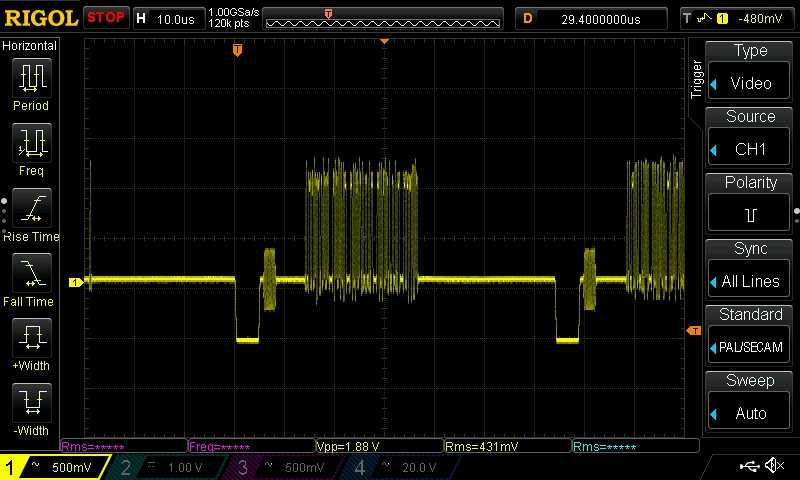
A video system of the type we’re used to is dot-sequential. It splits an image into pixels and transmits them sequentially, pixel by pixel and line by line. This is the same for an analogue video system as it is for many digital bitmap formats. In the case of a fully analogue TV system there is no individual pixel counting, instead the camera scans across each line in a continuous movement to generate an analogue waveform representing the intensity of light. If you add in a synchronisation pulse at the end of each line and another at the end of each frame you have a video signal.
But crucially it’s not a composite video signal, because it contains only luminance information. It’s a black-and-white image. The first broadcast TV systems as for example the British 405 line and American 525 line systems worked in exactly this way, with the addition of a separate carrier for their accompanying sound.
The story of the NTSC colour TV standard’s gestation in the late 1940s is well known, and the scale of their achievement remains impressive today. NTSC, and PAL after it, are both compatible standards, which means they transmit the colour information alongside that black-and-white video, such that it doesn’t interfere with the experience of a viewer watching on a black-and-white receiver. They do this by adding a sub-carrier modulated with the colour information, at a frequency high enough to minimise its visibility on-screen. for NTSC this is 3.578MHz, while for PAL it’s 4.433MHz. These frequencies are chosen to fall between harmonics of the line frequency. It’s this combined signal which can justifiably be called composite video, and in the past we’ve descended into some of the complexities of its waveform.
It’s Your SDR’s I and Q, But Sixty Years Earlier
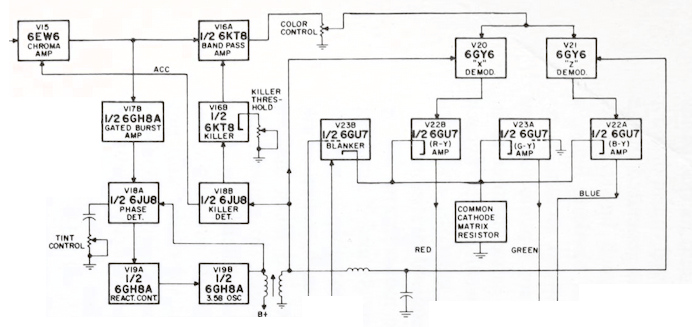
An analogue colour TV camera produces three video signals, one for each of the red, green, and blue components of the picture. Should you combine all three you arrive at that black-and-white video waveform, referred to as the luminance, or as Y. The colour information is then reduced to two further signals by computing the difference between the red and the luminance, or R-Y, and the blue and the luminance, or B-Y. These are then phase modulated as I-Q vectors onto the colour sub-carrier in the same way as happens in a software-defined radio.
At the receiver end, the decoder isolates the sub-carrier, I-Q demodulates it, and then rebuilds the R, G, and B, with a summing matrix. To successfully I-Q demodulate the sub-carrier it’s necessary to have a phase synchronised crystal oscillator, this synchronisation is achieved by sending out a short burst of the colour sub-carrier on its own at the start of the line. The decoder has a phase-locked-loop in order to perform the synchronisation.
So, Why The PAL Delay Line?

There in a few paragraphs, is the essence of NTSC colour television. How is PAL different? In essence, PAL is NTSC, with some improvements to correct phase errors in the resulting picture. PAL stands for Phase Alternate Line, and means that the phase of those I and Q modulated signals swaps every line. The decoder is similar to an NTSC one and indeed an NTSC decoder set to that 4.433MHz sub-carrier could do a job of decoding it, but a fully-kitted out PAL decoder includes a one-line delay line to cancel out phase differences between adjacent lines. Nowadays the whole thing is done in the digital domain in an integrated circuit that probably also decodes other standards such as the French SECAM, but back in the day a PAL decoder was a foot-square analogue board covered in juicy parts highly prized by the teenage me. Since it was under a Telefunken patent there were manufacturers, in particular those from Japan, who would try to make decoders that didn’t infringe on that IP. Their usual approach was to create two NTSC decoders, one for each phase-swapped line.
So if you use “NTSC” to mean “525-line” and “PAL” to mean “625-line”, then everyone will understand what you mean. But make sure you’re including that colour sub-carrier, or you might be misleading someone.
The Rise and Fall of The In-Car Fax Machines

Once upon a time, a car phone was a great way to signal to the world that you were better than everybody else. It was a clear sign that you had money to burn, and implied that other people might actually consider it valuable to talk to you from time to time.
There was, however, a way to look even more important than the boastful car phone user. You just had to rock up to the parking lot with your very own in-car fax machine.
Dial It Up
Today, the fax machine is an arcane thing only popular in backwards doctor’s offices and much of Japan. We rely on email for sending documents from person A to person B, or fill out forms via dedicated online submission systems that put our details directly in to the necessary databases automatically. The idea of printing out a document, feeding it into a fax machine, and then having it replicated as a paper version at some remote location? It’s positively anachronistic, and far more work than simply using modern digital methods instead.

Back in the early 90s though, the communications landscape looked very different. If you had a company executive out on the road, the one way you might reach them would be via their cell or car phone. That was all well and good if you wanted to talk, but if you needed some documents looked over or signed, you were out of luck.
Even if your company had jumped on the e-mail bandwagon, they weren’t going to be able to get online from a random truck stop carpark for another 20 years or so. Unless… they had a fax in the car! Then, you could simply send them a document via the regular old cellular phone network, their in-car fax would spit it out, and they could go over it and get it back to you as needed.
Of course, such a communications setup was considered pretty high end, with a price tag to match. You could get car phones on a wide range of models from the 1980s onwards, but faxes came along a little later, and were reserved for the very top-of-the-line machines.


Mercedes-Benz was one of the first automakers to offer a remote fax option in 1990, but you needed to be able to afford an S-Class to get it. With that said, you got quite the setup if you invested in the Büro-Kommunikationssystem package. It worked via Germany’s C-Netz analog cellular system, and combined both a car phone and an AEG Roadfax fax machine. The phone was installed in the backrest of one of the front seats, while the fax sat in the fold-down armrest in the rear. The assumption was that if you were important enough to have a fax in the car, you were also important enough to have someone else driving for you. You also got an AEG Olyport 40/20 laptop integrated into the back of the front seats, and it could even print to the fax machine or send data via the C-Netz connection.
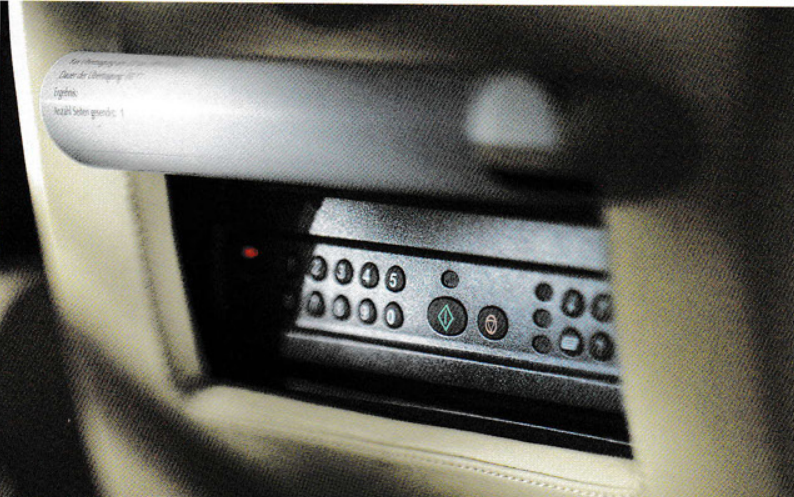
Not to be left out, BMW would also offer fax machines on certain premium 7 Series and L7 limousine models, though availability was very market-dependent. Some would stash a fax machine in the glove box, others would integrate it into the back rest of one of the front seats. Toyota was also keen to offer such facilities in its high-end models for the Japanese market. In the mid-90s, you could purchase a Toyota Celsior or Century with a fax machine secreted in the glove box. It even came with Toyota branding!
Ultimately, the in-car fax would be a relatively short-lived option in the luxury vehicle space, for several reasons. For one thing, it only became practical to offer an in-car fax in the mid-80s, when cellular networks started rolling out across major cities around the world.
By the mid-2000s, digital cell networks were taking over, and by the end of that decade, mobile internet access was trivial. It would thus become far more practical to use e-mail rather than a paper-based fax machine jammed into a car. Beyond the march of technology, the in-car fax was never going to be a particularly common selection on the options list. Only a handful of people ever really had a real need to fax documents on the go. Compared to the car phone, which was widely useful to almost anyone, it had a much smaller install base. Fax options were never widely taken up by the market, and had all but disappeared by 2010.
youtube.com/embed/0vbvu7EiWNA?…
The Toyota Celsior offered a nice healthy-sized fax machine in the 1990s, but it did take up the entire glove box.
These days, you could easily recreate a car-based fax-type experience. All you’d need would be a small printer and scanner, ideally combined into a single device, and a single-board computer with a cellular data connection. This would allow you to send and receive paper documents to just about anyone with an Internet connection. However, we’ve never seen such a build in the wild, because the world simply doesn’t run on paper anymore. The in-car fax was thus a technological curio, destined only to survive for maybe a decade or so in which it had any real utility whatsoever. Such is life!
Build a 2K Resolution MSLA 3D Resin Printer for Cheap

Have an old Android device collecting dust somewhere that you’d like to put to better use? [Electronoobs] shows us how to make a Masked Stereolithography Apparatus (MSLA) printer for cheap using screens salvaged from old Android phones or tablets.
[Electronoobs] wanted to revisit his earlier printer with all the benefits of hindsight, and this is the result. The tricky bit, which is covered in depth in the video below the break, is slicing up the model into graphics for each layer, so that these layers can be rendered by the LCD for each layer during the print.
The next tricky bit, once your layer graphics are in hand, is getting them to the device. This build does that by installing a custom Android app which connects to a web app hosted on the ESP32 microcontroller controlling the print, and the app has a backchannel via a USB OTG adapter installed in the device. [Electronoobs] notes that there are different and potentially better ways by which this full-duplex communication can be achieved, but he is happy to have something that works.
If you’re interested in resin printer tech, be sure to check out Continuous Printing On LCD Resin Printer: No More Wasted Time On Peeling? Is It Possible? and Resin Printer Temperature Mods And Continuous IPA Filtration.
youtube.com/embed/fu2NBy5zDxI?…
This 8-Bit Commodore PET Was Hard to Fix

Over on [Ken Shirriff]’s blog is a tricky Commodore PET repair: tracking down 6 1/2 bad chips. WARNING: contains 8-bit assembly code.
The Trinity of 1977 which started the personal computer revolution were the Apple II, the Commodore PET, and the TRS-80. In this project it’s a failing Commodore PET which is being restored.
In the video below the break you can see [Ken Shirriff] and [CuriousMarc] team up to crack this tough nut. Resolving the various issues required a whole heap of software and equipment. Most notably a Keysight DSOX3104T oscilloscope, a Retro Chip Tester Pro, an old Agilent 1670G logic analyzer (this thing is rocking a 3.5″ floppy disk drive!), an old Agilent 54622A oscilloscope (also rocking a floppy drive!), a Data I/O 29B Universal Programmer With UniPak 2 insert, and the disassembly software Ghidra.
In the end there were 6 (and a half) bad chips which needed to be discovered and then replaced. This project is a reminder that it’s nice to have the right tools for the job!
If you’re interested in the Commodore PET you might like to read A Tricky Commodore PET Repair And A Lesson About Assumptions or Tracking Satellites With A Commodore PET.
youtube.com/embed/nxilekpLp6g?…
An RP2040 Powered ADS-B Receiver

If you’ve ever heard the sound of an aircraft passing overhead and looked at an online plane tracker to try and figure out what it was, then you’ve interacted with ADS-B. It’s a protocol designed to enable easier aircraft monitoring, and it just so happens you can decode it yourself with the right hardware and software — which is how [John McNelly] came to develop ADSBee, an open source ADS-B receiver based around an RP2040.
ADS-B uses on–off keying (OOK) at 1 Mbps, and operates at 1090 MHz. This might seem like a rather difficult protocol to decode on a microcontroller, but the RP2040’s PIO is up to the task. All it takes is a bit of optimization, and a some basic RF components to amplify and digitize the signals.

What’s quite impressive is the various form factors the module is available in. Ranging from small solder-down modules to weatherproof outdoor base stations, nearly every potential need for an ADS-B receiver is covered. With POE or ESP32 S3 options available, there is no shortage of networking options either!
ADSBees have been placed in numerous locations, ranging from base stations to drones. One user even built out a tiny flight display cluster complete with traffic indicators into an FPV drone.
This isn’t the first time we have seen ADS-B receivers used by drone enthusiasts, but this is certainly the most feature rich and complete receiver we have come across.
Repairing a Self-Destructing SRS DG535 Digital Delay Generator

There’s a lot of laboratory equipment out there that the casual hobbyist will never need to use, but that doesn’t mean you wouldn’t snap it up if the price is right. That’s what happened when [Tom Verbeure] saw a 1980s digital delay generator at a flea market for $40. Not only is it an excellent way to learn something about these devices, but it also provides a fascinating opportunity to troubleshoot and hopefully fix it. Such was also the case with this Stanford Research Systems (SRS) DG535 that turned out to be not only broken, but even features an apparently previously triggered self-destruct feature.
These devices are pretty basic, with this specimen incorporating a Z80 MPU in addition to digital and analog components to provide a programmable delay with 12.5 nanosecond resolution on its output channels after the input trigger is sensed. For that reason it was little surprise that the problem with the device was with its supply rails, of which a few were dead or out of spec, along with a burned-out trace.
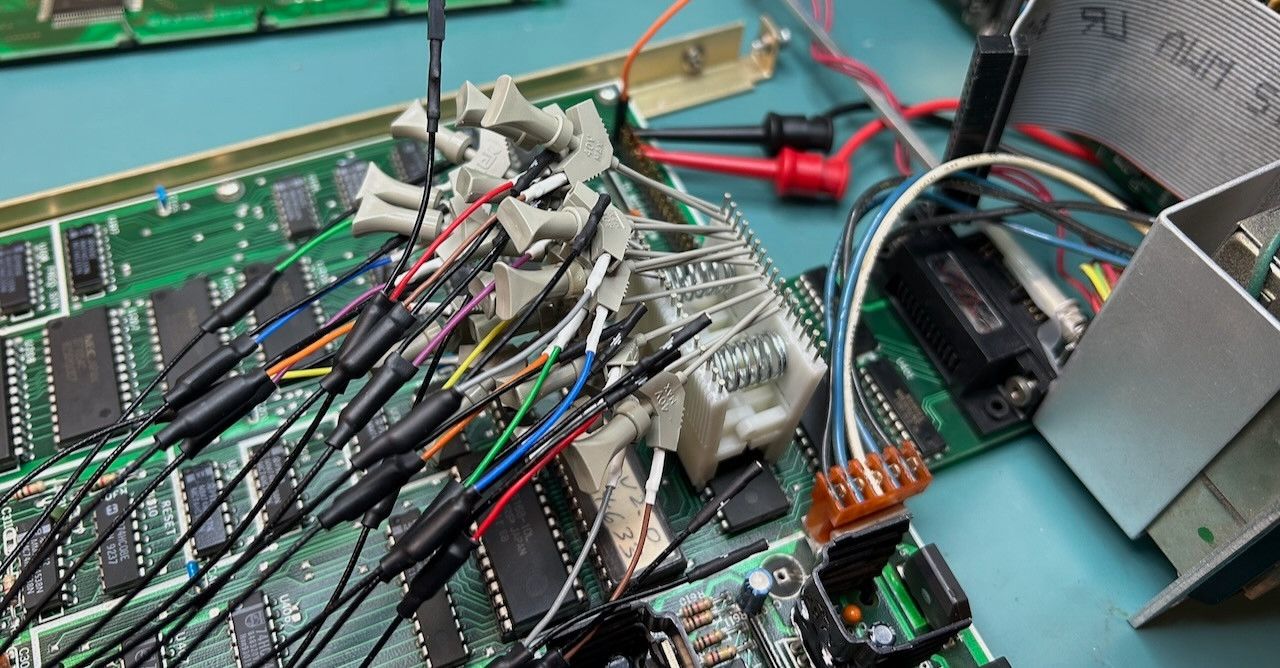
Unsurprisingly, this issue caused the same charred trace to reignite during [Tom]’s first repair attempt, but after working up the courage over the subsequent 18 months the second repair attempt went much better, also helped by the presence of the mostly correct original board schematics.
Ultimately the fixes were relatively modest, involving replacing a discrete diode bridge with an integrated one, fixing the -9 V rail with a bodge wire, and replacing the LCD with its busted AC-powered backlight with a modern one with a LED backlight. Fortunately running the 5 V rail at 7 V for a while seemed to have caused no readily observable damage, nor did flipping connectors because of SRS’ inconsistent ‘standards’ for its connector orientations.
Sadly, when [Tom] emailed SRS to inquire about obtaining an updated schematic for this unit — which is currently still being sold new for $4,495 — he merely got told to send his unit in for repair.


