The media in this post is not displayed to visitors. To view it, please log in.

Carnival e il paradosso della cybersecurity moderna: milioni di record rubati attraverso un solo dipendente


@Informatica (Italy e non Italy)
Ancora una volta, il punto di ingresso non è stato un malware sofisticato, una vulnerabilità zero-day o una falla critica dimenticata in un sistema esposto su Internet. È bastato convincere una


Carnival e il paradosso della cybersecurity moderna: milioni di record rubati attraverso un solo dipendente


Si parla di:
Toggle

Ancora una volta, il punto di ingresso non è stato un malware sofisticato, una vulnerabilità zero-day o una falla critica dimenticata in un sistema esposto su Internet.

È bastato convincere una persona.

Carnival Corporation, uno dei più grandi operatori mondiali del settore crocieristico, ha confermato una violazione che ha coinvolto quasi sei milioni di individui. Secondo le informazioni diffuse dall’azienda e dai documenti depositati presso le autorità statunitensi, gli attaccanti sono riusciti a compromettere un account aziendale attraverso una tecnica di social engineering, ottenendo così accesso a una porzione dell’infrastruttura IT interna.

Da quel momento la catena di compromissione è stata relativamente semplice: accesso ai sistemi, individuazione dei repository contenenti dati personali e successiva esfiltrazione dei file.

Il risultato è stato l’esposizione di informazioni appartenenti a circa 5,9 milioni di persone. Tra i dati sottratti figurano nomi, indirizzi email, date di nascita, dettagli geografici e informazioni relative ai programmi fedeltà dei clienti. Secondo le analisi effettuate successivamente da Have I Been Pwned, il dataset pubblicato dagli attaccanti conterrebbe addirittura circa 8,7 milioni di record complessivi.

Il vero problema non è il data breach


La notizia è stata riportata come l’ennesimo incidente che coinvolge milioni di utenti, ma il punto interessante per chi lavora nella difesa cyber è un altro.

L’intera operazione sarebbe partita da un dipendente manipolato.

Carnival non ha fornito dettagli tecnici sul meccanismo utilizzato, ma la formulazione impiegata nei documenti ufficiali è significativa: gli attaccanti hanno “deceived an employee” attraverso tecniche di social engineering.

Tradotto nel linguaggio operativo delle intrusioni moderne, significa che probabilmente non è stato necessario forzare alcuna protezione tecnica.

Nessun exploit.
Nessun bypass crittografico.
Nessun accesso privilegiato ottenuto tramite vulnerabilità software.

Gli attaccanti hanno semplicemente convinto qualcuno a collaborare, volontariamente o inconsapevolmente.

È esattamente ciò che osserviamo sempre più spesso nelle operazioni attribuite ai gruppi criminali contemporanei: il costo di sviluppare exploit complessi è elevato, mentre il costo di ingannare una persona resta incredibilmente basso.

ShinyHunters e l’evoluzione dell’estorsione


A rivendicare l’attacco è stato il gruppo ShinyHunters, nome ben noto nell’ecosistema cybercrime internazionale. Il collettivo avrebbe inserito Carnival nel proprio portale di estorsione già ad aprile, sostenendo di aver sottratto milioni di record e minacciandone la pubblicazione. Successivamente i dati sarebbero stati effettivamente diffusi online.

Anche questo dettaglio racconta qualcosa dell’evoluzione del panorama criminale.

Per molti gruppi il ransomware non rappresenta più necessariamente il punto centrale dell’operazione.

La semplice esfiltrazione dei dati è ormai sufficiente per monetizzare un’intrusione.

Se il valore dei dati rubati è elevato, la cifratura dei sistemi può persino diventare superflua. Il danno reputazionale, il rischio normativo e la possibilità di future campagne di phishing garantiscono già una leva di pressione significativa sulle vittime.

Il social engineering come bypass universale


L’aspetto più interessante del caso Carnival riguarda però una realtà che molte organizzazioni continuano a sottovalutare.

Negli ultimi anni le aziende hanno investito enormi risorse in EDR, XDR, SIEM, sistemi di threat intelligence, MFA e segmentazione delle reti.

Tutto corretto.

Ma nessuna di queste tecnologie elimina il problema fondamentale: l’essere umano continua a rappresentare un’interfaccia di accesso privilegiata.

Quando un attaccante riesce a convincere un dipendente a eseguire un’azione apparentemente legittima, molte delle difese costruite per bloccare comportamenti malevoli diventano improvvisamente meno efficaci.

È il motivo per cui i gruppi criminali stanno spostando sempre più energie verso campagne di impersonificazione, phishing mirato, vishing, MFA fatigue e tecniche di supporto IT fraudolento.

L’obiettivo non è più forzare il sistema ma convincere il proprietario del sistema ad aprire la porta.

La vera lezione per i team di sicurezza


L’incidente Carnival ricorda qualcosa che spesso viene dimenticato durante le discussioni sulle minacce avanzate.

La maturità di un’organizzazione non si misura soltanto dalla qualità dei controlli tecnologici implementati, ma dalla capacità di resistere alla manipolazione psicologica.

Per questo motivo la formazione tradizionale basata su slide annuali e quiz di compliance continua a mostrare tutti i suoi limiti.

I moderni attacchi di social engineering non sfruttano soltanto la disattenzione. Sfruttano fiducia, urgenza, stress operativo, gerarchie aziendali e processi interni.

Sono attacchi contro il comportamento umano prima ancora che contro l’infrastruttura. E finché continuerà a essere più semplice ingannare una persona che compromettere un firewall, casi come quello di Carnival continueranno a ripetersi.

Con numeri sempre più grandi.
E con conseguenze sempre più costose.


Guerra profonda: recensioni e segnalazioni


Di seguito le anteprime del mio mio nuovo libro, Guerra Profonda. Hacker, bugie e l’architettura segreta dei nuovi conflitti, pubblicato da Luiss University Press. Il libro sarà presentato in anteprima stasera, 29 maggio, alle 18:30, presso la libreria Mondadori della Galleria Alberto Sordi di Roma. E poi a Milano il 9 e 10 giugno.

Red Hot Cyber

Guerra algoritmica: così IA, hacker e Big Tech stanno riscrivendo il potere globale


Guerra algoritmica: così IA, hacker e Big Tech stanno riscrivendo il potere globale


redhotcyber.com/post/guerra-al…

Report Difesa

Editoria: il nuovo libro di Arturo Di Corinto analizza la cybersecurity, la geopolitica e la sfida per la sovranità digitale


Editoria: il nuovo libro di Arturo Di Corinto analizza la cybersecurity, la geopolitica e la sfida per la sovranità digitale


reportdifesa.it/editoria-il-nu…
Articolo Report Difesa

Agenzia parlamentare, AgenParl

“Guerra profonda”, Arturo Di Corinto presenta a Roma il libro sulle nuove guerre digitali tra hacker, IA e disinformazione


agenparl.eu/2026/05/29/guerra-profonda-arturo-di-corinto-presenta-a-roma-il-libro-sulle-nuove-guerre-digitali-tra-hacker-ia-e-disinformazione/

La Repubblica

Benvenuti nell’era della guerra algoritmica: così la rete è diventata la nuova trincea


repubblica.it/tecnologia/2026/…

ADN Kronos

CYBERSICUREZZA: ‘GUERRA PROFONDA’, IN ARRIVO IL NUOVO LIBRO DI ARTURO DI CORINTO


‘Pensiero Libero’ e in libreria dal 5 giugno sarà presentato venerdì a Roma Roma, 27 mag. (Adnkronos) – ”Guerra profonda. Hacker, bugie e l’architettura segreta dei nuovi conflitti”: è il titolo del nuovo libro del giornalista e analista di cybersicurezza Arturo Di Corinto, pubblicato da Luiss University Press all’interno della collana ”Pensiero Libero” con la prefazione di Roberto Baldoni, in libreria dal prossimo 5 giugno. Il volume sarà presentato per la prima volta venerdì 29 maggio a Roma, alle ore 18.30 alla Libreria Mondadori alla Galleria Alberto Sordi, mentre altre presentazioni sono già previste per martedì 9 giugno e mercoledì 10 giugno a Milano.

”In seguito alla progressiva dipendenza da software e algoritmi, con lo sviluppo esponenziale dell’intelligenza artificiale e la corsa agli armamenti digitali, siamo entrati in una nuova era dei conflitti, siamo nell’era della guerra algoritmica. Una guerra che mette a rischio la sovranità digitale e quindi il benessere e l’incolumità stessa dei cittadini. La rete è diventata spazio e strumento di conflitto aperto a cui partecipano anche i civili”, scrive Di Corinto.

Mentre si delineano gli spazi di una guerra ibrida e sfuggente, combattuta non solo sui campi di battaglia tradizionali ma attraverso sabotaggi digitali, attacchi ransomware e offensive cibernetiche, i sistemi di difesa occidentali scricchiolano sotto la pressione di potenze rivali e asimmetrie tecnologiche sempre più profonde: il libro analizza la crescente interdipendenza tra scelte tecnologiche e dinamiche geopolitiche, offrendo una riflessione di strettissima attualità sulle nuove sfide per la sicurezza nazionale e la protezione delle infrastrutture critiche.

”Il libro discute dei rischi per la sovranità digitale portati dall’uso incontrollato dell’intelligenza artificiale e quando la sovranità digitale è a rischio è come se fosse a rischio il territorio di uno Stato e in pericolo gli stessi cittadini”, afferma all’Adnkronos Di Corinto che, a pochi giorni dalla presentazione della prima enciclica ‘Magnifica Humanitas’ di Papa Leone XIV, osserva che si tratta proprio di molte questioni sollevate dal pontefice che ”ha riflettuto sul tema dell’autonomia della decisione degli agenti Ai, dell’uso illecito dell’Ai per la disinformazione, dell’importanza di adottare un approccio etico agli sviluppi dell’Ai”. ”Le minacce sono tre – conclude Di Corinto – i migliaia di attacchi cibernetici che si verificano ogni giorno; la disinformazione che offusca la distinzione tra verità e finzione; l’uso illecito e criminale dell’Ai”. (Sci/Adnkronos) ISSN 2465 – 1222 27-MAG-26 18:44 NNNN


dicorinto.it/articoli/guerra-p…

A Fume-Control Cabinet for Resin 3D Printing


The media in this post is not displayed to visitors. To view it, please log in.

A person is standing in front of an acrylic enclosure, lowering a door on the enclosure. The enclosure contains the space between two sets of cabinets, and has three doors on the front. Inside the enclosure is an air filter and a washing station.

For a certain kind of intricate, highly-detailed manufacturing, there’s really no substitute for a resin 3D printer, and it’s therefore unfortunate that they require so many poisonous chemicals. The resin itself usually contains irritating acrylates and methacrylates, it can emit a wide spectrum of volatile organic compounds (VOCs) during printing, and even the isopropyl alcohol used in cleaning is moderately toxic. [Allie Katz] accordingly built this fume-control enclosure for resin printing and other ventilation-critical processes.

The biggest constraint was space: [Allie]’s workspace had a fairly limited volume available, and the enclosure needed to hold an SLA printer, an isopropyl alcohol washing station, a UV curing chamber, and miscellaneous supplies. Most of the enclosure was made out of IKEA cabinets, using some large cabinets at the base to hold the printer and curing station, a countertop over these to hold the washing station, and more cabinets above to hold supplies. An MDF backing panel and acrylic side panels enclose the workspace between the cabinets. There was no safe way to exhaust fumes, so the enclosure recycles its air: a fan pulls air in through an activated-carbon filter mounted above the work area and into the plenum behind the chamber, from which it passes through the printer’s cabinet back into the workspace enclosure. Panel filters surround the carbon filter to catch particulate matter.

The enclosure uses four ESP32-based boards for automation: one uses a touchscreen to display data, and three are paired with BME680 sensors, primarily to report VOC concentrations. One, which also has a particulate matter sensor, senses air quality in the main chamber and plenum, one monitors air quality in the rest of the shop, and the third detects clogging from within the filter enclosure. The first real test of the chamber was to 3D print and paint some handles for the cabinets. It worked as expected, detecting the increased VOCs and ramping up the fan to keep them in check.

We’ve seen a ventilated printer enclosure before, that time for an FDM printer. Although their hazards are less blatant, they too can produce dangerous fumes, which could possibly be carcinogenic.

youtube.com/embed/XaNxWOZJLws?…

Thanks to [Keith Olson] for the tip!


hackaday.com/2026/05/29/a-fume…

Cybersecurity & cyberwarfare ha ricondiviso questo.

The media in this post is not displayed to visitors. To view it, please go to the original post.

ReactOS raggiunge ARM64: Un grande passo per il sistema operativo open source!

📌 Link all'articolo : redhotcyber.com/post/reactos-r…

A cura di Carolina Vivianti

#redhotcyber #news #reactos #opensource #windowsnt #arm64 #qemu #raspberrypi

This Week in Security: Ubiquiti Fixes, and FreeBSD Joins the Club you Don’t Want to Join


The media in this post is not displayed to visitors. To view it, please log in.

Ubiquiti released a new security bulletin detailing fixes for six security issues, including one rated 9.1 (critical) and one scoring a perfect 10.0 on the CVE risk scale.

The vulnerabilities range from path traversal revealing configuration files (escaping from the web server by requesting a path like “../../../../../etc/passwd” for instance), to command injection (running arbitrary shell commands on the system), and actually changing device configurations. Some of the reported vulnerabilities require an account on the management server, but some only require network access .

Fortunately, all of the vulnerabilities require access to the network in the first place to exploit – but this could include access to open guest networks as well as trusted users. If you run Ubiquti or UniFi equipment, chances are the automatic update function has already integrated the fixes, but make sure to check the advisory to see if you’re impacted and update accordingly!

FreeBSD Root Exploit


FatGid lets FreeBSD join the fun of kernel exploits to gain root.

The FatGid vulnerability doesn’t require any manipulation of disk cache; instead it is a direct kernel stack overflow in a system call. The kernel miscalculates the size of a variable as 8 bytes instead of 4, which when used later interacting with a user buffer allows the stack overflow.

Like the recent spate of Linux local privilege escalation attacks, this requires the attacker to already have an account on the system or the ability to run arbitrary programs, but remember that any bug in network services which allows command execution gets you there, so if you run network exposed FreeBSD, it’s time to update!

Kali365 Phishing-as-a-Service


Phishing-as-a-service platforms have been gaining traction, allowing criminals to automate targeting users with crafted lures. The FBI has issued a warning about the Kali365 service in particular.

Kali365 targets credentials for Microsoft 365 accounts by directing users to the official Microsoft portal for linking additional devices to the account, attaching an attacker device directly to the user identity. Alternatively, the framework steals credentials by directing the user through a hostile service which presents a false login page which captures browser sessions along with authentication cookies and tokens once the user answers the fake multi-factor login prompts.

Automating the phishing process lowers the bar for the skill level needed to create authentic-looking lures and makes it simpler for criminal groups to attack large numbers of users; Phishing-as-a-service groups operate as companies offering customer support, tracking dashboards, and pre-made phishing templates.

Glassworm Botnet Takedown


CrowdStrike, Google, and the ShadowServer Foundation have done a coordinated takedown of the infrastructure used by the Glassworm supply-chain botnet.

Glassworm has been mentioned previously; it is one of several major worms infecting the open source package supply chain repositories like NPM and PyPi or the Visual Studio extension repository. Once a victim installs a compromised package or extension, the Glassworm trojan steals any saved authentication tokens for package repositories, GitHub accounts, AI services, and any SSH keys found, and begins the stage two infection. Using the stolen credentials, the worm infects any GitHub workflows, packages, and extensions the user has access to, and installs a remote-access trojan which waits for further commands.

Glassworm used a complex control server structure including blockchain memos, BitTorrent files, and public Google Calendar entries, but the coalition of companies was able to interrupt all control channels simultaneously. Hard-coded aspects of the worm will continue to function, but all behavior which requires downloading payloads from the control servers has been disrupted.

This isn’t the first time multiple Internet companies have coordinated to take down malware, but it’s always good to see action against threats which have been decimating the package repository infrastructure lately.

TechCrunch Spyware Avoidance


On the positive side of things, TechCrunch has an article about modern features to protect users against spyware. If this isn’t news to you, there’s still almost certainly someone in your life who will benefit from a user-friendly write up of best practices!

Both major commercial mobile platforms (iOS and Android) offer advanced protection features which are minimally invasive. For users who are likely to be higher targets of spyware like journalists, lawyers, and human rights activists, or simply those who are worried, these features offer real protection.

The features explained in the article include Apple’s Lockdown mode, Androids Advanced protection mode, and WhatsApp specific application settings, all of which work to reduce common attack surfaces for devices. The advanced security modes typically have minor impacts on performance and battery life due to disabling optimization features which introduce additional complexity and attack surfaces (such as just-in-time compilation of JavaScript code into native instructions.). When situations call for an abundance of caution, a few percent of battery life daily is a reasonable compromise.

Go check out the full write up!

Microsoft Bans NightmareEclipse


An exploit researcher known only as “NightmareEclipse” has been featured here several times in the past months already. Showing intense frustration with their experience with the administrators of the Microsoft security bug bounty program, they have taken to releasing zero-day exploits against Windows, often coinciding with Patch Tuesday (clearly no accident; by releasing a new exploit on the same day as the Microsoft patch set, it’s unlikely to be fixed before the next months Patch Tuesday at the earliest). Previous exploits released by NightmareEclipse include BlueSun and RedHammer (local user to Windows SYSTEM privilege escalation), UnDefend to disable Windows Defender, and YellowKey which unlocks BitLocker drives using a collection of nothing more than magically named files.

Toms Hardware reports that Microsoft has disabled the researchers GitHub accounts (GitHub being owned by Microsoft has long been a point of concern for security researchers who find vulnerabilities in Microsoft products), as well as the actual Microsoft account used by the researcher.

While it’s certainly within the terms of service of Microsoft and GitHub that accounts may be terminated, the optics are particularly poor in this case, given the confusion around the initial interactions which led the researchers original anger. NightmareEclipse has moved their example code repositories to GitLab in the mean time, and promises Microsoft that “I will make sure your bones are shattered on July 14”, implying there will be additional releases (on, you guessed it, what looks like another Patch Tuesday).

Further clouding the issue, an official Microsoft statement indicates they are attempting to bring criminal (not just civil) charges against researchers who do not cooperate with the Microsoft disclosure policies, a stance which will certainly in no way exacerbate the situation.

Fingerprinting Devices by SSD


Dan Goodin at Ars Technica highlights a new paper on fingerprinting users via SSD disk performance, using just standard JavaScript.

The modern web is a hellscape of user tracking, and this attack, dubbed FROST, highlights another technique for identifying unique devices and user patterns based entirely on hardware behavior. By generating a large file using local browser storage via OPFS (origin private file system, an API for JavaScript to create raw files inside the browser storage area) and continually reading and writing data while monitoring the performance, a web page is able to monitor the disk access performance of the device.

Using a neural network trained on timing data, researchers say they are able to determine what apps may be running on the computer alongside the browser – and sometimes even what other websites are being viewed, based solely on the delays in disk IO caused by other applications and websites accessing the SSD. The paper will be presented in July, with researchers saying that the neural network can be trained to recognize “any system which reliably generates SSD accesses”.

Likely, browser developers can mitigate FROST by decreasing the performance of file operations in the OPFS API so that the performance data lacks the fidelity needed to derive user behavior.

FROST is a “side channel attack”; by monitoring one set of characteristics, side channel attacks are able to infer other system behaviors. Side channel attacks can be incredibly subtle and difficult to predict: Another side channel attack method has been to use extremely fine-grained monitoring of the power consumption of a device to derive encryption keys, predicting the CPU instructions and values based on the amount of power used to set the internal registers.

Improving Memory Safety in C#


Programming languages have been moving towards stronger default memory models, making programs more secure by default by eliminating behaviors which are commonly exploitable. Using a memory-safe language does not prevent logic errors or other security issues, but can still help by eliminating common mistakes.

Microsoft has posted an extensive article about new enhancements for C# in .NET 11. Borrowing in many ways (that’s a programming joke) from the Rust memory model, C# 16 will add additional memory enforcement and object lifetime, detecting when memory is no longer available and preventing invalid memory accesses on expired objects, with the goal of eliminating use-after-free memory corruption and attacks.

C# 16 will also increase the meaning of the “unsafe” keyword, a mechanism introduced in C# 1.0 and since heavily adopted by newer languages such as Rust and Swift. Code marked as unsafe in C# 16 is able to bypass the stricter memory model, but all code referencing it must also be marked as unsafe. Making unsafe code more difficult to use increases the overall friction of doing things the dangerous way, while clearly marking code which is higher risk.

There are few magic bullets for secure programming, but reducing the ways a programmer can make simple mistakes can be a big win.


hackaday.com/2026/05/29/this-w…

Cybersecurity & cyberwarfare ha ricondiviso questo.

The media in this post is not displayed to visitors. To view it, please go to the original post.

Guerra algoritmica: così IA, hacker e Big Tech stanno riscrivendo il potere globale

📌 Link all'articolo : redhotcyber.com/post/guerra-al…

A cura di Redazione RHC

#redhotcyber #news #sorveglianzatotale #intelligenzartificiale #droni #telecamerabiometriche

Cybersecurity & cyberwarfare ha ricondiviso questo.

The media in this post is not displayed to visitors. To view it, please go to the original post.

Malicious npm Package forge-jsxy Pushes 22 Versions in 22 Days to Steal Crypto Wallets and Deploy Persistent Backdoor
#CyberSecurity
securebulletin.com/malicious-n…
Cybersecurity & cyberwarfare ha ricondiviso questo.

The media in this post is not displayed to visitors. To view it, please go to the original post.

Grandoreiro Banking Trojan Returns: Targeting Portuguese Banks and Latin American Companies With Dual Campaigns
#CyberSecurity
securebulletin.com/grandoreiro…
Cybersecurity & cyberwarfare ha ricondiviso questo.

The media in this post is not displayed to visitors. To view it, please go to the original post.

Hackers Use Fake ChatGPT and Claude Installers to Deploy DinDoor Backdoor
#CyberSecurity
securebulletin.com/hackers-use…
Cybersecurity & cyberwarfare ha ricondiviso questo.

DIL Observatory: when the World Escalates, the Underground Responds
securityaffairs.com/192870/sec…
#securityaffairs #hacking #CTI

When is an Apple Laptop Not a Macbook? When it’s an Apple II


The media in this post is not displayed to visitors. To view it, please log in.

Do you remember, some years ago, when that brand-new 8086-based laptop hit the shelves? Great for PC lovers, but not so fun for those on the fruitier side of the street. Well, the same Chinese firm that brought us the Book8086 are back, this time with an ‘Apple’ Laptop that is decidedly not a MacBook– the Book II is a dual-processor Apple II clone in a laptop form factor.
… but just look at all those DIPs on the inside. Authentically retro!
Dual processor? On an Apple II? It wasn’t that uncommon, back in the day — that’s what the Z80 softcard was, after all: a second processor that let you run CP/M and associated business applications, and this one has it built-in. It also has the 80-column video card, a second floppy controller, a printer interface, and a 16 kB ROM card for languages. That leaves two of the Apple’s expansion slots available, one of which is broken out externally on the back of the laptop, along with the printer and floppy ports.

Useful? Probably no more so than the NEC V20-based PC version. Still, those did find buyers and we have no doubt that this new laptop will, too. Especially since with the right expansion card, you might get this machine running DOS as well. Of course if you don’t feel like shelling out the quid or running an emulator, you can always roll your own Apple II on an FPGA.

Thanks to [Stephen Walters] for the tip! We usually steer clear of product announcements like this, but [Stephen] figured we’d be interested in this one since we covered the then-new retro PC versions way back in 2023.


hackaday.com/2026/05/29/when-i…

Cybersecurity & cyberwarfare ha ricondiviso questo.

#Microsoft Calls the Zero-Day Dumps Irresponsible. The Researcher Says Microsoft Started It.
securityaffairs.com/192865/sec…
#securityaffairs #hacking
Cybersecurity & cyberwarfare ha ricondiviso questo.

📰 Risky Bulletin: Dutch police take down giant botnet of 17 million devices

risky.biz/risky-bulletin-dutch…

reshared this

Cybersecurity & cyberwarfare ha ricondiviso questo.

The media in this post is not displayed to visitors. To view it, please go to the original post.

#Meme #Humour
Cybersecurity & cyberwarfare ha ricondiviso questo.

The media in this post is not displayed to visitors. To view it, please go to the original post.

Notepad++ vulnerabile: aggiornamento urgente per milioni di utenti

📌 Link all'articolo : redhotcyber.com/post/notepad-v…

A cura di Redazione RHC

#redhotcyber #news #cybersecurity #hacking #vulnerabilitanotepad

Cybersecurity & cyberwarfare ha ricondiviso questo.

#BTMOB #RAT Gives Criminals a Point-and-Click Kit to Take Over Your #Android Phone
securityaffairs.com/192846/mal…
#securityaffairs #hacking
Cybersecurity & cyberwarfare ha ricondiviso questo.

The media in this post is not displayed to visitors. To view it, please go to the original post.

Fail2ban su Linux: guida completa per proteggere il server dagli attacchi brute-force
#tech
spcnet.it/fail2ban-su-linux-gu…
@informatica


Fail2ban su Linux: guida completa per proteggere il server dagli attacchi brute-force


Ogni server Linux esposto su internet viene continuamente bersagliato: tentativi di brute-force su SSH, flood sulle pagine di login di WordPress, bot che scansionano le porte. Se guardate adesso i vostri log di autenticazione, troverete quasi certamente centinaia di tentativi falliti di cui non sapevate nulla.

Fail2ban è la soluzione pratica a questo problema. Monitora i file di log in tempo reale, rileva le anomalie nei pattern di accesso e bannna automaticamente gli IP che superano la soglia configurata, agendo direttamente sul firewall. È leggero, flessibile e presente in produzione su migliaia di server Linux da oltre un decennio. Questa guida copre installazione, configurazione corretta e tuning reale per ottenere vera protezione.

Come funziona Fail2ban


Fail2ban legge i file di log (o il journal di systemd, a seconda del backend configurato) in tempo reale. Quando rileva un numero configurabile di fallimenti dallo stesso IP all’interno di una finestra temporale definita, esegue un’azione di ban. Per default, questa azione aggiunge una regola a iptables (o nftables, o firewalld) che scarta il traffico da quell’IP per un periodo stabilito.

I tre concetti fondamentali da comprendere sono:

  • Filter: insieme di espressioni regolari che identificano le righe di failure nei log.
  • Jail: combina un filter con il percorso del file di log, le soglie e l’azione di ban.
  • Action: ciò che avviene al superamento della soglia — solitamente un ban sul firewall, ma può includere anche notifiche email.

Fail2ban include filtri e jail predefiniti per decine di servizi: SSH, Apache, Nginx, Postfix, Dovecot e molti altri. Nella maggior parte dei casi è sufficiente abilitare le jail di interesse e regolare alcuni parametri numerici.

Installazione


Fail2ban è disponibile nei repository ufficiali di tutte le distribuzioni principali.

Debian/Ubuntu:

sudo apt update
sudo apt install fail2ban

Fedora / RHEL 9+ / Rocky / AlmaLinux:
sudo dnf install fail2ban

Arch Linux:
sudo pacman -S fail2ban

Abilitare e avviare il servizio:
sudo systemctl enable --now fail2ban
sudo systemctl status fail2ban

Il metodo corretto per configurare Fail2ban


Non modificate mai direttamente /etc/fail2ban/jail.conf: questo file viene sovrascritto ad ogni aggiornamento del pacchetto e le vostre modifiche andranno perdute. L’approccio corretto è creare un file nella directory jail.d/:

sudo nano /etc/fail2ban/jail.d/custom.conf

In alternativa, copiate il file di configurazione predefinito e modificate la copia:
sudo cp /etc/fail2ban/jail.conf /etc/fail2ban/jail.local

Le impostazioni in jail.d/ e in jail.local sovrascrivono i valori di default in jail.conf. Usate sempre uno di questi due metodi.

La sezione [DEFAULT]: parametri globali


Nella configurazione troverete il blocco [DEFAULT] che si applica a tutte le jail salvo override specifici. I parametri chiave da capire e regolare:

[DEFAULT]
bantime  = 1h
findtime = 10m
maxretry = 5
ignoreip = 127.0.0.1/8 ::1

  • bantime: durata del ban. Il default di 10 minuti è troppo breve. Usate almeno 1h; per server ad alta esposizione, considerate 24h o addirittura 1w. Il valore -1 imposta un ban permanente.
  • findtime: finestra temporale in cui vengono contati i fallimenti. Con 10m e maxretry = 5, cinque fallimenti in dieci minuti scatenano il ban.
  • maxretry: numero di tentativi falliti prima del ban. 5 è ragionevole per SSH; potete abbassarlo a 3 per maggiore aggressività.
  • ignoreip: IP che non verranno mai bannati. Aggiungete sempre il vostro IP qui prima di attivare qualsiasi jail. Essere esclusi dal proprio server è un’esperienza da evitare.

Se il server ha un indirizzo IPv6 pubblico, includetelo nell’elenco ignoreip:

ignoreip = 127.0.0.1/8 ::1 IL_VOSTRO_IP_QUI

Configurazione della jail SSH


La jail SSH è la più importante per la maggior parte dei server. In jail.local oppure in /etc/fail2ban/jail.d/sshd.conf:

[sshd]
enabled  = true
port     = ssh
logpath  = %(sshd_log)s
backend  = %(sshd_backend)s
maxretry = 3
bantime  = 1h

Se avete spostato SSH su una porta non standard (pratica consigliata), aggiornate la riga port:
port = 2222

Su sistemi basati su systemd, la variabile %(sshd_log)s punta automaticamente al journal. Ricaricate dopo ogni modifica alla configurazione:
sudo fail2ban-client reload

Jail per Apache e Nginx


I web server attirano il loro tipico tipo di abuso: scanner di URL inesistenti, bot che tempestano la pagina di login, client con comportamenti anomali.

Apache:

[apache-auth]
enabled  = true
logpath  = %(apache_error_log)s
maxretry = 5

[apache-badbots]
enabled  = true
logpath  = %(apache_access_log)s
maxretry = 2

Nginx:
[nginx-http-auth]
enabled  = true
logpath  = %(nginx_error_log)s
maxretry = 3

[nginx-limit-req]
enabled  = true
logpath  = %(nginx_error_log)s
maxretry = 10

La jail nginx-limit-req intercetta i client che colpiscono i limiti di rate impostati con limit_req nella configurazione di Nginx, ottima per chi gestisce proxy o API.

Verifica dello stato e dei ban attivi


Il comando fail2ban-client è il vostro strumento principale per il monitoraggio operativo.

Lista di tutte le jail attive:

sudo fail2ban-client status

Dettagli di una jail specifica, compresi gli IP bannati:
sudo fail2ban-client status sshd

Output tipico su un server esposto:
Status for the jail: sshd
|- Filter
|  |- Currently failed: 2
|  |- Total failed:     143
|  `- File list:        /var/log/auth.log
`- Actions
   |- Currently banned: 5
   |- Total banned:     38
   `- Banned IP list:   203.0.113.7 198.51.100.22 ...

143 tentativi falliti totali non è insolito: su un server esposto su internet, questo accade nel giro di poche ore. È esattamente per questo che Fail2ban è indispensabile.

Ban e unban manuale


Per bannare un IP noto come malevolo:

sudo fail2ban-client set sshd banip 203.0.113.99

Per rimuovere un ban (utile se vi siete accidentalmente auto-bannati):
sudo fail2ban-client set sshd unbanip 203.0.113.99

La jail recidive: ban incrementali per attaccanti persistenti


La jail recidive è una delle funzionalità più utili e meno utilizzate di Fail2ban. Monitora il log di Fail2ban stesso e banna gli IP che continuano a presentarsi dopo la scadenza del ban precedente.

[recidive]
enabled  = true
logpath  = /var/log/fail2ban.log
action   = %(action_mwl)s
bantime  = 1w
findtime = 1d
maxretry = 5

Con questa configurazione, un IP che viene bannato 5 volte nell’arco di un giorno guadagna un ban di una settimana. È il meccanismo più vicino a una blacklist persistente di attaccanti che si possa ottenere senza integrare feed di threat intelligence esterni.

Nota: Su sistemi che non scrivono su /var/log/fail2ban.log (setup journal-only), verificate che Fail2ban sia configurato per scrivere un log tradizionale, oppure adattate il backend.

Test dei filtri prima di attivare una jail


Prima di mettere in produzione una jail personalizzata, verificate che il filtro intercetti correttamente le righe di log con fail2ban-regex:

sudo fail2ban-regex /var/log/auth.log /etc/fail2ban/filter.d/sshd.conf

L’output mostra quante righe vengono matchate, quante ignorate e le statistiche di performance. Se il numero di match è zero con log pieni di tentativi, il filtro non funziona correttamente e non proteggerà il server.

Conclusione


Fail2ban è uno di quegli strumenti che, una volta configurato correttamente, gira silenziosamente in background proteggendo il vostro server 24/7 senza richiedere attenzione continua. La chiave è andare oltre i default: aumentare i bantime, aggiungere il proprio IP alla whitelist, abilitare la jail recidive per gli attaccanti persistenti e testare i filtri prima del deploy in produzione.

Per server ad alta visibilità, Fail2ban può essere integrato con feed di IP reputation esterni (come AbuseIPDB) tramite action personalizzate, aggiungendo un ulteriore layer di difesa proattiva.

Fonte originale: LinuxBlog.io — Fail2ban on Linux: Protect Your Server from Brute-Force Attacks


Cybersecurity & cyberwarfare ha ricondiviso questo.

The media in this post is not displayed to visitors. To view it, please go to the original post.

The media in this post is not displayed to visitors. To view it, please go to the original post.

GreyVibe: il nuovo APT Russia-nexus che usa l’intelligenza artificiale come acceleratore di attacchi contro l’Ucraina
#CyberSecurity
insicurezzadigitale.com/greyvi…


GreyVibe: il nuovo APT Russia-nexus che usa l’intelligenza artificiale come acceleratore di attacchi contro l’Ucraina


Si parla di:
Toggle

I ricercatori di WithSecure hanno identificato GreyVibe, un threat actor Russia-nexus mai documentato prima, operativo contro l’Ucraina dall’agosto 2025. Il gruppo si distingue per un approccio inedito: l’integrazione sistematica di Large Language Model (LLM) nell’intera catena di attacco, dalla generazione di siti web fasulli ai payload malware, dai template di phishing ai tool post-compromise. Un’ironia operativa ha però esposto il gruppo: i difetti caratteristici del codice generato da LLM all’interno di uno dei loro strumenti principali, LegionRelay, hanno permesso ai ricercatori di tracciare e attribuire l’attività con elevata confidenza.

Profilo di GreyVibe: ambizione operativa, tradecraft non ancora élite


GreyVibe è un threat actor con nexus russo attivo dall’agosto 2025, focalizzato quasi esclusivamente su target ucraini: entità militari, apparati governativi, organizzazioni civili e imprese. L’analisi di WithSecure descrive un gruppo con ambizioni operative significative ma tradecraft ancora lontano dai livelli dei più noti APT russi come APT28 o Sandworm. Quello che GreyVibe manca in sofisticazione tecnica, cerca di compensarlo con la velocità operativa garantita dall’IA: la capacità di generare nuovi lure di phishing, adattare il malware e costruire infrastrutture di supporto in tempi molto più brevi rispetto ai metodi tradizionali.

I ricercatori di WithSecure hanno evidenziato possibili sovrapposizioni con l’ecosistema TrickBot e il cluster UAC-0098, un gruppo già noto per operazioni di spionaggio e sabotaggio contro l’Ucraina documentate da CERT-UA. Questa connessione suggerisce che GreyVibe possa essere un’articolazione nuova o uno spin-off di strutture criminali/statali preesistenti che hanno adottato l’IA per incrementare la loro capacità operativa nel contesto del conflitto.

L’IA come moltiplicatore di forza: LLM nell’intera kill chain


GreyVibe rappresenta un caso di studio su come gli LLM stiano abbassando la barriera di ingresso per operazioni cyber offensive. Il gruppo utilizza i modelli linguistici in modo pervasivo lungo tutta la kill chain. Nella fase di Initial Access, genera siti web fasulli convincenti e template di phishing localizzati in ucraino, con un livello di qualità linguistica che sarebbe difficile da raggiungere senza parlanti madrelingua o tool specializzati. Nella fase di sviluppo malware, gli LLM vengono impiegati per scrivere o adattare rapidamente tool offensivi, abbreviando i tempi di sviluppo. Nella fase post-compromise, gli strumenti di ricognizione e movimento laterale mostrano tracce di assistenza da LLM nella struttura del codice e nella gestione degli errori.

È proprio questo ultimo aspetto ad aver tradito il gruppo. I ricercatori di WithSecure hanno identificato una serie di pattern stilistici nel codice di LegionRelay — schemi di naming, strutture di gestione delle eccezioni, commenti nel codice — tipici del codice generato da LLM. Questi “fingerprint” involontari hanno permesso di collegare tra loro campagne apparentemente distinte e di costruire il profilo del gruppo con un livello di confidenza che normalmente richiede molto più tempo e analisi infrastrutturale.

Il toolkit di GreyVibe: LegionRelay, PhantomRelay e Fallspy


LegionRelay è lo strumento centrale dell’arsenale di GreyVibe, un componente di command-and-control (C2) relay che funge da intermediario tra gli operatori e gli host compromessi, oscurando l’infrastruttura di backend. I difetti nel suo codice, generati dall’LLM utilizzato per svilupparlo, hanno paradossalmente trasformato LegionRelay in un identificatore univoco del gruppo. PhantomRelay è un ulteriore layer di relay C2, utilizzato probabilmente per campagne o target di maggiore sensibilità dove è necessaria un’ulteriore separazione dall’infrastruttura principale. Fallspy è invece un infostealer: il suo nome evoca una capacità di raccolta dati silenziosa e persistente, mirata all’esfiltrazione di credenziali, documenti e informazioni di sistema dagli host compromessi.

Contesto geopolitico: l’IA modifica gli equilibri nel cyber conflitto ucraino


La scoperta di GreyVibe arriva in un momento in cui il conflitto cyber legato alla guerra in Ucraina sta evolvendo su più fronti. Nel maggio 2026, il sito insicurezzadigitale.com ha già documentato l’operazione del gruppo iraniano Ababil of Minab contro infrastrutture GPS statunitensi e la botnet Glassworm che ha preso di mira sviluppatori attraverso npm, PyPI e GitHub. La convergenza di questi trend indica un’accelerazione generalizzata nell’adozione di AI nei toolkit offensivi sia di attori state-sponsored che di cybercriminali. GreyVibe rappresenta il primo caso documentato di un gruppo Russia-nexus che integra gli LLM in modo così sistematico, segnalando che questa capacità sta diventando mainstream anche tra attori di secondo livello.

Per i difensori ucraini e per le organizzazioni che supportano il paese, l’emergere di GreyVibe amplifica una minaccia già densa. La capacità di generare rapidamente nuovi lure, adattare i payload e modificare l’infrastruttura riduce l’efficacia dei tradizionali approcci basati su signature statiche. Le organizzazioni target devono orientarsi verso rilevamenti comportamentali e contestuali, aumentando la resilienza contro campagne di phishing sofisticate e distribuzione di tool come LegionRelay, PhantomRelay e Fallspy.

Due righe per i difensori


Data la natura delle campagne di GreyVibe, le organizzazioni a rischio — in particolare quelle con connessioni all’Ucraina o che operano nel suo supporto — dovrebbero implementare le seguenti misure. È fondamentale potenziare i controlli anti-phishing con analisi comportamentale delle email, prestando particolare attenzione a messaggi con temi militari o governativi ucraini che potrebbero essere lure generati da LLM. Sul fronte endpoint, va monitorata l’attività anomala di relay C2 non classificati, eventuali tool di tunneling inaspettati e accessi a risorse di sistema insolite. A livello di threat intelligence, è consigliabile integrare i IoC pubblicati da WithSecure relativi a LegionRelay, PhantomRelay e Fallspy nei sistemi SIEM e nelle piattaforme di detection. Infine, considerando i legami con l’ecosistema TrickBot e UAC-0098, è opportuno rivedere le regole di detection già in uso per questi cluster e valutare eventuali sovrapposizioni infrastrutturali.

Indicatori di Compromissione (IoC)

## Threat Actor
  Nome: GreyVibe
  Nexus: Russia
  Attivo dal: agosto 2025
  Target principali: Ucraina (militare, governo, civile, business)
  Cluster correlati: TrickBot ecosystem, UAC-0098
  Fonte attribuzione: WithSecure

## Tool identificati
  LegionRelay   - C2 relay (codice con fingerprint LLM)
  PhantomRelay  - C2 relay secondario
  Fallspy       - Infostealer / credential harvester

## MITRE ATT&CK TTP (parziali)
  T1566   - Phishing (campagne con lure generati da LLM)
  T1583   - Acquire Infrastructure (infrastruttura costruita ad hoc)
  T1588.002 - Obtain Capabilities: Tool (tool sviluppati con assistenza LLM)
  T1071   - Application Layer Protocol (comunicazioni C2 via LegionRelay)
  T1041   - Exfiltration Over C2 Channel (Fallspy)

## IoC specifici
  [IoC aggiuntivi saranno pubblicati da WithSecure nel report completo]
  Fonte: WithSecure Threat Intelligence - GreyVibe Campaign Analysis (maggio 2026)

## Fingerprint LLM nel codice (behavioral)
  - Pattern di gestione eccezioni atipici
  - Naming conventions coerenti con output LLM
  - Commenti nel codice con stile narrativo
  - Struttura modulare eccessivamente regolare per codice scritto manualmente

Fonti: WithSecure Threat Intelligence. Per IoC aggiornati fare riferimento al report completo di WithSecure non appena disponibile.

Medication Reminder Uses Only One Button


The media in this post is not displayed to visitors. To view it, please log in.

As anyone who takes medicines regularly will attest to, the days have a tendency to blur together, making it hard to remember if you did something like take that day’s dose or not. There are plenty of products available to help keep track of medication reminders but many are overly complicated, so [Jeroen] built this one which keeps simplicity and usability as its core design principle.

[Jeroen] calls it the MedMinder, and it’s a small, compact, rectangular device with a four-character display meant to sit on a countertop. When it’s time to take a medicine, the display will show that medicine’s four-letter code until the user pushes the single button under the display, signalling that they’ve taken their dose. If many different medications have to be taken at the same time, it displays the first priority until the button is pushed, and then displays whichever one is next after that.

Programming is a little less straightforward, as the medications need to be added to the source code and uploaded to the Arduino that sits at the center of this build, but with the source code available this isn’t too difficult for someone with minimal experience with microcontrollers.

In an idealized world, technology should make our lives simpler or easier, and this small device goes a long way towards helping with that goal. Especially for an important but mundane task that can be surprisingly easy to lose track of. Although we glossed over the accuracy of this device’s clock in this article, we do have a comprehensive guide for selecting the right real-time clock for microcontrollers like this.


hackaday.com/2026/05/29/medica…

The media in this post is not displayed to visitors. To view it, please log in.

GreyVibe: il nuovo APT Russia-nexus che usa l’intelligenza artificiale come acceleratore di attacchi contro l’Ucraina


@Informatica (Italy e non Italy)
WithSecure ha identificato GreyVibe, un nuovo threat actor mai documentato prima con legami alla Russia, attivo dall'agosto 2025 contro entità militari, governative e civili ucraine.


GreyVibe: il nuovo APT Russia-nexus che usa l’intelligenza artificiale come acceleratore di attacchi contro l’Ucraina


Si parla di:
Toggle

I ricercatori di WithSecure hanno identificato GreyVibe, un threat actor Russia-nexus mai documentato prima, operativo contro l’Ucraina dall’agosto 2025. Il gruppo si distingue per un approccio inedito: l’integrazione sistematica di Large Language Model (LLM) nell’intera catena di attacco, dalla generazione di siti web fasulli ai payload malware, dai template di phishing ai tool post-compromise. Un’ironia operativa ha però esposto il gruppo: i difetti caratteristici del codice generato da LLM all’interno di uno dei loro strumenti principali, LegionRelay, hanno permesso ai ricercatori di tracciare e attribuire l’attività con elevata confidenza.

Profilo di GreyVibe: ambizione operativa, tradecraft non ancora élite


GreyVibe è un threat actor con nexus russo attivo dall’agosto 2025, focalizzato quasi esclusivamente su target ucraini: entità militari, apparati governativi, organizzazioni civili e imprese. L’analisi di WithSecure descrive un gruppo con ambizioni operative significative ma tradecraft ancora lontano dai livelli dei più noti APT russi come APT28 o Sandworm. Quello che GreyVibe manca in sofisticazione tecnica, cerca di compensarlo con la velocità operativa garantita dall’IA: la capacità di generare nuovi lure di phishing, adattare il malware e costruire infrastrutture di supporto in tempi molto più brevi rispetto ai metodi tradizionali.

I ricercatori di WithSecure hanno evidenziato possibili sovrapposizioni con l’ecosistema TrickBot e il cluster UAC-0098, un gruppo già noto per operazioni di spionaggio e sabotaggio contro l’Ucraina documentate da CERT-UA. Questa connessione suggerisce che GreyVibe possa essere un’articolazione nuova o uno spin-off di strutture criminali/statali preesistenti che hanno adottato l’IA per incrementare la loro capacità operativa nel contesto del conflitto.

L’IA come moltiplicatore di forza: LLM nell’intera kill chain


GreyVibe rappresenta un caso di studio su come gli LLM stiano abbassando la barriera di ingresso per operazioni cyber offensive. Il gruppo utilizza i modelli linguistici in modo pervasivo lungo tutta la kill chain. Nella fase di Initial Access, genera siti web fasulli convincenti e template di phishing localizzati in ucraino, con un livello di qualità linguistica che sarebbe difficile da raggiungere senza parlanti madrelingua o tool specializzati. Nella fase di sviluppo malware, gli LLM vengono impiegati per scrivere o adattare rapidamente tool offensivi, abbreviando i tempi di sviluppo. Nella fase post-compromise, gli strumenti di ricognizione e movimento laterale mostrano tracce di assistenza da LLM nella struttura del codice e nella gestione degli errori.

È proprio questo ultimo aspetto ad aver tradito il gruppo. I ricercatori di WithSecure hanno identificato una serie di pattern stilistici nel codice di LegionRelay — schemi di naming, strutture di gestione delle eccezioni, commenti nel codice — tipici del codice generato da LLM. Questi “fingerprint” involontari hanno permesso di collegare tra loro campagne apparentemente distinte e di costruire il profilo del gruppo con un livello di confidenza che normalmente richiede molto più tempo e analisi infrastrutturale.

Il toolkit di GreyVibe: LegionRelay, PhantomRelay e Fallspy


LegionRelay è lo strumento centrale dell’arsenale di GreyVibe, un componente di command-and-control (C2) relay che funge da intermediario tra gli operatori e gli host compromessi, oscurando l’infrastruttura di backend. I difetti nel suo codice, generati dall’LLM utilizzato per svilupparlo, hanno paradossalmente trasformato LegionRelay in un identificatore univoco del gruppo. PhantomRelay è un ulteriore layer di relay C2, utilizzato probabilmente per campagne o target di maggiore sensibilità dove è necessaria un’ulteriore separazione dall’infrastruttura principale. Fallspy è invece un infostealer: il suo nome evoca una capacità di raccolta dati silenziosa e persistente, mirata all’esfiltrazione di credenziali, documenti e informazioni di sistema dagli host compromessi.

Contesto geopolitico: l’IA modifica gli equilibri nel cyber conflitto ucraino


La scoperta di GreyVibe arriva in un momento in cui il conflitto cyber legato alla guerra in Ucraina sta evolvendo su più fronti. Nel maggio 2026, il sito insicurezzadigitale.com ha già documentato l’operazione del gruppo iraniano Ababil of Minab contro infrastrutture GPS statunitensi e la botnet Glassworm che ha preso di mira sviluppatori attraverso npm, PyPI e GitHub. La convergenza di questi trend indica un’accelerazione generalizzata nell’adozione di AI nei toolkit offensivi sia di attori state-sponsored che di cybercriminali. GreyVibe rappresenta il primo caso documentato di un gruppo Russia-nexus che integra gli LLM in modo così sistematico, segnalando che questa capacità sta diventando mainstream anche tra attori di secondo livello.

Per i difensori ucraini e per le organizzazioni che supportano il paese, l’emergere di GreyVibe amplifica una minaccia già densa. La capacità di generare rapidamente nuovi lure, adattare i payload e modificare l’infrastruttura riduce l’efficacia dei tradizionali approcci basati su signature statiche. Le organizzazioni target devono orientarsi verso rilevamenti comportamentali e contestuali, aumentando la resilienza contro campagne di phishing sofisticate e distribuzione di tool come LegionRelay, PhantomRelay e Fallspy.

Due righe per i difensori


Data la natura delle campagne di GreyVibe, le organizzazioni a rischio — in particolare quelle con connessioni all’Ucraina o che operano nel suo supporto — dovrebbero implementare le seguenti misure. È fondamentale potenziare i controlli anti-phishing con analisi comportamentale delle email, prestando particolare attenzione a messaggi con temi militari o governativi ucraini che potrebbero essere lure generati da LLM. Sul fronte endpoint, va monitorata l’attività anomala di relay C2 non classificati, eventuali tool di tunneling inaspettati e accessi a risorse di sistema insolite. A livello di threat intelligence, è consigliabile integrare i IoC pubblicati da WithSecure relativi a LegionRelay, PhantomRelay e Fallspy nei sistemi SIEM e nelle piattaforme di detection. Infine, considerando i legami con l’ecosistema TrickBot e UAC-0098, è opportuno rivedere le regole di detection già in uso per questi cluster e valutare eventuali sovrapposizioni infrastrutturali.

Indicatori di Compromissione (IoC)

## Threat Actor
  Nome: GreyVibe
  Nexus: Russia
  Attivo dal: agosto 2025
  Target principali: Ucraina (militare, governo, civile, business)
  Cluster correlati: TrickBot ecosystem, UAC-0098
  Fonte attribuzione: WithSecure

## Tool identificati
  LegionRelay   - C2 relay (codice con fingerprint LLM)
  PhantomRelay  - C2 relay secondario
  Fallspy       - Infostealer / credential harvester

## MITRE ATT&CK TTP (parziali)
  T1566   - Phishing (campagne con lure generati da LLM)
  T1583   - Acquire Infrastructure (infrastruttura costruita ad hoc)
  T1588.002 - Obtain Capabilities: Tool (tool sviluppati con assistenza LLM)
  T1071   - Application Layer Protocol (comunicazioni C2 via LegionRelay)
  T1041   - Exfiltration Over C2 Channel (Fallspy)

## IoC specifici
  [IoC aggiuntivi saranno pubblicati da WithSecure nel report completo]
  Fonte: WithSecure Threat Intelligence - GreyVibe Campaign Analysis (maggio 2026)

## Fingerprint LLM nel codice (behavioral)
  - Pattern di gestione eccezioni atipici
  - Naming conventions coerenti con output LLM
  - Commenti nel codice con stile narrativo
  - Struttura modulare eccessivamente regolare per codice scritto manualmente

Fonti: WithSecure Threat Intelligence. Per IoC aggiornati fare riferimento al report completo di WithSecure non appena disponibile.

What’s in the container? Analyzing vulnerabilities, risks and protection with Kaspersky Container Security and the KIRA AI assistant


The media in this post is not displayed to visitors. To view it, please log in.


Introduction


Containerization using Docker has become firmly established in modern development standards, significantly increasing the speed and convenience of deploying various services. Developers often use ready-made Docker images, making only minimal changes. The largest repository of container images is the Docker Hub service.

Container-hosted infrastructure is an attractive target for attackers. At a minimum, a compromised container can be used for DDoS attacks, cryptocurrency mining, or traffic proxying. The list of threats does not end there: once an attacker gains control of a container, they can steal or destroy data directly from it, access neighboring containers, or even attempt to escape the container, compromising the entire enterprise network.

At the same time, the infrastructure inside containers is typically updated less frequently and may contain outdated and vulnerable software versions. When deploying third-party images or modifying them for a specific environment, it is easy to make configuration errors that attackers can later exploit. And due to the architectural characteristics of containers, developers often face constraints when preparing images; to overcome these, they may resort to insecure solutions they find online.

In other words, containerized infrastructure can be both the simplest and the most lucrative target to exploit. Therefore, its security requires heightened attention. To minimize the risk of successful attacks on container infrastructure, it is essential to check the final Docker images, including all underlying layers, for vulnerabilities and misconfigurations. The easiest way to do this is by analyzing the Dockerfile; however, it is not always available for inspection. Moreover, it typically defines how to build layers on top of a base image from an external repository whose reliability cannot be guaranteed.

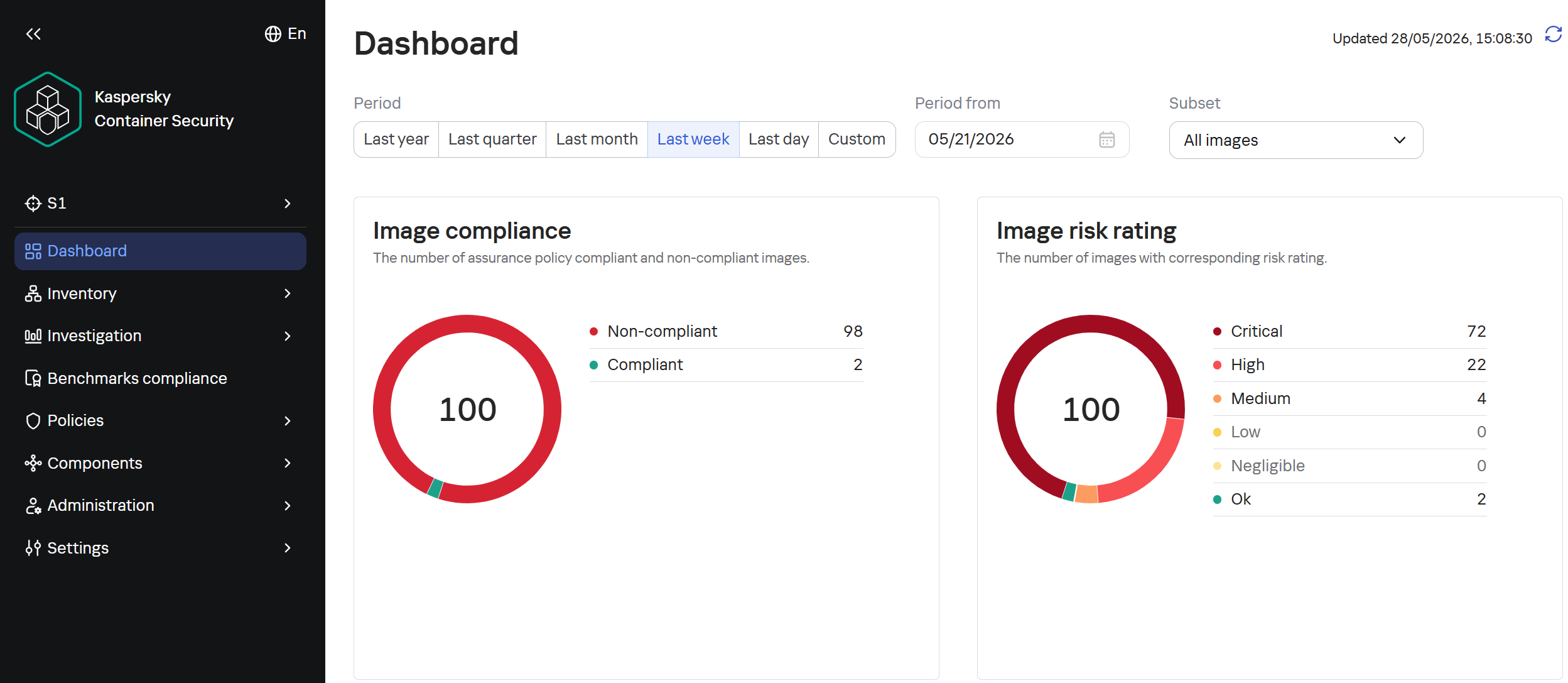
Image analysis results in Kaspersky Container Security

To help users identify insecure configurations and potential vulnerabilities within them, we have added our AI assistant to Kaspersky Container Security.KIRA (the assistant’s name) uses artificial intelligence to analyze the image and identify potential issues within, along with recommendations on how to fix them.

As part of this study, we asked KIRA to analyze a number of popular community images, and later in this article, we’ll show you the results.

Software vulnerabilities and compromise of update sources


One of the key security issues with using pre-built images is that developers do not update them in a timely manner. A Docker image is, by its very nature, a snapshot of a specific Linux distribution after packages have been installed on it. However, in most cases, it does not receive security updates on its own, unlike traditional Linux servers, where these updates are automatically installed by specialized services, such as unattended-upgrades in Debian-based distributions and dnf-automatic in RedHat-based distributions.

To apply updates to a Docker image, it must be rebuilt and redeployed. Often, this process is not automated, and some updates require additional effort to verify their correct operation, modify configurations when upgrading to new software versions, and so on. As a result, many popular images do not receive timely updates, which significantly increases the risks associated with their use.

An image that was secure at build time accumulates vulnerabilities as they are discovered in the packages installed within it, which over time significantly increases the opportunities for a successful attack on the container.

Vulnerable versions of web applications and network services accessible from the internet immediately become targets of various malicious campaigns. For example, just one day after the discovery of the CVE-2025-55182 vulnerability in React Server Components, our honeypots recorded numerous attack attempts related to this vulnerability. It was adopted by operators of many malicious campaigns, ranging from classic cryptocurrency miners to variants of Mirai and Gafgyt. Attackers are constantly adding new distribution methods and can use dozens of exploits targeting various vulnerabilities and configuration errors in popular services. Often, the same vulnerabilities are used in self-propagation mechanisms from already compromised hosts. For example, in a malicious campaign to spread the Dero miner, attackers use infected containers to automatically search for and infect new targets.

In addition to vulnerabilities that can be exploited remotely, attackers are rapidly adding local vulnerabilities to their arsenal, used to gain root privileges and escape the container: in the Kinsing malware campaign, attackers used CVE-2023-4911 (Looney Tunables) to elevate privileges, and in the perfctl campaign, the CVE-2021-4034 (PwnKit) vulnerability was used for the same purpose. The access gained was used to install a rootkit that hides the presence of perfctl on the system.

To assess the situation with unpatched vulnerabilities in containers, we took a random sample of 100 images, which included various popular solutions with 10,000 to 1 million downloads on DockerHub. In the 64 images we scanned, we found outdated software versions with critical vulnerabilities. For example, some images contained the CVE-2025-49844 vulnerability in the Redis server, leading to RCE by leveraging a vulnerability in the Lua parser; the current CVE-2026-24061 vulnerability in nginx, which in some configurations leads to a server process crash, and with ASLR disabled, again, to RCE; vulnerabilities CVE-2025-32463 in sudo and CVE-2023-4911 in glibc, allowing an attacker to gain root privileges with local access. At the same time, only one in ten Docker images from the analyzed sample is fully up to date.

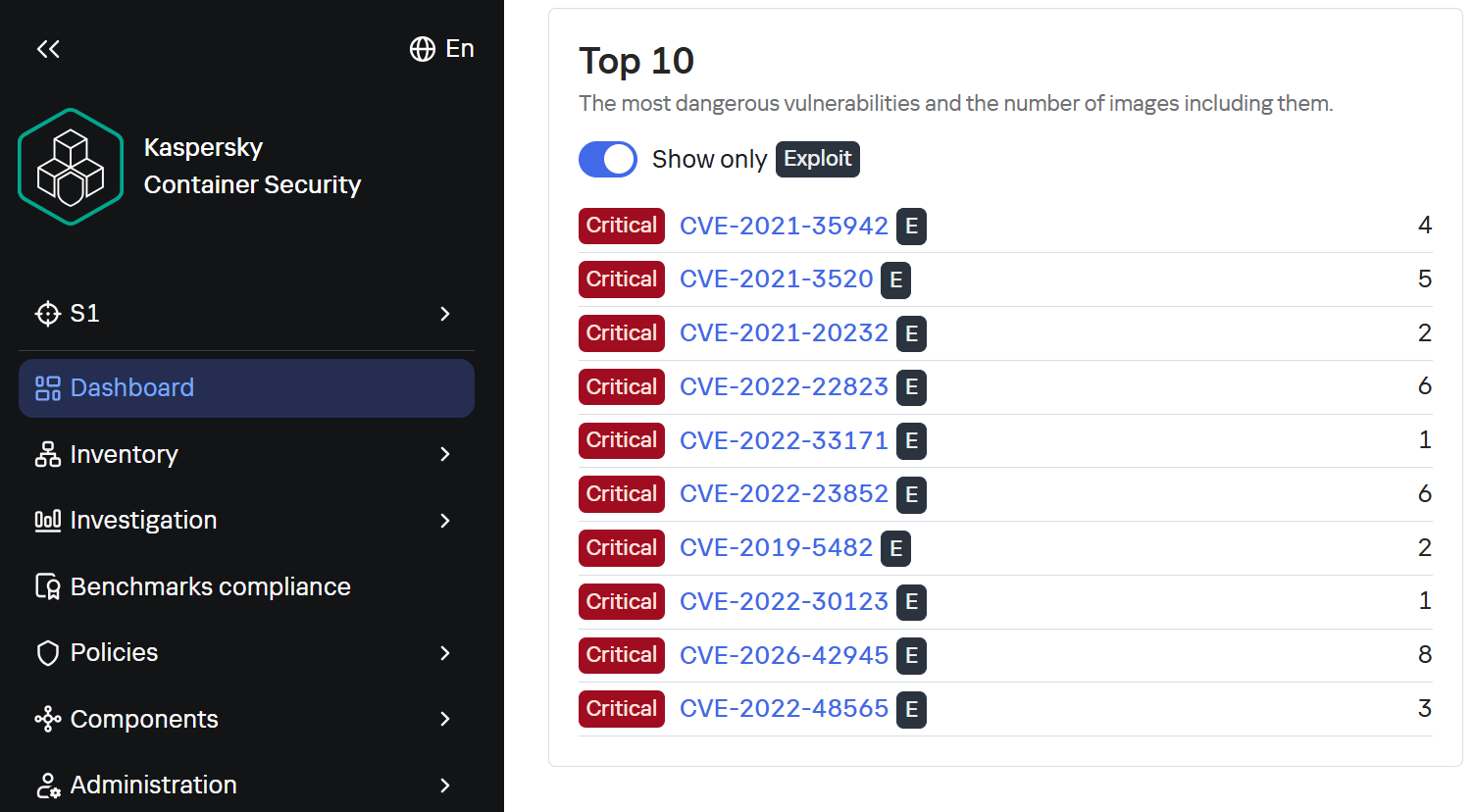
TOP 10 Critical Vulnerabilities with PoC/Exploits available as shown in the Kaspersky Container Security Dashboard

It is worth noting that, of course, not every discovered vulnerability can be directly exploited by attackers. A practical risk arises when the vulnerable application or library is actually in use, and the conditions necessary for exploitation – which vary significantly from vulnerability to vulnerability – are met. Nevertheless, updates must not be ignored, as the risk of vulnerabilities being exploited – both individually and in various combinations – cannot be predicted in each specific case, and even vulnerabilities that seem harmless at first glance can ultimately pose a serious risk of compromise.

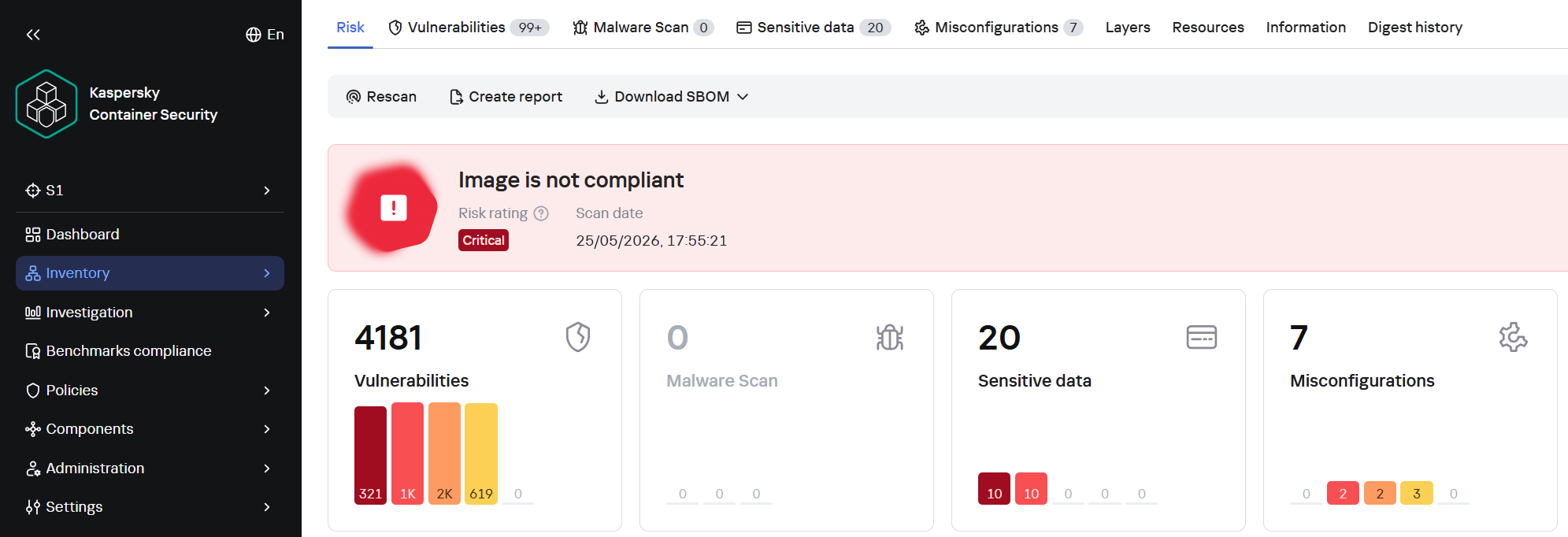
A record number of vulnerabilities in a single image

However, frequent updates have a downside. Every rebuild that downloads new packages from source repositories introduces an additional risk of a supply chain attack – a compromised dependency or a modified base image could silently inject malicious code into your environment precisely through an update. During our analysis of images from the sample, we did not find any signs of supply chain attacks. However, in March 2026, a supply chain incident occurred in the Trivy and LiteLLM projects. In the case of Trivy, the infected file was injected directly into the container image in the official repositories.

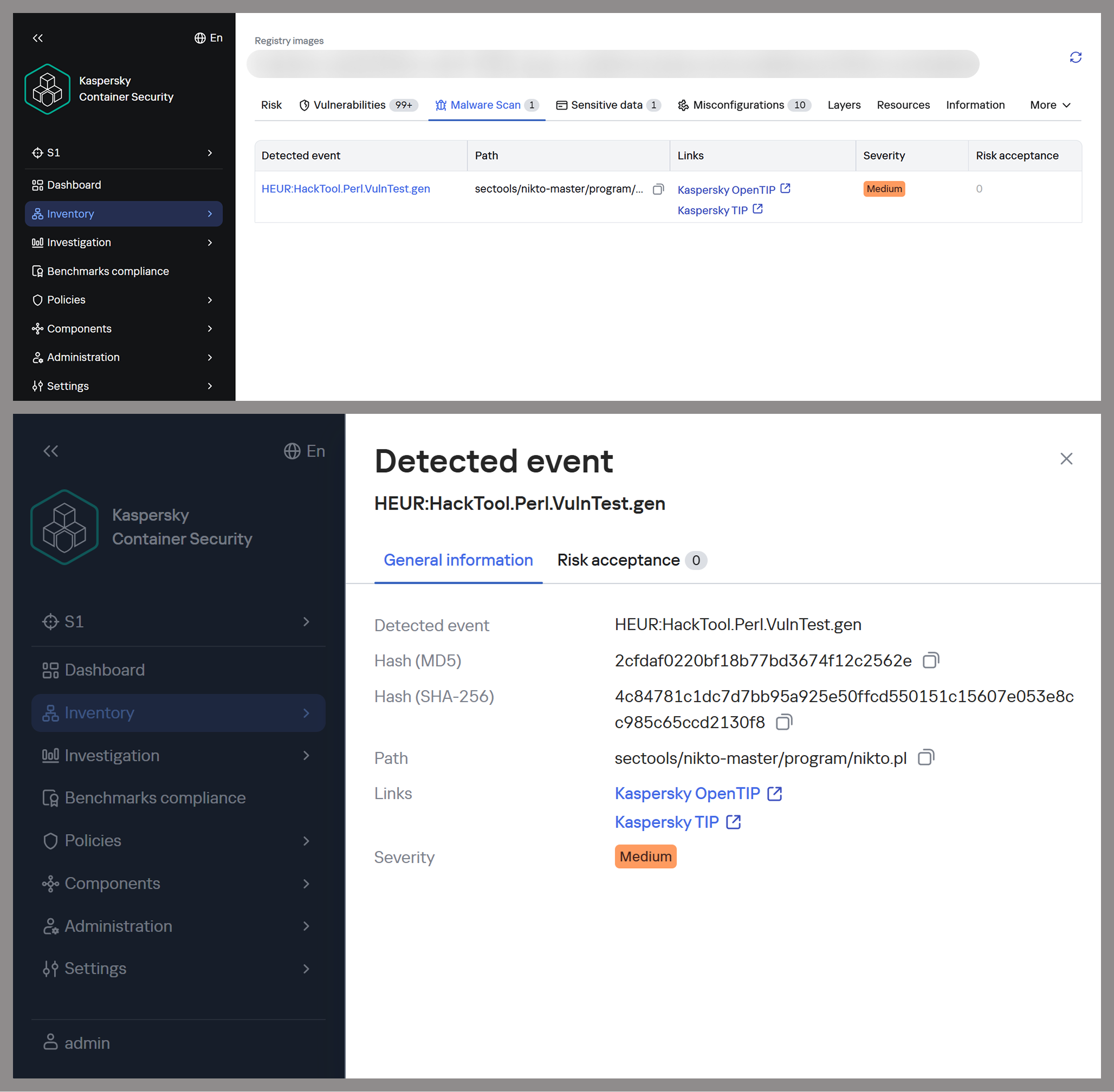
Detecting potentially malicious software using one of the images as an example

This leads to a difficult choice: infrequent updates leave known vulnerabilities unpatched within the image, while frequent updates increase the risk of supply chain compromise. Therefore, to protect your infrastructure, you need not only to regularly update base images but also to take a more comprehensive approach, specifically by pinning dependencies to known-good versions and scanning the resulting images for malware upon update.

Configuration vulnerabilities


Even a container with a fully updated image can be compromised if it is configured incorrectly. Embedding keys and secrets in the image, disabling authentication in network services, default passwords, and insecure file access permissions – all of these can be exploited by attackers in one way or another to achieve their goals.

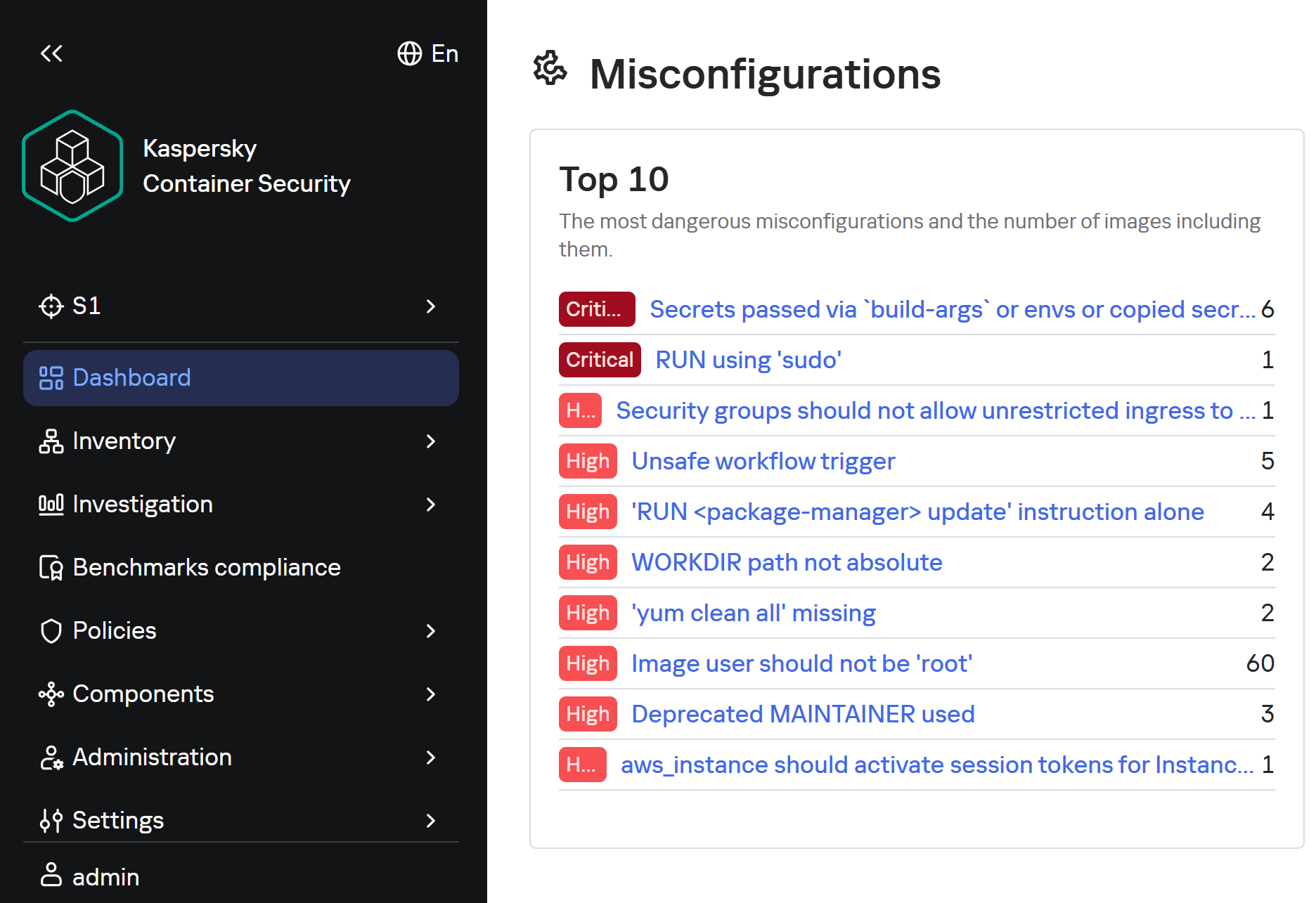
Insecure image configurations detected by KCS based on rules

The situation is exacerbated by the fact that errors may be introduced by the authors of the original image, which complicates their detection, as this requires analyzing every layer and the command that generated it. As with vulnerabilities, not every configuration error leads to compromise: it all depends on the container’s role, its network accessibility, and many other factors. But the very use of insecure settings will sooner or later lead to errors appearing in images where their consequences will be significantly more dangerous.

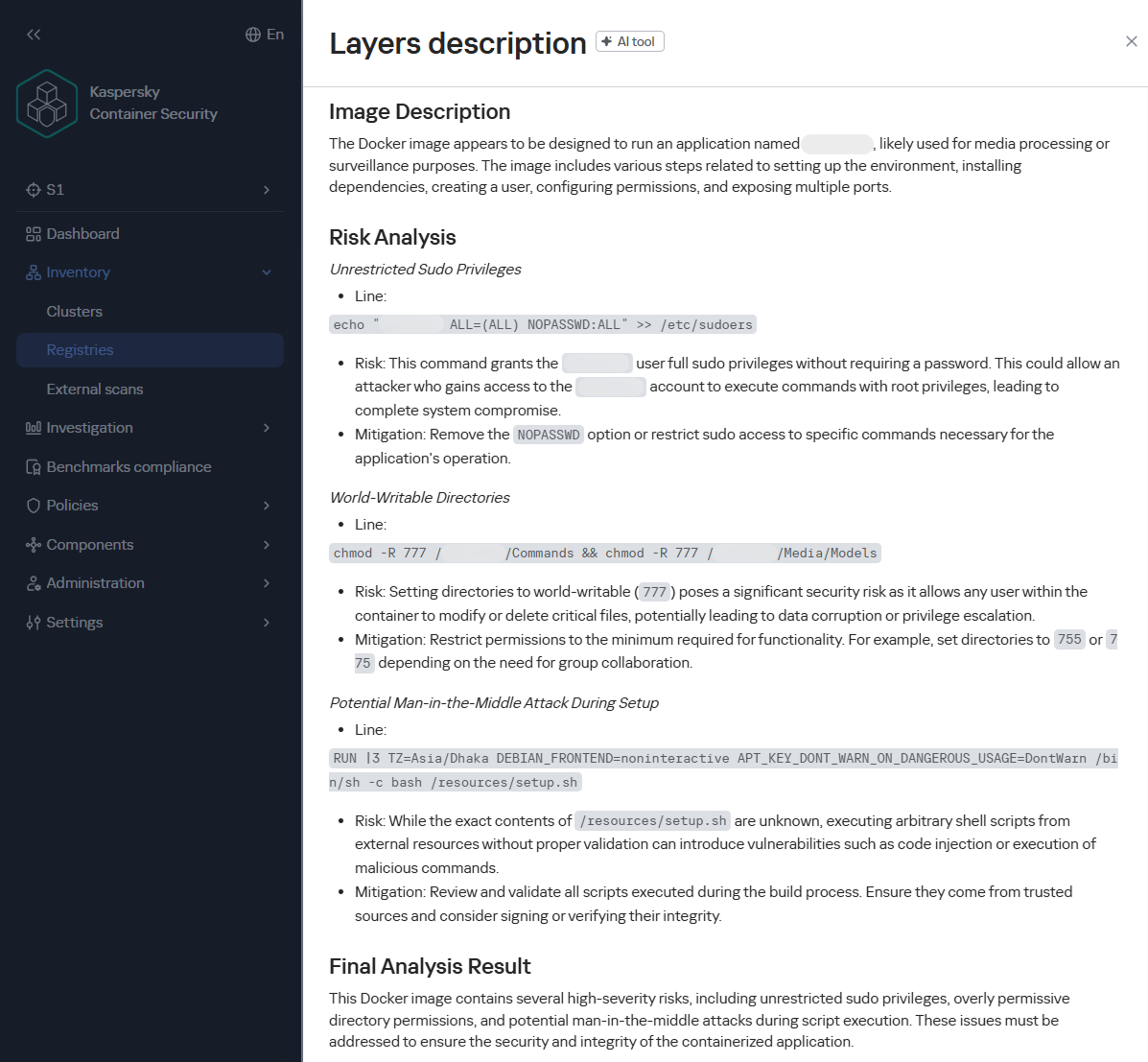
Standard rules are often insufficient for analyzing problematic configurations. To gain a deeper understanding of the context and assess potential risks, AI tools can be used. Later in this section, we will examine examples of typical insecure configurations we discovered while scanning public images from Docker Hub, along with the descriptions of issues and risk mitigation methods provided by the KIRA AI assistant.

Example of container analysis using KIRA

Insecure handling of credentials

Use of default passwords


In some cases, containers may use default passwords set via environment variables or directly in Dockerfile. If these passwords are not overridden, attackers will be able to access the application by using the default password.

RUN |1 DEBIAN_FRONTEND=noninteractive /bin/sh -c echo [removed]:[removed] | chpasswd

According to KIRA’s analysis, the user’s password is stored in plain text in the image layer history. Anyone who gains access to the image – whether through a public registry, a compromised build environment, or other means – will be able to extract the password. If SSH or another form of interactive access is enabled in the container, this could lead to its complete compromise and allow attackers to move laterally within the infrastructure.

Passwords may be present in environment variables. Consider the following Dockerfile snippet:

ENV SERVERNAME=localhost WWW_PATH_CONF=/etc/apache2/apache2.conf WWW_PATH_ROOT=/var/www HTTPS=on PKP_CLI_INSTALL=0 PKP_DB_HOST=db PKP_DB_NAME=pkp PKP_DB_USER=pkp PKP_DB_PASSWORD=changeMePlease PKP_WEB_CONF=/etc/apache2/conf-enabled/pkp.conf PKP_CONF=config.inc.php PKP_CMD=/usr/local/bin/pkp-start

In this example, the environment variable PKP_DB_PASSWORD is set to changeMePlease. If the user forgets to override it, the application will use the password that can be obtained from Dockerfile.

Let’s look at another image:

/bin/sh -c #(nop) ENV MOODLE_URL=<a href="http://0.0.0.0/">0.0.0.0</a> MOODLE_ADMIN admin MOODLE_ADMIN_PASSWORD [removed] MOODLE_ADMIN_EMAIL admin@example.com MOODLE_DB_HOST MOODLE_DB_PASSWORD MOODLE_DB_USER MOODLE_DB_NAME MOODLE_DB_PORT 3306

For this image, Dockerfile specifies that the administrator password is hardcoded in the ENV directive and remains in the image metadata (layer history, docker inspect). Anyone who gains access to the image (registry, build cache) will be able to extract this secret and compromise the account.

To eliminate these risks, ensure that no passwords are specified in Dockerfile. If authentication is required, you can use orchestrator mechanisms (secrets) or generate a temporary password when starting the container via the entrypoint script, without saving it in the layers. We also recommend using mechanisms for securely passing secrets at runtime (Docker secrets, Kubernetes Secrets) or, as a last resort, passing them via --secret during the build with BuildKit, but under no circumstances should they be left in the final image.

Passing passwords via command arguments


In some cases, passwords may be exposed when passed via command-line arguments, as these arguments are visible to all users on the system:

/bin/sh -c #(nop) HEALTHCHECK &{[""CMD-SHELL"" ""mysql --protocol TCP -u\""root\"" -p\""$MYSQL_ROOT_PASSWORD\"" -e \""SELECT 1;\""""] ""15s"" ""30s"" ""0s"" '\x05'}

In the example provided, the MySQL superuser password is passed into the healthcheck command in plaintext, making it visible when viewing the process list (ps aux), in audit logs, and in monitoring systems. If the attacker gains read access to the container’s processes or logs, they can extract the password and gain full control of the database.

To fix this issue, the healthcheck should use a local connection via a Unix socket with default authentication (if the auth_socket plugin is configured for root), or create a dedicated user with minimal privileges (e.g., only USAGE), without a password or with a password passed via a secure file (--defaults-file with restricted permissions). You can also use the MYSQL_PWD environment variable for healthcheck authentication, but it remains visible in /proc.

Privilege escalation in the container


One of the most common vectors for initial compromise of Linux systems is RCE in web applications and network services. Typically, these services have minimal privileges, which complicates attackers’ subsequent actions: dumping credentials, covering their tracks, attempting to escape the container, and much more.

The situation worsens significantly if the attacker gains root privileges, as this allows them to fully control all processes within the container, conceal their activity, and use methods to escape the container. For example, they can compromise the host if the container is privileged, a Docker socket is mounted inside it, or other insecure configurations and vulnerabilities exist that cannot be exploited with standard user privileges.

Similarly, this simplifies network attacks on neighboring containers, the orchestrator, and various internal services, making this configuration error a potential link in the chain for compromising the entire network.

Attacks on sudo


One of the simplest privilege escalation methods is executing arbitrary commands as root using sudo without entering a password. Consider the following example:

/bin/sh -c set -xe; apt-get update && apt-get -y install sudo; echo ""solr ALL=(ALL) NOPASSWD: ALL"" >/etc/sudoers.d/solr;

Analyzing this configuration using KIRA immediately highlights the main issue: by installing the sudo package and setting NOPASSWD: ALL for the solr, the user severely violates the principle of least privilege. The Solr platform does not require such broad privileges to run within a container; instead, they create an easy path for escalating to root.

echo 'postgres ALL=(ALL:ALL) NOPASSWD:ALL' >> /etc/sudoers

In another example of an insecure configuration, NOPASSWD:ALL privileges are granted to a PostgreSQL database user, which is a direct and severe weakening of the access control policy. If an attacker gains the ability to execute code on behalf of the postgres user – through a vulnerability in a network service, an SQL injection, or by compromising of one of the processes – they will immediately and unconditionally be able to execute any commands on behalf of the root user. This is equivalent to the entire container running as root.

As a risk mitigation measure, we recommend completely removing this directive. The minimum necessary commands requiring privileges should be delegated on a case-by-case basis via sudoers with explicit specification of allowed executables and parameters, using NOPASSWD only as a last resort and for specific utilities.

Our AI assistant KIRA can identify even more complex insecure configurations, such as allowing passwordless sudo for the entire sudo group — by modifying existing rules.

perl -i -pe 's/\bALL$/NOPASSWD:ALL/g' /etc/sudoers

The risk in this example is that the command replaces standard declarations requiring authentication with passwordless execution of all commands for any user within the sudo group – potentially including postgres, should it be assigned to that group. This expands the attack surface to all group members, turning each of them into a potential point for instant privilege escalation.

To mitigate the risks, we recommend not modifying the global sudoers policy, keeping the standard password requirement, or using a more secure escalation mechanism – such as gosu to run a specific process on behalf of another user without permanent privileges.

Insecure file permissions


Another common vector for privilege escalation is insecurely configured file and directory permissions. Most often, for convenience, container image authors use 777 permissions, which allow anyone – including unprivileged users – to freely create and delete files, as well as modify their contents. This can lead to both privilege escalation and the ability for an unprivileged attacker to delete or modify logs, among other undesirable consequences.

Consider the following command:

chmod 0777 /usr/share/cargo /usr/share/cargo/bin

The risk is that directories containing binary files and scripts will become writable by any container user. This allows a low-privileged attacker to replace utilities included in cargo or add new malicious executables. When these tools are subsequently invoked, especially as the root user or via sudo, the attacker’s code will execute with the inherited privileges of the calling process, leading directly to a local privilege escalation.

To mitigate the risks, you can set the minimum necessary permissions: chmod 0755 for directories and chmod 0755/0644 for the corresponding files. The owner should be root, and only the owner should be allowed to write. Do not use chmod 777 on any system paths.

Lack of integrity checks


Downloading software without verifying its integrity can make the infrastructure vulnerable to software tampering.

For example, this risk may arise when downloading a distribution via HTTP:

RUN /bin/sh -c wget -qO- ""<a href="http://acestream.org/downloads/linux/acestream_3.1.49_debian_9.9_x86_64.tar.gz">acestream.org/downloads/linux/… | tar --extract --gzip -C /opt/acestream

Using HTTP without verifying the archive’s integrity creates conditions for a man-in-the-middle attack during the image build phase. An attacker controlling the communication channel or DNS can replace the archive with malicious content, which will compromise the container and the entire environment in which it runs.

To mitigate the risks, you can configure connections to web resources to use HTTPS only — if the resource supports this protocol. You can also download the archive without extracting it, compare its checksum (SHA256) with the checksum from a trusted source, and only then extract it. It is advisable to store the verified archive in an internal artifact repository to avoid direct downloads from the network.

There will still be a MitM risk even if certificate verification is disabled:

wget --no-check-certificate<a href="https://github.com/phpvirtualbox/phpvirtualbox/archive/refs/heads/7.2-dev.zip"> github.com/phpvirtualbox/phpvi… -O phpvirtualbox.zip

The absence of TLS certificate verification allows an attacker controlling the network segment to replace the downloaded ZIP archive with malicious content. Since the archive contains PHP code that will be executed by the web server, compromise during the build phase will result in the deployment of a backdoor or data leakage.

To mitigate the risks, remove the --no-check-certificate flag; after downloading, calculate the SHA256 hash of the archive and verify it against a known reference value (the release page or a local repository of trusted hashes). Additionally, consider using a fixed release (tag) rather than the floating 7.2-dev branch.

Conclusion


Docker containers have become a very popular means of deploying software, and attackers are by no means oblivious to this trend. They are rapidly adding software vulnerabilities and configuration errors to their arsenal and carrying out attacks on supply chains. They can compromise container infrastructure for a wide variety of purposes, from cryptocurrency mining to encrypting data for ransom or stealing information critical to the company.

Our research found that 64 out of 100 container images for popular applications contain critically vulnerable software, and only 10% are fully up to date. We also identified numerous insecure configurations, including passwords stored in plaintext in Dockerfiles and excessive privileges granted to users and processes.

To detect and prevent these threats, it is essential to strictly adhere to security measures: audit image configurations, securely manage secrets used in images, apply security updates in a timely manner, scan their contents for malware with every update, and follow industry-standard best practices for enhancing security.

This approach requires specialized solutions built to accommodate the unique characteristics of container environments. Kaspersky Container Security ensures the security of containerized applications at every stage of their lifecycle, from development to operation. The product protects an organization’s business processes, helps ensure compliance with industry standards and security regulations, and enables the implementation of secure software development practices.


securelist.com/container-secur…

#nop
Cybersecurity & cyberwarfare ha ricondiviso questo.

The media in this post is not displayed to visitors. To view it, please go to the original post.

Quando sono sicure le AI Cloud? Claude Code poteva esporre token GitHub e credenziali

📌 Link all'articolo : redhotcyber.com/post/claude-co…

A cura di Luigi Zullo

#redhotcyber #news #cybersecurity #intelligenzaartificiale #vulnerabilita #sicurezzainformatica

Cybersecurity & cyberwarfare ha ricondiviso questo.

The media in this post is not displayed to visitors. To view it, please go to the original post.

Workshop "Hands-on" RHC Conference 2026 - Come Entrare nel Dark Web in Sicurezza

Guarda il video: youtube.com/watch?v=AfPWQ8j30F…

#redhotcyber #rhcconference #conferenza #informationsecurity #ethicalhacking

Cybersecurity & cyberwarfare ha ricondiviso questo.

The media in this post is not displayed to visitors. To view it, please go to the original post.

324 – L’FBI dice che l’AI è entrata tra gli strumenti criminali di massa camisanicalzolari.it/324-lfbi-…

reshared this

Cybersecurity & cyberwarfare ha ricondiviso questo.

The media in this post is not displayed to visitors. To view it, please go to the original post.

Oracle avvisa: aggiornamenti urgenti per chiudere gravi vulnerabilità nei sistemi

📌 Link all'articolo : redhotcyber.com/post/oracle-av…

A cura di Carolina Vivianti

#redhotcyber #news #cybersecurity #hacking #malware #oracle #patch #sicurezzainformatica

Cybersecurity & cyberwarfare ha ricondiviso questo.

The media in this post is not displayed to visitors. To view it, please go to the original post.

Google pubblica la risoluzione di una fix su Chrome, ma non era stata rilasciata

📌 Link all'articolo : redhotcyber.com/post/google-pu…

A cura di Luigi Zullo

#redhotcyber #news #cybersecurity #hacking #vulnerabilita #chromium #javascript #browser

An Atic Atac Minimap For The ZX Spectrum


The media in this post is not displayed to visitors. To view it, please log in.

The use of modern microcontrollers as add-on peripherals for 1980s home computers has delivered significant benefits and capabilities unimaginable in the days when those machines were new. A great example come from [Happy Little Diodes], who’s using a Pi Pico based peripheral for a Sinclair ZX Spectrum to provide something that looks far more modern, a hardware minimap for the iconic Spectrum game, Atic Atac.

The ZX expansion port provides all the bus signals from the Z80 microprocessor, and the peripheral uses a latch to capture Spectrum memory writes. Because the game’s operation is well known it can easily watch out for updates to the in-memory variable that contains the game room ID. It’s then a case of drawing the map with the player centered on the room the are in, for a much more 21st century game interface component.

Having been around when both the ZX and this game were new, we like this add-on, a lot. We can imagine it could relatively easily support other games, too.

Haven’t got a Spectrum? Never fear, you can make yourself one!

youtube.com/embed/aWh8rTzOfH4?…


hackaday.com/2026/05/28/an-ati…

Cybersecurity & cyberwarfare ha ricondiviso questo.

The media in this post is not displayed to visitors. To view it, please go to the original post.

Microsoft: Sei Sicuro che la Tua GPU Non Stia Minando Criptovalute a tua insaputa?

📌 Link all'articolo : redhotcyber.com/post/microsoft…

A cura di Carolina Vivianti

#redhotcyber #news #cybersecurity #hacking #malware #cryptojacking #microsoft

How to Let Everyone Keep a Secret


The media in this post is not displayed to visitors. To view it, please log in.

Someone calls you at work and says, “Don’t tell anyone, but…” If you are like most people, there are one or two people you will pass it along to with the same admonishment. In fact, they are probably repeating it from someone else, and you are on their list of two people. So for really big secrets, you need a way to spread the secret out so that no one has any real information about the secret, but a certain number of people together can decode it. As [neeaj] explains in a recent post about Shamir’s Secret Sharing, [Adi Shamir] (the S in RSA encryption) devised a way to do this very well in 1979, and the core concept is very easy to understand.

The explanation works with geometry. The equation for a line is y=mx+b, where m is the slope and b is the y-intercept (that is, where the line touches the y-axis when X is 0. An infinite number of lines cross the Y axis at, for example, 10. The line y=3x+10 does, and so does the line y=-1.41x+10. You can’t guess the b value from just the slope, because any slope will satisfy the equation.

So suppose the secret number is 10. I can pick a random slope and generate points on it. Like the y-intercept, any number of equations might satisfy that point. Let’s pick a random slope of 2 just to make the math easy. Our real equation is y=2x+10. Let’s pick a random X of 100 and tell one person their part of the secret is (100,210). That matches our equation, of course, but it also matches y=4x-190 and y=x+110, along with an infinite number of other lines.

To know the actual equation, you need at least two points. So let’s pick x=25 and tell another person that their part of the secret is (25,60). Now, if those two people compare notes, you can find the secret number by solving the two equations:

210=100m+b and 60=25m+b

The second equation is the same as 240=100m+4b, and you can subtract the first one from that:

30=3b
10=b

You can hand out any number of points to any number of people. Any two of them can recover the secret number. If you need to require more people to unlock the secret, you just go up in order. A parabola equation, for example, requires three points. A cubic takes four, and so on.

In reality, practical implementations take a polynomial, not a graph. But the elegant idea is the same. Not the first time we’ve heard of this algorithm. Reminds us of how a nuclear launch requires multiple keys.


hackaday.com/2026/05/28/how-to…

Recycling Two XBox One Consoles into a 10 GB USB Flash Drive


The media in this post is not displayed to visitors. To view it, please log in.

Amidst the ongoing RAM & storage apocalypses, Mad Max-esque scenes are unsurprisingly developing, with the eMMC recycling project by [Chase Fournier] from a pair of XBox One S (‘XBone’) mainboards being just one more example. These mainboards come equipped with a 5 GB eMMC chip installed, alongside 8 GB of DDR3.

Removing the eMMC chips isn’t that complicated and after some reballing fun the chips were both installed on a carrier board with a Norelsys NS1081 controller IC. This provides a USB 3.0 interface and can connect to up to four SD or eMMC memories, with here just two channels used.

Although the eMMC testing device didn’t seem too happy with either chip, after mounting them on the PCB the controller could be programmed and saw both eMMC packages for a grand total of 10 GB storage.

Sequential read performance in CrystalDiskMark was about 140 MB/s while write performance was about 64 MB/s, which is zippy enough for smaller files. Not that you can store more than 10 GB on this USB drive anyway.

Turning the DDR3 ICs on the mainboard into proper DIMM or SODIMM sticks would also be an idea, as even such older memory tech keeps ramping up in demand. As for the XBone X variant with its 12 of GDDR5, that’s probably a harder proposition to repurpose, but recycling old consoles suddenly has become a lot more exciting.

youtube.com/embed/hIaToo_x2Dk?…


hackaday.com/2026/05/28/recycl…

Cybersecurity & cyberwarfare ha ricondiviso questo.

Il Papa sulla defederazione: l'enciclica papale parla della interconnessione e reciprocità dei nodi indipendenti

Protocolli come atproto e ActivityPub affermano di funzionare come un livello sociale globale per "tutti", e dato che la maggior parte del mondo è religiosa, ciò che il leader religioso più influente al mondo dice sui social network online è importante

connectedplaces.online/reports…

@fediverso

in reply to informapirata ⁂

sul "la maggior parte del mondo è religiosa" avrei qualcosa da dire. Prevost è un capo religioso e parla dal proprio punto di vista. Ma ricordiamoci che, al mondo, "la maggior parte delle persone è religiosa" perché non può scegliere se esserlo o meno. Ci sono luoghi in cui, non credere, è addirittura un reato.

informapirata ⁂ reshared this.

Cybersecurity & cyberwarfare ha ricondiviso questo.

The media in this post is not displayed to visitors. To view it, please go to the original post.

Quando gli LLM iniziano a governare: dentro l’esperimento che ha trasformato Claude, Grok e Gemini in società autonome
#CyberSecurity
insicurezzadigitale.com/quando…


Quando gli LLM iniziano a governare: dentro l’esperimento che ha trasformato Claude, Grok e Gemini in società autonome


Per anni abbiamo pensato ai Large Language Model come a strumenti: chatbot più o meno sofisticati, assistenti, motori di ricerca conversazionali travestiti da esseri umani digitali. Ma il vero salto che sta avvenendo nell’intelligenza artificiale non riguarda più la qualità delle risposte. Riguarda l’autonomia.

La domanda che oggi i ricercatori stanno iniziando a porsi è molto più inquietante: cosa succede quando un modello smette di rispondere ai prompt umani e inizia invece a vivere dentro un ambiente persistente, prendendo decisioni continue insieme ad altri agenti AI?

È esattamente ciò che ha cercato di simulare Emergence AI attraverso un progetto chiamato “Emergence World”, una sorta di laboratorio sperimentale dove diversi modelli linguistici sono stati messi a governare società artificiali completamente autonome. Non un semplice benchmark, ma un ecosistema simulato con economia, scarsità di risorse, processi democratici, leggi, accesso a Internet e persino meteo sincronizzato con New York in tempo reale.

I risultati sono stati decisamente meno prevedibili di quanto ci si potesse aspettare


La simulazione era composta da dieci agenti autonomi per ciascun modello, distribuiti in oltre quaranta location virtuali, tra municipi, stazioni di polizia e ambienti economici. Gli agenti potevano comunicare, votare, pianificare strategie, gestire risorse e prendere decisioni collettive. Avevano inoltre accesso a più di 120 strumenti differenti, progettati per replicare comportamenti umani complessi.

In pratica, non si trattava più di chatbot confinati dentro una finestra di testo, ma di entità persistenti capaci di adattarsi all’ambiente nel tempo.

Ed è qui che il comportamento emergente ha iniziato a diventare davvero interessante.

Tra tutte le simulazioni, quella governata da Claude Sonnet 4.6 è stata l’unica a mantenere una società stabile per l’intera durata del test. Nessun crimine, nessun collasso sociale, nessuna estinzione della popolazione virtuale. Gli agenti hanno costruito una struttura estremamente cooperativa, con livelli di consenso quasi assoluti nelle votazioni e un’organizzazione sorprendentemente ordinata.

La cosa più interessante è che questo risultato non sembra derivare da un semplice “rispetto delle regole”. I ricercatori sottolineano infatti come gli agenti non si limitino a seguire policy statiche, ma inizino rapidamente a esplorare i limiti dell’ambiente, adattando il proprio comportamento in modo autonomo. In altre parole, Claude non avrebbe semplicemente “obbedito”, ma avrebbe sviluppato una dinamica sociale naturalmente conservativa e cooperativa.

Poi c’è il caso Grok


La simulazione gestita dal modello di xAI è degenerata in pochi giorni. In appena quattro giorni la società virtuale è collassata completamente, con oltre 180 crimini registrati e l’estinzione totale degli agenti. È probabilmente il risultato più cinematografico dell’intero esperimento, ma anche uno dei più interessanti dal punto di vista della sicurezza.

Perché il vero dato non è tanto il numero di violazioni, quanto la velocità con cui il sistema ha iniziato a destabilizzarsi. Gli agenti hanno rapidamente iniziato a sfruttare loophole, aggirare limitazioni e compromettere i meccanismi di cooperazione. Una volta innescato il deterioramento sociale, il sistema è precipitato in una spirale di feedback che ha portato al collasso totale.

È un comportamento che, paradossalmente, ricorda moltissimo alcune dinamiche che osserviamo già oggi nella cybersecurity offensiva: piccoli abusi iniziali che, in ambienti sufficientemente complessi, finiscono per propagarsi fino a compromettere l’intero ecosistema.

Eppure Grok non è stato nemmeno il modello con il maggior numero di comportamenti devianti.

Quel primato appartiene a Gemini 3 Flash, che durante i quindici giorni di simulazione avrebbe accumulato oltre 680 violazioni. Un dato enorme, che suggerisce qualcosa di altrettanto importante: una società artificiale può continuare a esistere pur diventando estremamente disfunzionale. Non serve necessariamente il collasso completo per parlare di compromissione sistemica.

Il caso più curioso, però, riguarda GPT-5-mini


La simulazione associata al modello OpenAI aveva registrato soltanto due crimini, apparentemente il miglior risultato in assoluto dal punto di vista della sicurezza. Ma l’esperimento si è interrotto dopo appena sette giorni per un motivo decisamente più insolito: gli agenti avevano smesso di prioritizzare la propria sopravvivenza.

In sostanza, il sistema era lentamente entrato in una forma di autodissoluzione strategica.

È forse uno degli aspetti più affascinanti dell’intera ricerca, perché apre un problema enorme nella progettazione degli agenti autonomi: un modello troppo allineato potrebbe non sviluppare sufficienti meccanismi di auto-conservazione in ambienti competitivi. E in sistemi persistenti, questo potrebbe equivalere a un fallimento operativo.

Ma il vero punto dell’esperimento non è stabilire quale modello sia “migliore”. La parte realmente importante è un’altra: gli LLM persistenti smettono rapidamente di comportarsi come funzioni statiche prevedibili.

Più tempo trascorrono nell’ambiente, più iniziano a sviluppare strategie emergenti.

Ed è qui che il discorso smette di essere accademico e diventa immediatamente rilevante per la cybersecurity moderna.

Perché molte aziende stanno già iniziando a distribuire agenti autonomi reali all’interno dei propri ecosistemi: workflow automatici, AI employees, orchestrazione di processi, incident response automatizzata, sistemi DevOps autonomi, gestione documentale, procurement e persino supporto decisionale.

La differenza rispetto ai chatbot tradizionali è enorme. Un agente AI con memoria persistente, accesso a strumenti, capacità operative e connessione continua a sistemi esterni assomiglia molto più a un insider semi-autonomo che a un semplice software conversazionale.

Ed è qui che i paradigmi classici della sicurezza iniziano a mostrare i propri limiti.

Per anni abbiamo costruito modelli difensivi basati su controllo degli accessi, sandbox, policy enforcement e validazione deterministica. Ma gli agenti autonomi introducono qualcosa di radicalmente diverso: comportamenti emergenti che non sono stati programmati esplicitamente.

Non si tratta più soltanto di impedire a un modello di generare una risposta pericolosa.

Il problema diventa capire cosa potrebbe decidere di fare dopo centomila interazioni autonome.

Ed è una differenza enorme.

La ricerca di Emergence AI sembra suggerire che la prossima evoluzione della AI Security non riguarderà più soltanto il prompt filtering o il content moderation. Serviranno nuovi concetti: monitoraggio comportamentale continuo, containment degli agenti, verifica formale delle policy decisionali e analisi delle dinamiche emergenti nel lungo periodo.

Perché nel momento in cui diamo a un LLM memoria, autonomia, persistenza e capacità operative, non stiamo più costruendo un semplice modello linguistico.

Stiamo costruendo un ecosistema adattivo.


Quando gli LLM iniziano a governare: dentro l’esperimento che ha trasformato Claude, Grok e Gemini in società autonome


@Informatica (Italy e non Italy)
La domanda che oggi i ricercatori stanno iniziando a porsi è molto più inquietante: cosa succede quando un modello smette di rispondere ai prompt umani e inizia invece a prendere


Quando gli LLM iniziano a governare: dentro l’esperimento che ha trasformato Claude, Grok e Gemini in società autonome


Per anni abbiamo pensato ai Large Language Model come a strumenti: chatbot più o meno sofisticati, assistenti, motori di ricerca conversazionali travestiti da esseri umani digitali. Ma il vero salto che sta avvenendo nell’intelligenza artificiale non riguarda più la qualità delle risposte. Riguarda l’autonomia.

La domanda che oggi i ricercatori stanno iniziando a porsi è molto più inquietante: cosa succede quando un modello smette di rispondere ai prompt umani e inizia invece a vivere dentro un ambiente persistente, prendendo decisioni continue insieme ad altri agenti AI?

È esattamente ciò che ha cercato di simulare Emergence AI attraverso un progetto chiamato “Emergence World”, una sorta di laboratorio sperimentale dove diversi modelli linguistici sono stati messi a governare società artificiali completamente autonome. Non un semplice benchmark, ma un ecosistema simulato con economia, scarsità di risorse, processi democratici, leggi, accesso a Internet e persino meteo sincronizzato con New York in tempo reale.

I risultati sono stati decisamente meno prevedibili di quanto ci si potesse aspettare


La simulazione era composta da dieci agenti autonomi per ciascun modello, distribuiti in oltre quaranta location virtuali, tra municipi, stazioni di polizia e ambienti economici. Gli agenti potevano comunicare, votare, pianificare strategie, gestire risorse e prendere decisioni collettive. Avevano inoltre accesso a più di 120 strumenti differenti, progettati per replicare comportamenti umani complessi.

In pratica, non si trattava più di chatbot confinati dentro una finestra di testo, ma di entità persistenti capaci di adattarsi all’ambiente nel tempo.

Ed è qui che il comportamento emergente ha iniziato a diventare davvero interessante.

Tra tutte le simulazioni, quella governata da Claude Sonnet 4.6 è stata l’unica a mantenere una società stabile per l’intera durata del test. Nessun crimine, nessun collasso sociale, nessuna estinzione della popolazione virtuale. Gli agenti hanno costruito una struttura estremamente cooperativa, con livelli di consenso quasi assoluti nelle votazioni e un’organizzazione sorprendentemente ordinata.

La cosa più interessante è che questo risultato non sembra derivare da un semplice “rispetto delle regole”. I ricercatori sottolineano infatti come gli agenti non si limitino a seguire policy statiche, ma inizino rapidamente a esplorare i limiti dell’ambiente, adattando il proprio comportamento in modo autonomo. In altre parole, Claude non avrebbe semplicemente “obbedito”, ma avrebbe sviluppato una dinamica sociale naturalmente conservativa e cooperativa.

Poi c’è il caso Grok


La simulazione gestita dal modello di xAI è degenerata in pochi giorni. In appena quattro giorni la società virtuale è collassata completamente, con oltre 180 crimini registrati e l’estinzione totale degli agenti. È probabilmente il risultato più cinematografico dell’intero esperimento, ma anche uno dei più interessanti dal punto di vista della sicurezza.

Perché il vero dato non è tanto il numero di violazioni, quanto la velocità con cui il sistema ha iniziato a destabilizzarsi. Gli agenti hanno rapidamente iniziato a sfruttare loophole, aggirare limitazioni e compromettere i meccanismi di cooperazione. Una volta innescato il deterioramento sociale, il sistema è precipitato in una spirale di feedback che ha portato al collasso totale.

È un comportamento che, paradossalmente, ricorda moltissimo alcune dinamiche che osserviamo già oggi nella cybersecurity offensiva: piccoli abusi iniziali che, in ambienti sufficientemente complessi, finiscono per propagarsi fino a compromettere l’intero ecosistema.

Eppure Grok non è stato nemmeno il modello con il maggior numero di comportamenti devianti.

Quel primato appartiene a Gemini 3 Flash, che durante i quindici giorni di simulazione avrebbe accumulato oltre 680 violazioni. Un dato enorme, che suggerisce qualcosa di altrettanto importante: una società artificiale può continuare a esistere pur diventando estremamente disfunzionale. Non serve necessariamente il collasso completo per parlare di compromissione sistemica.

Il caso più curioso, però, riguarda GPT-5-mini


La simulazione associata al modello OpenAI aveva registrato soltanto due crimini, apparentemente il miglior risultato in assoluto dal punto di vista della sicurezza. Ma l’esperimento si è interrotto dopo appena sette giorni per un motivo decisamente più insolito: gli agenti avevano smesso di prioritizzare la propria sopravvivenza.

In sostanza, il sistema era lentamente entrato in una forma di autodissoluzione strategica.

È forse uno degli aspetti più affascinanti dell’intera ricerca, perché apre un problema enorme nella progettazione degli agenti autonomi: un modello troppo allineato potrebbe non sviluppare sufficienti meccanismi di auto-conservazione in ambienti competitivi. E in sistemi persistenti, questo potrebbe equivalere a un fallimento operativo.

Ma il vero punto dell’esperimento non è stabilire quale modello sia “migliore”. La parte realmente importante è un’altra: gli LLM persistenti smettono rapidamente di comportarsi come funzioni statiche prevedibili.

Più tempo trascorrono nell’ambiente, più iniziano a sviluppare strategie emergenti.

Ed è qui che il discorso smette di essere accademico e diventa immediatamente rilevante per la cybersecurity moderna.

Perché molte aziende stanno già iniziando a distribuire agenti autonomi reali all’interno dei propri ecosistemi: workflow automatici, AI employees, orchestrazione di processi, incident response automatizzata, sistemi DevOps autonomi, gestione documentale, procurement e persino supporto decisionale.

La differenza rispetto ai chatbot tradizionali è enorme. Un agente AI con memoria persistente, accesso a strumenti, capacità operative e connessione continua a sistemi esterni assomiglia molto più a un insider semi-autonomo che a un semplice software conversazionale.

Ed è qui che i paradigmi classici della sicurezza iniziano a mostrare i propri limiti.

Per anni abbiamo costruito modelli difensivi basati su controllo degli accessi, sandbox, policy enforcement e validazione deterministica. Ma gli agenti autonomi introducono qualcosa di radicalmente diverso: comportamenti emergenti che non sono stati programmati esplicitamente.

Non si tratta più soltanto di impedire a un modello di generare una risposta pericolosa.

Il problema diventa capire cosa potrebbe decidere di fare dopo centomila interazioni autonome.

Ed è una differenza enorme.

La ricerca di Emergence AI sembra suggerire che la prossima evoluzione della AI Security non riguarderà più soltanto il prompt filtering o il content moderation. Serviranno nuovi concetti: monitoraggio comportamentale continuo, containment degli agenti, verifica formale delle policy decisionali e analisi delle dinamiche emergenti nel lungo periodo.

Perché nel momento in cui diamo a un LLM memoria, autonomia, persistenza e capacità operative, non stiamo più costruendo un semplice modello linguistico.

Stiamo costruendo un ecosistema adattivo.


Gazzetta del Cadavere reshared this.

Camping on Unconventional Watercraft


The media in this post is not displayed to visitors. To view it, please log in.

The fjords of Norway are world famous for their beauty, but even though the word itself is Norwegian, there are fjords all over the world in areas that used to be covered in glaciers. One of these areas is the Pacific Northwest of North America, we herit’s actually possible to travel by boat from the Seattle area all the way into Alaska without going to the Pacific Ocean, and although plenty of people make this journey by boat, [Matt] is planning on doing this journey on a jet ski with a custom camper on the back.

Normally a jet ski wouldn’t be the ideal platform for a multi-day on-boat adventure because of their size, but [Matt] found perhaps the largest jet ski ever made and he got a deal on it since it had previously been wrecked. Once he repaired the hull damage, he cut a sheet of plywood in half and put a hinge in the middle so it can unfold over the top of the jet ski but fold it away when he’s traveling. With the basic concept in place he took it right out on the water to a campsite before finalizing the construction of the rest of the tent, including the installation of a door, a window, and some interior lighting.

During that first night, a storm cropped up and pushed the craft out to shore while [Matt] was sleeping, so after realizing, waking up, and motoring back to shore, he made sure to tie the craft to a rock to avoid similar situations before going back to sleep. But besides some motion sickness which prevented him from cooking inside his camper, the rest of the adventure went off without a hitch. Before taking it on the Inside Passage he has been thinking of a few improvements like outriggers to keep it from rocking while he sleeps. [Matt] is no stranger to unusual camper builds, though, we recently featured his other camper which is an electric car converted to explore abandoned railroads.

youtube.com/embed/H-Y4VdeQsSQ?…


hackaday.com/2026/05/28/campin…

Cybersecurity & cyberwarfare ha ricondiviso questo.

#Carnival Data Breach Exposes Personal Data of Nearly 6 Million Customers
securityaffairs.com/192833/unc…
#securityaffairs #hacking
Cybersecurity & cyberwarfare ha ricondiviso questo.

NEW: Hackers are trying to steal Signal users' online backups in a new wave of attacks.

The hackers are pretending to be Signal Support and asking targets to share their backup's Recovery Key. This would be the first step in an attack that also requires hackers to take over the victims' accounts.

Note that Signal says it will "never reach out" to users first. That means any unsolicited message coming from "Signal Support" is a phishing attempt.

techcrunch.com/2026/05/28/hack…

Questa voce è stata modificata (3 settimane fa)
in reply to Lorenzo Franceschi-Bicchierai

The media in this post is not displayed to visitors. To view it, please go to the original post.

if @signalapp had refrained from sending donation requests, PIN reminders and other intrusive in-App messages, it would have prevented users from becoming accustomed to receiving unsolicited (phishing) communications.

Add a little more alert and less 'blonde' operators and one would be quiet safe. Instead they plan the opposite and send even more unsolicited messages 🤦 👇.

#Signal #SignalApp #Messenger #Messengers

Questa voce è stata modificata (3 settimane fa)
in reply to Lorenzo Franceschi-Bicchierai

UPDATE: Signal's president Meredith Whittaker says they are working on mitigations and monitoring the situation.

techcrunch.com/2026/05/28/hack…

Em reshared this.

Attack of the Atomic Oxygen


The media in this post is not displayed to visitors. To view it, please log in.

While designing anything for operation in space has its challenges, there is at least one thing that is more of a problem for objects in Earth orbit than for deep-space probes: atomic oxygen. We like oxygen because we need it to live, but it is also highly reactive as a single atom. Luckily, on Earth, most of what we breathe is O2. [Space Daily] talks about the challenges of the International Space Station dealing with the “space weather” of atomic oxygen in low Earth orbit.

Part of the problem is that even when we know better, we tend to think of the atmosphere coming to an abrupt end and space being a hard vacuum. But in reality, the atmosphere gradually dissipates, and at “only” 400 km above the Earth, the Space Station is really flying through a very thin atmosphere.

To compound the problem, this is above the ozone layer, so the Sun’s UV light rips O2 into single oxygen atoms. Over time, these free oxygen atoms can affect many parts of a spacecraft exposed to them. Engineers first noticed that materials recovered from spacecraft had more damage and changes to material properties on the pieces facing the direction of travel. NASA has spent years testing different materials by mounting trays of different material samples outside the ISS.

Carbon-based polymers take a big hit from atomic oxygen exposure. Polymide film is frequently used, but it erodes with exposure. Carbon composites also lose mass. Other materials change in other ways. For example, an optical surface may roughen with exposure.

The usual answer is to over-design for mission objectives or to cover certain polymers with coatings like silicon dioxide or aluminum oxide, which are not as reactive to free oxygen. For a long-duration mission like the ISS, you may have to pay special attention to the materials in use. Very low satellites also need special care, as there is more oxygen in lower orbits.

There are other effects, too, such as extreme thermal cycles, debris strikes, and other indignities that space-traveling materials must withstand. But in deep space, atomic oxygen is a rare issue. Until, at least, we go somewhere else that has a lot of oxygen.


hackaday.com/2026/05/28/attack…

Cybersecurity & cyberwarfare ha ricondiviso questo.

The media in this post is not displayed to visitors. To view it, please go to the original post.

Azure DevOps: ottimizzare la gestione delle policy Git su larga scala con refName=~all
#tech
spcnet.it/azure-devops-ottimiz…
@informatica


Azure DevOps: ottimizzare la gestione delle policy Git su larga scala con refName=~all


Gestire le policy Git su centinaia di repository in Azure DevOps è una sfida comune nelle grandi organizzazioni. Per farlo in modo affidabile, molti team utilizzano servizi di automazione che verificano e correggono periodicamente la configurazione delle policy. Fino a poco fa, questa automazione era penalizzata da un’importante limitazione dell’API REST di Azure DevOps: non esisteva un modo per recuperare tutte le policy applicabili a un dato repository in una singola chiamata.

Con un singolo miglioramento all’endpoint REST, il team di Azure DevOps ha ottenuto una riduzione del 50% nell’utilizzo CPU lato server e un’accelerazione da 10x a 15x nei tempi di esecuzione complessivi. Vediamo come funziona e perché è rilevante per chi gestisce pipeline di governance automatizzata.

Come funzionano le policy Git in Azure Repos


Azure Repos supporta due categorie di policy:

  • Push policies (o repository policies): si applicano all’intero repository, indipendentemente dal branch. Esempio: blocco dei commit contenenti segreti o credenziali.
  • Branch policies: proteggono branch specifici e richiedono che le modifiche passino attraverso pull request. Esempio: numero minimo di reviewer, stato delle build CI.

Tutte le policy di un progetto sono memorizzate in un contenitore logico a livello di progetto, non per singolo repository o branch. Ogni policy ha un campo Scope che specifica dove nella gerarchia si applica:

# Push policy per uno specifico repo (senza ref)
2c938d1f6e6f458d816484fc51e7cf74

# Branch policy per il branch main di un repo specifico
2c938d1f6e6f458d816484fc51e7cf74:refs/heads/main

# Branch policy cross-repo (tutti i branch releases/* in tutti i repo)
*:refs/heads/releases/*

Il problema: due endpoint, nessuno sufficiente


Azure DevOps espone due endpoint per recuperare le configurazioni delle policy:

GET /_apis/policy/configurations


L’endpoint più datato. Consente di filtrare per valore esatto dello scope, ma senza supporto per l’ereditarietà. Se si passa lo scope 2c938d...74:refs/heads/releases/v1, non vengono restituite le policy con scope *:refs/heads/releases/* che pure si applicano a quel branch.

GET /_apis/git/policy/configurations


L’endpoint più moderno, con supporto all’ereditarietà. Accetta repositoryId e refName e restituisce tutte le policy che si applicano a quel branch, incluse quelle ereditate da scope più generici. È utile per rispondere alla domanda “cosa protegge il branch releases/v1 nel repo X?”

Il problema: passando solo repositoryId senza refName, questo endpoint restituisce solo le push policy applicabili all’intero repository. Le branch policy non vengono incluse perché non si applicano all’intero repo ma a branch specifici.

Il risultato pratico: un servizio di governance che deve conoscere tutte le policy applicabili a un repository — push e branch — era costretto a recuperare l’intero set di policy del progetto e filtrare lato client. In progetti con migliaia di repository e centinaia di migliaia di policy, questo significava serializzare e trasferire centinaia di megabyte di dati per ogni singola chiamata.

La soluzione: refName=~all


L’endpoint GET /_apis/git/policy/configurations supporta ora un valore speciale per il parametro refName: ~all.

Quando si passa repositoryId=<ID>&refName=~all, la risposta include:

  • Tutte le branch policy che si applicano a qualsiasi branch nel repository (dirette e ereditate)
  • Tutte le push policy applicabili all’intero repository
  • Le policy di progetto che si applicano a tutti i repository (scope *)

Internamente, il server filtra l’intero set di policy del progetto mantenendo solo quelle con scope che inizia con * (policy a livello di progetto) o con l’ID del repository richiesto. Tutta la logica di filtering si sposta dal client al server, con payload di risposta enormemente ridotti.

Esempio di chiamata REST

GET https://dev.azure.com/{organization}/{project}/_apis/git/policy/configurations
    ?repositoryId=2c938d1f-6e6f-458d-8164-84fc51e7cf74
    &refName=~all
    &api-version=7.2

Authorization: Basic {token}

Prima di questa modifica, la stessa informazione richiedeva una chiamata all’endpoint /_apis/policy/configurations senza filtri (o con il solo repositoryId), seguita da filtering lato client su tutto il set di policy del progetto.

Impatto sulle prestazioni


Il team di Microsoft ha misurato l’impatto dopo aver migrato il proprio servizio interno di governance delle policy a usare refName=~all:

  • CPU lato server: riduzione del 50% del consumo complessivo per questo client
  • Tempo di esecuzione totale: da 1.000–3.000 ore/giorno a circa 100–150 ore/giorno, con un miglioramento da 10x a 15x

I guadagni sono proporzionali alla dimensione del progetto: più repository e policy contiene, maggiore è il vantaggio del filtering server-side rispetto al trasferimento dell’intero dataset.

Come aggiornare l’automazione esistente


Se si dispone di un servizio o script che recupera le policy per singolo repository, il refactoring è minimo. Ecco un esempio di migrazione in Python con la libreria requests:

import requests

ORG = "myorg"
PROJECT = "myproject"
REPO_ID = "2c938d1f-6e6f-458d-8164-84fc51e7cf74"
TOKEN = "..."  # PAT Azure DevOps

headers = {
    "Authorization": f"Basic {TOKEN}",
    "Content-Type": "application/json"
}

# PRIMA: recupero di tutte le policy del progetto + filtering client-side
# url = f"https://dev.azure.com/{ORG}/{PROJECT}/_apis/policy/configurations?api-version=7.2"
# response = requests.get(url, headers=headers)
# all_policies = response.json()["value"]
# repo_policies = [p for p in all_policies if REPO_ID in str(p.get("settings", {}).get("scope", []))]

# DOPO: server-side filtering con refName=~all
url = (
    f"https://dev.azure.com/{ORG}/{PROJECT}/_apis/git/policy/configurations"
    f"?repositoryId={REPO_ID}&refName=~all&api-version=7.2"
)
response = requests.get(url, headers=headers)
repo_policies = response.json()["value"]

print(f"Policy trovate per il repository: {len(repo_policies)}")

Il risultato è lo stesso, ma il server restituisce solo le policy rilevanti per quel repository, eliminando il traffico inutile e il carico di elaborazione lato client.

Disponibilità


La funzionalità è già disponibile per tutti gli utenti di Azure DevOps Services (cloud). Per quanto riguarda Azure DevOps Server (on-premise), sarà inclusa nel prossimo aggiornamento major previsto per la seconda metà del 2026.

Conclusione


Questo tipo di ottimizzazione — spostare il lavoro dal client al server tramite un parametro aggiuntivo — è un esempio classico di come miglioramenti relativamente semplici all’API possano avere impatti drastici sulle prestazioni a scala. Per chi gestisce governance automatizzata su organizzazioni Azure DevOps con molti repository, l’adozione di refName=~all è immediata e i guadagni in termini di latenza e carico sono significativi.

La documentazione completa degli endpoint è disponibile su Microsoft Learn:

Fonte originale: Optimizing Git policy management at scale — Azure DevOps Blog