Cybersecurity & cyberwarfare ha ricondiviso questo.

The media in this post is not displayed to visitors. To view it, please go to the original post.

Il Ministero dell’Istruzione che ci Meritiamo (ma di cui non abbiamo bisogno)

Il comunicato ministeriale che annuncia le nuove Indicazioni Nazionali per i Licei è il risultato mediocre di un’elaborazione in cui i contenuti tecnici ministeriali sono stati passati attraverso un LLM con un prompt scritto con il culo
informapirata.it/2026/05/14/il…

Questa voce è stata modificata (1 mese fa)
Cybersecurity & cyberwarfare ha ricondiviso questo.

The media in this post is not displayed to visitors. To view it, please go to the original post.

Il Ministero dell'Istruzione che ci Meritiamo ma di cui non abbiamo bisogno


Il comunicato ministeriale che annuncia le nuove Indicazioni Nazionali per i Licei è il risultato mediocre di un'elaborazione in cui i contenuti tecnici ministeriali sono stati passati attraverso un LLM con un prompt scritto con il culo

informapirata.it/2026/05/14/il…

@scuola


Il Ministero dell’Istruzione che ci Meritiamo (ma di cui non abbiamo bisogno)

Il comunicato ministeriale che annuncia le nuove Indicazioni Nazionali per i Licei è il risultato mediocre di un’elaborazione in cui i contenuti tecnici ministeriali sono stati passati attraverso un LLM con un prompt scritto con il culo
informapirata.it/2026/05/14/il…


Cybersecurity & cyberwarfare ha ricondiviso questo.

#NGINX Rift: an 18-year-old flaw in the world's most deployed web server just came to light
securityaffairs.com/192132/hac…
#securityaffairs #hacking

Kimsuky targets organizations with PebbleDash-based tools


The media in this post is not displayed to visitors. To view it, please log in.

Over the past few months, we have conducted an in-depth analysis of specific activity clusters of Kimsuky (aka APT43, Ruby Sleet, Black Banshee, Sparkling Pisces, Velvet Chollima, and Springtail), a prolific Korean-speaking threat actor. Our research revealed notable tactical shifts throughout multiple phases of the group’s latest campaigns.

Kimsuky has continuously introduced new malware variants based on the PebbleDash platform, a tool historically leveraged by the Lazarus Group but appropriated by Kimsuky since at least 2021. Our monitoring indicates various strategic updates to the group’s arsenal, including the use of VSCode Tunneling, Cloudflare Quick Tunnels, DWAgent, large language models (LLMs), and the Rust programming language. This expanding set of tools underscores the group’s ongoing adaptation and evolution.

Specifically, Kimsuky leveraged legitimate VSCode tunneling mechanisms to establish persistence and distributed the open-source DWAgent remote monitoring and management tool for post-exploitation activities. These activities affected various sectors in South Korea, impacting both public and private entities.

This article covers both previously undocumented attacks and a deeper technical analysis of incidents within this campaign that have been reported before — offering new insight beyond what has already been published.

Executive summary


  • Kimsuky obtains initial access to target systems by delivering spear-phishing emails containing malicious attachments disguised as documents. They also contact targets via messengers in some cases.
  • Kimsuky uses a variety of droppers in different formats, such as JSE, PIF, SCR, EXE, etc.
  • The droppers deliver malware mainly belonging to two big clusters: PebbleDash and AppleSeed. These clusters are considered the most technically advanced in the group’s toolset. The report covers the following PebbleDash malware: HelloDoor, httpMalice, MemLoad, httpTroy. It also covers AppleSeed and HappyDoor from AppleSeed cluster.
  • For post-exploitation activities Kimsuky uses legitimate tools Visual Studio Code (VSCode) and DWAgent. For VSCode, the attacker uses GitHub authentication method.
  • For hosting C2 infrastructure the group mainly uses domains registered at a free South Korean hosting provider. It also occasionally relies on hacked South Korean websites and tunneling tools, such as Ngrok or VSCode.
  • Kimsuky mainly targets South Korean entities. However, PebbleDash attacks were also seen in Brazil and Germany. This malware cluster focuses on defense sector, while AppleSeed most often targets government organizations.


Background


First identified by Kaspersky in 2013, Kimsuky has been active for over 10 years and is considered less technically proficient compared to other Korean-speaking APT groups. The group has targeted a wide range of entities and demonstrated capability in creating tailored spear-phishing emails. The group’s arsenal includes proprietary malware such as PebbleDash, BabyShark, AppleSeed, and RandomQuery, as well as open-source RATs like xRAT, XenoRAT, and TutRAT. This blog post examines the evolving PebbleDash-based malware (referred to as the PebbleDash cluster) and its connections to the AppleSeed-based malware (referred to as the AppleSeed cluster).

The PebbleDash and AppleSeed clusters are considered the most technically advanced in Kimsuky’s toolset. Since at least 2019, these clusters have masqueraded as legitimate documents and application installers, manifesting as JSE droppers or executables with .EXE, .SCR and .PIF extensions. Both are particularly adept at establishing backdoors and stealing information, and ongoing development of their variants has been observed. They even occasionally utilize stolen legitimate certificates from South Korean organizations to avoid detection.

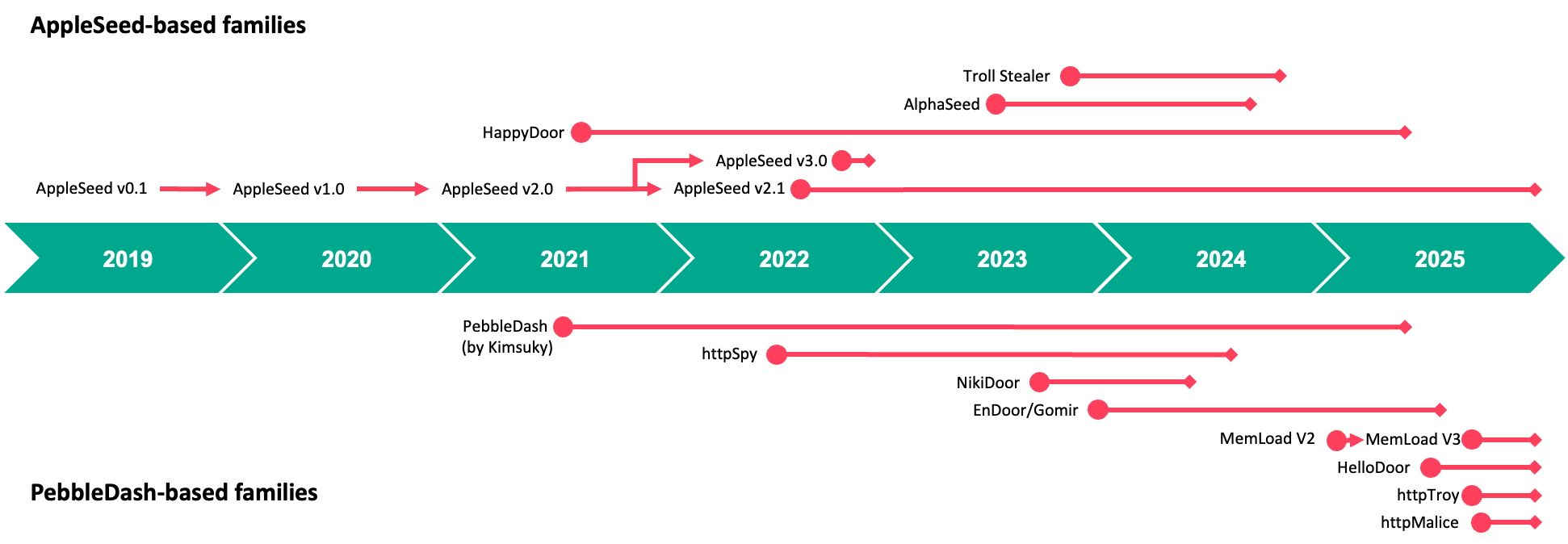
Timeline of the AppleSeed and PebbleDash malware families

AppleSeed and PebbleDash have primarily targeted the public and private sectors in South Korea. The PebbleDash cluster has shown a particular interest in the medical, military and defense industries worldwide. The PebbleDash cluster compromised Brazilian and South Korean defense organizations throughout the past several years, as well as a German defense firm. In 2024, the South Korean government released a security advisory regarding the AppleSeed cluster, detailing how the malware was distributed by replacing a security software installer required to access a construction entity’s website.

Initial access


Kimsuky meticulously crafts and delivers spear-phishing emails to its targets in an attempt to entice them into opening attachments. According to recent research, the group also occasionally approaches targets by contacting them via messengers. In all cases, the initial contact leads to the delivery of a malicious attachment disguised as a document. These attachments often consist of compressed files containing droppers in formats such as .JSE, .EXE, .PIF, or .SCR. The filenames are consistent with the message content and are meant to convince the recipient to open the attachment. The malicious files are often disguised as product quotations, job offers, information guides, surveys, government documents, and personal photos.

Here are some recently discovered examples:

NumberFilenameFilename (translated to English)Detection dateMD5Malware deployed
1[별지 제8호서식] 개인정보(열람 정정삭제 처리정지) 요구서(개인정보 보호법 시행규칙).hwp.jseAppendix Form No. 8 – Request for Access, Correction, Deletion, and Suspension of Processing of Personal Information (PIPA Enforcement Rules).hwp.jseAugust 28, 2025995a0a49ae4b244928b3f67e2bfd7a6eHelloDoor
22026년 상반기 국내대학원 석사야간과정 위탁교육생 선발관련 서류.hwpx.jseDocuments for the Selection of Commissioned Students for Domestic Graduate School Master’s Evening Programs (H1 2026).hwpx.jseDecember 14, 202552f1ff082e981cbdfd1f045c6021c63fhttpMalice
3security_20260126.scrJanuary 26, 202665fc9f06de5603e2c1af9b4f288bb22cReger Dropper, MemLoad, httpTroy
4노현정님.pdf.jseMs. Noh Hyun-jung.pdf.jseJanuary 28, 20268e15c4d4f71bdd9dbc48cd2cabc87806AppleSeed chain
5대국민서비스관리운영체계현장점검증적(초안).pifOn-site Inspection Evidence for the Public Service Management System (Draft).pifFebruary 5, 20268983ffa6da23e0b99ccc58c17b9788c7Pidoc Dropper, HappyDoor

JSE droppers contain a minimum of two Base64-encoded blobs: one serving as a benign lure file and one or more containing malicious code. Additional blobs may exist within the dropper, but they are unused. The two blobs are decoded using JScript and stored in an arbitrary location on disk, such as C:\ProgramData, with the malicious filenames randomly generated according to the scheme [random]{7}.[random]{4}. The lure file is opened immediately. The malicious payload leverages powershell.exe -windowstyle hidden certutil -decode [src path] [dst path] for the second Base64 decoding before execution. Ultimately, the malicious payload is executed via command-line instructions such as regsvr32.exe /s [file path] or rundll32.exe [file path] [export function].

Reger Dropper (.SCR) and Pidoc Dropper (.PIF) also contain benign lure files and malicious payloads that, in both cases, are encrypted using XOR operations. Specifically, Reger Dropper employs a hard-coded key #RsfsetraW#@EsfesgsgAJOPj4eml;, while Pidoc Dropper utilizes single-byte XOR with 0xFF to decrypt the internal data for execution. Pidoc Dropper is fully obfuscated using dummy data and encrypted strings. Both droppers deploy files in specific directories such as %temp% or C:\ProgramData before executing the malware using regsvr32.exe.

In addition to these droppers, Kimsuky employed a variety of executable droppers, including those crafted in Go or packaged with Inno Setup.

Deployed malware


In this section, we describe several malware families recently dropped by the droppers discussed above.

HelloDoor: first Rust-based PebbleDash variant


Written in Rust, a programming language rarely used by Kimsuky, HelloDoor is a DLL-based backdoor first identified in August 2025. It is deployed via a malicious JSE dropper. Since it has limited capabilities and a simplistic communication mechanism, the backdoor is most probably in the early stages of development. Nevertheless, it is noteworthy that HelloDoor employs a C2 server hosted through TryCloudflare, a temporary tunneling service provided by Cloudflare. This service allows users to expose a local web service to the internet with no setup or account, making the infrastructure behind it difficult to trace.

HelloDoor establishes persistence upon execution by registering itself to the HKCU\Software\Microsoft\Windows\CurrentVersion\Run key with the value name tdll and the command regsvr32.exe /s [current file path].

The implant communicates with the C2 server (hxxp://female-disorder-beta-metropolitan.trycloudflare[.]com/index.php) over the HTTP protocol. Depending on whether the process is executing with an elevated token, it binds to a specific local port: 5555 if the token is elevated, or 5554 if not. Before initiating communication, it generates a unique identifier by collecting device information, such as the MAC address, computer name, and the string “windows”, then computes a hash value from this information.

The malware then constructs a query string in the format aaaaaaaaaa=2&bbbbbbbbbb=[the unique identifier]&cccccccccc=1, which is a traditional format used across the PebbleDash cluster. Subsequent server responses are Base64-decoded and then decrypted using RC4 with the key fwr3errsettwererfs. The decrypted content contains command strings. Possible commands are:

CommandDescription
“mcd”Set the current directory
“msleep”Sleep for the provided time
“install”Register the regsvr32.exe /s [the provided file path] command to the HKCU\Software\Microsoft\Windows\CurrentVersion\Run autorun registry using the install value name
[command]Execute the provided command using chcp 65001 > nul & cmd /U /C [command]

Though interesting, it is no longer surprising that we found comments in the code that appear to have been generated by an LLM service rather than a human developer. This is based on traces that include emojis used for logging debugging messages.
✅ Port is now listening (no accepting)
❌ Port is already in use
🔍 regsvr32.exe detected as parent. Attempting to terminate...
This is a common trait of LLM services that provides users with better visibility. We previously observed similar comments in the PowerShell-based stealer suite used by BlueNoroff. HelloDoor’s simple structure and the fact that no other Rust-based malware from the group has been discovered yet support our claim.

Even though the code is believed to have been developed using an LLM service, we still found some typos and grammatical errors, such as:

  • result send fail (grammatically incorrect text)
  • server request fail (grammatically incorrect text)
  • command execute failed (grammatically incorrect text)
  • decrytion failed (typos)
  • autorum failed (typos)

It is likely that the flawed comments were added manually before or after AI was used.

httpMalice: latest backdoor variant of PebbleDash


The latest PebbleDash-based backdoor, httpMalice, emerged no later than December 2025 and is deployed by the JSE Dropper. Although we found limited direct connections to both the AppleSeed and PebbleDash clusters, the malware is closer to PebbleDash. The following shared characteristics have been identified:

  • (PebbleDash cluster) Ability to run commands received from the C2 server with the S-1-12-12288 SID, indicating a high integrity level – a feature also observed in PebbleDash and httpTroy.
  • (PebbleDash cluster) Unique identifier generated by combining the volume serial number of the root directory with the elevation status of the current token, mirroring a technique used since the appearance of NikiDoor.
  • (PebbleDash cluster) Communication with its C2 server utilizing three HTTP parameters, consistent with other PebbleDash-based families.
  • (PebbleDash cluster) Core command set more closely aligned with PebbleDash than with AppleSeed-based malware.
  • (AppleSeed cluster) Use of the m= parameter in C2 communication.
  • (AppleSeed cluster) Gathering system details using PowerShell and Windows commands similar to those found in AppleSeed and Troll Stealer.

Our analysis revealed two distinct versions of httpMalice based on their C2 communications: version 1.9 communicates over HTTP and version 1.8 uses Dropbox. The latter, the older variant, leverages the Dropbox API by utilizing pre-defined application credentials. Unlike its predecessor, the HTTP variant employs HTTP/HTTPS protocols to interact with its C2 server and maintains persistent access to the victim device through a Windows service named CacheDB. This mirrors tactics observed in similar threats, such as httpSpy.

The more recent variant gathers critical information from the compromised system, such as the current directory path, volume serial numbers, user privileges, username, local IP address, and the name and size of the currently executed httpMalice DLL file. It then combines the root drive’s volume serial number with the user’s access token privilege level to create a unique identifier for each infected system, formatted as [volume serial]{8}_[elevation status].

Value of elevation statusDescription
0Running under the SYSTEM account with an elevated token
1Running under an elevated administrator account
2Running without elevation

Depending on the token privilege, the backdoor then establishes persistence by either creating a service or registering itself to autostart at user logon. If the token is elevated, a service named CacheDB is created that executes the command cmd.exe /c “rundll32.exe [current DLL path], load”. The service’s display name is set to Administrator, and its description is defined as CacheDB Service. If the token is not elevated, the backdoor registers the same command under the registry key HKCU\Software\Microsoft\Windows\CurrentVersion\Run with the value name Everything 1.9a-[filesize]. The older version used Everything 1.8a-[filesize] as a value name.

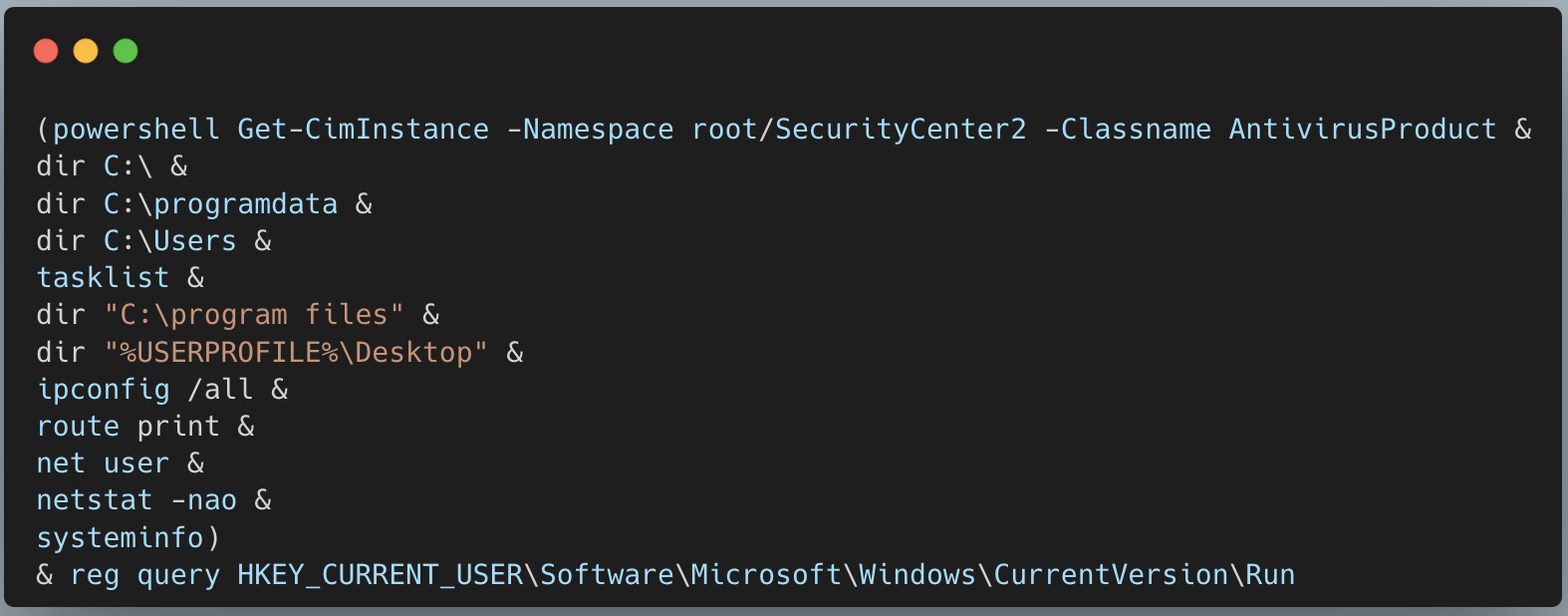
The latest version can execute a combination of Windows commands by default to perform host profiling, while the older version fetches the command set from Dropbox. In httpMalice, commands are mostly executed using the format cmd.exe /c chcp 949 [command] > [temporary filename], which redirects the output to separate files, with the consistent prefix 2Ato6478s added to their names. The chcp 949 command changes the code page to 949, indicating that the malware targets users of the Korean language (EUC-KR charset).

Windows commands used to gather system details

httpMalice transmits the result of host profiling to its C2 server as a URL parameter, using the POST method over the HTTP/HTTPS protocol, with the header x-www-form-urlencoded. The URL includes two or three parameters: operation mode, unique identifier (referred to as UID), and data. The operation mode, or parameter m, supports the following values:

ValueDescription
1Send the session identifier (parameter s) along with the current state (parameter a)
2Request command
3Send result after executing the command (parameter d)
8Request directory to be archived and sent
9Send the archived directory
10Send a message like “.cmd” or “.tmp” (parameter d)
11Send ping
12Send the captured screenshot (parameter d)
13Send the infected device information (parameter d)

As shown in the table above, the mode is set to 13 at the host profiling stage. The UID is formatted as [volume serial]{8}_[elevation status], and the data contains the ChaCha20-encrypted and Base64-encoded output of the command set stored in the temporary file. The resulting URL format is: m=13&u=[volume serial]{8}_[elevation status]&d=[Chacha20 encrypted + Base64-encoded data to be sent].

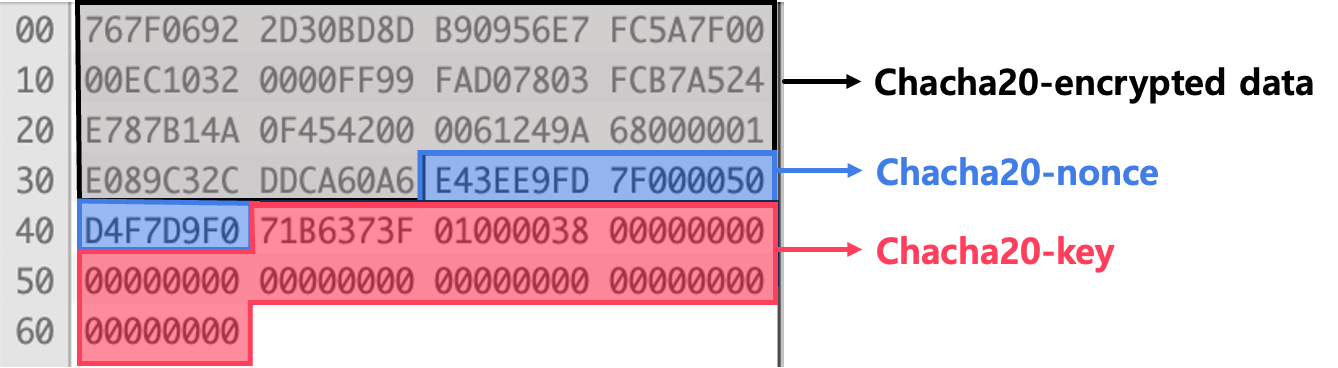
The key and nonce used for ChaCha20 encryption are derived from the pointer address of the buffer, resulting in nearly randomized keys. To ensure proper decryption on the attacker side, the nonce and key values are appended after the encrypted data, and the combined blob is then Base64-encoded. The counter is initialized to 0. The following figure illustrates how the encrypted data is structured after performing Base64 decoding.

Structure of the ChaCha20-encrypted data blob

After sending the host profiling data, the backdoor continuously transmits a screen capture with mode 12 and a ping message with mode 11. Finally, it sends a session identifier, which is a combination of the current username and local IP address separated by an ‘@’ symbol. In this case, the mode is set to 1 and the a parameter (current state) is set to 0, indicating that the C2 operation has been activated. The following table provides other possible values of the a parameter:

ValueDescription
0httpMalice has been activated
1httpMalice has been inactivated (upon command 9)
2httpMalice has been removed (upon command 8)

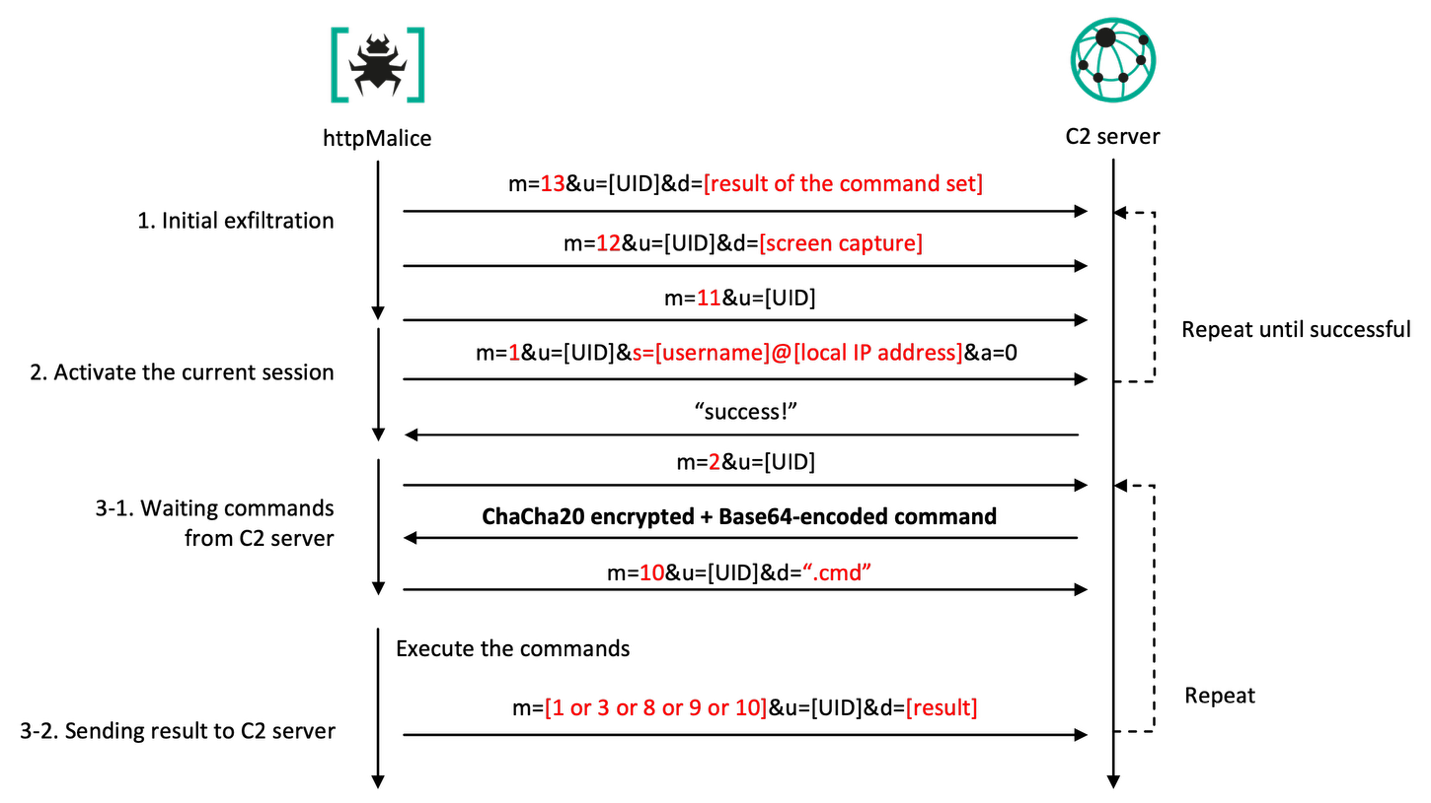
The whole process from sending the host profile to the backdoor activation repeats every two minutes until the C2 server returns a “success!” message.

C2 communication sequence of httpMalice

When the backdoor receives the message from the C2 server, it creates two threads dedicated to processing commands and sending the current state, including the session identifier. The first thread receives a command from the C2 server. It requests a command by sending mode 2 and, if successful, immediately sends mode 10 along with the string “.cmd” in the d parameter.

The commands supported by httpMalice are as follows:

CommandDescription
0Do nothing
1Execute the command with EUC-KR encoding
2Download and extract the file to the infected device
3Upload a directory to the C2 server after it has been archived
5Get the current directory
6Set the current directory
7Execute the command without setting a EUC-KR character set
8Remove its persistence traces and exit the process
9Hibernate
10Execute the command using the provided session ID
12Capture the screen
13Load the downloaded payload into memory

MemLoad downloads httpTroy


Since early 2025, we have observed several versions of MemLoad; specifically, MemLoad V2 emerged in March, and V3 appeared by September. The payload that began being deployed through the Reger Dropper this year has been identified as an updated variant of MemLoad, slightly modified from the V3 version (referred to internally as MemLoader.dll).

Kimsuky leverages MemLoad to evade detection of its final backdoor and to carefully assess the value of targeted systems through anti-VM checks and reconnaissance. Upon installation, it requests an additional payload from the C2 server, executing it reflectively in memory if deemed suitable. Notably, all versions of MemLoad V2 and later use the same RC4 key.

Below are the key operations of MemLoad:

  1. Creates a flag file. Creates a file containing a random eight-character string from the set 0123456789abcdefABCDEF with another random eight-character string as the name and “.dat.cfg” extension at the current file path.
  2. Generates an ID. Generates an ID value by adding either ‘A-‘ or ‘U-‘ to the beginning of the random bytes. The choice of symbol is determined by attempting to create a random file in the C:\Windows\system32 directory. If successful, the ID starts with ‘A-‘ (indicating administrative privileges); otherwise, it starts with ‘U-‘.
  3. Persistence via a scheduled task. Checks for the existence of the .dat.cfg file, and if confirmed, a scheduled task is set up for persistence. The task name is determined by whether the process is running with elevated privileges. If elevated, the task is named ChromeCheck, and the command schtasks/create/tn<task name>/tr"regsvr32 /s <current file path>"/sc minute/mo1/rl highest/f is executed. Otherwise, the task is named EdgeCheck, and the command schtasks/create/tn<task name>/tr"regsvr32 /s <current file path>"/sc minute/mo1/f is executed.
  4. C2 communication and payload download. Requests an additional payload from its C2 server, with the header Authorization: Bearer {ID} or X-Browser-Validation: {ID} for authentication. The ID is set to the previously generated ID value.
  5. Payload decryption and execution. Once the download is successful, the payload is decrypted using the RC4 algorithm with the key #RsfsetraW#@EsfesgsgAJOPj4eml;. The decrypted payload is then reflectively loaded into memory, and its hello export function is invoked.

The payload downloaded and executed by MemLoad is identified as the httpTroy backdoor. This backdoor serves as the primary role for long-term access and data exfiltration. Similar to MemLoad, it employs stealth techniques by creating a flag file and writing eight random bytes to it. However, in this case the file is created at [current file path]:HUI in the ADS (Alternative Data Stream) area. The backdoor then checks its privileges to determine if it is elevated and assigns an ID value in the format A-[random-8-chars] or U-[random-8-chars].

Since Gen Digital covers httpTroy’s features and functionality in detail elsewhere, we will not provide a thorough explanation here to avoid redundancy. Instead, we will simply note that it communicates with the C2 server at hxxps://file.bigcloud.n-e[.]kr/index.php.

AppleSeed


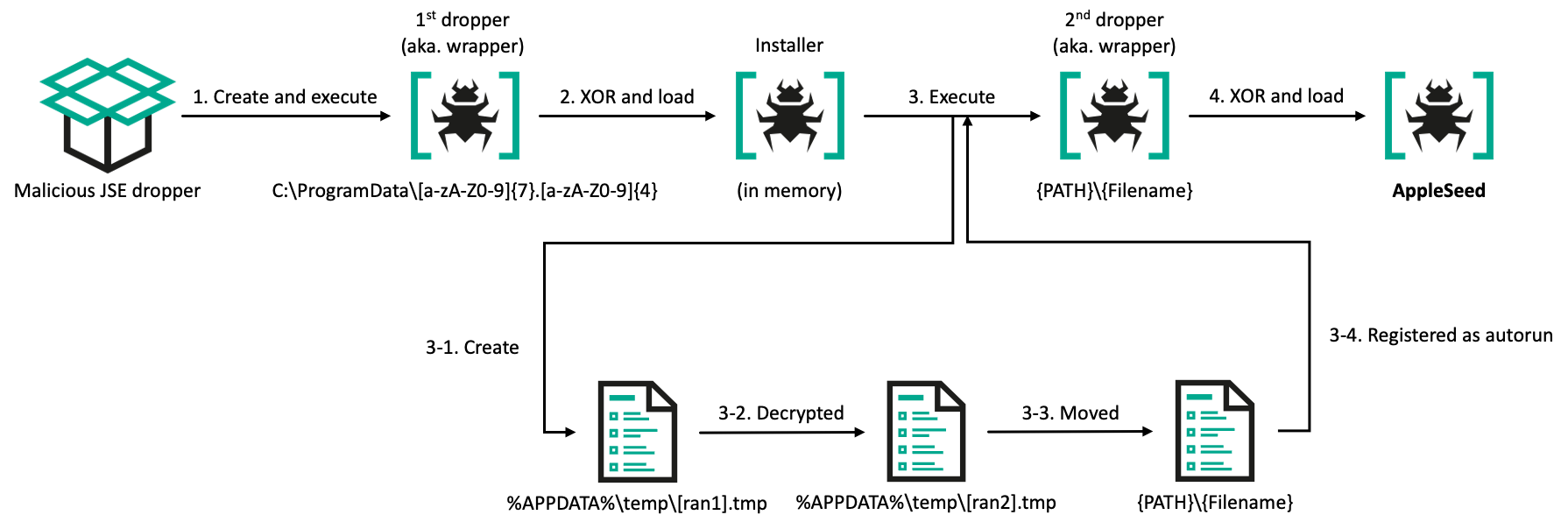
AppleSeed first appeared in 2019 and reached version 3.0. However, we now only see version 2.1. It originally consisted of two components: a dropper and the main AppleSeed. Since 2022, the updated AppleSeed chain has involved two droppers, an additional component referred to as the installer, and the main payload. It is mostly delivered through JSE Dropper.

Updated AppleSeed infection chain

There are two versions of the main AppleSeed: Dropper and Spy. The Dropper variant is responsible for downloading additional malware and executing commands received from its C2 server, while the Spy version gathers sensitive information such as documents, screenshots, keystrokes, and lists of USB drives. A notable change in version 2.1 is the inclusion, since 2022, of collecting the C:\GPKI directory – functionality that is also implemented in Troll Stealer. This directory contains a digital certificate used by the South Korean government to securely authenticate public officials and government systems.

HappyDoor


HappyDoor, an AppleSeed-based backdoor malware disclosed by AhnLab in 2024, is less visible than AppleSeed. HappyDoor shares several features with AppleSeed, including the same string obfuscation algorithm, the data types it collects, and the use of RSA encryption. Given these similarities, we assess with medium confidence that HappyDoor is an advanced variant evolved from AppleSeed.

Post-exploitation


We observed interesting post-exploitation activities involving VSCode and DWAgent. All of the observed VSCode droppers used the same lure files as the PebbleDash malware cluster. While we are unsure of the exact reason for this strategy, we suspect that the actor prepared both PebbleDash and VSCode droppers in anticipation of the PebbleDash infection chain being detected by security products because of its backdoor capabilities. In contrast, the use of VSCode is designed to have fewer detection points.

VSCode (launched by the JSE dropper)


Since last year, Kimsuky has been leveraging the legitimate Visual Studio Code Remote Tunneling feature to establish covert remote access to the victim’s device, bypassing detection designed for traditional malware-based C2 channels (first described by Darktrace researchers). In these attacks, instead of dropping malware, the JSE dropper downloads a legitimate Visual Studio Code (VSCode) CLI onto the infected device. The script establishes persistence by creating a tunnel via the application, with the tunnel name “bizeugene”, using the command below.

The Remote Tunneling feature in VSCode supports establishing a tunnel using either a Microsoft or GitHub account. When the code tunnel command is executed, the CLI initiates an authentication flow and returns a login URL along with a device code. The user must then navigate to the URL, enter the device code, and authenticate with their account. Once authentication is successful, the tunnel is created and the CLI outputs a URL for tunneling that enables browser-based access to the remote host.

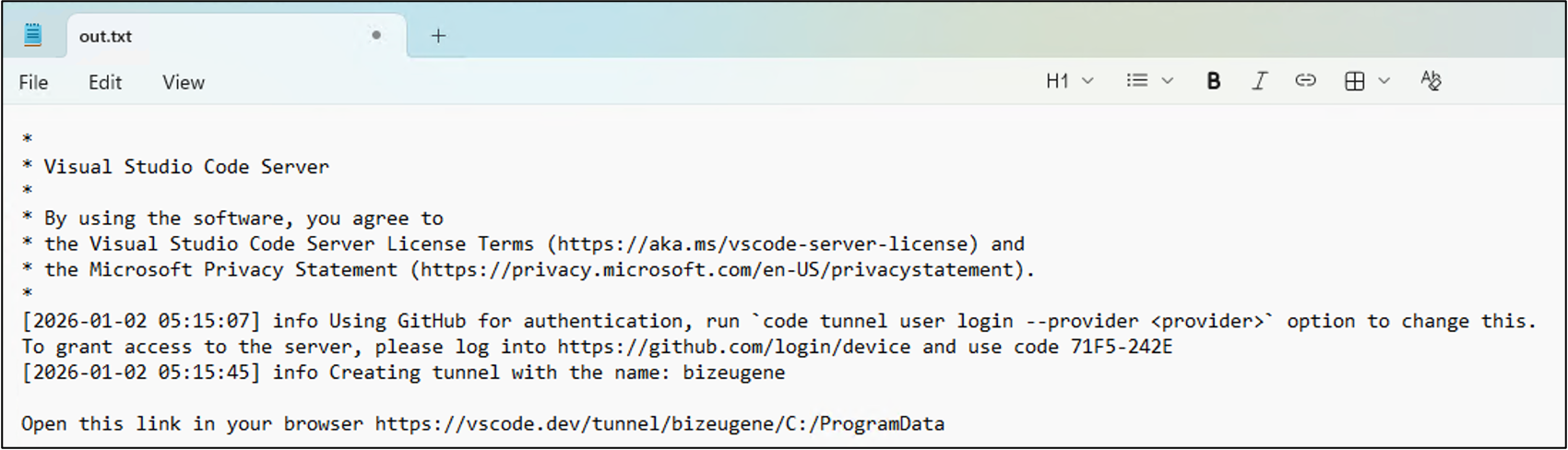
The GitHub authentication method is selected in this instance because GitHub is configured as the default provider in non-interactive execution contexts. By using echo |, the script injects a \r\n (Carriage Return and Line Feed) into the standard input stream, effectively confirming the default prompt selection without manual interaction. As a result, the CLI automatically initiates the GitHub authentication flow. Next, all CLI output that includes a login URL and a device code is saved to out.txt.

Out.txt content
Out.txt content

The JScript code in the JSE dropper monitors the out.txt file for a URL that begins with hxxps://vscode[.]dev/tunnel. This URL contains the full address of the established tunnel. Once detected, the file content containing the URL and the device code is sent to a compromised legitimate South Korean website (hxxps://www.yespp.co[.]kr/common/include/code/out[.]php) using the HTTP POST method. The request contains the file contents in the application/x-www-form-urlencoded header data formatted as out=URLencoded{result of the command}&token=URLencoded{"bizeugene"}. After authentication is complete, the attacker can access the compromised host externally through a web browser by authenticating with their own GitHub account.

VSCode (launched by VSCode installer)


While searching our telemetry for artifacts related to a different infection, we identified a new VSCode tunnel installer written in Go. A previous version of this installer was implemented using JScript and was limited to secure channels because of its reliance on a specific tunnel name. The new variant, named vscode_payload by the developer based on the embedded Go path, is fully operational and supports every tunnel on each targeted device. It includes features that are nearly identical to those of the previous version, such as downloading, unarchiving, and executing the VSCode CLI.

NumberInstaller typeVSCode versionDownload source
1Written in JScriptVSCode CLI 1.106.3hxxps://vscode.download.prss.microsoft[.]com/dbazure/download/stable/bf9252a2fb45be6893dd8870c0bf37e2e1766d61/vscode_cli_win32_x64_cli[.]zip
2Written in GoVSCode CLI 1.106.2hxxps://vscode.download.prss.microsoft[.]com/dbazure/download/stable/1e3c50d64110be466c0b4a45222e81d2c9352888/vscode_cli_win32_x64_cli[.]zip

After the VSCode CLI file has been successfully downloaded, it is unzipped into the C:\Users\Public directory, and the extracted code.exe is executed with the tunnel command.

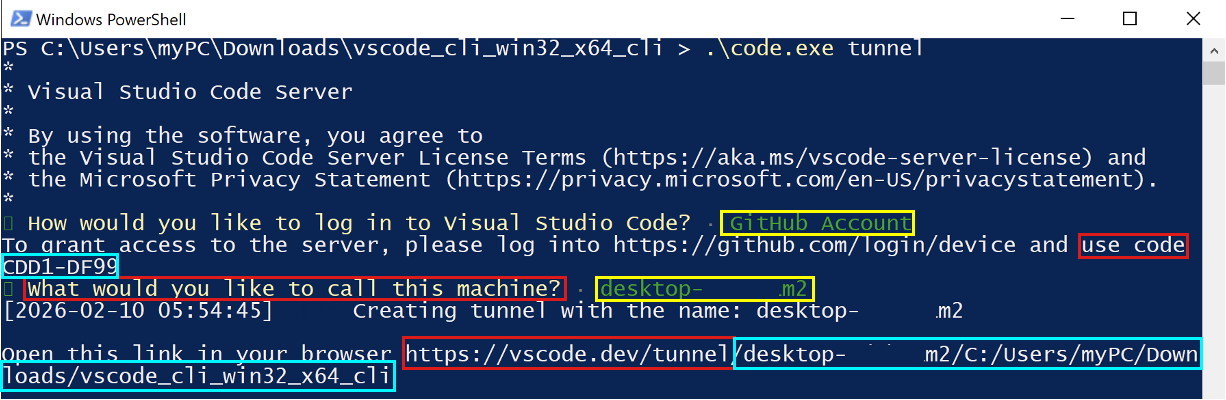
This is how the installer works:

  1. Executes code.exe tunnel.
  2. Searches for the “Microsoft Account” string in the stdout.
  3. Sends the 0x1B 0x5B 0x42 (Down Arrow) and 0x0A (Enter) escape sequence to the pseudo-terminal, which enables tunnel creation via a GitHub account.
  4. Searches for the “use code” string in the stdout.
  5. Sends the printed code for authentication, prepended with the “hxxps://github[.]com/login/device” => prefix. The attacker authorizes Visual Studio Code with the logged-in GitHub account using the printed code.
  6. Searches for the “What would you like to call this machine?” string in the stdout.
  7. Sends the 0x0A escape sequence to the pseudo-terminal to use the current machine name as the identifier.
  8. Searches for the “vscode.dev/tunnel/” string in the stdout.
  9. Sends the printed URL for tunneling to the Slack WebHook.

The following figure illustrates the sequence for creating a tunnel using the VSCode CLI. Red boxes highlight the strings that the installer searches for. Yellow boxes indicate standard input operations sent from the installer using escape sequences. Sky blue boxes represent the values that are necessary to create the tunnel on the attacker’s side. (The “Microsoft Account” string in the second step is not shown in this figure because the second “GitHub Account” was already selected during the process.)

Creating a tunnel using VSCode CLI

Once the process is complete, the attacker can access the targeted host through the tunnel on their remote machine using their GitHub account via a browser or VSCode. The targeted device then begins communicating with Microsoft-owned servers without the user realizing that the communication is from an attacker.

An interesting feature of this variant is that it sends debugging messages and necessary values to a Slack channel via a WebHook. Upon execution, it sends "[strong]+++ I am started +++"[/strong], as well as a heartbeat message "[strong]~~~ I am alive ~~~"[/strong] approximately every second during tunneling authentication.

DWAgent


DWAgent is a remote administration tool that is frequently exploited by threat actors, including ransomware and APT groups, to easily access compromised endpoints with minimal risk of detection. Kimsuky is one of the threat actors that uses this tool in its operations.

We observed that the group delivered DWAgent in at least two ways. The first involved delivering a compressed file containing DWAgent, along with separate commands, to a host infected with httpMalice for installation. The second method involved creating a separate installer.

This installer is very similar to the Reger Dropper. It uses the same RC4 key and has a similar code structure. It includes an archived binary and a legitimate unrar.exe binary, both encrypted with RC4. When executed, the installer decrypts the archived binary and saves it as 1.zip in the C:\ProgramData directory. It also creates an unrar.exe file in the same location using the decrypted unrar.exe binary. The dropper then uses the command C:\programdata\unrar.exe x C:\programdata\1.zip C:\programdata\ to extract the contents of the ZIP file. Finally, it executes the commands necessary to install DWService as a service on the target host:

  • c:\programdata\dwagent\native\dwagsvc.exe installService
  • c:\programdata\dwagent\native\dwagsvc.exe startService

The compressed file contains a pre-packaged, ready-to-use DWAgent, as well as a predefined config file. The actor deployed the agent with a config.json file linked to their own account to covertly control the device. As a result, the remote session is immediately activated by the above command, granting the attacker control.

The predefined config file is as follows. Note that the servers are legitimate DWAgent relay servers.
{
"enabled": true,
"key": "kDRNGmWGTMpjQmREgQzU",
"listen_port": 7950,
"nodes": [
{
"id": "ND896147",
"port": "443",
"server": "node896147.dwservice[.]net"
},
{
"id": "ND828765",
"port": "443",
"server": "node828765.dwservice[.]net"
},
{
"id": "ND484265",
"port": "443",
"server": "node484265.dwservice[.]net"
}
],
"password": "eJwrynEqD0r294twTXLKCHWqDPLPCql0Kg/JDqpIdk4HAKYMCso=",
"url_primary": "hxxps://www.dwservice[.]net/"
}

Infrastructure


For years, Kimsuky has relied heavily on the South Korea-based free domain hosting service 내도메인[.]한국 (pronounced as “naedomain[.]hankook) to mimic legitimate sites with domains like .p-e.kr, .o-r.kr, .n-e.kr, .r-e.kr, and .kro.kr. This service has been utilized to create C2 servers for PebbleDash and AppleSeed clusters, and the background infrastructures have been mostly resolved to the virtual private servers belonging to InterServer. It has also been noted that many other malicious actors have exploited this free domain hosting service, so it alone cannot be considered proof of a connection to Kimsuky.

The actor also occasionally exploits South Korean websites as C2 servers to evade network-IoC-based detection and increase the success rate of attacks. Furthermore, they actively leverage tunneling services such as Cloudflare Quick Tunnels, VSCode Tunneling, and Ngrok to hide their infrastructure. These traits are mostly observed across the PebbleDash cluster.

Victims


We identified multiple infection logs uploaded to the Dropbox storage used for httpMalice’s C2 server. They were analyzed as having been stolen from infected systems across various organizations or individuals in South Korea. Notably, each victim’s folder contained a user.txt file with detailed information such as target details, the presence of something named “http” (possibly a backdoor, such as httpTroy or httpMalice), DWAgent existence, and relationships between infected devices and targets. While we could not verify the exact creation process of these files, they were likely created manually by attackers to manage victims using Korean words.

Below you can see an example of this type of file content. In this context, “장악” means “take over” and “있음” means “exists”.
[Target's name] [Description] [Infection date] 장악, http 있음, DWService 있음.
While both clusters have mainly focused on targeting the private and public sectors in South Korea, the AppleSeed malware cluster shows more interest in government entities. The PebbleDash cluster has also shown particular interest in the defense sector worldwide.

Attribution


Over the past few years, we have observed two clusters using overlapping distribution methods – JSE, EXE, SCR, and PIF droppers. The targets are also increasingly aligning. Furthermore, we noted that several samples from both malware clusters were signed with the same stolen certificate and used identical mutex patterns. These findings suggest that a single actor is likely controlling both clusters and has the capability to modify code as needed. This concept was also described in another research paper at the Virus Bulletin conference.

Since its emergence, AppleSeed has been linked to Kimsuky operations, with each variant showing ties to the group. Since 2021, PebbleDash has been found exclusively in Kimsuky attacks. Based on our analysis of targets, infrastructure, and malware characteristics, we assess with medium-high confidence that attacks associated with these malware families are conducted by Kimsuky-affiliated clusters.

These two clusters share technical links to the threat actor known as Ruby Sleet, one of the names Microsoft uses for Kimsuky activity. In previous reports, Mandiant also referred to these clusters as Cerium, but now they appear to consider them part of the broader APT43 designation – another name for Kimsuky.

Conclusion


Our analysis shows that the actor retains access to the original source code of the malware clusters and the ability to modify it. Over time, malware undergoes updates and modifications, sometimes being repurposed or reused by other actors. Although analyzing malware may seem repetitive and time-consuming, understanding how these tools evolve helps us grasp the threat actor’s changing tactics.

Two clusters have overlapping target sectors that span the defense, military, government, medical, machinery, and energy industries. The AppleSeed cluster is shifting its focus to data exfiltration, and GPKI certificate extraction has become a signature capability. Meanwhile, the PebbleDash cluster demonstrates advanced remote control capabilities and an expanding set of targets.

Although AI may offer full automation for some attacks, many groups stick with the tools and strategies they have used for years. Structuring a fully automated attack is not trivial. Despite ongoing changes, we will continue to track advanced threat actors by comprehensively considering malware, initial vectors, targets, post-exploitation activities, and ultimate goals.

Indicators of compromise

File hashes


JSE Dropper
995a0a49ae4b244928b3f67e2bfd7a6e [별지 제8호서식] 개인정보(열람 정정삭제 처리정지) 요구서(개인정보 보호법 시행규칙).hwp.jse
52f1ff082e981cbdfd1f045c6021c63f 2026년 상반기 국내대학원 석사야간과정 위탁교육생 선발관련 서류.hwpx.jse
9fe43e08c8f446554340f972dac8a68c 2026년 상반기 국내대학원 석사야간과정 위탁교육생 선발관련 서류 (1).hwpx.jse
8e15c4d4f71bdd9dbc48cd2cabc87806 노현정님.pdf.jse

Reger Dropper
65fc9f06de5603e2c1af9b4f288bb22c security_20260126.scr
c19aeaedbbfc4e029f7e9bdface495b9 secu.scr

Pidoc Dropper
8983ffa6da23e0b99ccc58c17b9788c7 대국민서비스관리운영체계_현장점검_증적(초안).pif

AppleSeed (Dropper)
a7f0a18ac87e982d6f32f7a715e12532
f4465403f9693939fe9c439f0ab33610
5c373c2116ab4a615e622f577e22e9be

HappyDoor
d1ec20144c83bba921243e72c517da5e

MemLoad
58ac2f65e335922be3f60e57099dc8a3
f73ba062116ea9f37d072aa41c7f5108 jhsakqvv.dat

httpTroy
7e0825019d0de0c1c4a1673f94043ddb c:\programdata\config.db

httpMalice
08160acf08fccecde7b34090db18b321
94faed9af49c98a89c8acc55e97276c9

HelloDoor
c42ae004badddd3017adadbdd1421e00

VSCode Tunnel installer
9ca5f93a732f404bbb2cee848f5bbda0 xipbkmaw.exe

DWAgent installer
678fb1a87af525c33ba2492552d5c0e2

Domains and IPs


opedromos1.r-e[.]kr C2 of AppleSeed
morames.r-e[.]kr C2 of AppleSeed
load.ssangyongcne.o-r[.]kr C2 of MemLoad
load.yju.o-r[.]kr C2 of MemLoad
attach.docucloud.o-r[.]kr C2 of MemLoad
load.supershop.o-r[.]kr C2 of MemLoad
load.erasecloud.n-e[.]kr C2 of MemLoad

cms.spaceyou.o-r[.]kr C2 of HappyDoor
erp.spaceme.p-e[.]kr C2 of HappyDoor

file.bigcloud.n-e[.]kr C2 of httpTroy
load.auraria[.]org C2 of httpTroy

female-disorder-beta-metropolitan.trycloudflare[.]com C2 of HelloDoor
hxxps://www.pyrotech.co[.]kr/common/include/tech/default.php C2 of httpMalice
hxxp://newjo-imd[.]com/common/include/library/default.php C2 of httpMalice
hxxps://www.yespp.co[.]kr/common/include/code/out.php VSCode Tunneling using JScript


securelist.com/kimsuky-applese…

British Street Addresses, When Licenses Collide


The media in this post is not displayed to visitors. To view it, please log in.

The world of open source — and in particular open source licenses — is something we cover regularly here at Hackaday with respect to hardware and software, but it’s not so often we find open source data stories. Today’s case of the open British address data then is a bit of an outlier, but it may have implications for open source data further than British counties.

UK government data is released under the Open Government Licence, which is why we Brits can peer into all sorts of datasets our taxes paid for. This includes data from local government, so English counties release data sets of local addresses as part of their auditing of council taxes under the licence.
This is a picture of Barbra Streisand, who might almost be the patron saint of unintended consequences. Unknown author / Public domainThis is a picture of Barbra Streisand, the patron saint of unintended consequences.
[Owen Boswarva] has been collating these databases in order to produce a national open source address database, but has found himself at the receiving end of a legal threat from the Ordnance Survey, the UK mapping agency. They claim the data is theirs, not open.

British address data is in a sense open to all, in that there’s nothing to stop anyone walking down Acacia Avenue and noting the position of Number 1, Number 2, Number 3, and so on. This is what happened with OpenStreetMap worldwide, as people with GPS devices contributed their data and mapped the UK and everywhere else. The Ordnance Survey used to have a nice little earner charging top dollar for UK geospatial data which has been slashed by the arrival of OpenStreetMap, and we’re guessing that the prospect of losing another income stream to an open source equivalent has them worried.

The question of whether the councils should have released the data is one which will no doubt be settled at some point by the courts, and [Owen] goes into some detail on the subject in his analysis. There’s a good case to be made that the mapping agency are pushing it a little, but whatever the outcome it could set a dangerous precedent for open source data. We’ll keep you posted if there’s more on this story.


British street: Bill Harrison, CC BY-SA 2.0

Barbra Streisand: Unknown author, Public domain


hackaday.com/2026/05/14/britis…

Cybersecurity & cyberwarfare ha ricondiviso questo.

Fragnesia, la nuova falla nel kernel Linux che regala privilegi di root: come difendersi


@Informatica (Italy e non Italy)
Una terza vulnerabilità critica in meno di tre settimane colpisce il kernel Linux. Fragnesia consente a qualsiasi utente locale senza privilegi di ottenere accesso root corrompendo la page cache del kernel. Il PoC è già pubblico. Ecco

Cybersecurity & cyberwarfare ha ricondiviso questo.

The media in this post is not displayed to visitors. To view it, please go to the original post.

ClickFix Evolves: Attackers Combine Social Engineering With Decade-Old PySoxy SOCKS5 Proxy for Persistent Access
#CyberSecurity
securebulletin.com/clickfix-ev…
Cybersecurity & cyberwarfare ha ricondiviso questo.

The media in this post is not displayed to visitors. To view it, please go to the original post.

Gli hacker hanno il pollice verde! I tosaerba della Yarbo sono stati compromessi da remoto

📌 Link all'articolo : redhotcyber.com/post/hacker-co…

A cura di Bajram Zeqiri

#redhotcyber #news #cybersecurity #hacking #robot #giardinaggio #pulizia #vulnerabilita

reshared this

Cybersecurity & cyberwarfare ha ricondiviso questo.

The media in this post is not displayed to visitors. To view it, please go to the original post.

Critical Exim Vulnerability (EXIM-Security-2026-05-01.1): Remote Code Execution via GnuTLS BDAT Flaw — Patch Now
#CyberSecurity
securebulletin.com/critical-ex…
Cybersecurity & cyberwarfare ha ricondiviso questo.

The media in this post is not displayed to visitors. To view it, please go to the original post.

CVE-2026-32185: Microsoft Teams for Android Vulnerability Enables Local Spoofing Attacks — Patch Available
#CyberSecurity
securebulletin.com/cve-2026-32…
Cybersecurity & cyberwarfare ha ricondiviso questo.

The media in this post is not displayed to visitors. To view it, please go to the original post.

Threads, il social che ti molesta: benvenuti in FFF, il Finto Fediverso di Facebook (e non provate a uscire)

Se mai ci dovessimo dimenticare di quanto è squallido Threads, la realtà ce lo ricorda puntualmente...

informapirata.it/2026/05/14/th…

@fediverso


Threads, il social che ti molesta: benvenuti in FFF, il Finto Fediverso di Facebook (e non provate a uscire)

Se mai ci dovessimo dimenticare di quanto è squallido Threads, la realtà ce lo ricorda puntualmente…
informapirata.it/2026/05/14/th…


Cybersecurity & cyberwarfare ha ricondiviso questo.

Sacrifici umani propiziatori: per celebrare margine e fatturato record nel 3° trim 2026, Cisco taglia 4.000 persone che Chuck Robbins in persona ringrazia per il contributo

Ma almeno non ha usato la solita scusa della IA...

"A coloro che lasciano Cisco, grazie per il vostro contributo, la vostra dedizione e il segno che avete lasciato in questa azienda. Siamo profondamente grati"

blogs.cisco.com/news/our-path-…

@lavoro

Cybersecurity & cyberwarfare ha ricondiviso questo.

The media in this post is not displayed to visitors. To view it, please go to the original post.

Foxconn Confirms Cyberattack: Nitrogen Ransomware Gang Claims 8TB Stolen From North American Plants
#CyberSecurity
securebulletin.com/foxconn-con…
Cybersecurity & cyberwarfare ha ricondiviso questo.

#FamousSparrow targets #Azerbaijani energy sector in multi-wave espionage campaign
securityaffairs.com/192113/apt…
#securityaffairs #hacking
Cybersecurity & cyberwarfare ha ricondiviso questo.

The media in this post is not displayed to visitors. To view it, please go to the original post.

Se vuoi guardare contenuti per Adulti nel Regno Unito compra un iPhone

📌 Link all'articolo : redhotcyber.com/post/se-vuoi-g…

A cura di Carolina Vivianti

#redhotcyber #news #accessoaios #appleverificaeta #aylo #ios #regnounito #sicurezzainternet

LiDAR Matrix Sensor Sees in 3D


The media in this post is not displayed to visitors. To view it, please log in.

[Mellow_Labs] picked up a few LiDAR matrix sensors and found them very exciting. While a normal time-of-flight sensor can accurately determine a range, the matrix sensor is like an array of 64 sensors that can build a 2D map of distances from 2 cm to 3.5 m. [Mellow] wanted to add the sensor to his robot to help it see what was in front of it. You can see how it worked out in the video below.

The robot in question is Zippy, a 3D printed tank-like robot with an ESP32. By default, the robot requires control inputs, but using the sensor will enable autonomous operation. For good or ill, the sensor mounted to Zippy was seeing the floor with about half of the rows. That means about 50% of the data went to waste. However, we think having a robot be able to see the floor in front of it might be a good thing.

[Mellow] used an LLM to write most of the code, so there were a number of iterations required to get things working. This required decimating even more of the data from the sensor. Still, pretty impressive.

Want to learn more about ToF sensors? Or if you want to focus on the practical, there’s code you can borrow.

youtube.com/embed/FyJQ0Z0wMtk?…


hackaday.com/2026/05/14/lidar-…

Cybersecurity & cyberwarfare ha ricondiviso questo.

The media in this post is not displayed to visitors. To view it, please go to the original post.

309 – Italia prima in Europa sui profili AI camisanicalzolari.it/309-itali…
Cybersecurity & cyberwarfare ha ricondiviso questo.

#Nitrogen #Ransomware claims massive data theft from #Foxconn
securityaffairs.com/192099/unc…
#securityaffairs #hacking
Cybersecurity & cyberwarfare ha ricondiviso questo.

The media in this post is not displayed to visitors. To view it, please go to the original post.

Nuovo allarme Fortinet: gli hacker possono eseguire RCE senza autenticazione

📌 Link all'articolo : redhotcyber.com/post/nuovo-all…

A cura di Luca Galuppi del gruppo DarkLab

#redhotcyber #news #cybersecurity #hacking #vulnerabilita #fortinet #fortiauthenticator

Cybersecurity & cyberwarfare ha ricondiviso questo.

The media in this post is not displayed to visitors. To view it, please go to the original post.

🚀 Gli speaker della RHC Conference 2026

📍𝗤𝘂𝗮𝗻𝗱𝗼: Martedì 19 Maggio con ingresso dalle ore 8:45
📍𝗗𝗼𝘃𝗲: Teatro Italia, Via Bari 18, Roma (Metro Piazza Bologna)
📍𝗣𝗿𝗼𝗴𝗿𝗮𝗺𝗺𝗮: redhotcyber.com/linksSk2L/prog…
📍𝗜𝘀𝗰𝗿𝗶𝘇𝗶𝗼𝗻𝗲 conferenza di Martedì 19 Maggio: rhc-conference-2026.eventbrite…

#redhotcyber #rhcconference #conferenza #informationsecurity #ethicalhacking #dataprotection

Cybersecurity & cyberwarfare ha ricondiviso questo.

The media in this post is not displayed to visitors. To view it, please go to the original post.

DRIFT Linux: la distribuzione italiana per Incident Response e Digital Forensics

📌 Link all'articolo : redhotcyber.com/post/drift-lin…

A cura di Massimiliano Dal Cero

#redhotcyber #news #driftlinux #digitalforensics #incidentresponse #cybersecurity #linux

reshared this

Testing Giant Fire Darts from the Mary Rose


The media in this post is not displayed to visitors. To view it, please log in.


Fire arrow versus the recreated fire dart. (Credit: Tod's Workshop, YouTube)Fire arrow versus the recreated fire dart. (Credit: Tod’s Workshop, YouTube)
The Mary Rose was a carrack in the English Tudor Navy of King Henry VIII that fought in multiple battles during the 16th century before it was sunk in 1545. After its wreck was located in 1971 and raised in 1982 the ship and all the items contained within the partially preserved hull became the focus of intense study. Among these items are the weaponry found, including the canons, but also massive darts that seemed to have been designed for an incendiary payload. Recently [Tod’s Workshop] collaborated with others to test these presumed incendiary darts.

Although fire arrows have been around for a while, seeing what appears to be super-sized versions of these is somewhat unusual, but could make sense in taking out enemy ships of the time. The main questions are how you would even fire them, and how effective they would be. Were the darts thrown by hand from e.g. the crow’s nest, or fired from a canon?

The reproduction darts used are based on the recovered remnants of the original darts, with an incendiary mixture inside a pitch-covered cloth covering. This mixture would be ignited by wooden fuses after a set amount of time, at which point the resulting fire would be basically impossible to put out. Obviously, this also means that if you were to throw one of these darts, it can absolutely not fall onto your own ship.

First tested was throwing the dart by hand, which seems like it would clear the ship. Of course, the three recovered darts were found near a rather special canon that appeared to be both a miscast and angled upwards. Whether that canon was used for launching apparently somewhat experimental darts is hard to say, but it can be tested. Sadly, lacking a full-sized black powder canon a scale model dart was fired using compressed air.

From that scale test it’s clear that at full charge the dart would disintegrate due to the rapid acceleration, but a ‘soft’, or reduced, charge could work against nearby targets. Once the dart lodges itself into the enemy ship’s structure, it would definitely cause severe damage as further tests in the video demonstrate. Having a salvo of these fire darts fired at you from a nearby ship would definitely make for a pretty bad day.

youtube.com/embed/_c6LyEH8RD8?…


hackaday.com/2026/05/13/testin…

Cybersecurity & cyberwarfare ha ricondiviso questo.

The media in this post is not displayed to visitors. To view it, please go to the original post.

170.000 dollari per uno Zero-Day LPE su Linux in vendita del Dark Web

📌 Link all'articolo : redhotcyber.com/post/in-vendit…

A cura di Raffaela Crisci del gruppo DarkLab

#redhotcyber #news #cybersecurity #hacking #linux #zeroday #lpe #darkweb #sicurezzainformatica

reshared this

How Did Apollo Separate?


The media in this post is not displayed to visitors. To view it, please log in.

If you’ve watched a Saturn V launch, you’ve probably seen how a large rocket will often jettison a stage on the way up. There are several reasons for this — there is no reason to haul an empty fuel container, for example. However, you can probably imagine how the separation works. You release something — probably explosive bolts — and gravity pulls the old stage away from you as you climb on the next stage’s engines. But what about on the way back? The command module drops the service module before reentry. [Apollo11Space] has a video explaining just how complicated that was to pull off. You can watch it below.

The main problem? The service module has almost everything you need: oxygen, a big engine, fuel, and electrical generation capability. If you’ve ever seen a real command module, they are tiny. Somehow, you need to get the command module prepared to be on its own for the amount of time it takes to land, and get the service module safely away.

In orbit, gravity isn’t a big help in pulling the two pieces apart. For that reason, the mission design called for a very specific orientation for the separation. There are a number of other details you might not have known about.

Landing Apollo 11 successfully depended on some spy tech. We imagine the separation of the LEM had some similar issues, although even the moon’s weak gravity would have helped.

youtube.com/embed/jcC0ddrI2zQ?…


hackaday.com/2026/05/13/how-di…

Cybersecurity & cyberwarfare ha ricondiviso questo.

The media in this post is not displayed to visitors. To view it, please go to the original post.

The media in this post is not displayed to visitors. To view it, please go to the original post.

GitLab Act 2: il manifesto dell’AI agentica che promette il futuro e inquieta gli sviluppatori
#CyberSecurity
insicurezzadigitale.com/gitlab…


GitLab Act 2: il manifesto dell’AI agentica che promette il futuro e inquieta gli sviluppatori


Quando una piattaforma DevSecOps da miliardi di dollari decide di riscrivere la propria identità attorno agli agenti AI, non sta semplicemente annunciando una nuova roadmap di prodotto. Sta dichiarando che il modello stesso di sviluppo software che abbiamo conosciuto negli ultimi vent’anni è destinato a diventare obsoleto.

È questo il messaggio reale dietro GitLab Act 2, il lungo manifesto pubblicato da GitLab per spiegare la trasformazione interna dell’azienda nell’era dell’AI agentica. Un documento che, più che un post corporate, assomiglia a una dottrina industriale: il software costerà sempre meno produrlo, gli sviluppatori diventeranno supervisori di sistemi autonomi e le organizzazioni dovranno ripensare completamente struttura, processi e ruoli.

Il problema è che, dietro la retorica della “nuova era”, molti sviluppatori vedono qualcosa di molto diverso: una drastica razionalizzazione aziendale mascherata da inevitabile rivoluzione tecnologica.

La tesi di GitLab: il software sarà scritto dalle macchine


Nel manifesto, GitLab sostiene che l’AI generativa stia comprimendo il costo marginale della produzione software in modo paragonabile a quanto avvenuto nell’industria manifatturiera con l’automazione. La conseguenza, secondo l’azienda, non sarà una riduzione della domanda di software ma l’opposto: un’esplosione.

Se creare applicazioni diventa più economico, ogni azienda produrrà più software, più automazione, più integrazioni e più servizi interni. In questo scenario, il valore umano non sarà più nella scrittura manuale del codice ma nella definizione degli obiettivi, nella governance, nella sicurezza e nella supervisione degli agenti AI.

È una narrativa ormai dominante nella Silicon Valley: gli sviluppatori non spariranno, ma evolveranno in orchestratori di sistemi autonomi.

GitLab vuole posizionarsi esattamente al centro di questa transizione con la propria piattaforma “Duo Agent Platform”, immaginata come un layer operativo in cui agenti AI collaborano lungo l’intero ciclo DevSecOps: pianificazione, sviluppo, code review, security scanning, remediation, test e deployment.

Non più copiloti. Non più semplici assistenti. Ma entità autonome capaci di eseguire task complessi all’interno delle pipeline.

La ristrutturazione interna è il vero cuore del manifesto


La parte più interessante del documento non è però tecnologica. È organizzativa.

GitLab annuncia infatti una profonda trasformazione della propria struttura interna. L’azienda parla apertamente di riduzione dei livelli manageriali, team più piccoli e autonomi, maggiore automazione operativa e integrazione massiccia dell’AI nei processi decisionali.

I gruppi R&D verranno suddivisi in circa 60 unità snelle, progettate per muoversi più rapidamente e lavorare in parallelo insieme agli agenti AI. Nel manifesto si percepisce chiaramente un’influenza delle metodologie “founder mode” e delle moderne filosofie ultra-efficientiste adottate da molte aziende AI-first.

Tradotto dal linguaggio corporate: meno coordinamento umano, meno middle management e più automazione decisionale.

Ed è qui che la community ha iniziato a reagire in modo estremamente critico.

La critica principale: “state inseguendo l’hype”


Molti sviluppatori hanno interpretato Act 2 come il segnale definitivo che GitLab stia inseguendo il trend AI sacrificando progressivamente gli elementi che l’avevano resa popolare nella community engineering.

Nel forum ufficiale e su diverse discussioni tecniche, il malcontento è emerso rapidamente. Alcuni utenti accusano GitLab di aver trasformato la piattaforma in un contenitore di feature AI ancora immature mentre problemi storici di UX, performance e stabilità rimangono irrisolti.

Il timore più diffuso è che l’azienda stia vendendo una visione futuristica molto più avanzata della realtà tecnica attuale.

Ed effettivamente esiste un forte scollamento tra la narrativa dell’AI agentica e lo stato reale degli LLM moderni.

Per quanto impressionanti, gli agenti AI soffrono ancora problemi enormi in contesti enterprise:

  • perdita di contesto su codebase estese;
  • hallucinations in scenari complessi;
  • incapacità di ragionamento affidabile multi-step;
  • difficoltà nel comprendere architetture legacy;
  • fragilità nelle decisioni di sicurezza;
  • dipendenza da prompt engineering estremamente fragile.

Nel mondo DevSecOps questi limiti non sono marginali. Sono potenzialmente catastrofici.

Automatizzare una pipeline CI/CD è relativamente semplice. Delegare ad agenti AI remediation di vulnerabilità, code review o decisioni infrastrutturali in ambienti enterprise è un’altra storia.

Soprattutto quando si parla di sicurezza.

Il nodo cybersecurity: chi valida l’agente?


Dal punto di vista della cybersecurity, il manifesto di GitLab apre questioni enormi che nel documento vengono affrontate solo superficialmente.

Se gli agenti AI diventano parte attiva della supply chain software, diventano automaticamente anche una nuova superficie d’attacco.

Un agente che modifica codice, approva merge request o interagisce con pipeline CI/CD introduce rischi completamente nuovi:

  • prompt injection nei workflow DevOps;
  • poisoning dei contesti RAG;
  • manipolazione degli agenti tramite issue o commenti malevoli;
  • escalation di privilegi attraverso tool integration;
  • generazione di codice vulnerabile apparentemente corretto;
  • supply chain compromise mediata da AI.

La community security sta già osservando casi concreti di agenti AI manipolabili tramite input indiretti, specialmente quando connessi a repository, ticketing system o documentazione interna.

In pratica, il problema non è più soltanto “il codice è vulnerabile?”, ma anche:

“l’agente che ha preso la decisione era affidabile?”

È una differenza enorme.

GitLab sembra convinta che governance e supervisione umana saranno sufficienti a mitigare questi rischi. Ma molti esperti ritengono che l’industria stia sottovalutando drasticamente la complessità della sicurezza negli ecosistemi agentici.

Il sottotesto economico: fare di più con meno persone


C’è poi un altro elemento che ha generato parecchio nervosismo: il sospetto che “Act 2” sia soprattutto un piano di efficientamento.

Nel manifesto, GitLab evita accuratamente toni allarmistici sui posti di lavoro, ma il messaggio implicito è difficile da ignorare. Se gli agenti AI aumentano drasticamente la produttività, le aziende avranno bisogno di meno persone per svolgere gli stessi task.

Molti hanno letto il documento come la formalizzazione di una tendenza già evidente nel settore tech: usare l’AI come leva per comprimere organici, ridurre management intermedio e aumentare output per dipendente.

Ed è qui che la narrativa “visionaria” inizia a somigliare a qualcosa di molto più concreto: una ridefinizione radicale del rapporto tra capitale umano e automazione nel software engineering.

Un manifesto che racconta il futuro del settore


Al di là dell’hype e delle critiche, GitLab Act 2 resta un documento importante perché fotografa perfettamente il momento storico dell’industria software.

Per la prima volta una grande piattaforma DevSecOps non presenta l’AI come una feature aggiuntiva, ma come il fondamento operativo attorno a cui ridisegnare un’intera azienda.

La vera domanda non è se GitLab riuscirà o meno nella trasformazione.

La domanda è quante altre aziende seguiranno lo stesso modello nei prossimi 24 mesi.

Perché se Act 2 dovesse diventare il template organizzativo dell’era agentica, il cambiamento non riguarderà soltanto il modo in cui scriviamo codice.

Riguarderà il modo in cui verranno costruite le aziende tecnologiche stesse.


Cybersecurity & cyberwarfare ha ricondiviso questo.

The media in this post is not displayed to visitors. To view it, please log in.

GitLab Act 2: il manifesto dell’AI agentica che promette il futuro e inquieta gli sviluppatori


@Informatica (Italy e non Italy)
Quando una piattaforma DevSecOps da miliardi di dollari decide di riscrivere la propria identità attorno agli agenti AI, non sta semplicemente annunciando una nuova roadmap di prodotto. Sta dichiarando che il modello stesso di


GitLab Act 2: il manifesto dell’AI agentica che promette il futuro e inquieta gli sviluppatori


Quando una piattaforma DevSecOps da miliardi di dollari decide di riscrivere la propria identità attorno agli agenti AI, non sta semplicemente annunciando una nuova roadmap di prodotto. Sta dichiarando che il modello stesso di sviluppo software che abbiamo conosciuto negli ultimi vent’anni è destinato a diventare obsoleto.

È questo il messaggio reale dietro GitLab Act 2, il lungo manifesto pubblicato da GitLab per spiegare la trasformazione interna dell’azienda nell’era dell’AI agentica. Un documento che, più che un post corporate, assomiglia a una dottrina industriale: il software costerà sempre meno produrlo, gli sviluppatori diventeranno supervisori di sistemi autonomi e le organizzazioni dovranno ripensare completamente struttura, processi e ruoli.

Il problema è che, dietro la retorica della “nuova era”, molti sviluppatori vedono qualcosa di molto diverso: una drastica razionalizzazione aziendale mascherata da inevitabile rivoluzione tecnologica.

La tesi di GitLab: il software sarà scritto dalle macchine


Nel manifesto, GitLab sostiene che l’AI generativa stia comprimendo il costo marginale della produzione software in modo paragonabile a quanto avvenuto nell’industria manifatturiera con l’automazione. La conseguenza, secondo l’azienda, non sarà una riduzione della domanda di software ma l’opposto: un’esplosione.

Se creare applicazioni diventa più economico, ogni azienda produrrà più software, più automazione, più integrazioni e più servizi interni. In questo scenario, il valore umano non sarà più nella scrittura manuale del codice ma nella definizione degli obiettivi, nella governance, nella sicurezza e nella supervisione degli agenti AI.

È una narrativa ormai dominante nella Silicon Valley: gli sviluppatori non spariranno, ma evolveranno in orchestratori di sistemi autonomi.

GitLab vuole posizionarsi esattamente al centro di questa transizione con la propria piattaforma “Duo Agent Platform”, immaginata come un layer operativo in cui agenti AI collaborano lungo l’intero ciclo DevSecOps: pianificazione, sviluppo, code review, security scanning, remediation, test e deployment.

Non più copiloti. Non più semplici assistenti. Ma entità autonome capaci di eseguire task complessi all’interno delle pipeline.

La ristrutturazione interna è il vero cuore del manifesto


La parte più interessante del documento non è però tecnologica. È organizzativa.

GitLab annuncia infatti una profonda trasformazione della propria struttura interna. L’azienda parla apertamente di riduzione dei livelli manageriali, team più piccoli e autonomi, maggiore automazione operativa e integrazione massiccia dell’AI nei processi decisionali.

I gruppi R&D verranno suddivisi in circa 60 unità snelle, progettate per muoversi più rapidamente e lavorare in parallelo insieme agli agenti AI. Nel manifesto si percepisce chiaramente un’influenza delle metodologie “founder mode” e delle moderne filosofie ultra-efficientiste adottate da molte aziende AI-first.

Tradotto dal linguaggio corporate: meno coordinamento umano, meno middle management e più automazione decisionale.

Ed è qui che la community ha iniziato a reagire in modo estremamente critico.

La critica principale: “state inseguendo l’hype”


Molti sviluppatori hanno interpretato Act 2 come il segnale definitivo che GitLab stia inseguendo il trend AI sacrificando progressivamente gli elementi che l’avevano resa popolare nella community engineering.

Nel forum ufficiale e su diverse discussioni tecniche, il malcontento è emerso rapidamente. Alcuni utenti accusano GitLab di aver trasformato la piattaforma in un contenitore di feature AI ancora immature mentre problemi storici di UX, performance e stabilità rimangono irrisolti.

Il timore più diffuso è che l’azienda stia vendendo una visione futuristica molto più avanzata della realtà tecnica attuale.

Ed effettivamente esiste un forte scollamento tra la narrativa dell’AI agentica e lo stato reale degli LLM moderni.

Per quanto impressionanti, gli agenti AI soffrono ancora problemi enormi in contesti enterprise:

  • perdita di contesto su codebase estese;
  • hallucinations in scenari complessi;
  • incapacità di ragionamento affidabile multi-step;
  • difficoltà nel comprendere architetture legacy;
  • fragilità nelle decisioni di sicurezza;
  • dipendenza da prompt engineering estremamente fragile.

Nel mondo DevSecOps questi limiti non sono marginali. Sono potenzialmente catastrofici.

Automatizzare una pipeline CI/CD è relativamente semplice. Delegare ad agenti AI remediation di vulnerabilità, code review o decisioni infrastrutturali in ambienti enterprise è un’altra storia.

Soprattutto quando si parla di sicurezza.

Il nodo cybersecurity: chi valida l’agente?


Dal punto di vista della cybersecurity, il manifesto di GitLab apre questioni enormi che nel documento vengono affrontate solo superficialmente.

Se gli agenti AI diventano parte attiva della supply chain software, diventano automaticamente anche una nuova superficie d’attacco.

Un agente che modifica codice, approva merge request o interagisce con pipeline CI/CD introduce rischi completamente nuovi:

  • prompt injection nei workflow DevOps;
  • poisoning dei contesti RAG;
  • manipolazione degli agenti tramite issue o commenti malevoli;
  • escalation di privilegi attraverso tool integration;
  • generazione di codice vulnerabile apparentemente corretto;
  • supply chain compromise mediata da AI.

La community security sta già osservando casi concreti di agenti AI manipolabili tramite input indiretti, specialmente quando connessi a repository, ticketing system o documentazione interna.

In pratica, il problema non è più soltanto “il codice è vulnerabile?”, ma anche:

“l’agente che ha preso la decisione era affidabile?”

È una differenza enorme.

GitLab sembra convinta che governance e supervisione umana saranno sufficienti a mitigare questi rischi. Ma molti esperti ritengono che l’industria stia sottovalutando drasticamente la complessità della sicurezza negli ecosistemi agentici.

Il sottotesto economico: fare di più con meno persone


C’è poi un altro elemento che ha generato parecchio nervosismo: il sospetto che “Act 2” sia soprattutto un piano di efficientamento.

Nel manifesto, GitLab evita accuratamente toni allarmistici sui posti di lavoro, ma il messaggio implicito è difficile da ignorare. Se gli agenti AI aumentano drasticamente la produttività, le aziende avranno bisogno di meno persone per svolgere gli stessi task.

Molti hanno letto il documento come la formalizzazione di una tendenza già evidente nel settore tech: usare l’AI come leva per comprimere organici, ridurre management intermedio e aumentare output per dipendente.

Ed è qui che la narrativa “visionaria” inizia a somigliare a qualcosa di molto più concreto: una ridefinizione radicale del rapporto tra capitale umano e automazione nel software engineering.

Un manifesto che racconta il futuro del settore


Al di là dell’hype e delle critiche, GitLab Act 2 resta un documento importante perché fotografa perfettamente il momento storico dell’industria software.

Per la prima volta una grande piattaforma DevSecOps non presenta l’AI come una feature aggiuntiva, ma come il fondamento operativo attorno a cui ridisegnare un’intera azienda.

La vera domanda non è se GitLab riuscirà o meno nella trasformazione.

La domanda è quante altre aziende seguiranno lo stesso modello nei prossimi 24 mesi.

Perché se Act 2 dovesse diventare il template organizzativo dell’era agentica, il cambiamento non riguarderà soltanto il modo in cui scriviamo codice.

Riguarderà il modo in cui verranno costruite le aziende tecnologiche stesse.


Cybersecurity & cyberwarfare ha ricondiviso questo.

Tutorial di FreeCAD 1.1 per principianti che apprezzano istruzioni chiare.

«Se siete interessati a FreeCAD ma non sapete da dove iniziare, ecco un fantastico video tutorial per FreeCAD 1.1 realizzato da [Deltahedra], pensato appositamente per mostrarvi come modellare un componente 3D da zero, seguendo le migliori pratiche di progettazione ingegneristica»

@lealternative

hackaday.com/2026/05/13/freeca…

Cybersecurity & cyberwarfare ha ricondiviso questo.

FreeCAD 1.1 Tutorial, For Beginners Who Like Clear Instructions


The media in this post is not displayed to visitors. To view it, please log in.

If you’ve been interested in FreeCAD but haven’t known where to start, here’s a wonderful video tutorial for FreeCAD 1.1 by [Deltahedra] aimed squarely at how to model a 3D part from scratch while also following best engineering practices for part design. It focuses on a concise and meaningful workflow that respects your time and doesn’t make assumptions about skill level. It even starts by taking a few moments to explain how to navigate the interface, a courtesy many will appreciate.

FreeCAD can do quite a lot, so a tutorial that focuses on a specific yet broadly-applicable task with a clear context is a great way to narrow the scope into something manageable, and be comprehensive without getting bogged down in minutiae. [Deltahedra] does this by exclusively using the part design workbench, demonstrating what to do to make a part step-by-step, and showing common mistakes that can happen and how to fix them if they occur. Beyond that, it’s left up to the curious hacker to delve for themselves into what else FreeCAD has to offer.

Since 1.1 is (at this writing) the latest stable release, one can also be confident that the tutorial will match the user interface and features one sees on their own screen. After all, it can be frustrating to attempt to follow a tutorial only to find out things are a few versions behind and nothing is where one expects it to be.

Best practices aren’t just fussy rules about how to do things, and [Deltahedra] demonstrates this by showing how certain procedures just plain make more sense when designing shapes. Our own Arya Voronova has also shared best practices for FreeCAD, so check that out for some added perspective. You’ll be wielding FreeCAD in confidence and comfort in no time.

Thanks for the tip, [Vik Olliver]!

youtube.com/embed/KmtqNaGPiiQ?…


hackaday.com/2026/05/13/freeca…

Cybersecurity & cyberwarfare ha ricondiviso questo.

La regolamentazione UE non salverà i social network aperti. La newsletter di Laurens Hof (e Threads non ha più senso di esistere)

La Commissione europea ha deciso di non estendere le norme di interoperabilità del Digital Markets Act ai social media, precludendo così una potenziale via di adozione per i social network aperti.

connectedplaces.online/reports…

@fediverso

Cybersecurity & cyberwarfare ha ricondiviso questo.

♥️Un giudice federale blocca le sanzioni statunitensi contro Francesca Albanese, direttrice generale delle Nazioni Unite♥️

Il giudice distrettuale statunitense Richard Leon di Washington ha affermato che l'amministrazione Trump ha cercato di regolamentare la libertà di parola di Francesca Albanese a causa dell'"idea o del messaggio espresso".

x.com/i/status/205467873812667…

@news

Cybersecurity & cyberwarfare ha ricondiviso questo.

Rotto schermo/touch completamente del mio pixel 7a con grapheneos: come faccio a fare un backup?...


Sono talmente sfigato che del telefono non si è rotto nemmeno lo schermo ma direttamente, passatemi il termine da ignorante ,"sotto lo schermo" con due belle crepe dopo aver messo una pellicola nuova in modo impeccabile uguale all'altra che avevo prima che era tutta distrutta che con quella, nemmeno buttando il telefono per terra, si era mai rotto lo schermo.

Il telefono non ha adb/debug attivo di sicuro perché lo so ma ha un backup su seedvault di cui ho letteralmente smontato la camera di brutto per trovare le "12 words" per decriptarlo cercando in ogni possibile zona che ovviamente non ho trovato sennò non sarei qui visto che avevo backuppato tutto lì e avrei risolto.

Per due giorni non sono nemmeno riuscito ad accedere all'email (ora si) e attualmente sono riuscito ad accedere solo al server (con i miei dati di login) di nextcloud su cui ho alcuni dati tra cui seedvault in cloud (quello che dicevo prima) e anche le mie note di joplin che ho recuperato tutte.

Pure l'esim è ancora sul pixel rotto e non ho un telefono su cui metterla ma ho per fortuna un altro telefono (un dumbphone, il doov r77) con una sim a parte ma ovviamente avevo pure appena fatto la ricarica del telefono rotto principale due volte per sbaglio e se non la trasformo in sim normale perdo quei 20 euro di credito e avendo pochi soldi preferirei non spendere nulla (ho iliad e per trasformarla in sim fisica ci vuole quasi un mese in uno di quei "bidoni" di iliad che creano assai problemi a farlo ma non sto a dire tutto anche perché l'ho già fatto nel 2024 e so che problemi potrebbero creare, se volete chiedete).

Il pixel ha già due anni e mezzo e una cassa audio morta e l'altra quasi quindi ora avendo pure touch e schermo sfondati non sto di certo a sistemarlo per dei dati visto che non sono un enormità di dati ma qualcosa di importante c'è lì dentro...

La domanda vera e propria è:
Vista la mia disperazione, visto che se aggiustassi sto "catorcio" (mi piange il cuore chiamarlo così, è il telefono più bello che abbia mai avuto però ora è letteralmente da buttare) con boh 100 euro se va bene non ne varrebbe la pena, c'è qualche modo per tirare fuori questi dati, vedere lo schermo del cellulare su un monitor con un mouse o perlomeno trovare o cambiare le 12 parole di password da seedvault visto che lì ho tutto? O qualsiasi modo per fare qualcosa di utile per me? Ho già provato a collegarci un hub usb-c con hdmi ma non va nulla perché il pixel 7a è l'ultimo dispositivo a non supportare l'uscita hdmi e anche perché ho disattivato le connessioni usb totalmente tranne per la ricarica pure con device sbloccato (sono un pirla...).

Grazie mille davvero se mi aiutate perché sono disperato, i coinquilini iniziano seriamente a guardarmi male con la mia camera sottosopra.

in reply to Solipsismo

wrote:

My Pixel 7a with Grapheneos has a completely broken touchscreen: how do I make a backup?
...
The phone definitely doesn't have ADB/Debugging enabled, because I know that, but it does have a backup on SeedVault. I literally tore the camera apart to find the "12 words" to decrypt it, searching every possible area. Obviously, I couldn't find it, otherwise I wouldn't be here, since I had everything backed up there and would have solved the problem.


Have you tried asking @GrapheneOS for information?

@admin

Custom Mainboard for PS2 Portable


The media in this post is not displayed to visitors. To view it, please log in.

As time marches on, the retro gaming community gets more and more access to older systems. This is partially a product of modern computing having much more power to emulate more demanding systems, but also because many in the community have spent more time with their favorite systems. Such is the case for [tschicki] who has spent considerable time and effort reverse engineering the Playstation 2 to come up with this custom mainboard for a handheld version that still uses some of the original chips from the console.

This Playstation 2 handheld console is designed almost completely from the ground up, not just including the impressive main board but also its modernized features, including USB power delivery handled by an RP2040, digital video output, support for modern storage media like SD cards, a customized boot ROM, and upgraded audio. The DualShock 2 controller is also implemented within the handheld, and the case itself is designed to be 3D printed. It’s an impressive effort which preserves the original feel of the console without relying too much on ancient hardware for everything.

Before jumping in to building one yourself, though, [tschicki] cautions that this project is not for the faint of heart, as it requires some specilized tools and a high degree of skill, but for those still wishing to attempt this build all of the instructions are available on the project site. For such a popular console it’s no surprise we’ve seen plenty of other handheld PS2s before, from this one which uses an original PS2 mainboard to this one we featured way back in 2010.

Thanks to [raz] for the tip!


hackaday.com/2026/05/13/custom…

Cybersecurity & cyberwarfare ha ricondiviso questo.

Thiel punta sull’energia delle onde per alimentare i data center. Report Ft

Per vedere altri post come questo, segui la comunità @Informatica (Italy e non Italy)

Thiel si tuffa nei data center alimentati dalle onde oceaniche mentre crescono i bisogni energetici startmag.it/innovazione/thiel-…

Cybersecurity & cyberwarfare ha ricondiviso questo.

What's taller? A stack of hard drives containing all the malware stored by VirusTotal (31 petabytes)? Or the iconic Burj Khalifa skyscraper in Dubai?

@zackwhittaker set out to find out.

techcrunch.com/2026/05/13/this…

Cybersecurity & cyberwarfare ha ricondiviso questo.

#Microsoft #Patch #Tuesday for May 2026 fix 138 bugs, some of them are alarming
securityaffairs.com/192086/unc…
#securityaffairs #hacking