
Repairing a Tektronix 577 Curve Tracer

Over on his YouTube channel our hacker [Jerry Walker] repairs a Tektronix 577 curve tracer.
A curve tracer is a piece of equipment which plots I-V (current vs voltage) curves, among other things. This old bit of Tektronix kit is rocking a CRT, which dates it. According to TekWiki the Tektronix 577 was introduced in 1972.
In this repair video [Jerry] goes to use his Tektronix 577 only to discover that it is nonfunctional. He begins his investigation by popping off the back cover and checking out the voltages across the voltage rails. His investigations suggest a short circuit. He pushes on that which means he has to remove the side panel to follow a lead into the guts of the machine.
Then, in order to find the shorted component he suspect exists, [Jerry] breaks out the old thermal cam. And the thermal cam leads to the fault: a shorted tantalum capacitor, just as he suspected to begin with! After replacing the shorted tantalum capacitor this old workhorse is like new.
There are probably quite a number of repair lessons in this video, but we think that an important takeaway is just how useful a thermal camera can be when it comes time for fault finding. If you’re interested in electronics repair a thermal cam is a good trick to have up your sleeve, it excels at finding short circuits.
If you’re interested in repairing old Tektronix gear be sure to check out Repairing An Old Tektronix TDS8000 Scope.
youtube.com/embed/SI-DL0fU0Pc?…
Chess.com: come un tool di file transfer ha esposto i dati di migliaia di utenti
@Informatica (Italy e non Italy 😁)
Nel panorama dei servizi online, poche piattaforme possono vantare la stessa pervasività e fedeltà degli utenti di Chess.com. Con oltre 100 milioni di iscritti e 10 milioni di partite organizzate ogni giorno, il sito è il cuore pulsante del gioco degli
In sentencing memos and exhibits, Pratt's attorney paints of picture that points at Pratt's abusive father, his ADHD, his co-conspirators, the entire pornography industry, and the victims themselves.
In sentencing memos and exhibits, Prattx27;s attorney paints of picture that points at Prattx27;s abusive father, his ADHD, his co-conspirators, the entire pornography industry, and the victims themselves.#girlsdoporn


Ahead of Sentencing, GirlsDoPorn Ringleader Michael Pratt Attempts to Seem Reformed
Days away from finding out his sentence for sex trafficking as the ringleader of Girls Do Porn, Michael James Pratt and his attorney are attempting to paint a picture of a man reformed behind bars, through personal letters and certificates from classes he has passed inside prison.GirlsDoPorn was a sex trafficking operation posing as a porn studio that Pratt ran from 2009 to 2020. By lying to the women they recruited, telling them that they were being hired for “modeling” gigs and adult video shoots that would never be distributed outside offline private collections, GirlsDoPorn’s operators coerced young, inexperienced women into shooting rough, hours-long sex scenes in San Diego hotel rooms. The videos were distributed on massive porn sites including Pornhub, where GirlsDoPorn was a content partner for years. Women who have come forward for the civil and federal trials against GirlsDoPorn have said their lives were upended by Pratt’s criminal enterprise.
💡
Were you a victim of GirlsDoPorn, or do you have knowledge of how it operated? I would love to hear from you. Using a non-work device, you can message me securely on Signal at sam.404. Otherwise, send me an email at sam@404media.co.Pratt has been in custody since he was arrested in Spain on December 21, 2022 and extradited to the US. Prior to that, he’d been in hiding since fleeing the US in the middle of a massive civil trial in 2019, where 22 victims sued him and his co-conspirators for $22 million (a case they won). Right after his disappearance, Pratt was charged with federal counts of sex trafficking by force, fraud and coercion, and was on the FBI’s Most Wanted List for years. He initially pleaded not guilty to these charges in 2024, but changed his plea to guilty in June.
Exhibits filed by Pratt’s lawyer Brian White on Sept. 1 include letters, mostly anonymous, from people who knew him when he was younger asking the judge for leniency, including his sister and mother. “Mike's father, Steve Pratt, was not a good role model. He was a drinker and had a controlling personality. I caught Steve smacking Michael uncontrollably on a couple of occasions. I stopped it immediately,” his mother wrote.
“Three years of prison has given me enough time to think about this entire situation,” Pratt wrote in a letter to the court submitted on Monday. “Trying to understand things from other points of view has given me insight into how some victims were really affected by these videos. I put myself in the shoes of the women who participated, trying to see what they have gone through. I myself have been a victim of bullying and know how rough that is on the psyche. I cannot imagine the trauma experienced by a video being published where friends and family could come across it.”
We know, in fact, from years of testimonies and interviews—many while it was still unsafe for them to come forward, when the consequences of speaking up about this abuse risked compounding trauma and continued, violent harassment—how Pratt’s victims were impacted by his actions.
Several of the women who’ve testified in the civil and federal trials, and came forward to speak on the record to journalists, reported violent assault to the point of bleeding or injury, being trapped inside the hotel rooms with no clothing, and being lied to by Pratt and his co-conspirators about who would be able to see the videos. As one of the women targeted by GirlsDoPorn told me in 2021: “There were a few points where I was just like please, I need to stop, I need to stop, because it was just so much pain. I said, I can’t go on anymore… At that point I could have said nothing. I could have been mute. My voice was just not heard at all.” Another woman said while testifying during the civil trial: “They put furniture in front of the door, so what was I going to do—jump over the balcony?” GirlsDoPorn’s attorney at the time, Aaron Sadock, asked that woman on the stand if she had fun. “No, I did not have fun!” she said, crying.
Kristy Althaus, who sued Pornhub in 2023 for disseminating the videos, claimed that Pratt’s conspirators held her captive in a hotel room and filmed her being raped for nine to 10 hours, barricading the doors, ignoring her bleeding and cries, forcing her to consume alcohol, marijuana, and Xanax, and spiking her drink with oxycodone. According to that complaint, when she refused to return for another “shoot,” Pratt threatened her and her family, texting, “You have it coming for u,” “I will cut and kill you bitch,” and “You better be here by noon shoot 2tomorrow or your graveyard,” according to screenshots of texts from Althaus’s complaint.
For many of these women, the trauma and harassment didn’t stop once they left the hotel rooms. In some cases, they were disowned by their families and friends, harassed endlessly, struggled to find jobs in previously-prestigious careers and found it difficult to date or trust anyone intimately again.In the defendant’s sentencing memorandum, White blames Pratt’s alcoholic, abusive father and his own ADHD; throws his co-conspirators under the bus; accuses the entire pornography industry of being “exploitative and dehumanizing;” and asserts again that the women lied in their testimonies.
The memo paints a picture of Pratt as a precocious child with a difficult upbringing in Christchurch, New Zealand, where he taught himself how to use computers and eventually learned about websites and affiliate marketing. “Mr. Pratt began looking for better ways to generate income, and through the associations he made in the affiliate marketing business, he learned that making videos to direct internet traffic to pornography sites could be financially successful,” the memo says. But when he tried to make a pornography business himself, he wasn’t very good at it, blaming the banning of Craigslist’s erotic ads in 2009 for his difficulties in finding models. He claims he posted ads seeking “models” as a way around the ban.
Pratt's lawyer asserts in the memorandum that his employee, Andre Reuben “Dre” Garcia, the main “actor” in most of the GirlsDoPorn videos, stopped when the women told him to stop. “She said, ‘stop, it’s not going to work.’ Garcia stopped,” the memo says. “The model offered to try a second time and again told Garcia to stop because it wasn’t going to work. Again, Garcia stopped. That was the end of it. Forcing a model to do something against her will was not Mr. Pratt’s intention.” He also claims that when Pratt heard complaints about Garcia from models, Pratt “instituted certain safety measures” like locking the hotel room refrigerators and putting more cameras in the room. Those “safety measures” didn’t include firing Garcia, however.
When he’s arguing that he should have a lower sentence than Garcia’s 20 years, Pratt acknowledges that Garcia sexually assaulted many of these women. “Garcia physically raped a number of the models before and after the video shoots, and multiple women were forced to continue having sex with him on video despite their pleas to stop due to pain or because the sex went beyond the scope of what they had agreed to do,” the memorandum states.
The exhibits filed as part of the memo also attempt to show how productive and busy Pratt has been in prison. His attorney submitted nearly 100 “certificates of completion” issued by the learning platform Edovo, which offers classes for incarcerated people. The classes Pratt passed include “Embracing Unexpected Change,” “Doing Time With Jesus,” several anger management courses, “Media Relations Foundations,” marketing classes for LinkedIn and Facebook, “Augmented Reality Marketing,” “Human Trafficking in the United States: The Truth and What You Can Do About It,” “Introduction to Artificial Intelligence,” and multiple cooking classes, including “Soups” and “Sauces.”
Federal prosecutors seek a 22-year prison sentence, while Pratt’s defense countered with around 17 years; Judge Janis L. Sammartino will hand Pratt his sentence on Monday in San Diego.
playlist.megaphone.fm?p=TBIEA2…Prosecutors want to send GirlsDoPorn ringleader to prison for 22 years
Michael James Pratt pleaded guilty in June to charges of sex trafficking and conspiracy to commit sex trafficking in the GirlsDoPorn case.City News Service (Times of San Diego)

Giorgio Armani: la grandezza e l’umiltà
@Giornalismo e disordine informativo
articolo21.org/2025/09/giorgio…
Con la scomparsa di Giorgio Armani ci dice addio una certa idea di moda, una certa idea di Milano e anche una certa idea d’Italia. Armani, infatti, era un uomo colto, partito dal basso e rimasto umile per tutta la vita. Piacentino, classe 1934, si è affermato
Tips for Homebrewing Inductors

How hard can it be to create your own inductors? Get a wire. Coil it up. Right? Well, the devil is definitely in the details, and [Nick] wants to share his ten tips for building “the perfect” inductor. We don’t know about perfect, but we do think he brings up some very good points. Check out his video below.
If you are winding wire around your finger (or, as it appears in the video, a fork) or you are using a beefy ferrite core, you’ll find something interesting in the video.
Of course, the issue with inductors is that wires aren’t perfect, nor are core materials. Factors like this lead to inefficiency and loss, sometimes in a frequency-dependent way.
It looks like [Nick] is building a large switching power supply, so the subject inductor is a handful. He demonstrates some useful computational tools for analyzing data about cores, for example.
We learned a lot watching the tricks, but we were more interested in the inductor’s construction. We have to admit that the computed inductance of the coil matched quite closely to the measured value.
Need a variable inductor? No problem. Before ferrite cores, good coils were a lot harder to wind.
youtube.com/embed/PEme07iCH-s?…

Francesca Albanese e le sanzioni Usa: "Chi ha rapporti con me rischia 20 anni di carcere"
La relatrice speciale dell'Onu spiega le ripercussioni delle misureRedazione Adnkronos (Adnkronos)
like this
reshared this
A hacker has compromised Nexar, which turns peoples' cars into "virtual CCTV cameras" that organizations can then buy images from. The images include sensitive U.S. military and intelligence facilities.
A hacker has compromised Nexar, which turns peoplesx27; cars into "virtual CCTV cameras" that organizations can then buy images from. The images include sensitive U.S. military and intelligence facilities.#News
This Company Turns Dashcams into ‘Virtual CCTV Cameras.’ Then Hackers Got In
A hacker has broken into Nexar, a popular dashcam company that pitches its users’ dashcams as “virtual CCTV cameras” around the world that other people can buy images from, and accessed a database of terabytes of video recordings taken from cameras in drivers’ cars. The videos obtained by the hacker and shared with 404 Media capture people clearly unaware that a third party may be watching or listening in. A parent in a car soothing a baby. A man whistling along to the radio. Another person on a Facetime call. One appears to show a driver heading towards the entrance of the CIA’s headquarters. Other images, which are publicly available in a map that Nexar publishes online, show drivers around sensitive Department of Defense locations.The hacker also found a list of companies and agencies that may have interacted with Nexar’s data business, which sells access to blurred images captured by the cameras and other related data. This can include monitoring the same location captured by Nexar’s cameras over time, and lets clients “explore the physical world and gain insights like never before,” and use its virtual CCTV cameras “to monitor specific points of interest,” according to Nexar’s website.
This post is for subscribers only
Become a member to get access to all content
Subscribe nowThis Company Turns Dashcams into ‘Virtual CCTV Cameras.’ Then Hackers Got In
A hacker has compromised Nexar, which turns peoples' cars into "virtual CCTV cameras" that organizations can then buy images from. The images include sensitive U.S. military and intelligence facilities.Joseph Cox (404 Media)

rilanciamo la mobilitazione con una nuova due giorni di raccolta firme
Sabato 6 e domenica 7 torniamo nelle piazze per cancellare i poteri speciali grazie ai quali Gualtieri gioca la partita con un mazzo di carte truccato. Contro l'abuso di potere legalizzato puoi metterci la firma. Nella locandina trovi dove e quando firmare. Massima diffusione 💪🏼

404 Media first revealed ICE’s new app, called Mobile Fortify, in June. Now members of a congressional committee are pressing DHS for more information, including ICE's legal basis for using the app inside the U.S.
404 Media first revealed ICE’s new app, called Mobile Fortify, in June. Now members of a congressional committee are pressing DHS for more information, including ICEx27;s legal basis for using the app inside the U.S.#Impact
Congress Pushes DHS for Details on ICE’s New Facial Recognition App
Members of a congressional committee have demanded Department of Homeland Security (DHS) Secretary Kristi Noem for more information about Mobile Fortify, Immigration and Customs Enforcement’s (ICE) new facial recognition app, which taps into an unprecedented array of government databases and uses a system ordinarily reserved for when people enter or exit the U.S. 404 Media first revealed the app in June.The Democratic lawmakers, Bennie G. Thompson, J. Luis Correa, and Shri Thanedar, are asking Noem a host of questions about the app, including what databases Mobile Fortify searches, the tool’s accuracy, and ICE’s legal basis for using the app to identify people outside of ports of entry, including U.S. citizens.
“Congress has long had concerns with the Federal government’s use of facial recognition technology and has regularly conducted oversight of how DHS utilizes this technology. The Mobile Fortify application has been deployed to the field while still in beta testing, which raises concerns about its accuracy,” the letter from the Committee on Homeland Security and addressed to Noem reads.
💡
Do you know anything else about this app? I would love to hear from you. Using a non-work device, you can message me securely on Signal at joseph.404 or send me an email at joseph@404media.co.404 Media first revealed Mobile Fortify’s existence through leaked emails. Those emails showed that ICE officers could use the app to identify someone based on their fingerprints or face by just pointing a smartphone camera at them. The underlying Customs and Border Protection (CBP) system for the facial recognition part of the app is ordinarily used when people enter or leave the U.S. With Mobile Fortify, ICE then turned that capability inwards to identify people away from ports of entry.
In the footnotes of the letter, the lawmakers indicate they have a copy of a similar email, and the letter specifically cites 404 Media’s reporting.
In July 404 Media published a second report based on a Mobile Fortify user manual which explained the app’s capabilities and data sources in more detail. It said that Mobile Fortify uses a bank of 200 million images, and can pull up a subject’s name, nationality, date of birth, “alien” number, and whether a judge has marked them for deportation. It also showed that Mobile Fortify links databases from the State Department, CBP, the FBI, and states into a single tool. A “super query” feature lets ICE officers query multiple databases at once regarding “individuals, vehicles, airplanes, vessels, addresses, phone numbers and firearms.”
“Face recognition technology is notoriously unreliable, frequently generating false matches and resulting in a number of known wrongful arrests across the country. Immigration agents relying on this technology to try to identify people on the street is a recipe for disaster. Congress has never authorized DHS to use face recognition technology in this way, and the agency should shut this dangerous experiment down,” Nathan Freed Wessler, deputy director of the American Civil Liberties Union’s Speech, Privacy, and Technology Project, previously told 404 Media.
In their letter the lawmakers ask Noem questions about the app’s legality, including ICE’s legal basis to use the app to conduct biometric searches on people outside ports of entry; the databases Mobile Fortify has access to; any agreements between CBP and ICE about the app; information about the usage of the app, such as the frequency of ICE searches using the tool and what procedures ICE officials follow with the app; the app’s accuracy; and any policies or training to ICE agents on how to use the app.
“To ensure ICE is equipped with technology that is accurate and in compliance with constitutional and legal requirements, the Committee on Homeland Security is conducting oversight of ICE’s deployment of the Mobile Fortify application,” the letter says.
CBP acknowledged a request for comment but did not provide a response in time for publication. ICE did not respond to a request for comment.
You can find a copy of the letter here.
Inside ICE’s Supercharged Facial Recognition App of 200 Million Images
404 Media has seen user manuals for Mobile Fortify, ICE’s new facial recognition app which allows officers to instantly look up DHS, State Department, and state law enforcement databases by just pointing a phone at someone’s face.Joseph Cox (404 Media)

Designing an Open Source Micro-Manipulator

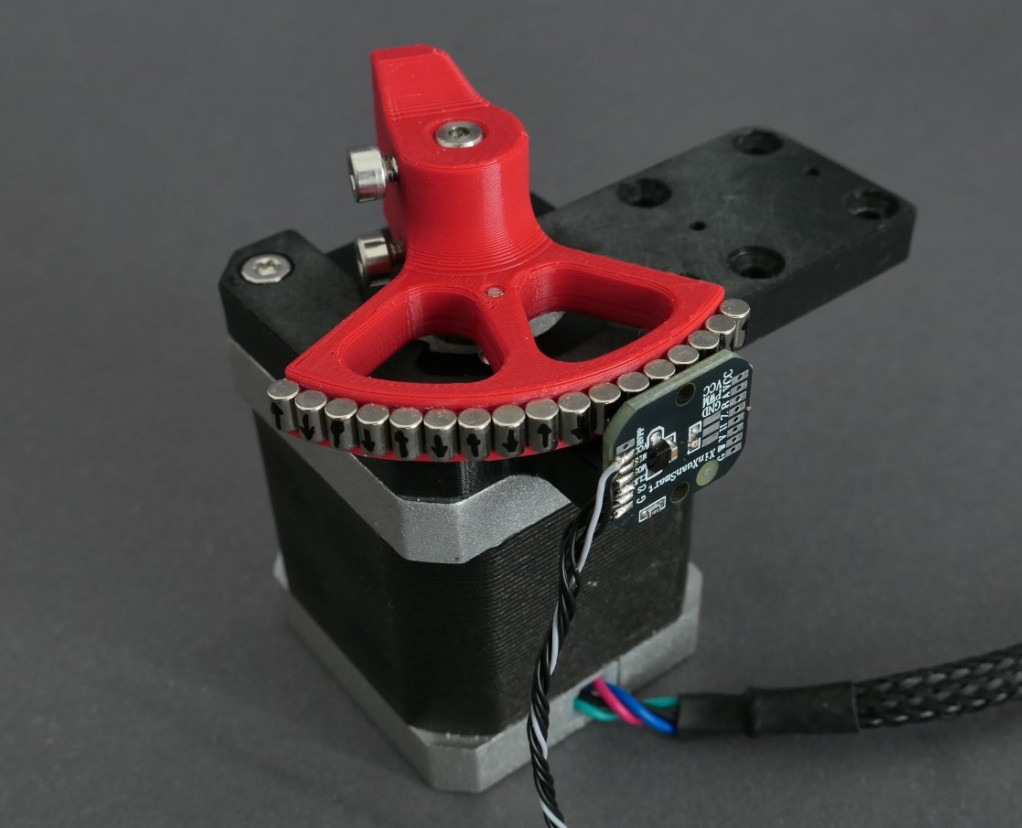
When you think about highly-precise actuators, stepper motors probably aren’t the first device that comes to mind. However, as [Diffraction Limited]’s sub-micron capable micro-manipulator shows, they can reach extremely fine precision when paired with external feedback.
The micro-manipulator is made of a mobile platform supported by three pairs of parallel linkages, each linkage actuated by a crank mounted on a stepper motor. Rather than attaching to the structure with the more common flexures, these linkages swivel on ball joints. To minimize the effects of friction, the linkage bars are very long compared to the balls, and the wide range of allowed angles lets the manipulator’s stage move 23 mm in each direction.
A Raspberry Pi Pico 2 and three motor drivers control this creation; even here, the attention to detail is impressive. The motor drivers couldn’t have internal charge pumps or clocked logic units, since these introduce tiny timing errors and motion jitter. The carrier circuit board is double-sided and uses through-hole components for ease of replication; in a nice touch, the lower silkscreen displays pin numbers.
To test the manipulator’s capabilities, [Diffraction Limited] used it to position a chip die under a microscope. To test its accuracy and repeatability, he traced the path a slicer generated for the first layer of a Benchy, vastly scaled-down, with the manipulator. When run slowly to reduce thermal drift, it could trace a Benchy within a 20-micrometer square, and had a resolution of about 50 nanometers.
He’s already used the micro-manipulator to couple an optical fiber with a laser, but [Diffraction Limited] has some other uses in mind, including maskless lithography (perhaps putting the stepper in “wafer stepper”), electrochemical 3D printing, focus stacking, and micromachining. For another promising take on small-scale manufacturing, check out the RepRapMicron.
youtube.com/embed/MgQbPdiuUTw?…
Thanks to [Nik282000] for the tip!
Returning To An Obsolete Home Movie Format

A few years ago, I bought an 8 mm home movie camera in a second hand store. I did a teardown on it here and pulled out for your pleasure those parts of it which I considered interesting. My vague plan was to put a Raspberry Pi in it, but instead it provided a gateway into the world of 8mm film technology. Since then I’ve recreated its Single 8 cartridge as a 3D printable model, produced a digital Super 8 cartridge, and had a movie camera with me at summer hacker camps.
When I tore down that Single 8 camera though, I don’t feel I did the subject justice. I concentrated on the lens, light metering, and viewfinder parts of the system, and didn’t bring you the shutter and film advance mechanism. That camera also lacked a couple of common 8 mm camera features; its light metering wasn’t through the lens, and its zoom lens was entirely manual. It’s time to dig out another 8 mm camera for a further teardown.
A Different Camera To Tear Down

My test camera is a battered and scuffed Minolta XL-250 that I found in a second hand store for not a lot. It takes Super 8 cartridges, of which I have an expired Kodachrome example for the pictures, and it has the advantage of an extremely well-thought-out design that makes dismantling it very easy. So out it comes to be laid bare for Hackaday.
Once the sides have come off the camera, immediately you can see a set of very early-70s-analogue PCBs containing the light metering circuitry. Typically this would involve a CdS cell and a simple transistor circuit, and the aperture is controlled via a moving coil meter mechanism. This camera also has a large mostly-unpopulated PCB, giving a clue to some of the higher-end features found on its more expensive sibling.


Turning our attention inside the camera to the film gate, we can see the casting the film cartridge engages with, and the frame opening for the shutter To the left of that opening is a metal claw that engages with the sprocket holes in the film, thus providing the primary film advancement. The metal claw is attached to a slider on the back of the film gate, which in turn is operated by the rotation of the shutter, which is the next object of our attention.


The shutter is a disc that spins at the frame rate, in this case 18 frames per second. It sits in the light path between the back of the lens system and the film gate. It has a segment cut out of the disc to let light through for part of the rotation, this is how it operates as a shutter. On its reverse is the cam which operates the slider for the film advancement claw, while its front is mirrored. This forms part of the through-the-lens light metering system which we’ll come to next.


The mirror on the front of the shutter is angled, which means that when the shutter is closed, the light is instead reflected upwards at right angles into a prism, which in turn directs the light to the light meter cell. The PCB on the other side must have a charge pump which takes this 18 Hz interrupted analogue signal and turns it into a DC to drive the moving coil mechanism. There’s a 10 uF capacitor which may be part of this circuit.


Finally, we come to the powered zoom feature that was missing from the previous camera. On the top of the camera is a W/T rocker, for Wide/Telephoto. that operates the zoom. It is connected to a set of levers inside the case, which emerge as a pin at the front of the camera below the lens. This engages with a small gearbox that drives a knurled ring on the lens body, and selects forward and reverse to turn the ring. It’s driven by the same motor as the shutter, so it only works when the camera is operating.
I hope this look at my Minolta has filled in some of the gaps left by the previous article, and maybe revealed that there’s more than meets the eye when it comes to 8 mm movies. Careful though. If you dip a toe into this particular puddle it may suck you in head first!
Berichte über Überwachung in Gaza: Microsoft entlässt Mitarbeitende nach Protesten
netzpolitik.org/2025/berichte-…

Li trovo davvero orrendi. Soffro forse di un deficit cognitivo?
libramenteblog.blogspot.com/20…
libramenteblog.blogspot.com/20…
Editoria scolastica: pubblicato il rapporto preliminare dell’Autorità Garante della Concorrenza e del Mercato
Editoria scolastica: pubblicato il rapporto preliminare dell’Autorità Garante della Concorrenza e del Mercato
L’Autorità Garante della Concorrenza e del Mercato ha reso nota nel bollettino 30/2025 del 04/08/2025 la pubblicazione di un due provvedimenti sull’editoria scolastica e di un interessante allegato al provvedimento, recante il rapporto preliminare sull’editoria scolastica che analizza in profondità le dinamiche economiche e strutturali del settore.
Il termine per la conclusione del procedimento è stato prorogato al 31 dicembre 2025.
L’indagine nasce esattamente un anno fa dalla necessità di comprendere meglio come vengono adottati, distribuiti e utilizzati i libri di testo nelle scuole italiane, con particolare attenzione ai costi sostenuti dalle famiglie e all’effettiva transizione verso il digitale.
Il mercato dell’editoria scolastica in Italia ha un valore stimato di circa 800 milioni di euro, con pochi grandi gruppi editoriali che dominano l’offerta. Nonostante la crescente disponibilità di contenuti digitali, la modalità più diffusa resta quella mista, che combina il libro cartaceo con contenuti online. Tuttavia, l’utilizzo effettivo delle risorse digitali è ancora molto limitato: solo una piccola percentuale delle licenze viene attivata e gli accessi alle piattaforme sono sporadici. Questo evidenzia una transizione digitale incompleta, ostacolata da carenze infrastrutturali, scarsa formazione del personale docente e da sistemi chiusi che limitano la condivisione e la flessibilità.
Il rapporto sottolinea anche le forti disparità territoriali e sociali. I libri sono gratuiti solo nella scuola primaria, mentre nelle secondarie le spese ricadono interamente sulle famiglie, con costi che possono superare i mille euro l’anno per studente. I tetti di spesa imposti dal Ministero risultano spesso inefficaci e facilmente aggirati, aggravando il peso economico soprattutto nelle regioni del Sud.
Un altro punto critico riguarda il mercato dell’usato, che rappresenta una risorsa importante per molte famiglie ma che viene ostacolato dalle politiche editoriali, in particolare per quanto riguarda i contenuti digitali, che non possono essere riutilizzati o ceduti. Inoltre, il rapporto evidenzia come le risorse educative aperte (OER) e le autoproduzioni didattiche siano ancora marginali, frenate da vincoli normativi e dalla mancanza di incentivi.
In conclusione, l’AGCM invita a ripensare il modello editoriale scolastico, promuovendo maggiore interoperabilità tra piattaforme, incentivando la produzione di contenuti aperti e sostenendo economicamente le famiglie e le scuole. L’obiettivo è rendere l’istruzione più accessibile, equa e al passo con le trasformazioni digitali.
Qui:
reshared this

Comitato Genitori Liceo Augusto likes this.
reshared this
A Pechino la People’s Liberation Army mostra le sue punte di diamante
@Notizie dall'Italia e dal mondo
La parata militare svoltasi a Pechino per celebrare l’anniversario della fine della Seconda Guerra Mondiale è stata un’occasione preziosa per la Repubblica Popolare. Da una parte, la Cina ha potuto mostrare al mondo intero la solidità del blocco euroasiatico, radunando nella capitale del Celeste Impero leader
Proteste in Indonesia: crescita della rabbia sociale e solidarietà regionale
@Notizie dall'Italia e dal mondo
Nelle ultime settimane, il Paese è attraversato da una ondata di manifestazioni, generata da un mix di ingiustizie economiche e privilegi istituzionali
L'articolo Proteste in Indonesia: crescita della rabbia sociale e solidarietà regionale proviene da Pagine
ISRAELE. Smotrich vuole annettere la Cisgiordania senza i palestinesi
@Notizie dall'Italia e dal mondo
Il ministro ultranazionalista ha affermato di volere "il massimo territorio e il minimo della popolazione"
L'articolo ISRAELE. Smotrich vuole annettere pagineesteri.it/2025/09/04/med…
Lo schiaffo di Pechino
@Giornalismo e disordine informativo
articolo21.org/2025/09/lo-schi…
“Presidente Trump e’ preoccupato dell’avvicinamento di questi giorni fra Russia e Cina?”” No , io ho buoni rapporti sia con il Presidente cinese che con quello russo”. Poche volte nella storia l’inadeguatezza di un leader e’ stata cosi’ palese. L’idea, o meglio l’illusione , che la superpersonalita’ di

Ecco perché il 9 leggeremo i nomi dei giornalisti uccisi a Gaza. Prima che sia troppo tardi
@Giornalismo e disordine informativo
articolo21.org/2025/09/ecco-pe…
il giornalisticidio é stato ed é la premessa per il genocidio
L'articolo Ecco perché il 9 leggeremo
Nei voli si può anche fare a meno del Gps. Braghini spiega come
@Notizie dall'Italia e dal mondo
Il caso delle interferenze di jamming al Gps del business jet Dassault Falcon 900LX che trasportava Ursula von der Leyen in Bulgaria ha avuto immediato e ampio risalto nelle prime pagine dei quotidiani. Senza dubbio si tratta di un episodio grave per il quale si sospetta la Russia, e sarebbe dunque
Va curato senza dimenticare
@Politica interna, europea e internazionale
Renato Vallanzasca è detenuto e sta male –Di fronte a una petizione che ha racimolato un migliaio di firme per chiedere a Sergio Mattarella la grazia per Renato Vallanzasca -promossa da uno degli ex membri della sua banda, Alfredo “Tino” Stefanini – è facile lasciarsi investire dal giudizio morale, dall’indignazione oppure, per converso, da una […]
noyb WIN: La DPA francese multa Google per 325 milioni di euro per le "email di spam" in Gmail La CNIL ha multato Google per 325 milioni di euro per aver creato email di spam in Gmail mickey04 September 2025
EDRi warns against GDPR ‘simplification’ at EU Commission dialogue
On 16 July 2025, EDRi participated in the European Commission’s GDPR Implementation Dialogue. We defended the GDPR as a cornerstone of the EU’s digital rulebook and opposed further attempts to weaken it under the banner of ‘simplification’. The discussion was more divided than the official summary suggests.
The post EDRi warns against GDPR ‘simplification’ at EU Commission dialogue appeared first on European Digital Rights (EDRi).
Hessisches Psychisch-Kranken-Hilfegesetz: „Aus einem Genesungsschritt wird ein Sicherheitsrisiko gemacht“
netzpolitik.org/2025/hessische…

Reviewing the “Convention against Corruption” in Vienna
The following is a comment from PPI’s main representative at UNOV, Kay Schroeder, who recently tried to attend the United Nations “Convention against Corruption” (UNCAC) in Vienna.
“This week, the “Conference of the States Parties to the United Nations Convention against Corruption” has begun in Vienna. Unfortunately, I cannot attend, as civil society is barred from participating. Nevertheless, I would like to share my thoughts on the topic of anti-corruption, the obvious impossibility of addressing this issue by the very suspects themselves, and the accompanying shadowboxing.
UNCAC is the highest decision-making body of the United Nations in the fight against corruption. Its tasks include implementing adopted measures, coordinating new initiatives, and deciding on future anti-corruption efforts. A commendable agenda, yet one that falters due to the nature of the states themselves—being the very subjects of corruption through their own representatives in the UN bodies tasked with oversight and enforcement.
It is evident that an institution composed exclusively of state actors can hardly contribute meaningfully to combating corruption, as its representatives are part of the problem. The exclusion of civil society from participation reinforces this impression, especially since we as Pirates have always stood for transparency and decentralization—two essential pillars of anti-corruption that rarely find their way into these forums.
There is, however, some good news from the perspective of anti-corruption. Quite unironically, Austria has today abolished official secrecy. After 100 years, the Freedom of Information Act is making its debut. That’s longer than the UN has existed.”
We thank Mr. Schroeder and all of our PPI UN representatives for their hard work attempting to represent us at the UN and reporting back to us.
If you or any other Pirates you know would like to participate in UN events, please let us know by filling out the volunteer form: lime.ppi.rocks/index.php?r=sur…
If you would like to help PPI continue to send representatives to these meetings, please consider making a small donation to our organization or becoming a member. If you would like to be involved personally in the movement, by writing about these issues or attending events, please let us know.
pp-international.net/donations…

Ah però... avevano finito i francobolli per le lettere di licenziamento e hanno avuto questa idea brillante?


Stellantis ha chiesto ai suoi operai italiani di andare a lavorare in Serbia - Il Post
https://www.ilpost.it/2025/09/04/stellantis-operai-italiani-serbia/?utm_source=flipboard&utm_medium=activitypubPubblicato su News @news-ilPost
Stellantis ha chiesto ai suoi operai italiani di andare a lavorare in Serbia
Lì vengono pagati poco e non se ne trovano abbastanza, mentre da noi sono quasi tutti in cassa integrazioneIl Post

Poliversity - Università ricerca e giornalismo reshared this.
L’aggressività di Trump spinge l’India tra le braccia di Pechino?
@Notizie dall'Italia e dal mondo
Assediata dai dazi statunitensi, l'India rafforza le relazioni con Mosca e avvia il disgelo con la Cina, potenza da sempre considerata con sospetto da New Delhi
L'articolo pagineesteri.it/2025/09/04/asi…
freezonemagazine.com/articoli/…
Sono stati quelli estivi, mesi di “esplorazione” della scena alternativa americana che ha fruttato risultati sorprendenti per la sterminata quantità di band presenti, meno per la qualità della musica proposta, essendo questa in diverse occasioni, interessantissima e degna di essere conosciuta. Cresciuti nel calore crepitante della scena DIY di Philadelphia e forgiati dall’azione comunitaria, dalla
Sono stati
Potremmo introdurre corsi per la preparazione del Gorgonzola, al Classico.

Valditara: “Abbiamo bisogno di scuole che sappiano tramandare le tradizioni”
@scuola
corriereuniv.it/valditara-abbi…“Abbiamo bisogno di scuole che sappiano tramandare il meglio della nostra tradizione culturale, artistica e artigianale”. Lo ha dichiarato il ministro dell’Istruzione e del Merito Giuseppe Valditara durante la sua visita al Liceo Artistico Scuola del Libro di Urbino, in provincia di Pesaro
Valditara: “Abbiamo bisogno di scuole che sappiano tramandare le tradizioni”
Valditara: "Abbiamo bisogno di scuole che sappiano tramandare le tradizioni" Leggi anche altre notizie su CorriereUnivRedazione Roma (CorriereUniv)

Poliversity - Università ricerca e giornalismo reshared this.
Next Sosyal è una nuova piattaforma social turca basata su Mastodon.
La piattaforma non ha abilitato la federazione e quindi non è accessibile dal fediverso. Next Sosyal è sostenuta dal partito turco al potere AKP e il presidente Erdoğan ha recentemente pubblicato il suo primo post sulla piattaforma.
"Viviamo in un mondo in cui i governanti autoritari sembrano avere una comprensione migliore delle attuali dinamiche dei social media rispetto a molti leader democratici. Sia Trump che Erdogan comprendono il valore di costruire una piattaforma social in cui avere un contatto diretto con i propri sostenitori e poter controllare la distribuzione dei messaggi. È doloroso che entrambi i leader utilizzino Mastodon per questo scopo, mentre la leadership democratica mostra scarso interesse a costruire le proprie piattaforme di distribuzione social sul social web aperto."
Da Fediverse Report
reshared this

@Julian Del Vecchio il problema delle soluzioni basate su Linux come per tutte le soluzioni basate su software libero, ma il discorso si può estendere a tutti i software e i servizi che non sono considerati leader del settore, e la percezione comune che non li vede come software e servizi affidabili punto
Non c'è alcun solo direttore it che non si sia trovato di fronte al dilemma tra acquistare software o servizi dei leader del settore rispetto al non acquistarli: la scelta andrà sempre ai leader del settore perché ti consente di devolvere la responsabilità della scelta. Infatti se le cose andranno male tu potrai sempre dire che ti sei affidato al leader del settore... in questo modo ottieni il frutto, ossia il pagamento dello stipendio da direttore, e rinunci alla scorza, ossia il fatto che non ti prendi praticamente alcuna responsabilità in caso di problemi.
Questo è il motivo per cui nella pubblica amministrazione e nella grande impresa è sempre molto difficile scalzare i cosiddetti e sedicenti leader del settore
Poliverso - notizie dal Fediverso ⁂ likes this.
Poliverso - notizie dal Fediverso ⁂ reshared this.
Pixelfed v0.12.6 è ora disponibile e introduce le "stories"


Pixelfed v0.12.6 is now available!With Stories ✨
github.com/pixelfed/pixelfed/r…
Release v0.12.6 · pixelfed/pixelfed
Added Pinned Posts (2f655d000) Custom Filters (#5928) (437d742ac) Legal Notice page (#5606) (c72fa0529) OIDC Support (#5608) (c72fa0529) Avif, HEIC, webp, libvips support + Preserve ICC color prof...GitHub

LIBERI DAI VELENI DI ROMA SI AVVICINA.
#Ambiente #StopInceneritore #NoInceneritore #NoInceneritori #ZeroWaste #Rifiuti #Riciclo #EconomiaCircolare #NoAlCarbone #EnergiaPulita

Dare luogo alla pace. A Catania la Piazza delle Tre Culture
@Giornalismo e disordine informativo
articolo21.org/2025/09/dare-lu…
Riparte da Catania la “Global Sumud Flottilla”. Basterà un filo di maestrale per far giungere i pacifisti (non terroristi!) in Palestina. La Sicilia si dimostra ancora crocevia del Mediterraneo e
Alfonso reshared this.
OrionBelt©
in reply to simona • • •simona likes this.
simona
in reply to simona • •