
A Tiny Reflecting Telescope For Portable Astronomy

For most of us who are not astronomers, the image that comes to mind when describing a reflecting telescope is of a huge instrument in its own domed-roof building on a mountain top. But a reflecting telescope doesn’t have to be large at all, as shown by the small-but-uncompromising design from [Lucas Sifoni].
Using an off-the-shelf mirror kit with a 76mm diameter and a 300mm focal length, he’s made a pair of 3D-printed frames that are joined by carbon fibre rods. The eyepiece and mirror assembly sit in the front 3D-printed frame, and the eyepiece is threaded so the telescope can be focused. There’s a 3D-printed azimuth-elevation mount, and once assembled, the whole thing is extremely compact.
While a common refracting telescope uses a lens and an eyepiece to magnify your view, a reflector uses a parabolic mirror to focus an image on a smaller diagonal mirror, and that mirror sends the image through the eyepiece. Most larger telescopes use this technique or a variation on it because large first-surface mirrors are easier to make than large lenses. There are also compound telescope types that use different combinations of mirrors and lenses. Which one is “best” depends on what you want to optimize, but reflectors are well known for being fairly simple to build and for having good light-gathering properties.
If you’d like to build your own version of this telescope then the files can all be found on Printables, meanwhile this isn’t the first 3D-printed telescope you might have seen on these pages. If you want to make your own mirror, that’s a classic hacker project, too.
Building a Multi-Channel Pipette for Parallel Experimentation

One major reason for the high cost of developing new drugs and other chemicals is the sheer number of experiments involved; designing a single new drug can require synthesizing and testing hundreds or thousands of chemicals, and a promising compound will go through many stages of testing. At this scale, simply performing sequential experiments is wasteful, and it’s better to run tens or hundreds of experiments in parallel. A multi-channel pipette makes this significantly simpler by collecting and dispensing liquid into many vessels at once, but they’re, unfortunately, expensive. [Triggy], however, wanted to run his own experiments, so he built his own 96-channel multi-pipette for a fiftieth of the professional price.
The dispensing mechanism is built around an eight-by-twelve grid of syringes, which are held in place by one plate and have their plungers mounted to another plate, which is actuated by four stepper motors. The whole syringe mechanism needed to move vertically to let a multi-well plate be placed under the tips, so the lower plate is mounted to a set of parallel levers and gears. When [Triggy] manually lifts the lever, it raises the syringes and lets him insert or remove the multi-well. An aluminium extrusion frame encloses the entire mechanism, and some heat-shrink tubing lets pipette tips fit on the syringes.
[Triggy] had no particularly good way to test the multi-pipette’s accuracy, but the tests he could run indicated no problems. As a demonstration, he 3D-printed two plates with parallel channels, then filled the channels with different concentrations of watercolors. When the multi-pipette picked up water from each channel plate and combined them in the multi-well, it produced a smooth color gradient between the different wells. Similarly, the multi-pipette could let someone test 96 small variations on a single experiment at once. [Triggy]’s final cost was about $300, compared to $18,000 for a professional machine, though it’s worth considering the other reason medical development is expensive: precision and certifications. This machine was designed for home experiments and would require extensive testing before relying on it for anything critical.
We’ve previously looked at the kind of miniaturization that made large-scale biology possible and some of the robots that automate that kind of lab work. Some are even homemade.
youtube.com/embed/2TTu-Lkz2Eo?…
Thanks to [Mark McClure] for the tip!
Hardware Store Marauder’s Map is Clarkian Magic

The “Marauder’s Map” is a magical artifact from the Harry Potter franchise. That sort of magic isn’t real, but as Arthur C. Clarke famously pointed out, it doesn’t need to be — we have technology, and we can make our own magic now. Or, rather, [Dave] on the YouTube Channel Dave’s Armoury can make it.
[Dave]’s hardware store might be in a rough neighborhood, since it has 50 cameras’ worth of CCTV coverage. In this case, the stockman’s loss is the hacker’s gain, as [Dave] has talked his way into accessing all of those various camera feeds and is using machine vision to track every single human in the store.
Of course, locating individuals in a video feed is easy — to locate them in space from that feed, one first needs an accurate map. To do that, [Dave] first 3D scans the entire store with a rover. The scan is in full 3D, and it’s no small amount of data. On the rover, a Jetson AGX is required to handle it; on the bench, a beefy HP Z8 Fury workstation crunches the point cloud into a map. Luckily it came with 500 GB of RAM, since just opening the mesh file generated from that point cloud needs 126 GB. That is processed into a simple 2D floor plan. While the workflow is impressive, we can’t help but wonder if there was an easier way. (Maybe a tape measure?)
Once an accurate map has been generated, it turns out NVIDIA already has a turnkey solution for mapping video feeds to a 2D spatial map. When processing so much data — remember, there are 50 camera feeds in the store — it’s not ideal to be passing the image data from RAM to GPU and back again, but luckily NVIDIA’s “Deep Stream” pipeline will do object detection and tracking (including between different video streams) all on the GPU. There’s also pose estimation right in there for more accurate tracking of where a person is standing than just “inside this red box”. With 50 cameras, it’s all a bit much for one card, but luckily [Dave]’s workstation has two GPUs.
Once the coordinates are spat out of the neural networks, it’s relatively simple to put footprints on the map in true Harry Potter fashion. It really is magic, in the Clarkian sense, what you can do if you throw enough computing power at it.
Unfortunately for show-accuracy (or fortunately, if you prefer to avoid gross privacy violations), it doesn’t track every individual by name, but it does demonstrate the possibility with [Dave] and his robot. If you want a map of something… else… maybe check out this backyard project.
youtube.com/embed/dO32ImnsX-4?…
The ‘Hidden’ Microphone inside the Sipeed NanoKVM

Recently, [Jeff Geerling] dropped into the bad press feeding frenzy around Sipeed’s NanoKVM, most notably because of a ‘hidden’ microphone that should have no business on a remote KVM solution. The problem with that reporting is, as [Jeff] points out in the video below, that the NanoKVM – technically the NanoKVM-Cube – is merely a software solution that got put on an existing development board, the LicheeRV Nano, along with an HDMI-in board. The microphone exists on that board and didn’t get removed for the new project, and it is likely that much of the Linux image is also reused.
Of course, the security report that caused so much fuss was published back in February of 2025, and some of the issues pertaining to poor remote security have been addressed since then on the public GitHub repository. While these were valid concerns that should be addressed, the microphone should not be a concern, as it’d require someone to be logged into the device to even use it, at which point you probably have bigger problems.
Security considerations aside, having a microphone in place on a remote KVM solution could also be very useful, as dutifully pointed out in the comments by [bjoern.photography], who notes that being able to listen to beeps on boot could be very useful while troubleshooting a stricken system. We imagine the same is true for other system sounds, such as fan or cooling pump noises. Maybe all remote KVM solutions should have microphone arrays?
Of course, if you don’t like the NanoKVM, you could always roll your own.
Top image: the NanoKVM bundle from [Jeff]’s original review. (Credit: [Jeff Geerling])
youtube.com/embed/RSUqyyAs5TE?…
Two-Wheeled Arduino Robot Project for Beginners

Here’s a fun build from [RootSaid] that is suitable for people just getting started with microcontrollers and robotics — an Arduino-controlled two-wheeled robot.
The video assumes you already have one of the common robotics kits that includes the chassis, wheels, and motors, something like this. You’ll also need a microcontroller (in this case, an Arduino Nano), a L293D motor driver IC, a 9 V battery, and some jumper wires.

The L293D motor driver IC powers and controls the motors connected to the wheels. The L293D takes its commands from the Arduino. The rest of the video is spent going over the software for controlling the wheels.
When you’re ready to go to the next level, you might enjoy this robot dog.
youtube.com/embed/sn_NWZkKO5g?…
SIRIA. Trump revoca le sanzioni del Caesar Act poi bombarda il paese
@Notizie dall'Italia e dal mondo
L'aviazione Usa ha colpito decine di presunti obiettivi dell'Isis nell'Est in apparente risposta all'uccisione di due soldati e un contractor americani. Il governo post jihadista di Damasco approva
L'articolo SIRIA. Trump revoca le sanzioni del Caesar Act poi bombarda
Notizie dall'Italia e dal mondo reshared this.
400 giorni di carcere in Venezuela per Alberto Trentini. Senza alcuna accusa formale
@Giornalismo e disordine informativo
articolo21.org/2025/12/400-gio…
Sono quattrocento giorni da quando Alberto Trentini, cooperante veneziano, si trova, senza accusa, alcuna sequestrato in
Giornalismo e disordine informativo reshared this.
Tv2000: lunedì 22 dicembre gli auguri di Papa Leone XIV alla Curia Romana e ai dipendenti vaticani
Tv2000, lunedì 22 dicembre, trasmette in diretta due appuntamenti con Papa Leone XIV in occasione della festività natalizie: alle ore 10, dall'Aula della Benedizione, gli auguri alla Curia Romana e alle ore 11.

All’opposizione in RAI è rimasta giusto la fiction
@Giornalismo e disordine informativo
articolo21.org/2025/12/alloppo…
Siamo nel regno del pensiero unico, d’accordo, TeleMeloni impera e non si vede l’alba, è altrettanto vero, eppure una piccola eccezione è rimasta, anzi due. Si tratta di due fiction amatissime e, non a caso, premiate da un
Giornalismo e disordine informativo reshared this.
Legge di bilancio: Tagli, botte agli ultimi e soldi alle spese militari
@Giornalismo e disordine informativo
articolo21.org/2025/12/legge-d…
Il caos che sta segnando la legge di bilancio, le risse tra alleati, le scelte sulle pensioni, le decisioni sulle spese condominiali, i tagli alla sanità, i nuovi
Giornalismo e disordine informativo reshared this.

Sicurezza sul lavoro. Dal decreto sicurezza sul lavoro poco o nulla di nuovo
@Giornalismo e disordine informativo
articolo21.org/2025/12/sicurez…
Con il decreto sicurezza sul lavoro, approvato definitivamente dal Parlamento, è stato fatto poco o nulla per cambiare e porre un freno a questo
Giornalismo e disordine informativo reshared this.

Giornalismo e disordine informativo reshared this.
“Perché voterò No”. Articolo21 invita tutti ad esprimere le ragioni del no al referendum
@Giornalismo e disordine informativo
articolo21.org/2025/12/perche-…
Oggi al via il comitato nazionale per il referendum sulla giustizia, per contrastare il referendum contro i
Giornalismo e disordine informativo reshared this.
pagellapolitica.it/articoli/co…
RFanciola reshared this.
Come dico spesso, l'unica cosa comunista rimasta nella Russia odierna è la repressione del dissenso. Vengono comminati letteralmente anni di carcere per un post sui social. Il reato di "diffamazione dell'esercito", creato dopo l'invasione dell'Ucraina, è puro arbitrio.
simona likes this.
An exoplanet located 750 light years from Earth has an atmosphere unlike anything previously known.#TheAbstract


Scientists Discover ‘Black Widow’ Exoplanet That Defies Explanation
Welcome back to the Abstract! Here are the studies this week that defied expectations, broke barriers, made trash into shelter, and lived to swear another day.First, there’s a giant, lemony, diamond-studded, black widow in space. I’ll explain. Then: electrons get ready for a close-up, the ultimately tiny home, and why expletives are the hottest new workout hack.
As always, for more of my work, check out my book First Contact: The Story of Our Obsession with Aliens or subscribe to my personal newsletter the BeX Files.
“Lemonworld”
Astronomers have observed a Jupiter-sized planet more than 700 light years from Earth that is unlike anything spotted before and defies explanation.
Known as PSR J2322-2650b, the exoplanet is shaped like a lemon, boasts baffling skies, and may have hidden troves of diamonds in its belly. The distant world closely orbits a pulsar, a type of hyper-dense dead star that is tugging on the gassy planet, giving it the distended shape.
Pulsar companions are normally other stars. These are called “black widow” systems because winds from the pulsar weather down the stellar companion, eventually destroying it, similar to the deadly embrace of the namesake spider. It is very rare to see a black widow system with a planet as the pulsar companion.
Curious about this unusual exoplanet, astronomers observed it with the James Webb Space Telescope (JWST), thereby “unveiling a bizarre atmosphere that raises more questions than it answers,” according to their new study.
“PSR J2322–2650b is different from other ultralight pulsar companions, being the only pulsar companion with a mass, a density, and a temperature similar to those of hot Jupiters,” said researchers led by Michael Zhang of the University of Chicago. “The atmosphere of such an object has never been observed.”
“In stark contrast to every known exoplanet orbiting a main-sequence star, we find an atmosphere rich in molecular carbon (C3, C2) with strong westward winds,” they said.
youtube.com/embed/oBf1GFkFjdc?…
Molecular carbon is unusual in planetary atmospheres because carbon atoms tend to bind to other elements, producing more familiar compounds like carbon dioxide. The atmosphere is so carbon-dominated, and so depleted in oxygen and nitrogen, that it doesn’t neatly line up with any known planetary formation scenarios. In a sparkling twist, its dense carbon atmosphere may produce soot clouds that then solidify into diamonds, bedazzling its core.Is this a long-lived gas giant that survived the transformation of its star into a pulsar? Or was it born from the debris of the supernova that created the pulsar? And will this black widow system end as others do, with a slow death by pulsar winds? Nobody knows!
“Our findings pose a challenge to the current understanding of black-widow formation” and it will take more observations of similar systems “to determine whether PSR J2322–2650b’s composition is unusual or representative of the class.”
In other news…
An attofirst for attoseconds
Scientists have created the shortest X-ray light pulse ever produced, a breakthrough that could resolve the previously hidden motions of electrons and other particles at subatomic scales.
These newly-demonstrated soft X-ray pulses last for just 19.2 attoseconds, where an attosecond is equal to one quintillionth (10−18) of a second. In other words, an attosecond is to a second as a second is to 31.69 billion years, more than twice the age of the universe.
This is where the science happened. Image: ICFO
“Excitation, scattering, and electron relaxation are crucial processes that control how matter interacts with light,” said researchers led by Fernando Ardana-Lamas of the Institute of Photonic Science (ICFO) in Spain. “Their timing influences how chemical bonds form or break, how charge and energy move, and how properties of molecules and materials emerge. Understanding these dynamics requires attosecond resolution, as electronic excitations and dynamics occur on timescales of tens of attoseconds.”“We demonstrated the generation of coherent attosecond [short X-ray] pulses with a duration of 19.2 as, significantly shorter than the atomic unit of time,” a milestone that offers “exciting new opportunities to investigate atomic, molecular, and solid-state physics,” the team concluded.
This high pulse speed is necessary for the development of instruments that could capture the mysterious dynamics of particles on subatomic timescales. Other experimental technologies are still required to make these ultrafast cameras a reality, but for now, here’s to shattering the shutter speed record.
My other house is a tooth socket
Here’s a question for prospective home owners: have you ever considered living in a clump of regurgitated bones? This solution worked out well for Caribbean cave bees that lived some 20,000 years ago, according to a new study that reports the discovery of the first known fossilized bee nests built inside skeletal remains.
Scientists found the honeycombed bones buried in a cave on the island of Hispaniola that was once also inhabited by owls. Since owls regularly barf up pellets—gnarly globs of half-digested prey—the solitary bee species had a ready-made supply of skeletal remains, which were apparently a perfect place to raise offspring.
A part of a fossilized mammal skull, with sediment in a tooth socket that turned out to be a nest built by a prehistoric bee. Image: Courtesy of Lazaro Viñola López.
“Isolated brood cells…were found inside cavities of vertebrate remains,” including tooth sockets and the spinal canal, said researchers led by Lázaro Viñola López of the Field Museum in Chicago. “The high abundance of nests throughout the deposit indicated that this cave was used for a long period as a nesting aggregation area by this solitary bee.”There’s nothing like getting the skeleton keys to your new skeleton house.
A prescription for profanity
Cussing is discouraged in polite company, but it may actually be good for your health and performance, according to a new study that confirms swearing alleviates inhibitions and provides increased endurance during physical challenges.
Psychologists recruited nearly 200 volunteers to hold themselves in a sustained chair pushup while repeating either a swear word of their choice, or a neutral word, every two seconds. The results revealed a consistent “swearing advantage” characterized by “significant performance improvements in the swearing condition.”
“These effects have potential implications for athletic performance, rehabilitation, and contexts requiring courage or assertiveness,” said researchers led by Richard Stephens of Keele University. “As such, swearing may represent a low-cost, widely accessible psychological intervention to help individuals ‘not hold back’ when peak performance is needed.”
At long last, science has vindicated the foul-spoken, the pottymouths, the salty-tongued, and the vulgarians. So go forth, ye cursers, and f*ck that sh*t up! It’s the doctor’s orders, after all.
Thanks for reading! See you next week.
First Contact
A narrative and visual exploration of humanity’s age-old search for and fixation with extraterrestrials.First Contact explores the ancient idea—and epic ...Hachette Book Group


Perché tutti sembrano soffrire di deficit di attenzione e iperattività (ADHD)?
I motivi dietro all’aumento dei casi di disturbo da deficit di attenzione e iperattività negli ultimi decenni sono diversi, e sono spesso legati alle modalità con cui vengono effettuate le diagnosi di ADHD.Focus.it
Pakistan e Cirenaica stringono un accordo di cooperazione militare
@Notizie dall'Italia e dal mondo
Dopo il patto di mutua difesa con l'Arabia Saudita, il Pakistan ha sottoscritto un accordo di cooperazione militare con la regione della Libia orientale controllata da Khalifa Haftar
L'articolo Pakistan e Cirenaica stringono un accordo di cooperazione militare proviene da
Notizie dall'Italia e dal mondo reshared this.


I genitori che non fanno regali di Natale ai figli
È un modo estremo e poco praticabile di gestire un problema diffuso, sia economico che educativoIl Post
la vedo dura con una popolazione mondiale di 8 miliardi di tornare a una vita "nostalgica" old style, fattoria & orto, tutti quanti. vita che personalmente NON rimpiango, pur al limite amando gli animali. ma la vecchia civiltà contadina era tutto meno che ecosostenibile e rispettosa dell'ambiente. ma portando la popolazione a un livello massimo di 500 milioni forse sarebbe ancora possibile. però non credo che la questione regali di natale, compleanno o festività per un bambino sia questo.
nella vita non si sceglie comunque mai niente, credo questa regola valga praticamente per tutti. in realtà pure per i ricconi. ma il problema è solo cosa di fa con quello che si ha.
Trames reshared this.
ANALISI. Nello Yemen si ridisegna la mappa dell’Arabia meridionale
@Notizie dall'Italia e dal mondo
Dieci anni dopo, gli Houthi restano trincerati nel nord, mentre il sud è diventato una scacchiera per le ambizioni divergenti della coalizione saudita-emiratina
pagineesteri.it/2025/12/20/med…
Notizie dall'Italia e dal mondo reshared this.
ma in fondo ala fine la vita è una "cagata pazzesca"

La povertà ruba sempre più vita agli anziani, quasi 10 anni in meno dei più ricchi - Sanità - Ansa.it
Gli anziani con reddito basso muoiono fino a nove anni prima rispetto a quelli più abbienti. (ANSA)Agenzia ANSA
RFanciola reshared this.
ASSURDO. IL GARANTE. L’ARTICOLO 11. BELGRADO.
Il Presidente della Repubblica ci spiega che le spese militari sono “poco popolari ma MAI COSÌ NECESSARIE”.
Ce lo dice dal Quirinale, con tono grave, parlando di “deterrenza”, “difesa collettiva”, “sicurezza europea indivisibile”.
Peccato che a dirlo sia il CUSTODE della Costituzione.
Quella che all’Art. 11 dice una cosa chiarissima: L’ITALIA RIPUDIA LA GUERRA.
Non la “gestisce meglio”. Non la “deterrentizza”. La RIPUDIA.
E qui il corto circuito è totale.
Perché se la democrazia è “sfidata da involuzioni autoritarie”, come dice Mattarella, allora qualcuno dovrebbe spiegare perché la risposta automatica è SEMPRE PIÙ ARMI, SEMPRE PIÙ SPESA MILITARE, SEMPRE MENO POLITICA.
Belgrado, 1999.
Bombardata per 78 giorni senza mandato ONU.
Anche allora si parlava di “difesa dei valori”, “diritti”, “sicurezza”.
Anche allora la democrazia veniva “salvata” a colpi di missili.
Il punto non è la dialettica politica.
Il punto è che qui si sta NORMALIZZANDO l’idea che la guerra sia uno STRUMENTO ORDINARIO di governo del mondo.
E che chi lo dice non è un generale, ma il GARANTE della Carta che dovrebbe impedirlo.
Quando la Costituzione diventa un orpello retorico da citare solo il 2 giugno,
e l’Articolo 11 un fastidio da reinterpretare,
non è la democrazia a essere “sfidata”.
È GIÀ STATA PIEGATA.
Ma tranquilli.
È per il nostro bene.
E se non capiamo, è perché siamo “poco popolari”.
Don Chisciotte 😉
(putinista, ovviamente)

Dipiazza, sindaco di Treviso di Forza Italia, ad una consigliera dell'opposizione:
«Non mi sono mai fatto comandare da una donna»
E per difendersi dalle accuse di sessismo:
Dipiazza ci ha anche tenuto a precisare che «le donne sono il più bel regalo che il buon Dio ci ha dato. Sono un estimatore e ho sempre avuto grande successo».
Questi giocano proprio in un altro campionato c'è poco da fare...
Poliversity - Università ricerca e giornalismo reshared this.


Sachsen: Sogar dem Koalitionspartner ist dieses Polizeigesetz zu hart
netzpolitik.org/2025/sachsen-s…

Florida prosecutor agrees: Photography is not a crime
FOR IMMEDIATE RELEASE:
New York, Dec. 18, 2025 — Photojournalist Dave Decker was arrested in November while documenting a protest in Miami, Florida. A coalition of 23 press organizations spoke out against the charges — and this week the prosecutor agreed.
The following statement can be attributed to Adam Rose, deputy director of advocacy for Freedom of the Press Foundation (FPF):
“Journalists have a distinct role at protests. They are not participants, merely observers. A broad local and national coalition said this in unison, and we were glad to see all charges dropped against Dave Decker. Hats off to his attorneys, lawyers for the Florida State Attorney’s Office and the Miami-Dade Sheriff’s Office, and all the community groups who rallied to his side.“At the same time, that’s a lot of people who had to work on something entirely preventable. I hope law enforcement officers take this to heart: Swearing an oath to protect the community means protecting everyone — including press. This is an opportunity for agencies like the sheriff’s office and Florida Highway Patrol to take proactive steps and review training approaches. Freedom of the Press Foundation is happy to help.
“And of course, it would be nice to see an apology to Dave and an offer to fix any of his equipment they damaged.”
Read the coalition’s letter:
freedom.press/static/pdf.js/we…
Please contact us if you would like further comment.
Covering protests is a dangerous job for journalists
Dear Friend of Press Freedom,
Rümeysa Öztürk has been facing deportation for 268 days for co-writing an op-ed the government didn’t like, and journalist Ya’akub Vijandre remains locked up by Immigration and Customs Enforcement over social media posts about issues he reported on.
Join us today and Dec. 21 in New York City for two special screenings of the Oscar-shortlisted film “Cover-Up” by Laura Poitras — an FPF founding board member — and Mark Obenhaus.
Read on for more on what we’re working on this week. We’ll be back in the new year.
Covering protests is a dangerous job for journalists
As of Dec. 15, the U.S. Press Freedom Tracker has documented 32 detainments or charges against journalists in the U.S. — 28 of those at immigration-related protests — according to a new report released by the Freedom of Press Foundation (FPF) project this week.
The report notes how, unlike most years, the majority of journalists were released without charges or had them soon dropped, with law enforcement instead focusing on deterring news gathering rather than pursuing charges.
Stop the deportation of Heng Guan
Use our action center to tell lawmakers to stop the Trump administration from deporting Heng Guan, who helped journalists expose the horrors of Uyghur prison camps in Xinjiang, China. He’s exactly the kind of person asylum laws are intended to protect.
The next hearing in Guan’s case is Jan. 12. He could be sent to Uganda, placing him at risk of being shipped back to China, where, according to his mother, he’d likely be killed.
Sign Up. Take Action.
Join our email list to stay up to date on the issues and learn how you can help protect journalists and sources everywhere.
Full Name Email Address Subscribe See all newsletters Go to mailing list subscription page
Thanks for signing up for our newsletter. You are not yet subscribed! Please check your email for a message asking you to confirm your subscription.
The FCC’s declaration of dependence
Federal Communications Commission Chair Brendan Carr admitted at a Senate hearing on Wednesday that there had been a political “sea change” and he no longer viewed the FCC as an independent agency.
FPF Director of Advocacy Seth Stern wrote for The Guardian that Carr’s admission proves the danger of letting a self-proclaimed partisan weaponize the FCC’s public interest standard to grant himself amorphous censorship powers. “Carr avoids ever articulating his vision of public-interest news, forcing anyone seeking to avoid his ire to play ‘Whac-A-Mole.’ … The only discernible rule of Carr’s FCC is ’don’t piss off Trump’.”
Trump’s BBC lawsuit is nonsense, like his others
President Donald Trump on Monday followed through on his threats to sue the BBC over its editing of his remarks on Jan. 6, 2021, for a documentary.
“If any ordinary person filed as many frivolous multibillion-dollar lawsuits as Donald Trump, they’d be sanctioned and placed on a restricted filers list,” FPF said in a statement, noting that Trump has demanded a total of $65 billion in damages from media outlets since taking office.
Under First Amendment, Diddy ‘can’t stop, won’t stop’ Netflix documentary
Sean “Diddy” Combs is threatening to sue Netflix for airing a docuseries that is, to say the least, unflattering to him. The disgraced music mogul’s cease-and-desist letter claims the series, “Sean Combs: The Reckoning,” uses “stolen footage.”
Stern wrote for Rolling Stone about why Diddy’s threatened lawsuit would be a non-starter: the right to publish content that sources obtain illegally is well established. But a series of recent cases nonetheless puts that right under unprecedented attack.
Body camera footage is for the public
The town of Hamburg, New York, claims its police body camera footage is copyrighted despite being a public record. It’s telling people who request footage under New York’s Freedom of Information Law that they can’t share the footage with others.
That’s ridiculous, and we wrote a letter to the police chief telling him to stop the nonsense and tell anyone who has received these frivolous warnings that they’re free to share body camera footage as they see fit.
Ask Lauren anything
FPF Daniel Ellsberg Chair on Government Secrecy Lauren Harper joined fellow Freedom of Information Act experts Jason Leopold, Liz Hempowicz, and Kevin Bell to take questions about FOIA and the numerous ways that it’s broken. They teamed up for a Reddit “ask me anything” discussion this week.
Free screening of “Cover-Up”
To our New York audiences and documentary film buffs: FPF is proud to host a special screening tonight of the Oscar-shortlisted film “Cover-Up” by award-winning directors Laura Poitras and Mark Obenhaus, followed by a Q&A moderated by our executive director, Trevor Timm. The film chronicles the career of legendary investigative journalist Seymour Hersh.
What we're reading
The Pentagon and the press
NPR
It’s shameful the Department of Defense is curtailing press access five decades after the Supreme Court’s Pentagon Papers ruling, Harper told NPR’s “1A.” Harper also joined “1A” to discuss how the Trump administration is enhancing its surveillance capabilities.
The US supreme court’s TikTok ruling is a scandal
The Guardian
That TikTok remains available “makes a mockery” of the government’s earlier national security claims that the platform was “an urgent national security risk – and of the court that deferred to those claims.”
How an AM radio station in California weathered the Trump administration’s assault on media
Associated Press
“‘Chilling effect’ does not begin to describe the neutering of our political coverage,” said one former KCBS journalist about the aftermath of Carr’s threats.
Defend the press: Brendan Carr has gone too far with attacks on media
Courier
Read the op-ed we co-wrote with partner organizations demanding the FCC recommit to the First Amendment.
Paramount’s Warner Bros Discovery bid faces conflict of interest concerns
Al Jazeera
Stern explained, “Throwing out the credibility of CNN and other Warner Bros Discovery holdings might benefit the Ellisons in their efforts to curry favour with Trump, but it’s not going to benefit anyone else, including shareholders.”
Europe’s Next Digital Frontier: Balancing Web 3.0 Innovation with Fundamental Rights
Evolution Of the Internet
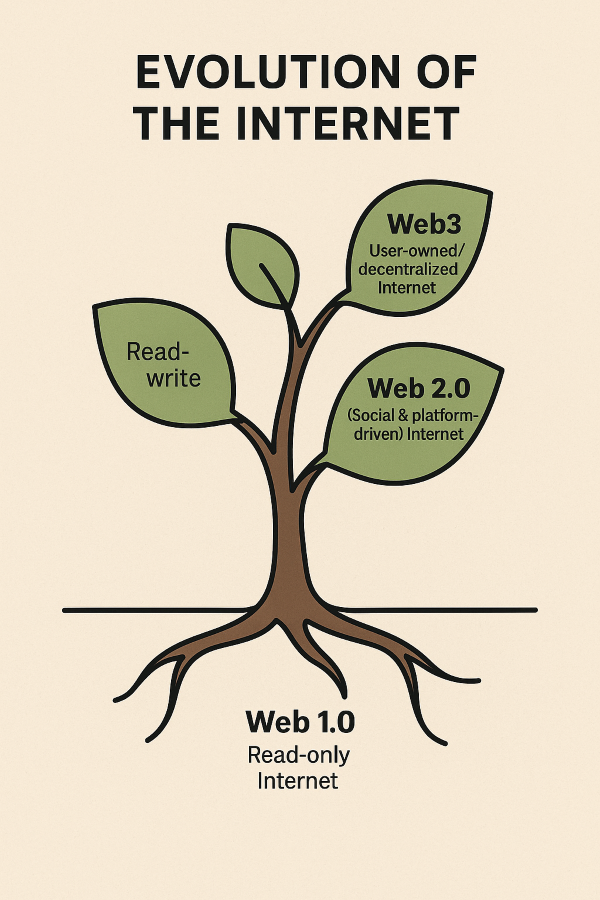
Comparing the internet’s growth to Darwin’s theory of evolution helps explain how it has changed over time, with each stage adapting to the needs, behaviours, and technologies of its time.
The initial phase, known as Web 1 (spanning the 1990s to the early 2000s), was characterised by the internet’s primary function as an information dissemination tool. During this period, only site owners managed content, resulting in a read-only experience for users and a unidirectional flow of information similar to a digital brochure.
Tim O’Reilly introduced the term “Web 2.0” in 2004, marking a new era as mobile services expanded, broadband connectivity improved, and technologies such as AJAX and HTML5 emerged. The internet became interactive, enabling users to create, share, and engage with content without needing special skills. This change opened new ways for people to communicate and connect worldwide.
But as Web 2.0 grew, a few big companies gained significant power and control over data. They decided how information was shared, which voices were heard, and how personal data was handled. Algorithms control every piece of information and opinion. At the same time, many of these platforms rely on business models that depend on extensive data collection, with user behaviour fueling targeted advertising. While these services often appear free, the trade-off is a gradual loss of privacy, autonomy, and control over one’s digital presence.
Concerns about this central control, privacy, and reliance on these platforms led to the idea of a new kind of internet, now called Web 3.0.
What is Web 3.0?
The internet is now moving toward a more user-focused phase, where data ownership is decentralised. Web 3.0 uses technologies such as blockchain and the Semantic Web to return control of data and digital assets to users rather than large technology companies. This change aims to enhance the transparency, security, and personalisation of online experiences.
Key Characteristics of Web 3.0
1. Decentralisation
Control is shared across networks rather than held by a single company or authority. This means that people need not rely on centralised platforms as much.
2. User control over data and identity
Users have more control over their digital identities and personal data, rather than giving that control to platforms by default.
3. Reduced intermediaries
Web 3.0 aims to cut out intermediaries by enabling people to interact, share, and make transactions directly, without needing a central platform to manage these actions.
4. Transparency by design
Many Web 3.0 systems are designed to make rules, transactions, and changes open and verifiable, rather than hidden within private systems.
5. Permissionless participation
Anyone can participate without approval from a central authority, provided they comply with the network’s rules.
6. Resilience and censorship resistance
The distribution of data and services increases the difficulty for any single entity to shut down platforms or completely silence users.
People often use the term Web 3.0 to refer to technologies such as cryptocurrencies, tokens, or blockchain-based finance. However, the main features listed above also make Web 3.0 useful in many areas, including supply chain management, gaming and the metaverse, healthcare, content creation and social media, intellectual property, and digital identity.
How Does Web 3.0 Work – A Brief Sneak Peek
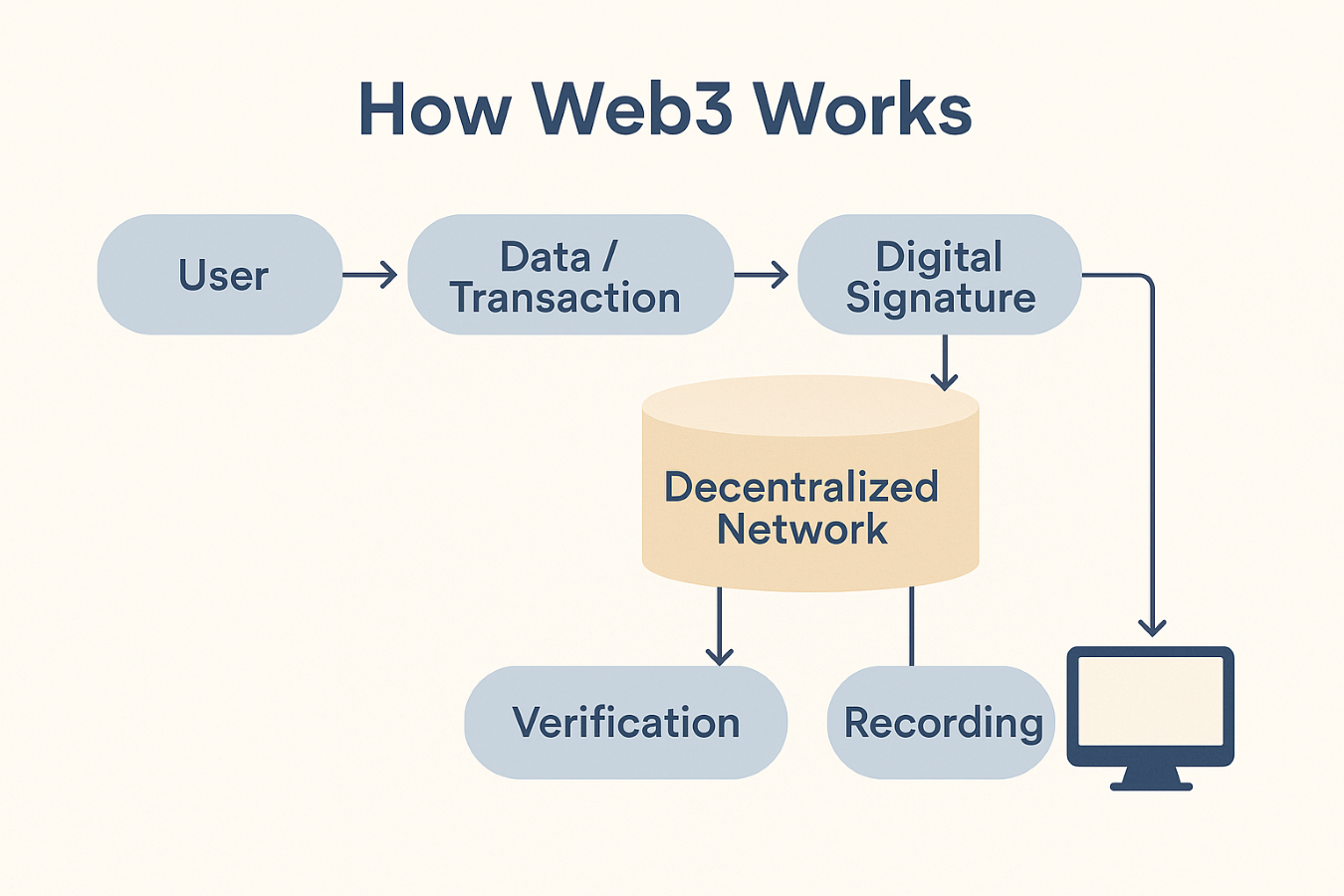
At its core, Web 3.0 changes how information is stored and managed. Instead of storing data on servers owned by a single company, information is distributed across networks. The action is cryptographically signed by the user, verified by multiple participants, and recorded in a shared ledger that is difficult to alter. This structure reduces reliance on central intermediaries and makes manipulation or data abuse more difficult, while shifting greater control and responsibility to users. Although the technology driving Web 3.0 is complex, the primary goal is simple: to give users greater control and responsibility.
Web 3.0: An Emerging, Yet Unsettled, Part of the EU’s Digital Vision
Freedom, Democracy, and Respect for human rights have been the core pillars of the European Union since its inception. These principles have been a centre of discussion whenever policies are framed, and the digital space is no exception. The European Union has signalled a clear willingness to invest in the development of Web 3.0-relevant technologies through official strategies, infrastructure development, and research funding. The European Union is actively shaping the digital world by protecting users, ensuring fair competition, and defending fundamental rights.
A Few Examples:
- The Commission’s blockchain and Web3 strategy outlines policy support, funding programmes, and legal frameworks to foster innovation in decentralised systems.
- Web 3.0-aligned technologies are being evaluated for identity and credential management and secure data exchange.
- EU funding programmes support projects on decentralised data, privacy-preserving technologies, and interoperability. (In recent times, 2016-2019, the EU invested 180 million Euros in a project called Horizon Europe, with grants expected to flow in the future as well)
Web 3.0 Is Still A probability, Not A Concrete Solution Yet.
However, the EU also values legal certainty, accountability, and consumer protection, which can be challenging to achieve in decentralised systems. As a result, the relationship between Web 3.0 and EU policy is still developing, reflecting both a willingness to innovate and a careful approach to potential risks. In this light, it is imperative to understand the complications and challenges associated with Web 3.0.
Challenges of Web 3.0:
- Still in its nascent stage, the technology underlying Web 3.0 is complex and not widely known. Concepts such as private keys, smart contracts, wallets, and decentralised storage are still largely unfamiliar and challenging for non-tech-savvy users.
- Centralised platforms outperform Web 3.0 due to easier user navigation. Influencing users to shift from a seamless platform to a complex option would require substantial investment in digital education and community building, as well as time.
- Beneath the layers of immutable privacy structures, due to a decentralised mechanism for data sharing and storage, technologies such as Web 3.0 lack accountability systems. In the absence of a centralised moderation mechanism, addressing harmful or illegal content, misinformation, and responding to abuse becomes challenging. Once the content is stored, its removal becomes nearly impossible.
- Protocols may be decentralised in theory, but small groups of developers or influential participants still influence many major decisions. This can recreate power imbalances similar to centralised platforms, undermining ideals of shared governance.
- Although Web 3.0 may be emerging as a technical solution to censorship, it is critical to understand that technology alone cannot address deeper social and political issues. Issues such as governance, community norms, power dynamics, and regulatory compliance require broader approaches beyond code.
- For less experienced users, the sole onus for online security, privacy, and data management, owing to greater control, could be overwhelming.
Looking ahead: between regulation and re-imagining
As Europe debates the future of its digital space, organisations such as European Digital Rights reiterate that technology alone does not secure freedom or fairness online. ERDi firmly believes that human rights, data protection, and democratic accountability should be the core of any discussion of new digital systems. From this perspective, Web 3.0 is neither a solution nor a threat in itself, but offers a new avenue of technological experimentation that must operate within existing legal frameworks and fundamental rights.
In the current political landscape, EU initiatives such as the Digital Services Act, the Digital Markets Act, and ongoing discussions around chat control and the Digital Omnibus reflect growing concern about platform dominance, surveillance, and the limits of the Web 2.0 model. These laws aim to correct structural harms through regulation, but also raise deeper questions about how digital infrastructures are designed and who ultimately holds power over them.
In this context, Web 3.0 can be seen as part of a broader conversation about decentralisation and user agency rather than a finished alternative. While its principles resonate with long-standing European Pirate values around privacy, autonomy, and resistance to excessive central control, decentralised technologies also risk creating new concentrations of power if left unchecked. EDRI’s cautious approach emphasises the need for civic interest control, civil society involvement, and robust safeguards.
The interaction between regulation and experimentation will likely shape Europe’s digital future. If approached critically and inclusively, discussions around Web 3.0 can help imagine an internet where innovation supports user rights, rather than undermining them.
europeanpirates.eu/europes-nex…

This week, we discuss history repeating itself, a phone wipe scandal, Meta's relationship with links and more.
This week, we discuss history repeating itself, a phone wipe scandal, Metax27;s relationship with links and more.#BehindTheBlog
Behind the Blog: Resisting Demoralization
This is Behind the Blog, where we share our behind-the-scenes thoughts about how a few of our top stories of the week came together. This week, we discuss history repeating itself and Meta's relationship with links.JOSEPH: I wanted to add a little bit from behind the scenes of this piece: Man Charged for Wiping Phone Before CBP Could Search It. As I said on the podcast this week, there are and continue to be many questions around the case. Especially why CBP stopped Samuel Tunick in the first place.
In the piece I did not focus on Tunick’s activism because frankly we don’t know yet how big a role it played in CBP stopping him. I mentioned it but didn’t focus on it. I think regardless, someone being charged for allegedly wiping a phone is interesting essentially no matter who they are.
Yes, it absolutely may turn out that he was stopped specifically because of his activism. Maybe lots of people think it’s very likely that’s the reason. But I can’t frame a story because it feels like that’s maybe the case. I have to go on what actual evidence I have at the moment.
This post is for subscribers only
Become a member to get access to all content
Subscribe nowBehind the Blog: Resisting Demoralization
This week, we discuss history repeating itself, a phone wipe scandal, Meta's relationship with links and more.Samantha Cole (404 Media)


Ministero dell'Istruzione
#Scuola, da oggi è disponibile il “Fascicolo digitale del personale scolastico”, la nuova piattaforma del #MIM che consente di consultare in modo semplice e sicuro le informazioni relative al proprio percorso professionale, attraverso i dati presenti…Telegram
LA REPUBBLICA ROMA: NUOVO ARTICOLO PIENO ZEPPO DI PROPAGANDA
Contro la falsa informazione pro-inceneritore.
Nell’articolo dell’edizione romana di ieri a firma di Salvatore Giuffrida leggiamo “Il cantiere a Santa Palomba partirà entro il primo trimestre del 2026 e durerà 32 mesi, fino a oltre la metà del 2028”. Il sottotitolo contiene la prima menzogna o bufala, come preferite. Le attività di costruzione dureranno 39 mesi e non 32 come scrive il giornalista e il cantiere terminerà nel maggio 2029. Attenzione, non siamo noi a dichiaralo ma è scritto nero su bianco sul più recente cronoprogramma del proponente.
“Il 2026 sarà l’anno del termovalorizzatore di Roma”. Nell’attacco del pezzo si condensa tutto lo strumentario della retorica tipica dei fan dell’incenerimento che si guarda bene dal ricordare, neppure incidentalmente che i poteri straordinari sono stati attributi per impiantistica destinata a far fronte all’afflusso straordinario dei pellegrini del Giubileo 2025. Un impianto che a Giubileo terminato non è ancora autorizzato e il cui iter è potuto andar avanti esclusivamente a forza di ordinanze, con la Procura di Roma che sta indagando al riguardo. Profili questi, guarda caso, del tutto omessi.
“Bisogna ancora aspettare due anni per inaugurare l’impianto, ma il percorso è già avviato: di fatto è ormai concluso il procedimento autorizzatorio unico regionale, Paur, che riunisce in un unico atto tutte le valutazioni, i pareri e le autorizzazioni di competenza regionale necessarie a realizzare il progetto e avviare il cantiere.”
Il procedimento non è affatto concluso. Ci sono i pareri contrari dei comuni di Albano, Ardea e Pomezia. C’è soprattutto la Soprintendenza Speciale di Roma ha tutta la competenza e decisive motivazioni per bocciare gli elaborati progettuali nella conferenza di servizi in corso e per contestare la procedura avviata in virtù delle proprie prerogative istituzionali discendenti dall’articolo 9 della Costituzione, attuato dal codice dei beni culturali.
Seguono poi i consueti ritornelli della propaganda inceneritorista: “Saranno inoltre realizzati quattro impianti ausiliari per recuperare le ceneri pesanti, un impianto fotovoltaico, una rete di teleriscaldamento e un sistema sperimentale per catturare l’anidride carbonica. Il termovalorizzatore sarà capace di bruciare 600mila tonnellate l’anno di rifiuti e di produrre energia elettrica per circa 200mila abitazioni”.
Al riguardo solo due repliche lampo a proposito di teleriscaldamento e sistema sperimentale cattura CO2. Il teleriscaldamento, conti alla mano, riguarderà un centinaio di famiglie. Dovranno provare di avere il contratto di fornitura indispensabile per la verifica del coefficiente R1 indice di efficienza energetica per ricondurre l’impianto tra quelli di recupero energetico.
Sull’impianto di cattura della CO2, oltre a non essere sperimentale come evidenziato dallo stesso proponente basti ricordare che la massima cattura equivale ad appena l’1per mille della Co 2 emessa. Su questo ci sono ben due esposti alla Corte dei conti ma anche su questo silenzio tombale.
Le 200 mila abitazioni che vorranno l’energia elettrica prodotta, non l’avranno certo a gratis ma dovranno pagarla a prezzi di mercato.
“Infine, a ottobre il Comune ha ratificato un protocollo d’intesa con Ferrovie dello Stato per gestire la logistica ambientale in merito al trasporto dei rifiuti senza costi aggiuntivi per le parti.” Un protocollo d’intesa privo di qualsivoglia autentica portata, chissà perché riportarlo?
Davanti a tanta spudorata propaganda rispondiamo con il nostro prossimo appuntamento: la mattina di lunedì 29 dicembre sit-in presso la Soprintendenza speciale di Roma per smuoverla a tutelare i beni archeologici presenti nell’area del progetto e che verrebbero irrimediabilmente distrutti.
Concludiamo il nostro comunicato richiamando il recentissimo parere contrario della Regione Lazio nella conferenza di servizi sulla discarica di Tor Tignosa che lascia l’inceneritore privo della sua discarica di servizio.
Non serve il giornalismo di inchiesta, sarebbe sufficiente il semplice giornalismo.
Buona serata!
19 dicembre 2025


L'animale più longevo mai scoperto aveva 507 anni. E lo abbiamo ucciso per sbaglio
Ming, nato nel 1499, ha attraversato cinque secoli di storia prima di morire il giorno della sua scoperta... purtroppo.Everyeye Tech
Effetto Gaza: piazze piene, urne vuote. L’ultimo sondaggio di Youtrend spiega perché
@Politica interna, europea e internazionale
Le elezioni regionali nelle Marche dello scorso settembre avevano già evidenziato questo tema: il candidato del centrosinistra Matteo Ricci ha dedicato gli ultimi giorni della campagna elettorale a iniziative apertamente a favore della causa palestinese. Le urne,
Politica interna, europea e internazionale reshared this.
I bambini della famiglia nel bosco restano in comunità, gli attacchi di Salvini e Roccella ai giudici: “Vergogna”
@Politica interna, europea e internazionale
Matteo Salvini ed Eugenia Roccella attaccano i giudici dopo la decisione della Corte d’Appello dell’Aquila di rigettare il ricorso di Nathan Trevallion e Catherine Birmingham contro la sospensione della responsabilità genitoriale. Il
Politica interna, europea e internazionale reshared this.
I giornalisti palestinesi Mohanna e Selmi sono riusciti ad arrivare in Italia
@Politica interna, europea e internazionale
Lo scorso 18 ottobre, a Roma, in Campidoglio, l’Istituto Ricerche Archivio Disarmo (Iriad) li aveva insigniti del Premio giornalistico Colombe d’Oro per la Pace. Ma loro, i premiati, non avevano potuto partecipare alla cerimonia di consegna, bloccati com’erano nella
Politica interna, europea e internazionale reshared this.
Perché il 2026 sarà un anno spartiacque per il Governo Meloni
@Politica interna, europea e internazionale
Giorgia Meloni si affaccia sul nuovo anno forte di sondaggi che stimano il suo partito, Fratelli d’Italia, saldamente intorno al 30% dei consensi. La fiducia di cui gode la presidente del Consiglio costituisce un’assicurazione sulla vita – anzi, un’assicurazione sul governo – anche per gli altri
Politica interna, europea e internazionale reshared this.
“Le Big Tech sono una minaccia per la democrazia”: intervista al prof. Juan De Martin
@Politica interna, europea e internazionale
Dal 23 al 25 gennaio il Palazzo Ducale di Genova ospiterà “Democrazia alla prova”, una tre giorni di dibattiti organizzata dal Forum Disuguaglianze e Diversità e dal Palazzo Ducale e curata in particolare dall’ex ministro Fabrizio Barca (co-coordinatore
reshared this
Missioni di pace, Crosetto e Portolano tracciano l’impegno dell’Italia nel mondo
@Notizie dall'Italia e dal mondo
Nell’ambito della tradizionale cerimonia di auguri natalizi ai militari italiani impegnati all’estero, alla presenza del presidente della Repubblica e dei vertici delle Forze armate, il ministro della Difesa Guido Crosetto e il capo di Stato maggiore della Difesa, il
Notizie dall'Italia e dal mondo reshared this.
Otttoz
in reply to Antonella Ferrari • • •Giornalismo e disordine informativo reshared this.