
[2026-01-30] Cena popolare BENEFIT COMITATO BARONA@ Coa T28 @ COA T28
Cena popolare BENEFIT COMITATO BARONA@ Coa T28
COA T28 - Via dei Transiti 28, Milano
(venerdì, 30 gennaio 20:00)
‼️IN OGNI CASA NESSUN RIMORSO‼️

"Il paradossale teorema poliziesco-giudiziario di cui non avevamo bisogno né meritavamo
La Baronata era uno spazio sociale nel quartiere popolare della Barona, animato dal Comitato Autonomo Abitanti Barona: un comitato di lotta per la casa nato dal basso, radicato nel territorio e costruito da chi il quartiere lo viveva ogni giorno. Un percorso collettivo che praticava solidarietà concreta attraverso l’autorganizzazione e il mutuo aiuto, offrendo attività come la scuola di italiano, il doposcuola e molte altre iniziative politiche e sociali, tutte completamente gratuite e aperte al quartiere e alla città. Un’esperienza di lotta per difendere il diritto all’abitare e costruire comunità, contro la solitudine e la violenza della speculazione.
LA STORIA CHE NON RACCONTANO
17 settembre 2018:
Durante l’assemblea del lunedì, una compagna denuncia portando anche elementi a supporto di aver subito una molestia da parte di un uomo che viveva alla Baronata. L’assemblea, all’unanimità, decide di allontanarlo dallo spazio. Una scelta chiara: chi pratica violenza non può far parte di un percorso collettivo.
18 settembre 2018 (il giorno dopo):
Durante l’apertura della scuola di italiano, l’uomo torna accompagnato da altre due persone. Protesta per la decisione dell’allontanamento, l’attacco da verbale diventa fisico: degenera in pochi istanti: insulti, pugni, spinte e persino l’uso di una cazzuola come arma improvvisata contro il viso di un compagno. I compagni e le compagne presenti riescono a bloccarlo e a portarlo fuori dallo spazio. Tutto finisce lì. O almeno così sembrava.
UN ANNO DOPO: LA VENDETTA GIUDIZIARIA
Il 30 ottobre 2019, quasi un anno più tardi, cinque compagni della Baronata vengono colpiti da misure cautelari: perquisizioni, obbligo di firma, divieto di dimora, sequestro di telefoni, computer e appunti di lavoro quotidiano.
Le accuse partono proprio dall’uomo allontanato nel 2018: violenza, minacce, danneggiamento, rapina e perfino estorsione aggravata.
Quest’ultima, la più pesante (dagli 8 ai 20 anni di detenzione) è anche la più assurda e paradossale: come può essere “estorsione” aver allontanato una persona dopo una molestia e un’aggressione da uno spazio dove vigevano principi di solidarietà, rispetto, supporto, ascolto e lotta dal basso!?
IL PARADOSSO: PUNIRE LA SOLIDARIETÀ
Milano è la città della speculazione edilizia per eccellenza: migliaia di case pubbliche sfitte, affitti brevi che sgretolano interi quartieri, sfratti quotidiani e senza alternative reali, complici Aler, Comune e privati.
Nella nostra società, in cui il denaro vale più della vita umana, se un proprietario decide di sfrattare un inquilino perché non paga più, non è estorsione, ma l’applicazione della legge.
Tuttavia, secondo l’accusa, è un’estorsione allontanare un uomo pericoloso e violento per tutelare una situazione dove vivono persone fragili. Questo pretesto viene usato per imbandire un processo: si attacca chi lotta per la casa, per la dignità, per un futuro migliore di liberi e uguali senza sfruttamento, razzismo e discriminazioni.
Ribaltiamo le accuse: è l’affitto ad essere un’estorsione legalizzata!
DALLE MISURE CAUTELARI AL PROCESSO
All’interrogatorio di garanzia, avvenuto nel novembre 2019, sono stati forniti i dati e le prove di quanto detto sopra, e le misure cautelari si sono interrotte. Nonostante la presentazione di elementi difensivi che hanno portato alla revoca graduale delle misure, il 10 febbraio 2026 l’udienza preliminare apre comunque al processo.
Gli imputati diventano otto: è bastata la semplice presenza in assemblea o l’etichetta di “leader” attribuita da chi indaga.
Un intero percorso collettivo viene riscritto per farlo entrare a forza in un teorema accusatorio.
Una scelta politica, non giudiziaria.
Questo continuo tentativo di criminalizzare le lotte sociali e in particolare la lotta per la casa a Milano non è certo una novità. Ne è un esempio il caso del Comitato Abitanti Giambellino Lorenteggio: carabinieri e procura di Milano aprirono un’indagine sostenendo che il Comitato avesse costituito un’associazione a delinquere finalizzata a occupare alloggi popolari sfitti e a resistere agli sgomberi.
Secondo i pubblici ministeri, le attività di solidarietà e auto-organizzazione del quartiere costituivano una struttura stabile con un presunto programma illecito. Tuttavia, dopo anni di processo, l’accusa di associazione a delinquere è infine caduta, perché i giudici hanno riconosciuto che non esistevano gli elementi necessari per configurare un’organizzazione criminale.
Un episodio che non resta isolato, ma che si inserisce in una strategia complessiva di repressione e delegittimazione delle forme di mutualismo, di autogestione e di resistenza dal basso che da decenni animano le periferie milanesi.
Mentre giornali e procure colpiscono gli spazi sociali, altri episodi di mala gestione, abusi e corruzione all’interno delle istituzioni passano sotto silenzio o si perdono nei meandri dei tribunali.
Due pesi e due misure che mostrano con chiarezza chi è considerato sacrificabile e chi no.
Difendere chi subisce violenza non è un reato!
La solidarietà non si processa!
Case pubbliche subito per tutti e tutte!
Stop alla criminalizzazione delle lotte!"
[2026-02-06] SERIGRAFIA E MUSICA BENEFIT @ Occupazione via del Leone
SERIGRAFIA E MUSICA BENEFIT
Occupazione via del Leone - Via del Leone 60/62
(venerdì, 6 febbraio 18:00)
Ci vediamo il 6 febbraio in via del leone 60 per una serata benefit.

Dalle 18:00 serigrafia, porta i tuoi tessuti e stampiamoli assiene
Dalle 20:00 cena veg e dolcetti
Dalle 21:00 snoup live dub
[2026-01-30] HAPPY FU**IN' BIRTHDAY PUGILISTICA NAVILE @ Pugilistica Navile
HAPPY FU**IN' BIRTHDAY PUGILISTICA NAVILE
Pugilistica Navile - Via dell'Arcoveggio 74/7
(venerdì, 30 gennaio 15:00)
Giornata di sport, musica e socialità per il compleanno della Navile!

[2026-02-05] Labcyberfem 5 febbraio 2026 @ Centro delle donne
Labcyberfem 5 febbraio 2026
Centro delle donne - Via del Piombo 7
(giovedì, 5 febbraio 18:30)
women.it/evento/labcyberfem-5-…

Laboratorio autogestito di approccio femminista alle tecnologie digitali,
Continuiamo con la doppia opzione Bla/Lab: uno è un salotto di discussione, l’altro è un tavolo di lavoro.
I propositi del nuovo incontro al LAB sono:
Posizionare la stampante a resina Hitry su un carrellino in modo che sia più comoda da spostare e stabilizzare un po il processo di stampa in modo che sia più rapido iniziare e finire il lab! Valutare se riuscire a svuotarla con una pompetta automatica..
Mettere come installazione fissa Pirogue per individuare la presenza di malware sullo smartphone al Centro delle donne, con una spiegazione per farsi un rapido SELF-TEST. In caso di “Allarmi” da parte del dispositivo contattare:… da decidere assieme come dare assistenza, chi e quando.
Domande/risposte, necessità ed altri argomenti, sono benvenute…
Se avete bisogno di installare Linux sul vostro PC, venite che lo facciamo insieme!
Il resto delle info su labcyberfem.women.it/feed/rss
Incontri promossi da Visionarie di Orlando Aps
[2026-02-07] Presentazione di The Primal Screamer (Nick Blinko) + Schifonoia • Diamine • Hasta La Muerte @ Circolo Hex
Presentazione di The Primal Screamer (Nick Blinko) + Schifonoia • Diamine • Hasta La Muerte
Circolo Hex - Via Corticella 56
(sabato, 7 febbraio 19:00)
Hex & Hellnation Record Store presentano:

✦ 𝐒𝐚𝐛𝐚𝐭𝐨 𝟕 𝐅𝐞𝐛𝐛𝐫𝐚𝐢𝐨 𝟐𝟎𝟐𝟔
✦ 𝐇𝐞𝐱 • 𝐕𝐢𝐚 𝐝𝐢 𝐂𝐨𝐫𝐭𝐢𝐜𝐞𝐥𝐥𝐚 𝟓𝟔, 𝐁𝐨𝐥𝐨𝐠𝐧𝐚
ʜ 19:00 • ᴅᴏᴏʀs
ʜ 19:30 • sᴛᴀʀᴛ
🕸 𝐓𝐡𝐞 𝐏𝐫𝐢𝐦𝐚𝐥 𝐒𝐜𝐫𝐞𝐚𝐦𝐞𝐫 | Nick Blinko (Rudimentary Peni)
Presentazione del libro con Luca Gringeri e Luca Ingrassia — traduttore della versione italiana edita da Garganta Press
Pubblicato originariamente nel 1993 e tradotto per la prima volta in italiano, ecco il romanzo-culto di Nick Blinko. Scritto in forma di diario dal dottor Rodney H. Dweller, 𝐓𝐡𝐞 𝐏𝐫𝐢𝐦𝐚𝐥 𝐒𝐜𝐫𝐞𝐚𝐦𝐞𝐫 racconta la storia del giovane Nathaniel Snoxell, preso in cura nel 1979 dopo un tentativo di suicidio. Sullo sfondo della livida Inghilterra thatcheriana dei primi anni '80, tra palchi di squat anarchici e istituti psichiatrici, Nathaniel vive il disagio della malattia mentale a ritmo di punk rock. Un romanzo venato di orrore lovecraftiano, in cui Blinko ha travasato tutta la sua esperienza umana e artistica.
𝐍𝐢𝐜𝐤 𝐁𝐥𝐢𝐧𝐤𝐨 è un artista, musicista e scrittore inglese nato nel 1961. Dai primi anni '80 è chitarrista e cantante dei Rudimentary Peni, band anarcopunk di fama internazionale nei circoli punk e d'avanguardia. Blinko, a cui è stato diagnosticato un disturbo schizoaffettivo all'età di diciassette anni, rappresenta una figura leggendaria dell'outsider art.
📚 Bookshop a cura di Hellnation Record Store
❤️🔥 Proventi del libro in benefit per Lince
ᴀ sᴇɢᴜɪʀᴇ • ʟɪᴠᴇ sʜᴏᴡs
💥 𝐒𝐜𝐡𝐢𝐟𝐨𝐧𝐨𝐢𝐚 | ᴀɴᴀʀᴄᴏᴘᴜɴᴋ • ᴅᴇᴀᴛʜ ʀᴏᴄᴋ
💥 𝐃𝐢𝐚𝐦𝐢𝐧𝐞 | ɢᴀʀᴀɢᴇ ᴘᴜɴᴋ'ɴ'ʀᴏʟʟ
💥 𝐇𝐚𝐬𝐭𝐚 𝐋𝐚 𝐌𝐮𝐞𝐫𝐭𝐞 | ᴘᴜɴᴋ ʀᴏᴄᴋ'ɴ'ʀᴏʟʟ
⌒⌒⌒⌒⌒⌒
✶ Fino alle 20:30 contributo partecipativo 5€
✶ Dalle 20:30 in poi contributo partecipativo 7€
🔔 𝐓𝐞𝐬𝐬𝐞𝐫𝐚 𝐀𝐫𝐜𝐢 • 𝐀𝐫𝐜𝐢𝐠𝐚𝐲 • 𝐔𝐢𝐬𝐩 𝐧𝐞𝐜𝐞𝐬𝐬𝐚𝐫𝐢𝐚. Se intendi tesserarti occorre che invii in anticipo la domanda di iscrizione scaricando sul tuo telefono l'app di ARCI e selezionando come associazione HEX APS.

Chat & Ask AI, which claims 50 million users, exposed private chats about suicide and making meth.#News #AI #Hacking


Massive AI Chat App Leaked Millions of Users Private Conversations
Chat & Ask AI, one of the most popular AI apps on the Google Play and Apple App stores that claims more than 50 million users, left hundreds of millions of those users’ private messages with the app’s chatbot exposed, according to an independent security researcher and emails viewed by 404 Media. The exposed chats showed users asked the app “How do I painlessly kill myself,” to write suicide notes, “how to make meth,” and how to hack various apps.The exposed data was discovered by an independent security researcher who goes by Harry. The issue is a misconfiguration in the app’s usage of the mobile app development platform Google Firebase, which by default makes it easy for anyone to make themselves an “authenticated” user who can access the app’s backend storage where in many instances user data is stored. Harry said that he had access to 300 million messages from more than 25 million users in the exposed database, and that he extracted and analyzed a sample of 60,000 users and a million messages. The database contained user files with a complete history of their chats with the AI, timestamps of those chats, the name they gave the app’s chatbot, how they configured the model, and which specific model they used. Chat & Ask AI is a “wrapper” that plugs into various large language models from bigger companies users can choose from, Including OpenAI’s ChatGPT, Anthropic's Claude, and Google’s Gemini.
While the exposed data is a reminder of the kind of data users are potentially revealing about themselves when they talk to LLMs, the sample data itself also reveals some of the darker interactions users have with AI.
“Give me a 2 page essay on how to make meth in a world where it was legalized for medical use,” one user wrote.
“I want to kill myself what is the best way,” another user wrote.
Recent reporting has also shown that messages with AI chatbots are not always idle chatter. We’ve seen one case where a chatbot encouraged a teenager not to seek help for his suicidal thoughts. Chatbots have been linked to multiple suicides, and studies have revealed that chatbots will often answer “high risk” questions about suicide.
Chat & Ask AI is made by Turkish developer Codeway. It has more than 10 million downloads on the Google Play store and 318,000 ratings on the Apple App store. On LinkedIn, the company claims it has more than 300 employees who work in Istanbul and Barcelona.
“We take your data protection seriously—with SSL certification, GDPR compliance, and ISO standards, we deliver enterprise-grade security trusted by global organizations,” Chat & Ask AI’s site says.
Harry disclosed the vulnerability to Codeway on January 20. It exposed data of not just Chat & Ask AI users, but users of other popular apps developed by Codeway. The company fixed the issue across all of its apps within hours, according to Harry.
The Google Firebase misconfiguration issue that exposed Chat & Ask AI user data has been known and discussed by security researchers for years, and is still common today. Harry says his research isn’t novel, but it now quantifies the problem. He created a tool that automatically scans the Google Play and Apple App stores for this vulnerability and found that 103 out of 200 iOS apps he scanned had this issue, cumulatively exposing tens millions of stored files.
Dan Guido, CEO of the cybersecurity research and consulting firm Trail of Bits, told me in an email that this Firebase misconfiguration issue is “a well known weakness” and easy to find. He recently noted on X that Trail of Bits was able to make a tool with Claude to scan for this vulnerability in just 30 minutes.
Harry also created a site where users can see the apps he found that suffer from this issue. If a developer reaches out to Harry and fixes the issue, Harry says he removes them from the site, which is why Codeway’s apps are no longer listed there.
Codeway did not respond to a request for comment.
ChatGPT Encouraged Suicidal Teen Not To Seek Help, Lawsuit Claims
As reported by the New York Times, a new complaint from the parents of a teen who died by suicide outlines the conversations he had with the chatbot in the months leading up to his death.Samantha Cole (404 Media)

Difendiamo la Rivoluzione Confederale!
Il Rojava è sotto attaccato perché rappresenta oggi l’esempio più vicino e concreto di un nuovo mondo possibile: autodeterminazione dei popoli, convivenza pacifica tra comunità diverse, rivoluzione delle donne, ecologia; una importante alternativa a Stati autoritari, patriarcato e capitalismo
Rompiamo il silenzio!
Domenica 01 febbraio – ore 18:00
Piazza martiri di Belfiore, Mantova

L'articolo Difendiamo la Rivoluzione Confederale! proviene da Retekurdistan.it.
L’estasi dell’ignoranza. La tradizione occidentale della non conoscenza
Perché un lettore crede a racconti palesemente falsi? Vuole evitare notizie scomode? Come fanno i fedeli religiosi a credere nella scienza e contemporaneamente affidarsi al mito? Si tratta di scelte razionali, strategie collettive oppure difesa privata e personale di un nucleo emotivo che altrimenti finirebbe in pezzi? Sono queste le domande che affiorano, con risposta annessa, nel libro del politologo Mark Lilla che per Luiss University Press ha pubblicato «L’estasi dell’ignoranza. La tradizione occidentale della non conoscenza».
A dispetto della moderna logica mediatica che obbliga tutti alla trasparenza, alla conoscenza, alla condivisione di informazioni e intimità sui social, Mark Lilla elabora una ricostruzione storica e filosofica del volto contrario di questa modernità, cioè dell’ignoranza intesa come volontà di non sapere. Strategia adattativa piuttosto che euristica vitale, l’ignoranza descritta da Lilla viene dissezionata nei miti antichi, come quello di Edipo, che non voleva sapere di essere giaciuto con la madre; passa per le Confessioni di Sant’Agostino che dubita della sua fede; arriva da Nietzsche il pazzo fino a Freud e alla sua teoria della rimozione, per ricostruire i tabù della verità, la delusione della curiosità quando si osa strappare il velo di Iside, fino alle cedevoli illusioni di innocenza personale, colte nelle loro forme quotidiane e talvolta penose.
La fuga dalla realtà è la chiave di questo viaggio intellettuale nella volontà di ignoranza. Certo, sull’ignoranza e sull’errore molto è stato detto, da Gianrico Carofiglio in Elogio dell’ignoranza e dell’errore, a Umberto Galimberti con Le contraddizioni della Verità e l’attitudine tutta binaria a pensare semplice senza troppo complicarsi la vita, come pure in L’età dell’ignoranza di Fabrizio Tonello, ma questo testo si misura sulla volontà di non conoscere quale strategia di sopravvivenza intima, nascosta e personale, per rendere la vita odierna più accettabile. Una scelta che è alla base di questioni tremendamente attuali, dagli effetti della disinformazione al cospirazionismo politico, dal pensiero magico alle semplificazioni scientifiche. In fondo, in fondo, il trionfo dell’ignorante è l’estasi del potere.

Supply chain attack on eScan antivirus: detecting and remediating malicious updates

On January 20, a supply chain attack has occurred, with the infected software being the eScan antivirus developed by an Indian company MicroWorld Technologies. The previously unknown malware was distributed through the eScan update server. The same day, our security solutions detected and prevented cyberattacks involving this malware. On January 21, having been informed by Morphisec, the developers of eScan contained the security incident related to the attack.
Malicious software used in the attack
Users of the eScan security product received a malicious Reload.exe file, which initiated a multi-stage infection chain. According to colleagues at Morphisec who were the first to investigate the attack, Reload.exe prevented further antivirus product updates by modifying the HOSTS file, thereby blocking the ability of security solution developers to automatically fix the problem, which, among other things, led to the update service error.
The malware also ensured its persistence in the system, communicated with control servers, and downloaded additional malicious payloads. Persistence was achieved by creating scheduled tasks; one example of such a malicious task is named CorelDefrag. Additionally, the consctlx.exe malicious file was written to the disk during the infection.
How the attackers managed to pull off this attack
At the request of the BleepingComputer information portal, eScan developers explained that the attackers managed to gain access to one of the regional update servers and deploy a malicious file, which was automatically delivered to customers. They emphasize that this is not a vulnerability — the incident is classified as unauthorized access to infrastructure. The malicious file was distributed with a fake invalid digital signature.
According to the developers, the infrastructure affected by the incident was quickly isolated, and all access credentials were reset.
How to stay safe?
To detect infection, it is recommended to review scheduled tasks for traces of malware, check the %WinDir%\System32\drivers\etc\hosts file for blocked eScan domains, and review the eScan update logs for January 20.
The developers of eScan have created a utility for their users that removes the malware, rolls back the modifications it has made, and restores the normal functionality of the antivirus. The utility is sent to customers upon request to technical support.
Users of the solution are also advised to block known malware control server addresses.
Kaspersky’s security solutions, such as Kaspersky Next, successfully detect all malware used by attackers with its Behavior Detection component.
Indicators of compromise
Several malicious domain names and links were listed in the Morphisec blog:
- vhs.delrosal[.]net/i
- tumama.hns[.]to
- blackice.sol-domain[.]org
- https://codegiant[.]io/dd/dd/dd.git/download/main/middleware.ts
Our experts have discovered additional network IoCs related to this attack:
Right now we are analyzing the malware used in this incident, and will post more details as soon as possible.
Did We Overestimate the Potential Harm from Microplastics?

Over the past years there have appeared in the media increasingly more alarming reports about micro- and nanoplastics (MNPs) and the harm that they are causing not only in the environment, but also inside our bodies. If some of the published studies were to be believed, then MNPs are everywhere inside our bodies, from our blood and reproductive organs to having deeply embedded themselves inside our brains with potentially catastrophic health implications.
Early last year we covered what we thought we knew about the harm from MNPs in our bodies, but since then more and more scientists have pushed back against these studies, calling them ‘flawed’ and questioning the used methodology and conclusions. Despite claims of health damage in mice, institutions like the German federal risk assessment institute also do not acknowledge evidence of harm to human health from MNPs.
All of which raises the question whether flawed studies have pushed us into our own Chicken Little moment, and whether it’s now time to breathe a sigh of relief that the sky isn’t falling after all.
Measuring Many Tiny Things
One of the problems with making statements about the amount of MNPs in the body pertains to the way that this is measured. Rather than sliding samples under a microscope and doing manual counting, the typical method involves a method like pyrolysis-gas chromatography-mass spectrometry (Py-GC-MS). For biological samples you first want to remove the organic components before pyrolysis, lest the subsequent mass spectrometry step produces false positives rather than an objective polymer analysis.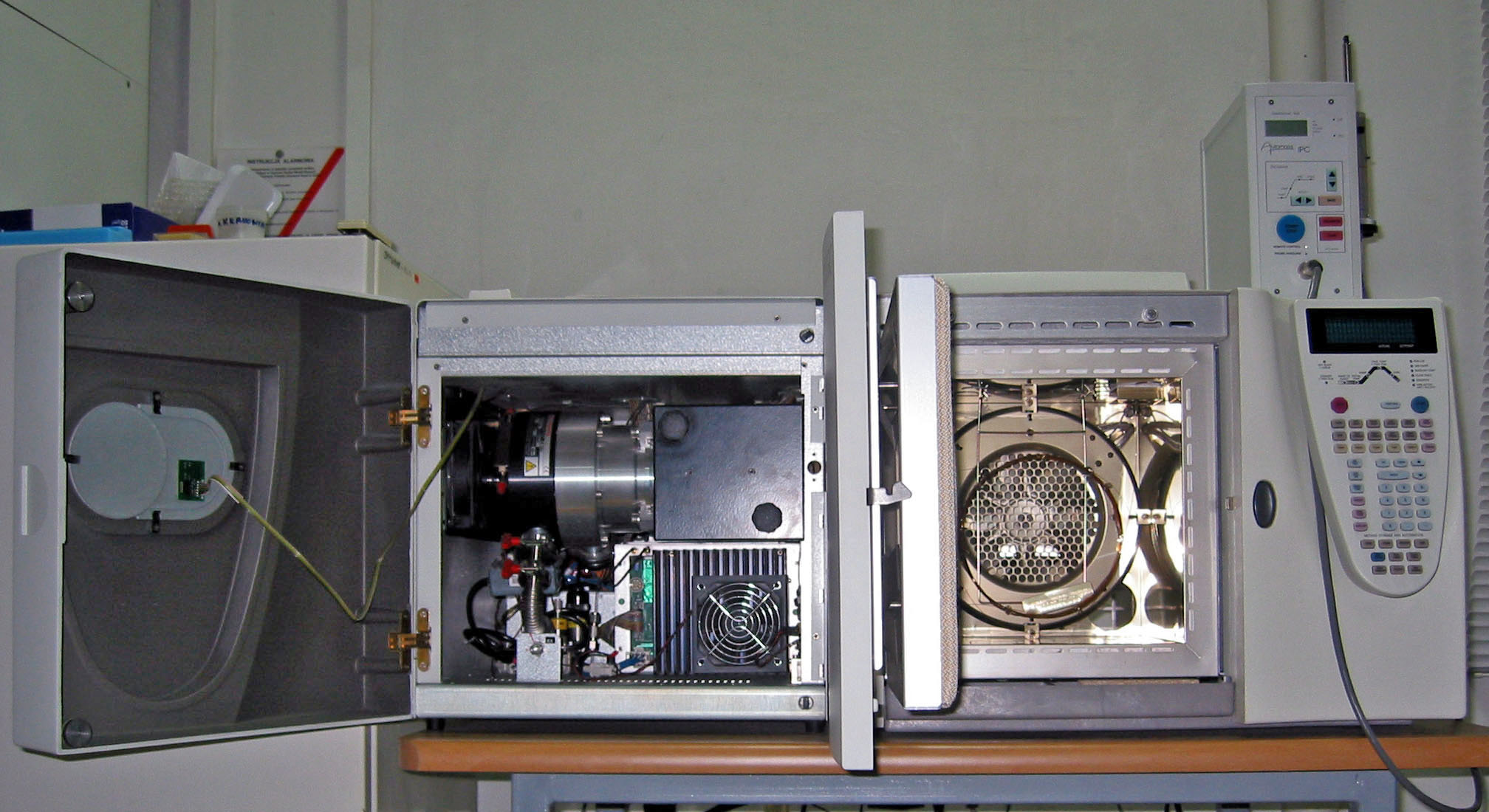
Py-GC-MS involves rapidly heating the sample in an inert atmosphere or vacuum. This cleaves large molecules into smaller fragments which can then be separated using a gas chromatography column and classified in combination with a mass spectrometer. With both results combined, the likely original materials in the sample can thus be deduced. This means that you are not literally counting MNP particles in the sample or measuring them, but quite literally vaporizing said sample and analyzing the debris cloud. Obviously this comes with some major asterisks.
A 2024 paper by Marthinus Brits et al. as published in Microplastics and Nanoplastics explored the use of Py-GC-MS for determining the amount of MNPs in human blood. Using whole blood samples they found mostly polyethylene (PE) polymer, with a mean of 268 ng/mL of MNPs across all 68 samples, with a call to investigate the health impact of this finding.
In response to this paper a correspondence by Bianca Wilhelmus et al. was submitted to the journal, in which one of the complaints was a lack of detail on the Py-GC-MS fingerprints using which the polymers were purportedly detected. It was also noted that with sub-micrometer MNP particles you’d need millions of them in a sample to really register, which is far above what had typically been found in human body fluids.
To this Brits et al. replied with among other things the admission that the quantitative analysis of MNPs using Py-GC-MS is still in early stages of development. To the issue of quantity it was noted that most of the MNPs are significantly larger than a micrometer, so they were still fairly confident of their findings.
It’s important to note more recent studies here, such as the 2025 study by Cassandra Rauert et al. in Environmental Science & Technology, in which also a study on using Py-GC-MS for detecting MNPs in blood was performed. Its conclusion was that this detection method has trouble detecting PE and PVC polymers, and the estimated exposure concentrations are testing the detection limits of this technique.
Contamination
One of the problems with trying to measure MNPs in a sample is that of environmental MNP contamination, as MNPs are being shed and distributed all around us, whether it’s from e.g. polyester clothing, plastic surfaces and tools, or carried in from outside. This makes it a real chore to make sure that in a laboratory setting such contamination does not ruin the findings, as with a recent study on MNPs in bottled water by Qian et al. in PNAS.
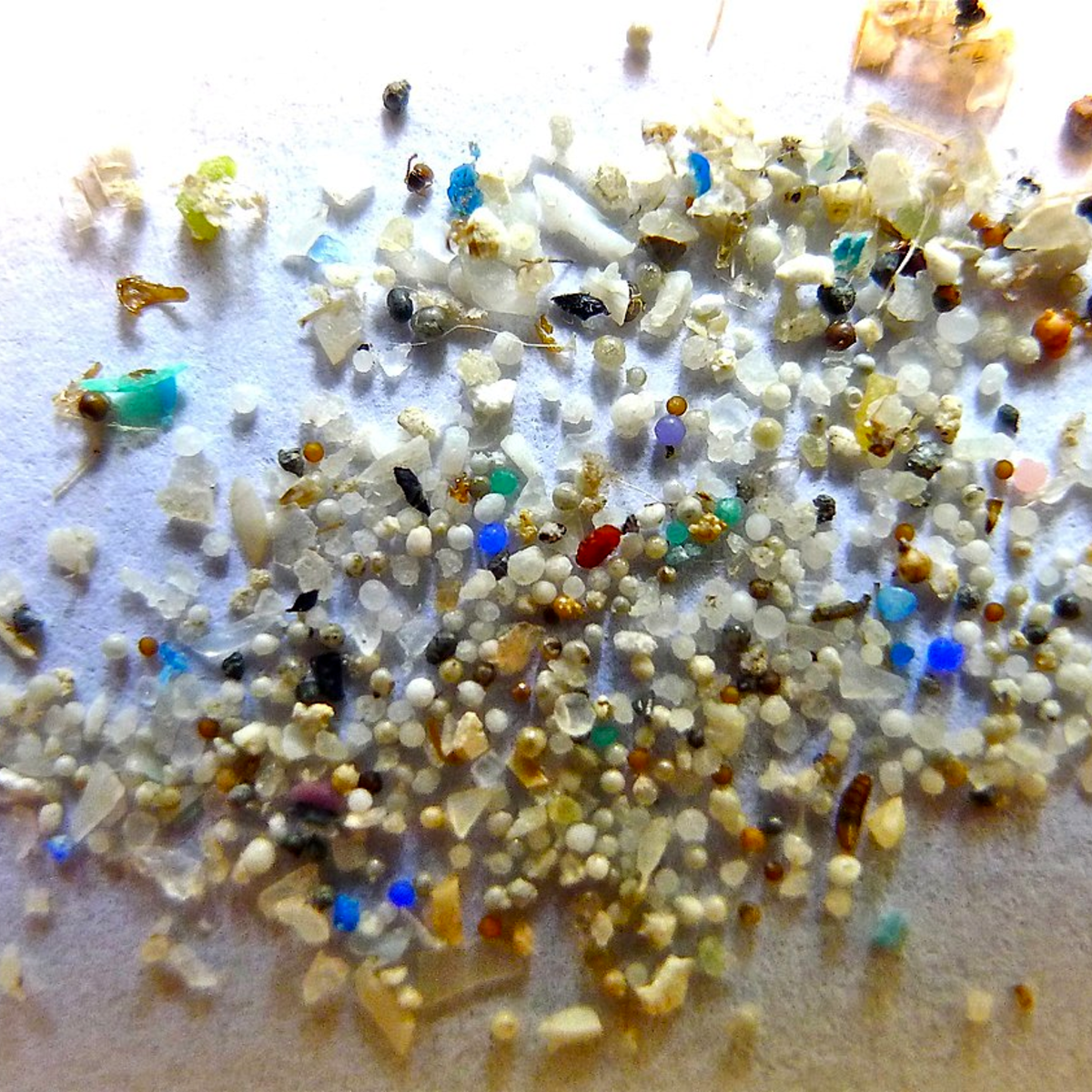
Rather than Py-GC-MS, this used stimulated Raman scattering, but also led to accusations of contamination due to improper procedures, with the finding that the ultra-pure filtered Milli-Q water that was used for a blank (i.e. control) contained as many MNPs as the bottled water. This and other issues were suggested as invalidating the findings. While Qian et al. acknowledged that using the Milli-Q water as a blank was resultingly improper, they disagreed with the premise that this invalidated the study’s findings.
Another type of contamination can come from the aforementioned biological tissue, such as in the early 2025 study on MNPs in the human brain and other organs by Nihart et al. as published in Nature Medicine. This analyzed tissue samples from human cadavers using, among other methods, Py-GC-MS, leading them to conclude that especially our brains are full of PE polymers, with major implications for Alzheimer’s and dementia research, for instance.
This assessment subsequently got challenged (full article) by Monikh et al. in a November 2025 published commentary, with the authors noting that Nihart et al.’s samples from the human liver, kidney and brain all have in common that they contain significant amounts of fatty tissue (lipids), which when subjected to pyrolysis produce fragments that are easily mistaken for PE polymer fragments.
When it comes to detecting polymers in such biological samples, it is absolutely essential to strip away the biological material, without affecting the sample that will ultimately be analyzed. In this case the processing method appears to have been flawed, leading to subsequent contamination. This was acknowledged by the team, in a reply by some of the study authors.
Empirical Correlation
Although it seems like we can at least conclude that our brains aren’t overflowing with PE polymer fragments, but that they are just filled with phospholipids in particular, this doesn’t necessarily take away all our concerns. After all, didn’t some studies find real, empirical evidence for MNPs causing actual damage? Especially since it seems harmful in mice, according to a 2025 study using starch-based plastics.
As highlighted by Baroni et al. in a September 2025 review paper on MNPs in the brain as published in Nanomaterials, the enduring problem that we are dealing with right now is one of a lack of information, a scarcity of standard detection methods and a total lack of longitudinal studies in humans.
Although we have health databases that span decades in countries with strong public healthcare systems, trying to figure out whether certain health trends are due to MNPs using their data is borderline lunacy, as you cannot realistically account for all confounding factors. Thus we are mostly stuck at this point trying to figure out how to actually effectively measure the presence of MNPs.
Methodology
The aforementioned Py-GC-MS and SRS methods are two tools available to us here, but clearly moving from measuring MNPs in water to measuring them in biological tissues is still a challenging topic. When we look at the established science of MNPs in water, we got a range of options, as illustrated by this application note by ThermoFisher Scientific:
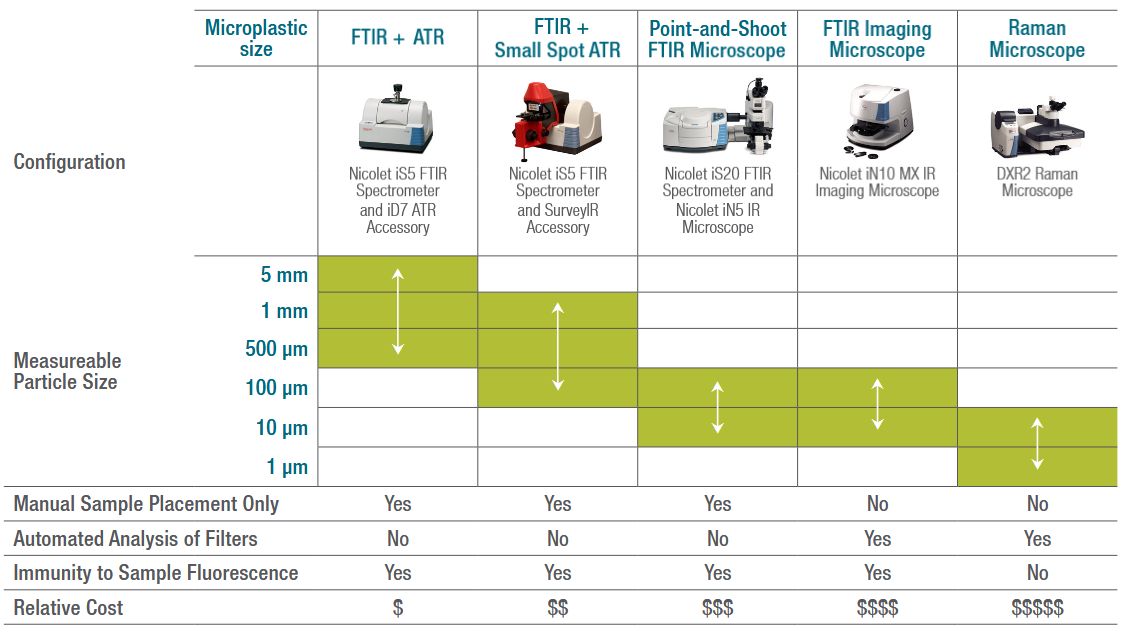
In order to measure not just the relatively large microplastic particles, but also the much smaller nanoplastics which are more likely to interact with biological systems, you are pretty limited here already. With only Raman spectroscopes applicable for such fine analysis, it’s little wonder that Py-GC-MS is being applied to biological samples.
Maybe once we have figured out the right methodology for Py-GC-MS and potentially other approaches will we be able to tell with some certainty how many of these polymer fragments are in our bodies right now, and how much of it will simply pass through rather than take up permanent residence. On the bright side, there’s no clear epidemiological evidence of MNPs being actively harmful to us, yet.
Although the sky hasn’t been confirmed to be falling, it is still looking somewhat unsteady. For that reason alone it is probably in our own best interest to use the precautionary principle here, as it’s better to have begun today to find ways to reduce and prevent the spread of MNPs, rather than to regret not having done so tomorrow.


Ministero dell'Istruzione
Polizza sanitaria per oltre 1.200.000 lavoratori della #scuola. Oggi è stata pubblicata da Consip la gara europea per l’erogazione di prestazioni sanitarie a favore di tutto il personale scolastico.Telegram
Roberto Rossetti reshared this.
Ask Hackaday: How Do You Digitize Your Documents?

Like many of you, I have a hard time getting rid of stuff. I’ve got boxes and boxes of weirdo bits and bobs, and piles of devices that I’ll eventually get around to stripping down into even more bits and bobs. Despite regular purges — I try to bring a car-load of crap treasure to local hackerspaces and meetups at least a couple times a year — the pile only continues to grow.
But the problem isn’t limited to hardware components. There’s all sorts of things that the logical part of me understands I’ll almost certainly never need, and yet I can’t bring myself to dispose of. One of those things just so happens to be documents. Anything printed is fair game. Could be the notes from my last appointment with the doctor, or fliers for events I attended years ago. Doesn’t matter, the stacks keep building up until I end up cramming it all into a box and start the whole process starts over again.
I’ve largely convinced myself that the perennial accumulation of electronic bric-à-brac is an occupational hazard, and have come to terms with it. But I think there’s a good chance of moving the needle on the document situation, and if that involves a bit of high-tech overengineering, even better. As such, I’ve spent the last couple of weeks investigating digitizing the documents that have information worth retaining so that the originals can be sent along to Valhalla in my fire pit.
The following represents some of my observations thus far, in the hopes that others going down a similar path may find them useful. But what I’m really interested in is hearing from the Hackaday community. Surely I’m not the only one trying to save some storage space by turn piles of papers into ones and zeros.
Take a Picture, It’ll Last Longer
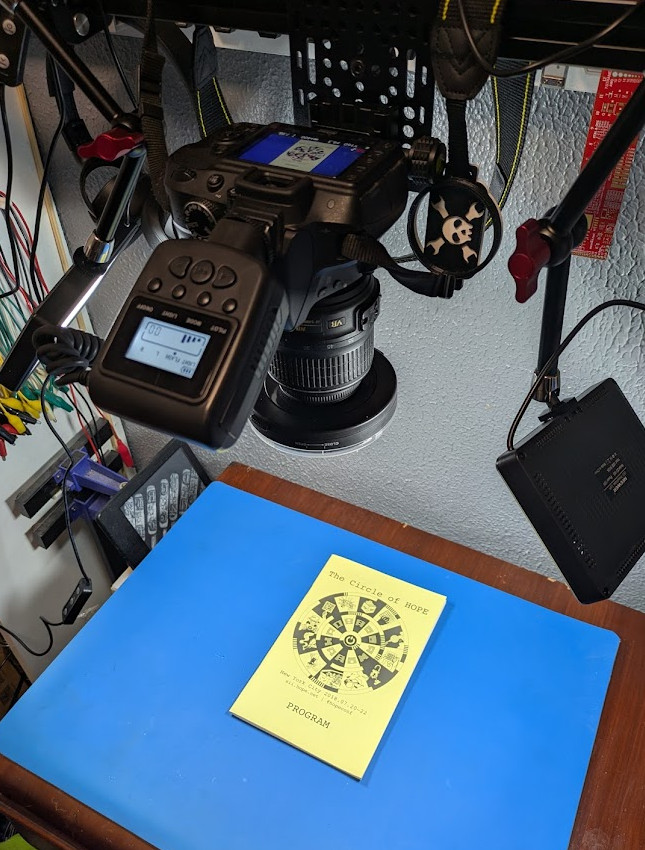
If you’ve got a decent camera, you can get a couple of lights and put together a nice overhead photography rig without spending too much money. Put your document down under the camera, snap a picture, and keep it moving.
Imaging doesn’t get any faster than taking a picture, and so long as you’re not using some point and shoot from the early 2000s, the resolution should be more than sufficient. This method is particularly appealing if you’re planning on digitizing books or anything else that can’t be laid perfectly flat on a scanner.
The major downside with this approach is the setup itself. It’s one thing if you’re digitizing documents and books on a daily basis, but for occasional use, putting something like this together is a big ask. A flatbed scanner certainly takes up a lot less room, and you don’t have to worry about getting the lighting right, mounting the camera, and so on.
Casting Some Magick
Whether you used a scanner or a camera, once you have the image of your document, you’ve technically digitized it. Congratulations, you’re now an amateur archivist.
If you’re looking to keep things simple, you could stop here. Stash the files someplace and be done with it. But depending on the type of content you’re working with and what your goals are, there’s a good chance you’ll want to touch up the images a bit. Luckily for us, the incredible ImageMagick project has many of the functions we need built-in, from cropping and resizing, all the way to image enhancement.
Consider the image below. It’s clear enough to read, but the text is rotated and the lighting isn’t consistent across the entire page.

We can fix both issues with a simple ImageMagick command via the convert tool:
convert input.png -deskew 30% -threshold 25% output.png
We won’t get too bogged down in the details, the ImageMagick documentation can break it all down better than I can. The short version is that we’re telling it to straighten out the image and convert it into pure black and white. The result looks like this:

The values can be tweaked a bit to refine the result, and as you might imagine there are many other ImageMagick functions that could potentially be brought in to clean up the result. Things do get more complicated if you’re working with something more complex than plain text, but you get the general idea.
This sort of post-processing is especially important if you plan on running the images through any sort of optical character recognition (OCR) to capture the actual text of the document. That first image might be perfectly legible to our human eyeballs. You might even prefer it over the stark look of the processed image, but tools like tesseract have a hell of a time picking the text out when the background isn’t uniform.
There’s an App For That
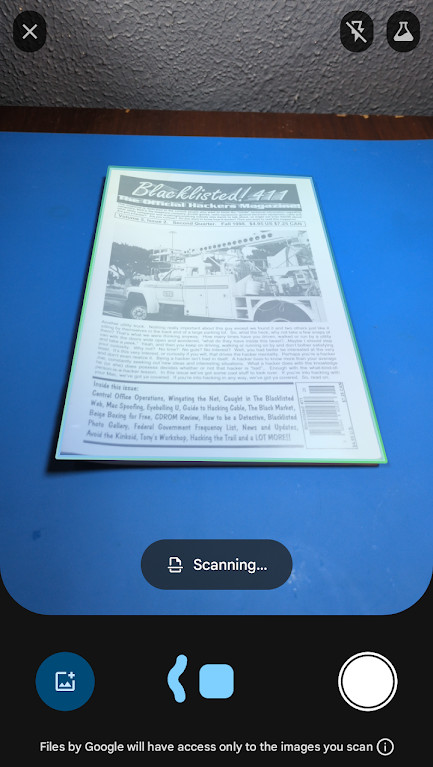
The Google Drive mobile application offers a very impressive document scanning mode that essentially automates everything above. If you give it access to your device’s camera, it will automagically detect documents in the field of view, find their edges, compensate for angle and rotation to straighten out the image, and even run it through filters to make the text pop. It’s fast, works reasonably well, and is exceptionally handy for cranking out multi-page PDFs.
The downside is that you’ve got relatively little control over the process, and being a product of Google, there’s the usual concerns over what they may be doing with the information that’s passing through the system. For these reasons it’s not something I would personally recommend for any private information, and its automatic nature the lack of fine-grained control means it may not be a great choice if your needs venture too far from the beaten path.
Still, the speed and ease of use it offers is admittedly very attractive.
Open to Suggestions
I’d love to hear the community’s thoughts on digitization, whether it’s hardware or software related. There’s surely some slick projects out there that aid in creating bespoke digital libraries, and there’s plenty of areas where real-world experience can help streamline and improve the overall process. For example, what’s your file naming convention look like?
Hackaday readers are rarely shy about sharing their opinions, so let’s hear them.
These Ultra-Cute, Handsfree Walkie-Talkies Are Built For Cycling

Walkie-talkies are great fun, and [RealCorebb]’s bbTalkie project takes the concept a step further by adding some extremely cool features to make a highly refined, self-contained ESP32-based communicator. bbTalkie completely does away with a push-to-talk button by implementing robust voice detection that works reliably even in noisy environments. It was all designed with cycling in mind, so hands-free operation that stands up to noise is a big plus.
The core of communication is done over ESP-NOW, which is Espressif’s own protocol for direct device-to-device broadcasting. This removes the need to involve any sort of external service like SIM cards or internet access to transmit voice. Performance is best with an external antenna, naturally, but ESP-NOW doesn’t actually require anything other than the existing on-board hardware.
We’ve seen ESP-NOW used to make digital walkie-talkies before, but bbTalkie is a really evolved take on the concept, not least of which due to its hands-free operation.
Because volume-based automatic triggers are highly susceptible to noise, voice detection is done with the help of VADNet, a neural network-based model implemented locally on the device. This system can reliably detect human speech, even in noisy environments. This lets bbTalkie switch between transmit and listen modes automatically and hands-free, without false triggers.
Even when doing all that, there’s still spare capability to play with. Further to the goal of making bbTalkie useful for cyclists in a group, [RealCorebb] added a system that can recognize specific voice commands (like “turn left” for example, or “wait for me!”) which trigger synchronized animations to play on the displays of all connected units. There’s even some experimental support for controlling a camera over Bluetooth, though currently it only supports hardware from Sony.
Watch a tour of it in the video below (Chinese language, English captions available). The OLED screens and animations are adorable, and are great visual feedback of what the unit is doing at any given moment.
youtube.com/embed/v0QcsWsoYbw?…


Through the Spyglass: On the Bastardization of Self-Determination [Part I]
There has been a notable absence of a certain topic on the United States Pirate Party website. Something that has been so relevant and so important to the day-to-day for anyone considering themselves “politically involved” that it almost becomes indefensible that nothing has been properly stated on the issue.
Today is a course correction.
There will not be only one topic being tackled today, and by the end of it, dear reader, it’s hoped you understand why this took so long.
Before we can begin, you must keep this question in the back of your mind: “Is this really self-determination?”
In the interest of familiarity, we will first start at a time everyone is familiar with: the American Revolution.
We know the history; Stamp Act, Boston Massacre, tea in the harbor, Shot Heard ‘Round the World, Lexington and Concord, Crossing the Delaware, Yorktown, independence and freedom from Great Britain and the monarchy. Kids are taught this stuff from a young age, and this is how the story of the U.S.A’s founding typically goes.
Less mentioned, if mentioned at all, is the “French-Indian War”, which was actually the North American theatre of the Seven Years War, the first truly world war.
That is where we truly need to begin this story.
The French-Indian War is named as such because the British Army, their colonial settlers, and their American Indian allies fought a war against the French Army, their colonial settlers, and their American Indian allies over the Ohio River Valley; modern day Pittsburgh and the Ohio River.
All that you know to be quintessential Americana was the subject of two European Empires and their colonial settlers attempting to claim land for themselves and their home empires.
The war began when tensions over who controlled the Ohio River Valley boiled over into conflict after a young George Washington (yes, really) and his regiment ambushed, attacked and killed Joseph Coulon de Jumonville, a French officer reportedly sent to warn Washington of their encroachment on French land and was said to be merely on a diplomatic mission.
Again: settlers on this land claiming it to be theirs. French settlers, numbering ~40,000 in 1750, and British settlers, ~1 million, claiming land that they only knew existed with certainty as early as 1503 (when Amerigo Vespucci confirmed it was not Asia they discovered a route to but the New World entirely) for countries that have only had permanent presence on the Américan continent since 1604 (France, Port-Royal) and 1607 (Great Britain, Jamestown).
While the French-Indian War ended in British victory and total control over what was previously French North America (essentially, the Saint Lawrence River, the Great Lakes and Mississippi River and the land around it), it was not the central war to the question of self-determination.
It was the war following the conclusion of the French-Indian War, and the war that would lead to further colonist anger towards Great Britain: Pontiac’s War.
In the middle of all of this, one tends to forget that the European Empires were playing local American Indian populations against one another and signing treaties for protection and monetary gain. Many settlers came to spread Christianity and convert the Natives from their Indigenous beliefs.
Have they been granted the right to self-determination? Is this really self-determination?
Once the more consolatory French were defeated and forced to leave, and once British General Jeffrey Amherst began imposing policies threatening the local population, it was Odawa Chief Pontiac (Obwaandi’eyaag) who realized their way of life in the Great Lakes was in danger.
May 1763, Native Americans attacked multiple forts and drove many British settlers out of the region. Due to this conflict, and out of fear that it could be a perpetual state of conflict between settlers and natives, George III of Great Britain proclaimed there shall be no new settlements west of the Appalachian Mountains in October 1763, and that west of the Appalachians would be designated as Indian Territory.
Remember: that is the land the settlers fought a war over specifically to control.
This, as well as anger imposed over taxes installed to pay off debts of the Seven Years War, would set off a chain reaction that would lead to the colonists declaring independence from Great Britain and seeking their own idea of “self-determination”.
During the Treaty of Paris (1783), which marked the end of the American Revolution (on paper), Great Britain, who had previously treated Native Americans with enough dignity to at least sign and honor treaties, gave away land that wasn’t theirs to give, without any Native American delegation present during negotiations.
After that, the story often falls under the growth of the country, the admission of states and keeping balance in the Union until it fell apart briefly, bloodily. Rarely, if ever, is the story of the American Indian spoken of when talking about the growth of the United States.
Perhaps it is too uncomfortable to think about, but in their pursuit of westward expansion, these descendants of settlers, who twenty years prior called themselves “British”, claimed it was their God-ordained right to claim all the land from the Atlantic to the Pacific.
Manifest Destiny, if you will.
While claiming “All men are created equal”, this country systematically had settlers drive the native population from their homes while many of the settlers also held African Americans in chattel slavery and considered them “property” and “3/5ths a person” for census keeping.
Is this really self-determination?
To restate a point from a previous Spyglass article:
“The United States Pirate Party, as part of our platform, advocates for self-determination. As outlined in our platform: “We advocate for the right to free association and self-determination. People living in a political entity should have the right to maintain, alter or conclude their relationship to larger entities, or join in union, if it is the will of the people.”
When Indigenous Americans cannot trust a treaty signed and continuously is driven from their land, is this really self-determination? When Black Americans are still in chains and treated like livestock instead of your fellow man, is this really self-determination?
To say the United States Revolution was a fight for self-determination and freedom becomes tainted when you zoom out and ask: “for who?”
Because if your version of “self-determination” doesn’t include everyone and is only “self-determination” for the in-group, is this really self-determination?
No. In execution, it looked more like genocide and apartheid. Even our own apartheid was simply called “Segregation” after chattel slavery’s “end”. Even the genocide of American Indian populations is boiled down to “leftist talking points” and dismissed.
So why bring this up? Is it to rag on the United States? Is it to hold up a mirror to the worst aspects of the United States and make the U.S. look bad?
No. In execution, I hoped to point out the worst aspects of U.S. history and say “We cannot change that past but we can learn from it and stop it from happening again.”
So what happened? Great Britain allied with a native population to fight a war and immediately turned their backs on them and gave their land away to the settler colonial project without their knowledge, and which the settlers claimed is their God-ordained right to have, leading to apartheid and genocide.
Oh.
Part II coming tomorrow.

Digitaler Omnibus: „Die EU-Kommission rüttelt an den Grundpfeilern des Datenschutzes“
netzpolitik.org/2026/digitaler…

Berlin: Undurchsichtige Gesundheitsdatenbank-Pläne nach Brandbrief vorerst gestoppt
netzpolitik.org/2026/berlin-un…

Embracing Linguistic Diversity: Shaping the Voice of Europe’s AI Future
At a time when the world is on the cusp of developing technologies that seamlessly integrate into daily life, particularly artificial intelligence, using language as input is a compelling proposition.
Language isn’t just a means of communication; it is a part of culture and identity, something people carry with them wherever they go. Imagine landing in a foreign land, surrounded by unfamiliar sounds, and suddenly hearing a familiar language being spoken. There is an immediate sense of connection, comfort, and belonging. This human response reflects a profound sentiment: Language is one of the forces that anchors human beings culturally, emotionally, and socially.
Linguistic Diversity And The European Dream Of Digital Sovereignty
With 24 official languages, alongside many regional and minority tongues, the European Union stands as a living example of “Unity in Diversity.” Despite such linguistic richness, the European AI landscape is dominated by English and a handful of other majority languages, leaving large parts of Europe linguistically underserved. For example, languages such as Latvian, Irish, and Maltese collectively account for only a small fraction of the datasets used to train the largest commercial models, which means these systems often perform poorly or inconsistently on them.
Having identified this gap, the European Commission launched a new initiative under its Digital Decade Programme 2030 to support the use of more languages in AI. Projects such as the Alliance for Language Technologies European Digital Infrastructure Consortium (ALT-EDIC) and the Language Data Space (LDS) aim to transform how AI is trained across the EU.
Why This Matters: Human and Competitive Edge
With many European languages underrepresented in the current digital landscape, the EU’s approach to embracing and incorporating linguistic diversity into its digital tech plans is a bid to uphold its identity while systematically reducing its dependence on non-EU models. The goal is to foster the EU’s local AI economy and strengthen tech autonomy.
- Digital Inclusion for All Citizens: When AI tools become operational in native languages, accessibility to the general public is enhanced. This helps close gaps in education, public services, healthcare, legal help, and civic life. It is not just convenient; it is essential for fair access to digital life.
- Cultural Preservation and Identity: The importance of languages in the history of the human race extends beyond the purview of a set of grammar rules or means of expression to communicate. Languages are cultural identities and a proof of evolution. AI that supports local and indigenous languages helps preserve cultural heritage in the digital world. Ensuring they thrive in technological ecosystems affirms their relevance and vitality.
- Boosting European Innovation and Competitiveness: Multilingual AI equips European startups and companies with market-tailored tools, reducing reliance on external providers and fostering homegrown innovation. Open models like OpenEuroLLM lower cost barriers, support custom use cases, and help European businesses compete globally on a stronger footing.
- Strategic Tech Sovereignty: By building its own infrastructure, data, and AI models, Europe depends less on foreign systems that may not comply with local laws, privacy rules, or language requirements. This supports the EU’s goals for digital independence and strength.
A Few Examples From The EU’s Initiatives
ALIA and AINA: Public AI for Spain’s Languages
The Barcelona Supercomputing Center created ALIA and AINA to support Spanish and its co-official languages: Catalan (including Valencian), Basque, and Galician.ALIA provides open language models to encourage innovation and strengthen Europe’s technology and culture. AINA’s goal is to preserve Catalan in the current digital era by providing linguistic and digital resources crucial to processes such as translation, voice assistants, and AI chatbots.
OpenEuroLLM: Multilingual Foundation Models for All EU Languages
Backed by a consortium of research institutions and companies and funded under the Digital Europe Programme, the OpenEuroLLM project is designed to develop a family of open-source Large Language Models (LLMs) covering all official European Union languages, compliant with European AI regulations, and reflecting European values such as transparency and openness.
These models are intended not only for academic use but also for everyday business, public services, and startup innovation, thereby lowering barriers to AI adoption across the EU.
ALT-EDIC and the European Language Data Space
Another cornerstone initiative is the Alliance for Language Technologies EDIC (ALT-EDIC). This multi-country consortium brings together Member States to build a shared infrastructure for language technologies, including data collection, model development, evaluation, and ecosystem support.
Complementing this is the Language Data Space (LDS), a data ecosystem funded under the Digital Europe Programme that facilitates access to multilingual linguistic data for innovation. Together, these efforts address a core challenge: many European languages lack the volume and quality of digital data needed to train robust AI models.
EU Institutional Language Models & Multilingual Services
The European Commission is also developing AI services and models through its institutional channels — for example, efforts to build an EU-wide large language model that supports all official languages and serves public administrations, small and medium-sized enterprises (SMEs), civil society, and academia. These include initiatives like:
- eTranslation (neural machine translation)
- eSummary (automated multilingual summarisation)
- eBriefing (draft document creation) All part of the Digital Europe AI ecosystem and contributing to multilingual public AI services.
Facing the Challenges
No discussion of ambitious AI policy is complete without acknowledging the hurdles:
- Data Scarcity: Many regional languages lack enough high-quality digital data — a core ingredient of powerful AI. Initiatives like ALT-EDIC help, but the work is long and resource-intensive.
- Compute and Energy Costs: Training large, multilingual models requires substantial compute and energy resources. Europe’s infrastructure investment must go hand in hand with sustainability commitments.
- Global Competition: While Europe’s strategy emphasizes openness, values, and inclusion, the global AI landscape is fiercely competitive, with U.S. and Chinese companies investing in vast proprietary systems. Investments such as those under Horizon Europe and Digital Europe are bridging gaps, but the challenge remains significant.
- Coordination and Scale: A shared pan-European approach requires alignment across 27 Member States, each with distinct languages, cultures, priorities, and capacities.
Conclusion: A Future Built for People and Purpose
Europe’s push for linguistic diversity in AI is more than a policy shift influenced by geopolitical changes. It’s a recognition that technology must reflect who we are: culturally, socially,y and democratically. This is a reminder that policies and investments should center not only on innovation but also on the people whose lives are shaped by the languages they speak.
From ALIA’s regional focus to EU-wide initiatives such as OpenEuroLLM and ALT-EDIC, Europe is working toward a future in which AI is inclusive, human-centred, and sovereign, and in which linguistic diversity isn’t an afterthought but a foundational strength.
Verso una legge elettorale EUROPEA. Sandro Gozi (Renew Europe) ci parla delle ultime novità
@Politica interna, europea e internazionale
L'articolo Verso una legge elettorale EUROPEA. Sandro Gozi (Renew Europe) ci parla delle ultime fondazioneluigieinaudi.it/vers…
Oh ma al povero Matteo non gliene va bene una!
Potrei cominciare a provare dell'umana pietà per lui.
Naaaaaaaaa...


La Corte Costituzionale ha corretto la norma su chi assume stupefacenti e si mette alla guida
https://www.ilpost.it/2026/01/29/sentenza-guida-sostanze-stupefacenti-pericolo/?utm_source=flipboard&utm_medium=activitypubPubblicato su News @news-ilPost
La Corte costituzionale ha corretto la norma su chi assume stupefacenti e si mette alla guida
La riforma del codice della strada promossa da Matteo Salvini aveva introdotto regole molto severeIl Post

Poliversity - Università ricerca e giornalismo reshared this.
Sempre più magro
Ucraina, Nato e Artico. I nodi della sicurezza europea secondo Cavo Dragone
@Notizie dall'Italia e dal mondo
Nel corso del New Year’s Forum, intervenendo nel panel dedicato a Difesa e Sicurezza, Giuseppe Cavo Dragone ha toccato alcuni dei nodi che attraversano il dibattito sulla sicurezza europea. Dalla guerra in Ucraina al tema dell’esercito europeo, fino alle implicazioni
Dagli Usa ci salveranno gli Usa
@Giornalismo e disordine informativo
articolo21.org/2026/01/dagli-u…
“Ho scritto questa canzone sabato, l’ho registrata ieri e ve l’ho pubblicata oggi in risposta al terrore di stato che sta colpendo la città di Minneapolis. È dedicata al popolo di Minneapolis, ai nostri innocenti vicini immigrati in memoria di Alex Pretti e Renee Good. Resta
like this
GaMe reshared this.
Stati Uniti-Iran, Washington si prepara all’offensiva? Cosa lo fa pensare
@Notizie dall'Italia e dal mondo
Il 26 gennaio, il gruppo navale della USS Abraham Lincoln è entrato nell’area di responsabilità del Centcom, in prossimità dell’Iran. L’arrivo della portaerei nucleare di classe Nimitz e dei tre cacciatorpediniere di scorta rappresenta solo l’ultimo atto del build-up militare che nelle ultime settimane ha

Guida dopo avere assunto droga, 'punibile solo se crea pericolo' - Ultima ora - Ansa.it
La stretta sulla guida sotto l'effetto di droga operata nel 2024 dall'articolo 187 del Codice della Strada non è illegittima purchè venga interpretata nel senso che possa essere punito solo chi si sia messo al volante, dopo l'assunzione di stupefacen…Agenzia ANSA

Virus dell'influenza: per trasmetterlo non basta condividere la stanza
Un esperimento mostra che le condizioni che permettono ai virus dell'influenza di propagarsi sono più sfumate e complesse di quanto si credesse.Focus.it
Giulio Regeni: a Monfalcone anteprima con il regista
@Giornalismo e disordine informativo
articolo21.org/2026/01/giulio-…
Dopo l’anteprima nazionale di Fiumicello, Giulio Regeni – Tutto il male del mondo arriva al Kinemax di Monfalcone per una proiezione-evento domenica 1° febbraio alle ore 17.00. Il documentario è la prima opera
Anduril è a caccia di talenti. In palio mezzo milione di dollari e un colloquio di lavoro
@Notizie dall'Italia e dal mondo
Anduril, l’azienda defence-tech guidata da Palmer Luckey, ha annunciato il lancio del suo primo AI Grand Prix, una competizione di drone racing completamente autonoma che mette in palio mezzo milione di dollari per il vincitore. L’evento,

Docenti schedati, grande preoccupazione dell’Istituto Parri
@Giornalismo e disordine informativo
articolo21.org/2026/01/docenti…
L’Istituto nazionale Ferruccio Parri in un documento “esprime grande preoccupazione per la richiesta di schedatura di insegnanti di sinistra – siamo alle liste di proscrizione? – da parte di Azione
Mro reshared this.
🔴 𝟒 𝐅𝐄𝐁𝐁𝐑𝐀𝐈𝐎 𝐒𝐈𝐓-𝐈𝐍 𝐀𝐔𝐁𝐀𝐂
Mercoledì 4 febbraio dalle 10.30 saremo on SIT IN all'Aubac (Autorità di Bacino Distrettuale dell'Appennino Centrale) per assicurarci che l'Autorità abbia effettivamente piena conoscenza dell'area interessata dallo sciagurato progetto inceneritorista di Gualtieri e Acea.
📣Verso il 19 febbraio: corteo contro l'inceneritore!

#Roma #Gualtieri #NoInceneritore #EmergenzaRifiuti #Politica #RifiutiZero #CittadiniEsasperati #Termovalorizzatore
Il ricordo di Marco Luchetta e il nostro mestiere
@Giornalismo e disordine informativo
articolo21.org/2026/01/il-rico…
32 anni dopo Marco Luchetta, Alessandro Saša Ota e Dario D’Angelo, assassinati a Mostar est il 28 gennaio 1994, ci ricordano che il nostro è un mestiere necessario, anche se non sempre siamo in grado di onorarlo fino in
Francesco Capaldini likes this.
PODCAST. Perché Xi Jinping purga i vertici dell’esercito
@Notizie dall'Italia e dal mondo
L'arresto del vice capo della commissione centrale militare Zhang Youxia evidenzia la volontà del presidente cinese di mantenere il controllo assoluto su un esercito obbediente. Il Podcast di Michelangelo Cocco
L'articolo PODCAST. Perché Xi Jinping purga i vertici dell’esercito proviene da Pagine
Sentenza Tar, l’intervento dei promotori della raccolta firme
@Giornalismo e disordine informativo
articolo21.org/2026/01/sentenz…
Ieri pomeriggio è stato diffuso il comunicato dei promotori della raccolta firme del referendum. “La decisione del TAR del Lazio in tre punti. – scrivono – Abbiamo lanciato una raccolta firme
e poi ci chiediamo se l'ucraina ha qualche chance di farcela…. intanto ha un pil e un'economia più solida della russia…
la differenza tra gli alleati della russia e gli alleati dellìucraina è che noi stiamo sostenendo l'ucraina senza spolparla, i cinesi che "sostengono" la russia in realtà ci vogliono fare l'affare (tipo petrolio e gas a costo stracciato) e tutto questo alla fine nel lungo periodo potrebbe avere un peso.
reshared this

Roberto Rossetti
in reply to Ministero Istruzione (unofficial) • • •Ministero Istruzione (unofficial)
in reply to Roberto Rossetti • •Roberto Rossetti
in reply to Ministero Istruzione (unofficial) • • •