
[2026-01-23] EPYC Live Concert - Gonghi @ EPYC
EPYC Live Concert - Gonghi
EPYC - Via Pignatelli Aragona 42 - Palermo
(venerdì, 23 gennaio 21:00)
🗓️ Venerdì 23 Gennaio ‘26 | 🕘 ore 21:00

Gonghi è un progetto musicale di Giovanni Fiderio, violinista e compositore siracusano che con strumenti ad arco, musica elettronica e registrazioni di campo, manda cartoline di viaggi infiniti con il pubblico a bordo. Gonghi fa il tifo per la natura e lotta per la pace.
Live set: Il live di Gonghi unisce il suono di viola e violino con quello dei micro synth di vecchia e nuova generazione. La radice dub e electro-punk che emerge dai synth si intreccia con quella più minimale e visionaria degli archi.
🪪 Ingresso gratuito con tessera arci
Flock is going after a website called HaveIBeenFlocked.com that has collated public records files released by police.#Flock


Police Unmask Millions of Surveillance Targets Because of Flock Redaction Error
A handful of police departments that use Flock have unwittingly leaked details of millions of surveillance targets and a large number of active police investigations around the country because they have failed to redact license plates information in public records releases. Flock responded to this revelation by threatening a site that exposed it and by limiting the information the public can get via public records requests.Completely unredacted Flock audit logs have been released to the public by numerous police departments and in some cases include details on millions Flock license plate searches made by thousands of police departments from around the country. The data has been turned into a searchable tool on a website called HaveIBeenFlocked.com, which says it has data on more than 2.3 million license plates and tens of millions of Flock searches.
The situation highlights one of the problems with taking a commercial surveillance product and turning it into a searchable, connected database of people’s movements and of the police activity of thousands of departments nationwide. It also highlights the risks associated with relying on each and every law enforcement customer to properly and fully redact identifiable information any time someone requests public records; in this case, single mistakes by individual police departments have exposed potentially sensitive information about surveillance targets and police investigations by other departments around the country.
Flock is aware of the exposure enabled by its own product design and has tried to do damage control with its law enforcement customers by blaming “increased public records act/FOIA activity seeking by the public,” according to an email Flock sent to police obtained via public record request. Flock has threatened Cris van Pelt, the creator of HaveIBeenFlocked, by going after his web hosts and claiming that he has violated their intellectual property rights and is posting information that “poses an immediate threat to public safety and exposes law enforcement officers to danger.” In recent weeks Flock severely limited the amount of information available on its audit logs, which are designed to be a transparency tool, raising questions about how much information journalists, regulators, and government agencies will be able to get about police use of Flock cameras in the future.
“I set up HaveIBeenFlocked to show how pervasive and prevalent this monitoring is, and to show just how many searches are getting done. That information, by itself, is shocking,” van Pelt told 404 Media. “To me, as a private citizen, that’s shocking, and I think that’s kind of what Flock is trying to hide or bury.” van Pelt added that he is committed to keeping the website online.
As 404 Media has reported before, Flock’s automated license plate reader cameras are connected to local, state, and/or national “networks” of cameras. When a police officer runs a search seeking the locations of a specific license plate, they are usually not just searching cameras owned by their own jurisdiction, they are usually searching all Flock cameras in that state or in the country. Each individual search creates a record of that search on as many as 80,000 different cameras around the country.
As a compliance and transparency measure, these search records can be obtained through a “search audit,” which are essentially huge spreadsheets of specific Flock searches that contain not just the searches of local police but of all police who have ever searched that camera. Using this data, we have previously been able to report that local police are regularly giving Immigrations and Customs Enforcement side-door access to Flock cameras, and we also reported that Texas searched tens of thousands of cameras nationwide for a woman who self-administered an abortion. Flock search audits have also been used to catch police who have allegedly illegally stalked people or otherwise abused the system.
An example of what search audits look like. License plate redaction done by 404 Media
Because these search audits are important tools for police transparency and accountability, they have become a popular type of public record to request for journalists, concerned citizens, privacy experts, city councils, and government regulators. In the vast majority of cases, the police departments releasing the search audit files redact the surveillance target’s license plate number. But in recent months, at least four police departments have released full Flock search audits without redacting anything at all, revealing information about a mix of more than a million individual surveillance targets, suspects, and crime victims. This means that any individual Flock customer could accidentally leak the specific search targets for millions of Flock searches nationwide; any single failure point anywhere in the country could dox the police activity and surveillance targets of other police departments elsewhere.With the license plate information, you can determine not just what police are using Flock for, but who they are using it against. An unredacted search log file obtained by 404 Media shows more than 700,000 individual searches from June 2025 alone, performed by hundreds of law enforcement agencies nationwide, including hundreds of searches performed by US Border Patrol agents. They show the specific date and time of a search, the name of the officer who did the search, sometimes show the specific case number of a search, the police-stated “reason” of a search, as well as the number of Flock cameras searched. Crucially, they also show the license plate, allowing someone to connect a specific license plate and therefore person to reasons like “drug trafficking,” “fugitive,” “narc,” immigration enforcement, “homicide,” “oil and gas theft,” etc. As the Electronic Frontier Foundation found, they also expose the victims of a host of biased policing tactics and dubious searches, including hundreds of searches of “No Kings” protesters, audit log reasons that included “possible gypsy,” and the search for a woman who had a self-administered abortion.
“EFF has had this [unredacted] information but we’ve chosen not to publish it or share it because of concerns about doxing people—our policy is not to release data of surveillance victims,” Cara Gagliano, a senior staff attorney at the EFF, told me.
404 Media has also had unredacted versions of some of these files for months but has not published any of them. At first, just one or two police departments failed to do redactions. In recent weeks, however, it has become clear that many police departments are not redacting license plates; this led van Pelt to create HaveIBeenFlocked.com, a website that collates many of these search audit logs and allows people to search individual license plates to determine if they have been run through the Flock system, and if so, where and when. The number of police departments who have now released fully unredacted logs has become so numerous that it can no longer be ignored, and the releases have caused Flock to drastically reduce the amount of information that can be obtained from a search audit.Rather than simply making sure that search audits exported for public records requests do not include license plates or are redacted by default, Flock has totally overhauled how the search logs work; in a December email to police customers obtained by 404 Media, Flock said that “to protect officer safety and active investigations, Network Audit Logs will no longer include: officer names, specific plates searched, vehicle fingerprint information.”
To be clear, Flock is not turning on license plate redaction by default: It is fully withholding officer names and license plate information from the police departments themselves.
“Flock is doing their best to have it both ways where they have no responsibility and also no accountability to the communities where their cameras are placed,” Chris Gilliard, privacy expert and author of the forthcoming Luxury Surveillance, told 404 Media. “Shoddy data hygiene by law enforcement is not seen as a threat or danger but accountability and transparency are.”
The letter from Cyble
In recent weeks, Flock, via a third party company called Cyble, has threatened van Pelt by filing bogus intellectual property takedown requests with Cloudflare and Hetzner, two of his web hosts. Takedown requests filed by Cyble state the site “presents a significant security risk to our client and its users. The website poses an immediate threat to public safety and exposes law enforcement officers to danger, in clear violation of our client’s users’ rights and its intellectual property rights. The website publicly and deliberately discloses extensive, sensitive information obtained from Flock and its automated license plate reader systems with the apparent intent to undermine law enforcement operations. It hosts three searchable databases that expose critical operational intelligence. Such disclosure of sensitive data substantially heightens the risk to officers and the public and necessitates urgent remedial action.”“Please be informed that our client is a renowned company in the US and directly works with government agencies,” it continues. “In view of the above, kindly suspend the services and stop the hosting of the website at the earliest convenience.”
The EFF’s Gagliano told 404 Media that, though the EFF hasn’t published license plate information, “these takedowns are bogus. They’re blatantly misrepresenting saying this data is obtained from Flock—no, it’s data obtained from public records. There are issues around deciding whether you should make it all widely available, but it was received from public government agencies and Flock really doesn’t have much standing to be taken down.”
Cloudflare refused to take action on HaveIBeenFlocked, saying that it “found insufficient evidence of a violation,” according to an appeal email van Pelt shared with 404 Media.
Flock told 404 Media in an email “That website that is doxxing cops during active investigations. Today, we're busy working with journalists to cover the fact that our technology was pivotal in cracking open the case that found the Brown university / MIT serial killer in New England. If you'd like to report the news that matters, we'd be happy to speak to you about bringing justice to victims instead of activists trying to let murderers go free.” Cyble did not respond to a request for comment.
In a December email to police customers titled “What you Need to Know About Recent Online Disclosures,” a Flock executive said “We are aware that agencies across the country, particularly in states with broad public-records laws, are seeing increased PRA/FOIA activity seeking, among other things, LPR search logs. Recently, a third-party website began aggregating search information that has been released through these public-records processes.
We recognize that seeing investigative search activity displayed publicly can raise understandable concerns about officer safety, investigative integrity, community perception, and compliance with state law.”
The email added “To be clear: Flock has not been breached or compromised. We are CJIS compliant. Regardless, we are continuing to make changes to our Product to better protect you and your officers.”
That much is true, because in this case the sensitive material released was taxpayer-funded public records willingly released by police departments around the country.
On the HaveIBeenFlocked website, van Pelt defends his decision to run the site: “This website aggregates and reformats already-public information. This information represents a fraction of what's being shared with Flock and its government, commercial, and private partners on a daily basis,” he wrote. “Policies exist to prevent the release of this information—they are not adhered to. Laws and regulations exist to enforce the policies—they go unenforced. Police, Flock, and politicians have been ignoring these problems for years while your private movements continue to be collected, catalogued, sold and traded.”
“This website exposes the problem because, as the old saying goes, sunlight is the best disinfectant. Law enforcement and legislation are needed to address the cause of the problem, and we highly encourage you to bring this site to the attention of your legislators,” he added. “We believe mass surveillance has no place in a free society, and this data should not be collected to begin with. If it is collected, warrants should be used, lookups should be rare, and police and private parties, like Flock and HaveIBeenFlocked.com, should not be permitted to act without functional restraints or oversight.”
A police accountability advocate who has seen the unredacted search audits but asked to remain anonymous because Flock has suggested such people are attacking the company and the police told 404 Media that the situation highlights broader problems with Flock.
"It could lead one to the conclusion that if that is an unacceptable outcome for customers, maybe they shouldn't be participating in a nationwide surveillance system," they said. "The platform is designed to collect as much data as possible. They want to make that as widely accessible and searchable as possible. They need the network effect so they can continue collecting data for their AI models. So, I struggle with the company’s framing of what’s happened. That framing is an attempt to dodge accountability for what their platform is doing which is collecting data without people's (and often informed elected officials') consent."
Flock going after HaveIBeenFlocked on dubious intellectual property grounds is similar to its strategy against DeFlock, a website that hosts an open source map of ALPR locations.
In a separate December email to Jim Williams, the police chief of Staunton, Virginia, Flock CEO Garrett Langley claimed that public records were being weaponized against the company. Langley claimed the company and police are under “coordinated attack” by activists “trying to turn a public records process into a weapon against you and against us.”
“Flock is building tools to help you fight the real crime affecting communities across the country. Many activists don't like that. Let's call this what it is: Flock, and the law enforcement agencies we partner with, are under coordinated attack. The attacks aren't new. You've been dealing with this for forever, and we've been dealing with this since our founding, from the same activist groups who want to defund the police, weaken public safety, and normalize lawlessness. Now, they're producing YouTube videos with misleading headlines,” Langley wrote. “They're also trying to turn a public records process into a weapon against you and against us. Make no mistake, we're fighting this fight for you, and, I hope, with you. I remain committed to building world-class technology to help you keep your communities safe. And doing so in a transparent, secure, and privacy centric way.”
Williams responded to Langley:
“As far as your assertion that we are currently under attack, I do not believe that this is so. I have dedicated the last 41 years of my life to serving the citizens of the City of Staunton as a police officer, the last 22 as the police chief,” he wrote. “What we are seeing here is a group of local citizens who are raising concerns that we could be potentially surveilling private citizens, residents and visitors and using the data for nefarious purposes. These citizens have been exercising their rights to receive answers from me, my staff, and city officials, to include our elected leaders. ln short, it is democracy in action.”
In a press release, the Staunton called Langley’s email “unsolicited” and said “The City of Staunton wants to make it clear that the Flock Safety CEO’s narrative does not reflect the city’s values.” Staunton canceled its Flock contract days later.
Flock Threatens Open Source Developer Mapping Its Surveillance Cameras
The surveillance camera company Flock sent DeFlock a cease-and-desist. DeFlock is fighting back.Jason Koebler (404 Media)


Ministero dell'Istruzione
Ieri sono state disposte le procedure di pagamento degli arretrati a oltre un milione e duecentomila docenti e personale ATA della #scuola.Telegram

191° Mercoledì di Nexa - Un’alternativa al capitalismo digitale? Confini e traiettorie delle piattaforme cooperative - Nexa Center for Internet & Society
11 febbraio 2026 | STEFANO TORTORICI (Scuola Normale Superiore di Firenze)Nexa Admin (Nexa Center for Internet & Society)
Attraverso questo nuovo servizio, disponibile su #UNICA per le #IscrizioniOnline, è possibile approfondire i percorsi della scuola secondaria di secondo grado ed esplorare l’offerta formativa …

Ministero dell'Istruzione
What’s Next, l’esperienza di orientamento nel #Metaverso! Attraverso questo nuovo servizio, disponibile su #UNICA per le #IscrizioniOnline, è possibile approfondire i percorsi della scuola secondaria di secondo grado ed esplorare l’offerta formativa …Telegram
📣 Da oggi aprono le #IscrizioniOnline! Le domande per il I e il II ciclo di istruzione potranno essere presentate online, attraverso la piattaforma #Unica, fino alle ore 20 del 14 febbraio 2026.
Qui tutti i dettagli ➡️ mim.gov.

Ministero dell'Istruzione
📣 Da oggi aprono le #IscrizioniOnline! Le domande per il I e il II ciclo di istruzione potranno essere presentate online, attraverso la piattaforma #Unica, fino alle ore 20 del 14 febbraio 2026. Qui tutti i dettagli ➡️ https://www.mim.gov.Telegram
The People vs Digital Omnibus
THIS IS DIGITAL POLITICS. But it's not Monday. I'm Mark Scott, and I apologize for the one-day delay in this week's newsletter. I've come down with what I really hope isn't Covid-19, so please forgive any typos in the dispatch below. Normal Monday transmission resumes next week.

— New polling suggests European citizens may not be as keen about the bloc's digital revamp as policymakers and industry.
— The United States' departure from more than 60 international organizations is another death knell in the open, interoperable internet.
– Despite global efforts, the US still dominates the market for data centers.
Let's get started:
Making Code a Hundred Times Slower With False Sharing
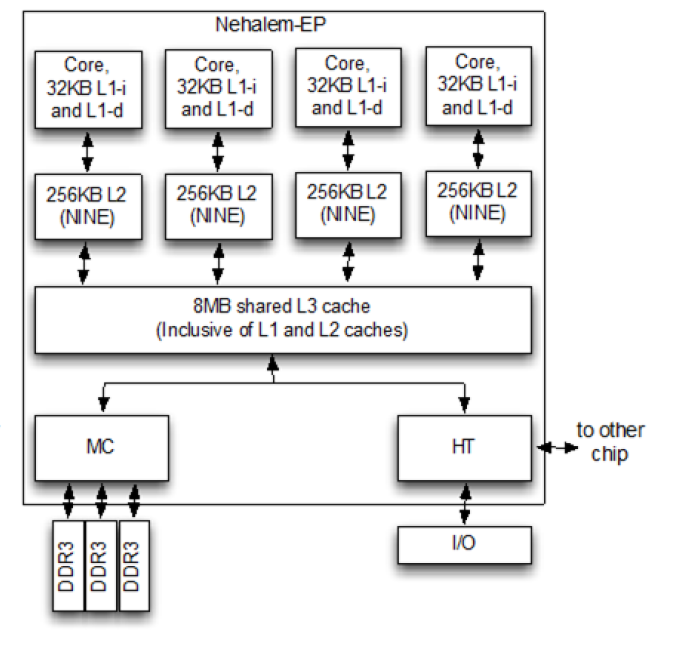
Writing good, performant code depends strongly on an understanding of the underlying hardware. This is especially the case in scenarios like those involving embarrassingly parallel processing, which at first glance ought to be a cakewalk. With multiple threads doing their own thing without having to nag the other threads about anything it seems highly doubtful that even a novice could screw this up. Yet as [Keifer] details in a recent video on so-called false sharing, this is actually very easy, for a variety of reasons.

With a multi-core and/or multi-processor system each core has its own local cache that contains a reflection of the current values in system RAM. If any core modifies its cached data, this automatically invalidates the other cache lines, resulting a cache miss for those cores and forcing a refresh from system RAM. This is the case even if the accessed data isn’t one that another core was going to use, with an obvious impact on performance.
The worst case scenario as detailed and demonstrated using the Google Benchmark sample projects, involves a shared global data structure, with a recorded hundred times reduction in performance. Also noticeable is the impact on scaling performance, with the cache misses becoming more severe with more threads running.
A less obvious cause of performance loss here is due to memory alignment and how data fits in the cache lines. Making sure that your data is aligned in e.g. data structures can prevent more unwanted cache invalidation events. With most applications being multi-threaded these days, it’s a good thing to not only know how to diagnose false sharing issues, but also how to prevent them.
youtube.com/embed/WIZf-Doc8Bk?…
Dad Makes Kid’s Balance Bike Into Electric Snow Trike Like a Boss

The balance bikes toddlers are rocking these days look like great fun, but not so great in the snow. Rather than see his kid’s favourite toy relegated to shed until spring, [John Boss] added electric power, and an extra wheel to make one fun-looking snow trike. Like a boss, you might say.
Physically, the trike is a delta configuration: two rear wheels and one front, though as you can see the front wheel has been turned into a ski. That’s not the most stable configuration, but by shifting the foot pegs to the front wheel and keeping the electronics down low, [John] is able to maintain a safe center of gravity. He’s also limiting the throttle so kiddo can’t go dangerously fast– indeed, the throttle control is in the rear electronics component. The kid just has a big green “go” button.
Bit-banging the throttle, combined with the weight of the kiddo up front, creates a strong tendency towards wheel-spin, but [John] fixes that with a some cleverly printed TPU paddles zip-tied to the harbor-freight wheels and tires he’s hacked into use. Those wheels are fixed to a solid axle that’s mounted to flat plate [John] had made up to attach to the bike frame. It’s all surprisingly solid, given that [John] is able to demonstrate the safety factor by going for a spin of his own. We would have done the same.
We particularly like the use of a tool battery for hot-swappable power. This isn’t the first time we’ve seen a kid’s toy get the tool battery treatment, but you aren’t limited to mobile uses. We’ve seen the ubiquitous 18V power packs in everything from fume extractors to a portable powerpack that can even charge a Tesla.
youtube.com/embed/L_3cA8oZP8w?…
A New Life For An Old Amplifier

An audio amplifier was once a fairly simple analogue device, but in recent decades a typical home entertainment amplifier will have expanded to include many digital functions. When these break they are often proprietary and not easy to repair, as was the case with a broken Pioneer surround-sound device given to [Boz]. It sat on the shelf for a few years until he had the idea of a jukebox for his ripped CDs, and his returning it to life with a new main board is something to behold.
Internally it’s a surprisingly modular design, meaning that the front panel with its VFD display and driver were intact and working, as were the class AB amplifier and its power supply. He had the service manual so reverse engineering was straightforward, thus out came the main board in favor of a replacement. He took the original connectors and a few other components, then designed a PCB to take them and a Raspberry Pi Pico and DAC. With appropriate MMBASIC firmware it looks as though it was originally made this way, a sense heightened by a look at the motherboard inside (ignoring a couple of bodges).
We like seeing projects like this one which revive broken devices, and this one is particularly special quality wise. We’re more used to seeing it with gaming hardware though.
FLOSS Weekly Episode 860: Elixir Origin Story

This week Jonathan and Randal chat with Jose Valim about Elixir! What led Jose to create this unique programming language? What do we mean that it’s a functional language with immutability?
youtube.com/embed/H4lC4JNUxOs?…
Did you know you can watch the live recording of the show right on our YouTube Channel? Have someone you’d like us to interview? Let us know, or have the guest contact us! Take a look at the schedule here.
play.libsyn.com/embed/episode/…
Direct Download in DRM-free MP3.
If you’d rather read along, here’s the transcript for this week’s episode.
Places to follow the FLOSS Weekly Podcast:
Theme music: “Newer Wave” Kevin MacLeod (incompetech.com)
Licensed under Creative Commons: By Attribution 4.0 License
hackaday.com/2026/01/14/floss-…
Genetic Therapy Aims To Bring Hearing To Those Born Deaf

For those born with certain types of congenital deafness, the cochlear implant has been a positive and enabling technology. It uses electronics to step in as a replacement for the biological ear that doesn’t quite function properly, and provides a useful, if imperfect, sense of hearing to its users.
New research has promised another potential solution for some sufferers of congenital deafness. Instead of a supportive device, a gene therapy is used to enable the biological ear to function more as it should. The result is that patients get their sense of hearing, not from a prosthetic, but from their own ears themselves.
New Therapy

There are a number of causes of congenital deafness, each of which presents in its own way. In the case of OTOF-related hearing loss, it comes down to a genetic change in a single critical protein. The otoferlin gene is responsible for making the protein of the same name, and this protein is critical for normal, functional hearing in humans. It’s responsible for enabling the communication of signals between the inner hair cells in the ear, and the auditory nerve which conducts these signals to the brain. However, in patients with a condition called autosomal recessive deafness 9, a non-functional variant of the otoferlin gene prevents the normal production of this protein. Without the proper protein available, the auditory nerve fails to receive the proper signals from the hair cells in the ear, and the result is profound deafness.
The typical treatment for this type of congenital hearing loss is the use of a cochlear implant. This is an electronic device that uses a microphone to pick up sound, and then translates it into electrical signals which are sent to electrodes embedded in the cochlear. These simulate the signals that would normally come from the ear itself, and provide a very useful sense of hearing to the user. However, quality and fidelity is strictly limited compared to a fully-functional human ear, and they do come with other drawbacks as is common with many prosthetic devices.
The better understanding that we now have of OTOF-related hearing loss presented an opportunity. If it were possible to get the right protein where it needed to be, it might be possible to enable hearing in what are otherwise properly-formed ears.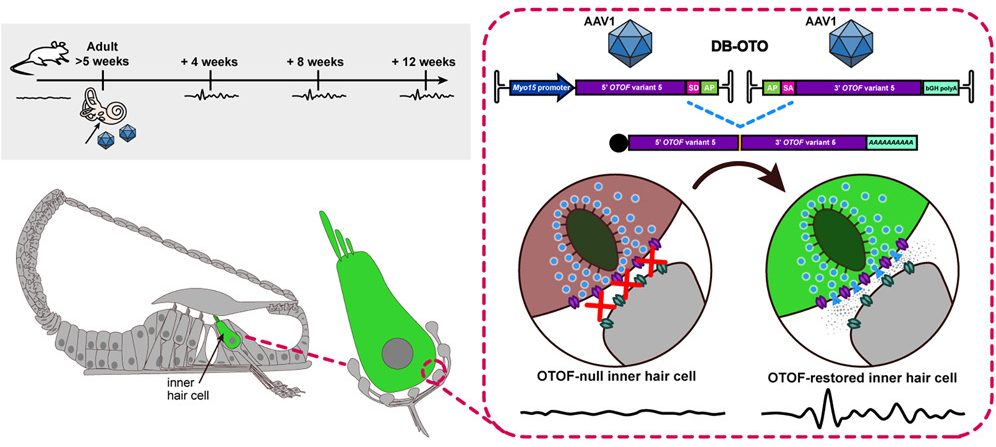
The treatment to do that job is called DB-OTO. It’s a virus-based gene therapy which is able to deliver a working version of the OTOF gene. It uses a non-pathogenic virus to carry the proper genetic code that produces the otoferlin protein. However, it’s no good if this gene is expressed in just any context. Thus, it’s paired with a special DNA sequence called a Myo15 promoter which ensures the gene is only expressed in cochlear hair cells that would normally express the otoferlin protein. Treatment involves delivering the viral gene therapy to one or both ears through a surgical procedure using a similar approach to implanting cochlear devices.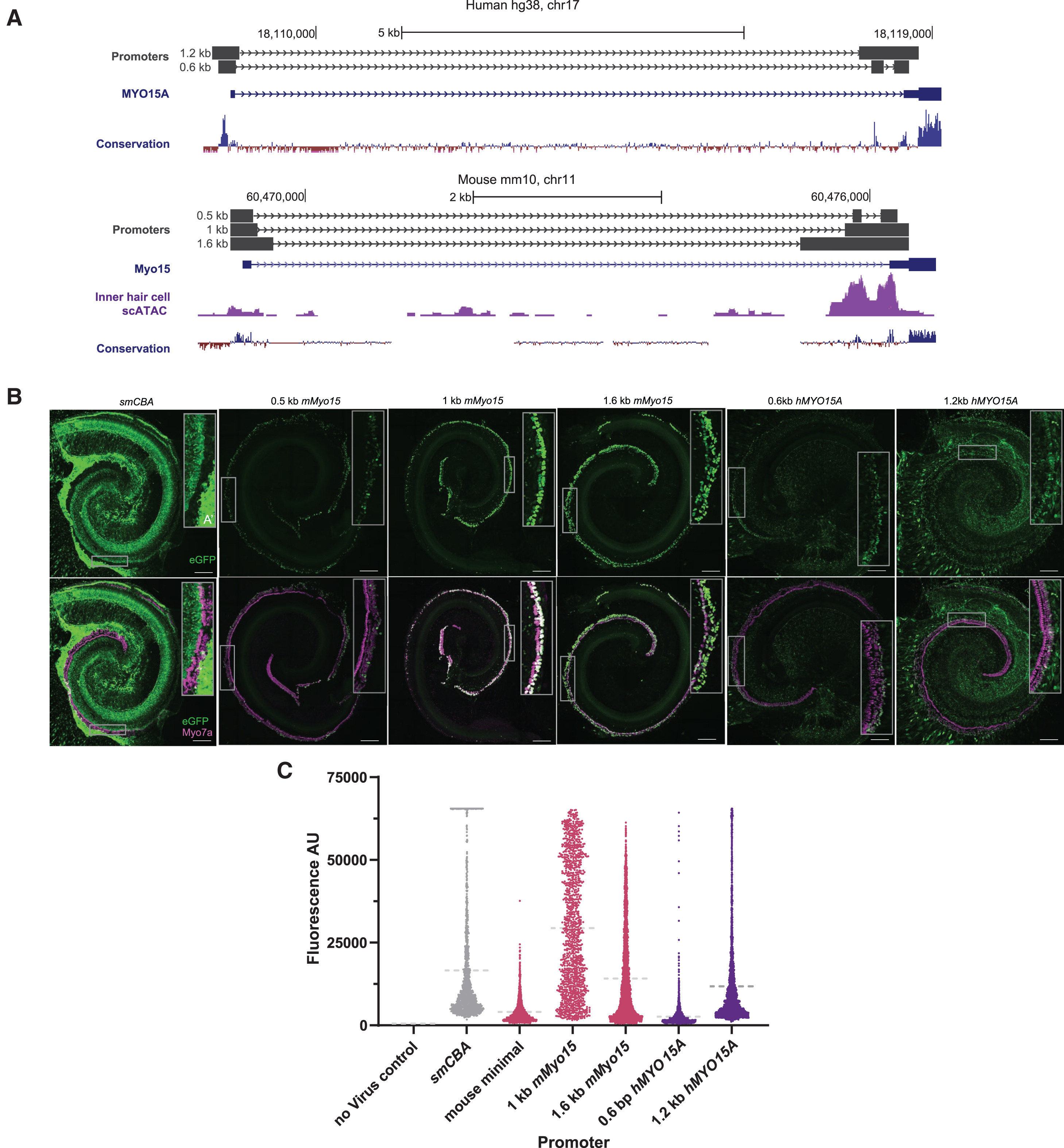
An early trial provided DB-OTO treatment to twelve patients, ranging in age from ten months to sixteen years. eleven out of twelve patients developed improved hearing within weeks of treatment with DB-OTO. Nine patients were able to achieve improvements to the point of no longer requiring cochlear implants and having viable natural hearing.
Six trial participants could perceive soft speech, and three could hear whispers, indicating a normal level of hearing sensitivity. Notably, hearing improvements were persistent and there were some signs of speech development in three patients in the study. The company behind the work, Regeneron, is also eager to take the learnings from its development and potentially apply it to other kinds of hearing loss from genetic causes.
DB-OTO remains an experimental treatment for now, but regulatory approvals are being pursued for its further use. It could yet prove to be a viable and effective treatment for a wide range of patients affected by this genetic issue. It’s just one of a number of emerging treatments that use viruses to deliver helpful genetic material when a patient’s own genes don’t quite function as desired.
ESP32-P4 Powers Retro Handheld after a Transplant

The ESP32-P4 is the new hotness on the microcontroller market. With RISC-V architecture and two cores running 400 MHz, to ears of a certain vintage it sounds more like the heart of a Unix workstation than a traditional MCU. Time’s a funny thing like that. [DynaMight] was looking for an excuse to play with this powerful new system on a chip, so put together what he calls the GB300-P4: a commercial handheld game console with an Expressif brain transplant.
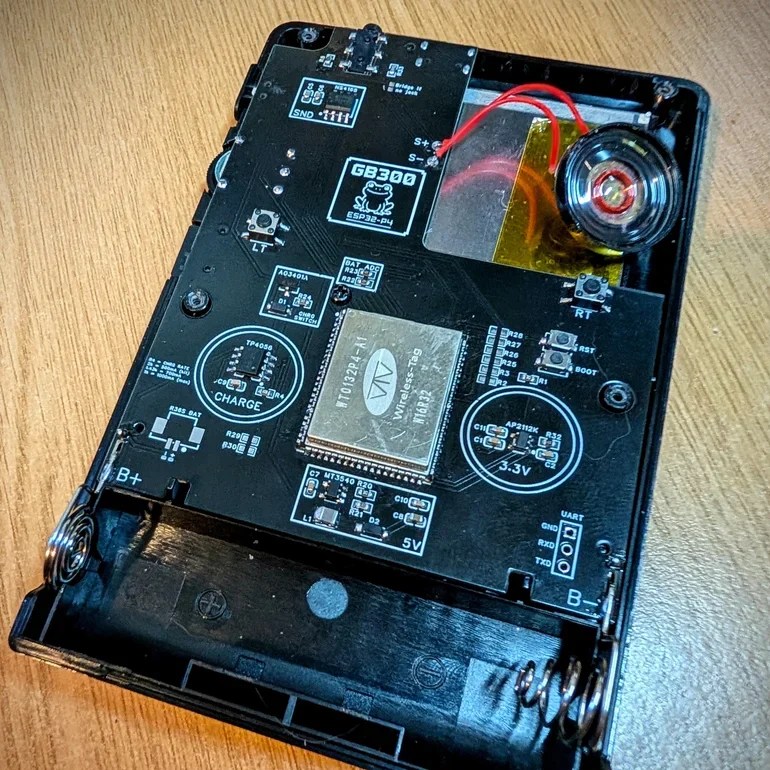
If the build quality on this handheld looks suspiciously professional, that’s because it is: [DynaMight] started with a GB300, a commercial emulator platform. Since the ESP32-P4 is replacing a MIPS chip clocked at 914 MHz in the original — which sounds even more like the heart of a Unix workstation, come to think of it — the machine probably doesn’t have better performance than it did from factory unless its code was terribly un-optimized. In this case, performance was not the point. The point was to have a handheld running RetroGo on this specific chip, which the project has evidently accomplished with flying colours. If you’ve got a GB300 you’d rather put an “Expressif Inside” sticker on, the project is on github. Otherwise you can check out the demo video below. (DOOM starts at 1:29, because of course it runs DOOM.)
The last P4 project we featured was a Quadra emulator; we expect to see a lot of projects with this chip in the new year, and they’re not all going to be retrocomputer-related, we’re sure. If you’re cooking up something using the new ESP32, or know someone who is, you know what to do.
youtube.com/embed/FW7MTuJyUNA?…


Lo sterminio degli ebrei di Varsavia e altri testi sull’antisemitismo
Meticolosamente curati da Jean Rière, autore inoltre delle acute pagine introduttive, e ben tradotti da Cristina Spinoglio, che ha saputo rendere la lucida vivacità degli scritti originali, questi articoli del rivoluzionario e pubblicista Victor Serge (Viktor L’vovič Kibal’čič, Bruxelles 1890 – Città del Messico 1947) consentono ora anche al lettore italiano di osservare come lo studioso avesse analizzato e compreso il fenomeno dell’odio antiebraico già tra la metà degli anni Venti e i primi anni Quaranta del secolo scorso. Fu allora che, dopo un’esistenza drammaticamente avventurosa trascorsa tra la Russia Sovietica, la Siberia dei gulag e la Francia del Fronte Popolare, egli riuscì a riparare in Messico, dove sarebbe rimasto fino alla morte.

Gli articoli raccolti in questa silloge sono stati in gran parte pubblicati su La Wallonie, il quotidiano socialista di Liegi: colpiscono per la limpidezza tanto dell’argomentazione quanto della scrittura. Occorre aggiungere, al riguardo, come la prosa di Serge si caratterizzi anche per la scorrevolezza e l’incisività, il tono colloquiale, i periodi brevi, il ritmo rapido, la ricchezza del lessico.
A proposito poi dell’antisemitismo, si deve mettere anzitutto in rilievo come, a parere dell’A., tale forma di ostilità non debba essere considerata una pura e semplice «opinione» priva di conseguenze, dal momento che si tratta al contrario di un’autentica ideologia di morte. Egli, quindi, non avrebbe mai cercato un dialogo né un confronto con gli antisemiti, ritenendoli «avversari» e addirittura «nemici» contro i quali si sarebbe dovuta condurre una lotta senza quartiere. Gli organi di stampa repubblicani, socialisti e rivoluzionari non avrebbero dovuto dunque accordare loro alcuno spazio: qualora lo avessero fatto, avrebbero commesso un gravissimo errore politico, filosofico e morale.
La posizione di Serge sull’argomento appare pertanto assolutamente ferma: fu in nome di questa intransigente convinzione che egli non esitò a polemizzare nei confronti di qualche sindacalista e dirigente di partito che sembrava incline a valutare positivamente alcune scelte della dittatura nazionalsocialista relative al presunto «livellamento delle differenze e al miglioramento della familiarità sociale». Scrisse al riguardo, in tono sferzante, lo studioso: «E quali “solidarietà sociali” si possono immaginare tra il grasso maresciallo Goering nelle sue cinquanta uniformi e i poveri disgraziati nei campi di lavoro? Per non parlare dei socialisti, dei comunisti e degli ebrei nei campi di concentramento? Che cosa ha ottenuto l’educazione se non l’invenzione del razzismo, per non parlare della proscrizione della musica classica, della relatività ebraica di Einstein e della psicologia ebraica di Freud?» (p. 81).
Emerge dunque con chiarezza, da questi scritti, come l’A. abbia pienamente compreso la portata del «crimine collettivo», nonché alcune delle peculiarità che ne hanno fatto, nell’ambito della storia moderna, un fenomeno inedito ed eccezionale. E anche come egli fosse consapevole che, successivamente a un’eventuale vittoria sul regime hitleriano, le conseguenze della cosiddetta «peste bruna» – costituita dall’antisemitismo e dal razzismo – sarebbero rimaste a lungo nella mente di tanti cittadini tedeschi ed europei: da ciò la pressante necessità di combattere incessantemente l’uno e l’altro, perché si potesse giungere all’affermazione di un nuovo umanesimo, all’avvento di una civiltà fondata sul rispetto e sulla tolleranza, irriducibile nemica dell’odio e della sopraffazione.
The post Lo sterminio degli ebrei di Varsavia e altri testi sull’antisemitismo first appeared on La Civiltà Cattolica.
Antonia Pozzi
Dopo la pubblicazione dei versi di Daria Menicanti, Valore Italiano Editore prosegue nel progetto Poesie Trilingue con una manciata di composizioni della milanese Antonia Pozzi (1912-1938), versi di rara purezza e misurato dolore. Due voci femminili, potenti e meste, relativamente poco conosciute, sono state individuate per allargare la conoscenza della «italianità» nei Paesi del Sudamerica. I testi poetici, offerti inizialmente in lingua italiana, sono stati appositamente volti in spagnolo e in portoghese, così da essere gustati, quasi ritmati, dall’intero continente sudamericano.

Gli autori al lavoro in questo progetto polilinguistico sono Silvia Cattoni (Universidad Nacional de Cordóba), Sergio Colella (Realtà Educative in America Latina), Fabio Minazzi (Università dell’Insubria), Patricia Peterle (Universidade Federal de Santa Catarina,a Florianópolis) e Lucia Wataghin (Universidade de São Paulo). A Minazzi si deve la presentazione della poetessa nel cenacolo banfiano, la «Scuola di Milano», innervata dall’intelligente criticismo del filosofo Antonio Banfi. In queste pagine si schizza la maturazione di Pozzi e il suo fresco abbeverarsi alle giovani e varie personalità che costituivano questo cenacolo che, bisogna riconoscerlo, si ergeva autonomo e fiero davanti all’imperante ideologia fascista.
Da ricordare, tuttavia, che Pozzi percepisce la sottovalutazione dei suoi versi in questo ambiente banfiano, come si evince in «Un destino», del 13 febbraio 1935. La giovane poetessa veniva da una famiglia agiata (a p. 23 si legga «Ida» e non «Isa», la zia di Antonia; per Emma viene da pensare che sia la zia, la sorella del padre; e a p. 150 si legga l’anno «1938» e non «1937»), amante dell’arte, della letteratura, dei viaggi, della fotografia e soprattutto delle montagne, a tal punto da immortalare queste «madri», le montagne, come «immense donne / la sera» (p. 136).
Si sa che Pozzi morì suicida – come suo nonno e la zia Emma –, perché immensa e insostenibile diventava col tempo la conciliazione fra la sua naturale pulsione poetica e il mondo che le era attorno: Oh, tu bene mi pesi / l’anima, poesia: / tu sai se io manco e mi perdo, / tu che allora ti neghi/ e taci.
Il libro raccoglie 22 composizioni, di cui le prime 10 costituiscono un bouquet di versi offerti al suo amato, Antonio Maria Cervi. Si tratta di poesie scritte da Pozzi fra l’agosto e l’ottobre 1934, racchiuse in un canzoniere intitolato La vita sognata, ove si rinviene l’incompiuto desiderio di quanto sognato, il baratro fra la trasparente luce della natura e la pesante durezza della terra. In queste composizioni si riversa lo sfaccettarsi della rottura, non voluta, del suo amore per Cervi, esaltando l’immediatezza del trasporto e l’abissale amarezza della rinuncia. La «pulizia della parola», la ponderata misura data all’evocazione invocata, traluce nella scrittura, facendo scaturire rivoli di bellezza, delicata e pittorica: una valle di erboso silenzio ospita il tinnire del canneto (Lieve offerta).
Scorrendo queste pagine, il lettore si accorge della pacata accettazione della finitezza, cantata con l’esuberanza di un’onirica danza nel tutto: Zattere sciolte – navighiamo / a incontrarci. Pozzi divorava la vita, sentendo in sé, già giovane, la presenza della fine.
Pregevole è la sottolineatura, da parte degli AA., dell’opzione delicata e profonda della poetessa verso gli «ultimi», verso la Milano povera e marginale, dove si rinviene la fame non appagata, / gli urli dei bambini non placati, / il petto delle mamme tisiche… (Via dei Cinquecento; e ancora la sublime Periferia). Siamo alla fine della vita di questa donna che, dando uno strappo alle sue origini alto-borghesi, distaccandosi dai desiderata paterni, s’avvia a partecipare della pesantezza della triste terra.
The post Antonia Pozzi first appeared on La Civiltà Cattolica.
Clone Wars: IBM Edition

If you search the Internet for “Clone Wars,” you’ll get a lot of Star Wars-related pages. But the original Clone Wars took place a long time ago in a galaxy much nearer to ours, and it has a lot to do with the computer you are probably using right now to read this. (Well, unless it is a Mac, something ARM-based, or an old retro-rig. I did say probably!)
IBM is a name that, for many years, was synonymous with computers, especially big mainframe computers. However, it didn’t start out that way. IBM originally made mechanical calculators and tabulating machines. That changed in 1952 with the IBM 701, IBM’s first computer that you’d recognize as a computer.
If you weren’t there, it is hard to understand how IBM dominated the computer market in the 1960s and 1970s. Sure, there were others like Univac, Honeywell, and Burroughs. But especially in the United States, IBM was the biggest fish in the pond. At one point, the computer market’s estimated worth was a bit more than $11 billion, and IBM’s five biggest competitors accounted for about $2 billion, with almost all of the rest going to IBM.
So it was somewhat surprising that IBM didn’t roll out the personal computer first, or at least very early. Even companies that made “small” computers for the day, like Digital Equipment Corporation or Data General, weren’t really expecting the truly personal computer. That push came from companies no one had heard of at the time, like MITS, SWTP, IMSAI, and Commodore.
The IBM PC
The story — and this is another story — goes that IBM spun up a team to make the IBM PC, expecting it to sell very little and use up some old keyboards previously earmarked for a failed word processor project. Instead, when the IBM PC showed up in 1981, it was a surprise hit. By 1983, there was the “XT” which was a PC with some extras, including a hard drive. In 1984, the “AT” showed up with a (gasp!) 16-bit 80286.
The personal computer market had been healthy but small. Now the PC was selling huge volumes, perhaps thanks to commercials like the one below, and decimating other companies in the market. Naturally, others wanted a piece of the pie.
youtube.com/embed/VslekgnIXDo?…
Send in the Clones
Anyone could make a PC-like computer, because IBM had used off-the-shelf parts for nearly everything. There were two things that really set the PC/XT/AT family apart. First, there was a bus for plugging in cards with video outputs, serial ports, memory, and other peripherals. You could start a fine business just making add-on cards, and IBM gave you all the details. This wasn’t unlike the S-100 bus created by the Altair, but the volume of PC-class machines far outstripped the S-100 market very quickly.
In reality, there were really two buses. The PC/XT had an 8-bit bus, later named the ISA bus. The AT added an extra connector for the extra bits. You could plug an 8-bit card into part of a 16-bit slot. You probably couldn’t plug a 16-bit card into an 8-bit slot, though, unless it was made to work that way.
The other thing you needed to create a working PC was the BIOS — a ROM chip that handled starting the system with all the I/O devices set up and loading an operating system: MS-DOS, CP/M-86, or, later, OS/2.
Protection

IBM didn’t think the PC would amount to much so they didn’t do anything to hide or protect the bus, in contrast to Apple, which had patents on key parts of its computer. They did, however, have a copyright on the BIOS. In theory, creating a clone IBM PC would require the design of an Intel-CPU motherboard with memory and I/O devices at the right addresses, a compatible bus, and a compatible BIOS chip.
But IBM gave the world enough documentation to write software for the machine and to make plug-in cards. So, figuring out the other side of it wasn’t particularly difficult. Probably the first clone maker was Columbia Data Products in 1982, although they were perceived to have compatibility and quality issues. (They are still around as a software company.)
Eagle Computer was another early player that originally made CP/M computers. Their computers were not exact clones, but they were the first to use a true 16-bit CPU and the first to have hard drives. There were some compatibility issues with Eagle versus a “true” PC. You can hear their unusual story in the video below.
youtube.com/embed/0wdunM5XZwo?…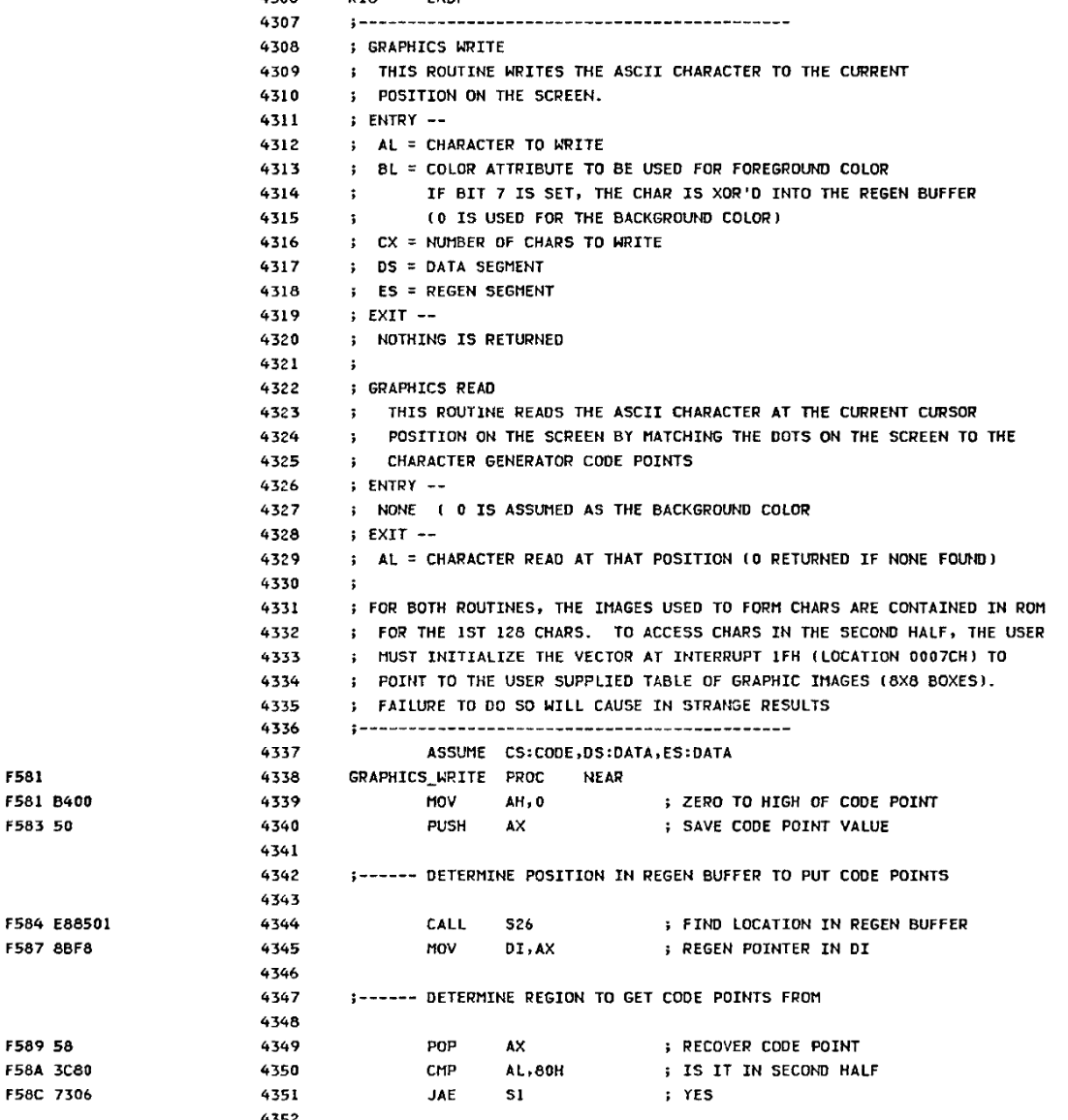
One of the first companies to find real success cloning the PC was Compaq Computers, formed by some former Texas Instruments employees who were, at first, going to open Mexican restaurants, but decided computers would be better. Unlike some future clone makers, Compaq was dedicated to building better computers, not cheaper.
Compaq’s first entry into the market was a “luggable” (think of a laptop with a real CRT in a suitcase that only ran when plugged into the wall; see the video below). They reportedly spent $1,000,000 to duplicate the IBM BIOS without peeking inside (which would have caused legal problems). However, it is possible that some clone makers simply copied the IBM BIOS directly or indirectly. This was particularly easy because IBM included the BIOS source code in an appendix of the PC’s technical reference manual.
Between 1982 and 1983, Compaq, Columbia Data Products, Eagle Computers, Leading Edge, and Kaypro all threw their hats into the ring. Part of what made this sustainable over the long term was Phoenix Technologies.
youtube.com/embed/fwvLu9aSkmQ?…
Rise of the Phoenix
Phoenix was a software producer that realized the value of having a non-IBM BIOS. They put together a team to study the BIOS using only public documentation. They produced a specification and handed it to another programmer. That programmer then produced a “clean room” piece of code that did the same things as the BIOS.
This was important because, inevitably, IBM sued Phoenix but lost, as they were able to provide credible documentation that they didn’t copy IBM’s code. They were ready to license their BIOS in 1984, and companies like Hewlett-Packard, Tandy, and AT&T were happy to pay the $290,000 license fee. That fee also included insurance from The Hartford to indemnify against any copyright-infringement lawsuits.
Clones were attractive because they were often far cheaper than a “real” PC. They would also often feature innovations. For example, almost all clones had a “turbo” mode to increase the clock speed a little. Many had ports or other features as standard that a PC had to pay extra for (and consume card slots). Compaq, Columbia, and Kaypro made luggable PCs. In addition, supply didn’t always match demand. Dealers often could sell more PCs than they could get in stock, and the clones offered them a way to close more business.
Issues
Not all clone makers got everything right. It wasn’t odd for a strange machine to have different interrupt handling than an IBM machine or different timers. Another favorite place to err involved AT/PC compatibility.
In a base-model IBM PC, the address bus only went from A0 to A19. So if you hit address (hex) FFFFF+1, it would wrap around to 00000. Memory being at a premium, apparently, some programs depended on that behavior.
With the AT, there were more address lines. Rather than breaking backward compatibility, those machines have an “A20 gate.” By default, the A20 line is disabled; you must enable it to use it. However, there were several variations in how that worked.
Intel, for example, had the InBoard/386 that let you plug a 386 into a PC or AT to upgrade it. However, the InBoard A20 gating differed from that of a real AT. Most people never noticed. Software that used the BIOS still worked because the InBoard’s BIOS knew the correct procedure. Most software didn’t care either way. But there was always that one program that would need a fix.
The original PC used some extra logic in the keyboard controller to handle the gate. When CPUs started using cache, the A20 gating was moved into the CPU for many generations. However, around 2013, most CPUs finally gave up on gating A20.
The point is that there were many subtle features on a real IBM computer, and the clone makers didn’t always get it right. If you read ads from those days, they often tout how compatible they are.
Total War!
IBM started a series of legal battles against… well… everybody. Compaq, Corona Data Systems, Handwell, Phoenix, AMD, and anyone who managed to put anything on the market that competed with “big blue” (one of IBM’s nicknames).
IBM didn’t win anything significant, although most companies settled out of court. Then they just used the Phoenix BIOS, which was provably “clean.” So IBM decided to take a different approach.
In 1987, IBM decided they should have paid more attention to the PC design, so they redid it as the PS/2. IBM spent a lot of money telling people how much better the PS/2 was. They had really thought about it this time. So scrap those awful PCs and buy a PS/2 instead.
Of course, the PS/2 wasn’t compatible with anything. It was made to run OS/2. It used the MCA bus, which was incompatible with the ISA bus, and didn’t have many cards available. All of it, of course, was expensive. This time, clone makers had to pay a license fee to IBM to use the new bus, so no more cheap cards, either.
You probably don’t need a business degree to predict how that turned out. The market yawned and continued buying PC “clones” which were now the only game in town if you wanted a PC/XT/AT-style machine, especially since Compaq beat IBM to market with an 80386 PC by about a year.
Not all software was compatible with all clones. But most software would run on anything and, as clones got more prevalent, software got smarter about what to expect. At about the same time, people were thinking more about buying applications and less about the computer they ran on, a trend that had started even earlier, but was continuing to grow. Ordinary people didn’t care what was in the computer as long as it ran their spreadsheet, or accounting program, or whatever it was they were using.
Dozens of companies made something that resembled a PC, including big names like Olivetti, Zenith, Hewlett-Packard, Texas Instruments, Digital Equipment Corporation, and Tandy. Then there were the companies you might remember for other reasons, like Sanyo or TeleVideo. There were also many that simply came and went with little name recognition. Michael Dell started PC Limited in 1984 in his college dorm room, and by 1985, he was selling an $800 turbo PC. A few years later, the name changed to Dell, and now it is a giant in the industry.
Looking Back
It is interesting to play “what if” with this time in history. If IBM had not opened their architecture, they might have made more money. Or, they might have sold 1,000 PCs and lost interest. Then we’d all be using something different. Microsoft retaining the right to sell MS-DOS to other people was also a key enabler.
IBM stayed in the laptop business (ThinkPad) until they sold to Lenovo in 2005. They would also sell them their server business in 2014.
Things have changed, of course. There hasn’t been an ISA card slot on a motherboard in ages. Boot processes are more complex, and there are many BIOS options. Don’t even get us started on EMS and XMS. But at the core, your PC-compatible computer still wakes up and follows the same steps as an old school PC to get started. Like the Ship of Theseus, is it still an “IBM-compatible PC?” If it matters, we think the answer is yes.
If you want to relive those days, we recently saw some new machines sporting 8088s and 80386s. Or, there’s always emulation.
DK 10x17 - AGCOM vs CloudFlare
Una legge, specie una discutibile come il Piracy Shield, si può discutere e modificare, ma intanto la si rispetta. E il CEO di CloudFlare può attaccarsi.
spreaker.com/episode/dk-10x17-…
Il profumo delle foglie di limone
Una delle ultime Lettere apostoliche di papa Francesco è stata dedicata al valore formativo della letteratura nel percorso dei candidati al sacerdozio ministeriale e degli operatori ecclesiali. In ambito europeo, uno degli autori che esprime meglio la sensibilità contemporanea è la scrittrice spagnola Clara Sánchez, che nel 2010 con Il profumo delle foglie di limone ha vinto il Premio letterario spagnolo Nadal de Novela,e negli anni successivi ha venduto più di due milioni e mezzo di copie dei suoi libri. La sua ultima opera, La casa che attende la notte, è un romanzo delicato, attento alle persone, ma anche complesso e articolato, con aspetti filosofici che occorre ascoltare con interesse e rispetto, ma anche con corretto senso critico.

Il romanzo Il profumo delle foglie di limone è stato pubblicato nel 2010 con il titolo Lo que esconde tu nombre, che esprime bene la dinamica che sostiene la narrazione. È la storia di una giovane donna spagnola, Sandra, incinta di cinque mesi e non ancora sposata, che in un momento di riposo sulla costa mediterranea della Spagna, nel clima caldo e mite di fine estate, si trova inconsapevolmente coinvolta in una serie di relazioni con persone anziane, che la pongono a contatto con gli eventi più tragici della storia europea del Novecento. I due coniugi anziani che si sono presi cura di lei, Fredrik e Karin, si rivelano essere due ex criminali nazisti, ritiratisi nella loro bella villa al mare. Del loro progressivo svelamento è autore un altro anziano conosciuto da Sandra negli stessi giorni, Julián, ex repubblicano spagnolo internato a Mauthausen, che ha dedicato la vita alla ricerca dei criminali nazisti.
La narrazione sviluppa varie vicende e porta a una progressiva conoscenza della vera identità dei personaggi. In tutto il racconto non c’è però alcun cenno alla dimensione religiosa: la narrazione autobiografica, condotta da Sandra e Julián, realizza un intreccio tra grandi questioni storiche e piccole realtà personali. L’anelito profondo del racconto è la ricerca della verità, di ciò che le persone sono veramente al di là della parvenza offerta dal loro stato sociale: una ricerca che conduce alla giustizia e alla pace.
Il nuovo romanzo ha come titolo in italiano La casa che attende la notte, e in spagnolo Una vida para Hugo, titolo che ne esprime meglio il dinamismo narrativo. Anche qui il protagonista del romanzo è una giovane donna spagnola, Alicia, che, nell’attesa di un concorso, accetta il lavoro di baby-sitter nella famiglia di Rafael, un bambino di nove mesi. Anche in questo romanzo le vicende della vita quotidiana – in questo caso, di una bambinaia e del suo bambino – si intrecciano con quelle più grandi della crisi dei genitori, della morte di un adolescente di nome Hugo e della cospicua eredità ricevuta dalla sua famiglia.
Il racconto fa riferimento a tre famiglie problematiche: quella di Alicia, che vive a Madrid con la sorella; quella di Rafael, i cui genitori si separano; e quella di Hugo, con i nonni, il papà, la mamma e la sorella avuta dalla mamma in una relazione precedente. Il racconto è ancora autobiografico, di Alicia e Hugo, e ricostruisce immaginativamente il rapporto dell’adolescente defunto Hugo con il perspicace Rafael, che guida Alicia alla scoperta della causa della morte violenta del giovane. La narrazione scorre veloce e affascina il lettore con improvvisi dettagli evocativi e considerazioni filosofiche.
Anche in questo racconto è assente un’esplicita dimensione religiosa: la Chiesa appare solo nel momento in cui Alicia cerca la spiegazione di ciò che accade. Proprio una breve, anche se infelice, confessione le permette di aprirsi alla fede e di continuare la ricerca della verità. Il sincretismo religioso del racconto include però un accenno alla reincarnazione delle anime e all’influsso dei defunti sui viventi. Questo aspetto va compreso come un artificio letterario, necessario per condurre avanti la narrazione: artificio a cui l’A. però non si sente di aderire.
Entrambi i racconti esprimono quindi la ricerca della verità all’interno della vita quotidiana: una ricerca che caratterizza la cultura europea e che fa di questi romanzi un mezzo per raggiungerla e comprenderla.
The post Il profumo delle foglie di limone first appeared on La Civiltà Cattolica.
Porto di Ancona: data breach
@Informatica (Italy e non Italy 😁)
Il 14 gennaio 2026 il collettivo Anubis ha pubblicato alcuni documenti che dimostrerebbero un data breach ai danni del Porto di Ancona. Il porto di Ancona fa parte dell’Autorità del […]
L'articolo Porto di Ancona: data breach proviene da Edoardo Limone.
L'articolo proviene edoardolimone.com/2026/01/15/p…
L’ultimo semestre di ‘Cemento Armato’: la pavidità del potere ne “La Grazia” di Sorrentino
@Giornalismo e disordine informativo
articolo21.org/2026/01/231608/
La visione de ‘La Grazia’ di Paolo Sorrentino conferma la maturità di un autore che, dopo la parentesi autobiografica di ‘È stata la mano di Dio’ e quella estetica di ‘Parthenope’, torna a interrogarsi su temi cruciali come la responsabilità di vivere. Il film, pur
😂😂😂


#Groenlandia: Svezia, Norvegia, Regno Unito, Germania e Francia mandano truppe. L'Italia, forte del riconoscimento Unesco alla sua cucina, manderà trippe.
Poliversity - Università ricerca e giornalismo reshared this.
Gran Bretagna: il dissenso è terrorismo

GB: il dissenso è terrorismo -
Mentre Israele, nonostante il cessate il fuoco formalmente in vigore, continua a massacrare civili a Gaza, in Gran Bretagna almeno tre attivisti pro-PalestinaMichele Paris (altrenotizie.org)
Il manuale USA per il #Venezuela

Il manuale USA per il Venezuela -
C’è un momento preciso in cui la retorica sulla promozione della democrazia smette di essere una formula rassicurante e diventa un progetto di potere. QuelRedazione (altrenotizie.org)
Il fediverso è adatto per introdurre i giovani all'internet sociale? La riflessione di @drupas@vivaldi.net
Una cosa tipica dei nuovi arrivati nel #fediverso proveniente dall'internet commerciale è "qui non succede niente", questo è morto...
Ma COSA VUOI CHE ACCADA? Cosa stai aspettando? Qualcosa di sensazionalistico? Morboso? Umiliante? Qualcosa che ti faccia saltare di rabbia e lanciare insulti? O desiderare follemente quel viaggio/scarpe/acqua di colonia/corpo che non è alla tua portata.

É o fediverso acaído para introducir á mocidade na internet social?
o desde a internet das corporacións é "aquí non pasa nada", esto está muerto... QUE QUERES QUE PASE? que agardas? Algo sensacionalista? Morboso? Humillante? Algo que che faga saltar de carraxe a lanzar insultos? Ou desexar con loucura esa viaxe/zapat…Write.as
like this
reshared this
Il paradosso di Fermi
reshared this
I bot nel Fediverso - L'articolo di Moreno, F., Perdomo-Quinteiro, P., Hernandez-Penaloza, G. et al.
I bot social sono un problema noto nella società odierna. Sono influenzati da una varietà di fattori, che vanno dalla presenza di bot alla mancanza di interazione tra bot e utenti. Questo articolo propone un approccio multipiattaforma per il rilevamento dei bot social basato su metadati del profilo e incorporamenti di testo, applicato agli account utente di Twitter, Mastodon e Bluesky. Il modello risultante raggiunge un'accuratezza del 97,39% in un'attività di classificazione a quattro classi, superando diverse linee di base consolidate, inclusi approcci basati su grafici e federati, pur essendo computazionalmente efficiente. Il contributo principale di questo lavoro è la dimostrazione che le caratteristiche utente possono supportare un'efficace classificazione dei bot in ambienti eterogenei e decentralizzati, dimostrando la fattibilità della generalizzazione interdominio su larga scala. Presentiamo inoltre un nuovo set di dati che combina account bot e non bot autoidentificati da piattaforme decentralizzate.
Il set di dati creato per questo studio è disponibile su richiesta. I ricercatori interessati possono contattare l'autore corrispondente all'indirizzo fran.moreno@upm.es. Il set di dati non include componenti derivati da Cresci et al. (2017).
informapirata ⁂ reshared this.
191° Mercoledì di Nexa – Un’alternativa al capitalismo digitale? Confini e traiettorie delle piattaforme cooperative
Le notizie dal Centro Nexa su Internet & Società del Politecnico di Torino su @Etica Digitale (Feddit)
11 febbraio 2026 | STEFANO TORTORICI (Scuola Normale Superiore di Firenze)
The post 191° Mercoledì di Nexa – Un’alternativa al capitalismo digitale? Confini e traiettorie delle piattaforme cooperative appeared
GaMe reshared this.
Separazione delle carriere: perchè si?
@Politica interna, europea e internazionale
WEBINAR – 13 GENNAIO 2026 – 18:00 con ANTONIO D’ALESSIO, Deputato della Repubblica di Azione e componente della Commissione Giustizia GIUSEPPE BENEDETTO, Presidente Fondazione Luigi Einaudi STEFANO CECCANTI, Professore ordinario diritto pubblico comparato, Università la Sapienza di Roma LORENZA VIOLINI, Professoressa ordinaria
Poliverso - notizie dal Fediverso ⁂
in reply to L' Alchimista Digitale • •Ciao @L' Alchimista Digitale ,
vorrei condividere con te degli appunti su una questione che riguarda i post Friendica con il titolo
Formattazione post con titolo leggibili da Mastodon
Come forse saprai già, con Friendica possiamo scegliere di scrivere post con il titolo (come su WordPress) e post senza titolo (come su Mastodon). Uno dei problemi più fastidiosi per chi desidera scrivere post con il titolo è il fatto che gli utenti Mastodon leggeranno il tuo post come se fosse costituito dal solo titolo e, due a capi più in basso, dal link al post originale: questo non è di certo il modo miglior per rendere leggibili e interessanti i tuoi post!
Gli utenti Mastodon infatti hanno molti limiti di visualizzazione, ma sono pur sempre la comunità più grande del Fediverso e perciò è importante che vedano correttamente i vostri post: poter contare sulla loro visibilità è un'opportunità per aggiungere ulteriori possibilità di interazioni con altre persone.
Fortunatamente, con le ultime release di Friendica abbiamo la possibilità di modificare un'impostazione per rendere perfettamente leggibili anche i post con il titolo. Ecco come fare:
A) dal proprio account bisogna andare alla pagina delle impostazioni e, da lì, alla voce "Social Network" al link poliverso.org/settings/connect…
B) Selezionando la prima sezione "Impostazione media sociali" e scorrendo in basso si può trovare la voce "Article Mode", con un menu a cascataC) Delle tre voci disponibili bisogna scegliere "Embed the title in the body"
Ecco che adesso i nostri post saranno completamente leggibili da Mastodon!