Cineforum all'Ex 51 in ricordo di Federico Frusciante
Ex 51 - Via Aurelio Bacciarini 12, Valle Aurelia (mercoledì, 4 marzo 21:30) In ricordo del compagno Federico Frusciante, recentemente scomparso, il cineforum dell'Ex 51 proietta 1997: Fuga da New York di John Carpenter. Ci vediamo mercoledì 4 marzo alle 21:30
CSOA Corto Circuito - via Filippo Serafini, 57 (venerdì, 6 marzo 20:00) Presentazione del libro "Abitare in Affitto. Le nuove frontiere dell'estrattivismo immobiliare" di Chiara Davoli e Stefano Portelli. Ne discuteremo con gli autori.
Casa del Parco delle Energie - Via Prenestina, 175, 00176 Roma RM (sabato, 7 marzo 16:00) RIFORMA DELLA MAGISTRATURA E SVOLTA AUTORITARIA
Sabato 7 Marzo ore 16.00, presso la Casa del Parco delle Energie (Via Prenestina 175).
In vista del referendum costituzionale indetto per il 22 e 23 marzo sulla legge Meloni-Nordio di riforma della magistratura, proveremo a contestualizzare la riforma nel più ampio disegno autoritario perseguito dal Governo, finalizzato a reprimere ogni forma di dissenso al potere e alle politiche neoliberiste.
Ne parleremo con: - Prof. Gianluca Bascherini, Prof. di Diritto Costituzionale presso l'Università la Sapienza - Avv. Antonello Ciervo, del Comitato per il No della societa’ civile.
Archivio Storico della F.A.I. - Via Fratelli Bandiera 19, Imola (BO) (venerdì, 6 marzo 21:15) VENERDÌ 6 MARZO dalle 21:15 - Archivio Storico della F.A.I.
PROIEZIONE DEL DOCUMENTARIO:
"IL GRANDE GIOCO MILANO-CORTINA: IL ROVESCIO DELLE MEDAGLIE"
Documentario realizzato da OPEN DDB
(Scrittura, regia, riprese: Off Topic, Laboratorio Film Olimpico, 2025, ITA, 69 minuti)
Le Olimpiadi Milano Cortina 2026: il grandioso show che promette di portare milioni di visitatori all’insegna di sostenibilità e inclusione. E che invece sottrae risorse alle comunità a beneficio di pochi. Con Il grande gioco Off Topic e il CIO (Comitato Insostenibili Olimpiadi) smontano il modello di questi giochi olimpici invernali e la logica predatoria di risorse sociali e ambientali che accomuna tutti i grandi eventi. Sportivi e non.
IMOLA - Via FRATELLI BANDIERA 19 o da Via Caterina Sforza 5, parco Verziere delle monache, di fronte al parcheggio dell’ “Ospedale Vecchio”.
Dopo l'incendio dei contatori nella Torre B del grattacielo di Ferrara, 11 gennaio scorso, ed il successivo sgombero delle torri A e C il 12 febbraio, oltre 600 persone, più del 70% di origine straniera, sono ora senza casa.
Quello che il Comune di Ferrara chiama “questione privata”, lasciando così spazio ad un progetto speculativo, è una tragedia che colpisce tutte le persone sfollate, chi proviene da altri Paesi, però, è ancora più colpito perché non può contare su una vasta rete di supporto.
Lavoratori e lavoratrici italianə e stranierə sfollatə che non ricevono alcuna forma di assistenza pubblica, alcuni alloggiati temporaneamente presso amici, altrə in dormitori di beneficenza, altri semplicemente in macchina o per strada.
Lavoratori e lavoratrici stranierə sfollatə disperatamente preoccupati di non soddisfare il requisito di continuità residenziale per il rinnovo dei permessi di soggiorno e il ricongiungimento familiare.
Famiglie sfollate, alcune delle quali hanno ottenuto un alloggio pubblico temporaneo, ma in alcuni casi al costo di essere separate, con il padre costretto a dormire altrove.
A queste persone, i cui progetti di vita sono stati mandati in frantumi, sembra che lo sgombero sia utilizzato dal Comune, attraverso le barriere burocratiche dell'indifferenza, come pretesto per allontanarle. Alcunə sono già tornatə nel loro Paese di origine, altrə ci stanno pensando e moltə provano un grande senso di rassegnazione e sconfitta, dopo tanti anni di sacrifici.
Tutti gli sfollati chiedono alla città e alle Istituzioni giustizia e riparazione e in particolare al Comune:
-uno sportello specifico per questa emergenza;
-un alloggio temporaneo pubblico per emergenza abitativa per tutte le persone che ne hanno bisogno;
-sospensione utenze e moratoria per i mutui prima casa;
-un contributo per l'autonoma sistemazione per le famiglie;
-garanzia di residenza per chi rischia di perdere diritti fondamentali;
-un piano immediato per il ripristino delle condizioni di sicurezza dello stabile;
Laboratorio Urbano Popolare Occupato - Piazza Pietro Lupo 25 (lunedì, 9 marzo 19:00) AttoppA
Una agenda condivisa per Catania
RACCOLTA BENI RECLUSX NEI CPR
La L.U.P.O. continua ad essere punto di raccolta beni per reclusx nei CPR e per tutte quelle persone che , richiedenti asilo e non, si trovano a dover vivere condizioni di estrema razializzazione.
nonostante la grande repressione che le persone che attraversano la L.U.P.O. hanno subito e la pressione a cedere nelle pratiche di autogestione e azione diretta che continua a subire per la sempre attiva allerta per uno sgombero imminente ,
Continuerà a essere attiva fonte di solidarietà e supporto per chi di questa società, diventa vittima costantemente costretta a esperienze disumane.
Non c'è altro modo per riscattarsi che l'autodeterminazione.
E il minimo per essere non sogiogatx dalle necessità è avere una coperta calda sotto cui dormire, del cibo da non dover rubare ( viva il furto alle aziende del capitale!)
E un sostegno per poter autodeterminarsi.
Sempre fuoco ai CPR e no ad qualsiasi forma di infantilizzazione.
La L.U.P.O. continua ad essere punto di raccolta beni per reclusx nei CPR e per tutte quelle persone che , richiedenti asilo e non, si trovano a dover vivere condizioni di estrema razializzazione.
nonostante la grande repressione che le persone che attraversano la L.U.P.O. hanno subito e la pressione a cedere nelle pratiche di autogestione e azione diretta che continua a subire per la sempre attiva allerta per uno sgombero imminente ,
Continuerà a essere attiva fonte di solidarietà e supporto per chi di questa società, diventa vittima costantemente costretta a esperienze disumane.
Non c'è altro modo per riscattarsi che l'autodeterminazione.
E il minimo per essere non sogiogatx dalle necessità è avere una coperta calda sotto cui dormire, del cibo da non dover rubare ( viva il furto alle aziende del capitale!)
E un sostegno per poter autodeterminarsi.
Sempre fuoco ai CPR e no ad qualsiasi forma di infantilizzazione.
Serial Burgher - Forlì - 128 Viale Roma Forlì, Forlì-Cesena, Italy (martedì, 17 marzo 20:30) Il munch è un aperitivo informale BDSM, non è necessario avere esperienza decennale, ma voglia confrontarsi e nasce con l'intento di scambiare esperienze, punti di vista e dare la possibilità di incontrarsi a persone appassionate o semplicemente curiose.
Biella - Caffetteria Campus - corso G. Pella, 2B - Biella (giovedì, 5 marzo 18:00) Aperitivo con Daniele Basso ed Eleonora Chiais, modera Sofia Parola.
Campiglia Cervo - La Bursch - Fraz. Oretto 22, Campiglia Cervo (domenica, 8 marzo 10:00) Ci accompagnano verso la Primavera i nuovi appuntamenti speciali con Francesca Perazzone, istruttrice dalla lunga esperienza in Yoga Nidra, Meditazione e Campane Tibetane. Per ogni appuntamento, vi attende una pratica diversa! Alla fine, avrete inoltre la possibilità di unirvi al nostro Brunch del Benessere, prolungando così il vostro relax. Prossime date Domenica 8, 15, 22 febbraio Domenica 1, 22, 29 marzo Lezione: 20€ a persona Lezione & Brunch del benessere: 40€ a persona.
With Iran War, Kalshi and Polymarket Bet That the Depravity Economy Has No Bottom
The main bet on the front page of Polymarket right now is “Will the Iranian regime fall by June 30?” The site has this at a 41 percent chance of happening as I write this.
On Polymarket, more than $5 million has been spent gambling on this question. On Kalshi, a competing prediction market where users can bet on almost anything, $54 million was spent on “Ali Khamenei out as Supreme Leader?,” a bet whose results somehow ended up ambiguous even after Khamenei’s assassination.
In a series of tweets over the weekend, Kalshi’s CEO and founder Tarek Mansour repeatedly twisted himself into pretzels attempting to explain how the absurd, grotesque exercise of allowing people to bet on politics, geopolitics, and world events is not supposed to allow people to profit from death.
“We don’t list markets directly tied to death. When there are markets where potential outcomes involve death, we design the rules to prevent people from profiting from death,” he wrote. He then posted the underlying rules of the bet, which read “If <leader> leaves solely because they have died, the associated market will resolve and the Exchange will determine the payouts to the holders of long and short positions based upon the last traded price (prior to the death).” That we are discussing the ins-and-outs of which random gamblers get paid out during an illegal war in which already hundreds of school children have been bombed to death feels like the type of grotesque sideshow that is only possible because the U.S. government is only interested in regulating its perceived political enemies, and which only feels possible because much of the American economy feels held together by cope and the gobs of money being thrown into AI, data centers, and gambling. All of this is part of the perverse Silicon Valley, AI, crypto, and X-adjacent hustlebro gambling economy, which was legalized by companies like DraftKings and FanDuel, who spent eyewatering sums lobbying states to allow their gambling apps, and has been “legitimized” by sports leagues who wanted to print money and media companies desperate for the advertising dollars that came from gambling and has turned this all into a massive industrial complex that is not-so-slowly bankrupting a generation of underemployed people addicted to gambling. Polymarket and Kalshi took the DraftKings and FanDuel model and let people bet on basically anything, so now you can bet on which countries Iran will launch missiles against on the same app you bet on the Nuggets/Jazz game or the winner of the Best Picture Academy Award. The new model is so good at parting people from their money that DraftKings and FanDuel themselves have been anxious to get into prediction markets. This is how we end up with extremely underregulated companies more or less making up rules on the fly as they hop from crisis to crisis trying to determine the nature of reality, such as whether a suit is a suit or whether a dead guy is still in charge of the government, with each disputed bet having millions of dollars on the line. Both Polymarket and Kalshi have decided to go with the line that letting people bet on war, politics, and the general nature of reality will not distort reality through the insider trading we’ve already repeatedly seen, but will somehow improve public trust in the reporting of news. Polymarket has added a note to all Iran-focused bets that says “The promise of prediction markets is to harness the wisdom of the crowd to create accurate, unbiased forecasts for the most important events to society. That ability is particularly invaluable in gut-wrenching times like today. After discussing with those directly affected by the attacks, who had dozens of questions, we realized that prediction markets could give them the answers they needed in ways TV news and X could not.”
This is, conveniently, a stance that allows Polymarket to continue to profit from death and war, and allows its customers to continue to bet on it. Polymarket’s X feed is kind of like a fucked up newswire service for degenerates, its tweets today including things like ““BREAKING: 41% of all scheduled flights to the Middle East have been cancelled today” and “NEW POLYMARKET: New Supreme Leader of Iran by…?” Polymarket’s recent integration with Substack means, I guess, that we’re about to see a generation of people who “get their news from gambling apps,” which is sure to lead to a healthy society. A recent interview on Polymarket’s own Substack valorizes a gambler named “Betwick” who lost 70 percent of his money largely because he “lost quite a bit on ‘Israel strikes Iran’ at the last minute, where it looked like they were going to negotiate for a few more days and Israel did the surprise attack” but was confident he could rebuild it by continuing to bet on various Iran war scenarios.
The obvious farce of all of this is that Kalshi’s line that “we design the rules to prevent people from profiting from death” is obviously untrue on its face, it’s just that the company would rather let you bet on the deaths and suffering of civilians rather than dictators and presidents. Betting that Khamenei would stay in power is an explicit bet that he would be allowed to continue silencing dissent and killing those who oppose him; betting that he would be deposed is an explicit bet on what has already become a very deadly, illegal regional war. Even bets on things like “Will Iran close the Strait of Hormuz” and gas prices are explicit bets on the escalation or deescalation of this war and thus a bet on people's deaths, which is obvious on its face but becomes more clear as you dig into the “rules” of any given bet.
Winning the Khamenei bet required any number of things that definitely would involve the deaths of many people and “requires a broad consensus of reporting indicating that core structures of the Islamic Republic (e.g. the office of the Supreme Leader, the Guardian Council, IRGC control under clerical authority) have been dissolved, incapacitated, or replaced by a fundamentally different governing system or otherwise lost de facto power over a majority of the population of Iran. This could occur via revolution, civil war, military coup, or voluntary abdication, but only qualifies if the Islamic Republic no longer exercises sovereign power. Routine political events such as elections, reforms, or leadership succession do not qualify. Internal coups or power shifts that preserve the Islamic Republic’s core structures also do not qualify. Only a clear break in continuity—such as a new provisional government, revolutionary council, or constitution replacing the Islamic Republic will qualify.” Meanwhile, over on Polymarket, “Will Iran strike a Gulf State on March 2” requires the definition of a “qualifying strike,” which is “the use of aerial bombs, drones, or missiles (including cruise or ballistic missiles) launched by Iranian military forces that impact a gulf state's ground territory.” In case you’re wondering, “Missiles or drones that are intercepted and surface-to-air missile strikes will not be sufficient for a ‘Yes’ resolution, regardless of whether they land on a gulf state's territory or cause damage. Actions such as artillery fire, small arms fire, FPV or ATGM strikes, ground incursions, naval shelling, cyberattacks, or other operations conducted by Iranian ground operatives will not qualify.”
There is no chance any of this ends well. It’s already a disaster. Wanna bet?
Sen. Chris Murphy (D-Conn.) is introducing legislation to outlaw war betting after insiders made $1.2M on US strikes on Iran. Trump-linked platform involved.
Some AWS services are down in the Middle East. Recovery is unclear as it requires 'careful assessment to ensure the safety of our operators,' according to Amazon.
Some AWS services are down in the Middle East. Recovery is unclear as it requires x27;careful assessment to ensure the safety of our operators,x27; according to Amazon.#News #war
Amazon Data Centers on Fire After Iranian Missile Strikes on Dubai
Amazon’s cloud services are down in some of the Middle East after “objects” hit data centers in the United Arab Emirates (UAE) causing “sparks and fire.” Around 60 services tied to AWS are down in the region, affecting web traffic in the UAE and Bahrain. The outage comes following Iranian attacks on the UAE as retaliation for US and Israeli strikes on Iran.
Customers in Bahrain and the UAE began to report outages tied to the mec1-az2 and mec1-az3 clusters in AWS’ ME-CENTRAL-1 Region on March 1 after Iranian ballistic missiles and drones struck targets in and around Dubai. Amazon did not confirm that AWS was down in the Middle East due to an Iranian attack and instead referred 404 Media to its online dashboard. playlist.megaphone.fm?p=TBIEA2… “At around 4:30 AM PST, one of our Availability Zones (mec1-az2) was impacted by objects that struck the data center, creating sparks and fire,” AWS said on its health dashboard. “The fire department shut off power to the facility and generators as they worked to put out the fire. We are still awaiting permission to turn the power back on, and once we have, we will ensure we restore power and connectivity safely. It will take several hours to restore connectivity to the impacted AZ.”
As of this morning at 9:22 AM ET, the damage had spread. “We are expecting recovery to take at least a day, as it requires repair of facilities, cooling and power systems, coordination with local authorities, and careful assessment to ensure the safety of our operators,” AWS said. “We recommend customers enact their disaster recovery plans and recover from remote backups into alternate AWS Regions, ideally in Europe.”
Amazon later shared more information about the attack and confirmed it was the result of drones. “Due to the ongoing conflict in the Middle East, both affected regions have experienced physical impacts to infrastructure as a result of drone strikes. In the UAE, two of our facilities were directly struck, while in Bahrain, a drone strike in close proximity to one of our facilities caused physical impacts to our infrastructure,” it said. “These strikes have caused structural damage, disrupted power delivery to our infrastructure, and in some cases required fire suppression activities that resulted in additional water damage. We are working closely with local authorities and prioritizing the safety of our personnel throughout our recovery efforts.”
On Saturday, the United States and Israel launched Operation Epic Fury and struck targets inside of Iran, killing several political and military leaders including Ayatollah Ali Khamenei, the country’s Supreme Leader. In retaliation, Iran launched drone and missile attacks against Israel and multiple US-allied targets in the Middle East.
According to the Emirati defense forces, Iran attacked the country with two cruise missiles, 165 ballistic missiles, and more than 540 drones. The UAE and its capital city Dubai are often seen as a safe and stable destination in the Middle East. The country hosts wealthy people from across the region and influencers from across the world. Footage shared on social media showed the neon towers of the UAE backlit by missiles and munitions.
It’s unclear how long it will take for Amazon to restore services to the region or how far the damage will spread. Amazon’s dashboard is promising to bring things back up in “at least a day” but the war is far from over. Iran continues to strike targets in the Middle East and it’s unclear what America’s plan of attack is or how long this war might grind on.
Update 2/2/26: This story has been updated with more specifics about the attack from Amazon.
Le procedure delle #IscrizioniOnline per l’anno scolastico 2026/2027 si sono concluse.
Il risultato più rilevante di questa tornata di iscrizioni è relativo alla filiera 4+2, con 10.532 iscritti, il numero è quasi raddoppiato rispetto ai 5.
Le procedure delle #IscrizioniOnline per l’anno scolastico 2026/2027 si sono concluse.
Il risultato più rilevante di questa tornata di iscrizioni è relativo alla filiera 4+2, con 10.532 iscritti, il numero è quasi raddoppiato rispetto ai 5.
Historically, moving and pointing a camera while filming was the job of a highly-skilled individual. However, there are machines that can do that, enabling all kinds of fancy movement that is difficult or impossible for a human to recreate. A great example is this pan-tilt build from [immofoto3d.]
The build uses a hefty cradle to mount DSLR-size cameras or similar. It’s controlled in the tilt axis by a chunky NEMA 17 stepper motor hooked up to a belt drive for smooth, accurate movement. Similarly, another stepper motor handles the pan axis, with an option for upgrade if you have a heavier camera rig that needs more torque to spin easily. Named Gantry Bot, it’s an open-source design with source files available, so you can make any necessary tweaks on your own. You will have to bring your own control mechanism, though—telling the stepper motors what to do and how fast to do it is up to you.
It’s a heavy-duty build, this one, and you’ll really want a decent metal-capable CNC to get it done, along with a 3D printer for all the plastic pieces. With that said, we’ve featured some other similar builds that might be more accessible if you don’t have a hardcore machine shop in the basement. If you’ve got your own impressive motion rig in the works, be sure to notify the tipsline!
Considering that the Serial Peripheral Interface bus semi-standard has been around since the early 1980s, it’s perhaps not that shocking that the controllers of the Super Nintendo Entertainment System (SNES) would take at least some strong design hints for the used protocol. This does however raise the question of exactly how compatible a SNES controller is when connected to the SPI master peripheral of any random MCU. Recently [James Sharman] set out to answer this question decisively.
The impetus for answering this question came after [James] designed a separate SNES controller board for his homebrew computer system, which led to many comments on that video saying that he could just have hooked the controller up to the SPI board in said homebrew system.
Here the short answer is that the SNES controller protocol is very close to SPI Mode-1, with a similar arrangement of clock/data/chip select (latch) lines and clocking. If you think of the SNES controller as an SPI device with just a MISO line, you’re basically there already. The only niggle that popped up was that the ‘MISO’ line does not get pulled into a high-impedance state when the active-low latch connection is pulled high.
This was fixable by introducing a 74HC125 tri-state buffer IC, after which both the original SD card and twin SNES controllers could be used simultaneously.
Many different types of printers have entered the market over the years. Most of us are intimately familiar with the common inkjet and laser, both of which can be found in homes and offices all over the world. Then there are those old dot matrix printers that were so noisy in use, thermal printers, and even solid ink printers that occupied a weird niche for a time.
However, very little attention is ever paid to the LED printer. They’re not actually that uncommon, and they work in a very familiar way. It’s just that because these printers are so similar to an existing technology, they largely escaped any real notability in the marketplace. Let’s explore the inner workings of the printer tech that the world forgot.
Blinding Lights
To understand the LED printer, it helps to first understand the laser printer, and before that, the photocopier. Indeed, it was the latter technology that spawned the xerographic process that underpins all three machines.
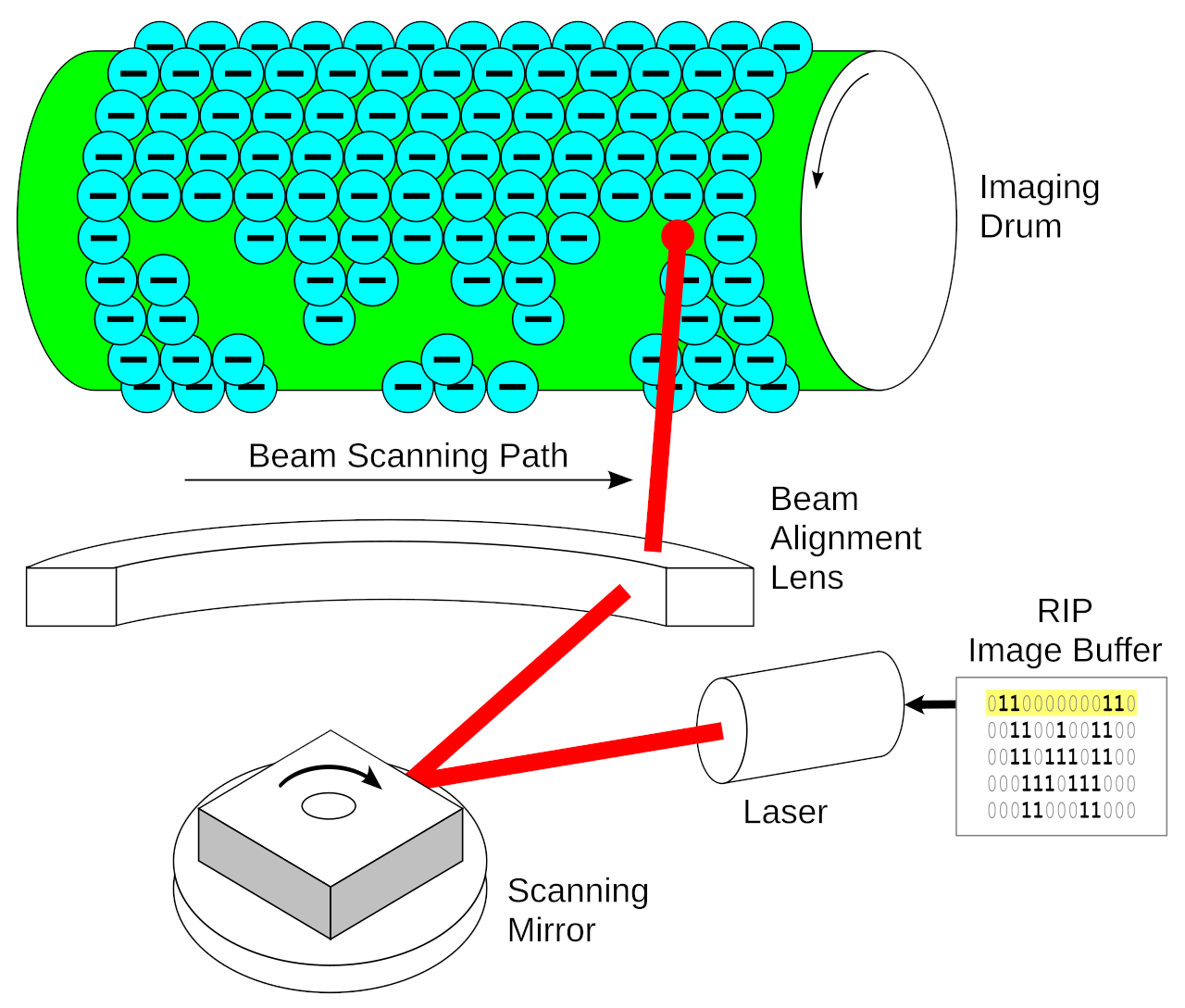
Xerography is a compound word, from the Greek words xeros (dry) and graphia (writing). It’s where the Xerox company earned its name, and the process is at the heart of the photocopier. In the modern form we’re all familiar with, a photocopier relies on the use of a cylindrical drum, coated in a photoconductive material. This drum can be given an electrostatic charge, which remains on the surface when in darkness, but is conducted away when exposed to light. In a photocopier, the drum is exposed to light from a scanning lamp passing over a document. Where the document has light sections, the charges on the drum are conducted away, and where there are dark sections, the charge remains. The drum is then exposed to tiny particles of toner, which are attracted to the charged areas on the drum. A corona wire is then used to generate an opposite charge to that of the toner, pulling it off the drum and onto a piece of paper to replicate the original document. It’s then merely a matter of heating the paper to fuse the toner in place by melting it, and then the completed document is fed out of the photocopier. It’s this final step that gives fresh photocopies their characteristic warm feel and mild plasticky smell. Laser printers use a scanning laser to discharge a photosensitive drum, which then picks up toner and deposits it on paper. Credit: Dale Mahalko, CC BY 3.0 It wasn’t long before the xerography process was applied beyond mere photocopies. Xerox engineer Gary Starkweather realized in 1969 that a scanning laser beam could be used to draw directly on to the drum in place of the scanning lamp of a photocopier. A few years later, this led to the development of a prototype which proved the concept, and by 1976, the first commercial laser printer was on the market.
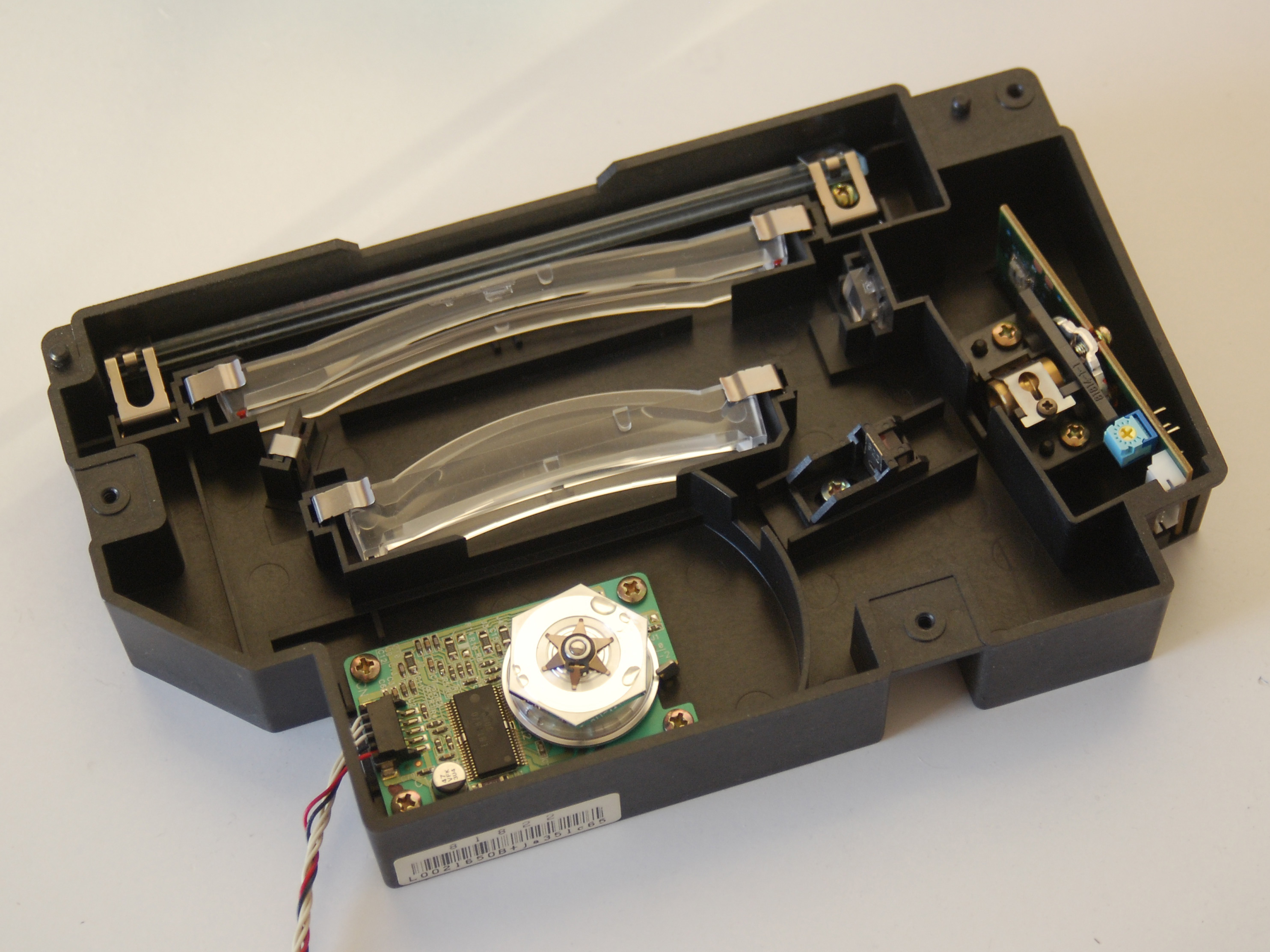
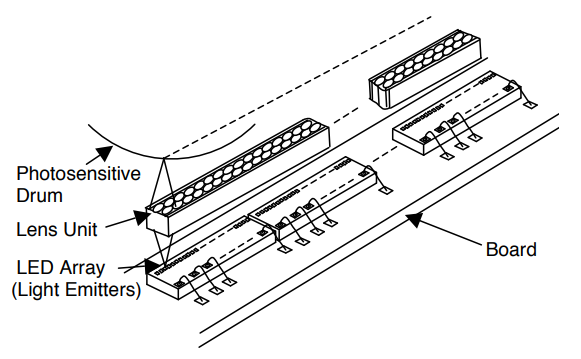
These printers were prized for their high speed and initially used in data center roles, before smaller desktop-sized units reached the market in the 1980s. Laser printers vary in construction, but most use a single laser diode with a rotating mirror that scans the beam over the drum. The beam is modulated as the mirror scans and the drum rotates to only remove charges from the drum in light areas that are not to have toner deposited. For color printing, some laser printers implement multiple drums, one for each color of toner—cyan, magenta, yellow, and key (black)—with four scanning lasers required in turn. The paper is passed over each, picking up one layer of toner at a time before it’s fused into the paper to create the final image. Some printers have also added a “transfer belt” to ease registration issues in color printers, wherein the drums deliver each color of toner to a belt, and the belt then delivers the toner to the paper in one fell swoop. A scanning laser unit from a Dell P1500 laser printer. Note hte hexagonal mirror and the lensing assemblies to focus it on the drum. Credit: Jeroen74, CC BY-SA 3.0 Laser printers are capable, high-speed printing machines, but they are expensive and do have a lot of moving parts. Engineers at Oki eventually realized it was possible to replace the combined laser diode and spinning mirror assembly with something simpler and more solid-state. Thus was born the LED printer, first developed in 1981 and commercialized in 1986. Rather than scanning a laser beam across a cylindrical drum, the LED printer has a line array of tiny individual LEDs that remove charges from the drum instead. The printer otherwise works in pretty much exactly the same way—only the method of discharging the drum was changed. A diagram of an LED printer head for discharging a photosensitive print drum. Credit: Oki LED printers are generally a bit cheaper to manufacture, and can sometimes print faster than comparable laser printers. In part, this is because the line array can flash a segment of the drum all at once versus a laser beam which must be scanned across it. Where laser printers routinely offer 1200 x 2400 DPI resolution, it took LED printers some time to reach the same heights, as fitting 1200 LEDs into a single inch is no mean feat. However, Oki was able to achieve this milestone by 1997, while some cheaper models sit at the 600 DPI level instead. Meanwhile, in 2024, Canon did produce a LED-type printer using OLED technology, which enabled resolutions up to 4800 x 2400 DPI. The higher light emitter density possible with OLED technology allowed this leap forward.
Notably, most color LED printers tend to use a transfer belt setup, in which each LED/drum unit delivers toner to the belt which is then deposited on the paper in one pass. This is why LED printers tend to have similar print speeds for color and black-an-white use. This was an advantage over older color laser printers that didn’t use transfer belts, but instead had a color page make four separate passes over a drum, slowing printing down significantly.
Canon leveraged OLED technology to produce an LED-type printer with far superior resolution to traditional designs. LED printers are commonly marketed with “laser” in the copy because consumers don’t know what an LED printer is. Credit: Screenshot, Brother website Funnily enough, some LED printers fly under the radar and are sold as “laser printers” despite not containing a laser. This is because, to the end user, the technology is not particularly different—the printers still use a charged drum for printing and still use toner to make an image. LED printers never differentiated themselves enough to make a big splash with disinterested consumers and commercial buyers who just want well-printed documents at the end of the day. LED printers mostly just look like laser printers and work similarly enough that few ever noticed the difference. Often, an LED printer will show up on e-commerce sites with “laser” scattered around the marketing copy because many understand them to be essentially the same thing from a user perspective.
LED printers are unlikely to become a household name any time soon, even if you have one in your household—if only because their close association with laser printing technology means most people never noticed they existed in the first place. In any case, next time you’re sitting at a table at your friend’s wedding with a bunch of people you’ve never met before, you now have an incredibly tedious technical lecture you can deliver to impress everybody at dinner. Spread the word about LED printers, because they’ve failed to do it themselves!
Downward-facing camera and microphone in the arm. (Credit: Techmoan, YouTube) There are many chess robots, most of which require the human player to move the opposing pieces themselves, or have a built-in mechanism that can slide the opposing pieces around to their new location. Ideally, such a chess robot would move the pieces just like how a human would, of course. That’s pretty much the promise behind the Manya Cynus chess robot, which [Matt] over at the Techmoan YouTube channel bought from the Kickstarter campaign.
Advertising itself as a ‘Portable AI Chess Robot’, the Manya Cynus chess robot comes in the form of a case that unfolds into a chess board and also contains the robotic arm that contains the guts of the operation. Powered by the open source Stockfish chess engine, it can play games against a human opponent at a few difficulty levels without requiring any online connectivity or a companion app. It moves its own pieces by picking up the metal-cored chess pieces with its arm, while its front display tries to display basic emotions with animated eyes. A 3-MP downward-facing camera is located on the head section, along with a microphone.
As for how well it works, [Matt] isn’t the best chess player, but he had a fair bit of fun with the machine. His major complaints circle around how unfinished the firmware still feels, with e.g., invalid moves basically ignored with only a barely visible warning popping up on the screen. In general, he’d rather classify it as an interesting development kit for a chess robot, which is where the BLE 5.1-based interface and a purported Python-based development environment provided by Manya seem to come into focus.
From the site, it’s not clear where this documentation and software can be found, and the chess robot appears to be fully sold out on the Kickstarter page. In addition to this, a promised companion app seems to have gone AWOL, too.
With no clear support or even availability, it would seem that this is less of a crowdfunding scam and more of a confusing product which may or may not become available again, yet which could perhaps provide inspiration to some DIY projects, as the basic principle seems sound enough. Or, keep it simple and use a gantry.
Liquid nitrogen isn’t exactly an everyday material, but it’s acquired conveniently enough to be used in extreme overclocking experiments, classroom demonstrations, chemistry and physics experiments, and a number of other niche applications. Liquid oxygen, by contrast, is dangerous enough that it’s only really used in rocket engines. Nevertheless, [Electron Impressions] made some of his own, and beyond the obvious pyrotechnic experimentation, demonstrated its unusual magnetic properties. Check out the video, below.
The oxygen in this case was produced by electrolysis through a proton-exchange membrane, which vented the hydrogen into the atmosphere and routed the oxygen into a Dewar flask mounted at the cold end of a Stirling cryo-cooler. The cooler had enough power to produce about 30 to 40 milliliters of liquid oxygen per hour, enough to build up an appreciable amount in short order. As expected, the pale blue liquid caused burning paper to disappear in a violent flame, and a piece of paper soaked in it almost exploded when ignited.
More interestingly, a piece of oxygen-soaked paper could also be picked up with a strong enough magnet. This is due to molecular oxygen’s paramagnetism, which is too weak to be significant in a gas made of quickly-moving molecules, but becomes noticeable in a liquid. When some liquid oxygen was poured onto a strong magnet, it stuck to the edges of the magnet, whereas liquid nitrogen just splashed away. Even as the liquid oxygen evaporated, it was possible to faintly see some of the cold vapours sticking close to the magnet. [Electron Impressions] tried to create a kind of coil gun by wrapping a coil around a test tube containing liquid oxygen, but it didn’t really work. Any effect was imperceptible among the disturbances caused by boiling oxygen and the physical jolt of the power supply connecting.
It’s not a process we’ve seen before, but the boiling point of liquid nitrogen is lower than the boiling point of oxygen, so if you have a convenient source of liquid nitrogen, it’s simple enough to make liquid oxygen.
For many decades humankind has entertained the notion that we can maybe tweak the Earth’s atmosphere or biosphere in such a way that we can for example undo the harms of climate change, or otherwise affect the climate for our own benefit. This often involves spreading certain substances in parts of the atmosphere in order to reflect or retain thermal solar radiation or induce rain.
Yet despite how limited in scope these attempts at such intentional experiments have been so far – with most proposals dying somewhere before being implemented – we have already embarked on a potentially planet-wide atmospheric reconfiguration that could affect life on Earth for centuries to come. This accidental experiment comes in the form of rocket stages, discarded satellites, and other human-made space litter that burn up in the atmosphere at ever increasing rates.
Rather than burning up cleanly into harmless components, this actually introduces metals and other compounds into the upper parts of the atmosphere. What the long-term effects of this will be is still uncertain, but with the most dire scenarios involving significant climate change and ozone layer degradation, we ought to figure this one out sooner rather than later.
Although Earth’s atmosphere looks pretty peaceful if you’re gazing at it from a space station in LEO or from a commercial airliner at cruising altitude, it’s actually constantly being assaulted. Everything from radiation to meteoroids, as well as the occasional asteroid are constantly making an attempt at inflicting real harm. This ranges all the way up to another mass-extinction event, but a meteoroid will settle for at the very least flattening another forest or inconveniencing a home owner.
Fortunately the atmosphere provides another feature beyond allowing us to not suffocate: by providing strong friction, the resulting high temperatures and intense plasma formation tend to burn up any object that tries to enter it at high velocity.
A less extreme form of this comes in the form of aerobraking, which is what spacecraft use to reduce their velocity relative to the planet; by creating enough friction in the atmosphere to shed kinetic energy, yet not heating up the spacecraft’s exterior to the point where things begin to melt, is incredibly helpful if one wishes to avoid having to resort to Plan B, being the violence of lithobraking.
This incinerator feature of the atmosphere is also very useful when it comes to the question of where the trash goes, whether it’s literal trash from the International Space Station, or things like discarded rocket stages and fairings, all the way to satellites that have reached their end of life stage. Yet much like the medieval solutions to waste disposal, the theme here is very much an ‘out of sight, out of mind’ approach, which is understandable as long as the volume of waste is still relatively small.
Running The Numbers
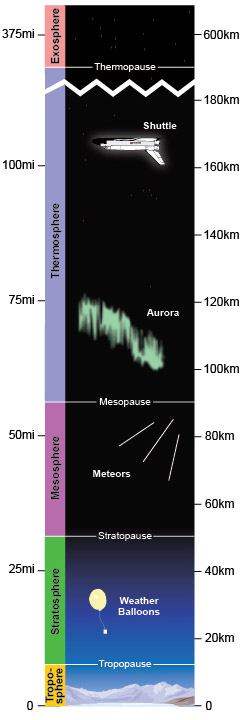
The five basic layers of the atmosphere. (Credit: NOAA)
When a human-made object disintegrates in the atmosphere, it’s reduced to its base compounds, after interaction with the super-heated plasma that forms around said object. With the commonly used aluminium, for example, this means the production of aluminium oxide.
By far the largest amount of mass that will be burning up in the atmosphere over the coming years is formed by LEO internet constellations such as Starlink, which have a cumulative mass of over 10,000 tons. In addition, the second stage of the Falcon 9 rockets that are currently used to launch Starlink v1 and v1.5 satellites into LEO also burns up in the atmosphere. Recently, such a Falcon 9 stage suffered a mishap that caused it to disintegrate over Europe, rather than the typical trajectory over remote parts of Earth’s oceans.
This provided the perfect natural experiment. Batteries onboard satellites contain lithium, and because it’s relatively scarce in the atmosphere, it makes a great marker for the effects of satellites burning up on re-entry.
In the article by Robin Wing et al., as published in Communications Earth & Environment, the upper atmosphere measurements by a resonance lidar in Germany allowed for a ten-fold increase in atomic lithium to be measured after the stage had disintegrated near Ireland at an altitude of 100 km. Air currents subsequently dispersed the atomic debris over the rest of Europe.
Most notable perhaps was that the plume of atomic lithium was being detected at the same altitude of 100 km, after advecting for 1,600 km, placing ablation and dispersal in the mesosphere and lower thermosphere (MLT). Normally this plume would be dispersed far away from instruments, making it a fortuitous event from a scientific perspective that it could be measured like this.
Lithium is just one tracer for the debris plume, but there are many other metals. Here also lies the issue with comparing purely the mass of asteroids and rocket stages burning up in the atmosphere versus meteoroids and asteroids doing the same. The latter aren’t usually composed of intricate collections of metal alloys, rare earths and composite materials, but generally more boring things that we’d generously call ‘rocks’ or ‘gravel’, with the occasional iron variant mixed in.
As noted by Robin Wing et al., this feature makes artificial sources relatively easy to distinguish from natural ones. Since within the next decades re-entering satellites are projected to match or exceed 40% of natural meteoroid influx, the question remains of what these substances hanging around in Earth’s atmosphere will do to it and consequently life in Earth’s biosphere.
Potential Impact
Back in 1987 the Montreal Protocol was signed. This banned the use of chlorofluorocarbons (CFCs) after it was found that the large-scale release of CFCs into the atmosphere from refrigeration systems and other sources had resulted in a significant depletion of the ozone layer. This layer is found primarily in Earth’s stratosphere and is essential for blocking harmful ultraviolet radiation which would otherwise irradiate the surface, in particular UV-C.
Although it’s currently projected that the ozone will have completely regenerated by 2045, a worrying 2024 research letter by José P. Ferreira et al. from the American Geophysical Union (AGU) with accompanying press release suggests that the massive rise in satellites burning up in the atmosphere over the coming decades could add so much aluminium oxides to the atmosphere that it could revert this ozone layer regeneration process.
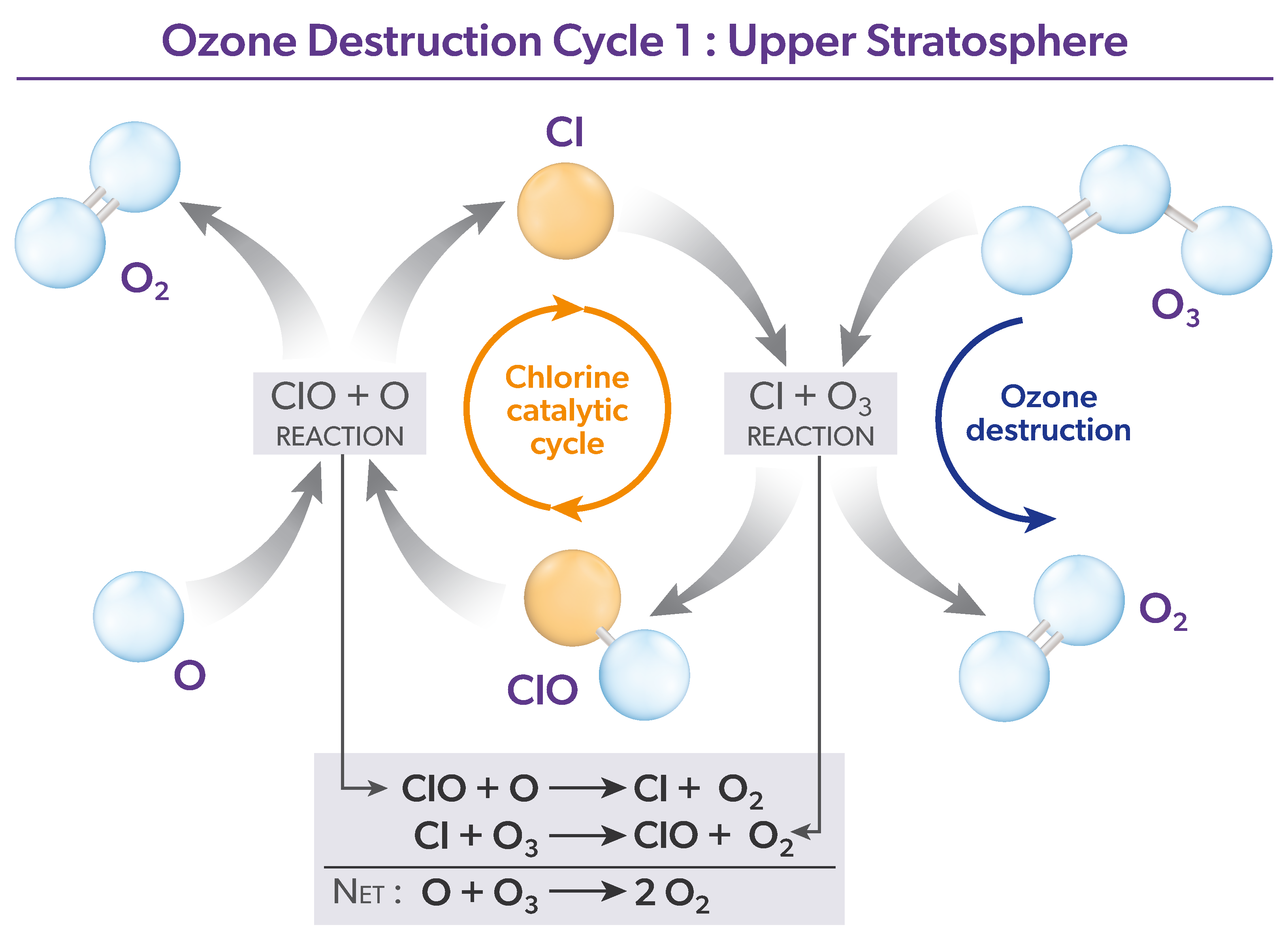
Using an atomic-scale molecular dynamics simulation they found that a typical 250 kg satellite upon its fiery demise in Earth’s atmosphere releases about 30 kg of aluminium oxide nanoparticles. These may remain in the atmosphere for decades, meanwhile acting as a catalyst for chlorine activation and thus ozone depletion.
With currently projected mass of mega-constellation satellites burning up in the atmosphere, we’d be looking over 360 tons of aluminium oxides per year being added. As a catalyst, these aluminium oxides would not be used up, but would keep depleting the ozone layer as fast as the input products (ClO or Cl) are added.
This is just one potential impact that we might see as we keep adding all of these foreign substances to the atmosphere. Fortunately there’s nothing that says that we cannot have all our satellites and still dodge these issues.
Reduce, Reuse, Recycle
The central issue here is that we have always treated the atmosphere similarly to the way that early medieval cities treated the local waterways. In their case it only took a few cholera- and other assorted epidemics to realize that maybe it was best to not use the waterways both for waste and drinking water. Similarly, we are now at a point where we’re beginning to realize that tossing our waste into the atmosphere may not be such a good plan, albeit it largely for financial reasons.
For many decades, it’s been accepted that rockets and satellites are effectively disposable, single-use items. Even the infamous STS (‘Shuttle’) program didn’t really push it much past ‘intense refurbishing’. Only recently has it become fashionable to reuse rockets and capsules, with the SpaceX Falcon 9 rocket’s first stage currently being the world-leader when it comes to partial reuse. Unfortunately its second stage still is burned up, as we saw with the analysis by Robin Wing et al.
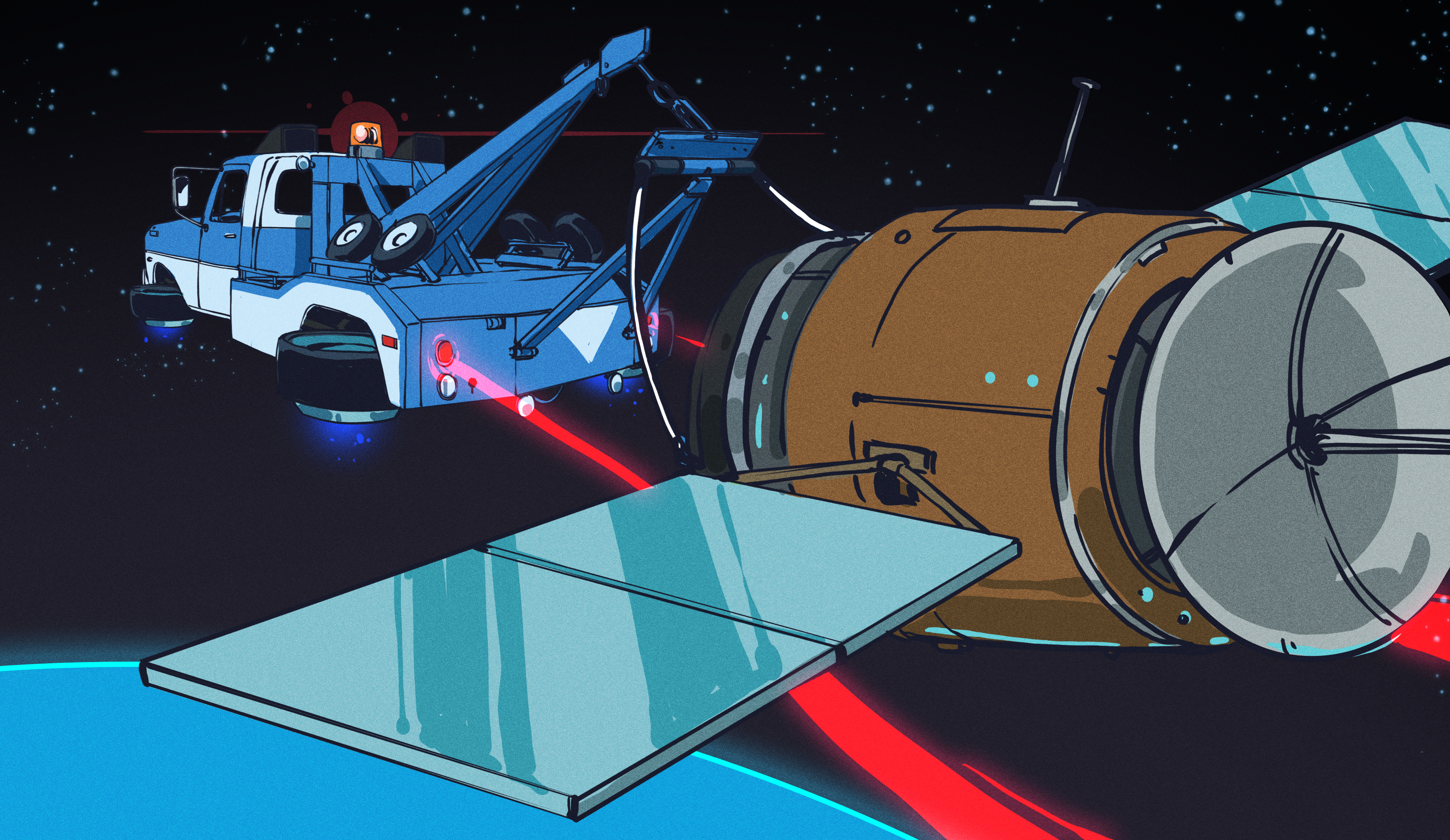
What can be done? Back in 2020 we covered Northrop Grumman’s Mission Extension Vehicle (MEV), which provides a way to latch onto an existing satellite and provide propulsion as well as other functionality when the target’s own resources have become exhausted. In 2021 MEV-2 docked with Intelsat 10-02 to push it back to a geosynchronous orbit, extending its life by five years.
This is an example of on-orbit satellite servicing, which can take many forms. At its most basic it will just drag a satellite to a specific orbit, but it can also entail actual servicing, refueling and repairs. This was actually one of the concepts behind the Shuttle, with the Hubble Telescope being serviced and upgraded during a number of missions.
Unfortunately with the STS program’s in-orbit repair feature remaining mostly a pleasant dream due to the high cost of such a mission, we may one day see satellites being refueled and repaired by robotic systems. Although fully reusable rockets seem to be just around the horizon with SpaceX Starship and kin leading the way, we can only hope that we can soon figure out a way to make it cheaper to just repair a satellite than to toss it and launch a new one.
"Un'abbondanza di mezzi e una confusione di fini". La formula attribuita ad Albert Einstein ha aperto i lavori del seminario "Potenzialità e sfide dell'Intelligenza artificiale", organizzato oggi a Roma dalla Segreteria per l'Economia e dall'Ufficio …
La prima settimana dell'ostensione delle spoglie mortali di san Francesco si conclude con un bilancio che racconta di una basilica che diventa luogo di incontro vivo e pulsante.
Arizona – the Arizona Pirate Party hosted their first in-person rally yesterday at the Marana Aquatic and Recreation Center. Blase and new AZPP Young Pirates Rep Jane both gave speeches. You can look back at last night’s rally here.
Committees – IT committee met last Wednesday and discussed a move from or a bridge connecting to Discord, with the end goal to ultimately move away from Discord entirely. Work projects for new designs, merchandise and other Pirate related visual elements have been sent down to both Outreach and Press Committee as action items.
Massachusetts – the Massachusetts Pirate Party has been at work electing a new Pirate Council. Ballots were sent out on February 13th and were due back on the 27th.
Nevada – As of today (3/2), Hunter Rand has formally filed for his candidacy. Just out the Facebook post announcing it here.
#ProjectNoCap– Per Captain’s request, the next meeting the Pirate National Committee holds (on 3/8) will feature a discussion on formally endorsing Mr. Beat’s #ProjectNoCap. While not formally adopting to our platform (at least, not currently being considered at present moment), #ProjectNoCap would fall under the “Opening Up the Government” aspect of our platform. Come 3/9, the Pirate Party should have an idea of how committed we will be towards the project moving forward.
Volunteers – As if our search for volunteers is ever over. We’re seeking Pirates from all 50 states and six territories, but especially those from Arizona, California, Colorado, Florida, Idaho, Illinois, Indiana, Kansas, Massachusetts, Michigan, New York, North Carolina, Ohio, Pennsylvania, Texas and West Virginia. If you don’t see your state, don’t think we don’t want or need you, too. In fact, not seeing your state might be even more reason to get involved. After all, Michigan and Colorado are newer additions, meaning folks come aboard all the time. See what sticks, see if this is right for you (it is).
In the age of rapid digital evolution, the world has increasingly come to resemble a global village, at our doorstep and just a click away. Digital technologies have reduced physical barriers, allowing people to work, study, and access services across borders with unprecedented ease.
But as digital systems become deeply embedded in everyday life, a fundamental question arises: Does digital convenience come at the cost of digital autonomy? As identity, authentication, and access move online, concerns about privacy, power, and institutional control are becoming central to the European digital debate.
In a progressively digital world, proving one’s identity online and across multiple geographic locations can be just as important as showing identification in person. From the European Union’s perspective, this is where eIDAS comes into play. The eIDAS Regulation, a set of European Union rules, has been updated to introduce a new concept: the EU Digital Identity Wallet.
It refers to the EU legal framework that regulates:
Trust services (like digital signatures, seals, and certificates)
The framework was established under the eIDAS Regulation to ensure that digital identities and electronic transactions are secure and legally recognised across all European Union Member States.
In simple terms, eIDAS is the law that enables people and businesses in the EU to use digital identities and trust digital documents across borders.
2014: eIDAS 1.0 regulation – First time establishment of legal frameworks for the cross-border recognition of national eID schemes. The implementation was unsuccessful due to low adoption and limited private-sector integration.
2021: A proposal floated by the European Commission, amending the 2014 regulation, to introduce a “European Digital Identity” framework, based on personal digital wallets.
2022-2023: Pilot projects introduced in April 2023. The objective was to test the wallets’ ability to process eHealth payments, driving licenses, and educational credentials.
2023-2024: A political consensus was reached in November 2023, and the EU regulation 2024/1183 came into force on 20 May 2024.
The exercise over all the above-mentioned years culminated in a decision that all Member States must provide their citizens with digital wallets by the end of 2026.
Why Digital Wallets Are Important: Policymakers’ Perspective
The EU’s Digital Decade Policy Programme 2030 aims to ensure that, by 2030, people across the Union can use a trusted, voluntary digital identity recognised everywhere in the EU and that gives users control over their personal data in online interactions.
If the timeline of eIDAS evolution is followed, the framework has experienced substantial change. eIDAS 1.0, introduced in 2014, focused primarily on the cross-border recognition of existing government-issued IDs. On the other hand, eIDAS 2.0 mandates that member states issue interoperable wallets that require verified attributes such as age, address, etc.
As proclaimed by the European Parliament, “The European Declaration on Digital Rights and Principles” also emphasises that everyone has the right to safe, secure, and privacy-protective digital technologies and services. This includes access to a reliable digital identity that protects individuals from risks such as data breaches, identity fraud, and unlawful exploitation of personal details. It further stresses that people should have control over how their data is used and shared.
Overall, a harmonised digital identity framework is intended to reduce digital barriers across Member States, strengthen transparency, and empower citizens and residents to benefit from digital services while protecting their rights.
But the roadmap to the European digital future is not without hurdles and blind spots. Under eIDAS regulations, every member state must provide its citizens with at least one digital wallet that can be used seamlessly across Europe. To facilitate a hassle-free exchange of information among wallet issuers and service providers, the European Commission adopted a Common Union Toolbox in June 2021, comprising common standards, technical specifications, guidelines, and best practices. Despite such steps, certain technical, administrative, and infrastructural gaps have been identified.
Implementation and Structural Challenges
Uneven digital readiness: Member States differ significantly in digital infrastructure. While some operate advanced electronic ID systems, others still rely heavily on traditional identification processes. This disparity may result in uneven rollout and effectiveness across the Union.
Governance and power dynamics: Digital identity systems don’t just make services easier. They also change who holds power online. Depending on how they are managed, these systems can either give people more control or put more power in the hands of governments and big tech companies.
Interoperability and technical complexity: For cross-border functionality, national systems must communicate securely and consistently. This requires common standards, certification mechanisms, rigorous testing, and long-term coordination.
Public trust and adoption: Privacy safeguards alone are not enough. Citizens must be able to trust that the system will not enable surveillance, misuse, or cybersecurity vulnerabilities. Transparency and accountability will be central to adoption.
Administrative alignment: Even though the EU sets the rules, each country is responsible for implementing them. Aligning laws, procedures, and technical systems across all countries is complicated and time-consuming.
Core Civil Society Concerns
While policymakers frame eIDAS 2.0 and the European Digital Identity Wallet as tools for integration and empowerment, civil rights parties and digital rights organisations have identified core civil society concerns that the eIDAS framework has failed to address. The European Pirates are among those digital rights advocates who argue that the risks to citizens require far greater scrutiny.
The European Pirates, along with Pirate members across the EU, have highlighted concerns that focus less on the idea of digital identity itself and more on how the system could operate in practice. Below is a list of the shortcomings of the eIDAS framework from the civil society’s perspective:
Surveillance and loss of anonymity: The wallet could enable cross-sector linking of activities such as finance, health, and transport. Critics argue that insufficient safeguards for anonymous or pseudonymous use may normalise routine identification in everyday interactions.
Over-identification and weak data minimisation: Users may be required to disclose more personal information than necessary, undermining the GDPR principle of data minimisation.
Centralisation and power concentration: Even though the system is described as user-controlled, it could end up being run mostly by government-approved providers and big platforms, leading to power imbalances.
Web security risks linked to Qualified Website Authentication Certificates (QWACs): Mandatory recognition of government-designated certificates may weaken existing browser trust models. Critics warn this could introduce vulnerabilities and potentially compromise encrypted communications.
De facto mandatory use and exclusion: Even if legally voluntary, widespread institutional implementation by banks, employers, and public services could make the wallet practically unavoidable. Those without smartphones, digital literacy, or reliable access to technology may face exclusion.
Function creep and systemic risk: There are concerns that the wallet’s scope could gradually expand beyond identification. At the same time, a widely adopted identity infrastructure could become a high-value target for cyberattacks, increasing systemic security risks.
Oversight and accountability gaps: Civil society organisations call for stronger independent oversight, open technical standards, and systematic audits to ensure the system complies with fundamental rights.
Alternative Approach
Addressing the risks posed by the eIDAS regulation to civil rights and internet freedom is of paramount importance to convert a well-intended plan into an impactful policy. If the European Digital Identity Wallet is to align with and uphold the European values of freedom and democracy, several safeguards must be put in place.
In this context, the European Pirates, in close consultation with the member Pirate Parties, have put forth a few recommendations as a formal submission to the European Citizens’ Initiative, as measures to counter the normalisation of compulsory identification – a price to be a part of a digital society.
Here are the recommendations:
Strictly voluntary participation: The use of any EU digital identity solution must remain optional and should never become a compulsory requirement for accessing services.
Decentralised and privacy-respecting design: The system should avoid a centralised structure or a permanent universal identifier and instead be built on a privacy-friendly, distributed architecture.
Mandatory use of Zero-Knowledge Proofs: Privacy-enhancing technologies such as Zero-Knowledge Proofs should be embedded as a required technical standard to enable verification of specific attributes without revealing unnecessary personal data.
Transparent regulation of relying parties: Entities that depend on the wallet for verification should be subject to clear registration, accountability, and transparency rules to minimise misuse or overreach.
No compulsory QWAC requirements: Browsers must retain the autonomy to evaluate and reject insecure certificates, without being forced to accept government-designated website authentication certificates.
Technological neutrality and digital sovereignty: The framework should prevent dependency on a narrow set of dominant, particularly non-European, technology providers and support a diverse technological ecosystem.
Safeguarding non-digital access: Traditional, offline alternatives must remain available to ensure that no individual is excluded from essential services due to digital barriers.
Closing Reflections
The EU Digital Identity Wallet represents a structural shift in how identity, access, and trust are managed in digital society. It reflects the European Union’s ambition to build an interoperable and secure digital ecosystem.
Yet the core question remains unresolved: will this infrastructure strengthen digital rights, or test their limits?
Digital convenience must not come at the cost of digital autonomy. A European Digital Identity framework worthy of its name must reinforce decentralisation, privacy-by-design, transparency, and democratic accountability.
The future of Europe’s digital space should not only be efficient and interoperable. It must remain fundamentally rights-based.
It weighs on our hearts that our government has decided to take action against the crews shipping oil. Just as we are against civil asset forfeiture, this too is an action that just steals from those sailors who are simply trying to make a living. With zero due process in international waters, Trump has directed our military to steal from those who do not align with his political stance.
This is not a dissent against our military brothers and sisters, who carried out the raids. They did so without harming the ships or the people, preforming at a level of excellence we have come to expect from them. Instead, this is a top down action that put both our military personnel and the merchant marine in harms way. They were not transporting illegal goods. They were transporting oil.
Those in the administration claim this is to stop tyranny while they are acting tyrannical. They claim this is for justice while holding no due process nor giving those arrested the right to representation. They claim the crews are breaking international law and are part of a shadow fleet, so does that mean the US is the end-all be-all of policing international trade?
We must not let this distract us from the real issues. We must push back again those who think they are above the law. No one is above the law and we all deserve justice with due process.
Locusta fu la prima vera serial killer della Storia: esperta di botanica e veleni, aprì una bottega sul Palatino trasformando il delitto perfetto in un'arte.
Sei arrabbiato. Bene. Davvero. Bene. La rabbia non è un difetto di fabbrica. Non è una falla morale, ma un segnale. Il problema non è che provi rabbia, ma cosa fai dopo. Molti cercano di reprimerla perché “non sta bene”. Altri la vomitano addosso al primo che passa. Entrambe le cose sono modi eleganti per evitarla. Accettare la rabbia significa una cosa molto più scomoda, significa restare lì dentro abbastanza a lungo da capire cosa sta proteggendo. Perché la rabbia non è quasi mai l’emozione primaria, è una guardia del corpo. Dietro c’è delusione, paura, sentirsi non rispettati e un confine superato. Ma è più facile dire “sono arrabbiato” che ammettere “mi ha ferito”. Accogliere la rabbia non significa giustificarla o fare danni, ma smettere di fingere che non ci sia. Perché quando la reprimi, si incastra, Se la esplodi, distrugge, mentre se la ascolti, informa. La rabbia ti dice dove non sei stato ascoltato, dove hai detto sì invece di no e dove hai tollerato troppo. Non è il nemico, è un messaggio con un tono aggressivo. La maturità non è non arrabbiarsi mai. È saper dire: “Ok, sono arrabbiato. Adesso vediamo perché.” Non devi diventare zen, nessuno te lo sta chiedendo, ma devi diventare consapevole. Perché una rabbia accolta diventa chiarezza, mentre una rabbia ignorata diventa risentimento. Se incontrollata poi diventa distruzione. Sei arrabbiato? Perfetto. Adesso non usarla per colpire, usala per capire. Perché sotto quella fiamma c’è qualcosa di importante che stai finalmente vedendo. E ignorarlo sarebbe molto più pericoloso della rabbia stessa. #mymindfulnesspath #lamindfulnesspertutti #mindfulnessitalia #mindfulness #benessere #lifecoaching #rabbia #emozioni #consapevolezza
io rimango convinta che se avessi un pulsante da giudizio universale la cosa più saggia sarebbe cancellare istantaneamente l'umanità. non perché sia moralmente peggio del creato... niente confronti del genere "gli animali sono persone migliori". ma di fatto siamo infinitamente tossici, questo è innegabile.
come specie autodefinitasi intelligente avremmo delle responsabilità, e invece siamo pessimi custodi del pianeta.
Circa 60mila tonnellate di armi chimiche sono state depositate sul fondo del Mar Baltico dalla Seconda Guerra Mondiale. Altre centinaia di migliaia di tonnellate sono armi convenzionali come le mine da combattimento.
Dalla base di Île Longue in Bretagna, sede dei sottomarini lanciamissili balistici della forza oceanica strategica francese, Emmanuel Macron ha annunciato un aumento del numero di testate nucleari dell’arsenale di
MamaBaba – Blues Hotel freezonemagazine.com/articoli/… MamaBaba è artista nella quale non mi ero mai imbattuto prima e la prima impressione, una volta ascoltato questo Blues Hotel è quella netta ed inequivocabile di trovarsi ad assistere ad una piece teatrale messa in musica. Sì, perché poi la conferma arriva anche leggendo le note inviate con la cartella stampa che raccontano di […] L'articolo MamaBaba – Blues Hotel proviene da FREE ZONE MAGAZINE. MamaBaba è
@Informatica (Italy e non Italy) L’escalation del braccio di ferro fra Anthropic e il Dipartimento della Guerra dell'amministrazione Trump ha avuto un esito imprevisto: l'impiego di Claude nella guerra in Iran, nonostante l'ordine esecutivo di Trump che ne
@Informatica (Italy e non Italy) La vulnerabilità Clawjacked scoperta nel gateway WebSocket di OpenClaw rivela un vettore d'attacco silenzioso e ad alto impatto: una pagina web malevola può dirottare l’agente AI locale dello sviluppatore, registrarsi come dispositivo fidato e accedere a dati, log e
INDICI DI CRIMINALITà 2025. L'EUROPA è RESILIENTE, LA CRIMINALITà è STABILE, MA VI SONO CAMBIAMENTI SIGNIFICATIVI
La Global Initiative è un'organizzazione indipendente della società civile, con sede a Ginevra, Svizzera, con un segretariato distribuito in tutto il mondo e un comitato consultivo di alto livello.
I membri della sua rete includono eminenti professionisti delle forze dell'ordine, della governance e dello sviluppo che si dedicano alla ricerca di strategie e risposte nuove e innovative alla criminalità organizzata. Produce ogni anno il "Global Organized Crime Index", fornendo un giudizio basato su "indicatori" sui livelli di criminalità dei cinque continenti nonché sulla rispettiva resilienza al crimine.
Secondo il Global Organized Crime Index 2025, i livelli di criminalità organizzata sono rimasti stabili in tutta Europa, mentre sono aumentati nella maggior parte delle altre regioni. L'Europa si classifica al secondo posto per criminalità dopo l'Oceania.
Tuttavia, questa stabilità complessiva nasconde cambiamenti significativi all'interno dei mercati criminali e tra gli attori criminali. Il punteggio di criminalità in Europa si attesta a 4,74, con un punteggio di resilienza di 6,28, il più alto a livello globale. Nonostante le prestazioni superiori dell'Europa in tutti i 12 indicatori di resilienza, l'attività criminale continua a espandersi ed evolversi, sottolineando l'urgenza di aggiornare le strategie di resilienza per affrontare le minacce emergenti. La criminalità finanziaria rimane il mercato criminale più diffuso in Europa per il secondo anno consecutivo. Questi reati comprendono frodi sempre più sofisticate condotte principalmente online, tra cui frodi sugli investimenti, compromissione delle e-mail aziendali, truffe sentimentali, appropriazione indebita ed evasione fiscale. I reati finanziari trascendono i confini regionali e sono sostanzialmente facilitati dalla corruzione. L'Europa rimane un importante hub globale per i reati informatici, classificandosi al secondo posto a livello continentale. Queste vanno dagli attacchi ransomware e dalla distribuzione di malware alle frodi con criptovalute, che spesso prendono di mira istituzioni governative, grandi aziende e infrastrutture critiche. Gli attori criminali informatici ibridi e tradizionali sono sempre più allineati, con gruppi sponsorizzati dallo Stato che spesso si spacciano per criminali informatici indipendenti. I mercati della droga continuano a rappresentare sfide significative. La cocaina e le droghe sintetiche hanno registrato i maggiori aumenti dal 2023. La cocaina rappresenta la principale fonte di reddito per numerosi gruppi criminali organizzati europei, con il continente che funge da destinazione, via di transito e mercato di consumo. La produzione di droghe sintetiche è sempre più dispersa, in particolare nell'Europa centrale e orientale, che ha registrato la crescita più significativa dal 2021. Il consumo di eroina è in calo, mentre la cannabis rimane la sostanza illecita più consumata. La tratta di esseri umani e il contrabbando rimangono minacce pervasive. Le reti di contrabbando sono saldamente radicate lungo la rotta dei Balcani occidentali, con molte nazioni europee che fungono da destinazioni finali dove le persone trafficate affrontano lavori forzati o sfruttamento sessuale. La presenza di attori criminali è cresciuta costantemente dal 2021. Gli attori stranieri rappresentano la preoccupazione più significativa, registrando l'aumento maggiore dal 2021. Questi gruppi sono sempre più diversificati, multietnici e interconnessi. Gli attori del settore privato svolgono un ruolo sostanziale nel riciclaggio di denaro, mentre gli attori integrati nello Stato, sebbene meno diffusi che altrove, facilitano l'attività criminale in determinati contesti.
L'indice di criminalità dell'Italia secondo il Global Index
I punti di forza della resilienza dell'Europa includono la cooperazione internazionale, politiche e legislazioni nazionali solide e l' integrità territoriale. Al contrario, la trasparenza e la responsabilità del governo si posizionano costantemente agli ultimi posti tra gli indicatori di resilienza, così come la capacità di contrasto al riciclaggio di denaro e di regolamentazione economica.
Sebbene l'Europa dimostri una resilienza complessivamente relativamente forte, alcuni mercati e attori criminali continuano a espandersi. Questi risultati evidenziano la necessità critica di meccanismi di risposta più efficaci e personalizzati, man mano che la criminalità organizzata si adatta in tutto il continente.