We recently got a note in the tips line from [Tavis Gustafson], who is one of the developers of Tronbyt — a replacement firmware and self-hosted backend that breaks the Tidbyt smart display free from its cloud dependency. When they started the project, [Tavis] says the intent was simply to let privacy-minded users keep their data within the local network, which was itself a goal worthy enough to be featured on these pages.
But now that Tidbyt has been acquired by Modal and has announced they’ll no longer be producing new units, things have shifted slightly. While the press release says that the Tidbyt backend is going to stay up and running for existing customers, the writing is clearly on the wall. It’s now possible that the Tronbyt project will be able to keep these devices from ending up in landfills when the cloud service is inevitably switched off, especially if they can get the word out to existing users before then.
What’s that? You say you haven’t heard of Tidbyt? Well, truth be told, neither had we. So we did some digging, and this is where things get really interesting.
A look inside the original Tidbyt. It turns out, Tidbyt started its life as a project on Hackaday.io by [Rohan Singh] back in 2020. The hardware consists of a 64×32 HUB75 LED panel and a small custom PCB holding an ESP32 inside of a wooden box, and while it doesn’t appear to have ever been an open source device per se, how it worked internally was hardly a secret. The software side of things however wasreleased on GitHub, which likely made creating the custom firmware that much easier for [Travis] and co.
By March of 2021, Tidbyt was on Kickstarter, where it blew past its goal in 48 hours and ultimately brought in just shy of one million dollars. In October of 2023, they were back on Kickstarter with a second generation of Tidbyt hardware, and this time brought in even more money than the first time.
So what’s the takeaway from all of this? Well, first of all we can’t believe this whole thing was developed right under our noses without us even realizing it. This seems like a good time as any to remind folks to drop us a line if you’re working on something cool and you want to share it with the class. We would’ve loved to connect with [Rohan] as Tidbyt was on the rise. Rohan Singh (center) poses with Modal founders, three years after posting the project on Hackaday.io But more importantly, it’s a great example of just how much better devices that were developed in the open can weather a storm than their proprietary counterparts. [Rohan] kept enough of Tidbyt open to the community that they were able to successfully create their own firmware and backend — a decision which now might end up being the only thing keeping some of these devices up and running in the future.
Oh yeah, and keep starting awesome projects on Hackaday.io and turning them into multi-million dollar ventures too. We like that also.
Gli scienziati del Korea Institute of Science and Technology di Daegu hanno creato una batteria nucleare compatta in grado di generare elettricità per decenni senza i rischi solitamente associati alla radioattività.
Il nuovo dispositivo è una cella a colorante beta-voltaico alimentata dal carbonio-14, un isotopo radioattivo che emette particelle beta. Queste particelle, essenzialmente elettroni ad alta energia, colpiscono un semiconduttore di biossido di titanio rivestito con un colorante a base di rutenio, facendone uscire gli elettroni e creando una corrente elettrica.
L’emivita del carbonio-14 è di circa 5.730 anni, il che consente teoricamente alla batteria di conservare metà della sua capacità iniziale dopo migliaia di anni. Ma nella pratica la produzione diminuisce molto più rapidamente: i materiali sono ancora soggetti a distruzione. Tuttavia, il potenziale della tecnologia è impressionante. Il prototipo attuale fornisce 20,75 nanowatt per centimetro quadrato per millicurie con un’efficienza del 2,86%. In parole povere, questa batteria delle dimensioni di un’aspirina fornisce circa lo 0,4% della potenza necessaria per far funzionare una calcolatrice tascabile. Per funzionare, sarebbero necessari altri 240 elementi circa.
Sebbene la sua potenza sia modesta, è sufficiente ad alimentare dispositivi medici impiantabili come pacemaker o sensori per la raccolta di dati ambientali. La tecnologia può essere utilizzata anche per alimentare tag RFID, microcircuiti e caricare condensatori in dispositivi che richiedono un impulso energetico breve ma potente. Questa direzione è promettente per l’elettronica ad altissima efficienza energetica, ma è ancora nelle prime fasi di sviluppo.
Il vantaggio principale è la sicurezza. Contrariamente a quanto si pensa comunemente del termine “nucleare“, il dispositivo non richiede una protezione complessa. Le particelle beta del carbonio-14 sono deboli e si trovano ovunque, anche nel corpo umano. Per la schermatura è sufficiente uno strato sottile di alluminio. La batteria è completamente solida, priva di materiali infiammabili e, in termini di sicurezza, può addirittura superare le batterie agli ioni di litio, soggette a surriscaldamento ed esplosioni.
In generale, l’idea delle batterie nucleari non è nuova. I primi dispositivi di questo tipo apparvero negli anni ’50, quando negli USA venne sviluppato un elemento basato sullo stronzio-90. Successivamente, negli anni ’60, i generatori termoelettrici a radioisotopi con plutonio-238 iniziarono a essere utilizzati nelle missioni spaziali. Uno dei primi esempi fu il satellite Transit 4A, utilizzato in uno dei primi sistemi di navigazione satellitare, il predecessore del GPS.
Negli ultimi anni l’interesse per le batterie nucleari è tornato a crescere. Ad esempio, Betavolt ha introdotto una batteria da 3 volt con nichel-63 e un semiconduttore al diamante, progettata per durare 50 anni. E Arkenlight sta sviluppando batterie basate sui diamanti al carbonio-14. Sebbene i principi rimangano gli stessi, i progressi nei materiali e nella sicurezza stanno avvicinando la tecnologia all’uso nel mondo reale, senza la necessità di costruire reattori nucleari.
Venerdì 28 marzo 2025, ore 12:00 – Ordine degli Ingegneri della Provincia di Milano, Viale Andrea Doria 9 – Milano Saluti Istituzionali Carlotta Penati, Presidente Ordine Ingegneri della Provincia di Milano Interverranno Giuseppe Benedetto, Presidente Fondazione Luigi Einaudi Andrea Cangini, Segretario Generale Fondazione
We ran a story about a wall-mounted plotter bot this week, Mural. It’s a simple, but very well implemented, take on a theme that we’ve seen over and over again in various forms. Two lines, or in this case timing belts, hang the bot on a wall, and two motors drive it around. Maybe a servo pulls the pen in and out, but that’s about it. The rest is motor driving and code.
We were thinking about the first such bot we’ve ever seen, and couldn’t come up with anything earlier than Hektor, a spray-painting version of this idea by [Juerg Lehni]. And since then, it’s reappeared in numerous variations.
Some implementations mount the motors on the wall, some on the bot. There are various geometries and refinements to try to make the system behave more like a simple Cartesian one, but in the end, you always have to deal with a little bit of geometry, or just relish the not-quite-straight lines. (We have yet to see an implementation that maps out the nonlinearities using a webcam, for instance, but that would be cool.) If you’re feeling particularly reductionist, you can even do away with the pen-lifter entirely and simply draw everything as a connected line, Etch-a-Sketch style. Maslow CNC swaps out the pen for a router, and cuts wood.
What I love about this family of wall-plotter bots is that none of them are identical, but they all clearly share the same fundamental idea. You certainly wouldn’t call any one of them a “copy” of another, but they’re all related, like riffing off of the same piece of music, or painting the same haystack in different lighting conditions: robot jazz, or a study in various mechanical implementations of the same core concept. The collection of all wall bots is more than the sum of its parts, and you can learn something from each one. Have you made yours yet?
(Fantastic plotter-bot art by [Sarah Petkus] from her write-up ten years ago!)
This article is part of the Hackaday.com newsletter, delivered every seven days for each of the last 200+ weeks. It also includes our favorite articles from the last seven days that you can see on the web version of the newsletter. Want this type of article to hit your inbox every Friday morning? You should sign up!
Lavori in ambito scientifico o in un ambiente in cui, in ogni caso, potresti leggere PDF con margini ampi impostati in Computer Modern? Vuoi rilassarti durante le ore di lavoro? Ecco il client Mastodon perfetto e di sola lettura per te: Mastodon-LaTeXclient trasforma la tua cronologia in un documento, così puoi tenerla aperta in modo molto discreto su uno schermo di lato!
Lunedì 24 marzo un F-35A del 495° squadrone di caccia dell’Air Force americana è atterrato a Cameri. È l’inizio della prima manutenzione programmata di un F-35A americano di stanza in Europa (USAFE) presso le strutture della base aerea in Piemonte che, grazie alla joint venture tra Leonardo e Lockheed
Tektronix must have been quite a place to work back in the 1980s. The company offered a bewildering selection of test equipment, and while the digital age was creeping in, much of their gear was still firmly rooted in the analog world. And some of the engineering tricks the Tek wizards pulled off are still the stuff of legend.
One such gem of analog design was the SG505, an ultra-low-distortion oscillator module that [Paul] is trying to replicate with modern parts. That’s a tall order since not only did the original specs on this oscillator call for less than 0.0008% total harmonic distortion over a frequency range of 20 Hz to 20 kHz, but a lot of the components it used are no longer manufactured. Tek also tended to use a lot of custom parts, especially mechanical ones like the barrel switch used to select attenuation levels in the SG505, leaving [Paul] no choice but to engineer his way around them.
So far, [Paul] has managed to track down most of the critical components or source suitable substitutes. One major win was locating the original J-FET Tek used in the oscillator’s AGC circuit. One part that’s proven more elusive is the potentiometer that Tek used to adjust the frequency; who knew that finding a dual-gang precision wirewound 10k single-turn pot with no physical stop would be such a chore?
[Paul] still seems to be very much in the planning stages of this project yet, and that’s probably for the best since projects such as these live and die on proper planning. We’re keen to see how this develops, and we’re very much looking forward to seeing the FFT results. We also imagine he’ll be busting out his custom curve tracer at some point in the build, too.
Distributore democrautomatico. Ogni decisione è politica. Vecchio distributore automatico di dvd pornografici non funzionante, hackerato e riconvertito. Installazione, urban art, 2025. …
Nella giornata di oggi, l'esercito israeliano ha colpito Beirut per la prima volta da quando, a fine novembre, è entrato in vigore il cessate il fuoco tra Israele e Hezbollah.
A sottolinearlo, in un'intervista al 'Corriere della Sera', è la presidente della Commissione Europea, Ursula von der Leyen. Il piano Readiness 2030 (Rearm
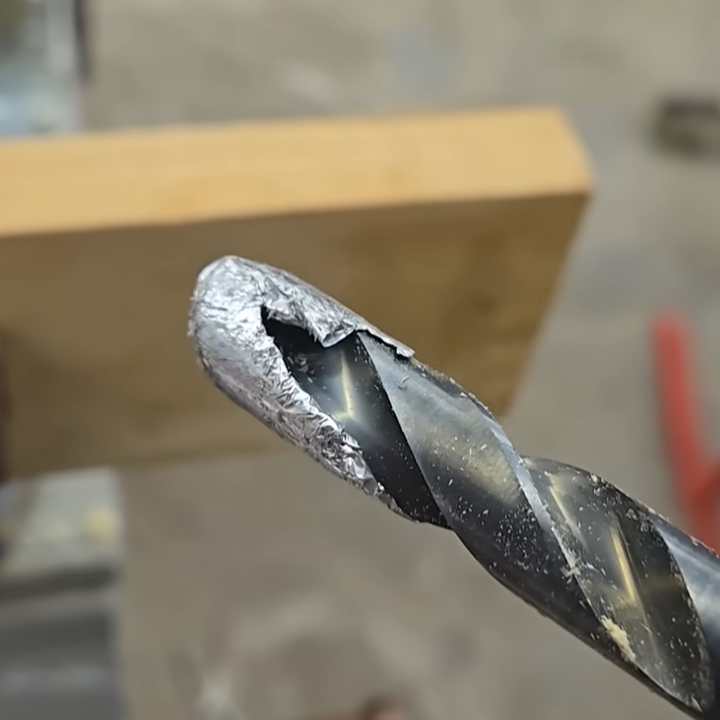
As everyone knows, no matter how many drill bits one owns, one inevitably needs a size that isn’t on hand. Well, if you ever find yourself needing to drill a hole that’s precisely 13 mm, here’s a trick from [AvE] to keep in mind for doing it with a 1/2″ bit. It’s a hack that only works in certain circumstances, but hey, it just may come in handy some day.
So the first step in making a 13 mm hole is to drill a hole with a 1/2″ bit. That’s easy enough. Once that’s done, fold a few layers of tinfoil over into a small square and lay it over the hole. Then put the drill bit onto the foil, denting it into the hole (but not puncturing it) with the tip, and drill at a slow speed until the foil wraps itself around the bit like a sheath and works itself into the hole. The foil enlarges the drill bit slightly and — as long as the material being drilled cooperates — resizes the hole a tiny bit bigger in the process. The basic idea can work with just about any drill bit.
It’s much easier demonstrated than described, so watch it in action in the video around the 2:40 mark which will make it all very clear.
It’s not the most elegant nor the most accurate method (the hole in the video actually ends up closer to 13.4 mm) but it’s still something worth keeping in the mental toolbox. Just file it away along with laying your 3D printer on its side to deal with tricky overhangs.
il giorno del ringraziamento sarà chiamato "giorno del grande affare" e le mutande dovranno essere portate sopra i pantaloni. il giorno del ringraziamento sarà spostato alla data di compleanno di trump. sulla luna sarà scolpita la sua faccia.
#NoiSiamoLeScuole, il video racconto di questa settimana è dedicato a due Nuove Scuole nel Veneto: la Primaria “Alfredo Fabris” di Zugliano (VI) e la Secondaria di I grado “Don Lorenzo Milani” di Zanè (VI), che, con i fondi #PNRR finalizzati alla cos…
#NoiSiamoLeScuole, il video racconto di questa settimana è dedicato a due Nuove Scuole nel Veneto: la Primaria “Alfredo Fabris” di Zugliano (VI) e la Secondaria di I grado “Don Lorenzo Milani” di Zanè (VI), che, con i fondi #PNRR finalizzati alla cos…
📣 Contrasto ai diplomifici, reclutamento docenti e diritto allo studio: oggi il Consiglio dei Ministri ha approvato il decreto-legge #PNRR con una serie di misure strategiche per la #scuola.
📣 Contrasto ai diplomifici, reclutamento docenti e diritto allo studio: oggi il Consiglio dei Ministri ha approvato il decreto-legge #PNRR con una serie di misure strategiche per la #scuola.
Qui tutti i dettagli ▶️ https://www.mim.gov.
Sono numeri positivi quelli con cui l’azienda campana Ala, specializzata nella logistica integrata e nella distribuzione di componentistica per l’industria aeronautica e aerospaziale, chiude il 2024. A dimostrarlo il bilancio consolidato presentato dal Consiglio di amministrazione che registra un
@Politica interna, europea e internazionale La segretaria del Partito democratico (Pd), Elly Schlein, ha attaccato la presidente del Consiglio, Giorgia Meloni, per le dichiarazioni rese in un’intervista al The Financial Times in cui definiva “infantile”
SCANDALO UE: 7° AUMENTO DI STIPENDIO Mentre i cittadini europei soffrono rincari e crisi, i 66.000 parass… ehm dipendenti UE si godono un nuovo, vergognoso aumento ad aprile: il settimo dal 2022! Si tratta degli arretrati del 2024, quando avrebbero dovuto ricevere un aumento del +8,5%. Nello stesso periodo (fonte: OCSE e Eurostat), i salari reali (al netto dell’inflazione) in Italia sono diminuiti del 7%.
Ecco i numeri scandalosi della Ue: - Lo stipendio minimo sale da 3.361€ a 3.645€; - Il massimo schizza da 23.262€ a 25.229€; - Von der Leyen incasserà 34.800€/mese (+2.700€), i commissari 28.400€ (+2.200€).
Il meccanismo? una formula del tutto imperscrutabile. E la farsa continua: nel 2025 potrebbero arrivare ulteriori 3 aggiustamenti. L’Europa premia sé stessa mentre danneggia i cittadini.
A cura di Leonardo Musci e di Alessandra Cavaterra Dal 28 marzo al 2 aprile 2025, dalle ore 9:30 alle ore 13.00, previa prenotazione scrivendo a ramus@fondazioneluigieinaudi.it Presso l’Ordine degli Ingegneri della Provincia di Milano Viale Andrea Doria, 9 – Milano L'articolo Mostra “Giovanni Malagodi un
Dall’inizio del conflitto in Ucraina, i droni marittimi (più correttamente definiti Unmanned Surface Vessels, o Usv) sono stati impiegati in modo sempre più efficace dalle forze di Kyiv nel disturbare le operazioni navali russe nel Mar Nero, fornendo all’Ucraina un mezzo economicamente vantaggioso per
@Notizie dall'Italia e dal mondo Non esiste la ricerca di un percorso trasformativo collettivo, proprio come il sistema si auspica. Ma non esiste neanche la fermezza critica di menti pensanti capaci di mantenere linearità di analisi e solidità di approccio. Non esiste alternativa
Verdad y Libertad, pseudoterapie riparative, vescovo di Palermo ne testa la correttezza: la diocesi non smentisce
Vescovo Corrado Lorefice e vicario per la pastorale Giuseppe Vagnarelli, organizzatore dell'incontro pubblico, che hanno introdotto e concluso i lavori, interpellati come diocesi dal pubblico, non hanno dato alcuna smentita, dopo 7 mesi di silenzio dagli articoli di stampa nazionale e internazionale dell'estate scorsa.
Giovedì 27 marzo 2025 pomeriggio, nella chiesa parrocchiale di Santa Caterina da Siena in via dell'Airone a Borgo Ulivia, la diocesi di Palermo ha tenuto un «aggiornamento teologico per laici», ad accesso pubblico, su «accompagnamento e accoglienza delle persone omosessuali».
Presenti almeno 150 persone in sala, tra cui il vescovo che ha lungamente aperto l’incontro, il vicario per la pastorale, l’addetto stampa del vescovo e una giornalista. Ho atteso il momento delle domande, e, al mio turno ho posto la seguente domanda:
9 settembre 2017, Bagheria, in una parrocchia, nel territorio della nostra arcidiocesi,
«a 20 anni, il rito iniziale: essere rinchiuso in uno stanzino buio, con una lista scritta di cose che devo lasciare fuori dalla porta, come l'attrazione per lo stesso sesso; qualcuno poi apre la porta, ti dice: "Vuoi venire alla luce?", rispondi di sì, esci dalla porta e metti dei lucchetti simbolici: al sesso, alla masturbazione. A questi momenti comunitari c'erano persone da diverse parti del mondo che si collegavano online per seguire».
Incontri successivi sempre
«seguiti non da professionisti ma daI fondatore.
Tappa obbligatoria - viaggio di una settimana a Granada a spese del seminario, dove gli incontri si tengono a casa di Miguel Angel Sanchez Cordòn, pediatra ex gay:
bagno in piscina tutti nudi; dover stare tutti nudi a guardarsi, per educare il corpo a non eccitarsi.
Essere obbligato a mettere in scena il proprio funerale: mettere su carta i tuoi difetti percepiti, come "omosessualità", "abominio", "falsità"; bruciarli, obbligato poi a seppellirne le ceneri sotto la tua lapide simbolica, disegnata da te, col tuo nome.
Ogni sera, dover fare un report via telegram se si sono avute delle minime pulsioni o erezioni; se accade, devi scriverlo sul gruppo in diretta e tutti cominciano a mandare messaggi di sostegno e preghiere collettive».
«Sentirsi intrappolato senza altra scelta se non quella di sopprimere il mio vero sé».
«Insormontabile pressione psicologica ad essere qualcuno che non ero».
E, poi, come effetti, «attacchi di panico», e, per i 7 anni successivi, «crisi di ansia e ira improvvisa».
che nel 2017 incontri di questo che lui chiama«percorso formativo»della durata di un anno, che avrebbe come«obiettivo una piena maturità umana e affettiva», si sono tenuti anche a Palermo;
che l'arcivescovo di questa diocesi, Palermo,«ha voluto partecipare» a qualche incontro per «testarne la correttezza»;
che«la parola definitiva se affidare o meno seminaristi» del seminario della propria diocesi a un percorso di questo genere «è del vescovo».
La diocesi smentisce?
Dopo il giro delle risposte di competenza dei tre relatori esterni, ha preso la parola il vicario per la pastorale Giuseppe Vagnarelli, per ringraziare e salutare, quindi una lunga preghiera condotta personalmente dall'arcivescovo Corrado Lorefice, e tutte e tutti a casa. Nessuno dei due ha minimamente toccato il tema. Nessuna smentita, quindi.
@informapirata ⁂ a me delirante sembra la mancata smentita - quindi ammissione che così sia andata; delirante il mancato fare ammenda; delirante che, come risposta, non aprano gli archivi dei seminari vescovili di Agrigento e Palermo a una commissione indipendente che faccia chiarezza e ricostruisca la vicenda andando a cercare una per una le decine di persone offese, che loro sanno perfettamente chi sono e noi no; delirante che se ne occupi stampa nazionale e internazionale, ma che, con l'unica eccezione di Claudia Fauzia, nessuno della stampa locale senta l'esigenza di intervistare, indagare, chiedere smentite ai varii Lorefice, Vagnarelli, Montenegro e ai rettori del seminario di Palermo di allora e di ora.
@Privacy Pride Il post completo di Christian Bernieri è sul suo blog: garantepiracy.it/blog/lacqua-c… Si, Claudia Giulia, hai capito bene, Stroppa ha detto che può accedere a qualsiasi dato personale degli utenti di twitter/x in modo arbitrario, inclusi quelli non pubblicamente visibili. Può vedere la reale identità degli utenti pseudonimi, che lui maccheronicamente chiama anonimi, può
@Notizie dall'Italia e dal mondo Chi vuole partire viene condotto al transito di Kerem Shalom. Dopo l'ispezione, prosegue verso Rafah, il ponte di Allenby o l'aeroporto di Ramon. A tutti verrebbe detto che «non è certo» che potranno tornare a Gaza L'articolo Come
@Politica interna, europea e internazionale L’idea che l’Italia debba scegliere tra gli Stati Uniti e l’Europa è “infantile” e “superficiale”, visto che Washington e il
Ecco, stiamo con i cattivi della storia. Capisco la voglia di mediare, ma non sta mediando una beneamata cippa, ci stiamo beccando dazi e insulti e noi a quanto pare ci pieghiamo pure a 90
@gildadriel @Tototun non c'è niente da fare... il trenino italiano, fintanto che non viene fatto deragliare, viaggia sempre ostinatamente verso la parte sbagliata della storia
Non siamo solo noi, le nazioni europee da tempo sono incapaci di esprimere qualcosa che non sia la sottomissione acritica e incondizionale agli USA.
Pensa alla Danimarca, che ha confermato da poco l'acquisto degli F35, cioé regalare miliardi a un paese che sta minacciando di invadere parte del suo territorio.
Alcuni dicono che è vero, altri dicono il contrario. Ma di fatto dipendere da ricambi e sopratutto software e telemetria gestiti dagli USA renderebbe quegli F35 estremamente ineffettivi.
Ad ogni modo l'Europa non può competere militarmente con gli Stati Uniti, a partire dal piccolo dettaglio che abbiamo le loro basi piazzate in casa.
@alfredon996 dal canto mio non credo dovremmo cercare la competizione militare, ma almeno l'indipendenza sul piano della difesa. Affidarsi ad un "alleato" che si è dimostrato inaffidabile più volte non è il massimo. Possiamo farci andare bene il fatto di essere affiliati agli USA, ma possiamo farci stare un po' meno bene l'idea di dover dipendere da loro per la nostra sicurezza.
DAL 2003, SLOWFORWARD (=slowforward.net) è il sito più testardo, aggiornato (e anziano) su #scritture di ricerca, #arte contemporanea, #musica sperimentale, materiali verbovisivi, #asemic writing, #poesia concreta, #prosa in prosa, prose brevi, scritture non assertive, e molto altro:
Mentre negli USA ci si avvia a passi rapidissimi verso un regime paradittatoriale la nostra presidente del consiglio si dichiara d'accordo con il vicepresidente di quel regime, Vance. Da chi frequenti si capisce chi o cosa sei.
Ecco perché secondo me #Librewolf non è, al momento, una vera alternativa a #Firefox.
L'ho installato su un PC al lavoro su cui precedentemente usavo Firefox.
Ecco come si presenta il mio client #zimbra su librewolf (prima immagine) rispetto a come si vede su Chrome (seconda immagine).
Sì, ok, non si muore, ma se si moltiplicano queste piccole cose per le centinaia di siti che uso durante la settimana, diventano una grande cosa.
Io mi auguro che dal codice di Firefox nasca qualcosa di nuovo, o forse di vecchio, come era Firefox un tempo. Che sia librewolf, waterfox o qualcos'altro.
Ma la strada da fare è ancora tanta per me, e in salita.
Franz Bartelt – Colpo gobbo freezonemagazine.com/rubriche/… Eccolo lì, l’idiota! Sbronzo marcio. Attorniato da un branco di ubriachi ancora più fatti di lui. Non l’avevo mai visto, in città. Ho chiesto a Coso chi fosse. Non ne sapeva niente neanche lui. Ho ordinato un’altra birra. Quello si vantava. Della sua grana: non parlava d’altro. E doveva averne, visto che pagava da bere, […] L'articolo Franz Bartelt – Colpo gobbo proviene da FREE ZONE MAGAZINE.
The ATmosphereConf was last weekend, independent relays are starting to appear, and more.
Conference
This weekend was the first ATProto conference, the ATmosphereConf, in Seattle. Over two days there were a large number of speakers and sessions, with over 150 people in attendance, and a significant number watching the live streams as well. I could not make it to the US, so for a full overview of the event, I recommend this extensive article by TechCrunch’ Sarah Perez, who was present at the event. The entire event was livestreamed, and all talks can be viewed via this YouTube playlist.
Some assortment of thoughts I had while watching the livestream and VODs over the last few days:
Bluesky CEO Jay Graber gave a short speech, about her background as a digital rights activist, and how she is now “holding the door open, so people can see another world is possible”. Graber is clearly aware of her position, where she is seen as a figurehead of the network, while also wanting to build a decentralised network where there is place for competing platforms. Being a figurehead of a network, without becoming the de facto leader of the network, while also holding the leadership position of by far the largest organisation in the network, is a challenging position to balance.
Bluesky CTO Paul Frazee talked about where Bluesky came from and where it is going. One of the things he talked about is the consideration of why Bluesky decided on their own protocol and not ActivityPub. His answer focuses on practical considerations, especially how ActivityPub handles identity and account migration. Watching the ATProto Ethos talk by Bluesky protocol engineer Daniel Holmgren it struck me that the question could also be framed as a matter of lineage. Holmgren talks about how ATProto takes inspiration from the Web, Peer to Peer systems as well as Distributed Systems. Placing it in such a context makes it clear that ATProto has quite a different background and other ways of thinking than ActivityPub has.
Ændra Rhinisland talked about how community projects can become load-bearing for the network, without adequate support structures for the people who run such projects. She also runs the popular news feeds using Graze. Graze has been adding support for advertisements, and Ændra is one of the first to take advantage. In her talk she walked through how at current usage rates, the feeds could generate over $20k per month in ad revenue. She plans to use this revenue to support the queer communities building on ATProto, and showed early plans for a self-sustaining fund powered by Graze’s feed revenue, to support initiatives such as Northsky.
The talk by Ms Boba is a great indication of how much under-explored design space there is on Bluesky and ATProto. Her talk focuses on labelers and fandom communities, and has some great examples of how they can be used outside of moderation.
Blacksky founder Rudy Fraser gave an excellent talk, describing Bluesky as a skeuomorphism, meaning that it imitates the design of the product it’s replacing. This phase is a part of the adoption cycle for new technologies, but Fraser does not to stop at imitation but instead explore the new ways that communities can be build online. Fraser is specifically interested in building platforms that can serve mid-sized communities, ranging from hundreds of thousands to a few million people. The Blacksky community is an example of this, and Fraser hopes that Blacksky can inspire other communities to do the same. His framing of content moderation as community care and not a cost of business also resonated with me.
Erin Kissane’s talk goes into detail about vernacular institutions, local and grassroots organisations and practices that are often illegible to outsiders but deeply embedded in local communities. This allows them to be close to the needs of their community members, but makes them hard to see and understand from the outside. This outside illegibility is a double-edged sword: IFTAS served a crucial role for trust and safety in the fediverse ecosystem, but had to shut down to a lack of funding as a result of being illegible to financiers.
Bluesky PBC has been working on a new version of the relay that makes it easier and cheaper to host, under the Sync 1.1 proposal. This new version is now starting to roll out, showing a significant drop in resource usage. Bluesky engineer Bryan Newbold shared some statistics here. Independent ATProto developer @futur.blue set up his own relay as a speedrun. He shows that a full network relay can be run on a 50USD Raspberry Pi, with an easy-to-follow tutorial here.
That full network ATProto relays are cheap to run has been known for a while within the ATProto developer community, but that knowledge has not spread much yet. One reason for this is that independent developers have set up relays primarily for their own use, sharing access with a few friends, but no other publicly accessible full-network relays exist yet1.
Upcoming short-form video platform Spark is building their own complete infrastructure. Spark’s relay will publicly accessible, and hosted in Brazil. Having ATProto infrastructure outside of US jurisdiction is a conversation that has come up regularly, and often followed by the assumption that the alternative is to have infrastructure like a relay hosted in Europe. Spark is bringing in a slightly unexpected twist here, by having the first publicly accessible relay that is not owned by Bluesky PBC being hosted in Brazil instead.
Having other relays that are not owned by Bluesky PBC has been the subject of a lot of conversation, and the Free Our Feeds campaign was founded on the idea that a significant financial investment is needed to do so. Furthermore, it assumes that such a relay is not only expensive, but that it requires an extensive governance infrastructure to manage it. The current developments regarding relays call both of these assumptions into serious question: relays are cheap, not expensive. Furthermore it seems that there is enough incentive that organisations that are serious about building their own ATProto platforms are willing to run their own relays.
In Other News
Bluesky PBC has published a proposal on how they want to handle OAuth Scopes. OAuth Scopes is one of the main projects on the roadmap for the first half of this year. Currently, logging into an ATProto app via OAuth requires you to give that app permission to access all the data for your account. OAuth Scopes allows an app to only ask for the permissions that are necessary, and not the entire account. There are two problems that need to solve: the technical part of making it work, as well as the handling the UX to communicate clearly to people what data an app wants to access. The challenging part of the UX is how to handle the translation from the technical description of the data that is requested (stylised like ‘app.bsky.feed.getFeed’, for example), into a way that is understandable for the everyday user. The second challenge is that apps require permission not for one, but for many types of this lexicon data. A third-party Bluesky client that is restricted to only Bluesky data will still have to request a dozen of these Lexicons. A long list of technical lexicon names makes it impossible for regular people to have an informed opinion on what data is and is not being accessed. Bluesky PBC’s proposal is to group different lexicons into bundles, and create new lexicons that reference these bundles. Scoped OAuth can then request access to a bundle of lexicons, with a description that is legible for regular people.
Git repository platform Tangled is working on news ideas how a GitHub alternative might do things differently, and one of their first proposals is defining two types of pull requests. For another look at Tangled, this blog post experiment with what the platform allows.
One of the talks at the ATmosphereConf was by independent developer Rashid Aziz, who is the co-founder of basic.tech. Basic is a protocol for user-owned data, and seems to be fairly comparable to the PDS part of ATProto, with the major difference that Basic allows for private data on their version of a PDS. Aziz used the combination of these two protocols to create private bookmarks for Bluesky.
The new Record Collector labeler automatically displays if someone has been using other apps in the ATmosphere outside of Bluesky.
Rocksky is a new music scrobbler service on ATProto, that is currently in closed beta testing. It allows people to connect their Spotify account and automatically ‘scrobble’ (track) the music they are listening to.
The Links
Some tech-focused links for ATProto:
ATCryptography is a package with cryptographic utilities for the ATProto, written in Swift.
A blog post by independent ATProto developer Mary about ‘AT Protocol, OAuth, and well, decentralization’. Mary also published a repository car file explorer this week.
That’s all for this week, thanks for reading! If you want more analysis, you can subscribe to my newsletter. Every week you get an update with all this week’s articles, as well as extra analysis not published anywhere else. You can subscribe below, and follow this blog @fediversereport.com and my personal account @laurenshof.online on Bluesky.
Cerulea.blue is a publicly accessible relay, using a custom implementation, but it is limited to non-Bluesky PDSes. ↩︎







informapirata ⁂
in reply to Marco Siino • • •@uaar @gayburg
Marco Siino
in reply to informapirata ⁂ • •informapirata ⁂ reshared this.
informapirata ⁂
in reply to Marco Siino • • •Marco Siino
in reply to Marco Siino • — (Palermo) •