
Brussels' digital power grab
IT'S MONDAY, AND THIS IS DIGITAL POLITICS. I'm Mark Scott, and am getting a serious case of SAD now that the weather has turned. Luckily, someone created this playlist to make everything just a little bit better.

— The European Commission has big plans for digital. A lot of it means giving more power and control to Brussels.
— Are we reaching the end of an American internet?
— Almost 40 percent of children under 2-years old have access to a smartphone. Here are the figures to prove it.
Let's get started
Tech in Plain Sight: Pneumatic Tubes

Today, if you can find a pneumatic tube system at all, it is likely at a bank drive-through. A conversation in the Hackaday bunker revealed something a bit surprising. Apparently, in some parts of the United States, these have totally disappeared. In other areas, they are not as prevalent as they once were, but are still hanging in there. If you haven’t seen one, the idea is simple: you put things like money or documents into a capsule, put the capsule in a tube, and push a button. Compressed air shoots the capsule to the other end of the tube, where someone can reverse the process to send you something back.
These used to be a common sight in large offices and department stores that needed to send original documents around, and you still see them in some other odd places, like hospitals or pharmacy drive-throughs, where they may move drugs or lab samples, as well as documents. In Munich, for example, a hospital has a system with 200 stations and 1,300 capsules, also known as carriers. Another medical center in Rotterdam moves 400 carriers an hour through a 16-kilometer network of tubes. However, most systems are much smaller, but they still work on the same principle.
That Blows — Or Sucks?
Air pressure can push a carrier through a tube or suck it through the tube. Depending on the pressure, the carrier can accelerate or decelerate. Large systems like the 12-mile and 23-mile systems at Mayo Clinic, shown in the video below, have inbound pipes, an “exchanger” which is basically a switchboard, and outbound pipes. Computers control the system to move the carriers at about 19 miles per hour. You’ll see in the video that some systems use oval tubes to prevent the tubes from spinning inside the pipes, which is apparently a bad thing to do to blood samples.
In general, carriers going up will move via compressed air. Downward motion is usually via suction. If the carrier has to go in a horizontal direction, it could be either. An air diverter works with the blower to provide the correct pressures.
youtube.com/embed/-izeXQpRd_k?…
History
This seems a bit retro, but maybe like something from the 1950s. Turns out, it is much older than that. The basic system was the idea of William Murdoch in 1799. Crude pipelines carried telegram messages to nearby buildings. It is interesting, too, that Hero understood that air could move things as early as the first century.
In 1810, George Medhurst had plans for a pneumatic tube system. He posited that at 40 PSI — just a bit more than double normal sea-level air pressure — air would move at about 1,600 km/h. He felt that even propelling a load, it could attain a speed of 160 km/h. He died in 1827, though, with no actual model built.
In 1853, Josiah Latimer Clark installed a 200-meter system between the London Stock Exchange and the telegraph office. The telegraph operator would sell stock price data to subscribers — another thing that you’d think was more modern but isn’t.
Within a few years, the arrangement was common around other stock exchanges. By 1870, improvements enabled faster operation and the simultaneous transit of multiple carriers. London alone had 34 kilometers of tube by 1880. In Aberdeen, a tube system even carried fish from the market to the post office.
There were improvements, of course. Some systems used rings that could dial in a destination address, mechanically selecting a path through the exchange, which you can see one in the Mayo Clinic video. But even today, the systems work essentially the way they did in the 1800s.
Famous Systems
Several cities had pneumatic mail service. Paris ran a 467 km system until 1984. Prague’s 60 km network was in operation until 2002. Berlin’s system covered 400 km in 1940. The US had its share, too. NASA’s mission control center used tubes to send printouts from the lower floors up to the mission control room floor. The CIA Headquarters had a system running until 1989.
In 1920 Berlin, you could use the system as the equivalent of text messaging if you saw someone who caught your eye at one local bar. You could even send them a token of your affection, all via tube.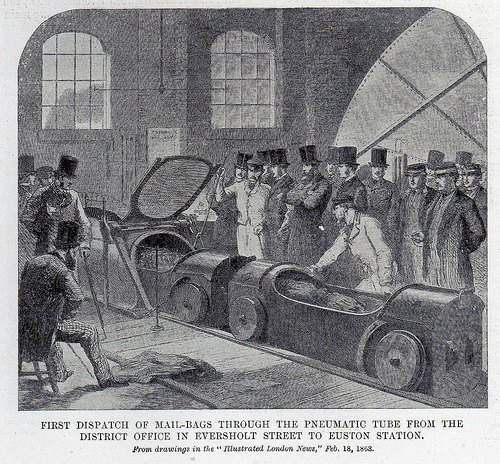
In 1812, there was some consideration of moving people using this kind of system, and there were short-lived attempts in Ireland, London, and Paris, among other places, in the mid-1800s. In general, this is known as an “atmospheric railroad.”
As a stunt, in 1865, the London Pneumatic Despatch Company sent the Duke of Buckingham and some others on a five-minute trip through a pneumatic tube. The system was made to carry parcels at 60 km/h using a 6.4-meter fan run by a steam engine. The capsules, in this case, looked somewhat like an automobile. There are no reports of how the Duke and his companions enjoyed the trip.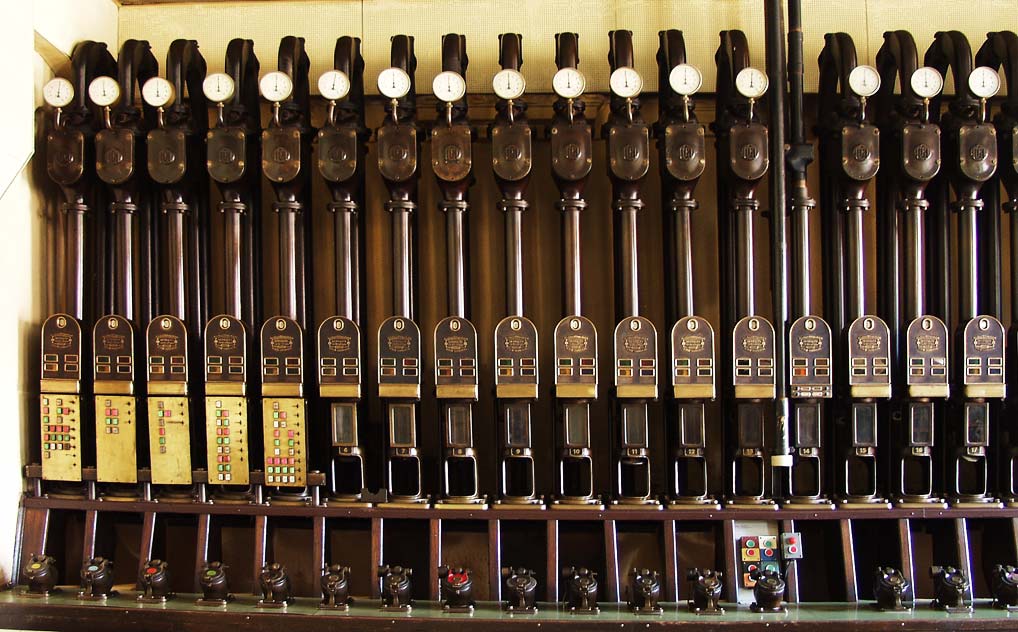
A 550-meter demonstration pneumatic train showed up at the Crystal Palace in 1864. Designed by Thomas Webster Rammell. It only operated for two months. A 6.7-meter fan blew air one way for the outbound trip and sucked it back for the return.
Don’t think the United States wasn’t in on all this, too. New York may be famous for its subway system, but its early predecessor was, in fact, pneumatic, as you can see in the video below.
youtube.com/embed/9g9dikUrbmk?…
Many of these atmospheric trains didn’t put the passengers in the capsule, but used the capsule to move a railcar. The Paris St. Germain system, which opened in 1837, used this idea.
Modern Times
Of course, where you once would send documents via tube, you’d now send a PDF file. Today, you mainly see tubes where it is important for an actual item to arrive quickly somewhere: an original document, cash, or medical samples. ThyssenKrupp uses a tube system to send toasty 900 °C steel samples from a furnace to a laboratory. Can’t do that over Ethernet.
There have been attempts to send food over tubes and even take away garbage. Some factories use them to move materials, too. So pneumatic tubes aren’t going away, even if they aren’t as common as they once were. In fact, we hear they are even more popular than ever in hospitals, so these aren’t just old systems still in use.
We haven’t seen many DIY pneumatic tube systems that were serious (we won’t count sucking Skittles through a tube with a shop vac). But we do see it in some robot projects. What would you do with a system like this? Even more importantly, are these still common in your area or a rarity? Let us know in the comments.
TMS9900-based Home Brew Computer
![[Usagi Electric] and his home brew computer](https://poliverso.org/photo/link/367718 "[Usagi Electric] and his home brew computer")
[Usagi Electric] is known for minicomputers, but in a recent video, he shows off his TMS9900-based homebrew computer. The TMS9900 CPU was an early 16-bit CPU famously used in the old TI-99/4A computer, but as the video points out, it wasn’t put to particularly good use in the TI-99/4A because its RAM was hidden behind an inefficient interface and it didn’t leverage its 16-bit address space.
The plan is for this computer to have 2K words of ROM, 6K words of RAM, and three serial lines: one for the console terminal, another for a second user console terminal, and the third for access to a tape drive.
Note that we have two user terminals: this is a multiuser system! The computer will use the TI series 10 “Insight” data terminal.
In the video, [Usagi Electric] spends a fair bit of time making the rack-mount casing for his computer and its two power supplies. The UART for 300-baud terminal access is currently in breadboard format, but it is set up to transmit and is functional so far! Up next will be support for receiving. The UART he’s using is the TR1602B, and he spends some time reviewing its datasheet in this video.
If you’re interested in the TMS9900, you might like to check out TMS9900 Retro Build and How The TI-99/4A Home Computer Worked.
youtube.com/embed/OUp0VRuMVCA?…
Reverse Engineering the Miele Diagnostic Interface

Since modern household appliances now have an MCU inside, they often have a diagnostic interface and — sometimes — more. Case in point: Miele washing machines, like the one that [Severin] recently fixed, leading to the firmware becoming unhappy and refusing to work. This fortunately turned out to be recoverable by clearing the MCU’s fault memory, but if you’re unlucky, you will have to recalibrate the machine, which requires very special and proprietary software.

Naturally, this led [Severin] down the path of investigating how exactly the Miele Diagnostic Utility (MDU) and the Program Correction (PC) interface communicate. Interestingly, the PC interface uses an infrared LED/receiver combination that’s often combined with a status LED, as indicated by a ‘PC’ symbol. This interface uses the well-known IrDA standard, but [Severin] still had to track down the serial protocol.
Research started with digging into a spare 2010-era Miele EDPW 206 controller board with the 65C02-like Mitsubishi 740 series of 8-bit MCUs. These feature a mask ROM for the firmware, so no easy firmware dumping. Fortunately, the Miele@Home ‘smart appliance’ feature uses a module that communicates via UART with the MCU, using a very similar protocol, including switching from 2400 to 9600 baud after a handshake. An enterprising German user had a go at reverse-engineering this Miele@Home serial protocol, which proved to be incredibly useful here.
What is annoying is that the PC interface requires a special unlock sequence, which was a pain to figure out. Fortunately, the SYNC pin on the MCU’s pins for (here unused) external memory was active. It provided insight in which code path was being followed, making it much easier to determine the unlock sequence. As it turned out, 11 00 00 02 13 were the magic numbers to send as the first sequence.
After this, [Severin] was able to try out new commands, including 30 which, as it turns out, can be used to dump the mask ROM. This enabled the creation of a DIY transceiver you can tape to a fully assembled washing machine, for testing. As of now, the next target is a Miele G651 I Plus-3 dishwasher, which annoyingly seems to use a different unlock key.
Of course, you can just trash the electronics and roll your own. That happens more often than you might think.
Thanks to [Daniel] for the tip.
La Presidenza Del Consiglio e Giorgia Meloni Advisor di Senvix? Attenzione alle truffe online!
Un nuovo allarme sulla sicurezza nel mondo degli investimenti online viene portato all’attenzione da Paragon sec, azienda attiva nel settore della cybersecurity, che ha pubblicato su LinkedIn un post, riferendosi a una sito che prometterebbe guadagni facili ma potrebbe nascondere rischi fraudolenti.
Tale sito pubblicizza Senvix è una piattaforma di trading di criptovalute basata su intelligenza artificiale: analizza costantemente i dati di mercato (prezzi, volumi, sentiment) con algoritmi avanzati per identificare opportunità di trading e, a seconda della versione, può generare segnali o anche eseguire operazioni automaticamente tramite broker partner.
Cosa viene denunciato
Secondo il post dei ricercatori di sicurezza, diversi segnali relativi al dominio https://presidenzagoverno[.]com/ indicano che il sito in questione non sia una piattaforma di investimento legittima, ma un potenziale schema fraudolento.
Intanto il sito è un dominio .com e non ha la consueta estensione .gov.it. Sebbene non vengano specificati tutti i dettagli relativi al nome del dominio o ai numeri coinvolti, l’avvertimento invita gli utenti alla cautela e a non fidarsi di promesse di rendimenti elevati senza adeguata verifica.
L’intervento di Paragonsec rientra in un quadro più ampio di pericoli legati al trading online non regolamentato, un fenomeno sempre più sotto i riflettori e sul Quale spesso forniamo informative su Red Hot Cyber.
Inoltre all’interno del sito presidenzagoverno[.]com sono presenti diversi video deepfake, come ad esempio quello della presidente del consiglio dei ministri Giorgia Meloni, che riporta la qualità della piattaforma Senvix.

Il contesto delle truffe di trading online
Il trading online, soprattutto su criptovalute o mercati ad alta volatilità, è diventato terreno fertile per le frodi. Questo tipo di truffe è sempre più diffuso e comporta ingenti danni economici per gli investitori.
Molti truffatori fanno leva su messaggi accattivanti: “rendimento garantito“, “guadagni rapidi“, “nessun rischio“. L’utente medio, attratto da queste promesse, può cadere in siti non regolamentati, contattati via email, social network o perfino telefonate dirette.

Come riconoscere un sito di trading sospetto
Paragonsec, attraverso il suo post, sembra voler attivare un campanello d’allarme tra potenziali vittime. Ecco alcuni segnali di pericolo, confermati anche da fonti istituzionali:
- Mancanza di autorizzazioni – Un broker o una piattaforma di trading riconosciuta deve essere autorizzato da un ente di regolamentazione finanziaria nazionale (in Italia, la CONSOB) o da un organismo equivalente europeo.
- Promesse irrealistiche – Rendimenti elevatissimi, soprattutto se “garantiti” o costanti, sono un forte indicatore di potenziale schema Ponzi.
- Struttura web poco professionale – Siti mal progettati, con email da domini generici (es. Gmail), mancanza di documentazione regolamentare o informazioni societarie chiare sono segnali di scarsa affidabilità.
- Segnalazioni dall’autorità – La CONSOB, per esempio, ha una pagina “Occhio alle truffe” dove mette in guardia proprio su soggetti che non hanno l’autorizzazione.
- Difficoltà nei prelievi – Nei casi di broker truffaldini, gli utenti possono incontrare ostacoli al ritiro dei fondi, scuse tecniche o blocchi repentini.

Un precedente recente: il caso 2139 Exchange
Il post arriva in un momento in cui il tema delle truffe nel trading è particolarmente caldo. Un esempio significativo è il 2139 Exchange, una piattaforma che prometteva rendimenti altissimi (fino all’1% al giorno) ma su cui sono emerse forti sospetti di schema Ponzi.
La CONSOB ha preso provvedimenti: ha ordinato la chiusura e l’oscuramento di siti collegati all’exchange per abusivismo finanziario, dopo aver rilevato che la società non aveva le autorizzazioni previste.
Testimonianze di utenti riportano come, inizialmente, fosse possibile prelevare piccole somme: una tattica classica per alimentare la fiducia e attirare più “investitori”.

Cosa fare se si è di fronte a un possibile scam
Alla luce dell’allerta posta dai ricercatori di sicurezza, è fondamentale adottare comportamenti prudenti:
- Prima di investire, verificare il broker su siti ufficiali (ad esempio, cercando la sua registrazione CONSOB).
- Non farsi sedurre da guadagni straordinari senza garanzia.
- Conservare tutte le comunicazioni (email, screenshot, contratti) nel caso ci fosse la necessità di denunciare o richiedere assistenza legale.
- Diiffidare di sedicenti “aiutanti del recupero fondi”: spesso, i truffatori usano anche questa tattica secondaria. Il vademecum “Un calcio alle frodi” raccomanda di non versare denaro per presunti recuperi.
- Segnalare eventuali sospetti alle autorità competenti (polizia postale, CONSOB) e valutare l’assistenza di professionisti per capire come agire.
Conclusione
L’allarme è un richiamo importante per tutti coloro che operano (o vorrebbero operare) nel trading online: non tutto ciò che sembra un’opportunità lo è davvero.
Il mondo degli investimenti digitali è affascinante, ma anche insidioso. Solo con informazione, prudenza e verifiche puntuali è possibile tutelarsi da rischi seri, e potenzialmente rilevanti perdite economiche.
L'articolo La Presidenza Del Consiglio e Giorgia Meloni Advisor di Senvix? Attenzione alle truffe online! proviene da Red Hot Cyber.


EU adopts Digital Trade Agreement with Singapore despite warnings: a setback for digital rights and democratic oversight
The European Parliament has approved the EU–Singapore Digital Trade Agreement, rejecting a motion to seek a Court of Justice opinion on its legality. This decision weakens the Union’s capacity to safeguard privacy, data protection, and accountability over software systems, at a time when deregulation pressures are increasing across Europe.
The post EU adopts Digital Trade Agreement with Singapore despite warnings: a setback for digital rights and democratic oversight appeared first on European Digital Rights (EDRi).
Gazzetta del Cadavere reshared this.
Gipfel zur Digitalen Souveränität: Europa braucht den Mut, seine Souveränität zu teilen
netzpolitik.org/2025/gipfel-zu…

ICYMI: Clean Water, 2026 Conference
Nov. 17th – ICYMI, during our 11/16 meeting, the United States Pirate Party officially adopted Clean Water to our platform.
The issue of clean water first came up on March 4th when the Supreme Court ruled 5-4 that the Environmental Protection Agency (EPA) cannot limit sewage discharge into water, leaving the door open for cities to dump even more sewage into bodies of water.
Soon after, we released Pirates for Water, an entry of the Through the Spyglass series reaffirming the Pirate commitment to clean water.
As of yesterday’s meeting, it has officially been added to our platform. Pirates for water indeed.
Also of note: the 2026 Pirate National Conference will take place on June 6th, 2026, a date which marks 20 years of the US Pirate Party.
Instead of simply picking a location and choosing it, supporters have had the chance to suggest cities that would be brought to a wider vote.
After weeks of voting, we are finally down to twelve picks. This next week, supporters will vote in the first round to see who will face the Top Four seeds next week.

We have fun here.
Boston, MA, Providence, RI, Portland, OR and Vicksburg, MS are currently the standout choices and the cities who have received a first round bye.
If you are interested in being apart of the process, join our Discord server and make your voice heard.
It’ll be a on a boat, regardless of location.
😢


Sono morte le gemelle Kessler - Il Post
https://www.ilpost.it/2025/11/17/morte-gemelle-kessler/?utm_source=flipboard&utm_medium=activitypubPubblicato su News @news-ilPost

Poliversity - Università ricerca e giornalismo reshared this.

I pod per senzatetto in Islanda
C'è un post che sta diventando virale su svariate piattaforme social, da Whatsapp a Facebook, da Instagram a TikTok; persino su Linkedin, che ormai sta diventando una fiera campionaria della bufala motivazionale.maicolengel butac (Butac – Bufale Un Tanto Al Chilo)
“La guerra è finita, perché non sono ancora tornati?”: Alla ricerca dei dispersi di Gaza
@Notizie dall'Italia e dal mondo
Oltre 11.000 palestinesi, per lo più donne e bambini, sono scomparsi dal 7 ottobre. I parenti non sanno se siano vivi o morti, se siano sotto le macerie o in prigione.
L'articolo “La guerra è finita, perché non sono ancora tornati?”:
Nessuno stato Palestinese: la via di Netanyahu.
noblogo.org/transit/nessuno-st…


Nessuno stato Palestinese: la via di Netanyahu.
(180)
La posizione del primo ministro israeliano Benjamin #Netanyahu e dei suoi governi rispetto alla nascita di uno stato palestinese è stata storicamente e sistematicamente di netta opposizione. Tale linea, consolidata nel corso di più mandati, si fonda su motivazioni di sicurezza, strategie politiche interne e supporto di alleati significativi come gli #USA, con uno specifico ruolo anche dell'Unione Europea, specialmente negli ultimi anni di conflitto e nella fragile tregua in atto.
Netanyahu si è sempre opposto in modo esplicito alla nascita di uno stato palestinese, sia in Cisgiordania che nella Striscia di Gaza, sostenendo che la creazione di tale entità comporterebbe gravi rischi per la sicurezza di Israele e porterebbe il territorio sotto l'influenza di Hamas e di altri gruppi considerati terroristici.
Nel corso dei decenni, il leader israeliano ha argomentato che l’origine del conflitto non dipende dall’assenza di uno stato palestinese, ma dall’opposizione all’esistenza stessa di Israele da parte di diverse parti palestinesi e arabe. Tale convinzione ha portato Netanyahu a promuovere politiche di isolamento dell’Autorità Nazionale Palestinese e al rafforzamento di Hamas a Gaza per mantenere la divisione tra i palestinesi: “Chi desidera ostacolare la nascita di uno stato palestinese deve sostenere il rafforzamento di #Hamas”, ha dichiarato in riunioni di partito.
A partire dal ritorno alla guida di #Israele nel dicembre 2022, il governo Netanyahu ha accentuato la sua opposizione a qualsiasi riconoscimento unilaterale di uno stato palestinese. Nel 2024, la Knesset ha votato formalmente contro la nascita di uno stato palestinese, definendo l’eventuale riconoscimento “un regalo al terrorismo”. Il primo ministro ha ottenuto il sostegno sia dai partiti di destra che da quelli centristi, consolidando una linea che respinge apertamente ogni diktat internazionale su tale questione. Parallelamente, sono state accelerate le operazioni militari a Gaza e l’espansione degli insediamenti in #Cisgiordania, rallentando o impedendo ogni serio negoziato di pace.
Gli Stati Uniti hanno storicamente sostenuto Israele anche rispetto al veto posto contro il riconoscimento di uno stato palestinese presso le Nazioni Unite. Nell’ultimo conflitto a #Gaza, Washington ha ripetutamente bloccato con il proprio veto risoluzioni ONU che chiedevano l’arresto delle ostilità e l’apertura agli aiuti umanitari, dichiarando che tali pressioni pianificate “indebolirebbero la sicurezza israeliana e rafforzerebbero Hamas”.
Tuttavia, segnali recenti indicano un leggero cambiamento: una parte del Congresso USA ha iniziato a proporre la risoluzione per il riconoscimento dello Stato palestinese, seppur senza concreto esito. La tregua attuale rimane estremamente fragile e subordinata alle dinamiche interne israeliane e alle pressioni internazionali, con il governo di Netanyahu che continua a minare la stabilità e i processi negoziali.
L’Unione Europea si è mostrata maggiormente incline a sostenere la “soluzione a due stati”, criticando apertamente la politica israeliana contemporanea. Tuttavia, la reale capacità d’influenza della #UE sulle scelte del governo israeliano rimane marginale, sia per le profonde divergenze interne alla stessa Europa che per il peso geopolitico degli Stati Uniti nelle politiche israeliane. La posizione della UE si limita spesso a dichiarazioni di principio e pressioni diplomatiche, risultando poco efficace nel condizionare gli sviluppi concreti sul campo.
L’opposizione di Netanyahu e del suo governo alla creazione di uno stato palestinese appare più radicata che mai nel contesto attuale. Le strategie di divisione interpalestinese, la retorica sulla sicurezza e la gestione della crisi di Gaza sono pilastri di questa immunità ai cambiamenti internazionali. Gli apparati di potere statunitensi e, in misura minore, europei, nonostante alcuni segnali di evoluzione, continuano a garantire una protezione diplomatica che rende difficile qualunque concreta attuazione della “soluzione a due stati”.#Israele vuole essere l’unico stato nella Palestina. Lo dice con le armi e la distruzione di ogni ragionevole ipotesi contraria.
#Blog #Israele #Palestina #USA #UE #Opinioni #Medioriente
Mastodon: @alda7069@mastodon.unoTelegram: t.me/transitblogFriendica: @danmatt@poliverso.orgBlue Sky: bsky.app/profile/mattiolidanie…Bio Site (tutto in un posto solo, diamine): bio.site/danielemattioli
Gli scritti sono tutelati da “Creative Commons” (qui)
Tutte le opinioni qui riportate sono da considerarsi personali. Per eventuali problemi riscontrati con i testi, si prega di scrivere a: corubomatt@gmail.com


ECUADOR. Nuova Costituzione: bocciata la proposta di Daniel Noboa
@Notizie dall'Italia e dal mondo
L’intenzione del presidente di destra era quella di riscrivere una Carta costituzionale con una chiara matrice neoliberista e rivolta alle privatizzazioni
pagineesteri.it/2025/11/17/ame…
Notizie dall'Italia e dal mondo reshared this.
Poliversity - Università ricerca e giornalismo reshared this.


servizi editoriali a cura di MG
#editing #schede #pareri #ufficiostampa #curatele #lezioni #conferenze
reshared this
De Cataldo torna in libreria con ‘Una storia sbagliata’
@Giornalismo e disordine informativo
articolo21.org/2025/11/de-cata…
Un intreccio tra il noir di denuncia e la memoria storica degli anni ’70: un periodo segnato dal terrorismo e culminato nel rapimento Moro. La storia, quella ufficiale, è sbagliata, distorta e in contrasto con
Giornalismo e disordine informativo reshared this.
Salvare Alberto Trentini non è né di destra, né di sinistra. È solo giusto, urgente, umano
@Giornalismo e disordine informativo
articolo21.org/2025/11/salvare…
Presidente Meloni, Alberto Trentini è da un anno in un carcere del Venezuela, senza neanche un’imputazione.
Giornalismo e disordine informativo reshared this.
Perché Epstein è un guaio serio per Trump
@Giornalismo e disordine informativo
articolo21.org/2025/11/perche-…
Se vi aspettate che dai “file” su Epstein emerga una foto o un video di Trump che fa sesso co una minorenne vi sbagliate, non accadrà. Ma se vi aspettate che Trump riesca con diversivi e minacce a uscire indenne anche da questo scandalo vi
Giornalismo e disordine informativo reshared this.

In un paese normale, davanti ad un partito che organizza una manifestazione in auto per protestare contro le piste ciclabili, uno si domanderebbe "ma che problemi hanno?".
Qui sali nei sondaggi...

Fratelli d’Italia ha organizzato una protesta in macchina contro le piste ciclabili
A Roma, contro le politiche di mobilità sostenibile del sindaco Roberto GualtieriIl Post

like this
reshared this


Antonio Rotelli likes this.
Il bollettino di guerra quotidiano delle morti sul lavoro
@Giornalismo e disordine informativo
articolo21.org/2025/11/il-boll…
La strage nell’indifferenza, quella di cui nessuno parla (tranne raramente) e nessuno vuole vedere. Un bollettino di guerra sul lavoro che fa paura. Non fredde statistiche, non freddi numeri, ma
reshared this

Ho scoperto che #AIMP ha un tag editor che ti permette di caricare anche un'immagine.
Adesso la mia vita non avrà più senso finché non avrò messo le copertine degli album di provenienza a tutti i miei mp3.
😍
Poliversity - Università ricerca e giornalismo reshared this.
La legge di Onan
@Politica interna, europea e internazionale
L'articolo La legge di Onan proviene da Fondazione Luigi Einaudi.
Politica interna, europea e internazionale reshared this.
Does anybody know how to change the mp3 tags that are displayed by AIMP?
In the image below I'd like to see the "date" tag ("1982") instead of the "album" tag ("Collezione").
#AIMP

Poliversity - Università ricerca e giornalismo reshared this.
The newly sequenced RNA is 25,000 years older than the previous record-holder, opening a new window into genetic evolution and revealing a surprise about a famous mammoth mummy.#TheAbstract


Scientists Make Genetic Breakthrough with 39,000-Year-Old Mammoth RNA
Welcome back to the Abstract! These are the studies this week that reached back through time, flooded the zone, counted the stars, scored science goals, and topped it all off with a ten-course meal.First, scientists make a major breakthrough thanks to a very cute mammoth mummy. Then: the climate case for busy beavers; how to reconnect with 3,000 estranged siblings; this is your brain on football; and last, what Queen Elizabeth II had for lunch on February 20, 1957.
As always, for more of my work, check out my book First Contact: The Story of Our Obsession with Aliens, or subscribe to my personal newsletter the BeX Files.
The long afterlife of Yuka the mammoth
Scientists have sequenced RNA—a key ingredient of life as we know it—from the remains of a mammoth that lived 39,000 years ago during the Pleistocene “Ice Age” period, making it by far the oldest RNA on record.
The previous record holder for oldest RNA was sourced from a puppy that lived in Siberia 14,300 years ago. The new study has now pushed that timeline back by an extraordinary 25,000 years, opening a new window into ancient genetics and revealing a surprise about a famous mammoth mummy called Yuka.
“Ancient DNA has revolutionized the study of extinct and extant organisms that lived up to 2 million years ago, enabling the reconstruction of genomes from multiple extinct species, as well as the ecosystems where they once thrived,” said researchers led by Emilio Mármol Sánchez of the Globe Institute in Copenhagen, who completed the study while at Stockholm University.
“However, current DNA sequencing techniques alone cannot directly provide insights into tissue identity, gene expression dynamics, or transcriptional regulation, as these are encoded in the RNA fraction.”
“Here, we report transcriptional profiles from 10 late Pleistocene woolly mammoths,” the team continued. “One of these, dated to be ∼39,000 years old, yielded sufficient detail to recover…the oldest ancient RNA sequences recorded to date.”
DNA, the double-stranded “blueprint” molecule that stores genetic information, is far sturdier than RNA, which is why it can be traced back for millions of years instead of thousands. Single-stranded RNA, a “messenger” molecule that carries out the orders of DNA, is more fragile and rare in the paleontological record.
In addition to proving that RNA can survive much longer than previously known, the team discovered that Yuka—the mammoth that died 39,000 years ago—has been misgendered for years (yes, I realize gender is a social construct that does not apply to extremely dead mammoths, but mis-sexed just doesn’t have the same ring).
Yuka was originally deemed female according to a 2021 study that observed the “presence of skin folds in the genital area compatible with labia vulvae structures in modern elephants and the absence of male-specific muscle structures.” Mármol Sánchez and his colleagues have now overturned this anatomical judgement by probing the genetic remnants of Yuka’s Y chromosome.
In fact, as I write this on Thursday, November 13—a day before the embargo on this study lifts on Friday—Yuka is still listed as female on Wikipedia.
Just a day until you can live your truth, buddy.In other news…
Leave it to beavers
Every era has a champion; in our warming world, eager beavers may rise to claim this lofty title.
These enterprising rodents are textbook “ecosystem engineers” that reshape environments with sturdy dams that create biodiverse havens that are resistant to climate change. To better assess the role of beavers in the climate crisis, researchers reviewed the reported behavioral beaver-related restoration (BRR) projects across North America.
“Climate change is projected to impact streamflow patterns in western North America, reducing aquatic habitat quantity and quality and harming native species, but BRR has the potential to ameliorate some of these impacts,” said researchers led by Jesse A. S. Burgher of Washington State University.
The team reports “substantial evidence that BRR increases climate resiliency…by reducing summer water temperatures, increasing water storage, and enhancing floodplain connectivity” while also creating “fire-resistant habitat patches.”
So go forth and get busy, beavers! May we survive this crisis in part through the skin of your teeth.
One big happy stellar family
Visible from both the Northern and Southern Hemispheres, the Pleiades is the most widely recognized and culturally significant star cluster in the night sky. While this asterism is defined by a handful of especially radiant stars, known as the Seven Sisters, scientists have now tracked down thousands of other stellar siblings born from the same clutch scattered across some 2,000 light years.
Wide-field shot of Pleiades. Image Antonio Ferretti & Attilio Bruzzone
“We find that the Pleiades constitutes the bound core of a much larger, coeval structure” and “we refer to this structure as the Greater Pleiades Complex,” said researchers led by Andrew W. Boyle of the University of North Carolina at Chapel Hill. “On the basis of uniform ages, coherent space velocities, detailed elemental abundances, and traceback histories, we conclude that most stars in this complex originated from the same giant molecular cloud.”The work “further cements the Pleiades as a cornerstone of stellar astrophysics” and adds new allure to a cluster that first exploded into the skies during the Cretaceous age. (For more on the Pleiades, check out this piece I wrote earlier this year about the deep roots of its lore).
Getting inside your head(er)
Scientists have peered into a place I would never dare to visit—the minds of football fans during high-stakes plays. To tap into the neural side of fanaticism, researchers enlisted 60 healthy male fans from the ages of 20 to 45 to witness dozens of goal sequences from matches involving their favorite teams, rival teams, and “neutral” teams while their brains were scanned by an fMRI machine.
The participants were rated according to a “Football Supporters Fanaticism Scale (FSFS)” with criteria like “violent thought and/or action tendencies” and “institutional belonging and/or identification.” The scale divided the group up into 38 casual spectators, 19 committed fans, and four deranged fanatics (adjectives are mine for flourish).
Rendering of the negative effect of significant defeat. Image: Radiological Society of North America (RSNA)
“Our key findings revealed that scoring against rivals activated the reward system…while conceding to rivals triggered the mentalization network and inhibited the dorsal anterior cingulate cortex (dACC)”—a region responsible for cognitive control and decision-making—said researchers led by Francisco Zamorano of the Universidad San Sebastián in Chile. “Higher Football Supporters Fanaticism Scale scores correlated with reduced dACC activation during defeats, suggesting impaired emotional regulation in highly engaged fans.”In other words, it is now scientifically confirmed that football fanatics are Messi bitches who love drama.
Diplomacy served up fresh
We’ll close, as all things should, with a century of fine Portuguese dining. In yet another edition of “yes, this can be a job,” researchers collected 457 menus served at various diplomatic meals in Portugal from 1910 to 2023 to probe “how Portuguese gastronomic culture has been leveraged as a culinary diplomacy and geopolitical rapprochement strategy.”
As a lover of both food and geopolitical bureaucracy, this study really hit the spot. Highlights include a 1957 “regional lunch” for Queen Elizabeth II that aimed to channel “Portugality” through dishes like lobster and fruit tarts from the cities of Peniche and Alcobaça. The study is also filled with amazing asides like “the inclusion of imperial ice cream in the European Free Trade Association official luncheon (ID45, 1960) seems to transmit a sense of geopolitical greatness and vast governing capacity.” Ice cream just tastes so much better when it’s a symbol of international power.
Menu of the “Luncheon in honour of her Majesty Queen Elizabeth II and his Royal Highness the Duke of Edinburgh” held in Alcobaça (Portugal) on February 20th, 1957. Image: Cabral et al., 2025.
The team also unearthed a possible faux pas: Indian president Ramaswamy Venkataraman, a vegetarian who was raised Hindu, was served roast beef in 1990. In a footnote, Cabral and his colleagues concluded that “further investigation is deemed necessary to understand the context of ‘roast beef’ service to the Indian President in 1990.” Talk about juicy gossip!Thanks for reading! See you next week.
Power for dinner. Culinary diplomacy and geopolitical aspects in Portuguese diplomatic tables (1910-2023)
IntroductionThis paper examines how diplomatic meals in Portugal (1910–2023) have been shaped by Portuguese foreign policy and geopolitical contexts, and con...Óscar Cabral (Frontiers)


Convocazione Assemblea dei Genitori del Liceo Augusto per il giorno venerdì 21 novembre alle ore 17
In base
- all'art. 5, Parte Seconda del Regolamento di Istituto
- all'art. 5 del Regolamento del Comitato dei Genitori,
- al consenso accordato alla convocazione da parte della maggioranza dei rappresentanti di classe membri dell'Assemblea dei Rappresentanti
- alle necessità di modificare la data inizialmente stabilita dal Comitato dei Genitori, a causa delle esigenze logistiche della Scuola
- all'esito dell'Assemblea dei Rappresentanti tenutasi il 13 novembre 2025 che ha dato mandato al Presidente di individuare una data sulla base delle disponibilità del maggior numero e alla maggior rappresentanza da parte dei genitori candidati come consiglieri di Istituto alle elezioni del 23 e 24 novembre
- alla risposta positiva di almeno due terzi dei candidati in ciascuna delle due liste concorrenti
il Presidente del Comitato dei Genitori
CONVOCA L'ASSEMBLEA DEI GENITORI DEL LICEO AUGUSTO PER IL GIORNO VENERDÌ 21 NOVEMBRE ALLE ORE 17
Trattandosi di Assemblea on line organizzata con strumenti e risorse del Comitato dei Genitori e non essendoci bisogno dell'autorizzazione della Scuola, non è necessario proporre due date di convocazione alla dirigenza scolastica.
L'Assemblea si terrà in videoconferenza con accesso tramite link che sarà inoltrato almeno mezz'ora prima dell'assemblea tramite:
- la presente mailing list
- l'account social del Comitato
- la bacheca delle attività del Comitato
L'ordine del giorno è il seguente:
1) Approvazione del regolamento dell'Assemblea e dell'ordine del giorno (il regolamento verrà inviato nei prossimi giorni)
2) Presentazione delle due liste di candidati della componente genitori per le elezioni per il Consiglio di Istituto e sessione di domande e risposte
3) Considerazioni relative alla rappresentanza dei genitori e raccolta delle istanze dei genitori
4) Varie ed eventuali
Fino alle 24 ore precedenti l'assemblea, tutti i genitori e tutori degli studenti del Liceo Augusto potranno richiedere, rispondendo a questa email, l'aggiunta di punti all'ordine del giorno nella sezione Varie ed Eventuali.
In forza dell'art. 5 del Regolamento di Istituto, all'assemblea di istituto possono partecipare con diritto di parola il Dirigente scolastico e i docenti dell'istituto; per ragioni organizzative, costoro potranno richiedere il link della riunione prendendo contatto con la presidenza del Comitato entro le 12 ore precedenti.

Ora Trump ha paura dell’inflazione: riduce i dazi su carne, pomodori, banane, caffè
Nell’elenco alcuni prodotti che gli Stati Uniti non possono coltivare e anche il manzo il cui prezzo ha raggiunto livelli record nel PaeseRedazione Esteri (Quotidiano Nazionale)
Venezuelani deportati dagli Stati Uniti e torturati in El Salvador
@Notizie dall'Italia e dal mondo
I venezuelani mandati in El Salvador dagli Usa all'inizio di quest'anno sono stati torturati e sottoposti ad altri abusi, tra cui violenze sessuali
L'articolo Venezuelani pagineesteri.it/2025/11/15/mon…
Notizie dall'Italia e dal mondo reshared this.
Max - Poliverso 🇪🇺🇮🇹
Unknown parent • •@zipidog
E in che modo chi assassina un assassino è migliore dell'assassino che ha assassinato?
Max - Poliverso 🇪🇺🇮🇹
Unknown parent • •@zipidog
Comunque con le condizioni di detenzione che abbiamo nelle carceri italiane devo dirti che la differenza morale tra chi rapisce e chi incarcera mi sembra sempre più sottile.
Max - Poliverso 🇪🇺🇮🇹
Unknown parent • •@zipidog
Ma io non discuto sull'errore giudiziario, io parto dall'idea che la persona sia la più colpevole del mondo, e che lo sia al di là di ogni dubbio.
C'è tutta questa differenza tra chi uccide un innocente e chi uccide un mostro? Io credo di no.