These days, you get a fantastic camera with the purchase of just about any modern smartphone. [Abe] missed some of the charm of earlier, lower-quality digital cameras, though, and wanted to recreate that experience. The way forward was obvious. He built a nostalgic digital video camera from scratch!
[Abe] figured he could build the entire project around analog gear, and then simply find a way to store the video digitally, thus creating the effect he was looking for. To that end, the build is based around a small analog video camera that’s intended for use with FPV drones. It runs on 5 to 20 volts and outputs a simple composite video signal. This makes it easy to display its output on a small LCD screen, originally intended to be used with an automotive reversing camera. These were both paired with a mini video recorder module from RunCam, which can capture composite video and store it on a microSD card in 640 x 480 resolution.
These parts were quickly lashed together, with the camera sending its output to the RunCam video recorder module, which then passed it on to the screen. Everything worked as expected, so [Abe] moved on to implementing an on-screen display using the MAX7456 chip, which is built specifically for this purpose. It overlays text on the video feed to the screen as commanded by an RP2040 microcontroller. Once that was all working, [Abe] just had to provide a battery power supply and wrap everything up in a nice retro-styled case. Then, at the last minute, the separate camera and recorder modules were replaced by a TurboWing module that combined both into one.
The result is a nifty-looking camera that produces grainy, slurry, old-school digital video. If you love 640 x 480 as a resolution, you’ll dig this. It’s got strong 90s camcorder vibes, and that’s a very good thing.
Questo nuovo modello sostituisce Gemini 2.5 Flash, rilasciato solo sei mesi prima.
Google afferma che Gemini 3 Flash ha migliorato significativamente ragionamento, multimodalità ed efficienza, mantenendo al contempo una bassa latenza.
Nei primi test, il modello si è avvicinato ai sistemi “di frontiera” di Google e OpenAI. Ad esempio, nel benchmark Humanity’s Last Exam, ha ottenuto un punteggio del 33,7% senza strumentazione, rispetto al 37,5% di Gemini 3 Pro, all’11% di Gemini 2.5 Flash e al 34,5% di GPT-5.2, rilasciato di recente da OpenAI. Nel test multimodale MMMU-Pro , Gemini 3 Flash ha ottenuto un punteggio dell’81,2%, che secondo Google è il miglior risultato tra i suoi concorrenti in questa categoria.
Nonostante le prestazioni migliorate, Google posiziona Flash come un modello “veloce”. L’azienda afferma che supera Gemini 2.5 Pro, con una velocità di esecuzione circa tre volte superiore e un consumo medio di circa il 30% in meno di token nelle attività di ragionamento, riducendo potenzialmente i costi di implementazione.
Per gli utenti abituali, Gemini 3 Flash è già diventato una funzionalità standard dell’app Gemini in tutto il mondo, mentre Gemini 3 Pro rimane disponibile per attività matematiche e di programmazione più complesse.
Google sta inoltre enfatizzando gli scenari multimodali: caricamento di brevi video per consigli e coaching, invio di schizzi per il riconoscimento e utilizzo di audio per analisi o creazione di quiz. Si nota inoltre che il modello suggerisce più spesso “risposte visive”, incluse immagini e tabelle, e aiuta a creare semplici prototipi di app direttamente all’interno dell’interfaccia Gemini sulla base di query di testo.
Nella ricerca, Google sta simultaneamente ampliando l’accesso a funzionalità avanzate: Gemini 3 Pro è ora disponibile per tutti gli utenti negli Stati Uniti e anche l’adozione del suo modello proprietario di generazione di immagini Nano Banana Pro nella ricerca è aumentata. In ambito aziendale, Google sta parlando dell’adozione di Gemini 3 Flash da parte di aziende come JetBrains, Figma, Cursor, Harvey e Latitude, e il modello stesso è disponibile tramite Vertex AI e Gemini Enterprise.
Agli sviluppatori è stato promesso l’accesso a un’anteprima tramite API e l’integrazione con Antigravity, uno strumento di programmazione rilasciato da Google il mese scorso.
Google ha fissato il prezzo dell’API a 0,50 dollari per milione di token in input e 3,00 dollari per milione di token in output, leggermente più costoso di Gemini 2.5 Flash, ma l’azienda attribuisce questo risultato a un miglioramento della qualità.
Google afferma inoltre che, dal rilascio della serie Gemini 3, oltre mille miliardi di token vengono elaborati tramite la sua API al giorno. In questo contesto, la concorrenza con OpenAI si sta intensificando: all’inizio di dicembre, alcune pubblicazioni hanno riportato la nota interna “Code Red” di Sam Altman a seguito di un calo del traffico di ChatGPT dovuto alla crescita della quota di Google.
The Amiga 600 was in its day the machine nobody really wanted — a final attempt to flog the almost original spec 68000 platform from 1985, in 1992. Sure it had a PCMCIA slot nobody used, and an IDE interface for a laptop hard drive, but it served only to really annoy anyone who’d bought one when a few months later the higher-spec 1200 appeared. It’s had a rehabilitation in recent years though as a retrocomputer, and [LinuxJedi] has a 600 motherboard in need of some attention.
As expected for a machine of its age it can use replacement electrolytic capacitors, and its reset capacitor had bitten the dust. But there’s more to that with one of these machines, as capacitor leakage can damage the filter circuitry surrounding its video encoder chip. Since both video and audio flow through this circuit, there was no composite video to be seen.
The hack comes in removing the original chip rather than attempt the difficult task of replacing the filter, and replacing it with a different Sony chip in the same series. It’s nicely done with a connector in the original footprint, and a small daughterboard. The A600 lives again, but this time it won’t be a disappointment to anyone.
If you want to wallow in some Amiga history as well as read a rant about what went wrong, we have you covered.
AI Solutions 87 says on its website its AI agents “deliver rapid acceleration in finding persons of interest and mapping their entire network.”#ICE #AI
ICE Contracts Company Making Bounty Hunter AI Agents
Immigration and Customs Enforcement (ICE) has paid hundreds of thousands of dollars to a company that makes “AI agents” to rapidly track down targets. The company claims the “skip tracing” AI agents help agencies find people of interest and map out their family and other associates more quickly. According to the procurement records, the company’s services were specifically for Enforcement and Removal Operations (ERO), the part of ICE that identifies, arrests, and deports people.
The contract comes as ICE is spending millions of dollars, and plans to spend tens of millions more, on skip tracing services more broadly. The practice involves ICE paying bounty hunters to use digital tools and physically stalk immigrants to verify their addresses, then report that information to ICE so the agency can act.
This post is for subscribers only
Become a member to get access to all content Subscribe now
When you start an STM32 MCU with its default configuration, its CPU will tick along at a leisurely number of cycles on the order of 8 to 16 MHz, using the high-speed internal (HSI) clock source as a safe default to bootstrap from. After this phase, we are free to go wild with the system clock, as well as the various clock sources that are available beyond the HSI.
Increasing the system clock doesn’t just affect the CPU either, but also affects the MCU’s internal buses via its prescalers and with it the peripherals like timers on that bus. Hence it’s essential to understand the clock fabric of the target MCU. This article will focus on the general case of increasing the system clock on an STM32F103 MCU from the default to the maximum rated clock speed using the relevant registers, taking into account aspects like Flash wait states and the APB and AHB prescalers.
Although the Dhrystone benchmark is rather old-fashioned now, it’ll be used to demonstrate the difference that a faster CPU makes, as well as how complex accurately benchmarking is. Plus it’s just interesting to get an idea of how a lowly Cortex-M3 based MCU compares to a once top-of-the line Intel Pentium 90 CPU.
Stitching The Clock Fabric
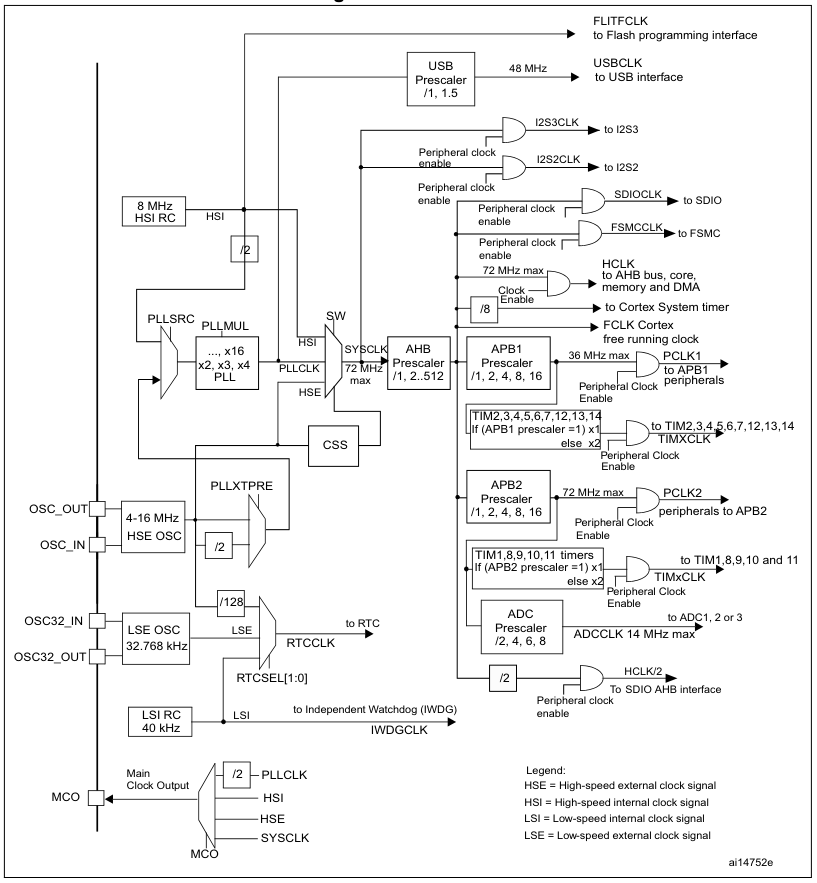
The F103’s clock tree isn’t identical to that of other families of STM32 MCUs, but the basic concepts remain the same. See the below graphic from Reference Manual 0008 for the clock tree of STM32F10x MCUs: The clock tree of the STM32F10x MCUs. (Source: RM0008) We can see the HSI clocked at 8 MHz, which feeds into the clock input switch (SW), from where it can provide the 8 MHz system clock without further fuss. Our other options are to use the HSE, which is fed in via its respective oscillator pins and from there is wired to the same switch as the HSI. If we want to get a higher clock speed than what the HSI or HSE can provide directly, we need to use the Phase Locked Loop (PLL) to generate a higher clock speed.
For this we need to first configure the PLL, enable it and select it as the input source for the clock switch. Before we can throw the switch, however, we also need to make sure that the prescalers for the buses (APB1, APB2, AHB) are set correctly. As we can see in the clock tree diagram, we have maximum speeds for each bus and fixed scaling numbers for each prescaler.
This pattern continues with individual peripherals, some of which also have their own prescaler – like USB and the ADC – but this is just something to keep in mind for when using these peripherals. If we’re just trying to crank the CPU core up to its maximum speed and still want to use the UART, all we need is to get the PLL configuration right, along with the AHB and APB prescalers so that the UART peripheral can be interacted with.
Plugging In Numbers
Before we start happily punching numbers on our keyboard to make the MCU go faster, there’s one tedious detail that we have take care of first: appeasing the Flash memory so that it can keep up. This involves configuring the right number of wait states, the use of prefetching and similar options. For this we open our copy of RM0008 to page 60 to ogle at the FLASH_ACR register and its options.
In this Flash access control register for the F103 and kin we get to enable or disable the prefetch buffer and the latency. Fortunately, for the latency the RM tells us exactly how many wait states we have to set here depending on our target system clock speed. For the 72 MHz that the F103 is rated for, we have to set two wait states.
Scrolling up a bit to page 58 and doing the unspeakable thing of reading the documentation, we can see that the prefetch buffer is turned on after reset by default and is best left enabled. As for the half cycle option, this is related to ‘power optimization’, which means that you will not touch this unless you know what you are doing and are sure that you need to change this.
Consequently we can configure our Flash as: FLASH->ACR |= 2 << FLASH_ACR_LATENCY_Pos | FLASH_ACR_PRFTBE; Next we wish to use the HSE via the PLL to get the most accurate and fastest system clock speed, which first requires enable the HSE and waiting for RCC_CR_HSERDY to change to 1 as indicate that it is ready for use. RCC->CR & RCC_CR_HSEON while ((RCC->CR & RCC_CR_HSERDY) == 0) { // Handle time-out. } Up next is configuring the PLL, starting with setting the PLL source to HSE: RCC->CFGR |= RCC_CFGR_PLLSRC; Now we can configure the AHB and APB prescalers. These take the new system clock and divide it by the set number. For the F103, the 36 MHz-limited APB1 needs to be set to 2, while AHB and APB2 can run at the full 72 MHz, ergo 1. RCC->CFGR |= 1 << RCC_CFGR_HPRE_Pos; RCC->CFGR |= 2 << RCC_CFGR_PPRE1_Pos; RCC->CFGR |= 1 << RCC_CFGR_PPRE2_Pos;
Final Steps
Continuing configuring of the PLL and assuming that it is currently disabled, we can now mash in its multiplier number. Unlike other STM32 families, the F1’s PLL is rather simple, with just a single multiplication factor. Since we’re using the HSE, we need to know the board that we are using and the speed that this HSE oscillates at. Taking the common ‘Blue Pill’ STM32F103 board as example, this features an 8 MHz HSE input, meaning that we have to multiply this by 9 to get the target of 72 MHz. RCC->CFGR |= 7 << RCC_CFGR_PLLMULL_Pos; The target PLLMUL register starts at 0x02 for a multiplier of x4, ergo we need to subtract two from our target multiplier. With that done we can enable the PLL and wait for it to stabilize: RCC->CR |= RCC_CR_PLLON; while (!(RCC->CR & RCC_CR_PLLRDY)) { // Timeout handling. } Next we throw the big switch to use the PLL’s output as the system clock source and wait for the switch to complete: RCC->CFGR &= ~(RCC_CFGR_SW); RCC->CFGR |= RCC_CFGR_SW_PLL; while (!(RCC->CFGR & RCC_CFGR_SWS_PLL)) { } We should be up and running now, leaving us just to update the global CMSIS SystemCoreClock variable with the new clock speed of 72 MHz.
Benchmarking
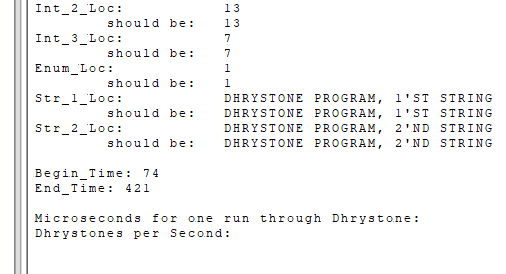
These certainly are Dhrystone results. (Credit: Maya Posch) Running Dhrystone on our F103 seems like a bit of a challenge as the benchmark was created for your typical desktop and server systems. To achieve this, I took the original pre-ANSI C code for Dhrystone 2.1 and adapted it to a Nodate project. The [url=https://github.com/MayaPosch/Nodate/blob/master/examples/stm32/dhrystone/src/dhrystone.cpp]dhrystone.cpp[/url] file contains the benchmark itself, with no significant modifications other than to set up the MCU and the UART as standard output target. The number of runs is also hardcoded to be 100 million so that it doesn’t have to be punched in every time.
After compiling the benchmark and flashing it to the STM32F103 board, it seemed to take a few eternities for it to complete with so many runs. When the board’s single LED finally started doing its leisurely blinking routine to indicate completion, it turned out that 347 seconds had expired, or roughly 5.78 minutes. As can be seen in the start time, this wasn’t the first attempt, after a 10 million run completed too quickly according to the benchmark’s criteria. C’est la vie.
Annoyingly, the printf-lite implementation that I use with Nodate didn’t seem to like the 32-bit float values and were absent in the final output, so I had to do the calculations for the Dhrystones Per Second (DPS) and related MIPS (DPS / 1757) myself. Since the times() implementation’s ticks equal seconds, this was at least fairly easily, giving the following numbers:
DPS: ~288,184.438
MIPS: ~164.021
To see whether these numbers are at all plausible, I consulted a few lists of Dhrystone benchmark results, including one for DPS and one for MIPS. Taking into account the noise created by running it on an OS versus bare metal, my use of -Og optimization level and other differences, the placement at the level of about a Pentium 100 doesn’t seem too farfetched.
There is an official ARM Dhrystone benchmarking guide (AN273), which cites a DPS of 40,600.9 for a Cortex-M MCU running at 18.5 MHz. This would be 158,014 DPS if extrapolated linearly, but obviously not the exact board, MCU or compile flags are used, so ‘rough ballpark’ seems to be the term of the day here.
Perhaps the most interesting finding is that a lowly STM32F103 MCU can keep up with a once high-end Pentium CPU of the early 1990s, at least within the limited integer-only Dhrystone benchmark. Next target will probably be to run the more modern and extensive CoreMark on the F103 and other STM32 MCUs, to give a more holistic perspective.
The build uses yoga mats as the raw material to create each individual square of the hopscotch board. The squares all feature simple break-beam light sensors that detect when a foot lands in the given space. These sensors are monitored by a Raspberry Pi Pico in each square. In turn, the Pico lights up addressable NeoPixel LED strips in response to the current position of the player.
It’s a simple little project which makes a classic game just a little more fun. It’s also a great learning project if you’re trying to get to grips with things like microcontrollers and addressable LEDs in an educational context. We’d love to see the project taken a step further, perhaps with wirelessly-networked squares that can communicate and track the overall game state, or enable more advanced forms of play.
Meanwhile, if you’re working on updating traditional playground games with new technology, don’t hesitate to let us know!
Il percorso delle celebrazioni per l’Ottavo Centenario francescano prosegue con un appuntamento musicale: venerdì 20 dicembre, alle ore 19, nella Chiesa di San Francesco a Ripa, si terrà “Canto delle Creature”, progetto di Ambrogio Sparagna con l’Orc…
Si è costituito il Centro Studi Internazionale Leone XIV Ets, Ente del terzo settore con sede a Firenze. Eretto dall’Ordine di Sant’Agostino con il consenso del Santo Padre, il Centro ha sede presso il Convento di Santo Spirito.
L’Italia compie un nuovo passo nel rafforzamento delle proprie capacità di difesa contro le minacce a lungo raggio, in una fase in cui la sicurezza europea è attraversata da trasformazioni rapide e da un ritorno della centralità dei sistemi di protezione integrata. Il quadro strategico dell’annuncio L’annuncio riguarda
Dovrà risarcire con 10mila euro ciascuna le ong Open Arms, Emergency, Sea-Watch, SOS Mediterranée, Louise Michel e Mediterranea, e con 7mila euro AOI, associazione che rappresenta le organizzazioni non governative italiane
The past few years have been very exciting for those who want to believe. The U.S. government has released tantalizing videos and held several gripping hearings showing and discussing UFOs. People who always thought the government was hiding evidence of alien life from the general population saw it as proof that what they’ve said was happening all along. Skeptics have made compelling arguments for why all these revelations could be anything but aliens.
But this debate and humanity’s obsession with aliens goes as far back as recorded history. In her book, First Contact: The Story of Our Obsession with Aliens, 404 Media’s science reporter and author of The Abstract newsletter Becky Ferreira delves deep into this history, what it teaches us about humans, and what the near and far future of the search for alien life looks like. open.spotify.com/embed/episode… I had a great time reading Becky’s book and an even better time discussing it with her on the podcast. It’s a great conversation that unpacks why these stories get so much attention, and a perspective on aliens in the news and pop culture that’s rooted in history and science.
Become a paid subscriber for early access to these interview episodes and to power our journalism. If you become a paid subscriber, check your inbox for an email from our podcast host Transistor for a link to the subscribers-only version! You can also add that subscribers feed to your podcast app of choice and never miss an episode that way. The email should also contain the subscribers-only unlisted YouTube link for the extended video version too. It will also be in the show notes in your podcast player. youtube.com/embed/QToByEeq2vU?…
Druetti (Possibile)-Marro (AVS): sgombero Askatasuna, altro che sicurezza, rappresaglie governative e repressione del dissenso militarizzano i quartieri
“Lo sgombero dell’Askatasuna è allo stesso tempo una rappresaglia e un ennesimo tassello nel progetto sistematico di repressione del dissenso e degli spazi sociali e solidali da parte del governo”, dichiara Francesca Druetti, Segretaria Nazionale di Possibile. “Così è stato per il Leoncavallo, così è per ogni spazio simbolo e realtà attiva sui territori”.
“Perquisizioni e sgomberi notturni e una militarizzazione dei quartieri, con scuole inaccessibili e strade bloccate, come testimoniano i cittadini e le cittadine che si sono trovate davanti uno scenario di guerra mentre portavano i figli a scuola non rendono niente e nessuno più sicuro, anzi”, continua Giulia Marro, Consigliera Regionale di Avs in Piemonte. “Danno volto e sostanza a una distopia autoritaria in cui conta solo fare sfoggio di muscoli e manganello, aprendo gli idranti sui presidi pacifici e interrompendo con cordoni di polizia in assetto anti sommossa la vita quotidiana delle persone”.
“Questa non sarà mai la nostra definizione di sicurezza, né la risposta alla tensione e alle proteste. Ci vediamo alle 18.00 al presidio in corso Regina 47 con tutte le persone solidali che la pensano così”, concludono Marro e Druetti.
Ieri il Ministro Giuseppe Valditara ha incontrato al #MIM le delegazioni delle scuole vincitrici della prima edizione del concorso “San Francesco d’Assisi: il pensiero, l’opera, la cultura e la sua eredità”.
Ieri il Ministro Giuseppe Valditara ha incontrato al #MIM le delegazioni delle scuole vincitrici della prima edizione del concorso “San Francesco d’Assisi: il pensiero, l’opera, la cultura e la sua eredità”.
Papa Leone XIV ha pranzato oggi nella nunziatura apostolica presso lo Stato italiano, per poi recarsi, nel primo pomeriggio al Palazzo della Minerva, dove si trova la Biblioteca del Senato della Repubblica.
Druetti-Marro: sgombero Askatasuna, altro che sicurezza, rappresaglie governative e repressione del dissenso militarizzano i quartieri possibile.com/druetti-marro-sg… Lo sgombero dell'Askatasuna è allo stesso tempo una rappresaglia e un ennesimo tassello nel progetto sistematico di repressione del dissenso e degli spazi sociali e solidali da parte
Gli Stati generali del Quantum, di cui Formiche era Media partner, hanno offerto uno spaccato multilivello della realtà quantistica italiana, mettendo attorno allo stesso tavolo istituzioni, mondo accademico, industria e decision-maker. Ne è emersa una fotografia composita, quella di un ecosistema che non nasce
@Politica interna, europea e internazionale È uscito il nuovo numero di The Post Internazionale. Il magazine, disponibile già da ora nella versione digitale sulla nostra App, e da domani, venerdì 19 dicembre, in tutte le edicole, propone ogni due settimane inchieste e approfondimenti sugli affari e il potere
Scientists found submerged stone structures off Brittany that date back at least 7,000 years, which may have been used as fish traps and protective cover for prehistoric people.#TheAbstract
Scientists Discover Massive Underwater Ruins That May Be a Lost City of Legend
Scientists have discovered the underwater ruins of huge stone structures erected by humans at least 7,000 years ago in the coastal waters of France, according to a new study published in the International Journal of Nautical Archaeology.
The submerged granite ruins near Sein Island, a Breton island in the Atlantic Ocean, are among the oldest large stone structures ever found in France, and may have inspired an ancient local legend about a city called Ys that vanished under the waves.
The structures vary in size from small stone dams, which were probably fish traps, to large monoliths and slabs that protrude six feet from the seafloor and extend 400 feet in length, which perhaps once served as a protective seawall.
Yves Fouquet, a geologist who works with the Society for Maritime Archaeology and Heritage (SAMM), first noticed hints of these long-lost megaliths in LiDAR data collected by the Litto3D program, a national initiative to create a precise 3D digital reconstruction of the entire French coastline. Fouquet and his colleagues confirmed the existence of the mysterious structures, and mapped out their locations, across dozens of dives carried out by ten SAMM divers between 2022 and 2024.
“The detailed analysis of these maps to redraw the underwater geological map of this area (faults, rock types) has made it possible to identify structures that did not appear natural to a geologist,” Fouquet said in an email to 404 Media.
Brittany, a peninsular region of northwest France, is home to the oldest megaliths in the nation and some of the earliest in Europe, which date back some 6,500 years. The team estimated that the submerged stone structures off Sein Island may predate these early megaliths in Brittany by about 500 years, based on their estimation of when the stones would have last been above sea level. But it will take more research to home in on the exact age of the megaliths.
“We plan to continue the exploration and carry out more detailed work to understand the architecture and precise the age of the structures,” Fouquet said.
The discovery of these stones opens a new window into the societies living in Brittany during the Mesolithic/Neolithic Transition, a period when hunter-gatherers began to shift toward settled lifestyles involving fishing, farming, and the construction of megaliths and other buildings. Photos of the structures in Figure 7 of the study. Image: SAMM, 2023 The peoples who made these structures must have been both highly organized and relatively abundant in population in order to erect the stones. They were also sophisticated marine navigators, as the waters around Sein Island are notoriously dangerous—prone to swells and strong currents—which is one reason its underwater heritage has remained relatively poorly explored.
“Our results bear witness to the possible sedentary lifestyle of maritime hunter-gatherers on the coast of the extreme west of France from the 6th millennium onwards,” said Fouquet and his colleagues in the study. “The technical know-how to extract, transport, and erect monoliths and large slabs during the Mesolithic/Neolithic transition precedes by about 500 years the megalithic constructions in western France in the 5th millennium.”
The discovery raises new questions about the origins of these megalithics structures, which may have had a symbolic or religious resonance to these past peoples. the team added. “This discovery in a high hydrodynamic environment opens up new perspectives for searching for traces of human settlement in Brittany along the submerged coastline of the period 6000–5000 years cal. BCE.”
The researchers also speculate about a possible link between these structures, and the prehistoric people who made them, and local legends about sunken cities that may date back thousands of years.
“Legends about sunken cities, compared with recent data on rising sea levels, shows that the stories of ancient submergences, passed down by oral tradition, could date back as far as 5,000 to 15,000 years,” the team said, citing a 2022 study. “This suggests that oral traditions that may have preserved significant events in memory that could well be worthy of scientific examination. These settlements described in legend reveal the profound symbolic significance of maritime prehistory, which should not be overlooked.”
In particular, the people of Brittany have long told tales of the lost city of Ys, a sunken settlement thought to be located in the Bay of Douarnenez, about six miles east of Sein Island. The sunken megaliths off Sein Island “allow us to question the origin of the history of the city of Ys, not from the historical legends and their numerous additions, but from scientific findings that may be at the origin of this legend,” the team said.
It’s extremely tantalizing to imagine that the long-hidden ruins of these peoples, who appear to have been expert seafarers and builders, are the source of tales that date back for untold generations in the region. But while the researchers raise the possibility of a link between the stones and the story, they cannot conclusively confirm the connection.
“Legend is legend, enriched by all the additions of human imagination over the centuries,” Fouquet said in his email. “Our discoveries are based on what can be scientifically proven.”
🌘 Subscribe to 404 Media to get The Abstract, our newsletter about the most exciting and mind-boggling science news and studies of the week.
Société d’Archéologie et de Mémoire Maritime Plongez dans l’histoire maritime. Vous recherchez sur le littoral Manche-Atlantique un navire, un naufrage, un ancêtre […]
iRobot Roomba modello del 2008 completo di: - stazione di ricarica e cavo - muro virtuale Funziona ma bisogna sostituire la batteria perché non tiene più la carica.
Corte Suprema austriaca: Meta deve dare agli utenti pieno accesso ai loro dati La Corte Suprema austriaca ha emesso una sentenza in un procedimento lungo 11 anni contro Meta mickey18 December 2025
Il discorso alla nazione di #DonaldTrump del 17 dicembre 2025, trasmesso in prima serata dalla Diplomatic Room (con decorazioni natalizie perlomeno incongruenti), è durato meno di 20 minuti, ma ha condensato un tono visibilmente frustrato, aggressivo e autocelebrativo. Trump ha puntato il dito contro i democratici e Joe Biden con frasi ripetute come “Ho ereditato un disastro totale” e “È tutta colpa loro”, apparendo “arrabbiato e sulla difensiva” secondo le cronache dei media.
Questo stile, lontano da un sobrio aggiornamento sullo stato dell'Unione, sembrava mirare a placare i malumori crescenti tra gli elettori per il carovita persistente e le delusioni economiche, invitando gli americani alla “pazienza” in attesa di un futuro “boom senza precedenti”. Ha chiuso con un appello patriottico, esaltando l'“America prima di tutto”, ma il suo cipiglio tradiva insicurezze sul consenso interno in calo.Il discorso è stato un autentico tripudio di superlativi e iperboli, tipico del repertorio trumpiano.
Ha descritto il confine meridionale come “il più sicuro della storia americana”, l'economia “tornata più forte che mai”, con “prezzi che calano a velocità record”, “salari che crescono più dell'inflazione per la prima volta in anni” e un “boom economico senza precedenti” realizzato in soli 11 mesi di mandato. Trump ha vantato 18.000 miliardi di dollari di investimenti privati attratti grazie ai dazi (definita la sua “parola preferita”, come se non si fosse capito) e ha rivendicato di aver “risolto otto guerre calde nel mondo”, inclusa una presunta pace stabile a #Gaza, portando “pace duratura in Medio Oriente per la prima volta nella storia”.
Non sono mancati annunci come il “warrior dividend” di 1.776 dollari (un numero simbolico per l'anno della dichiarazione d'indipendenza) per ogni militare, con assegni “già spediti per Natale”, esaltando un'America che “fa invidia al mondo intero” e che “tornerà grande come mai prima”.Queste affermazioni, pronunciate con enfasi teatrale, ignorano del tutto le complessità reali.
Il tycoon ha scaricato sistematicamente ogni problema economico e sociale sul predecessore #Biden, dipingendolo come responsabile di un'“invasione barbarica” alle frontiere, un “caos economico totale”, con un’inflazione “alle stelle come mai vista” e “mayhem” nei quartieri urbani.Ha deriso il suo predecessore per aver implorato al Congresso aiuti sul confine, sostenendo che bastava “un nuovo leader forte come me” per chiuderlo ermeticamente in soli sette mesi, riducendo i flussi di droga del 94% e fermando “milioni di criminali”.
Queste narrazioni distorcono i fatti storici: l'inflazione era già stabilizzata al 3% annuo all'insediamento di Trump a gennaio 2025, ereditata dal post-pandemia e dalle politiche globali, non un “disastro esclusivo” di Biden. Similmente, i flussi migratori erano in calo pre-Trump grazie a accordi messicani, e le accuse di “invasione” si basano su numeri gonfiati, come confermato da fact-check indipendenti.
Un capitolo a parte merita l'incapacità cronica di Trump nel gestire le relazioni internazionali, nonostante le millanterie. Ha vantato di aver “risolto otto guerre” e portato “pace duratura in Medio Oriente”, con #Gaza come “trionfo personale” grazie a presunte mediazioni USA. In realtà, il conflitto in #Ucraina persiste senza tregue stabili, con aiuti militari USA in stallo; a Gaza, le escalation israeliane continuano con centinaia di vittime civili, mentre i raid USA in Yemen hanno solo intensificato le tensioni con gli Houthi anziché risolverle.
Le sue “storiche paci” con nazioni arabe del primo mandato sono rimaste fragili e unilaterali, senza affrontare il nodo palestinese. Intanto, le elazioni con #Cina e alleati #NATO si sono deteriorate per dazi protezionistici e minacce di ritiri, lasciando gli USA più isolati diplomaticamente e con costi militari in aumento del 15% per operazioni “unilaterali”.
Questa politica erratica ha alimentato instabilità globale, contraddicendo le promesse di “pace attraverso la forza”. Contrariamente alle iperboli, i numeri del primo anno di Trump deludono clamorosamente le attese. Il PIL ha contratto dello 0,3% nel primo trimestre 2025 a causa dell'afflusso massiccio di import pre-dazi, con rischi di recessione che hanno portato a una crescita anemica del 3%, ma solo grazie a import in calo e non a investimenti strutturali. L'inflazione resta ferma al 3% annuo a settembre (lontana dal “prezzi in calo” promesso). La disoccupazione è salita al 4,6% a novembre, ai massimi dal 2021, con un mercato del lavoro in indebolimento, licenziamenti nel settore tech e consumi al palo.
Gli investimenti vantati sono gonfiati: annunci non vincolanti, stimati realisticamente al massimo 7-9 trilioni, non i 18 promessi, mentre i salari crescono ma non compensano i rincari energetici. I fact-check confermano: l'economia arranca tra tariffe, incertezze e debiti pubblici alle stelle.
Questo sproloquio riflette la narrazione trumpiana classica: trionfalistica, divisiva e smentita dai fatti. Trump vanta lodi dall'estero da leader come #GiorgiaMeloni, che lo esaltano pubblicamente per interessi economici (evitare dazi punitivi su export di auto Fiat, vino e macchinari) e strategici, come il supporto #NATO contro la Russia, ma si tratta di puro servilismo opportunistico. Meloni ha scritto su “X” “...Trump ha reso l'America forte di nuovo”, ignorando come le politiche protezioniste USA stiano causando rincari energetici in Europa e tensioni nel Mediterraneo, danneggiando Roma con bollette alle stelle e instabilità migratoria. Simili elogi da Orban o Netanyahu mascherano calcoli cinici, non ammirazione genuina. Gli americani, intanto, pagano costi elevati, crescita fiacca, caos internazionale e un'amministrazione isolata, con l'opinione pubblica in calo al 42%.
È ora di distinguere retorica da realtà. E sarebbe sempre il momento di imparare a fare da soli, che è meglio che essere accompagnati da un ballista dilettante.
Gli scritti sono tutelati da “Creative Commons” (qui)
Tutte le opinioni qui riportate sono da considerarsi personali. Per eventuali problemi riscontrati con i testi, si prega di scrivere a: corubomatt@gmail.com
@Notizie dall'Italia e dal mondo Le prospettive di accordo a lungo termine appaiono più remote che mai. I palestinesi ritengono che Israele non completerà mai il ritiro, impedirà una vera ricostruzione per mantenere la Striscia in uno stato di rovina permanente L'articolo
@Politica interna, europea e internazionale La Corte Costituzionale ha bocciato il ricorso del Governo italiano contro la legge della Regione Toscana che circa un anno fa ha regolamentato il mercato degli affitti brevi introducendo una serie di limiti. L’esecutivo
@Privacy Pride Il post completo di Christian Bernieri è sul suo blog: garantepiracy.it/blog/bluesky-… Maledette abitudini! Come tutti, penso, ho la mia routine ed eseguo meccanicamente compiti ed azioni senza pensarci troppo: imparo le sequenze e clicco distrattamente ove necessario per avviare un'app, ogni giorno, ogni
@Giornalismo e disordine informativo articolo21.org/2025/12/le-auto… Il tribunale di Roma ha annullato la sanzione che il garante per la privacy aveva inflitto per una inchiesta su Andrea Mascetti, uno degli avvocati della Lega, in relazione a suoi presunti contatti e relazioni con gli affari dei
Segnalato dal calendario eventi di Linux Italia e pubblicato sulla comunità Lemmy @GNU/Linux Italia Sabato 20 dicembre di pomeriggio faremo un brindisi di natale.
@Giornalismo e disordine informativo articolo21.org/2025/12/la-nott… A dispetto del ministro Valditara che invoca il latino, sono i Greci a sbarcare in Italia. Com’è noto (ne ha ampiamente scritto anche il manifesto), l’imprenditore ellenico Kyriakou è di una famiglia che divide i suoi interessi tra il petrolio e i media.
Ore 02:47, Tokyo. Un sistema di intelligenza artificiale intercetta un pattern anomalo nelle comunicazioni digitali. In meno di mezzo secondo valuta il rischio, attiva le contromisure, sventa un attacco informatico su larga scala. Nessun analista ha ancora letto il report. Nessun umano ha deciso. È successo davvero. Ed è il presente. Nel 2025 l’Intelligenza Artificiale non è più un semplice strumento. È diventata un attore cognitivo che partecipa ai processi decisionali più delicati: sicurezza nazionale, medicina predittiva, giustizia, finanza, creatività. Non ha emozioni. Non ha coscienza. Ma agisce. Il cuore di questa rivoluzione si chiama Transformer. Un’architettura matematica che non ragiona come un essere umano, ma che sa prevedere con precisione sorprendente cosa viene dopo: una parola, una decisione, una strategia. Modelli come GPT analizzano enormi quantità di dati, individuano pattern invisibili all’occhio umano e restituiscono risposte coerenti, fluide, spesso convincenti. Ma attenzione: l’IA non capisce. Simula la comprensione. E lo fa così bene da ingannarci. Ogni risposta che leggiamo non nasce da intenzione o consapevolezza, ma da probabilità statistiche. L’IA non sa cosa sia il dolore, l’etica, la giustizia. Sa solo come parliamo di queste cose. E questo la rende potente… e fragile allo stesso tempo. Il vero problema non è tecnico. È culturale. L’IA apprende dai dati. E i dati siamo noi: le nostre parole, i nostri pregiudizi, le nostre distorsioni. Se il mondo è sbilanciato, l’algoritmo lo sarà ancora di più. I bias non sono errori di sistema: sono specchi. Nel frattempo, le macchine stanno diventando multimodali. Leggono testi, analizzano immagini, interpretano suoni, scrivono codici. Un medico può caricare una TAC e ricevere un’analisi istantanea. Un programmatore può descrivere un’idea e vederla trasformarsi in software funzionante. Un artista può generare mondi visivi partendo da una frase. Siamo entrati nell’era della simbiosi uomo-macchina. Non più utenti e strumenti, ma collaboratori cognitivi. L’IA accelera il pensiero, amplia le possibilità, riduce il rumore. Ma non sostituisce il giudizio umano. O almeno, non dovrebbe. Perché l’IA non sa quando sta sbagliando. Può inventare fatti, citare fonti inesistenti, sostenere errori con assoluta sicurezza. E se le affidiamo decisioni critiche senza supervisione, il rischio non è l’errore. È la fiducia cieca. La domanda allora non è: le macchine diventeranno intelligenti? La vera domanda è: noi resteremo vigili? Capire come funziona l’intelligenza artificiale oggi non è più un lusso per tecnici o ingegneri. È una competenza culturale di base. Perché ogni algoritmo che decide al posto nostro ridefinisce, un po’, anche ciò che significa essere umani. Il futuro non è scritto nel codice. Ma nel modo in cui sceglieremo di usarlo.
Il progetto revisionista del governo canadese per riabilitare di fatto il nazismo e i suoi crimini si è trasformato in un clamoroso boomerang a un anno esatto dall’inaugurazione dell’elemento centrale di questo piano di propaganda, il cosiddetto Memo…
Giovedì 8 gennaio 2026, ore 16:30 presso la Biblioteca Centrale della Regione Siciliana “A. Bombace”, Sala Missioni, Via Vittorio Emanuele, 429 – Palermo Saluti Dott.ssa Laura Cappuggi Prof. On. Roberto La Galla Dialogheranno con l’autore Avv. Giuseppe Benedetto Prof. Antonio
Il #MIM, in collaborazione con Luiss Guido Carli, Ministero della Giustizia, Ministero dell'Università e della Ricerca, Consiglio Superiore della Magistratura, Direzione Nazionale Antimafia e Antiterrorismo, Anac, Carabinieri, Fondazione Severino, pr…
Il #MIM, in collaborazione con Luiss Guido Carli, Ministero della Giustizia, Ministero dell'Università e della Ricerca, Consiglio Superiore della Magistratura, Direzione Nazionale Antimafia e Antiterrorismo, Anac, Carabinieri, Fondazione Severino, pr…
Per il diritto all'aborto sicuro in Europa, approvata dal Parlamento europeo l’ iniziativa di 1,3 mln di cittadini europei MyVoiceMyChoice. E' un segnale contro chi vorrebbe smantellare la UE, a favore di un'Europa dei diritti. Ora la palla passa alla Commissione europea.
@Politica interna, europea e internazionale Dopo l’attacco della ministra Bernini agli studenti di medicina che la contestavano, sono tornate virali sul web alcune frasi che l’allora presidente della Repubblica Sandro Pertini rivolse ad alcuni universitari. L’episodio risale al 1980
Una nuova scritta "Spara a Giorgia" con la stella delle Br compare a Busto Arsizio
La frase, scritta con vernice nera, questa volta è comparsa sul muro che divide la sede locale del Partito Democratico e gli uffici del Sindacato Pensionati Italiani ------- PD e pensionati hanno deciso di alzare il livello dello scontro?
Che poi... i pensionati potrei pure crederci, un po' di verve, un po' di voglia di cambiare le cose, una visione del futuro, le hanno... MA IL PD!!!
#Sicurnauti, da oggi sono disponibili i contenuti rivolti ai #genitori, dedicati al tema “Attenzione a cosa condividi online”.
Qui il video ➡️ https://www.youtube.com/watch?v=3vkvwSh8Iao
Qui l’infografica ➡️ https://unica.istruzione.gov.
Gli Stati generali del Quantum hanno riunito a Roma rappresentanti delle istituzioni, del mondo della ricerca e dell’industria per fare il punto sulla Strategia nazionale per le tecnologie quantistiche e sulle sue implicazioni per sicurezza, innovazione e
Hack Reveals the a16z-Backed Phone Farm Flooding TikTok With AI Influencers
Doublespeed, a startup backed by Andreessen Horowitz (a16z) that uses a phone farm to manage at least hundreds of AI-generated social media accounts and promote products has been hacked. The hack reveals what products the AI-generated accounts are promoting, often without the required disclosure that these are advertisements, and allowed the hacker to take control of more than 1,000 smartphones that power the company.
The hacker, who asked for anonymity because he feared retaliation from the company, said he reported the vulnerability to Doublespeed on October 31. At the time of writing, the hacker said he still has access to the company’s backend, including the phone farm itself. Doublespeed did not respond to a request for comment.
“I could see the phones in use, which manager (the PCs controlling the phones) they had, which TikTok accounts they were assigned, proxies in use (and their passwords), and pending tasks. As well as the link to control devices for each manager,” the hacker told me. “I could have used their phones for compute resources, or maybe spam. Even if they're just phones, there are around 1100 of them, with proxy access, for free. I think I could have used the linked accounts by puppeting the phones or adding tasks, but haven't tried.”
As I reported in October, Doublespeed raised $1 million from a16z as part of its “Speedrun” accelerator program, “a fast‐paced, 12-week startup program that guides founders through every critical stage of their growth.” Doublespeed uses generative AI to flood social media with accounts and posts to promote certain products on behalf of its clients. Social media companies attempt to detect and remove this type of astroturfing for violating their inauthentic behavior policies, which is why Doublespeed uses a bank of phones to emulate the behavior of real users. So-called “click farms” or “phone farms” often use hundreds of mobile phones to fake online engagement of reviews for the same reason.
The hacker told me he had access to around 1,100 smartphones Doublespeed operates. One way the hacker proved he had access to devices was by taking control of one phone’s camera, which seemingly showed it in a rack with other phones.
Images the hacker captured from some of the phones in Doublespeed's phone farm.
The hacker also shared a list with me of more than 400 TikTok accounts Doublespeed operates. Around 200 of those were actively promoting products on TikTok, mostly without disclosing the posts were ads, according to 404 Media’s review of them. It’s not clear if the other 200 accounts ever promoted products or were being “warmed up,” as Doublespeed describes the process of making the accounts appear authentic before it starts promoting in order to avoid a ban.
I’ve seen TikTok accounts operated by Doublespeed promote language learning apps, dating apps, a Bible app, supplements, and a massager.
One health-themed Doublespeed Tiktok account named Chloe Davis posted almost 200 slideshows featuring a middle-aged AI-generated woman. In the posts, the woman usually discusses various physical ailments and how she deals with them. The last image in the slide always includes a picture of someone using a massage roller from a company called Vibit. Vibit did not respond to a request for comment.
A Doublespeed TikTok account promoting a Vibit massager.
Another Doublespeed-operated TikTok account named pattyluvslife posted dozens of slideshows of a young woman who, according to her bio, is a student at UCLA. All the posts from this account talk about how “big pharma” and the supplements industry is a scam. But the posts also always promoted a moringa supplement from a company called Rosabella. The AI-generated woman in these TikTok posts often holds up the bottle of supplements, but it’s obviously AI-generated as the text on the bottle is jumbled gibberish. An AI-generated image promoting a Rosabella supplement. Rosabella’s site also claims the product is “viral on TikTok.” Rosabella did not respond to a request for comment. An image from Rosabella's site claiming its brand is viral on TikTok. While most of the content I’ve seen on Doublespeed-operated TikTok accounts included AI-generated slideshows and still images, Doublespeed is also able to AI-generate videos as well. One Doublespeed-operated account posted several AI-generated videos of a young woman voguing at the camera. The account was promoting a company called Playkit, a “TikTok content agency” that pays users to promote products on behalf of its clients. Notably, this is the exact kind of business Doublespeed would in theory be able to replace with AI-generated accounts. Playkit did not respond to a request for comment.
0:00 /0:04 1×
An AI-generated video promoting Playkit, a TikTok content agency.
TikTok told me that its Community Guidelines make clear that it requires creators to label AI-generated or significantly edited content that shows realistic-looking scenes or people. After I reached out for comment, TikTok added a label to the Doublespeed-operated accounts I flagged indicating they're AI-generated.
A16z did not respond to a request for comment.
Doublespeed has said it has the ability to and soon plans to launch its services on Instagram, Reddit, and X, but so far seems to only be operating on TikTok. In October, a Reddit spokesperson told me that Doublespeed’s service would violate its terms of service. Meta did not respond to a request for comment. As we noted in October, Marc Andreessen, after whom half of Andreessen Horowitz is named, sits on Meta’s board of directors. Doublespeed’s business would clearly violate Meta’s policy on “authentic identity representation.”
A man was charged for allegedly wiping a phone before CBP could search it; an Anthropic exec forced AI onto a Discord community that didn't want it; and we talk the Disney-OpenAI deal.
A man was charged for allegedly wiping a phone before CBP could search it; an Anthropic exec forced AI onto a Discord community that didnx27;t want it; and we talk the Disney-OpenAI deal.#Podcast
Joseph had to use a different mic this week, that will be fixed next time! We start this week talking about a very unusual case: someone is being charged for allegedly wiping a phone before CBP could search it. There are a lot of questions remaining, but a super interesting case. After the break, we talk about Matthew’s article on an Anthropic exec forcing AI onto a queer gamer Discord. In the subscribers-only section, we all chat about the Disney and OpenAI deal. playlist.megaphone.fm?e=TBIEA8… Listen to the weekly podcast on Apple Podcasts,Spotify, or YouTube. Become a paid subscriber for access to this episode's bonus content and to power our journalism. If you become a paid subscriber, check your inbox for an email from our podcast host Transistor for a link to the subscribers-only version! You can also add that subscribers feed to your podcast app of choice and never miss an episode that way. The email should also contain the subscribers-only unlisted YouTube link for the extended video version too. It will also be in the show notes in your podcast player. youtube.com/embed/tOpIpReZPoM?… Timestamps: 00:48 - Man Charged for Wiping Phone Before CBP Could Search It 17:44 - Anthropic Exec Forces AI Chatbot on Gay Discord Community, Members Flee 41:17 - Disney Invests $1 Billion in the AI Slopification of Its Brand
Tech News Podcast · Updated Weekly · Welcome to the podcast from 404 Media where Joseph, Sam, Emanuel, and Jason catch you up on the stories we published this week. 404 Media is a journalist-owned digital media company exploring the way …
@Politica interna, europea e internazionale La Russia è “impantanata” in Ucraina ma non ha ancora mostrato l’intenzione di contribuire “in maniera equa, credibile e costruttiva” alle trattative di pace, per questo “non
La protezione dello spazio sottomarino sta emergendo con forza come uno dei nodi strategici centrali della sicurezza contemporanea, non solo sul piano militare ma soprattutto su quello economico e infrastrutturale. In un momento storico in cui attori globali come gli Stati Uniti
@Politica interna, europea e internazionale L’Unione europea deve prepararsi a “combattere una moderna guerra ibrida” in un “mondo di guerre e predatori”. Nel suo intervento alla plenaria del Parlamento europeo a Strasburgo, dove oggi è in corso il dibattito sulla preparazione del Consiglio




Photos of the structures in Figure 7 of the study. Image: SAMM, 2023


An AI-generated image promoting a Rosabella supplement.
An image from Rosabella's site claiming its brand is viral on TikTok.


SuluBeddu
in reply to Antonella Ferrari • • •Antonella Ferrari
in reply to SuluBeddu • •reshared this
Giornalismo e disordine informativo, GaMe e RFanciola reshared this.
SuluBeddu
in reply to Antonella Ferrari • • •