
Linux Arena – 2025
pnlug.it/2025/11/18/linux-aren…
Segnalato dal Grupo Linux di #Pordenone e pubblicato sulla comunità Lemmy @GNU/Linux Italia
Siete pronti a farvi travolgere da un'ondata di open source che nemmeno un'alluvione di bit potrebbe fermare?
GNU/Linux Italia reshared this.
Aggiornamenti release di Friendica
@Signor Amministratore ⁂ ciao Super Admin, volevo sapere come mai non ci sono nuove versioni del software di friendica... ? Anche la release installata su poliverso.org è di dicembre 2024. Ho visto au GitHub che negli anni precedenti c'erano sempre varie release durante l'anno, ma nel 2025 nessuna! Ho visto che c'è un branch di luglio 2025, ho anche visto una sua preview su friendica.world e devo dire che è molto buona... Molto più usabile, accessibile e ottimizzata per smartphone. Resto in attesa ciao
like this
Writing Type-Safe Generics in C

The fun part about a programming language like C is that although the language doesn’t directly support many features including object-oriented programming and generics, there’s nothing that’s keeping you from implementing said features in C. This extends to something like type-safe generics in C, as [Raph] demonstrates in a blog post.
After running through the various ways that generics are also being implemented using methods including basic preprocessor macros and void pointers, the demonstrated method is introduced. While not necessarily a new one, the advantage with this method is that is type-safe. Much like C++ templates, these generics are evaluated at compile time, with the preprocessor handling both the type checking and filling in of the right template snippets.
While somewhat verbose, it can be condensed into a single header file, doesn’t rely on the void type or pointers and can be deduplicated by the linker, preventing bloat. If generics is what you are looking for in your C project, this might be a conceivable solution.
Binary Clock Also Monitors Weather

There are two things most of us want to know on a daily basis—the weather, and what time it is. [Guitarman9119] built a single device that can provide both pieces of information with a pleasingly nerdy aesthetic.
The heart of the build is a Raspberry Pi Pico W, which is proudly displayed on the front panel of the device. It’s responsible for driving the array of LEDs that display the time in hours, minutes, and seconds in binary format. The Pi Pico W uses its wireless connection to query the WorldTime API and an IP geolocation server. This provides the local date and time, and the location is then used to query the OpenWeather service for current weather information. The weather information is thankfully not displayed in binary format, because that would be straining to read. Instead, it’s displayed in human-readable format on a small OLED display.
There’s something about the way this is built—the discrete LEDs, that weird blue color that seemed to disappear by 1984—that gives this a wonderfully old school charm. You could imagine it turning up in a college lab full of old blinkenlights gear. Video after the break.
youtube.com/embed/hAAY1Tiw1yg?…

A Researcher Made an AI That Completely Breaks the Online Surveys Scientists Rely On#News #study #AI


A Researcher Made an AI That Completely Breaks the Online Surveys Scientists Rely On
Online survey research, a fundamental method for data collection in many scientific studies, is facing an existential threat because of large language models, according to new research published in the Proceedings of the National Academy of Sciences (PNAS). The author of the paper, associate professor of government at Dartmouth and director of the Polarization Research Lab Sean Westwood, created an AI tool he calls "an autonomous synthetic respondent,” which can answer survey questions and “demonstrated a near-flawless ability to bypass the full range” of “state-of-the-art” methods for detecting bots.According to the paper, the AI agent evaded detection 99.8 percent of the time.
"We can no longer trust that survey responses are coming from real people," Westwood said in a press release. "With survey data tainted by bots, AI can poison the entire knowledge ecosystem.”
Survey research relies on attention check questions (ACQs), behavioral flags, and response pattern analysis to detect inattentive humans or automated bots. Westwood said these methods are now obsolete after his AI agent bypassed the full range of standard ACQs and other detection methods outlined in prominent papers, including one paper designed to detect AI responses. The AI agent also successfully avoided “reverse shibboleth” questions designed to detect nonhuman actors by presenting tasks that an LLM could complete easily, but are nearly impossible for a human.
💡
Are you a researcher who is dealing with the problem of AI-generated survey data? I would love to hear from you. Using a non-work device, you can message me securely on Signal at (609) 678-3204. Otherwise, send me an email at emanuel@404media.co.“Once the reasoning engine decides on a response, the first layer executes the action with a focus on human mimicry,” the paper, titled “The potential existential threat of large language models to online survey research,” says. “To evade automated detection, it simulates realistic reading times calibrated to the persona’s education level, generates human-like mouse movements, and types open-ended responses keystroke by-keystroke, complete with plausible typos and corrections. The system is also designed to accommodate tools for bypassing antibot measures like reCAPTCHA, a common barrier for automated systems.”
The AI, according to the paper, is able to model “a coherent demographic persona,” meaning that in theory someone could sway any online research survey to produce any result they want based on an AI-generated demographic. And it would not take that many fake answers to impact survey results. As the press release for the paper notes, for the seven major national polls before the 2024 election, adding as few as 10 to 52 fake AI responses would have flipped the predicted outcome. Generating these responses would also be incredibly cheap at five cents each. According to the paper, human respondents typically earn $1.50 for completing a survey.
Westwood’s AI agent is a model-agnostic program built in Python, meaning it can be deployed with APIs from big AI companies like OpenAI, Anthropic, or Google, but can also be hosted locally with open-weight models like LLama. The paper used OpenAI’s o4-mini in its testing, but some tasks were also completed with DeepSeek R1, Mistral Large, Claude 3.7 Sonnet, Grok3, Gemini 2.5 Preview, and others, to prove the method works with various LLMs. The agent is given one prompt of about 500 words which tells it what kind of persona to emulate and to answer questions like a human.
The paper says that there are several ways researchers can deal with the threat of AI agents corrupting survey data, but they come with trade-offs. For example, researchers could do more identity validation on survey participants, but this raises privacy concerns. Meanwhile, the paper says, researchers should be more transparent about how they collect survey data and consider more controlled methods for recruiting participants, like address-based sampling or voter files.
“Ensuring the continued validity of polling and social science research will require exploring and innovating research designs that are resilient to the challenges of an era defined by rapidly evolving artificial intelligence,” the paper said.
Polarization Research Lab
Research on the origins, effects, limits and solutions to polarizationPolarization Research Lab


Building A Smart Speaker Outside The Corporate Cloud

If you’re not worried about corporate surveillance bots scraping your shopping list and manipulating you through marketing, you can buy any number of off-the-shelf smart speakers for your home. Alternatively, you can roll your own like [arpy8] did, and keep your life a little more private.
The build is based around an ESP32 microcontroller. It connects to the ‘net via its inbuilt Wi-Fi connection, and listens out for your voice with an INMP441 omnidirectional microphone module. The audio data is trucked off to a backend server running a Whisper speech-to-text model. The text is then passed to Google’s Gemini 2.5 Flash large language model. The response generated is passed to the Piper Neural Voice text-to-speech engine, sent back to the ESP32, and spat out via the device’s DAC output and a speaker attached to an LM386 amplifier. Basically, anything you could ask Gemini, you can do with this device.
By virtue of using a commercial large language model, it’s not perfectly private by any means. Still, it’s at least a little farther removed than using a smart speaker that’s directly logged in to your Amazon/Google/Hulu/Beanstikk account. Files are on Github for those eager to dive into the code. We’ve seen some other fun builds along these lines before, too. Video after the break.
youtube.com/embed/_BZOLwxb_aU?…

Meet The Shape That Cannot Pass Through Itself

Can a shape pass through itself? That is to say, if one had two identical solids, would it be possible to orient one such that a hole could be cut through it, allowing the other to pass through without breaking the first into separate pieces? It turns out that the answer is yes, at least for certain shapes. Recently, two friends, [Sergey Yurkevich] and [Jakob Steininger], found the first shape proven not to have this property.

Later, researchers showed this was also true of more complex shapes. This ability to pass unbroken through a copy of oneself became known as Rupert’s Property. Sometimes it’s an amazingly tight fit, but it seems to always work.
In fact, it was so difficult to find candidates for exceptions to this that it was generally understood and accepted by mathematicians that every convex polyhedron (that is, every shape with flat sides and no holes, protrusions, or indentations) would have Rupert’s property. Until one was found that did not.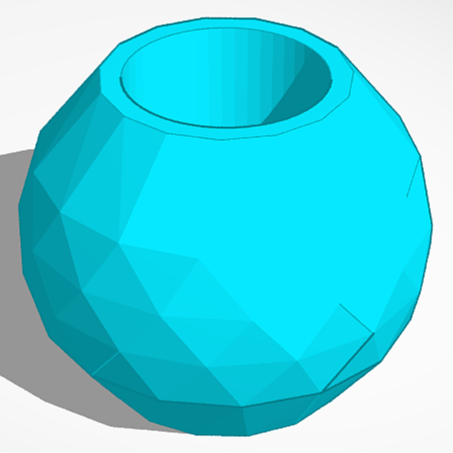
The first shape proven not to be able to pass through itself — known as the Noperthedron — is a vaguely ball-like shape, with a flat top and bottom. A fan has already added a cavity to create a 3D-printable pencil holder version of the noperthedron (shown here) if you want your own.
There are other promising candidate objects (they are rare) that may also lack Rupert’s property, but so far, this is the only proven one.
Shapes with unusual properties are interesting, and we love how tactile and visual they are. Consider Penrose tiles, a tile set that can cover any size of area without repeating. For decades, the minimum number of tile shapes needed to accomplish this was two. Recently, though, the number has dropped to one thanks to a shape known as “the hat.”
Keebin’ with Kristina: the One with the Cipher-Capable Typewriter

I must confess that my mouth froze in an O when I saw [Jeff]’s Typeframe PX-88 Portable Computing System, and I continue to stare in slack-jawed wonder as I find the words to share it with you. Let me give it a shot.
[Jeff] tells us that he designed Typeframe for his spouse to use as a writer deck. That’s good spousing, if you ask me. Amazingly, this is [Jeff]’s first project of this type and scope, and somehow it’s an elegant, yet easy build that’s quite well documented to boot. Whatever Typeframe’s design may borrow, it seems to give back in spades.
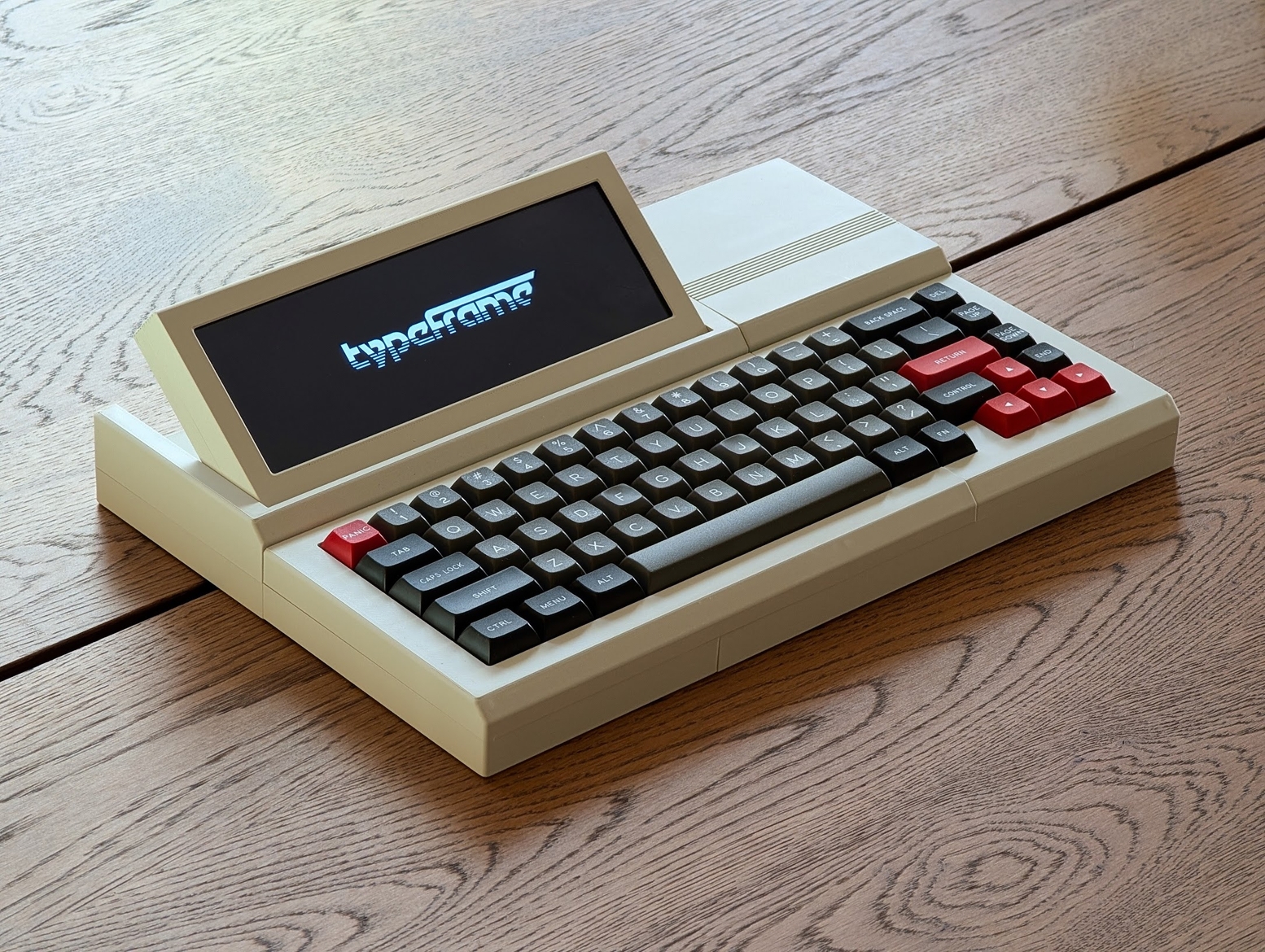
This Raspberry Pi 4B-based productivity machine has all sorts of neat features. The touch screen flips upward at an angle, so you don’t have to hunch over it or carry a mouse around. Want to sit back a bit while you work? The aesthetically spot-on keyboard is detachable. Yeah.
If that’s not enough to get you interested, Typeframe is designed for simple construction with minimal soldering, and the sliding panels make maintenance a breeze.
A little more about that keyboard — this is Keebin’, after all. It’s an MK Point 65, which boasts hot-swap sockets under those DSA Dolch keycaps. See? Minimal soldering. In fact, the only things you have to solder to make the Typeframe your own are the power switch and the status light. Incredible.
Decktility Goes Where You Go
Need something even more portable than the Typeframe? Something that might even fit in your cargo pocket? Decktility could be your answer. You’re gonna have to use your thumbs to type on this one, but that’s the price you pay for ultra portability.

The tricky part about using your thumbs is that the experience can be somewhat lacking. But the Bluetooth keyboard [Ken] used actually looks pretty good, and I say this based on this close-up from GitHub. The keys look responsive and the caps aren’t too shallow.
One of the design challenges centered around the batteries — 18650s, because as [Ken] says, flat Li-Pos get spicy when they short-circuit. Both the 18650s and the screen are somewhat heavy, so everything is balanced with the batteries acting somewhat as handles.
This is a great project, and it seems as though [Ken] learned a lot in the process. Be sure to check out the build log for all the gory details.
The Centerfold: Party Like It’s Nineteen Nine-T9
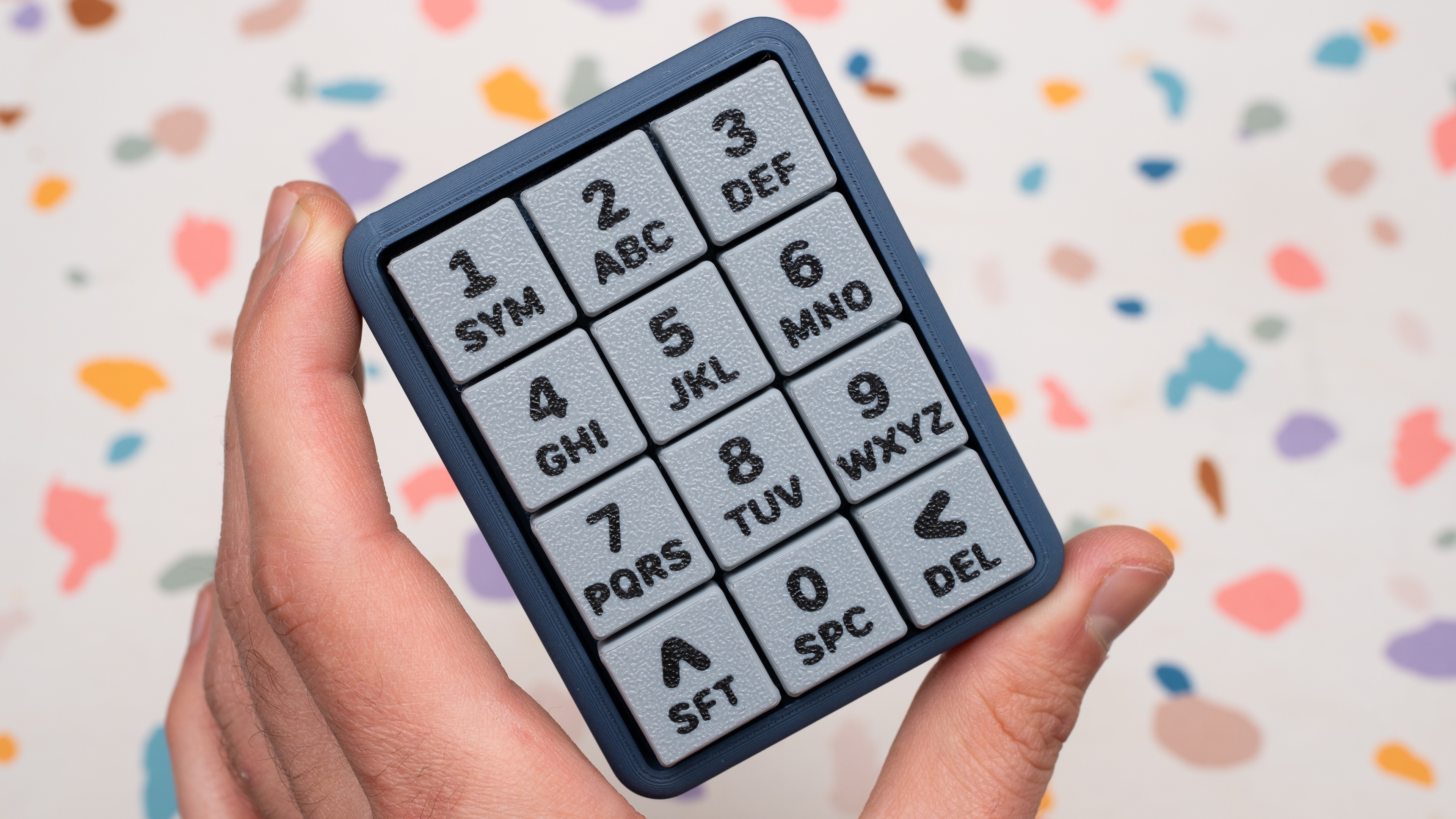
Rather than using predictive typing, the ScottoT9 uses QMK tap dance, wherein a single key can do ‘3, 5, or 100 different things’ depending on how many times you hit it in quick succession. [Joe] reports that it’s surprisingly easy get up to speed on the thing.
This RP2040 Pro Micro-based build is completely open source, including those lovely keycaps. But if you want them to look this good, you may want to just buy some.
Do you rock a sweet set of peripherals on a screamin’ desk pad? Send me a picture along with your handle and all the gory details, and you could be featured here!
Historical Clackers: the Diskret Code Typewriter
The Diskret (discreet) code typewriter from 1899 is a stunning German beauty of an index typewriter, far removed from the neon-accented see-through plastic label-maker from the late 80s that I often use.
Yet they are of the same spirit: choose a letter with some pointing device, imprint it with some lever action, and repeat.
Stark aesthetic differences aside, the Diskret does far more than my newfangled index typewriter. Designed with two concentric rings, the inner ring can be spun to allow the user to type in code.
For normal typewritering, the typist chose a letter from the outer ring of characters with a lever, which turned the typewheel mounted behind it. Then they would press down to print, and the carriage would advance by one character width to get ready for the next impression.
To use the Diskret as a cipher machine, the typist would spin the inner ring to create a false index, generating a coded letter. The recipient would have to have a Diskret in the same position in order to read the message. Yes, it’s basic, but it was one of the first code typewriters.
Most of this beautiful machine’s metal components were engraved with Jugendstil, or German Art Nouveau embellishments. It came mounted to a thick wood base, and featured a top with handle. A Diskret cost 75 marks, and, at the time, one mark equaled about $4. So, not exactly cheap, but it’s two typewriters in one.
Finally, Will Gen Alpha Cancel Keyboards Altogether?
No, of course not. But a study by the London School of Economics seems to think that the office drones of 2030 or so will skirt future first-draft keyboard use with AI voice typing tools, like everyday, all the time. And yeah, but they’ll have to use a keyboard to edit. Or, get this — they’ll just send voice notes to their bosses all the time. You know, good old unsearchable audio files that will be a pain to sift through later. Sure.
Did I mention that the study was done in collusion with Jabra, an audio-video technology company? They make highfalutin’ headsets and such. Ahem.
Now, I have a little secret — Y.T. has used powerful (and not-so-powerful) dictation tools here and there, especially after the surgery, and I could swear I’ve heard others talk-typing around the Hackaday Dungeon, although I can’t be sure. But I really like the act of typing, especially now that it doesn’t cause me intense, weird pain.
If I may cherry-pick a quote from the Fortune article, I choose this one: “speaking replaces typing because it matches how we think: fast, iterative, conversational.” I say all of that depends on your level of written wit, something that gets refined throughout the course of one’s life by, you know, writing or typing, and then reading, editing, removing, replacing, and so forth until it appears flowy and conversational.
And no, I didn’t speak-type a bit of this column. I missed typing on my Kinesis Advantage too much. See you next week-ish.
Got a hot tip that has like, anything to do with keyboards? Help me out by sending in a link or two. Don’t want all the Hackaday scribes to see it? Feel free to email me directly.
Watching Radioactive Decay with a Homemade Spinthariscope

Among the many science toys that have fallen out of fashion since we started getting nervous around things like mercury, chlorinated hydrocarbons, and radiation is the spinthariscope, which let people watch the flashes of light on a phosphor screen as a radioactive material decayed behind it. In fact, they hardly expose their viewers to any radiation, which makes [stoppi]’s homemade spinthariscope much safer than it might first seem.
[Stoppi] built the spinthariscope out of the eyepiece of a telescope, a silver-doped zinc sulfide phosphor screen, and the americium-241 capsule from a smoke detector. A bit of epoxy holds the phosphor screen in the lens’s focal plane, and the americium capsule is mounted on a light filter and screwed onto the eyepiece. Since americium is mainly an alpha emitter, almost all of the radiation is contained within the device.
After sitting in a dark room for a few minutes to let one’s eyes adjust, it’s possible to see small flashes of light as alpha particles hit the phosphor screen. The flashes were too faint for a smartphone camera to pick up, so [stoppi] mounted it in a light-tight metal box with a photomultiplier and viewed the signal on an oscilloscope, which revealed many small pulses.
While a spinthariscope is a bit easier to set up, they’re considerably less common among amateurs than are cloud chambers, another way to view radioactive decay. For scientific instruments, though, this project’s scintillator-and-photomultiplier approach is the standard, from tiny gamma ray spectrometers to giant neutrino detectors.
youtube.com/embed/ifEmv3BeM1I?…
Asus rilascia aggiornamento firmware in emergenza per router DSL vulnerabili
Asus ha rilasciato un aggiornamento firmware di emergenza per diversi modelli di router DSL. La patch corregge una vulnerabilità critica che consente agli aggressori di assumere il controllo completo dei dispositivi senza autenticazione.
La vulnerabilità, identificata come CVE-2025-59367, riguarda i router DSL-AC51, DSL-N16 e DSL-AC750. Il problema consente ad aggressori remoti di accedere a dispositivi non protetti accessibili tramite Internet. L’attacco non richiede alcuna preparazione o interazione da parte dell’utente: è sufficiente conoscere l’indirizzo IP del router vulnerabile.
“È stata scoperta una vulnerabilità di bypass dell’autenticazione in alcuni router DSL che potrebbe consentire ad aggressori remoti di ottenere un accesso non autorizzato al dispositivo”, avvertono gli sviluppatori Asus .
L’azienda consiglia vivamente ai proprietari dei dispositivi vulnerabili di installare immediatamente gli aggiornamenti del firmware alla versione 1.1.2.3_1010.
Se per qualche motivo non è possibile aggiornare immediatamente il dispositivo, il produttore offre misure di sicurezza temporanee.
Innanzitutto, disabilita tutti i servizi accessibili da Internet: accesso remoto tramite WAN, port forwarding, DDNS, server VPN, DMZ, trigger di porta e FTP.
ASUS ricorda inoltre agli utenti di utilizzare password complesse per il pannello di amministrazione del router e per le reti Wi-Fi, di controllare regolarmente la disponibilità di aggiornamenti del firmware e di evitare di utilizzare le stesse credenziali di accesso per servizi diversi.
L'articolo Asus rilascia aggiornamento firmware in emergenza per router DSL vulnerabili proviene da Red Hot Cyber.


Studie zum Digital Services Act: Transparenzdatenbank für Online-Dienste erfüllt Ziele nicht
netzpolitik.org/2025/studie-zu…


Ministero dell'Istruzione
Dal 18 al 20 novembre il #MIM sarà presente al Salone Dello Studente di #Roma con un info point per l'orientamento, spazi per conoscere gli ITS Academy e un'area dedicata al progetto #MadeinMIM. All’evento parteciperà il Ministro Giuseppe Valditara.Telegram


L’Energia Nucleare tutta in mano alle AI! E se poi scoppia un incidente?
Nell’ambito tecnologico, si sta radicando l’idea che lo sviluppo futuro dei sistemi generativi dipenda inesorabilmente dall’ampliamento della capacità nucleare, spingendo i protagonisti del settore a individuare strategie per velocizzare la costruzione di nuovi reattori.
A questo proposito, sono state recentemente integrate le reti neurali nella predisposizione della documentazione richiesta per l’avvio di nuovi progetti. Tuttavia, gli istituti di ricerca mettono in guardia dalle possibili ripercussioni negative associate a questo metodo.
Secondo un rapporto di AI Now, un’iniziativa di Microsoft e della società energetica americana Westinghouse mira a utilizzare modelli per accelerare il rilascio delle licenze per gli impianti nucleari. Il rapporto sottolinea che gli algoritmi non possono sostituire il processo in più fasi progettato per ridurre al minimo i rischi e prevenire errori che portano a incidenti gravi.
AI Now sottolinea che il rilascio delle licenze non è un semplice insieme di moduli, ma un processo complesso che richiede analisi, discussione delle soluzioni progettuali e giustificazione dell’affidabilità del futuro impianto. Gli autori del rapporto sottolineano che il tentativo di ridurre questo processo alla sola generazione di documenti potrebbe comportare il completamento di alcune fasi di controllo come una formalità.
Microsoft propone di addestrare il modello utilizzando materiali archiviati da agenzie di regolamentazione e dati sui futuri siti degli impianti. L’algoritmo genererà documenti di progettazione, che saranno poi esaminati dai dipendenti dell’azienda. L’Idaho National Laboratory sta già utilizzando un approccio simile, sperando di utilizzare una rete neurale per accelerare la preparazione dei materiali per le richieste di autorizzazione. Lloyd’s Register segue un approccio simile e Westinghouse sta promuovendo il proprio sistema chiamato Bertha, promettendo di ridurre i tempi di preparazione della documentazione da mesi a minuti.
Gli esperti di AI Now considerano questo scenario una minaccia per la sicurezza nucleare. Sottolineano che anche una piccola imprecisione nella versione del software o nelle specifiche delle apparecchiature può portare a conclusioni errate sul comportamento del sistema e innescare una catena di errori. Citano come esempio l’incidente diThree Mile Island del 1979, in cui una combinazione di malfunzionamenti e interpretazioni errate delle letture portò a una fusione parziale del nocciolo. Gli autori del rapporto ritengono che i modelli siano soggetti a errori sottili, quindi il rischio che uno scenario simile si ripeta quando parte del processo di autorizzazione viene automatizzato aumenta.
Oltre ai rischi tecnici, viene sollevata anche la questione della riservatezza nucleare . Secondo AI Now, le richieste delle aziende tecnologiche di accesso a set di dati estesi dimostrano di fatto un interesse per informazioni solitamente non divulgate al pubblico. Queste informazioni potrebbero facilitare la creazione di risorse a duplice uso, pertanto l’accesso ad esse è strettamente regolamentato. Gli autori del rapporto sottolineano che il trasferimento di tali dati ai servizi cloud crea ulteriori minacce.
Il contesto politico è particolarmente preoccupante. L’amministrazione statunitense sta promuovendo una riforma normativa, cercando di ridurre i tempi di revisione dei progetti. I rappresentanti della Nuclear Regulatory Commission hanno già avvertito il Congresso che le decisioni e le riduzioni del personale potrebbero compromettere le capacità di supervisione della sicurezza. Allo stesso tempo, la Casa Bianca sta collegando lo sviluppo delle infrastrutture nucleari alla necessità di fonti energetiche ad alta densità da parte dell’IA , considerando la costruzione accelerata di reattori un imperativo per la sicurezza nazionale.
L’industria nucleare, tuttavia, ha una prospettiva diversa. Alcuni analisti ritengono che l’uso attento di algoritmi per sistematizzare grandi volumi di documenti possa migliorare l’efficienza e facilitare il lavoro degli enti regolatori. Tuttavia, anche i sostenitori di tali tecnologie sottolineano che l’automazione non può sostituire la supervisione umana e che affidarsi ciecamente alle conclusioni dei modelli rappresenta una minaccia per il settore, dove gli errori hanno conseguenze irreversibili.
Gli autori del rapporto AI Now concludono con un avvertimento: tentare di sottoporre la progettazione nucleare alla logica di una corsa all’intelligenza artificiale e ridurre il livello di controllo per accelerare il processo potrebbe minare la fiducia nella tecnologia nucleare e aumentare contemporaneamente i rischi di proliferazione dei dati necessari per creare risorse a duplice uso.
L'articolo L’Energia Nucleare tutta in mano alle AI! E se poi scoppia un incidente? proviene da Red Hot Cyber.

Biometrische Überwachung: Weiterhin scharfe Kritik am neuen Berliner Polizeigesetz
netzpolitik.org/2025/biometris…

12/9: Speak out against surveillance!
The Cambridge Public Safety Committee will review whether to roll out Flock surveillance cameras on December 9, 2025 at noon to 2pm. It will be in the Sullivan Chamber of Cambridge City Hall at 795 Massachusetts Avenue. You can participate in person or via Zoom. After this meeting, the committee’s proposal will go back to the city council.
If you would like to provide public comment, you can use their public comment sign up form to sign up. The meeting can be viewed on the city’s open meeting portal. Cambridge residents may also view on Channel 22-City View Local Access.
We especially encourage Cambridge Pirates to speak out at the meeting.
Vittoria noyb: Microsoft 365 Education non può tracciare gli scolari
softwareliberoliguria.org/vitt…
Segnalato dall'Associazione Software Libero Liguria di #Genova e pubblicato sulla comunità Lemmy @GNU/Linux Italia
#Firenze
L’Autorità

#Gaza, pace che sembra #genocidio

Gaza, pace che sembra genocidio
Il “piano di pace” per Gaza di Donald Trump, che sta per essere oggetto di voto al Consiglio di Sicurezza delle Nazioni Unite, rimane un documento che non migliora di una virgola le prospettive di emancipazione del popolo palestinese, né tantomeno pr…www.altrenotizie.org
reshared this

In Italia nei decenni passati se si era abbastanza potenti era la prassi.
Ovviamente la mia è solo un'ipotesi. Però hanno tentato di fare passare il ponte come spesa militare, assolutamente ridicolo, quindi cos'è che non tenterebbero?
reshared this
Video games are more popular than ever, but many of the biggest companies in the business seem like they are struggling to adapt and convert that popularity into stability and sustainability.#Podcast #interview
The Video Game Industry’s Existential Crisis (with Jason Schreier)
The video game industry has had a turbulent few years. The pandemic made people play more and caused a small boom, which then subsided, resulting in wave after wave of massive layoffs. Microsoft, one of the major console manufacturers, is shifting its strategy for Xbox as the company shifts its focus to AI. And now, Electronic Arts, once a load-bearing publisher for the industry with brands like The Sims and Madden, is going private via a leveraged buyout in a deal involving Saudi Arabia’s Public Investment Fund and Jared Kushner.
playlist.megaphone.fm?e=TBIEA8…
Video games are more popular than ever, but many of the biggest companies in the business seem like they are struggling to adapt and convert that popularity into stability and sustainability. To try and understand what the hell is going on, this week we have a conversation between Emanuel and Jason Schreier, who reports about video games for Bloomberg and one of the best journalists on this beat.
youtube.com/embed/6ydF7hD6cFI?…
Jason helps us unpack why Microsoft is now aiming for higher-than-average profit margins at Xbox and why the company is seemingly bowing out of the console business despite a massive acquisition spree. We also talk about what the EA deal tells us about other game publishers, and what all these problems tell us about changing player habits and the future of big budget video games.Listen to the weekly podcast on Apple Podcasts, Spotify, or YouTube.
Become a paid subscriber for early access to these interview episodes and to power our journalism. If you become a paid subscriber, check your inbox for an email from our podcast host Transistor for a link to the subscribers-only version! You can also add that subscribers feed to your podcast app of choice and never miss an episode that way. The email should also contain the subscribers-only unlisted YouTube link for the extended video version too. It will also be in the show notes in your podcast player.
- Microsoft Pushes Xbox Division to Hit Higher Profit Margins
- EA's Deal to Go Private Could Be Good for Investors, Bad for Employees
- EA Buyout Highlights Gaming Struggles as Growth Slows
- The Video-Game Industry Has a Problem: There Are Too Many Games
The 404 Media Podcast
Tech News Podcast · Updated Weekly · Welcome to the podcast from 404 Media where Joseph, Sam, Emanuel, and Jason catch you up on the stories we published this week. 404 Media is a journalist-owned digital media company exploring the way …Apple Podcasts

Material viewed by 404 Media shows data giant Thomson Reuters enriches license plate data with marriage, voter, and ownership records. The tool can predict where a car may be in the future.#ICE #Privacy
This App Lets ICE Track Vehicles and Owners Across the Country
Immigration and Customs Enforcement (ICE) recently invited staff to demos of an app that lets officers instantly scan a license plate, adding it to a database of billions of records that shows where else that vehicle has been spotted around the country, according to internal agency material viewed by 404 Media. That data can then be combined with other information such as driver license data, credit header data, marriage records, vehicle ownership, and voter registrations, the material shows.The capability is powered by both Motorola Solutions and Thomson Reuters, the massive data broker and media conglomerate, which besides running the Reuters news service, also sells masses of personal data to private industry and government agencies. The material notes that the capabilities allow for predicting where a car may travel in the future, and also can collect face scans for facial recognition.
The material shows that ICE continues to buy or source a wealth of personal and sensitive information as part of its mass deportation effort, from medical insurance claims data, to smartphone location data, to housing and labor data. The app, called Mobile Companion, is a tool designed to be used in real time by ICE officials in the field, similar to its facial recognition app but for finding more information about vehicles.
💡
Do you work at ICE or CBP? I would love to hear from you. Using a non-work device, you can message me securely on Signal at joseph.404 or send me an email at joseph@404media.co.This post is for subscribers only
Become a member to get access to all content
Subscribe now

Poliversity - Università ricerca e giornalismo reshared this.
Tutti i numeri e i risultati della ricerca italiana in cyber security
@Informatica (Italy e non Italy 😁)
La ricerca italiana ci ha dato un cyberspazio più sicuro e affidabile e quindi più giusto. Ma c’è di più: progetti materialmente finalizzati, semi di open innovation, contenuti per il trasferimento tecnologico, conoscenza per la formazione specialistica. Tutto ciò
Matteo Mainardi a Ravenna per “Riflessioni sul tema del fine vita”
Ravenna – Casa Melandri, Sala P. D’Attorre, via Ponte Marino 2-4
Sabato 22 novembre 2025
Ore 17:00
Ingresso libero
In occasione dello spettacolo teatrale I’m nowhere / Desvanecimiento, organizzato da Ravenna Teatro, si terrà un incontro pubblico dedicato al tema del fine vita.
All’evento dal titolo “Riflessioni sul tema del fine vita”, parteciperà Matteo Mainardi, consigliere generale dell’Associazione Luca Coscioni e responsabile delle iniziative sul fine vita, che porterà il contributo dell’Associazione alle battaglie per la libertà di scelta e l’autodeterminazione. Con lui intervengono Alessandro Argnani codirettore di Ravenna Teatro, Maia Cornacchia filosofa ideatrice della Pratica di Lavoro Organico, Giovanni Gordini consigliere regionale (Gruppo Civici con De Pascale) vicepresidente Commissione Sanità e Norbert Rakowski registra dello spettacolo. Modererà l’incontro Andrea Pocosgnich, giornalista e critico teatrale.
Per gli iscritti all’Associazione Luca Coscioni sarà possibile assistere agli spettacoli teatrali che si terranno sabato 22 novembre ore 21:00 e Domenica 23 novembre ore 16:00 usufruendo di una tariffa scontata scrivendo a promozione@ravennateatro.com
L'articolo Matteo Mainardi a Ravenna per “Riflessioni sul tema del fine vita” proviene da Associazione Luca Coscioni.
È disponibile il nuovo numero della newsletter del Ministero dell’Istruzione e del Merito.

Ministero dell'Istruzione
#NotiziePerLaScuola È disponibile il nuovo numero della newsletter del Ministero dell’Istruzione e del Merito.Telegram

Ministero dell'Istruzione
#Noisiamolescuole questa settimana è dedicato alla costruzione della nuova Scuola secondaria di I grado “Giuseppe Ungaretti” a Spinea (VE) e all’IIS “Andrea Gritti” di Venezia che, con i fondi del #PNRR, ha potenziato le competenze #STEM e realizzato…Telegram

Ministero dell'Istruzione
Il #17novembre è la Giornata internazionale degli studenti. Oggi ricordiamo quei giovani e i loro docenti, vittime dell’eccidio compiuto dai nazisti nell’allora Cecoslovacchia il 17 novembre 1939.Telegram
Skamu
in reply to Skamu • •Skamu
in reply to Skamu • •Skamu
in reply to Skamu • •Signor Amministratore ⁂
in reply to Skamu • •Ciao @Skamu
Una premessa: su questo server non vedrai mai una Release Candidate.
Il nostro server deve utilizzare una Release stabile e non una Release sperimentale, perché gli utenti di questo server non devono fare i Beta Tester, ma devono essere lasciati liberi di usare Friendica come (appunto) utenti
Al momento non abbiamo né voglia, né soprattutto soldi da spendere per un server secondario su cui lasciar fare test tagli utenti.
Il fatto che molti server Friendica installino le Release candidate è un gesto sicuramente molto gentile verso gli sviluppatori, che in questo modo possono Testare le loro ultime modifiche, ma riteniamo che sia un gesto Poco rispettoso nei confronti degli utenti.
Purtroppo hai ragione sul fatto che nell'ultimo anno non ci sono stati rilasci stabili del software, con una inversione di tendenza rispetto a tutti gli ultimi anni. C'è anche da dire che con l'ultima release, friendica ha finalmente raggiunto una stabilità e una velocità (sì, non è una battuta) mai avuta prima d'ora. Posso quindi capire che gli sviluppatori abbiano deciso di prendersi un anno Prima di tirare fuori una nuova release. Ricordo Poi che lo staff di sviluppo di Friendica è ridotto all'osso e quando c'è da mettere mano sul sistema, le righe di codice che si sono accumulate in questi dieci anni sono davvero tante.
Speriamo quindi che venga pubblicata prima della fine dell'anno la nuova release, ma anche in questo caso temo di deluderti: a seguito di alcune esperienze non proprio positive, non aggiorniamo mai il sistema alla nuova release prima di avere fatto un test su un nostro piccolo server personale di test e prima di avere verificato che non ci siano problemi che rendono necessario il rilascio di qualche patch. Pertanto, se la nuova Release verrà pubblicata a dicembre molto probabilmente qui la installeremo nel 2026 😅
like this
Skamu e djpanini like this.
Skamu
in reply to Signor Amministratore ⁂ • •Signor Amministratore ⁂ likes this.
Signor Amministratore ⁂ reshared this.