Anyone with an inkling of interest in super-sized remote control aircraft probably has at least seen some of the mind-blowing projects that [Ramy RC] has worked on over the years, with examples like the ongoing Airbus A380-800 build approaching the size of a full-sized business jet. That said, they recently got the offer to build a flying prototype of the Natilus Horizon, a blended wing body (BWB) aircraft that’s currently being developed into a full-sized production aircraft.
Suffice it to say that BWB RC aircraft isn’t something that they have built before, but as co-founder of Natilus, [Aleksey Matyushev], explains, they want to prove in this manner that building scale prototypes of future production aircraft is not nearly as complex as it’s often made out to be. Meaning that even two blokes in a shed as is the case here should be able to pull it off.
Natilus was founded in 2016 amidst strongly rising interest in these BWB aircraft designs that may one day threaten today’s tubes-with-wings. Their Kona design would be the cargo version and this Horizon prototype that [Ramy RC] is building the passenger version.
In this first video of two total, we can see the CAD project of the prototype and how the basic aircraft structure is being constructed out of carbon fiber composite, wood and foam. To this the engine nacelles, landing gear and wings are mounted, readying it for its maiden flight. The Natilus engineers have previously done all the simulations that should mean that it’ll fly like a glider, but we will have to wait until the next video to see whether that is the case.
Ore 02:47, Tokyo. Un sistema di intelligenza artificiale intercetta un pattern anomalo nelle comunicazioni digitali. In meno di mezzo secondo valuta il rischio, attiva le contromisure, sventa un attacco informatico su larga scala. Nessun analista ha ancora letto il report. Nessun umano ha deciso. È successo davvero. Ed è il presente. Nel 2025 l’Intelligenza Artificiale non è più un semplice strumento. È diventata un attore cognitivo che partecipa ai processi decisionali più delicati: sicurezza nazionale, medicina predittiva, giustizia, finanza, creatività. Non ha emozioni. Non ha coscienza. Ma agisce. Il cuore di questa rivoluzione si chiama Transformer. Un’architettura matematica che non ragiona come un essere umano, ma che sa prevedere con precisione sorprendente cosa viene dopo: una parola, una decisione, una strategia. Modelli come GPT analizzano enormi quantità di dati, individuano pattern invisibili all’occhio umano e restituiscono risposte coerenti, fluide, spesso convincenti. Ma attenzione: l’IA non capisce. Simula la comprensione. E lo fa così bene da ingannarci. Ogni risposta che leggiamo non nasce da intenzione o consapevolezza, ma da probabilità statistiche. L’IA non sa cosa sia il dolore, l’etica, la giustizia. Sa solo come parliamo di queste cose. E questo la rende potente… e fragile allo stesso tempo. Il vero problema non è tecnico. È culturale. L’IA apprende dai dati. E i dati siamo noi: le nostre parole, i nostri pregiudizi, le nostre distorsioni. Se il mondo è sbilanciato, l’algoritmo lo sarà ancora di più. I bias non sono errori di sistema: sono specchi. Nel frattempo, le macchine stanno diventando multimodali. Leggono testi, analizzano immagini, interpretano suoni, scrivono codici. Un medico può caricare una TAC e ricevere un’analisi istantanea. Un programmatore può descrivere un’idea e vederla trasformarsi in software funzionante. Un artista può generare mondi visivi partendo da una frase. Siamo entrati nell’era della simbiosi uomo-macchina. Non più utenti e strumenti, ma collaboratori cognitivi. L’IA accelera il pensiero, amplia le possibilità, riduce il rumore. Ma non sostituisce il giudizio umano. O almeno, non dovrebbe. Perché l’IA non sa quando sta sbagliando. Può inventare fatti, citare fonti inesistenti, sostenere errori con assoluta sicurezza. E se le affidiamo decisioni critiche senza supervisione, il rischio non è l’errore. È la fiducia cieca. La domanda allora non è: le macchine diventeranno intelligenti? La vera domanda è: noi resteremo vigili? Capire come funziona l’intelligenza artificiale oggi non è più un lusso per tecnici o ingegneri. È una competenza culturale di base. Perché ogni algoritmo che decide al posto nostro ridefinisce, un po’, anche ciò che significa essere umani. Il futuro non è scritto nel codice. Ma nel modo in cui sceglieremo di usarlo.
Il progetto revisionista del governo canadese per riabilitare di fatto il nazismo e i suoi crimini si è trasformato in un clamoroso boomerang a un anno esatto dall’inaugurazione dell’elemento centrale di questo piano di propaganda, il cosiddetto Memo…
This week Jonathan chats with Jonathan Thomas about OpenShot, the cross-platform video editor that aims to be simple to use, without sacrificing functionality. We did the video edit with OpenShot for this episode, and can confirm it gets the job done. What led to the creation of this project, and what’s the direction it’s going? Watch to find out!
Did you know you can watch the live recording of the show right on our YouTube Channel? Have someone you’d like us to interview? Let us know, or have the guest contact us! Take a look at the schedule here.
Giovedì 8 gennaio 2026, ore 16:30 presso la Biblioteca Centrale della Regione Siciliana “A. Bombace”, Sala Missioni, Via Vittorio Emanuele, 429 – Palermo Saluti Dott.ssa Laura Cappuggi Prof. On. Roberto La Galla Dialogheranno con l’autore Avv. Giuseppe Benedetto Prof. Antonio
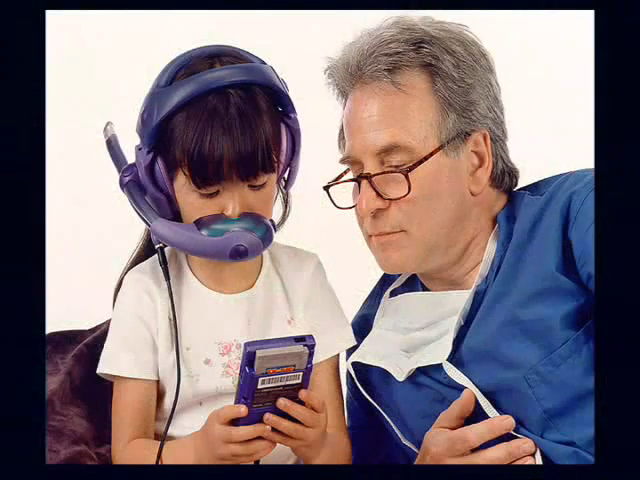
One can understand that it would be nice to have something to focus on while trying to remain calm ahead of a medical procedure. Credit: PediSedate Once upon a time, surgery was done on patents who were fully conscious and awake. As you might imagine, this was a nasty experience for all involved, and particularly the patients. Eventually, medical science developed the techniques of anaesthesia, which allowed patients to undergo surgery without feeling pain, or even being conscious of it at all.
Adults are typically comfortable in the medical environment and tolerate anaesthesia well. For children, though, the experience can be altogether more daunting. Thus was invented the PediSedate—a device which was marketed almost like a Game Boy accessory intended to deliver anaesthetic treatment in order to safely and effectively prepare children for surgery.
A Happy Distraction
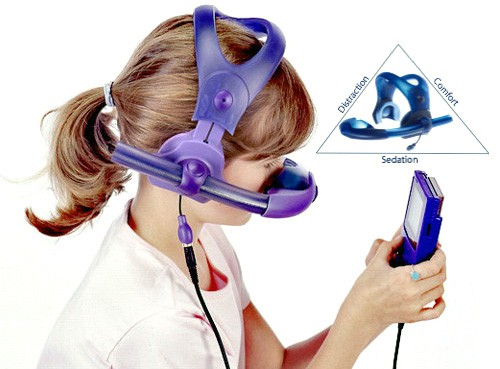
A child wearing the PediSedate mask. Credit: PediSedate The patent filing for the PediSedate doesn’t give away much in the title—”Inhalation And Monitoring Mask With Headset.” Still, US patent 5,697,363 (PDF) recorded an innovative device, intended to solve several issues around the delivery of anaesthesia to pediatric patients. Most specifically, those developing the device had noted a great deal of anxiety and stress when using traditional anaesthesia masks with young patients. The device was created by Geoffrey A. Hart, an anaestheologist based in Boston. His hope was to create an anaesthesia delivery device that could be used with a child in a “non-threatening, non-intrusive manner.”
The resulting device looked rather a lot like a big, colorful audio headset. Indeed, it had headphones to that could play audio to the wearer, while an arm that extended out over the face could deliver nitrous oxide or other gases via the nasal route. Sensors were included for pulse oximetry in order to track the patient’s heart rate and blood oxygenation, while an integrated capnometer measured vital respiratory factors including carbon dioxide levels in the breath. Provision in the patent was also made for including a microphone, either for interactivity purposes with entertainment content for distraction’s sake, or to allow communication with medical personnel at a distance. This would be particularly useful in the case of certain imaging studies or treatments, where doctors and nurses must remain a certain distance away. Press materials that showed the device in use with a handheld created the idea that this was a Game Boy accessory. It was certainly never an official one; in reality, it was a pair of headphones that also delivered anaesthesia while monitoring the patient. Credit: PediSedate Press materials and a website were launched in 2009, as the device went through Phase II clinical trials. Most materials showed the PediSedate being used in tandem with a Nintendo Game Boy. The device featured an aesthetic that followed the late 90s trend of bright colors and translucent plastics. It was often paired in photos hooked up to a Game Boy to help distract a child during sedation, with the device often talked about as an “accessory” for the handheld console. This wasn’t really the case—it was essentially a child-friendly anaesthetic mask with headphones that could be hooked up to any relevant sound source. However, at the time, a Game Boy was a readily available way to distract and calm a sick child, and it could be had in colors that matched the PediSedate device.
Those behind the PediSedate noted the device was “very well recieved by parents, kids and health-care workers.” The benefits seem to pass the common-sense check—it’s believable that the PediSedate succeeded at being a less-scary way to present children with anaesthetic treatment while also giving them something pleasant to focus on as they drifted out of consciousness. However, success was seemingly not on the cards. The PediSedate website disappeared from the internet in 2011, and precious little was heard of the device since. The creator, Geoffrey A. Hart, continued to practice medicine in the intervening years, until he resigned his license in 2024 according to the Massachusetts Board of Medicine.
An explainer video demonstrated the use of the device, which was going through Phase II trials in 2009.
By and large, the medical field has gotten by without devices like the PediSedate. Children undergoing sedation with inhalational anaesthetics will typically be treated with relatively conventional masks, albeit in small sizes. They lack colorful designs or hookups for game consoles, but by and large seem to do the job. It might have been nice to play a little Donkey Kong before a daunting procedure, but alas, the PediSedate never quite caught on.
Il #MIM, in collaborazione con Luiss Guido Carli, Ministero della Giustizia, Ministero dell'Università e della Ricerca, Consiglio Superiore della Magistratura, Direzione Nazionale Antimafia e Antiterrorismo, Anac, Carabinieri, Fondazione Severino, pr…
Il #MIM, in collaborazione con Luiss Guido Carli, Ministero della Giustizia, Ministero dell'Università e della Ricerca, Consiglio Superiore della Magistratura, Direzione Nazionale Antimafia e Antiterrorismo, Anac, Carabinieri, Fondazione Severino, pr…
Per il diritto all'aborto sicuro in Europa, approvata dal Parlamento europeo l’ iniziativa di 1,3 mln di cittadini europei MyVoiceMyChoice. E' un segnale contro chi vorrebbe smantellare la UE, a favore di un'Europa dei diritti. Ora la palla passa alla Commissione europea.
@Politica interna, europea e internazionale Dopo l’attacco della ministra Bernini agli studenti di medicina che la contestavano, sono tornate virali sul web alcune frasi che l’allora presidente della Repubblica Sandro Pertini rivolse ad alcuni universitari. L’episodio risale al 1980
Most of us choose our own outfits on a daily basis. [NeuroForge] decided that he’d instead offload this duty to artificial intelligence — perhaps more for the sake of a class project than outright fashion.
The concept involved first using an AI model to predict the weather. Those predictions would then be fed to a large language model (LLM), which would recommend an appropriate outfit for the conditions. The output from the LLM would be passed to a simple alarm clock which would wake [NeuroForge] and indicate what he should wear for the day. Amazon’s Chronos forecasting model was used for weather prediction based on past weather data, while Meta’s Llama3.1 LLM was used to make the clothing recommendations. [NeuroForge] notes that it was possible to set all this up to work without having to query external services once the historical weather data had been sourced.
While the AI choices often involved strange clashes and were not weather appropriate, [NeuroForge] nonetheless followed through and wore what he was told. This got tough when the outfit on a particularly cold day was a T-shirt and shorts, though the LLM did at least suggest a winter hat and gloves be part of the ensemble. Small wins, right?
We’ve seen machine learning systems applied to wardrobe-related tasks before. One wonders if a more advanced model could be trained to pick not just seasonally-appropriate clothes, but to also assemble actually fashionable outfits to boot. If you manage to whip that up, let us know on the tipsline. Bonus points if your ML system gets a gig on the reboot of America’s Next Top Model.
“Quando il ministero della Salute ha emanato ‘le linee di indirizzo sulla interruzione volontaria di gravidanza con mifepristone e prostaglandine’, la Regione Piemonte ha scritto una comunicazione formale notificata al ministero stesso, argomentando – testualmente – ‘l’inapplicabilità delle disposizioni contenute nelle concernenti la somministrazione farmacologica di mifepristone (Ru486) in consultorio’, indicando le motivazioni sotto il profilo giuridico sul ruolo attribuito ai consultori dalla legge 194 e tecnico-sanitario sui potenziali rischi per la salute della donna con la somministrazione in ambito extraospedaliero”
Così avrebbe risposto ieri Alberto Cirio alla richiesta alla consigliera del PD Nadia Conticelli rispetto al divieto di somministrazione della Ru486 nei consultori familiari senza il recepimento delle linee di indirizzo ministeriali del 2020. Cirio parla di “potenziali rischi” senza fare riferimento ai dati di evidenza scientifica, anzi negandoli.
L’aborto farmacologico è sicuro e un ricovero non necessario non lo renderebbe più sicuro, anzi.
“Sono oltre trent’anni che la letteratura scientifica ci rassicura sulla efficacia e sulla non pericolosità dei farmaci per l’aborto farmacologico. La sua sicurezza, secondo l’Associazione dei ginecologi e ostetrici americani (ACOG), è paragonabile a quella dell’ibuprofene, che possiamo comprare senza nemmeno l’obbligo di ricetta”, dichiarano Mirella Parachini (ginecologa e vicesegretaria dell’Associazione Luca Coscioni), Chiara Lalli (bioeticista e consigliera generale dell’Associazione Luca Coscioni) e Anna Pompili (ginecologa e consigliera generale dell’Associazione Luca Coscioni).
La procedura farmacologica è stata introdotta in Italia nel 2009, vent’anni dopo la Francia e la Cina. Nel 2019 l’Organizzazione mondiale della sanità (OMS) ha rimosso la raccomandazione della somministrazione sotto controllo medico e ne ha ammesso l’autosomministrazione a domicilio. Sulla base delle evidenze scientifiche, delle raccomandazioni dell’OMS e delle principali società scientifiche internazionali, nel 2020, le linee di indirizzo ministeriale hanno stabilito che la procedura farmacologica può essere eseguita in consultorio o in ambulatorio, anche con autosomministrazione a domicilio del secondo farmaco.
Non è però solo il presidente del Piemonte a pensarla diversamente dall’OMS, dal Ministero della salute e dalle associazioni mediche. Infatti, ammesso in 5 Regioni e davvero attuato solo in 3, l’accesso alla procedura farmacologica è ancora fortemente limitato e non è ammesso il regime ambulatoriale, solo per motivi ideologici. Questo significa che le donne non possono davvero scegliere e che sono costrette a ricoveri inappropriati, inutili e pericolosi, che comportano uno spreco inaccettabile di risorse pubbliche e costituiscono un ostacolo all’accesso alla interruzione volontaria della gravidanza.
“Proprio a questo serve la campagna Aborto senza ricovero, per chiedere al Consiglio Regionale di approvare procedure chiare, definite e uniformi per l’aborto farmacologico in regime ambulatoriale, garantendo la possibilità di prendere il secondo farmaco a casa, proprio come indicato anche dalle linee di indirizzo ministeriali del 2020”, concludono Parachini, Lalli e Pompili.
Nel pomeriggio di oggi, il Papa ha ricevuto una telefonata da parte del presidente dello Stato di Israele, Isaac Herzog, in occasione delle imminenti festività natalizie e della festa ebraica di Hanukkah.
Una nuova scritta "Spara a Giorgia" con la stella delle Br compare a Busto Arsizio
La frase, scritta con vernice nera, questa volta è comparsa sul muro che divide la sede locale del Partito Democratico e gli uffici del Sindacato Pensionati Italiani ------- PD e pensionati hanno deciso di alzare il livello dello scontro?
Che poi... i pensionati potrei pure crederci, un po' di verve, un po' di voglia di cambiare le cose, una visione del futuro, le hanno... MA IL PD!!!
Tania Re, psicoterapeuta, Consigliera Generale dell’Associazione Luca Coscioni interviene al convegno “L’arrivo della terapia assistita con psichedelici nelle Università italiane”, promossa dallo University Network for Psychedelic Students – Italia.
La Redazione di Scomodo, Via Carlo Emanuele I 26, RomaSabato 27 dicembre 2025 Ore 14:00
Il programma della giornata prevede contributi dalle Associazioni universitarie italiane: PAPS (Padova), AUMEPSI (Roma), UTOPSI (Torino), Antonio Chimenti – SIMEPSI, Georgia Wilson Jones – Illuminismo Psichedelico, Letizia Renzini – MAPS Italia.
Un’occasione per approfondire, con esperti e attivisti, il dibattito crescente sull’integrazione delle terapie psichedeliche nei percorsi di cura e formazione accademica.
#Sicurnauti, da oggi sono disponibili i contenuti rivolti ai #genitori, dedicati al tema “Attenzione a cosa condividi online”.
Qui il video ➡️ https://www.youtube.com/watch?v=3vkvwSh8Iao
Qui l’infografica ➡️ https://unica.istruzione.gov.
We are electing our Pirate Council in February. Positions include Captain, First Officer, Quartermaster, PR/Media Director, Activism Director, Swarmwise Director, Web/Info Director, three Arbitrators and two representatives to the US Pirate Party.
Ballots will be sent out by February 13th and are due back by February 27th. We will use the same voting mechanism we used in our previous election. Voters will be emailed a randomly generated id that only the voter will know. Once the election is done, we will delete the ids. In this way, we can ensure that only supporters can vote, while also maintaining the secrecy of votes.
Gli Stati generali del Quantum hanno riunito a Roma rappresentanti delle istituzioni, del mondo della ricerca e dell’industria per fare il punto sulla Strategia nazionale per le tecnologie quantistiche e sulle sue implicazioni per sicurezza, innovazione e
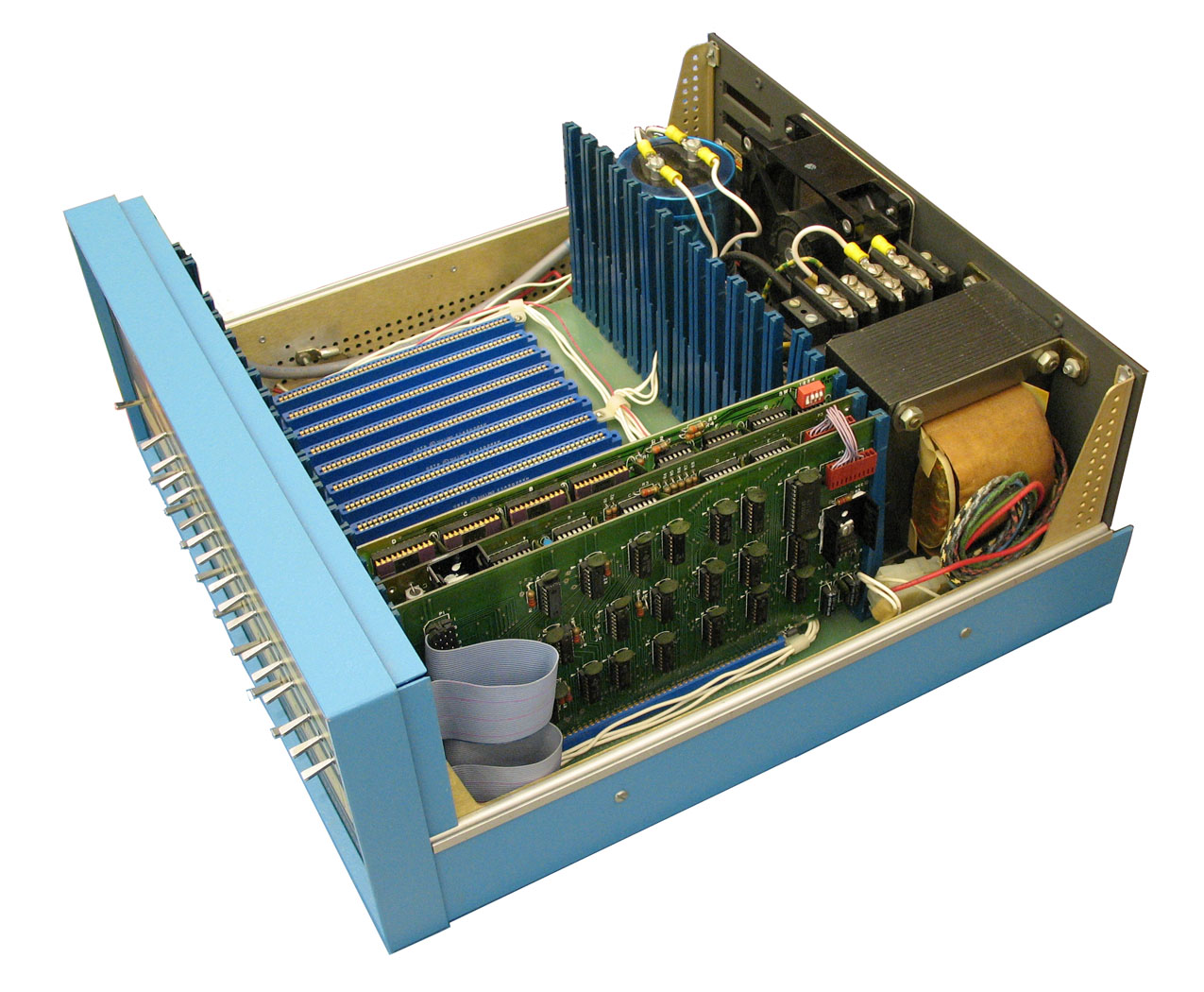
The PC has had its fair share of bus slots. What started with the ISA bus has culminated, so far, in PCI Express slots, M.2 slots, and a few other mechanisms to connect devices to your computer internally. But if the 8-bit ISA card is the first bus you can remember, you are missing out. There were practically as many bus slots in computers as there were computers. Perhaps the most famous bus in early home computers was the Altair 8800’s bus, retroactively termed the S-100 bus, but that wasn’t the oldest standard.
There are more buses than we can cover in a single post, but to narrow it down, we’ll assume a bus is a standard that allows uniform cards to plug into the system in some meaningful way. A typical bus will provide power and access to the computer’s data bus, or at least to its I/O system. Some bus connectors also allow access to the computer’s memory. In a way, the term is overloaded. Not all buses are created equal. Since we are talking about old bus connectors, we’ll exclude new-fangled high speed serial buses, for the most part.
Tradeoffs
There are several trade-offs to consider when designing a bus. For example, it is tempting to provide regulated power via the bus connector. However, that also may limit the amount of power-hungry electronics you can put on a card and — even worse — on all the cards at one time. That’s why the S-100 bus, for example, provided unregulated power and expected each card to regulate it.
On the other hand, later buses, such as VME, will typically have regulated power supplies available. Switching power supplies were a big driver of this. Providing, for example, 100 W of 5 V power using a linear power supply was a headache and wasteful. With a switching power supply, you can easily and efficiently deliver regulated power on demand.
Some bus standards provide access to just the CPU’s I/O space. Others allow adding memory, and, of course, some processors only allow memory-mapped I/O. Depending on the CPU and the complexity of the bus, cards may be able to interrupt the processor or engage in direct memory access independent of the CPU.
In addition to power, there are several things that tend to differentiate traditional parallel buses. Of course, power is one of them, as well as the number of bits available for data or addresses. Many bus structures are synchronous. They operate at a fixed speed, and in general, devices need to keep up. This is simple, but it can impose tight requirements on devices.
Tight timing requirements constrain the length of bus wires. Slow devices may need to insert wait states to slow the bus, which, of course, slows it for everyone.
An asynchronous bus, on the other hand, works transactionally. A transaction sends data and waits until it is acknowledged. This is good for long wires and devices with mixed speed capability, but it may also require additional complexity.
Some buses are relatively dumb — little more than wires hanging off the processor through some drivers. Then how can many devices share these wires? Open-collector logic is simple and clever, but not very good at higher speeds. Tri-state drivers are a common solution, although the fanout limitations of the drivers can limit how many devices you can connect to the bus.
If you look at any modern bus, you’ll see these limitations have driven things to serial solutions, usually with differential signaling and sophisticated arbitration built into the bus. But that’s not our topic today.
Unibus
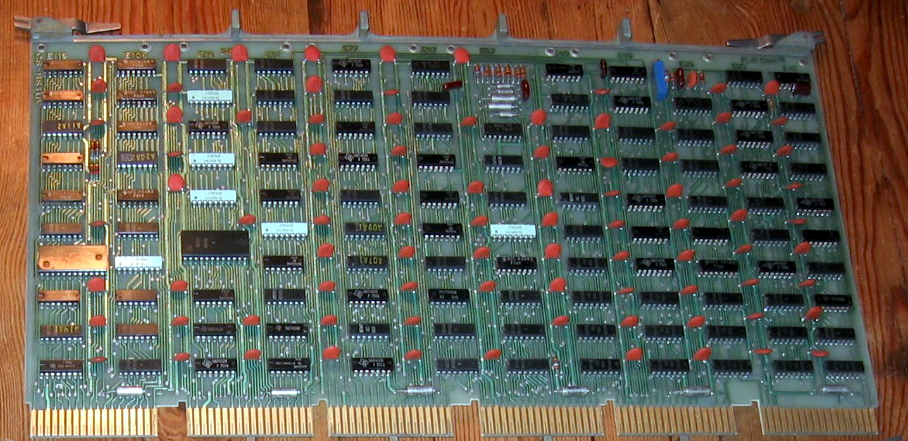
A Unibus card (public domain) A common early bus was the Digital Equipment Corporation Unibus. In 1969, you needed a lot of board space to implement nearly anything, so Unibus cards were big. PDP-11 computers and some early VAX machines used Unibus as both the system bus for memory and I/O operations.
Unibus was asynchronous, so devices could go as fast as they could or as slow as they needed. There were two 36-pin edge connectors with 56 pins of signals and 16 pins for power and ground.
Unibus was advanced for its time. Many of the pins had pull-up resistors on the bus so that multiple cards could assert them by pulling them to ground. For example, INTR, the interrupt request line, would normally be high, with no cards asserting an interrupt. If any board pulls the line low, the processor will service the interrupt, subject to priority resolution that Unibus supported via bus requests and grants.
The grants daisy-chained from card to card. This means that empty slots required a “grant continuity card” that connected the grant lines to prevent breaking the daisy chain.
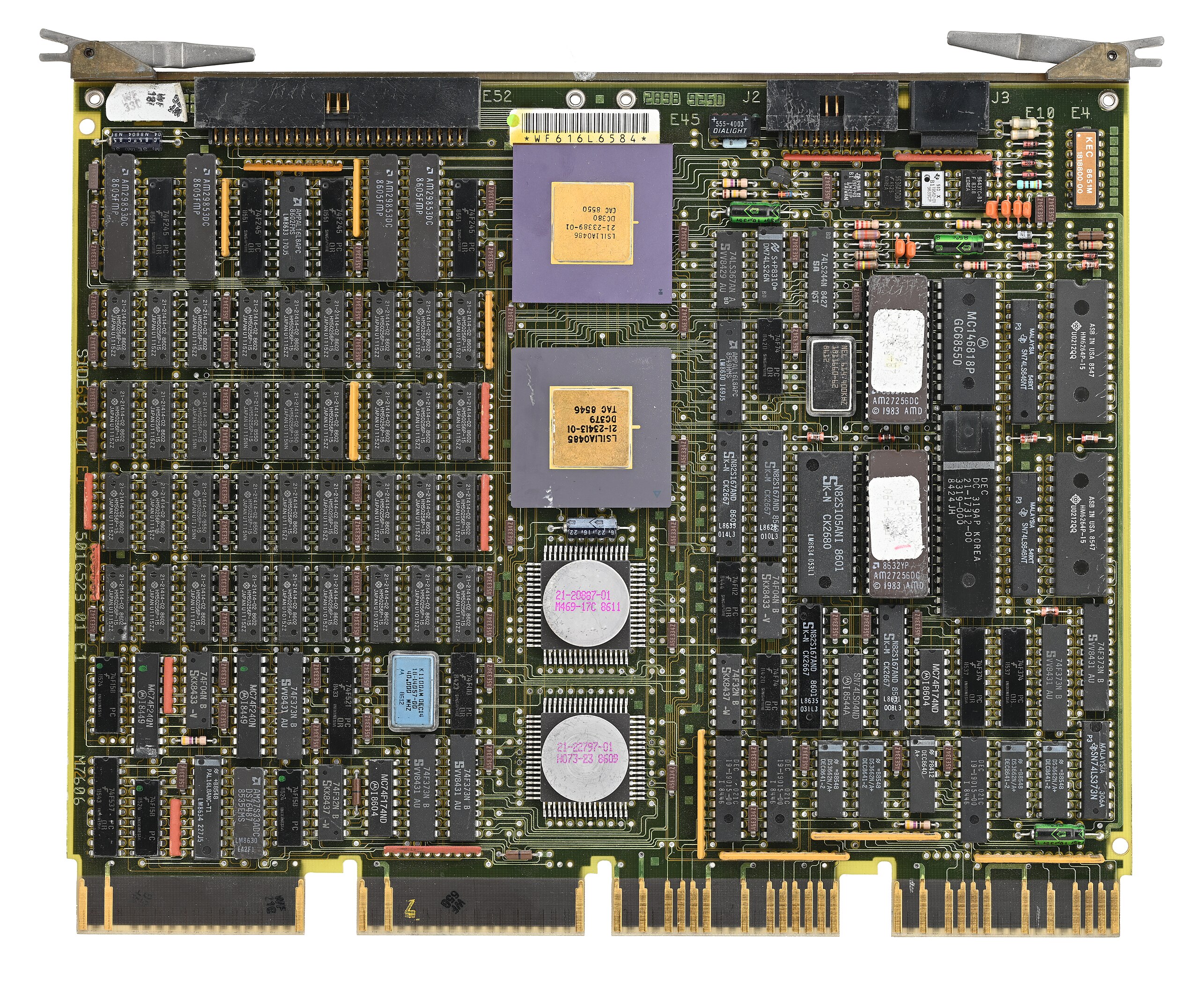
Q-Bus CPU card (CC BY-SA 4.0 by [Phiarc])The bus also had power quality lines that could inform devices when AC or DC power was low. High-performance computers might have “Fastbus,” which was two Unibuses connected but optimized to increase bandwidth. Because the boards were large, Digital would eventually adopt Q-Bus, or the LSI-11 bus. This was very similar to Unibus, but it multiplexed data and address lines, allowing boards to be smaller and cheaper to produce. Fewer wires also meant simplified backplanes and wiring, reducing costs.
Eventually, the Digital machines acquired Massbus for connecting to specific disk and tape drives. It was also an asynchronous bus, but only for data. It carried 18 bits plus a parity bit. Boards like the RH11 would connect Massbus devices to the Unibus. There would be other Digital Equipment buses like TURBOChannel.
Other computer makers, of course, had their own ideas. Sun had MBus and HP 3000 and 9000 computers, which used the HP Precision Bus and HP GSC. But the real action for people like us was with the small computers.
S-100 and Other Micros
It is easy to see that when the designers defined the Altair 8800 bus, they didn’t expect it to be a standard. There was simply a 100-pin connector that accepted cards 10 inches long by 5 inches tall. The bus was just barely more than the Intel 8080 pins brought out, along with some power. At first, the bus split the databus into an input and output bus. However, later cards used a bidirectional bus to allow for more grounds on the now unused bus bits to help reduce noise.
Through the late 1970s and early 1980s, the S-100 market was robust. Most CP/M machines using an 8080 or Z-80 had S-100 bus slots. In fact, it was popular enough that it gave birth to a real standard: IEEE 696. However, by 1994, the IBM PC had made the S-100 bus a relic, and the IEEE retired the standard.
Of course, the PC bus would go on to be dominant on x86 machines for a while; other systems had other buses. The SS-50 was sort of the S-100 for 6800 computers. The 68000 computers often used VMEbus, which was closely tied to the asynchronous bus of that CPU.
Embedded Systems
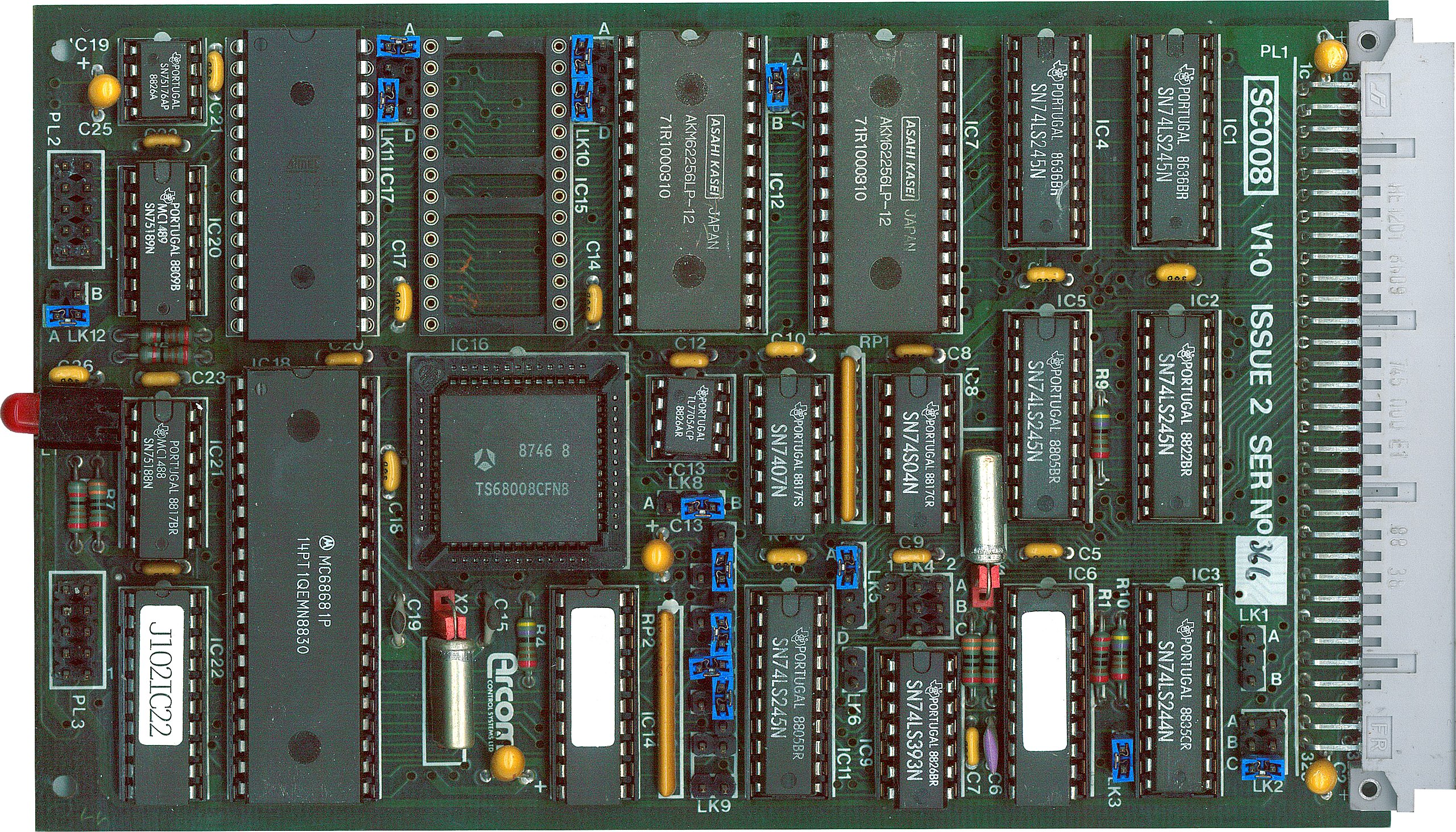
While things like S-100 were great for desktop systems, they were generally big and expensive. That led to competitors for small system use. Eurocard was a popular mechanical standard that could handle up to 96 signals. The DIN 41612 connectors had 32 pins per row, with two or three rows.
Eurocard CPU (CC BY-SA 4.0 by [SpareHeadOne])A proper Eurocard could handle batteries and had strict rules about signal fanout and input levels. Unfortunately, it wasn’t really a bus because it didn’t define all the pin assignments, so cards made by one vendor didn’t always work with cards from another vendor. The N8VEM homebrew computer (see the video below) used Eurocards. VME used a 3-row Eurocard connector, as well.
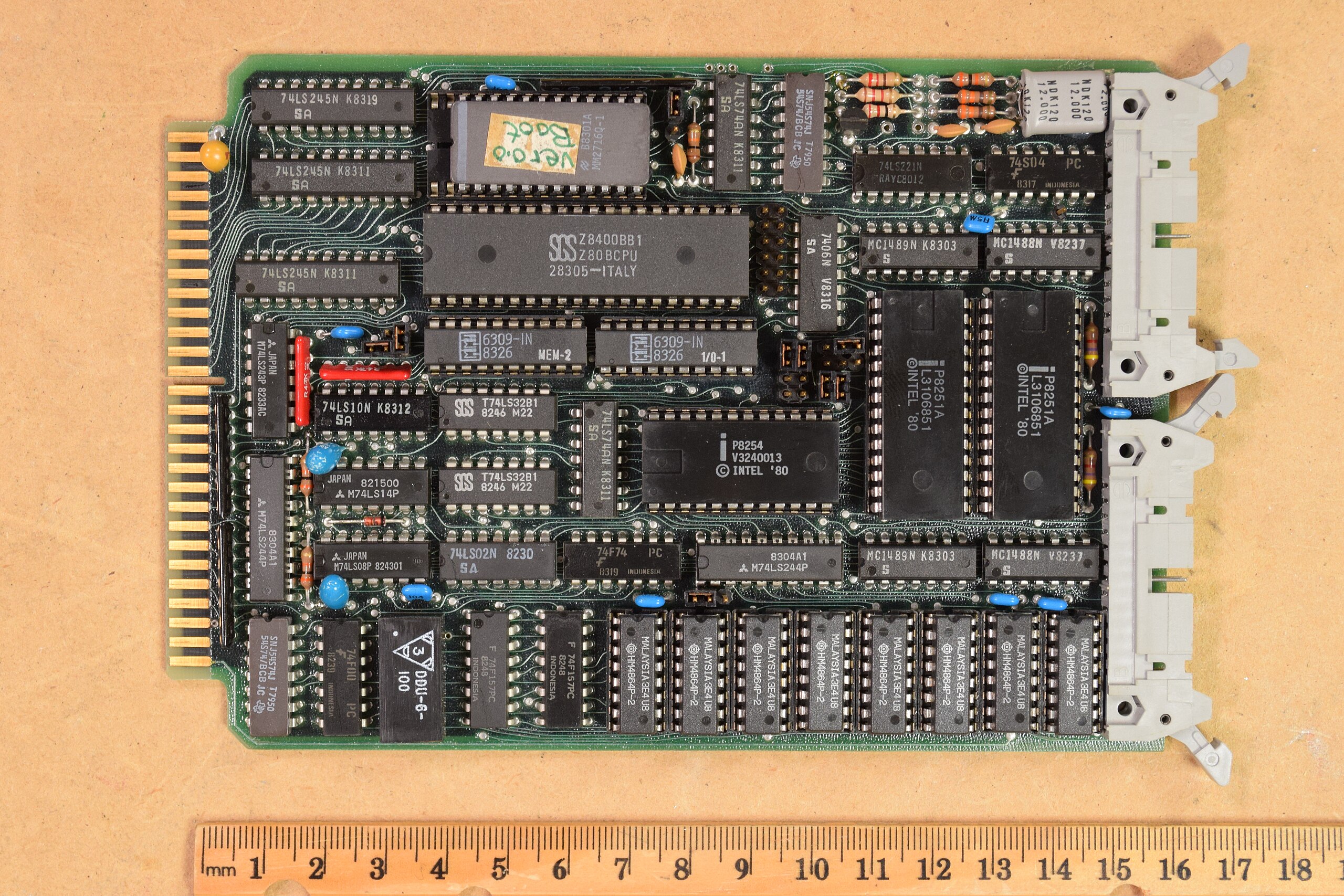
STD Bus card (CC-BY 4.0 by [AkBkukU])Another popular small system bus was the STD Bus popularized by companies like Mostek. These were small 6.5″ x 4.5″ cards with a 56-pin connector. At one time, more than 100 companies produced these cards. You can still find a few of them around, and the boards show up regularly on the surplus market. You can see more about the history of these common cards and their bus in the video below.
We don’t deal much with these kinds of buses in modern equipment. Modern busses tend to be high-speed serial and sophisticated. Besides, a hobby-level embedded system now probably uses a system-on-a-chip or, at least, a single board computer, with little need for an actual bus other than, perhaps, SPI, I2C, or USB for I/O expansion.
E’ arrivato! E’ dicembre che arriva sempre con quel carico di bilanci che pesano sulla schiena.
Ma ormai il bilancio non si fa più solo tra sé e sé. C’è questo strano fenomeno del sovraccarico, una specie di rumore di fondo che diventa insopportabile proprio quando dovremmo rallentare.
I social ad esempio, si riempiono di gente che urla i propri successi dell’anno e le chat di lavoro esplodono perché bisogna chiudere tutto, subito, prima che scatti il primo gennaio, come se poi il mondo finisse davvero.
In mezzo a questo caos, gli algoritmi dei negozi non ti lasciano respirare.
Ti inseguono con sconti che sembrano occasioni imperdibili, che rasentano lo scam di massa, e intanto senti la pressione di dover scattare la foto perfetta per Instagram. E poi intorno al 24, si finisce a passare le ore a fare copia e incolla di un unico messaggio di auguri (con tanto di immagine) da inviare a tutti gli “amici” su WhatsApp, perdendo di vista quello che sta succedendo davvero nella nostra stanza.
Il bisogno di staccare la spina
“Stacca, Stacca, Staccami la spina” cantava Jovanotti (Lorenzo Cherubini) moltissimi anni fa.
Ma molti (e non nascondetelo) se ne accorgono così, quasi per caso, di quanto sono diventati schiavi di quel rettangolo luminoso. Uno tira fuori il telefono per guardare che tempo fa o se sono già le otto, e trenta minuti dopo è ancora lì che scorre notizie o reals a caso, senza un motivo preciso.
Capita pure durante le cene: il cibo arriva in tavola e invece di mangiarlo lo si fotografa da ogni angolazione, interrompendo tutto il ritmo della serata.
Le famiglie si ritrovano sedute allo stesso tavolo ma vivono vite parallele.
Ognuno fissa il suo schermo, immerso in una bolla digitale che rende la presenza fisica una specie di accessorio opzionale. È un modo di stare insieme che non è stare insieme, ed è in questo momento di massima frizione che la voglia di una disintossicazione digitale inizia a farsi strada nella testa della gente.
La fatica di elaborare troppi dati
I ricercatori hanno pure dato un nome a questa sensazione di pesantezza:burnout digitale.
È una stanchezza cronica che viene dal mangiare troppe informazioni, un’indigestione di dati che il cervello umano non è proprio fatto per gestire. Siamo bombardati.
Ogni notifica che arriva attiva il sistema dello stress e ci tiene in uno stato di allerta perenne, manco fossimo nella giungla a scappare dai predatori, e invece stiamo solo leggendo una mail.
Il problema grosso è che la nostra capacità di concentrarci profondamente sta andando a farsi benedire.
Passiamo da un’app all’altra, da una scheda del browser a un’altra, e il cervello poveretto non riesce a starti dietro. Esiste questa cosa chiamata attenzione residua: un pezzo di te resta incastrato nel compito di prima, così quello che stai facendo adesso lo fai peggio. È un’efficienza che cola a picco, un po’ come cercare di correre nel fango.
Chimica del sonno e giornate corte
A dicembre questa stanchezza accumulata per dodici mesi arriva a un punto di rottura.
La gente diventa irritabile (e ci credo), fa fatica a prendere sonno e non combina più niente di buono al lavoro.
C’è anche una questione tecnica, legata alla luce blu degli schermi che blocca la melatonina. In inverno, con le giornate che durano un attimo e la luce naturale che scarseggia, questa interferenza con l’ormone del sonno è una mazzata per l’organismo.
Il fatto è che dicembre non è un mese come gli altri, ha questo peso simbolico di chiusura del cerchio. È il momento in cui ci si guarda indietro e si pensa che forse si potrebbe vivere diversamente, anche se questa “consapevolezza”, capita molte poche volte all’anno. Se per tutto l’anno hai rimandato il pensiero di cambiare abitudini, l’arrivo dell’anno nuovo ti dà quella spinta di “ultima occasione” per rimetterti in sesto.
Preparare il terreno per il nuovo anno
Fare un detox digitale prima di Capodanno viene visto un po’ come un rito di purificazione.
Come quando si fanno le pulizie di primavera in casa, solo che qui si pulisce lo spazio mentale.
È l’opportunità per smettere di agire come robot, di rendersi conto di quanto tempo si butta via a guardare il nulla e provare a riprendersi le redini della propria attenzione.
Non è che bisogna buttare il telefono nel cassonetto, eh. Si tratta di ritrovare un equilibrio che abbia un senso.
Qualcuno stabilisce dei coprifuoco digitali, tipo che un’ora prima di dormire o durante i pasti i telefoni spariscono dalla vista. Altri cancellano le app che creano più dipendenza o decidono che un giorno a settimana i social non esistono proprio.
Piccole strategie di sopravvivenza
C’è chi prova a tornare all’analogico, che sembra quasi un concetto vintage.
Un libro di carta invece dell’e-book, o un gioco da tavolo invece di rincitrullirsi davanti ai videogiochi. Una cosa che aiuta molto, dicono, è farsi una domanda banale prima di sbloccare lo schermo: “Perché sto prendendo in mano il telefono?”. Spesso la risposta è “per noia”, e già rendersene conto è un passo avanti.
Alla fine, il punto non è odiare la tecnologia, ma smettere di farsi usare da lei. Il vero vantaggio di tutto questo staccare è che si torna a essere presenti, a stare nel momento mentre le cose succedono.
Dicembre è pieno di momenti che meriterebbero di essere vissuti davvero, tra cene e parenti, e riscoprire la gioia di parlarsi dal vivo senza notifiche che vibrano in tasca non è poi così male.
Io questo anno stacco veramente la spina per riaccenderla ad inizio gennaio. E voi?
Hack Reveals the a16z-Backed Phone Farm Flooding TikTok With AI Influencers
Doublespeed, a startup backed by Andreessen Horowitz (a16z) that uses a phone farm to manage at least hundreds of AI-generated social media accounts and promote products has been hacked. The hack reveals what products the AI-generated accounts are promoting, often without the required disclosure that these are advertisements, and allowed the hacker to take control of more than 1,000 smartphones that power the company.
The hacker, who asked for anonymity because he feared retaliation from the company, said he reported the vulnerability to Doublespeed on October 31. At the time of writing, the hacker said he still has access to the company’s backend, including the phone farm itself. Doublespeed did not respond to a request for comment.
“I could see the phones in use, which manager (the PCs controlling the phones) they had, which TikTok accounts they were assigned, proxies in use (and their passwords), and pending tasks. As well as the link to control devices for each manager,” the hacker told me. “I could have used their phones for compute resources, or maybe spam. Even if they're just phones, there are around 1100 of them, with proxy access, for free. I think I could have used the linked accounts by puppeting the phones or adding tasks, but haven't tried.”
As I reported in October, Doublespeed raised $1 million from a16z as part of its “Speedrun” accelerator program, “a fast‐paced, 12-week startup program that guides founders through every critical stage of their growth.” Doublespeed uses generative AI to flood social media with accounts and posts to promote certain products on behalf of its clients. Social media companies attempt to detect and remove this type of astroturfing for violating their inauthentic behavior policies, which is why Doublespeed uses a bank of phones to emulate the behavior of real users. So-called “click farms” or “phone farms” often use hundreds of mobile phones to fake online engagement of reviews for the same reason.
The hacker told me he had access to around 1,100 smartphones Doublespeed operates. One way the hacker proved he had access to devices was by taking control of one phone’s camera, which seemingly showed it in a rack with other phones.
Images the hacker captured from some of the phones in Doublespeed's phone farm.
The hacker also shared a list with me of more than 400 TikTok accounts Doublespeed operates. Around 200 of those were actively promoting products on TikTok, mostly without disclosing the posts were ads, according to 404 Media’s review of them. It’s not clear if the other 200 accounts ever promoted products or were being “warmed up,” as Doublespeed describes the process of making the accounts appear authentic before it starts promoting in order to avoid a ban.
I’ve seen TikTok accounts operated by Doublespeed promote language learning apps, dating apps, a Bible app, supplements, and a massager.
One health-themed Doublespeed Tiktok account named Chloe Davis posted almost 200 slideshows featuring a middle-aged AI-generated woman. In the posts, the woman usually discusses various physical ailments and how she deals with them. The last image in the slide always includes a picture of someone using a massage roller from a company called Vibit. Vibit did not respond to a request for comment.
A Doublespeed TikTok account promoting a Vibit massager.
Another Doublespeed-operated TikTok account named pattyluvslife posted dozens of slideshows of a young woman who, according to her bio, is a student at UCLA. All the posts from this account talk about how “big pharma” and the supplements industry is a scam. But the posts also always promoted a moringa supplement from a company called Rosabella. The AI-generated woman in these TikTok posts often holds up the bottle of supplements, but it’s obviously AI-generated as the text on the bottle is jumbled gibberish. An AI-generated image promoting a Rosabella supplement. Rosabella’s site also claims the product is “viral on TikTok.” Rosabella did not respond to a request for comment. An image from Rosabella's site claiming its brand is viral on TikTok. While most of the content I’ve seen on Doublespeed-operated TikTok accounts included AI-generated slideshows and still images, Doublespeed is also able to AI-generate videos as well. One Doublespeed-operated account posted several AI-generated videos of a young woman voguing at the camera. The account was promoting a company called Playkit, a “TikTok content agency” that pays users to promote products on behalf of its clients. Notably, this is the exact kind of business Doublespeed would in theory be able to replace with AI-generated accounts. Playkit did not respond to a request for comment.
0:00 /0:04 1×
An AI-generated video promoting Playkit, a TikTok content agency.
TikTok told me that its Community Guidelines make clear that it requires creators to label AI-generated or significantly edited content that shows realistic-looking scenes or people. After I reached out for comment, TikTok added a label to the Doublespeed-operated accounts I flagged indicating they're AI-generated.
A16z did not respond to a request for comment.
Doublespeed has said it has the ability to and soon plans to launch its services on Instagram, Reddit, and X, but so far seems to only be operating on TikTok. In October, a Reddit spokesperson told me that Doublespeed’s service would violate its terms of service. Meta did not respond to a request for comment. As we noted in October, Marc Andreessen, after whom half of Andreessen Horowitz is named, sits on Meta’s board of directors. Doublespeed’s business would clearly violate Meta’s policy on “authentic identity representation.”
A man was charged for allegedly wiping a phone before CBP could search it; an Anthropic exec forced AI onto a Discord community that didn't want it; and we talk the Disney-OpenAI deal.
A man was charged for allegedly wiping a phone before CBP could search it; an Anthropic exec forced AI onto a Discord community that didnx27;t want it; and we talk the Disney-OpenAI deal.#Podcast
Joseph had to use a different mic this week, that will be fixed next time! We start this week talking about a very unusual case: someone is being charged for allegedly wiping a phone before CBP could search it. There are a lot of questions remaining, but a super interesting case. After the break, we talk about Matthew’s article on an Anthropic exec forcing AI onto a queer gamer Discord. In the subscribers-only section, we all chat about the Disney and OpenAI deal. playlist.megaphone.fm?e=TBIEA8… Listen to the weekly podcast on Apple Podcasts,Spotify, or YouTube. Become a paid subscriber for access to this episode's bonus content and to power our journalism. If you become a paid subscriber, check your inbox for an email from our podcast host Transistor for a link to the subscribers-only version! You can also add that subscribers feed to your podcast app of choice and never miss an episode that way. The email should also contain the subscribers-only unlisted YouTube link for the extended video version too. It will also be in the show notes in your podcast player. youtube.com/embed/tOpIpReZPoM?… Timestamps: 00:48 - Man Charged for Wiping Phone Before CBP Could Search It 17:44 - Anthropic Exec Forces AI Chatbot on Gay Discord Community, Members Flee 41:17 - Disney Invests $1 Billion in the AI Slopification of Its Brand
Tech News Podcast · Updated Weekly · Welcome to the podcast from 404 Media where Joseph, Sam, Emanuel, and Jason catch you up on the stories we published this week. 404 Media is a journalist-owned digital media company exploring the way …
La corsa di OpenAI procede spedita tra investimenti miliardari con Amazon, aggiornamenti avanzati di ChatGPT, partnership con Disney e nuove strategie per startmag.it/innovazione/tutte-…
@Politica interna, europea e internazionale La Russia è “impantanata” in Ucraina ma non ha ancora mostrato l’intenzione di contribuire “in maniera equa, credibile e costruttiva” alle trattative di pace, per questo “non
@Informatica (Italy e non Italy 😁) L’intelligence interna francese (DGSI) ha rinnovato il suo contratto pluriennale con Palantir, mostrando la dipendenza della sicurezza nazionale della République dalle capacità tecnologiche statunitensi. Altro che macronate anti Usa... L'analisi di Alessandro Aresu
Basta avvisi inutili. Basta monitoraggi passivi. Meno di due anni dopo il suo lancio, Google ha deciso di chiudere uno degli strumenti più chiacchierati per la sicurezza digitale: il Dark Web Report. La funzione, pensata per aiutare gli utenti a scoprire se i propri dati personali fossero finiti sul dark web, cesserà di esistere il 16 febbraio 2026, mentre le scansioni per nuove violazioni si fermeranno già il 15 gennaio 2026. Secondo il gigante tecnologico, il report “offriva informazioni generali, ma il feedback degli utenti ha mostrato che non forniva indicazioni concrete su cosa fare”. Google promette ora di concentrarsi su strumenti che offrano passi chiari e immediatamente azionabili per proteggere le proprie informazioni online.
Per chi lo desidera, è possibile eliminare anticipatamente il proprio profilo di monitoraggio: basta accedere al Dark Web Report, cliccare su “Edit monitoring profile” e infine selezionare “Delete monitoring profile”. Tutti i dati verranno cancellati automaticamente con la disattivazione della funzione.
Lanciato a marzo 2023, il Dark Web Report era stato concepito come una difesa contro le frodi d’identità online, controllando il darknet per dati personali come nome, indirizzo, email, numero di telefono e Social Security Number. Nel luglio 2024, Google aveva esteso il servizio da Google One a tutti gli account, ampliando così la portata del monitoraggio.
Ora Google invita gli utenti a prendere in mano la propria sicurezza digitale. La prima mossa consigliata è attivare le passkey, strumenti di autenticazione multifattore resistenti al phishing, che rendono più difficile per i criminali rubare le credenziali. Non basta più avere una password complessa: serve una protezione che non si limiti a segnalare i rischi, ma li neutralizzi davvero.
In parallelo, Google suggerisce di utilizzare la funzione “Results about you” per rimuovere i propri dati personali dai risultati di ricerca. Questo non è solo un passo di privacy, ma un vero scudo contro l’esposizione non voluta dei propri dati online. Ogni informazione lasciata pubblica può essere raccolta, combinata e rivenduta sul dark web: proteggerla significa ridurre drasticamente il rischio di furti d’identità.
La decisione segna un cambio di rotta netto: da un approccio di monitoraggio passivo a una strategia basata su azioni concrete e protezione attiva, lasciando dietro di sé uno strumento che, seppur utile per scovare i dati nel dark web, non forniva la guida necessaria per difendersi davvero.
@Giornalismo e disordine informativo articolo21.org/2025/12/tappa-a… Sala piena a Bergamo per la presentazione del libro di Paolo Berizzi “I segreti di Casapound”. Ancora una volta Berizzi, come nei libri precedenti ha indicato i fili che legano la destra di casa pound alla destra di governo e ha invitato a
La protezione dello spazio sottomarino sta emergendo con forza come uno dei nodi strategici centrali della sicurezza contemporanea, non solo sul piano militare ma soprattutto su quello economico e infrastrutturale. In un momento storico in cui attori globali come gli Stati Uniti







La Redazione di Scomodo, Via Carlo Emanuele I 26, Roma
Sabato 27 dicembre 2025
Ore 14:00





An AI-generated image promoting a Rosabella supplement.
An image from Rosabella's site claiming its brand is viral on TikTok.


