'Shame Thrives in Seclusion:' How AI Porn Chatbots Isolate Us All
Noelle Perdue recently joined us on the 404 Media podcast for a wide-ranging conversation about AI porn, censorship, age verification legislation, and a lot more. One part of our conversation really resonated with listeners – the idea that erotic chatbots are increasing the isolation so many people already feel – so we asked her to expand on that thought in written form.
Today’s incognito window, a pseudo friend to perverts and ad-evaders alike, is nearly useless. It doesn’t protect against malware and your data is still tracked. Its main purpose is, ostensibly, to prevent browsing history from being saved locally on your computer.
But the concept of privatizing your browsing history feels old-fashioned, vestigial from a time when computers were such a production that they had their own room in the house. Back then, the wholesome desktop computer was shared between every person of clicking-age in a household. It had to be navigated with some amount of hygiene, lest the other members learn about your affinity for Jerk Off Instruction.
Even before desktop computers, pornography was unavoidably communal whether or not you were into that kind of thing. Part of the difficulty in getting ahold of porn was the embarrassment of having to interact with others along the way; whether it was the movie store clerk showing you the back of the store or the gas station cashier reaching for a dirty magazine, it was nearly impossible to access explicit material without interacting with someone else, somewhere along the line. Porn theaters were hotbeds for queer cruising, with (usually men) gathering to watch porn, jerk off and engage in mostly-anonymous sexual encounters. Even a lack of interaction was communal, like the old tradition of leaving Playboys or Hustlers in the woods for other curious porn aficionados to find. playlist.megaphone.fm?p=TBIEA2… With the internet came access, yes, but also privacy. Suddenly, credit card processing put beaded curtain security guards out of business, and forums had more centrefolds than every issue of Playboy combined. Porn theaters shut down—partially due to stricter zoning ordinances and 80’s sex-panic pressure from their neighbors, but also because the rise of streaming pay-per-view and the internet meant people had more options to stay in the comfort of their homes with access to virtually whatever they wanted, whenever they wanted it.
Today, with computers in our pockets and slung against our shoulders, even browsing history has become private by circumstance. Computers are now “personal devices,” rather than communal machines—what we do with them is our business. We have no corporate privacy, of course; our data is being harvested at record volumes. Instead, in exchange for shipping off all our most sensitive information, we have tremendous, historically unheard-of interpersonal privacy. At least, Gen Z are likely the last generation to have embarrassing “my parents looked at my browsing history” anecdotes. We’ve left that information to be seen and sorted by Palantir interns.
Most recently in technology’s ongoing love-hate affair with porn, OpenAI CEO Sam Altman announced he was going to allow ChatGPT to generate erotica, joining hundreds of AI-powered porn platforms offering highly tailored generated content at the push of a button. youtube.com/embed/9eqMXBwWtkA?… Now, from the user’s perspective, there are no humans at any point in this interaction. The consumer is in their room, requesting a machine, and the machine spits out a product. You are entirely alone at every step of this process.
Other people can also provide a useful temperature check- I’m all for nonnormative sexuality and fantasy, but it’s good to get a tone read every once in a while on where the hungry animal has taken you. Strange things happen in isolation, and the dehumanization of sexual imagery by literally removing the human allows people to disconnect personhood from desire, a practice it serves us well to avoid. Compartmentalization of inner sexuality so far as to have it be completely disconnected from what another person can offer you (or what you can offer another person) can lead to sexual frustration at best and genuine harm at worst. This isn’t hypothetical; We know that chatbots have the power to lure vulnerable people, especially the elderly and young, away from reality and into situations where they’re hurt or taken advantage of in real life. And while real, human sex workers endure decades of censorship and marginalization online from industry giants that make it harder and harder to earn a living online, the AI chatbot platforms of the world push ahead, even exposing minors to explicit content or creating child sexual abuse imagery with seemingly zero consequence.
I don’t think anyone needs to project their porn use on the side of their house. Sexual boundaries exist for a reason, and everyone is entitled to their own internal world. But I do think in a period of increasing sexual shame, open communication is a valuable tool. Sex is human, sex is animal, sex is social. Even in periods of celibacy or self-pleasure, sexual desire connects us, person-to-person—even if in practice you happen to be connecting with your right hand.
Noelle is a writer, producer, and Internet porn historian whose works has been published in Wired, TheWashington Post, Slate, and more. You can find her on Substack here.
La Biblioteca nazionale centrale di Firenze, nell’ambito delle attività di prevenzione e tutela del patrimonio librario e documentario, rende pubblico il proprio Piano di Limitazione dei Danni (PLD) al patrimonio culturale, strumento operativo finalizzato alla gestione delle emergenze e alla riduzione delle conseguenze di eventi incidentali o calamitosi sulle collezioni. Il Piano, redatto in conformità agli Indirizzi e strumenti operativi per l’elaborazione, l’attuazione e l’aggiornamento del Piano di Limitazione dei Danni (PLD) al patrimonio culturaleemanati dal Ministero della Cultura (Circolare MiC-DiT n. 2 del 25 marzo 2025), definisce:
le procedure di intervento e le responsabilità operative in caso di emergenza;
i criteri di individuazione delle priorità di messa in sicurezza dei beni culturali mobili e inamovibili;
le modalità di protezione in loco e di eventuale allontanamento delle collezioni;
il coordinamento con il Piano di Emergenza e con il Documento di Valutazione dei Rischi dell’Istituto.
Il “Piano di Limitazione dei Danni della Biblioteca nazionale centrale di Firenze” è reso disponibile in formato digitale e può essere scaricato dal sito istituzionale a questa pagina. La sua pubblicazione intende contribuire alla diffusione delle buone pratiche in materia di prevenzione e gestione delle emergenze, offrendo un riferimento operativo e uno spunto metodologico per la redazione di analoghi piani da parte di altre biblioteche e istituzioni culturali.
Si comunica che durante le festività natalizie la Biblioteca sarà aperta con i consueti orari ad eccezione delle giornate del 24 e del 31 dicembre in cui è prevista l’apertura solo in orario antimeridiano dalle 8.15 alle 13.30.
Giornate di chiusura totale: 25 e 26 dicembre, 1 e 6 gennaio.
Il Servizio riproduzioni GAP non sarà inoltre disponibile nella giornata di sabato 27 dicembre.
Il personale e la Direttrice della Biblioteca augurano a tutti Buone Feste!
La Biblioteca nazionale centrale di Firenze, ai fini dell’ampliamento delle proprie collezioni di manoscritti e libri rari, ha acquistato nel corso del 2025 sul mercato antiquario:
il manoscritto dei Facta et dicta memorabilia di Valerio Massimo (Nuove accessioni 1522), un volume totalmente ignoto alla bibliografia e, per la sua conservazione in mani private, sfuggito ai censimenti recenti; si tratta di un testimone della seconda redazione del volgarizzamento toscano con interessanti chiose marginali databile tra la fine del XIV secolo e l’inizio del XV secolo
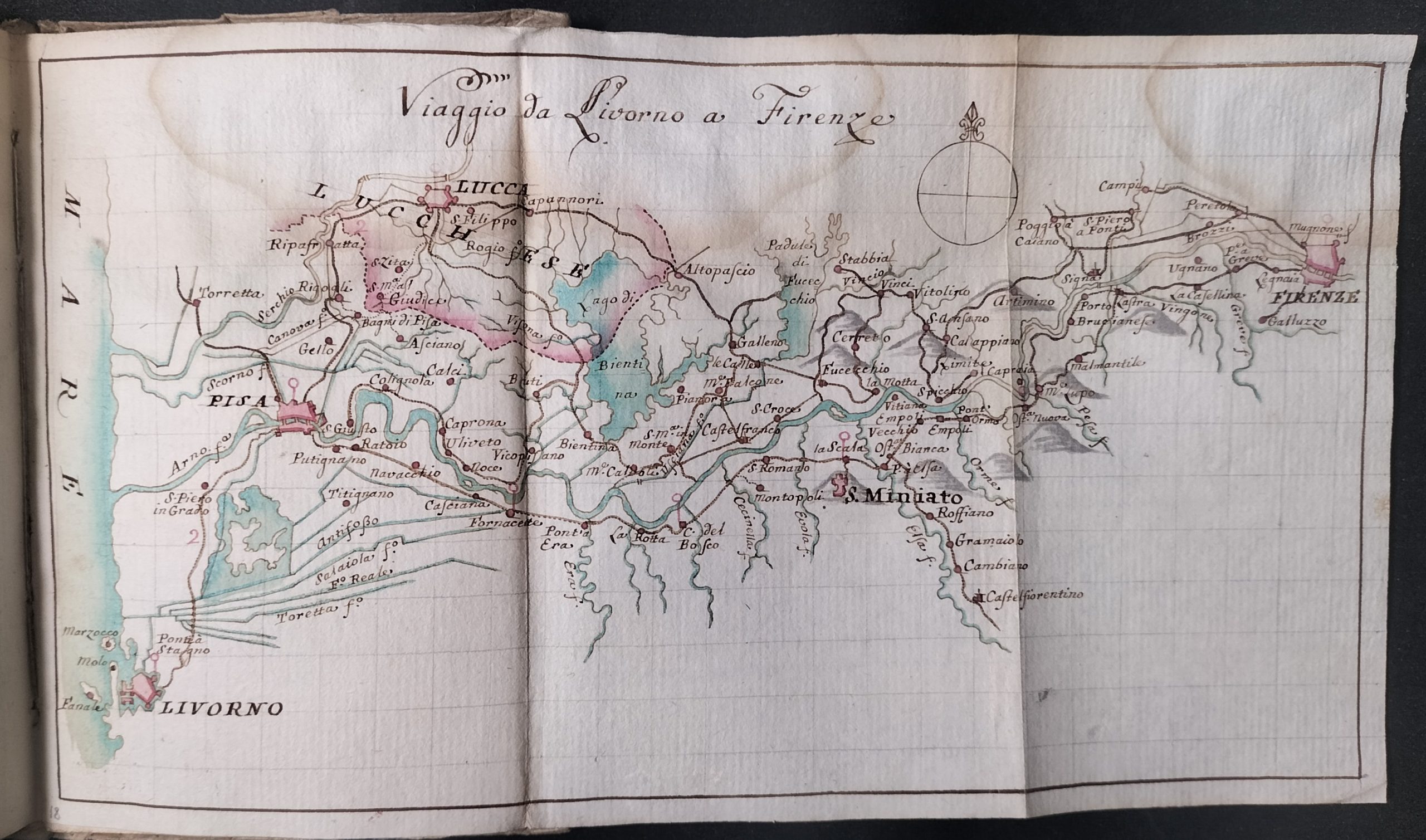
il manoscritto dei Viaggi del Granducato di Toscana con la distinzione di quei luoghi ove sono le poste (Nuove accessioni 1520), libro pieghevole, da viaggio, prodotto nello stesso ambiente dei fratelli Antonio, Luigi e Francesco Giachi, agrimensori, disegnatori e copisti, che, nella seconda metà del sec. XVIII, animarono una delle officine più attive nell’allestimento di carte di varie tipologie
quattro cinquecentine: un’edizione di un calendario perpetuo sinora sconosciuta in cui si rileva l’utilizzo di una vignetta già impiegata per l’edizione Tractato contra li astrologi di Savonarola stampata a Firenze da Bartolomeo de Libri non dopo il 1497 ; il volume contenente due stampati, rispettivamente Diui Hieronymi in vitas patrum … Lugduni: ab Iacobo Huguetan, [1512] e Regulae monasticorum … Venezia, Johannes Emericus de Spira, per Lucantonio Giunta, 13 Apr. 1500, entrambi provenienti dalla Badia fiorentina; infine l’Historia de’ dieci mila martiri crucifissi di Anastasio armarista, variante sconosciuta dell’edizione stampata a Firenze per Gian Stephano di Carlo da Pavia intorno al 1510 (ISTC No.ih00283000)
Valerio Massimo Valerio Massimo Viaggi del Granducato di Toscana Calendario perpetuo Diui Hieronymi in vitas patrum Regulae monasticorum Orazione funerale Orazione funerale Ex libris Landau Passione delli dieci mila martyri crocifixi
A seguito della sentenza della Corte costituzionale sulla legge sul Fine vita approvata dalla Regione Toscana, l’Associazione Luca Coscioni per la libertà di ricerca scientifica APS promuove il seminario webinar:
“La sentenza della Corte costituzionale n. 204 del 2025 e la legge toscana sul fine vita. Competenze regionali, servizio sanitario e tempi delle verifiche e assistenza”
L’appuntamento è per giovedì 15 gennaio 2026, dalle ore 10.30 alle ore 12.30, sulla piattaforma Zoom, iscrivendosi a QUESTO LINK.
La sentenza n. 204 del 2025 della Corte costituzionale segna un passaggio rilevante nel percorso di attuazione dei diritti in materia di fine vita, nel quadro della giurisprudenza costituzionale e della normativa vigente. La pronuncia contribuisce a chiarire il rapporto tra competenze regionali, organizzazione del Servizio sanitario e responsabilità del legislatore nazionale. Il seminario intende offrire un confronto giuridico rigoroso sulle implicazioni della sentenza e sui criteri, coerenti con la giurisprudenza costituzionale, per garantire l’effettivo esercizio dei diritti riconosciuti.
— Programma —
Introduzione e apertura dei lavori
Filomena GALLO, Avvocata e Segretaria nazionale dell’Associazione Luca Coscioni per la libertà di ricerca scientifica APS
Marco CAPPATO, Tesoriere dell’Associazione Luca Coscioni per la libertà di ricerca scientifica APS
Matteo MAINARDI, Coordinatore della campagna “Liberi subito” e Consigliere generale dell’Associazione Luca Coscioni per la libertà di ricerca scientifica APS
La sentenza n. 204/2025 e la sua portata nel bilanciamento tra istituzioni e diritti della persona
Marilisa D’AMICO, Professoressa ordinaria di Diritto costituzionale presso l’Università degli Studi di Milano
Fernanda FRAIOLI, Procuratrice regionale per il Piemonte presso la Corte dei Conti
Le competenze delle Regioni in materia di fine vita dopo la sentenza n. 204/2025
Corrado CARUSO, Professore ordinario di Diritto costituzionale e pubblico presso l’Alma Mater Studiorum, Università degli Studi di Bologna
Stefano CATALANO, Professore ordinario di Diritto costituzionale presso l’Università degli Studi di Verona
Tavola rotonda “Il tempo come garanzia costituzionale effettiva. Criteri giuridici e scelte legislative dopo la sentenza n. 2024/2025
Coordinano: Filomena GALLO e Marco CAPPATO
Intervengono:
Marilisa D’AMICO, Professoressa ordinaria di Diritto costituzionale presso l’Università degli Studi di Milano
Corrado CARUSO, Professore ordinario di Diritto costituzionale e pubblico presso l’Alma Mater Studiorum, Università degli Studi di Bologna
Fernanda FRAIOLI, Procuratrice regionale per il Piemonte presso la Corte dei Conti
Elisabetta FRONTONI, Professoressa associata di Diritto costituzionale presso l’Università degli Studi di Roma Tre
La tavola rotonda è dedicata a un approfondimento operativo sul tema dei tempi delle verifiche quale snodo centrale per l’effettività dei diritti riconosciuti dalla giurisprudenza costituzionale. Il confronto si concentra sui margini di intervento del legislatore e delle amministrazioni regionali nel definire procedure idonee a evitare ritardi non giustificati, senza compromettere le garanzie richieste dall’ordinamento.
Dopo le rivelazioni della piattaforma investigativa tedesca EXIF sugli eventi che si sono svolti tra Lonate Pozzolo e Bollate a novembre 2025, quando esponenti di movimenti e gruppi musicali di estrema destra che inneggiano apertamente al nazismo e alla violenza hanno trovato accoglienza negli spazi della Pro Loco cittadina per un concerto e un’assemblea, continua l’azione di Possibile per far sentire la voce di cittadine e cittadini che non ritengono accettabile ospitare tali realtà nel territorio provinciale.
Insieme ad altre associazioni della zona, abbiamo denunciato l’accaduto, a sottolineare che la provincia di Varese non resta in silenzio di fronte a manifestazioni d’odio e di razzismo, e abbiamo sostenuto le forze locali di Lonate Pozzolo nel ribadire che gli spazi cittadini devono rimanere espressione dei valori repubblicani, intrinsecamente antifascisti e antinazisti.
Ma la gravità dei fatti non permette di limitarsi ai livelli locali, pertanto Varese Possibile si unisce all’Onorevole Marco Grimaldi, parlamentare di Alleanza Verdi e Sinistra, nell’interrogazione parlamentare presentata il 9 gennaio al Ministro Piantedosi per chiedere che vengano prese misure affinché soggetti pregiudicati e realtà che vanno contro i principi democratici della nostra Costituzione antifascista non possano più trovare spazio in luoghi dedicati alla promozione di un territorio che ha partecipato con orgoglio alla Resistenza.
Milena Berteotti e Sofia Mason Portavoci di Varese Possibile Walter Girardi Comitato Scientifico Nazionale Possibile
#Scuola, autorizzati 532 nuovi percorsi quadriennali della filiera tecnologico-professionale per l’Anno Scolastico 2026/2027.
Qui tutti i dettagli ▶️ https://www.mim.gov.
📣 Da domani iniziano le #IscrizioniOnline! Sulla piattaforma #Unica sono disponibili le sezioni dedicate all’orientamento, pensate per accompagnare le famiglie e gli studenti.
📣 Da domani iniziano le #IscrizioniOnline!
Sulla piattaforma #Unica sono disponibili le sezioni dedicate all’orientamento, pensate per accompagnare le famiglie e gli studenti.
questi sono i veri eroi. questo è il vero popolo arabo. insignificanti i terroristi plagiati che a giro per il mondo si fanno saltare solo per uccidere persone a caso.
Trump valuta le opzioni, la Russia: 'Un nuovo attacco avrebbe conseguenze disastrose'. L':Onu: 'Siamo inorriditi'. Domani un manifestante di 26 anni 'sarà giustiziato' (ANSA)
ARCTURUS was a research computer system developed on a shoestring budget at Sydney University in the 1960s, and was in service until 1975. Particularly the system was developed by [David Wong] as a part of his PhD thesis: The design and construction of the digital computers snocom, nimbus and arcturus (PDF). [David] worked in collaboration with [Kevin R. Rosolen] who is interviewed in the video.
The machine is described as a fixed-point, binary, parallel, single address, general-purpose digital computer using packaged diode-transistor circuits. Ferrite-core memory was used instead of drum memory because drum memory was too slow and performance was a high priority feature. For the same reason parallel features were implemented where serial might have been done more simply, if it hadn’t been so slow. In addition to the ferrite-core there were paper-tape peripherals and control panels.
The machine supported 32 distinct instructions and had a 13-bit address space allowing it to directly address 8,192 words, each word comprising 20-bits. Those word bits were one sign bit and nineteen magnitude bits for fixed-point two’s complement binary numbers.
We covered The Computer History of Australia by [State of Electronics] back when they released their 5th video in the series, Australia’s Silliac Computer, if you’re interested in more history of computing in Australia.
It turns out, that mold is everywhere. The problem is when it becomes too much, as mold infestations can have serious health effects on both humans and animals. Remediation is extremely expensive, too. So there are plenty of benefits to finding mold early. Now, German researchers are proposing an electronic “nose” that uses UV-activated tin oxide nanowires that change resistance in the presence of certain chemicals, and they say it can detect two common indoor mold species.
The nanowire sensors can detect Staachybotrys chartarum and Chaetominumglobosum. The real work, though, is in the math used to determine positive versus negative results.
Traditional methods take some sort of physical sample that is sent to a lab and require days to process. However, trained dogs can also smell mold, but as you might expect, there aren’t many dogs trained to find mold. Besides, the training is expensive, you have to maintain the dog all the time, and if the dog knows what kind of mold it is, it can’t say. So an electronic nose that can give fast, specific results is quite attractive.
Even if you don’t care about mold, the data crunching to classify the sensor data has application to many types of sensors. They used training to build multiple models, then they combine the outputs using a regression algorithm to predict the true output. Finally, they use a majority voting technique to combine the results of the model and the regression output.
Could you make a sensor like this? Reading section 4.2 of the paper, it looks like you need a pretty stout set of lab gear to play. But the math ideas are certainly something you could replicate or use as a starting point for your own sensor fusion projects.
Want a deep dive into sensor fusion? You should have been at the Hackaday Superconference a few years ago. Luckily, you can still watch [Christal’s] talk about fusing multiple streams of sensor data.
You’ve heard of wind tunnels– get some airflow going over a thingy, put some some smoke on, and voila! Flow visualization. How hard could it be? Well, as always, the devil is in the details and [toast] is down in there with him with this Hot-Wheels sized wind tunnel video.
To get good, laminar flow inside of a wind tunnel, there are important ratios to be followed– the inlet and outlet diameters must relate to the interior size to get the correct slope on the contraction and exhaust cones. You need a flow straightener on both ends. All of it can be easily 3D printed, as [toast] shows, but you have to know those design rules and pay attention to, which [toast] does… this time. One of his “don’t do this” examples in this video is previous build of his where he did not follow all the rules, and the difference is clear.
Now, unless you’re hooked on flow visualizations —guilty— or are a Hot-Wheels aficionado, since that’s what this wind tunnel is sized for, you probably won’t rush to gumroad to buy [toast]’s STLs. On the other hand, if you pay attention to the lessons [toast] has learned in this video you can apply them to wind tunnels of whatever size and construction technique you need, be it cardboard or junk box plastic and get a more stable result.
Over the decades the number of Linux distributions has effectively exploded, from a handful in the late ’90s to quite literally hundreds today, not counting minor variations. There lately seems to be a counter-movement brewing in response to this fragmentation, with Project Bluefin’s Distroless project being the latest addition here. Also notable are KDE’s efforts, with KDE Linux as its own top-down KDE-based distro, but now with a switch to BuildStream from Arch likely as a distroless move.
It should be clear that there is no obvious course here yet, and that opinions are very much divided. The idea of ‘Linux’ becoming a more singular OS appeals to some, while to others it’s the antithesis of what ‘Linux’ is about. This much becomes clear in [Brodie Robertson]’s exploration of this topic as well.
The way to think about ‘distroless’ is that there is a common base using the Freedesktop SDK on which the customization layer is applied, such as Bluefin, KDE or Gnome’s environments. You could think of this base as the common runtime, using the Freedesktop standards for interoperability for a user-selected layer that’s installed on top. This way the idea of basing a distro on a specific distro is tossed out in favor of something that’s vaguely reminiscent of the Linux Standard Base attempt at standardization.
It’ll be fascinating to see how things will move from here, as there are definite arguments to be made in favor of less fragmentation and resultingly less duplicated effort. In many ways this would bring Linux closer to for example FreeBSD, which avoids the Linux Chaos Vortex problem by having a singular codebase. FreeBSD ‘distros’ like GhostBSD and NomadBSD are therefore essentially just specialized customizations that target a sub-group of FreeBSD users.
Of course, when we start talking about package managers and other base-distro specific features, we may very well risk igniting the same problems that tore apart the LSB so many years ago. Will we also standardize on RPM over DEB package files and kin, or something else?
We suspect there are three kinds of people in the world. People who have access to a Michelson Interferometer and are glad, those who don’t have one and don’t know what one is, and a very small number of people who want one but don’t have one. But since [Longest Path Search] built one using 3D printing, maybe the third group will dwindle down to nothing.
If you are in the second camp, a Michelson interferometer is a device for measuring very small changes in the length of optical paths (oversimplifying, a distance). It does this by splitting a laser into two parts. One part reflects off a mirror at a fixed distance from the splitter. The other reflects off another, often movable, mirror. The beam splitter also recombines the two beams when they reflect back, producing an interference pattern that varies with differences in the path length between the splitter and the mirror. For example, if the air between the splitter and one mirror changes temperature, the change in the refraction index will cause a minute difference in the beam, which will show up using this instrument.
The device has been used to detect gravitational waves, study the sun and the upper atmosphere, and also helped disprove the theory that light is transmitted through a medium known as luminiferous aether.
The tolerances for such a device are tight, but within the capability of modern 3D printers. The CAD files are online. The key was the mirror mounts, which use springs and thumbscrews. So you do need some hardware and, oh yeah, a laser, although that’s not as hard to obtain as it once was. You obviously can’t 3D print the mirrors or the beam splitter either.
The post claims the device is cheap because the bill of materials was roughly $3, although that didn’t include the beamsplitter, which would bring the cost up to maybe $20. The device, in theory, could detect distance changes as small as one wavelength of the laser, which is around 650nm. Not bad for a few bucks.
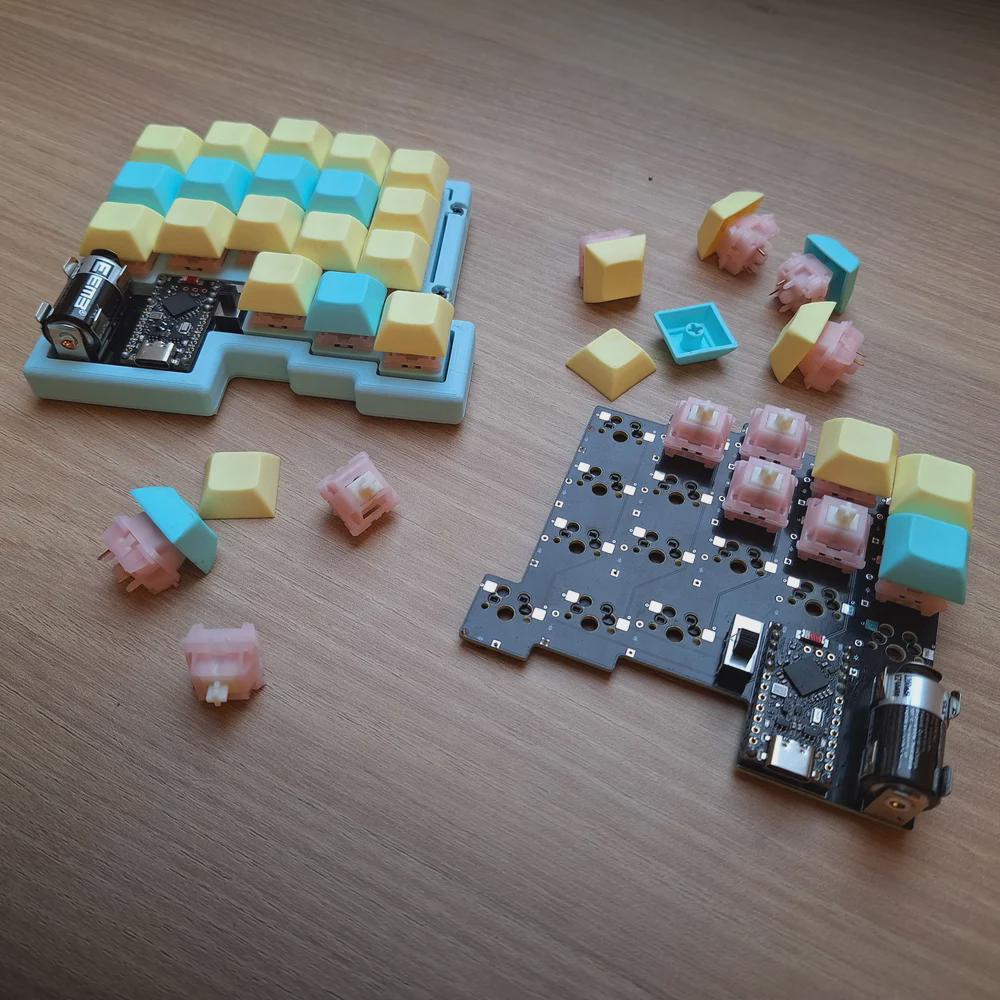
All right, I’ll cut to the chase: Cheap03xD is mainly so cheap because the PCB falls within a 10 x 10 cm footprint. The point was to make a very affordable keyboard — all the parts come to ~40 Euro (~$47). So it would seem that [Lander03xD_] succeeded.
Image by [Lander03xD_] via redditCheap03xD is all the things — 36-key, split, column-staggered, wireless, hot-swappable, and uses ZMK. The batteries are easily replaceable, and no they don’t get in the way.
Those are MMD Princess silent switches, which I wouldn’t choose, but [Lander03xD_] is taking this board to the office, so I get it. They sure are a nice shade of pink, anyway, and they go really well with the pastels of the DSA keycaps and the bezel.
One cool thing to note is that the PCBs are reversible, like the ErgoDox. This isn’t [Lander03xD_]’s first board, and it won’t be the last.
Now, let’s talk batteries. [Saixos] pointed out that the design doesn’t appear to include a protection circuit. In case you can’t tell from where you’re sitting, those are nice!nano clones that [Lander03xD_] is using, and they expect a protection circuit.
[Lander03xD_] is going to look through the docs and see what’s what. The goal is not to have any daughter boards, so this may take some rethinking.
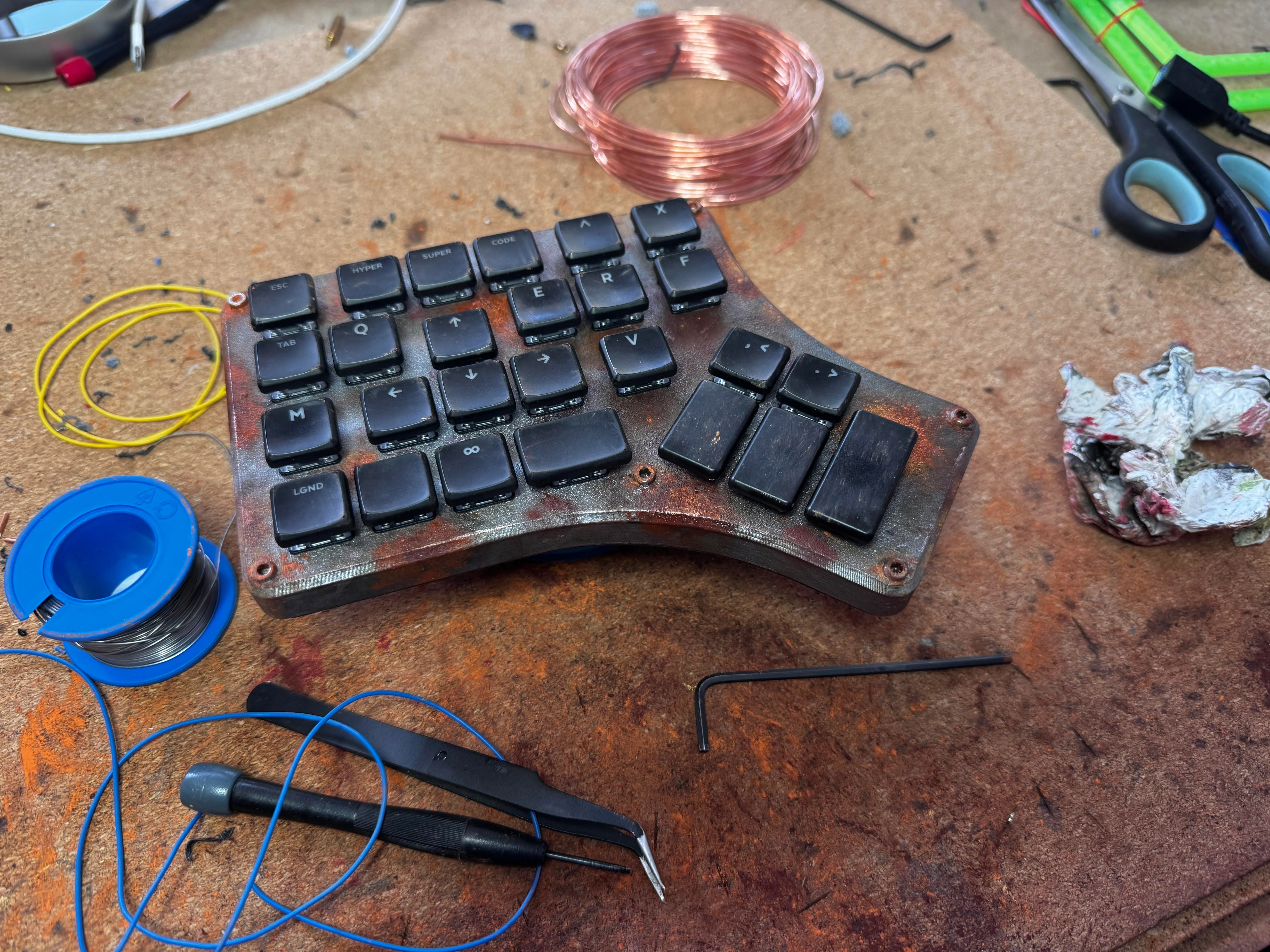
So Arc Raiders is this cool-looking, stripe-logoed, multiplayer extraction shooter that just came out a couple of months ago for all the platforms. It’s not something I could personally play as it’s way too immersive (read: time-consuming), but it definitely looks good, much like this keyboard that [RunRunAndyRun] designed to play it.
Image by [RunRunAndyRun] via redditHaving enjoyed the game with a game pad for a couple of weeks, [RunRunAndyRun] longed for the precision of a keyboard and mouse. The only problem was that his stock of split keyboards all lack a number row.
No matter; just make a new one. Why not? This rustic beauty runs on the Waveshare RP2040 Zero. The case was 3D printed on a Prusa Mk4, which you’d never know unless you blew up the picture. And then [RunRunAndyRun] gave it that nice patina using Panduro hobby acrylics and a bit of weathering powder.
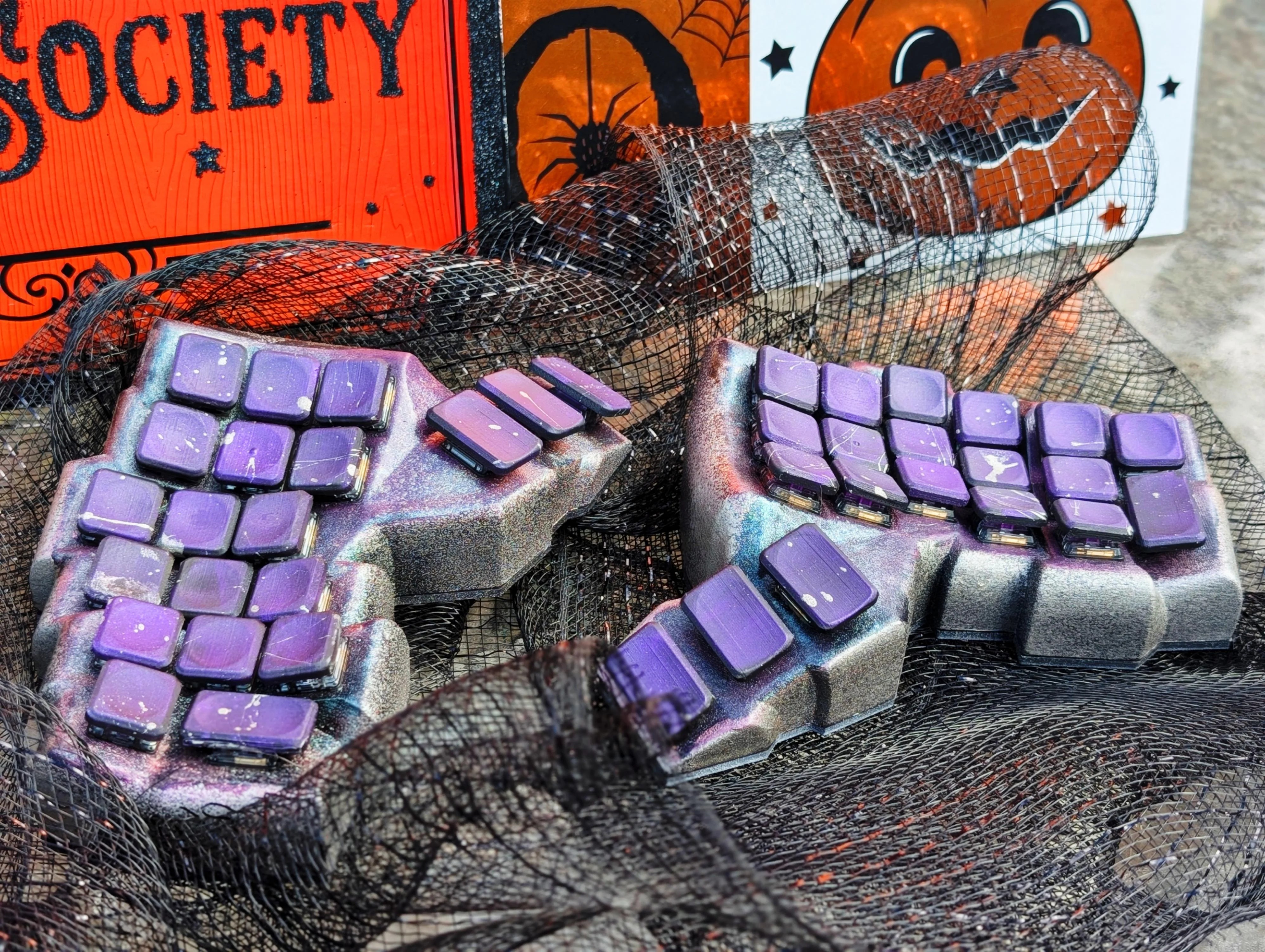
Image by [CaptLynx] via redditThis stunning beauty, Witch’s Brew, was created by [CaptLynx] with the Cosmos keyboard configurator. Doesn’t sound familiar? It’s the one that uses a scan of your hand to create your ultimate comfort. This keyboard is a custom build for a commission. I must say, as much as I dislike the work of Jackson Pollock, I do absolutely love the spatter on those keycaps.
Do you rock a sweet set of peripherals on a screamin’ desk pad? Send me a picture along with your handle and all the gory details, and you could be featured here!
Historical Clackers: the Keystone
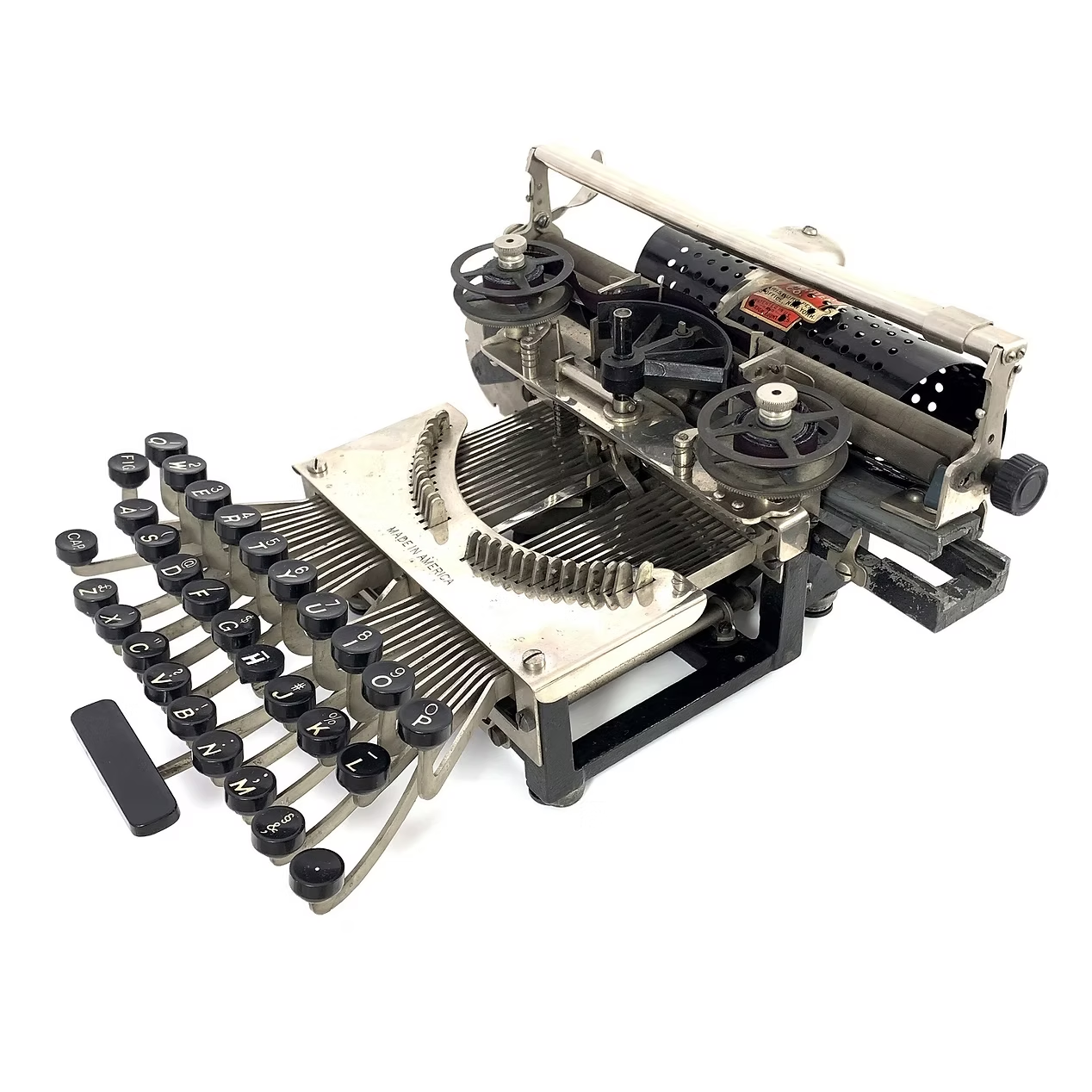
Image via The Antikey Chop This spartan beauty was named after the state in which it was made, Pennsylvania. Manufactured between 1898 and 1903, the Keystone was invented by William Prehn Quentell.
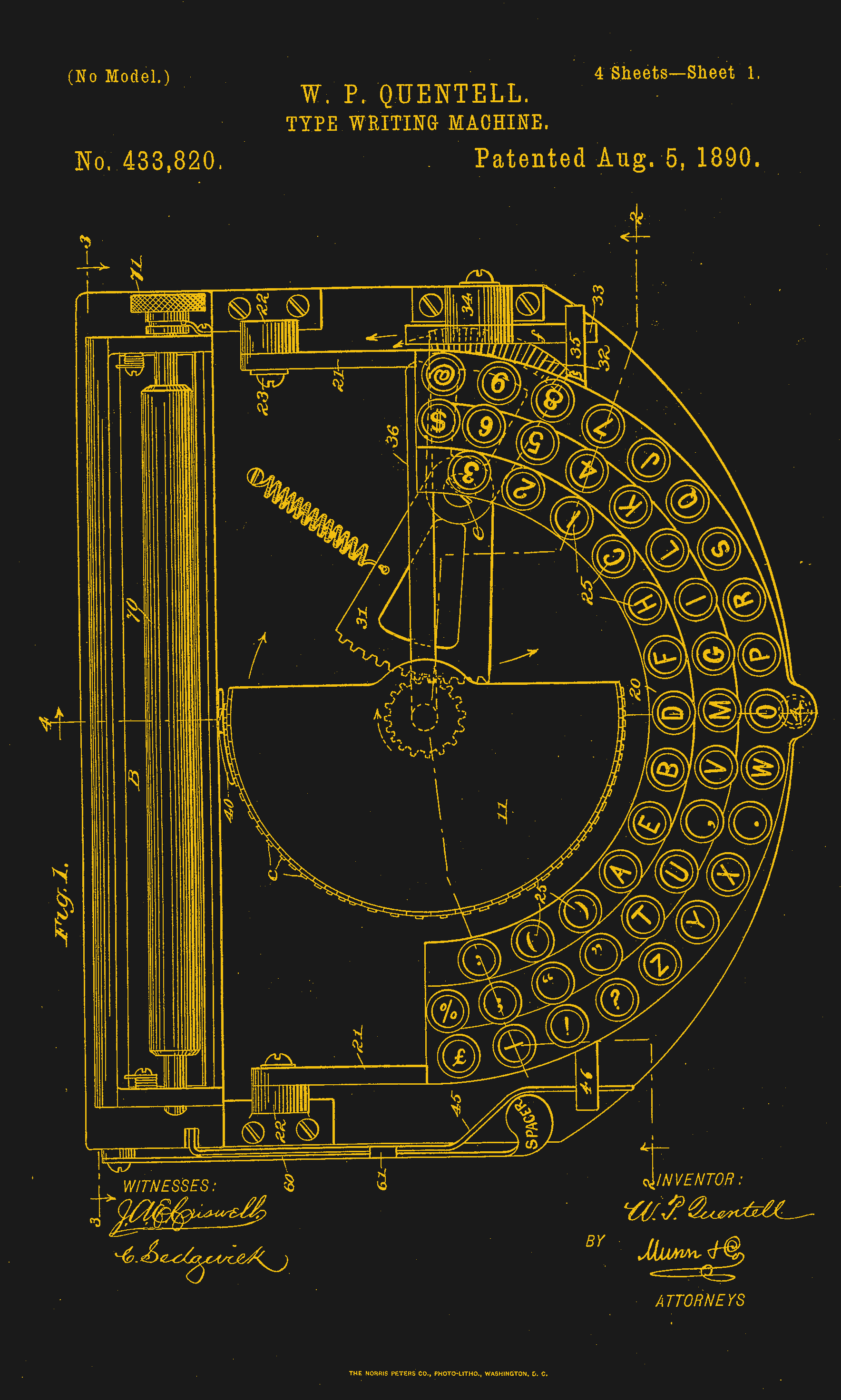
Quentell was living in Kansas City, MO when he first applied for a patent, and later moved to the east coast. At the time, the machine was nameless. The patent looks nothing like the finished product pictured here, but the genesis of the key feature of this “poor man’s Hammond” is there — the swinging type sector.
What this means is that the Keystone has its type on a half wagon wheel, which is evident in the patent drawing. The glyphs are molded around the outside edge of the wheel, which gets rotated into the correct position with each keystroke. This type wheel could be easily changed out for different fonts. Image via Google Patents To imprint the paper, a spring-driven hammer strikes from behind, pushing the paper and ribbon against the type wheel. The paper is loaded into a cylindrical holder in the rear, and unfurls as one types.
So, why was it a poor man’s Hammond? Well, for one, the patent image looks like a Hammond. But the poor part is felt the hardest in the makeup of the typewriter.
In the early Keystone examples, the carriage rails were made of pig iron. Why? It’s a simple case of lateral integration. The factory that was retrofitted to manufacture the machine had previously been the Lochiel iron mill, a producer of pig iron. They were just using up old stock, I imagine.
The Keystone featured two Shift keys on the left, one for Caps and one for Figures. It was a comparatively inexpensive at $40, and then later, $35 (around $1,200 today).
Production was supposed to begin in May of 1898. But by June of ’99, “the company has been unable to fill the orders which are piling up at the works.” Sounds like your average Kickstarter. Quentell was already working on his next project by 1902, the Postal typewriter.
Finally, a Keyboard That Charges Your Phone
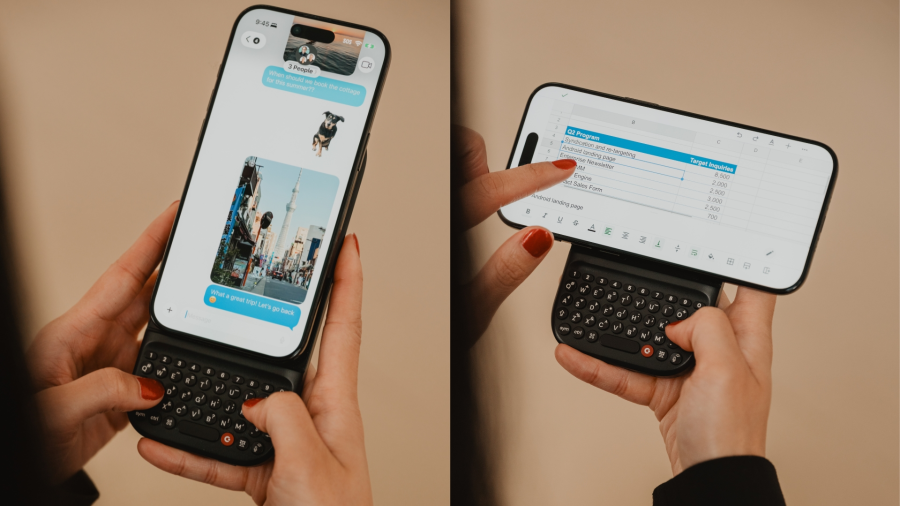
So this article mainly centers on the new little Blackberry-esque number from Clicks which might just be my next phone, except that it doesn’t actually telephone. Clicks is meant to be your second phone, the one you use for emailing and such. You can pre-order it for $399 if you put a $199 deposit down before February 27th. If you decide to drop the full four hundo as an early bird, you’ll get two additional back covers, which slightly change the look of the phone. Image by Clicks via TechCrunch But I’d like to talk about the add-on Power Keyboard for smart phones that Clicks is also dropping at CES this year. Do you miss your Sidekick? Well, here’s a sliding keyboard with multiple positions for differently-sized smart phones, tablets, and even smart TVs. (Because forget typing with the remote control.)
It uses a 2,150 mAh battery and attaches via MagSafe or Qi2, but it also can be used with the case on. When paired with a smart TV, you just use it by itself. Honestly, it looks kind of hard to type on without the phone for support. But I don’t use the smart features of my TV, so whatever.
Honestly, I will probably start by getting the keyboard, which is $79 for early birds through their site, and $109 later on. Pre-orders started a week ago, so I guess I should get on that.
One of the most widely recognised product brands in the world is probably Coca-Cola, and its formula is famously kept a secret through precautions that probably rival those of many nation states. There are other colas, and there are many amateurs who have tried to copy Coke’s flavour, but in well over a century, nobody has managed it. Why does [LabCoatz] think his attempt will be successful where others failed? He has friends with their own mass spectrometers.
‘The video below the break is a nearly half-hour exploration into food chemistry and the flavour profile of the well-known soft drink. It’s easy to name many of the ingredients, but some, such as acetic acid, are unexpected. Replicating the contribution from Coke’s de-cocainised coca leaf extract requires the purchase of some of the constituent chemicals in pure form. Its value lies in showing us how flavour profiles are built up, and the analytical methods used in their decoding.
He makes the point that Coke has never patented the formula because to do so would reveal it, but perhaps in that lies the real point. The value in a secret formula for brands such as Coke lies not in the secret itself, as it’s not difficult to make a refreshing cola drink. Instead, it’s the mystique of their product having a secret recipe that matters. Since this isn’t the recipe itself but something that’s supposed to taste a lot like it, that mystique stays intact. He’s not positioning his Lab-Cola as the real thing, so while we might have used a different label colour and font just to make sure, we’re guessing he’s safe from the lawyers. If you’re interested in the legal grey areas surrounding perceived infringement, though, it’s a topic we’ve looked at before.
Civiltà dei dati è una bella rivista. Prosecuzione ideale della Civiltà delle macchine che dal 1953 al 1979 ha contribuito a modellare la cultura dell’innovazione nel nostro paese, aspira oggi come allora a intrecciare il dialogo tra scienza, tecnologica e sperimentazione letteraria e artistica con un focus specifico sull’ontologia del dato. Proprio quel dato che consente scelte e previsioni, il dato che ci anticipa e rappresenta nel mondo digitale e che è il carburante delle nuove macchine IA è il centro e al centro della rivista. Diretta da Jaime D’Alessandro, storica penna tecnologica dell’Espresso e di Repubblica, è un contenitore di alcune delle migliori firme del pensiero contemporaneo in lingua italiana, Floridi, Taddeo, Benanti, Aresu, e del giornalismo tech come Iacona, Aluffi, Sterling e altri. I primi quattro numeri della rivista, frutto di un progetto della Fondazione Leonardo, direttrice generale la giornalista Helga Cossu, sono stati dedicati a quattro grandi temi d’attualità: lo spazio, la mente, gli archivi, l’IA e i digital twins.
La rivista è molto curata, sia dal punto di vista grafico, con una chiara impronta visiva, sia per i contenuti.
Il primo numero è una parata delle stelle femminili protagoniste della ricerca spaziale; il secondo, è incentrato sugli effetti psicologici della tecnologia e dei social network; il terzo si fonda sul rapporto tra analogico e digitale per parlare di archivi. Particolarmente interessanti sono le riflessioni di Paolo Benanti in questo numero tre quando parla dell’importanza della memoria selettiva, cioè di quel processo che è umano ma non macchinico, di ritenere solo quello che serve, come accadeva con le biblioteche. Benanti fa anche un riferimento importante all’etica dell’IA quando ricorda che gli strumenti, tutti gli strumenti, non sono neutri, ma forme d’ordine e disposizioni di potere. Nella rivista numero 4 va letta l’intervista a Lucilla Sioli, direttrice dell’ufficio europeo per l’IA. Detto per inciso è quella graficamente più bella (recupera le copertine di Urania). Ma è sempre nel numero 3 che troviamo la chicca: una storia a fumetti dell’impareggiabile Milo Manara basato sulla storia della biblioteca meccanica di Jorge Luis Borges. Chissà se quell’utopia bella e terribile della macchina da scrivere universale, oggi rappresentata dall’IA generativa, potrà mai predirci il futuro dentro a un libro. Accetteremmo anche qualche errore di sintassi.
«Civiltà dei dati. 2025. Fondazione Leonardo. Direttore Jaime D’Alessandro». Nella foto i primi quattro numeri.
Il card. Fabio Baggio, direttore generale del Centro di alta formazione Laudato si’, ha nominato don Stefano Charles Cascio vicedirettore amministrativo-gestionale del Borgo Laudato si’ a Castel Gandolfo.
La rivista mensile San Francesco patrono d’Italia inaugura l’ottavo centenario della morte di san Francesco d’Assisi con un numero dedicato al tema della pace.
"Da Leone XIII a Leone XIV. Nuove sfide, rinnovato impegno sociale" è il tema del corso annuale di formazione in Insegnamento sociale della Chiesa promosso dalla Fondazione Centesimus Annus pro Pontifice, che prende il via sabato 17 gennaio a Roma.
"Il diacono e la cura. Aspetti fondamentali, elementi di liturgia e spiritualità" è il tema del convegno in programma dal 23 al 25 gennaio ad Assisi (Domus Pacis) per iniziativa dell'Ufficio nazionale per la pastorale della salute della Cei.
Parte oggi pomeriggio, alla Pontificia Università Urbaniana, il corso intensivo dedicato ai "Delitti" riservati al Dicastero per la Dottrina della Fede, i cosiddetti “Delicta Graviora”. Oggi, dopo l’intervento introduttivo dell’arcivescovo, mons.
Altis, Graduate School of Sustainable Management dell’Università Cattolica del Sacro Cuore, organizza la quinta edizione del corso executive “Finanza ed ecologia integrale.
"In data odierna la Corte di Cassazione si è pronunciata con due ordinanze in merito ai ricorsi proposti dal Promotore di Giustizia, in un caso prendendo atto della dichiarazione di astensione nel procedimento del prof.
Un programma speciale di borse di studio in comunicazione per religiose del sud del mondo, perché possano “svolgere un ruolo significativo nei ministeri dei media all’interno delle loro congregazioni” è quello lanciato dalla Fondazione Conrad N.
Il Papa ha ricevuto oggi in udienza i Capitani Reggenti della Serenissima Repubblica di San Marino, Matteo Rossi e Lorenzo Bugli, i quali hanno poi incontrato il card. Pietro Parolin, segretario di Stato vaticano, accompagnato da mons.
Una delle ultime Lettere apostoliche di papa Francesco è stata dedicata al valore formativo della letteratura nel percorso dei candidati al sacerdozio ministeriale e degli operatori ecclesiali. In ambito europeo, uno degli autori che esprime meglio la sensibilità contemporanea è la scrittrice spagnola Clara Sánchez, che nel 2010 con Il profumo delle foglie di limone ha vinto il Premio letterario spagnolo Nadal de Novela,e negli anni successivi ha venduto più di due milioni e mezzo di copie dei suoi libri. La sua ultima opera, La casa che attende la notte, è un romanzo delicato, attento alle persone, ma anche complesso e articolato, con aspetti filosofici che occorre ascoltare con interesse e rispetto, ma anche con corretto senso critico.
Il romanzo Il profumo delle foglie di limone è stato pubblicato nel 2010 con il titolo Lo que esconde tu nombre, che esprime bene la dinamica che sostiene la narrazione. È la storia di una giovane donna spagnola, Sandra, incinta di cinque mesi e non ancora sposata, che in un momento di riposo sulla costa mediterranea della Spagna, nel clima caldo e mite di fine estate, si trova inconsapevolmente coinvolta in una serie di relazioni con persone anziane, che la pongono a contatto con gli eventi più tragici della storia europea del Novecento. I due coniugi anziani che si sono presi cura di lei, Fredrik e Karin, si rivelano essere due ex criminali nazisti, ritiratisi nella loro bella villa al mare. Del loro progressivo svelamento è autore un altro anziano conosciuto da Sandra negli stessi giorni, Julián, ex repubblicano spagnolo internato a Mauthausen, che ha dedicato la vita alla ricerca dei criminali nazisti.
La narrazione sviluppa varie vicende e porta a una progressiva conoscenza della vera identità dei personaggi. In tutto il racconto non c’è però alcun cenno alla dimensione religiosa: la narrazione autobiografica, condotta da Sandra e Julián, realizza un intreccio tra grandi questioni storiche e piccole realtà personali. L’anelito profondo del racconto è la ricerca della verità, di ciò che le persone sono veramente al di là della parvenza offerta dal loro stato sociale: una ricerca che conduce alla giustizia e alla pace.
Il nuovo romanzo ha come titolo in italiano La casa che attende la notte, e in spagnolo Una vida para Hugo, titolo che ne esprime meglio il dinamismo narrativo. Anche qui il protagonista del romanzo è una giovane donna spagnola, Alicia, che, nell’attesa di un concorso, accetta il lavoro di baby-sitter nella famiglia di Rafael, un bambino di nove mesi. Anche in questo romanzo le vicende della vita quotidiana – in questo caso, di una bambinaia e del suo bambino – si intrecciano con quelle più grandi della crisi dei genitori, della morte di un adolescente di nome Hugo e della cospicua eredità ricevuta dalla sua famiglia.
Il racconto fa riferimento a tre famiglie problematiche: quella di Alicia, che vive a Madrid con la sorella; quella di Rafael, i cui genitori si separano; e quella di Hugo, con i nonni, il papà, la mamma e la sorella avuta dalla mamma in una relazione precedente. Il racconto è ancora autobiografico, di Alicia e Hugo, e ricostruisce immaginativamente il rapporto dell’adolescente defunto Hugo con il perspicace Rafael, che guida Alicia alla scoperta della causa della morte violenta del giovane. La narrazione scorre veloce e affascina il lettore con improvvisi dettagli evocativi e considerazioni filosofiche.
Anche in questo racconto è assente un’esplicita dimensione religiosa: la Chiesa appare solo nel momento in cui Alicia cerca la spiegazione di ciò che accade. Proprio una breve, anche se infelice, confessione le permette di aprirsi alla fede e di continuare la ricerca della verità. Il sincretismo religioso del racconto include però un accenno alla reincarnazione delle anime e all’influsso dei defunti sui viventi. Questo aspetto va compreso come un artificio letterario, necessario per condurre avanti la narrazione: artificio a cui l’A. però non si sente di aderire.
Entrambi i racconti esprimono quindi la ricerca della verità all’interno della vita quotidiana: una ricerca che caratterizza la cultura europea e che fa di questi romanzi un mezzo per raggiungerla e comprenderla.
Candidate News – Timothy Grady, independent gubernatorial from Ohio and candidate endorsed by the Pirate Party, was a guest on Talk the Plank! on Saturday. You can check out that episode here.
Hunter Rand, Pirate candidate running in the nonpartisan Sparks City Council race in Nevada, appeared on the US Transhumanist Party‘s Virtual Enlightenment Salon on Sunday, which you can find here.
Another Pirate candidate will be properly revealed on Wednesday, one which we are proud to reveal more than happy to endorse. During last night’s meeting, the endorsement was made official and is no secret to anyone watching last night’s meeting. Even as such, the official announcement will come Wednesday.
Committee News – No major updates from IT Committee. Outreach Committee met and discussed different ideas to help state parties, including business cards and in-person recruiting. Platform committee has been asked to explore both the idea of term limits and #ProjectNoCap, the latter being a Mr. Beat started project to uncap the United States House of Representatives.
Massachusetts – Preparations are actively being made for the 2026 Pirate National Conference in Boston. The conference will be hybrid with both in-person and online options to attend. The conference will take prior to the FIFA World Cup, and given Boston will play host, it is advised that those looking to attend book early before prices begin to rise. The conference will begin June 6th and is expected to conclude on the 7th. We WILL be on a boat for the conference.
You can check out the latest Pirate National Committee meeting here.
10 января 2026 года прошла очередная Генеральная Ассамблея Пиратского Интернационала (Pirate Parties International).
Пиратскую партию России на Генассамблее представляли члены Федерального Штаба ППР Александр Исавнин, Григорий Дизер, Валерия Клестова и член Контрольно-ревизионной комиссии ППР Николай Воронов.
Ключевое приветствие и вступительное слово произнесла Лилия Кайра Куюмджу (председатель Пиратской партии Германии), подчеркнув ценности свободы, цифровых прав и международного сотрудничества внутри Пиратского движения.
Поступили отчёты от руководящих органов PPI: Совет (Board) — обзор деятельности за 2025 год, участие в международных форумах и конференциях, деятельность в ООН. Казначей (Treasurer), Арбитражный суд (Court of Arbitration) и Независимый аудитор (Lay Auditor) — отчёты и замечания.
Ассамблея рассмотрела и утвердила бюджет PPI на 2026 год.
На Генассамблее приняты две важных для мирового пиратского движения резолюции:
1. Солидарность с иранским движением за свободу и против избирательной цензуры в сфере защиты цифровых прав
1. Народная партия Ирана подтверждает свою непоколебимую солидарность с иранским народом, призывая к немедленному включению Корпуса стражей исламской революции (КСИР) в список террористических организаций на территории всего ЕС, введению всеобъемлющих санкций против должностных лиц режима и активной поддержке диаспорных сетей, противостоящих влиянию режима и цифровым репрессиям.
2. Мы осуждаем все формы цензуры, включая систематические цифровые репрессии иранского режима и западные механизмы «доверенной маркировки» в рамках DSA, которые позволяют осуществлять избирательный контроль над контентом, как это показано в деле HateAid. Мы призываем партии-члены выступать за реформы, отдающие приоритет устойчивому, плюралистическому диалогу, а не технократическому контролю.
3. Партиям-членам Международной организации пиратских партий настоятельно рекомендуется без исключения интегрировать универсальные права человека в свои платформы, способствуя открытым, плюралистическим и устойчивым внутренним дебатам, избегая при этом избирательного активизма, игнорирующего режимы, подобные иранскому, или усиливающего внутренние догмы, – обеспечивая тем самым, чтобы наше движение оставалось неукротимым, устойчивым, последовательным и заслуживающим доверия.
2. Рамочная основа этического регулирования искусственного интеллекта
По мере того как искусственный интеллект (ИИ) и машинное обучение (МО) все глубже интегрируются в общественную инфраструктуру, рынок труда и судебные системы, пиратское движение осознает как преобразующий потенциал, так и экзистенциальные риски для неприкосновенности частной жизни и автономии личности. Необходимо обеспечить, чтобы ИИ служил инструментом расширения прав и возможностей человека, а не механизмом социального контроля или непрозрачного корпоративного доминирования. Мы признаем следующие основные принципы:
1. Прозрачность алгоритмов: Любая система искусственного интеллекта, внедряемая в государственном секторе или используемая для принятия важных частных решений (например, в сфере кредитования, трудоустройства или жилищного обеспечения), должна подлежать независимой государственной проверке. Базовая логика и обучающие наборы данных должны быть прозрачными, доступными и проверяемыми.
2. Право на участие человека в процессе принятия решения: Ни одно решение, коренным образом влияющее на правовой статус или средства к существованию человека, не должно приниматься исключительно автоматизированной системой. Граждане должны иметь юридически закрепленное право на содержательную проверку со стороны человека.
3. Запрет массового биометрического наблюдения: Мы выступаем за глобальный запрет на биометрическую идентификацию в режиме реального времени (например, распознавание лиц) в общественных местах как государственными, так и частными организациями.
4. Открытый исходный код как обязательное условие: для обеспечения безопасности и общественного доверия системы искусственного интеллекта, заказываемые или используемые правительствами, должны основываться на свободном и открытом программном обеспечении (FOSS).
Предлагаемые действия Генеральная Ассамблея поручает новому 16-му составу Совета воссоздать Постоянный комитет по политике в области ИИ. Этот комитет будет координировать международные усилия по продвижению этих принципов на уровне ООН и ЕС, особенно с Европейской пиратской партией, стремясь обеспечить их интеграцию в формирующиеся глобальные рамки и правила.
Также проведено несколько выборных сессий: — Заместителем председателя Борды избран Грегори Энгельс, член Пиратской партии Германии, уроженец Москвы и наш большой друг; — членами Борды избраны на двухлетний срок Себастьян Кроне, Карлос Поло и член Федерального Штаба ППР Григорий Дизер; — альтернативными членами Борды избраны Барт Оверкамп, Лилия Кайра Куюмджу, Томас Гал и выдвинутый ППР член ПП Германии Numero6; — аудиторами избраны Ноам Кузар и член КРК ППР Николай Воронов; — также 6 членами CoA избраны Миа Утц, Александр Колер, Охад Шем Тов, Майлз Уитикер.
Кроме того, было принято заявление о солидарности с ПП США в связи с ситуацией в США: Пиратский Интернационал выражает свою поддержку Пиратской партии США в связи с недавним убийством Рене Николь Гуд сотрудником Федеральной иммиграционной и таможенной службы (ICE). Пусть в Соединенных Штатах или любой другой стране не будет убежища для врагов свободы.
Пиратская партия России является членом-учредителем и неотъемлемой частью Пиратского Интернационала, что мы в том числе закрепили в Уставе и Программе. И, несмотря на мировые дезинтеграционные процессы и всеобщее недоверие, мы продолжим активно участвовать в стирании границ, стремиться к созданию и развитию инструментов и ресурсов для построения более справедливого мира, сохранения существующих и создания новых возможностей.
Al Chaos Communication Congress di Amburgo, un’hacker tedesca che si fa chiamare Martha Root si è presentata vestita da Power Ranger Rosa e ha cancellato in diretta tre siti suprematisti bianchi, tra cui WhiteDate, noto come “il Tinder dei suprematisti”
Il Power Ranger Rosa che ha buttato giù il “Tinder dei nazisti”: i dati sono potere
Al Chaos Communication Congress di Amburgo, un’hacker tedesca che si fa chiamare Martha Root si è presentata vestita da Power Ranger Rosa e ha cancellato in diretta tre siti suprematisti bianchi, tra cui WhiteDate, noto come “il Tinder dei suprematisti”
Al Chaos Communication Congress di Amburgo, un’hacker tedesca che si fa chiamare Martha Root si è presentata vestita da Power Ranger Rosa e ha cancellato in diretta tre siti suprematisti bianchi, tra cui WhiteDate, noto come “il Tinder dei suprematisti”.
Fichissimo, applausi. Eppure serve farsi delle domande.
Martha era dentro da mesi. Aveva messo in piedi profili fasulli di donne ariane gestiti da chatbot e racconta che quegli uomini si erano innamorati. Mentre gli utenti flirtavano con l’intelligenza artificiale, lei raccoglieva dati e informazioni, trasformando un ambiente pensato per far incontrare persone in un dispositivo che espone identità e reti. Dalle sue analisi è emerso che la piattaforma era gestita da una persona con legami con ambienti suprematisti bianchi. WhiteDate veniva venduto come sito di appuntamenti, ma gli utenti erano quasi tutti uomini: il punto non pare la ricerca di partner, ma la costruzione di un network suprematista travestito da Tinder per ariani.
I membri della cosiddetta razza superiore si sono fatti fregare lasciando il sito senza protezioni adeguate. Un’infrastruttura che classifica, aggrega e rende operativi dati sensibili produce una forma di soft power che, se progettata male, si ribalta in una falla boomerang. Il Power Ranger Rosa non si è fermata alla distruzione: ha reso consultabili su okstupid.lol informazioni filtrate, mentre il dataset completo è stato condiviso attraverso canali dedicati a giornalisti e ricercatori. Esporre quei dati significa raccontare le persone: chi c’è dentro, come si descrive, come si colloca nello spazio, cosa cerca, a quale oggetto storico dichiara appartenenza.
WhiteDate stava in una galassia di siti tematici: WhiteDate (dating), WhiteChild (famiglia, ancestry e donazioni di sperma/uova per suprematisti bianchi) e WhiteDeal (networking professionale per razzisti).
Ed è interessante, non per i nazisti e basta. Perché quello che Martha Root ha mostrato non è che “la sicurezza faceva schifo” e stop, ma che un’infrastruttura di matching è, di fatto, una macchina che rende operativi dati sensibili: identità, preferenze, reti, geografia, appartenenze. E quando quella macchina si rompe, il potere che di solito esercita in silenzio diventa visibile.
Il punto è che non servono confessioni esplicite. Bastano i data proxy: segnali indiretti che, incrociati, ti profilano. Se mangio kosher “divento” ebreo nei modelli; se segno tutte le moschee “divento” musulmano; se posto “Black Lives Matter” finisco letto in modo diverso anche da sistemi assicurativi. È profilazione per deduzione: il dato sensibile non lo dichiari, lo lasci emergere dai contorni.
Per questo le policy non sono una cintura di sicurezza: cambiano, si reinterpretano, si aggirano. Il design invece è la decisione politica incorporata nell’architettura: cosa si collega, cosa si correla, cosa si esporta. Se una correlazione è tecnicamente possibile, prima o poi qualcuno la farà. È lo stesso motivo per cui, quando guardo infrastrutture pubbliche, mi interessa l’architettura politica oltre a quella tecnica: lo SPID nasceva con un’idea più decentralizzata proprio per evitare correlazioni tra Stato, portali e autenticazioni. Poi si è cambiata impostazione.
E la parte più inquietante è che non serve nemmeno un WhiteDate. Noi ci autoprofiliamo ogni giorno: i social sono un flusso continuo di segnali, e i metadati in foto e video sono boe, a volte coordinate vicino casa, con ricadute anche su chi vive con noi. Zuboff lo chiama capitalismo della sorveglianza: una raccolta diffusa in cui non sai quante aziende ti prendono, come ti incrociano e in quali liste finisci. Okstupid.lol è la versione “con la luce accesa”: lo stesso principio reso pubblico. Di norma le liste sono invisibili: non meno reali, meno consultabili.
okstupid.lol è spettacolare. Ma il suo spettacolo è una dimostrazione tecnica di quanto sia facile classificare e aggregare quando l’infrastruttura lo permette. E questa facilità, storicamente, non resta neutra. In Ruanda nel 1994 lo sterminio dei Tutsi fu facilitato anche da carte d’identità che classificavano le persone in base all’etnia. Negli anni Quaranta, dati del censimento vennero usati per localizzare e supportare misure di sorveglianza e internamento di persone di ascendenza giapponese dopo Pearl Harbor.
La tecnologia è un apparato amministrativo e informazionale piegato agli scopi di chi la possiede e del contesto politico. E il contesto politico cambia più velocemente delle policy. Per quanto apprezzi Martha Root, non la leggo come uno show: è un promemoria. Il potere dominante queste capacità le ha già, senza Power Ranger, senza exploit, con procedure, contratti standard e con quella cosa che mi piace tanto ma che in certi casi è un problema: l’interoperabilità.
Questo è un post di prova pubblicato dall’app Raccoon, dopo l’installazione del plugin #WordPress Enable mastodon app, una soluzione che implementa in un…
Questo è un post di prova pubblicato dall’app Raccoon, dopo l’installazione del plugin #WordPress Enable mastodon app, una soluzione che implementa in un qualsiasi sito Wordpress le API di mastodon.
Obiettivi
L’obiettivo è capire se i tag di formattazione presenti su Raccoon, come quelli del grassetto, del corsivo, del sottolineato, del testo monospazio e del barrato, funzionano.
Vorrei […]
Questo è un post di prova pubblicato dall’app Raccoon, dopo l’installazione del plugin #WordPressEnable mastodon app, una soluzione che implementa in un qualsiasi sito WordPress le API di mastodon.
Obiettivi
L’obiettivo è capire se i tag di formattazione presenti su Raccoon, come quelli del grassetto, del corsivo, del sottolineato, del testo monospazio e del barrato, funzionano.
Vorrei provare anche le citazioni ma non so bene quale tag utilizzare…
…quindi Ne utilizzo due.
Vediamo invece se funzionano le menzioni e come vanno trattate:
Giovedì, l'Ufficio informazioni del Consiglio di Stato cinese ha pubblicato un libro bianco intitolato "Controllo degli armamenti, disarmo e non proliferazione della Cina nella nuova era"



404 MediaJason Koebler
youtube.com/embed/vU1-uiUlHTo?…youtube.com/embed/uB0gr7Fh6lY?…youtube.com/embed/Pp9MwZkHiMQ?…
404 MediaSamantha Cole












Introduzione e apertura dei lavori





Segui il canale di InformaPirata


