
Riepilogo del mio viaggio nel nord della Germania
[post aggiornato dopo aver spostato i contenuti qui su Friendica]
Ecco i link diretti ai post con le tappe del mio viaggio di quest'estate in Mecklenburg-Vorpommern e Schleswig-Holstein (aprire sempre le didascalie/testi alternativi delle immagini per qualche particolare in più)
Schloss Ulrichshusen (concerto)
Ankershagen (museo Schliemann)
Greifswald, Boddenlandschaft (museo Caspar David Friedrich)
Stralsund (fabbrica di carte da gioco)
Marne (concerto)
Amburgo (Kunsthalle) - somiglianze?
Lipsia (itinerario musicale, San Nicola)
Ritratto di gatta viaggiatrice
2025 One Hertz Challenge: Blinking An LED With The Aid Of Radio Time

If you want to blink an LED once every second, you could use just about any old timer circuit to create a 1 Hz signal. Or, you could go the complicated route like [Anthony Vincz] and grab 1 Hz off a radio clock instead.
The build is an entry for the 2025 One Hertz Challenge, with [Anthony] pushing himself to whip up a simple entry on a single Sunday morning. He started by grabbing a NE567 tone decoder IC, which uses a phase-locked loop to trigger an output when detecting a tone of a given frequency. [Anthony] had used this chip hooked up to an Arduino to act as a Morse decoder, which picked up sound from an electret mic and decoded it into readable output.
However, he realized he could repurpose the NE567 to blink in response to output from radio time stations like the 60 KHz British and 77.5 KHz German broadcasts. He thus grabbed a software-defined radio, tuned it into one of the time stations, and adjusted the signal to effectively sound a regular 800 Hz tone coming out of his computer’s speakers that cycled once every second. He then tweaked the NE567 so it would trigger off this repetitive tone every second, flashing an LED.
Is it the easiest way to flash an LED? No. It’s complicated, but it’s also creative. They say a one hertz signal is always in the last place you look.
youtube.com/embed/vjqnhFVmqjU?…

For Americans Only: Estimating Celsius and Other Mental Metrics

I know many computer languages, but I’ve struggled all my life to learn a second human language. One of my problems is that I can’t stop trying to translate in my head. Just like Morse code, you need to understand things directly, not translate. But you have to start somewhere. One of the reasons metric never caught on in the United States is that it is hard to do exact translations while you are developing intuition about just how hot is 35 °C or how long 8 cm is.
If you travel, temperature is especially annoying. When the local news tells you the temperature is going to be 28, it is hard to do the math in your head to decide if you need a coat or shorts.
Ok, you are a math whiz. And you have a phone with a calculator and, probably, a voice assistant. So you can do the right math, which is (9/5) x °C + 32. But for those of us who can’t do that in our heads, there is an easier way.
Field Expedient
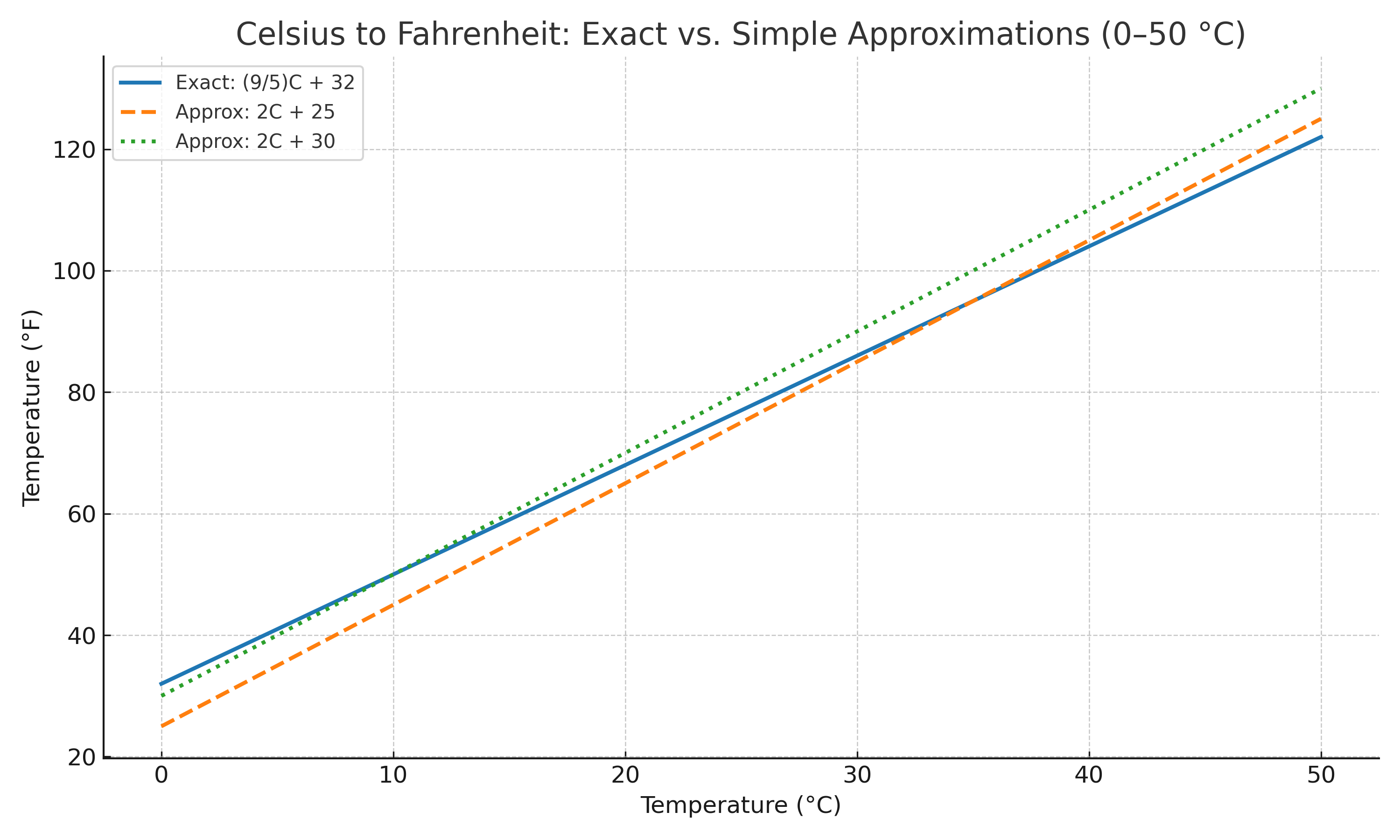
Most of us can’t multiply by 9/5 in our heads. But 9/5 is very nearly two. So if you double the Celsius temperature, you are halfway there. Of course, the number will be too high. But to make up for it, instead of adding 32, just add 30. For weather temperatures, this gives you a ballpark estimate. For 0 °C, you get 30 °F instead of 32. For 20 °C, you get 70 °F instead of 68. For 35 °C, you get 100 °F instead of 95. All close enough.
If you want to flip the error as the temperature goes up, you can remember to add 25 instead of 30 if the temperature is more than, say 25 °C. Then 35 °C gives you 95 °F on the dot, although other temperatures will still have some error, of course.
The error gets worse as the temperature rises, but it has to get fairly high before it gets useless. For example, my AMD CPU is currently at 48 °C. Using the +25 estimate, that’s 121 °F, instead of the correct 118. But maybe it won’t help you set up your metal smelting furnace.
Other Estimates
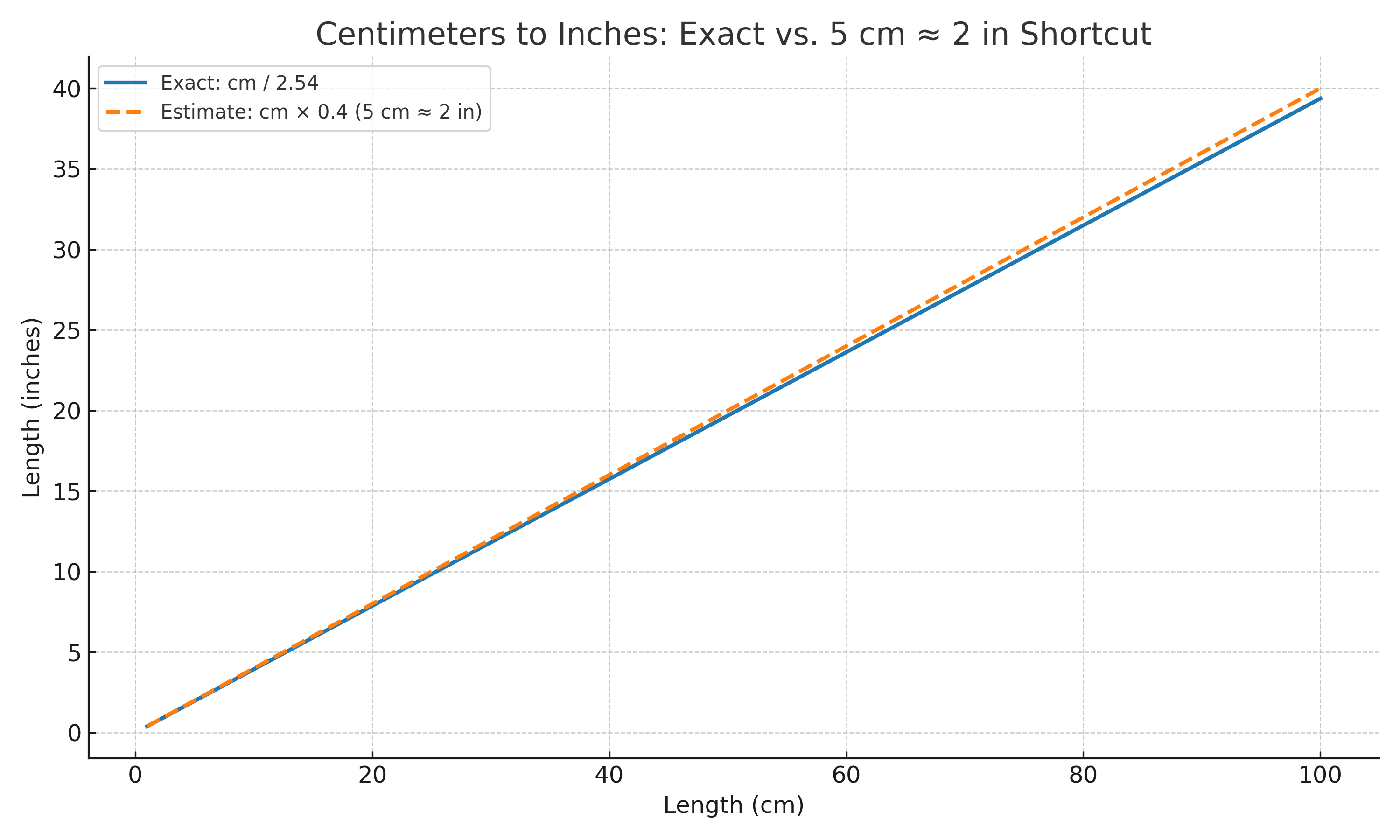
This is a useful way to embrace metric. Find rough estimates for units you deal with. For example, 2.54 cm/inch is not the easiest thing to apply. But if you remember that 5 cm is about 2 in, that works well. So a 160 mm rod is 16 cm. If you think of that as 3 x 5 + 1, you’ll know it is 6 inches plus an extra centimeter. The right answer is about 6.3 inches. Not close enough to start cutting things, but it does give you a feel for how big a thing you are talking about.
If you lived through the time when gasoline in the US went from less than $1/gallon to over, you might remember that many gas stations switched to liters because the pumps couldn’t be set for a dollar. The reason is a liter is very nearly a quart, and there are four quarts to a gallon. So 12 liters is practically 12 quarts or 3 gallons. This turns out to be very close.
Kilograms and kilometers are a bit trickier. The right way to imprecisely convert kilograms to pounds is to multiply by 2.2. But a nice mental math trick is to double it. Then remove the last digit and add the rest back in to the whole result. Then put the last digit you removed after the decimal point. So 8 kg would be 16+1 (throw away the six) or 17 pounds. Then put the 0.6 in for the correct answer of 17.6 pounds. Of course, the conversion factor isn’t exactly 2.2, but that’s what most people use anyway. If you are trying to be scientifically accurate, none of this is going to help you.
The factor for kilometers is roughly 0.6 km/mile or 1.6 miles/km. If you halve the kilometers, that will get you a fairly low estimate. So 35 km (21.7 miles) is easy to guess as more than 17.5 miles. That’s a pretty big difference, though. But if you then add 10% of the 35 back (3.5) you get 21 miles which is close.
Advice
I’m not trying to say that these rule-of-thumb tricks are good when you need an exact answer. But they are handy when you simply want a gut feel over some measure. Over time, you’ll just naturally know that 35 °C is summer-weather hot and you need more than a coffee mug to hold 3 liters.
Do you have a favorite fast conversion back or forth from metric? Share it in the comments. Americans love their strange measuring system. Turns out, some of the reasons we didn’t get metric was due to pirates, as you can see in the video below.
youtube.com/embed/WoUBpPbv0zs?…
Featured image: Wood thermometer on white background by Marco Verch under Creative Commons 2.0
3D Printing a Self-cleaning Water Filter

No one likes cleaning out water spouts. [NeedItMakeIt] wanted to collect rainwater and was interested in using a Coanda filter that those used on hydroelectric plants to separate out debris. Ultimately, he decided to design his own and 3D print it.
The design uses a sloping surface with teeth on it to coax water to go in one direction and debris to go in another. It fits into a typical spout, and seems like it works well enough. Some commenters note that varying volumes of rain and different types of debris behave differently, which is probably true. However, there are similar commercial products, so you’d guess there would be some value to using the technique.
The water pushes the debris off the slope, so you end up losing a little water with the debris. So as always, there’s a trade-off. You can see in the video that if the water flow isn’t substantial, the debris tends to stall on the slope. Could the filter be improved? That was the point in trying a second design.
It wasn’t a big improvement. That’s where there’s a plot twist. Well, actually, a literal twist. Instead of making a flat slope, the new design is a conic shape with a spiral channel. That improved flow quite a bit. We weren’t clear from the video of exactly where the debris was going with the last version.
Usually, when we think of the Coanda effect, we are thinking aerodynamics. It can be quite uplifting.
youtube.com/embed/wy9lKx8X1HI?…
How The Widget Revolutionized Canned Beer

Walk into any pub and order a pint of Guinness, and you’ll witness a mesmerizing ritual. The bartender pulls the tap, fills the glass two-thirds full, then sets it aside to settle before topping it off with that iconic creamy head. But crack open a can of Guinness at home, and something magical happens without any theatrical waiting period. Pour it out, and you get that same cascading foam effect that made the beer famous.
But how is it done? It’s all thanks to a tiny little device that is affectionately known as The Widget.
Beer Engineering

In 1959, draught Guinness diverged from other beers. The pints served from the tap at the pub were charged with a combination of nitrogen gas and carbon dioxide, rather than just carbon dioxide alone. Nitrogen is less soluble in beer than carbon dioxide, and low temperatures and higher pressures are required to get it to stay in the fluid. Charging the beer in this way, and then forcing it through a tap with a restrictor plate with many fine holes, allows the pouring of a beer with small, fine bubbles. This is what gives Guinness its signature smooth, creamy texture and characteristic dense head. The lower carbon dioxide level also contributes to the flavor, removing some of the sharp taste present in regular carbonated beers.
When Guinness started using the nitrogenation method, it quickly gained popularity and became the default way to serve the draught beer. The problem was that it wasn’t initially practical to do the same for bottled Guinness. Without being poured through the fine holes of a special tap under pressure, it wasn’t possible to create the same foamy head. Bottled Guinness thus remained carbonated in the traditional manner, and it was thus very much unlike the draught beer served at the pub. The desire was to produce a better version—”bottled draught Guinness” was a term often bandied about. The company experimented with a variety of methods of serving nitrogenated Guinness from a bottle or can. It even sold some bottles with a special “initiator” syringe to generate head in select markets, but it was all too clumsy to catch on with the beer drinking public. A better solution was needed.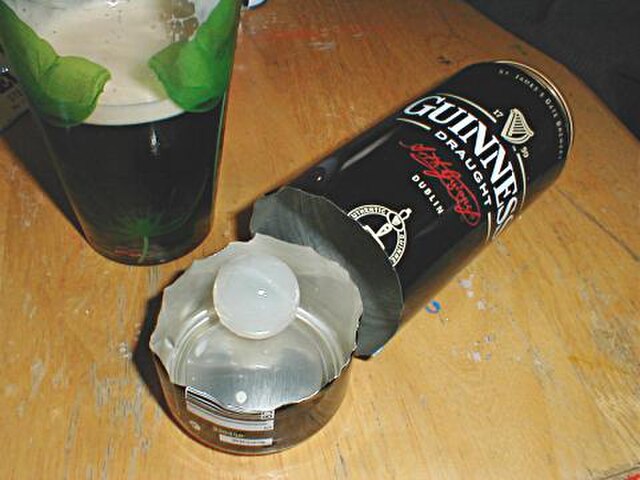
The modern widget was developed as the technological solution to this fundamental problem in beverage physics. Guinness tackled this challenge by essentially putting a tiny pressure vessel inside the larger pressure vessel of the can itself. The widget is a small plastic sphere, hollow inside, with a tiny hole on the surface. The widget and beer are placed inside the can on the production line. Liquid nitrogen is then added, before the can’s lid is sealed. The can is then inverted as the liquid nitrogen quickly boils off into a gas. This effectively fills the widget with gaseous nitrogen under pressure, often along with a small amount of beer. It’s a charged pressure vessel lurking inside the can itself.
The magic happens when the beverage is served. When you crack open the can, the pressure inside drops rapidly to atmospheric pressure. The nitrogen under pressure in the widget thus wants to equalize with the now lower-pressure environment outside. Thus, the nitrogen sprays out through the tiny hole with tremendous force, creating countless microscopic bubbles that act as nucleation sites for the rest of the nitrogen dissolved in the surrounding beer. As the beer is poured into a glass, a foamy head forms, mimicking the product served fresh from the tap at the local pub.
Today’s widget, first marketed in 1997, is the floating sphere type, but the original version was a little different. The original widget launched in 1989 was a flat disc, which was mounted in the bottom of the can, but fundamentally worked in the same way. However, it had a tendency to cause rapid overflowing of the beer if opened when warm. The floating spherical widget reduced this tendency, though the precise engineering reasons why aren’t openly explained by the company. The fixed widget actually had a surprise return in 2020 due to COVID-19 supply chain issues, suggesting it was still mostly fit for purpose in the brewery’s eyes.
The key to the widget’s performance is in the filling and the construction. It’s important to ensure the widget is filled with pressurized gas, hence the inversion step used in the filling process. If the pressurized nitrogen was allowed to simply sit in the empty space in the top of the can, it would just vent out on opening without making any head. The orifice size on the widget is also critical. Too large, and the pressure equalizes too quickly without creating the necessary turbulence. Too small, and insufficient gas and beer volume flows through to generate adequate nucleation. The widget as it stands today is the result of much research and development to optimize its performance.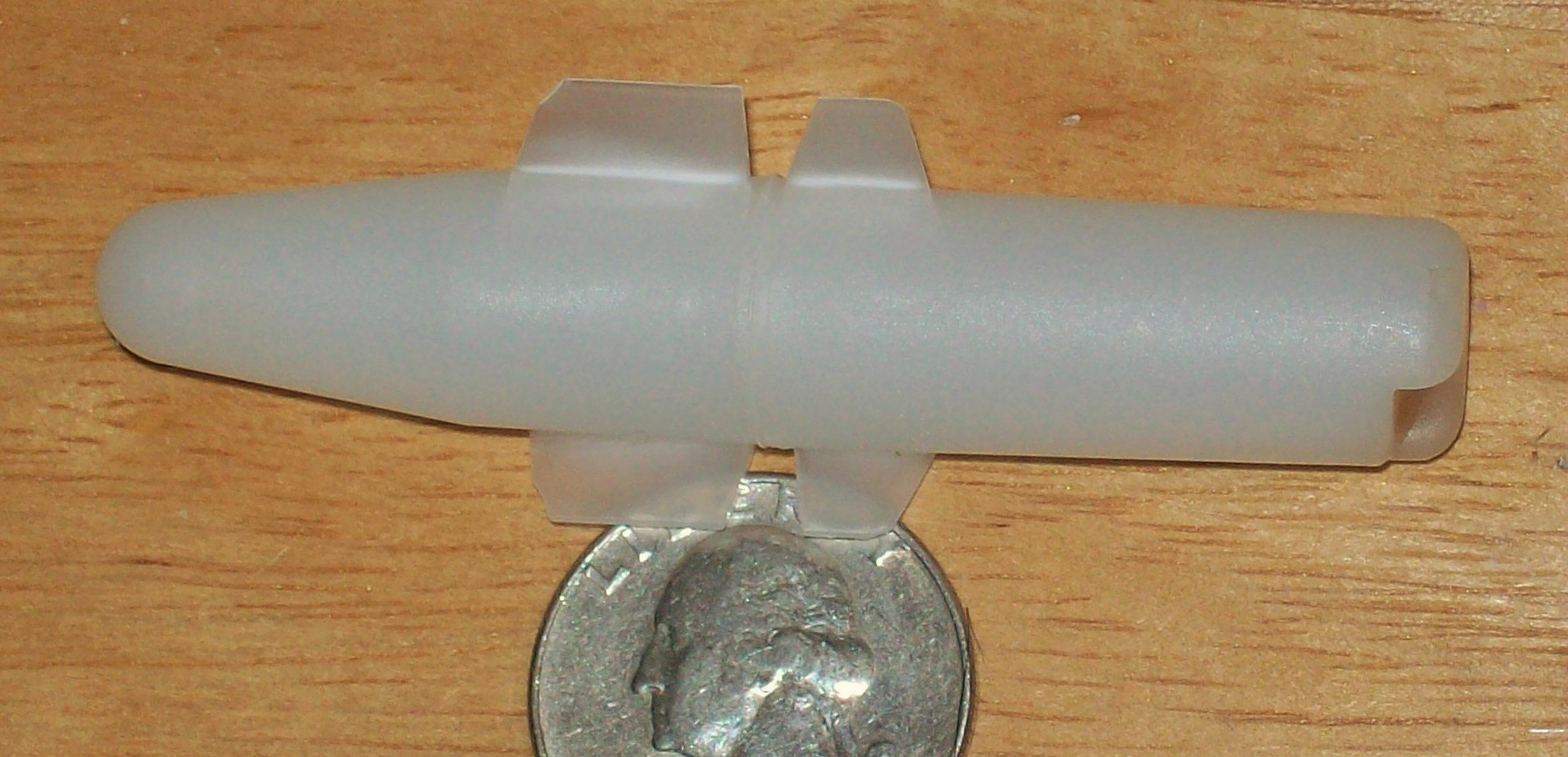
Further different widget designs have emerged over the years. The company had mastered draught Guinness in a can, though it needed to be poured into a glass to be drank properly. The company later looked to create draught Guinness that could be drank straight from the bottle. This led to the creation of the “rocket widget.” It worked largely in the same way, but was designed to float while remaining in the correct orientation inside the neck of the bottle. Fins ensured it wouldn’t fall out of the bottle during drinking. It would charge the beer with bubbles when first opened, and continue to boost the head to a lesser degree each time the bottle was tilted for a sip.
Guinness could have left this problem unsolved. It could have remained a beautiful tap-based beer, while selling its lesser carbonated products in bottles and cans for home consumption. Instead, it innovated, finding a way to create the same creamy tap-poured experience right out of the can.
The next time you crack open a widget-equipped can and watch that mesmerizing cascade of bubbles, you’re witnessing a masterpiece of beverage engineering that took years to perfect. It’s a reminder that sometimes the most elegant engineering solutions hide in the most ordinary places, waiting for someone clever enough to recognize that a tiny plastic ball could revolutionize how we experience beer outside the pub.
Dopo Darcula arriva Magic Mouse: il nuovo incubo del phishing ruba 650.000 carte al mese
Dopo la chiusura della piattaforma di phishing Darcula e del software Magic Cat utilizzato dai truffatori, la soluzione Magic Mouse ha guadagnato popolarità tra i criminali. Secondo gli specialisti di Mnemonic, Magic Mouse contribuisce già al furto di dati da almeno 650.000 carte bancarie al mese.
Recentemente abbiamo parlato del lavoro di Darcula e dell’indagine condotta dagli esperti di Mnemonic. Questa piattaforma PhaaS (phishing-as-a-service) ha preso di mira utenti Android e iPhone in oltre 100 paesi. Il servizio criminale ha utilizzato 20.000 domini che imitavano marchi noti per rubare credenziali.
Secondo gli analisti, gli operatori di Darcula sono stati responsabili del furto di 884.000 carte bancarie e le vittime di hacker in tutto il mondo hanno cliccato su link dannosi ricevuti tramite messaggi di testo 13 milioni di volte.
Poco dopo l’attività di Darcula è cessata, ma come hanno spiegato i ricercatori di Mnemonic al DEF CON, un altro servizio di phishing simile sta guadagnando popolarità tra i criminali informatici.
Gli esperti ricordano che il software Magic Cat ha svolto un ruolo chiave nel lavoro di Darcula. Ora Magic Cat è stato sostituito da una piattaforma simile, Magic Mouse, la cui popolarità è aumentata notevolmente dopo la chiusura di Darcula.
Gli esperti ritengono che Magic Mouse sia un’operazione nuova, con sviluppatori diversi dietro. Non è quindi correlato a Darcula. Tuttavia, l’attuale successo di Magic Mouse è dovuto in gran parte al fatto che nuovi operatori si sono appropriati dei kit di phishing che hanno reso così popolare il software del suo predecessore.
Questi kit contengono centinaia di modelli di siti di phishing che Magic Cat ha utilizzato per imitare pagine web legittime di importanti colossi tecnologici, noti servizi al consumatore e servizi di consegna. Tutti questi siti sono stati progettati per indurre le vittime a fornire i dati della propria carta di credito.
Sebbene Magic Mouse sia già popolare e potrebbe diventare ancora più pericoloso di Magic Cat in futuro, portando ai suoi operatori milioni di dollari di profitti (sotto forma di fondi rubati alle vittime), i ricercatori osservano che le forze dell’ordine “non riescono a vedere” oltre alcune segnalazioni isolate di frode. In altre parole, nessuno attualmente considera Magic Mouse una campagna fraudolenta su larga scala.
Allo stesso tempo, Mnemonic ritiene che gran parte della responsabilità dell’esistenza e della prosperità di tali schemi fraudolenti ricada sulle aziende tecnologiche e sui giganti della finanza, che continuano a rendere difficile ai truffatori l’utilizzo di carte rubate.
L'articolo Dopo Darcula arriva Magic Mouse: il nuovo incubo del phishing ruba 650.000 carte al mese proviene da il blog della sicurezza informatica.
Desalvinizziamo il Ponte sullo Stretto
@Politica interna, europea e internazionale
L'articolo Desalvinizziamo il Ponte sullo Stretto proviene da Fondazione Luigi Einaudi.
freezonemagazine.com/news/john…
Esce il 10 ottobre il Box deluxe composto di nove CD + tre Blue-Ray più un libro di oltre duecento pagine dedicato a John Lennon e Yoko Ono. 31 brani live tratti dai due storici concerti di John e Yoko al One To One Concert, accompagnati dalla Plastic Ono Band, dagli Elephant’s Memory e da […]
L'articolo John Lennon &
Ucraina, l’Europa supera gli Usa e diventa il maggior fornitore di aiuti militari a Kyiv
@Notizie dall'Italia e dal mondo
Per la prima volta dall’inizio della guerra in Ucraina, l’Europa ha superato gli Stati Uniti nella produzione e nella fornitura di materiale militare a Kyiv. Lo dicono i numeri diffusi dal Kiel Institute for the World Economy: tra febbraio 2022 e giugno 2025, la produzione militare europea
Samsung si piega a Trump: nuovi investimenti per chip americani
L'articolo proviene da #StartMag e viene ricondiviso sulla comunità Lemmy @Informatica (Italy e non Italy 😁)
Il lavoro muscolare di Trump sta dando i suoi frutti: la necessità di Apple e Tesla di trovare una filiera statunitense sta portando Samsung a investire nuovamente negli States. La notizia comunque ha una
Golden Dome, ecco come funzionerà lo scudo spaziale di Trump. I dettagli
@Notizie dall'Italia e dal mondo
Il Dipartimento della Difesa degli Stati Uniti ha deciso di alzare il velo sull’architettura operativa del Golden Dome, il futuro sistema di difesa missilistica destinato a proteggere l’intero territorio statunitense – Alaska e Hawaii inclusi – contro le minacce balistiche,
"Fiat: in autunno le prime immagini del prossimo SUV"
ancora suv? maledetti suv. sono la rovina del mondo. a chi si ostina produrre suv posso solo augurare il fallimento.
il concerto di Gastone Pietrucci e la Macina con Elisa Ridolfi - 13 agosto 2025

Il concerto di Gastone Pietrucci e La Macina insieme a Elisa Ridolfi, vincitrice del Premio Tenco 2024 per la migliore opera prima, si è rivelato un'esperienza suggestiva e toccante. Il luogo prescelto, una radura a pochi metri dal borgo medievale di Cerreto di Montegiorgio, ha donato all'evento un'atmosfera intima e quasi magica. Seduti su semplici assi di legno grezzo, ci siamo ritrovati a stretto contatto con i musicisti, annullando ogni barriera e favorendo una vera e propria comunione tra artisti e ascoltatori.
Nonostante la qualità del suono non fosse sempre eccelsa, quasi a voler dimostrare che quello che conta è la sincerità e non la perfezione artificiale, l'espressività dei musicisti ha superato ogni limite tecnico. Le emozioni scaturite da ogni nota e da ogni parola sono state così coinvolgenti da rendere l'esperienza unica e indimenticabile.
L'esibizione ha offerto un viaggio musicale che ha saputo unire brani originali ad omaggi ad alcuni dei più grandi cantautori italiani: le canzoni di De André, Ciampi, Tenco e Piero Cesanelli (padre della rassegna musicale Musicultura) sono state reinterpretate con passione e rispetto. Momenti di rara intensità si sono raggiunti con le esecuzioni appassionate di "Vedrai, vedrai" di Luigi Tenco e del canto popolare "Sotto la croce Maria", così come con la sorprendente interpretazione della “Ballata degli impiccati” di De André, che è stata introdotta dalla voce nuda e dirompente di Elisa Ridolfi.
Questi passaggi hanno trasformato la serata da un semplice concerto in un'esperienza quasi spirituale di condivisione di sentimenti e storie, confermando ancora una volta il valore di una musica che affonda le radici nella tradizione, ma che sa parlare con forza e attualità al cuore di chi ascolta.
(13agosto2025 - #worldland festival)
Giacomo Franca reshared this.

Arrabbiato? Non sfogarti: respira
Sfogarsi fisicamente quando si è arrabbiati, urlando o prendendo a pugni un muro può essere controproducente: per calmarsi meglio fare un bel respiro.Focus.it
L’obsolescenza programmata di Microsoft verrà punita?
L'articolo proviene da #StartMag e viene ricondiviso sulla comunità Lemmy @Informatica (Italy e non Italy 😁)
La sospensione del supporto a Windows 10 finisce in tribunale. Un cittadino californiano accusa Microsoft di spingere all'acquisto di nuovi dispositivi al fine di dominare il mercato dell'IA. Il caso, tra l'altro, ha anche un
reshared this
Il missile nucleare che inquina l’Artico. Putin testa il Burevestnik alla vigilia dei colloqui con Trump
@Notizie dall'Italia e dal mondo
Dal 7 al 12 agosto, le autorità russe hanno chiuso lo spazio aereo per 500 chilometri lungo la costa occidentale di Novaya Zemlya. Almeno quattro navi di supporto hanno raggiunto posizioni di osservazione nel Mare di Barents, mentre due velivoli della Rosatom
DARWIN MONKEY, LA SCIMMIA DI DARWIN, CONOSCIUTA ANCHE COME WUKONG, IL PRIMO SUPERCOMPUTER CON IL CERVELLO DI UN MACACO
@Informatica (Italy e non Italy 😁)
La notizia è del 2 agosto ultimo scorso ed è stata quasi del tutto ignorata. Forse perché è tempo di ferie...
L'articolo DARWIN MONKEY, LA SCIMMIA DI DARWIN, CONOSCIUTA ANCHE
Passo qualche giorno da una mia zia 85enne a cui sono molto affezionato, lo faccio un paio di volte l'anno, per ferragosto e per l'ultimo dell'anno.
Da 5 anni io la televisione l'accendo solo per guardare Netflix, la TV vera e propria la guardo solo qui da mia zia, dove è accesa dalla mattina alla sera.
Ecco... io credo che per capire meglio questo paese, e come sia finito così in basso, non si possa prescindere dal riflettere su quello che passa in TV.
reshared this

La guerra dei chip si tinge di giallo: tracker statunitensi nei semiconduttori per non finire in Cina
L'articolo proviene da #StartMag e viene ricondiviso sulla comunità Lemmy @Informatica (Italy e non Italy 😁)
Per evitare che i chip americani finiscano nelle AI cinesi Washington avrebbe iniziato - ben prima dell'arrivo di Trump - a
reshared this
Recensione : Wojtek Mazowleski Quintet – Live Spirit I
Con Live Spirit I, il Wojtek Mazolewski Quintet firma il suo primo album dal vivo: un viaggio sonoro tra jazz spirituale e momenti di estasi collettiva, che celebra la libertà compositiva del suo leader.

Musk vuole portare in tribunale Apple (a causa di OpenAI)
L'articolo proviene da #StartMag e viene ricondiviso sulla comunità Lemmy @Informatica (Italy e non Italy 😁)
Elon Musk starebbe per procedere legalmente nei confronti di Apple, che accusa di favorire solo OpenAI nel suo App Store, violando le norme antitrust. Ma anche Sam Altman ha qualcosa da ridire su X e poi in ballo ci
La favola dell’anonimato online. Il post di F-Norm Society sull'attacco degli Stati ai diritti dei cittadini
Si racconta la favola dell’anonimato online come la causa di tutti i mali. Il problema è che qualcuno ci crede. Non solo. Il problema è anche che chi ci crede è anche una politica che pensa così di soddisfare un finto problema con una proposta di soluzione stupida. Così stupida che viene addirittura giustificata con l’intenzione di rendere Internet e gli ecosistemi digitali “più sicuri” rendendoli praticamente ad accesso controllato.
reshared this
chiariamo bene: youtu.be/rNFsj5P0ukc
#Gaza #genocide #genocidio #Palestine #Palestina #warcrimes #sionismo #zionism #starvingpeople #starvingcivilians #iof #idf #colonialism #sionisti #izrahell #israelterroriststate #invasion #israelcriminalstate #israelestatocriminale #children #bambini #massacri #deportazione #concentramento #famearmadiguerra
Poliversity - Università ricerca e giornalismo reshared this.
freezonemagazine.com/articoli/…
Quando ci si imbatte in una lettura sui massimi sistemi si sa che il percorso è in salita e per niente facile ma il segno che lascia in questo caso è davvero rivoluzionario e avvincente. Federico Faggin è uno scienziato che ha lavorato dal 1968 alla Silicon Valley inventando quel microprocessore che ha cambiato lo […]
L'articolo OLTRE L’INVISIBILE – Federico
The Department of Energy said it will close FOIA requests from last year unless the requester emails the agency to say they are still interested. Experts say it's an "attempt to close out as many FOIA requests as possible."
The Department of Energy said it will close FOIA requests from last year unless the requester emails the agency to say they are still interested. Experts say itx27;s an "attempt to close out as many FOIA requests as possible."#FOIA #FOIAForum


Trump Administration Outlines Plan to Throw Out an Agency's FOIA Requests En Masse
The Department of Energy (DOE) said in a public notice scheduled to be published Thursday that it will throw out all Freedom of Information Act (FOIA) requests sent to the agency before October 1, 2024 unless the requester proactively emails the agency to tell it they are still interested in the documents they requested. This will result in the improper closure of likely thousands of FOIA requests if not more; government transparency experts told 404 Media that the move is “insane,” “ludicrous,” a “Pandora’s Box,” and “an underhanded attempt to close out as many FOIA requests as possible.”The DOE notice says “requesters who submitted a FOIA request to DOE HQ at any time prior to October 1, 2024 (FY25), that is still open and is not under active litigation with DOE (or another Federal agency) shall email StillInterestedFOIA@hq.doe.gov to continue processing of the FOIA request […] If DOE HQ does not receive a response from requesters within the 30-day time-period with a DOE control number, no further action will be taken on the open FOIA request(s), and the file may be administratively closed.” A note at the top of the notice says it is scheduled to be formally published in the Federal Register on Thursday.
The agency will send out what are known as “still interested” letters, which federal agencies have used over the years to see if a requester wants to withdraw their request after a certain period of inactivity. These types of letters are controversial and perhaps not legal, and previous administrations have said that they should be used rarely and that requests should only be closed after an agency made multiple attempts to contact a requester over multiple methods of communication. What the DOE is doing now is sending these letters to submitters of all requests prior to October 1, 2024, which is not really that long ago; it also said it will close the requests of people who do not respond in a specific way to a specific email address.
FOIA requests—especially complicated ones—can often take months or years to process. I have outstanding FOIA requests with numerous federal agencies that I filed years ago, and am still interested in getting back, and I have gotten useful documents from federal agencies after years of waiting. The notion that large numbers of people who filed FOIA requests as recently as September 2024, which is less than a year ago, are suddenly uninterested in getting the documents they requested is absurd and should be seen as an attack on public transparency, experts told 404 Media. The DOE’s own reports show that it often does not respond to FOIA requests within a year, and, of course, a backlog exists in part because agencies are not terribly responsive to FOIA.
“If a requester proactively reaches out and says I am withdrawing my request, then no problem, they don’t have to process it,” Adam Marshall, senior staff attorney at the Reporters Committee for Freedom of the Press, told me. “The agency can’t say we’ve decided we’ve gotten a lot of requests and we don’t want to do them so we’re throwing them out.”
“I was pretty shocked when I saw this to be honest,” Marshall added. “I’ve never seen anything like this in 10 years of doing FOIA work, and it’s egregious for a few reasons. I don’t think agencies have the authority to close a FOIA request if they don’t get a response to a ‘still interested’ letter. The statute doesn’t provide for that authority, and the amount of time the agency is giving people to respond—30 days—it sounds like a long time but if you happen to miss that email or aren’t digging through your backlogs, it’s not a lot of time. The notion that FOIA requesters should keep an eye out in the Federal Register for this kind of notice is ludicrous.”
The DOE notice essentially claims that the agency believes it gets too many FOIA requests and doesn’t feel like answering them. “DOE’s incoming FOIA requests have more than tripled in the past four years, with over 4,000 requests received in FY24, and an expected 5,000 or more requests in FY25. DOE has limited resources to process the burgeoning number of FOIA requests,” the notice says. “Therefore, DOE is undertaking this endeavor as an attempt to free up government resources to better serve the American people and focus its efforts on more efficiently connecting the citizenry with the work of its government.”
Lauren Harper of the Freedom of the Press Foundation told me in an email that she also has not seen any sort of precedent for this and that “it is an underhanded attempt to close out as many FOIA requests as possible, because who in their right mind checks the federal register regularly, and it should be challenged in court. (On that note, I am filing a FOIA request about this proposal.)”
“The use of still interested letters isn't explicitly allowed in the FOIA statute at all, and, as far as I know, there is absolutely zero case law that would support the department sending a mass ‘still interested’ letter via the federal register,” she added. “That they are also sending emails is not a saving grace; these types of letters are supposed to be used sparingly—not as a flagrant attempt to reduce their backlog by any means necessary. I also worry it will open a Pandora's Box—if other agencies see this, some are sure to follow.”
Marshall said that FOIA response times have been getting worse for years across multiple administrations (which has also been my experience). The Trump administration and the Department of Government Efficiency (DOGE) have cut a large number of jobs in many agencies across the government, which may have further degraded response times. But until this, there hadn’t been major proactive attempts taken by the self-defined “most transparent administration in history” to destroy FOIA.
“This is of a different nature than what we have seen so far, this affirmative, large-scale effort to purport to cancel a large number of pending FOIA requests,” Marshall said.

Rete criminale organizzata albanese smantellata

Una serie di perquisizioni in Albania, nei giorni scorsi, ha portato all'arresto di 10 presunti membri di una rete criminale organizzata albanese coinvolta nel traffico di cocaina e nel riciclaggio di denaro. La rete, che aveva legami con organizzazioni internazionali, è stata presa di mira dalle forze dell'ordine albanesi in coordinamento con Belgio, Francia, Germania, Italia e Paesi Bassi.

Durante l'operazione, le autorità hanno sequestrato ingenti beni, tra cui immobili, veicoli e azioni di società per un valore di diversi milioni di euro. L'indagine ha inoltre portato alla luce una serie di prove fisiche e digitali, inclusi i dati della piattaforma di comunicazione criptata Sky ECC, che è stata disattivata nel 2021 ma ha comunque prodotto risultati operativi.
Il capo della rete era coinvolto nell'organizzazione di spedizioni e nell'investimento in grandi quantità di cocaina, ed era ricercato per una condanna a 21 anni di carcere emessa da un tribunale italiano per omicidio e altri reati. L'operazione ha segnato un successo basato sui dati: gli investigatori hanno ricostruito consegne di tonnellate di cocaina verso i porti dell'UE e sequestrato milioni di euro di beni.
fabrizio reshared this.
F-35 italiani intercettano due caccia russi nello spazio aereo Nato. I dettagli
@Notizie dall'Italia e dal mondo
Per la prima volta, due caccia F-35 Lightning II dell’Aeronautica militare italiana hanno intercettato due velivoli russi operanti vicino allo spazio aereo dell’Alleanza. I due aerei intercettati sono decollati dalla base di Ämari, in Estonia, come confermato
By omitting the "one-third" provision that most other states with age verification laws have adopted, Wyoming and South Dakota are placing the burden of verifying users' ages on all sorts of websites, far beyond porn.
By omitting the "one-third" provision that most other states with age verification laws have adopted, Wyoming and South Dakota are placing the burden of verifying usersx27; ages on all sorts of websites, far beyond porn.#ageverification
Recensione : Mark Solotroff – In Search of Total Placelessness
Mark Solotroff, figura cardine della scena noise-industrial e power electronics americana (fondatore di Intrinsic Action, Anatomy Of Habit, BLOODYMINDED), torna quest'anno con In Search of Total Placelessness
#musica
iyezine.com/mark-solotroff-in-…

Mark Solotroff - In Search of Total Placelessness - In Your Eyes ezine
Mark Solotroff, figura cardine della scena noise-industrial e power electronics americana (fondatore di Intrinsic Action, Anatomy Of Habit, BLOODYMINDED), torna quest'anno con In Search of Total PlacelessnessNoiseGang (In Your Eyes ezine)
Recensione : The Unknowns – Looking from the outside
The Unknowns "Looking from the outside": un'esperienza punk che scuote e incendia! Scopri il terzo album della band australiana che spacca!
iyezine.com/the-unknowns-looki…

The Unknowns - Looking from the outside - In Your Eyes ezine
The Unknowns "Looking from the outside": un'esperienza punk che scuote e incendia! Scopri il terzo album della band australiana che spacca!Reverend Shit-Man (In Your Eyes ezine)
Tiziano
in reply to Tiziano • •(dal mio vecchio account Mastodon)
Destinazione: Germania settentrionale. Prima tappa: Ulm con il suo incredibile Münster, il Rathaus decoratissimo e il suo cielo plumbeo e piovoso.
Tiziano
in reply to Tiziano • •(dal mio vecchio account Mastodon)
Stamattina concerto al castello (duo violino-violoncello con Tjeknavorian e Müller-Schott, in programma Kodály, Ravel e Halvorsen)
Concerto spettacolare! 😍👏👏👏
Tiziano
in reply to Tiziano • •(dal mio vecchio account Mastodon)
...e nel pomeriggio, un tuffo nelle memorie del Classico con il museo dedicato a Schliemann ad Ankershagen
Katy B. 📚 🥛
in reply to Tiziano • • •Era disegnata sulla copertina di un libro delle medie!
...dunque esiste davvero!
Tiziano
in reply to Tiziano • •(dal mio vecchio account Mastodon)
Il giro in Mecklenburg-Vorpommern prosegue... Da Greifswald, città di Caspar David Friedrich, alla natura del Boddenlandschaft.
Tiziano
in reply to Tiziano • •(dal mio vecchio account Mastodon)
L'anseatica Stralsund mi ricorda che, quando c'è bellezza, non c'è una vera differenza tra arte, scienza e gioco...
Tiziano
in reply to Tiziano • •(dal mio vecchio account Mastodon)
Comunque a Stralsund ho scoperto e visitato con piacere questa piccola fabbrica di carte da gioco in cui si usano ancora i sistemi di una volta e ho acquistato due mazzi ripresi da modelli storici 😍
@Sole 🏳️🌈
Sole 🏳️🌈
in reply to Tiziano • • •Tiziano likes this.
Tiziano
in reply to Tiziano • •(dal mio vecchio account Mastodon)
Rapida carrellata di Wismar e Schwerin (vedere descrizioni immagini)
Tiziano
in reply to Tiziano • •(dal mio vecchio account Mastodon)
Lubecca in tre collage (vedere descrizioni immagini)
Tiziano
in reply to Tiziano • •(dal mio vecchio account Mastodon)
Concerto spettacolare stasera a Marne (Schleswig-Holstein):
Sabine Meyer (cl), Anastasia Kobekina (vlc), Kit Armstrong (pf)
Beethoven: Trio
Bernstein: Sonata per cl e pf
Beethoven: Sonata per vlc e pf op. 69
Brahms: Trio
Nel video il bis (l'hanno annunciato in tedesco ma non ho capito... qualcuno conosce il pezzo? A me suona vagamente schumanniano)
peertube.uno/w/rKdHTTFtUZthYj4…
@Pierrette @Boerps ☑️ @Matteo Zenatti idee?
Tiziano
in reply to Tiziano • •(dal mio vecchio account Mastodon)
Dalla stupenda Kunsthalle di Amburgo...
#arte #Kunst #Hamburg #romanticismo #Friedrich #Munch #Fussli
Tiziano
in reply to Tiziano • •(dal mio vecchio account Mastodon)
Comunque mentre stavo entrando nella sala principale del museo un tipo mi si avvicina e mi fa (in inglese, piuttosto concitatamente e sgranando gli occhi): "Ehi, c'è un tuo ritratto qua dentro!" e alla mia faccia sbigottita precisa: "C'è un ritratto che ti assomiglia tantissimo!", fa un gesto verso il lato sinistro della sala e se ne va. Dopo aver guardato bene tutto quello che era esposto ed eliminato l'impossibile, ho concluso che doveva riferirsi a questo... (ho I capelli più lunghi adesso)
Tiziano
in reply to Tiziano • •(dal mio vecchio account Mastodon)
Stade, una gemma della Bassa Sassonia
Tiziano
in reply to Tiziano • •(dal mio vecchio account Mastodon)
Oggi ho scoperto i Kunstautomat, distributori automatici d'arte. Sono un'idea originale e secondo me carinissima: un vecchio distributore automatico di tabacchi diventa un mezzo per mettere in contatto gli artisti locali e il pubblico. Con 4 euro si può prelevare una scatoletta preparata da un artista con una piccola opera, il suo CV e I suoi contatti. Ecco il sito del progetto tradotto in italiano: translate.kagi.com/translate/i…
@Cultura, Storia, Libri, Arte, Architettura, Scuola, Design, Fumetti e Bookwyrm
Tiziano
in reply to Tiziano • •(dal mio vecchio account Mastodon)
CONTRASTI (1/2)
A Celle, le case a graticcio dalle decorazioni fantasiose e variopinte non sono l'unica cosa "particolare"...
Tiziano
in reply to Tiziano • •(dal mio vecchio account Mastodon)
CONTRASTI (2/2)
Nei dintorni, ben celato dalle distese boschive, sorgeva il tristemente noto campo di Bergen-Belsen, dove trovò la morte una ragazza olandese di 15 anni che abbiamo tutti nel cuore.
(Girando per le tombe ho scambiato qualche parola con una ragazza che vedevo soffermarsi a lungo davanti alle lapidi e ai cartelli. Aveva 15 anni e veniva dall'Olanda. Mi ha espresso il suo pensiero più forte: "Avrei potuto essere io")
Tiziano
in reply to Tiziano • •(dal mio vecchio account Mastodon)
Le bellezze di Hildesheim (info nelle didascalie)
Tiziano
in reply to Tiziano • •(dal mio vecchio account Mastodon)
Lipsia è stata un'immersione nel "mio" mondo musicale di violoncellista: entrare nei luoghi frequentati da Bach, Mendelssohn e Schumann (ma anche Mozart, Liszt e tanti altri) è stata un'emozione unica...
Tiziano
in reply to Tiziano • •(dal mio vecchio account Mastodon)
Sempre a Lipsia: la chiesa di San Nicola (Nikolaikirche), dall'incredibile architettura stile impero che la fa assomigliare a un teatro e addirittura (almeno al mio occhio) anticipa il liberty di un secolo... Non ero mai entrato in un chiesa così!
Tiziano
in reply to Tiziano • •(dal mio vecchio account Mastodon)
Ed ecco l'ultimo "arretrato" dal viaggio in Germania: Norimberga. Questa volta a casa di un altro artista importante (e anche da lui una piccola sorpresa...)
Tiziano
in reply to Tiziano • •(dal mio vecchio account Mastodon)
Dovrei fare i post delle ultime città del giro perché sono rimasto indietro di diversi giorni, ma visto che oggi è sabato approfitto del #caturday per rendere omaggio alla nostra compagna di viaggio che si è fatta centinaia di chilometri in camper senza un lamento!
Ecco a voi Pollyanna (detta Cici) la viaggiatrice! 🐱❤️
#catsofmastodon #cats #cat #catsoffediverse #catstodon
MEOW Moments reshared this.