
Commesse Dipartimento Difesa Usa. La Leonardo al primo posto sistemi anti-droni
@Notizie dall'Italia e dal mondo
Presentato il sistema “Ring C-UxS” che sfrutta un sofisticato apparato elettronico in grado di intercettare, identificare e distruggere droni “nemici” provenienti da terra, dall’aria e dal mare
L'articolo Commesse Dipartimento Difesa Usa. La
Il Ces è il nuovo ring tech tra Usa e Cina: a prendersi a cazzotti sono i robot
Per vedere altri post come questo, segui la comunità @Informatica (Italy e non Italy 😁)
Quello dei robot è un ecosistema ancora vergine e inesplorato: al Ces di Las Vegas prevalgono gli espositori cinesi ma gli americani hanno dalla loro diverse Big che spesso si muovono all'unisono con
116117 Numero Europeo Armonizzato (NEA) per cure non urgenti
https://www.regione.liguria.it/homepage-salute/cosa-cerchi/campagne-di-comunicazione/sanita-piu-vicina/numero-116-117.Ministero della Salute
freezonemagazine.com/news/mich…
In libreria dal 23 Gennaio 2026 Jimenez Edizioni apre il 2026 con Lupi nella notte, l’ultimo romanzo di Michael Farris Smith, un autore già ampiamente conosciuto e apprezzato negli Stati Uniti, finora mai pubblicato in Italia. Un oscuro racconto del Sud, popolato da anime spezzate, la cui vita è dominata da scelte […]
L'articolo Michael Farris Smith – Lupi nella notte
freezonemagazine.com/news/mass…
In libreria dal 23 Gennaio 2026 Con l’originalità che ne ha contraddistinto la produzione e il gusto narrativo che ha reso Gente nel tempo e Il figlio di due madri dei classici della letteratura italiana, Bontempelli torna in libreria con un’opera bizzarra, a tratti surreale, che coniuga sperimentazione e divertimento, in conformità ai principi del […]
L'articolo Massimo Bontempelli
Report annuale Polizia Postale 2025: la normalità dell’attacco, il dovere della resilienza
@Informatica (Italy e non Italy 😁)
La fotografia scattata dal report annuale della Polizia Postale è netta: frodi industrializzate, incidenti continui, AI che aumenta la credibilità delle truffe. Un’analisi dei punti salienti e delle scelte operative che imprese e
freezonemagazine.com/articoli/…
Il canto sommesso di un gruppo che non ha mai smesso di essere necessario Nel contesto del 1975 — anno di Born to Run, di Blood on the Tracks, dell’ascesa della West Coast dorata e del suono FM — questo disco sembrava fuori asse. Eppure, nella sua modestia, anticipava quella vena roots introspettiva che solo […]
L'articolo The Beau Brummels
Drive 1024×600 Pixels via I2C with an ATtiny85

If you need to drive a big screen for a project, it’s fair to say your first thought isn’t going to be to use the ATtiny85. With just 512 bytes of RAM and 8 kilobytes of flash memory, the 8-bit micro seems a little cramped to drive, say, a 10″ screen. Yet that’s exactly what [ToSStudio] is doing with TinyTFT_LT7683: 1024 x 600 pixels of TFT goodness, over I2C no less.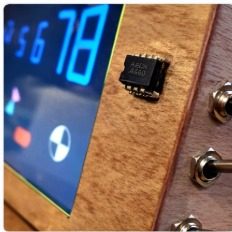
The name kind of gives away the secret: it won’t work on just any TFT display. It’s using properties of the LT7683 display driver, though if you don’t have one of those, the RA8875 is also compatible. Those drivers can take more than just a pixel stream– a good thing, since you’d be hard pressed to get that many pixels streaming from an ATtiny. These are character/graphic display drivers, which means you can get them to draw both characters and graphics on the screen if you speak the lingo.
It’s still not blazing fast; the documentation suggests “static or moderately dynamic UIs” as the suggested use case, and a clock is of the pre-programmed examples. From that, we can surmise that you can get 1 FPS or better with this code. You’re limited both by the simple micro-controller and the bandwidth of the I2C bus, but within those limits this seems like a very powerful technique.
This isn’t the first ATtiny graphics library to blow our minds, but if you really want an impressive graphics demo from the little micro that could, you really need to race the beam.
Thanks to [Thomas Scherer] for the tip!
LA GUERRA: ALCUNE DEFINIZIONI E CARATTERISTICHE (PRIMA PARTE)
@Informatica (Italy e non Italy 😁)
In questi ultimi anni la comunicazione, scritta e verbale, ci ha subissato di informazioni inerenti alle guerre, seppur concentrandosi sulle due principali.
L'articolo LA GUERRA: ALCUNE DEFINIZIONI E CARATTERISTICHE (PRIMA PARTE) proviene da GIANO NEWS.
#DIFESA
[2026-01-13] GAZA: DOCTORS UNDER ATTACK @ Ospedale Santa Maria delle Croci - ingresso via Missiroli
GAZA: DOCTORS UNDER ATTACK
Ospedale Santa Maria delle Croci - ingresso via Missiroli - 5, Viale Vincenzo Randi, Alberoni, Ravenna, Emilia-Romagna, 48121, Italia
(martedì, 13 gennaio 15:00)
Proiezione del documentario

GAZA: DOCTORS UNDER ATTACK
- prima proiezione 15:00 - 17:00
- seconda proiezione 18:00 - 20:00
Aula Pavoni Dea (settimo piano)
Saranno presenti rappresentanti di Emergency Ravenna e Carlo Biasioli, skipper di Morgana (Flotilla)
[2026-01-30] ECHI DAL SUDAN IN LOTTA @ Spazio libertario Sole e Baleno
ECHI DAL SUDAN IN LOTTA
Spazio libertario Sole e Baleno - 27, Sobborgo Valzania, Quartiere Fiorenzuola, Ponte Abbadesse, Cesena, Unione dei comuni Valle del Savio, Forlì-Cesena, Emilia-Romagna, 47521, Italia
(venerdì, 30 gennaio 19:30)
Ore 19:30 - Cena Vegan BENEFIT PER LA LOTTA IN SUDAN.
Ore 20:30 – ECHI DAL SUDAN IN LOTTA

Nel 2019 una rivolta popolare della durata di 4 mesi ha costretto il dittatore sudanese Al-Bashir, alla guida dello stato dal 1989 cedere il potere. L'insurrezione è continuata anche sotto il successivo governo di transizione civile-militare, e non è cessata nemmeno dopo il colpo di stato militare del 2021, che ha rimesso al potere i generali. Nonostante la brutale repressione, l'autorganizzazione nei quartieri è continuata, creando spiragli di libertà in cui potesse prendere forma un modo di vivere libero da stato, poteri religiosi ed etnici.
E' in questo contesto che è nata e ha agito la federazione anarchica del Sudan, incitando alla rivolta, organizzando distribuzioni di cibo, farmaci e beni di prima necessità. Il moto rivoluzionario è continuato fino al 2023, quando lo scoppio della guerra civile tra i due generali al potere, l'ha soffocata nel sangue, diffondendo, come ogni guerra, stupri, massacri e distruzione.
Da quasi 3 anni i signori della guerra, con il supporto finanziario e militare di vari attori esteri, cinicamente assetati di risorse, si combattono. Le stime, probabilmente al ribasso, parlano di 150 000 morti/e e 15 milioni di sfollati/e.
I compagni e le compagne sudanesi tentano di sopravvivere e resistere in questo contesto brutale, senza prendere parte per uno o l'altro signore della guerra, costrettx a imbracciare le armi, anche a costo della vita.
Lo stato italiano e l'unione europea hanno la loro parte, avendo finanziato e addestrato le milizie RSF in funzione anti migranti, e ampliando il commercio di armi con gli Emirati Arabi, uno dei principali sponsor della guerra in Sudan.
Ne parliamo in collegamento con un compagno dal Sudan.
[2026-01-11] Assemblea plenaria @ Lab!Puzzle
Assemblea plenaria
Lab!Puzzle - Via Monte Meta, 21
(domenica, 11 gennaio 17:00)
𝐋’𝐀𝐒𝐒𝐄𝐌𝐁𝐋𝐄𝐀
L’assemblea di Lab!Puzzle è libera, pubblica, democratica, antifascista, antisessista e antirazzista, prerogative che riteniamo indispensabili per il vivere civile ed un confronto sano. Si tiene ogni prima domenica del mese alle ore 17:00, salvo quando diversamente specificato.

𝐎𝐑𝐃𝐈𝐍𝐄 𝐃𝐄𝐋 𝐆𝐈𝐎𝐑𝐍𝐎:
L’odg si redige in mailing list ed è in continuo aggiornamento. Per iscriversi occorre partecipare ad almeno un’assemblea.
𝐄̀ 𝐋𝐀 𝐏𝐑𝐈𝐌𝐀 𝐕𝐎𝐋𝐓𝐀 𝐂𝐇𝐄 𝐕𝐈𝐄𝐍𝐈?
È riservato uno spazio all’interno di ogni assemblea per le presentazioni, per raccontarsi, per dire la propria.
𝐏𝐮𝐨𝐢 𝐏𝐀𝐑𝐓𝐄𝐂𝐈𝐏𝐀𝐑𝐄 𝐚𝐧𝐜𝐡𝐞 𝐎𝐍𝐋𝐈𝐍𝐄
Qui il link meet.jit.si/assemblea_labpuzzl…
[2026-01-12] Assemblee delle Donne e Libere Soggettività dei Consultori @ Via Brugnato
Assemblee delle Donne e Libere Soggettività dei Consultori
Via Brugnato - Via Brugnato, 2, 00148 Roma RM
(lunedì, 12 gennaio 16:00)
Riprendono le assemblee delle donne e delle libere soggettività dei consultori di Roma e del Lazio

Una volta al mese (giorno e orario fisso e pubblicato da NUDM) nei consultori dove è presente L'ASSEMBLEA DELLE DONNE E DELLE LIBERE SOGGETTIVITÀ, viene fatto dal coordinamento un incontro aperto al territorio
PER ri-attivare e far conoscere, specialmente alle nuove generazioni, queste strutture socio-sanitarie di territorio gratuite, laiche e per la prevenzione di tutt coloro che le attraversano;
PER creare rapporto e confronto con le/gli operator e una costante verifica/controllo della qualità dell'offerta con i responsabili delle diverse Aziende socio sanitarie; PER metterci in gioco ed essere parte attiva del diritto alla nostra salute e benessere.
Partecipiamo e aumentiamole, non solo per difendere i consultori da costanti attacchi e chiusure, ma per farne aprire molti di più e rispondere ai nostri bisogni e desideri.
Per ulteriori informazioni puoi scrivere a
coordinamentoconsultorilazio@gmail.com
Coordinamento delle Assemblee delle donne e delle libere soggettività dei consultori di Roma e del Lazio
[2026-01-13] Assemblee delle Donne e Libere Soggettività dei Consultori @ Ospedale Luigi Spolverini
Assemblee delle Donne e Libere Soggettività dei Consultori
Ospedale Luigi Spolverini - Via delle Cerquette, 2, 00040 Ariccia RM
(martedì, 13 gennaio 14:00)
Riprendono le assemblee delle donne e delle libere soggettività dei consultori di Roma e del Lazio

Una volta al mese (giorno e orario fisso e pubblicato da NUDM) nei consultori dove è presente L'ASSEMBLEA DELLE DONNE E DELLE LIBERE SOGGETTIVITÀ, viene fatto dal coordinamento un incontro aperto al territorio
PER ri-attivare e far conoscere, specialmente alle nuove generazioni, queste strutture socio-sanitarie di territorio gratuite, laiche e per la prevenzione di tutt coloro che le attraversano;
PER creare rapporto e confronto con le/gli operator e una costante verifica/controllo della qualità dell'offerta con i responsabili delle diverse Aziende socio sanitarie; PER metterci in gioco ed essere parte attiva del diritto alla nostra salute e benessere.
Partecipiamo e aumentiamole, non solo per difendere i consultori da costanti attacchi e chiusure, ma per farne aprire molti di più e rispondere ai nostri bisogni e desideri.
Per ulteriori informazioni puoi scrivere a
coordinamentoconsultorilazio@gmail.com
Coordinamento delle Assemblee delle donne e delle libere soggettività dei consultori di Roma e del Lazio

Due bambini al casolare Impastato.
Quandola Memoria diventa Seme.Paolo Chirco (Il Blog di Paolo Chirco)

Scientists discovered that some dogs, known as Gifted Word Learners, can passively pick up language and may possess toddler-level cognitive skills.#TheAbstract


‘Gifted’ Dogs Learn Human Language, Study Finds
Welcome back to the Abstract! Here are the studies this week that lurked in the dark, pulsated with light, wagged a tail, and called it a night.First, scientists have yet again spotted a bizarre object in space that has never been seen before—the universe just keeps serving them up. Then: news from the biggest star in the sky, a tale of eavesdropping dogs, and a jellyfish sleepover.
As always, for more of my work, check out my book First Contact: The Story of Our Obsession with Aliensor subscribe to my personal newsletter the BeX Files.
You don’t want to be on this Cloud-9
Astronomers have glimpsed a new type of cosmic object—a starless clump of dark matter that never quite worked up the oomph to become a galaxy. Known as Cloud-9, the entity is located about 14 million light years away and likely provides the first look at an ancient dark matter halo.
Dark matter, as you may have heard, is weird stuff that has never been directly detected or identified, but nonetheless accounts for almost all matter in the universe. In the early universe, clumps of dark matter formed halos that attracted gas, sparked star formation, and evolved into the first galaxies. But while all galaxies appear to have dark matter halos, not all dark matter halos turned into galaxies.
Scientists have long speculated that some halos may have never accumulated the right amount of mass to make a star-studded galaxy. For years, astronomers have searched for the gravitational signatures of these dark starless “failed galaxies,” which are known as Reionization-Limited H I Clouds (RELHICs).
Now, a team reports that the first clear RELHIC candidate ever discovered, providing support for the standard model of cosmology, also known as the Lambda cold dark matter (ΛCDM) model, which is the current working framework of the universe.
Digitized Sky Survey image covering a 10′ × 10′ region around Cloud-9. Image: Anand, Gagandeep S. et al.
“The abundance of halos far exceeds that of known galaxies, implying that not all halos are able to host luminous galaxies,” said researchers led by Gagandeep S. Anand of the Space Telescope Science Institute in Baltimore. “This has been interpreted to mean that galaxies only form in halos that exceed a ‘critical’ mass.’”“Our results make Cloud-9 the leading RELHIC candidate,” the team continued. “This provides strong support for a cornerstone prediction of the Lambda cold dark matter model, namely the existence of gas-filled starless dark matter halos on subgalactic mass scales, and constrains the present-day threshold halo mass for galaxy formation.”
Cloud-9 might one day accumulate enough mass to pass the threshold for star formation, allowing it to eventually graduate into a galaxy. But for now, it is a galaxy school flunkie.
In other news…
Big star go boom soon
WOH G64, one of the largest stars in the sky, is nearing its death. At about 2,000 times the size of the Sun, this supergiant would extend beyond Saturn if it were placed in our solar system.
Scientists have speculated that the recent dimming of the senescent star might signal a transition from a red supergiant to a yellow hypergiant, making it one step closer to supernova. But a new study reveals evidence that WOH G64 “is currently a red supergiant” and its changing light may be influenced by a companion star in orbit around it, making this a binary system.
Concept art of WOH G64. image: ESO/L. Calçada
“For a long time, WOH G64 was known as the most extreme red supergiant outside our Galaxy,” said researchers led by Jacco Th. van Loon of Keele University. “However, in a matter of years it has faded” and “its pulsations have become suppressed.”“We have presented evidence that the remarkable changes witnessed in the 21st-century in the optical brightness and spectrum of the most extreme known extragalactic red supergiant, WOH G64 may be due to binary interaction,” the team continued, noting that “we may be witnessing the birth of a…supernova progenitor.”
Fortunately, this time bomb is located 160,000 light years away, so we are well beyond the blast radius. Whenever WOH G64 does explode, the supernova could be bright enough to see with the naked eye from Earth, despite its location far outside the Milky Way.
Learn with doggo-lingo
It’s not your imagination: Your dog might actually be a really good listener. While it’s well-known that dogs respond to a variety of commands, researchers have now demonstrated that some pooches, known as Gifted Word Learners, can pick up new words just by passively overhearing their owners’ conversations.
Over a series of experiments, researchers gave dogs fun toys to play with, which their owners then named in conversations that were not directed at the dogs. The pets were then able to identify the toys by the labels at a rate significantly above what would be expected by chance, even though they had never been directly taught the words.
A dog that participated in the study, enjoying the toys. Image: Don Harvey
The findings suggest that some dogs may have sociocognitive skills parallel to young toddlers, and further confirms that a variety of animals can demonstrate various degrees of language comprehension. But the best part is the following detail about how the effervescent joy of dogs was accounted for in the experimental design.“Because dogs are neophilic and often get excited by new toys, we gave them ample opportunities to interact with the toys without hearing their labels,” said researchers led by Shany Dror of University of Veterinary Medicine in Vienna.
Science completed? Check. Dogs got loads of playtime? Check. Win-win.
Jellyfish naps > cat naps
We’ll close by yawning and going back to bed—a waterbed in this case, because this is a story about the sleep cycles of marine animals. To probe the broader evolutionary purpose of sleep, scientists monitored periods of slumber and wakefulness in the upside-down jellyfish Cassiopea andromeda and the anemone Nematostella vectensis.
The results revealed that these animals had remarkably similar sleeping habits to people. “Like humans, both species require a total of approximately 8 hours of sleep per day,” said researchers led by Raphaël Aguillon, who conducted the work at Bar-Ilan University, and is now at IBPC Paris-Sorbonne University.
“Notably, similar to findings in primates and flies, a midday nap was also observed in C. andromeda,” the team added.
Talk about sleeping with the fishes! The upshot of the study is that sleep has evolved across all animals with a nervous system to help repair damaged DNA, a benefit that is apparently worth the vulnerability of a resting state. But for our weekend purposes, my takeaway is that even jellyfish enjoy a midday nap, so go ahead and take that siesta.
Thanks for reading! See you next week.
NASA’s Hubble Examines Cloud-9, First of New Type of Object
A team using Hubble uncovered a new type of astronomical object — a starless, gas-rich, dark-matter cloud, a remnant of early galaxy formation.NASA Hubble Mission Team (NASA Science)
This week, we discuss viewing terrible images online and giving out zines at a benefit show.#BehindTheBlog
Behind the Blog: The 'View From Nowhere'
This is Behind the Blog, where we share our behind-the-scenes thoughts about how a few of our top stories of the week came together. This week, we discuss viewing terrible images online and giving out zines at a benefit show.EMANUEL: I’ve seen a lot of terrible videos in my years online but by far the most upsetting type of video shows police using excessive force and especially videos of police killing people. There are more graphic videos from battlefields and other dark corners of the internet but what happened to Renee Nicole Good this week could happen to anyone living in America, and when I imagine the tragedy that has been visited on her loved ones I can’t help but imagine how easily I or anyone I care about can find ourselves in the same situation.
This post is for subscribers only
Become a member to get access to all content
Subscribe now

In an attempt to push more people toward a paying subscription, Grok now refuses to generate images in replies. The paywall is pretty leaky, though.#ElonMusk #xcom #ncii #abuseimagery
Masterful Gambit: Musk Attempts to Monetize Grok's Wave of Sexual Abuse Imagery
Elon Musk, owner of the former social media network turned deepfake porn site X, is pushing people to pay for its nonconsensual intimate image generator Grok, meaning some of the app’s tens of millions of users are being hit with a paywall when they try to create nude images of random women doing sexually explicit things within seconds.Some users trying to generate images on X using Grok receive a reply from the chatbot pushing them toward subscriptions: “Image generation and editing are currently limited to paying subscribers. You can subscribe to unlock these features.”
Users who fork over $8 a month can still reply to random images of random women and girls directly on X and tag in Grok with things like “make her wear clear tapes with tiny black censor bar covering her private part protecting her privacy and make her chest and hips grow largee[sic] as she squatting with leg open widely facing back, while head turn back looking to camera.” These images are still visible in everyone’s X feed, subscribers or not.On the Grok app, a subscription to SuperGrok ($29.99/month) or SuperGrok Heavy ($299.99/month) allow users to generate images even faster. On Thursday, I received messages in the Grok app several times warning me that usage rates for the app were higher than normal and that I could pay to skip the wait.
As the Verge reported this morning, this paywall is very leaky. It’s still possible to generate images using Grok in a variety of ways, but replying directly to someone’s post by tagging @[url=https://bird.makeup/users/grok]Grok[/url] returns the “limited to subscribers” message.
Grok’s AI Sexual Abuse Didn’t Come Out of Nowhere
With xAI’s Grok generating endless semi-nude images of women and girls without their consent, it follows a years-long legacy of rampant abuse on the platform.404 MediaSamantha Cole
As many legacy news outlets have already reported, Musk improved the subscription revenue funnel on his money-burning app following an outcry against these extremely popular uses of the app. “X Limits Grok Image Tool To Subscribers After Deepfake Outcry,” Deadline reported. “Grok turns off image generator for most users after outcry over sexualised AI imagery,” wrote the Guardian. “Elon Musk restricts Grok’s image tools following a wave of non-consensual deepfakes of women and children,” Fortune wrote.Based on these headlines, you may be thinking, This is an uncharacteristic show of accountability and perhaps even self reflection from the billionaire technocrat white supremacist sympathizer who owns X.com, wow! But as with all things Musk does, this is a business move to monetize the long-established harassment factory he’s owned for three years and has yet to figure out how to make profitable. After years of attempting to push users toward a subscription model by placing meaningless status signifiers behind a paywall and making the site so toxic it bleeds users by the millions, he might have found a way to do it: by monetizing abuse at the source. Several other AI industry giants have already figured out that sexual content is where the money’s at, and Musk appears to be catching up. Putting the nonconsensual sexual images behind a paywall is also what every “nudify” and “undress” app and image generator platform on the market already does.
On Thursday, in the middle of Grok’s CSAM shitstorm, Bloomberg reported that xAI is looking at “a net loss of $1.46 billion for the September quarter, up from $1 billion in the first quarter,” according to internal documents obtained by Bloomberg. “In the first nine months of the year, it spent $7.8 billion in cash.” It’s too early to speculate, but making the people who are tagging @[url=https://bird.makeup/users/grok]Grok[/url] under the posts of women they don’t know and writing prompts like “make her bend over on all fours doggy style” multiple times a second pay for the privilege could be a play to get the company back in the black.
playlist.megaphone.fm?p=TBIEA2…
In addition to using Grok on X.com on desktop, It’s also still easy to generate images and videos in the Grok app without a subscription, which is still available on the Apple and Google app stores, despite blatantly breaking their rules against non-consensual material and pornography. The app and underground Telegram groups are where the really bad stuff is, anyway. Apple and Google have not replied to my request for comment about why the app is still available.Signing up for X Premium or SuperGrok requires handing over your payment information, name associated with your credit card, and phone number. It also comes with the risk of having all of that hacked, stolen, and released to the dark web in the next big data breach of the platform.
Correction: An earlier version of this article incorrectly stated how many years ago Musk bought Twitter.
Massive breach of Elon Musk's X allegedly leaks over 200 million users' email addresses
Billions of X accounts could be affected overallMatt Binder (Mashable)


Le politiche di Trump contro le persone trans sono estremamente preoccupanti
Dagli Stati Uniti arriva un segnale di allarme che non può essere ignorato. L’Istituto Lemkin, ONG internazionale impegnata nella prevenzione dei genocidi, ha recentemente pubblicato uno studio che invita a leggere con estrema attenzione le politiche adottate dall’amministrazione Trump nei confronti delle persone trans*, non binarie e intersex. Secondo l’Istituto, e secondo autorevoli studiosi della materia, tra cui due ex presidenti dell’Associazione Internazionale degli Studiosi del Genocidio, tali politiche presentano caratteristiche riconducibili alle fasi iniziali dei processi di persecuzione sistematica che, in diversi contesti storici del Novecento, hanno preceduto crimini di massa e stermini di intere comunità.
La letteratura comparata sul genocidio mostra con chiarezza come questi processi non abbiano inizio con l’eliminazione fisica, ma con la costruzione istituzionale dell’alterità: la definizione di un gruppo come deviante, pericoloso o incompatibile con l’ordine sociale; la progressiva erosione dei suoi diritti; la normalizzazione della discriminazione attraverso atti amministrativi, legislativi e retorici. Dinamiche analoghe sono state osservate nei regimi totalitari europei del secolo scorso, così come in altri contesti segnati da politiche di esclusione radicale e disumanizzazione collettiva.
In questo quadro si collocano le politiche di persecuzione delle persone transgender, non binarie e intersex, che l’Istituto Lemkin individua come un preambolo a forme più estreme di violenza. Emblematica è la normativa che obbliga le persone trans* a utilizzare i servizi igienici in base al sesso assegnato alla nascita: una misura che non può essere considerata simbolica o marginale, ma che contribuisce a legittimare socialmente il controllo dei corpi e l’esposizione forzata nello spazio pubblico.
La dottoressa Elisa von Joeden-Forgey sottolinea come la combinazione di paura, propaganda e retoriche d’odio promosse o tollerate da apparati politico-statali costituisca il terreno su cui attecchiscono le forme più estreme di violenza. È uno schema ricorrente nella storia dei genocidi: prima l’isolamento simbolico, poi l’esclusione giuridica, infine la violenza aperta. I dati che ci arrivano confermano la gravità di questo contesto, mostrando un aumento delle difficoltà nel fare coming out e un incremento dei tassi di suicidio all’interno della comunità, segnali inequivocabili di una pressione sistemica che colpisce direttamente la vita delle persone.
Trump sta utilizzando i corpi delle persone migranti e di quelle trans*, non binarie e intersex come strumenti politici, contribuendo ad anestetizzare l’opinione pubblica rispetto alla violenza strutturale tipica dei regimi autoritari. È una strategia già vista nella storia, in cui la normalizzazione dell’abuso e dell’esclusione prepara il terreno a forme sempre più radicali di disumanizzazione.
Per questo, ricordando le parole del pastore Martin Niemöller nel celebre sermone “Prima vennero…”, è nostro compito non voltarci mai dall’altra parte davanti alla violenza e alla sua normalizzazione. Non saremo mai in un mondo libero finché esisterà anche una sola persona oppressa per il suo credo, per il suo sesso, per la sua identità di genere, per la sua nazionalità o per il colore della sua pelle.
Gianmarco Capogna
Vanessa Capretto
Thomas Predieri
L'articolo Le politiche di Trump contro le persone trans sono estremamente preoccupanti proviene da Possibile.
Nicola Pizzamiglio likes this.
Nicola Pizzamiglio reshared this.


Ministero dell'Istruzione
#NoiSiamoLeScuole questa settimana è dedicato alle nuove scuole di Sibari e Grisolia Scalo, due interventi scolastici finanziati dal #PNRR in provincia di Cosenza, che rafforzano l’offerta educativa attraverso edifici sicuri, sostenibili e progettati…Telegram

Ministero dell'Istruzione
Dal 13 gennaio iniziano le #IscrizioniOnline! Se avete dubbi nella scelta della #scuola, sulla piattaforma #Unica è possibile consultare la pagina dedicata alla ricerca, al confronto e alla scelta del percorso di studi più adatto.Telegram
The Intel 8087 and Conditional Microcode Tests

Continuing his reverse-engineering of the Intel 8087, [Ken Shirriff] covers the conditional tests that are implemented in the microcode of this floating point processing unit (FPU). This microcode contains the details on how to perform the many types of specialized instructions, like cos and arctan, all of which decode into many microcode ops. These micro ops are executed by the microcode engine, which [Ken] will cover in more detail in an upcoming article, but which is effectively its own CPU.
Conditional instructions are implemented in hardware, integrating the states of various functional blocks across the die, ranging from the instruction decoder to a register. Here, the evaluation is performed as close as possible to the source of said parameter to save on wiring.
Implementing this circuitry are multiplexers, with an example shown in the top die shot image. Depending on the local conditions, any of four pass transistors is energized, passing through that input. Not shown in the die shot image are the inverters or buffers that are required with the use of pass transistors to amplify the signal, since pass transistors do not provide that feature.
Despite how firmly obsolete the 8087 is today, it still provides an amazing learning opportunity for anyone interested in ASIC design, which is why it’s so great that [Ken] and his fellow reverse-engineering enthusiasts keep plugging away at recovering all this knowledge.
The SCSI Film Scanner Resurrection

[Ronan] likes 35mm film photography, but the world, of course, has gone digital. He picked up an Epson FilmScan 200 for about €10. This wonder device from 1997 promised to convert 35mm film to digital at 1200 DPI resolution. But there was a catch: it connects via SCSI. Worse, the drivers were forever locked to Windows 95/98 and Mac System 7/8.
In a surprise twist, though, [Ronan] recently resurrected a Mac SE/30 with the requisite SCSI port and the System 7 OS. Problem solved? Not quite. The official software is a plugin for Photoshop. So the obvious answer is to write new software to interact with the device.
First, of course, you have to figure out how the device works. A service manual provided clues that, as far as the SCSI bus knew, the device wasn’t a scanner at all, but a processor. The processor, though, used SCSI as a simple pipe to handle Epson’s standard “ESC/I” protocol.
Armed with that information and a knowledge of the Mac’s SCSI Manager API, the rest is just coding. Well, that is until [Ronan] tried to scan the other five negatives in the six-negative film carrier. He was frustrated until he found an old patched SANE driver for the scanner from 2002. By looking at how it worked, he was able to figure out how to switch to the other negatives.
Color scanning also took a little coaxing. The scanner returns three monochrome images, one for each color channel. Some assembly, then, is required. In the end, though, the project was a complete success. Can’t find a FilmScan 200? Don’t have a SCSI port? There’s always the roll-your-own approach.


Digitale Gewalt: Abgeordnete, Ministerien und EU-Kommission bleiben auf Deepfake-Plattform X
netzpolitik.org/2026/digitale-…


What the Maduro ‘extradition’ could mean for U.S. journalists
For journalists who work online, the most dangerous assumption is that press freedom is territorial. It is not. In the digital age, journalists publish globally by default, and states increasingly assert criminal jurisdiction globally as well.
The recent assertion of U.S. authority to seize (kidnapping is such an “ugly” word) Venezuelan President Nicolás Maduro illustrates a broader and deeply unsettling truth: Once a state claims jurisdiction, the limiting factor is not law, but power. For journalists, that reality has been quietly unfolding for decades.
Extraterritorial jurisdiction and the press
Domestic law (and law enforcement) does not stop at the border. Most countries reserve the “right” to prosecute those outside the country whose actions are directed inside the country, or which impact that country’s laws, citizens, or property.
The concept of “extraterritorial” jurisdiction of domestic law was recognized by the U.S. Supreme Court in 1922 in United States v. Bowman, where the court noted that certain criminal statutes apply extraterritorially by their nature when they protect national interests. This is commonly called the “protective” principle of extraterritorial application of law. In the cyber era, courts have applied this doctrine aggressively to online conduct, including speech, publication, and data access.
Journalists are not exempt. While the First Amendment provides robust protection against U.S. prosecution for publishing truthful information of public concern, those protections are not portable. They do not bind foreign courts, nor do they prevent foreign states from asserting jurisdiction over content accessible within their borders.
Journalists prosecuted for online speech abroad
One of the earliest and most influential cases illustrating this problem is LICRA v. Yahoo! Inc., a 2000 French case where the court asserted jurisdiction over Yahoo, a U.S. company, for hosting Nazi memorabilia auctions accessible from France, where French law prohibited the display of Nazi materials.
Although Yahoo ultimately resisted enforcement in U.S. courts, the case established the principle that online publication can subject speakers and publishers to the criminal law of any country where the content is accessible. Countries routinely attempt to enforce their own laws — terrorism, defamation, etc., over the activities of journalists outside their borders.
For example, in Akçam v. Turkey, the European Court of Human Rights recognized the chilling effect of Turkey’s criminal laws on speech, including academic and journalistic commentary. But Turkish prosecutors continue to attempt to use Interpol red notices — which alert law enforcement agencies worldwide to locate and detain an individual — to have foreign journalists prosecuted.
In 2023, Russian authorities issued criminal charges against foreign reporters for coverage of the war in Ukraine, alleging dissemination of “false information” about the Russian military — conduct that would be core protected speech in the United States — in violation of the Russian criminal code.
If other countries adopt the Maduro precedent, a foreign country can enforce its laws against U.S. journalists simply by force or power.
China has attempted to use Article 12 of the Cybersecurity Law of the PRC to prosecute those who disseminate online content that “endangers national security” or “damages the public interest” of China. Foreign journalists have been detained, expelled, or prosecuted for online reporting hosted on servers outside China but accessible within it. The Maduro regime itself cracked down on journalists within its own borders, prosecuting them for crimes like terrorism, incitement, and conspiracy.
The United States recently proposed to require those entering the country to provide border agents with access to five years of their social media history, threatening to use this information to ban, arrest, detain, or punish those whose history indicates some vaguely defined “un-American” political persuasion. Moreover, the U.S. government spent years attempting to obtain jurisdiction over Australian WikiLeaks founder Julian Assange for his publication from abroad of materials the U.S. government claimed could not be published under U.S. law.
There is no ‘there there’
Typically, if speech is permitted (or protected) in the jurisdiction in which it is uttered or published, but prohibited or regulated in another country, the “injured” country has few remedies to go after the speaker/publisher. While it can charge the person with a crime and request that they be extradited, extradition treaties typically require that the conduct be considered “criminal” in both countries. And many countries (including the U.S.) do not typically extradite their own citizens.
Add to that the fact that most extradition treaties also permit the host country to resist extradition for “political speech” or “political activity,” and that an extradition request is subject to both a legal and political process. In addition, the likelihood that a U.S. journalist would be extradited to China, Turkey, or another country for First Amendment-protected activity is small — not nonexistent, but small.
Countries may, however, consider the activities of journalists to constitute violations of surveillance, theft, intellectual property, threat, defamation, or espionage laws, increasing the chance that they will be treated as nonpolitical offenses. Put simply, we extradite whom we want to countries we want for purposes we want. And that’s what other countries do as well.
Kidnapping, rendition, and the Ker–Frisbie Doctrine
What the Maduro case shows is that governments (including the U.S. government) reserve either the right or the pure ability to invade the territorial sovereignty of other nations to obtain jurisdiction over those (including heads of state) we believe have violated U.S. law. The U.S. Supreme Court has repeatedly affirmed the authority of the U.S. to “kidnap” persons overseas and bring them to U.S. courts — and presumably the opposite applies as well.
Under what is called the Ker-Frisbie Doctrine, the domestic courts do not look at the way the court obtained jurisdiction over the defendant (unless this “shocks the conscience”), but simply look at whether the defendant is physically present.
In the 1886 case Ker v. Illinois, the Supreme Court held that a defendant abducted from Peru could still be tried in U.S. court. It affirmed the principle in 1952 in Frisbie v. Collins. In the 1992 case United States v. Alvarez-Machain, after U.S. Drug Enforcement Administration agents abducted a doctor in Mexico and brought him to trial in the U.S., the court noted that the U.S./Mexico extradition treaty was just “one way” to obtain jurisdiction over a person. Apparently, kidnapping is another. As a federal appellate court made clear five years later in United States v. Noriega, this principle applies to foreign heads of state as well.
What this means for journalists
For journalists, the implication is sobering. Publishing an article, hosting leaked documents, or reporting on state misconduct online can expose a reporter to criminal liability in jurisdictions with radically different views of press freedom.
The fact that the work is lawful — and even celebrated — in the United States offers no protection abroad. We saw that when Washington Post journalist Jamal Khashoggi was abducted and dismembered by the Saudi government at the Saudi consulate in Istanbul, Turkey.
What typically “saves” journalists is that foreign countries may fear invading the territorial sovereignty of the host nation. This is why most prosecutions of journalists occur in the country in which they are operating. Russia’s prosecutions of Alsu Kurmasheva, a Russian-American journalist working for Radio Free Europe/Radio Liberty, and Wall Street Journal correspondent Evan Gershkovich follow this pattern, as does the Turkish government’s detention of freelance journalist Lindsey Snell in Turkey in 2016.
In a networked world, journalism is inherently transnational, but press freedom is not.
However, if a journalist can be lured into a compliant country, or if other countries adopt the Maduro precedent, a foreign country can enforce its laws on people in the U.S. simply by force or power. Instructive is the case of Henry Liu, a Chinese American critic of the Taiwanese government, which hired Taiwanese gang members to kill him in California, or the attempted murder in Brooklyn, New York, of Iranian-American journalist Masih Alinejad.
While journalists and others may be protected by the First Amendment, that protection typically applies only if they are physically in the United States, and assumes that the U.S. has no interest in extraditing the journalist to another country. With the Maduro precedent extending the authority to kidnap those who we perceive to have violated the law of one nation, other nations can be expected to follow suit. It’s no longer about what White House Deputy Chief of Staff Stephen Miller called “international niceties” but is about “a world, … the real world, … that is governed by strength, that is governed by force, that is governed by power.”
Law as narrative, power as reality
The lesson for journalists is not that the law is meaningless, but that it is secondary. Power determines who is charged, who is seized, and who is left alone. Law supplies justification after the fact.
In a networked world, journalism is inherently transnational, but press freedom is not. For journalists who work online, the question is no longer merely, “Is this lawful where I am?” It is, “Who might claim jurisdiction, and what can they do to enforce it?”
The answer, increasingly, depends less on courts than on geopolitics.
In cyberspace, publication is global. So is exposure.
Trump punta su Starlink di Musk per liberare internet in Iran
Per vedere altri post come questo, segui la comunità @Informatica (Italy e non Italy 😁)
Il regime di Teheran spegne Internet nel mezzo delle proteste e il presidente Usa Trump sta valutando una serie di possibili opzioni. Al centro del confronto anche l'uso del servizio di connettività satellitare di Elon Musk. Il blackout
Guerra civile Rai. Perché un programma non può attaccare un altro
@Giornalismo e disordine informativo
articolo21.org/2026/01/guerra-…
“Tocca ricordare un’ovvietà: non si può usare uno spazio Rai per dare addosso a un altro programma Rai, con minacce annesse. Visto quanto accade, è però necessario ribadirlo,
Poliversity - Università ricerca e giornalismo reshared this.
La battaglia della famiglia e della società civile per la liberazione di Alberto Trentini
@Giornalismo e disordine informativo
articolo21.org/2026/01/la-batt…
Diciamolo subito. Il merito primario della liberazione del cooperante veneziano Alberto Trentini è
A Bologna il primo febbraio 2026 prima edizione del Premio Nazionale Andrea Purgatori
@Giornalismo e disordine informativo
articolo21.org/2026/01/a-bolog…
A Bologna il primo febbraio, in occasione della giornata dedicata ad Andrea Purgatori: “Buon compleanno Andrea”,
Ottavia Piccolo: “La liberazione di Alberto è il risveglio da un incubo”
@Giornalismo e disordine informativo
articolo21.org/2026/01/ottavia…
Sulla liberazione di Alberto Trentini è intervenuta Ottavia Piccolo. .L’attrice e doppiatrice, che è anche presidente di Articolo 21 a Venezia, è il volto
Trentini libero: finalmente!
@Giornalismo e disordine informativo
articolo21.org/2026/01/trentin…
Alberto Trentini è libero: finalmente! Nessun’altra esclamazione ha senso di fronte a una notizia che abbiamo atteso per oltre quattrocento giorni. È il compimento di una battaglia che abbiamo combattuto in prima persona anche quando a occuparci delle sorti del cooperante veneziano eravamo
Si vede da come mi vede
A volte non serve lo specchio per capire chi siamo. Basta uno sguardo. Quello di chi ci incrocia distrattamente in metropolitana, o quello più intenso di chi ci conosce davvero. È buffo, ma finiamo sempre per misurarci con il riflesso che gli altri ci restituiscono, come se la nostra identità fosse una foto sfocata che solo gli occhi altrui riescono a mettere a fuoco. Ci si abitua presto a vivere sotto osservazione, anche quando nessuno ci guarda. In fondo, siamo animali sociali: abbiamo bisogno di sentirci visti per credere di esistere.
Nicola Pizzamiglio likes this.
#Iran, la guerra prima della guerra

Iran, la guerra prima della guerra -
L’ondata di proteste che nelle ultime settimane sta attraversando l’Iran rappresenta forse la minaccia più grave per la tenuta del sistema uscito dallaMichele Paris (altrenotizie.org)

Con la multa a Cloudflare Piracy Shield dimostra ciò che sappiamo da tempo. Che non funziona
Il funzionamento dello scudo nazionale anti-pirateria ha un peccato originale: non tiene conto di come funziona internet. E saranno le tanto vituperate regole europee a proteggere l'azienda Usa e il suo ad che sbaglia a usare l’arma del ricattoLuca Zorloni (Wired Italia)
With xAI's Grok generating endless semi-nude images of women and girls without their consent, it follows a years-long legacy of rampant abuse on the platform.
With xAIx27;s Grok generating endless semi-nude images of women and girls without their contest, it follows a years-long legacy of rampant abuse on the platform.#grok #ElonMusk #AI #csam
Grok's AI Sexual Abuse Didn't Come Out of Nowhere
The biggest AI story of the first week of 2026 involves Elon Musk’s Grok chatbot turning the social media platform into an AI child sexual imagery factory, seemingly overnight.I’ve said several times on the 404 Media podcast and elsewhere that we could devote an entire beat to “loser shit.” What’s happening this week with Grok—designed to be the horny edgelord AI companion counterpart to the more vanilla ChatGPT or Claude—definitely falls into that category. People are endlessly prompting Grok to make nude and semi-nude images of women and girls, without their consent, directly on their X feeds and in their replies.
Sometimes I feel like I’ve said absolutely everything there is to say about this topic. I’ve been writing about nonconsensual synthetic imagery before we had half a dozen different acronyms for it, before people called it “deepfakes” and way before “cheapfakes” and “shallowfakes” were coined, too. Almost nothing about the way society views this material has changed in the seven years since it’s come about, because fundamentally—once it’s left the camera and made its way to millions of people’s screens—the behavior behind sharing it is not very different from images made with a camera or stolen from someone’s Google Drive or private OnlyFans account. We all agreed in 2017 that making nonconsensual nudes of people is gross and weird, and today, occasionally, someone goes to jail for it, but otherwise the industry is bigger than ever. What’s happening on X right now is an escalation of the way it’s always been, and almost everywhere on the internet.
💡
Do you know anything else about what's going on inside X? Or are you someone who's been targeted by abusive AI imagery? I would love to hear from you. Using a non-work device, you can message me securely on Signal at sam.404. Otherwise, send me an email at sam@404media.co.The internet has an incredibly short memory. It would be easy to imagine Twitter Before Elon as a harmonious and quaint microblogging platform, considering the four years After Elon have, comparatively, been a rolling outhouse fire. But even before it was renamed X, Twitter was one of the places for this content. It used to be (and for some, still is) an essential platform for getting discovered and going viral for independent content creators, and as such, it’s also where people are massively harassed. A few years ago, it was where people making sexually explicit AI images went to harass female cosplayers. Before that, it was (and still is) host to real-life sexual abuse material, where employers could search your name and find videos of the worst day of your life alongside news outlets and memes. Before that, it was how Gamergate made the jump from 4chan to the mainstream. The things that happen in Telegram chats and private Discord channels make the leap to Twitter and end up on the news.
What makes the situation this week with Grok different is that it’s all happening directly on X. Now, you don’t need to use Stable Diffusion or Nano Banana or Civitai to generate nonconsensual imagery and then take it over to Twitter to do some damage. X has become the Everything App that Elon always wanted, if “everything” means all the tools you need to fuck up someone’s life, in one place.
Inside the Telegram Channel Jailbreaking Grok Over and Over Again
Putting people in bikinis is just the tip of the iceberg. On Telegram, users are finding ways to make Grok do far worse.404 MediaEmanuel Maiberg
This is the culmination of years and years of rampant abuse on the platform. Reporting from the National Center for Missing and Exploited Children, the organization platforms report to when they find instances of child sexual abuse material which then reports to the relevant authorities, shows that Twitter, and eventually X, has been one of the leading hosts of CSAM every year for the last seven years. In 2019, the platform reported 45,726 instances of abuse to NCMEC’s Cyber Tipline. In 2020, it was 65,062. In 2024, it was 686,176. These numbers should be considered with the caveat that platforms voluntarily report to NCMEC, and more reports can also mean stronger moderation systems that catch more CSAM when it appears. But the scale of the problem is still apparent. Jack Dorsey’s Twitter was a moderation clown show much of the time. But moderation on Elon Musk’s X, especially against abusive imagery, is a total failure.In 2023, the BBC reported that insiders believed the company was “no longer able to protect users from trolling, state-co-ordinated disinformation and child sexual exploitation” following Musk’s takeover in 2022 and subsequent sacking of thousands of workers on moderation teams. This is all within the context that one of Musk’s go-to insults for years was “pedophile,” to the point that the harassment he stoked drove a former Twitter employee into hiding and went to federal court because he couldn't stop calling someone a “pedo.” Invoking pedophelia is a common thread across many conspiracy networks, including QAnon—something he’s dabbled in—but Musk is enabling actual child sexual abuse on the platform he owns.
Generative AI is making all of this worse. In 2024, NCMEC saw 6,835 reports of generative artificial intelligence related to child sexual exploitation (across the internet, not just X). By September 2025, the year-to-date reports had hit 440,419. Again, these are just the reports identified by NCMEC, not every instance online, and as such is likely a conservative estimate.
When I spoke to online child sexual exploitation experts in December 2023, following our investigation into child abuse imagery found in LAION-5B, they told me that this kind of material isn’t victimless just because the images don’t depict “real” children or sex acts. AI image generators like Grok and many others are used by offenders to groom and blackmail children, and muddy the waters for investigators to discern actual photographs from fake ones.
Grok’s AI CSAM Shitshow
We are experiencing world events like the kidnapping of Maduro through the lens of the most depraved AI you can imagine.404 MediaJason Koebler
“Rather than coercing sexual content, offenders are increasingly using GAI tools to create explicit images using the child’s face from public social media or school or community postings, then blackmail them,” NCMEC wrote in September. “This technology can be used to create or alter images, provide guidelines for how to groom or abuse children or even simulate the experience of an explicit chat with a child. It’s also being used to create nude images, not just sexually explicit ones, that are sometimes referred to as ‘deepfakes.’ Often done as a prank in high schools, these images are having a devastating impact on the lives and futures of mostly female students when they are shared online.”The only reason any of this is being discussed now, and the only reason it’s ever discussed in general—going back to Gamergate and beyond—is because many normies, casuals, “the mainstream,” and cable news viewers have just this week learned about the problem and can’t believe how it came out of nowhere. In reality, deepfakes came from a longstanding hobby community dedicated to putting women’s faces on porn in Photoshop, and before that with literal paste and scissors in pinup magazines. And as Emanuel wrote this week, not even Grok’s AI CSAM problem popped up out of nowhere; it’s the result of weeks of quiet, obsessive work by a group of people operating just under the radar.
And this is where we are now: Today, several days into Grok’s latest scandal, people are using an AI image generator made by a man who regularly boosts white supremacist thought to create images of a woman slaughtered by an ICE agent in front of the whole world less than 24 hours ago to “put her in a bikini.
As journalist Katie Notopoulos pointed out, a quick search of terms like “make her” shows people prompting Grok with images of random women, saying things like “Make her wear clear tapes with tiny black censor bar covering her private part protecting her privacy and make her chest and hips grow largee[sic] as she squatting with leg open widely facing back, while head turn back looking to camera” at a rate of several times a minute, every minute, for days.
A good way to get a sense of just how fast the AI undressed/nudify requests to Grok are coming in is to look at the requests for it t.co/ISMpp2PdFU
— Katie Notopoulos (@katienotopoulos) January 7, 2026
In 2018, less than a year after reporting that first story on deepfakes, I wrote about how it’s a serious mistake to ignore the fact that nonconsensual imagery, synthetic or not, is a societal sickness and not something companies can guardrail against into infinity. “Users feed off one another to create a sense that they are the kings of the universe, that they answer to no one. This logic is how you get incels and pickup artists, and it’s how you get deepfakes: a group of men who see no harm in treating women as mere images, and view making and spreading algorithmically weaponized revenge porn as a hobby as innocent and timeless as trading baseball cards,” I wrote at the time. “That is what’s at the root of deepfakes. And the consequences of forgetting that are more dire than we can predict.”A little over two years ago, when AI-generated sexual images of Taylor Swift flooding X were the thing everyone was demanding action and answers for, we wrote a prediction: “Every time we publish a story about abuse that’s happening with AI tools, the same crowd of ‘techno-optimists’ shows up to call us prudes and luddites. They are absolutely going to hate the heavy-handed policing of content AI companies are going to force us all into because of how irresponsible they’re being right now, and we’re probably all going to hate what it does to the internet.”
It’s possible we’re still in a very weird fuck-around-and-find-out period before that hammer falls. It’s also possible the hammer is here, in the form of recently-enacted federal laws like the Take It Down Act and more than two dozen piecemeal age verification bills in the U.S. and more abroad that make using the internet an M. C. Escher nightmare, where the rules around adult content shift so much we’re all jerking it to egg yolks and blurring our feet in vacation photos. What matters most, in this bizarre and frequently disturbing era, is that the shareholders are happy.
Elon Musk's xAI raises $20 billion from investors including Nvidia, Cisco, Fidelity
Elon Musk's AI said it raised $20 billion in new funding after CNBC reported in November that a financing round would value the company at about $230 billion.Lora Kolodny (CNBC)

