
[2026-03-06] Cena popolare + presentazione libro "Memorie della periferia" @ COA T28
Cena popolare + presentazione libro "Memorie della periferia"
COA T28 - Via dei Transiti 28, Milano
(venerdì, 6 marzo 18:30)
Venerdì 6 marzo in Via Dei Transiti 28 al COA T28

Dalle 18:30 presentazione del libro "memorie della periferia" di Manolo Morlacchi
A seguire cena popolare a base di cassœula e
musica dialettale milanese con Luca Bartolommei!
[2026-03-07] Azione di Food Not Bombs @ Manituana - Laboratorio Culturale Autogestito
Azione di Food Not Bombs
Manituana - Laboratorio Culturale Autogestito - Largo Maurizio Vitale 113, Torino
(sabato, 7 marzo 13:30)
Unisciti alla prossima azione di Food Not Bombs, movimento internazionale decentralizzato e autogestito che recupera cibo invenduto per distribuire gustosi pasti vegani in strada!

Si comincia con la recupera nei mercati locali nel primo pomeriggio, poi ci si aggrega a Manituana per cucinare, e la sera si distribuisce quanto preparato. Non è richiesta nessuna competenza specifica, solo voglia di stare assieme e fare qualcosa di concreto!
Data la concomitanza col corteo NUDM, per questa azione ci divideremo in due gruppi per il tempo centrale: uno cucinerà a Manituana mentre l’altro porterà una merenda solidale (tè, cioccolato, frutta…) in piazza. Le attività di recupera e di distribuzione in strada si svolgeranno rispettivamente prima e dopo il corteo.
Considerando l'emergenza freddo, per le azioni invernali chiediamo anche, per chi può, di portare coperte e vestiti pesanti da distribuire in strada. Ti aspettiamo!
p.s. non esitare a chiedere maggiori informazioni attraverso la pagina instagram (@foodnotbombs_torino) o la email (foodnotbombsaugustataurinorum@yahoo.it)!
[2026-03-21] APERIDIVO DI PRIMAVERA @ I Frattimi
APERIDIVO DI PRIMAVERA
I Frattimi - Via Consolare, 27, 25030 Zocco BS
(sabato, 21 marzo 11:00)
APERIDIVO DI PRIMAVERA 🌼
L’aperitivo del mattino 🌅

La settimana volge al termine e tu già vedi la luce in fondo al tunnel? Ci vorrebbe un aperitivo per iniziare bene il week-end.. la cascina è il posto che stai cercando ☀️
🎶 DJ set di @beppe_orizzonti_orgnl per accompagnare la giornata con ritmo e leggerezza 🕺🏻
Tutto il ricavato sarà devoluto al progetto “Il Bosco di Lorenzo” per piantare nuovi alberi e creare a un mondo sempre più verde 🪴
📍 Cascina I Frattimi, Via Consolare 27, Zocco D’Erbusco (BS)
📆 SABATO 21 MARZO, from 11 to 16
Vi aspettiamo! ✨
[2026-05-01] Distorto vol. 6 Viva Jack @ All'orto (RN)
Distorto vol. 6 Viva Jack
All'orto (RN) - stay tuned
(venerdì, 1 maggio 14:00)

[2026-03-04] Assemblea aperta per la costruzione del TDOV @ Gender X
Assemblea aperta per la costruzione del TDOV
Gender X - Via Augusto Dulceri, 137, 00176 Roma RM, Italia
(mercoledì, 4 marzo 18:30)

[2026-03-04] Costruiamo il TDOV 2026 @ via Dulceri 137
Costruiamo il TDOV 2026
via Dulceri 137 - via Dulceri 137
(mercoledì, 4 marzo 18:30)
31 marzo

giornata internazionale della visibilità trans
Ci ritroviamo questo pomeriggio in un'assemblea aperta per costruire insieme questo importante appuntamento per tutta la comunità trans, non binaria, intersex, agenere, di genere fluido e .....
[2026-03-05] GIOVEdìPOETA @ allo SPIGOLO
GIOVEdìPOETA
allo SPIGOLO - SUL CROCICCHIO TRA VIA BRACCIO DA MONTONE E VIA FANFULLA DA LODI
(giovedì, 5 marzo 20:00)
5 Marzo 2026 dalle 20

GIOVEdìPOETA
NON CI MANCHINO LE PAROLE
poesie de n'antro monno
per farla finita con le prigioni reali e virtuali
per farla finita con l’angustia economica
per farla finita con la prosa sciatta del dominio
...e deliziarsi nella Poesia del non servire a niente !
Libere Letture con
MING
SORA LENZA
VERONICA BECCABUNGA
e CHI je VA
(nel mentre se beve e se magna vegan)
Allo Spigolo sul crocicchio tra Via Braccio da Montone e Via Fanfulla da Lodi al Pigneto
A sostegno della Biblioteca L’Idea
La biblioteca è aperta tutti i martedì e venerdì dalle ore 17 in Via Braccio da Montone 71a
----------------------------------------------------------
----------------------------------------------------------
inventati.org/biblidea/sostien…
produzionidalbasso.com/project…
[2026-03-04] CINEMA KROEN - Proiezione di Radio Solaire @ Colorificio Kroen
CINEMA KROEN - Proiezione di Radio Solaire
Colorificio Kroen - Via Antonio Pacinotti, 19 - 37135 Verona (VR)
(mercoledì, 4 marzo 20:00)
Phishing su Zoom e Meet: la nuova frontiera dell’abuso di software legittimo
@Informatica (Italy e non Italy)
È stata identificata una campagna di social engineering mirata su utenti Zoom e Google Meet in cui i criminali informatici non distribuiscono malware ma usano software commerciali autentici per finalità di sorveglianza nascosta. Ecco tutti i
Informatica (Italy e non Italy) reshared this.
Indonesia, maxi-intesa subacquea con l’Italia. Tutti i dettagli
@Notizie dall'Italia e dal mondo
L’industria della difesa italiana mette a segno un altro colpo nell’Indo-Pacifico. La società Drass, specializzata in sistemi subacquei, si appresta ad avviare la costruzione di sei sottomarini compatti di nuova generazione – denominati Dgk – destinati alla Marina Militare dell’Indonesia, per un valore complessivo
Notizie dall'Italia e dal mondo reshared this.
Per Mantovano i credenti voteranno Sì al referendum? Che Dio, quello autentico, ce li conservi
@Giornalismo e disordine informativo
articolo21.org/2026/03/per-man…
I credenti voteranno Sì, ha tuonato il “cattolicissimo” sottosegretario Mantovano, che viene
Giornalismo e disordine informativo reshared this.
AI translated articles swapped sources or added unsourced sentences with no explanation, while others added paragraphs sourced from completely unrelated material.#News #Wikipedia #AI


AI Translations Are Adding ‘Hallucinations’ to Wikipedia Articles
Wikipedia editors have implemented new policies and restricted a number of contributors who were paid to use AI to translate existing Wikipedia articles into other languages after they discovered these AI translations added AI “hallucinations,” or errors, to the resulting article.The new restrictions show how Wikipedia editors continue to fight the flood of generative AI across the internet from diminishing the reliability of the world’s largest repository of knowledge. The incident also reveals how even well-intentioned efforts to expand Wikipedia are prone to errors when they rely on generative AI, and how they’re remedied by Wikipedia’s open governance model.
The issue in this case starts with an organization called the Open Knowledge Association (OKA), a non-profit organization dedicated to improving Wikipedia and other open platforms.
“We do so by providing monthly stipends to full-time contributors and translators,” OKA’s site says. “We leverage AI (Large Language Models) to automate most of the work.”
The problem is that editors started to notice that some of these translations introduced errors to articles. For example, a draft translation for a Wikipedia article about the French royal La Bourdonnaye family cites a book and specific page number when discussing the origin of the family. A Wikipedia editor, Ilyas Lebleu, who goes by Chaotic Enby on Wikipedia, checked that source and found that the specific page of that book “doesn't talk about the La Bourdonnaye family at all.”
“To measure the rate of error, I actually decided to do a spot-check, during the discussion, of the first few translations that were listed, and already spotted a few errors there, so it isn't just a matter of cherry-picked cases,” Lebleu told me. “Some of the articles had swapped sources or added unsourced sentences with no explanation, while 1879 French Senate election added paragraphs sourced from material completely unrelated to what was written!”
As Wikipedia editors looked at more OKA-translated articles, they found more issues.
“Many of the results are very problematic, with a large number of [...] editors who clearly have very poor English, don't read through their work (or are incapable of seeing problems) and don't add links and so on,” a Wikipedia page discussing the OKA translation said. The same Wikipedia page also notes that in some cases the copy/paste nature of OKA translators’ work breaks the formatting on some articles.
Wikipedia editors investigated how OKA was operating and found that it was mostly relying on cheap labor from contractors in the Global South, and that these contractors were instructed to copy/paste articles to popular LLMs to produce translations.
For example, a public spreadsheet used by OKA translators to keep track of what articles they’re translating instructs them to “pick an article, copy the lead section into Gemini or chatGPT, then review if some of the suggestions are an improvement to readability. Make edits to the Wiki articles only if the suggestions are an improvement and don't change the meaning of the lead. Do not change the content unless you have checked that what Gemini says is correct!”
Lebleu told me, and other editors have noted in their public on-site discussion of the issue, that these same instructions previously told OKA translators to use Grok, Elon Musk’s LLM, for the same purpose. Grok, which also produces an entirely automated alternative to Wikipedia called Grokepedia, is prone to errors precisely because it does not use humans to vet its output.
“The use of Grok proved controversial, notably given the reasons for which Grok has been in the news recently, and a recent in-house study showed ChatGPT and Claude perform more accurately, leading them to switch a few days ago, although they still recommend Grok as ‘valuable for experienced editors handling complex, template-heavy articles,’” Lebleu told me.
Ultimately the editors decided to implement restrictions against OKA translators who make multiple errors, but not block OKA translation as a rule.
“OKA translators who have received, within six months, four (correctly applied) warnings about content that fails verification will be blocked without further warning if another example is found,” the Wikipedia editors wrote. “Content added by an OKA translator who is subsequently blocked for failing verification may be presumptively deleted [...] unless an editor in good standing is willing to take responsibility for it.”
A job posting for a “Wikipedia Translator” from OKA offers $397 a month for working up to 40 hours per week. The job listing says translators are expected to publish “5-20 articles per week (depending on size).”
“They leverage machine translation to accelerate the process. We have published over 1500 articles and the number grows every day,” the job posting says.
“Given this precarious status, I am worried that more uncertainty in the translator duties may lead to an overloading of responsibilities, which is worrying as independent contractors do not necessarily have the same protections as paid employees,” Lebleu wrote in the public Wikipedia discussion about OKA.
Jonathan Zimmermann, the founder and president of OKA, and who goes by 7804j
on Wikipedia, told me that translators are paid hourly, not per article, and that there is no fixed article quota.
“We emphasize quality over speed,” Zimmerman told me in an email. “In fact, some of the problematic cases involved unusually high output relative to time spent — which in retrospect was a warning sign. Those cases were driven by individual enthusiasm and speed rather than institutional pressure.”
Zimmerman told me that “errors absolutely do occur,” but that OKA’s process includes human review, requires translators to check their content against cited sources, and that “senior editors periodically review samples, especially from newer translators.”
“Following the recent discussion, we have strengthened our safeguards,” Zimmerman told me. “We are now rolling out a second, independent LLM review step. Translators must run the completed draft through a separate model using a dedicated comparison prompt designed to identify potential discrepancies, omissions, or inaccuracies relative to the source text. Initial findings suggest this is highly effective at detecting potential issues.”
Zimmerman added that if this method proves insufficient, OKA is considering introducing formal peer review mechanisms
Using AI to check the output of AI for errors is a method that is historically prone to errors. For example, we recently reported on an AI-powered private school that used AI to check AI-generated questions for students. Internal testing found it had at least a 10 percent failure rate.
“I agree that using AI to check AI can absolutely fail — and in some contexts it can fail at very high rates. We’re not assuming the secondary model is reliable in isolation,” Zimmerman said. “The key point is that we’re not replacing human verification with automated verification. The second model is a complement to manual review, not a substitute for it.”
“When a coordinated project uses AI tools and operates at scale, it’s going to attract attention. I understand why editors would examine that closely. Ultimately, the outcome of the discussion formalized expectations that are largely aligned with our existing internal policies,” Zimmerman added. “However, these restrictions apply specifically to OKA translators. I would prefer that standards apply equally to everyone, but I also recognize that organized, funded efforts are often held to a higher bar.”
'Students Are Being Treated Like Guinea Pigs:' Inside an AI-Powered Private School
Leaked documents reveal the inner workings of Alpha School, which both the press and the Trump administration have applauded. The documents show Alpha School's AI is generating faulty lessons that sometimes do "more harm than good."Emanuel Maiberg (404 Media)

Dopo un anno di attesa, Silvano, affetto da sclerosi multipla, è morto con il suicidio assistito: è il dodicesimo in Italia e il primo in Liguria
“Mi auguro che la mia lotta possa servire anche ad altri nella mia stessa condizione”. L’appello di Silvano alla Regione Liguria e Parlamento
Aveva fatto richiesta un anno fa. Dopo diffide e messe in mora, la ASL ha fornito il farmaco e la strumentazione. L’assistenza medica, in assenza di disponibilità all’interno dell’ASL, è stata a cura del suo medico di fiducia, il dottor Mario Riccio
Silvano, 56enne genovese, affetto da sclerosi multipla progressiva da quasi trent’anni, è morto lo scorso 26 febbraio, a seguito dell’autosomministrazione di un farmaco per il fine vita fornito dal Servizio sanitario nazionale, insieme alla strumentazione necessaria.
Dopo aver atteso un anno dalla sua richiesta, Silvano è la 12esima persona in Italia ad aver completato la procedura prevista dalla Consulta con la sentenza 242/2019 sul caso “Cappato/Antoniani”, con l’assistenza diretta del Servizio sanitario nazionale, la nona seguita dall’Associazione Luca Coscioni. In assenza di medici dell’ASL disponibili a vigilare sulla procedura, Silvano è stato assistito dal dottor Mario Riccio, medico anestesista, consigliere generale dell’Associazione Luca Coscioni, che nel 2006 aveva assistito Piergiorgio Welby e poi alcuni pazienti che fino a oggi hanno avuto accesso al suicidio medicalmente assistito.
A causa della malattia Silvano era divenuto tetraplegico, con gravi difficoltà nella comunicazione e nella deglutizione. Aveva bisogno di assistenza continuativa per ogni attività quotidiana: mangiare, bere, assumere farmaci, muoversi. Aveva un catetere vescicale permanente ed era sottoposto a manovre meccaniche per l’evacuazione. Le sue condizioni cliniche e le sofferenze erano diventate per lui intollerabili.
Il 24 febbraio 2025 aveva presentato alla ASL la richiesta di verifica delle condizioni per accedere al suicidio medicalmente assistito. Nel giugno 2025 l’azienda sanitaria aveva comunicato il parere positivo sulla sussistenza dei requisiti, senza tuttavia indicare le modalità esecutive della procedura. Si è reso così necessario l’intervento dei legali di Silvano, coordinati dall’avvocata Filomena Gallo, Segretaria nazionale dell’Associazione Luca Coscioni, e composto dall’avvocato Angelo Calandrini e dalle avvocate Francesca Re ed Alessia Cicatelli. Solo a seguito di formale diffida e messa in mora, e ulteriori diffide nei mesi successivi, la ASL ha trasmesso, lo scorso ottobre, la relazione finale contenente anche le modalità operative e Silvano, dopo un anno dalla richiesta, ha scelto di procedere.
Queste le parole di Silvano:
La mia libertà di scelta è quella di dire basta alle sofferenze, è amore per me, per chi sono e sono stato. Mi auguro vivamente che la mia lotta possa servire ad altri nella mia stessa condizione per non dovere attuare la volontà di autodeterminarsi in altri Paesi, lontano da tutto e da tutti. Chiedo, in primis, alla Regione Liguria di garantire tempi certi di risposta e verifica delle condizioni e al Parlamento italiano che legiferi per rispettare la libertà di scelta dei malati che oggi non possono accedere al fine vita con un percorso chiaro e rispettoso delle nostre scelte. Il silenzio non deve più essere fonte di sofferenza per le persone che vivono la mia stessa situazione.
Filomena Gallo, avvocata e Segretaria nazionale dell’Associazione Luca Coscioni commenta: “Il caso di Silvano conferma che il diritto riconosciuto dalla Corte costituzionale nel 2019 è pienamente vigente, ma continua a essere ostacolato da inerzie amministrative e dall’assenza di procedure uniformi. La sentenza 242/2019 è un vincolo giuridico per lo Stato e per il Servizio sanitario nazionale: quando ricorrono le condizioni previste, la risposta deve essere tempestiva e completa. È inaccettabile che per attuare un diritto costituzionalmente garantito si debba ricorrere a diffide. Il giudicato costituzionale attribuisce responsabilità precise alle istituzioni, affinché l’autodeterminazione terapeutica sia garantita in modo uniforme su tutto il territorio nazionale”.
Le fa eco Marco Cappato, tesoriere dell’Associazione Luca Coscioni: “Silvano è il primo caso in Liguria, ma è soprattutto la dimostrazione che il diritto al suicidio medicalmente assistito, così come riconosciuto dalla Corte costituzionale, è già vigente e deve essere garantito senza ostacoli. Oggi il problema non è solo il ritardo del Parlamento, ma il tentativo di intervenire per restringere la portata di un giudicato costituzionale, sottraendo diritti che sono già stati riconosciuti. Questo sarebbe un grave arretramento sul piano dello Stato di diritto. La politica non può trasformare una sentenza della Corte in un diritto svuotato o condizionato oltre quanto stabilito dai giudici costituzionali. Se verranno approvate norme che limitano diritti già in vigore, continueremo ad accompagnare le persone nelle sedi giudiziarie e, se necessario, con azioni di disobbedienza civile. La libertà di scelta non è negoziabile né comprimibile per ragioni ideologiche”.
L'articolo Dopo un anno di attesa, Silvano, affetto da sclerosi multipla, è morto con il suicidio assistito: è il dodicesimo in Italia e il primo in Liguria proviene da Associazione Luca Coscioni.

Ministero dell'Istruzione
Anche quest’anno il #MIM sarà presente a Didacta dall’11 fino al 13 marzo con un ricco programma di attività che prevede oltre 100 eventi con un ampio spazio, presso il padiglione Spadolini, articolato in un’arena per la formazione, in spazi informat…Telegram
Postcard from Brussels: the digital vibe shift
WELCOME BACK TO THE FREE MONTHLY EDITION of Digital Politics.I'm Mark Scott, and the world appears to be veering out of control (again). You're here for digital policy. But for the latest on the evolving crisis in the Middle East, see here, here, here, here and here.

— The mood within European Union policymaking circleshas markedly changed when it comes to digital sovereignty, online competition and platform governance.
— The likelihood of a digital-focused transatlantic trade war has risen significantly in the wake of the US Supreme Court's overturning of Donald Trump's tariff regime.
— Who's actually funding Europe's AI industry? The answer isn't who you would think.
Let's get started:
THE NEW REALITY OF THE BRUSSELS BUBBLE
THE EU QUARTER CAN BE A STRANGE PLACE. Among the glass-fronted European Commission buildings, the hustle and bustle of multilingual lobbyists and the cavalcade of European Parliament lawmakers that most people have never heard of, it's difficult to decipher fact from fiction. I've spent most of the last two weeks entrenched in the so-called Brussels bubble. I come bearing news: the EU's collective digital policymaking priorities are in flux — and a new reality is starting to emerge.
First, a caveat. This analysis is based on conversations before the US and Israeli attacks on Iran over the weekend. Such an open-ended conflict will inevitably change political priorities, including those associated with tech. I don't know how that will shake out. Reader discretion is advised.
What is unmistakable, however, is that three fundamental shifts are underway in how the 27-country bloc approaches digital policymaking. This shift is couched in 1) the deregulatory environment created by Mario Draghi's 2024 competitiveness report; 2) the dominance of the center-right European People's Party across all EU institutions; and 3) a relegation of tech-related issues behind those linked to Ukraine and trade.
First, the EU is implementing a version of digital sovereignty that will try to onshore infrastructure and seek to reduce the Continent's independence on US tech giants. This move began before Donald Trump's second term in the White House. But over the last 12 months, even staunch US allies in Eastern Europe and the Baltics have come to recognize that Washington can no longer be seen as a short-term trusted partner. That has jumpstarted a policy agenda aimed at investing public European money into local alternatives to gradually wean the bloc off US tech.
This is still an early-stage movement. Many within more defense-focused policy circles fret that a so-called "rip-and-replace" strategy, which would see the likes of AWS infrastructure give way to a European alternative, would create systemic vulnerabilities which would not be in EU member countries' short-term national interests. More fiscally hawkish officials also worry that throwing EU public funds at often legacy industrial players — many of which are the only ones currently positioned to offer alternatives to Silicon Valley — would not represent good value for money.
Thanks for reading the free monthly version of Digital Politics. Paid subscribers receive at least one newsletter a week. If that sounds like your jam, please sign up here.
Here's what paid subscribers read in February:
— Digital policymaking needs a fundamental rethink; US attacks against Europe's online safety regime are not really about the bloc's online safety regime; Southeast Asia still dominates the world's semiconductor industry. More here.
— Public security and combating disinformation are increasingly intertwined, often in ways that should leave us feeling queasy; How Brussels' latest regulatory enforcement about TikTok plays into the EU's wider legislative agenda; Polarized social media has led to a public exodus from these platforms. More here.
— Be wary of anyone at India's AI Impact Summit peddling easy solutions for AI governance; The rise of kids' social media bans is example of the lack of quantifiable evidence in digital policymaking; The Global Majority is missing from the global data center boom. More here.
— What is, and what is not, working within the EU's Digital Services Act; Debrief from the AI Impact Summit: more trade show than policymaking; One-third of US teenagers use AI chatbots every day. More here.
And yet, my conversations with EU officials over the last two weeks made it clear that such a "Make Europe Great Again" digital sovereignty strategy — including now open discussions of funding European alternatives to American social media companies — has been baked into the bloc's policy priorities.
Second (and this is related to the first point) is a growing awareness and willingness to use the EU's digital competition rulebook to fast-track the newly-empowered digital sovereignty strategy.
While some officials and advocates would like to pour money into European alternatives (and that inevitably will happen), others are taking a more nuanced approach. That includes galvanizing the EU's Digital Markets Act to reduce market concentration which, in turn, would open up space for European alternatives to flourish.
This strategy is based on the somewhat naive belief that if only Big Tech didn't control the market, then a steady flow of European and non-European firms would be able to compete in everything from social media to online marketplaces to cloud computing infrastructure. Such a theory misunderstands the network effects from which consumers benefit when such services are bundled together — often at a cheaper price compared to buying such digital wares individually.
But as the DMA undergoes a current review, policymaking hope to extend the competition levers within this legislation to more aggressively hobble US tech firms, as well as expand areas of interoperability so that smaller firms can build on top of these platforms by offering people the ability to connect often rival services to each other. This is already available for messaging services within the bloc, and some EU startups now offer that ability.
Policymakers are also looking to extend that functionality — and, goes the theory, reduce Big Tech's market dominance and boost the bloc's digital sovereignty — to the likes of social media.
Third: the era of vigorous enforcement of the bloc's online safety and platform governance rules will be replaced by more nuanced policymaking aimed at balancing internal political priorities with those coming from outside the bloc.
That may sound odd, given my take on the EU's online safety landscape from last week. But the political winds have shifted away from comprehensive enforcement on topics like platform design and disinformation (editor's note: this does not constitute illegal content under the bloc's Digital Services Act). In its place, there will be more kneejerk policymaking attempts around populist topics like social media bans for teenagers, which meet short-term priorities for national leaders without addressing the long-term harm derived from how these platforms are designed.
It would be wrong to think that attacks from the US on the DSA had not played a role in this shift. The European Commission is a political beast. The repeated (and unfounded) claims that these rules equate to censorship of Americans' First Amendment rights have been heard at the very top of the Berlaymont building.
But, in truth, the shift away from aggressive, fast and comprehensive enforcement of the bloc's online safety rules has been driven by a change in the EU's internal dynamics.
Many center-right politicians — and such lawmakers now hold a majority in the European Commission, European Parliament and Council of the EU — are openly skeptical of the need for these rules. The complexities of implementing the DSA, in which Brussels enforcers are struggling to have a meaningful impact, have run up against shifting political priorities that promote deregulation and a more populist digital agenda.
That doesn't mean Brussels won't continue enforcing the DSA. But it is no longer first among legislative equals as EU officials turn their attention to digital sovereignty and the use of the bloc's competition rules to lift up European alternatives to their US and Chinese competitors.
Chart of the week
EUROPE WANTS TO GO IT ALONE ON AI. But which investors lie at the heart of the Continent's strategic ambitions for the emerging technology?
The University of Amsterdam's Leevi Saari crunched investment funds for all AI-linked European startups (including those from non-EU countries.) He then ranked which investors were central to these deals, ranking them on so-called "betweenness centrality," or a figure that measures the importance of certain actors in how the Continent's AI startups grow.
At the top of the list is French public investor BPI France, which plays a central role in the country's AI scene. Only one American Big Tech firm — Nvidia — makes the list (at number six.) Top-tier US venture capitalists and Europe's billionaire class, like Xavier Niel, also underpin how AI investment works across Europe, based on Saari's analysis.
ARE WE HEADING TOWARD A TRANSATLANTIC (DIGITAL) TRADE WAR?
THE RECENT US SUPREME COURT 6-3 DECISIONto invalidate 60 percent of US tariffs against third-party countries feels like a lifetime ago. In truth, it only happened on Feb 20. The world is rightly preoccupied with other matters. But the ongoing global omnishambles should take away from the fact that the EU-US trade deal — known as the Turnberry Framework — is on life support after the European Parliament refused to ratify it; and US President Trump threatened a new round of potential tariffs, including those that targeted the 27-country bloc (more on that below).
Trade negotiators, on both sides, are seeking a compromise. Maroš Šefčovič, the EU's trade czar, held meetings with his US counterpart, and said that "full respect for the EU-US deal is paramount."
If only things were that simple.
I still believe that any future transatlantic trade beef would likely be limited to the offline, not online, world. The US runs a significant trade surplus with the EU on digital services, whereas it runs an almost identical trade deficit on non-digital goods. If Washington really wants to hurt Brussels (and other European capitals), then it makes a lot more sense to slap tariffs on French wine and German cars than it does to tax incoming digital services from the likes of <<checks notes>> almost no EU-based firm (I joke, but only just.)
This, however, is where things get sticky. As part of the White House's new arsenal of potential tariff measures are so-called Section 301 investigations. These probes allow the US Trade Representative to look into any country's trading practices to determine if they are discriminatory or unfair against US firms. When it comes to Europe, the Trump administration has already made clear its anger toward the bloc's digital rulebook.
"The European Union and certain EU Member States have persisted in a continuing course of discriminatory and harassing lawsuits, taxes, fines, and directives against U.S. service providers," the USTR said in late 2025. "If the EU and EU Member States insist on continuing to restrict, limit, and deter the competitiveness of U.S. service providers through discriminatory means, the United States will have no choice but to begin using every tool at its disposal to counter these unreasonable measures."
Shots fired, if you will.
Sign up for Digital Politics
Thanks for getting this far. Enjoyed what you've read? Why not receive weekly updates on how the worlds of technology and politics are colliding like never before. The first two weeks of any paid subscription are free.
Subscribe
Email sent! Check your inbox to complete your signup.
No spam. Unsubscribe anytime.
There is still a long way to go before Washington starts specific 301 investigations into Europe — let alone before it leads to a tit-for-tat trade war with Washington. US President Trump, however, is looking for any opportunity to impose new tariffs. And for the EU, that's most likely connected to the bloc's competition laws, known as the Digital Markets Act, and national digital services taxes, which almost exclusively are paid by American tech firms.
That contrasts with the public attention focused by some in the White House against the bloc's online safety rules. Such ire may represent red meat in the ongoing culture war issue of platform governance. But for almost all US tech giants, the bigger issue remains EU digital competition rules and these unilateral digital services taxes.
If I was to be a betting man, I would put all my money on upcoming 301 investigations to focus on these two digital issues in how Washington responds to last month's US Supreme Court decision. Former administrations, on both sides of the aisle, have raised objections to these laws. Competition rules and digital services taxes would neatly fix into the definition required to start such investigations. And the focus on tech — compared to more analogue products — provides the White House with a strong corporate lobbying constituency willing to back a more aggressive stance with Europe.
For now, such speculation remains what it is: speculation. Officials' attention is also drawn elsewhere.
But in the coming months, I would wager the US will attempt to use such digital-focused 301 investigations to force the issue. In response, Europe already has a suite of tech-focused tariff responses that would be aimed at Silicon Valley — including potential hefty EU tariffs and, if things really go badly, potential Continent-wide bans on certain digital services.
Hopefully, we do not get to such a stage, for the sake of officials on both sides of the Atlantic. In the wake of the Turnberry deal (almost of which did not affect the digital world), most people breathed a sigh of relief that we had avoided a transatlantic trade war. That threat is now back — and all bets may soon be off.
What I'm reading
— Chatham House published an analysis into how so-called Middle Powers countries could navigate the dual hegemony of the US and China on AI. More here.
— A report from Citrini, a research group, into the potential labor force and market impact of mass adoption of AI led to a significant fall in US financial markets. Read the analysis here.
— We are living in a 'sovereignty paradox' in which the more governments and companies try to build their own AI systems, the more they rely on a small number of foreign providers, argues Damien Kopp for the Digital New Deal
— More than 60 data protection authorities from around the world signed a joint voluntary statement on the privacy impact on AI-generated imagery. More here.
— The US federal government ordered all agencies to stop using Anthropic's AI systems after it refused to meet certain commitments, including the use of its technology to surveil American citizens within the country and to power unmanned military equipment. Here is Anthropic's statement. And here is the statement from OpenAI's Sam Altman after the company agreed to work with the US Department of War.
New Artemis Plan Returns to Apollo Playbook

In their recent announcement, NASA has made official what pretty much anyone following the Artemis lunar program could have told you years ago — humans won’t be landing on the Moon in 2028.
It was always an ambitious timeline, especially given the scope of the mission. It wouldn’t be enough to revisit the Moon in a spidery lander that could only hold two crew members and a few hundred kilograms of gear like in the 60s. This time, NASA wants to return to the lunar surface with hardware capable of setting up a sustained human presence. That means a new breed of lander that dwarfs anything the agency, or humanity for that matter, has ever tried to place on another celestial body.

Unsurprisingly, developing such vehicles and making sure they’re safe for crewed missions takes time and requires extensive testing. The simple fact is that the landers, being built by SpaceX and Blue Origin, won’t be ready in time to support the original Artemis III landing in 2028. Additionally, development of the new lunar extravehicular activity (EVA) suits by Axiom Space has fallen behind schedule. So even if one of the landers would have been ready to fly in 2028, the crew wouldn’t have the suits they need to actually leave the vehicle and work on the surface.
But while the Artemis spacecraft and EVA suits might be state of the art, NASA’s revised timeline for the program is taking a clear step back in time, hewing closer to the phased approach used during Apollo. This not only provides their various commercial partners with more time to work on their respective contributions, but critically, provides an opportunity to test them in space before committing to a crewed landing.
Artemis II Remains Unchanged
Given its imminent launch, there are no changes planned for the upcoming Artemis II mission. In fact, had there not been delays in getting the Space Launch System (SLS) rocket ready for launch, the mission would have already flown by now. Given how slow the gears of government tend to turn, one wonders if the original plan was to announce these program revisions after the conclusion of the mission. The launch is currently slated for April, but could always slip again if more issues arise.
At any rate, the goals for Artemis II have always been fairly well-aligned with its Apollo counterpart, Apollo 8. Just like the 1968 mission, this flight is designed to test the crew capsule and collect real-world experience while in the vicinity of the Moon, but without the added complexity of attempting a landing. Although now, as it was then, the decision to test the crew capsule without its lander wasn’t made purely out of an abundance of caution.
As originally envisioned, Apollo 8 would have seen both the command and service module (CSM) and the lunar module (LM) tested in low Earth orbit. But due to delays in LM production, it was decided to fly the completed CSM without a lander on a modified mission that would put it into orbit around the Moon. This would give NASA an opportunity to demonstrate the critical translunar injection (TLI) maneuver and gain experience operating the CSM in lunar orbit — tasks which were originally scheduled to be part of the later Apollo 10 mission.
In comparison, Artemis II was always intended to be flown with only the Orion crew capsule. NASA’s goal has been to keep the program relatively agnostic when it came to landers, with the hope being that private industry would furnish an array of vehicles from which the agency could chose depending on the mission parameters. The Orion capsule would simply ferry crews to the vicinity of the Moon, where they would transfer over to the lander — either via directly docking, or by using the Lunar Gateway station as a rallying point.
There’s no lander waiting at the Moon for Artemis II, and the fate of Lunar Gateway is still uncertain. But for now, that’s not important. On this mission, NASA just wants to demonstrate that the Orion capsule can take a crew of four to the Moon and bring them back home safely.
Artemis III Kicks the Tires
For Artemis III, the previous plan was to have the Orion capsule mate up with a modified version of SpaceX’s Starship — known in NASA parlance as the Human Landing System (HLS) — which would then take the crew down to the lunar surface. While the HLS contract did stipulate that SpaceX was to perform an autonomous demonstration landing before Artemis III, the aggressive nature of the overall timeline made no provision for testing the lander with a crew onboard ahead of the actual landing attempt — a risky plan even in the best of circumstances.
The newly announced timeline resolves this issue by not only delaying the actual Moon landing until 2028, to take place during Artemis IV, but to change Artemis III into a test flight of the lander from the relative safety of low Earth orbit in 2027. The crew will liftoff from Kennedy Space Center and rendezvous with the lander in orbit. Once docked, the crews will practice maneuvering the mated vehicles and potentially perform an EVA to test Axiom’s space suits.
This new plan closely follows the example of Apollo 9, which saw the CSM and LM tested together in Earth orbit. At this point in the program, the CSM had already been thuroughly tested, but the LM had never flown in space or had a crew onboard. After the two craft docked, the crew performed several demonstrations, such as verifying that the mated craft could be maneuvered with both the CSM and LM propulsion systems.
The two craft then separated, and the LM was flown independently for several hours before once again docking with the CSM. The crew also performed a brief EVA to test the Portable Life Support System (PLSS) which would eventually be used on the lunar surface.
While the Artemis III and Apollo 9 missions have a lot in common, there’s at least one big difference. At this point, NASA isn’t committing to one particular lander. If Blue Origin gets their hardware flying before SpaceX, that’s what they’ll go with. There’s even a possibility, albeit remote, that they could test both landers during the mission.
Artemis IV Takes a Different Path
After the success of Apollo 9, there was consideration given to making the first landing attempt on the following mission. But key members of NASA such as Director of Flight Operations Christopher C. Kraft felt there was still more to learn about operating the spacecraft in lunar orbit, and it was ultimately decided to make Apollo 10 a dress rehearsal for the actual landing.
The CSM and LM would head to the Moon, separate, and go through the motions of preparing to land. The LM would begin its descent to the lunar surface, but stop at an altitude of 14.4 kilometers (9 miles). After taking pictures of the intended landing site, it would return to the CSM and the crew would prepare for the return trip to Earth. With these maneuvers demonstrated, NASA felt confident enough to schedule the history-making landing for the next mission, Apollo 11.
But this time around, NASA will take that first option. Rather than do a test run out to the Moon with the Orion capsule and attached lander, the plan is to make the first landing attempt on Artemis IV. This is partially because we now have a more complete understanding of orbital rendezvous and related maneuvers in lunar orbit. But also because by this point, SpaceX and Blue Origin should have already completed their autonomous demonstration missions to prove the capabilities of their respective landers.
Entering Uncharted Territory

While Apollo was an incredible success, one can only follow its example so far. Despite some grand plans, the program petered out once it was clear the Soviet Union was no longer in the game. It cemented NASA’s position as the preeminent space agency, but the dream of exploring the lunar surface and establishing an outpost remained unfulfilled. With China providing a modern space rival, and commercial partners rapidly innovating, perhaps Artemis may be able to succeed where Apollo fell short.
Creating an Ultra-Stable Lunar Clock With a Cryogenic Silicon Cavity Laser

Phase-coherent lasers are crucial for many precision tasks, including timekeeping. Here on Earth the most stable optical oscillators are used in e.g. atomic clocks and many ultra-precise scientific measurements, such as gravitational wave detection. Since these optical oscillators use cryogenic silicon cavities, it’s completely logical to take this principle and build a cryogenic silicon cavity laser on the Moon.
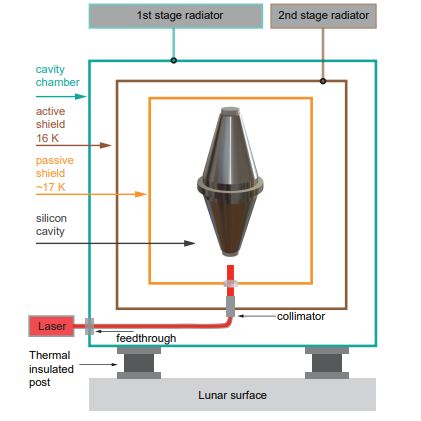
In the pre-print article by [Jun Ye] et al., the researchers go through the design parameters and construction details of such a device in one of the permanently shadowed regions (PSRs) of the Moon, as well as the applications for it. This would include the establishment of a very precise lunar clock, optical interferometry and various other scientific and telecommunication applications.
Although these PSRs are briefly called ‘cold’ in the paper’s abstract, this is fortunately quickly corrected, as the right term is ‘well-insulated’. These PSRs on the lunar surface never get to warm up due to the lack of an atmosphere to radiate thermal energy, and the Sun’s warm rays never pierce their darkness either. Thus, with some radiators to shed what little thermal energy the system generates and the typical three layers of thermal shielding it should stay very much cryogenic.
Add to this the natural vacuum on the lunar surface, with PSRs even escaping the solar wind’s particulates, and maintaining a cryogenic, ultra-high vacuum inside the silicon cavity should be a snap, with less noise than on Earth. Whether we’ll see this deployed to the Moon any time soon remains to be seen, but with various manned missions and even Moon colony plans in the charts, this could be just one of the many technologies to be deployed on the lunar surface over the next few decades.


Fahrplan für Interoperabilität: EU erweitert ihre Datenbanken mit Gesichtserkennung
netzpolitik.org/2026/fahrplan-…

Un decreto contro l’odio che colpisce il dissenso.
noblogo.org/transit/un-decreto…


Un decreto contro l’odio che colpisce il dissenso.
(211)
Dopo il voto di oggi al Senato, il decreto legge «antisemitismo» entra nella sua seconda fase: il testo passa ora alla Camera, dove la maggioranza punta a confermarne l’impianto senza modifiche sostanziali, blindando in via definitiva la nuova cornice giuridica su antisemitismo e critica a Israele.
All’inizio di questo post voglio essere chiaro su un punto essenziale: criticare lo Stato di Israele per la sua condotta a #Gaza e in #Cisgiordania non significa, in alcun modo, essere antisemiti. L’antisemitismo è un odio antico e pericoloso che va combattuto con la massima determinazione, ma proprio per questo non può essere usato come scusa per zittire chi denuncia bombardamenti su civili, occupazione militare, annessione di territori e violazioni sistematiche del diritto internazionale.
Il decreto «antisemitismo» non è più solo una minaccia: oggi il Senato lo ha approvato, confermando in aula l’impianto liberticida già emerso nei lavori della “Commissione Affari costituzionali” e facendo un passo decisivo verso la trasformazione della critica a Israele in sospetto di odio razziale. Il testo adotta la definizione di antisemitismo dell’IHRA, già al centro di durissime critiche perché, in concreto, tende a far passare come “antisemita” ogni critica radicale al sionismo e alle politiche del governo israeliano, compresa la denuncia di apartheid, annessione della Cisgiordania e pulizia etnica a Gaza.
Nonostante gli appelli di giuristi, associazioni per i diritti umani e pezzi importanti della società civile, la maggioranza ha tirato dritto, respingendo gli emendamenti delle opposizioni che provavano almeno a limitare i danni di una norma che confonde deliberatamente dissenso politico e razzismo.
Rispetto alla versione iniziale, alcune delle disposizioni più sfacciatamente repressive sono state limate per evitare una bocciatura immediata davanti alla Corte costituzionale, in particolare quelle che prevedevano in modo esplicito il divieto di manifestazioni pubbliche anti ebree e l’inasprimento delle sanzioni contro personale scolastico e universitario critico verso Israele.
Ma il cuore del problema è rimasto intatto: l’adozione piena della definizione #IHRA e l’inquadramento dell’antisemitismo in una logica securitaria che consente di trattare le manifestazioni contro la politica israeliana come minaccia per l’ordine pubblico e la sicurezza nazionale.
“Amnesty International”, tra gli altri, ha avvertito che così si soffocano il dibattito pubblico, l’accademia, la libertà di associazione e di protesta, perché chi denuncia crimini di guerra, apartheid e genocidio rischia di essere equiparato per legge a chi diffonde odio antiebraico.
Considero l’antisemitismo uno dei veleni più persistenti della storia europea, da combattere con decisione nella scuola, nella cultura, nei media, nella vita quotidiana. Proprio per questo trovo gravissimo che la memoria della “Shoah” e la sacrosanta lotta all’antisemitismo vengano piegate a diventare scudo di uno Stato che oggi bombarda, assedia, occupa, annette, e che pretende immunità morale e politica in nome delle proprie vittime passate.
Difendere gli ebrei dall’odio non significa blindare il governo #Netanyahu dalle sue responsabilità, né trasformare in reato di opinione chi usa parole dure (come genocidio, apartheid, pulizia etnica) per descrivere ciò che accade sul terreno in #Palestina.
In uno Stato che voglia dirsi democratico, criticare Israele per la sua condotta deve essere non solo possibile, ma necessario, esattamente come si critica qualsiasi altro governo quando calpesta il diritto internazionale e i diritti umani.
Con il voto di oggi, il governo Meloni mostra ancora una volta il suo vero volto: non quello del presunto baluardo di libertà, ma quello di un potere che piega le leggi alla ragion di Stato filo-israeliana, subordina i diritti costituzionali alla fedeltà a un alleato e considera il dissenso un problema di ordine pubblico da neutralizzare.
Il testo ora proseguirà il suo iter alla Camera, dove la stessa maggioranza che l’ha imposto al Senato punta a blindarlo in tempi rapidi, respingendo le richieste di cambiamento di chi chiede almeno di separare chiaramente antisemitismo e critica legittima a Israele.
Ma qualunque sarà la forma finale, una cosa è già chiara: oggi Palazzo Madama ha votato non solo un disegno di legge, ha votato un messaggio politico preciso (in Italia si può dire “mai più” solo se non disturba gli equilibri geopolitici) e la libertà di parola finisce dove comincia l’interesse del governo a non irritare Tel Aviv e Washington.
#Blog #GovernoMeloni #DLAntisemitismo #Politica #Italia #Opinioni
Mastodon: @alda7069@mastodon.unoTelegram: t.me/transitblogFriendica: @danmatt@poliverso.orgBlue Sky: bsky.app/profile/mattiolidanie…Bio Site (tutto in un posto solo, diamine): bio.site/danielemattioli
Gli scritti sono tutelati da “Creative Commons” (qui)
Tutte le opinioni qui riportate sono da considerarsi personali. Per eventuali problemi riscontrati con i testi, si prega di scrivere a: corubomatt@gmail.com


Pirate Party Condemns Unlawful U.S. Seizure of Tankers
March 4 – It weighs on our hearts that our government has decided to take action against the crews shipping oil. Just as we are against civil asset forfeiture, this too is an action that just steals from those sailors who are simply trying to make a living. With zero due process in international waters, Trump has directed our military to steal from those who do not align with his political stance.
This is not a dissent against our military brothers and sisters, who carried out the raids. They did so without harming the ships or the people, preforming at a level of excellence we have come to expect from them. Instead, this is a top down action that put both our military personnel and the merchant marine in harms way. They were not transporting illegal goods. They were transporting oil.
Those in the administration claim this is to stop tyranny while they are acting tyrannical. They claim this is for justice while holding no due process nor giving those arrested the right to representation. They claim the crews are breaking international law and are part of a shadow fleet, so does that mean the US is the end-all be-all of policing international trade?
We must not let this distract us from the real issues. We must push back again those who think they are above the law. No one is above the law and we all deserve justice with due process.
Image Source: Public Domain, Link.
The above was previously posted by the Massachusetts Pirate Party. Similar to the statements they previously made on Iran that we echoed and adopted as our own, we chose to share the words of our Massachusetts Pirates and echo that here.
KDE Plasma 6.6.2: miglioramenti allo scroll e accessibilità più precisa
linuxeasy.org/kde-plasma-6-6-2…
KDE Plasma 6.6.2 corregge bug, migliora lo scroll ad alta risoluzione, perfeziona l’accessibilità e introduce una gestione più sicura degli appunti. L'articolo KDE Plasma 6.6.2:
GNU/Linux Italia reshared this.
Piantedosi: “Iran, pronti a difenderci. Nostre barriere efficaci”
@Informatica (Italy e non Italy)
“Lo scoppio della guerra ci ha sollecitato direttamente e ci ha subito allertati. Abbiamo affrontato da subito uno scenario di rischi, con annesse contromisure per difendere i luoghi sensibili. Siamo pronti a difenderci”. Lo ha detto Matteo Piantedosi, Ministro dell’Interno, nel suo
Informatica (Italy e non Italy) reshared this.
LIBANO. La vita tra le bombe e gli sfollamenti
@Notizie dall'Italia e dal mondo
Israele avanza nel Libano del sud, tra bombardamenti, occupazione e ordini di sfollamento, terrorizzando la popolazione civile. Huda Az ci racconta la situazione dal campo profughi palestinese di Rashdiyeh.
L'articolo LIBANO. La pagineesteri.it/2026/03/04/var…
Notizie dall'Italia e dal mondo reshared this.
freezonemagazine.com/articoli/…
La storia racconta di questo nastro di un concerto degli Hollis Brown registrato agli inizi di novembre 2015 in quel di Vigevano, in provincia di Pavia, al Teatro Moderno, rimasto nei cassetti, e riesumato qualche mese fa da Paolo Pagetti, patron di Rivertale Productions, proposto alla band per pubblicarlo. Il concerto originale era composto da […]
L'articolo Hollis Brown –
USA, rivolta nella catena di comando: 200 militari denunciano ordini ‘suicidi’ dettati dalla retorica apocalittica dei Comandanti
un post su fb di Claudileia Lemes Dias condiviso da Stefano Guglielmin:
differx.noblogs.org/2026/03/04…
#messianismo #teocrazie #iran #usa #trump #apocalisse #armageddon #allucinazioni #gerontocomio #casabiancagerontocomio
reshared this
La pervasività delle università private (un post di Christian Raimo)
La pervasività delle università private (un articolo di Christian Raimo su fb)
differx.noblogs.org/2026/03/01…
#universitàprivate #LucianoViolante #ChristianRaimo #istruzione #istruzionepubblica
reshared this
Anche il Quantum entra nel perimetro dei Servizi italiani. Tecnologie e rischi
@Notizie dall'Italia e dal mondo
La Relazione annuale sulla politica dell’informazione per la sicurezza 2026 contiene, tra i suoi allegati tematici, un inserto interamente dedicato alle tecnologie quantistiche. Il documento parte dalla premessa che la sfida posta dal quantum computing rappresenta già oggi
Notizie dall'Italia e dal mondo reshared this.
gli spazi in rete su blogspot/blogger attivati dagli autori di ricerca
credo che un giorno andrà (forse) da qualcuno scritta la storia, la non piccola avventura, letteralmente mondiale e non solo in area anglofona, degli spazi in rete su blogspot/blogger attivati dagli autori di ricerca, prosatori estranei al mainstream, visual poets, autori di googlism eccetera.
non solo per ciò che quei blog hanno significato come stagione di produzione di testi, materiali verbovisivi, flarf, scrittura concettuale, asemic writing, fotografie, glitch e quant'altro, ma anche come tessitura di relazioni di amicizia, di dialogo, di discussione.
qui pochissimi link / esempi, davvero una manciata minima, per ‘the flux i share’:
reshared this