1 miliardo di dollari, due anni, e centinaia di migliaia di asset. Queste sono le cifre di Drone Dominance Program, un’iniziativa lanciata dal Pentagono per rafforzare la sua capacità di acquisizione di droni, mirando a rifornirsi di centinaia di migliaia di sistemi
Le notizie dal Centro Nexa su Internet & Società del Politecnico di Torino su @Etica Digitale (Feddit)
There is no excerpt because this is a protected post. The post Protected: Podcast sullo Smartphone appeared first on Nexa Center for Internet & Society. nexa.polito.it/podcast-sullo-s…
Leonardo ha inaugurato a Kuala Lumpur il Regional cyber center, segnando un passaggio rilevante nella mappa della sicurezza digitale del Sud Est asiatico. L’apertura inserisce la capitale malese in un circuito internazionale dedicato alla protezione di infrastrutture
il maschilismo in italia è così radicato, che quando dici che dati statistici alla mano una donna a parità di ruolo e competenza guadagna mediamente il 30% in meno di un uomo. eppure sono dati statistici, pubblici, non opinioni. non sono dati soggetti a dibattito. praticamente è come contestare l'evidente. nel privato di fatto lo stipendio vero dipende dalla voce "ad personam". che come dice il nome non è specificata in contratto ma varia da persona a persona. in pratica dare un aumento nel pubblico a qualcuno, significa inserire l'aumento nella voce ad personam. perché la cifra contrattuale è quasi sempre insufficiente, e spesso per convincere un lavoratore a cambiare lavoro occorre offrire un aumento, piuttosto che proporre il semplice valore previsto da contratto. così funziona. comunque poco importa da quale voce di stipendio derivi lo stipendio complessivo. alla fine quello che conta è il totale.
Dal teatro ucraino arriva la notizia di una nuova evoluzione del famigerato drone kamikaze Shahed-136. Un video diffuso dall’Ong ucraina Sternenko Community Foundation mostra infatti uno dei sistemi unmanned di progettazione iraniana, abbattuto dalla contraerea ucraina, che monta
In queste ultime settimane, a seguito di annunci in varie Nazioni europee e dopo alcune dichiarazioni del Ministro della Difesa Crosetto, è ripartito il dibattito sulla leva militare e sull’esigenza di disporre di Riserve addestrate. Ancora una volta,
La guida definitiva per rispondere a un post su Mastodon:
1) Inizia a scrivere una risposta impertinente, ma inizia a preoccuparti che venga fraintesa. 2) Scarta la risposta senza pubblicarla. 3) Inizia a scrivere una risposta sincera. Continua finché non avrai scritto un post di 5000 caratteri, composto da più paragrafi. 4) Scarta la risposta senza pubblicarla. 5) Inizia a scrivere una nuova risposta in cui cerchi di formulare il tuo post nel modo più succinto possibile. 6) Arrenditi e scarta la risposta senza pubblicarla. 9) Clicca semplicemente sul pulsante a forma di stella del post ⭐
1. Begin writing a sassy reply, but start to worry that it will be misunderstood. 2. Discard reply without posting. 3. Start writing a sincere reply. Continue until you have written a 5000 character, multi paragraph screed. 4. Discard without posting. 5. Start a new reply where you try to phrase your screed as succinctly as possible. 5. Give up and discard without posting. 6. Just click the star button on the post instead ⭐
Io però ... La stellina mi appare povera e fraintendibile nei suoi valori . Alle elementari , prima ancora dei componimenti , mi stimolavano a scrivere i pensierini : concetti semplici senza fronzoli brevi senza per forza un collegamento con l'eventuale seguito . 🫠
@Notizie dall'Italia e dal mondo Le delegazioni provenienti da tutta l'Africa hanno difeso la necessità di riconoscere formalmente i crimini commessi dalle potenze coloniali, di definire la colonizzazione come un "crimine contro l'umanità" e di garantire
The idea behind the site is simple—it’s a place to discover and share unique little tools and accessories for use with Wago’s line of electrical connectors. Most are 3D printed accessories that make working with Wago connectors easier. There are some fun and innovative ideas up there, like an ESP8266 development kit that has a Wago connector for all the important pins, as well as a tool for easily opening the lever locks. Perhaps most amusing, though, is the project entitled “Hide Your Wago From Americans”—which consists of a 3D-printed wire nut lookalike designed to slide over the connectors to keep them out of view. There’s also a cheerful attempt at Wago art, that doesn’t really look like anything recognizable at all. Oh well, they can’t all be winners.
It’s great to see Wago so openly encouraging creativity among those that use its products. The sharing of ideas has been a big part of the 3D printing movement, and Wago isn’t the first company to jump on the bandwagon in this regard. If you’ve got some neat Wago hacks of your own, you can always let us know on the tipsline!
@Notizie dall'Italia e dal mondo «How are we helping the most vulnerable, if this is the quality of the outcomes of what we call ambition?» («Come facciamo ad aiutare i più vulnerabili, se questa è la qualità di risultati che definiamo ambiziosi?»). Questa citazione brevissima, ma iconica riassume perfettamente la L'articolo Anche la Cop30 ci ha
(N.B. Il titolo dell’iniziativa non ha nulla a che vedere con il libro.)
CONDIVIDI PARTECIPA DIFFONDI
📅 Sabato 6 dicembre, ore 16:30 SERVER RIBELLI — con @giulianasorci@mastodon.world e il Collettivo @Collettivo Bida oltre a @kappazeta e altri ancora
Un percorso nella storia dell’attivismo digitale in Italia: dagli hacklab nei centri sociali agli hackmeeting degli anni ’90, fino alle nuove comunità hacker e all’esperienza di mastodon.bida.im.
Inizia:Sabato Dicembre 06, 2025 @ 4:30 PM GMT+01:00 (Europe/Rome)
Finisce:Sabato Dicembre 06, 2025 @ 9:00 PM GMT+01:00 (Europe/Rome)
🍝Spaghetti Hacker👩💻
— due incontri per pensare e praticare un rapporto diverso con la tecnologia
(N.B. Il titolo dell’iniziativa non ha nulla a che vedere con il libro.)
CONDIVIDI PARTECIPA DIFFONDI
📅 Martedì 18 novembre, ore 18:00
PEDAGOGIA HACKER — con Collettivo C.I.R.C.E.
Un’esplorazione su come costruire relazioni più consapevoli con il digitale.
Rivolto a chi educa, crea, si prende cura o semplicemente vuole abitare la tecnologia con un’attitudine critica e conviviale.
Per ridurre l’alienazione tecnica e sperimentare forme di immaginazione liberatoria.
📅 Sabato 6 dicembre, ore 16:30
SERVER RIBELLI — con Giuliana Sorci e Collettivo BIDA
Un percorso nella storia dell’attivismo digitale in Italia: dagli hacklab nei centri sociali agli hackmeeting degli anni ’90, fino alle nuove comunità hacker e all’esperienza di mastodon.bida.im.
Google Home assediata da utenti inferociti per il peggioramento del servizio. Mountain View in alcuni casi ha ammesso i bug e chiesto di pazientare, ma negli Usa è stata avviata una class action. Nelle ultime ore nuova lamentela: le videocamere di prima generazione
@Informatica (Italy e non Italy 😁) Dopo anni di rinvii e modifiche, il Consiglio dell’Unione Europea ha votato a favore della norma contro la diffusione di materiale pedopornografico: ecco come funziona, quali sono i rischi e che cosa succederà adesso L'articolo L’eterno ritorno di Chat Control proviene da Guerre di Rete.
@Giornalismo e disordine informativo articolo21.org/2025/12/dio-mio… Una doverosa premessa. Le «Autorità» furono negli anni 90 del secolo scorso una felice scelta per rendere più veloci procedure ed interventi in settori in rapida trasformazione, nei e sui quali la
Missouri’s age verification law, enacted on November 30, is the halfway mark for the sweep of age verification laws across the country. #ageverification #porn
Half of the US Now Requires You to Upload Your ID or Scan Your Face to Watch Porn
As of this week, half of the states in the U.S. are under restrictive age verification laws that require adults to hand over their biometric and personal identification to access legal porn.
Missouri became the 25th state to enact its own age verification law on Sunday. As it’s done in multiple other states, Pornhub and its network of sister sites—some of the largest adult content platforms in the world—pulled service in Missouri, replacing their homepages with a video of performer Cherie DeVille speaking about the privacy risks and chilling effects of age verification.
💡 Do you have a tip to share about age verification? I would love to hear from you. Using a non-work device, you can message me securely on Signal at sam.404. Otherwise, send me an email at sam@404media.co.
The other states include Louisiana, Utah, Mississippi, Virginia, Arkansas, Texas, Montana, North Carolina, Idaho, Kansas, Kentucky, Nebraska, Indiana, Alabama, Oklahoma, Florida, South Carolina, Tennessee, Georgia, Wyoming, South Dakota, North Dakota, Arizona, and Ohio.
“As you may know, your elected officials in Missouri are requiring us to verify your age before allowing you access to our website. While safety and compliance are at the forefront of our mission, giving your ID card every time you want to visit an adult platform is not the most effective solution for protecting our users, and in fact, will put children and your privacy at risk,” DeVille says in the video. On the blocked homepages there’s also a link to an explanation of the “Restricted to Adults,” or RTA label, which porn site administrators place on their sites to signal to device-based parental controls that the websites are inappropriate for minors.
Age verification laws reach beyond porn sites, however. In Wyoming, South Dakota, Mississippi and Ohio, where the laws are written broadly enough to cover social media sites and any platform hosting adult content, Bluesky users have to submit to a face scan by the third-party company Yoti or upload a photo of their credit card to verify they’re over 18 years of age. In July, Bluesky started requiring all UK users to verify their ages in response to the Online Safety Act. We’ve previously reported on the security risks inuploading sensitive personal data to identity verification services, including the potential for hackers to then get ahold of that information themselves. In October, after Discord started requiring UK users to verify ages, the platform announced hackers breached one of its third-party vendors that handles age-related appeals, and said it identified around 70,000 users who may have had their government ID photos exposed as part of the breach.
Last week, Pornhub’s parent company Aylo sent letters to Apple, Google, and Microsoft, urging them to support device-based age verification in their app stores and operating systems, WIRED reported. “Based on our real-world experience with existing age assurance laws, we strongly support the initiative to protect minors online,” Anthony Penhale, chief legal officer for Aylo, said in the letter. “However, we have found site-based age assurance approaches to be fundamentally flawed and counterproductive.”
Instead of protecting minors, age verification laws spike usage of virtual private networks and send users—including, potentially, minors—to unregulated or unmoderated sites that don’t care about complying with U.S. or UK laws. In Missouri, searches for VPNs spiked following the law’s enactment.
Missouri schools are not required to teach sex education, leaving it up to local school boards to decide what, if anything, children are taught about sexual health. School districts that do teach sex ed are required to promote abstinence, a modality long recognized as ineffective at protecting children from engaging in risky sexual behaviors. Even if a district offers sex ed, parents are allowed to pull their kids out of that class altogether. But despite research showing age verification laws don’t work either, Missouri Attorney General Catherine Hanaway believes forcing adults to undergo age verification protects the children in her state. “We are proud to stand on the side of parents, families and basic decency. Missouri will not apologize for protecting children,” Hanaway said in a press release.
In occasione della Giornata internazionale per i diritti delle persone con disabilità lanciamo il video podcast condotto dalla giornalista Valentina Tomirotti
Nel video podcast si raccontano le storie che cambiano i diritti
In occasione della Giornata Internazionale per i diritti delle persone con disabilità, l’Associazione lancia il podcast dal titolo “Corpi politici”, condotto dalla giornalista Valentina Tomirotti che ne ha realizzato la la narrazione costruendo un viaggio attraverso le esperienze delle persone con disabilità e le iniziative dell’Associazione Luca Coscioni. Le quattro puntate – dedicate all’accessibilità, agli ausili, all’assistenza e ai caregiver – saranno online sulle principali piattaforme di distribuzione e in video podcast su YouTube.
In tutti questi anni, questo metodo dell’Associazione Luca Coscioni ha portato importanti risultati, tra gli ultimi ricordiamo quello che ha consentito a Christian Durso, giovane con disabilità motoria grave, di diventare il primo studente della Sapienza a frequentare Giurisprudenza ed effettuare esami da remoto, o le recenti conquiste ottenute grazie all’impegno dell’avvocato Alessandro Gerardi sul fronte dei Piani di eliminazione delle barriere architettoniche, con cui sta prendendo forma un vero e proprio “diritto ai PEBA”, confermato dalle pronunce dei tribunali per i comuni di Santa Marinella e Catania che impongono l’obbligo di adottare piani di accessibilità completi e vincolanti.
Dichiara Rocco Berardo, coordinatore delle iniziative per i diritti delle persone con disabilità dell’Associazione Luca Coscioni: “Una delle puntate di questo podcast riprende il tema dell’assistenza e del caregiver familiare, tema affrontato nell’ultimo congresso dell’associazione anche attraverso il racconto di Stefano Massoli, marito di Laura Santi, che ha voluto condividere l’altra parte della loro storia. La vita quotidiana, spesso invisibile, di un caregiver familiare, preannunciando su questo il suo impegno personale.
Registriamo proprio su questo tema da parte del Governo, attraverso la Ministra Locatelli, annunci di grandi riforme. Ma la semplice definizione di caregiver familiare non lo è, e peraltro esisteva già: ciò che manca è la “definizione” di risorse adeguate. Se le risorse previste si fermassero a 250 milioni, ci troveremmo davanti a una cifra apparentemente significativa ma del tutto insufficiente a coprire il fabbisogno. Se venissero reperite sottraendole a fondi già destinati in bilancio alle persone con disabilità, sarebbe un paradosso ancora più grave, perché finirebbe per penalizzare proprio le persone che si dichiara di voler tutelare.
A questo si sommano criteri di accesso che chiamare restrittivi è dir poco, come il limite ISEE di 15.000 euro, l’obbligo di almeno 91 ore settimanali di assistenza e un reddito da lavoro non superiore a 3.000 euro annui. Peraltro con stanziamenti così esigui, i beneficiari si ridurrebbero comunque a circa 52.000 persone, a fronte dei 2,2 milioni di caregiver stimati nel nostro Paese.
Subordinare un diritto fondamentale alla scarsità delle risorse, invece di adeguare le risorse ai bisogni reali, significa capovolgere la logica espressa dalle sentenze della Corte costituzionale sul tema. E alla fine, far finta di risolvere un problema è il modo peggiore per affrontarlo”
Roberto D’Andrea, interverrà al convegno “Profili dilemmatici della maternità surrogata” al Tribunale di Napoli
Tribunale di Napoli, Aula Girardi – Piazza Giovanni Falcone e Paolo Borsellino 1, Napoli Venerdì 5 dicembre 2025 Ore 11:00
Venerdì 5 dicembre, presso l’Aula Girardi del Tribunale di Napoli, si terrà il convegno “Profili dilemmatici della maternità surrogata”, promosso da AIGA Napoli, dal Consiglio dell’Ordine degli Avvocati di Napoli e dal Comitato Pari Opportunità COA Napoli.
Tra i relatori, interverrà anche l’Avv. Roberto D’Andrea, dottore di ricerca in diritto penale presso la Scuola Superiore Sant’Anna e referente dell’Associazione Luca Coscioni, che porterà il punto di vista dell’associazione sui profili penali, etici e di tutela dei diritti fondamentali legati al tema.
Per l’elenco completo dei relatori consultare il sito
Mina Welby tra i volti della mostra “Marianne d’Italia” a Montecitorio
Palazzo Montecitorio, P.zza Montecitorio 1 – Roma Domenica 7 dicembre 2025 dalle 10 alle 13:30
Mina Welby Co-Presidente dell’Associazione Luca Coscioni, sarà tra i volti immortalati della mostra “Marianne d’Italia”, nuovo progetto artistico del fotografo Riccardo Bagnoli, a cura di Paola Severini Melograni.
L’esposizione propone una riflessione visiva sul tema della rappresentazione femminile nell’Italia contemporanea, ispirandosi alla figura simbolica di “Marianne”, emblema universale di libertà, impegno civico e identità repubblicana, mostrando attraverso il linguaggio della fotografia, il ruolo delle donne nella società odierna e la loro centralità nei processi culturali e civili del Paese.
Oggi a Torino è stato arrestato Filippo Blengino, segretario dei Radicali Italiani, durante un’azione dimostrativa in cui ha ceduto cannabis CBD non drogante. Un gesto di disobbedienza civile che mette in luce l’assurdità dell’articolo 18 del Decreto Sicurezza, una norma che equipara prodotti non stupefacenti allo spaccio e espone le persone a pene fino a vent’anni di carcere.
«Solidarietà da parte di tutta Possibile a Filippo Blengino, arrestato a Torino sulla base di norme inutili e proibizioniste che non producono alcun risultato se non criminalizzare cittadini e imprenditori della cannabis CBD. È un’impostazione anti-scientifica e repressiva, pienamente fatta propria dal governo e dal ddl Sicurezza. Speriamo che la determinazione di Blengino porti l’articolo 18 davanti alla Corte Costituzionale: saremo al suo fianco», dichiara Francesca Druetti, Segretaria nazionale di Possibile.
“Quello che è accaduto a Blengino accade ogni giorno in tutta Italia: anche in Piemonte, da Cuneo in giù, negozi di cannabis legale vengono perquisiti, prodotti sequestrati e persone denunciate come spacciatori, con danni enormi a un intero comparto economico che opera nella legalità”, commenta Giulia Marro, Consigliera Regionale del Piemonte AVS.
Come Possibile e come consigliera regionale del Piemonte di Alleanza Verdi Sinistra, ribadiamo che questa norma va cambiata. Serve una legislazione basata su evidenze scientifiche, non sulla propaganda proibizionista. Serve tutelare chi lavora onestamente, non criminalizzarlo.
Druetti (Possibile): ONU critica i centri per migranti in Albania, Meloni abbandoni il progetto
“Mentre Meloni continua a dire che “funzioneranno”, i campi per le persone migranti di Gjadër in Albania sono finiti al centro delle preoccupazioni e critiche del comitato ONU contro la Tortura e Comportamenti Disumani e Degradanti. E la notizia già si commenta da sola sottolineando il fallimento e lo scempio etico e politico di questo progetto.”
Lo dichiara la Segretaria Nazionale di Possibile Francesca Druetti, commentando il report del Comitato ONU, disponibile qui: ohchr.org/en/press-releases/20…
“Il Comitato ONU — continua Druetti — ha espresso dubbi sul Protocollo Italia-Albania, in particolare sulla mancanza di chiarezza sulla giurisdizione e sul rispetto del divieto di refoulment (principio fondamentale del diritto internazionale).
Ha inoltre evidenziato dubbi riguardo la conformità alla Convenzione contro la tortura così come l’assenza di dati affidabili su torture, maltrattamenti e uso eccessivo della forza da parte della polizia. La detenzione delle persone migranti è una violazione della dignità umana, come dimostrano chiaramente le numerose prove dai nostri CPR. Deportare le persone contro la propria volontà perlopiù in un paese con cui non hanno legami, non può in alcun modo essere considerato ragionevole o sostenibile.
Noi continueremo a chiedere la chiusura non solo del CPR di Gjader ma anche di tutti quelli presenti in Italia, perché rappresentano luoghi in cui i diritti umani vengono calpestati quotidianamente.”
Oggi il Ministro Giuseppe Valditara e il Presidente dell’Associazione Nazionale Alpini, Sebastiano Favero, hanno siglato un Protocollo d’Intesa che consente di promuovere nelle #scuole i valori dell’etica della partecipazione civile, della solidariet…
Oggi il Ministro Giuseppe Valditara e il Presidente dell’Associazione Nazionale Alpini, Sebastiano Favero, hanno siglato un Protocollo d’Intesa che consente di promuovere nelle #scuole i valori dell’etica della partecipazione civile, della solidariet…
Maxie Reynolds loves an adventure, especially the kind where she’s breaking into buildings (legally). In this episode, she shares stories from her time as a professional penetration tester, including high-stakes physical intrusions, red team chaos, a…
@Notizie dall'Italia e dal mondo Viaggio di solo andata per i gazawi. I piani si Israele per svuotare la Striscia sono antichi e l’icona del sionismo italiano vi partecipò da protagonista L'articolo PALESTINA. Quando Ada Sereni lavorava alla “emigrazione volontaria” da Gaza proviene da
Italia e Romania: scompaginata una rete rumena di traffico di esseri umani
Condotta congiuntamente da Italia e Romania, l'operazione ha preso di mira un clan familiare di cittadini rumeni con sede a Iasi, in Romania. Il gruppo criminale organizzato, operante da oltre 20 anni, sfruttava le ragazze attraverso la coercizione, la violenza e la manipolazione psicologica e aveva forti legami con cittadini albanesi coinvolti nello sfruttamento sessuale a Roma, in Italia.
Nel corso dell'attività sono state effettuate 25 perquisizioni domiciliari condotte (20 in Romania, 5 in Italia);sequestrati 20 000 euro in contanti; arrestati 19 sospetti rumeni; due persone poste sotto controllo giudiziario; individuati 99 conti bancari presumibilmente utilizzati per riciclare i proventi criminali; sequestrate 7 spade, 1 ascia e 4 pistole; sequestrati in Romania 10 immobili, 8 auto di lusso, gioielli, 45 documenti, 32 telefoni cellulari e 3 computer.
La rete criminale utilizzava la tecnica del "lover boy" per reclutare e adescare le vittime, spesso a partire dalla giovane età, e costringerle a prostituirsi a Roma. Soltanto nei tempi delle indagini si sospetta che la rete criminale abbia generato un utile stimato di 1,7 milioni di euro.
#Europol ha sostenuto l'operazione facilitando lo scambio di informazioni, fornendo supporto analitico e coordinando la cooperazione transfrontaliera, mentre #Eurojust ha coordinato l'indagine internazionale istituendo una squadra investigativa congiunta e organizzando diverse riunioni presso la sede di Eurojust all'Aia.
Inoltre l'indagine è stata sostenuta dalla Rete @ON (#atON) finanziata dalla Commissione Europea, guidata dalla Direzione Investigativa Antimafia Italiana (#DIA), che ha sostenuto finanziariamente le riunioni operative e il reciproco dispiegamento degli investigatori.
Prosegue la persistente minaccia posta dalle reti criminali coinvolte nella tratta di esseri umani, sì da esaltare l’importanza della #cooperazioneinternazionale nella lotta a questi crimini. La tratta di esseri umani è un crimine grave che abusa dei diritti fondamentali e della dignità delle persone. Implica lo sfruttamento criminale delle persone vulnerabili al solo scopo di guadagno economico. La tratta di esseri umani è una forma moderna di schiavitù. È spesso di carattere internazionale e le sue vittime appartengono ad entrambi i sessi, a tutte le età e origini.
Paesi e agenzie partecipanti: Italia: Polizia di Stato Italiana – Squadra Mobile di Roma e il Servizio Centrale Operativo (Polizia di Stato – Squadra Mobile di Roma e Servizio Centrale Operativo); Procura della Repubblica Roma (Procura Distrettuale di Roma) Romania: Polizia rumena - Brigata per la lotta alla criminalità organizzata Iaяi (Poli Brigadiei Română - Brigada de Combaterea Criminalităii Organizate Ia Iii) Eurojust
Not every project has to be complicated– reinventing the wheel has its place, but sometimes you find a module or two that does exactly what you want, and the project is more than halfway done. That the kind of project [mircemk]’s Simple Retro Style VFO is — it’s a variable frequency oscillator for HAM and other use, built with just a couple of modules. Strictly speaking, this is all you need for the project. The modules in question are the SI5351 Clock Generator module, which is a handy bit of kit with its own crystal reference and PLL to generate frequencies up to 150 MHz, and the Elecrow CrowPanel 1.28inch-HMI ESP32 Rotary Display. The ESP32 in the CrowPanel controls the SI5351 module via I2C; control is via the rest of the CrowPanel module. This Rotary Display is a circular touchscreen surrounded by a rotary display, so [mircmk] has all the inputs he needs to control the VFO.
To round out the parts count, he adds an appropriate connector, plus a power switch, red LED and a lithium battery. One could include a battery charger module as well, but [mircmk] didn’t have one on hand. Even if he had, that still keeps the parts count well inside the single digits. If you like video, we’ve embedded his about the project below; if not the write up on Hackaday.io is upto [mircmk]’s typical standard.
People have been using the SI5351 to make VFOs for years now, but the addition of the round display makes for a delightfully retro presentation.
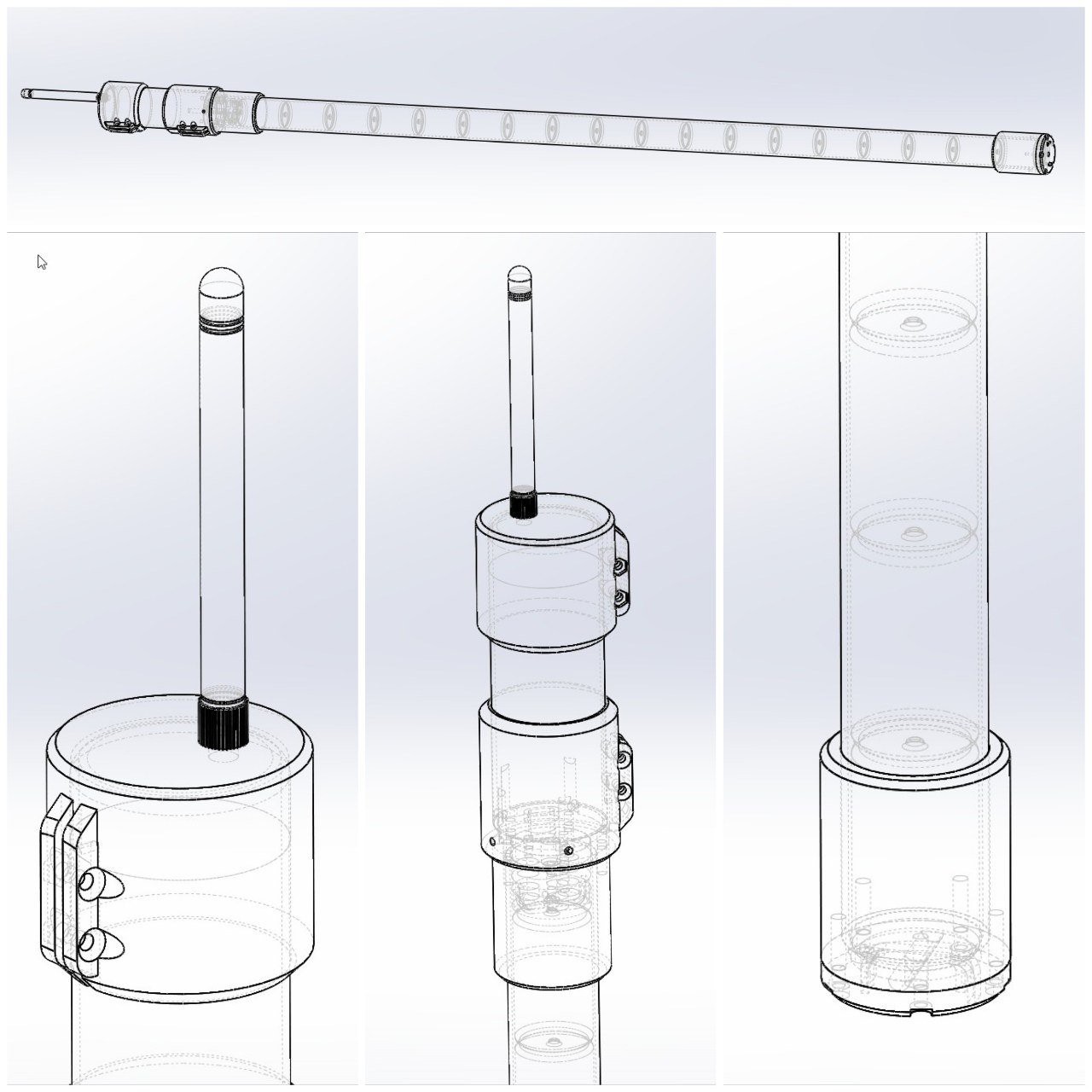
Sometimes it makes sense to go with plain old batteries and off-the-shelf PVC pipe. That’s the thinking behind [Bertrand Selva]’s clever LoRaTube project. PVC pipe houses a self-contained LoRa repeater, complete with a big stack of D-size alkaline cells. LoRa is a fantastic solution for long-range and low-power wireless communication (and popular, judging by the number of projects built around it) and LoRaTube provides an autonomous repeater, contained entirely in a length of PVC pipe. Out the top comes the antenna and inside is all the necessary hardware, along with a stack of good old D-sized alkaline cells feeding a supercap-buffered power supply of his own design. It’s weatherproof, inexpensive, self-contained, and thanks to extremely low standby current should last a good five years by [Bertrand]’s reckoning.
One can make a quick LoRa repeater in about an hour but while the core hardware can be inexpensive, supporting electronics and components (not to mention enclosure) for off-grid deployment can quickly add significant cost. Solar panels, charge controllers, and a rechargeable power supply also add potential points of failure. Sometimes it makes more sense to go cheap, simple, and rugged. Eighteen D-sized alkaline cells stacked in a PVC tube is as rugged as it is affordable, especially if one gets several years’ worth of operation out of it.
You can watch [Bertrand] raise a LoRaTube repeater and do a range test in the video (French), embedded below. Source code and CAD files are on the project page. Black outdoor helper cat not included.
Learning something on YouTube seems kind of modern. But if you are watching a 1957 instructional film about slide rules, it also seems old-fashioned. But Encyclopædia Britannica has a complete 30-minute training film, which, what it lacks in glitz, it makes up for in mathematical rigor.
We appreciated that it started out talking about numbers and significant figures instead of jumping right into the slide rule. One thing about the slide rule is that you have to sort of understand roughly what the answer is. So, on a rule, 2×3, 20×30, 20×3, and 0.2×300 are all the same operation.
You don’t actually get to the slide rule part for about seven minutes, but it is a good idea to watch the introductory part. The lecturer, [Dr. Havery E. White] shows a fifty-cent plastic rule and some larger ones, including a classroom demonstration model. We were a bit surprised that the prestigious Britannica wouldn’t have a bit better production values, but it is clear. Perhaps we are just spoiled by modern productions.
We love our slide rules. Maybe we are ready for the collapse of civilization and the need for advanced math with no computers. If you prefer reading something more modern, try this post. Our favorites, though, are the cylindrical ones that work the same, but have more digits.
During World War II, as the Allies planned the invasion of Normandy, there was one major hurdle to overcome—logistics. In particular, planners needed to guarantee a solid supply of fuel to keep the mechanized army functional. Tanks, trucks, jeeps, and aircraft all drink petroleum at a prodigious rate. The challenge, then, was to figure out how to get fuel over to France in as great a quantity as possible.
War planners took a diverse approach. A bulk supply of fuel in jerry cans was produced to supply the initial invasion effort, while plans were made to capture port facilities that could handle deliveries from ocean-going tankers. Both had their limitations, so a third method was sought to back them up. Thus was born Operation Pluto—an innovative plan to simply lay fuel pipelines right across the English channel.
Precious Juice
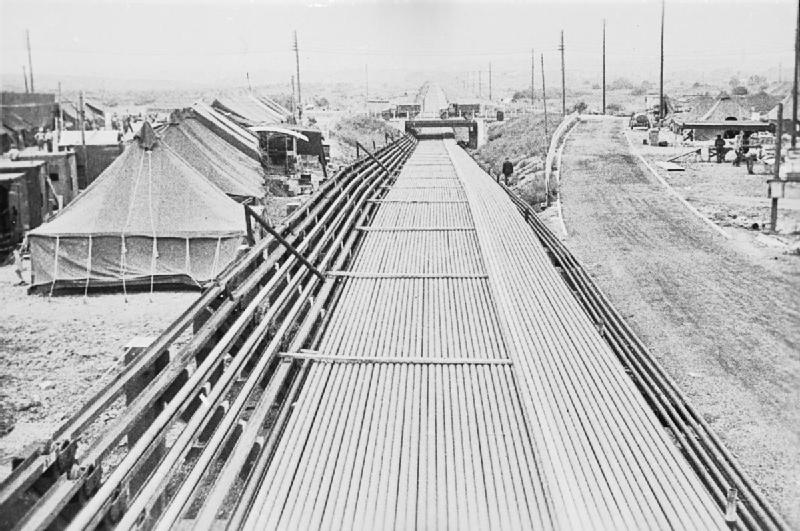
War is thirsty work, and for the soldiers too. Crown copyright, Imperial War Museums Back in the 1940s, undersea pipelines were rather underexplored technology. However, they promised certain benefits over other methods of shipping fuel to the continent. They would be far more difficult to destroy by aerial attack compared to surface ships or floating pipelines. An undersea pipeline would also be less likely to be damaged by rough sea conditions that were typical in the English Channel.
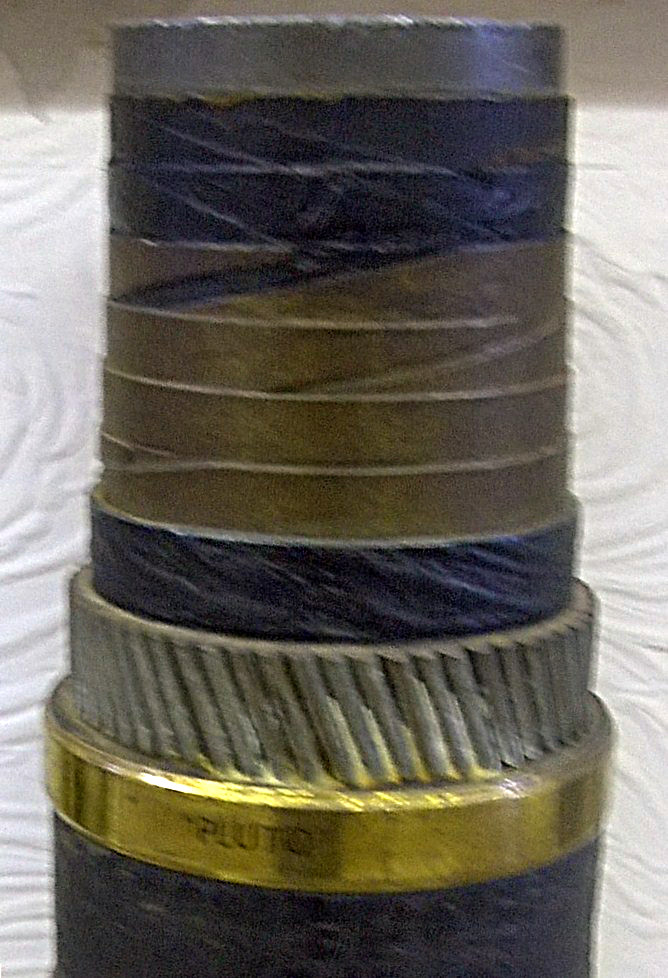
The idea was granted the codename PLUTO—for Pipe-Line Under The Ocean. Development began as soon as 1942, and the engineering challenges ahead were formidable. The Channel stood a good twenty miles wide at its narrowest point, with strong currents, variable depths, and the ever-present threat of German interference. Any pipeline would need to withstand high pressure from the fuel flowing inside, resist corrosion in seawater, and be flexible enough to handle the uneven seabed. It also needed to be laid quickly and surreptitiously, to ensure that German forces weren’t able to identify and strike the pipelines supplying Allied forces. A sectioned piece of HAIS pipeline. Note the similarities to then-contemporary undersea cable construction. Credit: Geni, CC BY-SA 3.0 The first pipe developed as part of the scheme was HAIS. It was developed by Siemens Brothers and was in part the brainchild of Clifford Hartley, then Chief Engineer of Anglo-Iranian Oil and an experienced hand at delivering fuel pipelines in tough conditions. Thus the name—which stood for Hartly-Anglo-Iranian-Siemens. It used a 2-inch diameter pipe of extruded pipe to carry the fuel, surrounded by asphalt and paper doused in a vinyl-based resin. It was then wound with a layer of steel tape for strength, and then further layered with jute fiber and more asphalt and paper. The final layers were an armored sheath of galvanized steel wires and a canvas outer cover. The techniques used were inspired by those that had proved successful in the construction of undersea telegraph cables. As designed, the two-inch diameter pipe was intended to flow up to 3,500 imperial gallons of fuel a day when running at 500 psi.
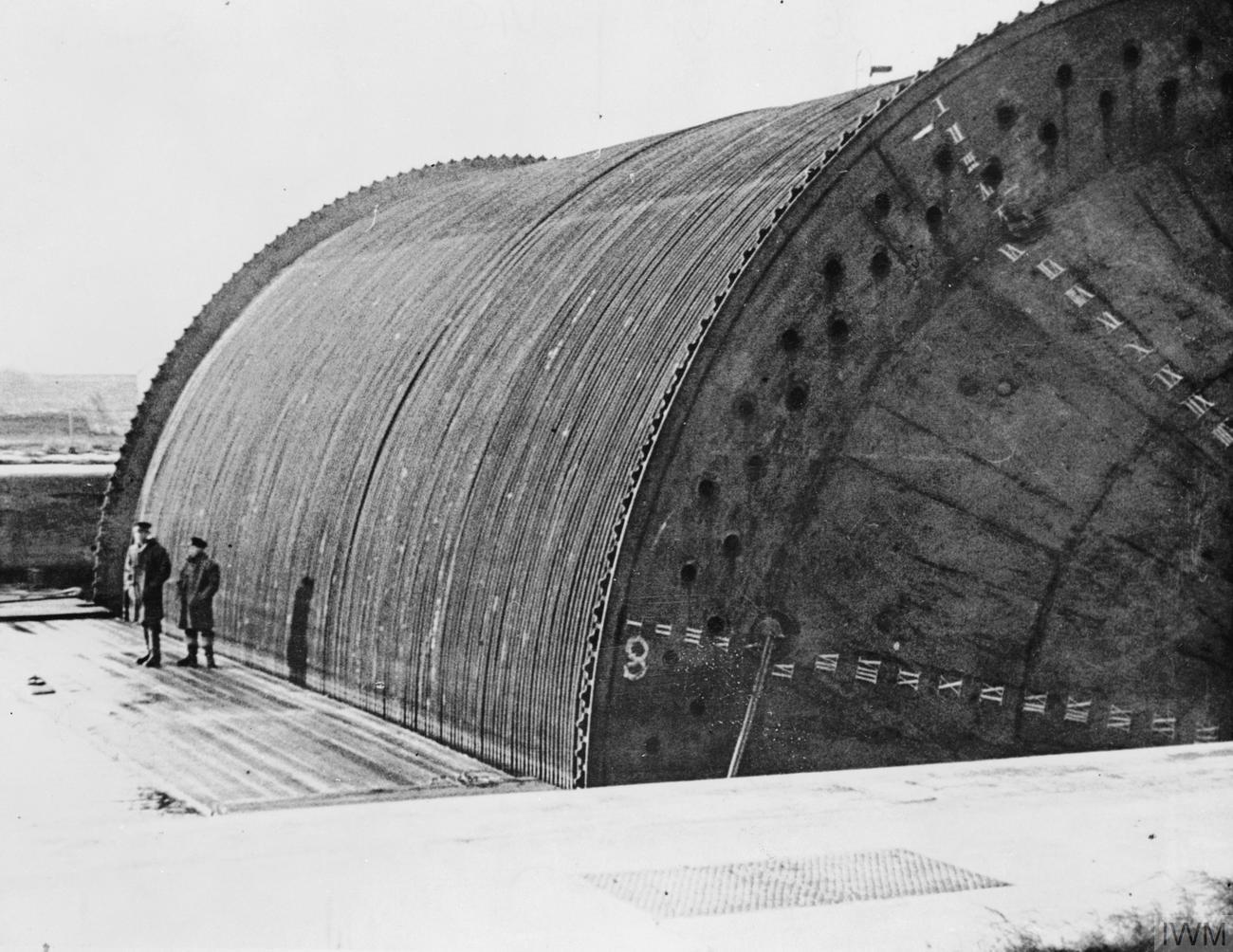
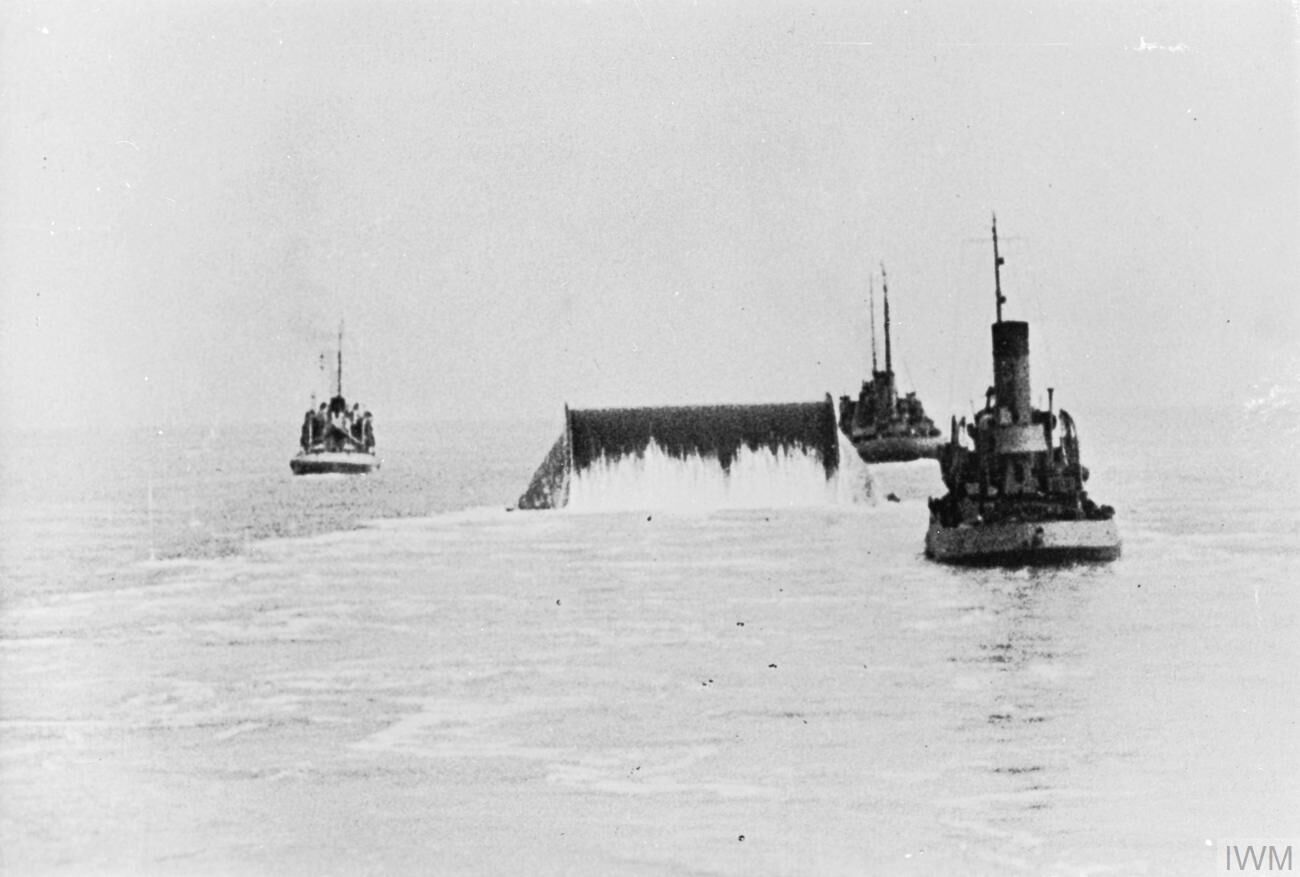
HAIS pipe was produced across several firms in the UK and the US. Initial testing took place with pipe laid across the River Medway. Early efforts proved unsuccessful, with leaks caused by lead from the central core pushing out through the steel tape layer. The steel tape wraps were increased, however, and subsequent testing over the Firth of Clyde was more successful. Trials pushed the pipe up to 1,500 psi, showing that up to 250,000 liters of fuel could be delivered per day. The pipeline also proved robust, surviving a chance attack by a German bomb landing nearby. The positive results from testing led to the development of a larger 3-inch verison of the HAIS pipe to support even greater flow. HAMEL pipe in long lengths prior to loading on a Conundrum. Crown copyright,Imperial War Museums By this point in the war, however, supplies were becoming constrained on all sides. In particular, lead was becoming scarce, which spurred a desire for a cheaper pipe design to support Operation PLUTO. Thus was born HAMEL, named after engineers Bernard J. Ellis and H.A. Hammick, who worked on the project. HAMEL pipe loaded on a Conundrum, ready to be laid on the seafloor. Crown copyright, Imperial War Museums The HAMEL design concerned a flexible pipe constructed out of mild steel, at 3-½ inches in diameter. Lengths of the pipe were produced in 40-foot segments which would then be resistance welded together to create a longer flexible pipeline that could be laid on the seafloor. The steel-based pipe was stiffer than the cable-like HAIS, which caused an issue—it couldn’t readily be coiled up in a ship’s hold. Instead, giant floating drums were constructed at some 40 feet in diameter, nicknamed “Conundrums.” These were to be towed by tugs or hauled by barges to lay the pipeline across the Channel. Testing took place by laying pipelines to the Isle of Wight, which proved the concept was viable for deployment.
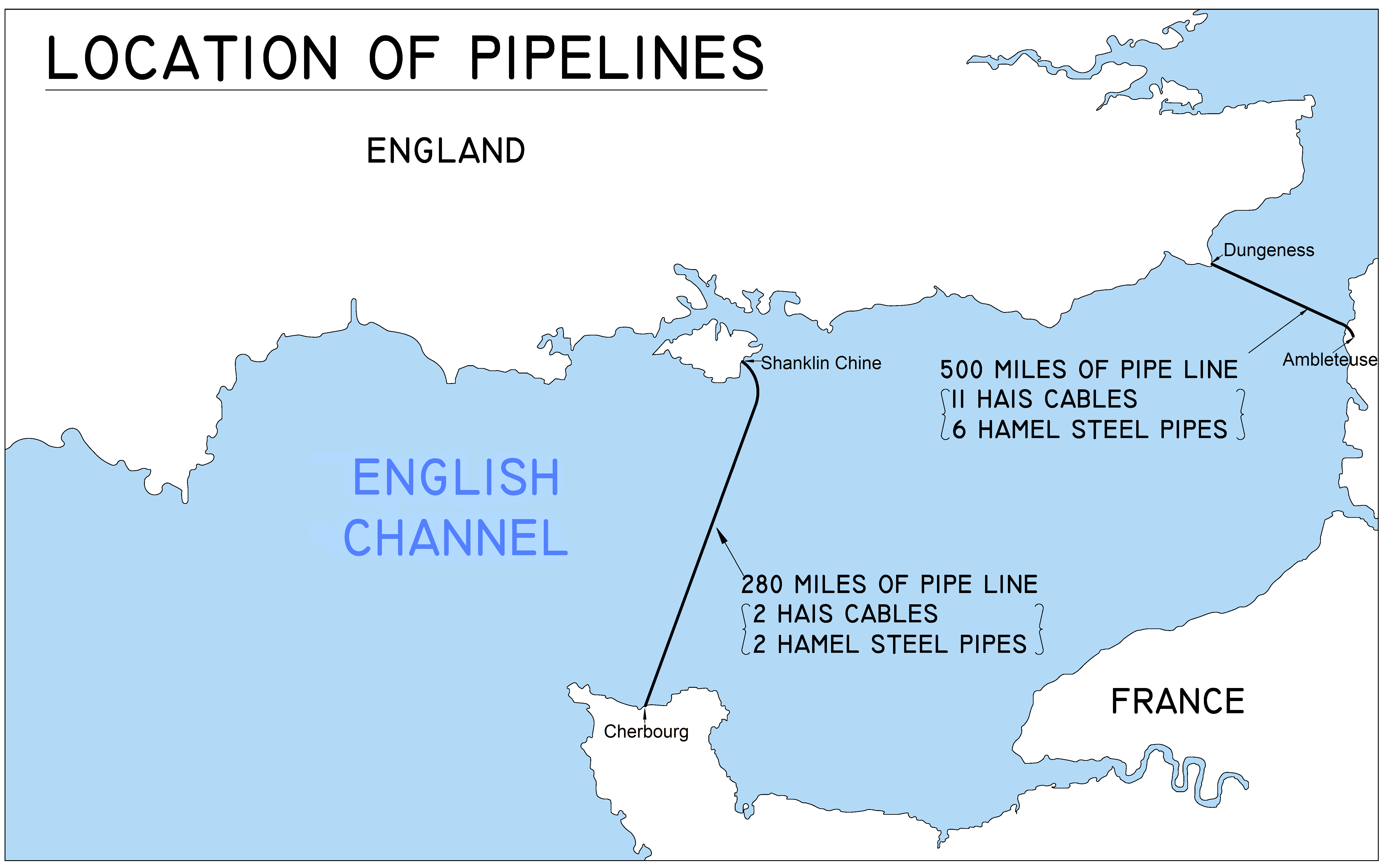
Beyond the two types of pipeline, a great deal of work went into the supporting infrastructure for the project. War planners had to build pumping stations to feed the pipelines, as well as ensure that they could in turn be fed fresh fuel from the UK’s network of fuel storage facilities and refineries. All this had to be done with a certain level of camouflage, lest German aircraft destroy the coastal pumping stations prior to the British invasion of the continent. Two main stations at Sandown and Dungeness were selected, and were intended to be connected via undersea pipe to the French ports of Cherbourg and Ambleteuse, respectively. The Sandown-Cherbourg link was to be named Bambi, while the Dungeness-Ambleteuse link would be named Dumbo, referencing further Disney properties since the overall project was called Pluto.
The Big Dance
On D-Day, the initial landings and immediate securing of the beachhead would run on pre-packaged fuel supplies in jerry cans and drums. The pipelines were intended to come later, ensuring that the Allied forces had the fuel supplies to push deep into Europe as they forced back the German lines. It would take some time to lay the pipelines, and the work could only realistically begin once the initial ports were secure. A map indicating the Bambi and Dumbo pipelines between England and France. Notably, the Dumbo pipelines were run to Boulogne instead of the original plan of Ambleteuse. Credit: public domain Bambi was intended to go into operation just 75 days after D-Day, assuming that Allied forces had managed to capture the port of Cherbourg within eight days of the landings. This process instead took 21 days due to the vagaries of war. Efforts to lay a HAIS pipeline began as soon as 12 August 1944, just 67 days after D-Day, only to fail due to an anchor strike by an escort destroyer. The second effort days later was scuppered when the piping was wound up in the propeller of a supporting craft. A HAMEL pipelaying effort on 27 August would also fail thanks to barnacles jamming the massive Conundrum from rotating, and while cleaning efforts freed it up, the pipeline eventually broke after just 29 nautical miles of the 65 nautical mile journey.
It wasn’t until 22 September that a HAIS cable was successfully installed across the Channel, and began delivering 56,000 imperial gallons a day. A HAMEL pipe was then completed on the 29 September. However, both pipes would fail just days later on October 3 as pressure was increased to up the rate of fuel delivery, and the Bambi effort was cancelled. Despite the great efforts of all involved, the pipelines had delivered just 935,000 imperial gallons, or 3,300 long tons of fuel—a drop in the ocean relative to what the war effort required. A Conundrum pictured as it was towed to Cherbourg to lay a HAMEL pipeline as part of Operation Bambi. Credit: public domain Dumbo would prove more successful, perhaps with little surprise that the distances involved were shorter. The first HAIS pipeline was completed and operational by 26 October. The pipeline was redirected from Dungeness to Boulogne instead of the original plan to go to Ambleteuse thanks to heavy mining by the Germans, and covered a distance of 23 nautical miles. More HAIS and HAMEL pipelines followed, and the pipeline would later be extended to Calais to use its rail links for delivery further inland.
A total of 17 pipelines were eventually laid between the two coasts by the end of 1944. They could deliver up to 1,300 long tons of fuel per day—soon eclipsing the Bambi efforts many times over. The HAMEL pipelines proved somewhat unreliable, but the HAIS cable-like pipes held up well and none broke during their use until the end of the war in Europe. The pipelines stuck to supplying petrol, while initial plans to deliver other fuels such as high-octane aviation spirit were discarded. Once a key piece of war infrastructure, now a small part of a thrilling minigolf course. Credit: Paul Coueslant, CC BY-SA 2.0 Overall, Operation Pluto would deliver 370,000 long tons of fuel to support Allied forces, or about 8 percent of the total. The rest was largely delivered by oceangoing tankers, with some additional highly-expensive aerial delivery operations used when logistical lines were stretched to their very limits. Bulk fuel delivery by undersea pipeline had been proven possible, but perhaps not decisively important when it came to wartime logistics. A small section of pipeline left over from Operation Pluto at Shanklin Chine on the Isle of Wight. Credit: Crookesmoor, CC BY SA 3.0 Arguments as to the value of the project abound in war history circles. On the one hand, Operation Pluto was yet another impressive engineering feat achieved in the effort to bring the war to an end. On the other hand, it was a great deal of fuss and ultimately only delivered a moderate portion of the fuel needed to support forces in theatre. In any case, there are still lingering reminders of Operation Pluto today—like a former pumping station that has been converted into a minigolf course, or remnants of the pipelines on the Isle of Wight.
Since World War II, we’ve seen precious few conflicts where infrastructure plays such a grand role in the results of combat. Nevertheless, the old saying always rings true—when it comes to war, amateurs discuss tactics, while professionals study logistics.


404 MediaEmanuel Maiberg


Tribunale di Napoli, Aula Girardi – Piazza Giovanni Falcone e Paolo Borsellino 1, Napoli
Venerdì 5 dicembre 2025
Ore 11:00
Palazzo Montecitorio, P.zza Montecitorio 1 – Roma
Domenica 7 dicembre 2025
dalle 10 alle 13:30










libero
in reply to Poliverso - notizie dal Fediverso ⁂ • • •La stellina mi appare povera e
fraintendibile nei suoi valori .
Alle elementari ,
prima ancora dei componimenti ,
mi stimolavano a scrivere i
pensierini :
concetti semplici
senza fronzoli
brevi
senza per forza un collegamento
con l'eventuale seguito .
🫠
Che succede nel Fediverso? reshared this.