
Fediverso che avanza: il blog e il forum degli Androidiani rinascono con il supporto di Activitypub
Il blog Androidiani.net (questo che state leggendo) parla ora il linguaggio del Fediverso. #WordPress è stato collegato ad #ActivityPub, il protocollo che permette ai contenuti di vivere oltre i confini del singolo sito. Questo significa che ogni articolo pubblicato qui non resta chiuso dentro un dominio, ma diventa un oggetto federato: può essere seguito, commentato e condiviso direttamente da Mastodon, Firefish, Misskey e da qualsiasi altra piattaforma compatibile con ActivityPub. Non serve un account qui per partecipare alla conversazione, non serve iscriversi a un social centralizzato, non serve passare da un algoritmo che decide cosa merita attenzione e cosa no.
Il forum, invece, non è “solo” un forum. Androidiani.net utilizza appunto #NodeBB, che non è semplicemente un software moderno ma una vera e propria istanza federata. Anche qui, i thread non sono più silos isolati: diventano parte del flusso del Fediverso. Le discussioni possono essere seguite dall’esterno, gli utenti del Fediverso possono interagire, rispondere, partecipare. È una comunità che non vive chiusa in una piattaforma ma si connette a una rete più ampia, distribuita, resiliente.
like this
reshared this
24 gennaio — Dragtivism Tour a Venezia!
SAVE THE DATE!
Il DragTivism Tour Italia fa tappa a Venezia. Vi aspettiamo il 24 gennaio, dalle ore 15:30, al Combo, in Campo dei Gesuiti Cannaregio, 4878.
Ad aspettarvi PriscillaDrag, House of Serenissima, Progetto Tiresia, Gianmarco Capogna e Francesca Druetti di Possibile, insieme ai comitati di Possibile veneti e tant* altr*.
La drag culture è uno strumento di lotta politica, una risposta al clima di odio e alla propaganda che cerca di silenziare le voci della comunità, una resistenza artistica e culturale che abbraccia le battaglie per l’uguaglianza.
Tutto questo è “Dragtivism”.
Ecco il programma completo della giornata:
15:30 – Welcoming
16:00 – Saluti e introduzione
16:30 — Vogliamo abitare queer. La casa come diritto di comunità (Assemblea Pubblica)
18:30 – Aperidrag Meet & Greet
Dalle ore 20:00 performance Drag: House of Serenissima and friends.
Protagoniste saranno le realtà attive sul territorio, attivist* e agitator*, artist* e chiunque voglia portare il racconto di una forma di resistenza a difesa della comunità.
Ringraziamo il Combo Venezia per l’ospitalità.

L'articolo 24 gennaio — Dragtivism Tour a Venezia! proviene da Possibile.
Nicola Pizzamiglio likes this.
Mercoledì 7 gennaio, in tutte le scuole italiane sarà osservato un minuto di silenzio in memoria delle vittime del tragico incendio avvenuto a Crans-Montana.
Qui le dichiarazioni del Ministro Giuseppe Valditara ➡️ mim.gov.

Ministero dell'Istruzione
Mercoledì 7 gennaio, in tutte le scuole italiane sarà osservato un minuto di silenzio in memoria delle vittime del tragico incendio avvenuto a Crans-Montana. Qui le dichiarazioni del Ministro Giuseppe Valditara ➡️ https://www.mim.gov.Telegram
What will happen in tech policy during 2026?
IT'S MONDAY, AND THIS IS DIGITAL POLITICS. I'm Mark Scott, and Happy New Year!

As I plan for the year ahead, I'm looking to arrange more in-person events — mostly because it's great to connect with people in real life. If that sounds something you'd be interested in, please fill out this survey to help my planning.
Just as the last newsletterlooked back over what happened in 2025, this first edition of the new year focuses on how global tech policy will evolve over the next 12 months. I've skipped the clichés — 'AI will consume everything,' 'Washington and Brussels won't get along' — to highlight macro trends that, imo, will underpin what will likely be a bumpy road ahead.
Some of my predictions will be wrong. That's OK — no one's perfect.
What follows is my best guess at the topics which will dominate 2026 at a time when geopolitics, technology and economic competitiveness have become intertwined like never before.
Let's get started:
Tying up Loose Ends on a Rope-based Robot Actuator

One of the perennial challenges of building robots is minimizing the size and weight of drive systems while preserving power. One established way to do this, at least on robots with joints, is to fit each joint with a quasi-direct-drive motor integrating a brushless motor and gearbox in one device. [The 5439 Workshop] wanted to take this approach with his own robot project, but since commercial drives were beyond his budget, he designed his own powerful, printable actuator.
The motor reducing mechanism was the biggest challenge: most quasi-direct drives use a planetary gearbox, but this would have been difficult to 3D-print without either serious backlash or limited torque. A cycloidal drive was an option, but previous printable cycloidal drives seemed to have low efficiency, and they didn’t want to work with a strain-wave gearing. Instead, he decided to use a rope drive (this seems to be another name for a kind of Capstan drive), which doesn’t require particularly strong materials or high precision. These normally use a rope wound around two side-by-side drums, which are difficult to integrate into a compact actuator, but he solved the issue by putting the drums in-line with the motor, with two pairs of pulleys guiding the rope between them in a “C” shaped path.
To build the actual motor, they used a hand-wound stator inside a 3D-printed rotor with magnets epoxied into it, and used Dyneema rope in the reducer for its high strength. The printed rotor proved problematic when the attraction between the rotor and magnets caused it to flex and scrape against the housing, and it eventually had to be reinforced with some thin metal sheets. After fixing this, it reached five Newton-meters of torque at one amp and nine Newton-meters at five amps. The diminishing returns seem to be because the 3D-printed pulley wheels broke under higher torque, which should be easy to fix in the future.
This looks like a promising design, but if you don’t need the output shaft inline with the motors, it’s probably easier to build a simple Capstan drive, the mathematics of which we’ve covered before. Both makers we’ve previously seen build Capstan drives used them to make robot dogs, which says something for their speed and responsiveness.
youtube.com/embed/02vmEU2-5d4?…
Putting the M in a UNI-T MSO

[Kerry Wong] points out that the Uni-T MSO oscilloscopes have a logic analyzer built in — that’s the MSO, or Mixed Signal Oscilloscope, part — but you have to add the probes. He shows you how it works in a recent video below.
He’s looked at the scope’s analog capabilities before and was not unimpressed. The probes aren’t inexpensive, but they do unlock the mixed signal capabilities of the instrument.
Although simple logic analyzers are very affordable today, having the capability integrated with your scope has several advantages, including integrated triggering and the simple convenience of being able to switch measurement modes with no problem.
In many cases, being able to do things like decode UART signals without dragging out a laptop and firing up software is a nice feature. If all you’ve used are the super-cheap USB logic analyzers, you may find some of the features of a more serious instrument surprising.
Is it worth the extra expense? That depends on you and what you are doing. But if you ever wondered if it was worth splurging on digital probes for a UNI-T scope, [Kerry] can help you decide.
Not that simple logic analyzers aren’t useful, and they certainly cost less. Some of them will even work as a scope, too.
youtube.com/embed/ceYI-TNx2gA?…
Commodore Disk Drive Becomes General Purpose Computer

The Commodore 1541 was built to do one job—to save and load data from 5.25″ diskettes. [Commodore History] decided to see whether the drive could be put to other purposes, though. Namely, operating as a standalone computer in its own right!
It might sound silly, but there’s a very obvious inspiration behind this hack. It’s all because the Commodore 1541 disk drive contains a MOS 6502 CPU, along with some RAM, ROM, and other necessary supporting hardware. As you might remember, that’s the very same CPU that powers the Commodore 64 itself, along with a wide range of other 1980s machines. With a bit of work, that CPU can indeed be made to act like a general purpose computer instead of a single-purpose disk controller.
[Commodore History] compares the 1541 to the Commodore VIC-20, noting that the disk drive has a very similar configuration, but less than half the RAM. The video then explains how the drive can be reconfigured to run like the even-simpler MOS Technology KIM-1 — a very primitive but well-known 8-bit machine. What’s wild is that this can be achieved with no hardware modifications. It’s not just a thought exercise, either. We get a full “Hello World!” example running in both BASIC and machine code to demonstrate that it really works.
Code is on GitHub for the curious. We’ve featured hacks with the chunky Commodore 1541 before, too.
youtube.com/embed/6loDwvG4CP8?…
Thanks to [Bruce] and [Stephen] for the tip!
reshared this
Hands On WIth The Raspberry Pi Compute Module Zero

We are all familiar enough by now with the succession of boards that have come from Raspberry Pi in Cambridge over the years, and when a new one comes out we’ve got a pretty good idea what to expect. The “classic” Pi model B+ form factor has been copied widely by other manufacturers as has their current Compute Module. If you buy the real Raspberry Pi you know you’ll get a solid board with exceptionally good software support.
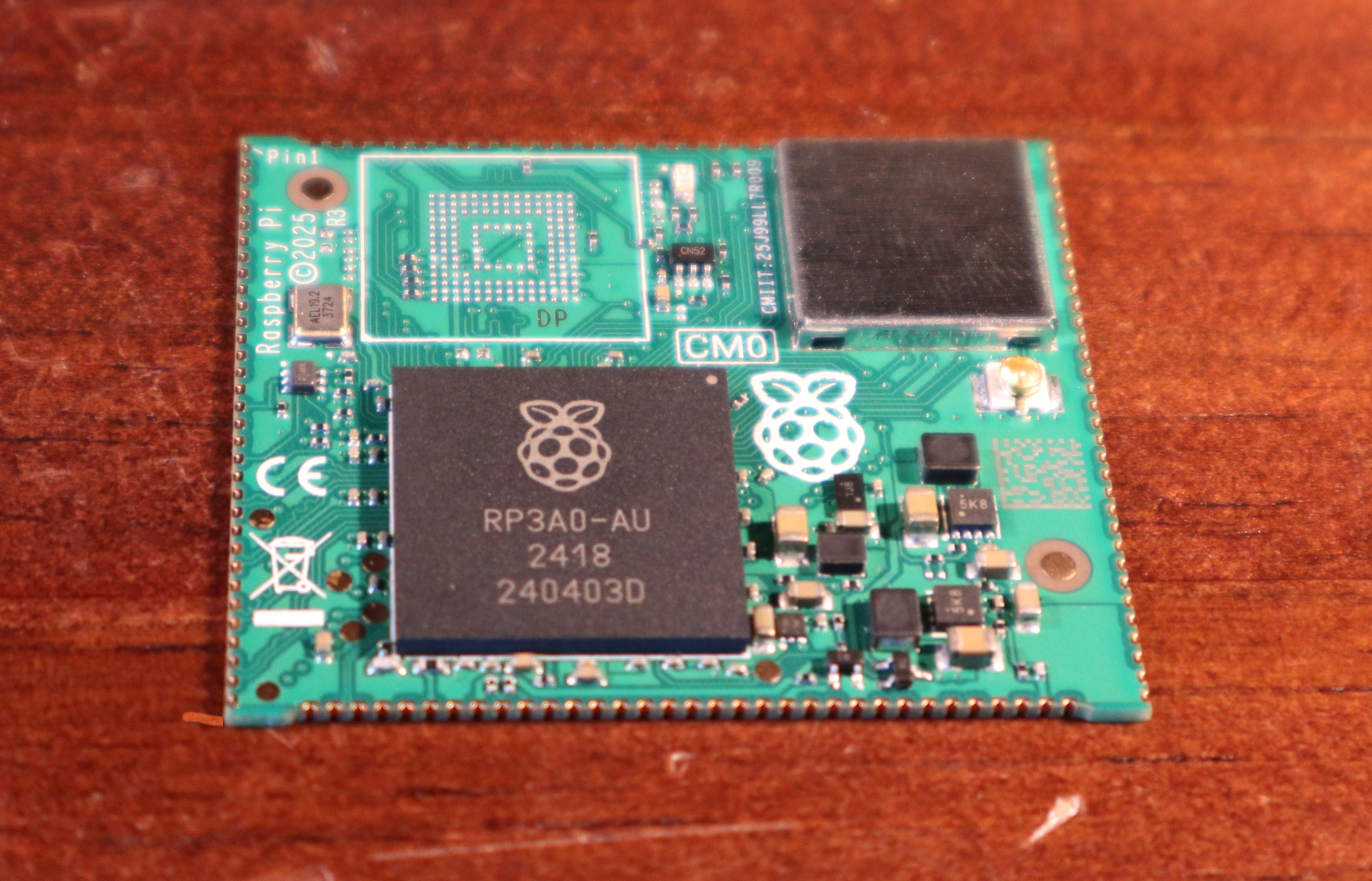
Every now and then though, they surprise us, with a board that follows a completely different path, which brings us to the one on our bench today. The Compute Module Zero packs the same quad-core RP3 system-on-chip (SoC) and Wi-Fi module as the Pi Zero 2 W with 512 MB of SDRAM onto a tiny 39 mm by 33 mm postage-stamp module. It’s a Pi, but not as you know it, so what is it useful for?
A Pi Zero 2 As You Haven’t Seen It Before

The first clue as to where this module sits in the Pi range comes from how it came to me. I have a bare module and the dev kit on loan from a friend who’s evaluating them with the idea of incorporating into a product. Instead of buying it from a store here in Europe he had to have it shipped from LCSC in China. It’s Chinese-made and distributed, and it’s not a consumer part in the way your Pi 5 is. Instead it’s an OEM part, and one which appears from where we’re sitting to be tailored specifically to the needs of OEMs manufacturing in China. Would you like a Linux computer with useful software updates and support built into your product? Look no further.
I put up a quick video showing it in detail which you can see at the bottom of the page. Physically it appears to carry the same parts we’re used to from the Zero 2, with the addition of an eMMC storage chip and with an antenna socket in place of the PCB antenna on the Zero. All the available interfaces are brought out to the edge of the board including some not seen on the Zero. The module is available with a variety of different storage options, including the version with no eMMC which my friend has. He’s also bought one with the storage on the dev board, so you can see both types.
The dev board is similar to a Pi model A+ in size, with a bit of extra PCB at the bottom for the USB and HDMI connectors. Like the Zero it has Micro-USB connectors for power and USB, but it carries a full-size HDMI socket. There are connectors for an LCD display, a camera, a micro SD card if you’re using the version without eMMC, and 40-pin GPIO header.
In addition, there’s an extrnal stick-on antenna in the box. Electrically it’s nothing you won’t have seen before, after all it’s little more than a Pi Zero 2 on a different board, and with less memory. This one is fresh from the box and doesn’t have an OS installed, but since we all already know how well a Pi Zero 2 runs and the likely implications of 512 MB of memory I’ve left it that way for my friend.
What Can This Board Do For Us?
The idea of a bottom-end Raspberry Pi as a component module for your Chinese assembly house is a good one. It has to be the RP3 on board, because as we’ve noted, the earlier Pi architecture is heading into the sunset and that is now their lowest-power 64-bit silicon. It could use more memory, but 512 MB is enough for many undemanding Linux applications and more than appears on many SoCs.
For tiny little computer applications, it’s an attractive component, but it’s a little bit expensive. Depending on the version, and whether it comes with the dev board, it ranges from about $25 to $38, and we can imagine that even with a quantity price break that may be too much for many manufacturers. A Chinese SoC, albeit with worse long-term Linux support, can be had for much less. If this SBC form factor catches on, we’d expect to see knockoff boards appear for a more reasonable price in due course.
Perhaps as the price of memory eventually comes down they will increase the spec a little, but we’d hazard a guess that a lower price would mean more success. A low power, plug-innable computer for $20 would be interesting for a number of projects where size really matters. Only time will tell, but meanwhile if you’re designing a product you have a new Linux option for it, and for the rest of us it’s time to look out for these modules appearing in things we buy.
Would you use one of these, and for what?
youtube.com/embed/jtdAFIAMueM?…
Popular Science Experiments in Sound During the 19th-Century

Check one, two; check one, two; is this thing on? Over on The Public Domain Review [Lucas Thompson] takes us for a spin through sound, as it was in Britain around and through the 1800s.
The article begins by introducing the Father of Acoustics, German physicist Ernst Chladni. After placing grains of sand on a thin metal plate and drawing a violin bow along one edge Chladni figures appear, making manifest that which previously could only be heard, that is, sound waves.
It’s fun to think that it wasn’t so long ago that the physics of sound was avant-garde. Middle class Victorian society was encouraged to reproduce cutting edge experiments with equipment in their own homes, participating in a popular science which was at the same time part entertainment and part instruction, for young and old alike. Throughout the rest of his article [Lucas] lists a number of popular science books from the period and talks a little about what was to be found within.
See the video below the break for a demonstration of Chladni figures from The Royal Institution. Of course the present state of the art regarding sonics is well advanced as compared with that of the 19th century. If you’re interested to know more check out Building A Wall-Mounted Sound Visualizer and Seeing Sound For Under $200.
youtube.com/embed/OLNFrxgMJ6E?…
reshared this
2025: As The Hardware World Turns

If you’re reading this, that means you’ve successfully made it through 2025! Allow us to be the first to congratulate you — that’s another twelve months of skills learned, projects started, and hacks….hacked. The average Hackaday reader has a thirst for knowledge and an insatiable appetite for new challenges, so we know you’re already eager to take on everything 2026 has to offer.
But before we step too far into the unknown, we’ve found that it helps to take a moment and reflect on where we’ve been. You know how the saying goes: those that don’t learn from history are doomed to repeat it. That whole impending doom bit obviously has a negative connotation, but we like to think the axiom applies for both the lows and highs in life. Sure you should avoid making the same mistake twice, but why not have another go at the stuff that worked? In fact, why not try to make it even better this time?
As such, it’s become a Hackaday tradition to rewind the clock and take a look at some of the most noteworthy stories and trends of the previous year, as seen from our rather unique viewpoint in the maker and hacker world. With a little luck, reviewing the lessons of 2025 can help us prosper in 2026 and beyond.
Love it or Hate it, AI is Here
While artificial intelligence software — or at least, what passes for it by current standards — has been part of the technical zeitgeist for a few years, 2026 was definitely the year that AI seemed to be everywhere. So much so that the folks at Merriam-Webster decided to make “slop”, as in computer-generated garbage content, their Word of the Year. They also gave honorable mention to “touch grass”, which they describe as a phrase that’s “often aimed at people who spend so much time online that they become disconnected from reality.” But we’re going to ignore that one for personal reasons.
At Hackaday, we’ve obviously got some strong feelings on AI. For those who earn a living by beating the written word into submission seven days a week, the rise of AI is nothing less than an existential crisis. The only thing we have going for us is the fact that the average Hackaday reader is sharp enough to recognize the danger posed by a future in which all of our media is produced by a Python script running on somebody’s graphics card and will continue to support us, warts and all.

But while most of us are on the same page about AI in regards to things like written articles or pieces of art, it’s not so clear cut when it comes to more utilitarian endeavours. There’s a not insignificant part of our community that’s very interested in having AI help out with tedious tasks such as writing code, or designing PCBs; and while the technology is still in its infancy, there’s no question the state of the art is evolving rapidly.
For a practical example we can take a look at the personal projects of two of our own writers. Back in 2023. Dan Maloney had a hell of a time getting ChatGPT to help him design a latch in OpenSCAD. Fast forward to earlier this month, and Kristina Panos convinced it to put together a customized personal library management system with minimal supervision.
We’ve also seen a uptick in submitted projects that utilized AI in some way. Kelsi Davis used a large language model (LLM) to help get Macintosh System 7 running on x86 in just three days, Stable Diffusion provided the imagery for a unique pizza-themed timepiece, Parth Parikh used OpenAI’s Speech API to bring play-by-play commentary to PONG, and Nick Bild used Google Gemini to help turn physical tomes into DIY audio books.
Make no mistake, an over-reliance on AI tools can be dangerous. In the best case, the user is deprived of the opportunity to actually learn the material at hand. In the worst case, you make an LLM-enhanced blunder that costs you time and money. But when used properly, the takeaway seems to be that a competent maker or hacker can leverage these new AI tools to help bring more of their projects across the finish line — and that’s something we’ve got a hard time being against.
Meshtastic Goes Mainstream
Another tech that gained steam this year is Meshtastic. This open source project aims to allow anyone to create an off-grid, decentralized, mesh network with low cost microcontrollers and radio modules. We fell in love with the idea as soon as we heard about it, as did many a hacker. But the project has reached a level of maturity that it’s starting to overflow into other communities, with the end result being a larger and more capable mesh that benefits everyone.
Part of the appeal is really how ridiculously cheap and easy it is to get started. If you’re starting from absolutely zero, connecting up to an existing mesh network — or creating your own — can cost you as little as $10 USD. But if you’re reading Hackaday, there’s a good chance you’ve already got a supported microcontroller (or 10) laying around, in which case you may just need to spring for the LoRa radio module and wire it up. Add a 3D printed case, and you’re meshin’ with the best of them.

If you’re OK with trading some money for time, there’s a whole world of ready to go Meshtastic devices available online from places like Amazon, AliExpress, and even Etsy for that personal touch. Fans of the retro aesthetic would be hard pressed to find a more stylish way to get on the grid than the Hacker Pager, and if you joined us in Pasadena this year for Hackaday Supercon, you even got to take home a capable Meshtastic device in the form of the Communicator Badge.
Whether you’re looking for a backup communication network in the event of a natural disaster, want to chat with neighbors without a megacorp snooping on your discussion, or are simply curious about radio communications, Meshtastic is a fantastic project to get involved with. If you haven’t taken the plunge already, point your antenna to the sky and see who’s out there, you might be surprised at what you find.
Arduino’s New Overlord
In terms of headlines, the acquisition of Arduino by Qualcomm was a pretty big one for our community. Many a breathless article was written about what this meant for the future of the company. And things only got more frantic a month later, when the new Arduino lawyers updated the website’s Terms and Conditions.
But you didn’t see any articles about that here on Hackaday. The most interesting part of the whole thing to us was the new Arduino Uno Q: an under $50 USD single-board computer that can run Linux while retaining the classic Uno layout. With the cost of Raspberry Pi hardware steadily increasing over the years, some competition on the lower end of the price spectrum is good for everyone.

As for the Qualcomm situation — we’re hackers, not lawyers. Our immediate impression of the new ToS changes was that they only applied to the company’s web services — “The Platform” in the contract — and had no bearing on the core Arduino software and hardware offerings that we’re all familiar with. The company eventually released a blog post explaining more or less the same thing, explaining that evolving privacy requirements for online services meant they had to codify certain best practices, and that their commitment to open source is unwavering.
For now, that’s good enough for us. But the whole debacle does bring to mind a question: if future Arduino software development went closed-source tomorrow, how much of an impact would it really have on the community at this point? Today when somebody talks about doing something with Arduino they are more likely to be talking about the IDE and development environment than one of the company’s microcontroller boards — the licenses for which mean the versions we have now will remain open in perpetuity. The old AVR Arduino code is GPLed, after all, as are the newer cores for microcontrollers like the ESP32 and RP2040, which weren’t written by Arduino anyway. On the software side, we believe that we have nothing to lose.
But Arduino products have also always been open hardware, and we’ve all gained a lot from that. This is where Qualcomm could still upset the applecart, but we don’t see why they would, and they say they won’t. We’ll see in 2026.
The Year of Not-Windows on the Desktop?
The “Year of Linux on the Desktop” is a bit like fusion power, in that no matter how many technical hurdles are cleared, it seems to be perennially just over the horizon. At this point it’s become a meme, so we won’t do the cliché thing and claim that 2025 (or even 2026) is going to finally be the year when Linux breaks out of the server room and becomes a mainstream desktop operating system. But it does seem like something is starting to shift.
That’s due, at least in part, to Microsoft managing to bungle the job so badly with their Windows 11 strategy. In spite of considerable push-back in the tech community over various aspects of the operating system, the Redmond software giant seems hell-bent on getting users upgraded. At the same time, making it a hard requirement that all Windows 11 machines have a Trusted Platform Module means that millions of otherwise perfectly usable computers are left out in the cold.

Does that mean everyone is switching over to Linux? Well, no. Certainly Linux is seeing an influx of new users, but for the average person, it’s more likely they’d switch to Mac or pick up a cheap Chromebook if all they want to do is surf the web and use social media.
Of course, there’s an argument to be made that Chromebook users are technically Linux users, even if they don’t know it. But for that matter, you could say anyone running macOS is a BSD user. In that case, perhaps the “Year of *nix” might actually be nigh.
Grandma is 3D Printing in Color
There was a time when desktop 3D printers were made of laser-cut wood, used literal strings instead of belts, and more often then not, came as a kit you had to assemble with whatever assistance you could scrounge up from message boards and IRC channels — and we liked it that way. A few years later, printers were made out of metal and became more reliable, and within a decade or so you could get something like an Ender 3 for a couple hundred bucks on Amazon that more or less worked out of the box. We figured that was as mainstream as 3D printing was likely to get…but we were very wrong.
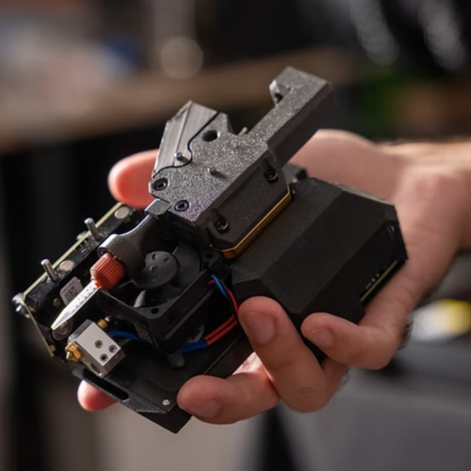
Today 3D printing is approaching a point where the act of downloading a model, slicing it, and manifesting it into physical form has become, dare we say it, mundane. While we’re not always thrilled with the companies that make them and their approach to things that are important to us like repairability, open development, and privacy, we have to admit that the new breed of printers on the market today are damn good at what they do. Features like automatic calibration and filament run-out sensors, once the sort of capabilities you’d only see on eye-wateringly expensive prosumer machines, have became standard equipment.
While it’s not quite at the point where it’s an expected feature, the ability to print in multiple materials and colors is becoming far more common. Pretty much every printer manufacturer has their own approach, and the prices on compatible machines are falling rapidly. We’re even starting to see printers capable of laying down more exotic materials such as silicone.
Desktop 3D printing still hasn’t reached the sort of widespread adoption that all those early investors would have had us believe in the 2000s, where every home would one day have their own Star Trek style personal replicator. But they are arguably approaching the commonality of something like a table saw or drill press — specialized but affordable and reliable tools that act as a force multiplier rather than a tinkerer’s time sink.
Tariffs Take Their Toll
Finally, we couldn’t end an overview of 2025 without at least mentioning the ongoing tariff situation in the United States. While it hasn’t ground DIY electronics to a halt as some might have feared, it’s certainly had an impact.
A tax on imported components is nothing new. We first ran into that back in 2018, and though it was an annoyance, it didn’t have too much of an impact at the hobbyist scale. When an LED costs 20 cents, even a 100% tariff wouldn’t be much of a hit to the wallet at the scale most of us are operating at. Plus there are domestic, or at least non-Chinese, options for some jellybean components. The surplus market can also help here — you can often find great deals on things like partial reels of SMD capacitors and resistors on eBay if you keep an eye out for them.
We’ve heard more complaints about PCB production than anything. After years of being able to get boards made overseas for literal pennies, seeing a import tax that added at checkout can be quite a shock. But just like the added tax on components, while annoying, it’s not enough to actually keep folks from ordering. Even with the tariffs, the cost of getting a PCB made at OSH Park is going to be much higher than any Chinese board house.
Truth be told, if an import tax on Chinese-made PCBs and components resulted in a boom of affordable domestic alternatives, we’d be all over it. The idea that our little hobby boards needed to cross an ocean just to get to us always seemed unsustainable anyway. It wouldn’t even have to be domestic, there’s an opportunity for countries with a lower import tariff to step in. Instead of having our boards made in China, why not India or Mexico?
But unfortunately, the real-world is more complex than that. Building up those capabilities, either at home or abroad, takes time and money. So while we’d love to see this situation lead to greater competition, we’ve got a feeling that the end result is just more money out of our pockets.
Thanks for Another Year of Hacks
One thing that absolutely didn’t change in 2025 was you — thanks to everyone that makes Hackaday part of their daily routine, we’ve been able to keep the lights on for another year. Everyone here knows how incredibly fortunate we are to have this opportunity, and your ongoing support is never taken for granted.
We’d love to hear what you thought the biggest stories or trends of 2025 were, good and bad. Let us know what lessons you’ll be taking with you into 2026 down below in the comments.
hackaday.com/2026/01/05/2025-a…
Moving From Windows To FreeBSD As The Linux Chaos Alternative
Back in the innocent days of Windows 98 SE, I nearly switched to Linux on account of how satisfied I was with my Windows experience. This started with the Year of the Linux Desktop in 1999 that sta…Hackaday
GitHub Disables Rockchip’s Linux MPP Repository After DMCA Request

Recently GitHub disabled the Rockchip Linux MPP repository, following a DMCA takedown request from the FFmpeg team. As of writing the affected repository remains unavailable. At the core of this issue is the Rockchip MPP framework, which provides hardware-accelerated video operations on Rockchip SoCs. Much of the code for this was lifted verbatim from FFmpeg, with the allegation being that this occurred with the removal of the original copyright notices and authors. The Rockchip MPP framework was further re-licensed from LGPL 2.1 to the Apache license.
Most egregious of all is perhaps that the FFmpeg team privately contacted Rockchip about this nearly two years ago, with clearly no action taken since. Thus FFmpeg demands that Rockchip either undoes these actions that violate the LGPL, or remove all infringing files.
This news and further context is also covered by [Brodie Robertson] in a video. What’s interesting is that Rockchip in public communications and in GitHub issues are clearly aware of this license issue, but seem to defer dealing with it until some undefined point in the future. Clearly that was the wrong choice by Rockchip, though it remains a major question what will happen next. [Brodie] speculates that Rockchip will keep ignoring the issue, but is hopeful that he’ll be proven wrong.
Unfortunately, these sort of long-standing license violations aren’t uncommon in the open source world.
youtube.com/embed/cYvvYPth1fo?…


Datenzugang für Nutzer:innen und Forschung: „Wir haben das Recht auf unserer Seite“
netzpolitik.org/2026/datenzuga…

ICYMI: Updates from the 1/4 Meeting
ICYMI
Ohio – The Ohio Pirate Party was unanimously voted in as the ninth Pirate National Committee member state! Congratulations to the Ohio Pirate Party!
Young Pirates USA – Bylaws for our Young Pirates USA organization was approved during last night’s meeting. Co-Captains Lily and Jack were both in attendance for the approval of the bylaws.
Other News – Arizona and Illinois hosted their first in-person meeting for the year, with more meetings for state parties and their local affiliates to come this month. More candidates for the U.S. Pirate Party are expected to be announced in the coming weeks.
Just a reminder that our 2026 Pirate National Conference will take place June 6th, 2026, which will mark 20 years of the United States Pirate Party. The conference will take place in Boston, MA, as decided by our members. The next piece of business to be voted on by the Pirate Party supporters shall be in regards to the theme and/or tagline of the conference.
Remember: we will host the conference aboard a boat!
guigui3000 reshared this.
Trump vuole congelare i dividendi delle industrie della Difesa. Ecco perché
@Notizie dall'Italia e dal mondo
Una pioggia di miliardi per le aziende della difesa, ma anche un avvertimento per i contractor: questi fondi non andranno nelle tasche degli azionisti. Almeno, non per adesso. In un post pubblicato sul suo social Truth, Donald Trump ha affermato di voler vietare i
freezonemagazine.com/articoli/…
Ultima chiamata … la Mostra “George Simenon. Otto Viaggi di un Romanziere” sta per finire. C’è sempre un qualche buon motivo per andare a Bologna. La città è bella e anche la gente, di norma. Se andate pazzi per i tortellini, Sfoglia Rina non aspetta altro che ci mettiate piede e anche il portafoglio.
la scomparsa di Bruno Breguet - sabato 10.01 a Bellinzona (TI), Svizzera

Sabato 10 gennaio 2026, al Centro La Nocciola a Bellinzona – a 10 anni dalla presentazione organizzata dal Collettivo Scintilla sulla scomparsa del militante ticinese del Fronte popolare per la Liberazione della Palestina Bruno Breguet – abbiamo il piacere e il dovere di riproporre l’evento.
La situazione a Gaza e in Cisgiordania non cessa di peggiorare ed è importante – oggi più che mai – continuare a parlare di Palestina.
Nel 1970, Bruno Breguet, liceale appena ventenne viene arrestato in Israele mentre cerca di contrabbandare esplosivi per la resistenza palestinese. Durante la sua detenzione si radicalizza e all’uscita di prigione entra nel gruppo del terrorista Carlos. Sparisce misteriosamente nel 1995.
La serata si dividerà in due momenti.
Alle 17:00 la proiezione del documentario “La scomparsa di Bruno Breguet” del regista ticinese Olmo Cerri.
Il film ricostruisce la storia di Breguet incontrando le persone che lo hanno conosciuto, riflette sui mezzi e sui fini della lotta e sul senso della militanza allora come oggi.
Alle 18:30, alla presenza di Olmo Cerri e Cristiano Armati di Red Star Press – Hellnation Libri, presenteremo il libro “La scuola dell’odio – Sette anni nelle prigioni israeliane” di Bruno Breguet.
A seguire alle 20:00, cena popolare (5 CHF).
Pirates Assembly
@politics
europeanpirates.eu/pirates-ass…
International Pirates pay attention!The 20th Council Meeting is coming: 30 – 31 January in Ljubljana. Participation is appreciated, discourse.european-pirateparty… Online participation will be…
Disordine mondiale, dibattito a Roma il 9 gennaio
@Giornalismo e disordine informativo
articolo21.org/2026/01/disordi…
Su iniziativa del Forum Pace e Disarmo, venerdì 9 gennaio alle 18, presso il circolo di Sinistra Italiana in via Zabaglia 22a, a Roma, si terrà un dibattito pubblico che riteniamo utile per riflettere ed approfondire le vicende
Così Trump continua a ritirare gli Usa dalle organizzazioni internazionali
@Giornalismo e disordine informativo
articolo21.org/2026/01/cosi-tr…
Il presidente degli Stati Uniti Donald Trump ha firmato mercoledì 7 gennaio un memorandum che ritira gli USA da 66 organizzazioni internazionali,
Sospensione
@Giornalismo e disordine informativo
articolo21.org/2026/01/sospens…
Solo a novembre, con le elezioni di medio termine negli Usa, sapremo se gli americani ragionevoli ci salveranno dagli americani violenti. Nove mesi sono un tempo infinito in un periodo dove assistiamo a una violazione al giorno del diritto internazionale. Ma Trump potrebbe arrivare anche alla violazione del diritto interno, accusando di
L’Appello per la difesa della legalità e del diritto internazionale ha raggiunto 7500 adesioni. Firma anche tu
@Giornalismo e disordine informativo
articolo21.org/2026/01/lappell…
Sono ormai 7500 le persone che hanno aderito
L’accusa di Narco-terrorismo è una scusa per disciplinare il continente
@Notizie dall'Italia e dal mondo
Il “narco-terrorismo”, pretesto usato dagli Usa per attaccare il Venezuela, non è una categoria giuridica riconosciuta, ma una costruzione politica funzionale
L'articolo L’accusa di Narco-terrorismo è una scusa per disciplinare il continente proviene da Pagine
Ostaggi nel deserto. Le prigioni libiche sono piene di egiziani
@Notizie dall'Italia e dal mondo
Una volta in Libia, molti migranti egiziani vengono sequestrati, detenuti e torturati. Il rapimento, nel 2024 di sei egiziani a Zawiya ha mostrato la brutalità del pagineesteri.it/2026/01/08/med…
Minneapolis e l’uso sconsiderato del potere
@Giornalismo e disordine informativo
articolo21.org/2026/01/minneap…
Il sindaco di Minneapolis ha definito ‘stronzate’ le accuse dell’ICE contro Renee Nicole Good, ha parlato precisamente di “uso sconsiderato del potere”. Questo è il punto. L’uso sconsiderato del potere da parte delle Istituzioni democratiche non
Crans Montana, lutto nazionale
Al lavoro non si parla d'altro.. Come sui social, commenti a sproposito e molto giudicanti verso i giovani...
Un po' di rispetto, no?
Aaah 😵 per fortuna domani non lavoro.
rsi.ch/info/svizzera/Rogo-a-Cr…
#cransmontana #luttonazionale #svizzera

Rogo a Crans-Montana: la Svizzera si prepara al lutto nazionale - RSI
Domani la giornata di cordoglio: un minuto di silenzio e raccoglimento in tutta la Svizzera, cerimonia commemorativa a Martignyrsi
La modalità “piccante” di Grok di Elon Musk alimenta le richieste di una stretta dell’UE
Per vedere altri post sull' #IntelligenzaArtificiale, segui la comunità @Intelligenza Artificiale
L’assistente AI Grok, di proprietà di Elon Musk, è stato progettato fin dall’inizio per essere provocatorio – persino politicamente scorretto – ma lo
L' ICE spara e la democrazia arretra.
noblogo.org/transit/l-ice-spar…


L' ICE spara e la democrazia arretra.
(192)
A Minneapolis, a pochi isolati dal punto in cui fu ucciso George Floyd, un’agente dell’ #ICE ha sparato e ucciso una donna di 37 anni durante una maxi‑operazione anti‑migranti, colpendola alla testa mentre era alla guida della sua auto. Il suo nome era Renee Nicole Good ed era disarmata, identificata da più testimoni e da rappresentanti politici come una osservatrice legale presente per monitorare l’azione federale, non per minacciare nessuno. L’ennesima uccisione a freddo, nel solco di una repressione sempre più brutale, rischia di incendiare ancora una volta il tessuto sociale degli Stati Uniti nei prossimi mesi.
L’ICE sostiene che la donna stesse tentando di investire gli agenti, ma i video circolati online mostrano un’auto che si muove lentamente e un agente che spara in testa mentre il veicolo prova ad allontanarsi, una versione che molti leader locali definiscono inaccettabile e menzognera.
Il sindaco ha chiesto apertamente agli agenti federali di “andarsene affanculo fuori da #Minneapolis e dal Minnesota”, accusandoli di seminare caos e violenza in una città che porta ancora le cicatrici del 2020. I democratici parlano di “esecuzione” e di uso temerario della forza, mentre dalla Casa Bianca di #Trump arrivano dichiarazioni che bollano le proteste come “terrorismo interno”, capovolgendo la realtà e criminalizzando il dissenso.
Minneapolis non è un luogo qualsiasi: è il simbolo dell’omicidio di George Floyd e dell’esplosione di “Black Lives Matter”, e tornare a vedere una persona uccisa da un agente, a pochi isolati da lì, apre ferite mai rimarginate.
Negli ultimi mesi, almeno una decina di sparatorie che coinvolgono agenti federali in operazioni migratorie sono state segnalate dai media, segno di un clima in cui l’uso letale della forza contro corpi percepiti come “sacrificabili” sta diventando routine.
Le prime ore dopo l’uccisione hanno visto nascere veglie, cortei, blocchi simbolici di edifici federali e proteste in altre città, con una parola d’ordine chiara: “ICE out of our cities”. L’episodio arriva nel pieno di una nuova stretta federale sull’immigrazione, alimentata da una retorica razzista contro la comunità somala e da scandali usati come pretesto per un intervento muscolare di Trump sul territorio. È prevedibile un rafforzamento dei movimenti abolizionisti e delle reti di difesa dei migranti, che già ora chiedono lo smantellamento dell’ICE e il ritiro delle forze federali dalle città, trasformando il caso di Renee Nicole Good in un simbolo nazionale.
In questo scenario, lo scontro tra amministrazioni locali e governo federale rischia di radicalizzarsi: sindaci, governatori e consigli comunali si trovano stretti tra la pressione delle comunità e la linea dura della Casa Bianca, creando un conflitto istituzionale che alimenterà mobilitazioni, boicottaggi e campagne di disobbedienza civile.
Quando un governo difende l’uccisione di una donna disarmata e definisce “terrorista” chi protesta, non sta solo coprendo un crimine: sta normalizzando l’idea che alcuni corpi possano essere eliminati senza processo, senza domande, senza memoria. Il fatto che una osservatrice legale, presente per tutelare diritti fondamentali, venga abbattuta come un bersaglio qualsiasi dice molto sul livello di disumanizzazione raggiunto dalla macchina della deportazione e del controllo. Nei prossimi mesi, gli Stati Uniti si muoveranno su un crinale pericoloso: da un lato una società sempre più abituata a vedere immagini di esecuzioni in diretta, dall’altro comunità che rifiutano di accettare l’idea che lo Stato possa sparare a chi osserva, filma, documenta.
Minneapolis sembra lontana, ma ciò che accade lì parla anche all’Europa e all’Italia, dove la logica dell’“emergenza migranti” viene usata per giustificare respingimenti, morti in mare, abusi ai confini e nei CPR (pure vuoti e pure all'estero.) Se oggi un’agente federale può sparare alla testa di una donna che documenta un’operazione, domani chiunque alzi un telefono, una penna, una telecamera per raccontare può diventare un bersaglio: è questo il messaggio più inquietante che arriva dagli Stati Uniti, la più grande anti-democrazia del mondo.
#Blog #USA #Minneapolis #ICE #DirittiCivili #DirittiUmani #Opinioni
Mastodon: @alda7069@mastodon.unoTelegram: t.me/transitblogFriendica: @danmatt@poliverso.orgBlue Sky: bsky.app/profile/mattiolidanie…Bio Site (tutto in un posto solo, diamine): bio.site/danielemattioli
Gli scritti sono tutelati da “Creative Commons” (qui)
Tutte le opinioni qui riportate sono da considerarsi personali. Per eventuali problemi riscontrati con i testi, si prega di scrivere a: corubomatt@gmail.com


freezonemagazine.com/articoli/…
Alla fine lo beccai, Abraham Trahearne: lo beccai che beveva birra in compagnia di un bulldog alcolizzato, tale Fireball Roberts, in una sgangherata bettola appena fuori Sonoma, California, intento a spremere anche le ultime gocce di un bel pomeriggio di primavera. Questo è il meraviglioso incipit de L’ultimo vero bacio di James Crumley: uno […]
L'articolo James Crumley – L’ultimo