
tinyCore Board Teaches Core Microcontroller Concepts

Looking for an educational microcontroller board to get you or a loved one into electronics? Consider the tinyCore – a small and nifty hexagon-shaped ESP32 board by [MR. INDUSTRIES], simplified for learning yet featureful enough to offer plenty of growth, and fully open.
The tinyCore board’s hexagonal shape makes it more flexible for building wearables than the vaguely rectangular boards we’re used to, and it’s got a good few onboard gadgets. Apart from already expected WiFi, BLE, and GPIOs, you get battery management, a 6DoF IMU (LSM6DSOX) in the center of the board, a micro SD card slot for all your data needs, and two QWIIC connectors. As such, you could easily turn it into, say, a smartwatch, a motion-sensitive tracker, or a controller for a small robot – there’s even a few sample projects for you to try.
You can buy one, or assemble a few yourself thanks to the open-source-ness – and, to us, the biggest factor is the [MR.INDUSTRIES] community, with documentation, examples, and people learning with this board and sharing what they make. Want a device with a big display that similarly wields a library of examples and a community? Perhaps check out the Cheap Yellow Display hacks!
youtube.com/embed/3Nd6zynJclk?…
We thank [Keith Olson] for sharing this with us!
700.000 record di un Registro Professionale Italiano in vendita nel Dark Web
Un nuovo allarme arriva dal sottobosco del cybercrime arriva poche ore fa. A segnalarlo l’azienda ParagonSec, società specializzata nel monitoraggio delle attività delle cyber gang e dei marketplace clandestini, che ha riportato la comparsa su un forum underground di un presunto database contenente oltre 700.000 record appartenenti ad un Registro Professionale Italiano non meglio precisato.
L’annuncio, pubblicato da un utente che si firma gtaviispeak, descrive la disponibilità di una “fresh db” contenente una quantità impressionante di informazioni sensibili di un database ad oggi sconosciuto che contiene dati personali estremamente dettagliati.
Disclaimer: Questo rapporto include screenshot e/o testo tratti da fonti pubblicamente accessibili. Le informazioni fornite hanno esclusivamente finalità di intelligence sulle minacce e di sensibilizzazione sui rischi di cybersecurity. Red Hot Cyber condanna qualsiasi accesso non autorizzato, diffusione impropria o utilizzo illecito di tali dati. Al momento, non è possibile verificare in modo indipendente l’autenticità delle informazioni riportate, poiché l’organizzazione coinvolta non ha ancora rilasciato un comunicato ufficiale sul proprio sito web. Di conseguenza, questo articolo deve essere considerato esclusivamente a scopo informativo e di intelligence.

Il contenuto del database: un rischio elevatissimo
Secondo quanto riportato nel post, il database includerebbe una lunga lista di campi, tra cui:
- Dati anagrafici completi: nome, cognome, sesso, luogo di nascita, data di nascita
- Codice fiscale
- Email e numeri telefonici (fissi e cellulari)
- Password (non è noto di quale sito siano riferite)
- Dati lavorativi: ente di lavoro, ruolo, categoria professionale
- Indirizzi di residenza e domicilio
- CAP, provincia, comune
- Eventuali informazioni di gruppo e stato professionale
- Dati amministrativi di registrazione
- Indirizzo IP associato all’utente
La presenza di password in chiaro (o comunque disponibili nel dump) aumenta notevolmente il rischio di compromissioni successive, soprattutto se gli utenti riutilizzano le stesse credenziali su altri servizi.
La vendita avviene su Telegram
Il venditore invita gli interessati a contattarlo tramite un canale Telegram dedicato, una prassi ormai consolidata nelle dinamiche di vendita di database sottratti illegalmente. Nel post è presente anche un link a un presunto sample del dataset, finalizzato a dimostrare l’autenticità del materiale.
Una minaccia concreta per cittadini e aziende
Se confermato, questo leak rappresenta un rischio significativo per:
- Frodi fiscali grazie alla disponibilità del codice fiscale
- Phishing altamente mirato (spear phishing) basato su dati personali e professionali
- Furti d’identità attraverso combinazioni di dati anagrafici, contatti e credenziali
- Attacchi contro enti pubblici o professionali, sfruttando i dati lavorativi e l’email associata
Il livello di dettaglio dei campi elencati suggerisce che si tratti di un database istituzionale o comunque proveniente da una piattaforma amministrativa con dati certificati.
Sebbene un utente del forum abbia precisato che gli account non sarebbero ‘fresh’, ciò incide ben poco: informazioni come dati anagrafici, codice fiscale e recapiti non cambiano nel tempo. Di conseguenza, il materiale resta estremamente sensibile e può essere sfruttato con facilità per diverse tipologie di frodi.
Le fughe di dati provenienti da enti pubblici e registri professionali stanno aumentando in tutta Europa. I cybercriminali puntano sempre più su database certificati e ufficiali, poiché consentono attacchi più credibili e redditizi.

L'articolo 700.000 record di un Registro Professionale Italiano in vendita nel Dark Web proviene da Red Hot Cyber.
NetSupport RAT: il malware invisibile che gli antivirus non possono fermare
Gli specialisti di Securonix hanno scoperto una campagna malware multilivello volta a installare segretamente lo strumento di accesso remoto NetSupport RAT. L’attacco si sviluppa attraverso una serie di fasi accuratamente nascoste, ciascuna progettata per garantire la massima discrezione e lasciare tracce minime sul dispositivo compromesso.
Il download iniziale del codice dannoso inizia con un file JavaScript iniettato nei siti web hackerati. Questo script ha una struttura complessa e una logica nascosta che si attiva solo quando vengono soddisfatte determinate condizioni.
È in grado di rilevare il tipo di dispositivo dell’utente e anche di registrare se è la prima volta che visita la pagina, consentendogli di eseguire azioni dannose una sola volta per dispositivo. Se le condizioni sono soddisfatte, lo script inietta un frame invisibile nella pagina o carica la fase successiva: un’applicazione HTML.
La seconda fase, riportano i ricercatori, prevede l’avvio di un file HTA, un’applicazione nascosta eseguita tramite lo strumento nativo di Windows mshta.exe. Estrae lo script PowerShell crittografato, lo decrittografa utilizzando un processo a più fasi e lo esegue direttamente in memoria. Ciò garantisce che tutte le attività dannose si verifichino senza creare file persistenti, ostacolando significativamente il rilevamento da parte del software antivirus.
Il passaggio finale prevede il download e l’installazione del NetSupport RAT. Per farlo, uno script di PowerShell scarica l’archivio, lo decomprime in una directory poco visibile e avvia il file eseguibile tramite un wrapper JScript. Per mantenerne la presenza nel sistema, viene creato un collegamento nella cartella di avvio, camuffato da componente di Windows Update. Questo approccio consente agli aggressori di mantenere l’accesso anche dopo il riavvio del dispositivo.
NetSupport RAT è uno strumento di amministrazione remota inizialmente legittimo, utilizzato attivamente dagli aggressori per attività di spionaggio, furto di dati e controllo remoto. Durante questa campagna, ottiene il pieno controllo del sistema infetto, intercettando l’input da tastiera, gestendo i file, eseguendo comandi e utilizzando funzioni proxy per navigare all’interno della rete.
Gli esperti stimano che l’infrastruttura dannosa sia costantemente sottoposta a manutenzione e aggiornamento e che la sua architettura indichi l’elevata competenza degli sviluppatori. L’attacco prende di mira gli utenti dei sistemi aziendali e si diffonde attraverso siti web falsi e reindirizzamenti nascosti. Nonostante l’elevato livello di sofisticazione, non è stato ancora possibile stabilire l’esatta affiliazione degli operatori con alcun gruppo criminale informatico noto.
La campagna rilevata evidenzia l’importanza di bloccare l’esecuzione di script non firmati, rafforzare il controllo sul comportamento dei processi di sistema, monitorare le directory di avvio e analizzare le attività di rete sospette. Si raccomanda particolare attenzione nel limitare l’uso di mshta.exe e nel monitorare i tentativi di download di file nelle cartelle %TEMP% e ProgramData.
L'articolo NetSupport RAT: il malware invisibile che gli antivirus non possono fermare proviene da Red Hot Cyber.


Gelosia 2.0
noblogo.org/lalchimistadigital…
tempo iperdenso e linee di fuga
noblogo.org/differx/e-un-perio…

è un periodo in cui le scadenze di consegna di lavori (non pagati o pagati...
& slowforward (entropia gratis) + ko-fi (help, support!)...differxdiario
reshared this
IL DOPOGUERRA SINO AL SERVIZIO INFORMAZIONI DIFESA (SID). PRIMA PARTE.
@Informatica (Italy e non Italy 😁)
Nel gennaio 1945 il SIM mutò la denominazione in “Ufficio Informazioni dello Stato Maggiore Generale” ma la struttura rimase pressoché invariata.
L'articolo IL DOPOGUERRA SINO AL SERVIZIO INFORMAZIONI DIFESA (SID). PRIMA PARTE. proviene da GIANO NEWS.
#DIFESA
Informatica (Italy e non Italy 😁) reshared this.
Dozens of government websites have fallen victim to a PDF-based SEO scam, while others have been hijacked to sell sex toys.#AI


Porn Is Being Injected Into Government Websites Via Malicious PDFs
Dozens of government and university websites belonging to cities, towns, and public agencies across the country are hosting PDFs promoting AI porn apps, porn sites, and cryptocurrency scams; dozens more have been hit with a website redirection attacks which lead to animal vagina sex toy ecommerce pages, penis enlargement treatments, automatically-downloading Windows program files, and porn.“Sex xxx video sexy Xvideo bf porn XXX xnxx Sex XXX porn XXX blue film Sex Video xxx sex videos Porn Hub XVideos XXX sexy bf videos blue film Videos Oficial on Instagram New Viral Video The latest original video has taken the internet by storm and left viewers in on various social media platforms ex Videos Hot Sex Video Hot Porn viral video,” reads the beginning of a three-page PDF uploaded to the website of the Irvington, New Jersey city government’s website.
The PDF, called “XnXX Video teachers fucking students Video porn Videos free XXX Hamster XnXX com” is unlike many of the other PDFs hosted on the city’s website, which include things like “2025-10-14 Council Minutes,” “Proposed Agenda 9-22-25,” and “Landlord Registration Form (1 & 2 unit dwelling).”
It is similar, however, to another PDF called “30 Best question here’s,” which looks like this:
Irvington, which is just west of Newark and has a population of 61,000 people, has fallen victim to an SEO spam attack that has afflicted local and state governments and universities around the United States.💡
Do you know anything else about whatever is going on here? I would love to hear from you. Using a non-work device, you can message me securely on Signal at jason.404. Otherwise, send me an email at jason@404media.co.
Researcher Brian Penny has identified dozens of government and university websites that hosted PDF guides for how to make AI porn, PDFs linking to porn videos, bizarre crypto spam, sex toys, and more.Reginfo.gov, a regulatory affairs compliance website under the federal government’s General Services Administration, is currently hosting a 12 page PDF called “Nudify AI Free, No Sign-Up Needed!,” which is an ad and link to an abusive AI app designed to remove a person’s clothes. The Kansas Attorney General’s office and the Mojave Desert Air Quality Management District Office in California hosted PDFs called “DeepNude AI Best Deepnude AI APP 2025.” Penny found similar PDFs on the websites for the Washington Department of Fish and Wildlife, the Washington Fire Commissioners Association, the Florida Department of Agriculture, the cities of Jackson, Mississippi and Massillon, Ohio, various universities throughout the country, and dozens of others. Penny has caught the attention of local news throughout the United States, who have reported on the problem.
The issue appears to be stemming from websites that allow people to upload their own PDFs, which then sit on these government websites. Because they are loaded with keywords for widely searched terms and exist on government and university sites with high search authority, Google and other search engines begin to surface them. In the last week or so, many (but not all) of the PDFs Penny has discovered have been deleted by local governments and universities.But cities seem like they are having more trouble cleaning up another attack, which is redirecting traffic from government URLs to porn, e-commerce, and spam sites. In an attack that seems similar to what we reported in June, various government websites are somehow being used to maliciously send traffic elsewhere. For example, the New York State Museum’s online exhibit for something called “The Family Room” now has at least 11 links to different types of “realistic” animal vagina pocket masturbators, which include “Zebra Animal Vagina Pussy Male Masturbation Cup — Pocket Realistic Silicone Penis Sex Toy ($27.99),” and “Must-have Horse Pussy Torso Buttocks Male Masturbator — Fantasy Realistic Animal Pussie Sex Doll.”
Links Penny found on Knoxville, Tennessee’s site for permitting inspections first go to a page that looks like a government site for hosting files then redirects to a page selling penis growth supplements that features erect penises (human penises, mercifully), blowjobs, men masturbating, and Dr. Oz’s face.Another Knoxville link I found, which purports to be a pirated version of the 2002 Vin Diesel film XXX simply downloaded a .exe file to my computer.
Penny believes that what he has found is basically the tip of the iceberg, because he is largely finding these by typing things like “nudify site:.gov” “xxx site:.gov” into Google and clicking around. Sometimes, malicious pages surface only on image searches or video searches: “Basically the craziest things you can think of will show up as long as you’re on image search,” Penny told 404 Media. “I’ll be doing this all week.”
The Nevada Department of Transportation told 404 Media that “This incident was not related to NDOT infrastructure or information systems, and the material was not hosted on NDOT servers.This unfortunate incident was a result of malicious use of a legitimate form created using the third-party platform on which NDOT’s website is hosted. NDOT expeditiously worked with our web hosting vendor to ensure the inappropriate content was removed.” It added that the third-party is Granicus, a massive government services company that provides website backend infrastructure for many cities and states around the country, as well as helps them stream and archive city council meetings, among other services. Several of the affected local governments use Granicus, but not all of them do; Granicus did not respond to two requests for comment from 404 Media.
The California Secretary of State’s Office told 404 Media: “A bad actor uploaded non-business documents to the bizfile Online system (a portal for business filings and information). The files were then used in external links allowing public access to only those uploaded files. No data was compromised. SOS staff took immediate action to remove the ability to use the system for non-SOS business purposes and are removing the unauthorized files from the system.” The Washington Department of Fish and Wildlife said “WDFW is aware of this issue and is actively working with our partners at WaTech to address it.” The other government agencies mentioned in this article did not respond to our requests for comment.
AI porn on state websites
Mainland whistleblower warns of malicious webpages being hosted on government websites nationwide, including in Hawaiʻi.Michael Brestovansky (Aloha State Daily)


The discovery of fire-cracked handaxes and sparking tools in southern Britain pushes the timeline of controlled fires back 350,000 years.#TheAbstract
Scientists Discover the Earliest Human-Made Fire, Rewriting Evolutionary History
🌘
Subscribe to 404 Media to get The Abstract, our newsletter about the most exciting and mind-boggling science news and studies of the week.Humans made fires as early as 400,000 years ago, pushing the timeline of this crucial human innovation back a staggering 350,000 years, reports a study published on Wednesday in Nature.
Mastery of fire is one of the most significant milestones in our evolutionary history, enabling early humans to cook nutritious food, seek protection from predators, and establish comfortable spaces for social gatherings. The ability to make fires is completely unique to the Homo genus that includes modern humans (Homo sapiens) and extinct humans, including Neanderthals.
Early humans may have opportunistically exploited wildfires more than one million years ago, but the oldest known controlled fires, which were intentionally lit with specialized tools, were previously dated back to about 50,000 years ago at Neanderthal sites in France.
Now, archaeologists have unearthed the remains of campfires ignited by an unidentified group of humans 400,000 years ago at Barnham, a village near the southern coast of the United Kingdom.
“This is a 400,000-year-old site where we have the earliest evidence of making fire—not just in Britain or Europe, but in fact, anywhere else in the world,” said Nick Ashton, an archaeologist at the British Museum who co-authored the study, in a press briefing held on Tuesday.
“Many of the great turning points in human development, and the development of our civilization, depended on fire,” added co-author Rob Davis, also an archaeologist at the British Museum. “We're a species who have used fire to really shape the world around us—in belief systems, as well. It's a very prominent part of belief systems across the world.”
Artifacts have been recovered from Barnham for more than a century, but the remnants of this ancient hearth were identified within the past decade. The researchers were initially tipped off by the remains of heated clay sediments, hydrocarbons associated with fire, and fire-cracked flint handaxes.
But the real smoking gun was the discovery of two small fragments of iron pyrite, a mineral commonly used to strike flint to produce sparks at later prehistoric campfires such as the French Neanderthal sites.
Discovery of the first fragment of iron pyrite in 2017 at Barnham, Suffolk Image: Jordan Mansfield, Pathways to Ancient Britain Project.
“Iron pyrite is a naturally occurring mineral, but through geological work in the area over the last 36 years, looking at 26 sites, we argue that pyrite is incredibly rare in the area,” said Ashton. “We think humans brought pyrite to the site with the intention of making fire.”The fire-starters were probably Neanderthals, who were known to be present in the region at the time thanks to a skull found in Swanscombe, about 80 miles northeast of Barnham. But it’s possible that the fires were made by another human lineage such as Homo heidelbergensis, which also left bones in the U.K. around the same period. It was not Homo sapiens as our lineage emerged in Africa later, about 300,000 years ago.
Regardless of this group’s identity, its ability to make fire would have been a major advantage, especially in the relatively cold environment of southern Britain at the time. It also hints that the ability to make fire extends far deeper into the past than previously known.
“We assume that the people who made the fire at Barnham brought the knowledge with them from continental Europe,” said co-author Chris Stringer, a physical anthropologist at the Natural History Museum. “There was a land bridge there. There had been a major cold stage about 450,000 years ago, which had probably wiped out everyone in Britain. Britain had to be repopulated all over again.”
“Having that use of fire, which they must have brought with them when they came into Britain, would have helped them colonize this new area and move a bit further north to places where the winters are going to be colder,” he continued. “You can keep warm. You can keep wild animals away. You get more nutrition from your food.”
Excavation of the ancient campfire, removing diagonally opposed quadrants. The reddened sediment between band B’ is heated clay. Image: Jordan Mansfield, Pathways to Ancient Britain Project.
Although these humans likely had brains close in size to our own, the innovation of controlled fire would have amplified their cognitive development, social bonds, and symbolic capacities. In the flickering light of ancient campfires, these humans shared food, protection, and company, passing on a tradition that fundamentally reshaped our evolutionary trajectory.“People were sitting around the fires, sharing information, having extra time beyond pure daylight to make things, to teach things, to communicate with each other, to tell stories,” Stringer said. “Maybe it may have even fueled the development of language.”
“We've got this crucial aspect in human evolution, and we can put a marker down that it was there 400,000 years ago,” he concluded.
Earliest evidence of making fire - Nature
Baked sediment, heat-shattered artefacts and introduced pyrite in a 400,000-year-old Palaeolithic occupation site in Suffolk, UK provide evidence of intentional fire-making, marking a pivotal moment in human development.Nature
Se stai programmando una vacanza negli USA, controlla i tuoi post sui social anche vecchi di 5 anni
Gli USA vogliono rendere obbligatorio l'accesso ai profili social per i visitatori europei prima di farli entrare alla frontiera. A meno che non siano milionariRiccardo Piccolo (Wired Italia)
reshared this
Marco Perduca al Teatro Off/Off per “Diritto a stare bene”
Marco Perduca al Teatro Off/Off per “Diritto a stare bene”
Marco Perduca, coordinatore delle iniziative dell’Associazione Luca Coscioni sulla ricerca e l’uso terapeutico delle sostanze psichedeliche parteciperà alla celebrazione del raggiungimento delle 72.000 firme raccolte a sostegno della campagna nazionale “Diritto a Stare Bene”
Teatro Off/Off, Via Giulia 20 – Roma
Sabato 13 dicembre 2025
Ore 16:00 – 19:00
La proposta di legge di iniziativa popolare mira all’istituzione di un servizio nazionale pubblico di psicologia, accessibile, gratuito e integrato nel Servizio Sanitario Nazionale.
Insieme a lui interverranno Maria Teresa Bellucci (viceministra del Lavoro e delle Politiche Sociali), Maura Latini (Presidente Coop Italia), Francesco Maesano (coordinatore nazionale Diritto a stare bene), Michela Marzano (filosofa e docente universitaria),Linda Laura Sabbadini (statistica e pioniera negli studi di genere),Maria Antonietta Gulino (Presidente CNOP) e Parlamentari di diversi schieramenti.
A seguire, dalle ore 20:00, la festa continuerà al Campomagnetico (Vicolo delle Grotte 3) con un talk show targato Mentifricio e DJ set.
L'articolo Marco Perduca al Teatro Off/Off per “Diritto a stare bene” proviene da Associazione Luca Coscioni.
Le prestazioni sociosanitarie e le liste d’attesa: l’assenza ingiustificabile dal PNGLA
Il nuovo Piano Nazionale di Governo delle Liste d’Attesa viene presentato come la risposta sistemica ai ritardi nell’erogazione di visite ed esami, con l’obiettivo dichiarato di garantire maggiore trasparenza, tempi certi e tutele per gli utenti. Tuttavia, dentro questo impianto che ambisce alla modernizzazione del sistema, continua a persistere un vuoto enorme: quello dei servizi sociosanitari. RSA, interventi per la disabilità, residenzialità psichiatrica, centri diurni e assistenza domiciliare integrata restano completamente fuori dal perimetro del Piano, nonostante siano prestazioni riconosciute come Livelli Essenziali di Assistenza e finanziate dal Fondo sanitario nazionale. Non compaiono nelle tabelle dei tempi massimi, non sono associate a percorsi di tutela, e non esistono per esse standard nazionali di pubblicità delle graduatorie o di presa in carico entro tempi determinati. L’effetto è immediato: per migliaia di persone, l’attesa non ha limiti né garanzie.
Ne deriva un Paese a due velocità. Per una prestazione diagnostica, il cittadino può invocare tempi precisi e un quadro normativo che ne tutela il diritto; per un posto in RSA, per l’ingresso in una struttura per persone con disabilità grave o per avviare un percorso di cura residenziale in ambito psichiatrico, la stessa persona si ritrova relegata in un limbo amministrativo senza scadenze. Accade così che individui che hanno già superato la valutazione UVM/UVG, ai quali è stato riconosciuto un bisogno sanitario e approvato un progetto assistenziale personalizzato, rimangano per mesi – spesso anni – con la sola etichetta di “collocato in graduatoria”, espressione che nasconde la totale assenza di un termine entro cui la prestazione deve essere garantita. È una distorsione che amplifica le differenze territoriali e che si pone in evidente contrasto con il principio di uguaglianza e con il diritto alla salute sancito dalla Costituzione. È incomprensibile che una prestazione sanitaria tradizionale debba essere erogata entro limiti certi, mentre una prestazione sociosanitaria, pur definita essenziale, sia lasciata oscillare tra disponibilità di posti, bilanci regionali e scelte amministrative mutevoli. Un’anomalia normativa e culturale che ricade proprio su chi è più fragile e sulle famiglie già gravate da responsabilità di cura.
In un contesto così carente, il cittadino è costretto a farsi carico di azioni di tutela. La prima è l’accesso agli atti: chiedere formalmente contezza della propria posizione, dei punteggi utilizzati per la valutazione, delle regole di priorità e dello storico degli scorrimenti. Obbligare l’amministrazione a mostrare i dati riduce lo spazio per arbitri e inerzie. Fondamentale anche richiedere aggiornamenti periodici, sempre per iscritto, sulla situazione della graduatoria e sui posti effettivamente disponibili. Quando l’attesa supera ogni ragionevolezza o il bisogno è particolarmente urgente, diventa necessario presentare una diffida formalizzata, richiamando il carattere essenziale delle prestazioni sociosanitarie, l’obbligo di assicurare i LEA e la giurisprudenza che tutela il nucleo incomprimibile del diritto alla salute. Nei casi più gravi, soprattutto quando la mancata presa in carico produce un danno diretto alla persona o alla famiglia, è possibile valutare il ricorso al giudice amministrativo o civile per ottenere l’attuazione del progetto individuale o la prestazione in deroga*. Non si tratta della via preferibile, ma spesso è l’unica che interrompe lo stallo istituzionale.
Non dovrebbe essere così. Un sistema sanitario “ambulatorialecentrico” che ignora le persone con bisogni complessi e di lunga durata rinuncia alla propria funzione pubblica più fondamentale. Finché il PNGLA continuerà a lasciare fuori l’integrazione sociosanitaria, il diritto alla salute resterà solido solo per le esigenze “semplici”, mentre diventerà incerto e contrattabile per chi necessita di percorsi assistenziali continuativi. Portare i servizi sociosanitari dentro il PNGLA non è mero tecnicismo amministrativo: è una scelta politica, culturale e civile. È il passo che ancora manca per superare la distanza storica tra sanità e sociale, per realizzare davvero l’integrazione sociosanitaria e per ridurre diseguaglianze che oggi gravano soprattutto sulle persone con cronicità, disabilità e non autosufficienza. Un sistema moderno non può più permettersi di relegare il bisogno più fragile ai margini della programmazione nazionale.
*Consiglio di Stato nella sent. n. 1 del 2020:
“[…] Ritiene il Collegio che una volta individuate le necessità dei disabili tramite il Piano individualizzato, l’attuazione del dovere di rendere il servizio comporti l’attivazione dei poteri -doveri di elaborare tempestivamente le proposte relative all’individuazione delle risorse necessarie a coprire il fabbisogno e, comunque, l’attivazione di ogni possibile soluzione organizzativa. […]…”
L'articolo Le prestazioni sociosanitarie e le liste d’attesa: l’assenza ingiustificabile dal PNGLA proviene da Associazione Luca Coscioni.
Gabriella Dodero e Jennifer Tocci all’incontro “Donare è vivere” a Genova
Gabriella Dodero, attivista della Cellula Coscioni di Genova e del Numero Bianco e Jennifer Tocci, coordinatrice della Cellula Coscioni di Genova, interverranno in occasione dell’incontro pubblico “Donare è vivere”, dove si parlerà di donazione di organi, tessuti e testamento biologico come espressione concreta del diritto all’autodeterminazione
Centro Civico Buranello – Sala Blu, Via G. Buranello 1, (Genova)
Martedì 16 dicembre 2025
Ore 17:45
L’incontro vedrà inoltre gli interventi di:
- Dr. Enzo Andorno, Direttore U.O. di Chirurgia epatobiliare e trapianti d’organo, Policlinico San Martino
- Dr. Emanuele Angelucci, Direttore Ematologia e Centro Trapianti Cellule Staminali e Terapie Cellulari, Policlinico San Martino
Modera Gianni Pastorino, consigliere regionale.
Un momento di approfondimento e dialogo aperto a tutta la cittadinanza, per promuovere consapevolezza e scelte informate su temi fondamentali per la vita e la libertà di ciascuno.
L'articolo Gabriella Dodero e Jennifer Tocci all’incontro “Donare è vivere” a Genova proviene da Associazione Luca Coscioni.
Diego Silvestri modera “Mi accompagni davvero a sopportare il dolore dall’inizio alla fine?” a Vicenza
Diego Silvestri, psichiatra e attivista dell’Associazione Luca Coscioni modererà l incontro informativo promosso da Faiberica Cooperativa Sociale, dedicato a familiari, professionisti e cittadinanza interessata ad approfondire uno degli aspetti più delicati della cura e del fine vita dal nome “Mi accompagni davvero a sopportare il dolore dall’inizio alla fine?”
Venerdì 12 dicembre 2025
Ore 18:30
Casa Provvidenza, Stradella delle Cappuccine 5, Vicenza
Interverranno:
Dott.ssa Angela Toffolatti, Medica di medicina generale – Palliativista, Dott.ssa Stefania Groppo, Referente infermieristica di Casa Provvidenza, componente del Comitato di Etica per la Pratica Clinica, Dott.ssa Anna Lanaro, Assistente sociale, responsabile dello sportello DAT ULSS 8 Vicenza, Dott.ssa Laura Ceriotti, Terapista occupazionale e coordinatrice di struttura, Rossella Menegato, familiare e scrittrice
L’incontro rappresenta un’occasione importante per confrontarsi sui diritti delle persone nelle fasi più critiche della vita, sulla possibilità di scegliere consapevolmente il proprio percorso terapeutico e sul ruolo delle strutture socio-sanitarie.
Per informazioni: eventi@faiberica.it
L'articolo Diego Silvestri modera “Mi accompagni davvero a sopportare il dolore dall’inizio alla fine?” a Vicenza proviene da Associazione Luca Coscioni.
Siccome siamo già all'11 e non l'ho ancora sentita, percepisco che questo potrebbe essere il mio anno e quindi ho deciso di gareggiare nell'epica sfida del #Whamageddon 😁
Stasera però vado a Pilates, lì c'è musica e sebbene l'istruttore sia un Grinch il rischio è alto...
Poliversity - Università ricerca e giornalismo reshared this.
Niente. Sono stato eliminato subito, come una nazionale italiana di calcio qualsiasi.
😢
Hunting for Mythic in network traffic

Post-exploitation frameworks
Threat actors frequently employ post-exploitation frameworks in cyberattacks to maintain control over compromised hosts and move laterally within the organization’s network. While they once favored closed-source frameworks, such as Cobalt Strike and Brute Ratel C4, open-source projects like Mythic, Sliver, and Havoc have surged in popularity in recent years. Malicious actors are also quick to adopt relatively new frameworks, such as Adaptix C2.
Analysis of popular frameworks revealed that their development focuses heavily on evading detection by antivirus and EDR solutions, often at the expense of stealth against systems that analyze network traffic. While obfuscating an agent’s network activity is inherently challenging, agents must inevitably communicate with their command-and-control servers. Consequently, an agent’s presence in the system and its malicious actions can be detected with the help of various network-based intrusion detection systems (IDS) and, of course, Network Detection and Response (NDR) solutions.
This article examines methods for detecting the Mythic framework within an infrastructure by analyzing network traffic. This framework has gained significant traction among various threat actors, including Mythic Likho (Arcane Wolf) и GOFFEE (Paper Werewolf), and continues to be used in APT and other attacks.
The Mythic framework
Mythic C2 is a multi-user command and control (C&C, or C2) platform designed for managing malicious agents during complex cyberattacks. Mythic is built on a Docker container architecture, with its core components – the server, agents, and transport modules – written in Python. This architecture allows operators to add new agents, communication channels, and custom modifications on the fly.
Since Mythic is a versatile tool for the attacker, from the defender’s perspective, its use can align with multiple stages of the Unified Kill Chain, as well as a large number of tactics, techniques, and procedures in the MITRE ATT&CK® framework.
- Pivoting is a tactic where the attacker uses an already compromised system as a pivot point to gain access to other systems within the network. In this way, they gradually expand their presence within the organization’s infrastructure, bypassing firewalls, network segmentation, and other security controls.
- Collection (TA0009) is a tactic focused on gathering and aggregating information of value to the attacker: files, credentials, screenshots, and system logs. In the context of network operations, collection is often performed locally on compromised hosts, with data then packaged for transfer. Tools like Mythic automate the discovery and selection of data sought by the adversary.
- Exfiltration (TA0010) is the process of moving collected information out of the secured network via legitimate or covert channels, such as HTTP(s), DNS, or SMB, etc. Attackers may use resident agents or intermediate relays (pivot hosts) to conceal the exfiltration source and route.
- Command and Control (TA0011) encompasses the mechanisms for establishing and maintaining a communication channel between the operator and compromised hosts to transmit commands and receive status updates. This includes direct connections, relaying through pivot hosts, and the use of covert protocols. Frameworks like Mythic provide advanced C2 capabilities, such as scheduled command execution, tunneling, and multi-channel communication, which complicate the detection and blocking of their activity.
This article focuses exclusively on the Command and Control (TA0011) tactic, whose techniques can be effectively detected within the network traffic of Mythic agents.
Detecting Mythic agent activity in network traffic
At the time of writing, Mythic supports data transfer over HTTP/S, WebSocket, TCP, SMB, DNS, and MQTT. The platform also boasts over a dozen different agents, written in Go, Python, and C#, designed for Windows, macOS, and Linux.
Mythic employs two primary architectures for its command network:
- In this model, agents communicate with adjacent agents forming a chain of connections which eventually leads to a node communicating directly with the Mythic C2 server. For this purpose, agents utilize TCP and SMB.
- In this model, agents communicate directly with the C2 server via HTTP/S, WebSocket, MQTT, or DNS.
P2P communication
Mythic provides pivoting capabilities via named SMB pipes and TCP sockets. To detect Mythic agent activity in P2P mode, we will examine their network traffic and create corresponding Suricata detection rules (signatures).
P2P communication via SMB
When managing agents via the SMB protocol, a named pipe is used by default for communication, with its name matching the agent’s UUID.
Although this parameter can be changed, it serves as a reliable indicator and can be easily described with a regular expression. Example:
[a-z0-9]{8}\-[a-z0-9]{4}\-[a-z0-9]{4}\-[a-z0-9]{4}\-[a-z0-9]{12}
For SMB communication, agents encode and encrypt data according to the pattern: base64(UUID+AES256(JSON)). This data is then split into blocks and transmitted over the network. The screenshot below illustrates what a network session for establishing a connection between agents looks like in Wireshark.
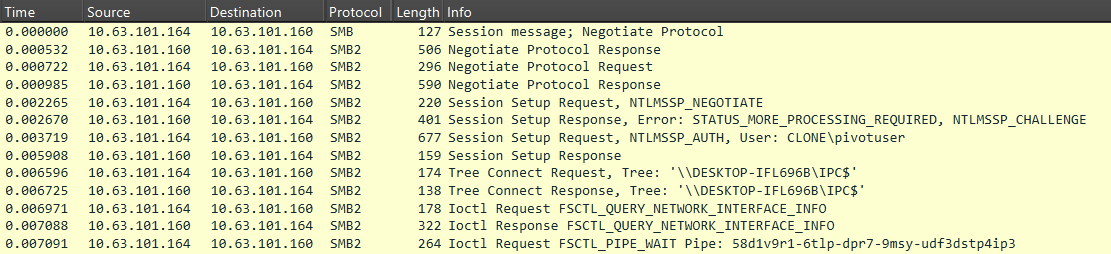
Commands and their responses are packaged within the MythicMessage data structure. This structure contains three header fields, as well as the commands themselves or the corresponding responses:
- Total size (4 bytes)
- Number of data blocks (4 bytes)
- Current block number (4 bytes)
- Base64-encoded data
The screenshot below shows an example of SMB communication between agents.
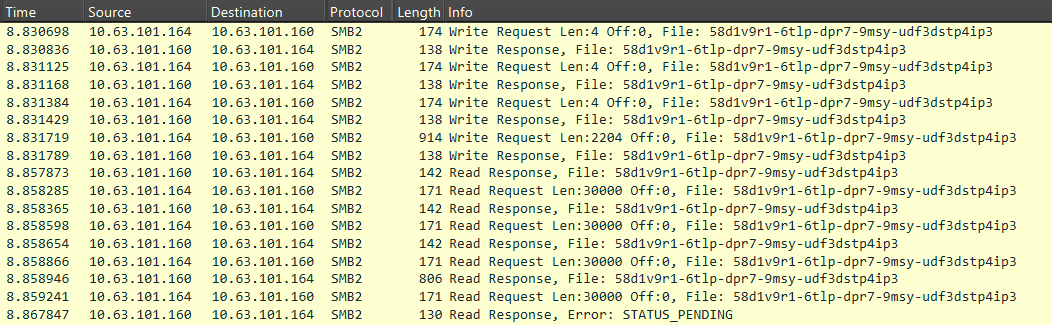
The agent (10.63.101.164) sends a command to another agent in the MythicMessage format. The first three Write Requests transmit the total message size, total number of blocks, and current block number. The fourth request transmits the Base64-encoded data. This is followed by a sequence of Read Requests, which are also transmitted in the MythicMessage format.
Below are the data transmitted in the fourth field of the MythicMessage structure.
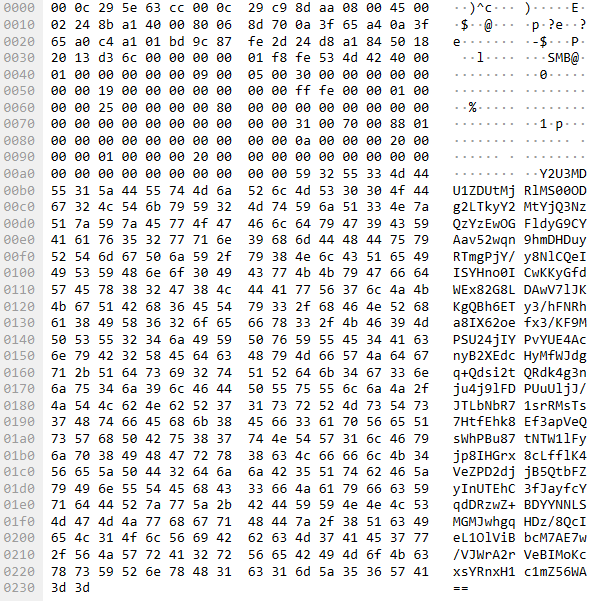
The content is encoded in Base64. Upon decoding, the structure of the transmitted information becomes visible: it begins with the UUID of the infected host, followed by a data block encrypted using AES-256.
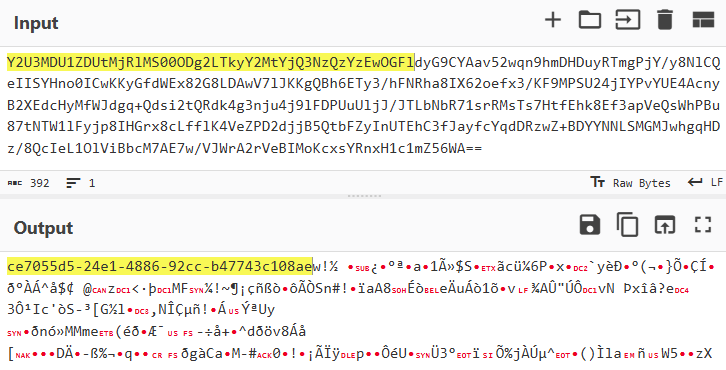
The fact that the data starts with a UUID string can be leveraged to create a signature-based detection rule that searches network packets for the identifier pattern.
To search for packets containing a UUID, the following signature can be applied. It uses specific request types and protocol flags as filters (Command: Ioctl (11), Function: FSCTL_PIPE_WAIT (0x00110018)), followed by a check to see if the pipe name matches the UUID pattern.
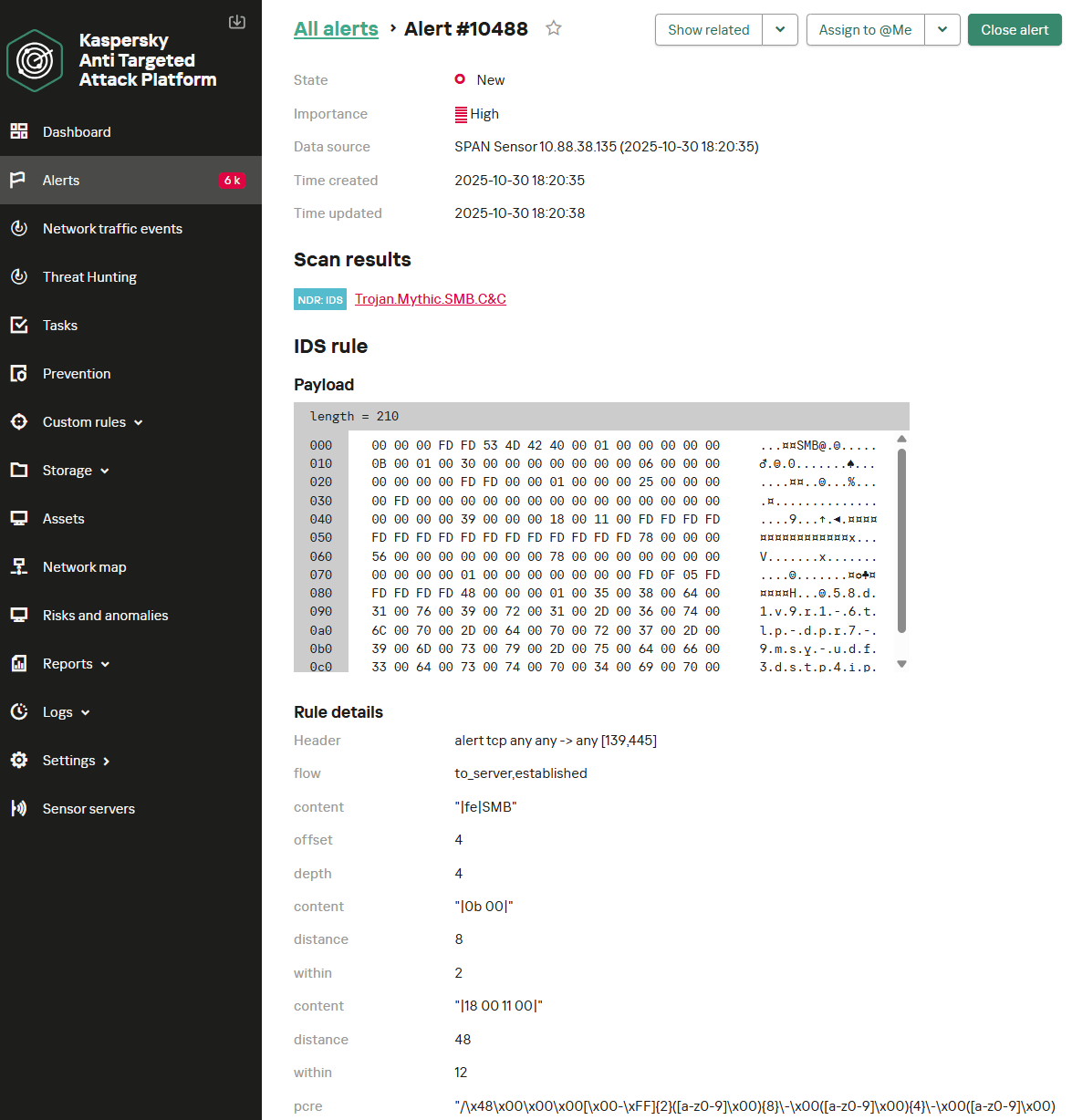
alert tcp any any -> any [139, 445] (msg: "Trojan.Mythic.SMB.C&C"; flow: to_server, established; content: "|fe|SMB"; offset: 4; depth: 4; content: "|0b 00|"; distance: 8; within: 2; content: "|18 00 11 00|"; distance: 48; within: 12; pcre: "/\x48\x00\x00\x00[\x00-\xFF]{2}([a-z0-9]\x00){8}\-\x00([a-z0-9]\x00){4}\-\x00([a-z0-9]\x00){4}\-\x00([a-z0-9]\x00){4}\-\x00([a-z0-9]\x00){12}$/R"; threshold: type both, track by_src, count 1, seconds 60; reference: url, github.com/MythicC2Profiles/sm… classtype: ndr1; sid: 9000101; rev: 1;)
Agent activity can also be detected by analyzing data transmitted in SMB WriteRequest packets with the protocol flag Command: Write (9) and a distinct packet structure where the BlobOffset and BlobLen fields are set to zero. If the Data field is Base64-encoded and, after decoding, begins with a UUID-formatted string, this indicates a command-and-control channel.
alert tcp any any -> any [139, 445] (msg: "Trojan.Mythic.SMB.C&C"; flow: to_server, established; dsize: > 360; content: "|fe|SMB"; offset: 4; depth: 4; content: "|09 00|"; distance: 8; within: 2; content: "|00 00 00 00 00 00 00 00 00 00 00 00|"; distance: 86; within: 12; base64_decode: bytes 64, offset 0, relative; base64_data; pcre: "/^[a-z0-9]{8}\-[a-z0-9]{4}\-[a-z0-9]{4}\-[a-z0-9]{4}\-[a-z0-9]{12}/"; threshold: type both, track by_src, count 1, seconds 60; reference: url, github.com/MythicC2Profiles/sm… classtype: ndr1; sid: 9000102; rev: 1;)
Below is the KATA NDR user interface displaying an alert about detecting a Mythic agent operating in P2P mode over SMB. In this instance, the first rule – which checks the request type, protocol flags, and the UUID pattern – was triggered.
It should be noted that these signatures have a limitation. If the SMBv3 protocol with encryption enabled is used, Mythic agent activity cannot be detected with signature-based methods. A possible alternative is behavioral analysis. However, in this context, it suffers from low accuracy and a high false-positive rate. The SMB protocol is widely used by organizations for various legitimate purposes, making it difficult to isolate behavioral patterns that definitively indicate malicious activity.
P2P communication via TCP
Mythic also supports P2P communications via TCP. The connection initialization process appears in network traffic as follows:
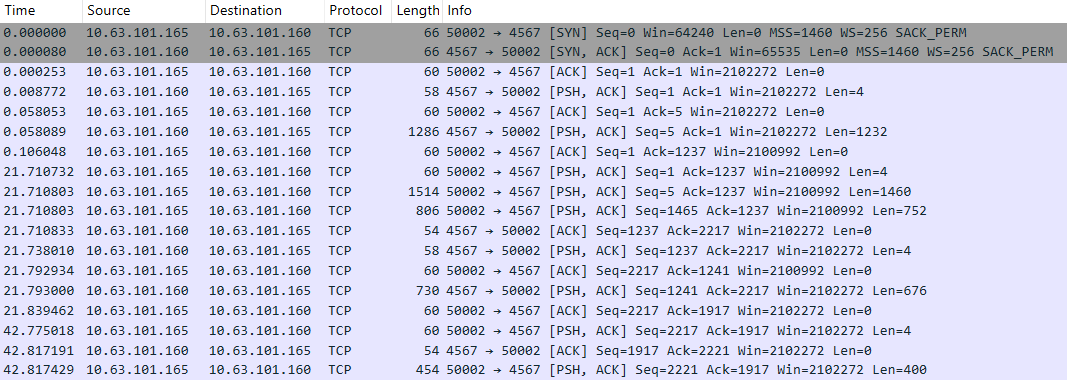
As with SMB, the MythicMessage structure is used for transmitting and receiving data. First, the data length (4 bytes) is sent as a big-endian DWORD in a separate packet. Subsequent packets transmit the number of data blocks, the current block number, and the data itself. However, unlike SMB packets, the value of the current block number field is always 0x00000000, due to TCP’s built-in packet fragmentation support.
The data encoding scheme is also analogous to what we observed with SMB and appears as follows: base64(UUID+AES256(JSON)). Below is an example of a network packet containing Mythic data.
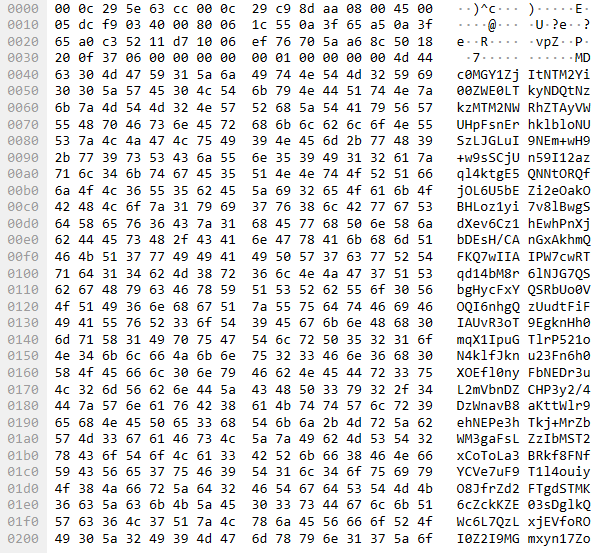
The decoded data appears as follows:
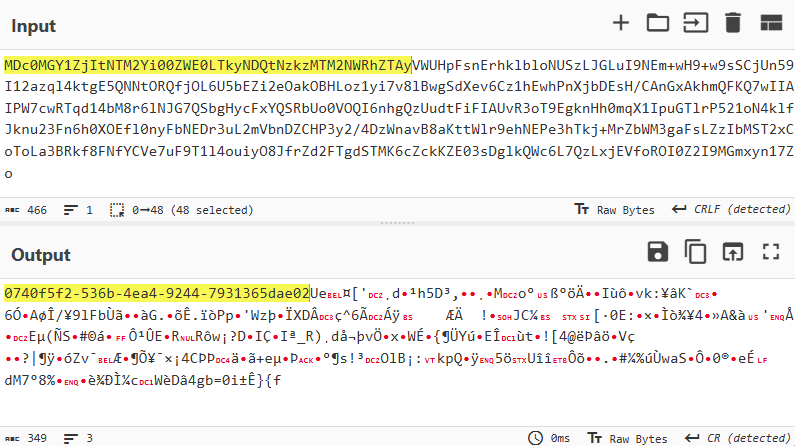
Similar to communication via SMB, signature-based detection rules can be created for TCP traffic to identify Mythic agent activity by searching for packets containing UUID-formatted strings. Below are two Suricata detection rules. The first rule is a utility rule. It does not generate security alerts but instead tags the TCP session with an internal flag, which is then checked by another rule. The second rule verifies the flag and applies filters to confirm that the current packet is being analyzed at the beginning of a network session. It then decodes the Base64 data and searches the resulting content for a UUID-formatted string.
alert tcp any any -> any any (msg: "Trojan.Mythic.TCP.C&C"; flow: from_server, established; dsize: 4; stream_size: server, <, 6; stream_size: client, <, 3; content: "|00 00|"; depth: 2; pcre: "/^\x00\x00[\x00-\x5C]{1}[\x00-\xFF]{1}$/"; flowbits: set, mythic_tcp_p2p_msg_len; flowbits: noalert; threshold: type both, track by_src, count 1, seconds 60; reference: url, github.com/MythicC2Profiles/tc… classtype: ndr1; sid: 9000103; rev: 1;)
alert tcp any any -> any any (msg: "Trojan.Mythic.TCP.C&C"; flow: from_server, established; dsize: > 300; stream_size: server, <, 6000; stream_size: client, <, 6000; flowbits: isset, mythic_tcp_p2p_msg_len; content: "|00 00 00|"; depth: 3; content: "|00 00 00 00|"; distance: 1; within: 4; base64_decode: bytes 64, offset 0, relative; base64_data; pcre: "/^[a-z0-9]{8}\-[a-z0-9]{4}\-[a-z0-9]{4}\-[a-z0-9]{4}\-[a-z0-9]{12}/"; threshold: type both, track by_src, count 1, seconds 60; reference: url, github.com/MythicC2Profiles/tc… classtype: ndr1; sid: 9000104; rev: 1;)
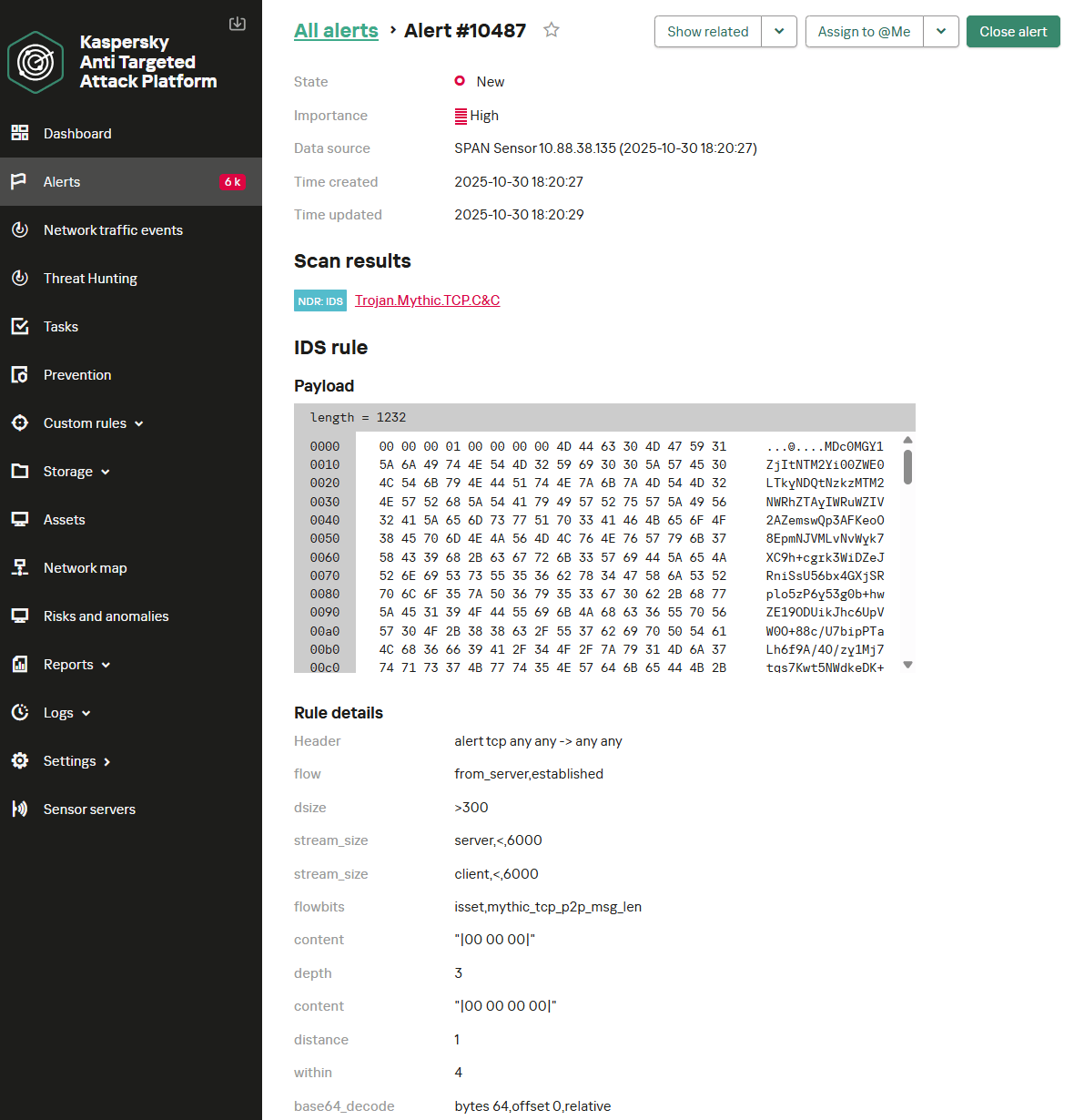
Below is the NDR interface displaying an example of the two rules detecting a Mythic agent operating in P2P mode over TCP.
Egress transport modules
Covert Egress communication
For stealthy operations, Mythic allows agents to be managed through popular services. This makes its activity less conspicuous within network traffic. Mythic includes transport modules based on the following services:
- Discord
- GitHub
- Slack
Of these, only the first two remain relevant at the time of writing. Communication via Slack (the Slack C2 Profile transport module) is no longer supported by the developers and is considered deprecated, so we will not examine it further.
The Discord C2 Profile transport module
The use of the Discord service as a mediator for C2 communication within the Mythic framework has been gaining popularity recently. In this scenario, agent traffic is indistinguishable from normal Discord activity, with commands and their execution results masquerading as messages and file attachments. Communication with the server occurs over HTTPS and is encrypted with TLS. Therefore, detecting Mythic traffic requires decrypting this.
Analyzing decrypted TLS traffic
Let’s assume we are using an NDR platform in conjunction with a network traffic decryption (TLS inspection) system to detect suspicious network activity. In this case, we operate under the assumption that we can decrypt all TLS traffic. Let’s examine possible detection rules for that scenario.
Agent and server communication occurs via Discord API calls to send messages to a specific channel. Communication between the agent and Mythic uses the MythicMessageWrapper structure, which contains the following fields:
- message: the transmitted data
- sender_id: a GUID generated by the agent, included in every message
- to_server: a direction flag – a message intended for the server or the agent
- id: not used
- final: not used
Of particular interest to us is the message field, which contains the transmitted data encoded in Base64. The MythicMessageWrapper message is transmitted in plaintext, making it accessible to anyone with read permissions for messages on the Discord server.
Below is an example of data transmission via messages in a Discord channel.

To establish a connection, the agent authenticates to the Discord server via the API call /api/v10/gateway/bot. We observe the following data in the network traffic:

After successful initialization, the agent gains the ability to receive and respond to commands. To create a message in the channel, the agent makes a POST request to the API endpoint /channels/<channel.id>/messages. The network traffic for this call is shown in the screenshot below.
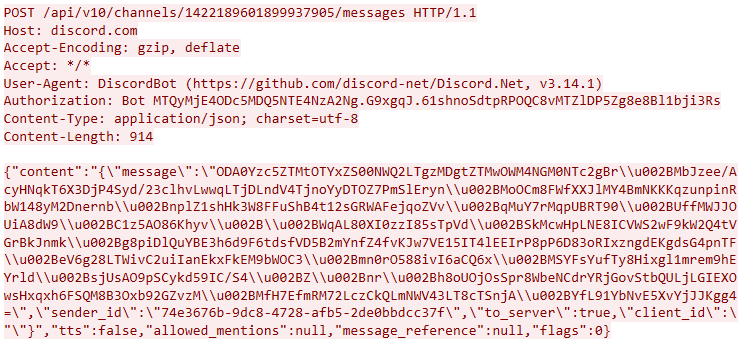
After decoding the Base64, the content of the message field appears as follows:
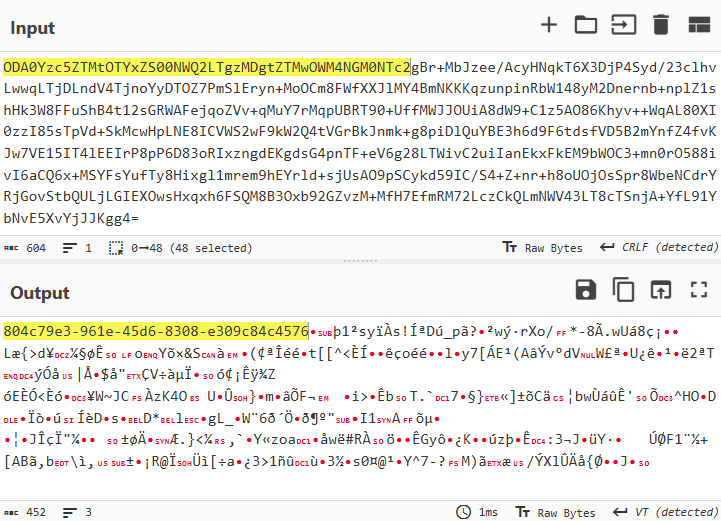
A structure characteristic of a UUID is visible at the beginning of the packet.
After processing the message, the agent deletes it from the channel via a DELETE request to the API endpoint /channels/{channel.id}/messages/{message.id}.

Below is a Suricata rule that detects the agent’s Discord-based communication activity. It checks the API activity for creating HTTP messages for the presence of Base64-encoded data containing the agent’s UUID.
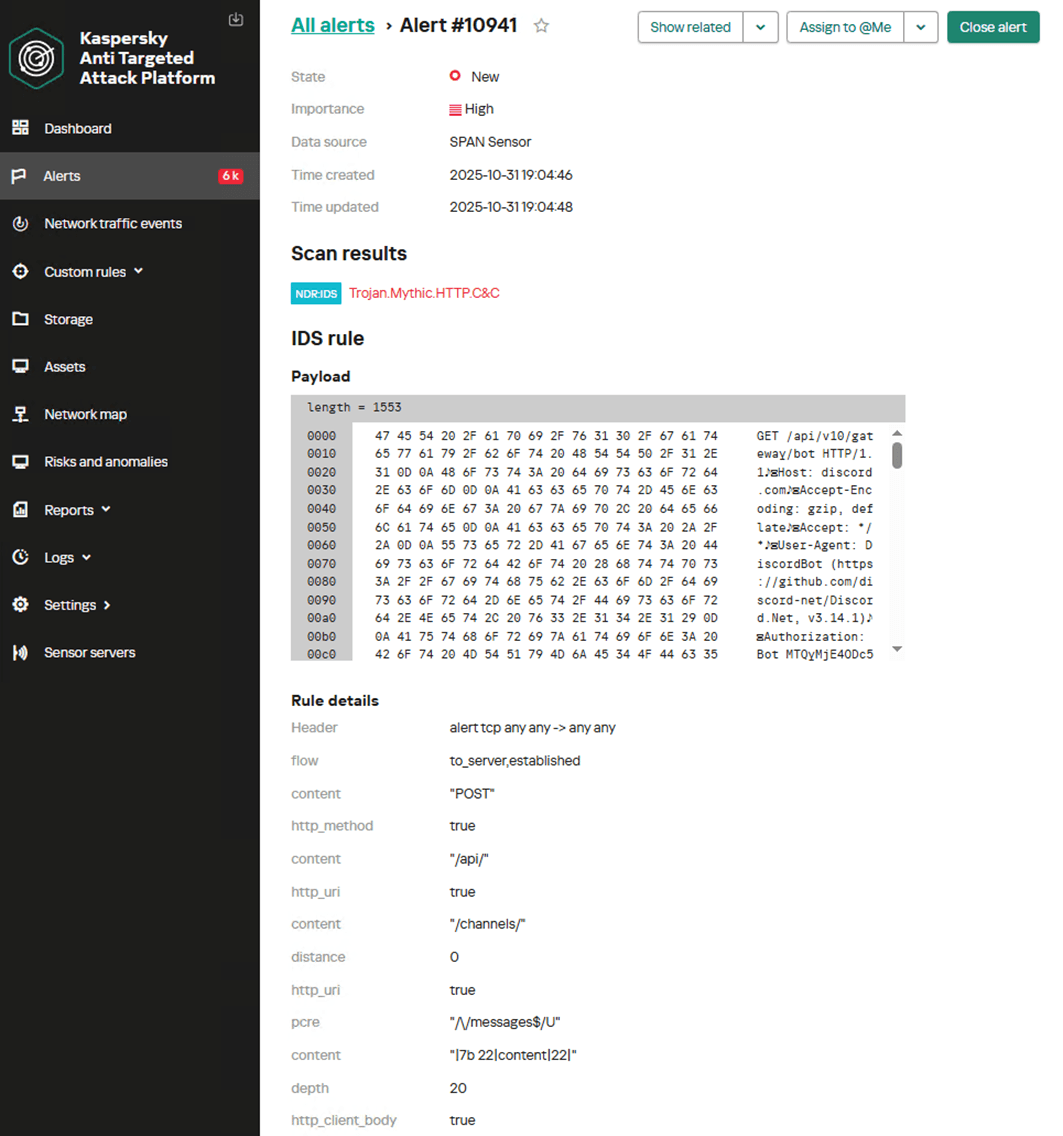
alert tcp any any -> any any (msg: "Trojan.Mythic.HTTP.C&C"; flow: to_server, established; content: "POST"; http_method; content: "/api/"; http_uri; content: "/channels/"; distance: 0; http_uri; pcre: "/\/messages$/U"; content: "|7b 22|content|22|"; depth: 20; http_client_body; content: "|22|sender_id"; depth: 1500; http_client_body; pcre: "/\x22sender_id\x5c\x22\x3a\x5c\x22[a-z0-9]{8}\-[a-z0-9]{4}\-[a-z0-9]{4}\-[a-z0-9]{4}\-[a-z0-9]{12}/"; threshold: type both, track by_src, count 1, seconds 60; reference: url, github.com/MythicC2Profiles/di… classtype: ndr1; sid: 9000105; rev: 1;)
Below is the NDR user interface displaying an example of detecting the activity of the Discord C2 Profile transport module for a Mythic agent within decrypted HTTP traffic.
Analyzing encrypted TLS traffic
If Discord usage is permitted on the network and there is no capability to decrypt traffic, it becomes nearly impossible to detect agent activity. In this scenario, behavioral analysis of requests to the Discord server may prove useful. Below is network traffic showing frequent TLS connections to the Discord server, which could indicate commands being sent to an agent.
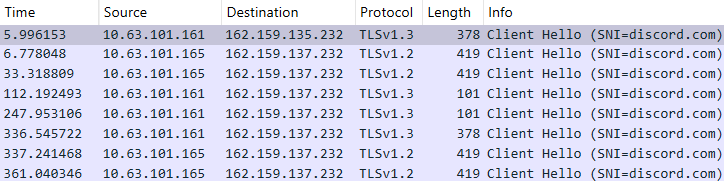
In this case, we can use a Suricata rule to detect the frequent TLS sessions with Discord servers:
alert tcp any any -> any any (msg: "NetTool.PossibleMythicDiscordEgress.TLS.C&C"; flow: to_server, established; tls_sni; content: "discord.com"; nocase; threshold: type both, track by_src, count 4, seconds 420; reference: url, github.com/MythicC2Profiles/di… classtype: ndr3; sid: 9000106; rev: 1;)
Another method for detecting these communications involves tracking multiple DNS queries to the discord.com domain.
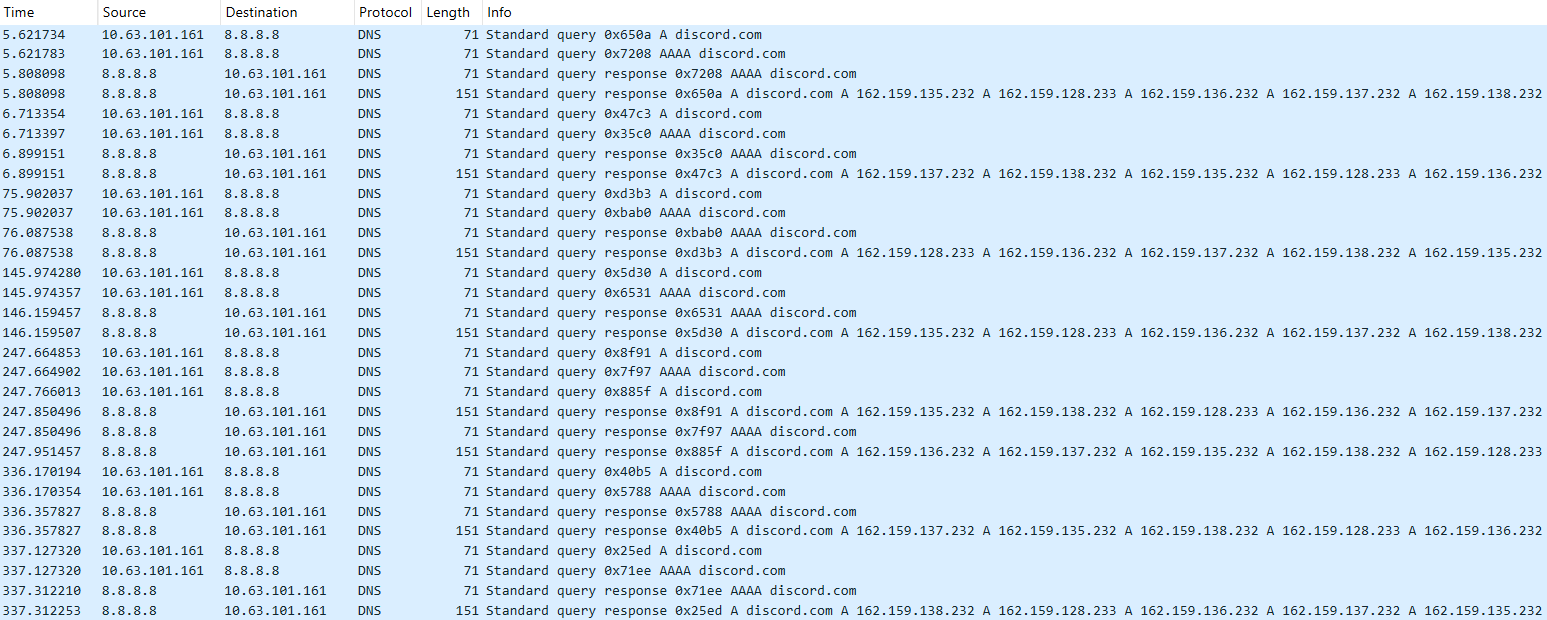
The following rule can be applied to detect these:
alert udp any any -> any 53 (msg: "NetTool.PossibleMythicDiscordEgress.DNS.C&C"; content: "|01 00 00 01 00 00 00 00 00 00|"; depth: 10; offset: 2; content: "|07|discord|03|com|00|"; nocase; distance: 0; threshold: type both, track by_src, count 4, seconds 60; reference: url, github.com/MythicC2Profiles/di… classtype: ndr3; sid: 9000107; rev: 1;)
Below is the NDR user interface showing an example of a custom rule in operation, detecting the activity of the Discord C2 Profile transport module for a Mythic agent within encrypted traffic based on characteristic DNS queries.
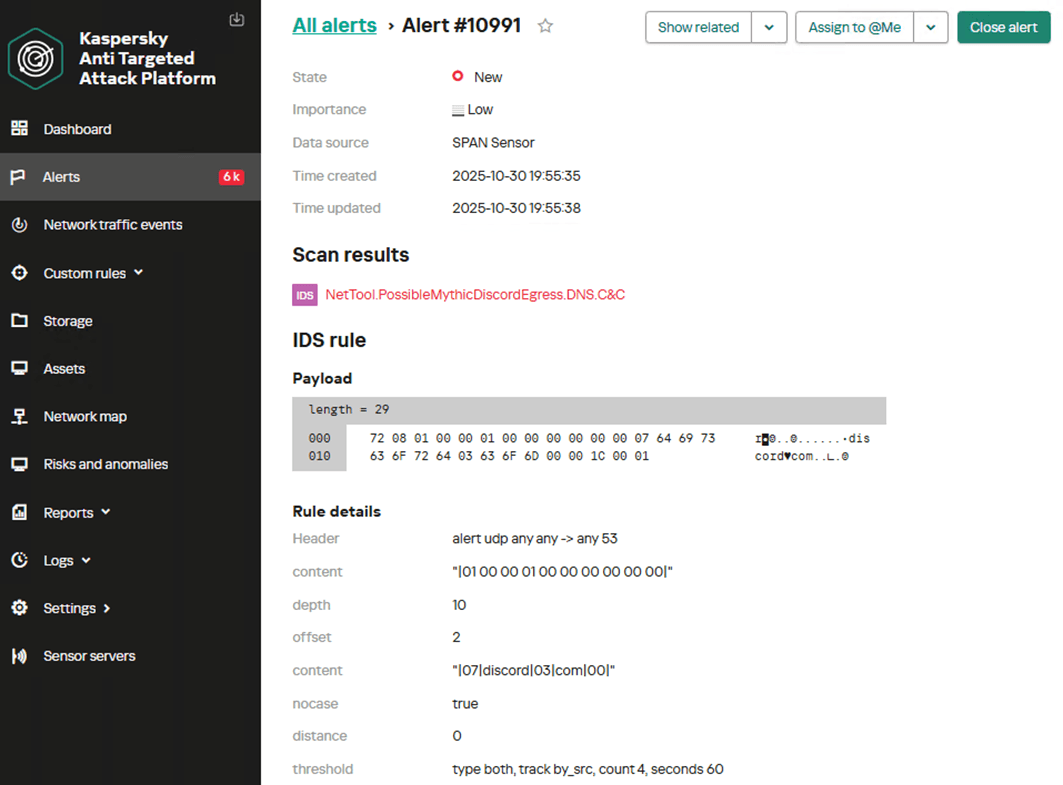
The proposed rule options have low accuracy and can generate a high number of false positives. Therefore, they must be adapted to the specific characteristics of the infrastructure in which they will run. Threshold and count parameters, which control the triggering frequency and time window, require tuning.
GitHub C2 Profile transport module
GitHub’s popularity has made it an attractive choice as a mediator for managing Mythic agents. The core concept is the same as in other covert Egress communication transport modules. Communication with GitHub utilizes HTTPS. Successful operation requires an account on the target platform and the ability to communicate via API calls. The transport module utilizes the GitHub API to send comments to pre-created Issues and to commit files to a branch within a repository controlled by the attackers. In this model, the agent interacts only with GitHub: it creates and reads comments, uploads files, and manages branches. It does not communicate with any other servers. The communication algorithm via GitHub is as follows:
- The agent posts a comment (check-in) to a designated Issue on GitHub, intended for agents to report their results.
- The Mythic server validates the comment, deletes it, and posts a reply in an issue designated for server use.
- The agent creates a branch with a name matching its UUID and writes a get_tasking file to it (performs a push request).
- The Mythic server reads the file and writes a response file to the same branch.
- The agent reads the response file, deletes the branch, pauses, and repeats the cycle.
Analyzing decrypted TLS traffic
Let’s consider an approach to detecting agent activity when traffic decryption is possible.
Agent communication with the server utilizes API calls to GitHub. The payload is encoded in Base64 and published in plaintext; therefore, anyone who can view the repository or analyze the traffic contents can decode it.
Analysis of agent communication revealed that the most useful traffic for creating detection rules is associated with publishing check-in comments, creating a branch, and publishing a file.
During the check-in phase, the agent posts a comment to register a new agent and establish communication.
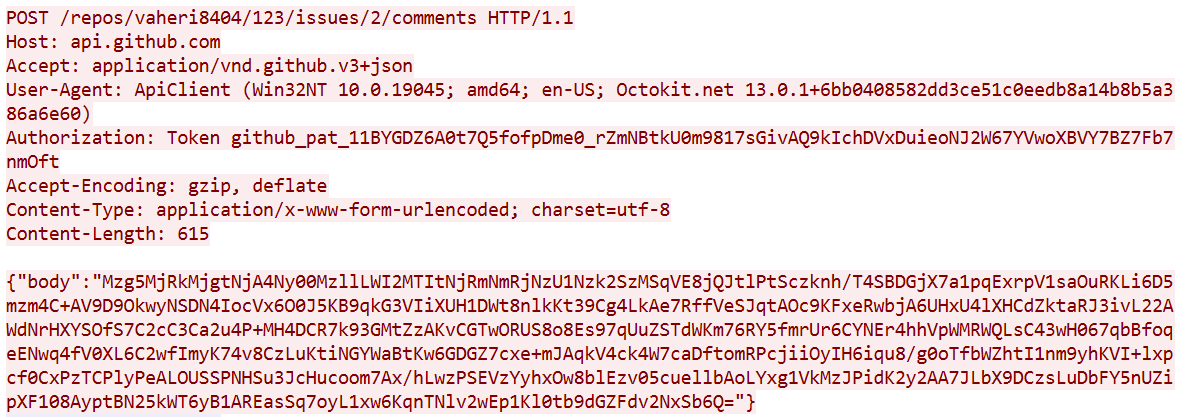
The transmitted data is encoded in Base64 and contains the agent’s UUID and the portion of the message encrypted using AES-256.
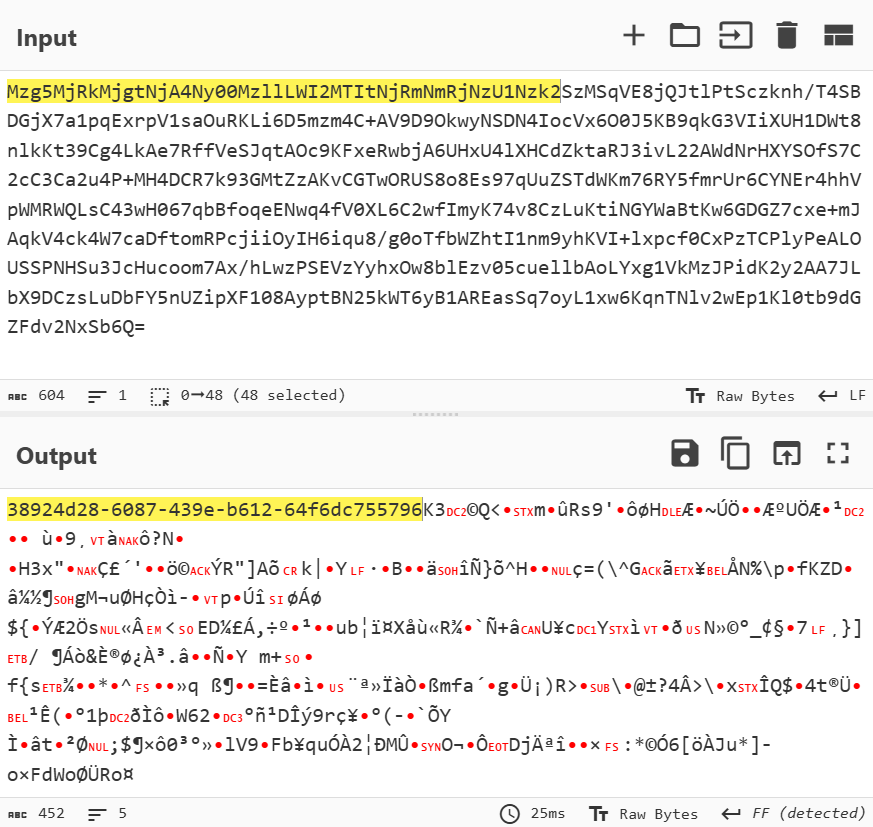
This allows for a signature that detects UUID-formatted substrings within GitHub comment creation requests.
alert tcp any any -> any any (msg: "Trojan.Mythic.HTTP.C&C"; flow: to_server, established; content: "POST"; http_method; content: "api.github.com"; http_host; content: "/repos/"; depth: 8; http_uri; pcre: "/\/comments$/U"; content: "|22|body|22|"; depth: 8; http_client_body; base64_decode: bytes 300, offset 2, relative; base64_data; pcre: "/^[a-z0-9]{8}\-[a-z0-9]{4}\-[a-z0-9]{4}\-[a-z0-9]{4}\-[a-z0-9]{12}/"; threshold: type both, track by_src, count 1, seconds 60; reference: url, github.com/MythicC2Profiles/gi… classtype: ndr1; sid: 9000108; rev: 1;)
Another stage suitable for detection is when the agent creates a separate branch with its UUID as the name. All subsequent relevant communication with the server will occur within this branch. Here is an example of a branch creation request:

Therefore, we can create a detection rule to identify UUID-formatted strings within branch creation requests.
alert tcp any any -> any any (msg: "Trojan.Mythic.HTTP.C&C"; flow: to_server, established; content: "POST"; http_method; content: "api.github.com"; http_host; content: "/repos/"; depth: 100; http_uri; content: "/git/refs"; distance: 0; http_uri; content: "|22|ref|22 3a|"; depth: 10; http_client_body; content: "refs/heads/"; distance: 0; within: 50; http_client_body; pcre: "/refs\/heads\/[a-z0-9]{8}\-[a-z0-9]{4}\-[a-z0-9]{4}\-[a-z0-9]{4}\-[a-z0-9]{12}\x22/"; threshold: type both, track by_src, count 1, seconds 60; reference: url, github.com/MythicC2Profiles/gi… classtype: ndr1; sid: 9000109; rev: 1;)
After creating the branch, the agent writes a file to it (sends a push request), which contains Base64-encoded data.
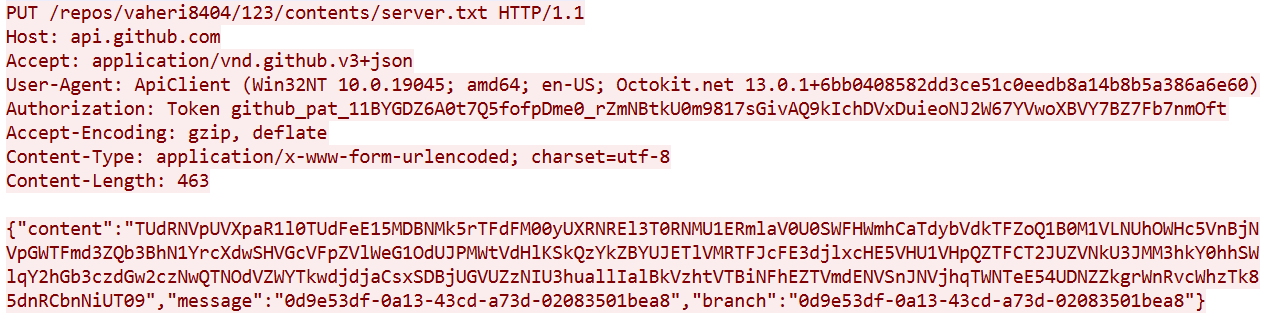
Therefore, we can create a rule to trigger on file publication requests to a branch whose name matches the UUID pattern.
alert tcp any any -> any any (msg: "Trojan.Mythic.HTTP.C&C"; flow: to_server, established; content: "PUT"; http_method; content: "api.github.com"; http_host; content: "/repos/"; depth:8; http_uri; content: "/contents/"; distance: 0; http_uri; content: "|22|content|22|"; depth: 100; http_client_body; pcre: "/\x22message\x22\x3a\x22[a-z0-9]{8}\-[a-z0-9]{4}\-[a-z0-9]{4}\-[a-z0-9]{4}\-[a-z0-9]{12}\x22/"; threshold: type both, track by_src, count 1, seconds 60; reference: url, github.com/MythicC2Profiles/gi… classtype: ndr1; sid: 9000110; rev: 1;)
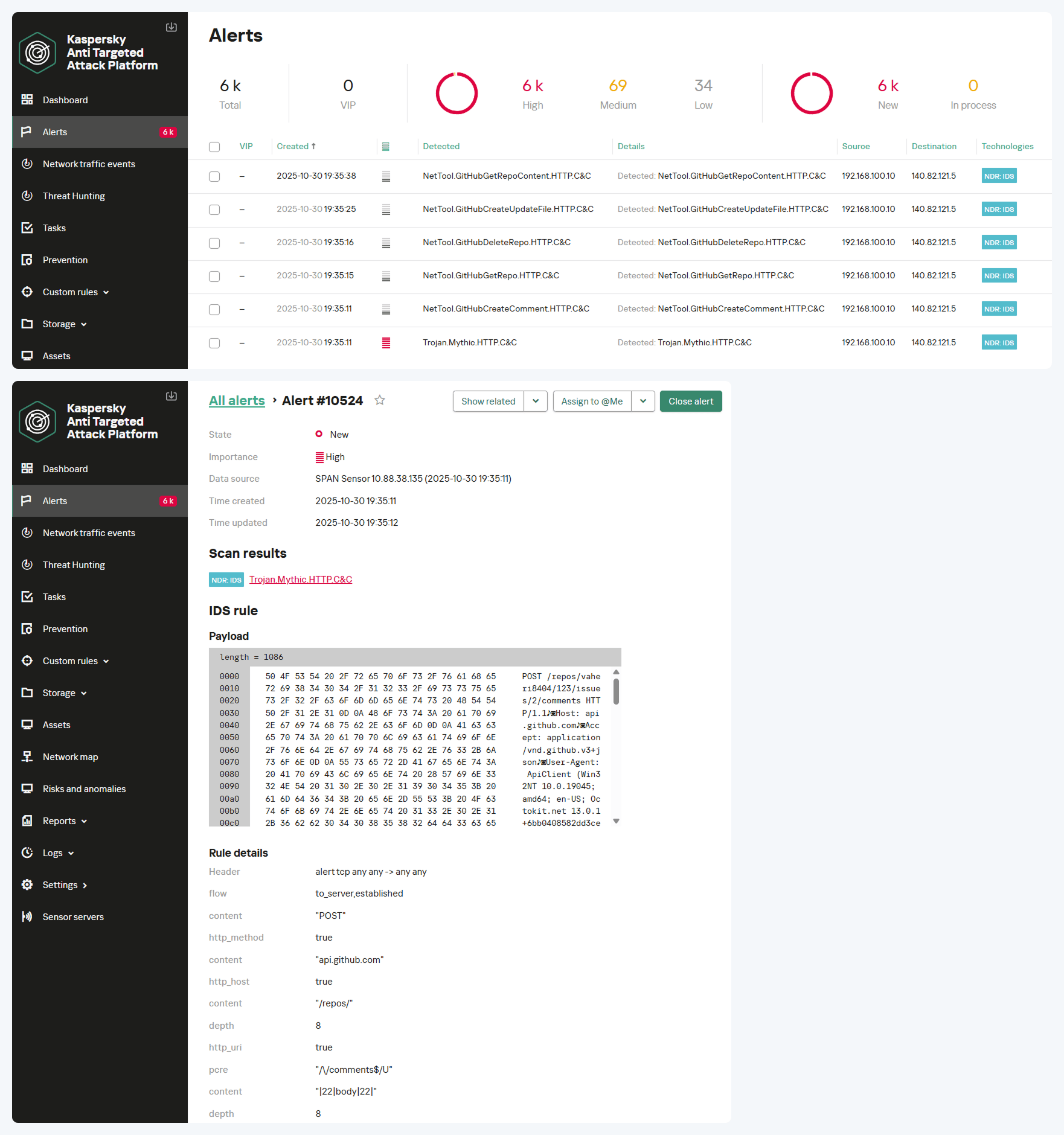
The screenshot below shows how the NDR solution logs all suspicious communications using the GitHub API and subsequently identifies the Mythic agent’s activity. The result is an alert with the verdict Trojan.Mythic.HTTP.C&C.
Analyzing encrypted TLS traffic
Communication with GitHub occurs over HTTPS; therefore, in the absence of traffic decryption capability, signature-based methods for detecting agent activity cannot be applied. Let’s consider a behavioral agent activity detection approach.
For instance, it is possible to detect connections to GitHub servers that are atypical in frequency and purpose, originating from network segments where this activity is not expected. The screenshot below shows an example of an agent’s multiple TLS sessions. The traffic reflects the execution of several commands, as well as idle time, manifested as constant polling of the server while awaiting new tasks.
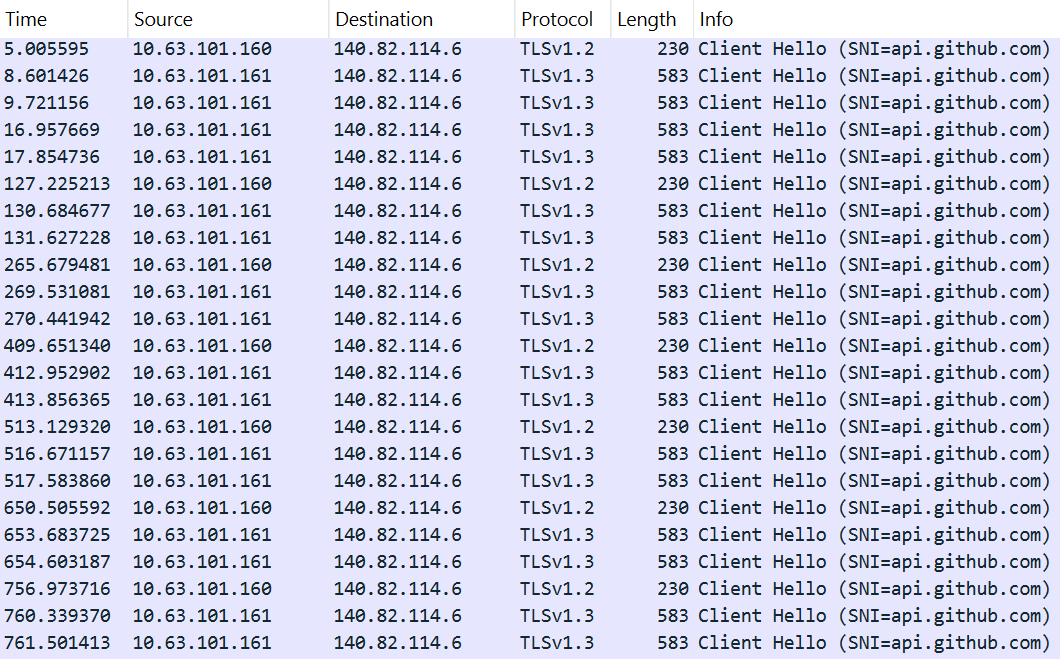
Multiple TLS sessions with the GitHub service from uncharacteristic network segments can be detected using the rule presented below:
alert tcp any any -> any any (msg:"NetTool.PossibleMythicGitHubEgress.TLS.C&C"; flow: to_server, established; tls_sni; content: "api.github.com"; nocase; threshold: type both, track by_src, count 4, seconds 60; reference: url, github.com/MythicC2Profiles/gi… classtype: ndr3; sid: 9000111; rev: 1;)
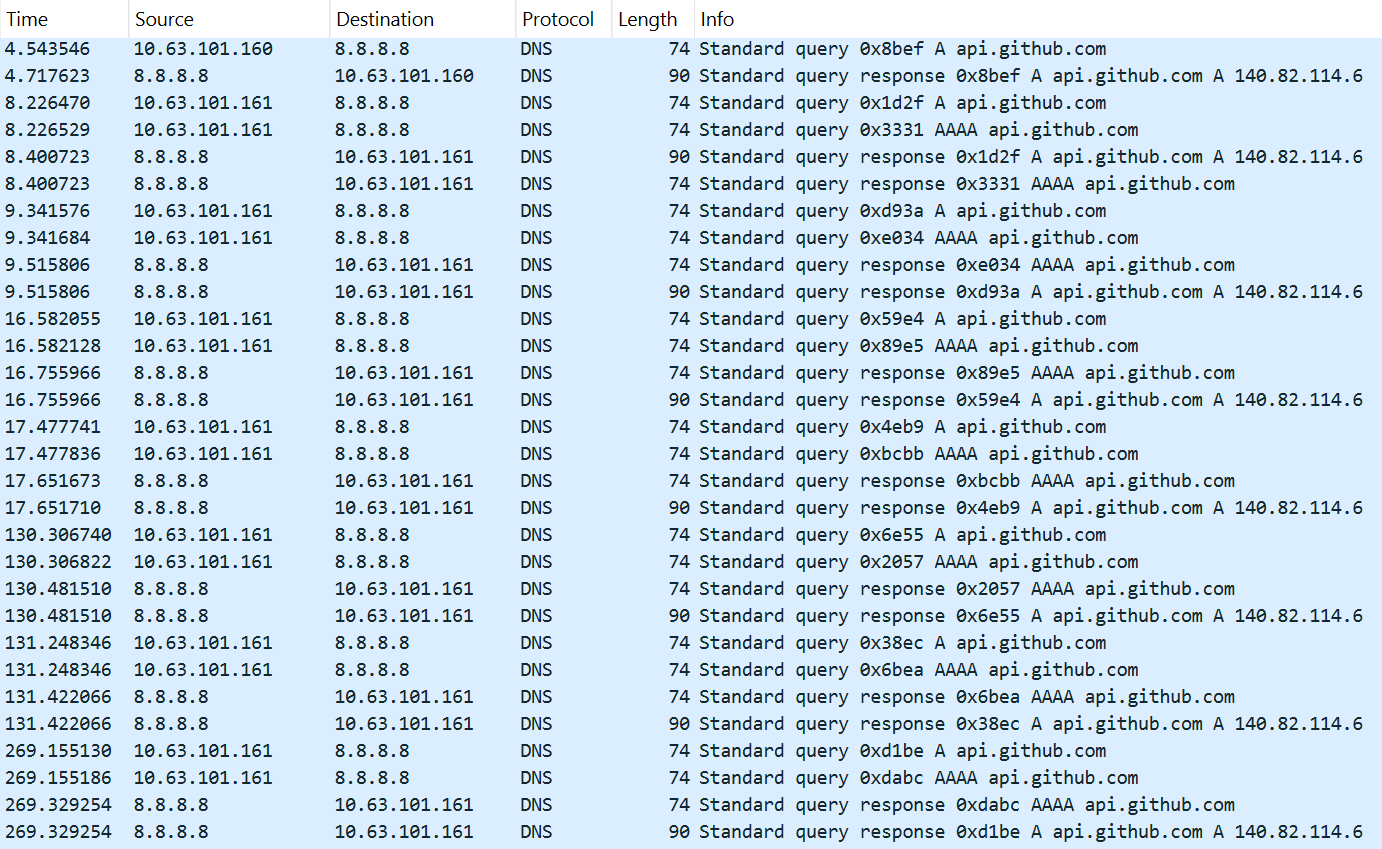
Additionally, multiple DNS queries to the service can be logged in the traffic.
This activity is detected with the help of the following rule:
alert udp any any -> any 53 (msg: "NetTool.PossibleMythicGitHubEgress.DNS.C&C"; content: "|01 00 00 01 00 00 00 00 00 00|"; depth: 10; offset: 2; content: "|03|api|06|github|03|com|00|"; nocase; distance: 0; threshold: type both, track by_src, count 12, seconds 180; reference: url, github.com/MythicC2Profiles/gi… classtype: ndr3; sid: 9000112; rev: 1;)
The screenshot below shows the NDR interface with an example of the first rule in action, detecting traces of the GitHub profile activity for a Mythic agent within encrypted TLS traffic.
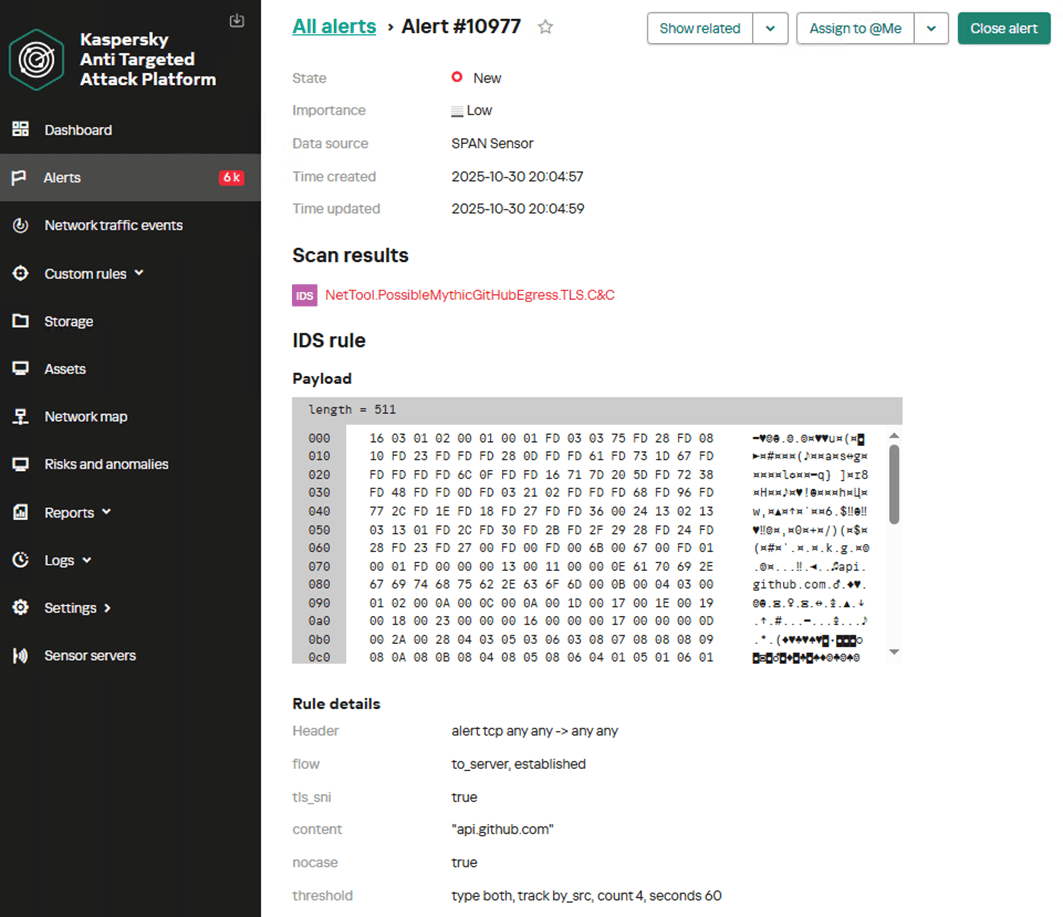
The suggested rule options can produce false positives, so to improve their effectiveness, they must be adapted to the specific characteristics of the infrastructure in which they will run. The parameters of the threshold keyword – specifically the count and seconds values, which control the number of events required to generate an alert and the time window for their occurrence in NDR – must be configured.
Direct Egress communication
The Egress communication model allows agents to interact directly with the C2 server via the following protocols:
- HTTP(S)
- WebSocket
- MQTT
- DNS
The first two protocols are the most prevalent. The DNS-based transport module is still under development, and the module based on MQTT sees little use among operators. We will not examine them within the scope of this article.
Communication via HTTP
HTTP is the most common protocol for building a Mythic agent control network. The HTTP transport container acts as a proxy between the agents and the Mythic server. It allows data to be transmitted in both plaintext and encrypted form. Crucially, the metadata is not encrypted, which enables the creation of signature-based detection rules.
Below is an example of unencrypted Mythic network traffic over HTTP. During a GET request, data encoded in Base64 is passed in the value of the query parameter.
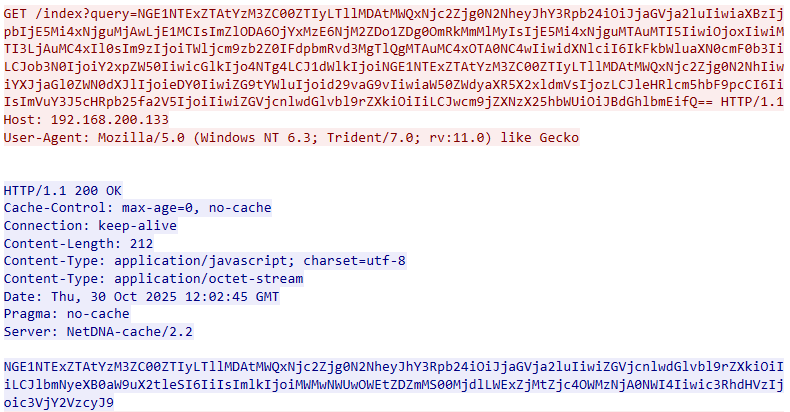
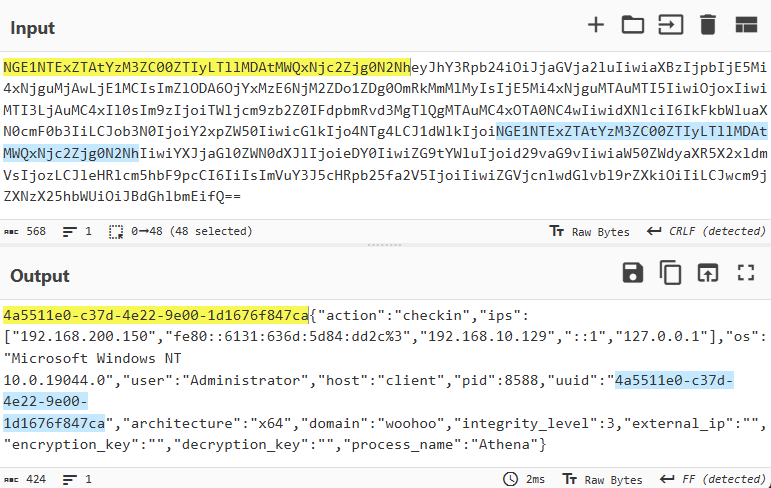
After decoding, the agent’s UUID – generated according to a specific pattern – becomes visible. This identifier is followed by a JSON object containing the key parameters of the host, collected by the agent.
If data encryption is applied, the network traffic for agent communication appears as shown in the screenshot below.
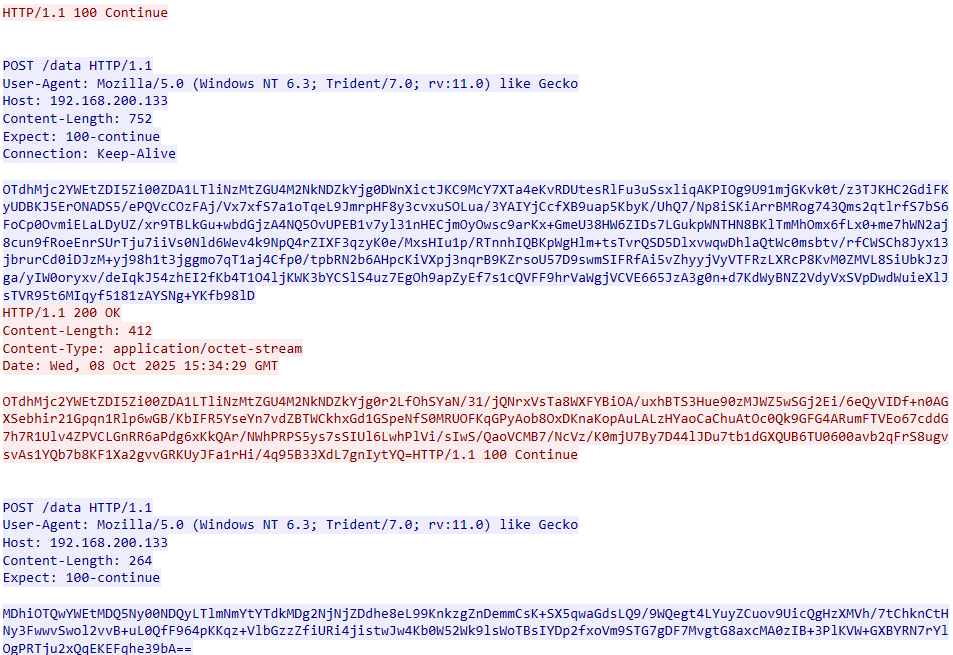
After decrypting the traffic and decoding from Base64, the communication data reveals the familiar structure: UUID+AES256(JSON).
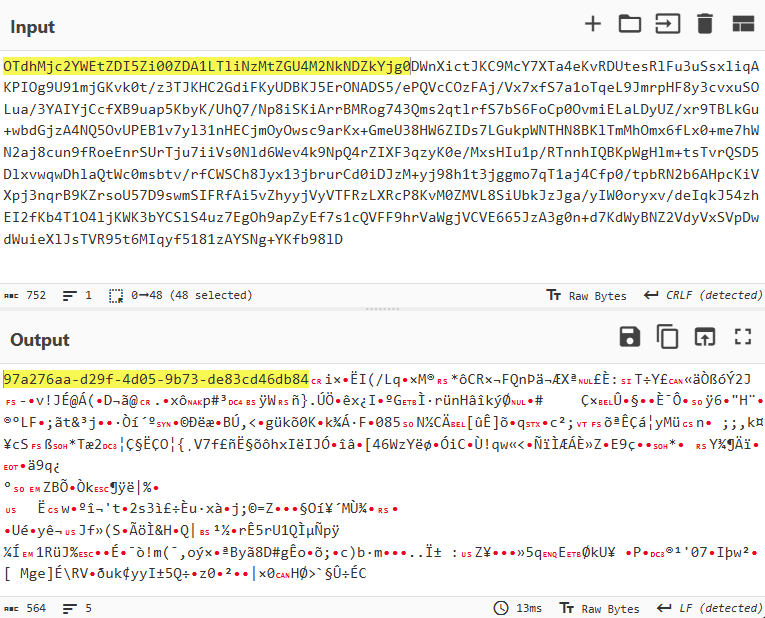
Therefore, to create a detection signature for this case, we can also rely on the presence of a UUID within the Base64-encoded data in POST requests.
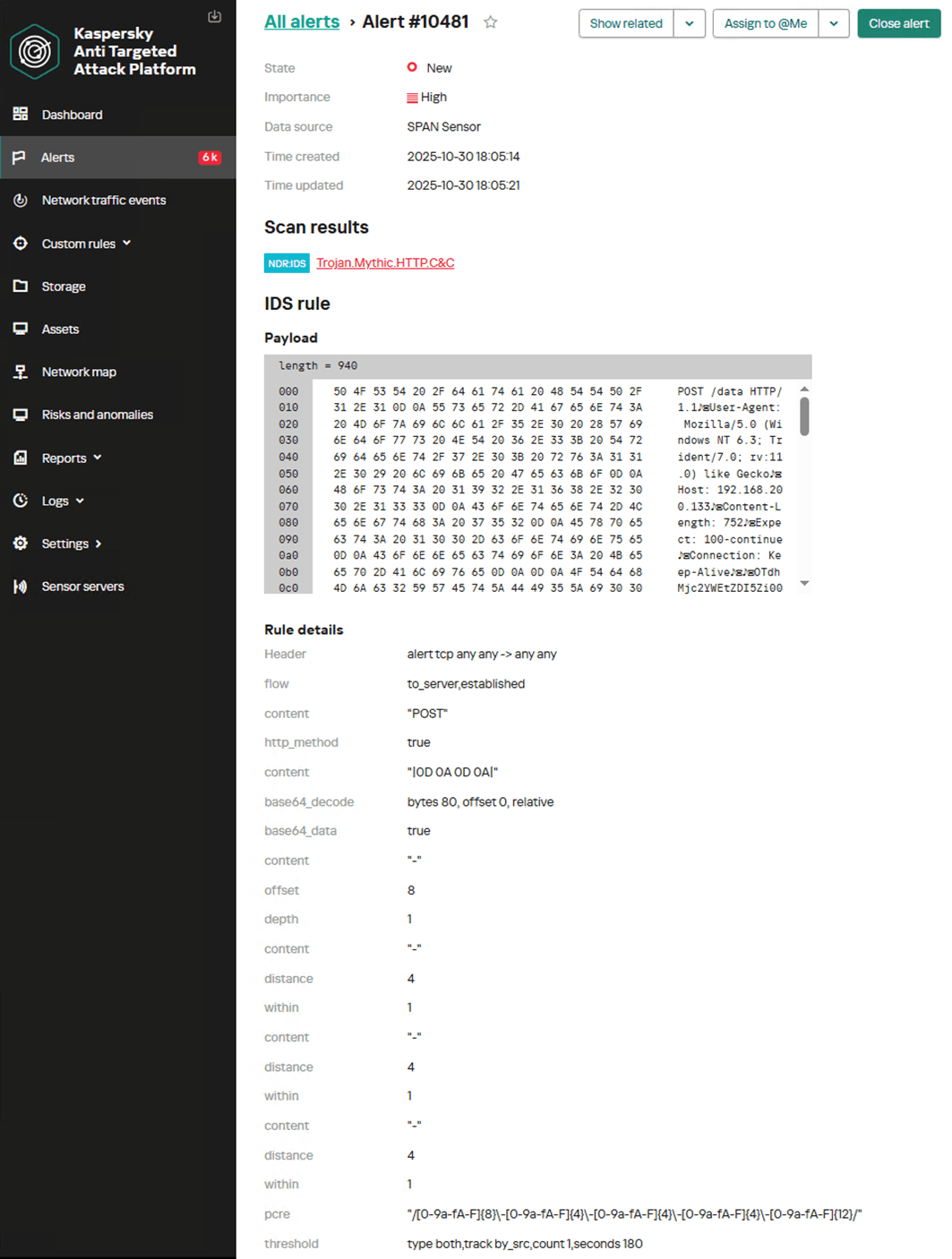
alert tcp any any -> any any (msg: "Trojan.Mythic.HTTP.C&C"; flow: to_server, established; content: "POST"; http_method; content: "|0D 0A 0D 0A|"; base64_decode: bytes 80, offset 0, relative; base64_data; content: "-"; offset: 8; depth: 1; content: "-"; distance: 4; within: 1; content: "-"; distance: 4; within: 1; content: "-"; distance: 4; within: 1; pcre: "/[0-9a-fA-F]{8}\-[0-9a-fA-F]{4}\-[0-9a-fA-F]{4}\-[0-9a-fA-F]{4}\-[0-9a-fA-F]{12}/"; threshold: type both, track by_src, count 1, seconds 180; reference: md5, 6ef89ccee639b4df42eaf273af8b5ffd; classtype: trojan1; sid: 9000113; rev: 2;)
The screenshot below shows how the NDR platform detects agent communication with the server over HTTP, generating an alert with the name Trojan.Mythic.HTTP.C&C.
Communication via HTTPS
Mythic agents can communicate with the server via HTTPS using the corresponding transport module. In this case, data is encrypted with TLS and is not amenable to signature-based analysis. However, the activity of Mythic agents can be detected if they use the default SSL certificate. Below is an example of network traffic from a Mythic agent with such a certificate.
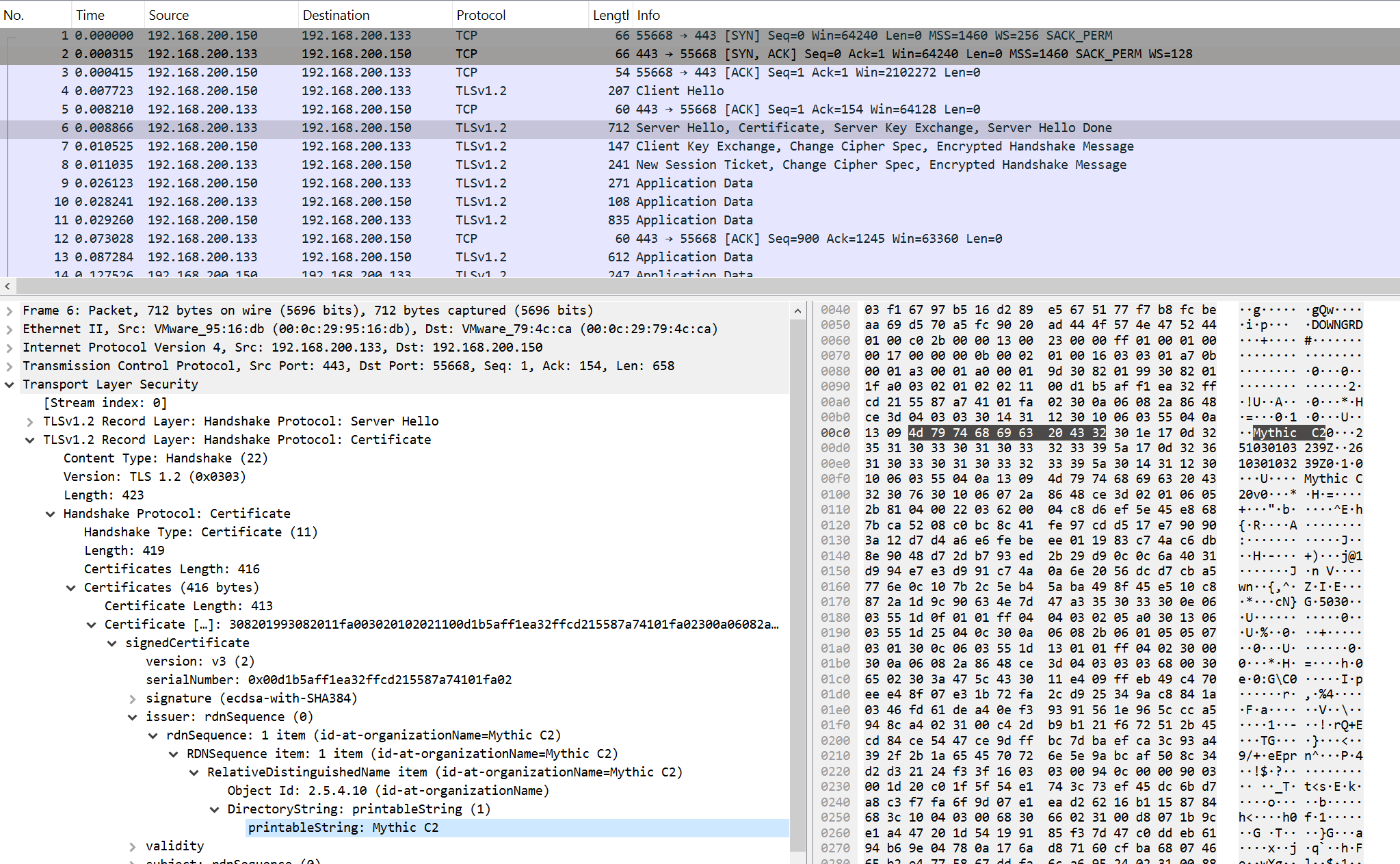
For this purpose, the following signature is applied:
alert tcp any any -> any any (msg: "Trojan.Mythic.HTTPS.C&C"; flow: established, from_server, no_stream; content: "|16 03|"; content: "|0B|"; distance: 3; within: 1; content: "Mythic C2"; distance: 0; reference: url, github.com/its-a-feature/Mythi… classtype: ndr1; sid: 9000114; rev: 1;)
WebSocket
The WebSocket protocol enables full-duplex communication between a client and a remote host. Mythic can utilize it for agent management.
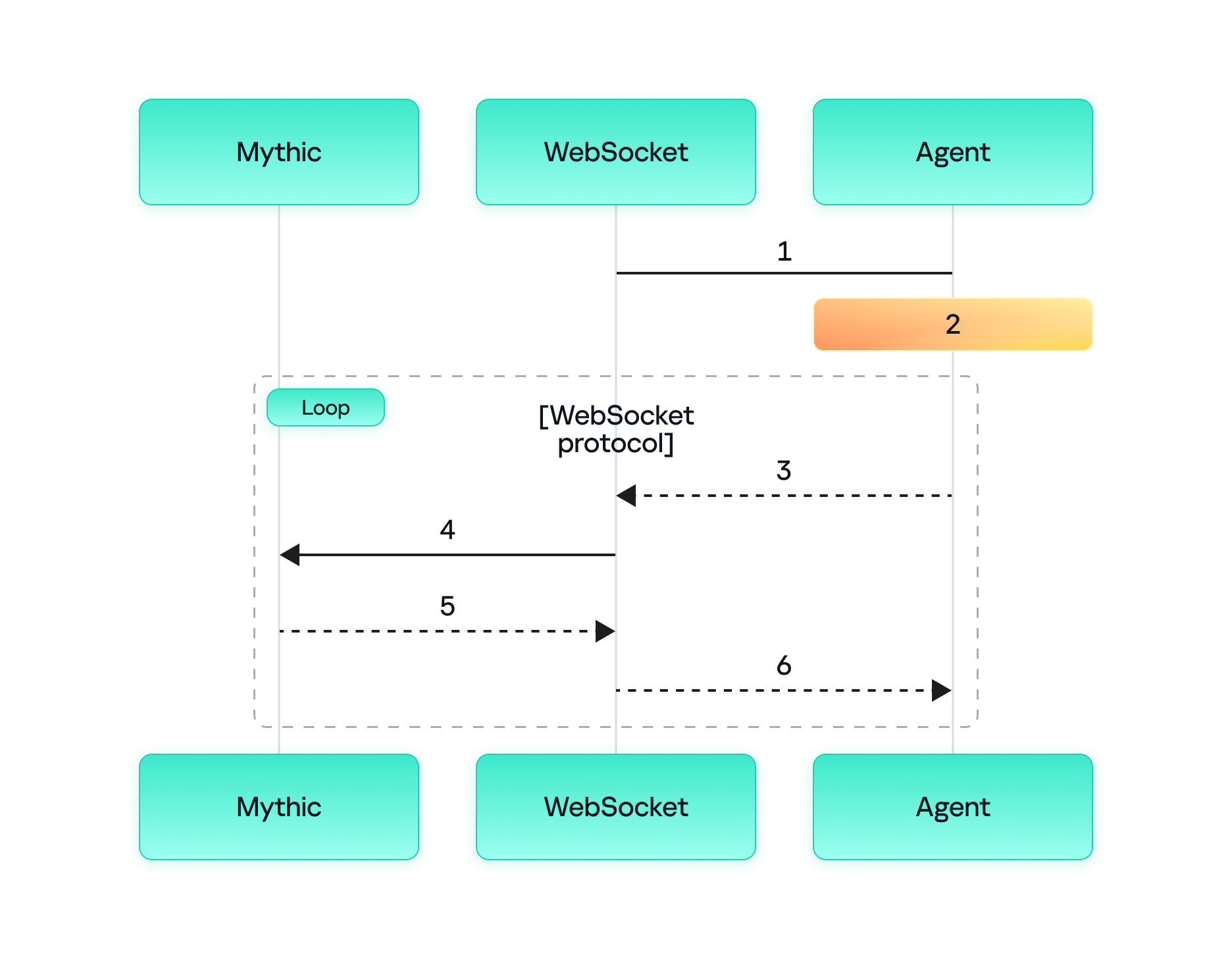
The process of agent communication with the server via WebSocket is as follows:
- The agent sends a request to the WebSocket container to change the protocol for the HTTP(S) connection.
- The agent and the WebSocket container switch to WebSocket to send and receive messages.
- The agent sends a message to the WebSocket container requesting tasks from the Mythic container.
- The WebSocket container forwards the request to the Mythic container.
- The Mythic container returns the tasks to the WebSocket container.
- The WebSocket container forwards these tasks to the agent.
It is worth mentioning that in this communication model, both the WebSocket container and the Mythic container reside on the Mythic server. Below is a screenshot of the initial agent connection to the server.
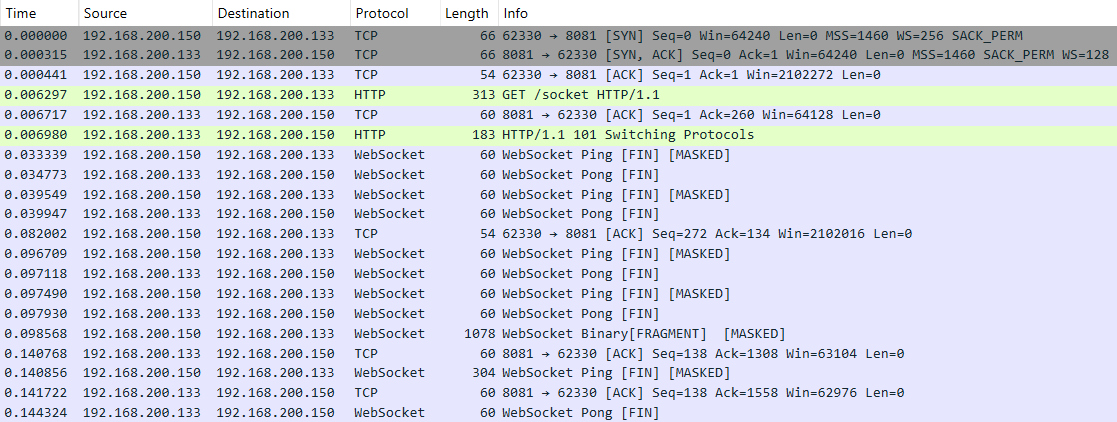
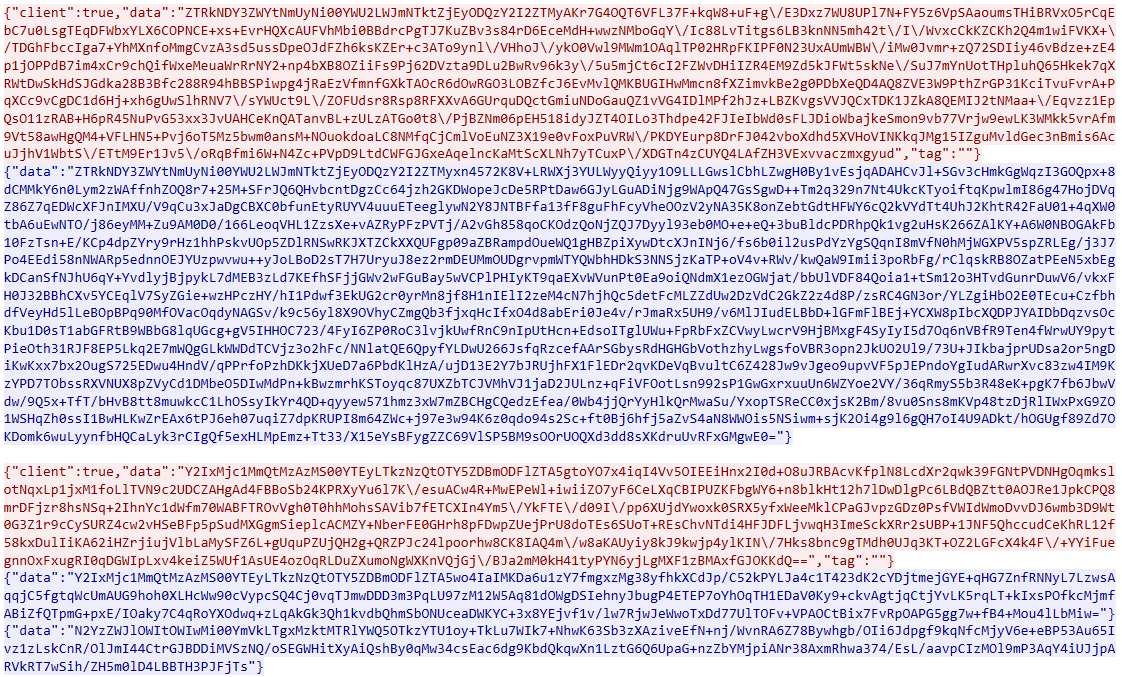
An analysis of the TCP session shows that the actual data is transmitted in the data field in Base64 encoding.
Decoding reveals the familiar data structure: UUID+AES256(JSON).
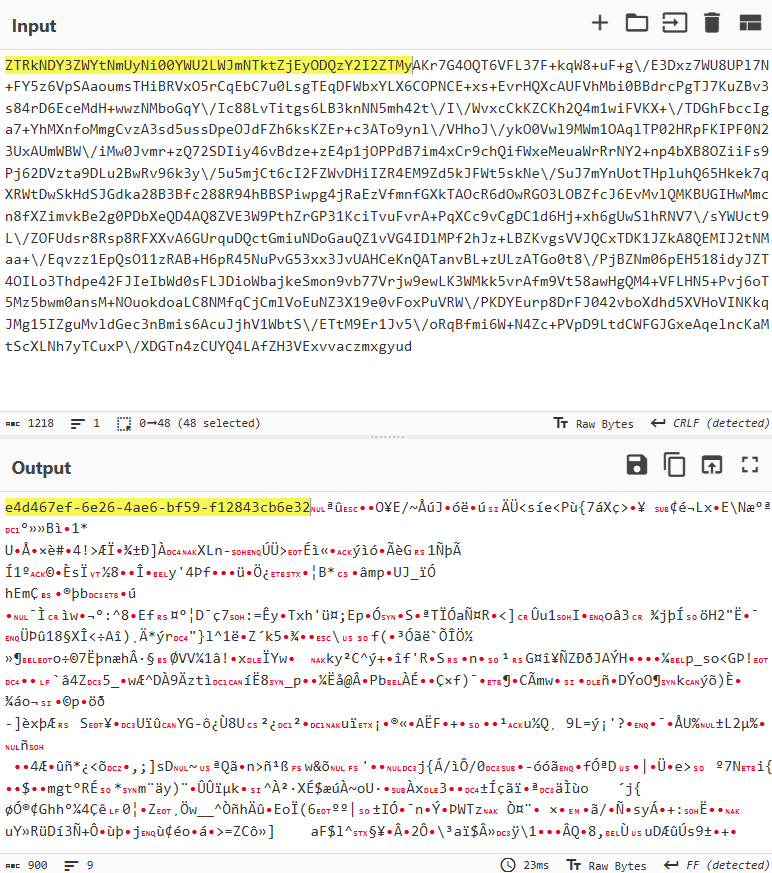
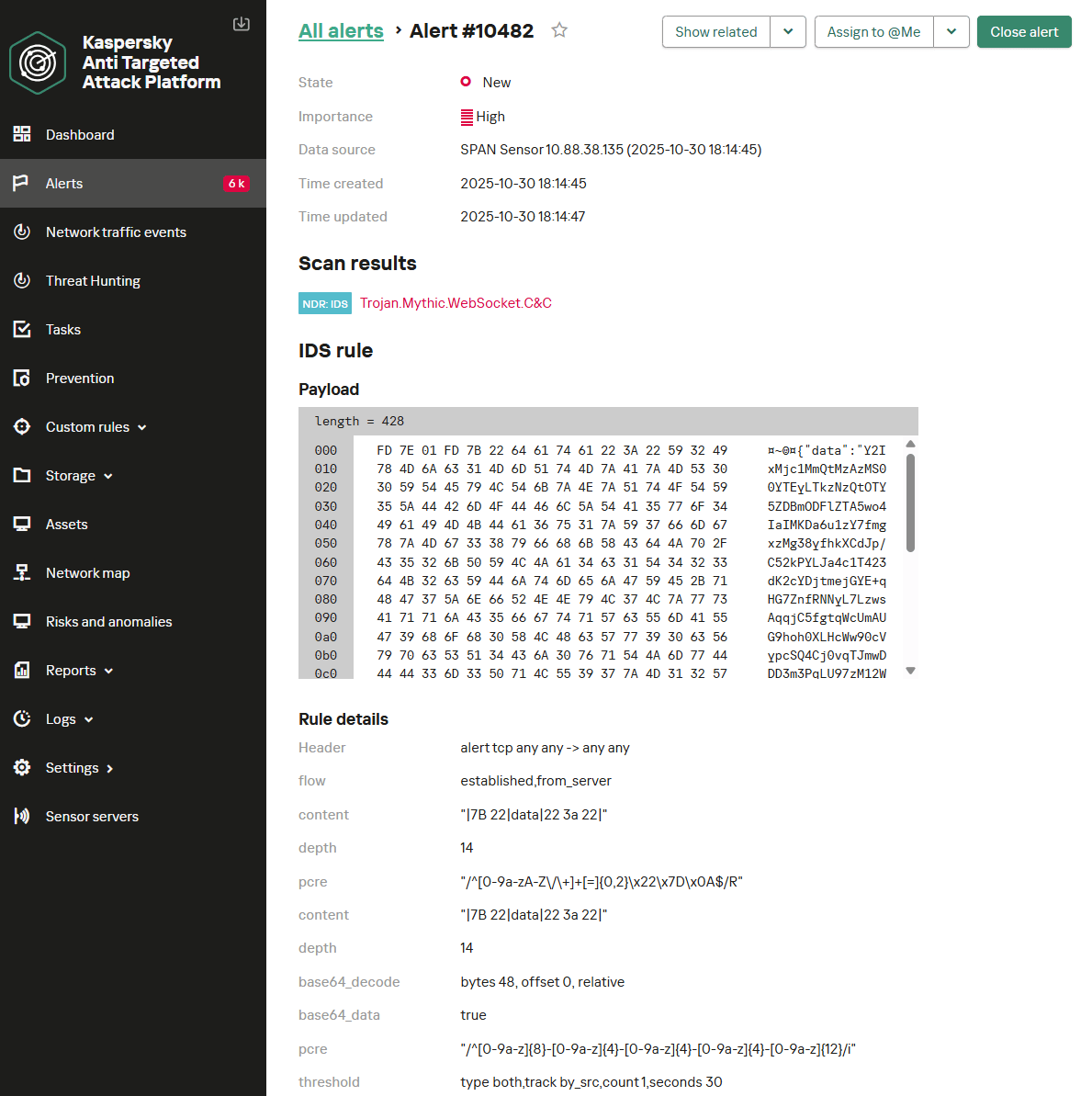
Therefore, we can use an approach similar to those discussed above to detect agent activity. The signature should rely on the UUID string at the beginning of the data field. The rule first verifies that the session data matches the data:base64 format, then decodes the data field and searches for a string matching the UUID pattern.
alert tcp any any -> any any (msg: "Trojan.Mythic.WebSocket.C&C"; flow: established, from_server; content: "|7B 22|data|22 3a 22|"; depth: 14; pcre: "/^[0-9a-zA-Z\/\+]+[=]{0,2}\x22\x7D\x0A$/R"; content: "|7B 22|data|22 3a 22|"; depth: 14; base64_decode: bytes 48, offset 0, relative; base64_data; pcre: "/^[a-z0-9]{8}\-[a-z0-9]{4}\-[a-z0-9]{4}\-[a-z0-9]{4}\-[a-z0-9]{12}/i"; threshold: type both, track by_src, count 1, seconds 30; reference: url, github.com/MythicAgents/; classtype: ndr1; sid: 9000115; rev: 2;)
Below is the Trojan.Mythic.WebSocket.C&C signature triggering on Mythic agent communication over WebSocket.
Takeaways
The Mythic post-exploitation framework continues to gain popularity and evolve rapidly. New agents are emerging, designed for covert persistence within target infrastructures. Despite this evolution, the various implementations of network communication in Mythic share many common characteristics that remain largely consistent over time. This consistency enables IDS/NDR solutions to effectively detect the framework’s agent activity through network traffic analysis.
Mythic supports a wide array of agent management options utilizing several network protocols. Our analysis of agent communications across these protocols revealed that agent activity can be detected by searching for specific data patterns within network traffic. The primary detection criterion involves tracking UUID strings in specific positions within Base64-encoded transmitted data. However, while the general approach to detecting agent activity is similar across protocols, each requires protocol-specific filters. Consequently, creating a single, universal signature for detecting Mythic agents in network traffic is challenging; individual detection rules must be crafted for each protocol. This article has provided signatures that are included in Kaspersky NDR.
Kaspersky NDR is designed to identify current threats within network infrastructures. It enables the detection of all popular post-exploitation frameworks based on their characteristic traffic patterns. Since the network components of these frameworks change infrequently, employing an NDR solution ensures high effectiveness in agent discovery.
Kaspersky verdicts in Kaspersky solutions (Kaspersky Anti-Targeted Attack with NDR module and Kaspersky NGFW)
Trojan.Mythic.SMB.C&C
Trojan.Mythic.TCP.C&C
Trojan.Mythic.HTTP.C&C
Trojan.Mythic.TLS.C&C
Trojan.Mythic.WebSocket.C&C


DNS-Massenüberwachung: „Das war dringend notwendig, diese neue Idee einer Schleppnetzfahndung im Internet abzuwenden“
netzpolitik.org/2025/dns-masse…

Gaza in ginocchio: freddo, pioggia e nuovi bombardamenti israeliani devastano il territorio
@Notizie dall'Italia e dal mondo
Sommersi i campi degli sfollati. A Khan Younis una neonata di otto mesi è morta per il freddo. L’Unrwa chiede aiuti urgenti per affrontare l’inverno
L'articolo Gaza in ginocchio: freddo, pioggia e nuovi bombardamenti
Notizie dall'Italia e dal mondo reshared this.
La Cina accelera sui portadroni. Primo volo per il Jiutian
@Notizie dall'Italia e dal mondo
La provincia dello Shaanxi, nella Cina nord-orientale, è stata teatro del primo volo di prova del “Jiutian”, termine cinese traducibile con “Nove cieli” che indica il mastodontico velivolo unmanned portadroni prodotto dalla statale Xi’an Chida Aircraft Parts Manufacturing e presentato dalla Repubblica
Notizie dall'Italia e dal mondo reshared this.
today.it/economia/tassa-2-euro…
Various Devboards and PCBs - Questo è un post automatico da FediMercatino.it
Prezzo: 0 €
2x Cypress C8CKIT
2x MCP2515 CAN interface
1x Serial SD-card mp3 player
1x powerbank PCB
1x Midibox GM5 USB-MIDI-Interface
2x USB Host Shield (verbastelt, probably working)
Il Mercatino del Fediverso 💵♻️ reshared this.
Various Devboards and PCBs - Questo è un post automatico da FediMercatino.it
Prezzo: 0 €
2x Cypress C8CKIT
2x MCP2515 CAN interface
1x Serial SD-card mp3 player
1x powerbank PCB
1x Midibox GM5 USB-MIDI-Interface
2x USB Host Shield (verbastelt, probably working)
Il Mercatino del Fediverso 💵♻️ reshared this.

Tatiana e la fuga dalla paura: “Credevo di essere malata. Poi il panico è diventato vergogna: non avevo la forza di tornare a casa”
Tatiana Tramacere parla dopo il finto sequestro a Nardò (Lecce): “Chiedo scusa a tutti, ero spaventata dal clamore che si era creato. Ero in un periodo buio, aspettavo un esame. Non è stata una bravata: Dragos mi ha accolto da amico.Nino Femiani (Quotidiano Nazionale)
“Riflessioni sul fine vita – Aspetti etici e giuridici” a Pontinia con la Cellula Coscioni di Latina
Aula Consiliare, Comune di Pontinia
Giovedì 11 dicembre 2025
Ore 18:00
La Cellula Coscioni di Latina promuove un momento di confronto aperto sul tema del fine vita, con particolare attenzione agli aspetti etici, giuridici e sanitari.
L’incontro sarà introdotto da Matteo Lovato, Consigliere Comunale del Comune di Pontinia e Maria Grazia Boaretto, Coordinatrice della Cellula Coscioni di Latina
Seguiranno gli interventi di Eligio Tombolillo, Sindaco del Comune di Pontinia, Michela Guarda, Dirigente infermieristico Hospice San Marco, Massimo Frisetti, Avvocato penalista del Foro di Latina, Luca Palombo, Infermiere e Coordinatore Cellula Coscioni Latina, Ferdinando Tucci, Psicoterapeuta
Una preziosa occasione per approfondire diritti e strumenti a tutela dell’autodeterminazione nel fine vita, tra cui le Disposizioni Anticipate di Trattamento (DAT).
L'articolo “Riflessioni sul fine vita – Aspetti etici e giuridici” a Pontinia con la Cellula Coscioni di Latina proviene da Associazione Luca Coscioni.
EDRi-gram, 11 December 2025
What has the EDRi network been up to over the past few weeks? Find out the latest digital rights news in our bi-weekly newsletter. In this edition: 2025 might be almost over, but we aren’t done fighting for digital rights
The post EDRi-gram, 11 December 2025 appeared first on European Digital Rights (EDRi).
Bandire i social media ai minori di 16 anni?
Per vedere altri post come questo, segui la comunità @Informatica (Italy e non Italy 😁)
È notizia di questi giorni che – primo governante al mondo – in Australia il premier Anthony Albanese ha deciso di bandire i social media ai minori di 16 anni. L'intervento del professor Marco Mayer in occasione della Cyberweek 2025 presso l'Università di Tel Aviv
reshared this

Informa Pirata likes this.
Informa Pirata reshared this.
Informatica (Italy e non Italy 😁) reshared this.
linkiesta.it/2025/12/possibile…
credo che meloni che non è scema (anche se mediamente incompetente) ma solo malvagia sappia tutto. non è persona corretta.
reshared this
Migrant smuggling laws: European Commission found in breach of transparency rules
The European Ombudsman has found that the Commission disregarded important transparency rules while preparing the Europol Regulation, which is a part of the legislation to "counter migrant smuggling". The inquiry concluded that the Commission didn't provide enough evidence to justify the claims of "urgency" to bypass their own 'Better Regulation' rules, and skipping public consultations, thorough impact assessments and evidence gathering.
The post Migrant smuggling laws: European Commission found in breach of transparency rules appeared first on European Digital Rights (EDRi).
How Danes je nov dan helped stop dangerous spyware in Slovenia
EDRi affiliate Danes je nov dan launched a multi-faceted campaign in response to a government proposal that would allow the Slovene Intelligence and Security Agency (SOVA) to use invasive spyware and mass surveillance tools under the guise of “national security”. By combining a satirical online tool with targeted advocacy towards lawmakers, their efforts helped generate critical pressure needed to stop the legislation from being adopted.
The post How Danes je nov dan helped stop dangerous spyware in Slovenia appeared first on European Digital Rights (EDRi).
Moving past ‘Chat Control’ to solutions that truly protect kids and privacy
This article highlights evidence-based alternatives that strengthen child safety while safeguarding encryption and fundamental rights. It calls for better enforcement, more targeted tools, and meaningful support for child protection services rather than broad surveillance measures.
The post Moving past ‘Chat Control’ to solutions that truly protect kids and privacy appeared first on European Digital Rights (EDRi).
SìParte!
@Politica interna, europea e internazionale
19 dicembre 2025, ore 11:00 – Sala Galasso, Società Napoletana di Storia Patria – Castel Nuovo (Maschio Angioino), Via Vittorio Emanuele III, 310 – Napoli Saluti di Ugo de Flaviis, Referente Campania FLE Pier Camillo Falasca, Direttore L’Europeista Carmine Foreste, Pres. Ord. Avv. Napoli Marco Muscariello, Pres. Cam. Penale Napoli Introduce Vincenzo Maiello, Università “Federico […]
Politica interna, europea e internazionale reshared this.
Sedotta e abbandonata, l’Ucraina rischia il tracollo
@Notizie dall'Italia e dal mondo
L'Ucraina di fronte a una tragica scelta: perdere altri territori o continuare a combattere una guerra ormai persa? Kiev intanto è sempre più vicina al punto di rottura
L'articolo Sedotta e abbandonata, l’Ucraina pagineesteri.it/2025/12/11/eur…
Notizie dall'Italia e dal mondo reshared this.
freezonemagazine.com/articoli/…
“Mr. Redbone (…) ho composto questa canzone che sarebbe perfetta per lei, sir”- “Molto interessante (…) Questa canzone è stata scritta prima del 1940?” (Richard Flohil) Prima che si dissolva anche il 2025 è buono ricordare che fra tutte le ricorrenze che l’anno ha portato con sé (uno dei pochi meriti per cui sarà ricordato […]
L'articolo Leon Redbone, “mystery man” proviene da FREE ZONE MAGAZINE.
L’Ecuador chiede giustizia per i 4 bambini di Guayaquil
@Notizie dall'Italia e dal mondo
Un anno dopo il rapimento e l’uccisione dei quattro bambini di Las Malvinas, l’Ecuador torna in piazza per chiedere verità e giustizia, denunciando la militarizzazione del territorio, le responsabilità delle Forze Armate e l’escalation di violazioni contro l’infanzia nelle regioni più
aimee80 likes this.
Notizie dall'Italia e dal mondo reshared this.
Trasferimenti di dati UE-USA: è tempo di prepararsi a nuovi problemi in arrivo
La maggior parte dei trasferimenti di dati tra UE e USA si basa sul "Quadro Transatlantico sulla Privacy dei Dati" (TAFPF) o sulle cosiddette "Clausole Contrattuali Tipo" (SCC). Entrambi gli strumenti si basano su leggi statunitensi fragili, regolamenti non vincolanti e una giurisprudenza che è sotto attacco e che probabilmente verrà smantellata nei prossimi mesi. Mentre l'instabilità del sistema legale statunitense diventa innegabile e gli Stati Uniti mostrano evidenti segnali di ostilità nei confronti dell'UE, è tempo di riconsiderare dove fluiscono i nostri dati e per quanto tempo reggerà il "castello di carte" legale costruito dall'UE.
noyb.eu/en/eu-us-data-transfer…
@Privacy Pride


⚖️ In light of the upcoming US #SupremeCourt ruling in #Trump v. Slaughter, we took a detailed look at the implications for US-EU #datatransfers. In short: It's time for EU companies to prepare for more trouble to come.noyb.eu/en/eu-us-data-transfer…
EU-US Data Transfers: Time to prepare for more trouble to come
As instability in the US legal system becomes undeniable and the US shows open signs of hostility towards the EU, it is time to reconsider where our data is flowingnoyb.eu

reshared this
La Stampa in assemblea permanente, il giornale non sarà in edicola: “una giornata drammatica per la storia della nostra testata”
@Giornalismo e disordine informativo
articolo21.org/2025/12/la-stam…
Pubblichiamo la nota del Comitato di Redazione del quotidiano “La Stampa”. Articolo21 esprime grande
Quel filo nero che unisce le stragi all’evento di Articolo 21. Voci e volti della democrazia che resiste
@Giornalismo e disordine informativo
articolo21.org/2025/12/quel-fi…
Guardare al futuro significa coltivare la memoria e ciò equivale
informapirata ⁂
in reply to simona • • •simona likes this.
Luca Sironi
in reply to informapirata ⁂ • • •tra un po va a finire che DEVI avere i social commerciali perche' devono controllarli.
reshared this
informapirata ⁂ reshared this.
Luca Sironi
in reply to Luca Sironi • • •se non hai neanche instagram nel 2025, hai qualcosa da nascondere !
reshared this
informapirata ⁂ reshared this.
informapirata ⁂
in reply to Luca Sironi • • •Elena Brescacin
in reply to Luca Sironi • • •No, scherzo. Ma sinceramente per il tipo di vacanze che faccio io, due sono le cose: non rompete le palle se mi spoglio, e datemi da mangiare che sia bene e abbondante. Solo l'Italia le può garantire entrambe nello stesso posto.
Finlandia e Olanda, ci sono stata 30 anni fa e mi trovai bene. Ma ora che hanno l'estrema destra pure loro in mezzo ai piedi...
informapirata ⁂ reshared this.
Elena Brescacin
in reply to Elena Brescacin • • •"non mi si rompa se mi spoglio" si intende stare in costume da bagno, in pantaloncini corti e magliettina, insomma sbragate.
Col culo dentro o fuori, di solito dentro. Perché basta la faccia, è un duplicato