
Has Steampunk Delivered the Hoverboard?

The hoverboard, one of the teen crazes of the last decade, is both a marvel of technology and a source of hacker parts that have appeared in so many projects on these pages. It contains an accelerometer or similar, along with a microcontroller and a pair of motor controllers to drive its in-wheel motors. That recipe is open to interpretation of course and we’ve seen a few in our time, but perhaps not quite like this steampunk design from [Skrubis]. It claims a hoverboard design with no modern electronics, only relays, mercury switches, and neon bulbs.
The idea is that it’s a hoverboard from 1884 using parts available in that era, hence there’s talk of telegraph relays and galvanomic piles. The write-up is presented in steampunk-style language which if we’re honest makes our brain hurt, but the premise is intriguing enough to persevere. As far as we can see it uses a pair of relays and a transformer to make an oscillator, from which can be derived the drive for a 3-phase motor. This drive is sent to the motors by further relays operating under the influence of mercury tilt switches.
There are a full set of hardware designs once you wade past the language, but as yet it has no evidence of a prototype. We admit we kinda want it to work because the idea is preposterous enough to be cool if it ran, but we’d be lying if we said we didn’t harbor some doubts. Perhaps you our readers can deliver a verdict, after all presenting you with entertainment is what it’s all about. If a working prototype surfaces we’ll definitely be featuring it, after all it would be cool as heck.
Oddly this isn’t the first non-computerized balance transport we’ve seen.
Header: Simakovarik, CC BY-SA 4.0.
DIY Light Panels Work With Home Assistant

There are a few major companies out there building colorful LED panels you can stick on your wall for aesthetic purposes. Most commercial options are pretty expensive, and come with certain limitations in how they can be controlled. [Smart Solutions For Home] has whipped up a flexible DIY design for decorating your walls with light that is altogether more customizable.
In this case, the DIY light panels ape the hexagonal design made popular by brands like Nanoleaf. In this case, each hexagon panel runs an ESP32 microcontroller, which controls a series of WS2812 addressable LEDs. This allows each panel to glow whatever color you like, and they’re arranged in an XY grid to enable you to light individual panels with a range of different geometric effects. The benefit of having a full microcontroller on each panel is that they can act quite independently—each one able to be used as a smart light, an notification display, or even as a physical button, all integrated with Home Assistant.
If you’re a fan of DIY smart home products, these might be right up your alley. They’re supremely flexible and customizable, and can do a lot of things that commercial versions can’t easily replicate. Just don’t ignore the fact that they require a considerable amount of assembly, what with the custom PCBs, 3D printed enclosures, and front diffusers to deal with. That’s just the way the LED wall crumbles.
We’ve seen other similar builds before, too. Why? The simple fact is that a lot of people want cool glowy panels on their wall without having to pay through the nose for them.
youtube.com/embed/KsK9eldbPj0?…
La nuova guerra europea alla privacy Chat Control violerà i diritti fondamentali
In teoria, Chat Control avrebbe dovuto essere sepolto il mese scorso. Il minaccioso piano dell'UE di scansionare in massa i messaggi privati dei cittadini ha incontrato una schiacciante resistenza pubblica in Germania, con il governo del paese che si è rifiutato di approvarlo. Ma Bruxelles raramente si tira indietro solo perché i cittadini lo chiedono. E così, fedele alla sua forma, una versione rielaborata del testo è già in fase di elaborazione, questa volta nascosta, a porte chiuse.
reshared this
On the Benefits of Filling 3D Prints With Spray Foam

Closed-cell self-expanding foam (spray foam) is an amazing material that sees common use in construction. But one application that we hadn’t heard of before was using it to fill the internal voids of 3D printed objects. As argued by [Alex] in a half-baked-research YouTube video, this foam could be very helpful with making sure that printed boats keep floating and water stays out of sensitive electronic bits.
It’s pretty common knowledge by now that 3D printed objects from FDM printers aren’t really watertight. Due to the way that these printers work, there’s plenty of opportunity for small gaps and voids between layers to permit moisture to seep through. This is where the use of this self-expanding foam comes into play, as it’s guaranteed to be watertight. In addition, [Alex] also tests how this affects the strength of the print and using its insulating properties.
The test prints are designed with the requisite port through which the spray foam is injected as well as pressure relief holes. After a 24 hour curing period the excess foam is trimmed. Early testing showed that in order for the foam to cure well inside the part, it needed to be first flushed with water to provide the moisture necessary for the chemical reaction. It’s also essential to have sufficient pressure relief holes, especially for the larger parts, as the expanding foam can cause structural failure.
As for the results, in terms of waterproofing there was some water absorption, likely in the PETG part. But after 28 hours of submerging none of the sample cubes filled up with water. The samples did not get any stronger tensile-wise, but the compression test showed a 25 – 70% increase in resistance to buckling, which is quite significant.
Finally, after tossing some ice cubes into a plain FDM printed box and one filled with foam, it took less than six hours for the ice to melt, compared to the spray foam insulated box which took just under eight hours.
This seems to suggest that adding some of this self-expanding foam to your 3D printed part makes a lot of sense if you want to keep water out, add more compressive strength, or would like to add thermal insulation beyond what FDM infill patterns can provide.
youtube.com/embed/Pkk9Lt-j2hM?…
A Flexible Light Inspired by IKEA

The IKEA SMÅSNÖRE is a flexible silicone rod with an embedded LED strip, attached at each end to a base. It’s eye-catching enough, and it has the useful property of providing a diffuse light from multiple angles that makes it a promising candidate for a work lamp. That’s enough for [Daniel James] to create his own lamp on a similar vein.
The electronics of his lamp are straightforward enough: a 12 volt LED strip whose brightness is controlled by a Pi Pico in response to a potentiometer as a brightness control. It’s not quite stiff enough to form the arch itself, so he’s created a 3D printed chain that forms the structure of the lamp. Similar to a bicycle chain in the way it’s constructed, it has individual links that slot together and pivot. The electronics are in the printed base at one end.
We like this lamp a lot, for the light it gives on the bench and for the ingenuity of the printed chain. We might even make one for ourselves.
il ponte sullo stretto mi va stretto
reshared this

Ustica è una questione morale. E civica
@Giornalismo e disordine informativo
articolo21.org/2025/11/ustica-…
Nei giorni scorsi abbiamo promosso, insieme con l’Associazione dei familiari delle vittime della strage di Ustica e la Presidente Daria Bonfietti un incontro-stampa per chiedere di non archiviare le indagini. Per la prima volta a livello nazionale, a
Giornalismo e disordine informativo reshared this.
Magistratura democratica: l’irruzione nella sede del quotidiano La Stampa atto vile e intollerabile
@Giornalismo e disordine informativo
articolo21.org/2025/11/magistr…
Magistratura Democratica interviene su quanto accaduto a Torino. “La violenta
Giornalismo e disordine informativo reshared this.

Scruscio! finalmente un calendario condiviso anche a Palermo
Nasce scruscio.org/about , istanza palermitana di Gancio
reshared this
Un server ActivityPub in un singolo file PHP? Ecco come fare... Il post di @tofeo
Qualsiasi programma per computer può essere progettato per essere eseguito da un singolo file, se la progettazione è abbastanza sbagliata! 🤣
Volevo creare il server #Fediverse più semplice possibile, che potesse essere utilizzato come strumento didattico per mostrare come funziona ActivityPub / Mastodon.
shkspr.mobi/blog/2024/02/activ…


ActivityPub Server in a Single PHP File
shkspr.mobi/blog/2024/02/activ…Any computer program can be designed to run from a single file if you architect it wrong enough!
I wanted to create the simplest possible Fediverse server which can be used as an educational tool to show how ActivityPub / Mastodon works.
The design goals were:
- Upload a single PHP file to the server.
- No databases or separate config files.
- Single Actor (i.e. not multi-user).
- Allow the Actor to be followed.
- Post plain-text messages to followers.
- Be roughly standards compliant.
And those goals have all been met! Check it out on GitLab. I warn you though, it is the nadir of bad coding. There are no tests, bugger-all security, scalability isn't considered, and it is a mess. But it works.
You can follow the test user
@[url=https://example.viii.fi/example]example@example.viii.fi[/url]Architecture
Firstly, I've slightly cheated on my "single file" stipulation. There's an.htaccessfile which turnsexample.com/whateverintoexample.com/index.php?path=whateverThe
index.phpfile then takes that path and does stuff. It also contains all the configuration variables which is very bad practice.Rather than using a database, it saves files to disk.
Again, this is not suitable for any real world use. This is an educational tool to help explain the basics of posting messages to the Fediverse. It requires absolutely no dependencies. You do not need to spin up a dockerised hypervisor to manage your node bundles and re-compile everything to WASM. Just FTP the file up to prod and you're done.
Walkthrough
This is a quick ramble through the code. It is reasonably well documented, I hope.Preamble
This is where you set up your account's name and bio. You also need to provide a public/private keypair. The posting page is protected with a password that also needs to be set here.
PHP // Set up the Actor's information $username = rawurlencode("example"); // Encoded as it is often used as part of a URl $realName = "E. Xample. Jr."; $summary = "Some text about the user."; $server = $_SERVER["SERVER_NAME"]; // Domain name this is hosted on // Generate locally or from cryptotools.net/rsagen // Newlines must be replaced with "\n" $key_private = "-----BEGIN RSA PRIVATE KEY-----\n...\n-----END RSA PRIVATE KEY-----"; $key_public = "-----BEGIN PUBLIC KEY-----\n...\n-----END PUBLIC KEY-----"; // Password for sending messages $password = "P4ssW0rd";Logging
ActivityPub is a "chatty" protocol. This takes all the requests your server receives and saves them in/logs/as a datestamped text file.
PHP // Get all headers and requests sent to this server $headers = print_r( getallheaders(), true ); $postData = print_r( $_POST, true ); $getData = print_r( $_GET, true ); $filesData = print_r( $_FILES, true ); $body = json_decode( file_get_contents( "php://input" ), true ); $bodyData = print_r( $body, true ); $requestData = print_r( $_REQUEST, true ); $serverData = print_r( $_SERVER, true ); // Get the type of request - used in the log filename if ( isset( $body["type"] ) ) { $type = " " . $body["type"]; } else { $type = ""; } // Create a timestamp in ISO 8601 format for the filename $timestamp = date( "c" ); // Filename for the log $filename = "{$timestamp}{$type}.txt"; // Save headers and request data to the timestamped file in the logs directory if( ! is_dir( "logs" ) ) { mkdir( "logs"); } file_put_contents( "logs/{$filename}", "Headers: \n$headers \n\n" . "Body Data: \n$bodyData \n\n" . "POST Data: \n$postData \n\n" . "GET Data: \n$getData \n\n" . "Files Data: \n$filesData \n\n" . "Request Data:\n$requestData\n\n" . "Server Data: \n$serverData \n\n" );Routing
The.htaccesschanges/whateverto/?path=whateverThis runs the function of the path requested.
PHP !empty( $_GET["path"] ) ? $path = $_GET["path"] : die(); switch ($path) { case ".well-known/webfinger": webfinger(); case rawurldecode( $username ): username(); case "following": following(); case "followers": followers(); case "inbox": inbox(); case "write": write(); case "send": send(); default: die(); }WebFinger
The WebFinger Protocol is used to identify accounts.It is requested withexample.com/.well-known/webfinger?resource=acct:username@example.comThis server only has one user, so it ignores the query string and always returns the same details.
PHP function webfinger() { global $username, $server; $webfinger = array( "subject" => "acct:{$username}@{$server}", "links" => array( array( "rel" => "self", "type" => "application/activity+json", "href" => "https://{$server}/{$username}" ) ) ); header( "Content-Type: application/json" ); echo json_encode( $webfinger ); die(); }Username
Requestingexample.com/usernamereturns a JSON document with the user's information.
PHP function username() { global $username, $realName, $summary, $server, $key_public; $user = array( "@context" => [ "https://www.w3.org/ns/activitystreams", "https://w3id.org/security/v1" ], "id" => "https://{$server}/{$username}", "type" => "Person", "following" => "https://{$server}/following", "followers" => "https://{$server}/followers", "inbox" => "https://{$server}/inbox", "preferredUsername" => rawurldecode($username), "name" => "{$realName}", "summary" => "{$summary}", "url" => "https://{$server}", "manuallyApprovesFollowers" => true, "discoverable" => true, "published" => "2024-02-12T11:51:00Z", "icon" => [ "type" => "Image", "mediaType" => "image/png", "url" => "https://{$server}/icon.png" ], "publicKey" => [ "id" => "https://{$server}/{$username}#main-key", "owner" => "https://{$server}/{$username}", "publicKeyPem" => $key_public ] ); header( "Content-Type: application/activity+json" ); echo json_encode( $user ); die(); }Following & Followers
These JSON documents show how many users are following / followers-of this account.The information here is self-attested. So you can lie and use any number you want.
PHPfunction following() { global $server; $following = array( "@context" => "https://www.w3.org/ns/activitystreams", "id" => "https://{$server}/following", "type" => "Collection", "totalItems" => 0, "items" => [] ); header( "Content-Type: application/activity+json" ); echo json_encode( $following ); die(); } function followers() { global $server; $followers = array( "@context" => "https://www.w3.org/ns/activitystreams", "id" => "https://{$server}/followers", "type" => "Collection", "totalItems" => 0, "items" => [] ); header( "Content-Type: application/activity+json" ); echo json_encode( $followers ); die(); }Inbox
The/inboxis the main server. It receives all requests. This server only responds to "Follow" requests.A remote server sends a follow request which is a JSON file saying who they are.This code does not cryptographically validate the headers of the received message.The name of the remote user's server is saved to a file so that future messages can be delivered to it.An accept request is cryptographically signed and POST'd back to the remote server.
PHP function inbox() { global $body, $server, $username, $key_private; // Get the message and type $inbox_message = $body; $inbox_type = $inbox_message["type"]; // This inbox only responds to follow requests if ( "Follow" != $inbox_type ) { die(); } // Get the parameters $inbox_id = $inbox_message["id"]; $inbox_actor = $inbox_message["actor"]; $inbox_host = parse_url( $inbox_actor, PHP_URL_HOST ); // Does this account have any followers? if( file_exists( "followers.json" ) ) { $followers_file = file_get_contents( "followers.json" ); $followers_json = json_decode( $followers_file, true ); } else { $followers_json = array(); } // Add user to list. Don't care about duplicate users, server is what's important $followers_json[$inbox_host]["users"][] = $inbox_actor; // Save the new followers file file_put_contents( "followers.json", print_r( json_encode( $followers_json ), true ) ); // Response Message ID // This isn't used for anything important so could just be a random number $guid = uuid(); // Create the Accept message $message = [ "@context" => "https://www.w3.org/ns/activitystreams", "id" => "https://{$server}/{$guid}", "type" => "Accept", "actor" => "https://{$server}/{$username}", "object" => [ "@context" => "https://www.w3.org/ns/activitystreams", "id" => $inbox_id, "type" => $inbox_type, "actor" => $inbox_actor, "object" => "https://{$server}/{$username}", ] ]; // The Accept is sent to the server of the user who requested the follow // TODO: The path doesn't *always* end with/inbox $host = $inbox_host; $path = parse_url( $inbox_actor, PHP_URL_PATH ) . "/inbox"; // Get the signed headers $headers = generate_signed_headers( $message, $host, $path ); // Specify the URL of the remote server's inbox // TODO: The path doesn't *always* end with /inbox $remoteServerUrl = $inbox_actor . "/inbox"; // POST the message and header to the requester's inbox $ch = curl_init( $remoteServerUrl ); curl_setopt( $ch, CURLOPT_RETURNTRANSFER, true ); curl_setopt( $ch, CURLOPT_CUSTOMREQUEST, "POST" ); curl_setopt( $ch, CURLOPT_POSTFIELDS, json_encode($message) ); curl_setopt( $ch, CURLOPT_HTTPHEADER, $headers ); $response = curl_exec( $ch ); // Check for errors if( curl_errno( $ch ) ) { file_put_contents( "error.txt", curl_error( $ch ) ); } curl_close($ch); die(); }UUID
Every message sent should have a unique ID. This can be anything you like. Some servers use a random number.I prefer a date-sortable string.
PHP function uuid() { return sprintf( "%08x-%04x-%04x-%04x-%012x", time(), mt_rand(0, 0xffff), mt_rand(0, 0xffff), mt_rand(0, 0x3fff) | 0x8000, mt_rand(0, 0xffffffffffff) ); }Signing Headers
Every message that your server sends needs to be cryptographically signed with your Private Key.This is a complicated process. Please read "How to make friends and verify requests" for more information.
PHP function generate_signed_headers( $message, $host, $path ) { global $server, $username, $key_private; // Encode the message to JSON $message_json = json_encode( $message ); // Location of the Public Key $keyId = "https://{$server}/{$username}#main-key"; // Generate signing variables $hash = hash( "sha256", $message_json, true ); $digest = base64_encode( $hash ); $date = date( "D, d M Y H:i:s \G\M\T" ); // Get the Private Key $signer = openssl_get_privatekey( $key_private ); // Sign the path, host, date, and digest $stringToSign = "(request-target): post $path\nhost: $host\ndate: $date\ndigest: SHA-256=$digest"; // The signing function returns the variable $signature // php.net/manual/en/function.ope… openssl_sign( $stringToSign, $signature, $signer, OPENSSL_ALGO_SHA256 ); // Encode the signature $signature_b64 = base64_encode( $signature ); // Full signature header $signature_header = 'keyId="' . $keyId . '",algorithm="rsa-sha256",headers="(request-target) host date digest",signature="' . $signature_b64 . '"'; // Header for POST reply $headers = array( "Host: {$host}", "Date: {$date}", "Digest: SHA-256={$digest}", "Signature: {$signature_header}", "Content-Type: application/activity+json", "Accept: application/activity+json", ); return $headers; }User Interface for Writing
This creates a basic HTML form. Type in your message and your password. It then POSTs the data to the/sendendpoint.
PHP function write() { // Display an HTML form for the user to enter a message.echo <<< HTML<![url=https://mastodon.social/users/doctype]Aleks Dorohovich[/url] html><html lang="en-GB"> <head> <meta charset="UTF-8"> <title>Send Message</title> <style> *{font-family:sans-serif;font-size:1.1em;} </style> </head> <body> <form action="/send" method="post" enctype="multipart/form-data"> <label for="content">Your message:</label><br> <textarea id="content" name="content" rows="5" cols="32"></textarea><br> <label for="password">Password</label><br> <input type="password" name="password" id="password" size="32"><br> <input type="submit" value="Post Message"> </form> </body></html>HTML; die(); }Send Endpoint
This takes the submitted message and checks the password is correct.It reads thefollowers.jsonfile and sends the message to every server that is following this account.
PHP function send() { global $password, $server, $username, $key_private; // Does the posted password match the stored password? if( $password != $_POST["password"] ) { die(); } // Get the posted content $content = $_POST["content"]; // Current time - ISO8601 $timestamp = date( "c" ); // Outgoing Message ID $guid = uuid(); // Construct the Note // contentMap is used to prevent unnecessary "translate this post" pop ups // hardcoded to English $note = [ "@context" => array( "https://www.w3.org/ns/activitystreams" ), "id" => "https://{$server}/posts/{$guid}.json", "type" => "Note", "published" => $timestamp, "attributedTo" => "https://{$server}/{$username}", "content" => $content, "contentMap" => ["en" => $content], "to" => ["https://www.w3.org/ns/activitystreams#Public"] ]; // Construct the Message $message = [ "@context" => "https://www.w3.org/ns/activitystreams", "id" => "https://{$server}/posts/{$guid}.json", "type" => "Create", "actor" => "https://{$server}/{$username}", "to" => [ "https://www.w3.org/ns/activitystreams#Public" ], "cc" => [ "https://{$server}/followers" ], "object" => $note ]; // Create the context for the permalink $note = [ "@context" => "https://www.w3.org/ns/activitystreams", ...$note ]; // Save the permalink $note_json = json_encode( $note ); // Check for posts/ directory and create it if( ! is_dir( "posts" ) ) { mkdir( "posts"); } file_put_contents( "posts/{$guid}.json", print_r( $note_json, true ) ); // Read existing users and get their hosts $followers_file = file_get_contents( "followers.json" ); $followers_json = json_decode( $followers_file, true ); $hosts = array_keys( $followers_json ); // Prepare to use the multiple cURL handle $mh = curl_multi_init(); // Loop through all the severs of the followers // Each server needs its own cURL handle // Each POST to an inbox needs to be signed separately foreach ( $hosts as $host ) { $path = "/inbox"; // Get the signed headers $headers = generate_signed_headers( $message, $host, $path ); // Specify the URL of the remote server $remoteServerUrl = "https://{$host}{$path}"; // POST the message and header to the requester's inbox $ch = curl_init( $remoteServerUrl ); curl_setopt( $ch, CURLOPT_RETURNTRANSFER, true ); curl_setopt( $ch, CURLOPT_CUSTOMREQUEST, "POST" ); curl_setopt( $ch, CURLOPT_POSTFIELDS, json_encode($message) ); curl_setopt( $ch, CURLOPT_HTTPHEADER, $headers ); // Add the handle to the multi-handle curl_multi_add_handle( $mh, $ch ); } // Execute the multi-handle do { $status = curl_multi_exec( $mh, $active ); if ( $active ) { curl_multi_select( $mh ); } } while ( $active && $status == CURLM_OK ); // Close the multi-handle curl_multi_close( $mh ); // Render the JSON so the user can see the POST has worked header( "Location: https://{$server}/posts/{$guid}.json" ); die(); }Next Steps
This is not intended to be used in production. Ever. But if you would like to contribute more simple examples of how the protocol works, please come and play on GitLab.You can follow the test user
@[url=https://example.viii.fi/example]example@example.viii.fi[/url]Terence Eden / ActivityPub-Single-PHP-File · GitLab
A single PHP file which acts as a basic ActivityPub server.GitLab

reshared this
Building a Simple Ribbon Synth

The usual input device for playing a synthesizer is the good old piano keyboard. However, you don’t have to stick to such pedestrian interfaces when making music. [Daisy] has a fun build that shows us how to put together a ribbon synth that makes wonderful little noises.
Naturally, the heart of the build is a ribbon potentiometer (also known as soft pots). It’s essentially a touch sensitive strip that changes in resistance depending on where you touch it. You can slide your finger up and down to vary the output continuously; in musical contexts, they can behave rather like a fretless instrument. [Daisy] employs one of these potentiometers in such a role by hooking it up to a Daisy Seed microcontroller board, which reads it with an analog-to-digital converter (ADC). The resistance values are used to vary the pitch of a dual-saw synthesizer programmed in the plugdata framework.
We’ve featured some other great ribbon synths over the years, too, like this tribute to the Eowave Persephone. They’re not the ideal choice for those that prefer their notes on pitch, but they’re beautifully fun to play with when you’re getting a little more experimental.
youtube.com/embed/iUDOLJ1Ki84?…


Firefox cambia: arrivano i profili separati
Mozilla introduce i profili in Firefox per separare e organizzare più facilmente le attività online degli utenti del browser web.Antonello Buzzi (Tom's Hardware)


Scientists found that major celebrities died four years earlier than their less famous peers, hinting that fame itself can be a mortality risk.#TheAbstract


Being Famous Can Shorten Your Lifespan, Scientists Find
Welcome back to the Abstract! Here are the studies this week that hit the books, bottled alien lightning, reared wolf cubs, and tallied the price of fame.First, we’ve got a centuries-long history of an Indian savannah told through songs, folktales, and screaming peacocks. Then: Mars gets charged, the secrets of Stora Karlsö, and the epidemiology of stardom.
As always, for more of my work, check out my book First Contact: The Story of Our Obsession with Aliens or subscribe to my personal newsletter the BeX Files.
When folk tales are field guides
It has happened again: Researchers have turned to the annals of literature to address a scientific question. Longtime readers of the Abstract will recall that this is a simply irresistible category of research to me (see: China’s porpoise corpus, Transylvanian weather reports, and milky seas). To the library!
In this edition of Science from the Stacks, researchers probed the origins of the tropical savannah in western Maharashtra, India, by collecting references to plants in 28 stories and songs dating back at least 750 years. The aim was to reconstruct a vegetation history that could hint at shifts in the region between forest and savannah biomes.
“Ttraditional literature—for example, myths, folk songs and stories—is a culturally resonant, yet underutilized line of evidence to understand ecological histories and foster biodiversity conservation,” said researchers led by Ashish N. Nerlekar of Michigan State University.
A folio from an early 19th-century manuscript of the Bhaktavijaya mentioning the taraṭī tree. Image: Nerlekar, Ashish N. et al.
“We found that descriptions of both the landscape and specific plants point to an open-canopy savanna in the past rather than a forest,” the team said. “Of the 44 wild plant species recorded (i.e. omitting exclusively cultivated plants), a clear majority (27 species) were savanna indicators, 14 were generalists, and only three were forest indicators. Our ecological reconstructions from traditional literature complement data from archival paintings, revenue records, plant and animal fossils, and dated molecular phylogenies of endemic biodiversity—all attesting to the antiquity of India's savannas.”It’s an out-of-the-box way to reconstruct the natural history of a region. But the highlights of these studies are always the excerpts from the literature, like the amazing origin story of this village:
“A folk tale illustrates the founding myth of Kolvihire village near Jejuri. The tale is about a robber-murderer named Vālhyā Koḷī, who lived near Kolvihire. Upon meeting a sage, Vālhyā Koḷī introspected on his wrongdoings and performed penance for 12 years. After completion of the penance, as a living testimony to Vālhyā Koḷī's sincere devotion, leaves sprouted from his stick, which he had used to hit and kill travellers to loot their money. Eventually, Vālhyā Koḷī became the sage-poet Vālmikī. According to the tale, the sprouted stick grew into a pāḍaḷa tree, and the tree still exists in Kolvihire.”
You have to love a good botanical redemption story. Another standout line is this memorable description of a thorny patch in the savannah from the early 16th century: “Such is this thorny forest | it is highly frightening | this forest is empty | peacocks scream here.”
I don’t know exactly why, but “peacocks scream here” is just about the scariest description I’ve ever heard of a place. Shout out to this ancient poet for capturing some legendary bad vibes.
In other news…
Extraterrestrial electricity
Chide, Baptiste et al. “Detection of triboelectric discharges during dust events on Mars.” Nature.Lightning is a big deal on Earth, inspiring awe, fear, and some of the naughtiest deities imaginable. But lightning also strikes on other planets, including Jupiter and Saturn. For years, scientists have suspected that Mars might host its own bolts, but detecting them has remained elusive.
Now, scientists have finally captured lightning on Mars thanks to “serendipitous observations” from the SuperCam microphone aboard the Perseverance rover.
“Fifty-five events have been detected over two Martian years, usually associated with dust devils and dust storm convective fronts,” said researchers led by Baptiste Chide of the Institut de Recherche en Astrophysique et Planétologie in Toulouse, France. “Beyond Mars, this work also reinforces the prospect of triboelectric discharges associated with wind-blown sediment on Venus and Titan.”
It goes to show that even a very dead world like Mars can still crackle and zap now and then.
The wolves of Stora Karlsö
About 4,000 years ago on a small island in the Baltic sea, people cared for two wolves — perhaps as pets — feeding them fish, seals, and other marine fare. That’s the cozy portrait presented in a new study that analyzed the remains of ancient wolves buried in the Stora Förvar cave on the Swedish island of Stora Karlsö.
While dogs are commonly buried at ancient human sites, wolves and humans rarely mix in the archaeological record. But the wolves at Stora Karlsö were unlikely to have reached the island without the aid of humans, and their primarily seafood diet—unusual for wild wolves—suggests they were also fed by people. Moreover, one of the animals suffered from a pathology that might have limited its mobility, hinting that it was kept alive by humans.
The cave where the wolf remains were found. Image: Jan Storå/Stockholm UniversityThe study presents the “possibility of prehistoric human control of wolves,” said researchers led by Linus Girdland-Flink of the University of Aberdeen. “Our results provide evidence that extends the discourse about past human–wolf interactions and relationships.”
Fame! I’m going to live forever (or not)
Celebrity may literally be to die for, according to a new study that evaluated fame as a comorbidity.
Scientists collected a list of 324 big music stars active between 1950 and 1990, including Elvis Presley, Kurt Cobain, Sam Cooke, and Janis Joplin. Those heavy-hitters were then matched with 324 “twin” musicians that were not household names, but otherwise shared many characteristics of the celebs, including gender, nationality, genre, and roughly similar birth dates. The idea was to directly compare the lifespans of A-listers and B-listers to isolate the extent to which fame itself is a mortality risk factor, rather than the lifestyle of a musician.
The study suggests that famous singers die four years earlier, on average, compared to their B-list peers, demonstrating “a 33% higher mortality risk compared with less famous singers,” said researchers led by Johanna Hepp of the Central Institute of Mental Health in Mannheim, Germany. “This study provides new evidence suggesting that fame may be associated with increased mortality risk among musicians, beyond occupational factors.”
Lady Gaga had it right, as if there were ever any doubt: Under the glitz, the Fame Monster is always waiting.
Thanks for reading! See you next week.
The Ocean Spectacle that Has Entranced Sailors for Centuries
“It was like we were in the ‘Twilight Zone’ and peering at a negative of the real world,” said one mariner.Becky Ferreira (404 Media)

Bologna manifesta: finanziaria truffa, salari più dignitosi, stop alla guerra
@Giornalismo e disordine informativo
articolo21.org/2025/11/bologna…
Per gli esponenti della maggioranza in Italia tutto è ok. Per il Governo erano anni che il nostro Paese non cresceva così tanto. La finanziaria?
like this
Giornalismo e disordine informativo reshared this.
Sulle tracce delle inchieste del giornalista Jan Kuciak, assassinato con la sua compagna Martina Kusnirova
@Giornalismo e disordine informativo
articolo21.org/2025/11/sulle-t…
Sono passati oltre sette anni dall’omicidio del
Giornalismo e disordine informativo reshared this.
E’ una questione di dignità e di libertà, non di triangoli o quadrilateri
@Giornalismo e disordine informativo
articolo21.org/2025/11/e-una-q…
“Il triangolo no, non lo avevo considerato…” , sembra riecheggiare il ritornello audace del Renato Zero anni ’70 nella vicenda dell’invito alla festa di
Giornalismo e disordine informativo reshared this.
UCRAINA. Corruzione, nuova tegola su Zelensky
@Notizie dall'Italia e dal mondo
Il presidente ucraino è costretto a licenziare il suo capo di gabinetto e capo negoziatore Andrii Yermak, accusato di essere a capo di una vasta rete di corruzione
L'articolo UCRAINA. Corruzione, nuova tegola su Zelensky proviene da pagineesteri.it/2025/11/29/eur…
Notizie dall'Italia e dal mondo reshared this.
hwupgrade.it/news/sistemi-oper…
da utente Linux è divertente vedere microsoft e i suoi utenti ostinarsi a usare qualcosa che fatica così tanto a funzionare. chi è causa del suo mal pianga se stesso.

Il nuovo Esplora file per Windows 11 è ancora più lento di Windows 10, e consuma più RAM
Microsoft sta sperimentando una soluzione per velocizzare Esplora File di Windows 11 attraverso il precaricamento in background.Hardware Upgrade
freezonemagazine.com/articoli/…
Window è il nuovo album in studio dell’acclamato cornettista Kirk Knuffke, che presenta sia il suo approccio distintivo come strumentista sia, in tre brani, un aspetto vocale raramente ascoltato della sua arte. Accompagnato dal bassista Stomu Takeishi e dal leggendario batterista jazz Bill Goodwin, un signore che si porta 83 primavere sulle spalle con

Ministero dell'Istruzione
#JobOrienta, alle ore 11.00 il Ministro Giuseppe Valditara interverrà al convegno "Conoscere la Filiera formativa tecnologico-professionale (4+2): un nuovo percorso di studi per il futuro dei giovani" presso il Centro Congressi di Veronafiere.Telegram

Airbus ferma oltre seimila aerei, possibili danni ai computer di bordo: migliaia di voli a rischio
L'inconveniente su un velivolo del tipo A320 ha permesso di scoprire che intense radiazioni solari possono danneggiare il funzionamento del software di voloTgcom24
Ilya Sutskever e le ere dell’intelligenza artificiale
Per vedere altri post come questo, segui la comunità @Informatica (Italy e non Italy 😁)
Nato nell'allora Urss, Ilya Sutskever, classe 1986, è il ricercatore cruciale reclutato da Sam Altman ed Elon Musk nel 2015 con l’avvio di OpenAI, di cui è stato storico chief scientist fino all'anno scorso. Nel podcast di Dwarkesh Patel, Sutskever parla
Informatica (Italy e non Italy 😁) reshared this.
Un Paese provvisorio
@Politica interna, europea e internazionale
L'articolo Un Paese provvisorio proviene da Fondazione Luigi Einaudi.
Politica interna, europea e internazionale reshared this.
KW 48: Die Woche, in der NRW es erlaubte, mit unseren Daten Überwachungs-KI zu trainieren
netzpolitik.org/2025/kw-48-die…


Sorpresa, gli esperti di IA non delegano all’IA
Per vedere altri post come questo, segui la comunità @Informatica (Italy e non Italy 😁)
Gli esperti di IA sono più "vecchia scuola" di molti utenti e si rivolgono alla tecnologia solo in alcuni casi (e non per scrivere email o gestire il calendario). L'articolo del Wall startmag.it/innovazione/sorpre…
reshared this
Israele all’attacco in Cisgiordania e Siria: morti e feriti
@Notizie dall'Italia e dal mondo
Condanne diffuse per l'esecuzione sommaria di due palestinesi che si erano arresi. Incursione con 13 morti in Siria
L'articolo Israele all’attacco in Cisgiordania e Siria: morti e pagineesteri.it/2025/11/29/med…
Notizie dall'Italia e dal mondo reshared this.
HONDURAS. Elezioni: Rixi Moncada: democratizzare l’economia
@Notizie dall'Italia e dal mondo
Il programma della candidata progressista prevede la continuazione del processo di trasformazione economica e sociale iniziato da Xiomara Castro
L'articolo HONDURAS. Elezioni: Rixi pagineesteri.it/2025/11/29/ame…
Notizie dall'Italia e dal mondo reshared this.
Proteste gegen AfD-Jugend: Verwaltungsgerichtshof bestätigt Demoverbotszone in Gießen
netzpolitik.org/2025/proteste-…


Ministero dell'Istruzione
#NoiSiamoLeScuole questa settimana è dedicato all’Istituto di Istruzione Superiore “Alfonso Casanova” di Napoli che, con i fondi #PNRR, ha avviato attività laboratoriali teatrali contro la dispersione scolastica e corsi per migliorare le competenze l…Telegram
Rapporto di valutazione di chatcontrol: la Commissione UE non riesce ancora una volta a dimostrare l’efficacia della sorveglianza di massa di foto e video personali intimi
Trovate qui la traduzione del post che Patrick Breyer ha pubblicato oggi L’attuale pressione del Consiglio dell’UE per rendere permanente il Chat Control 1.0 (Regolamento (UE) 2021/1232) è giuridicamente ed eticamente sconsiderata. La stessa relazione di valutazione del 2025 della Commissione ammette un fallimento totale nella raccolta dei dati, l’incapacità di collegare la sorveglianza di…

Bosnia: un paese sospeso tra fratture etniche, disillusione politica e nuove lotte ambientali
@Notizie dall'Italia e dal mondo
Dopo decenni di paralisi politica e separazioni istituzionali, comitati e comunità locali guidano una nuova stagione di mobilitazioni contro le mini-centrali e la svendita del territorio.
L'articolo Bosnia: un paese
Notizie dall'Italia e dal mondo reshared this.
"In vacanza fino al 20”: come una nota WhatsApp può rovinarti la vita
Negli anni ’80 ci insegnavano che il pericolo arrivava dalle cabine telefoniche e dai punk con il coltellino. Oggi, invece, arriva da un dettaglio messo nello stato di WhatsApp. Una nota. Una frase. Una data. Un indizio per chi sa leggerlo.
Con le nuove Activity Notes di WhatsApp — micro-frasi che restano visibili per 24 ore e diventano parte del profilo — si apre una nuova superficie di attacco. Nulla di “drammatico” in sé, ma tutto diventa significativo quando lo guardi con gli occhi dell’OSINT, della social engineering e della deception analysis
reshared this
La nuova piattaforma di Fincantieri punta su flessibilità e missioni subacquee
@Notizie dall'Italia e dal mondo
Fincantieri ha annunciato che fornirà alla Marina militare una nuova unità di supporto che dovrà incrementare notevolmente la versatilità operativa della flotta. L’iniziativa è volta a rafforzare la capacità italiana di intervenire in ambienti marittimi complessi
Notizie dall'Italia e dal mondo reshared this.
Netting for Ukraine: A Project of the Pirate Party of the Netherlands
The Pirate Party of the Netherlands has launched a humanitarian campaign to help Ukraine. You can read more about it in detail here: piratenpartij.nl/help-mee-nett…
They are collecting and delivering used fishing nets to Ukraine. The nets are used to protect civilians from drone attacks. Please amplify their message and make a donation. Local volunteers and European partners will help install the nets over streets and public areas. This simple method saves lives. Click on this link to make a donation.
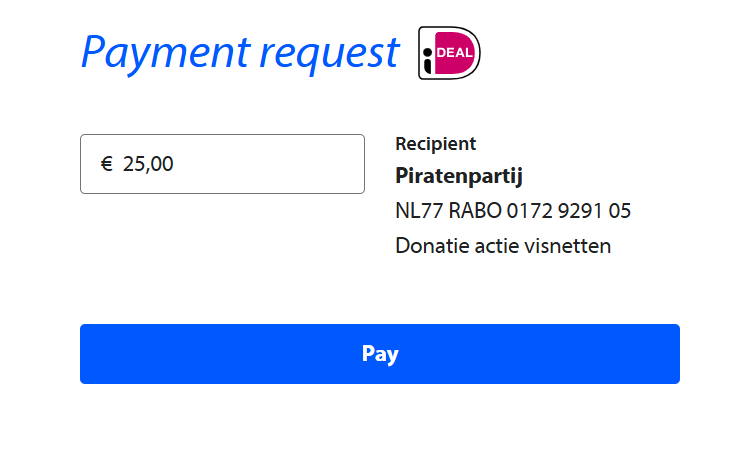
Their first trip leaves in two weeks. They will regularly update their activities so you can see what we do with the donations. They also welcome volunteers to join the transport team. Interested supporters can email info@piratenpartij.nl.
Please help them spread the word across about this project.

pp-international.net/2025/11/n…


reshared this
Chat control evaluation report: EU Commission again fails to demonstrate effectiveness of mass surveillance of intimate personal photos and videos
The EU Council’s current push to make Chat Control 1.0 (Regulation (EU) 2021/1232) permanent is legally and ethically reckless. The Commission’s own 2025 evaluation report admits to a total failure in data collection, an inability to link mass surveillance to actual convictions, and significant error rates in detection technologies. To permanently enshrine a derogation of fundamental rights based on a report that explicitly states “available data are insufficient” to judge proportionality is a violation of EU lawmaking principles.
Detailed Critique
1. The “Argument from Ignorance” on Proportionality
The Report: In Section 3 (Conclusions), the Commission states that “the available data are insufficient to provide a definitive answer” regarding the proportionality of the Regulation. Yet, in the very same paragraph, it concludes: “there are no indications that the derogation is not proportionate.”
The Critique: This is a logical fallacy. The Commission is arguing that because their data is too fragmented to prove the law is bad, it must be good. You cannot permanently suspend the fundamental right to privacy (Article 7, Charter of Fundamental Rights) based on an absence of data. The burden of proof lies with the legislator to demonstrate necessity and efficacy, which this report fails to do.
2. The Broken Link Between Surveillance and Convictions
The Report: Section 2.2.3 explicitly admits: “It is not currently possible… to establish a clear link between these convictions and the reports submitted by providers.” Furthermore, major Member States like Germany and Spain failed to provide usable data on convictions linked to this Regulation.
The Critique: As noted in my blogpost on the previous evaluation, there is no evidence that the mass scanning of private messages contributes significantly to convicting abusers. If millions of private messages are scanned and hundreds of thousands of reports are generated (708,894 in 2024), but the Commission cannot point to a specific number of resulting convictions, the system is a dragnet that violates privacy without a proven benefit to child safety. The system generates “noise” for law enforcement rather than actionable intelligence.
3. High Error Rates and “Black Box” Algorithms
The Report:
- Microsoft (Section 2.1.6) reported that its data was “insufficient to calculate an error rate.”
- Yubo reported error rates for detecting new CSAM/grooming of 20% in 2023 and 13% in 2024.
- The report notes that “human review is not factored into the statistics,” meaning the raw algorithmic intrusion is even less accurate than presented.
The Critique: Making this regulation permanent endorses the use of technology that is admittedly flawed. A 13-20% error rate in flagging “grooming” or new CSAM means thousands of innocent users are flagged, their private communications viewed by corporate moderators, and potentially reported to police erroneously. The fact that a giant like Microsoft cannot even calculate its error rate proves that Big Tech is operating without accountability or transparency. According to the German Police and former EU Commissioner Johansson the actual error rate is far higher (50-75%).
4. Chaos in Data and Lack of EU Control
The Report: The Commission admits that providers “did not use the standard form for reporting” (Section 1) and that Member States provided “fragmented and incomplete” data. The disparity between NCMEC reports sent to Member States vs. reports acknowledged by Member States is massive (e.g., France received 150k reports from NCMEC but has incomplete processing data).
The Critique: The EU cannot effectively oversee this surveillance. If, after three years, the Commission cannot force providers to use a standard reporting form or get Member States to track basic statistics, the Regulation is dysfunctional. Making a dysfunctional temporary fix permanent is poor governance. It cements a system where US tech giants (Google, Meta, Microsoft) act as private police forces with no standardized oversight.
5. Obsolescence via Encryption
The Report: The report notes a 30% drop in reports concerning the EU in 2024, attributed largely to interpersonal messaging services moving to end-to-end encryption (E2EE) (Section 2.2.1).
The Critique: The Regulation is already obsolete. As noted in the previous commentary, as platforms move to E2EE (like Meta), voluntary scanning becomes impossible without breaking encryption (client-side scanning). The drop in reports proves that voluntary scanning is a dying model. Making this Regulation permanent is a desperate attempt to cling to a failing approach rather than investing in targeted investigations and “safety by design” that respects encryption.
6. Failure to Assess Privacy Intrusion
The Report: The conclusion states: “No information was submitted by the providers on whether the technologies were deployed… in the least privacy-intrusive way.”
The Critique: The Regulation requires that the derogation be used only when necessary and in the least intrusive manner. The Commission admits it has no information on whether this legal requirement is being met. To extend a law permanently when the primary safeguard (minimization of privacy intrusion) is not being monitored is a dereliction of duty.
Conclusion
The Council looks to permanently legalize a regime of mass surveillance where:
- The technology has double-digit error rates (Yubo).
- The efficacy (convictions) is unproven.
- The oversight (data collection) is broken.
- The targets (encrypted chats) are increasingly immune to it.
This confirms the fears raised in the previous evaluation: this is performative security that sacrifices the privacy of all citizens for a system that the Commission admits it cannot properly measure or validate.
Read on: chatcontrol.eu
Maronno Winchester reshared this.
La casa nel bosco
Verona – Incontro informativo sul Testamento Biologico
Giovedì 11 dicembre 2025
Ore 20:30
Sede AVIS Comunale di Verona – Via Ponte Aleardi 1
La Cellula Coscioni Vicenza Padova in collaborazione con l’AVIS Comunale di Verona, e l’Associazione Italiana Sindrome Fibromialgica – Verona, promuove un incontro pubblico dal titolo: “Informarsi per scegliere – Incontro informativo sul Testamento Biologico e le Disposizioni Anticipate di Trattamento (DAT)”
Un’occasione per approfondire diritti e strumenti previsti dalla legge, comprendere meglio il contenuto delle DAT, la pianificazione condivisa delle cure e le possibilità di autodeterminazione in ambito sanitario.
Interverranno:
- Dott. Diego Silvestri, medico, coordinatore Cellula Vicenza Padova
- Domenico Farano, coordinatore Cellula Vicenza Padova
Ingresso gratuito – Posti limitati (30 partecipanti)
Iscrizione obbligatoria: chiamare il numero 335.7505780 oppure scrivere a asfsrlverona1@gmail.com
Al termine seguirà un momento conviviale.
L'articolo Verona – Incontro informativo sul Testamento Biologico proviene da Associazione Luca Coscioni.
Truffa ai danni dell’Unione Europea erogando falsi corsi di formazione: tra Lombardia e Puglia nei guai in sette nell’indagine della Procura Europea - EPPO condotta dai CC Tutela Lavoro

Il 25 novembre 2025 nelle province di Milano, Brescia e Foggia il Nucleo Operativo Tutela del Lavoro dei Carabinieri di Milano e della Sezione EPPO del Nucleo Investigativo Carabinieri del capoluogo lombardo hanno dato esecuzione a un'ordinanza di misura cautelare agli arresti domiciliari e a una misura interdittiva di inibizione dei contratti con la pubblica amministrazione e dell'esercizio di incarichi dirigenziali presso persone giuridiche e imprese, emesse dal Giudice per le Indagini Preliminari di Brescia su richiesta della Procura Europea - Sede di Milano, nei confronti di tre imprenditori italiani (due agli arresti domiciliari e uno sottoposto a misure interdittive). Gli individui sono ritenuti responsabili, in associazione tra loro, dei reati di truffa aggravata finalizzata al conseguimento di erogazioni pubbliche e autoriciclaggio.
L'indagine si è concentrata sulla verifica delle procedure di erogazione dei fondi UE alle aziende attraverso il "Fondo Nuove Competenze" ed è stata condotta attraverso un'ampia operazione di intercettazioni tecniche, analisi dei flussi finanziari condotta in coordinamento con l'Unità di Supporto all'Autorità Giudiziaria della Banca d'Italia e interviste a oltre 200 dipendenti. Ciò ha consentito agli investigatori di documentare le attività di due gruppi aziendali che fornivano servizi di consulenza, organizzando corsi di formazione fittizi per circa 1.500 dipendenti di 32 aziende, anche tramite una piattaforma digitale dedicata.
L'indagine ha accertato che il danno complessivo ai fondi pubblici e dell'Unione Europea ammonta a circa 40 milioni di euro a fronte del "Fondo Nuove Competenze", destinato a coprire una parte significativa degli stipendi dei dipendenti durante la partecipazione a corsi di formazione per il miglioramento delle loro competenze. Inoltre, gli indagati hanno condotto complesse operazioni finanziarie attraverso le quali hanno trasferito e investito i proventi della frode in attività commerciali, acquistando immobili tramite società immobiliari appositamente costituite nelle aree di Milano e Brescia per un valore di circa 20 milioni di euro.
Contemporaneamente, sono stati eseguiti altri sette mandati di perquisizione nei confronti di altre sette persone fisiche e giuridiche sotto inchiesta per gli stessi reati, ma non sottoposte a misure cautelari.
In totale, sette persone sono sotto inchiesta per vari ruoli nell'elaborata attività fraudolenta ai danni dell'Unione Europea, insieme a sette società utilizzate per perseguire lo stesso obiettivo.

I Carabinieri per la tutela del Lavoro operano alle dipendenze funzionali del Ministro del Lavoro e delle Politiche Sociali. Il personale dei Nuclei Carabinieri Ispettorato del Lavoro, in servizio presso gli Ispettorati Territoriali del Lavoro, dipende funzionalmente dal Dirigente preposto alla sede territoriale dell'Ispettorato e gerarchicamente dal comandante dell'articolazione del Comando CC Tutela del Lavoro; il personale addetto ai Nuclei Operativi di Gruppo (complessivamente sono istituiti 5 Gruppi, con sedi a Venezia, Milano, Roma, Napoli (con competenza interregionale) e Palermo (con competenza sulla Sicilia)), a seguito dell'avvio dell'Ispettorato Nazionale del Lavoro, dipende funzionalmente dai rispettivi Ispettorati Interregionali.

La Procura europea (EPPO) è un organismo indipendente dell'Unione europea operativo dal 1º giugno 2021 incaricato di indagare, perseguire e portare in giudizio i reati che ledono gli interessi finanziari dell'UE. L'EPPO è competente per i seguenti reati a danno del bilancio dell'UE: Frodi, Corruzione, Riciclaggio, Frodi IVA transfrontaliere. A livello nazionale
i Procuratori europei delegati sono responsabili dello svolgimento di indagini penali nei 24 paesi partecipanti, ed operano in piena indipendenza dalle autorità nazionali.
#EPPO
reshared this
La Gallery di Novembre
Ecco un po’ di foto dalle nostre Cellule Coscioni in giro per l’Italia: dalle proiezioni del film Lasciatemi morire ridendo, alla nascita della nuova Cellula Coscioni dell’Altomilanese, passando per l’incontro di Roma con Filomena Gallo e Marco Cappato, gli eventi informativi su Dat e di raccolta firme sull’Aborto senza ricovero. Clicca sull’icona della macchina fotografica per scorrere le foto!
L'articolo La Gallery di Novembre proviene da Associazione Luca Coscioni.
simona
in reply to simona • •