
Hunting for Mythic in network traffic

Post-exploitation frameworks
Threat actors frequently employ post-exploitation frameworks in cyberattacks to maintain control over compromised hosts and move laterally within the organization’s network. While they once favored closed-source frameworks, such as Cobalt Strike and Brute Ratel C4, open-source projects like Mythic, Sliver, and Havoc have surged in popularity in recent years. Malicious actors are also quick to adopt relatively new frameworks, such as Adaptix C2.
Analysis of popular frameworks revealed that their development focuses heavily on evading detection by antivirus and EDR solutions, often at the expense of stealth against systems that analyze network traffic. While obfuscating an agent’s network activity is inherently challenging, agents must inevitably communicate with their command-and-control servers. Consequently, an agent’s presence in the system and its malicious actions can be detected with the help of various network-based intrusion detection systems (IDS) and, of course, Network Detection and Response (NDR) solutions.
This article examines methods for detecting the Mythic framework within an infrastructure by analyzing network traffic. This framework has gained significant traction among various threat actors, including Mythic Likho (Arcane Wolf) и GOFFEE (Paper Werewolf), and continues to be used in APT and other attacks.
The Mythic framework
Mythic C2 is a multi-user command and control (C&C, or C2) platform designed for managing malicious agents during complex cyberattacks. Mythic is built on a Docker container architecture, with its core components – the server, agents, and transport modules – written in Python. This architecture allows operators to add new agents, communication channels, and custom modifications on the fly.
Since Mythic is a versatile tool for the attacker, from the defender’s perspective, its use can align with multiple stages of the Unified Kill Chain, as well as a large number of tactics, techniques, and procedures in the MITRE ATT&CK® framework.
- Pivoting is a tactic where the attacker uses an already compromised system as a pivot point to gain access to other systems within the network. In this way, they gradually expand their presence within the organization’s infrastructure, bypassing firewalls, network segmentation, and other security controls.
- Collection (TA0009) is a tactic focused on gathering and aggregating information of value to the attacker: files, credentials, screenshots, and system logs. In the context of network operations, collection is often performed locally on compromised hosts, with data then packaged for transfer. Tools like Mythic automate the discovery and selection of data sought by the adversary.
- Exfiltration (TA0010) is the process of moving collected information out of the secured network via legitimate or covert channels, such as HTTP(s), DNS, or SMB, etc. Attackers may use resident agents or intermediate relays (pivot hosts) to conceal the exfiltration source and route.
- Command and Control (TA0011) encompasses the mechanisms for establishing and maintaining a communication channel between the operator and compromised hosts to transmit commands and receive status updates. This includes direct connections, relaying through pivot hosts, and the use of covert protocols. Frameworks like Mythic provide advanced C2 capabilities, such as scheduled command execution, tunneling, and multi-channel communication, which complicate the detection and blocking of their activity.
This article focuses exclusively on the Command and Control (TA0011) tactic, whose techniques can be effectively detected within the network traffic of Mythic agents.
Detecting Mythic agent activity in network traffic
At the time of writing, Mythic supports data transfer over HTTP/S, WebSocket, TCP, SMB, DNS, and MQTT. The platform also boasts over a dozen different agents, written in Go, Python, and C#, designed for Windows, macOS, and Linux.
Mythic employs two primary architectures for its command network:
- In this model, agents communicate with adjacent agents forming a chain of connections which eventually leads to a node communicating directly with the Mythic C2 server. For this purpose, agents utilize TCP and SMB.
- In this model, agents communicate directly with the C2 server via HTTP/S, WebSocket, MQTT, or DNS.
P2P communication
Mythic provides pivoting capabilities via named SMB pipes and TCP sockets. To detect Mythic agent activity in P2P mode, we will examine their network traffic and create corresponding Suricata detection rules (signatures).
P2P communication via SMB
When managing agents via the SMB protocol, a named pipe is used by default for communication, with its name matching the agent’s UUID.
Although this parameter can be changed, it serves as a reliable indicator and can be easily described with a regular expression. Example:
[a-z0-9]{8}\-[a-z0-9]{4}\-[a-z0-9]{4}\-[a-z0-9]{4}\-[a-z0-9]{12}
For SMB communication, agents encode and encrypt data according to the pattern: base64(UUID+AES256(JSON)). This data is then split into blocks and transmitted over the network. The screenshot below illustrates what a network session for establishing a connection between agents looks like in Wireshark.
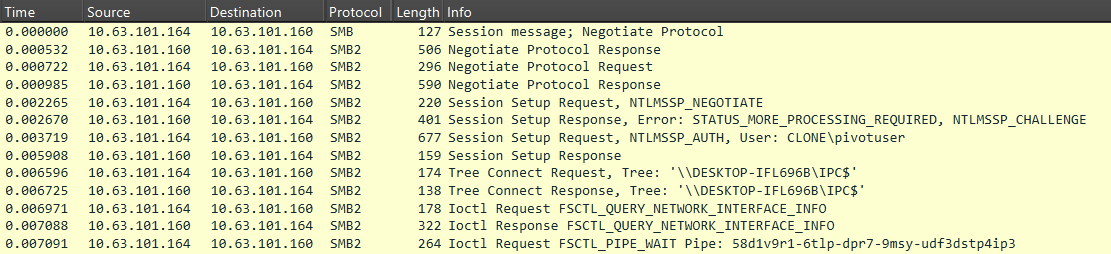
Commands and their responses are packaged within the MythicMessage data structure. This structure contains three header fields, as well as the commands themselves or the corresponding responses:
- Total size (4 bytes)
- Number of data blocks (4 bytes)
- Current block number (4 bytes)
- Base64-encoded data
The screenshot below shows an example of SMB communication between agents.
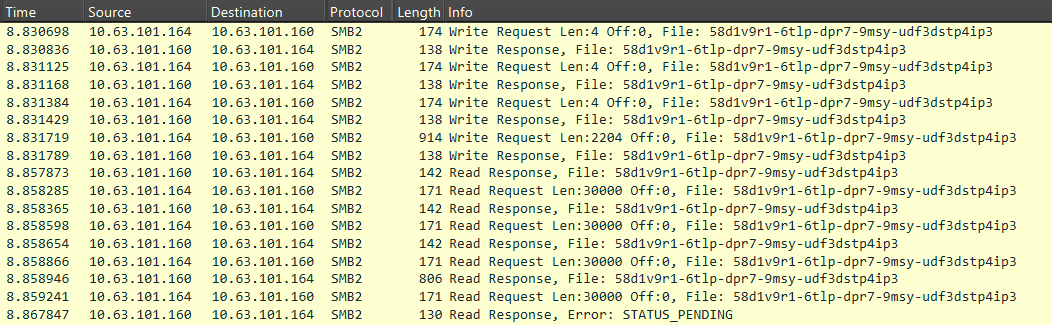
The agent (10.63.101.164) sends a command to another agent in the MythicMessage format. The first three Write Requests transmit the total message size, total number of blocks, and current block number. The fourth request transmits the Base64-encoded data. This is followed by a sequence of Read Requests, which are also transmitted in the MythicMessage format.
Below are the data transmitted in the fourth field of the MythicMessage structure.
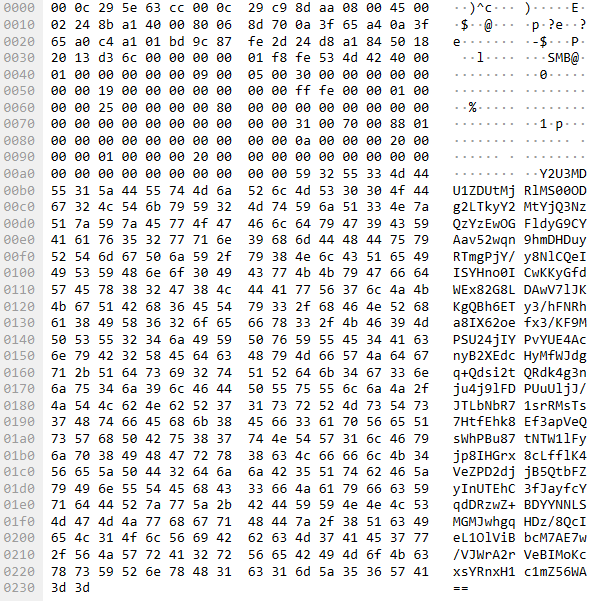
The content is encoded in Base64. Upon decoding, the structure of the transmitted information becomes visible: it begins with the UUID of the infected host, followed by a data block encrypted using AES-256.
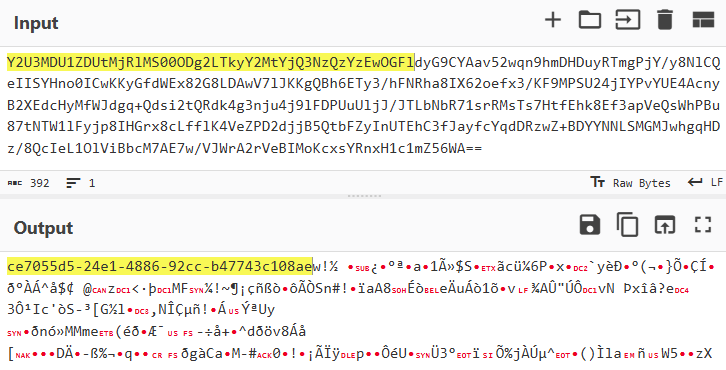
The fact that the data starts with a UUID string can be leveraged to create a signature-based detection rule that searches network packets for the identifier pattern.
To search for packets containing a UUID, the following signature can be applied. It uses specific request types and protocol flags as filters (Command: Ioctl (11), Function: FSCTL_PIPE_WAIT (0x00110018)), followed by a check to see if the pipe name matches the UUID pattern.
alert tcp any any -> any [139, 445] (msg: "Trojan.Mythic.SMB.C&C"; flow: to_server, established; content: "|fe|SMB"; offset: 4; depth: 4; content: "|0b 00|"; distance: 8; within: 2; content: "|18 00 11 00|"; distance: 48; within: 12; pcre: "/\x48\x00\x00\x00[\x00-\xFF]{2}([a-z0-9]\x00){8}\-\x00([a-z0-9]\x00){4}\-\x00([a-z0-9]\x00){4}\-\x00([a-z0-9]\x00){4}\-\x00([a-z0-9]\x00){12}$/R"; threshold: type both, track by_src, count 1, seconds 60; reference: url, github.com/MythicC2Profiles/sm… classtype: ndr1; sid: 9000101; rev: 1;)
Agent activity can also be detected by analyzing data transmitted in SMB WriteRequest packets with the protocol flag Command: Write (9) and a distinct packet structure where the BlobOffset and BlobLen fields are set to zero. If the Data field is Base64-encoded and, after decoding, begins with a UUID-formatted string, this indicates a command-and-control channel.
alert tcp any any -> any [139, 445] (msg: "Trojan.Mythic.SMB.C&C"; flow: to_server, established; dsize: > 360; content: "|fe|SMB"; offset: 4; depth: 4; content: "|09 00|"; distance: 8; within: 2; content: "|00 00 00 00 00 00 00 00 00 00 00 00|"; distance: 86; within: 12; base64_decode: bytes 64, offset 0, relative; base64_data; pcre: "/^[a-z0-9]{8}\-[a-z0-9]{4}\-[a-z0-9]{4}\-[a-z0-9]{4}\-[a-z0-9]{12}/"; threshold: type both, track by_src, count 1, seconds 60; reference: url, github.com/MythicC2Profiles/sm… classtype: ndr1; sid: 9000102; rev: 1;)
Below is the KATA NDR user interface displaying an alert about detecting a Mythic agent operating in P2P mode over SMB. In this instance, the first rule – which checks the request type, protocol flags, and the UUID pattern – was triggered.
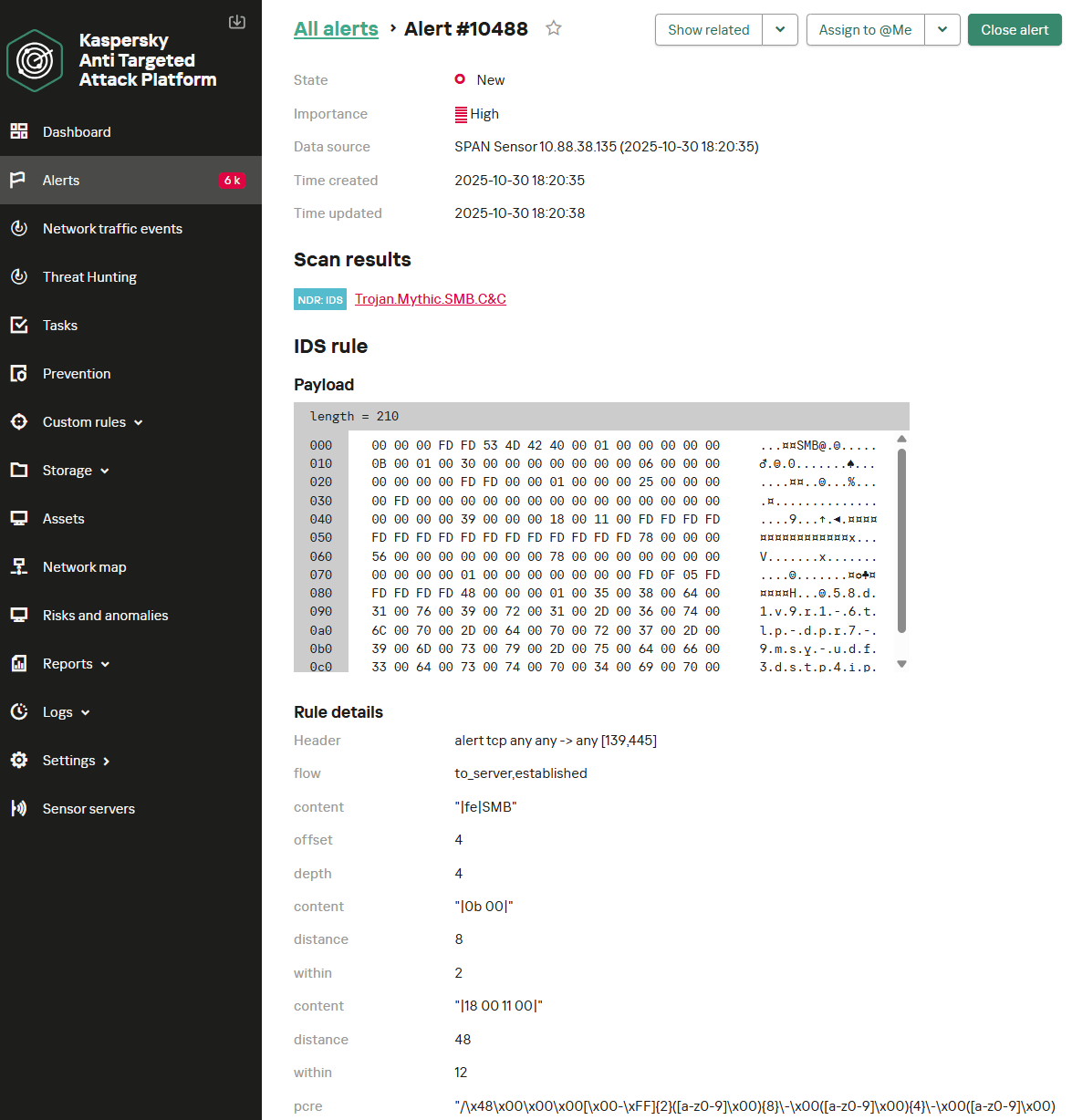
It should be noted that these signatures have a limitation. If the SMBv3 protocol with encryption enabled is used, Mythic agent activity cannot be detected with signature-based methods. A possible alternative is behavioral analysis. However, in this context, it suffers from low accuracy and a high false-positive rate. The SMB protocol is widely used by organizations for various legitimate purposes, making it difficult to isolate behavioral patterns that definitively indicate malicious activity.
P2P communication via TCP
Mythic also supports P2P communications via TCP. The connection initialization process appears in network traffic as follows:
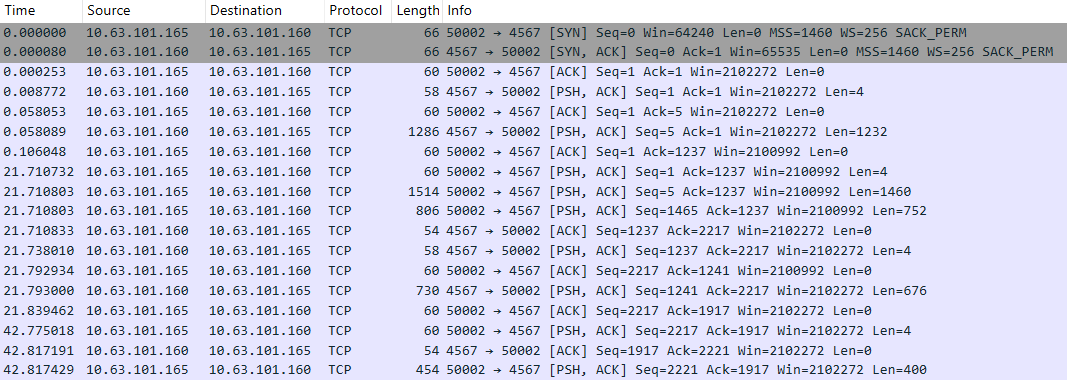
As with SMB, the MythicMessage structure is used for transmitting and receiving data. First, the data length (4 bytes) is sent as a big-endian DWORD in a separate packet. Subsequent packets transmit the number of data blocks, the current block number, and the data itself. However, unlike SMB packets, the value of the current block number field is always 0x00000000, due to TCP’s built-in packet fragmentation support.
The data encoding scheme is also analogous to what we observed with SMB and appears as follows: base64(UUID+AES256(JSON)). Below is an example of a network packet containing Mythic data.
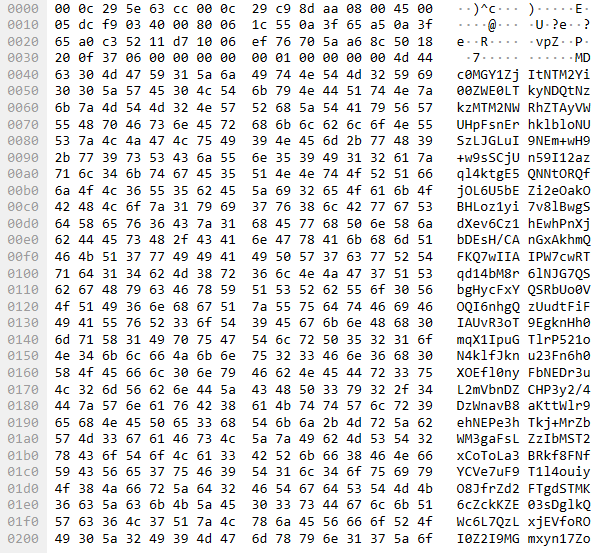
The decoded data appears as follows:
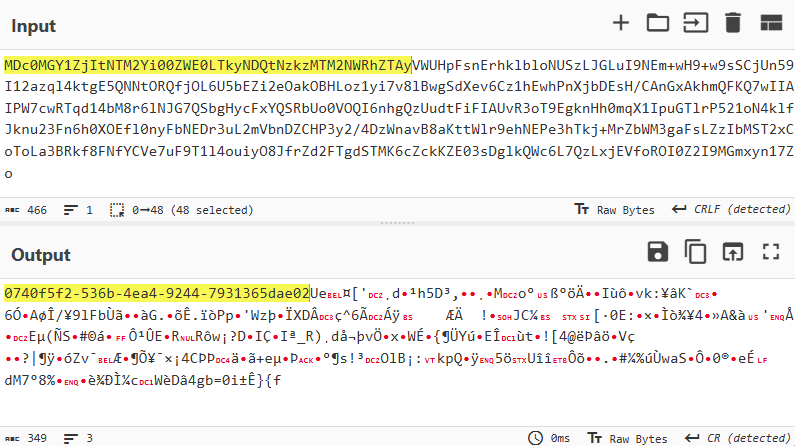
Similar to communication via SMB, signature-based detection rules can be created for TCP traffic to identify Mythic agent activity by searching for packets containing UUID-formatted strings. Below are two Suricata detection rules. The first rule is a utility rule. It does not generate security alerts but instead tags the TCP session with an internal flag, which is then checked by another rule. The second rule verifies the flag and applies filters to confirm that the current packet is being analyzed at the beginning of a network session. It then decodes the Base64 data and searches the resulting content for a UUID-formatted string.
alert tcp any any -> any any (msg: "Trojan.Mythic.TCP.C&C"; flow: from_server, established; dsize: 4; stream_size: server, <, 6; stream_size: client, <, 3; content: "|00 00|"; depth: 2; pcre: "/^\x00\x00[\x00-\x5C]{1}[\x00-\xFF]{1}$/"; flowbits: set, mythic_tcp_p2p_msg_len; flowbits: noalert; threshold: type both, track by_src, count 1, seconds 60; reference: url, github.com/MythicC2Profiles/tc… classtype: ndr1; sid: 9000103; rev: 1;)
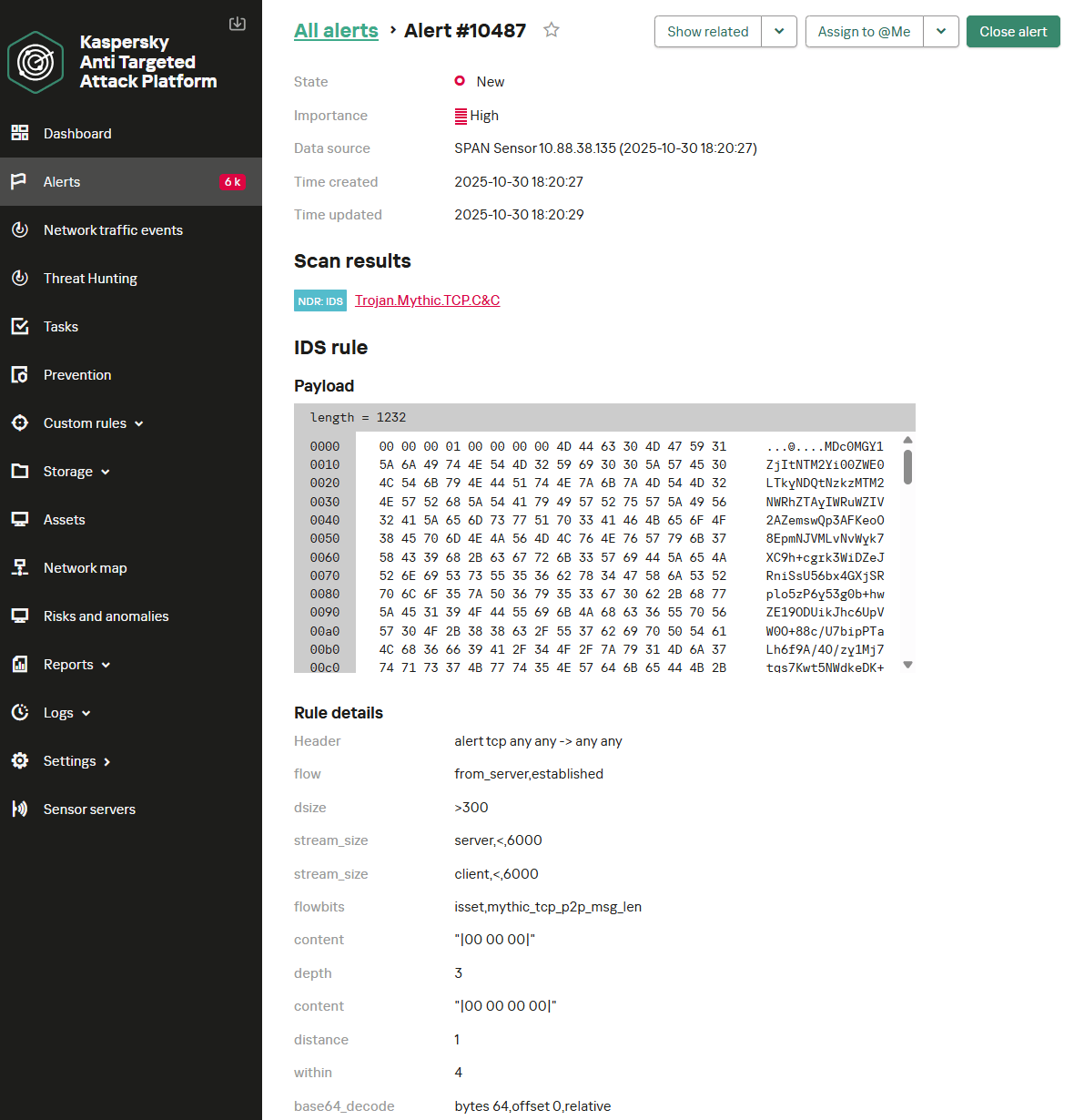
alert tcp any any -> any any (msg: "Trojan.Mythic.TCP.C&C"; flow: from_server, established; dsize: > 300; stream_size: server, <, 6000; stream_size: client, <, 6000; flowbits: isset, mythic_tcp_p2p_msg_len; content: "|00 00 00|"; depth: 3; content: "|00 00 00 00|"; distance: 1; within: 4; base64_decode: bytes 64, offset 0, relative; base64_data; pcre: "/^[a-z0-9]{8}\-[a-z0-9]{4}\-[a-z0-9]{4}\-[a-z0-9]{4}\-[a-z0-9]{12}/"; threshold: type both, track by_src, count 1, seconds 60; reference: url, github.com/MythicC2Profiles/tc… classtype: ndr1; sid: 9000104; rev: 1;)
Below is the NDR interface displaying an example of the two rules detecting a Mythic agent operating in P2P mode over TCP.
Egress transport modules
Covert Egress communication
For stealthy operations, Mythic allows agents to be managed through popular services. This makes its activity less conspicuous within network traffic. Mythic includes transport modules based on the following services:
- Discord
- GitHub
- Slack
Of these, only the first two remain relevant at the time of writing. Communication via Slack (the Slack C2 Profile transport module) is no longer supported by the developers and is considered deprecated, so we will not examine it further.
The Discord C2 Profile transport module
The use of the Discord service as a mediator for C2 communication within the Mythic framework has been gaining popularity recently. In this scenario, agent traffic is indistinguishable from normal Discord activity, with commands and their execution results masquerading as messages and file attachments. Communication with the server occurs over HTTPS and is encrypted with TLS. Therefore, detecting Mythic traffic requires decrypting this.
Analyzing decrypted TLS traffic
Let’s assume we are using an NDR platform in conjunction with a network traffic decryption (TLS inspection) system to detect suspicious network activity. In this case, we operate under the assumption that we can decrypt all TLS traffic. Let’s examine possible detection rules for that scenario.
Agent and server communication occurs via Discord API calls to send messages to a specific channel. Communication between the agent and Mythic uses the MythicMessageWrapper structure, which contains the following fields:
- message: the transmitted data
- sender_id: a GUID generated by the agent, included in every message
- to_server: a direction flag – a message intended for the server or the agent
- id: not used
- final: not used
Of particular interest to us is the message field, which contains the transmitted data encoded in Base64. The MythicMessageWrapper message is transmitted in plaintext, making it accessible to anyone with read permissions for messages on the Discord server.
Below is an example of data transmission via messages in a Discord channel.

To establish a connection, the agent authenticates to the Discord server via the API call /api/v10/gateway/bot. We observe the following data in the network traffic:

After successful initialization, the agent gains the ability to receive and respond to commands. To create a message in the channel, the agent makes a POST request to the API endpoint /channels/<channel.id>/messages. The network traffic for this call is shown in the screenshot below.
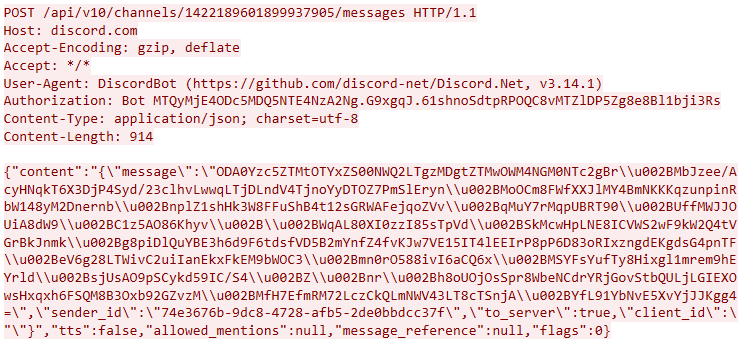
After decoding the Base64, the content of the message field appears as follows:
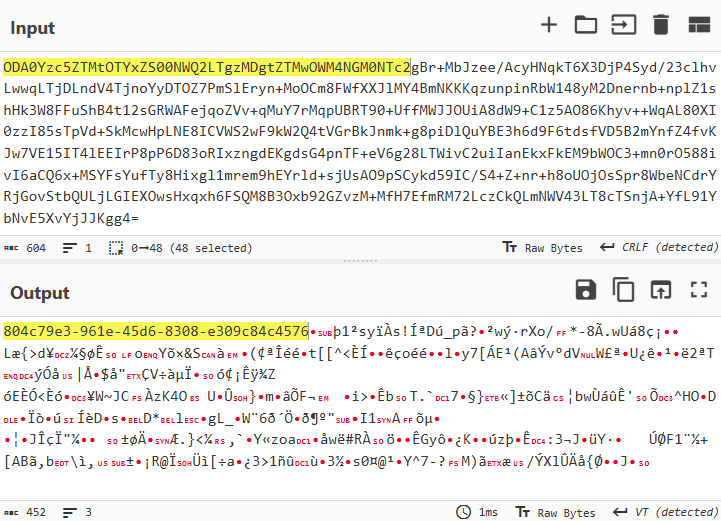
A structure characteristic of a UUID is visible at the beginning of the packet.
After processing the message, the agent deletes it from the channel via a DELETE request to the API endpoint /channels/{channel.id}/messages/{message.id}.

Below is a Suricata rule that detects the agent’s Discord-based communication activity. It checks the API activity for creating HTTP messages for the presence of Base64-encoded data containing the agent’s UUID.
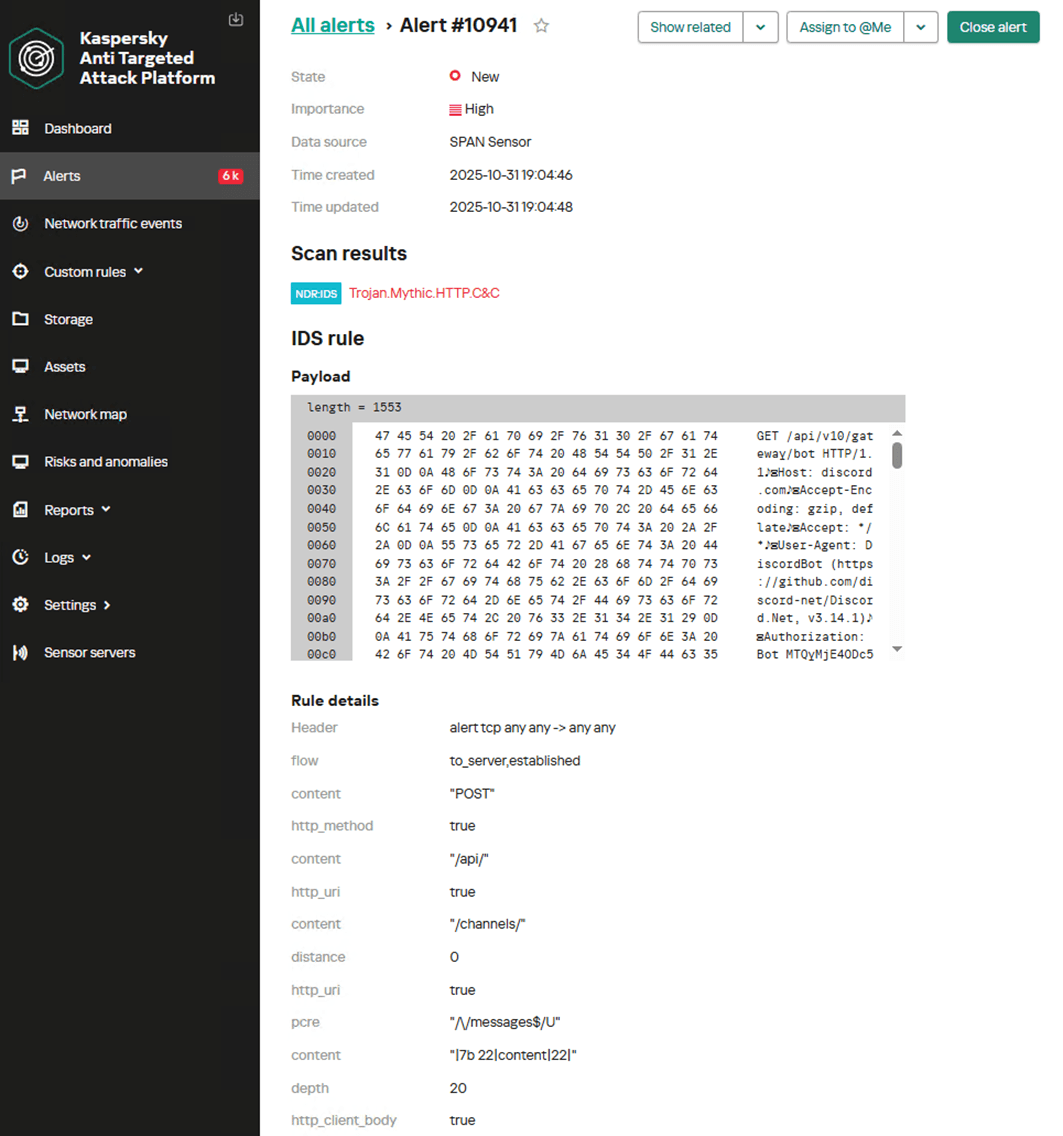
alert tcp any any -> any any (msg: "Trojan.Mythic.HTTP.C&C"; flow: to_server, established; content: "POST"; http_method; content: "/api/"; http_uri; content: "/channels/"; distance: 0; http_uri; pcre: "/\/messages$/U"; content: "|7b 22|content|22|"; depth: 20; http_client_body; content: "|22|sender_id"; depth: 1500; http_client_body; pcre: "/\x22sender_id\x5c\x22\x3a\x5c\x22[a-z0-9]{8}\-[a-z0-9]{4}\-[a-z0-9]{4}\-[a-z0-9]{4}\-[a-z0-9]{12}/"; threshold: type both, track by_src, count 1, seconds 60; reference: url, github.com/MythicC2Profiles/di… classtype: ndr1; sid: 9000105; rev: 1;)
Below is the NDR user interface displaying an example of detecting the activity of the Discord C2 Profile transport module for a Mythic agent within decrypted HTTP traffic.
Analyzing encrypted TLS traffic
If Discord usage is permitted on the network and there is no capability to decrypt traffic, it becomes nearly impossible to detect agent activity. In this scenario, behavioral analysis of requests to the Discord server may prove useful. Below is network traffic showing frequent TLS connections to the Discord server, which could indicate commands being sent to an agent.
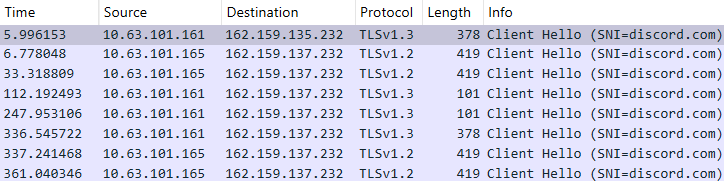
In this case, we can use a Suricata rule to detect the frequent TLS sessions with Discord servers:
alert tcp any any -> any any (msg: "NetTool.PossibleMythicDiscordEgress.TLS.C&C"; flow: to_server, established; tls_sni; content: "discord.com"; nocase; threshold: type both, track by_src, count 4, seconds 420; reference: url, github.com/MythicC2Profiles/di… classtype: ndr3; sid: 9000106; rev: 1;)
Another method for detecting these communications involves tracking multiple DNS queries to the discord.com domain.
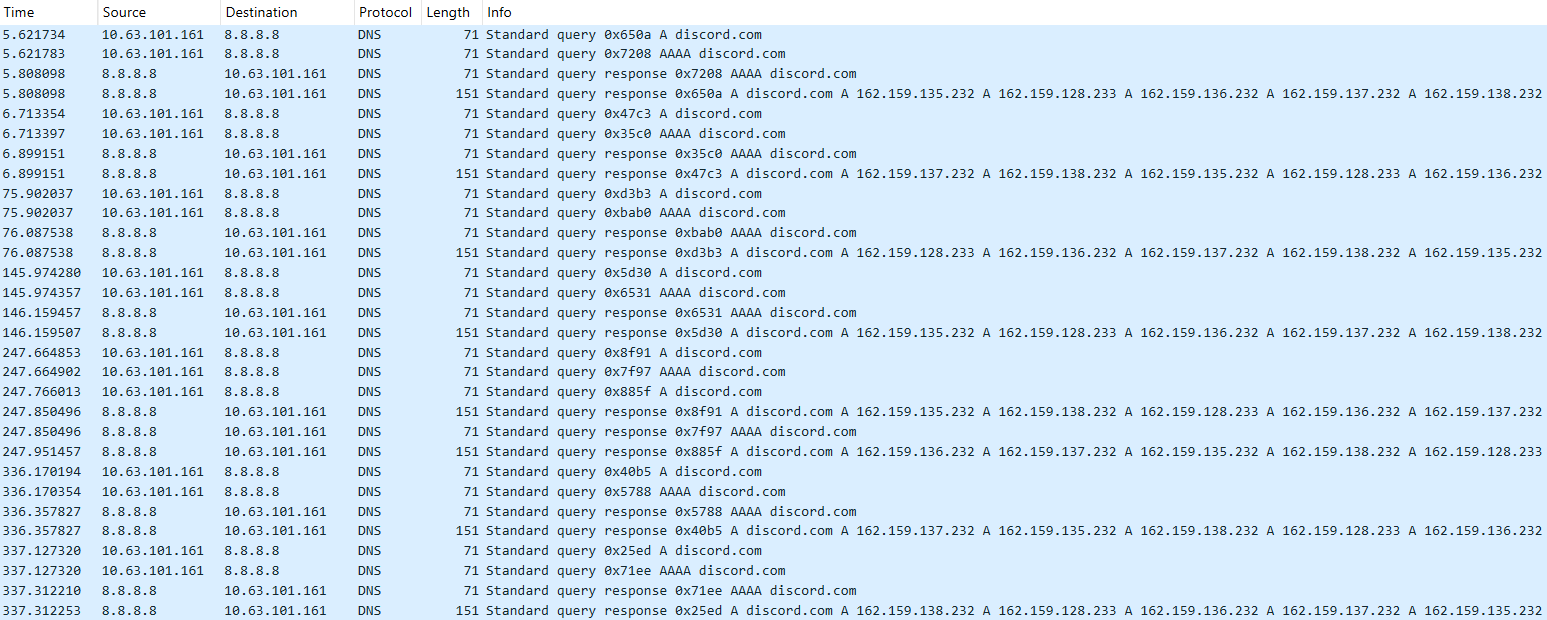
The following rule can be applied to detect these:
alert udp any any -> any 53 (msg: "NetTool.PossibleMythicDiscordEgress.DNS.C&C"; content: "|01 00 00 01 00 00 00 00 00 00|"; depth: 10; offset: 2; content: "|07|discord|03|com|00|"; nocase; distance: 0; threshold: type both, track by_src, count 4, seconds 60; reference: url, github.com/MythicC2Profiles/di… classtype: ndr3; sid: 9000107; rev: 1;)
Below is the NDR user interface showing an example of a custom rule in operation, detecting the activity of the Discord C2 Profile transport module for a Mythic agent within encrypted traffic based on characteristic DNS queries.
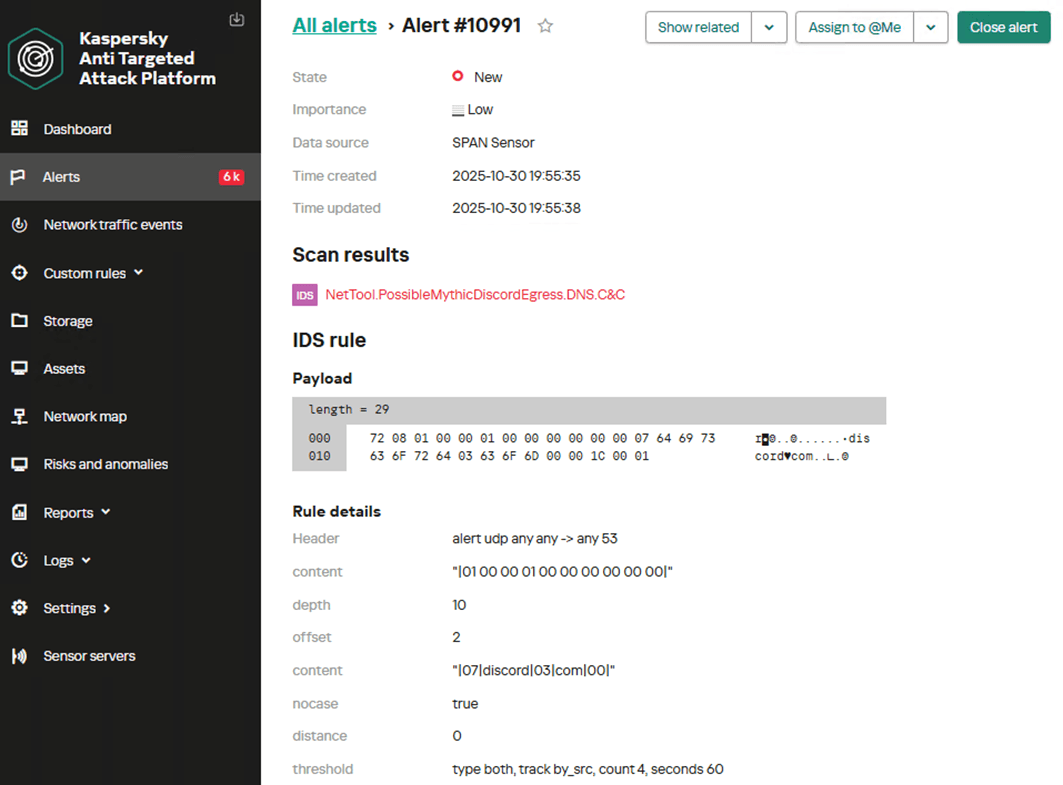
The proposed rule options have low accuracy and can generate a high number of false positives. Therefore, they must be adapted to the specific characteristics of the infrastructure in which they will run. Threshold and count parameters, which control the triggering frequency and time window, require tuning.
GitHub C2 Profile transport module
GitHub’s popularity has made it an attractive choice as a mediator for managing Mythic agents. The core concept is the same as in other covert Egress communication transport modules. Communication with GitHub utilizes HTTPS. Successful operation requires an account on the target platform and the ability to communicate via API calls. The transport module utilizes the GitHub API to send comments to pre-created Issues and to commit files to a branch within a repository controlled by the attackers. In this model, the agent interacts only with GitHub: it creates and reads comments, uploads files, and manages branches. It does not communicate with any other servers. The communication algorithm via GitHub is as follows:
- The agent posts a comment (check-in) to a designated Issue on GitHub, intended for agents to report their results.
- The Mythic server validates the comment, deletes it, and posts a reply in an issue designated for server use.
- The agent creates a branch with a name matching its UUID and writes a get_tasking file to it (performs a push request).
- The Mythic server reads the file and writes a response file to the same branch.
- The agent reads the response file, deletes the branch, pauses, and repeats the cycle.
Analyzing decrypted TLS traffic
Let’s consider an approach to detecting agent activity when traffic decryption is possible.
Agent communication with the server utilizes API calls to GitHub. The payload is encoded in Base64 and published in plaintext; therefore, anyone who can view the repository or analyze the traffic contents can decode it.
Analysis of agent communication revealed that the most useful traffic for creating detection rules is associated with publishing check-in comments, creating a branch, and publishing a file.
During the check-in phase, the agent posts a comment to register a new agent and establish communication.
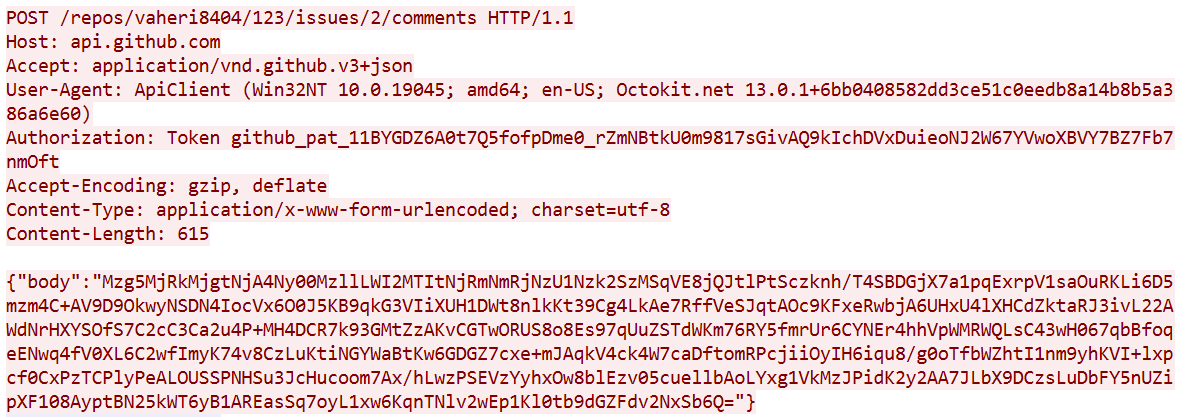
The transmitted data is encoded in Base64 and contains the agent’s UUID and the portion of the message encrypted using AES-256.
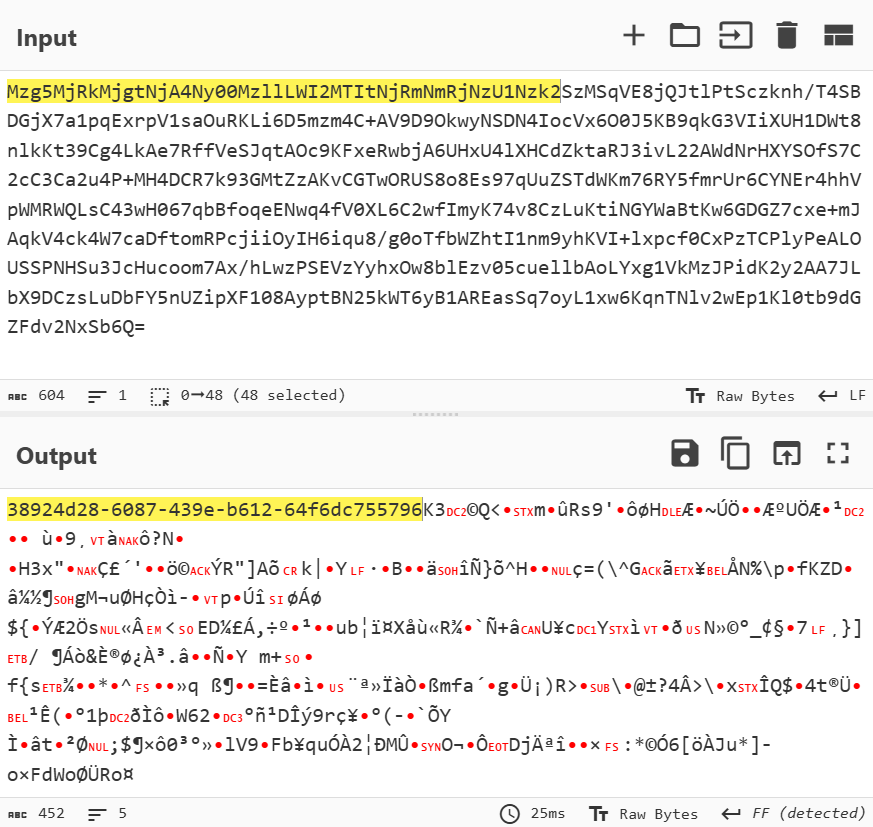
This allows for a signature that detects UUID-formatted substrings within GitHub comment creation requests.
alert tcp any any -> any any (msg: "Trojan.Mythic.HTTP.C&C"; flow: to_server, established; content: "POST"; http_method; content: "api.github.com"; http_host; content: "/repos/"; depth: 8; http_uri; pcre: "/\/comments$/U"; content: "|22|body|22|"; depth: 8; http_client_body; base64_decode: bytes 300, offset 2, relative; base64_data; pcre: "/^[a-z0-9]{8}\-[a-z0-9]{4}\-[a-z0-9]{4}\-[a-z0-9]{4}\-[a-z0-9]{12}/"; threshold: type both, track by_src, count 1, seconds 60; reference: url, github.com/MythicC2Profiles/gi… classtype: ndr1; sid: 9000108; rev: 1;)
Another stage suitable for detection is when the agent creates a separate branch with its UUID as the name. All subsequent relevant communication with the server will occur within this branch. Here is an example of a branch creation request:

Therefore, we can create a detection rule to identify UUID-formatted strings within branch creation requests.
alert tcp any any -> any any (msg: "Trojan.Mythic.HTTP.C&C"; flow: to_server, established; content: "POST"; http_method; content: "api.github.com"; http_host; content: "/repos/"; depth: 100; http_uri; content: "/git/refs"; distance: 0; http_uri; content: "|22|ref|22 3a|"; depth: 10; http_client_body; content: "refs/heads/"; distance: 0; within: 50; http_client_body; pcre: "/refs\/heads\/[a-z0-9]{8}\-[a-z0-9]{4}\-[a-z0-9]{4}\-[a-z0-9]{4}\-[a-z0-9]{12}\x22/"; threshold: type both, track by_src, count 1, seconds 60; reference: url, github.com/MythicC2Profiles/gi… classtype: ndr1; sid: 9000109; rev: 1;)
After creating the branch, the agent writes a file to it (sends a push request), which contains Base64-encoded data.
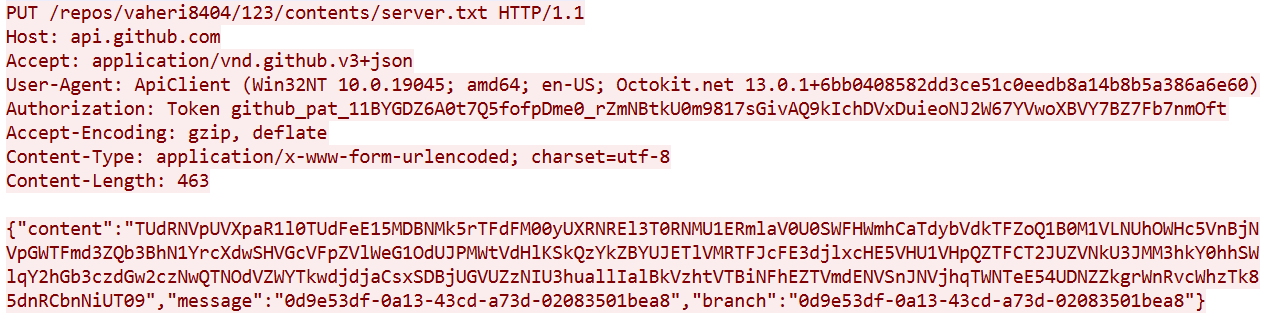
Therefore, we can create a rule to trigger on file publication requests to a branch whose name matches the UUID pattern.
alert tcp any any -> any any (msg: "Trojan.Mythic.HTTP.C&C"; flow: to_server, established; content: "PUT"; http_method; content: "api.github.com"; http_host; content: "/repos/"; depth:8; http_uri; content: "/contents/"; distance: 0; http_uri; content: "|22|content|22|"; depth: 100; http_client_body; pcre: "/\x22message\x22\x3a\x22[a-z0-9]{8}\-[a-z0-9]{4}\-[a-z0-9]{4}\-[a-z0-9]{4}\-[a-z0-9]{12}\x22/"; threshold: type both, track by_src, count 1, seconds 60; reference: url, github.com/MythicC2Profiles/gi… classtype: ndr1; sid: 9000110; rev: 1;)
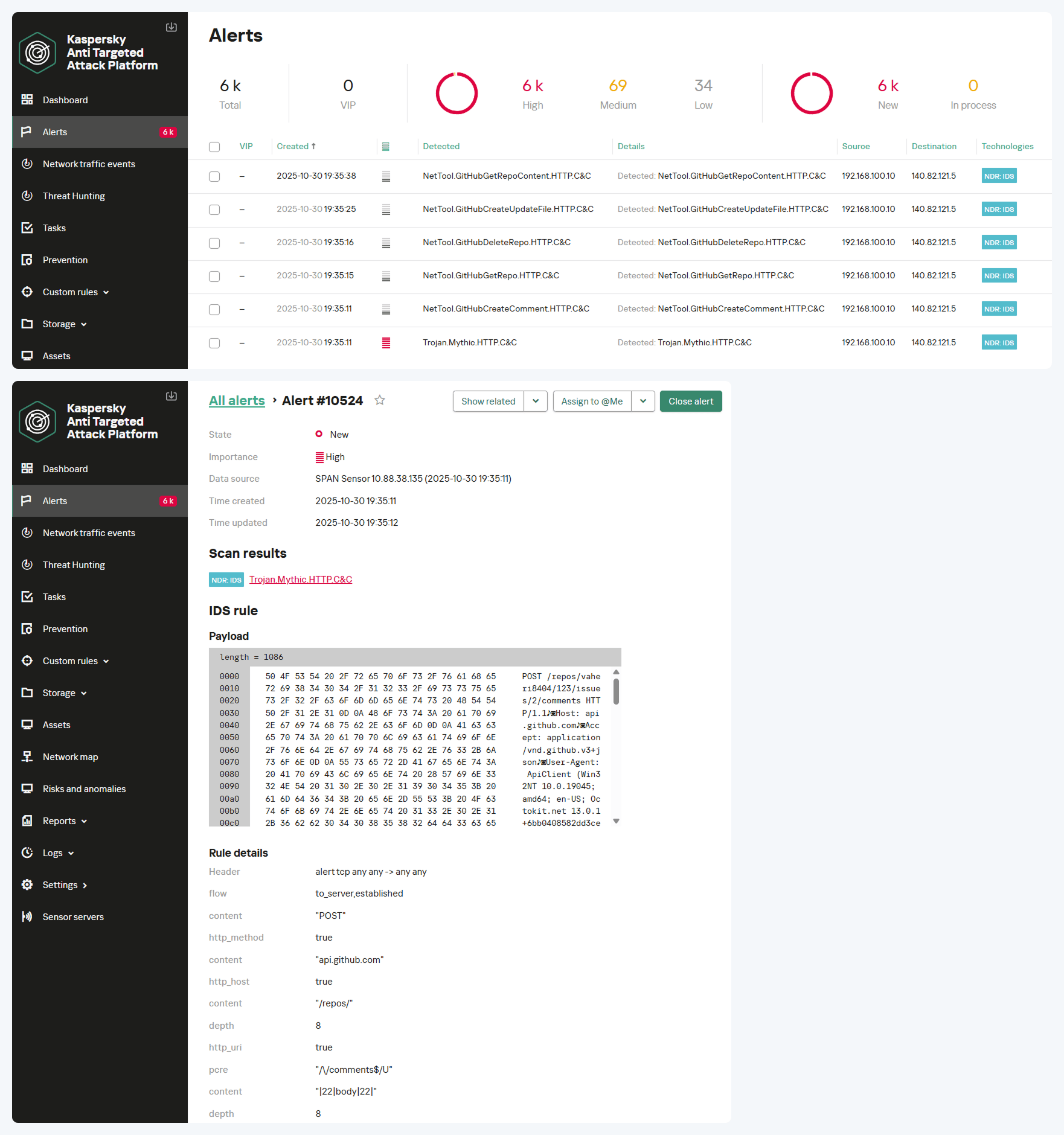
The screenshot below shows how the NDR solution logs all suspicious communications using the GitHub API and subsequently identifies the Mythic agent’s activity. The result is an alert with the verdict Trojan.Mythic.HTTP.C&C.
Analyzing encrypted TLS traffic
Communication with GitHub occurs over HTTPS; therefore, in the absence of traffic decryption capability, signature-based methods for detecting agent activity cannot be applied. Let’s consider a behavioral agent activity detection approach.
For instance, it is possible to detect connections to GitHub servers that are atypical in frequency and purpose, originating from network segments where this activity is not expected. The screenshot below shows an example of an agent’s multiple TLS sessions. The traffic reflects the execution of several commands, as well as idle time, manifested as constant polling of the server while awaiting new tasks.
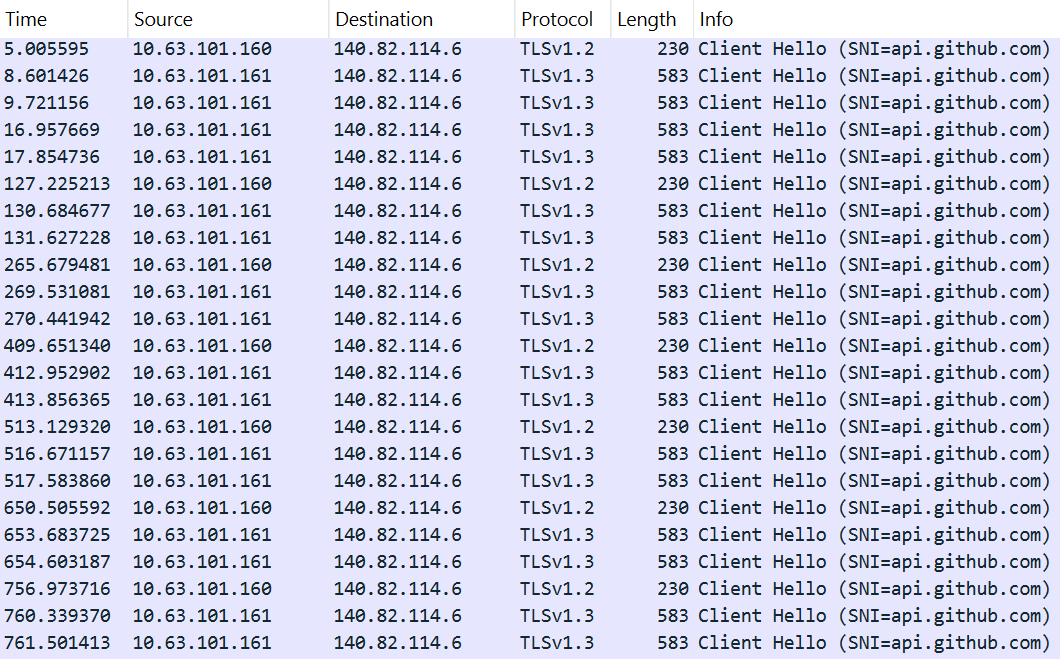
Multiple TLS sessions with the GitHub service from uncharacteristic network segments can be detected using the rule presented below:
alert tcp any any -> any any (msg:"NetTool.PossibleMythicGitHubEgress.TLS.C&C"; flow: to_server, established; tls_sni; content: "api.github.com"; nocase; threshold: type both, track by_src, count 4, seconds 60; reference: url, github.com/MythicC2Profiles/gi… classtype: ndr3; sid: 9000111; rev: 1;)
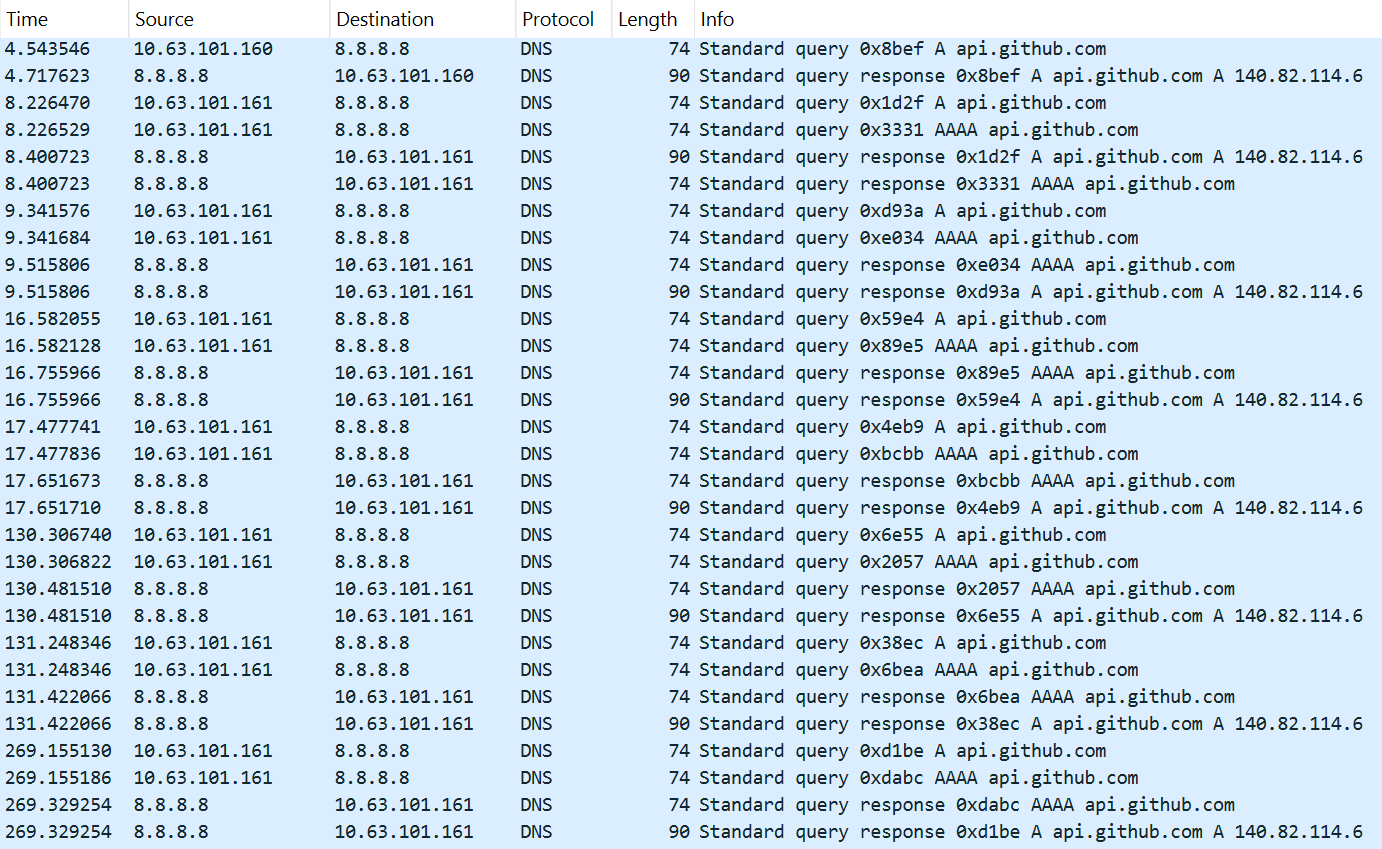
Additionally, multiple DNS queries to the service can be logged in the traffic.
This activity is detected with the help of the following rule:
alert udp any any -> any 53 (msg: "NetTool.PossibleMythicGitHubEgress.DNS.C&C"; content: "|01 00 00 01 00 00 00 00 00 00|"; depth: 10; offset: 2; content: "|03|api|06|github|03|com|00|"; nocase; distance: 0; threshold: type both, track by_src, count 12, seconds 180; reference: url, github.com/MythicC2Profiles/gi… classtype: ndr3; sid: 9000112; rev: 1;)
The screenshot below shows the NDR interface with an example of the first rule in action, detecting traces of the GitHub profile activity for a Mythic agent within encrypted TLS traffic.
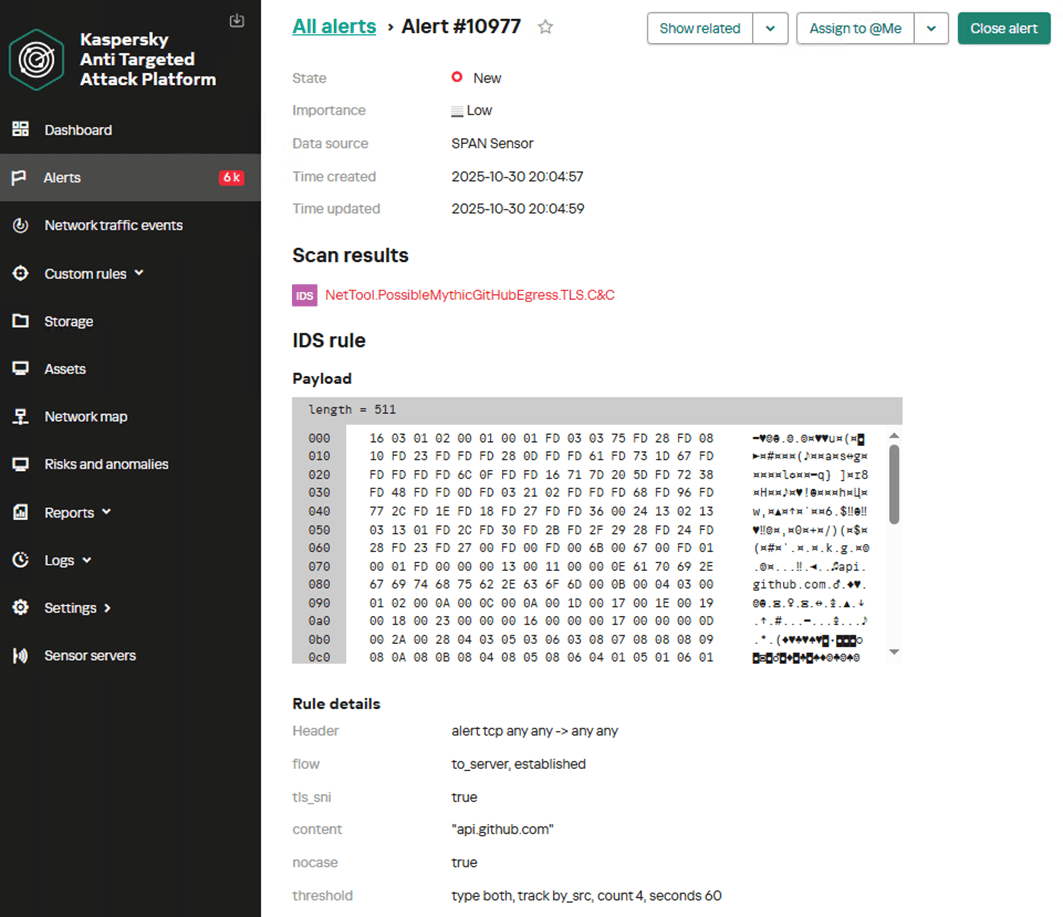
The suggested rule options can produce false positives, so to improve their effectiveness, they must be adapted to the specific characteristics of the infrastructure in which they will run. The parameters of the threshold keyword – specifically the count and seconds values, which control the number of events required to generate an alert and the time window for their occurrence in NDR – must be configured.
Direct Egress communication
The Egress communication model allows agents to interact directly with the C2 server via the following protocols:
- HTTP(S)
- WebSocket
- MQTT
- DNS
The first two protocols are the most prevalent. The DNS-based transport module is still under development, and the module based on MQTT sees little use among operators. We will not examine them within the scope of this article.
Communication via HTTP
HTTP is the most common protocol for building a Mythic agent control network. The HTTP transport container acts as a proxy between the agents and the Mythic server. It allows data to be transmitted in both plaintext and encrypted form. Crucially, the metadata is not encrypted, which enables the creation of signature-based detection rules.
Below is an example of unencrypted Mythic network traffic over HTTP. During a GET request, data encoded in Base64 is passed in the value of the query parameter.
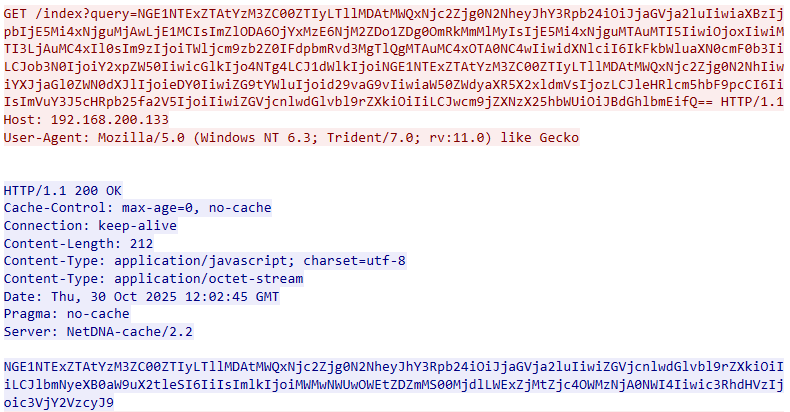
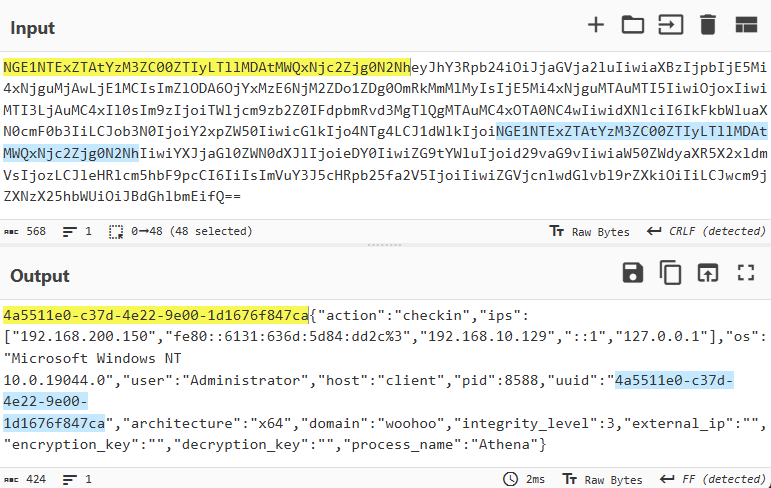
After decoding, the agent’s UUID – generated according to a specific pattern – becomes visible. This identifier is followed by a JSON object containing the key parameters of the host, collected by the agent.
If data encryption is applied, the network traffic for agent communication appears as shown in the screenshot below.
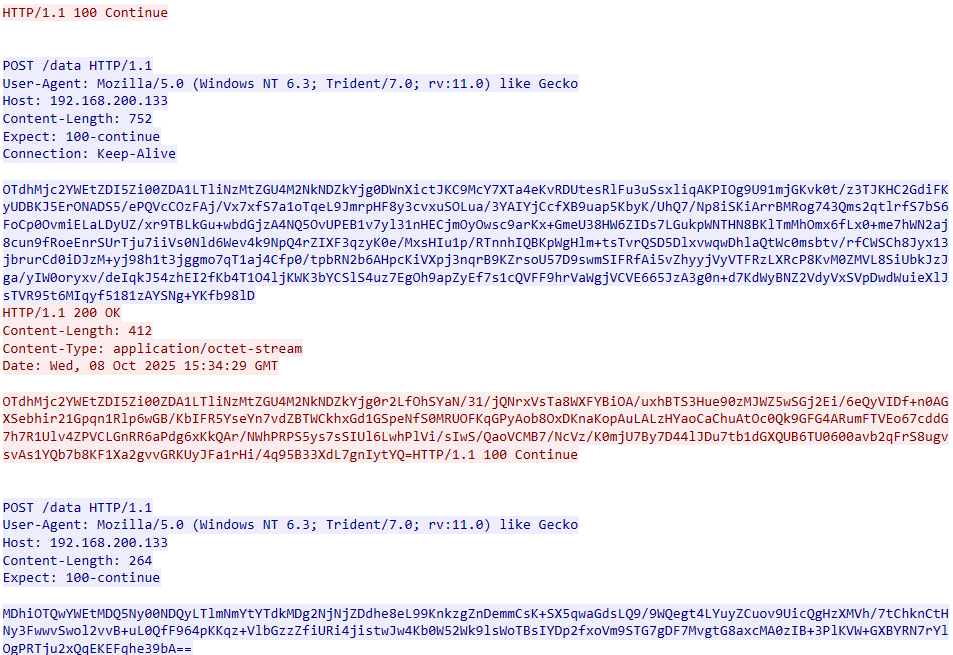
After decrypting the traffic and decoding from Base64, the communication data reveals the familiar structure: UUID+AES256(JSON).
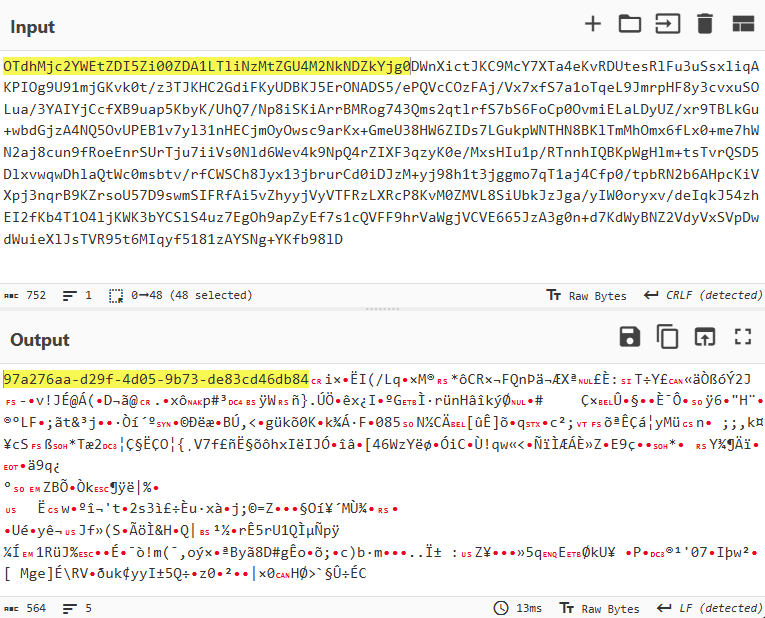
Therefore, to create a detection signature for this case, we can also rely on the presence of a UUID within the Base64-encoded data in POST requests.
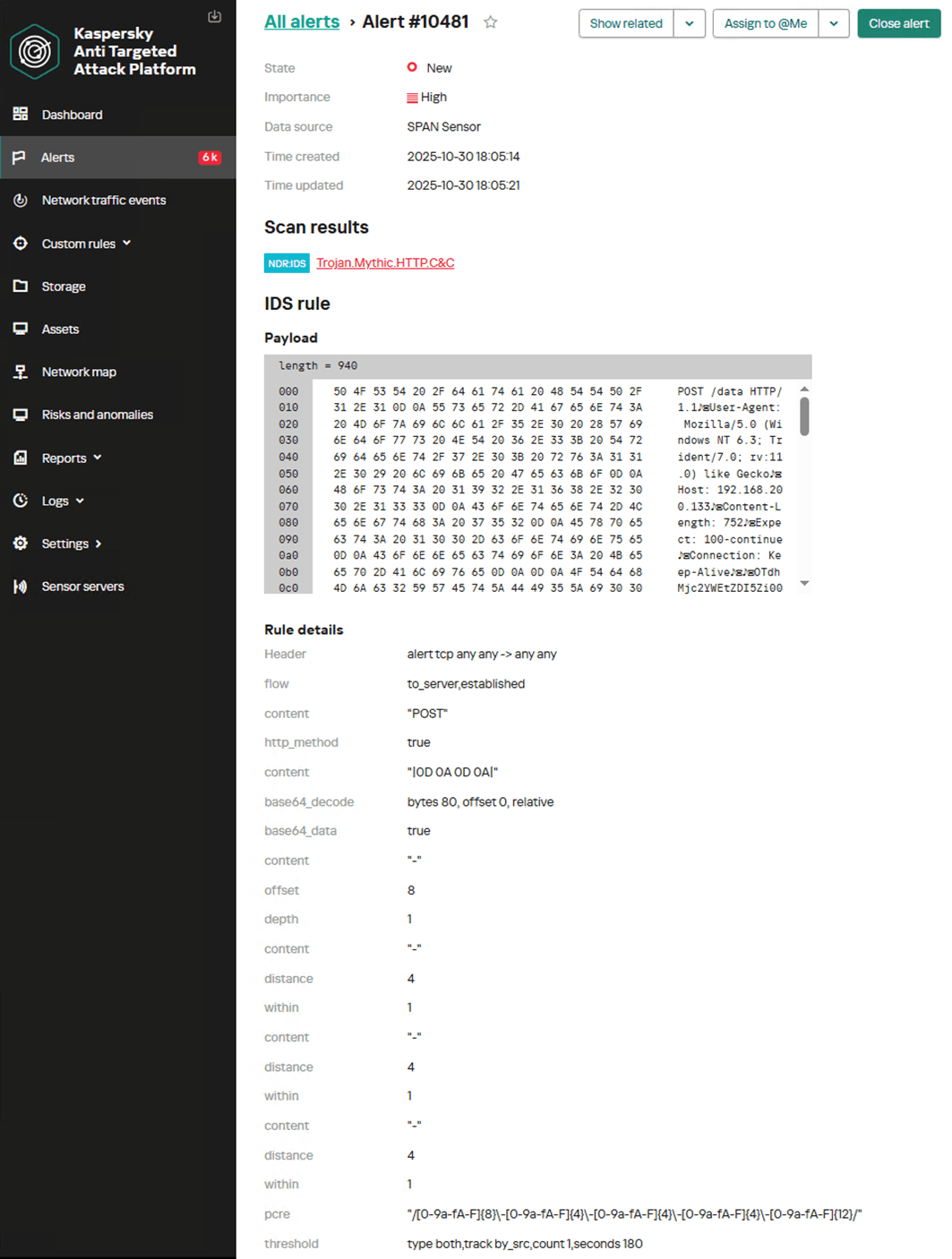
alert tcp any any -> any any (msg: "Trojan.Mythic.HTTP.C&C"; flow: to_server, established; content: "POST"; http_method; content: "|0D 0A 0D 0A|"; base64_decode: bytes 80, offset 0, relative; base64_data; content: "-"; offset: 8; depth: 1; content: "-"; distance: 4; within: 1; content: "-"; distance: 4; within: 1; content: "-"; distance: 4; within: 1; pcre: "/[0-9a-fA-F]{8}\-[0-9a-fA-F]{4}\-[0-9a-fA-F]{4}\-[0-9a-fA-F]{4}\-[0-9a-fA-F]{12}/"; threshold: type both, track by_src, count 1, seconds 180; reference: md5, 6ef89ccee639b4df42eaf273af8b5ffd; classtype: trojan1; sid: 9000113; rev: 2;)
The screenshot below shows how the NDR platform detects agent communication with the server over HTTP, generating an alert with the name Trojan.Mythic.HTTP.C&C.
Communication via HTTPS
Mythic agents can communicate with the server via HTTPS using the corresponding transport module. In this case, data is encrypted with TLS and is not amenable to signature-based analysis. However, the activity of Mythic agents can be detected if they use the default SSL certificate. Below is an example of network traffic from a Mythic agent with such a certificate.
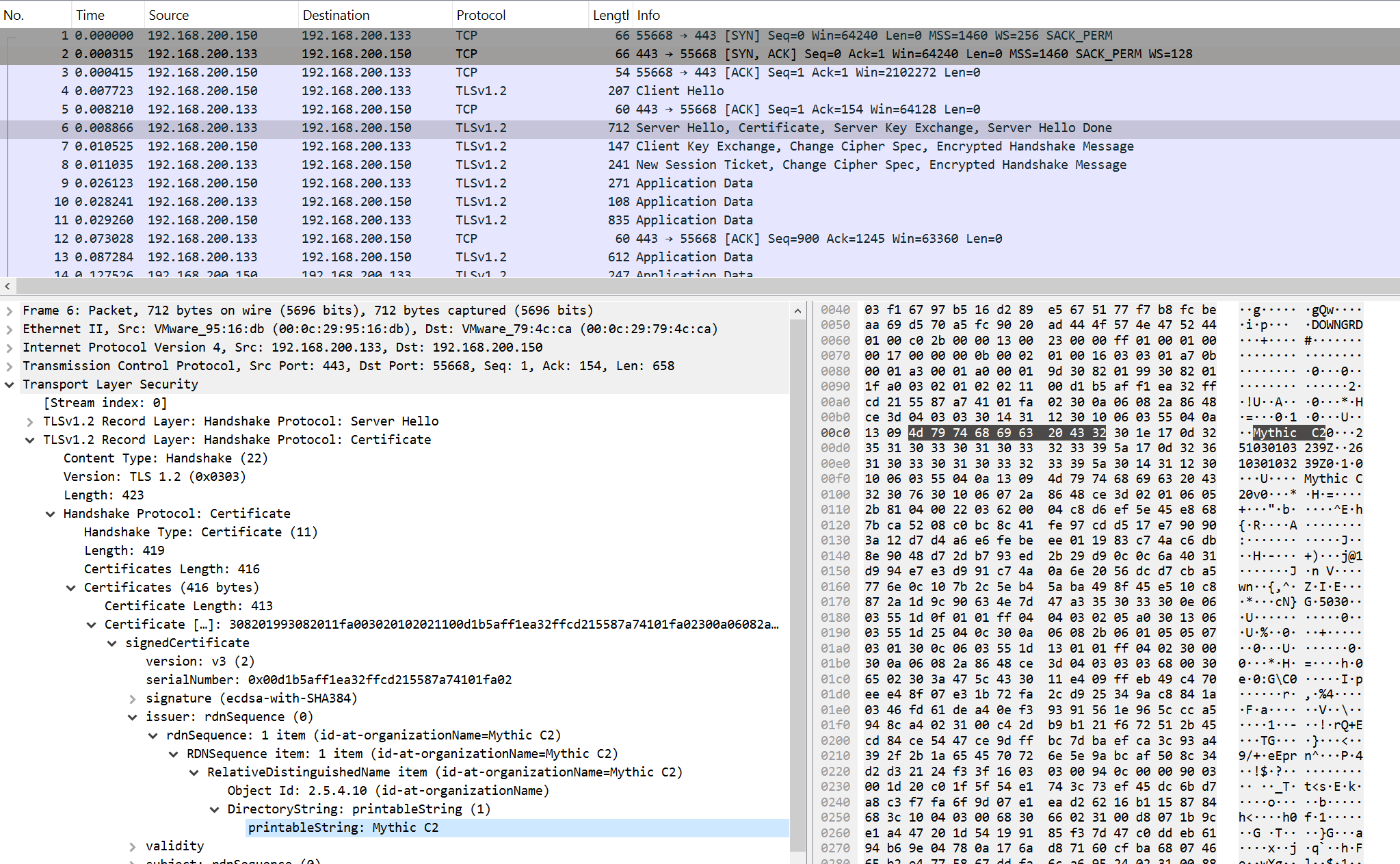
For this purpose, the following signature is applied:
alert tcp any any -> any any (msg: "Trojan.Mythic.HTTPS.C&C"; flow: established, from_server, no_stream; content: "|16 03|"; content: "|0B|"; distance: 3; within: 1; content: "Mythic C2"; distance: 0; reference: url, github.com/its-a-feature/Mythi… classtype: ndr1; sid: 9000114; rev: 1;)
WebSocket
The WebSocket protocol enables full-duplex communication between a client and a remote host. Mythic can utilize it for agent management.
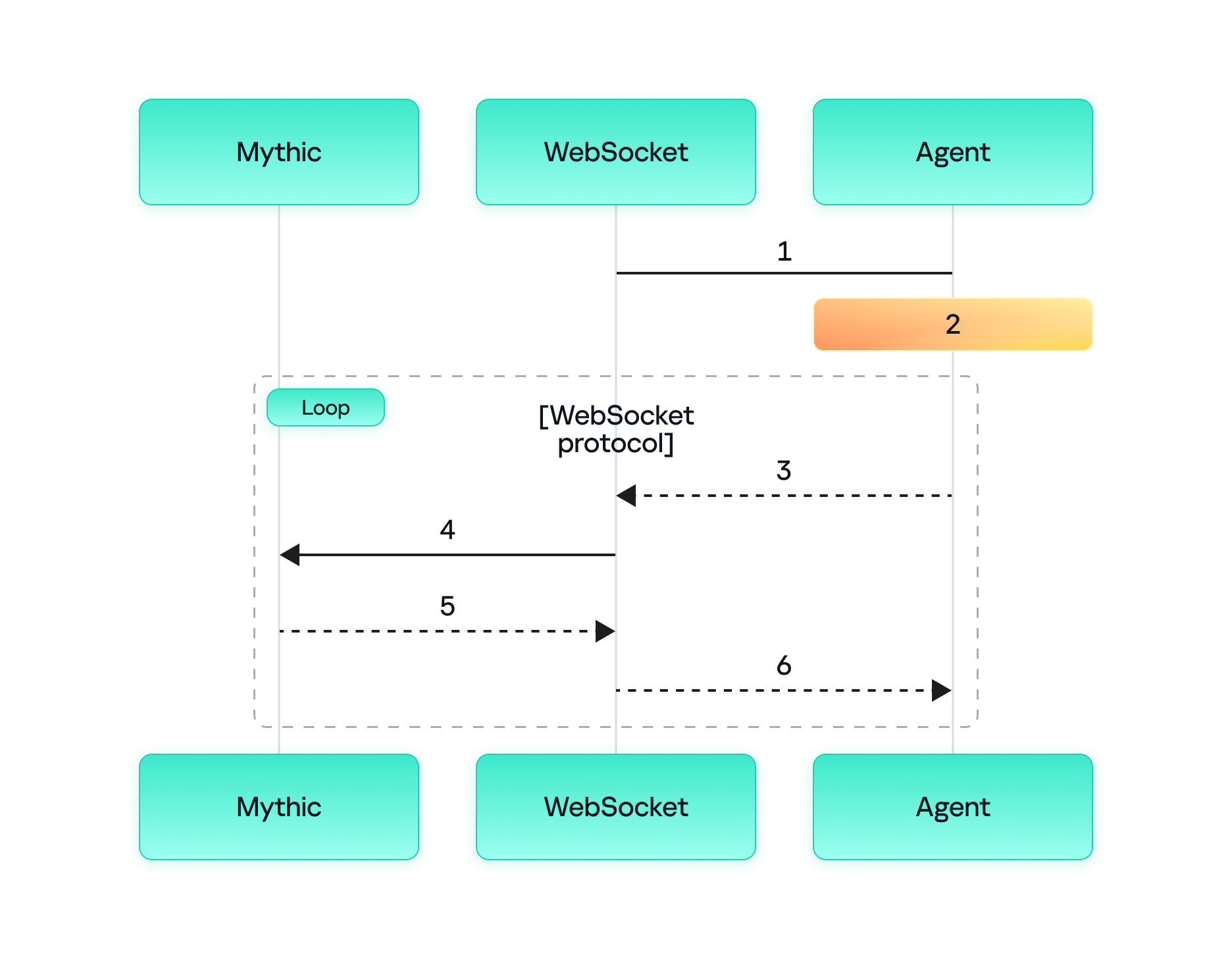
The process of agent communication with the server via WebSocket is as follows:
- The agent sends a request to the WebSocket container to change the protocol for the HTTP(S) connection.
- The agent and the WebSocket container switch to WebSocket to send and receive messages.
- The agent sends a message to the WebSocket container requesting tasks from the Mythic container.
- The WebSocket container forwards the request to the Mythic container.
- The Mythic container returns the tasks to the WebSocket container.
- The WebSocket container forwards these tasks to the agent.
It is worth mentioning that in this communication model, both the WebSocket container and the Mythic container reside on the Mythic server. Below is a screenshot of the initial agent connection to the server.
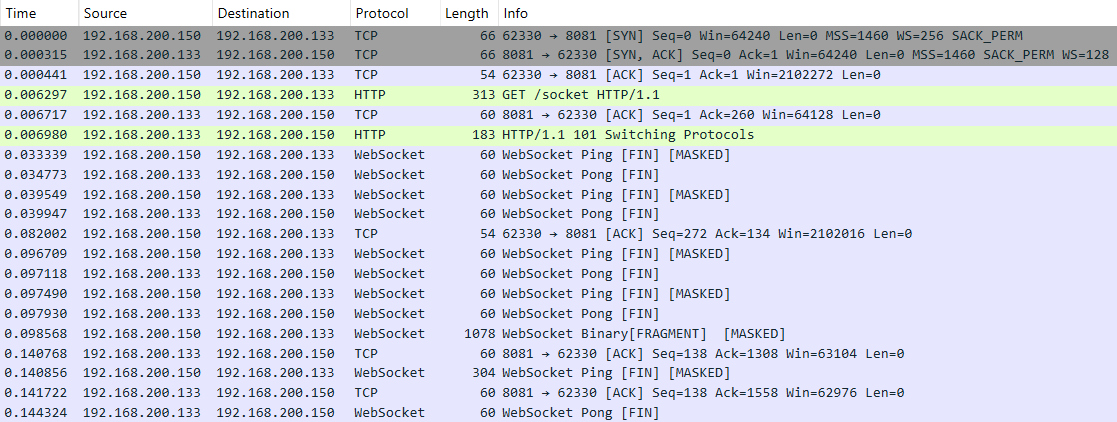
An analysis of the TCP session shows that the actual data is transmitted in the data field in Base64 encoding.
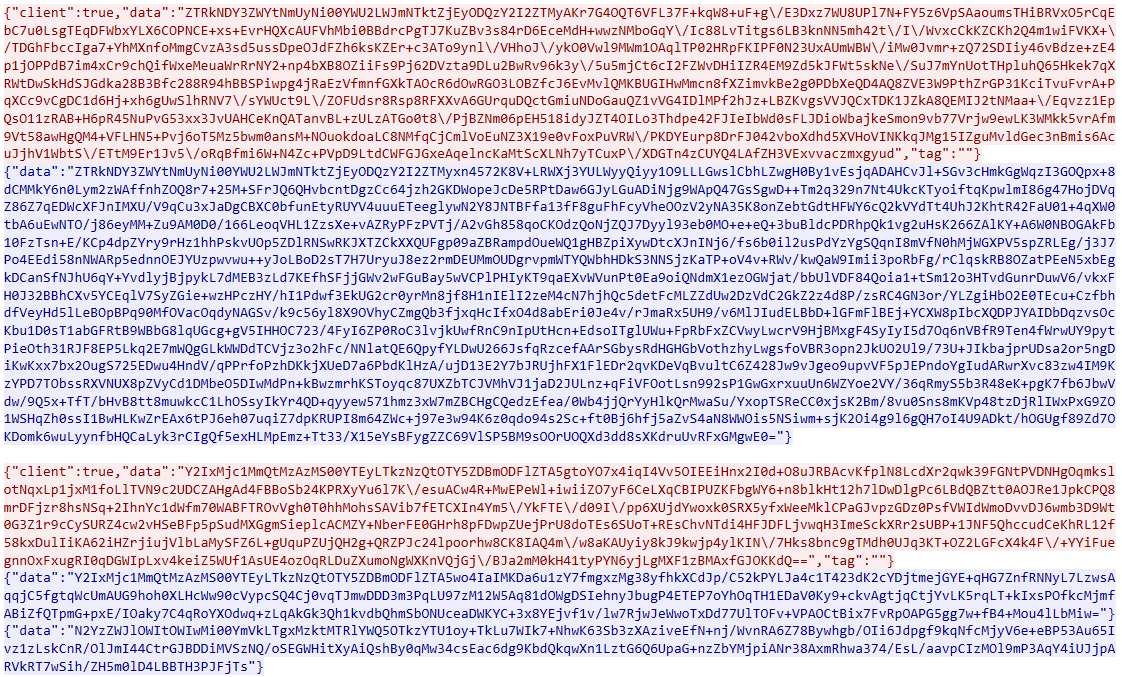
Decoding reveals the familiar data structure: UUID+AES256(JSON).
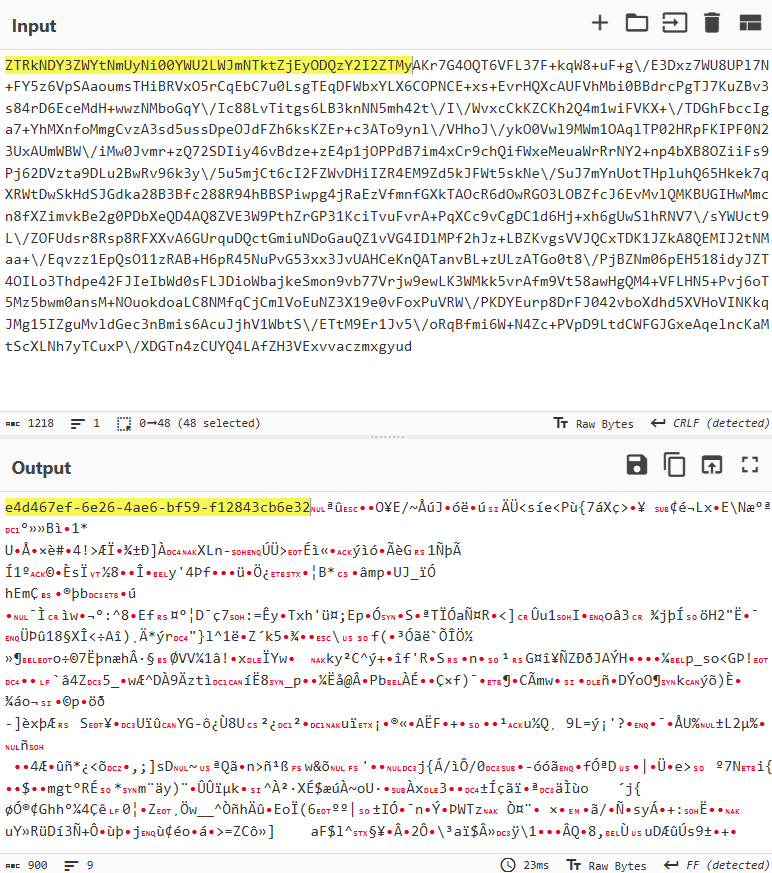
Therefore, we can use an approach similar to those discussed above to detect agent activity. The signature should rely on the UUID string at the beginning of the data field. The rule first verifies that the session data matches the data:base64 format, then decodes the data field and searches for a string matching the UUID pattern.
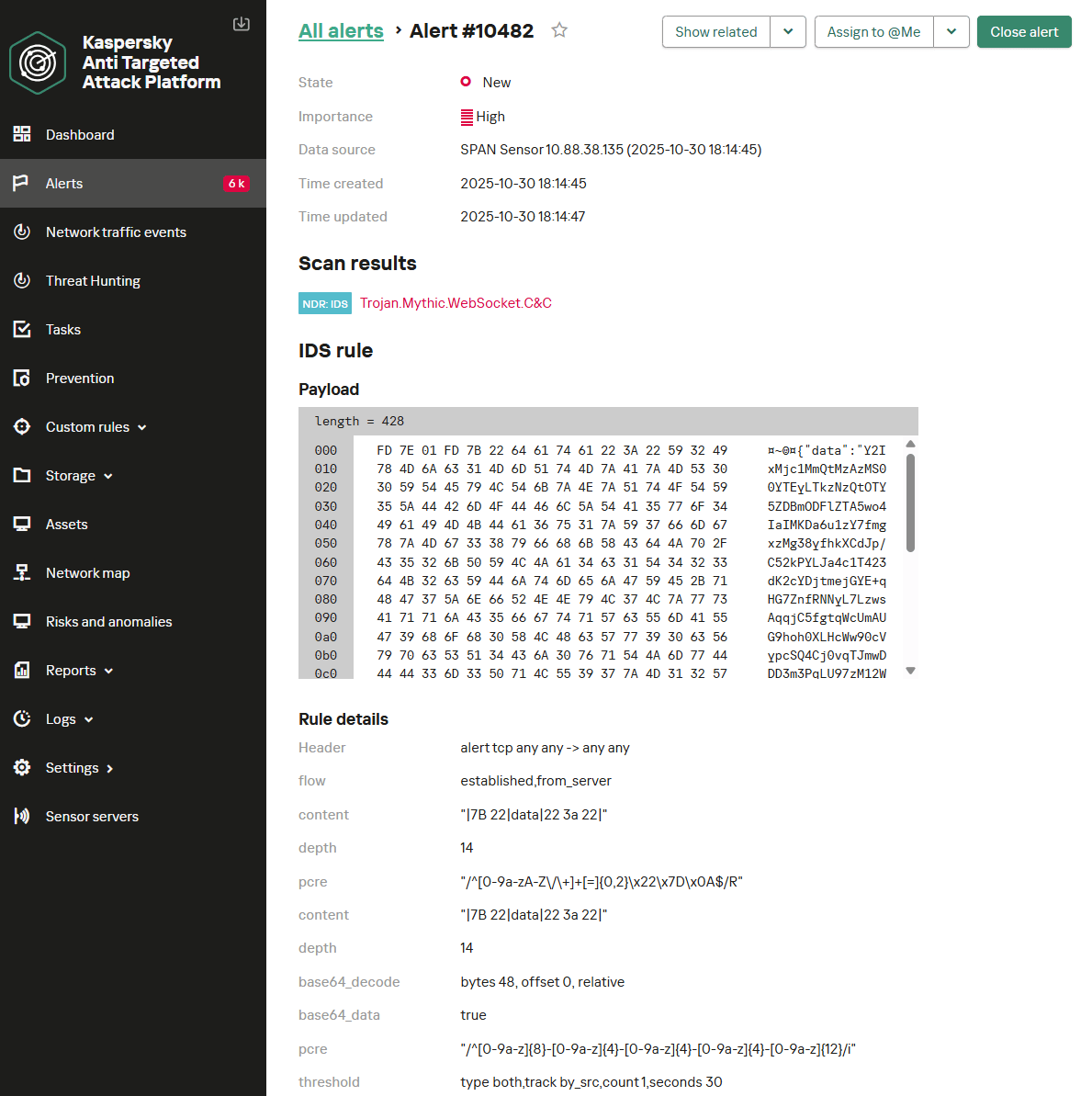
alert tcp any any -> any any (msg: "Trojan.Mythic.WebSocket.C&C"; flow: established, from_server; content: "|7B 22|data|22 3a 22|"; depth: 14; pcre: "/^[0-9a-zA-Z\/\+]+[=]{0,2}\x22\x7D\x0A$/R"; content: "|7B 22|data|22 3a 22|"; depth: 14; base64_decode: bytes 48, offset 0, relative; base64_data; pcre: "/^[a-z0-9]{8}\-[a-z0-9]{4}\-[a-z0-9]{4}\-[a-z0-9]{4}\-[a-z0-9]{12}/i"; threshold: type both, track by_src, count 1, seconds 30; reference: url, github.com/MythicAgents/; classtype: ndr1; sid: 9000115; rev: 2;)
Below is the Trojan.Mythic.WebSocket.C&C signature triggering on Mythic agent communication over WebSocket.
Takeaways
The Mythic post-exploitation framework continues to gain popularity and evolve rapidly. New agents are emerging, designed for covert persistence within target infrastructures. Despite this evolution, the various implementations of network communication in Mythic share many common characteristics that remain largely consistent over time. This consistency enables IDS/NDR solutions to effectively detect the framework’s agent activity through network traffic analysis.
Mythic supports a wide array of agent management options utilizing several network protocols. Our analysis of agent communications across these protocols revealed that agent activity can be detected by searching for specific data patterns within network traffic. The primary detection criterion involves tracking UUID strings in specific positions within Base64-encoded transmitted data. However, while the general approach to detecting agent activity is similar across protocols, each requires protocol-specific filters. Consequently, creating a single, universal signature for detecting Mythic agents in network traffic is challenging; individual detection rules must be crafted for each protocol. This article has provided signatures that are included in Kaspersky NDR.
Kaspersky NDR is designed to identify current threats within network infrastructures. It enables the detection of all popular post-exploitation frameworks based on their characteristic traffic patterns. Since the network components of these frameworks change infrequently, employing an NDR solution ensures high effectiveness in agent discovery.
Kaspersky verdicts in Kaspersky solutions (Kaspersky Anti-Targeted Attack with NDR module and Kaspersky NGFW)
Trojan.Mythic.SMB.C&C
Trojan.Mythic.TCP.C&C
Trojan.Mythic.HTTP.C&C
Trojan.Mythic.TLS.C&C
Trojan.Mythic.WebSocket.C&C
Creating User-Friendly Installers Across Operating Systems

After you have written the code for some awesome application, you of course want other people to be able to use it. Although simply directing them to the source code on GitHub or similar is an option, not every project lends itself to the traditional configure && make && make install, with often dependencies being the sticking point.
Asking the user to install dependencies and set up any filesystem links is an option, but having an installer of some type tackle all this is of course significantly easier. Typically this would contain the precompiled binaries, along with any other required files which the installer can then copy to their final location before tackling any remaining tasks, like updating configuration files, tweaking a registry, setting up filesystem links and so on.
As simple as this sounds, it comes with a lot of gotchas, with Linux distributions in particular being a tough nut. Whereas on MacOS, Windows, Haiku and many other OSes you can provide a single installer file for the respective platform, for Linux things get interesting.
Windows As Easy Mode
For all the flak directed at Windows, it is hard to deny that it is a stupidly easy platform to target with a binary installer, with equally flexible options available on the side of the end-user. Although Microsoft has nailed down some options over the years, such as enforcing the user’s home folder for application data, it’s still among the easiest to install an application on.
While working on the NymphCast project, I found myself looking at a pleasant installer to wrap the binaries into, initially opting to use the NSIS (Nullsoft Scriptable Install System) installer as I had seen it around a lot. While this works decently enough, you do notice that it’s a bit crusty and especially the more advanced features can be rather cumbersome.
This is where a friend who was helping out with the project suggested using the more modern Inno Setup instead, which is rather like the well-known InstallShield utility, except OSS and thus significantly more accessible. Thus the pipeline on Windows became the following:
- Install dependencies using vcpkg.
- Compile project using NMake and the MSVC toolchain.
- Run the Inno Setup script to build the
.exebased installer.
Installing applications on Windows is helped massively both by having a lot of freedom where to install the application, including on a partition or disk of choice, and by having the start menu structure be just a series of folders with shortcuts in them.
The Qt-based NymphCast Player application’s .iss file covers essentially such a basic installation process, while the one for NymphCast Server also adds the option to download a pack of wallpaper images, and asks for the type of server configuration to use.
Uninstalling such an application basically reverses the process, with the uninstaller installed alongside the application and registered in the Windows registry together with the application’s details.
MacOS As Proprietary Mode
Things get a bit weird with MacOS, with many application installers coming inside a DMG image or PKG file. The former is just a disk image that can be used for distributing applications, and the user is generally provided with a way to drag the application into the Applications folder. The PKG file is more of a typical installer as on Windows.
Of course, the problem with anything MacOS is that Apple really doesn’t want you to do anything with MacOS if you’re not running MacOS already. This can be worked around, but just getting to the point of compiling for MacOS without running XCode on MacOS on real Apple hardware is a bit of a fool’s errand. Not to mention Apple’s insistence on signing these packages, if you don’t want the end-user to have to jump through hoops.
Although I have built both iOS and OS X/MacOS applications in the past – mostly for commercial projects – I decided to not bother with compiling or testing my projects like NymphCast for Apple platforms without easy access to an Apple system. Of course, something like Homebrew can be a viable alternative to the One True Apple Way
Anything But Linux
The world of desktop systems is larger than just Windows, MacOS and Linux, of course. Even mobile OSes like iOS and Android can be considered to be ‘desktop OSes’ with the way that they’re being used these days, also since many smartphones and tablets can be hooked up to to a larger display, keyboard and mouse.
How to bootstrap Android development, and how to develop native Android applications has been covered before, including putting APK files together. These are the typical Android installation files, akin to other package manager packages. Of course, if you wish to publish to something like the Google Play Store, you’ll be forced into using app bundles, as well as various ways to signing the resulting package.
The idea of using a package for a built-in package manager instead of an executable installer is a common one on many platforms, with iOS and kin being similar. On FreeBSD, which also got a NymphCast port, you’d create a bundle for the pkg package manager, although you can also whip up an installer. In the case of NymphCast there is a ‘universal installer’ built into the Makefile after compilation via the fully automated setup.sh shell script, using the fact that OSes like Linux, FreeBSD and even Haiku are quite similar on a folder level.
That said, the Haiku port of NymphCast is still as much of a Beta as Haiku itself, as detailed in the write-up which I did on the topic. Once Haiku is advanced enough I’ll be creating packages for its pkgman package manager as well.
The Linux Chaos Vortex

It is this complete and utter chaos with Linux distros which has made me not even try to create packages for these, and instead offer only the universal .tar.gz installation method. After un-tar-ing the server code, simply run [url=https://github.com/MayaPosch/NymphCast/blob/master/setup.sh]setup.sh[/url] and lean back while it compiles the thing. After that, run install_linux.sh and presto, the whole shebang is installed without further ado. I also provided an uninstall_linux.sh script to complete the experience.
That said, at least one Linux distro has picked up NymphCast and its dependencies like Libnymphcast and NymphRPC into their repository: Alpine Linux. Incidentally FreeBSD also has an up to date package of NymphCast in its repository. I’m much obliged to these maintainers for providing this service.
Perhaps the lesson here is that if you want to get your neatly compiled and packaged application on all Linux distributions, you just need to make it popular enough that people want to use it, so that it ends up getting picked up by package repository contributors?
Wrapping Up
With so many details to cover, there’s also the easily forgotten topic that was so prevalent in the Windows installer section: integration with the desktop environment. On Windows, the Start menu is populated via simple shortcut files, while one sort-of standard on Linux (and FreeBSD as corollary) are Freedesktop’s XDC Desktop Entry files. Or .desktop files for short, which purportedly should give you a similar effect.
Only that’s not how anything works with the Linux ecosystem, as every single desktop environment has its own ideas on how these files should be interpreted, where they should be located, or whether to ignore them completely. My own experiences there are that relying on them for more advanced features, such as auto-starting a graphical application on boot (which cannot be done with Systemd, natch) without something throwing an XDG error or not finding a display is basically a fool’s errand. Perhaps that things are better here if you use KDE Plasma as DE, but this was an installer thing that I failed to solve after months of trial and error.
Long story short, OSes like Windows are pretty darn easy to install applications on, MacOS is okay as long as you have bought into the Apple ecosystem and don’t mind hanging out there, while FreeBSD is pretty simple until it touches the Linux chaos via X11 and graphical desktops. Meanwhile I’d strongly advise to only distribute software on Linux as a tarball, for your sanity’s sake.
Iteration3D is Parametric Python in the Cloud

It’s happened to all of us: you find the perfect model for your needs — a bracket, a box, a cable clip, but it only comes in STL, and doesn’t quite fit. That problem will never happen if you’re using Iteration3D to get your models, because every single thing on the site is fully-parametric, thanks to an open-source toolchain leveraging 123Dbuilds and Blender.
Blender gives you preview renderings, including colors where the models are set up for multi-material printing. Build123D is the CAD behind the curtain — if you haven’t heard of it, think OpenSCAD but in Python, but with chamfers and fillets. It actually leverages the same OpenCascade that’s behind everyone’s other favorite open-source CAD suite, FreeCAD. Anything you can do in FreeCAD, you can do in Build123D, but with code. Except you don’t need to learn the code if the model is on Iteration3D; you just set the parameters and push a button to get an STL of your exact specifications.
Right now, if you’re looking for a box or a pipe hanger or a bracket, plugging your numbers into Iteration3D’s model generator is going to be a lot faster than rolling your own, weather that rolling be done in OpenSCAD, FreeCAD, or one of those bits of software people insist on paying for. There’s a good variety of templates — 18 so far — so it’s worth checking out. Iteration3D is still new, having started in early 2025, so we will watch their career with great interest.
Going back to the problem in the introduction, if Iteration3D doesn’t have what you need and you still have an STL you need to change the dimensions of, we can help you with that.
Thanks to [Sylvain] for the tip!
Terremoto? No, AI-Fake! Un’immagine generata dall’IA paralizza i treni britannici
In Inghilterra, i treni sono stati sospesi per diverse ore a causa del presunto crollo di un ponte ferroviario causato da un’immagine falsa generata da una rete neurale. In seguito al terremoto avvenuto durante la notte, avvertito dagli abitanti del Lancashire e del Lake District meridionale, sui social media sono circolate immagini che mostravano il Carlisle Bridge a Lancaster gravemente danneggiato.
Network Rail, la società statale che gestisce l’infrastruttura ferroviaria britannica, ha riferito di aver appreso dell’immagine intorno alle 00:30 GMT e, per precauzione, di aver sospeso il traffico ferroviario sul ponte fino a quando i tecnici non avessero potuto verificarne le condizioni.
Intorno alle 02:00 GMT, il binario è stato completamente riaperto, non sono stati riscontrati danni e un giornalista della BBC che ha visitato il sito ha confermato che la struttura del ponte era intatta.

Un giornalista della BBC ha sottoposto l’immagine a un chatbot con intelligenza artificiale, che ha evidenziato diversi segnali rivelatori di un possibile falso. Tuttavia, Network Rail sottolinea che qualsiasi avviso di sicurezza deve essere trattato come se l’immagine fosse autentica, poiché sono in gioco vite umane.
L’azienda ha riferito che 32 treni, sia passeggeri che merci, hanno subito ritardi a causa dell’incidente. Alcuni treni hanno dovuto essere fermati o rallentati in avvicinamento al ponte, mentre altri hanno subito ritardi perché il loro percorso era bloccato da servizi precedentemente in ritardo. Data la lunghezza della West Coast Main Line, le conseguenze hanno raggiunto anche i treni diretti a nord, verso la Scozia.
Network Rail ha esortato gli utenti a considerare le potenziali conseguenze di tali immagini false. Secondo un portavoce dell’azienda, la creazione e la distribuzione di tali immagini comporta ritardi del tutto inutili, comporta costi per i contribuenti e aumenta il carico di lavoro dei dipendenti, già impegnati al massimo per garantire il regolare e sicuro funzionamento della ferrovia.
L’azienda ha sottolineato che la sicurezza dei passeggeri e del personale rimane una priorità assoluta e che pertanto qualsiasi potenziale minaccia all’infrastruttura viene presa estremamente sul serio.
La polizia dei trasporti britannica ha confermato di essere stata informata della situazione, ma al momento non è in corso alcuna indagine specifica sull’incidente.
L'articolo Terremoto? No, AI-Fake! Un’immagine generata dall’IA paralizza i treni britannici proviene da Red Hot Cyber.
Gazzetta del Cadavere reshared this.
Il Digital Wellness Coaching: i 3 passi per un mindsetfix e l’uso intenzionale della tecnologia
Viviamo nella dissociazione: lodiamo l’equilibrio tra lavoro e vita privata, eppure ci ritroviamo costantemente online, come marionette in balia di fili invisibili
Il vero problema non è la tecnologia, ma come noi, esseri umani, rispondiamo ad essa
Quella che chiamiamo stress digitale non è solo un fastidio; è una crisi profonda che investe il nostro benessere, la nostra identità e la nostra consapevolezza.
Lo Stress Digitale: il nucleo del problema
Esploriamo ciascun aspetto per capire meglio come funziona
Livello Fisiologico
Quando riceviamo una notifica sul nostro dispositivo, si attiva in noi la risposta di lotta o fuga. Questo costante switch attenzionale provoca un aumento cronico del cortisolo, l’ormone dello stress, come evidenziato dagli studi sul costo del cambio di contesto (switch cost) nel multitasking. A lungo andare, questo stato di allerta costante ci porta a soffrire di insonnia, di fatica visiva e a sviluppare tensioni muscolari (fenomeni ampiamente documentati dall’ergonomia digitale)
Livello Cognitivo
Il nostro cervello è costretto a un continuo switch di contesto. Come sottolineato dalle ricerche sulla carica cognitiva questo “multitasking” erode la nostra capacità di mantenere un’attenzione profonda, essenziale per raggiungere uno stato di flow efficiente e sostenuto
Livello Emotivo
A livello emotivo, la nostra autostima diventa intimamente legata alla nostra disponibilità, alimentando spesso la FOMO (Fear of Missing Out) e la convinzione profonda: “Se non rispondo subito, non sono utile o importante.” Questa convinzione ci può portare a sentirci costantemente sotto pressione e a sottovalutare il nostro valore, distaccandoci dai nostri veri bisogni e desideri. La pratica della Mindfulness è lo strumento ideale per contrastare questa reattività, riportando l’attenzione al momento presente e ai bisogni interni, anziché alla costante richiesta esterna di disponibilità
In sintesi, la nostra esposizione costante alla tecnologia reattiva non solo danneggia il nostro corpo, ma impoverisce anche la nostra mente e, infine, influisce sulla nostra autostima. Comprendere queste dinamiche è il primo passo verso una gestione più sana del nostro benessere digitale
Digital Wellness Coaching: esercizi pratici
Non abbiamo bisogno di un techfix (come disabilitare le app), ma di un mindsetfix.
Qui entra in gioco il Digital Wellness Coaching che ci guida verso una gestione sana e consapevole della tecnologia in 3 fasi:
1. Consapevolezza (Awareness)
Il debug dell’abitudine
- Usare un diario digitale per monitorare l’uso reattivo e intenzionale, annotando l’emozione provata prima di afferrare il telefono.
- Esercizio: la pausa di 3 secondi. Prima di sbloccare il telefono, fermiamoci e chiediamoci: “Qual è l’intenzione specifica per cui sto prendendo questo dispositivo?” Se non c’è un’intenzione chiara, riponiamolo.
- Riflessione guida: “Quando prendiamo in mano il telefono, cosa stiamo cercando realmente? L’informazione o una fuga?”
2. Confine (Boundary)
Installare il firewall personale
- Adottare pratiche come il time boxing intenzionale, pianificando momenti di disconnessione (es. area rossa dalle 20:00).
- Esercizio: il contratto di disconnessione. Stabiliamo una zona della casa (es. la camera da letto) come “No-Phone Zone” e rispettiamo rigorosamente questo confine per due settimane.
- La regola della non-urgenza è cruciale: il 99% di ciò che sembra urgente è semplicemente la priorità di qualcun altro
3. Riconnessione (Re-Connection)
Aggiornare il sistema corpo-mente
- Introdurre micro-pause consapevoli di 30 secondi (es. stretching o pratiche brevi di Mindfulness e respirazione profonda) e riscoprire hobby analogici. L’obiettivo è quello di ancorare la mente al presente non digitale.
- Esercizio: il risveglio analogico. Non tocchiamo dispositivi digitali (telefono, tablet, TV) per almeno una ora dopo esserci svegliati. Usiamo quel tempo per colazione, lettura cartacea o meditazione Mindfulness.
- L’obiettivo è separare chi siamo dal nostro ruolo: non siamo un server, ma un essere umano
L’impatto del Coaching: dalla teoria alla trasformazione
Il valore del Digital Wellness Coaching risiede nella sua capacità di trasformare la consapevolezza in azione sostenibile. Non si limita a dare consigli generici (“usa meno il telefono”) ma offre:
- Partnership: il Coach funge da “partner di responsabilità”, aiutandoci a rimanere fedeli ai confini che abbiamo stabilito per noi stessi.
- Personalizzazione: le strategie del Coach vengono adattate non solo all’uso della tecnologia, ma anche al nostro specifico stile di vita, lavoro e valori emotivi.
- Superamento dei blocchi: con il Coach identifichiamo e smantelliamo le convinzioni profonde (come “Devo rispondere subito “) che alimentano il ciclo dello stress digitale
L’idea della Community
La necessità di affrontare questo tema ha dato vita alla community RHC Cyber Angels, un insieme che esplora il lato umano delle sfide digitali, con il benessere digitale come obiettivo centrale. Il benessere digitale non è una dieta temporanea, ma una filosofia operativa.
Significa smettere di considerarci una risorsa infinita e iniziare a riconoscerci come una risorsa limitata e preziosa.
Se sei una donna interessata ai temi del benessere digitale e della cybersecurity in generale, scrivi a redazione@redhotcyber.com per candidarti ad entrare all’interno del gruppo delle RHC Cyber Angels.
Modo reazione vs. modo intenzione: la mappa per l’autonomia
Quando siamo in modalità reazione, diamo il nostro potere al mondo esterno, rispondendo passivamente.
In modalità intenzionale, invece, esercitiamo il nostro potere interno, scegliendo attivamente come spendere il nostro tempo e la nostra energia
Quale delle due modalità scegliamo di allenare da oggi?
Qual è la prima cosa non-digitale che faremo, nel prossimo weekend, per ricordarci che il nostro tempo è prezioso e limitato?
L'articolo Il Digital Wellness Coaching: i 3 passi per un mindsetfix e l’uso intenzionale della tecnologia proviene da Red Hot Cyber.


DNS-Massenüberwachung: „Das war dringend notwendig, diese neue Idee einer Schleppnetzfahndung im Internet abzuwenden“
netzpolitik.org/2025/dns-masse…

Gaza in ginocchio: freddo, pioggia e nuovi bombardamenti israeliani devastano il territorio
@Notizie dall'Italia e dal mondo
Sommersi i campi degli sfollati. A Khan Younis una neonata di otto mesi è morta per il freddo. L’Unrwa chiede aiuti urgenti per affrontare l’inverno
L'articolo Gaza in ginocchio: freddo, pioggia e nuovi bombardamenti
La Cina accelera sui portadroni. Primo volo per il Jiutian
@Notizie dall'Italia e dal mondo
La provincia dello Shaanxi, nella Cina nord-orientale, è stata teatro del primo volo di prova del “Jiutian”, termine cinese traducibile con “Nove cieli” che indica il mastodontico velivolo unmanned portadroni prodotto dalla statale Xi’an Chida Aircraft Parts Manufacturing e presentato dalla Repubblica
today.it/economia/tassa-2-euro…
Various Devboards and PCBs - Questo è un post automatico da FediMercatino.it
Prezzo: 0 €
2x Cypress C8CKIT
2x MCP2515 CAN interface
1x Serial SD-card mp3 player
1x powerbank PCB
1x Midibox GM5 USB-MIDI-Interface
2x USB Host Shield (verbastelt, probably working)
Various Devboards and PCBs - Questo è un post automatico da FediMercatino.it
Prezzo: 0 €
2x Cypress C8CKIT
2x MCP2515 CAN interface
1x Serial SD-card mp3 player
1x powerbank PCB
1x Midibox GM5 USB-MIDI-Interface
2x USB Host Shield (verbastelt, probably working)

Tatiana e la fuga dalla paura: “Credevo di essere malata. Poi il panico è diventato vergogna: non avevo la forza di tornare a casa”
Tatiana Tramacere parla dopo il finto sequestro a Nardò (Lecce): “Chiedo scusa a tutti, ero spaventata dal clamore che si era creato. Ero in un periodo buio, aspettavo un esame. Non è stata una bravata: Dragos mi ha accolto da amico.Nino Femiani (Quotidiano Nazionale)
“Riflessioni sul fine vita – Aspetti etici e giuridici” a Pontinia con la Cellula Coscioni di Latina
Aula Consiliare, Comune di Pontinia
Giovedì 11 dicembre 2025
Ore 18:00
La Cellula Coscioni di Latina promuove un momento di confronto aperto sul tema del fine vita, con particolare attenzione agli aspetti etici, giuridici e sanitari.
L’incontro sarà introdotto da Matteo Lovato, Consigliere Comunale del Comune di Pontinia e Maria Grazia Boaretto, Coordinatrice della Cellula Coscioni di Latina
Seguiranno gli interventi di Eligio Tombolillo, Sindaco del Comune di Pontinia, Michela Guarda, Dirigente infermieristico Hospice San Marco, Massimo Frisetti, Avvocato penalista del Foro di Latina, Luca Palombo, Infermiere e Coordinatore Cellula Coscioni Latina, Ferdinando Tucci, Psicoterapeuta
Una preziosa occasione per approfondire diritti e strumenti a tutela dell’autodeterminazione nel fine vita, tra cui le Disposizioni Anticipate di Trattamento (DAT).
L'articolo “Riflessioni sul fine vita – Aspetti etici e giuridici” a Pontinia con la Cellula Coscioni di Latina proviene da Associazione Luca Coscioni.
Filomena Gallo interviene al convegno “Dignità, Cure Palliative e la sua dimensione sociale”
Filomena Gallo interviene al convegno “Dignità, Cure Palliative e la sua dimensione sociale”
Filomena Gallo, segretaria nazionale dell’Associazione Luca Coscioni, interverrà in collegamento nella sessione di sabato 13 dicembre dedicata ai dilemmi medici, giuridici ed etici legati al fine vita del convegno “Dignità, Cure Palliative e la sua dimensione sociale”, promosso da ARNAS Garibaldi Nesima con il patrocinio dell’Ordine dei Medici di Catania e dell’Associazione Azione Forense.
13 dicembre 2025 ore 10:30 -12:00
Aula Magna Endocrinologia – ARNAS Garibaldi Nesima, Via Palermo 636, Catania
Il suo intervento sarà in dialogo con Cesare Mirabelli, già presidente della Corte Costituzionale, per affrontare con approccio giuridico e bioetico le sfide ancora aperte in materia di autodeterminazione e diritti civili nelle fasi terminali della vita.
Il Convegno avrà luogo nelle giornate del 12 e 13 dicembre e sarà accreditato con 10 crediti ECM
La partecipazione è riservata a personale sanitario e avvocati. Iscrizione tramite Intranet aziendale ARNAS Garibaldi entro l’8 dicembre.
L'articolo Filomena Gallo interviene al convegno “Dignità, Cure Palliative e la sua dimensione sociale” proviene da Associazione Luca Coscioni.
EDRi-gram, 11 December 2025
What has the EDRi network been up to over the past few weeks? Find out the latest digital rights news in our bi-weekly newsletter. In this edition: 2025 might be almost over, but we aren’t done fighting for digital rights
The post EDRi-gram, 11 December 2025 appeared first on European Digital Rights (EDRi).
Bandire i social media ai minori di 16 anni?
Per vedere altri post come questo, segui la comunità @Informatica (Italy e non Italy 😁)
È notizia di questi giorni che – primo governante al mondo – in Australia il premier Anthony Albanese ha deciso di bandire i social media ai minori di 16 anni. L'intervento del professor Marco Mayer in occasione della Cyberweek 2025 presso l'Università di Tel Aviv
reshared this
linkiesta.it/2025/12/possibile…
credo che meloni che non è scema (anche se mediamente incompetente) ma solo malvagia sappia tutto. non è persona corretta.
reshared this
Migrant smuggling laws: European Commission found in breach of transparency rules
The European Ombudsman has found that the Commission disregarded important transparency rules while preparing the Europol Regulation, which is a part of the legislation to "counter migrant smuggling". The inquiry concluded that the Commission didn't provide enough evidence to justify the claims of "urgency" to bypass their own 'Better Regulation' rules, and skipping public consultations, thorough impact assessments and evidence gathering.
The post Migrant smuggling laws: European Commission found in breach of transparency rules appeared first on European Digital Rights (EDRi).
How Danes je nov dan helped stop dangerous spyware in Slovenia
EDRi affiliate Danes je nov dan launched a multi-faceted campaign in response to a government proposal that would allow the Slovene Intelligence and Security Agency (SOVA) to use invasive spyware and mass surveillance tools under the guise of “national security”. By combining a satirical online tool with targeted advocacy towards lawmakers, their efforts helped generate critical pressure needed to stop the legislation from being adopted.
The post How Danes je nov dan helped stop dangerous spyware in Slovenia appeared first on European Digital Rights (EDRi).
Moving past ‘Chat Control’ to solutions that truly protect kids and privacy
This article highlights evidence-based alternatives that strengthen child safety while safeguarding encryption and fundamental rights. It calls for better enforcement, more targeted tools, and meaningful support for child protection services rather than broad surveillance measures.
The post Moving past ‘Chat Control’ to solutions that truly protect kids and privacy appeared first on European Digital Rights (EDRi).
plan-A reshared this.
SìParte!
@Politica interna, europea e internazionale
19 dicembre 2025, ore 11:00 – Sala Galasso, Società Napoletana di Storia Patria – Castel Nuovo (Maschio Angioino), Via Vittorio Emanuele III, 310 – Napoli Saluti di Ugo de Flaviis, Referente Campania FLE Pier Camillo Falasca, Direttore L’Europeista Carmine Foreste, Pres. Ord. Avv. Napoli Marco Muscariello, Pres. Cam. Penale Napoli Introduce Vincenzo Maiello, Università “Federico […]
Sedotta e abbandonata, l’Ucraina rischia il tracollo
@Notizie dall'Italia e dal mondo
L'Ucraina di fronte a una tragica scelta: perdere altri territori o continuare a combattere una guerra ormai persa? Kiev intanto è sempre più vicina al punto di rottura
L'articolo Sedotta e abbandonata, l’Ucraina pagineesteri.it/2025/12/11/eur…
freezonemagazine.com/articoli/…
“Mr. Redbone (…) ho composto questa canzone che sarebbe perfetta per lei, sir”- “Molto interessante (…) Questa canzone è stata scritta prima del 1940?” (Richard Flohil) Prima che si dissolva anche il 2025 è buono ricordare che fra tutte le ricorrenze che l’anno ha portato con sé (uno dei pochi meriti per cui sarà ricordato […]
L'articolo Leon Redbone, “mystery man” proviene da FREE ZONE MAGAZINE.
L’Ecuador chiede giustizia per i 4 bambini di Guayaquil
@Notizie dall'Italia e dal mondo
Un anno dopo il rapimento e l’uccisione dei quattro bambini di Las Malvinas, l’Ecuador torna in piazza per chiedere verità e giustizia, denunciando la militarizzazione del territorio, le responsabilità delle Forze Armate e l’escalation di violazioni contro l’infanzia nelle regioni più
aimee80 likes this.
Trasferimenti di dati UE-USA: è tempo di prepararsi a nuovi problemi in arrivo
La maggior parte dei trasferimenti di dati tra UE e USA si basa sul "Quadro Transatlantico sulla Privacy dei Dati" (TAFPF) o sulle cosiddette "Clausole Contrattuali Tipo" (SCC). Entrambi gli strumenti si basano su leggi statunitensi fragili, regolamenti non vincolanti e una giurisprudenza che è sotto attacco e che probabilmente verrà smantellata nei prossimi mesi. Mentre l'instabilità del sistema legale statunitense diventa innegabile e gli Stati Uniti mostrano evidenti segnali di ostilità nei confronti dell'UE, è tempo di riconsiderare dove fluiscono i nostri dati e per quanto tempo reggerà il "castello di carte" legale costruito dall'UE.
noyb.eu/en/eu-us-data-transfer…
@Privacy Pride


⚖️ In light of the upcoming US #SupremeCourt ruling in #Trump v. Slaughter, we took a detailed look at the implications for US-EU #datatransfers. In short: It's time for EU companies to prepare for more trouble to come.noyb.eu/en/eu-us-data-transfer…
EU-US Data Transfers: Time to prepare for more trouble to come
As instability in the US legal system becomes undeniable and the US shows open signs of hostility towards the EU, it is time to reconsider where our data is flowingnoyb.eu

reshared this
La Stampa in assemblea permanente, il giornale non sarà in edicola: “una giornata drammatica per la storia della nostra testata”
@Giornalismo e disordine informativo
articolo21.org/2025/12/la-stam…
Pubblichiamo la nota del Comitato di Redazione del quotidiano “La Stampa”. Articolo21 esprime grande
Quel filo nero che unisce le stragi all’evento di Articolo 21. Voci e volti della democrazia che resiste
@Giornalismo e disordine informativo
articolo21.org/2025/12/quel-fi…
Guardare al futuro significa coltivare la memoria e ciò equivale

Mark Russo reported the dataset to all the right organizations, but still couldn't get into his accounts for months.
Mark Russo reported the dataset to all the right organizations, but still couldnx27;t get into his accounts for months.#News #AI #Google


A Developer Accidentally Found CSAM in AI Data. Google Banned Him For It
Google suspended a mobile app developer’s accounts after he uploaded AI training data to his Google Drive. Unbeknownst to him, the widely used dataset, which is cited in a number of academic papers and distributed via an academic file sharing site, contained child sexual abuse material. The developer reported the dataset to a child safety organization, which eventually resulted in the dataset’s removal, but he claims Google’s has been "devastating.”A message from Google said his account “has content that involves a child being sexually abused or exploited. This is a severe violation of Google's policies and might be illegal.”
The incident shows how AI training data, which is collected by indiscriminately scraping the internet, can impact people who use it without realizing it contains illegal images. The incident also shows how hard it is to identify harmful images in training data composed of millions of images, which in this case were only discovered accidentally by a lone developer who tripped Google’s automated moderation tools.
💡
Have you discovered harmful materials in AI training data ? I would love to hear from you. Using a non-work device, you can message me securely on Signal at @emanuel.404. Otherwise, send me an email at emanuel@404media.co.In October, I wrote about the NudeNet dataset, which contains more than 700,000 images scraped from the internet, and which is used to train AI image classifiers to automatically detect nudity. The Canadian Centre for Child Protection (C3P) said it found more than 120 images of identified or known victims of CSAM in the dataset, including nearly 70 images focused on the genital or anal area of children who are confirmed or appear to be pre-pubescent. “In some cases, images depicting sexual or abusive acts involving children and teenagers such as fellatio or penile-vaginal penetration,” C3P said.
In October, Lloyd Richardson, C3P's director of technology, told me that the organization decided to investigate the NudeNet training data after getting a tip from an individual via its cyber tipline that it might contain CSAM. After I published that story, a developer named Mark Russo contacted me to say that he’s the individual who tipped C3P, but that he’s still suffering the consequences of his discovery.
Russo, an independent developer, told me he was working on an on-device NSFW image detector. The app runs locally and can detect images locally so the content stays private. To benchmark his tool, Russo used NudeNet, a publicly available dataset that’s cited in a number of academic papers about content moderation. Russo unzipped the dataset into his Google Drive. Shortly after, his Google account was suspended for “inappropriate material.”
On July 31, Russo lost access to all the services associated with his Google account, including his Gmail of 14 years, Firebase, the platform that serves as the backend for his apps, AdMob, the mobile app monetization platform, and Google Cloud.
“This wasn’t just disruptive — it was devastating. I rely on these tools to develop, monitor, and maintain my apps,” Russo wrote on his personal blog. “With no access, I’m flying blind.”
Russo filed an appeal of Google’s decision the same day, explaining that the images came from NudeNet, which he believed was a reputable research dataset with only adult content. Google acknowledged the appeal, but upheld its suspension, and rejected a second appeal as well. He is still locked out of his Google account and the Google services associated with it.
Russo also contacted the National Center for Missing & Exploited Children (NCMEC) and C3P. C3P investigated the dataset, found CSAM, and notified Academic Torrents, where the NudeNet dataset was hosted, which removed it.
As C3P noted at the time, NudeNet was cited or used by more than 250 academic works. A non-exhaustive review of 50 of those academic projects found 134 made use of the NudeNet dataset, and 29 relied on the NudeNet classifier or model. But Russo is the only developer we know about who was banned for using it, and the only one who reported it to an organization that investigated that dataset and led to its removal.
After I reached out for comment, Google investigated Russo’s account again and reinstated it.
“Google is committed to fighting the spread of CSAM and we have robust protections against the dissemination of this type of content,” a Google spokesperson told me in an email. “In this case, while CSAM was detected in the user account, the review should have determined that the user's upload was non-malicious. The account in question has been reinstated, and we are committed to continuously improving our processes.”
“I understand I’m just an independent developer—the kind of person Google doesn’t care about,” Russo told me. “But that’s exactly why this story matters. It’s not just about me losing access; it’s about how the same systems that claim to fight abuse are silencing legitimate research and innovation through opaque automation [...]I tried to do the right thing — and I was punished.”
Home
As Canada’s tipline for reporting online child sexual abuse and exploitation, Cybertip.ca is dedicated to reducing child victimization through technology, education, public awareness, along with supporting survivors and their families.Cybertip.ca

Our new zine; a very strange change at Instagram; and the creator of ICEBlock is suing the U.S. government.#Podcast
Podcast: Zines Are Back
We start this week with news of our zine! We’re printing it very soon, and walk you through the process. Independent media is turning back to physical zines as a way to subvert algorithms. After the break, Emanuel tells us about some very weird Instagram changes. In the subscribers-only section, Joseph explains ICEBlock’s lawsuit against the U.S. government.
playlist.megaphone.fm?e=TBIEA4…
Listen to the weekly podcast on Apple Podcasts,Spotify, or YouTube. Become a paid subscriber for access to this episode's bonus content and to power our journalism. If you become a paid subscriber, check your inbox for an email from our podcast host Transistor for a link to the subscribers-only version! You can also add that subscribers feed to your podcast app of choice and never miss an episode that way. The email should also contain the subscribers-only unlisted YouTube link for the extended video version too. It will also be in the show notes in your podcast player.
youtube.com/embed/lseEXc-ZzsQ?…
Timestamps:
1:37 - 1st Story - 404 Media Is Making a Zine; buy the zine here.
23:35 - 2nd Story - Instagram Is Generating Inaccurate SEO Bait for Your Posts
36:09 - 3rd Story - ICEBlock Creator Sues U.S. Government Over App’s RemovalThe 404 Media Podcast
Tech News Podcast · Updated Weekly · Welcome to the podcast from 404 Media where Joseph, Sam, Emanuel, and Jason catch you up on the stories we published this week. 404 Media is a journalist-owned digital media company exploring the way …Apple Podcasts

Le sperimentazioni sulle terapie avanzate sono ferme da due anni: pazienti in attesa e ricercatori esclusi
Nella Giornata Mondiale dei diritti umani, l’Associazione Luca Coscioni presenta un appello al Ministro Urso: “La ricerca è un diritto umano, e salva vite”
Bloccata anche una terapia cellulare che rigenera la cornea, consentendo il recupero della vista
In Italia esistono sperimentazioni e terapie avanzate sviluppate grazie a oltre trent’anni di ricerca pubblica che hanno già dimostrato di poter arrivare a salvare la vita e ridare la vista a persone senza alternative terapeutiche. Si tratta delle sperimentazioni per la terapia genica per l’Epidermolisi Bollosa – malattia rara nota come “sindrome dei bambini farfalla” – che ha già salvato la vita a un bambino altrimenti destinato a morte certa, e della terapia cellulare di Holoclar, che rigenera l’epitelio corneale e ha già permesso a centinaia di pazienti europei di recuperare la vista.
Queste tecnologie sono state sviluppate dai professori Michele De Luca, anche co presidente dell’Associazione Luca Coscioni e Graziella Pellegrini, entrambi dell’Università di Modena e Reggio Emilia e portate ai pazienti attraverso Holostem, azienda fondata nel 2008 come eccellenza italiana nel campo delle terapie cellulari e geniche. Nel 2023, a seguito della decisione del socio privato di liquidare la società, il Governo autorizzò l’acquisizione da parte della Fondazione Enea Tech & Biomedical con l’obiettivo di garantire continuità alle attività.
A due anni dall’acquisizione, però, le sperimentazioni cliniche sull’Epidermolisi bollosa non sono ancora partite e la produzione di Holoclar è quasi ferma. Inoltre, inspiegabilmente i ricercatori che hanno sviluppato le terapie non risultano più coinvolti nei processi scientifici, nonostante la natura altamente specialistica delle tecnologie basate su cellule staminali epiteliali.
Questa situazione sta lasciando senza risposta sia i pazienti affetti da una malattia terribile, in alcune forme anche letale, sia coloro che potrebbero recuperare la vista grazie a un trattamento già approvato e utilizzato con successo per anni.
“Noi, persone con malattie rare, siamo chiamate ‘pazienti’ – racconta Alessandro Barneschi, 40 enne affetto da Epidermolisi bollosa sin dalla nascita e volto della campagna. “Ma l’Epidermolisi Bollosa non ha pazienza: non aspetta. Per noi, il tempo è fondamentale, perché il tempo della malattia non è quello della burocrazia. La malattia non è paziente: agisce, avanza, e non si ferma”.
Di fronte alla paralisi delle attività, l’Associazione Luca Coscioni, nella Giornata Mondiale dei Diritti Umani lancia un appello rivolto al Ministro delle Imprese e del Made in Italy, Adolfo Urso, per chiedere un intervento immediato che ristabilisca le condizioni necessarie alla ripresa delle terapie e delle sperimentazioni, garantendo l’utilizzo delle competenze scientifiche che hanno reso possibile lo sviluppo di queste terapie.
L’appello richiama anche una dichiarazione resa dal Ministro in Parlamento il 29 novembre 2023, quando sottolineò l’importanza di assicurare continuità a queste attività e di non lasciare senza risposte i pazienti coinvolti.
Il documento – che sarà da oggi sottoposto a ricercatori, pazienti, sostenitori della ricerca pubblica e a tutti i cittadini – chiede un’intervento urgente del Ministro Urso e del Governo, affinché terapie italiane già dimostrate efficaci possano tornare a essere disponibili.
L'articolo Le sperimentazioni sulle terapie avanzate sono ferme da due anni: pazienti in attesa e ricercatori esclusi proviene da Associazione Luca Coscioni.
Elena Brescacin reshared this.
Trasferimenti di dati UE-USA: E' tempo di prepararsi ad altri problemi
Poiché l'instabilità del sistema giuridico statunitense diventa innegabile e gli Stati Uniti mostrano aperti segni di ostilità nei confronti dell'UE, è tempo di riconsiderare dove scorrono i nostri dati
mickey10 December 2025

La persona disabile – Dalla fragilità alla proabilità: nascono nuove opportunità
Palazzo della Cultura – Sala della Notte, Via Vittorio Emanuele 119, Catania
Sabato 13 dicembre 2025
Ore 16:00 – 18:30
Sabato 13 dicembre, presso il Palazzo della Cultura di Catania, si terrà l’incontro “La persona disabile – Dalla fragilità alla proabilità: nascono nuove opportunità”, promosso dalla Cellula Coscioni di Catania con la partecipazione di diverse realtà associative del territorio.
L’appuntamento si inserisce nel percorso avviato lo scorso anno dal Comune di Catania per la realizzazione del PEBA – Piano per l’Eliminazione delle Barriere Architettoniche. Alla luce delle recenti novità, tra cui la sentenza del TAR Catania che ha nominato un Commissario ad Acta, l’incontro vuole essere un momento di informazione, confronto e ascolto aperto alla cittadinanza per contribuire alla costruzione di una città più accessibile, inclusiva e rispettosa dei diritti di tutte e tutti.
L'articolo La persona disabile – Dalla fragilità alla proabilità: nascono nuove opportunità proviene da Associazione Luca Coscioni.
reshared this


Sono stati condannati a un anno di carcere i quattro militanti di CasaPound che aggredirono il giornalista della Stampa Andrea Joly a Torino - Il Post
https://www.ilpost.it/2025/12/10/casa-pound-4-condanne-aggressione-giornalista-andrea-joly/?utm_source=flipboard&utm_medium=activitypubPubblicato su News @news-ilPost

Poliversity - Università ricerca e giornalismo reshared this.
Israele ha utilizzato le tecnologie Palantir nell'attacco terroristico con cercapersone in Libano.
Nella nuova biografia del co-fondatore di Palantir, Alex Karp, "The Philosopher in the Valley: Alex Karp, Palantir, and the Rise of the Surveillance State", scritta dal giornalista del New York Times Michael Steinberger, si scrive che prima del genocidio di Gaza, "il Mossad aveva utilizzato la tecnologia Palantir", aggiungendo che lo Shin Bet e l'IDF "hanno cercato di ottenere il software di Palantir in seguito al 7 ottobre".
"la tecnologia dell'azienda è stata impiegata dagli israeliani durante le operazioni militari in Libano nel 2024 che hanno decimato i vertici di Hezbollah" ed "è stata utilizzata anche nell'operazione Grim Beeper, in cui centinaia di combattenti di Hezbollah sono rimasti feriti e mutilati quando i loro cercapersone e walkie-talkie sono esplosi (gli israeliani avevano piazzato trappole esplosive nei dispositivi)".
the307.substack.com/p/revealed…
Per altri aggiornamenti sull'informatica, la cybersecurity e la tecnologia, puoi seguire il gruppo activitypub @Informatica (Italy e non Italy 😁)

Revealed: Israel Used Palantir Technologies In Pager Terrorist Attack In Lebanon.
A New Book Quietly Reveals That Israel Used Palantir In It's Terrorist Attack On Lebanon.The Dissident
reshared this
Io non credo che le persone, qui in Europa, si stiano rendendo conto di quello che sta succedendo.
Ogni mattina andiamo al lavoro, facciamo le nostre vite come se nulla fosse cambiato, ma sono in corso alcuni cambiamenti storici e molto, molto rilevanti che cambieranno per sempre le nostre vite, e temo che tutto ciò che abbiamo dato per scontato fino a questo punto verrà messo in discussione dall'attualità.
Dall'est arrivano venti di guerra. Al di là di come la si pensi sul riarmo, resta un fatto: che non passa giorno in cui le evidenze della guerra ibrida - che nulla ha a che fare col riarmo - mostri i suoi segnali sempre più rilevanti.
E' di oggi la notizia che l'Estonia ha dichiarato lo stato di calamità per l'invasione ormai quotidiana da parte dei palloni sonda russi, che arrivano nel Paese non certo perché tira il vento, e comunque in numero tale da creare caos nei cieli (e i meno addormentati potrebbero pensare che sia per rallentare eventuali operazioni di difesa. Anche soltanto il dubbio che questo possa verificarsi è sufficiente per l'obiettivo della guerra ibrida: creare instabilità, disordine, sfiducia, senso di precarietà. E ci stanno riuscendo).
In tutto ciò Putin, un dittatore sanguinario, si dichiara pronto a difendersi. Insomma, un po' come il tizio che va in giro accoltellando gli altri, e dice che se qualcuno oserà sparargli tirerà fuori il bazooka. Penso che soltanto chi ha scollegato il cervello negli ultimi anni possa continuare a sostenere che tutto questo derivi dal fatto che "sono stati provocati". Anche in quel caso, direi "bel carattere di merda": se c'è qualche problema, se ne parla, non ci si trincera dietro al "sono pronto a difendermi". Ma, come è evidente, basta seguire le trasmissioni sulla TV russa (sì, girano tradotte), per rendersi conto del fatto che la retorica naziputiniana è già ben oltre il livello del "sono pronto a difendermi".
Poi ci sono le informazioni degli 007 Nato. Si parla di un attacco militare all'Europa - ripeto, un attacco all'Europa - entro il 2028/29. La guerra, in casa nostra. Non possiamo più pensare che tutto questo sia casuale, o surreale.
Si parla di attacchi sferrati - e per fortuna sventati - alla nostra aviazione civile per far precipitare gli aerei. Avete capito bene?
Vogliono fare precipitare i mezzi su cui viaggiamo (e stavano per riuscirci).
Inutile dire da dove provengano. Nelle ex zone occupate dall'esercito russo si ritrovano cadaveri di bambini torturati, che spuntano fuori dalle fosse comuni come fossero funghi nel mese di ottobre.
Insomma: la realtà è sotto gli occhi di tutti, e un quadro più grande sta finalmente - purtroppo - prendendo forma in maniera sempre più chiara.
In tutto questo cosa succede di là dall'Atlantico?
Succede che un mezzo continente che credevamo nostro alleato ha smesso di essere nostro alleato. E vabbè, dirà qualcuno ha cui gli States creavano qualche prurito.
E vabbè un cazzo, rispondo io.
Perché non è che gli USA hanno smesso di essere alleati per essere neutrali: ogni giorno che passa stanno diventando, sempre di più e sempre più chiaramente, un altro dei tanti nemici del continente.
Ora, io lo so che non siamo santi e ognuno ha le sue colpe, ma mi pare che tutto ciò che ci sta per accadere, sinceramente, non ce lo meritiamo molto.
Dobbiamo prepararci a vedere cambiare le nostre vite, e qui vengo al punto del discorso. Le cose di cui parlare sono e saranno sempre di più, ma il mio lavoro di tutti i giorni mi fa pensare e vedere che siamo legati mani e pieni alle tecnologie di qualcuno che da un giorno all'altro (circa) dice che le nostre istituzioni andrebbero sciolte, come se stesse dicendo che domani pioverà secondo il meteo, con la stessa leggerezza.
Non so a voi, ma a me tutto questo inquieta.
L'Europa che tanto amiamo (o che dovremmo) rischia seriamente, concretamente di restare schiacciata tra colossi, se non reagiamo subito e in fretta. Ognuno di noi può fare qualcosa.
Come informatico non faccio che pensare e - spero - far pensare che il 99% delle tecnologie che utilizziamo nel mondo del lavoro, tutti i giorni, è statunitense (mi riferisco al software, in particolare).
Non esiste cellulare in cui non ci sia software statunitense, ormai. Per quanto riguarda i computer, siamo ad una percentuale del 95% circa (se non contiamo i server).
Ripeto, non so a voi ma me tutto questo inquieta un po', in un mondo in cui i rapporti sono sempre più tesi. Se pensate che stia esagerando, forse non comprendete bene la portata della cosa: parliamo del fatto che qualcuno, in mezzo secondo, può decidere di bloccare tutto - o quasi - o come minimo di non consentirci più di far funzionare le cose.
Un esempio semplice: un sacco di gente per navigare usa inconsapevolmente i DNS di Google. Senza questi, ciao ciao navigazione. Certo, ci si potrebbe organizzare diversamente, ma passerebbero giorni, settimane, mesi in cui niente funzionerebbe più.
Esagero? Voglio sperare di sì.
Ma...siamo sicuri di voler rischiare? Non è che ci converrebbe cominciare a pensare che un altro modo di fare le cose è possibile?
Perché non cominciamo ad usare servizi e tecnologie europee?
Io credo che, arrivati a questo punto, sia il minimo che possiamo fare, sia per tutelarci che per lanciare un forte segnale.
L'Europa - con qualche rinuncia - può fare da sola. E può migliorare, può e deve iniziare a pensare di DOVERCELA FARE da sola.
Con questo spirito, io che di mestiere campo con l'informatica, ho deciso di svincolarmi da servizi statunitensi, il più possibile e progressivamente. Perché non posso vivere con questa consapevolezza e non fare nulla per essere coerente con quello che dico.
Di più: è anche giusto essere d'esempio. Se non lo facciamo noi informatici, che abbiamo più mezzi per mettere in atto il cambiamento, chi altri dovrebbe dare l'esempio?
Nel Fediverso circolano molti esempi di cosa possiamo fare.
Il concetto non è "boicottiamo tutto!" perché sarebbe difficile (anche se non impossibile), ma possiamo mettere in atto almeno 4 cose, sin da subito:
1) creiamo consapevolezza, parliamo di questi argomenti a chi riusciamo a raggiungere;
2) non attiviamo NUOVI servizi statunitensi/russi/cinesi
3) disattiviamo i servizi statunitensi da cui dipendiamo. Se non possiamo/vogliamo disattivarli TUTTI almeno cominciamo con quelli che possiamo disattivare, chiudere per sempre. Qualcosa è decisamente meglio di NULLA.
4) usiamo servizi di aziende europee. Esistono, sono tante, si può: l'open source ci da una grossa mano.
Io ho già cominciato. In un paio d'anni ho ottenuto questi risultati, ma voglio cominciare ad accelerare. E tu? Tu cosa puoi fare già da oggi, da subito? Ci sono tante cose che puoi cambiare, a cominciare da alcune, molto semplici.
Almeno, riflettici.
Ecco cosa ho fatto io finora:
❌ Firefox/Chrome --> Vivaldi
❌ Android (Google, Xiaomi) --> (in parte) Lineage OS 🤖
❌ Facebook (3 account) --> Friendica 🫂
❌ Instagram --> Pixelfed 🖼️
❌ X (Twitter) --> Mastodon 🐘
❌ Telegram --> Quicksy/Conversations (client XMPP) 💬
❌ DNS Google --> DNS4EU 🛡️
❌ Google Authenticator --> Aegis 🔑
❌ Google Maps --> Organic Maps, Here We Go 🗺️
❌ Outlook (App) --> K-9 Mail 📧
❌ Google Play Store --> (parzialmente) F-Droid 🏪
❌ Google Drive --> Nextcloud ☁️
❌ Adobe Photoshop --> Luminar Neo 📸 (ora a NY, ma azienda Ucraina)
❌ Adobe Acrobat Reader --> Vivaldi
❌ Google Files --> File Navigator 📁
❌ Youtube Music (per podcast) --> Antenna Pod 🎙️
❌ Google (motore di ricerca) --> Qwant e SearXng.devol.it 🔎
❌ Gmail (app) --> K-9 Mail 📥
❌ Windows --> (su alcuni PC) Linux
❌ Paramount --> di Trump, chiusa.
❌ Blogspot (Google) --> Wordpress / NoBlogo
La strada è ancora molto lunga, e ci sono cose strategiche che non so se riuscirò mai a spostare in Europa.
Ma è un inizio, e io non mi arrendo!
Condividi più che puoi!
#guerraibrida #degoogle #USA #russia #cina #statiuniti #sovranitàdigitale #linux #android #google #bigtech #facebook #dns #instagram #musk #comproeuropeo #opensource
reshared this
Tensione nei cieli asiatici. L’ultimo allarme su Mosca e Pechino
@Notizie dall'Italia e dal mondo
Nelle scorse ore la tensione nei cieli dell’Indo-Pacifico è salita alle stelle, quando Giappone e Corea del Sud hanno fatto decollare i propri caccia martedì in risposta a un nuovo pattugliamento aereo congiunto di bombardieri cinesi e russi su aree di mare vicine ai due Paesi. Il ministero
African Lion non è solo un’esercitazione. Perché il Marocco è diventato strategico
@Notizie dall'Italia e dal mondo
Migliorare la capacità dei Paesi coinvolti nell’azionare operazioni combinate e interforze, oltre a contribuire alla stabilità e alla sicurezza regionali. Questi gli obiettivi dell’esercitazione militare internazionale African Lion 2026, i cui preparativi
lindipendente.online/2025/12/0…
Passamontagna e manganelli: come la polizia serba reprime il dissenso nelle piazze
@Notizie dall'Italia e dal mondo
«Voglio che sappiate che dietro a tutti gli attacchi agli studenti che protestano a Belgrado e a Novi Sad c’è sempre lo stesso sistema che invia lo stesso messaggio: “Obbedisci. Non parlare. Non denunciare. Non ribellarti, perché non avrai mai speranza o
Secondo l'ultimo rapporto di CTRL-ALT-RECLAIM le giovani voci stanno rimodellando il mondo digitale!
In tutta Europa, i giovani chiedono un nuovo patto digitale, che tuteli la loro salute mentale, la loro privacy e i loro diritti democratici online.
Oggi, ctrl+alt+reclaim, il primo movimento europeo per la giustizia tecnologica e i diritti digitali guidato dai giovani, insieme a People vs Big Tech lanciano Power Shift: Young voices reshaping the digital world , un nuovo rapporto che traccia il profilo di una generazione emergente di giovani attivisti in tutta Europa che lottano contro l'impatto che i danni online hanno sulle loro vite
reshared this

Come sarebbe l’Europa rimodellata da Trump
Il presidente degli Stati Uniti vuole rimodellare il continente perché non sia più un polo autonomo ma una regione vassalla, sotto la doppia influenza statunitense e russa. LeggiPierre Haski (Internazionale)
I-CAN, l'organizzazione internazionale anti-'Ndrangheta punta ad allargarsi alla Romania
Un momento della riunione

Un importante incontro di polizia internazionale si è tenuto in Romania per combattere la criminalità organizzata.
Si sono riuniti rappresentanti di alto livello della polizia rumena e italiana, insieme a organizzazioni internazionali come SELEC (un centro di cooperazione per le forze dell'ordine dell'Europa sud-orientale).
Il tema principale trattato ha riguardato la 'Ndrangheta
La 'Ndrangheta è come noto una delle più potenti organizzazioni mafiose italiane, originaria della Calabria. A differenza di altre mafie, la sua caratteristica principale è la capacità di:
- Infiltrarsi nell'economia legale di molti paesi;
- Operare a livello globale, non solo in Italia;
- Vantare collegamenti e connessioni anche in Romania.

I-CAN (Interpol Cooperation against 'Ndrangheta) è un progetto di cooperazione internazionale voluto dall'Italia ed abbracciato da Interpol, specificamente dedicato a contrastare questa organizzazione criminale. Attualmente coinvolge 24 paesi.
Si è discusso delle Silver Notices INTERPOL - avvisi internazionali usati per tracciare metodi criminali e collegamenti, particolarmente utili per seguire i flussi finanziari illegali della 'Ndrangheta.
L'incontro ha rafforzato la collaborazione tra Italia e Romania, con l'obiettivo che la Romania diventi il 25° paese a unirsi formalmente al progetto I-CAN per combattere più efficacemente questa organizzazione criminale a livello globale.
fabrizio reshared this.
Un paese che lavora, ma non vive.
noblogo.org/transit/un-paese-c…


Un paese che lavora, ma non vive.
(186)
In Italia, il lavoro ha smesso di essere una garanzia contro la povertà. Nel 2025 oltre un lavoratore su dieci è in difficoltà economica pur avendo un impiego, con un tasso di rischio di povertà lavorativa che supera l’11% e colloca il paese stabilmente sopra la media europea.
È il volto dei cosiddetti #workingpoor, persone che timbrano il cartellino, consegnano pacchi, servono ai tavoli, assistono anziani e bambini, ma non riescono a condurre una vita dignitosa. Secondo i dati più recenti, oltre un lavoratore su dieci in Italia è a rischio povertà, con una quota di “working poor” che in alcune analisi si avvicina a un quarto della forza lavoro, se si considerano contratti part time involontari, stagionali e parasubordinati.
L’occupazione cresce (almeno nelle tabelle del #GovernoMeloni, quelle che spacciano per tavole della verità), ma cresce anche il numero di chi, pur lavorando, non supera la soglia dei mille euro al mese e non riesce a far fronte al costo della vita. Si parla di milioni di persone che vivono in condizioni di povertà o rischio di povertà nonostante un’occupazione, smentendo l’idea che “basta un lavoro” per stare al sicuro.La povertà lavorativa non è solo una statistica: si traduce in vite più fragili, reti sociali che si spezzano, salute che si deteriora.
La mancanza di un reddito stabile e sufficiente costringe a rinunciare a uscite, viaggi, corsi per i figli, cure sportive o culturali, alimentando l’isolamento sociale. Per molte coppie, l’incertezza economica significa rinviare indefinitamente progetti di vita, come avere un figlio o andare a vivere da soli, mentre ansia e stress da precarietà diventano condizioni permanenti, con effetti documentati anche sulla salute mentale.
Il lavoro povero incide anche sull’accesso alla sanità e ai servizi fondamentali. Cresce la quota di chi rinuncia a visite specialistiche, esami o terapie per i costi diretti o per l’impossibilità di assentarsi dal lavoro precario senza perdere giornate pagate a ore. Allo stesso modo, la povertà educativa si radica nelle famiglie dei “working poor”: bambini e ragazzi che non partecipano a attività extrascolastiche, corsi di lingua, musica o sport, e che vivono fin da piccoli il peso delle ristrettezze economiche.
Così la povertà lavorativa di oggi prepara le disuguaglianze di domani. La povertà lavorativa non è un incidente di percorso, ma il prodotto di scelte politiche precise. Tra il 2019 e il 2024 i salari reali hanno perso circa il 10,5% del potere d’acquisto, perché i prezzi sono saliti di oltre il 21% a fronte di retribuzioni cresciute di poco più del 10%, con una perdita secca per milioni di lavoratori.
In questo quadro, il rifiuto ostinato di introdurre un salario minimo legale espone chi lavora a un ricatto permanente: accettare qualsiasi paga, qualsiasi orario, qualsiasi condizione, pur di non scivolare nella povertà assoluta. Le promesse di “difendere i salari” e “mettere al centro il lavoro” restano slogan, mentre aumentano le persone costrette a rivolgersi a mense e associazioni pur avendo un contratto in tasca.
Oggi in Italia la povertà ha cambiato volto: diminuiscono i senza dimora assistiti dalle reti solidali, aumentano invece i lavoratori poveri, i giovani, gli over 60, le famiglie numerose che non riescono più a far quadrare i conti. In un paese dove la spesa complessiva per il Natale 2025 è stimata in quasi 28 miliardi di euro, con oltre mille euro di budget medio a famiglia tra regali, cibo, viaggi e ristoranti, chi vive di salario basso guarda da fuori una festa costruita sul consumo. Per di questi lavoratori, le tredicesime servono solo a coprire affitti, bollette, debiti, ben lontano dai 200 euro a testa che in media si spenderanno per i regali.
Non c’è spazio per l’ipocrisia: uno Stato che accetta tutto questo senza garantire una retribuzione minima dignitosa e senza contrastare davvero la precarietà non è un arbitro distratto, ma un attore consapevole di una società che può permettersi cene, luci e shopping, ma non la dignità di chi quelle luci le accende e quelle cene le serve.
Auguri.
#Blog #Italia #LavoPovero #Diseguaglianze #Povertà #WorkingPoor #StatoSociale #Opinioni
Mastodon: @alda7069@mastodon.unoTelegram: t.me/transitblogFriendica: @danmatt@poliverso.orgBlue Sky: bsky.app/profile/mattiolidanie…Bio Site (tutto in un posto solo, diamine): bio.site/danielemattioli
Gli scritti sono tutelati da “Creative Commons” (qui)
Tutte le opinioni qui riportate sono da considerarsi personali. Per eventuali problemi riscontrati con i testi, si prega di scrivere a: corubomatt@gmail.com


[...]l’idea è di aprire i primi cantieri entro la prossima estate, ma negli ultimi due anni il ministro dei Trasporti Matteo Salvini aveva già detto di volerli aprire entro l’estate del 2024 e poi entro l’estate del 2025.
Se si limitasse a dire "entro l'estate" sarebbe tutto OK, è il volerci mettere una data che lo frega...
Il progetto del ponte sullo Stretto è tornato indietro di otto mesi - Il Post
https://www.ilpost.it/2025/12/10/ponte-stretto-ritardi-cantieri-corte-conti/?utm_source=flipboard&utm_medium=activitypubPubblicato su News @news-ilPost
Il progetto del ponte sullo Stretto è tornato indietro di otto mesi
Il governo ha deciso di provare a sistemare i problemi segnalati dalla Corte dei Conti, e quindi dovrà ricominciare quasi da capoIl Post

Poliversity - Università ricerca e giornalismo reshared this.
Perché in Cina tutti temono lo smartphone Ai di ByteDance (TikTok)
Per vedere altri post come questo, segui la comunità @Informatica (Italy e non Italy 😁)
Dopo un iniziale entusiasmo per lo Zte Nubia M153, il primo smartphone "posseduto" dall'Ai, in Cina sempre più aziende ed esperti iniziano a guardarlo con sospetto
Usa, Eileen Higgins è la nuova sindaca di Miami. Prima vittoria democratica dopo 30 anni.
Sconfitto al ballottaggio Emilio González, sostenuto da Trump
Poliversity - Università ricerca e giornalismo reshared this.
Roma ladrona!!!
L'ex presidente della Camera Irene Pivetti è stata condannata anche in appello per evasione fiscale e riciclaggio - Il Post
https://www.ilpost.it/2025/12/10/irene-pivetti-condannata-appello-evasione-fiscale-riciclaggio/?utm_source=flipboard&utm_medium=activitypubPubblicato su News @news-ilPost

Poliversity - Università ricerca e giornalismo reshared this.

Cortili
@Politica interna, europea e internazionale
Al cambio dell’ambiente internazionale cambiano le politiche continentali e nazionali. Basterà restare a quel che abbiamo già vissuto: con il crollo del Muro di Berlino e dell’Unione Sovietica si poté realizzare la riunificazione europea (non solo tedesca) e furono rasi al suolo gli equilibri politici italiani. Raccontare le cose accadute è il mestiere degli storici, […]
L'articolo Cortili
Benin: fallito il golpe militare
@Notizie dall'Italia e dal mondo
Domenica un gruppo militare annunciato un colpo di stato. Dopo poche ore, il Presidente Talon ha assicurato che i cospiratori saranno puniti. Si tratta dell’ennesimo segnale dell’instabilità politica di una regione attanagliata dalla violenza jihadista
L'articolo Benin: pagineesteri.it/2025/12/10/afr…
freezonemagazine.com/articoli/…
Un indizio è un indizio, due indizi sono una coincidenza, ma tre indizi fanno una prova. È una frase della scrittrice Agatha Christie che l’ha concepita per il suo personaggio, diventato celebre, l’investigatore Hercule Poirot. L’incipit non è per parlare di lei e del suo protagonista, ma per riprendere la terza parte della sua frase, […]
L'articolo Cookin’ On 3 Burners –
emama
in reply to Informa Pirata • • •Informa Pirata likes this.
Informa Pirata reshared this.
Informa Pirata
in reply to emama • •