[Electronoobs] wanted to revisit his earlier printer with all the benefits of hindsight, and this is the result. The tricky bit, which is covered in depth in the video below the break, is slicing up the model into graphics for each layer, so that these layers can be rendered by the LCD for each layer during the print.
The next tricky bit, once your layer graphics are in hand, is getting them to the device. This build does that by installing a custom Android app which connects to a web app hosted on the ESP32 microcontroller controlling the print, and the app has a backchannel via a USB OTG adapter installed in the device. [Electronoobs] notes that there are different and potentially better ways by which this full-duplex communication can be achieved, but he is happy to have something that works.
The Trinity of 1977 which started the personal computer revolution were the Apple II, the Commodore PET, and the TRS-80. In this project it’s a failing Commodore PET which is being restored.
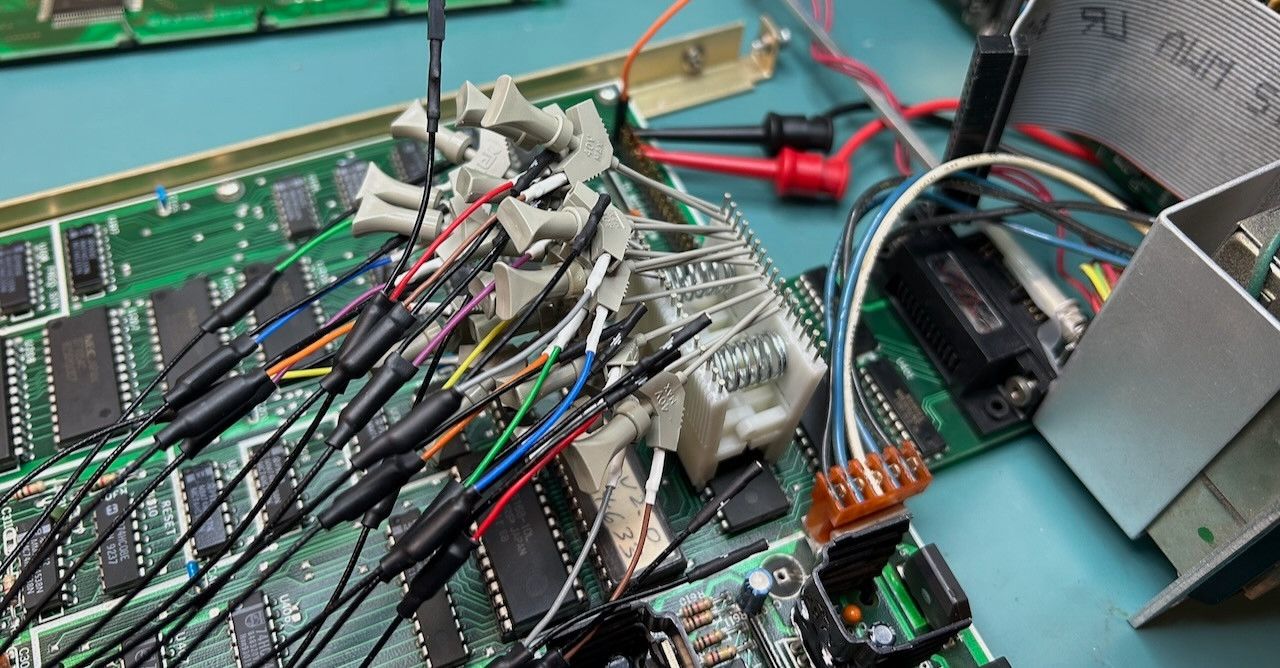
In the video below the break you can see [Ken Shirriff] and [CuriousMarc] team up to crack this tough nut. Resolving the various issues required a whole heap of software and equipment. Most notably a Keysight DSOX3104T oscilloscope, a Retro Chip Tester Pro, an old Agilent 1670G logic analyzer (this thing is rocking a 3.5″ floppy disk drive!), an old Agilent 54622A oscilloscope (also rocking a floppy drive!), a Data I/O 29B Universal Programmer With UniPak 2 insert, and the disassembly software Ghidra.
In the end there were 6 (and a half) bad chips which needed to be discovered and then replaced. This project is a reminder that it’s nice to have the right tools for the job!
If you’ve ever heard the sound of an aircraft passing overhead and looked at an online plane tracker to try and figure out what it was, then you’ve interacted with ADS-B. It’s a protocol designed to enable easier aircraft monitoring, and it just so happens you can decode it yourself with the right hardware and software — which is how [John McNelly] came to develop ADSBee, an open source ADS-B receiver based around an RP2040.
ADS-B uses on–off keying (OOK) at 1 Mbps, and operates at 1090 MHz. This might seem like a rather difficult protocol to decode on a microcontroller, but the RP2040’s PIO is up to the task. All it takes is a bit of optimization, and a some basic RF components to amplify and digitize the signals.
However, not all aircraft utilize the 1090 MHz ADS-B implementation, and instead use a related protocol called UAT. Operating at 978 MHz, a second receiver is needed for decoding UAT traffic data, which is where the CC1312 comes into play. ADSBee may even be the first open source implementation of a UAT decoder!
What’s quite impressive is the various form factors the module is available in. Ranging from small solder-down modules to weatherproof outdoor base stations, nearly every potential need for an ADS-B receiver is covered. With POE or ESP32 S3 options available, there is no shortage of networking options either!
ADSBees have been placed in numerous locations, ranging from base stations to drones. One user even built out a tiny flight display cluster complete with traffic indicators into an FPV drone.
This isn’t the first time we have seen ADS-B receivers used by drone enthusiasts, but this is certainly the most feature rich and complete receiver we have come across.
There’s a lot of laboratory equipment out there that the casual hobbyist will never need to use, but that doesn’t mean you wouldn’t snap it up if the price is right. That’s what happened when [Tom Verbeure] saw a 1980s digital delay generator at a flea market for $40. Not only is it an excellent way to learn something about these devices, but it also provides a fascinating opportunity to troubleshoot and hopefully fix it. Such was also the case with this Stanford Research Systems (SRS) DG535 that turned out to be not only broken, but even features an apparently previously triggered self-destruct feature.
These devices are pretty basic, with this specimen incorporating a Z80 MPU in addition to digital and analog components to provide a programmable delay with 12.5 nanosecond resolution on its output channels after the input trigger is sensed. For that reason it was little surprise that the problem with the device was with its supply rails, of which a few were dead or out of spec, along with a burned-out trace.
Where the self-destruct feature comes into play is with the use of current boosting resistors around its linear regulators. Although these provide a current boost over what the regulator can provide, their disadvantages include a tendency towards destruction whenever the load on the supply rail decreases. This could for example occur when you’re debugging an issue and leave some of the PCBs disconnected.
Unsurprisingly, this issue caused the same charred trace to reignite during [Tom]’s first repair attempt, but after working up the courage over the subsequent 18 months the second repair attempt went much better, also helped by the presence of the mostly correct original board schematics.
Ultimately the fixes were relatively modest, involving replacing a discrete diode bridge with an integrated one, fixing the -9 V rail with a bodge wire, and replacing the LCD with its busted AC-powered backlight with a modern one with a LED backlight. Fortunately running the 5 V rail at 7 V for a while seemed to have caused no readily observable damage, nor did flipping connectors because of SRS’ inconsistent ‘standards’ for its connector orientations.
Sadly, when [Tom] emailed SRS to inquire about obtaining an updated schematic for this unit — which is currently still being sold new for $4,495 — he merely got told to send his unit in for repair.
“L’unità attrae, la divisione disperde”. Lo ha detto Leone XIV, nel discorso pronunciato durante il suo primo Concistoro straordinario, che è cominciato questo pomeriggio alle 15.
“Viviamo in tempi di tempeste terribili, segnati da una violenza crescente, dal crimine armato fino alla guerra. Il divario tra ricchi e poveri si amplia sempre di più. L’ordine globale nato dopo l’ultima guerra mondiale si sta sgretolando.
Sono due i temi scelti dai cardinali che partecipano al primo Concistoro straordinario di Papa Leone XIV: la sinodalità e la missionarietà, nella prospettiva dell’Evangelii gaudium.
“L’unità attrae, la divisione disperde”. Lo ha detto il Papa, nel discorso con cui ha iniziato il suo primo Concistoro straordinario, che è cominciato questo pomeriggio alle 15.
“Far parte della parrocchia della cattedrale di Yaoundé e avere la Porta santa quasi ‘in casa’ mi ha permesso di ricorrere a questo passaggio di grazia nei momenti di tristezza e di difficoltà.
Every Thursday of the week, Bastian’s Night is broadcast from 21:30 CET.
Bastian’s Night is a live talk show in German with lots of music, a weekly round-up of news from around the world, and a glimpse into the host’s crazy week in the pirate movement.
An abridged version of this story appeared in 404 Media's zine. Get a copy here.
The same sort of algorithms that use your face to unlock your phone are being used by cops to recognize you in traffic stops and immigration raids. Cops have access to tools that have scraped billions of images from the web, letting them identify essentially anyone by pointing a phone camera at them. Being aware of all the ways your face is being recognized by algorithms and sometimes collected by cameras when you walk outside can start to feel overwhelming at best, and futile to resist at worst.
But there are ways to disguise yourself from facial recognition systems in your everyday life, and it doesn’t require owning clothes with a special design, or high-tech anti-surveillance gear.
Technologist Adam Harvey’s interest in privacy started right after 9/11, when caring about what information governments and companies could extract from one’s movements was still fringe. “You can connect all these dots from 9/11 and how the surveillance and biometric surveillance industry exploded after that,” Harvey told me in a call. “And the projects that I was interested in doing were a response to that.” One of his earliest forays into anti-surveillance design was CV Dazzle, strategically applied facepaint and hair that fooled a specific facial recognition algorithm. But that was in 2010, and face paint is no longer useful for evading those, or any, systems. They mostly just look cool.
“I try to point that out in all of my texts, but it's often not as interesting as painting your face,” Harvey said. “So people paint their faces and then think that's the key to making it work, and it's fun. I don't want to tell people that they shouldn't have fun. So, you know, the project has really taken on a life of its own online, and I've taken a step back from trying to manage that.” playlist.megaphone.fm?p=TBIEA2… In the years since the Dazzle project made adversarial design mainstream, there have been lots of projects that attempt to confound, pollute, or elude the cameras that watch us move through the world every day. Harvey’s made several more, including heat obscuring ponchos meant to hide the wearer from drones, Faraday cage pockets for phones, and high-powered LED flash arrays for blinding paparazzi. But much of the wearables in this genre—from high-fashion streetwear shops to cheap listings by dropshippers—rely on 2D printed designs that don’t keep up with how quickly algorithms change and improve. The $600 hoodie with a cool pixel design on it might have worked yesterday, in perfect conditions, but the next time the cameras in the mall update their algorithms or datasets, it doesn’t work anymore.
To outsmart surveillance systems, it’s helpful to understand them. Facial recognition—which identifies an individual face—works differently from biometric scans that look at a person’s iris or fingerprints, and those systems work differently from automatic license plate readers, which could in theory match an individual’s movements to a car through a database. And consumer-level facial recognition systems, like Pimeyes, operate using different algorithms and databases from the cameras you might encounter when boarding a flight—with the caveat that the differences in these systems and what data they share is more blurred every day.
Most facial recognition systems break down the elements of a face into its parts: the shape of your eyes, lips, nose, and even ears, and the distances between each part of your face, combined with skin color and numerous other factors. The system then boils your face down to a numerical value. If that value matches the value of existing images it has in its database closely enough, it may be presented as being you. 404 Media Is Making a Zine We are publishing a risograph-printed zine about the surveillance technologies used by ICE. 404 MediaJason Koebler
The facial recognition rabbit hole goes a lot deeper than that; there are theories about how individuals’ face, fingerprint, and iris biometric “signatures” are read by these systems. In the Biometric Menagerie theory developed in 2010, researchers grouped people into four categories: “Sheep,” or people who are easily recognizable by biometric systems; the more difficult “goats” which are difficult to recognize; shape-shifting “wolves” that can successfully imitate others, and later, more subsets of these including “worms,” “doves,” and “lambs.”
All of this sounds complex and sophisticated, but these systems aren’t necessarily hard to fool. It turns out, you probably already own the most effective anti-surveillance fashion: a cloth mask.
“Despite how anybody may try to discourage you, covering your face with a face mask is still very effective,” technologist and fashion designer Kate Rose told me. In 2019, Rose created Adversarial Fashion, a line of clothing that’s covered in fake license plates, meant to pollute the data collected by automatic license plate readers.
“But the question that you had, and everyone has, is, can you beat face recognition? And the answer is yes, and the easiest way is with a Covid mask,” Harvey said. “You see ICE operatives wearing face coverings and sunglasses. At some point there's not enough information to do face recognition.”
Every system is different and every scenario is contextual, but adding a few common items to your kit can reduce the likelihood that enough of your biometrics are obscured to get your biometric matching score down. Big sunglasses, covering your chin and mouth, and wearing a baseball cap or brimmed hat that obscures your features from cameras placed above can all bring that score down. “It's kind of almost a linear relationship between how much of your face you hide and your score in that way. It's quite simple,” Harvey said. But the problem is, you never know what your score is, so you’re going out blindly, not knowing if your Jackie Onassis sunglasses are going to cover enough of your face, or if you have to get an extra long turtleneck or something to wear.”
If you want to really step up your sunglasses game, you could get a pair of glasses that block infrared wavelengths from cameras, like the ones in newer iPhones that use FaceID. The creator of infrared-blocking glasses line Reflectacles, who asked to go by Skitch, told me he sees the anti-surveillance “fashion” market becoming more mainstream with companies like Zenni selling glasses that block some types of facial recognition joining the trend 10 years after he launched his own IR-blocking specs. “I see the landscape of anti-surveillance wearables becoming popularized and monetized,” Skitch said. “If people with money find out that an area of business exists without them making money, they will certainly find a way to gather that market, that money.”
Reflectacles don’t look like normal glasses—they look like something from The Matrix, with a green tint and cyberpunk shapes—but sometimes signaling that you care about privacy to other people is part of the point.
Rose has been organizing community meetings in her small Pacific Northwest town to talk about the influx of Flock cameras on their streets, and she said she’s found that people across all walks of life and political leanings care deeply about privacy. “It can feel kind of futile, but I think it's important to remember that it's also about art and fashion, right? It’s about helping people with their mental abstraction of how [surveillance] works. And to have a tiny little protest that says, well, you have to store all my garbage, analyze it... People get a chance to talk to each other about what's important to them, and it actually helps people to understand something that’s often kind of techy and abstract about how a piece of prevalent surveillance tech works.” If a license plate camera database can be foiled by a t-shirt, maybe we should think twice about putting a camera on every corner.
“I like the definition of privacy from the Cypherpunk Manifesto: ‘Privacy is the power to selectively reveal yourself,’” Harvey said, referring to technologist and cryptographer Eric Hughes’ 1993 call for encrypted information systems. “By allowing other people to collect, watch or monitor you... It's a power dynamic that puts you on the losing end. It's really about power and individual agency, but there's also a destructive political and democratic component to allowing these mass surveillance systems to grow even larger.”
il problema non è neppure solo diventare uno degli stati federali usa ma diventare parte di uno grande stato fascista come quello verso sui sta traghettando con successo il paese. pure la california vorrebbe probabilmente andarsene...
Quando si parla di terre rare l’aggettivo inganna ma solo fino a un certo punto: non sono poi così rare. Sono 17 elementi — dal lantanio al lutezio più scandio e ittrio — ampiamente presenti nella crosta terrestre.
@Giornalismo e disordine informativo articolo21.org/2026/01/meloni-… Dalla conferenza stampa della presidente Meloni è uscita chiara, coerente e spaventosa la morale del “carciofo”, che può sedurre nell’immediato ma porta soltanto alla tragedia della guerra. Cosa è la morale del “carciofo”’ Il mix tra “deterrenza” ed “interesse nazionale”. La
@Giornalismo e disordine informativo articolo21.org/2026/01/david-c… Dal quel triste 11 gennaio di quattro anni fa mi domando cosa sarebbe cambiato se avessimo ancora avuto David Sassoli in campo per la politica europea e per la politica italiana. Poco più di un mese dopo sarebbero partiti i carri armati russi per Kiev, l’anno dopo il 7 ottobre, Hamas,
quello che chiamiamo lo scorrere del tempo è in realtà il risultato di in continuo aumento di entropia. lo stato del sistema precedente all'aumento di entropia va perso. la memoria locale di un sistema locale preesistente, anche se preservato, potrebbe non essere più applicato in un contesto globale di entropia aumentata e stato sistemico modificato. lo stesso scorrere della storia è significativo. noi abbiamo i libri di storia che ci dicono cosa è successo in passato. le informazioni migliori sono quelle raccolte nell'epoca presa in esame. ma sono tutte semplificazioni. lo stato del mondo corrente nell'anno 1857 non è globalmente memorizzato e memorizzabile, e non lo è stato, e di fatto è andato perso per sempre con il trascorrere del tempo. è proprio quell'informazione che a causa dell'entropia è andata distrutta. per questo non è possibile tornare indietro nel tempo. l'informazione del passato è stata cancellata, come un nastro che memorizza sempre sulla stesso nastro ripartendo dopo poco a inizio nastro. un buffer molto corto.
@Notizie dall'Italia e dal mondo Assolto il vertice dell’Ordine di Istanbul dopo un processo politico seguito da osservatori internazionali: una crepa nel sistema repressivo, mentre centinaia di legali restano in carcere. L'articolo
Un soliloquio per riflettere sul domani che non vogliamo. Scritto da Alessandro Lepidini (Portavoce dell'Unione dei Comitati contro l'inceneritore) e interpretato da Andrea Santarelli.
Stop Inc Fest - Santa Paolomba 26 agosto 2023
Insieme, diciamo NO all’inceneritore a Santa Palomba.
Mentre il Sindaco Gualtieri "celebra" l'impianto di Copenaghen, noi riportiamo i piedi per terra.
In questi video, Alessandro Lepidini (Portavoce dell'Unione dei Comitati contro l'inceneritore) replica alla " Sviolinata " di Gualtieri sul termovalorizzatore di Copenaghen.
Alla narrazione unilaterale attendiamo ancora Confronti Reali.
Video realizzati dal Comitato No Inceneritore a Santa Palomba.
A Milano i trattori tornano in piazza contro il Mercosur La maggioranza dei Paesi UE ha dato il prima via libera alla firma dell’accordo di libero scambio con il blocco sudamericano del Mercosur, che comprende Brasile, Argentina, Uruguay e Paraguay. Intanto, a Milano decine di trattori hanno bloccato il traffico in piazza Duca d’Aosta per protestare contro l’intesa. Agricoltori e allevatori da tutta Italia, con bandiere tricolori e cartelli come “Difendiamo il Made in Italy”, chiedono garanzie su prezzi, controlli e tutela del reddito agricolo, denunciando che l’accordo favorirebbe importazioni a basso costo e speculazione dannosa per produttori e consumatori. La mobilitazione è promossa da Riscatto Agricolo Lombardia, Coapi e altri sindacati di settore.
“Spegnere le luci” di Caracas: la guerra tecnologica americana smette di essere segreta. Questa trasformazione della difesa non è solo una strategia di marketing politico, ma è diventata essenziale per la gestione e l’attrazione del talento, tema cruciale della competizione
Nell'Anello del Nibelungo di Wagner appare evidente che tutto lo svolgimento dell'azione dall'inizio (l'oro del Reno) fino alla fine (Il crepuscolo degli dei) dipende dalla moglie di Wotan, Frika che detta i comportamenti al marito a cui il capo degli dei non si può sottrarre.
A margine di tutto ciò mi domando perché Frika ha sposato il guercio megalomane, traditore infingardo del matrimonio con tutte le sue scappatelle.
In sostanza il messaggio dell'opera non è solo una pesante critica del potere politico che uccide persino i più amati figli dei potenti con le guerre e le stesse armi del genitore solo per desiderio di potere, di ricchezza e di apparire con oggetti immaginifici che solo loro possono avere. È anche uno spaccato familiare di interessi divergenti fra coniugi che operano uno in conflitto con l'altro perché vogliono solo affermare il loro dominio personale.
Se non fosse stato per la bellezza della musica e le tesi anarchiche accuratamente nascoste l'opera sarebbe stata vittima della censura e mai rappresentata.
Perciò dobbiamo ringraziare la miopia dei censori che ci hanno lasciato un'opera attualissima come contenuti politici e di disgregazione familiare.
L'unico problema è che non abbiamo le tre Norne che ci predicano la distruzione con l'incendio del Valhalla per la liberazione dei popoli dal giogo dei potenti traditori guerci e megalomani.
@Notizie dall'Italia e dal mondo Secondo fonti curde, le fazioni affiliate al governo continuano i bombardamenti, colpendo infrastrutture civili L'articolo ALEPPO. L’esercito siriano afferma di aver preso Sheikh Maqsoud, le forze curde negano proviene da Pagine Esteri.
Segnalato dall'Internet User Group di #Este e pubblicato sulla comunità Lemmy @GNU/Linux Italia #Este Se il tuo computer sembra sia passato da nuovo a modalità tartaruga, questo è il posto giusto per trovare una soluzione 😎Molti utenti notano cali di
“Spegnere le luci” di Caracas: la guerra tecnologica americana smette di essere segreta. Questa trasformazione della difesa non è solo una strategia di marketing politico, ma è diventata essenziale per la gestione e l’attrazione del talento, tema cruciale della competizione
FIRENZE, CULLA DEL RINASCIMENTO. O DELL’AUTOCENSURA?
Succede anche questo, nell’Italia del 2026.
Il Teatro del Maggio Musicale Fiorentino decide di “sospendere momentaneamente” — formula elegante per dire CANCELLARE — gli spettacoli del 20 e 21 gennaio con due artisti di statura mondiale: Svetlana Zakharova e Vadim Repin.
Non per motivi artistici. Non per problemi tecnici. Ma — udite udite — su richiesta dell’Ambasciata ucraina a Roma.
L’arte che chiede il permesso. La musica che deve esibire il passaporto giusto.
A rendere il quadro ancora più edificante, pare che il Teatro riceva fondi dalla Commissione Europea. E si sa: quando il RUBINETTO si apre o si chiude da Bruxelles, la “libertà culturale” diventa improvvisamente molto educata, molto prudente, molto allineata.
Così Firenze — la città di Michelangelo, di Dante, del pensiero libero — festeggia un nuovo “traguardo”: la rinuncia preventiva, la sudditanza elegante, la CULTURA CONDIZIONATA.
Non è difesa dei valori. È normalizzazione della russofobia. È la prova che oggi non serve più censurare: basta FINANZIARE.
E mentre si parla di pace, dialogo e ponti tra i popoli, si continuano a segare le corde dei violini. Con applausi istituzionali.
L'intelligenza artificiale nella scoperta e sperimentazione dei farmaci tra GSK, Insilico Medicine, gemelli digitali e nuovi modelli biologici. L'articolo
“Spegnere le luci” di Caracas: la guerra tecnologica americana smette di essere segreta. Questa trasformazione della difesa non è solo una strategia di marketing politico, ma è diventata essenziale per la gestione e l’attrazione del talento, tema cruciale della competizione
Cascina Torchiera - Piazzale Cimitero Maggio 18, Milano (martedì, 13 gennaio 19:00) GallinƏ! Da questo mese partono ben tre nuovi corsi, per cui correte in cascina, vi aspettiamo con gioia e voglia espressiva!
CPA Firenze sud - Via di Villamagna 27/a, Firenze (sabato, 10 gennaio 21:00) SABATO 10 GENNAIO
Ore 21.00 al CPA Firenze Sud
Iniziativa e dibattito
VENEZUELA, GUERRA e IMPERIALISMO con
Max Lioce - Comitato Internazionalista
Yoselina Guevara Lopez - Scrittrice, giornalista e attivista venezuelana
Sarà un momento di esposizione sull'attuale situazione in Venezuela, dopo i bombardamenti su Caracas e il sequestro del Presidente Maduro e della deputata Flores.
Sarà un momento di confronto sul legame tra le lotte di Resistenza, dalla Palestina all'America Latina fino a ciò che accade nel nostro paese, che si colloca pienamente all'interno del blocco imperialista euro-atlantico, e dove il nostro compito è quello di alimentare lo sviluppo della lotta contro la guerra e la repressione.
Associazione Musicale Culturale Vecchio Son - 14, Via Giovanni Antonio Sacco, San Donato, San Donato-San Vitale, Bologna, Emilia-Romagna, 40127, Italia (domenica, 11 gennaio 10:00) Workshop di danza Sabar a cura di Flaminia Vendruscolo e Tidiane Diop. QUANDO?
Domenica 11 Gennaio 2026 dalle 10 alle 13.30
DOVE? Vecchio Son, via G.A Sacco, 14 – Bologna → 15 minuti a piedi dalla stazione centrale.
L’oggetto del seminario è la danza del Farwoudjar, la madre delle danze che compongono il Sabar. È uno studio in profondità sia per chi non ha mai incontrato il Sabar, o la danza in generale, sia per danzatori. Prende le basi dall'insegnamento di Yama e dal mio percorso di ricerca. Per più info: it.navicellatheatre.org/worksh… flaminia-danza-senegalese
COSA PORTARE? - Pagne o pareo grande - Quaderno e penna Early bird entro il 5 gennaio e ulteriore sconto se porti un'amica/o! Posti Limitati - per info e iscrizione: 3465735907 info@keraps.org Vi aspettiamo!
Barattolo - Via del Borgo di San Pietro, Irnerio, Santo Stefano, Bologna, Emilia-Romagna, 40126, Italia (giovedì, 15 gennaio 17:30) Festival queer di autoproduzioni artistiche: creatività indipendente & aperitivi antifascisti.
N'oi con Lince BENEFIT - Mele Marce, Cesoia, T-Rex Squad, Oltre La Linea
Stella Nera - 67, Via Silvino Folloni, Fossalta, Buon Pastore-Sant'Agnese-San Damaso, Modena, Emilia-Romagna, 41126, Italia (sabato, 17 gennaio 19:00) pizzata e serata benefit per Lince che, la sera del 2 ottobre, durante una manifestazione contro il genocidio in Palestina, è stata colpita al volto da un lacrimogeno, sparato ad altezza uomo, che le ha causato la perdita permanente della vista in un occhio. Si tratta di violenza e repressione che vanno ben oltre il concetto di "ordine pubblico". Questi episodi di abusi stanno diventando sempre più frequenti e le forze dell'ordine si sentono sempre più legittimate, protette da uno stato di polizia. La rabbia e la solidarietà sono le nostre armi. LIBERI DI DISSENTIRE
Ore 20:00 PIZZATA
Ore 22:00 INIZIO CONCERTI:
- Oltre la linea - Cesoia - T-rex Squad - Mele Marce Il ricavato della serata contribuirà ad aiutare Lince a sostenere le spese mediche e legali.
“It is a massive surprise,” said one astronomer who measured the high temperatures of gas in galaxy cluster that existed 12 billion years ago.#TheAbstract
Astronomers Discovered Something Near the Dawn of Time That Shouldn’t Exist
🌘 Subscribe to 404 Media to get The Abstract, our newsletter about the most exciting and mind-boggling science news and studies of the week.
Astronomers have discovered an ancient reservoir of gas that is too hot for cosmic models to handle, reports a study published on Monday in Nature.
By peering over 12 billion years through time to the infant cosmos, a team captured an unprecedented glimpse of a baby galaxy cluster called SPT2349-56. Cosmological models suggest that the gas strewn between galaxies in these ancient clusters should be much cooler than gas observed in modern galaxies, which has been heated up by the intense gravitational interactions that play out in clusters over billions of years.
But the new observations of SPT2349-56 reveal an inexplicably hot reservoir of this intracluster gas, with temperatures similar to those at the center of the Sun, a finding that is “contrary to current theoretical expectations,” according to the new study.
“It is a massive surprise,” said Dazhi Zhou, a PhD candidate at the University of British Columbia who led the study, in a call with 404 Media. “According to our current theory, this kind of hot gas inside young galaxy clusters should still be cool and less abundant, because these baby clusters are still accumulating and gradually heating their gas.”
“This one we discover is already pretty abundant and even hotter than many mature clusters that we see today,” he added. “So, it's a bit different and forces us to rethink our current understanding of how these large structures form and evolve in the universe.”
The first stars and galaxies emerged in the universe a few hundred million years after the Big Bang, during an era called cosmic dawn. Galaxies gradually accumulated together into large clusters over time; for instance, our Milky Way galaxy is part of the Laniakea supercluster which contains about 100,000 galaxies and stretches across hundreds of millions of light years.
As a baby cluster, SPT2349-56 is much smaller, measuring about 500,000 light years across, and containing about 30 luminous galaxies and at least three supermassive black holes. Zhou and his colleagues observed the cluster with Atacama Large Millimeter/submillimeter Array (ALMA), a highly sensitive network of radio telescopes in Chile, which allowed them to capture the first temp check of its intracluster gas.
“Because this gas is pretty distant, it's very challenging to see the light of the gas directly,” explained Zhou. To probe it, the team searched for what’s known as the thermal Sunyaev–Zeldovich signature, which is a detectable distortion of the oldest light in the universe as it passes through intracluster gas.
The results produced a thermal energy measurement of 1061 erg, which is about five times hotter than expected. While the heat source is still unknown, Zhou speculated that it could be caused by high levels of activity in the cluster, where stars are forming 5,000 times faster than in our own galaxy and huge energetic jets of matter spout out of galactic cores.
However, it will take more observations of these distant clusters to figure out whether the hot gas within SPT2349-56 is an aberration, or if super-hot gas is more common in early clusters than predicted.
“Like every first discovery, we have to be cautious and careful with big results,” Zhou said. “We need to test it further, with more independent observations and comparisons to other galaxy clusters at a similar time. This is what we hope that our community will do next, and we're also planning for follow up observations of other clusters to see whether there is a broader trend or if this system is an outlier.”
The new study is part of a wave of unprecedented observations of the early universe within the past few years. The James Webb Space Telescope, for example, has discovered massive galaxies much earlier in time than expected, pointing to a tantalizing gap in our knowledge about how our modern cosmos emerged from these ancient structures.
“It is starting to change our current understanding of how energetic the galaxy formation process was in such an early time,” Zhou said. “Galaxies were formed and evolved with much more violence, and were more active, more extreme, and more energetic than what we used to expect. The James Webb results are also consistent with our current discovery that these galaxies were very powerful in shaping their surroundings.”
Detection of hot intracluster gas in SPT2349−56 with the Atacama Large Millimeter/submillimeter Array provides new insights into early cluster formation.
The publisher is teaming with a company that claims its proprietary AI can ‘provide 2 to 3 times higher quality translations’ than other large language models.#News #AI
HarperCollins Will Use AI to Translate Harlequin Romance Novels
Book publisher HarperCollins said it will start translating romance novels under its famous Harlequin label in France using AI, reducing or eliminating the pay for the team of human contract translators who previously did this work.
Publisher’s Weekly broke the news in English after French outlets reported on the story in December. According to a joint statement from French Association of Literary Translators (ATFL) and En Chair et en Os (In Flesh and Bone)—an anti-AI activist group of French translators—HarperCollins France has been contacting its translators to tell them they’re being replaced with machines in 2026. playlist.megaphone.fm?p=TBIEA2… The ATFL/ En Chair et en Os statement explained that HarperCollins France would use a third party company called Fluent Planet to run Harlequin romance novels through a machine translation system. The books would then be checked for errors and finalized by a team of freelancers. The ATFL and En Chair et en Os called on writers, book workers, and readers to refuse this machine translated future. They begged people to “reaffirm our unconditional commitment to human texts, created by human beings, in dignified working conditions.”
HarperCollins France did not return 404 Media’s request for comment, but told Publisher’s Weekly that “no Harlequin collection has been translated solely using machine translation generated by artificial intelligence.” In its statement, it explained that the company turned to AI translations because Harlequin’s sales had declined in France.
“We want to continue offering readers as many publications as possible at the current very low retail price, which is €4.99 for the Azur series, for example,” the statement said. “We are therefore conducting tests with Fluent Planet, a French company specializing in translation for 20 years: this company uses experienced translators who utilize artificial intelligence tools for part of their work.”
According to Fluent Planet’s website, its translators “studied at the best translation universities or have decades of experience under their belt.” These human translators are aided by a proprietary translation agent Fluent Planet called BrIAn.
“When compared to standard machine translation systems that use neural networks, BrIAn can provide 2 to 3 times higher quality translations, that are more accurate, offer idiomatic phrasing, provide a deeper understanding of the meaning and a faithful representation of the style and emotions of the source text,” the site said. “BrIAn takes into account the author’s tone and intention, making it highly effective for complex literary or marketing content.”
Translation is a delicate work that requires deep knowledge of both languages. Nuances and subtleties—two aspects of writing AIs are notoriously terrible at—can be lost or deranged if not carefully considered during the translation process. Translation is not simply a substitution game. Idioms, jargon, and regional dialects come into play and need a human touch to work in another language. Even with humans, the results are never perfect.
“I will tell you that the author community is up in arms about this, as we are anytime an announcement arrives that involves cutting back on human creativity and ingenuity in order to save money,” romance author Caroline Lee told 404 Media. “Sure, AI-generated art is going to be cheaper, but it cuts out our cover artists, many of whom we've been working with for a decade or more (indie publishing first took off around 2011). AI editing can pick up on (some) typos, but not as well as our human editors can. And of course, we're all worried what the glut of AI-generated books will mean for our author careers.”
HarperCollins France is not the first major publisher to announce its giving some of its translation duties over to an AI. In March of 2025, UK Publisher Taylor & Francis announced plans to use AI to publish English-language books in other languages to “expand readership.” The publisher promised AI-translated books would be “copyedited and then reviewed by Taylor & Francis editors and the books’ authors before publication.”
In a manifesto on its website, In Flesh and Bone begged readers to “say no to soulless translations.”
“These generative programmes are fed with existing human works, mined as simple bulk data, without offering the authors the choice to give their consent or not,” the manifesto said. “Furthermore, the data processing remains dependent on an enormous amount of human labour that is invisibilized, often carried out in conditions that are appalling, underpaid, dehumanizing, even traumatizing (when content moderation is involved). Finally, the storage of the necessary data for the functioning and training of algorithms produces a disastrous ecological footprint in terms of carbon balance and energy consumption. What may appear as progress is actually leading to immense losses of expertise, cognitive skills, and intellectual capacity across all human societies. It paves the way for a soulless, heartless, gutless future, saturated with standardized content, produced instantaneously in virtually unlimited quantity. We are close to a point of no return that we would never forgive ourselves for reaching.”
The translation of the manifesto from French to English was done by the collective themselves.
Following backlash from the French Literary Translators Association, HarperCollins France confirmed it’s “conducting tests” with a French company that “uses experienced translators who utilize artificial intelligence tools,” to translate Harleq
Here is the Agreement Giving ICE Medicaid Patients' Data
A data sharing agreement between the Department of Homeland Security (DHS) and the Centers for Medicare & Medicaid Services (CMS), which was designed for ICE to receive the personal data of nearly 80 million Medicaid patients, was published as part of a lawsuit last year, with the public now able to see the exact text of that unprecedented agreement.
Last year, Freedom of the Press Foundation and 404 Media sued DHS for a copy of the agreement after the agency failed to turn it over in response to Freedom of Information Act (FOIA) requests. A U.S. attorney working on that case then flagged to our counsel that the document had been released in a separate lawsuit various states brought against the Department of Health and Human Services and DHS.
The full text of the agreement also shows the data promised to ICE included more granular data than previously reported, such as patients’ banking “routing number, account type, account number.”
“Access to this information will allow ICE to receive information concerning the identity and location of aliens in the United States, such as address, telephone number, banking information (routing number, account type, account number), email address, internet protocol (IP) addresses, or other information relevant to identifying and locating aliens in the United States,” the agreement reads.
💡 Do you know anything else about this data sharing? I would love to hear from you. Using a non-work device, you can message me securely on Signal at joseph.404 or send me an email at joseph@404media.co.
The existence of the data sharing agreement was reported at the time by the Associated Press and later WIRED. 404 Media has uploaded a copy here. At the end of December, a judge ruled that the Trump administration could resume sharing much of the data after it had been blocked from doing so, Politico reported. That means ICE can use Medicaid data in deportation cases starting Tuesday, Politico added.
Under a section called “description of the data that may be disclosed,” the agreement says that data includes “Medicaid recipients: Name, address, assigned Medicaid identification number, social security number (SSN), date of birth, sex, phone number, locality, ethnicity and race.” The data allowed to be given to ICE under the new ruling is slightly narrower than that, and includes citizenship, immigration status, address, phone number, date of birth, and Medicaid ID, and is limited to people living unlawfully in the U.S., Politico reported.
In June the Associated Press reported Medicaid officials unsuccessfully fought to block the transfer of data related to millions of Medicaid enrollees from California, Illinois, Washington state, and Washington D.C. Emails showed two top advisers to Health Secretary Robert F. Kennedy Jr. ordered the data transfer and CMS officials had 54 minutes to comply, the Associated Press added. At the time, the exact purpose of the data sharing was not known. Then the Associated Press reported on the agreement itself that said the sharing was for ICE to locate aliens in the country. playlist.megaphone.fm?p=TBIEA2… CMS did not respond to 404 Media’s request for comment.
DHS Assistant Secretary Tricia McLaughlin told 404 Media in a statement, “President Trump consistently promised to protect Medicaid for eligible beneficiaries. To keep that promise after Joe Biden flooded our country with tens of millions of illegal aliens CMS and DHS are exploring an initiative to ensure that illegal aliens are not receiving Medicaid benefits that are meant for law-abiding Americans.” Undocumented immigrants do not have access to federally funded healthcare coverage, including Medicaid, according to the non-partisan, non-profit organization American Immigration Council. Federal law mandates that hospitals provide emergency care regardless of the person’s immigration status, the organization says.
The agreement is part of a much wider practice of data sharing across the second Trump administration and its mass deportation effort. The IRS has funneled data to ICE; in November a court blocked that data sharing. This month the New York Times revealed the TSA was sharing multiple lists of people a week with ICE so immigration authorities could then detain them at airports.
Correction: due to an editing error, this article previously said we sued DHS earlier this year. It was last year. The copy has been updated to reflect this.
A federal judge sided with plaintiffs who argued that the data-sharing pact violated privacy laws, putting immigrants at risk of their information being “impermissibly used” by ICE.
No, non è umano. Non è proprio dell'umanità uccidere un uomo perché un immigrato. Oppure straniero. O perché figlio di un'altra cultura, di un altro paese, di un altra regione o città. È disumano. Che poi, che significa "straniero", "immigrato", "extracomunitario"? È forse qualcuno che ha osato superare gli invisibili confini politici della terra di cui ci siamo stomachevolmente appropriati? Gente che ha avuto l'ardire di oltrepassare la soglia di "casa nostra"? Ma quale posto può esistere che non possa essere condiviso? Quali mani non possono attingere dallo stesso piatto? Quale pane non può essere spezzato in due? E i confini, che cosa sono? Non capisco. Dall'alto non si vedono, giuro. Chiunque può accertarlo: basta guardare dal finestrino di un aereo quando sorvola le nazioni e città. Si vedono solo alberi, laghi, colli e fiumi. Montagne altissime, prati, e poi il cielo. Non c'è occhio che possa distinguere una frontiera, e non esistono braccia che non possano distruggere muri e reti, cancellare delimitazioni; non esistono piedi incapaci di sbiadire le soglie, di prendere a calci le porte chiuse. Dovremmo sfondarle, le barricate dell'egoismo. Spalancarle, e lasciare tutti liberi. Perché lo spazio non esiste, è solo il rapporto tra le cose. E non esiste rapporto tra cosa e cosa, posto tra un punto e un punto, che possa giustificare un assassinio, un discrimine, una qualunque ributtante cattiveria. Che cazzo significa essere stranieri? Ditemelo, che cosa voglia mai dire essere "di un altro posto"? Perché sarebbe così tanto importante da ridurre il valore della vita a quello di una volgare raffica di mitra? Perché la sua vita dovrebbe valere meno della mia, della nostra, della vita della "gente di qua"? Vuol forse dire che non sono uguali a me? Che il loro sangue ha un colore diverso? Che i loro cuori non sanguinano davanti alla morte, alle disgrazie, alle malattie, ai dispiaceri di questo mondo? Vuol dire che le loro mani, quando vengono strette forte dai loro figli, non provano le stesse vibrazioni che provo io, quando sono i miei figli a stringermele? Vuol dire che i loro occhi non lacrimano davanti a Dio, quando pregano? Che le loro palpebre, quando si chiudono, non lasciano liberi i sogni? Vuol dire che la loro dignità è niente, solo perché stranieri? Forse non respirano la mia stessa aria? Non si bruciano la pelle sotto il sole? Non sentono il freddo o il caldo, come quando la neve colpisce con i suoi aghi il viso, o come quando il sole acceca, e non vedi più dove vai? Forse non hanno la mia stessa fame? E le loro papille gustative percepiscono i sapori diversamente dai miei? E i loro orecchi non sentono forse i miei stessi rumori, i miei stessi suoni, la mia stessa musica? I loro palpiti nervici, le mie stesse, incontrollabili, emozioni? Che vuol dire? Che cazzo vogliono dire tutte queste assurde cretinate? Che cazzo stiamo diventando? Che cazzo siamo diventati?
Pubblicato da @IFTAS questo rapporto si basa su sondaggi dettagliati e sul feedback della community, composto da moderatori volontari, amministratori e community manager del social web decentralizzato. Offre il quadro più completo finora sul panorama della fiducia e della sicurezza in progetti come Mastodon, GoToSocial, WordPress, PeerTube e altri.
Cosa c'è nel rapporto
- Nuove pressioni sui moderatori : il rapporto medio moderatori-utenti è peggiorato a 1:3.500 - Lo spam ha superato il CSAM come principale preoccupazione per la maggior parte delle squadre - Il burnout rimane diffuso : 1 amministratore e moderatore su 5 ha segnalato traumi o esaurimento - La maggior parte dei servizi non dispone delle garanzie legali o procedurali necessarie per gestire il rischio - Le piccole comunità dominano , ma l'ecosistema non ha gli strumenti progettati per loro - La federazione basata sul consenso sta emergendo come un modello desiderato per la crescita e la sicurezza
Novità del 2025
- C’è una crescente concentrazione tra i grandi servizi e una crescente tensione - C'è meno integrazione di nuovi moderatori , anche se le minacce aumentano - Le campagne di disinformazione e lo spam generato dall'intelligenza artificiale sono ora rischi importanti - La complessità legale e normativa è in aumento, ma il supporto resta scarso
Previsioni per il 2026
Il rapporto di quest'anno include anche una previsione lungimirante, individuando cinque tendenze che caratterizzeranno l'anno a venire:
- La logica condivisa e i segnali di fiducia sostituiranno le liste di blocco frammentate - I media sintetici e l'impersonificazione metteranno alla prova la moderazione umana - I rischi di cattura delle infrastrutture aumentano man mano che gli strumenti vengono centralizzati - La regolamentazione globale della sicurezza sta diventando obbligatoria e non facoltativa - Greylisting e allowlisting potrebbero presto sostituire la “federazione aperta predefinita”
Perché questo è importante
I moderatori sono la spina dorsale di un social web più sicuro, ma la maggior parte di loro non è retribuita, non riceve sufficiente supporto ed è costantemente sotto pressione. Se vogliamo un futuro per le piattaforme decentralizzate che rispetti l'autonomia degli utenti, la libertà di parola e l'autonomia della comunità, dobbiamo supportare l'infrastruttura che ne garantisce la sicurezza.
New insights into the people, pressures, and infrastructure shaping decentralised platforms Published by IFTAS, this report draws on detailed surveys and community feedback from volunteer moderators, administrators, and community managers across the decentralised social web. It offers our most comprehensive picture yet of the trust and safety landscape across projects like Mastodon, GoToSocial, WordPress, PeerTube, and more.
What’s in the Report
New pressures on moderators: The average mod-to-user ratio has worsened to 1:3,500
Spam has overtaken CSAM as the top concern for most teams
Burnout remains widespread: 1 in 5 admins and moderators reported trauma or exhaustion
Most services lack legal or procedural safeguards needed to manage risk
Small communities dominate, but the ecosystem lacks tooling designed for them
Consent-based federation is emerging as a desired model for growth and safety
What’s New in 2025
There is growing consolidation among large services – and growing strain
There’s less onboarding of new moderators, even as threats increase
Disinformation campaigns and AI-generated spam are now prominent risks
Legal and regulatory complexity is increasing – but support remains scarce
Forecasts for 2026
This year’s report also includes a forward-looking forecast, identifying five trends that will shape the coming year:
Shared logic and trust signals will replace fragmented blocklists
Synthetic media and impersonation will challenge human moderation
Infrastructure capture risks are rising as more tooling centralises
Global safety regulation is becoming enforceable, not optional
Greylisting and allowlisting may soon replace “default open federation”
Why This Matters
Moderators are the backbone of a safer social web – but most are unpaid, under-supported, and under constant strain. If we want a future for decentralised platforms that respects user agency, civil speech, and community autonomy, we need to support the infrastructure that keeps it safe.
In the weeks ahead, we’ll be publishing a series of follow-up posts that take a closer look at the trends, challenges, and emerging patterns highlighted in this year’s report. These articles will explore context and practical insights for anyone working to support safer, more resilient decentralised platforms.
Media or Press Enquiries
For questions, interviews, or background information related to the report or IFTAS’ work, contact press@iftas.org
Follow IFTAS to stay informed: Mastodon, Bluesky, WordPress (see below)
Running a federated messaging service exposes the volunteer staff to legal and regulatory requirements, online harms, and myriad questions. IFTAS provides resources to volunteer moderators, adminis…
The Legion of Doom (LoD) wasn’t just a hacker group, it captured the essence of underground hacking in the 80s/90s. BBSes, phreaking, rival crews, and the crackdowns that changed everything.








404 MediaJason Koebler