
letter(atur)e minori (deleuze) / vita minore / verbi-nomi-fratelli-sorelle minori
differx.noblogs.org/2026/02/10…
reshared this
Informiamo Porro che il bando vinto servirà per difendere la libertà d’informazione
@Giornalismo e disordine informativo
articolo21.org/2026/02/informi…
Da Roberto Morione a Paolo Petrecca, da Roberto Benigni ad Andrea Pucci, questa è la Rai voluta e imposta dalla presidente
Giornalismo e disordine informativo reshared this.
Dichiarazione pubblica sull’assedio imposto a Kobani
Da oltre tre settimane, la città di Kobani è sottoposta a un assedio severo e continuo che colpisce più di mezzo milione di persone. Tra queste vi sono i residenti originari della città, così come famiglie sfollate che vi avevano trovato rifugio provenendo da Afrin, dai quartieri Sheikh Maqsoud e Ashrafieh, da Tabqa, Raqqa e dalle aree rurali circostanti. Questo assedio è stato accompagnato dalla sospensione deliberata dei servizi di elettricità e acqua, nonché da restrizioni all’ingresso di forniture mediche, cibo, carburante e altri beni essenziali. Di conseguenza, le condizioni umanitarie e sanitarie della città sono peggiorate in modo allarmante.
Il protrarsi di queste dure condizioni mette seriamente a rischio la vita dei civili, in particolare dei bambini, dei malati e delle famiglie vulnerabili. Sono state segnalate gravi carenze di cibo, latte artificiale per neonati e medicinali essenziali, mentre le strutture sanitarie stanno affrontando un esaurimento critico di forniture mediche e materiali di cura. La maggior parte dei negozi locali è stata costretta a chiudere dopo aver esaurito le scorte disponibili, e la vita quotidiana è diventata una lotta costante per soddisfare i bisogni di base. Questa situazione equivale a una punizione collettiva e costituisce una grave violazione degli standard umanitari internazionali.
Kobani è diventata un simbolo globale della resistenza contro il terrorismo, e la sua liberazione ha segnato un punto di svolta nella lotta contro l’ISIS. Oggi la città è sottoposta a misure ritorsive per il ruolo svolto nella difesa di valori umani condivisi. Sfruttare la situazione della città come strumento di pressione politica contro le Forze Democratiche Siriane (SDF) è un’azione pericolosa e coercitiva. Essa prende di mira una popolazione che ha avuto un ruolo guida nella lotta al terrorismo, proteggendo non solo il proprio popolo, ma anche gli interessi più ampi dell’umanità.
Il Consiglio Democratico Siriano (SDC) esprime la sua assoluta condanna dell’assedio imposto alla città di Kobani. Considera questo assedio un crimine contro l’umanità e una flagrante violazione del diritto umanitario internazionale e di tutte le convenzioni internazionali concepite per proteggere i civili durante i conflitti armati. L’SDC ritiene le parti che impongono l’assedio pienamente responsabili — legalmente e moralmente — di ogni vittima civile che possa morire a causa della fame, delle malattie o della mancanza di cure mediche essenziali. Respinge con forza l’uso dei civili e dei loro mezzi di sussistenza come strumenti di coercizione politica o militare, sotto qualsiasi giustificazione.
L’SDC invita inoltre l’autorità provvisoria di Damasco ad assumersi le proprie responsabilità sovrane e legali nei confronti dei cittadini. Esorta all’immediata apertura di tutti i valichi per consentire l’ingresso di cibo, medicinali, carburante e beni di prima necessità, e chiede la cessazione di tutte le misure che contribuiscono a inasprire l’assedio della città. L’unità della Siria non può essere costruita attraverso l’affamamento del suo popolo, ma attraverso la tutela della sua dignità e dei suoi diritti fondamentali.
Inoltre, l’SDC invita tutte le forze nazionali e democratiche siriane a prendere posizione rispetto al grave crimine che si sta commettendo a Kobani. Sottolinea la necessità di una posizione nazionale unitaria che respinga l’assedio e ponga la dignità umana al di sopra di interessi politici limitati.
L’SDC sollecita inoltre la Coalizione Globale contro l’ISIS ad adempiere alle proprie responsabilità nel mantenimento della sicurezza, intervenendo con urgenza per revocare l’assedio e prevenire un ulteriore collasso umanitario. Un simile collasso minaccerebbe di compromettere la relativa stabilità raggiunta nel Nord-Est della Siria.
L’SDC si rivolge infine alle Nazioni Unite, al Consiglio di Sicurezza dell’ONU e alle organizzazioni umanitarie internazionali affinché intraprendano azioni immediate. Chiede l’invio di missioni investigative indipendenti, l’apertura di corridoi umanitari urgenti e la classificazione di queste violazioni nel quadro dei crimini che richiedono responsabilità internazionale. L’SDC sottolinea che dichiarazioni ed espressioni di preoccupazione, da sole, sono insufficienti di fronte a una crisi di tale portata.
Oggi Kobani richiama l’attenzione della comunità internazionale. Una città che un tempo ha rappresentato la difesa della vita e la resistenza contro il terrorismo non deve essere lasciata a deteriorarsi in queste condizioni. L’SDC ribadisce che la dignità del popolo di Kobani non è negoziabile e che la determinazione di una popolazione che ha sconfitto l’ISIS non può essere piegata da un assedio o dalla privazione.
Consiglio Democratico Siriano
9 febbraio 2026
L'articolo Dichiarazione pubblica sull’assedio imposto a Kobani proviene da Retekurdistan.it.
dispiace che sia uno scrittore russo (e la russia non ha certo l'esclusiva comunque) ma oggettivamente è uno dei libri migliori mai letti. come minimo nella top 50.
ci sono dei libri che anche solo ripensare ti danno un "calore dentro"... come se davvero avessero vita e ti arricchissero. un po' come una fede religiosa. complessi e articolati e mai del tutto svelati. libri che non smettono mai di parlare. che non puoi che ammirare e amare. questo è uno di loro. solo a rileggere questo articolo ho rivissuto emozioni incredibili. una sorta di solletico mentale che ti ricorda quanto è stato bello ogni volta leggerlo. pochi libri danno queste emozioni. non di più della mia top 50. un libro unico e imperdibibile. per certi versi testimone del dramma e dell'imperfezione umana.
non metterei la cultura russa su un piedistallo, ma quel libro di certo ha vita e un valore suo. sono quelle opere che diventano esse stessa "persone". probabilmente il libro stesso ha una sua anima. ho un debole per l'ironia e quel libro è magistrale in tal senso. solo leggerlo è appagante.

"Il Maestro e Margherita": come orientarsi prima (e dopo) la lettura? - Una guida
"Il Maestro e Margherita", capolavoro postumo di Michail Afanas'evič Bulgakov, resta uno dei romanzi più originali e complessi della letteratura del '900, con il suo fascino satirico-grottesco e le sue stratificazioni culturali, storiche e politiche.Eva Luna Mascolino (Il Libraio)
Referendum: puntare sui SI per far vincere i NO
@Giornalismo e disordine informativo
articolo21.org/2026/02/referen…
Se l’affluenza al referendum sulla giustizia resterà sotto il 50%, rincorrere gli indecisi o tentare di convertire un elettore di destra al “No” equivale a un investimento a basso rendimento. Le risorse disponibili – tempo, messaggi,
Giornalismo e disordine informativo reshared this.
Ring's 'Search Party' is dystopian surveillance accelerationism.
Ringx27;s x27;Search Partyx27; is dystopian surveillance accelerationism.#Ring #Surveillance


With Ring, American Consumers Built a Surveillance Dragnet
America, it’s time to refamiliarize yourself with Ring.
youtube.com/embed/OheUzrXsKrY?…
At Sunday’s Super Bowl, Ring advertised “Search Party,” a cute, horrifyingly dystopian feature nominally designed to turn all of the Ring cameras in a neighborhood into a dragnet that uses AI to look for a lost dog: “One post of a dog’s photo in the Ring app starts outdoor cameras looking for a match,” Ring founder Jamie Siminoff said in the Super Bowl commercial. “Search Party from Ring uses AI to help families find lost dogs.” Onscreen, an AI-powered box forms around a missing dog: “Milo Match,” it says. “Since launch, more than a dog a day has been reunited with their family. Be a hero in your neighborhood with Search Party. Available to everyone for free right now.”It does not take an imagination of any sort to envision this being tweaked to work against suspected criminals, undocumented immigrants, or others deemed ‘suspicious’ by people in the neighborhood. Many of these use cases are how Ring has been used by people on its dystopian “Neighbors” app for years. Ring rose to prominence as a piece of package theft prevention tech owned by Amazon and by forming partnerships with local police around the country, asking them to shill their doorbell cameras to people in their neighborhoods in return for a system that allowed police to request footage from individual users without a warrant.
Chris Gilliard, a privacy expert and author of the upcoming book Luxury Surveillance, told 404 Media these features and its Super Bowl ad are “a clumsy attempt by Ring to put a cuddly face on a rather dystopian reality: widespread networked surveillance by a company that has cozy relationships with law enforcement and other equally invasive surveillance companies.”
Unlike, say, data analytics giant Palantir or some other high-profile surveillance companies, Ring is a surveillance network that homeowners have by and large deployed themselves, powered by fear mongering against our neighbors and unfettered consumerism.
After a lot of criticism in the late 2010s over its police contracts and its terrible security settings that resulted in hackers breaking into a series of indoor Ring cameras to terrorize children and families, Ring somehow found a way to more or less fly under the radar the last few years as a critical part of our ever-expanding surveillance state. It did this by scaling back police partnerships that were so critical to its growth but that received lots of scrutiny from journalists and privacy advocates. Siminoff left Ring in 2023, but returned last year; in his absence, Ring explicitly sought to take on a softer tone by branding itself as more or less as a device that could be used to film viral moments on people’s porches. It turned its owners into mini cops who would complain about delivery people who didn’t drop a package in the correct spot; who became hyperaware of the comings and goings of their friends, spouses, and children, or who might catch a potentially sharable moment when someone slipped on an icy porch or whatever. Part of this strategy included creating a short-lived reality TV show called Ring Nation, which consisted of precious little moments filmed through Ring cameras.
When Siminoff returned last year, he immediately sought to re-establish many of Ring’s partnerships with police, and set an explicit goal of injecting more AI into Ring cameras and trying to “revolutionize how we do our neighborhood safety.”
“Ring is rolling back many of the reforms it’s made in the last few years by easing police access to footage from millions of homes in the United States. This is a grave threat to civil liberties in the United States,” Matthew Guariglia of the Electronic Frontier Foundation wrote shortly after Siminoff’s return. “This is most likely about Ring cashing in on the rising tide of techno-authoritarianism, that is, authoritarianism aided by surveillance tech. Too many tech companies want to profit from our shrinking liberties.”
Even in Siminoff’s absence, Ring had always, explicitly been intended to assist law enforcement. In a series of investigations we did back at VICE, we uncovered thousands of pages of documents, emails, and chats via public records requests and leaks that highlighted Ring’s surveillance ambitions. The company threw parties for police, employees wore “FUCK CRIME” shirts to internal parties, and helped police facilitate the retrieval of footage from its customers’ cameras if they initially refused to cooperate. It helped police set up elaborate, completely useless package “sting” operations designed to catch criminals but that did not result in any arrests. Ring gave cops devices that they could raffle off to people in their towns, gave police “heat maps” of where its customers lived, used its social media accounts to post footage of supposed suspicious people, and incentivized customers to create “Digital Neighborhood Watch” groups that could earn them swag if they used their Ring cameras to report suspicious activity to police.
With Ring’s recent partnership with Flock, which will further facilitate the sharing of video footage with police, and its new Search Party feature, the message is clear: Ring is still, again, and always will be in the business of leveraging its network of luxury surveillance consumers as a law enforcement tool. After years of saying it wasn’t doing facial recognition and that it was focused more on “object recognition,” it has now explicitly launched “friendly” versions of facial recognition and facial recognition-adjacent technologies: “Search Party” is essentially specific dog recognition (for now), and a beta product called “Familiar Faces” specifically identifies people you know when they’re at your door. “Alexa Guard identifies who’s who,” the product’s website reads. “With Familiar Faces, easily tag your family and friends in the Ring app so your 2k and 4k cameras can notify you when someone is spotted.”
Ring has always been a surveillance tool, but adding AI analysis and networking the devices together—like is being promised with Search Party—turns discrete pieces of tech into massive, automated surveillance dragnets.
“Siminoff’s return was a hard pivot back to, in his words, the ‘crime fighting’ element and away from the softer tone they had tried to establish with Ring as a fun way to interact with people in your community,” Gilliard said. “But I think it’s becoming very obvious to people how these systems are being deployed against their neighbors in oppressive ways, and they are beginning to reject them, particularly since there is no strong evidence that they prevent crime or make people safer.”
The YouTube comments on Ring’s Super Bowl ad are almost uniformly negative, with people noting “this is like the commercial they show at the beginning of a dystopian sci fi film to quickly show people how bad things have gotten,” “are we really supposed to believe that the main intent for this is lost pets,” and “glad people are freaking out. This is dystopia becoming reality.”
Ring’s poorly defined partnership with Flock in particular has been the subject of various viral posts and public backlash. Many people have suggested that this partnership is evidence that Ring camera footage will be shared with ICE. At the moment there’s not enough evidence to explicitly say that that’s the case.
The supposed vector goes something like this: Ring says it will partner with Flock, which is used by thousands of local police departments. As we have reported, some of those police departments have performed Flock license plate lookups for ICE. It’s too early to say whether Ring footage will eventually end up with ICE, but the fact that people immediately drew that conclusion and understood the possible method of information sharing shows that surveillance companies can no longer hide behind viral videos of delivery drivers dancing. It’s a mask off moment, and people know it: “In Amazon’s alliance with this administration, it’s become more clear than ever that Ring is an extension of the carceral state,” Gilliard said. “An emotionally charged Super Bowl ad won’t change that.”
ICE Taps into Nationwide AI-Enabled Camera Network, Data Shows
Flock's automatic license plate reader (ALPR) cameras are in more than 5,000 communities around the U.S. Local police are doing lookups in the nationwide system for ICE.Jason Koebler (404 Media)

Privacy and Surveillance reshared this.
Il nuovo video di Pasta Grannies: youtube.com/shorts/x97dpOa3dNs
@Cucina e ricette
(HASHTAG)
Cucina e ricette reshared this.

Via dal bus 15enne disabile che ha dimenticato l'abbonamento a casa, il caso a Vicenza
Il giovane è stato fatto scendere dall'autista, che ora potrebbe essere sanzionatoRedazione Adnkronos (Adnkronos)

Verso un’austerity dei diritti digitali (e non solo) - Nexa Center for Internet & Society
CRS | 8 febbraio 2026 | di Maurizio BorghiNexa Admin (Nexa Center for Internet & Society)
Summer school in Biblioteca. 1966-2026. Frammenti dall’alluvione di Firenze
La Biblioteca nazionale centrale di Firenze intende accostarsi al sessantesimo anniversario dell’alluvione di Firenze, che ricorrerà il 4 novembre 2026, affrontando lo studio e la catalogazione di una particolarissima tipologia di materiali, i frammenti manoscritti estratti dalle legature dei volumi alluvionati e accantonati nell’urgenza di restituire alla fruizione pubblica i libri stessi.
Dal 29 giugno al 3 luglio 2026, sarà organizzata presso la Biblioteca, in collaborazione con l’Associazione Manoscritti Datati d’Italia, l’Ente nazionale Giovanni Boccaccio e l’Istituto nazionale di Studi sul Rinascimento, una Summer School rivolta a giovani laureati e laureate che intendano confrontarsi con lo studio e la catalogazione di frammenti manoscritti e a stampa.
La settimana di studio si svolgerà su 32 ore, tra lezioni frontali e seminariali. A ogni studente saranno assegnati alcuni frammenti, che durante le sessioni seminariali saranno identificati, studiati e catalogati.
È inoltre prevista la pubblicazione di un catalogo e un momento di restituzione pubblica il giorno 4 novembre 2026.
Modalità di partecipazione
Alla Summer School accedono dieci studiosi, previa selezione effettuata dalla Biblioteca. Alla selezione sono ammessi candidati, che siano: laureati magistrali di università italiane o straniere.
Per partecipare alla selezione i candidati dovranno inviare la domanda entro il 30 aprile 2026 al seguente indirizzo: bnc-fi@cultura.gov.it con indicazione dell’oggetto: “Summer School 2026”.
Alla domanda dovrà essere allegato:
- curriculum vitae et studiorum firmato;
- copia di un documento d’identità.
La partecipazione alla Summer School è gratuita; non sono previsti rimborsi spese e borse di studio. Si ricorda che è fortemente consigliata la conoscenza del latino.
L’Avviso è disponibile anche nella nostra sezione Amministrazione trasparente > Bandi di concorso.
Con la collaborazione di


L'articolo Summer school in Biblioteca. 1966-2026. Frammenti dall’alluvione di Firenze proviene da Biblioteca nazionale centrale di Firenze.
Il New Jersey è il quarto stato USA con terapie psichedeliche
Testo preparato con Peppe Brescia
Lo Stato del New Jersey ha approvato a gennaio un disegno di legge che istituisce un programma pilota per la somministrazione medica di psilocibina. Si tratta di un’iniziativa popolare che ha ricevuto il via libera dal Parlamento dello Stato lo scorso 12 Gennaio con una votazione di 48-23 alla Camera e 35-4 al Senato. Phil Murphy, governatore dello Stato, ha apposto la firma il successivo 20 Gennaio, data che è coincisa con il suo ultimo giorno di mandato.
La misura prevede la possibilità per alcuni medici designati di prescrivere psilocibina come trattamento per patologie come il disturbo da stress post-traumatico o la depressione resistente ai farmaci. Inoltre, è stata stabilita la creazione di un comitato consultivo di 11 membri cui spetterà il compito di supervisione, nonché uno stanziamento di circa sei milioni di dollari a sostegno della ricerca.
In un primo momento, la legislazione avrebbe dovuto regolamentare in maniera più ampia possesso e utilizzo di psilocibina a fini personali, ma il dibattito parlamentare ha infine ridimensionato la portata del provvedimento, per questi motivi i senatori Nicholas Scutari e Joseph Vitale hanno depositato un’ulteriore proposta finalizzata a delineare un quadro normativo più completo che includa anche la presenza di centri specializzati.
A seguito dell’entrata in vigore della legge, il Dipartimento della Salute dello Stato sarà tenuto a inoltrare una richiesta di proposta alle strutture ospedaliere intenzionate a prendere parte al progetto. Secondo un principio di equità territoriale e amministrativa, sarà consentito selezionare una sola clinica per ognuna delle tre regioni geografiche in cui è suddiviso lo Stato. A ciascuna struttura verrà assegnato un budget di circa due milioni.
Per quanto riguarda la fase di somministrazione, essa seguirà il modello in tre fasi già utilizzato in altre ricerche, seguendo uno schema che prevede una sessione di preparazione, una sessione di somministrazione e una sessione di terapia integrativa. Una volta concluso l’iter, i pazienti rimarranno sotto osservazione fino al deflusso degli effetti della terapia.
Come specificato nella legge, in nessuna fase della sperimentazione sarà consentito utilizzare, stabilire o implementare alcun tipo di pratica che possa porsi in conflitto con i protocolli e le linee guida fissate dalla Food and Drug Administration in merito ai trattamenti sanitari con molecole psichedeliche.
Per la sperimentazione è stato previsto un periodo di sviluppo di 18 mesi: a studio concluso, i funzionari dovranno presentare relazioni al governatore e alla legislatura, includendo raccomandazioni inerenti l’espansione del progetto così come suggerimenti nella prospettiva di una regolamentazione organica della materia. Allo stesso tempo, il Dipartimento della Salute potrà iniziare ad accettare le richieste di licenza. Qualora l’iter venisse portato a termine senza controindicazioni, il progetto entrerà ufficialmente nella fase operativa.
Secondo Lisa Swain, presidente della commissione per gli stanziamenti dell’Assemblea, il disegno di legge costituisce solo un “primo passo”, in particolare considerando le restrizioni imposte dalle modifiche al testo iniziale.
Sebbene la riforma sia stata generalmente accolta con favore, il provvedimento non ha mancato di suscitare critiche – principalmente rivolte al modello economico: secondo il parere della deputata repubblicana Dawn Fantasia, “i sei milioni di dollari non riguardano in realtà i funghi”, ma rappresentano “il capitale iniziale per un intero nuovo ecosistema governativo che continuerà a essere finanziato anno dopo anno”. Di segno opposto le dichiarazioni di Stacy Swanson – rappresentante di Veterans Exploring Treatment Solutions (VETS), per cui il merito della legge consiste nella creazione di “un accesso strutturato e clinicamente supervisionato, con l’integrazione e il follow-up necessari”.
Nel New Jersey, una prima riforma circa la legislazione sul possesso di psilocibina ha avuto luogo già nel 2021, quando il possesso fino a un’oncia è stato declassato a reato minore.
Nel corso di un sondaggio, condotto nel 2024 dal William J. Hughes Center for Public Policy della Stockton University, è stato stimato che il 55% degli intervistati nello Stato si è dichiarato favorevole alla legalizzazione della psilocibina per uso medico.
Con l’approvazione del Psilocybin Behavioral Health Access and Services Act, il New Jersey diventa dunque il quarto Stato americano a consentire un programma sperimentale di trattamento con psilocibina, unendosi a Oregon, Colorado e New Mexico.
L'articolo Il New Jersey è il quarto stato USA con terapie psichedeliche proviene da Associazione Luca Coscioni.
Uno studente gay è bloccato in Iran. Riportiamolo a casa in Italia!
Un giovane studente di medicina dovrebbe essere libero di studiare, curarsi, progettare il proprio futuro.
Invece è bloccato in Iran, intrappolato da una burocrazia che oggi mette a rischio la sua vita.
È uno studente che vive in Italia. È gay.
E in Iran questo significa repressione, paura quotidiana, violenze possibili. Significa doversi nascondere per restare vivi.
Non sta chiedendo un favore.
Sta chiedendo un diritto: tornare in Italia, continuare gli studi, vivere in sicurezza.
Quando uno Stato nega il rientro a chi è in pericolo, quella non è neutralità: è una scelta politica.
E ogni giorno di silenzio pesa sulle spalle di chi rischia tutto.
L’Italia conosce la situazione in Iran. Conosce i rischi per le persone LGBTQIA+.
Può e deve intervenire ora.

Nessuna vita può essere sacrificata sull’altare della burocrazia.
(Questa campagna è condotta da: Agapanto, Agedo nazionale, Arcigay, Antinoo Arcigay Napoli, Associazione Quore, Associazione Radicale Certi Diritti, CEST centro salute trans e gender variant, Circolo di Cultura Omosessuale Mario Mieli, EDGE, GayCenter, Gaynet, Intersex Esiste, Omphalos LGBTI, Open Catania, Polis aperta, Possibile LGBTI+, Rete Genitori Rainbow, Stonewall GLBT+ Siracusa, T Genus, Ygrò A.P.S., One Billion Rising Italia, Assist Ass. Naz. Atlete aps, Famiglie Arcobaleno, Genderlens e Libellula Italia APS.)
L'articolo Uno studente gay è bloccato in Iran. Riportiamolo a casa in Italia! proviene da Possibile.

Ministero dell'Istruzione
Il #10febbraio è il #GiornodelRicordo, dedicato alla memoria delle vittime delle foibe e dell’esodo dalle loro terre degli istriani, fiumani e dalmati nel secondo dopoguerra.Telegram
Addestramento condiviso e cooperazione. Così si rafforza l’asse Italia, Stati Uniti e Germania
@Notizie dall'Italia e dal mondo
Nella cornice operativa di Vicenza, un gruppo di militari italiani e statunitensi ha preso parte a un’attività addestrativa che va oltre la dimensione della singola prova. Il conseguimento del distintivo di idoneità militare tedesco
Notizie dall'Italia e dal mondo reshared this.
L’auto che sa tutto (ma proprio tutto) di te.
@Privacy Pride
Il post completo di Christian Bernieri è sul suo blog: garantepiracy.it/blog/autosapi…
Claudia ci vizia ancora con le sue preziose riflessioni, tanto vere quanto severe. Non posso aggiungere nulla, se non un fugace pensiero: CB Entri in macchina, chiudi la portiera, lo schermo si accende prima ancora che tu abbia allacciato la cintura. Mappe,
reshared this
Sei semplici passaggi per creare la dipendenza dallo smartphone
peertube.uno/w/aAsMFPGpYR72vQc…



Sei semplici passaggi per creare la dipendenza dallo smartphone
Volete sapere quali accorgimenti tecnici sono utilizzati per tenerci incollati allo smartphone?
È colpa nostra se non riusciamo a spegnere il telefono, oppure è colpa di chi sviluppa le applicazioni?Video originale in lingua inglese
watch.tacticaltech.org/w/dpsm6…
(traduzione non ufficiale)Voce italiana (gratuita per uso non commerciale)
luvvoice.com/Musica:
jamendo.com/track/2206837/work…Traccia audio:
freesound.org/people/Glaneur%2…
freesound.org/people/Glaneur%2…
freesound.org/people/sgossner/…
freesound.org/people/crawfordj…
freesound.org/people/MattRuthS…Luvvoice: Free Convert Text to Speech Online, No Word Limit
Free text to speech voices over 70 languages and 200 voices,no word limit. Listen online and download files in mp3 format.A free tts tool.Luvvoice: Free Convert Text to Speech Online, No Word Limit

Is That Ancient Reel Of PLA Any Good?

When it comes to knowledge there are things you know as facts because you have experienced them yourself or had them verified by a reputable source, and there are things that you know because they are common knowledge but unverified. The former are facts, such as that a 100mm cube of water contains a litre of the stuff, while the latter are received opinions, such as the belief among Americans that British people have poor dental care. The first is a verifiable fact, while the second is subjective.
In our line there are similar received opinions, and one of them is that you shouldn’t print with old 3D printing filament because it will ruin the quality of your print. This is one I can now verify for myself, because I was recently given a part roll of blue PLA from a hackerspace, that’s over a decade old. It’s not been stored in a special environment, instead it’s survived a run of dodgy hackerspace premises with all the heat and humidity that’s normal in a slightly damp country. How will it print?
It Ain’t Stringy
In the first instance, looking at the filament, it looks like any other filament. No fading of the colour, no cracking, if I didn’t know its age it could have been opened within the last few weeks. It loads into the printer, a Prusa Mini, fine, it’s not brittle, and I’m ready to print a Benchy.
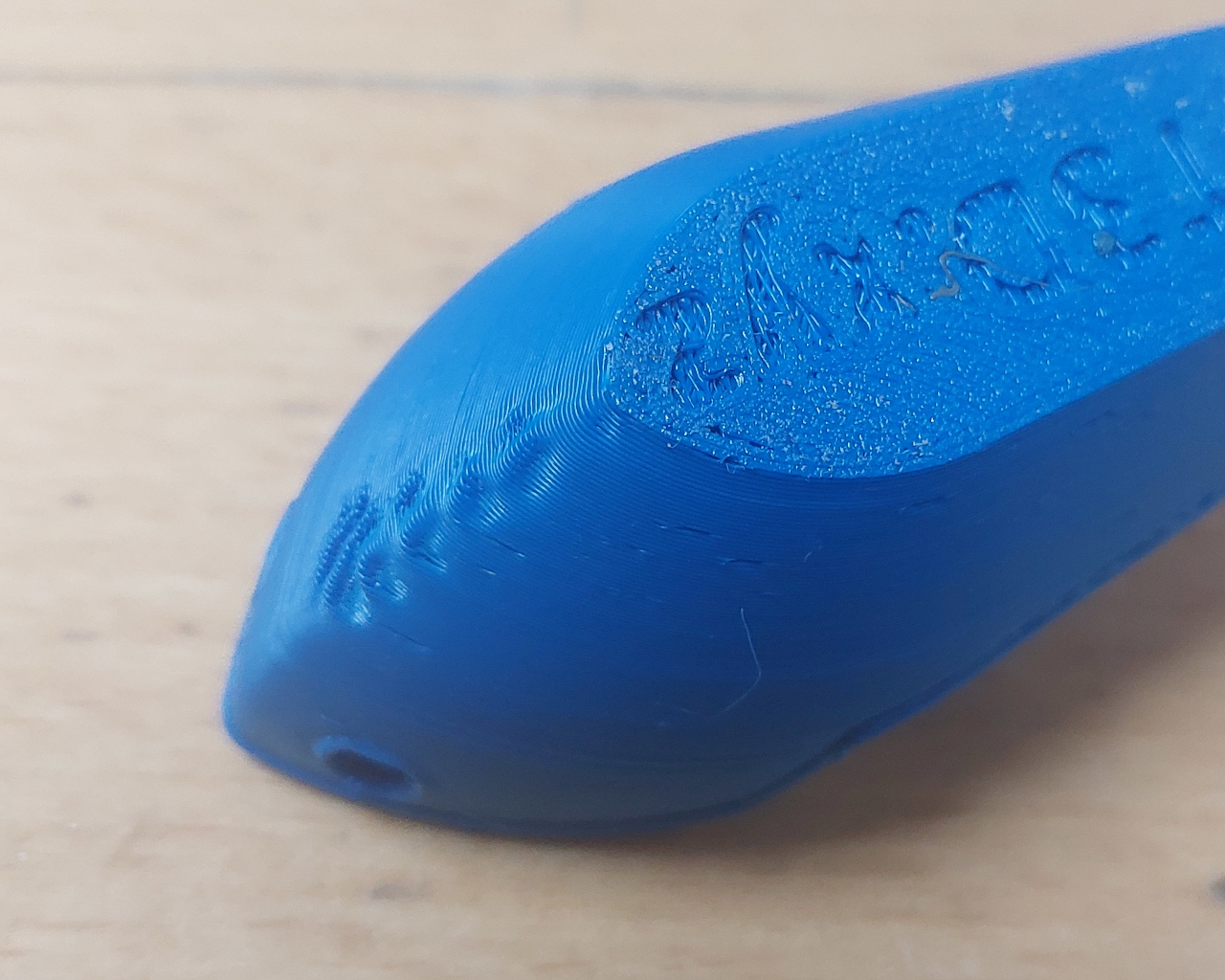
My first surprise on printing the Benchy is that it’s a pretty good print. Received Opinion tells me that PLA is hydrophobic, and if you leave some out for a decade it will absorb so much moisture as to be unusable. In fact I was expecting a very stringy print indeed because I’ve seen that before with filament left out for about a year in the damp British climate. But this Benchy had almost no hairiness, its only flaw was a little bit of collapse along its prow line. I know the Mini isn’t at fault here as I’ve seen it print a flawless Benchy with new PLA, so that’s strike one to the ancient plastic.
Manipulating the Benchy, I found strike two. This is a reasonable print, but with not-too-hard pressure on the cabin I could snap it. The layer adhesion wasn’t as much as it is with a new-filament Benchy, and it has broken cleanly along the layer lines in the cabin pillars. Since snapping a Benchy isn’t a quantitative measure of how much the layer adhesion had degraded, I decided to formulate a test for layer adhesion. If I print something designed for measuring layer adhesion failure in both this old PLA and some new PLA, I can compare the two. It’s not perfect as I don’t have a new reel of the same formulation as the old stuff, but it’ll be close enough.
Punishing Prints, And Risking Holes In The Floor

What I have come up with is a 150 mm long box section with a 2 mm wall. If I clamp the first 5 0mm to the edge of a table, I can apply a force to the far end of the 100 mm poking out into free space, and find its breaking point. To that end I’ve printed two, one in my blue old PLA, and another in brand new grey PLA. I’m dangling a collection of angle brackets each of which weighs 130 g from the end of the box section, and adding brackets until it breaks.
I had only twenty brackets, and as expected the old PLA broke first, at ten brackets, or a 1.3 kg load. My back of the envelope calculation from high school physics gives me about a 130 N force on the top edge of the layer boundary over the fulcrum on the edge of the table to do this. I ran out of brackets and other hardware to try to break the grey box section, and finally admitted defeat when it refused to break with a 3 kg piece of rail I’ve been hoarding to make an anvil dangling from its end. I have proved that layer adhesion with ancient PLA is more than three times weaker than on the same printer with new PLA. It’s interesting when examining the break, the layers have parted very cleanly, this is not tearing of the PLA but simply poor adhesion between layers.
In doing these experiments I’ve discovered, not unexpectedly, that ancient PLA isn’t as good as new PLA. I am assuming that this was as good a PLA as the modern stuff when it was new — indeed I remember printing back in the day and my prints seemed just as good as today. What does surprise me though is that how it’s deteriorated isn’t what I expected. It produces good prints in terms of their physical form, without the hairiness I was expecting. In turn I didn’t expect the prints with this stuff to be weak, so what’s going on?
When The Volatiles Depart, What’s Left?
PLA filament is not pure PLA, instead it has chemicals added to modify its properties. The most obvious one in this reel is the blue pigment, but others might modify its plasticity or melting characteristics, to name two possibilities. These are not going to be stable solids like the polymer, instead they will be volatile compounds which are capable of evaporating over time.
I’m no polymer chemist, so I’ll draw my engineer’s conclusions here and prepare for a roasting from the chemists if I’m wrong. What I think has happened is that the volatile additives in the filament have departed over the years, and both the stringiness in damp newer PLA and the strength in prints made with new PLA are as much due to their presence or absence as to the PLA itself. In my tests here I think I have seen something closer to PLA alone with the additive chemistry absent, and along the way I may have touched on why the manufacturers add it in the first place.
It’s likely few of you are printing using ancient PLA, so while interesting, these results have limited direct relevance to your printing. But I have to wonder whether there’s a lesson to be learned in filament storage, and perhaps using a warm environment to stave off moisture might hasten the departure of those volatiles. Perhaps the best thing is not to be a hoarder, and to use your filament up as quickly as you can. Meanwhile, this isn’t the first time we’ve ventured into backyard physical measurements.
ReMemory is the Amnesia-hedging Buddy Backup You Didn’t Know You Needed

What would happen if you lost your memory, even partially? With so much of our lives being digital, forgetting your passwords (or the master key to your password manager) could be disastrous. Haunted by that specter after a concussion, [eljojo] created ReMemory, a tool based on Shamir’s Secret Sharing to help your friends help you.
Shamir’s Secret Sharing, for the uninitiated, is a way to split up important data between parties so that the full picture is only available when a quorum comes together. The classic example is giving everyone a couple of digits out of the combination to the bank vault, but no one the full combination. Together, they can open the vault.
ReMemory works the same way. Rather than the combination to a bank vault, the locally-hosted, browser-based interface splits the encryption key to your sensitive data. If you’re old fashioned that might be a plaintext list of passwords, or for the more modern the recovery codes to your password manager. It could be literally anything, like your Aunt Edna’s famous cupcake recipe, which surely should not be lost to time.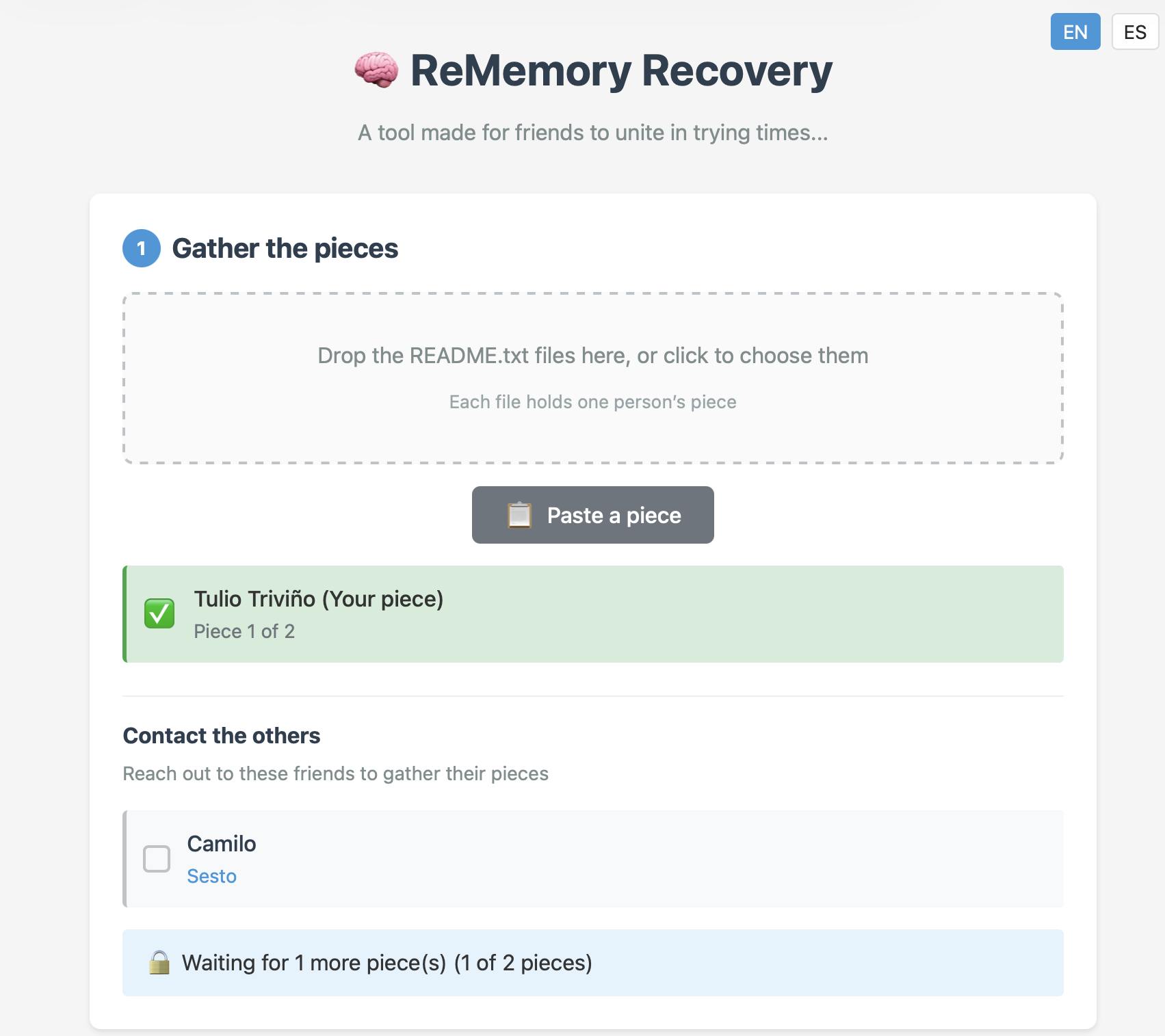
You can chose how many friends to split your data betwixt, and how many will be required to meet quorum– the minimum, of course, being two, but the suggested default is to split the data five ways, and allow decryption from any three parties. Each bundle includes the complete recovery tool, so anyone in your circle of trust can start the process of decrypting your data if they get the others on board. Since it’s self-hosted and browser based, those friends don’t have to be particularly tech-savvy, as long as they can be trusted to hold onto the files. Everything is explained in the readme included in each bundle.
This does have the downside of requiring you to have multiple close friends, at least some of whom you trust to come through in a crunch, and all of whom you trust not to collude behind your back. Still, if you’re the social type, this seems like it might be a useful tool. The code is available under an Apache 2.0 license, so you can audit it for yourself — a must for any tool you plan on entrusting your secrets to.
The best part of the sharing algorithm is that it’s not vulnerable to quantum computing. While [eljojo] was thinking of amnesia when he put the tool together, we can’t help but think this also solves the postmortem password problem.
Gaming on an Arduino Uno Q in Linux

After Qualcomm’s purchase of Arduino it has left many wondering what market its new Uno Q board is trying to target. Taking the ongoing RAM-pocalypse as inspiration, [Bringus Studios] made a tongue-in-cheek video about using one of these SoC/MCU hybrid Arduino boards for running Linux and gaming on it. Naturally, with the lack of ARM-native Steam games, this meant using the FEX x86-to-ARM translator in addition to Steam’s Proton translation layer where no native Linux game exists, making for an excellent stress test of the SoC side of this board.
We covered this new ‘Arduino’ board previously, which features both a quad-core Cortex-A53 SoC and a Cortex-M33 MCU. Since it uses the Uno form factor, all SoC I/O goes via the single USB-C connector, meaning that a USB-C docking station is pretty much required to use the SoC, though there’s at least 16 GB of eMMC to install the OS on. A Debian-based OS image even comes preinstalled, which is convenient.
With a mere 2 GB of LPDDR4 it’s not the ideal board to run desktop Linux on, but if you’re persistent and patient enough it will work, and you can even play 3D video games as though it’s Qualcomm’s take on Raspberry Pi SBCs. After some intense gaming the SoC package gets really quite toasty, so adding a heatsink is probably needed if you want to peg its cores and GPU to 100% for extended periods of time.
As for dodging the RAM-pocalypse with one of these $44 boards, it’s about the same price as the 1 GB Raspberry Pi 5, but the 2 GB RPi 5 – even with the recent second price bump – is probably a better deal for this purpose. Especially since you can skip the whole docking station, but losing the eMMC is a rawer deal, and the dedicated MCU could be arguably nice for more dedicated purposes. Still, desktop performance is a hard ‘meh’ on the Uno Q, even if you’re very generous.
Despite FEX being a pain to set up, it seems to work well, which is promising for Valve’s upcoming Steam Frame VR glasses, which are incidentally Qualcomm Snapdragon-based.
youtube.com/embed/YrrqF2y-dlM?…


EDRi urged the Council to demand a proper scrutiny of the Digital Omnibus proposal
The Digital Omnibus proposal fails to comply with the Charter of Fundamental Rights and Better Regulation rules, EDRi urged the Council to send the proposal back to the Commission for proper scrutiny and comprehensive assessments.
The post EDRi urged the Council to demand a proper scrutiny of the Digital Omnibus proposal appeared first on European Digital Rights (EDRi).
The EU’s Evolving Surveillance Laws Model
When it comes to digital rights, the European Union likes to position itself as the leader globally. Ever since the European Union’s data protection regulation, numerous court verdicts that stopped mass surveillance and the charter that established privacy as a fundamental right, the reputation of the European Union as a leader on digital rights has developed over time. Yet at the same time, EU surveillance laws are being expanded quietly – not by way of some big law that grabs headlines but by a growing number of special regulations that give governments access to digital data faster, broader and more often.
Surveillance is increasingly becoming a part of how the EU regulates the digital sphere, shaping laws on national security, online safety, cross-border policing, and digital infrastructure. What we get is a system that recognizes the rights of people, but puts those rights to test in practice. The EU’s highest court has decided more than once that blanket surveillance has no place in the EU.
It was a little more than a decade ago that the European Union’s Data Retention Directive was ruled by the European Court of Justice to be an unlawful interference in private life as it required communication service providers to store all customer data for some period in order to be able to supply this data to state authorities on request. Later, it was also decided by the European Court of Justice that even just communication data like who you contact, when, and from where, can reveal intimate details about people, so that this metadata must also be protected. The court is clear that surveillance has to be targeted, be proportional to what you want to do and you have to have an independent body overseeing it.
What followed was not a step back but a new strategy – which is a part of contemporary European digital lanscape. Older laws required telecoms and platforms to store data systematically; newer directives focus on access rather than collection. Data may no longer be retained by default but it is increasingly reachable through accelerated processes, technical obligations on providers and cross-border requests that bypass older safeguards.
The legal form has changed, while the practical availability of data often has a different shape. To that end, the growing role of private companies is one of the most visible shifts: platforms are becoming gatekeepers of surveillance. EU rules will allow police and prosecutors in one country to request user data directly from service providers based in another; the aim is speed, as investigations should not stall because data sits behind a border. Even though judicial authorisation should remain central, in practice platforms will be the first line of decision-making, required to assess the legality of requests, often within hours and across different legal systems. A second trend reshaping EU surveillance law is prevention: new legislative proposals aim to detect serious harm – such as child abuse material – before it spreads; few dispute the legitimacy of these goals but the challenge lies in the tools required to achieve them.
Detection systems rely on programs that scan traffic, match patterns and watch networks without pause. When governments use them sparingly, the systems still sweep vast stretches of data. Experts and lawyers warn that once the engines start, no simple off switch exists, above all when privacy is required to remain secure.
Europe’s judiciary has consistently opposed generalized monitoring. In matters concerning national security, judges have emphasized that even significant threats do not warrant permanent or indiscriminate surveillance. The conflict is becoming increasingly evident: preventive goals drive the need for continuous oversight, while constitutional principles demand exceptions and restraint.
But courts have made clear that when providers are required to cooperate systematically with public authorities, fundamental rights still apply-regardless of whether the rules are framed as security or infrastructure policy. (e.g., in cases like Privacy International).
As digital governance shifts toward centralised control of networks, the boundary between managing infrastructure and monitoring users becomes harder to define. Formally, the safeguards remain in place. Courts review surveillance measures. Data protection authorities exist. Independent regulators still play a role.
Yet institutional design matters. Recent reforms emphasise coordination, speed, and centralisation. Oversight is increasingly shared between EU bodies, national authorities, and private companies. Responsibility is spread thin.
European judges have consistently emphasized that access to sensitive data must be granted by entities that are both independent and authorized to deny such access. The question remains whether this standard can be maintained as surveillance becomes increasingly integrated into daily digital systems. This does not constitute a clear rejection of privacy or civil liberties.
In theory, EU surveillance legislation continues to adhere to principles of necessity, proportionality, and judicial oversight. The change is more nuanced. Surveillance is no longer perceived as an extraordinary power but rather as a standard aspect of digital governance, embedded within platforms, networks, and international collaboration. For a Union that identifies itself with transparency, individual rights, and an open digital society, the challenge extends beyond mere legal compliance. It involves ensuring that surveillance does not become the default state of online participation. Whether the existing framework achieves that equilibrium, or subtly shifts it, will significantly influence Europe’s digital future more than any individual piece of legislation.
*Mike reshared this.
European Pirate Party Submission – Towards European Open Digital Ecosystems
Executive Summary
The European Pirate Party considers the Commission’s Towards European Open Digital Ecosystems initiative a significant opportunity to strengthen Europe’s technological sovereignty by embedding open-source principles at its foundation. Open source should be regarded as a component of public infrastructure given its contributions to transparency, cybersecurity resilience, and democratic oversight.
To ensure that this objective is effectively implemented, action is required in four priority areas: updating public procurement frameworks to favour open standards; establishing sustainable funding mechanisms for the long-term maintenance and governance of open-source projects; reducing structural reliance on non-EU digital infrastructure; and introducing safeguards to prevent openwashing and undue vendor influence.
In the absence of coordinated EU-level measures, Europe’s developer community may continue to demonstrate strong technical capacity while remaining fragmented, limiting progress toward strategic autonomy and balanced market competition.
Our full submission responds to all five consultation questions, providing evidence-based analysis and specific policy recommendations.
For the complete analysis and supporting recommendations, please refer to the attached document:
The Case for a Digital Legacies Treaty
Pirate Parties International has increasingly advocated for digital rights in international forums. Our UNHQ representatives presented the importance of digital rights during their 2018 speech at the United Nations Economic and Social Council, and we also published the following statement that year for the Report of the High Commissioner for Human Rights.
We emphasize that digital rights are human rights, and global treaties must sanctify those rights and police nation states that both restrict access to digital services and violate privacy. Our digital footprints are more than merely data. They are a part of our person. When we die our digital footprint remains. We must protect our medical records, emails, photos, social profiles, games, and the host of digital records that reflect ourselves in this modern age where a person exists in a digital world that coexists alongside the physical one.

“…you´ll never need to delete another message”
Imagine logging into an old email only to find years of correspondence vanished, or a cherished game erased, or all of your emails, photographs, and files suddenly in danger of being erased if you do not download them from the cloud. Such is the case when service remove free cloud storage that they dangle to attract new users. Remember when Gmail told us that we would never have to erase an email again: “Don’t throw anything away. 1000 megabytes of free storage so you’ll never need to delete another message”.

That amounts to only 1 gb, which they have since expanded to 15 gb for free, but it is still not enough for most people. Furthermore, utilizing free corporate services like Gmail means that you are selling your data to companies and government agencies. We must provide safe and free storage as a human right.
“Social media platforms must ensure that user accounts are preserved.”
Pirate parties have long championed digital rights, privacy, and user sovereignty. It’s time to protect our extracorporeal (beyond body) and posthumous (after death) online existence with a global Digital Legacies Treaty. The core argument of this accord is to protect personal archives. Even if a user is inactive or dead, we must sanctify their digital records. Individuals who are alive must be able to obtain access to their accounts and services. Likewise, next of kin, must have rights to access them. The right to digital services is similar to a child´s need for education but extending over a lifetime and beyond. This act would ensure perpetual access to services and transfer rights, as well as prevent companies from removing access to services that were provided for free (e.g. offering free storage and then changing policy to charge for it). Social media platforms must ensure that user accounts are preserved, unless the user or their next of kin has expressly provided demands to remove them. As social media grows over time, platforms will have distinct incentives to remove the information of users that do not benefit their corporate or political goals. We must ensure that users and user data are not erased in an effort to control the present and our memories of the past.
“Email services and social media platforms must be treated as effective utilities”
To directly tackle corporate arguments that it’s costly to maintain access and preserve user data, a shift in governance regulations is required. Email services and social media platforms must be treated as effective utilities, similar to healthcare and other emergency services. This means that the financial costs required for the services to maintain access to user data would become a government expense, an essential service akin to a military defense budget. In the growing age of AI disinformation, access to an individual´s authentic information is vital towards our survival as a civilization. With this, investments must be made to ensure that only public information remains and an individual´s privacy is respected.

When platforms shutter, data often evaporates. Projects, such as the Internet Archive´s Wayback Machine, UNESCO´s Memory of the World, and the EU´s Europeana archive play a crucial role in preserving our shared digital heritage. Prior global initiatives, such as UNESCO´s Charter on the Preservation of Digital Heritage, are non-binding or lack enforcement mechanisms, resulting in limited scope and uneven implementation. As a result, a large chunk of our collective personal memories are cremated, often while we are still alive. The Digital Legacies Treaty aims to address this with structured procedures. First, it will mandate bailout, takeover, or merger options to keep services alive, prioritizing user data continuity over profit. If that’s impossible, it would require donation of archival data to trusted GLAM institutions (galleries, libraries, archives, and museums). Aside from the ongoing global projects listed above, viable national recipients include the National Diet Library of Japan, the Bibliothèque nationale of France, and the National Archives of the USA. Collaboration between national and global parties will ensure humanity does not experience a digital dark age.
“ National Legacy governance acts will likely precede any successful supranational treaty.”
Finally, we cannot trust that a global Digital Legacies Treaty will be effectively implemented in our lifetimes. National Legacy governance acts will likely precede any successful supranational treaty, and even such reforms may never be sufficient. For the time being, we encourage the public to preserve your own records. Create manual backups on good storage. Remember that even the best hard drives have limited durability. Please consider creating memory disks and other long-term storage. While we often believe that we are living in the modern age, in fact we are at the dawn of the digital age. Our generation is among the first to be able to have digital records that can be preserved forever. We believe that our digital records are important. They are our collective memory preserved for the future. Ultimately, we are responsible for preserving our own memories. And to do so, we must make a global united stand to ensure that our online lives are protected in the same way as our physical ones. We hope that more policymakers, tech leaders, and individuals will join us in this fight. Contact your representatives, share this vision, and demand a web that respects our legacies. Our digital souls depend on it.
————————————————————————————————–
The following message was prepared by members of the PPI Discord community. It does not necessarily reflect the views of all PPI members, but we hope it does. If any of our members have competing ideas about this issue or any other issue that they would like us to broadcast, please share them with us. We are happy to broadcast a variety of ideological opinions and diverse issues. Our goal is to create positive communication to solve problems.
Perché OOXML non è uno standard per i documenti d’ufficio secondo la Document Foundation
linuxeasy.org/perche-ooxml-non…
La Document Foundation spiega perché OOXML non è uno standard affidabile per i documenti d’ufficio: complessità, ambiguità, mancanza di
reshared this
Verso un’austerity dei diritti digitali (e non solo)
Le notizie dal Centro Nexa su Internet & Società del Politecnico di Torino su @Etica Digitale (Feddit)
CRS | 8 febbraio 2026 | di Maurizio Borghi
The post Verso un’austerity dei diritti digitali (e non solo) appeared first on Nexa Center for Internet & Society.
nexa.polito.it/verso-unausteri…
Etica Digitale (Feddit) reshared this.