



Printing With Metal on the Ender 3 Using Only a Friction Wheel

Printing metal as easily as it is to printed with thermoplastics has been a dream for a very long time, with options for hobbyists being very scarce. This is something which [Rotoforge] seeks to change, using little more than an old Ender 3 FDM printer and some ingenuity. Best of all is that the approach on which they have been working for the past year does not require high temperature, molten metals and no fussing about with powdered metal.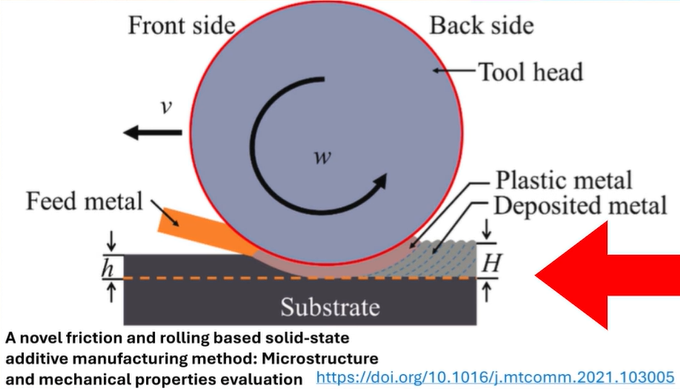
Rather than an extruder that melts a thermoplastic filament, their setup uses metal wire that is fed into a friction welding tool head, the details of which are covered in the video as well as on the GitHub project page. Unlike their previous setup which we reported on last year, this new setup is both safer and much riskier. While there’s no more molten metal, instead a very loud and very fast spinning disk is used to provide the friction required for friction welding, specifically friction and rolling-based additive manufacturing (FRAM) as in the cited 2021 paper by [Ruishan Xie] et al. in Materials Today Communications. By the same lead author there’s also a 2025 paper that explores more complex implementations of FRAM.
With this method the feed wire (e.g. aluminium) will experience plastic shear, causing it to become somewhat fluid and capable of adhering to other surfaces. This same method can be used for other materials, including plastics and glass. As can be seen in the video, FRAM certainly seems viable, though it is a veritable rabbit hole of complications since you’re dealing with a high-velocity engineering challenge.
Here’s where [Rotoforge] found that slitting saws are a good, off-the-shelf option as they have basically the same high-speed-but-safely requirements. This left the motor part, which has to keep the friction wheel going. After a lot of trial and mostly error, it was found that the motor in a Dremel tool provided the solution in the form of a universal AC motor. Unlike brush-less DC motors, these AC motors are far more simpler, cheaper and can keep up a constant speed much better, which is probably why they’re still used in power tools everywhere. Ergo some cheap Vevor flex-shaft grinders were bought and adapted for some FRAM purposes.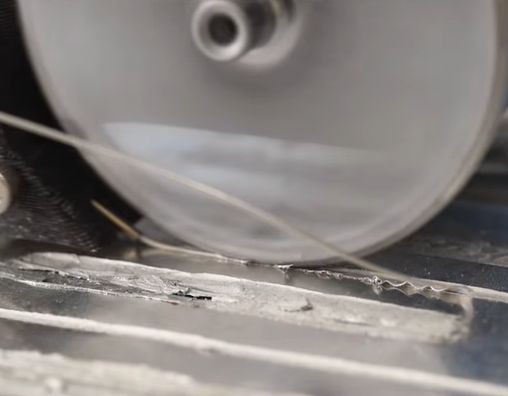
Initial experiments with Al1100 aluminium alloy showed very good layer adhesion, to the point that they were very similar to a solid bar of aluminium. Due to the layered nature of the prints, they perform better than solid Al1100 parts in some tests. Thus the next challenge was to try more advanced printing techniques than a single straight line, which posed the bigger challenge and is where the basic Ender 3-based prototype met its match.
Next a fourth axis will be added to hopefully resolve some of the issues encountered with the current prototype, along with a host of other improvements to make printing more reliable and versatile. Although it’s clearly still early days for FRAM, it is rather exciting that even in a hobby setting without massive monetary investment it’s already possible to do this much.
Of course, it should definitely be said that eye- and hearing protection are absolute requirements if you intend to do some FRAM printing yourself. The video gives some idea of how loud the process is, and high-speed discs and wheels together with metalworking always introduce the exciting possibility of high-velocity shrapnel.
youtube.com/embed/tRrVOfOU9qE?…
[2025-12-26] 🎄 VENERDÌ 26 DICEMBRE ORE 20 CENONE DEGLI AVANZI + TOMBOLA e GIOCHI🎄 @ Nuovo presidio San Giuliano
🎄 VENERDÌ 26 DICEMBRE ORE 20 CENONE DEGLI AVANZI + TOMBOLA e GIOCHI🎄
Nuovo presidio San Giuliano - San Giuliano di Susa
(venerdì, 26 dicembre 19:30)

Natale con i tuoi, Pasqua con chi vuoi e Santo Stefano con il movimento No Tav 💕. Continuiamo a scaldare il cuore del presidio, festeggiamo il Natale e diamo il colpo finale alla nostra linea inviadiabile. Porta avanzi, liquidi e qualcosina di brutto da mettere in palio per la Tombola…
Mesh “Lens” Lets Your Camera Make Weird Pixel Art

We seldom talk about 3D printing lenses because most techniques can’t possibly produce transparent parts of optical quality. However, you can 3D print something like a lens, as [Luke Edwin] demonstrates, and get all kinds of crazy pictures out of it.
[Luke’s] lens isn’t really a lens, per se. There’s no transparent optical medium being used to bend light, here. Instead, he’s printed a very fine grid in a cylindrical form factor, stuck it on a lens mount, and put that on the front of a camera.
The result is effectively a set of parallel tubes that guide light on to the camera’s image sensor. With the lack of any sort of focus mechanism, you can’t use this “lens” to photograph anything more than a few centimeters away. Get something up close, though, and you can take very simple, very grainy images that are reminiscent of classic pixel art. [Luke] demonstrates this in some fun ways, using it to take photographs of money, a plant, and his own eye. The images look almost like art assets straight out of a 16-bit game. He’s got the STL file up for sale if you want to print your own at home.
We’d love to see this concept explored further, maybe with some supporting optics for more versatile use. In the meantime, you might explore other ways of using 3D printers for photographic gain.
youtube.com/embed/8ln2zjmyITk?…
La telefonata del presidente Mattarella alla madre di Trentini. Un gesto buono e giusto
@Giornalismo e disordine informativo
articolo21.org/2025/12/la-tele…
Il presidente Mattarella ha telefonato alla mamma di Alberto Trentini, il volontario e cooperante veneziano
Giornalismo e disordine informativo reshared this.
Iran: oltre 1500 esecuzioni nel 2025
@Giornalismo e disordine informativo
articolo21.org/2025/12/iran-ol…
Con oltre 1500 esecuzioni nel 2025, la Repubblica Islamica dell’Iran, ha registrato il numero più alto di esecuzioni negli ultimi tre decenni. Il 2025 si chiude con oltre 5000 persone in attesa dell’esecuzione, almeno 44 dei quali condannati a morte per ragioni
reshared this
Auguri a tutti noi in direzione ostinata e contraria
@Giornalismo e disordine informativo
articolo21.org/2025/12/auguri-…
Sarà un anno difficile, attacco alla Costituzione, una Finanziaria che cancella dei diritti acquisiti, venti di guerra, informazione negata, giustizia sotto il controllo del Governo, e per ultimo non ultima la
Giornalismo e disordine informativo reshared this.

Un referendum in diretta televisiva
@Giornalismo e disordine informativo
articolo21.org/2025/12/un-refe…
Bene ha fatto il Consiglio nazionale dell’Ordine dei giornalisti a fare appello all’Autorità per le garanzie nelle comunicazioni perché venga convocato con urgenza il Comitato istituito per vigilare sulla correttezza della trattazione dei processi in tv. L’Agcom
Giornalismo e disordine informativo reshared this.
Nuovo naufragio alla Vigilia di Natale: 16 morti
@Giornalismo e disordine informativo
articolo21.org/2025/12/nuovo-n…
Un nuovo naufragio alla Vigilia di Natale Secondo quanto riferisce sul proprio account di X l’ong Sea Watch, “116 persone hanno perso la vita nell’ennesimo naufragio del 2025. L’unico sopravvissuto è stato salvato da
reshared this
Buone feste! Ecco il mio augurio.
@Privacy Pride
Il post completo di Christian Bernieri è sul suo blog: garantepiracy.it/blog/augurio/
Ho un personalissimo proposito ed è anche il mio augurio per il nuovo anno: Che tu possa diffidare, sempre, anche se… Prosit.
reshared this
Abusing x86 SIMD Instructions to Optimize PlayStation 3 Emulation

Key to efficient hardware emulation is an efficient mapping to the underlying CPU’s opcodes. Here one is free to target opcodes that may or may not have been imagined for that particular use. For emulators like the RPCS3 PlayStation 3 emulator this has led to some interesting mappings, as detailed in a video by [Whatcookie].
It’s important to remember here that the Cell processor in the PlayStation 3 is a bit of an odd duck, using a single regular PowerPC core (PPE) along with multiple much more simple co-processors called synergistic processing elements (SPEs) all connected with a high-speed bus. A lot of the focus with Cell was on floating point vector – i.e. SIMD – processing, which is part of why for a while the PlayStation 3 was not going to have a dedicated GPU.
As a result, it makes perfect sense to do creative mapping between the Cell’s SIMD instructions and those of e.g. SSE and AVX, even if Intel removing AVX-512 for a while caused major headaches. Fortunately some of those reappeared in AVX2.
The video goes through a whole range of Cell-specific instructions, how they work, and what x86 SIMD instructions they were mapped to and why. The SUBD instruction for example is mapped to VPDPBUSD as well as VDBPSADBW in AVX-512, the latter of which mostly targets things like video encoding. In the end it’s the result that matters, even if it also shows why the Cell processor was so interesting for high-performance compute clusters back in the day.
youtube.com/embed/40tyEVx_umY?…

Tutti i danni che i video brevi possono causare al nostro cervello
L'esposizione prolungata a video brevi attiva il sistema della ricompensa, con conseguenze su concentrazione, autocontrollo, memoria, equilibrio emotivo e difficoltà di concentrazione su compiti lunghi.Filippo Bonaventura (Geopop)
Guinness_Irish_Stout67 reshared this.
[2025-12-31] Corso di percussioni brasiliane @ CSA Magazzino 47
Corso di percussioni brasiliane
CSA Magazzino 47 - via industriale 10 Brescia
(mercoledì, 31 dicembre 20:30)


[2026-01-07] Assemblea di autogestione - 7 Gennaio @ Spazio libertario Sole e Baleno
Assemblea di autogestione - 7 Gennaio
Spazio libertario Sole e Baleno - 27, Sobborgo Valzania, Quartiere Fiorenzuola, Ponte Abbadesse, Cesena, Unione dei comuni Valle del Savio, Forlì-Cesena, Emilia-Romagna, 47521, Italia
(mercoledì, 7 gennaio 20:00)


[2025-12-31] Hacklabkelo espazioa @ La Kelo Gaztetxea
Hacklabkelo espazioa
La Kelo Gaztetxea - Mahastiak / Las Viñas 63, 48980 Santurtzi
(miércoles, 31 diciembre 20:00)
Hacklabkelo espazioa teknologiarekin, softwarearekin, hardware librearekin, sistema eragileekin, sareekin, birtualizazioarekin, DIY, etab. erlazionatutako guztiarekin esperimentatzeko

Espacio Hacklabkelo para experimentar con todo lo relacionado con la tecnologia, software y hardware libre, sistemas operativos, redes, virtualización, DIY, etc.
Disposable Camera Viewfinder Becomes 3D Printed Lens

Disposable cameras are a fun way to get into classical photography. However, they can also be a valuable source of interesting parts that can be put to other uses. For example, as [Billt] demonstrates, their viewfinders can be repurposed into a rather interesting lens for more serious cameras.
[Billt] was lucky enough to score a grabbag of used disposable cameras from a local film lab, and tore them down for parts. He was particularly interested in the viewfinders, since Kodak equipped its disposable cameras with actual plastic lenses for this very purpose.
[Billt] wanted to see what these lenses would do when thrown on the front of a proper digital camera, and set about designing a mount for that purpose. The 3D printed part was designed to mount one of the viewfinder lens assemblies on the front of any Sony E-mount camera. In a rather nifty trick, [Billt] realized the lens assembly could be installed in the adapter by pausing mid-way through the 3D print to drop it in. The only unfortunate thing? The lenses didn’t really work, and all the camera could see was a haze of unfocused light.
With the aid of some cardboard experiments, [Billt] decided to make some changes. The front element of the viewfinder was dumped, with the rear element being used solo instead. This was fitted to the adapter on a simple slide mechanism so that focus could be reliably adjusted. With these changes, the lens came good, and provided some really interesting shots. It’s quite a cropped lens and it can achieve a very close focus distance, as little as 1 inch in testing. It’s quite sharp in the center of the image, while softly blurring out towards the edges—something that sounds very familiar if you’ve used one of these disposable cameras in the wild.
Sometimes it’s fun to grab a random piece of junk to see if you can turn it into something good. Video after the break.
youtube.com/embed/kFDJlVilFP0?…

Famiglia nel bosco, la madre da un mese non si lava in casa famiglia: «Non apre al dialogo». I rifiuti al sondino anti intossicazione e agli antibiotici
Nel provvedimento del tribunale per i minorenni, che ha confermato la permanenza dei minori in casa famiglia, è stata sottolineata l’intransigenza della madre, che rifiuta ogni tipo di dialogo. E le difficoltà dei figli nel socializzareUgo Milano (Open)
collezionismo (o no)
cosa 'non' fa di me un collezionista
noblogo.org/differx/cosa-non-f…
reshared this
Ausili e protesi: Il TAR boccia il decreto tariffe. Ass. Coscioni: “Ora il Ministero intervenga con istruttoria seria”
Il TAR del Lazio ha annullato il Decreto Tariffe del 25 novembre 2024 anche per la parte relativa all’assistenza protesica, accogliendo il ricorso della Federazione Italiana degli Operatori in Tecniche Ortopediche (Fioto). Con la sentenza n. 22313/2025, pubblicata il 10 dicembre, i giudici amministrativi hanno bocciato il provvedimento “per grave difetto di istruttoria”, dando al Ministero della Salute un anno di tempo per riformularlo.
“Questa pronuncia del TAR Lazio, letta unitamente alla sentenza scaturita dalla class action promossa dall’Associazione Luca Coscioni, mette in evidenza una criticità strutturale del sistema dei LEA”, afferma l’avvocato Alessandro Bardini, Consigliere Generale dell’Associazione Luca Coscioni. “Dalle decisioni giudiziarie emerge con chiarezza che il Ministero della Salute ha affrontato la riforma dell’assistenza protesica in modo approssimativo, in assenza di una reale istruttoria sui bisogni delle persone con disabilità e sui costi effettivi delle prestazioni. Il Giudice amministrativo riafferma un principio fondamentale: senza istruttoria adeguata non può esservi legittimità dell’azione amministrativa. La logica del risparmio, quando non è fondata su valutazioni tecniche serie, rischia di compromettere il diritto alla salute degli assistiti”.
“Questa sentenza conferma quanto emerso dalla nostra class action vinta prima al TAR e poi confermata dal Consiglio di Stato proprio sul tema ausili”, dichiara Rocco Berardo, coordinatore iniziative sui diritti delle persone con disabilità dell’Associazione Luca Coscioni. “Anche in quel caso il Ministero è stato condannato perché non ha rispettato quanto previsto dalla legge del 2017, in particolare relativamente all’art. 30 bis sugli ausili destinati alle disabilità più gravi e complesse. Il Ministero non ha effettuato le istruttorie previste, anche ascoltando le associazioni, per verificare il funzionamento della legge e il suo eventuale miglioramento lasciando le persone con disabilità abbandonate a sé stesse”.
La prova di quanto non funzioni l’attuale sistema è stata tra l’altro restituita da un’indagine condotta dall’Associazione Luca Coscioni, che ha raccolto centinaia di testimonianze. “Le evidenze raccolte – dichiara Rocco Berardo – confermano che le procedure ad evidenza pubblica stanno penalizzando le persone con disabilità più gravi. Tempi di attesa insostenibili, costi aggiuntivi anche molto elevati a carico delle famiglie e l’impossibilità di ottenere ausili realmente personalizzati stanno svuotando di contenuto il diritto all’assistenza protesica previsto dai LEA. È indispensabile, dunque, come richiesto dall’Associazione Luca Coscioni alla commissione del Ministero, che gli ausili più critici siano inseriti fuori dall’elenco degli ausili da mettere a gara e che siano garantite per gli stessi la personalizzazione e la riparazione”.
L'articolo Ausili e protesi: Il TAR boccia il decreto tariffe. Ass. Coscioni: “Ora il Ministero intervenga con istruttoria seria” proviene da Associazione Luca Coscioni.
Ecco come Ast SpaceMobile sfida Starlink con il lancio del satellite per smartphone BlueBird 6
Per vedere altri post come questo, segui la comunità @Informatica (Italy e non Italy 😁)
L'azienda texana Ast SpaceMobile ha annunciato il lancio di successo con un razzo indiano di BlueBird 6, iI sistema di comunicazione più grande mai dispiegato in orbita
Informatica (Italy e non Italy 😁) reshared this.
Resoconto Linux Day 2025
firenze.linux.it/2025/12/resoc…
Segnalato dal LUG di Firenze e pubblicato sulla comunità Lemmy @GNU/Linux Italia
#Firenze
L’anno scorso fummo sorpresi dal successo del giorno di GNU/Linux alla biblioteca di Scandicci, malgrado i modesti mezzi e i tempi ristretti per l’organizzazione. Al contrario quest’anno
GNU/Linux Italia reshared this.
DIY E-Reader Folds Open Like a Book

There are plenty of lovely e-readers out on the market that come with an nice big e-paper display. There aren’t nearly as many that come with two. [Martin den Hoed] developed the Diptyx e-reader with such a design in order to better replicate the paper books of old.
The build is based around the ESP32-S3, a powerful microcontroller which comes with the benefit of having WiFi connectivity baked in. It’s hooked up to a pair of 648×480 e-paper displays, which are installed in a fold-open housing to create the impression that one is reading a traditional book. The displays themselves are driven with custom look-up tables to allow for low-latency updates when turning pages. The firmware of the device is inspired by the epub reader from [Atomic14], and can handle different fonts and line spacing without issue. Power is from a pair of 1,500 mAh lithium-polymer cells, which should keep the device running for a good long time, and they can be charged over USB-C like any modern gadget.
You can follow along with the project on the official website, or check it out on Crowd Supply if you’re so inclined. The project is intended to be open source, with files to be released once the design is finalized for an initial production run.
We’ve seen some great DIY e-reader builds over the years, and we’re loving the development we’re seeing in the writer deck space, too. If you’re whipping up something fun in this vein, be sure to let us know on the tipsline!
like this
incoscienza a proposito della Liberazione
dal 2015 : youtu.be/cBesCvBzXfw
(e credo che in questi ultimi dieci anni le cose siano ancora peggiorate.
non si spiegano molte faccende orribili, altrimenti)
#25aprile #Liberazione #FestaDellaLiberazione #antifascismo
notilla su
noblogo.org/differx/dal-2015-y…
reshared this
Natale, istruzioni per l’uso (del portafoglio.)
noblogo.org/transit/natale-ist…


Natale, istruzioni per l’uso (del portafoglio.)
(189)
Un tempo il #Natale sapeva di mandarini e di freddo. Oggi sa di plastica, di profumo sintetico alla cannella e di offerte “imperdibili”. È passato da evento religioso (che riconosco, ma non frequento per coerenza) a vaccino annuale contro la malinconia, somministrato in dosi di pubblicità e zucchero. Non si aspetta più la nascita di un improbabile “Salvatore”: si aspetta il corriere espresso.
L’unico presepe che conta è quello dove il nuovo dio è lo scontrino fiscale. La festa comincia già a novembre, quando si accendono i LED sponsorizzati e le vetrine diventano vetrate di cattedrali dedicate alle divinità del consumo. L’atmosfera natalizia è una liturgia pubblicitaria senza fine: famiglie perfette, pacchi scintillanti, sorrisi programmati. “Fatevi un regalo”, dicono. Ma per molti, il vero regalo sarebbe un affitto pagato o una bolletta non scaduta.
Nei magazzini e nei centri di smistamento si lavora a tempo di jingle. I veri elfi di Babbo Natale sono precari con la schiena a pezzi e la consegna garantita. Mentre il mondo si commuove davanti agli spot, loro fanno le notti per tenere accesa la giostra del Natale. Il miracolo non è la nascita di un bambino, ma che qualcuno ancora sorrida dopo dodici ore di lavoro.
Arriva la Vigilia: la prova di sopravvivenza più ipocrita dell’anno. Tavole imbandite, sorrisi forzati, discussioni che nessuno ha voglia di affrontare. A Natale ci si ama per obbligo, si ascolta per forza, si brinda per abitudine. È il grande festival delle relazioni diplomatiche: tutti seduti insieme, uniti solo dalla stanchezza e dal desiderio che finisca in fretta. Fuori, le città traboccano di “esperienze autentiche”: mercatini vintage, regali “etici”, panettoni artigianali da quarantacinque euro.
Tutto mercificato, anche la bontà. Se non compri, non esisti. La gioia è un’unità di misura tracciata in scontrini, la pace si conta in like. “Buone feste” è diventato un riflesso condizionato, un rumore di fondo da cui nessuno si salva. Dietro le luci e i brindisi resta il buio dei margini. I poveri, i precari, gli invisibili assistono al grande spettacolo del benessere da dietro la quinta. Per loro, il Natale è solo un altro turno, un altro giorno da superare. Poi arrivano i servizi televisivi “commoventi”, la lacrima di circostanza, e tutto finisce lì: quel poco di solidarietà si scioglie più in fretta del burro nel panettone.
Il Natale consumistico è una macchina perfetta: produce desideri, li vende, e poi li sostituisce. È la religione del capitale emotivo, dove la preghiera è contactless e la redenzione avviene in tre rate. Ogni gennaio ci chiediamo perché ci sentiamo vuoti. La risposta è semplice: lo siamo, ma almeno abbiamo comprato il vuoto in confezione regalo. Viva il #Natale, dunque: patrono dell’apparenza, santo protettore dell’ipocrisia e martire della sincerità. Non importa più cosa significhi, basta che arrivi il pacco in tempo e che l’etichetta sia quella giusta. Perché in fondo, nel presepe del mondo moderno, l’unico Bambin Gesù rimasto è un prodotto in pronta consegna.
#Blog #Natale #Consumismo #Economia #Opinioni
Mastodon: @alda7069@mastodon.unoTelegram: t.me/transitblogFriendica: @danmatt@poliverso.orgBlue Sky: bsky.app/profile/mattiolidanie…Bio Site (tutto in un posto solo, diamine): bio.site/danielemattioli
Gli scritti sono tutelati da “Creative Commons” (qui)
Tutte le opinioni qui riportate sono da considerarsi personali. Per eventuali problemi riscontrati con i testi, si prega di scrivere a: corubomatt@gmail.com


Corazzate nucleari, armi laser e industria. Tutto sulla Golden Fleet Initiative
@Notizie dall'Italia e dal mondo
Una flotta rinnovata, capace di schierare le navi più potenti di sempre e di riportare la Marina statunitense ai fasti di un tempo. Questo è il piano dell’amministrazione Usa per rilanciare la propria industria cantieristica e mandare un messaggio alla Cina e
Notizie dall'Italia e dal mondo reshared this.
In the age of Spotify and AI slop, tapes remind us what we’re missing when we stop taking risks.#Music #physicalmedia


Why I Quit Streaming And Got Back Into Cassettes
Whenever I tell people I’m getting back into tapes, their faces immediately light up.There’s a genuine excitement in peoples’ expressions these days when I mention physical media. Lately I’ve been talking about the cheap walkman I bought on a recent trip to Tokyo, and the various little shops where I hunted for music on cassettes. Unlike in Europe and the US, physical media never went out of vogue in Japan, and many people still have a strong preference for shopping in-person. This made Tokyo the ideal place to rediscover my love of portable analog music.
I searched through racks of tapes stacked on top of an old piano in a back-alley store on the edge of Shimokitazawa, a neighborhood known for thrifted fashion and oddball record shops. On recommendation from a friend-of-a-friend, I checked out a specialist shop on a sleepy street in Nakameguro, where cassettes easily outnumbered vinyl records 10-to-1. Almost always, I steered myself toward local artists whose names I didn’t recognize. Sometimes, I bought tapes based on the cover art or description alone. Most second-hand music stores in Tokyo keep everything sealed in plastic, so you either have to bother the shopkeep, or just trust your gut and take a chance.
This kind of music discovery delights people when I describe it to them. Sometimes they start telling me about rediscovering their old CD collection, or wanting to track down an old iPod Classic to experience their music library away from the surveillance and excess of big tech platforms. Maybe it’s just because I live in a particular social bubble in a particular countercultural pocket of New York City. But recently, the conversations I’ve had on this topic have got me feeling like the culture of music is shifting.
playlist.megaphone.fm?p=TBIEA2…
People areleaving Spotify, and those who aren’t seem embarrassed about using it. Major artistspulled their music off the platform this year in protest of the company’sICE recruitment ads and connections tomilitary drones, and posting your Wrapped stats has gone from a ubiquitous year-end pastime to a cultural faux pas. Many folks aresick of streaming in general. They’re sick of giant corporations, algorithmic playlists, and aninternet infested with AI slop. Artists are tired of tech platforms that pay them virtually nothing, owned by degenerate billionaires that see all human creativity as interchangeable aesthetic wallpaper, valued only for its ability to make numbers go up. Everywhere I go,people are exhausted by the never-ending scroll, desperately wanting to reconnect with something real.My own path to re-embracing physical media unfolded in stages. Last year, I canceled my Apple Music subscription and started exclusively listening to music I bought from artists on Bandcamp. I still have a large mp3 library, and I thought about setting up aself-hosted media server to stream everything to my phone. But ultimately, I got lazy and wound up just listening to albums I downloaded from the Bandcamp app. Then I ran out of storage on my phone, and the amount of music I had available on-the-go shrank even more.
When I came to Tokyo, a friend took me to a store that sold cheap portable cassette players, and I knew it wouldn’t be a huge leap to take my music listening fully offline. The walkman I bought is unbranded and has a transparent plastic shell, allowing you to watch all the little mechanical gears turning inside as the tape spools around the wheels and past the playheads. It was one of the easiest purchasing decisions I’ve made in recent memory: After years of psychic damage from social media and other phone-based distractions, I was ready to once again have a dedicated device that does nothing but play music.
There are lots of advantages to the cassette lifestyle. Unlike vinyl records, tapes are compact and super-portable, and unlike streaming, you never have to worry about a giant company suddenly taking them away from you. They can be easily duplicated, shared, and made into mixtapes using equipment you find in a junk shop. When I was a kid, the first music I ever owned were tapes I recorded from MTV with a Kids’ Fisher Price tape recorder. I had no money, so I would listen to those tapes for hours, relishing every word Kim Gordon exhaled on my bootlegged copy of Sonic Youth’s “Bull in the Heather.” Just like back then, my rediscovery of cassettes has led me to start listening more intentionally and deeply, devoting more and more time to each record without the compulsion to hit “skip.” Most of the cassettes I bought in Tokyo had music I probably never would have found or spent time with otherwise.
Getting reacquainted with tapes made me realize how much has been lost in the streaming era. Over the past two decades, platforms like Spotify co-opted the model of peer-to-peer filesharing pioneered by Napster and BitTorrent into a fully captured ecosystem. But instead of sharing, this ecosystem was designed around screen addiction, surveillance, and instant gratification — with corporate middlemen and big labels reaping all the profits.
Streaming seeks to virtually eliminate what techies like to call “user friction,” turning all creative works into a seamless and unlimited flow of data, pouring out of our devices like water from a digital faucet. Everything becomes “Content,” flattened into aesthetic buckets and laser-targeted by“perfect fit” algorithms to feed our addictive impulses. Thus the act of listening to music is transformed from a practice of discovery and communication to a hyper-personalized mood board of machine-optimized “vibes.”
What we now call “AI Slop” is just a novel and more cynically efficient vessel for this same process. Slop removes human beings as both author and subject, reducing us to raw impulses — a digital lubricant for maximizing viral throughput. Whether we love or hate AI Slop is irrelevant, because human consumers are not its intended beneficiaries. In the minds of CEOs like OpenAI’s Sam Altman, we’re simply components in a machine built to maintain and accelerate information flows, in order to create value for an insatiably wealthy investor class.
On one hand, I empathize with those who still feel like they get something out of streaming. Having access to so much music can feel empowering, especially when so many people feel like they lack the time and resources to develop a music-listening practice. “What streaming service should I use instead of Spotify?” is a question I’ve been seeing constantly over the past few months.
Here’s my contrarian answer: What if there’s no ethical way to have unlimited access to every book, film, and record ever created? And moreover, what if that’s not something we should want?
What if we simply decided to consume less media, allowing us to have a deeper appreciation for the art we choose to spend our time with? What if, instead of having an on-demand consumer mindset that requires us to systematically strip art of all its human context, we developed better relationships with creators and built new structures to support them? What if we developed a politics of refusal — the ability to say enough is enough — and recognized that we aren’t powerless to the whims of rich tech CEOs who force this dystopian garbage down our throats while claiming it’s “inevitable?”
0:00
/0:07
1×Tapes and other physical media aren’t a magic miracle cure for late-stage capitalism. But they can help us slow down and remember what makes us human. Tapes make music-listening into an intentional practice that encourages us to spend time connecting with the art, instead of frantically vibe-surfing for something that suits our mood from moment-to-moment. They reject the idea that the point of discovering and listening to music is finding the optimal collection of stimuli to produce good brain chemicals.
More importantly, physical media reminds us that nothing good is possible if we refuse to take risks. You might find the most mediocre indie band imaginable. Or you might discover something that changes you forever. Nothing will happen if you play it safe and outsource all of your experiences to a content machine designed to make rich people richer.
How To Ditch Spotify and Support Music in the Age of AI Slop
There’s no shortage of reasons to quit Spotify in 2025. Artists and fans have been departing the platform in droves because they’re fed up with the company paying artists virtually nothing, using algorithms that promote AI-generated slop, running rec…Janus Rose (Touch Grass)
Famiglia nel bosco, Salvini: “Separarli a Natale è una violenza di Stato senza senso e senza precedenti”
@Politica interna, europea e internazionale
Matteo Salvini si scaglia nuovamente contro i giudici per il caso della cosiddetta famiglia nel bosco. Il vicepremier e ministro dei Trasporti, infatti, ha scritto sui social: “Separare una famiglia anche nel giorno di Natale, una violenza
Politica interna, europea e internazionale reshared this.
How we tracked ourselves with exposed Flock cameras; a year in review; and our personal recommendations on all sorts of things.#Podcast
Podcast: We Tracked Ourselves with Exposed Flock Cameras
We start this week with Jason’s story about Flock exposing a bunch of AI-powered cameras. These cameras zoom in on people as they walk by, sometimes so closely you can read what’s on their phone screen. After the break, we talk about some of our biggest stories this year. In the subscribers-only section, we give some of our personal recommendations of games, other reporting, or just a more chill life.
playlist.megaphone.fm?e=TBIEA7…
Listen to the weekly podcast on Apple Podcasts,Spotify, or YouTube. Become a paid subscriber for access to this episode's bonus content and to power our journalism. If you become a paid subscriber, check your inbox for an email from our podcast host Transistor for a link to the subscribers-only version! You can also add that subscribers feed to your podcast app of choice and never miss an episode that way. The email should also contain the subscribers-only unlisted YouTube link for the extended video version too. It will also be in the show notes in your podcast player.
- Flock Exposed Its AI-Powered Cameras to the Internet. We Tracked Ourselves
- Anyone Can Push Updates to the DOGE.gov Website
- Mike Waltz Accidentally Reveals Obscure App the Government Is Using to Archive Signal Messages
- How Tea’s Founder Convinced Millions of Women to Spill Their Secrets, Then Exposed Them to the World
- Half of the US Now Requires You to Upload Your ID or Scan Your Face to Watch Porn
Mike Waltz Accidentally Reveals Obscure App the Government Is Using to Archive Signal Messages
A photograph of Trump administration official Mike Waltz's phone shows him using an unofficial version of Signal designed to archive messages during a cabinet meeting.Joseph Cox (404 Media)

è sempre adessoa

è sempre adesso
Sono il mio mulino a vento quello che cammina sulla scala mobile per il paradiso di Natale alla fine di un arcobaleno banale contento e...ordinariafollia
Il Pentagono e le armi cinesi. Cosa dice su Pechino il report annuale dei militari Usa
@Notizie dall'Italia e dal mondo
Il rapporto annuale del Dipartimento della Guerra statunitense sulle evoluzioni militari e di sicurezza della Cina, pubblicato in queste ore, offre molto più di un aggiornamento tecnico sulle capacità dell’Esercito Popolare di Liberazione (Pla).
Notizie dall'Italia e dal mondo reshared this.
Barbara Berlusconi: “Io in politica? No. Pensare di entrarci solo per il cognome non ha senso”
@Politica interna, europea e internazionale
Dal rapporto con papà Silvio alla depressione fino ai cinque figli: Barbara Berlusconi si racconta al Corriere della Sera. La terzogenita dell’ex presidente del Consiglio afferma che ora le “piacerebbe cominciare da chi sono ora”. Per questo ha creato una fondazione che
Politica interna, europea e internazionale reshared this.
SIRIA. Aleppo, i miliziani legati alla Turchia sparano sui quartieri curdi
@Notizie dall'Italia e dal mondo
Le sparatorie avvengono mentre cresce la tensione per il mancato raggiungimento dell'intesa tra curdi e Damasco
L'articolo SIRIA. Aleppo, ihttps://pagineesteri.it/2025/12/24/medioriente/siria-aleppo-i-miliziani-legati-alla-turchia-sparano-sui-quartieri-curdi/
Notizie dall'Italia e dal mondo reshared this.
PODCAST. Betlemme, il Natale dietro i muri: attese e occupazione militare
@Notizie dall'Italia e dal mondo
Nel servizio della giornalista Micol Hassan raccontiamo il Natale a Betlemme in una presunta normalità fortemente segnata dal dolore dei palestinesi per le vittime e le distruzioni di Gaza
L'articolo PODCAST. Betlemme, il Natale dietro i muri: attese e
Notizie dall'Italia e dal mondo reshared this.
L'altro è il Presidente della NATO.
Avete letto le differenze?

Sanktionen gegen HateAid-Führung: Die Bundesregierung muss jetzt scharf protestieren
netzpolitik.org/2025/sanktione…

Dopo il riarmo l’Unione Europea vuole una “Schengen militare”
@Notizie dall'Italia e dal mondo
La "Schengen militare" approvata dall'Eurocamera prevede la rimozione degli impedimenti fisici e burocratici alla libera circolazione delle truppe e dei mezzi militari sulle ferrovie e le strade di tutta Europa
L'articolo Dopo il riarmo l’Unione Europea vuole una “Schengen militare” proviene da Pagine
Notizie dall'Italia e dal mondo reshared this.
La vera data di nascita di Gesù
freepik.it

Numerosi studi hanno analizzato la figura di Gesù di Nazareth, questioni riguardanti l'attendibilità storica della sua vita e perfino la sua effettiva esistenza. Benché attualmente si ritenga largamente che sia esistito davvero, al di là degli aspetti mistici, le informazioni disponibili risultano frequentemente contraddittorie e influenzate da intenti religiosi. Tuttavia, distinguendo gli eventi storicamente plausibili da quelli inventati, si possono ricavare informazioni attendibili sulla sua esistenza, inclusa la data di nascita.
La data erroneamente identificata come anno 1 venne stabilita - per errore o deliberatamente - nel VI secolo da Dionigi il Piccolo, monaco bizantino che creò un nuovo sistema di datazione per distinguere l'epoca pagana da quella cristiana: l'Anno Domini - "anno del Signore", dalla nascita di Gesù, sostituendo il sistema romano ad Urbe condita - "dalla fondazione della città" di Roma.
Il 25 dicembre, scelto per commemorare la sua nascita, è certamente una decisione deliberata, dato che neppure le fonti religiose originarie indicano questa data. Il primo accenno al 25 dicembre risale al periodo dell'imperatore Costantino, che con l'Editto di Milano del 313 d.C. terminò le persecuzioni contro i cristiani. Quando Dionigi il Piccolo sviluppò il suo sistema di datazione, il 25 dicembre era già la data stabilita. La scelta di questo giorno derivava dal fatto che coincideva con la festività del Sole Invitto, divinità orientale che l'imperatore Aureliano aveva elevato a culto ufficiale dell'Impero verso la fine del III secolo.
Per saperne di più
storicang.it/a/in-che-anno-nac…
Altbot
in reply to storiaweb • • •A stylized illustration depicts three figures: a seated woman, a seated man, and a baby in a manger. The background includes a large, light-colored circular shape with stars and vertical lines. The woman wears a long, flowing robe with a head covering; the man wears a robe and has a beard; the baby lies in a straw-filled manger. The color palette consists of muted blues and browns. No text is present in the image.
Fornito da @altbot, generato localmente e privatamente utilizzando Qwen3-Vl:30b
🌱 Energia utilizzata: 0.064 Wh