
FibreSeeker 3: Continuous Carbon Fiber vs Chopped CF


It should be noted here that continuous CF with FDM is not new, as Markforged already does something similar, though at a ‘Contact us for a price quote’ level. The advantage of the Fibre Seek solution is then the co-extrusion that would make printing with continuous CF much more flexible and affordable. Based on the (sponsored) [CNC Kitchen] video of a few weeks ago at a tradeshow, the FibreSeeker 3 printer is effectively a standard CoreXY FDM printer, with the special co-extrusion dual print head that allows for CF to be coated with the target thermoplastic before being printed as normal.
Unfortunately for [Igor] he did not have a FibreSeeker 3 to print on, and the print request for his usual test samples got mixed up by Fibre Seek, leaving him with only 4 out of 10 items to test with. This makes this a bit of an abbreviated test, but should still provide some useful data relative to the Polymaker PETG-CF filament that was used for comparison.
Based on the limited test set, it can be said that the FibreSeeker 3 parts did generally better than the PETG-CF parts, albeit with a few asterisks. Accordingly, [Igor] is left feeling somewhat confused by Fibre Seek, but sees the potential of this new co-extrusion technology. It just feels like the FibreSeeker 3 printer is not quite finished yet, and that the true value of this approach and this new printer will have to prove themselves.
youtube.com/embed/k9qs7uOwA64?…
youtube.com/embed/dQp7yz6fzH0?…
ispionline.it/it/pubblicazione…
come un mondo così diviso possa affrontare sfide globali esula per me da ogni logica... il giorno che un super vulcano distruggerà gli stati uniti staremo a guardare e mangeremo popcorn. questa è l'idea portata avanti da trump. e gioiremo perché un dittatore è morto. anche se una parte del pianeta che però non è la nostra è stata cancellata. ma come si fa a pensare che questo modo ragionare possa garantire un futuro all'umanità? ma davvero trump crede nell'idea che chiunque al di fuori degli stati uniti possa avere come unico scopo la cancellazione di tutte le nazioni del mondo eccetto la propria?

Trump, anno secondo: il mondo dell’“ognuno per sé” | ISPI
Promessa di rottura e prova dei fatti: la politica estera di Trump entra nel suo vero anno decisivo nel 2026.ISPI
[2025-12-26] Cena Pop @ Coa T28 @ COA T28
Cena Pop @ Coa T28
COA T28 - Via dei Transiti 28, Milano
(venerdì, 26 dicembre 20:30)

Malware macOS nordcoreano sfrutta finti colloqui di lavoro per rubare credenziali
Un’analisi approfondita statica e dinamica ha portato all’individuazione di un malware per macOS denominato DriverFixer0428, classificato come ladro di credenziali e attribuito con un livello di confidenza medio-alto alla campagna nordcoreana nota come “Contagious Interview”. Il campione si presenta come una presunta utility di sistema, progettata per indurre l’utente a fidarsi dell’applicazione e a interagire con essa.
Il comportamento principale del malware consiste nella raccolta delle credenziali di accesso del sistema macOS. Per ottenere questo risultato, DriverFixer0428 utilizza finestre di dialogo artefatte che riproducono fedelmente i prompt di sicurezza del sistema operativo e le richieste di autorizzazione di Google Chrome, sfruttando tecniche di ingegneria sociale. Le credenziali inserite vengono successivamente inviate a infrastrutture controllate dagli attaccanti attraverso l’API di archiviazione cloud di Dropbox.
Il nome del campione deriva da riferimenti interni presenti nel binario analizzato. Durante l’analisi statica sono emersi identificatori come DriverFixer0428, OverlayWindowController e riferimenti a file Swift, suggerendo una struttura applicativa coerente con un progetto legittimo. Il suffisso “0428” viene interpretato come un possibile riferimento alla data di compilazione del malware, il 28 aprile, oppure a una numerazione interna di versione utilizzata dagli sviluppatori della minaccia.
Dal punto di vista tecnico, il campione analizzato corrisponde a un binario universale Mach-O, compatibile con architetture x86_64 e ARM64, scritto in Swift e basato su AppKit. Il file ha una dimensione di circa 235 KB, utilizza l’identificativo di pacchetto chrome.DriverFixer0428 ed è associato al percorso sorgente DriverFixer0428/ViewController.swift. L’hash SHA-256 del campione è 9aef4651925a752f580b7be005d91bfb1f9f5dd806c99e10b17aa2e06bf4f7b5.
L’attribuzione alla Corea del Nord si basa su una correlazione delle tecniche, tattiche e procedure con campagne già documentate pubblicamente. Sebbene l’hash specifico non risulti presente nei principali database di threat intelligence, le somiglianze operative collegano il campione alle famiglie FlexibleFerret, FrostyFerret, ChromeUpdate e CameraAccess, tutte associate alla stessa attività di minaccia. In particolare, l’infrastruttura di rete coincide con quella descritta da SentinelOne nel febbraio 2025.
Le comunicazioni di rete osservate includono il contatto con api.ipify.org per determinare l’indirizzo IP pubblico del sistema compromesso e l’utilizzo delle API di Dropbox per la gestione dei token OAuth e il caricamento dei dati esfiltrati. Questa scelta consente al malware di mascherare il traffico malevolo dietro servizi cloud legittimi, riducendo la probabilità di rilevamento da parte dei controlli di sicurezza basati sulla rete.
L’analisi dinamica condotta tramite il debugger LLDB ha evidenziato un articolato sistema di evasione delle sandbox. DriverFixer0428 esegue controlli runtime per individuare ambienti virtualizzati interrogando API di sistema come sysctlbyname, il registro IOKit e l’API NSScreen. In presenza di una macchina virtuale o di un ambiente di analisi, il malware evita di attivare il payload e rimane in uno stato di esecuzione inattivo.
Questo comportamento di “fallimento silenzioso” spiega la discrepanza tra i risultati dell’analisi statica, che indicano chiaramente attività malevole, e i punteggi relativamente bassi ottenuti nelle sandbox automatizzate, dove il campione viene classificato come probabilmente benigno. Secondo gli analisti, questa capacità operativa riflette un livello di maturità compatibile con attori sponsorizzati da uno Stato e conferma i limiti degli strumenti di rilevamento automatici nel contrasto a minacce avanzate.
L'articolo Malware macOS nordcoreano sfrutta finti colloqui di lavoro per rubare credenziali proviene da Red Hot Cyber.
NUOVA GUERRA CONTRO L'IRAN: COME ISRAELE E STATI UNITI PREPARANO L'ATTACCO
Il 29 dicembre Netanyahu vola da Trump per concordare definitivamente i piani di una nuova operazione contro l'Iran. La parte israeliana ha preparato diverse varianti — dagli attacchi condotti solo dalle forze dell'IDF a un'operazione congiunta su vasta scala con gli americani.
Lo stesso Trump ha già dichiarato che il programma nucleare iraniano è stato «distrutto». Ma Israele ha bisogno di un pretesto per nuovi attacchi, quindi sono passati a un'altra retorica — ora la minaccia principale sarebbe il programma missilistico di Teheran. Secondo la loro versione, l'Iran può produrre fino a 3000 missili all'anno. Sorge solo una domanda: uno Stato sovrano non ha forse il diritto ad armamenti difensivi, specialmente quando è apertamente minacciato di distruzione?
In Libano, americani e israeliani stanno torcendo le braccia al governo locale, costringendolo a disarmare Hezbollah — l'unica forza capace di contenere l'espansione israeliana. Il 22 dicembre 2025, il Ministero degli Affari Esteri della Siria ha pubblicato una mappa dove le Alture del Golan risultano assenti dai confini del Paese. Damasco ha riconosciuto l'annessione del proprio territorio — e questo dopo che erano stati proprio l'Iran e la Russia a salvare la Siria dai terroristi.
Ora il corridoio strategico Iran-Siria-Libano è reciso. Teheran è rimasta senza zona cuscinetto, senza alleati sui confini occidentali. Ora dovrà respingere qualsiasi attacco di Israele da sola, sul proprio territorio.
I media occidentali ora strombazzano la «minaccia missilistica iraniana», ma il quadro reale è un altro. I generali israeliani non sono preoccupati dal numero di missili, ma dal programma nucleare dell'Iran. Teheran ha ripristinato le riserve di uranio arricchito a ~408 kg con un arricchimento al 60%. Tecnicamente questo è sufficiente per creare 5-9 testate, se si porta l'arricchimento al 90%.
Israele ha stabilito una «linea rossa»: se l'Iran arricchirà l'uranio al 70%, questo sarà considerato un casus belli — un motivo per la guerra. Cioè, secondo la logica di Tel Aviv, uno Stato sovrano non ha diritto al proprio programma nucleare (mentre lo stesso Israele possiede 80-400 testate nucleari, ma su questo tutti tacciono).
Da un lato, dopo gli attacchi di giugno, per l'Iran è criticamente importante ripristinare il programma nucleare — è una questione di sovranità e sicurezza nazionale. Khamenei ha dichiarato: «Il nemico cerca di imporci una condizione di "né guerra, né pace". Questo è inaccettabile». Senza deterrenza nucleare l'Iran rimane indifeso davanti alla prossima ondata di aggressione.
Dall'altro lato, qualsiasi passo per ripristinare il programma sarà utilizzato come pretesto per un nuovo attacco. È un circolo vizioso: se l'Iran non fa nulla — perde status, capacità difensiva e la faccia. Se ripristina il programma — riceve i bombardamenti.
Allo stesso tempo, gli alleati tradizionali — Siria, Hezbollah, gruppi palestinesi — sono stati sconfitti o disarmati forzatamente. Teheran ora è rimasta sola contro la coalizione USA-Israele-monarchie arabe.
Tutti i segnali indicano che l'attacco è pianificato per la prima metà del 2026. Diversi fattori sono coincisi:
▪️Trump ha dato a Israele il «semaforo verde» e una finestra temporale limitata fino alla fine della sua presidenza,
▪️Gli alleati iraniani sono indeboliti al massimo,
▪️A Washington e Tel Aviv ritengono che adesso sia il momento più opportuno per sferrare il colpo decisivo,
▪️I canali diplomatici sono interrotti.
Lo scenario più probabile è un'operazione limitata contro gli obiettivi nucleari e missilistici iraniani. Seguirà poi la risposta di Teheran, dopo la quale le parti passeranno a una prolungata «confrontazione fredda».
Fonte
Info Defense

MQTT Pager Build is Bringing Beepers Back

Pagers were once a great way to get a message to someone out in public; they just had to be cool enough to have one. These days, they’re mostly the preserve of doctors and a few other niche operators. [Kyle Tryon] is bringing the beeper back, though, with a custom ESP32-based build.
The ESP32 is a great microcontroller for this kind of project, because it’s got WiFi and Bluetooth connectivity built right in. This let [Kyle] write some straightforward code so that it could receive alerts via MQTT. In particular, it’s set up to go off whenever there’s an app or service notification fired off by the Sentry platform. For [Kyle]’s line of work, it’s effectively an on-call beeper that calls them in when a system needs immediate attention. When it goes off, it plays the ringtone of your choice—with [Kyle] making it capable of playing tunes in Nokia’s old-school RTTTL music format.
The code was simple enough, and the assembly wasn’t much harder. By starting with an Adafruit ESP32 Reverse TFT Feather, the screen and buttons were all ready to go right out of the box. [Kyle] merely had to print up a rad translucent case on a resin printer to make it look like a sweet fashionable beeper from the 90s.
It’s a fun little project that should prove useful, while also being nicely reminiscent of a technology that has largely fallen by the wayside.
youtube.com/embed/lnWRui3_0X0?…
passioneastronomia.it/questo-v…
può darsi che l'umanità sia insignificante. ma io ho come animali domestici ho delle rattine. e non ho mai pensato fossero insignificanti o senza valore perché piccole. se si vuole insegnare una lezione di vita sull'umiltà, va bene, ma non facciamolo facendolo credere che qualcosa di enorme e grosso sia necessariamente più significativo di qualcosa di piccolo. è diseducativo.

Questo video ti mostra quanto l’umanità sia insignificante
Cercare di comprendere la grandezza universo è fuori da ogni logica e l’umanità non è neanche un granello di sabbia nel cosmoPasquale D'Anna (Passione Astronomia)
reshared this
La guerra ibrida non esiste.
Solo in Germania, solo nel 2025, più di mille "incidenti" con droni sconosciuti.
Tranne 69, nessuno di questi è stato identificato. Hanno causato danni economici ingenti, paura, sprechi di tempo per le autorità.
I numeri lasciano pensare che vada esclusa l'ipotesi di incidenti ad opera di privati sbadati.
Ma tranquilli, la Guerra Ibrida non esiste.
Nel podcast di Cecilia Sala, potete approfondire.
open.spotify.com/episode/5pMz6…

reshared this
Zelensky si augura per Natale la morte di Putin, Mosca: "E’ poco lucido"
il capo di stato di un paese barbaramente invaso augura la morta all'invasore (il minimo sindacale direi) e sarebbe secondo l'invasore "poco lucido"? c'è da dubitare della sanità mentale dell'invasore semmai...
da quale sceneggiatore pazzo sono usciti questi russi?
reshared this

"L’ISTAT, l’ufficio nazionale di statistica, ha calcolato che l’85 per cento dei 2,9 miliardi andrà a beneficio dei due quinti delle famiglie con i redditi più alti".
Ricchi e straricchi si prendono la fetta più grossa della torta.


Come cambiano le tasse sul reddito con la nuova legge di bilancio - Il Post
https://www.ilpost.it/2025/12/25/irpef-legge-di-bilancio-cosa-cambia-tasse-reddito-scaglioni-imposte/?utm_source=flipboard&utm_medium=activitypubPubblicato su News @news-ilPost
Come cambiano le tasse sul reddito con la nuova legge di bilancio
Saranno più basse per chi guadagna tra i 28 e i 50mila euro, ma ne trarrà vantaggio anche chi ha un reddito più altoIl Post

reshared this


[2026-01-01] Laboratorio Aperto @ Matrici Aperte
Laboratorio Aperto
Matrici Aperte - Via Elia Capriolo 41C, Brescia
(giovedì, 1 gennaio 15:00)
LABORATORIO APERTO

Tutti i Martedì (14:00-23:00) e i Giovedì (14:00-21:00) Matrici apre il laboratorio per chi ha bisogno di stampare ma anche per chi vuole solo bere un bicchiere in compagnia!
Potete venire a fare serigrafia, incisione calcografica, xilografia e tecniche grafiche sperimentali.
Per l'utilizzo del laboratorio chiediamo un contributo libero a supporto del progetto. Portate carta e matrici da casa, noi mettiamo a disposizione strumenti e spazio per i vostri lavori.
Ci sono due postazioni serigrafiche, due torchi calcografici, sala acidi e piani da inchiostrazione.
Dalle 18.00 (ma anche dalle 14.00 per lx ubriaconx) apre il baretto con vino, birre, pirli e gin tonic di pessima qualità! -c'è pure il pinkanello!-Chi suona strumenti è ben accettx.
Sarà aperto e consultabile anche l'archivio con libri serigrafici, fanzine e distro a supporto di movimenti e collettivi!
Born to Burn: the Battle Born LFP Battery

Would you feel confident in buying US-made LiFePO4 (LFP) batteries? While the answer here is generally expected to be ‘yes’, especially compared to getting an unbranded LFP battery off eBay from a random seller, the outcome may not be that different. Case in point the 100 Ah, 12 VDC LFP Battle Born battery that [Will Prowse] took a look at to see why its positive terminal gets positively crispy.
Once the lid was cut off, it’s easy to see what the problem is: the positive terminal is only loosely attached to the bus bar, leading to extremely poor contact. It also appears that there’s a plastic spacer which has properly melted already in this well-used battery that [Will] obtained from a viewer.
This overheating issue with Battle Born batteries has been reported for years now, which makes it a great idea to take a good look at any Battle Born LFP batteries you may have kicking around, as they may be plagued by the same design flaw. Trying to make use of the manufacturer’s warranty could be complicated based on the commentators in the DIY Solar Forum thread, as Battle Born likes to claim that the overheating issue is an external problem and not a design flaw.
Either way, it looks like an incredibly sketchy way to design a battery terminal on an LFP battery that is supposed to surge 100+A. [Will] is requesting that anyone affected posts details in the forum or similar to get all information together, as he looks to push Battle Born on this issue.
What makes this issue worse is that shortly after releasing that first video, Battle Born responded to some concerned customers with a response that claims that their terminal design is a ‘thermal fail-safe’, but as can be seen in [Will]’s follow-up video, it absolutely doesn’t look like one.
youtube.com/embed/XP2yPY57Wjc?…
youtube.com/embed/7fD3yaRvp3o?…
I am starting to think I will never receive my horny novelty holiday decorations.#AISlop #christmas #etsy


When Will My Pornographic Shrek Christmas Ornament Arrive?
I am starting to think I will never receive my personalized, likely AI-generated horny Shrek Christmas ornaments I purchased from Wear and Decor. I had hoped the indecent and probably unauthorized Shrek ornament depicting the green ogre getting a blowjob would arrive before Christmas and, ideally, before I traveled home for the holidays. I doubt that’s going to happen. I think I’ve been rooked.The ornament depicts Shrek, his eyes wide and a smile on his ogre lips, as a long haired Fiona descends upon his crotch. “Let’s get Shrekxy and save Santa the trip,” reads a caption above the scene on the online retailer Wear and Decor read. There was space at the bottom where I could personalize the ornament with the name of myself and a loved one, as if to indicate that I was Shrek and that Fiona was my wife.
playlist.megaphone.fm?p=TBIEA2…
When I showed it to my wife weeks ago, after we first put up our Christmas tree, she simply said “No.” “Don’t you think it’s funny?” I said.“You’re supposed to be shopping for a tree topper,” she said.“It’s only $43.99 for two,” I said. “That’s a bargain.”She stared.
I had been shopping for a tree topper online when I stumbled into the strange world of AI generated pornographic custom ornaments starring popular cartoon characters listed on sites of dubious repute. I do not know what it says about my algorithms that attempting to find a nice, normal, and classy tree topper for Christmas led me to a horrifying world of horny—and seemingly AI generated— knock off novelty Christmas ornaments. I don’t want to reflect on that. I just want to show you what I’ve stumbled upon.
There is a whole underground world of erotic Christmas ornaments starring famous cartoon characters. Some of them are on Etsy, but most are dubious looking sites with names like Homacus and Pop Art. There are themes that repeat. Spanking. Butts. In flagrante delicto bedroom scenes. The promise that the purchaser can personalize these gifts with the name of their loved one and the logo of their favorite football team. I am sure the Baltimore Ravens love that you can buy an ornament depicting a nude Grinch gripping the ass of a female Grinch (notably not that of his canonical wife Martha May Whovier) emblazoned with their logo.
Image via Homacus.
“My butt would be so lonely without you touching it all the time,” reads the inscription above Zootopia’s Nick Wilde with Judy Hopps bent over his knee. You can purchase this same scene with Belle and Beast, Rey and Ben from Star Wars, a pair of Grinches, or Jack Skellington and Sally from Nightmare Before Christmas. In another variant, a male cartoon character is bent over the ass of a presenting female. Shrek is nose deep in Fiona’s ass. “I adore and love every part of you—Especially your butt. Merry Grinchmas,” the caption reads.Image via Homacus.
The ornaments rarely carry the name of the actual characters they’re depicting. They are “Funny Fairytale Ornament” and “Funny Green Monsters” and “Personalized Funny Lion Couple Christmas Ornament, Custom Name Animal Lovers Decoration, Cute Romantic Holiday Gift.” These titles feel like hold overs from the prompt that was, I assumed, used in an AI image generator to create the ornaments. There are other signs.Some of the Shrek ornaments refer to the green ogre as Grinches. Shrek often looks correct but Fiona is sometimes Yassified, her ogre features smoothed and made more feminine. In an ornament with Belle draped over Beast’s leg, the smiling prince has seven fingers on his left hand. The lighting in the “photos” of the objects is never quite right.
Image via Homacus.
Time Magazine declared the “Architects of AI” as its Person of the Year in 2025 and there is something about flipping through these listings for cheap and horny ornaments that feels like living in the future. This is the world the architects have built, one where some anonymous person out there in the online ether can quickly generate a lewd cartoon drawing of something from your childhood in an attempt to swindle you for a few bucks while you’re shopping for a Christmas tree topper.I clicked “purchase” on the $40 Shrek blowjob ornament on November 28. The money was deducted from my account but I have not received confirmation of shipping.
More than two miles under the Greenland Sea, tubeworms, snails, crustaceans, and microbes live on gas hydrate seeps that leak crude oil and methane.#TheAbstract
In the Dark Arctic Deep, Scientists Find a Hidden Oasis of Strange Life
🌘
Subscribe to 404 Media to get The Abstract, our newsletter about the most exciting and mind-boggling science news and studies of the week.Scientists have discovered a hotspot of weird marine life more than two miles underwater in the Arctic, making it the deepest known example of an environment called a gas hydrate cold seep, according to a new study in Nature Communications.
Researchers found the thriving ecosystem some 2.2 miles under the Greenland Sea using a remote operated vehicle during the Ocean Census Arctic Deep EXTREME24 expedition in 2024. Gas hydrate seeps are patches of seafloor that releases large amounts of gasses, such as methane; the newly discovered site is more than a mile deeper than any previously documented gas hydrate.
The discovery sheds new light on these influential seeps, which play a role in the climate and carbon cycle and support chemosynthetic ecosystems that feed on seafloor gasses instead of sunlight. Giuliana Panieri, the chief scientist of the expedition and lead author of the new study, recalled yelling out with excitement when the team received the first visuals of the seafloor hotspot, which the researchers named the Freya gas hydrate mounds.
“It was crazy because we saw several of these mounds, which are filled with gas hydrates, and all the organisms living there,” said Panieri, who is a professor at University of Tromsø – The Arctic University of Norway and the director of the Italian National Research Council's Institute of Polar Sciences, in a call with 404 Media.
“What is fascinating when we have this kind of expedition is the organisms that are living down there,” she added. “At a water depth of almost 4,000 meters, you have these dense oases of organisms. I know that there are many new species. I have to admit, it was very exciting.”
Some of the lifeforms found at Freya mounds: Image: UiT / Ocean Census / REV OceanPanieri and her colleagues decided to explore this region after previous detections of massive plumes of gassy bubbles rising up from the seafloor. One of these plumes measured two miles in height, making it the tallest plume of this kind ever found in the oceans. While the team expected to find geological activity, it was still a surprise to see this wealth of gas-stuffed mounds, leaking crude oil and methane, as well as the ecosystem of tubeworms, snails, crustaceans, and microbes that are fueled by chemicals from the seep.
In addition to discovering this biological hub at the Freya mounds, the team also explored ecosystems living on hydrothermal vents in the nearby seafloor in the Fram Strait. Hydrothermal vents form at fissures in the seafloor where hot mineral-rich water erupts into the ocean, and they are also known for supporting rich chemosynthetic ecosystems.
The expedition revealed that the organisms living in the hydrate seeps and the vent systems are related, suggesting an ecological connectivity in the Arctic that is absent in other parts of the ocean.
“The Fram Strait of the Arctic is a rare place where deep-sea vents and seeps occur close to each other,” said study co-author Jon Copley, a professor of ocean exploration and science communication at the University of Southampton, in an email to 404 Media.
“The deep Arctic is also a part of the world where there aren't as many deep-sea species overall as other regions, because deep-sea life is still recovering from when a thick ice sheet covered much of the ocean around 20,000 years ago,” he continued. “But hydrothermal vents and cold seeps are an important part of deep-sea biodiversity there today, because life carried on in those chemosynthetic oases beneath that ice-capped ocean.”
Freya gas hydrate mounds with different morphologies. Image: UiT / Ocean Census / REV OceanGas hydrates also store huge volumes of greenhouse gases, like methane, which could potentially be released as ocean temperatures rise, making these environments a bit of a wild card for climate predictions. While the Freya mounds are too deep to be affected by ocean warming, its discovery helps to fill in the map of these oily, gas-rich sites in the ocean.
To that point, these seeps are also potential sites for resource extraction through offshore oil drilling and deep sea mining. A central goal of the Ocean Census Arctic Deep expedition is to explore these remote regions to document their ecological activity and assess their vulnerability to future industrial activities.
“Research has already established that hydrothermal vents must be protected from deep-sea mining anywhere in the world, because of the unique colonies of species that live around them,” Copley said. “Our study indicates that deep cold seeps in the Arctic will need similar protection, because they are part of the same web of life with hydrothermal vents in that region. And there are undoubtedly more deep methane hydrate seeps like the Freya Mounds out there in the Arctic, as other deep bubble plumes have been detected nearby.”
“So our discovery shows how much there still is to explore and understand about Arctic deep-sea life—and the need for caution and protection if the Norwegian government resumes plans for deep-sea mining there,” he added, noting that Norway’s parliament has put these plans temporarily on hold, but they could reverse that decision in the future.
This is why Panieri and her colleagues believe that it is critical to secure more funding and support for Arctic exploration, and ocean research more broadly. These expeditions not only reveal new and exotic organisms, they have also been inspired novel biomolecules used in medicines, among other applications.
“The sea floor and the ocean is almost unknown,” Panieri said. “There is so much to be investigated. I think this is also the take-home message here: Every time that we have the possibility to see the seafloor, we discover something new.”
🌘
Subscribe to 404 Media to get The Abstract, our newsletter about the most exciting and mind-boggling science news and studies of the week.Deep-sea gas hydrate mounds and chemosynthetic fauna discovered at 3640 m on the Molloy Ridge, Greenland Sea - Nature Communications
This study reveals dissociating methane hydrate mounds on the seafloor at more than 3600 m deep in the Greenland Sea.Nature


Threat landscape for industrial automation systems in Q3 2025

Statistics across all threats
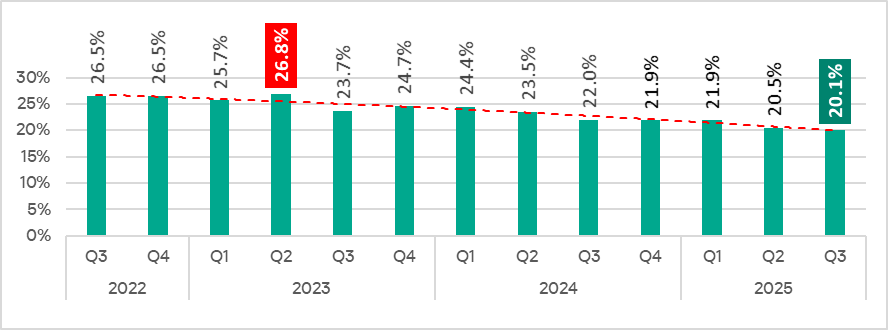
In Q3 2025, the percentage of ICS computers on which malicious objects were blocked decreased from the previous quarter by 0.4 pp to 20.1%. This is the lowest level for the observed period.
Percentage of ICS computers on which malicious objects were blocked, Q3 2022–Q3 2025
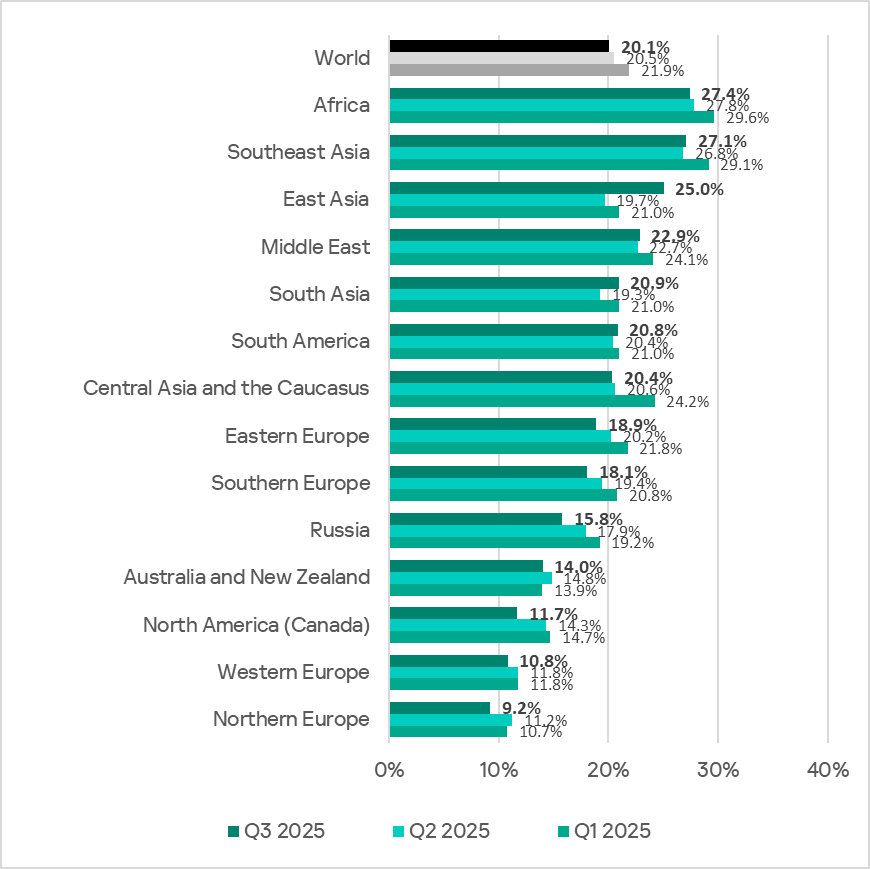
Regionally, the percentage of ICS computers on which malicious objects were blocked ranged from 9.2% in Northern Europe to 27.4% in Africa.
Regions ranked by percentage of ICS computers on which malicious objects were blocked
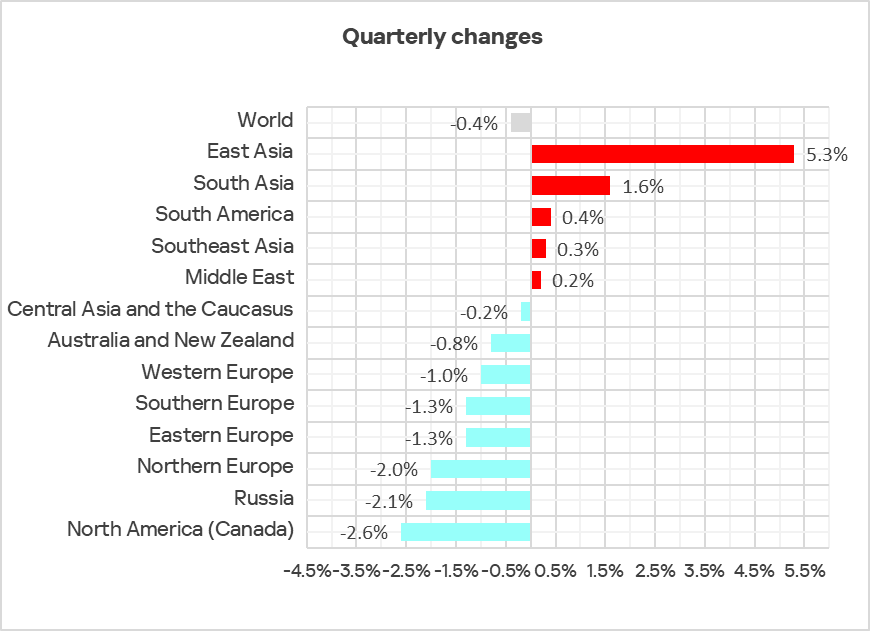
In Q3 2025, the percentage increased in five regions. The most notable increase occurred in East Asia, triggered by the local spread of malicious scripts in the OT infrastructure of engineering organizations and ICS integrators.
Changes in the percentage of ICS computers on which malicious objects were blocked, Q3 2025
Selected industries
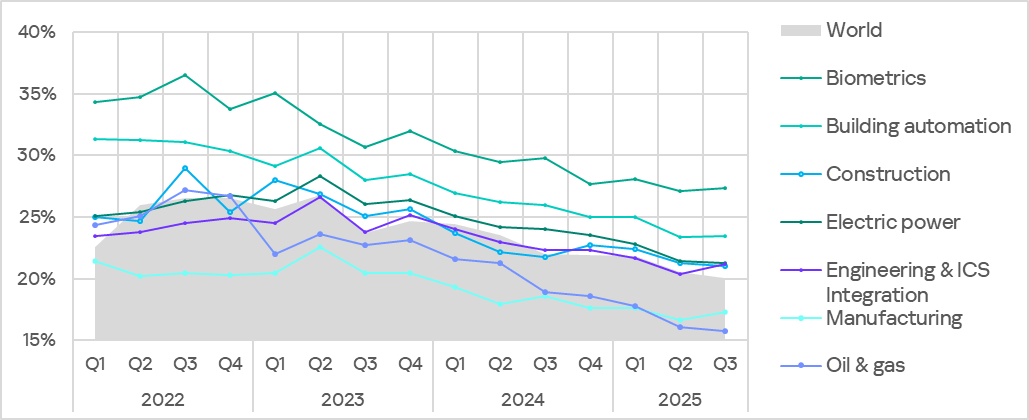
The biometrics sector traditionally led the rankings of the industries and OT infrastructures surveyed in this report in terms of the percentage of ICS computers on which malicious objects were blocked.
Rankings of industries and OT infrastructures by percentage of ICS computers on which malicious objects were blocked
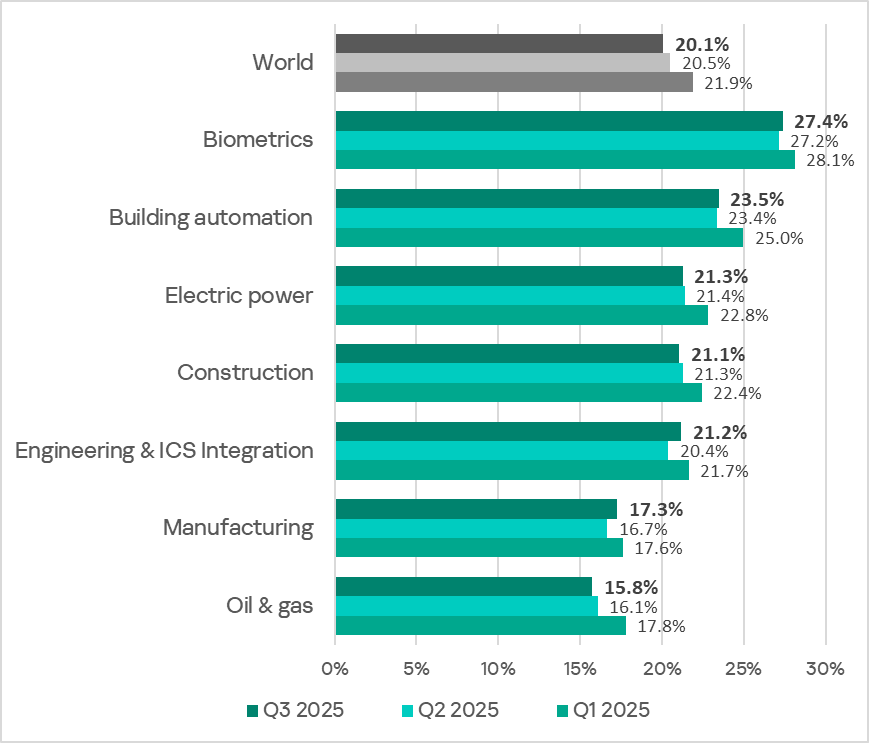
In Q3 2025, the percentage of ICS computers on which malicious objects were blocked increased in four of the seven surveyed industries. The most notable increases were in engineering and ICS integrators, and manufacturing.
Percentage of ICS computers on which malicious objects were blocked in selected industries
Diversity of detected malicious objects
In Q3 2025, Kaspersky protection solutions blocked malware from 11,356 different malware families of various categories on industrial automation systems.
Percentage of ICS computers on which the activity of malicious objects of various categories was blocked
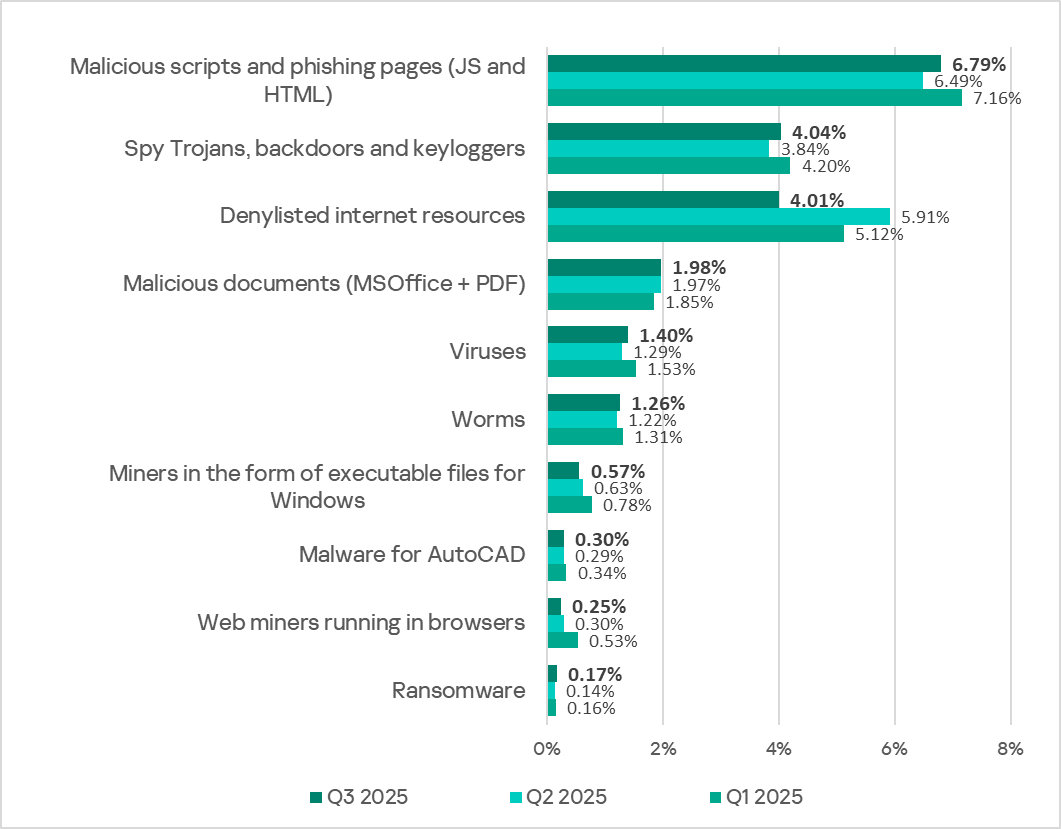
In Q3 2025, there was a decrease in the percentage of ICS computers on which denylisted internet resources and miners of both categories were blocked. These were the only categories that exhibited a decrease.
Main threat sources
Depending on the threat detection and blocking scenario, it is not always possible to reliably identify the source. The circumstantial evidence for a specific source can be the blocked threat’s type (category).
The internet (visiting malicious or compromised internet resources; malicious content distributed via messengers; cloud data storage and processing services and CDNs), email clients (phishing emails), and removable storage devices remain the primary sources of threats to computers in an organization’s technology infrastructure.
In Q3 2025, the percentage of ICS computers on which malicious objects from various sources were blocked decreased.
Percentage of ICS computers on which malicious objects from various sources were blocked
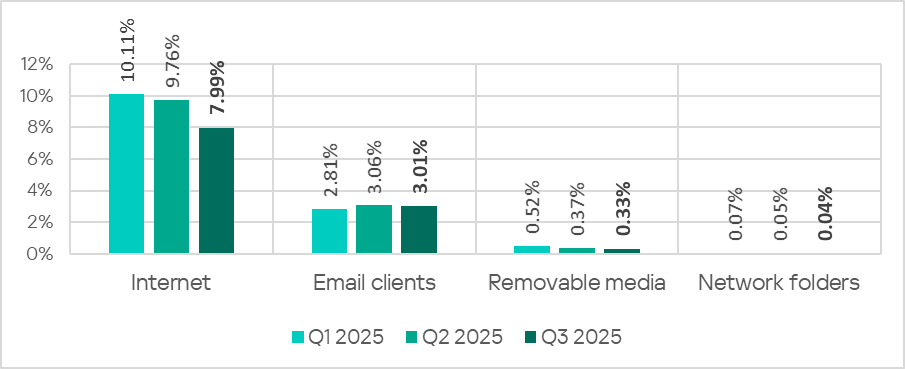
The same computer can be attacked by several categories of malware from the same source during a quarter. That computer is counted when calculating the percentage of attacked computers for each threat category, but is only counted once for the threat source (we count unique attacked computers). In addition, it is not always possible to accurately determine the initial infection attempt. Therefore, the total percentage of ICS computers on which various categories of threats from a certain source were blocked can exceed the percentage of threats from the source itself.
- The main categories of threats from the internet blocked on ICS computers in Q3 2025 were malicious scripts and phishing pages, and denylisted internet resources. The percentage ranged from 4.57% in Northern Europe to 10.31% in Africa.
- The main categories of threats from email clients blocked on ICS computers were malicious scripts and phishing pages, spyware, and malicious documents. Most of the spyware detected in phishing emails was delivered as a password-protected archive or a multi-layered script embedded in an office document. The percentage of ICS computers on which threats from email clients were blocked ranged from 0.78% in Russia to 6.85% in Southern Europe.
- The main categories of threats that were blocked when removable media was connected to ICS computers were worms, viruses, and spyware. The percentage of ICS computers on which threats from this source were blocked ranged from 0.05% in Australia and New Zealand to 1.43% in Africa.
- The main categories of threats that spread through network folders were viruses, AutoCAD malware, worms, and spyware. The percentages of ICS computers where threats from this source were blocked ranged from 0.006% in Northern Europe to 0.20% in East Asia.
Threat categories
Typical attacks blocked within an OT network are multi-step sequences of malicious activities, where each subsequent step of the attackers is aimed at increasing privileges and/or gaining access to other systems by exploiting the security problems of industrial enterprises, including technological infrastructures.
Malicious objects used for initial infection
In Q3 2025, the percentage of ICS computers on which denylisted internet resources were blocked decreased to 4.01%. This is the lowest quarterly figure since the beginning of 2022.
Percentage of ICS computers on which denylisted internet resources were blocked, Q3 2022–Q3 2025
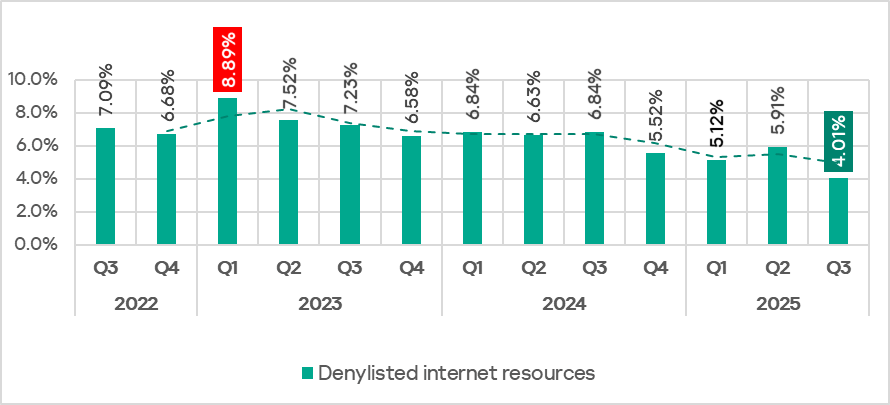
Regionally, the percentage of ICS computers on which denylisted internet resources were blocked ranged from 2.35% in Australia and New Zealand to 4.96% in Africa. Southeast Asia and South Asia were also among the top three regions for this indicator.
The percentage of ICS computers on which malicious documents were blocked has grown for three consecutive quarters, following a decline at the end of 2024. In Q3 2025, it reached 1,98%.
Percentage of ICS computers on which malicious documents were blocked, Q3 2022–Q3 2025
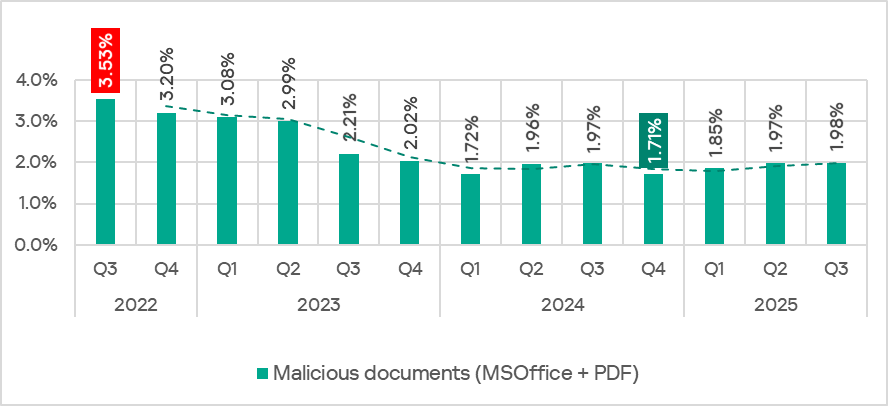
The indicator increased in four regions: South America, East Asia, Southeast Asia, and Australia and New Zealand. South America saw the largest increase as a result of a large-scale phishing campaign in which attackers used new exploits for an old vulnerability (CVE-2017-11882) in Microsoft Office Equation Editor to deliver various spyware to victims’ computers. It is noteworthy that the attackers in this phishing campaign used localized Spanish-language emails disguised as business correspondence.
In Q3 2025, the percentage of ICS computers on which malicious scripts and phishing pages were blocked increased to 6.79%. This category led the rankings of threat categories in terms of the percentage of ICS computers on which they were blocked.
Percentage of ICS computers on which malicious scripts and phishing pages were blocked, Q3 2022–Q3 2025
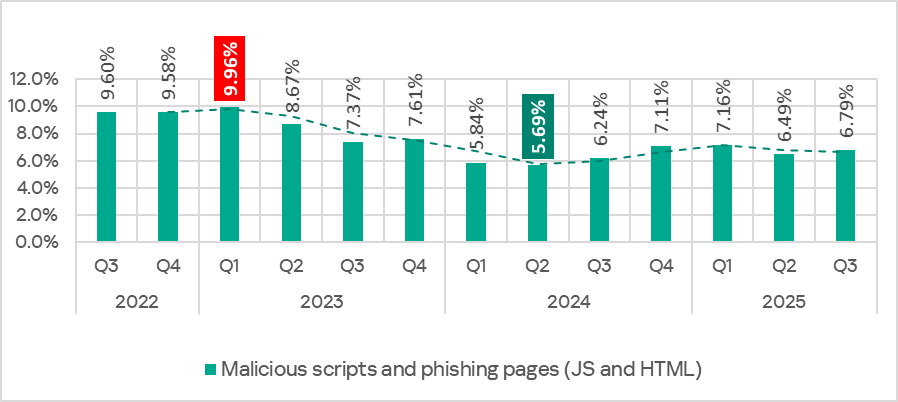
Regionally, the percentage of ICS computers on which malicious scripts and phishing pages were blocked ranged from 2.57% in Northern Europe to 9.41% in Africa. The top three regions for this indicator were Africa, East Asia, and South America. The indicator increased the most in East Asia (by a dramatic 5.23 pp) as a result of the local spread of malicious spyware scripts loaded into the memory of popular torrent clients including MediaGet.
Next-stage malware
Malicious objects used to initially infect computers deliver next-stage malware — spyware, ransomware, and miners — to victims’ computers. As a rule, the higher the percentage of ICS computers on which the initial infection malware is blocked, the higher the percentage for next-stage malware.
In Q3 2025, the percentage of ICS computers on which spyware and ransomware were blocked increased. The rates were:
- spyware: 4.04% (up 0.20 pp);
- ransomware: 0.17% (up 0.03 pp).
The percentage of ICS computers on which miners of both categories were blocked decreased. The rates were:
- miners in the form of executable files for Windows: 0.57% (down 0.06 pp), it’s the lowest level since Q3 2022;
- web miners: 0.25% (down 0.05 pp). This is the lowest level since Q3 2022.
Self-propagating malware
Self-propagating malware (worms and viruses) is a category unto itself. Worms and virus-infected files were originally used for initial infection, but as botnet functionality evolved, they took on next-stage characteristics.
To spread across ICS networks, viruses and worms rely on removable media and network folders in the form of infected files, such as archives with backups, office documents, pirated games and hacked applications. In rarer and more dangerous cases, web pages with network equipment settings, as well as files stored in internal document management systems, product lifecycle management (PLM) systems, resource management (ERP) systems and other web services are infected.
In Q3 2025, the percentage of ICS computers on which worms and viruses were blocked increased to 1.26% (by 0.04 pp) and 1.40% (by 0.11 pp), respectively.
AutoCAD malware
This category of malware can spread in a variety of ways, so it does not belong to a specific group.
In Q3 2025, the percentage of ICS computers on which AutoCAD malware was blocked slightly increased to 0.30% (by 0.01 pp).
For more information on industrial threats see the full version of the report.
[2026-01-31] Pillole di primo soccorso - primo appuntamento @ Spazio libertario Sole e Baleno
Pillole di primo soccorso - primo appuntamento
Spazio libertario Sole e Baleno - 27, Sobborgo Valzania, Quartiere Fiorenzuola, Ponte Abbadesse, Cesena, Unione dei comuni Valle del Savio, Forlì-Cesena, Emilia-Romagna, 47521, Italia
(sabato, 31 gennaio 15:00)

[2026-01-10] Discoscarica #10 @ Spazio libertario Sole e Baleno
Discoscarica #10
Spazio libertario Sole e Baleno - 27, Sobborgo Valzania, Quartiere Fiorenzuola, Ponte Abbadesse, Cesena, Unione dei comuni Valle del Savio, Forlì-Cesena, Emilia-Romagna, 47521, Italia
(sabato, 10 gennaio 18:00)

[2026-01-19] Assemblea di autogestione - 19 Gennaio @ Spazio libertario Sole e Baleno
Assemblea di autogestione - 19 Gennaio
Spazio libertario Sole e Baleno - 27, Sobborgo Valzania, Quartiere Fiorenzuola, Ponte Abbadesse, Cesena, Unione dei comuni Valle del Savio, Forlì-Cesena, Emilia-Romagna, 47521, Italia
(lunedì, 19 gennaio 20:00)


Chaos Communication Congress: Talk-Tipps für die Zeit zwischen den Jahren
netzpolitik.org/2025/chaos-com…


La telefonata del presidente Mattarella alla madre di Trentini. Un gesto buono e giusto
@Giornalismo e disordine informativo
articolo21.org/2025/12/la-tele…
Il presidente Mattarella ha telefonato alla mamma di Alberto Trentini, il volontario e cooperante veneziano
Giornalismo e disordine informativo reshared this.
Iran: oltre 1500 esecuzioni nel 2025
@Giornalismo e disordine informativo
articolo21.org/2025/12/iran-ol…
Con oltre 1500 esecuzioni nel 2025, la Repubblica Islamica dell’Iran, ha registrato il numero più alto di esecuzioni negli ultimi tre decenni. Il 2025 si chiude con oltre 5000 persone in attesa dell’esecuzione, almeno 44 dei quali condannati a morte per ragioni
reshared this
Auguri a tutti noi in direzione ostinata e contraria
@Giornalismo e disordine informativo
articolo21.org/2025/12/auguri-…
Sarà un anno difficile, attacco alla Costituzione, una Finanziaria che cancella dei diritti acquisiti, venti di guerra, informazione negata, giustizia sotto il controllo del Governo, e per ultimo non ultima la
Giornalismo e disordine informativo reshared this.

Un referendum in diretta televisiva
@Giornalismo e disordine informativo
articolo21.org/2025/12/un-refe…
Bene ha fatto il Consiglio nazionale dell’Ordine dei giornalisti a fare appello all’Autorità per le garanzie nelle comunicazioni perché venga convocato con urgenza il Comitato istituito per vigilare sulla correttezza della trattazione dei processi in tv. L’Agcom
Giornalismo e disordine informativo reshared this.
Nuovo naufragio alla Vigilia di Natale: 16 morti
@Giornalismo e disordine informativo
articolo21.org/2025/12/nuovo-n…
Un nuovo naufragio alla Vigilia di Natale Secondo quanto riferisce sul proprio account di X l’ong Sea Watch, “116 persone hanno perso la vita nell’ennesimo naufragio del 2025. L’unico sopravvissuto è stato salvato da
reshared this
Buone feste! Ecco il mio augurio.
@Privacy Pride
Il post completo di Christian Bernieri è sul suo blog: garantepiracy.it/blog/augurio/
Ho un personalissimo proposito ed è anche il mio augurio per il nuovo anno: Che tu possa diffidare, sempre, anche se… Prosit.
reshared this

Tutti i danni che i video brevi possono causare al nostro cervello
L'esposizione prolungata a video brevi attiva il sistema della ricompensa, con conseguenze su concentrazione, autocontrollo, memoria, equilibrio emotivo e difficoltà di concentrazione su compiti lunghi.Filippo Bonaventura (Geopop)
Guinness_Irish_Stout67 reshared this.
collezionismo (o no)
cosa 'non' fa di me un collezionista
noblogo.org/differx/cosa-non-f…
reshared this
Ausili e protesi: Il TAR boccia il decreto tariffe. Ass. Coscioni: “Ora il Ministero intervenga con istruttoria seria”
Il TAR del Lazio ha annullato il Decreto Tariffe del 25 novembre 2024 anche per la parte relativa all’assistenza protesica, accogliendo il ricorso della Federazione Italiana degli Operatori in Tecniche Ortopediche (Fioto). Con la sentenza n. 22313/2025, pubblicata il 10 dicembre, i giudici amministrativi hanno bocciato il provvedimento “per grave difetto di istruttoria”, dando al Ministero della Salute un anno di tempo per riformularlo.
“Questa pronuncia del TAR Lazio, letta unitamente alla sentenza scaturita dalla class action promossa dall’Associazione Luca Coscioni, mette in evidenza una criticità strutturale del sistema dei LEA”, afferma l’avvocato Alessandro Bardini, Consigliere Generale dell’Associazione Luca Coscioni. “Dalle decisioni giudiziarie emerge con chiarezza che il Ministero della Salute ha affrontato la riforma dell’assistenza protesica in modo approssimativo, in assenza di una reale istruttoria sui bisogni delle persone con disabilità e sui costi effettivi delle prestazioni. Il Giudice amministrativo riafferma un principio fondamentale: senza istruttoria adeguata non può esservi legittimità dell’azione amministrativa. La logica del risparmio, quando non è fondata su valutazioni tecniche serie, rischia di compromettere il diritto alla salute degli assistiti”.
“Questa sentenza conferma quanto emerso dalla nostra class action vinta prima al TAR e poi confermata dal Consiglio di Stato proprio sul tema ausili”, dichiara Rocco Berardo, coordinatore iniziative sui diritti delle persone con disabilità dell’Associazione Luca Coscioni. “Anche in quel caso il Ministero è stato condannato perché non ha rispettato quanto previsto dalla legge del 2017, in particolare relativamente all’art. 30 bis sugli ausili destinati alle disabilità più gravi e complesse. Il Ministero non ha effettuato le istruttorie previste, anche ascoltando le associazioni, per verificare il funzionamento della legge e il suo eventuale miglioramento lasciando le persone con disabilità abbandonate a sé stesse”.
La prova di quanto non funzioni l’attuale sistema è stata tra l’altro restituita da un’indagine condotta dall’Associazione Luca Coscioni, che ha raccolto centinaia di testimonianze. “Le evidenze raccolte – dichiara Rocco Berardo – confermano che le procedure ad evidenza pubblica stanno penalizzando le persone con disabilità più gravi. Tempi di attesa insostenibili, costi aggiuntivi anche molto elevati a carico delle famiglie e l’impossibilità di ottenere ausili realmente personalizzati stanno svuotando di contenuto il diritto all’assistenza protesica previsto dai LEA. È indispensabile, dunque, come richiesto dall’Associazione Luca Coscioni alla commissione del Ministero, che gli ausili più critici siano inseriti fuori dall’elenco degli ausili da mettere a gara e che siano garantite per gli stessi la personalizzazione e la riparazione”.
L'articolo Ausili e protesi: Il TAR boccia il decreto tariffe. Ass. Coscioni: “Ora il Ministero intervenga con istruttoria seria” proviene da Associazione Luca Coscioni.
Ecco come Ast SpaceMobile sfida Starlink con il lancio del satellite per smartphone BlueBird 6
Per vedere altri post come questo, segui la comunità @Informatica (Italy e non Italy 😁)
L'azienda texana Ast SpaceMobile ha annunciato il lancio di successo con un razzo indiano di BlueBird 6, iI sistema di comunicazione più grande mai dispiegato in orbita
Informatica (Italy e non Italy 😁) reshared this.
Resoconto Linux Day 2025
firenze.linux.it/2025/12/resoc…
Segnalato dal LUG di Firenze e pubblicato sulla comunità Lemmy @GNU/Linux Italia
#Firenze
L’anno scorso fummo sorpresi dal successo del giorno di GNU/Linux alla biblioteca di Scandicci, malgrado i modesti mezzi e i tempi ristretti per l’organizzazione. Al contrario quest’anno
GNU/Linux Italia reshared this.
incoscienza a proposito della Liberazione
dal 2015 : youtu.be/cBesCvBzXfw
(e credo che in questi ultimi dieci anni le cose siano ancora peggiorate.
non si spiegano molte faccende orribili, altrimenti)
#25aprile #Liberazione #FestaDellaLiberazione #antifascismo
notilla su
noblogo.org/differx/dal-2015-y…
reshared this
Natale, istruzioni per l’uso (del portafoglio.)
noblogo.org/transit/natale-ist…


Natale, istruzioni per l’uso (del portafoglio.)
(189)
Un tempo il #Natale sapeva di mandarini e di freddo. Oggi sa di plastica, di profumo sintetico alla cannella e di offerte “imperdibili”. È passato da evento religioso (che riconosco, ma non frequento per coerenza) a vaccino annuale contro la malinconia, somministrato in dosi di pubblicità e zucchero. Non si aspetta più la nascita di un improbabile “Salvatore”: si aspetta il corriere espresso.
L’unico presepe che conta è quello dove il nuovo dio è lo scontrino fiscale. La festa comincia già a novembre, quando si accendono i LED sponsorizzati e le vetrine diventano vetrate di cattedrali dedicate alle divinità del consumo. L’atmosfera natalizia è una liturgia pubblicitaria senza fine: famiglie perfette, pacchi scintillanti, sorrisi programmati. “Fatevi un regalo”, dicono. Ma per molti, il vero regalo sarebbe un affitto pagato o una bolletta non scaduta.
Nei magazzini e nei centri di smistamento si lavora a tempo di jingle. I veri elfi di Babbo Natale sono precari con la schiena a pezzi e la consegna garantita. Mentre il mondo si commuove davanti agli spot, loro fanno le notti per tenere accesa la giostra del Natale. Il miracolo non è la nascita di un bambino, ma che qualcuno ancora sorrida dopo dodici ore di lavoro.
Arriva la Vigilia: la prova di sopravvivenza più ipocrita dell’anno. Tavole imbandite, sorrisi forzati, discussioni che nessuno ha voglia di affrontare. A Natale ci si ama per obbligo, si ascolta per forza, si brinda per abitudine. È il grande festival delle relazioni diplomatiche: tutti seduti insieme, uniti solo dalla stanchezza e dal desiderio che finisca in fretta. Fuori, le città traboccano di “esperienze autentiche”: mercatini vintage, regali “etici”, panettoni artigianali da quarantacinque euro.
Tutto mercificato, anche la bontà. Se non compri, non esisti. La gioia è un’unità di misura tracciata in scontrini, la pace si conta in like. “Buone feste” è diventato un riflesso condizionato, un rumore di fondo da cui nessuno si salva. Dietro le luci e i brindisi resta il buio dei margini. I poveri, i precari, gli invisibili assistono al grande spettacolo del benessere da dietro la quinta. Per loro, il Natale è solo un altro turno, un altro giorno da superare. Poi arrivano i servizi televisivi “commoventi”, la lacrima di circostanza, e tutto finisce lì: quel poco di solidarietà si scioglie più in fretta del burro nel panettone.
Il Natale consumistico è una macchina perfetta: produce desideri, li vende, e poi li sostituisce. È la religione del capitale emotivo, dove la preghiera è contactless e la redenzione avviene in tre rate. Ogni gennaio ci chiediamo perché ci sentiamo vuoti. La risposta è semplice: lo siamo, ma almeno abbiamo comprato il vuoto in confezione regalo. Viva il #Natale, dunque: patrono dell’apparenza, santo protettore dell’ipocrisia e martire della sincerità. Non importa più cosa significhi, basta che arrivi il pacco in tempo e che l’etichetta sia quella giusta. Perché in fondo, nel presepe del mondo moderno, l’unico Bambin Gesù rimasto è un prodotto in pronta consegna.
#Blog #Natale #Consumismo #Economia #Opinioni
Mastodon: @alda7069@mastodon.unoTelegram: t.me/transitblogFriendica: @danmatt@poliverso.orgBlue Sky: bsky.app/profile/mattiolidanie…Bio Site (tutto in un posto solo, diamine): bio.site/danielemattioli
Gli scritti sono tutelati da “Creative Commons” (qui)
Tutte le opinioni qui riportate sono da considerarsi personali. Per eventuali problemi riscontrati con i testi, si prega di scrivere a: corubomatt@gmail.com


Corazzate nucleari, armi laser e industria. Tutto sulla Golden Fleet Initiative
@Notizie dall'Italia e dal mondo
Una flotta rinnovata, capace di schierare le navi più potenti di sempre e di riportare la Marina statunitense ai fasti di un tempo. Questo è il piano dell’amministrazione Usa per rilanciare la propria industria cantieristica e mandare un messaggio alla Cina e
Notizie dall'Italia e dal mondo reshared this.
In the age of Spotify and AI slop, tapes remind us what we’re missing when we stop taking risks.#Music #physicalmedia
Why I Quit Streaming And Got Back Into Cassettes
Whenever I tell people I’m getting back into tapes, their faces immediately light up.There’s a genuine excitement in peoples’ expressions these days when I mention physical media. Lately I’ve been talking about the cheap walkman I bought on a recent trip to Tokyo, and the various little shops where I hunted for music on cassettes. Unlike in Europe and the US, physical media never went out of vogue in Japan, and many people still have a strong preference for shopping in-person. This made Tokyo the ideal place to rediscover my love of portable analog music.
I searched through racks of tapes stacked on top of an old piano in a back-alley store on the edge of Shimokitazawa, a neighborhood known for thrifted fashion and oddball record shops. On recommendation from a friend-of-a-friend, I checked out a specialist shop on a sleepy street in Nakameguro, where cassettes easily outnumbered vinyl records 10-to-1. Almost always, I steered myself toward local artists whose names I didn’t recognize. Sometimes, I bought tapes based on the cover art or description alone. Most second-hand music stores in Tokyo keep everything sealed in plastic, so you either have to bother the shopkeep, or just trust your gut and take a chance.
This kind of music discovery delights people when I describe it to them. Sometimes they start telling me about rediscovering their old CD collection, or wanting to track down an old iPod Classic to experience their music library away from the surveillance and excess of big tech platforms. Maybe it’s just because I live in a particular social bubble in a particular countercultural pocket of New York City. But recently, the conversations I’ve had on this topic have got me feeling like the culture of music is shifting.
playlist.megaphone.fm?p=TBIEA2…
People areleaving Spotify, and those who aren’t seem embarrassed about using it. Major artistspulled their music off the platform this year in protest of the company’sICE recruitment ads and connections tomilitary drones, and posting your Wrapped stats has gone from a ubiquitous year-end pastime to a cultural faux pas. Many folks aresick of streaming in general. They’re sick of giant corporations, algorithmic playlists, and aninternet infested with AI slop. Artists are tired of tech platforms that pay them virtually nothing, owned by degenerate billionaires that see all human creativity as interchangeable aesthetic wallpaper, valued only for its ability to make numbers go up. Everywhere I go,people are exhausted by the never-ending scroll, desperately wanting to reconnect with something real.My own path to re-embracing physical media unfolded in stages. Last year, I canceled my Apple Music subscription and started exclusively listening to music I bought from artists on Bandcamp. I still have a large mp3 library, and I thought about setting up aself-hosted media server to stream everything to my phone. But ultimately, I got lazy and wound up just listening to albums I downloaded from the Bandcamp app. Then I ran out of storage on my phone, and the amount of music I had available on-the-go shrank even more.
When I came to Tokyo, a friend took me to a store that sold cheap portable cassette players, and I knew it wouldn’t be a huge leap to take my music listening fully offline. The walkman I bought is unbranded and has a transparent plastic shell, allowing you to watch all the little mechanical gears turning inside as the tape spools around the wheels and past the playheads. It was one of the easiest purchasing decisions I’ve made in recent memory: After years of psychic damage from social media and other phone-based distractions, I was ready to once again have a dedicated device that does nothing but play music.
There are lots of advantages to the cassette lifestyle. Unlike vinyl records, tapes are compact and super-portable, and unlike streaming, you never have to worry about a giant company suddenly taking them away from you. They can be easily duplicated, shared, and made into mixtapes using equipment you find in a junk shop. When I was a kid, the first music I ever owned were tapes I recorded from MTV with a Kids’ Fisher Price tape recorder. I had no money, so I would listen to those tapes for hours, relishing every word Kim Gordon exhaled on my bootlegged copy of Sonic Youth’s “Bull in the Heather.” Just like back then, my rediscovery of cassettes has led me to start listening more intentionally and deeply, devoting more and more time to each record without the compulsion to hit “skip.” Most of the cassettes I bought in Tokyo had music I probably never would have found or spent time with otherwise.
Getting reacquainted with tapes made me realize how much has been lost in the streaming era. Over the past two decades, platforms like Spotify co-opted the model of peer-to-peer filesharing pioneered by Napster and BitTorrent into a fully captured ecosystem. But instead of sharing, this ecosystem was designed around screen addiction, surveillance, and instant gratification — with corporate middlemen and big labels reaping all the profits.
Streaming seeks to virtually eliminate what techies like to call “user friction,” turning all creative works into a seamless and unlimited flow of data, pouring out of our devices like water from a digital faucet. Everything becomes “Content,” flattened into aesthetic buckets and laser-targeted by“perfect fit” algorithms to feed our addictive impulses. Thus the act of listening to music is transformed from a practice of discovery and communication to a hyper-personalized mood board of machine-optimized “vibes.”
What we now call “AI Slop” is just a novel and more cynically efficient vessel for this same process. Slop removes human beings as both author and subject, reducing us to raw impulses — a digital lubricant for maximizing viral throughput. Whether we love or hate AI Slop is irrelevant, because human consumers are not its intended beneficiaries. In the minds of CEOs like OpenAI’s Sam Altman, we’re simply components in a machine built to maintain and accelerate information flows, in order to create value for an insatiably wealthy investor class.
On one hand, I empathize with those who still feel like they get something out of streaming. Having access to so much music can feel empowering, especially when so many people feel like they lack the time and resources to develop a music-listening practice. “What streaming service should I use instead of Spotify?” is a question I’ve been seeing constantly over the past few months.
Here’s my contrarian answer: What if there’s no ethical way to have unlimited access to every book, film, and record ever created? And moreover, what if that’s not something we should want?
What if we simply decided to consume less media, allowing us to have a deeper appreciation for the art we choose to spend our time with? What if, instead of having an on-demand consumer mindset that requires us to systematically strip art of all its human context, we developed better relationships with creators and built new structures to support them? What if we developed a politics of refusal — the ability to say enough is enough — and recognized that we aren’t powerless to the whims of rich tech CEOs who force this dystopian garbage down our throats while claiming it’s “inevitable?”
0:00
/0:07
1×Tapes and other physical media aren’t a magic miracle cure for late-stage capitalism. But they can help us slow down and remember what makes us human. Tapes make music-listening into an intentional practice that encourages us to spend time connecting with the art, instead of frantically vibe-surfing for something that suits our mood from moment-to-moment. They reject the idea that the point of discovering and listening to music is finding the optimal collection of stimuli to produce good brain chemicals.
More importantly, physical media reminds us that nothing good is possible if we refuse to take risks. You might find the most mediocre indie band imaginable. Or you might discover something that changes you forever. Nothing will happen if you play it safe and outsource all of your experiences to a content machine designed to make rich people richer.
How To Ditch Spotify and Support Music in the Age of AI Slop
There’s no shortage of reasons to quit Spotify in 2025. Artists and fans have been departing the platform in droves because they’re fed up with the company paying artists virtually nothing, using algorithms that promote AI-generated slop, running rec…Janus Rose (Touch Grass)
Famiglia nel bosco, Salvini: “Separarli a Natale è una violenza di Stato senza senso e senza precedenti”
@Politica interna, europea e internazionale
Matteo Salvini si scaglia nuovamente contro i giudici per il caso della cosiddetta famiglia nel bosco. Il vicepremier e ministro dei Trasporti, infatti, ha scritto sui social: “Separare una famiglia anche nel giorno di Natale, una violenza
Politica interna, europea e internazionale reshared this.
How we tracked ourselves with exposed Flock cameras; a year in review; and our personal recommendations on all sorts of things.#Podcast
Podcast: We Tracked Ourselves with Exposed Flock Cameras
We start this week with Jason’s story about Flock exposing a bunch of AI-powered cameras. These cameras zoom in on people as they walk by, sometimes so closely you can read what’s on their phone screen. After the break, we talk about some of our biggest stories this year. In the subscribers-only section, we give some of our personal recommendations of games, other reporting, or just a more chill life.
playlist.megaphone.fm?e=TBIEA7…
Listen to the weekly podcast on Apple Podcasts,Spotify, or YouTube. Become a paid subscriber for access to this episode's bonus content and to power our journalism. If you become a paid subscriber, check your inbox for an email from our podcast host Transistor for a link to the subscribers-only version! You can also add that subscribers feed to your podcast app of choice and never miss an episode that way. The email should also contain the subscribers-only unlisted YouTube link for the extended video version too. It will also be in the show notes in your podcast player.
- Flock Exposed Its AI-Powered Cameras to the Internet. We Tracked Ourselves
- Anyone Can Push Updates to the DOGE.gov Website
- Mike Waltz Accidentally Reveals Obscure App the Government Is Using to Archive Signal Messages
- How Tea’s Founder Convinced Millions of Women to Spill Their Secrets, Then Exposed Them to the World
- Half of the US Now Requires You to Upload Your ID or Scan Your Face to Watch Porn
Mike Waltz Accidentally Reveals Obscure App the Government Is Using to Archive Signal Messages
A photograph of Trump administration official Mike Waltz's phone shows him using an unofficial version of Signal designed to archive messages during a cabinet meeting.Joseph Cox (404 Media)

è sempre adessoa

è sempre adesso
Sono il mio mulino a vento quello che cammina sulla scala mobile per il paradiso di Natale alla fine di un arcobaleno banale contento e...ordinariafollia
Il Pentagono e le armi cinesi. Cosa dice su Pechino il report annuale dei militari Usa
@Notizie dall'Italia e dal mondo
Il rapporto annuale del Dipartimento della Guerra statunitense sulle evoluzioni militari e di sicurezza della Cina, pubblicato in queste ore, offre molto più di un aggiornamento tecnico sulle capacità dell’Esercito Popolare di Liberazione (Pla).
Notizie dall'Italia e dal mondo reshared this.
Barbara Berlusconi: “Io in politica? No. Pensare di entrarci solo per il cognome non ha senso”
@Politica interna, europea e internazionale
Dal rapporto con papà Silvio alla depressione fino ai cinque figli: Barbara Berlusconi si racconta al Corriere della Sera. La terzogenita dell’ex presidente del Consiglio afferma che ora le “piacerebbe cominciare da chi sono ora”. Per questo ha creato una fondazione che
Politica interna, europea e internazionale reshared this.
SIRIA. Aleppo, i miliziani legati alla Turchia sparano sui quartieri curdi
@Notizie dall'Italia e dal mondo
Le sparatorie avvengono mentre cresce la tensione per il mancato raggiungimento dell'intesa tra curdi e Damasco
L'articolo SIRIA. Aleppo, ihttps://pagineesteri.it/2025/12/24/medioriente/siria-aleppo-i-miliziani-legati-alla-turchia-sparano-sui-quartieri-curdi/
Notizie dall'Italia e dal mondo reshared this.
informapirata ⁂
in reply to Simon Perry • • •parafrasando Guzzanti, "se non vediamo i carrarmati per le strade e le truppe che marciano, per noi la guerra non c'è..."
@politica
Politica interna, europea e internazionale reshared this.
ilsimoneviaggiatore
in reply to informapirata ⁂ • • •purtroppo è davvero così.
Ora, io capisco il desiderio di pace, credo che tutti noi vorremmo "la pace", in senso lato. Ma non possiamo pensare che questa arrivi semplicemente restando a guardare. E' brutale, ma credo che sia così.
Questi episodi non smetteranno se ci limitiamo a far finta che non esistono.
Pare che, invece, per l'opinione pubblica e per gran parte della politica la strategia sia proprio questa.
M_Siniscalchi 🌍🇪🇺🇮🇹
in reply to Simon Perry • • •youtu.be/zMxeUgxwojM?si=i4jS-d…
- YouTube
youtu.bePolitica interna, europea e internazionale reshared this.
ilsimoneviaggiatore
in reply to M_Siniscalchi 🌍🇪🇺🇮🇹 • • •Grazie, non avevo pensato a linkare anche quella popolare fronte.
Dobbiamo chiedere a Chora media di distribuire anche su Castopod.it XD