


Threat landscape for industrial automation systems in Q3 2025

Statistics across all threats
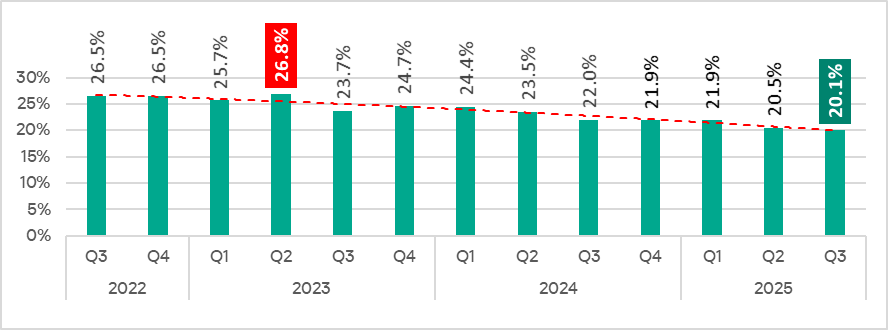
In Q3 2025, the percentage of ICS computers on which malicious objects were blocked decreased from the previous quarter by 0.4 pp to 20.1%. This is the lowest level for the observed period.
Percentage of ICS computers on which malicious objects were blocked, Q3 2022–Q3 2025
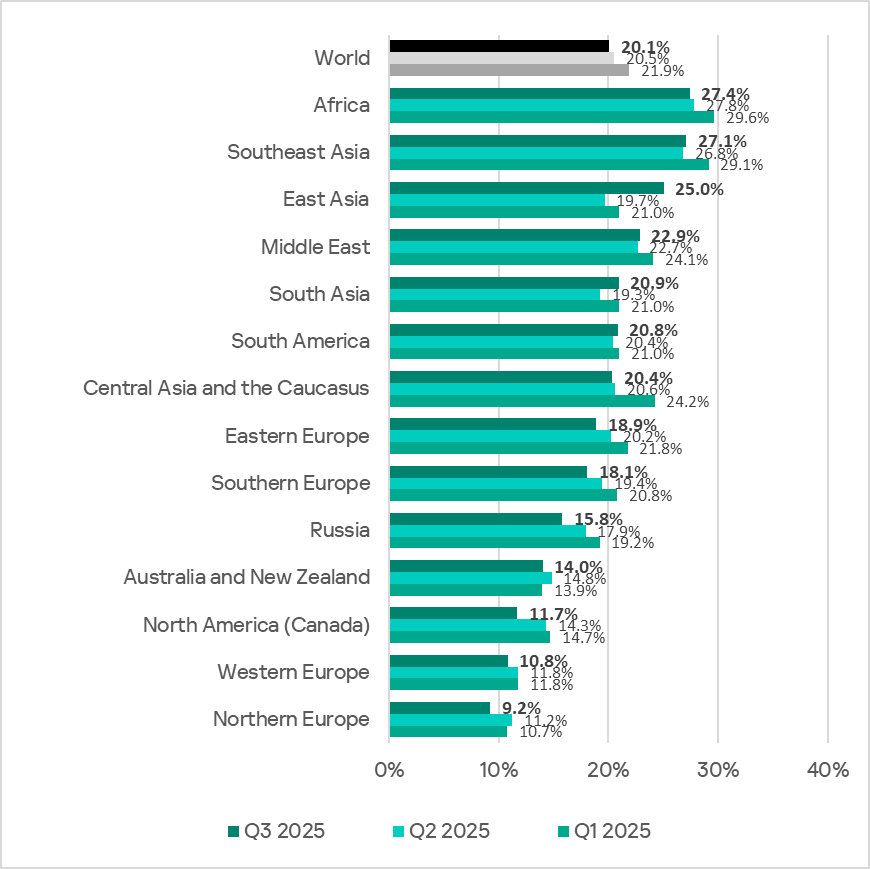
Regionally, the percentage of ICS computers on which malicious objects were blocked ranged from 9.2% in Northern Europe to 27.4% in Africa.
Regions ranked by percentage of ICS computers on which malicious objects were blocked
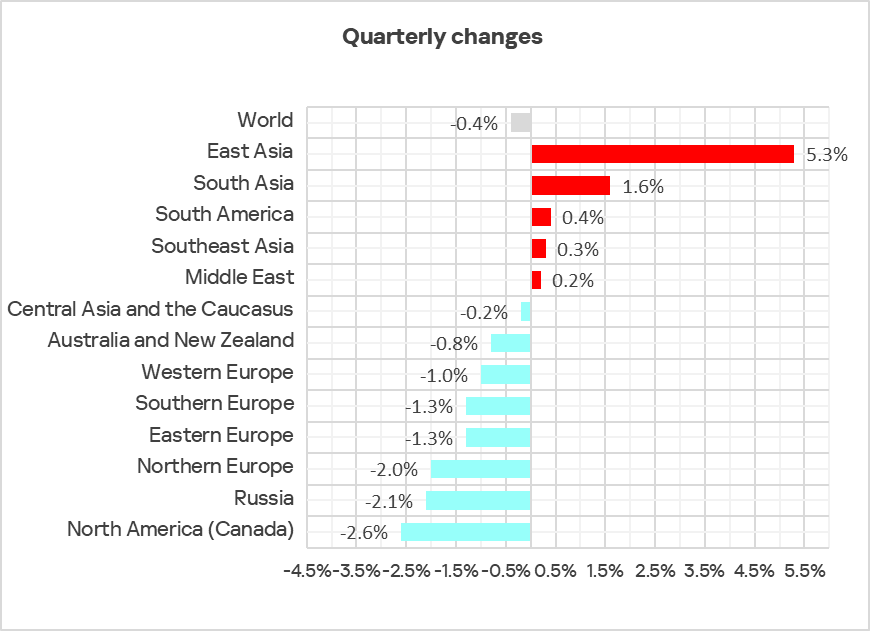
In Q3 2025, the percentage increased in five regions. The most notable increase occurred in East Asia, triggered by the local spread of malicious scripts in the OT infrastructure of engineering organizations and ICS integrators.
Changes in the percentage of ICS computers on which malicious objects were blocked, Q3 2025
Selected industries
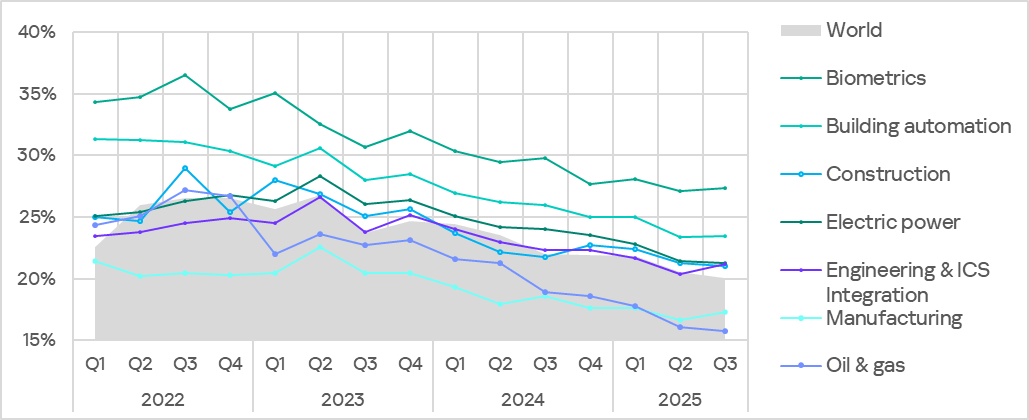
The biometrics sector traditionally led the rankings of the industries and OT infrastructures surveyed in this report in terms of the percentage of ICS computers on which malicious objects were blocked.
Rankings of industries and OT infrastructures by percentage of ICS computers on which malicious objects were blocked
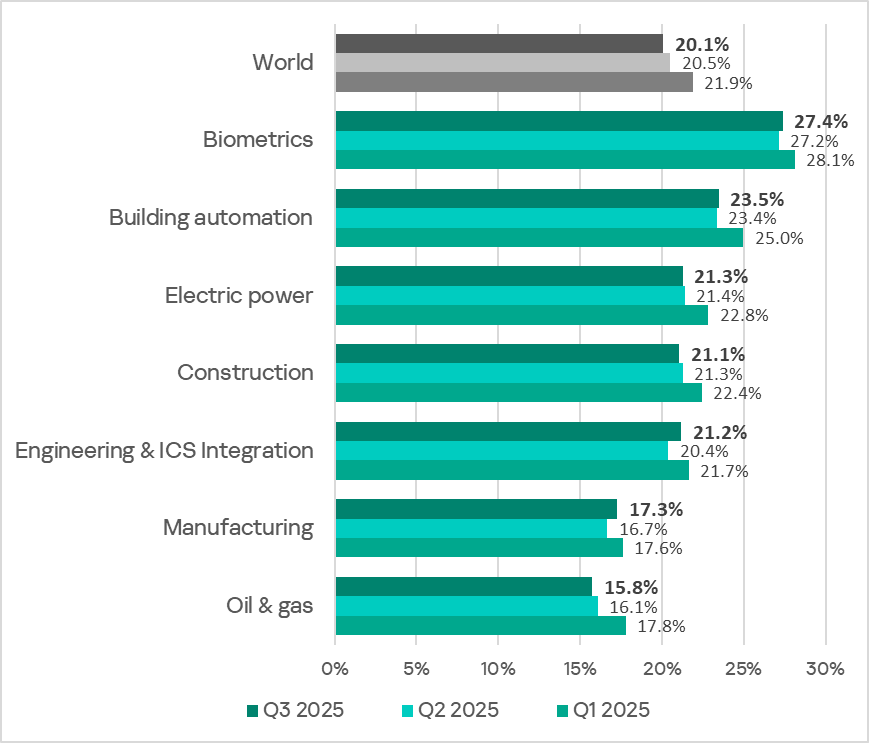
In Q3 2025, the percentage of ICS computers on which malicious objects were blocked increased in four of the seven surveyed industries. The most notable increases were in engineering and ICS integrators, and manufacturing.
Percentage of ICS computers on which malicious objects were blocked in selected industries
Diversity of detected malicious objects
In Q3 2025, Kaspersky protection solutions blocked malware from 11,356 different malware families of various categories on industrial automation systems.
Percentage of ICS computers on which the activity of malicious objects of various categories was blocked
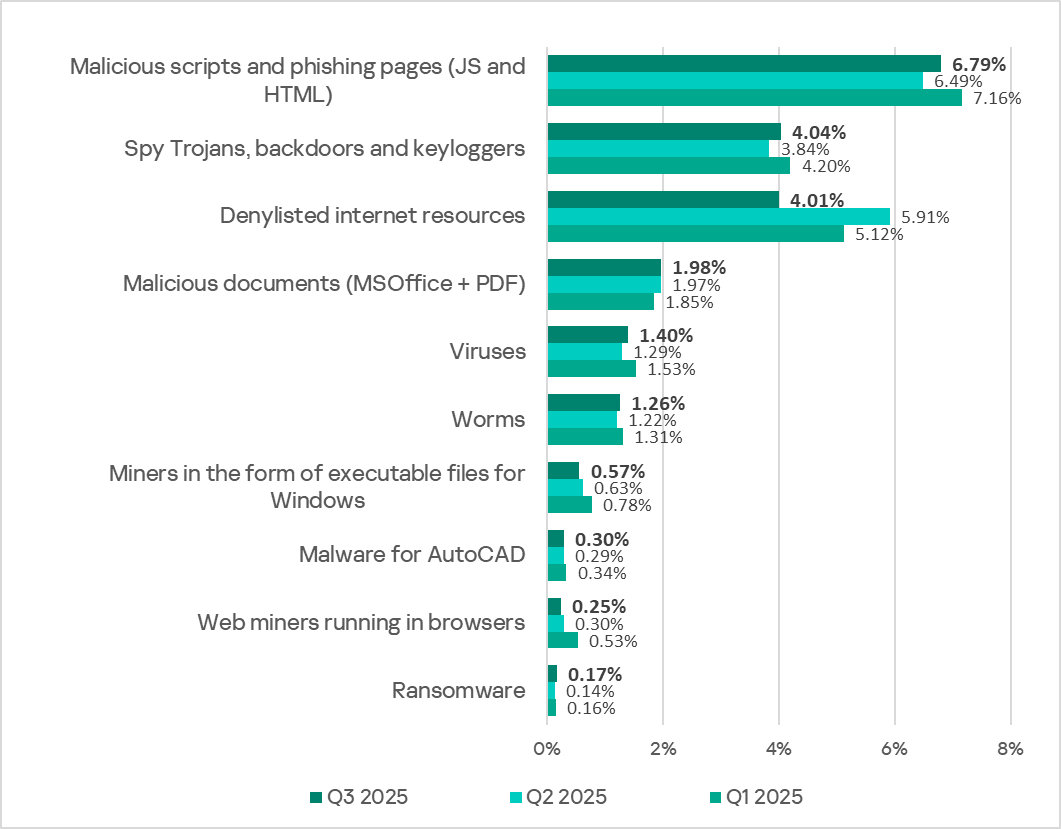
In Q3 2025, there was a decrease in the percentage of ICS computers on which denylisted internet resources and miners of both categories were blocked. These were the only categories that exhibited a decrease.
Main threat sources
Depending on the threat detection and blocking scenario, it is not always possible to reliably identify the source. The circumstantial evidence for a specific source can be the blocked threat’s type (category).
The internet (visiting malicious or compromised internet resources; malicious content distributed via messengers; cloud data storage and processing services and CDNs), email clients (phishing emails), and removable storage devices remain the primary sources of threats to computers in an organization’s technology infrastructure.
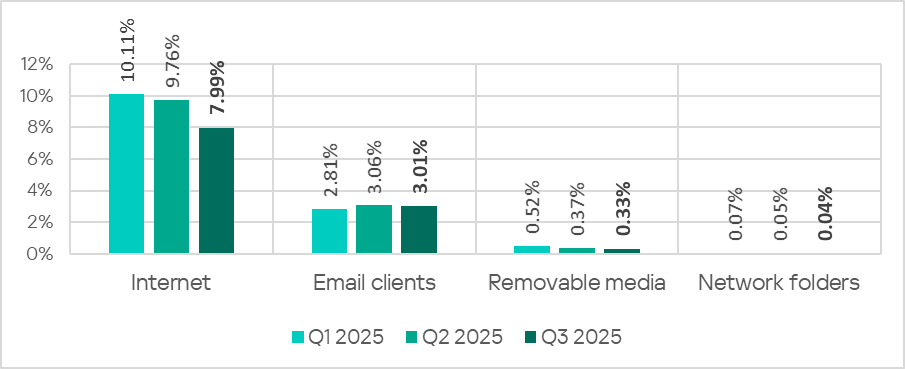
In Q3 2025, the percentage of ICS computers on which malicious objects from various sources were blocked decreased.
Percentage of ICS computers on which malicious objects from various sources were blocked
The same computer can be attacked by several categories of malware from the same source during a quarter. That computer is counted when calculating the percentage of attacked computers for each threat category, but is only counted once for the threat source (we count unique attacked computers). In addition, it is not always possible to accurately determine the initial infection attempt. Therefore, the total percentage of ICS computers on which various categories of threats from a certain source were blocked can exceed the percentage of threats from the source itself.
- The main categories of threats from the internet blocked on ICS computers in Q3 2025 were malicious scripts and phishing pages, and denylisted internet resources. The percentage ranged from 4.57% in Northern Europe to 10.31% in Africa.
- The main categories of threats from email clients blocked on ICS computers were malicious scripts and phishing pages, spyware, and malicious documents. Most of the spyware detected in phishing emails was delivered as a password-protected archive or a multi-layered script embedded in an office document. The percentage of ICS computers on which threats from email clients were blocked ranged from 0.78% in Russia to 6.85% in Southern Europe.
- The main categories of threats that were blocked when removable media was connected to ICS computers were worms, viruses, and spyware. The percentage of ICS computers on which threats from this source were blocked ranged from 0.05% in Australia and New Zealand to 1.43% in Africa.
- The main categories of threats that spread through network folders were viruses, AutoCAD malware, worms, and spyware. The percentages of ICS computers where threats from this source were blocked ranged from 0.006% in Northern Europe to 0.20% in East Asia.
Threat categories
Typical attacks blocked within an OT network are multi-step sequences of malicious activities, where each subsequent step of the attackers is aimed at increasing privileges and/or gaining access to other systems by exploiting the security problems of industrial enterprises, including technological infrastructures.
Malicious objects used for initial infection
In Q3 2025, the percentage of ICS computers on which denylisted internet resources were blocked decreased to 4.01%. This is the lowest quarterly figure since the beginning of 2022.
Percentage of ICS computers on which denylisted internet resources were blocked, Q3 2022–Q3 2025
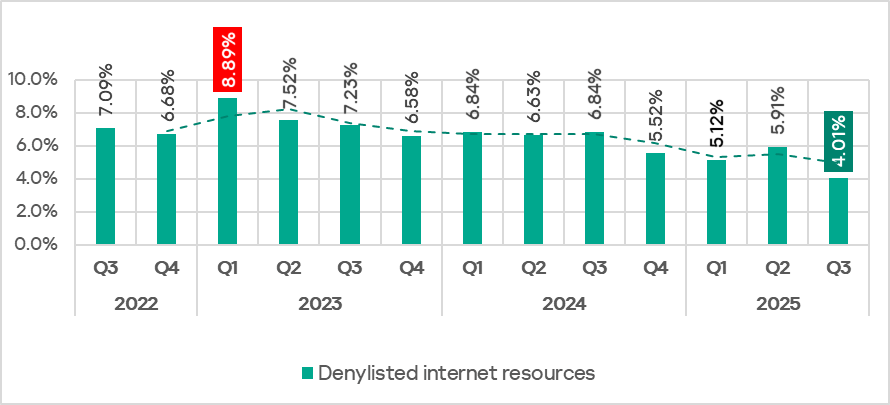
Regionally, the percentage of ICS computers on which denylisted internet resources were blocked ranged from 2.35% in Australia and New Zealand to 4.96% in Africa. Southeast Asia and South Asia were also among the top three regions for this indicator.
The percentage of ICS computers on which malicious documents were blocked has grown for three consecutive quarters, following a decline at the end of 2024. In Q3 2025, it reached 1,98%.
Percentage of ICS computers on which malicious documents were blocked, Q3 2022–Q3 2025
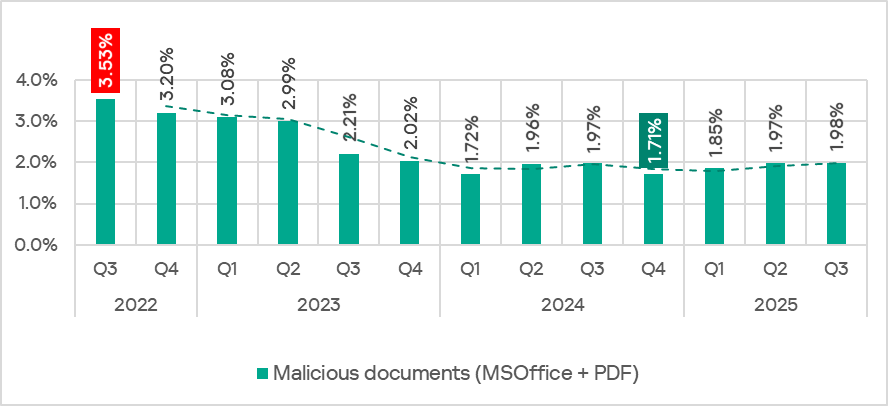
The indicator increased in four regions: South America, East Asia, Southeast Asia, and Australia and New Zealand. South America saw the largest increase as a result of a large-scale phishing campaign in which attackers used new exploits for an old vulnerability (CVE-2017-11882) in Microsoft Office Equation Editor to deliver various spyware to victims’ computers. It is noteworthy that the attackers in this phishing campaign used localized Spanish-language emails disguised as business correspondence.
In Q3 2025, the percentage of ICS computers on which malicious scripts and phishing pages were blocked increased to 6.79%. This category led the rankings of threat categories in terms of the percentage of ICS computers on which they were blocked.
Percentage of ICS computers on which malicious scripts and phishing pages were blocked, Q3 2022–Q3 2025
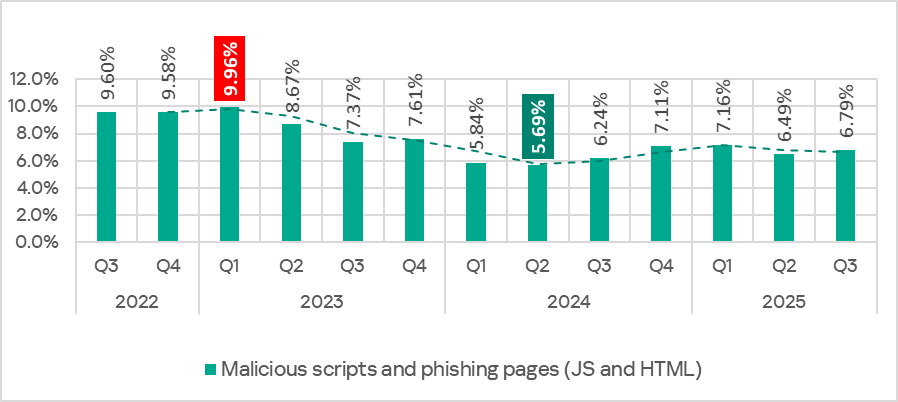
Regionally, the percentage of ICS computers on which malicious scripts and phishing pages were blocked ranged from 2.57% in Northern Europe to 9.41% in Africa. The top three regions for this indicator were Africa, East Asia, and South America. The indicator increased the most in East Asia (by a dramatic 5.23 pp) as a result of the local spread of malicious spyware scripts loaded into the memory of popular torrent clients including MediaGet.
Next-stage malware
Malicious objects used to initially infect computers deliver next-stage malware — spyware, ransomware, and miners — to victims’ computers. As a rule, the higher the percentage of ICS computers on which the initial infection malware is blocked, the higher the percentage for next-stage malware.
In Q3 2025, the percentage of ICS computers on which spyware and ransomware were blocked increased. The rates were:
- spyware: 4.04% (up 0.20 pp);
- ransomware: 0.17% (up 0.03 pp).
The percentage of ICS computers on which miners of both categories were blocked decreased. The rates were:
- miners in the form of executable files for Windows: 0.57% (down 0.06 pp), it’s the lowest level since Q3 2022;
- web miners: 0.25% (down 0.05 pp). This is the lowest level since Q3 2022.
Self-propagating malware
Self-propagating malware (worms and viruses) is a category unto itself. Worms and virus-infected files were originally used for initial infection, but as botnet functionality evolved, they took on next-stage characteristics.
To spread across ICS networks, viruses and worms rely on removable media and network folders in the form of infected files, such as archives with backups, office documents, pirated games and hacked applications. In rarer and more dangerous cases, web pages with network equipment settings, as well as files stored in internal document management systems, product lifecycle management (PLM) systems, resource management (ERP) systems and other web services are infected.
In Q3 2025, the percentage of ICS computers on which worms and viruses were blocked increased to 1.26% (by 0.04 pp) and 1.40% (by 0.11 pp), respectively.
AutoCAD malware
This category of malware can spread in a variety of ways, so it does not belong to a specific group.
In Q3 2025, the percentage of ICS computers on which AutoCAD malware was blocked slightly increased to 0.30% (by 0.01 pp).
For more information on industrial threats see the full version of the report.
Twelve Days of Christmas as Performed By 1980s Speech Chip

In a curious historical twist, the “Twelve days of Christmas” are actually the days of revelry that followed the 25th. The preceding period, Advent, was traditionally a fast, not unlike Lent. When and why a fast became an excuse for chocolate calendars we cannot say, but this historical information is presented to explain that this great hack by [Kevin], making a vintage speech synthesizer chip sing the classic carol will remain relevant at least until January 5th — or perhaps even the 19th, for the Orthodox amongst us.
The chip in question is an SP0256A-AL2, which you may remember from various speech projects for 8-bit computers back in the day. It can talk, after a fashion, by reproducing 56 “allophones” — the sounds that make up English speech — from ROM. Singing, though? We cannot recall much of that back in the day, but then, a talking computer was impressive enough.
As it turns out this is building on an earlier hack [Kevin] did in which he used an Arduino to make the venerable speech chip MIDI controllable. In that project’s write-up it is revealed that a Si5351 programmable clock module is used to give a variable pitch signal to the speech synthesizer. In this way he’s able to get about an octave an a half, which is good enough when the carol in question only spans one octave.
Of course the pitch signal needs to be varied by something and for that the venerable Arduino once again takes the place of an 8-bit computer. In this case it’s pre-programmed, but can also be set up for MIDI control.Of course nothing says you can’t use true retro hardware or a more-capable RP2040 instead of the Amtel chip.
It’s sad to think how much compute power has been wasted this year on AI-generated novelty carols when a little bit of 1980s silicon and some ingenuity can do nearly as good — or better, depending on your tastes.
makertube.net/videos/embed/diB…
EDR Nel mirino: i forum underground mettono in vendita NtKiller
All’interno di un forum underground chiuso, frequentato da operatori malware e broker di accesso iniziale, è comparso un annuncio che ha attirato l’attenzione della comunità di cyber threat intelligence. Il post promuove “NtKiller”, una presunta utility “kernel-level” progettata per disattivare in modo silente antivirus, EDR, con riferimenti espliciti a rootkit, persistenza avanzata e bypass UAC zero-day.
Il prezzo dichiarato è di 500 dollari, con contatti diretti via Telegram e una lista di soluzioni di sicurezza “supportate” che include nomi di primo piano: Windows Defender, ESET, Kaspersky, Bitdefender, Malwarebytes e altri.
Una proposta che, se autentica, si colloca nella fascia alta del cybercrime-as-a-service.
Disclaimer: Questo rapporto include screenshot e/o testo tratti da fonti pubblicamente accessibili. Le informazioni fornite hanno esclusivamente finalità di intelligence sulle minacce e di sensibilizzazione sui rischi di cybersecurity. Red Hot Cyber condanna qualsiasi accesso non autorizzato, diffusione impropria o utilizzo illecito di tali dati. Al momento, non è possibile verificare in modo indipendente l’autenticità delle informazioni riportate, poiché l’organizzazione coinvolta non ha ancora rilasciato un comunicato ufficiale sul proprio sito web. Di conseguenza, questo articolo deve essere considerato esclusivamente a scopo informativo e di intelligence.

Cosa sono gli EDR
Gli EDR (Endpoint Detection and Response) sono soluzioni di sicurezza avanzata progettate per andare oltre il tradizionale antivirus. Il loro compito non è solo bloccare file malevoli, ma monitorare costantemente il comportamento del sistema.
In sintesi, un EDR:
- raccoglie telemetria continua dagli endpoint;
- analizza processi, chiamate di sistema, driver e memoria;
- correla eventi sospetti nel tempo;
- consente risposta attiva, come l’isolamento del sistema o la terminazione di processi.
A differenza degli AV classici, molti EDR operano a livello kernel, rendendo più difficile la loro disattivazione da parte di codice malevolo eseguito in user-mode.

Perché gli EDR sono un obiettivo primario
Nel cybercrime moderno, soprattutto nel contesto ransomware e intrusioni mirate, la prima fase dopo l’accesso iniziale è quasi sempre la neutralizzazione delle difese. Un EDR attivo:
- registra le azioni dell’attaccante;
- può generare alert in tempo reale;
- può interrompere la catena di attacco prima della fase finale.
Per questo motivo, la capacità di “accecamento” o disattivazione silente degli EDR è diventata un valore di mercato nei forum underground.
Come vengono aggirati gli EDR (livello concettuale)
I post come quello su NtKiller fanno riferimento a tecniche note a livello teorico, già osservate in campagne APT e ransomware avanzate. Non si tratta di exploit “magici”, ma di abusi profondi dell’architettura del sistema operativo.
Tra le macro-categorie di bypass comunemente discusse nei circuiti underground:
- Abuso del livello kernel
Portare codice malevolo allo stesso livello di privilegio dell’EDR riduce drasticamente la capacità di difesa. A questo livello, i controlli diventano una “lotta tra pari”. - Manipolazione dei driver
L’uso (o abuso) di driver vulnerabili firmati è una tecnica storicamente osservata per ottenere operazioni privilegiate senza exploit diretti del kernel. - Disattivazione indiretta
Invece di “uccidere” l’EDR, alcuni malware puntano a:- degradarne la visibilità;
- interferire con la telemetria;
- bloccare componenti di logging o comunicazione.
- Persistenza invisibile
Rootkit e meccanismi di avvio precoce permettono al malware di caricarsi prima delle soluzioni di sicurezza. - Bypass dei controlli di elevazione
I riferimenti a UAC bypass indicano tecniche per ottenere privilegi elevati senza allertare l’utente, spesso sfruttando fiducia implicita in componenti di sistema.
Marketing underground e realtà operativa
Va sottolineato che non tutti gli annunci nei forum underground corrispondono a strumenti realmente efficaci. Molti sono:
- rebranding di tool già noti;
- proof-of-concept venduti come “weapon-grade”;
- vere e proprie truffe interne al mondo criminale.
Post come questo confermano che:
- gli EDR restano centrali nella difesa;
- il kernel è diventato un campo di battaglia;
- la sicurezza endpoint deve essere affiancata da monitoraggio comportamentale, hardening del driver model e threat hunting proattivo.
Per i difensori, osservare questi forum non significa “imparare ad attaccare”, ma capire come ragiona l’avversario, quali promesse vengono vendute e quali capacità sono considerate “di valore” nel sottobosco cybercriminale.
L'articolo EDR Nel mirino: i forum underground mettono in vendita NtKiller proviene da Red Hot Cyber.

[2026-01-31] Pillole di primo soccorso - primo appuntamento @ Spazio libertario Sole e Baleno
Pillole di primo soccorso - primo appuntamento
Spazio libertario Sole e Baleno - 27, Sobborgo Valzania, Quartiere Fiorenzuola, Ponte Abbadesse, Cesena, Unione dei comuni Valle del Savio, Forlì-Cesena, Emilia-Romagna, 47521, Italia
(sabato, 31 gennaio 15:00)

[2026-01-10] Discoscarica #10 @ Spazio libertario Sole e Baleno
Discoscarica #10
Spazio libertario Sole e Baleno - 27, Sobborgo Valzania, Quartiere Fiorenzuola, Ponte Abbadesse, Cesena, Unione dei comuni Valle del Savio, Forlì-Cesena, Emilia-Romagna, 47521, Italia
(sabato, 10 gennaio 18:00)

[2026-01-19] Assemblea di autogestione - 19 Gennaio @ Spazio libertario Sole e Baleno
Assemblea di autogestione - 19 Gennaio
Spazio libertario Sole e Baleno - 27, Sobborgo Valzania, Quartiere Fiorenzuola, Ponte Abbadesse, Cesena, Unione dei comuni Valle del Savio, Forlì-Cesena, Emilia-Romagna, 47521, Italia
(lunedì, 19 gennaio 20:00)

[2026-01-17] To kill a war machine @ Spazio libertario Sole e Baleno
To kill a war machine
Spazio libertario Sole e Baleno - 27, Sobborgo Valzania, Quartiere Fiorenzuola, Ponte Abbadesse, Cesena, Unione dei comuni Valle del Savio, Forlì-Cesena, Emilia-Romagna, 47521, Italia
(sabato, 17 gennaio 17:00)

Building a High-Performance Shifter for Sim Racing

These days, sim racing is more realistic than ever. There are better screens, better headsets, and better steering wheels with better force-feedback, all of which help make you feel like you’re driving the real thing. If you’re looking for a stick shifter to complete such a setup, [DAZ Projects] might have just what you’re looking for.
To create a robust shifter with great feel, the build relies on 3D printed parts as well as lots of quality metal hardware. At the heart of the build is a linear rail for the front-to-back movement, with a printed slider on top with a carefully-profiled indexer to ensure the stick properly ca-chunks into the right gear. A ball joint locates the shift lever itself, while allowing for smooth movement left-to-right. Centering is via simple extension springs. The H-pattern shift is enforced with machined steel rods. Detecting the position of the stick is handled via microswitches, with an Arduino Leonardo reading the switches and reporting itself as a USB device that should work with any modern sim.
It’s funny to think that such a mechanism would once have been a very serious machining job. These days, you can just squirt all this stuff out on a printer in a few hours. For the parts that can’t be extruded, [DAZ Projects] has provided a parts list on Google Docs.
We’ve featured some great racing sim builds over the years, from button pads to pedal boxes.
youtube.com/embed/_zBWefLVVEc?…
Arriva BitLocker con accelerazione hardware: Microsoft migliora la sicurezza e le prestazioni
Negli anni Microsoft ha cercato di mantenere l’impatto di BitLocker sulle prestazioni entro limiti contenuti, storicamente inferiori alla doppia cifra percentuale. L’obiettivo è sempre stato garantire la protezione dei dati senza penalizzare in modo significativo l’esperienza d’uso, un equilibrio che oggi risulta più complesso a causa dell’evoluzione dell’hardware.
La diffusione delle unità NVMe ha infatti innalzato in modo significativo le velocità di input/output. Questi dispositivi offrono prestazioni molto superiori rispetto alle generazioni precedenti, ma richiedono anche una maggiore capacità di elaborazione quando i dati vengono cifrati e decifrati in tempo reale. In questo scenario, le operazioni crittografiche di BitLocker possono incidere maggiormente sull’utilizzo della CPU.

L’effetto diventa più evidente nei carichi di lavoro ad alta intensità di I/O. Attività come il gaming, l’editing video professionale o la compilazione di grandi progetti software possono risentire di un aumento della latenza o di un consumo più elevato delle risorse di sistema quando la crittografia è gestita interamente via software.
La crescente aspettativa degli utenti in termini di prestazioni ha reso necessario ripensare l’approccio alla sicurezza. La protezione dei dati resta centrale, ma deve essere accompagnata da soluzioni capaci di sfruttare le nuove architetture hardware senza trasformarsi in un collo di bottiglia.
In questo contesto, Microsoft ha annunciato il mese scorso, durante Microsoft Ignite, l’introduzione di BitLocker con accelerazione hardware. La nuova implementazione è progettata per combinare livelli di sicurezza elevati con prestazioni più efficienti, riducendo il carico computazionale sulla CPU.
A partire dall’aggiornamento di settembre 2025 per Windows 11 24H2 e con il rilascio di Windows 11 25H2, BitLocker potrà sfruttare nuove funzionalità offerte da System on Chip e CPU di prossima generazione, oltre al supporto già esistente per la tecnologia UFS Inline Crypto Engine. L’obiettivo è migliorare la gestione della crittografia sulle unità NVMe attuali e future.
Tra le principali novità rientra l’offload delle operazioni crittografiche verso motori dedicati, che consente di liberare risorse della CPU e migliorare anche l’efficienza energetica. Le chiavi di crittografia vengono inoltre protette tramite hardware, affiancando il ruolo del Trusted Platform Module e riducendo l’esposizione a vulnerabilità legate a CPU e memoria.
Nei dispositivi compatibili dotati di unità NVMe e SoC in grado di supportare l’offload crittografico, BitLocker con accelerazione hardware sarà attivo di default con algoritmo XTS-AES-256. Il supporto iniziale arriverà sui sistemi Intel vPro con processori Intel Core Ultra Series 3, nome in codice Panther Lake, con un’estensione prevista anche ad altre piattaforme hardware.
L'articolo Arriva BitLocker con accelerazione hardware: Microsoft migliora la sicurezza e le prestazioni proviene da Red Hot Cyber.

Chaos Communication Congress: Talk-Tipps für die Zeit zwischen den Jahren
netzpolitik.org/2025/chaos-com…


[2025-12-26] 🎄 VENERDÌ 26 DICEMBRE ORE 20 CENONE DEGLI AVANZI + TOMBOLA e GIOCHI🎄 @ Nuovo presidio San Giuliano
🎄 VENERDÌ 26 DICEMBRE ORE 20 CENONE DEGLI AVANZI + TOMBOLA e GIOCHI🎄
Nuovo presidio San Giuliano - San Giuliano di Susa
(venerdì, 26 dicembre 19:30)

Natale con i tuoi, Pasqua con chi vuoi e Santo Stefano con il movimento No Tav 💕. Continuiamo a scaldare il cuore del presidio, festeggiamo il Natale e diamo il colpo finale alla nostra linea inviadiabile. Porta avanzi, liquidi e qualcosina di brutto da mettere in palio per la Tombola…
La telefonata del presidente Mattarella alla madre di Trentini. Un gesto buono e giusto
@Giornalismo e disordine informativo
articolo21.org/2025/12/la-tele…
Il presidente Mattarella ha telefonato alla mamma di Alberto Trentini, il volontario e cooperante veneziano
Giornalismo e disordine informativo reshared this.
Iran: oltre 1500 esecuzioni nel 2025
@Giornalismo e disordine informativo
articolo21.org/2025/12/iran-ol…
Con oltre 1500 esecuzioni nel 2025, la Repubblica Islamica dell’Iran, ha registrato il numero più alto di esecuzioni negli ultimi tre decenni. Il 2025 si chiude con oltre 5000 persone in attesa dell’esecuzione, almeno 44 dei quali condannati a morte per ragioni
reshared this
Auguri a tutti noi in direzione ostinata e contraria
@Giornalismo e disordine informativo
articolo21.org/2025/12/auguri-…
Sarà un anno difficile, attacco alla Costituzione, una Finanziaria che cancella dei diritti acquisiti, venti di guerra, informazione negata, giustizia sotto il controllo del Governo, e per ultimo non ultima la
Giornalismo e disordine informativo reshared this.

Un referendum in diretta televisiva
@Giornalismo e disordine informativo
articolo21.org/2025/12/un-refe…
Bene ha fatto il Consiglio nazionale dell’Ordine dei giornalisti a fare appello all’Autorità per le garanzie nelle comunicazioni perché venga convocato con urgenza il Comitato istituito per vigilare sulla correttezza della trattazione dei processi in tv. L’Agcom
Giornalismo e disordine informativo reshared this.
Nuovo naufragio alla Vigilia di Natale: 16 morti
@Giornalismo e disordine informativo
articolo21.org/2025/12/nuovo-n…
Un nuovo naufragio alla Vigilia di Natale Secondo quanto riferisce sul proprio account di X l’ong Sea Watch, “116 persone hanno perso la vita nell’ennesimo naufragio del 2025. L’unico sopravvissuto è stato salvato da
reshared this
Buone feste! Ecco il mio augurio.
@Privacy Pride
Il post completo di Christian Bernieri è sul suo blog: garantepiracy.it/blog/augurio/
Ho un personalissimo proposito ed è anche il mio augurio per il nuovo anno: Che tu possa diffidare, sempre, anche se… Prosit.
reshared this

Tutti i danni che i video brevi possono causare al nostro cervello
L'esposizione prolungata a video brevi attiva il sistema della ricompensa, con conseguenze su concentrazione, autocontrollo, memoria, equilibrio emotivo e difficoltà di concentrazione su compiti lunghi.Filippo Bonaventura (Geopop)
Guinness_Irish_Stout67 reshared this.

Famiglia nel bosco, la madre da un mese non si lava in casa famiglia: «Non apre al dialogo». I rifiuti al sondino anti intossicazione e agli antibiotici
Nel provvedimento del tribunale per i minorenni, che ha confermato la permanenza dei minori in casa famiglia, è stata sottolineata l’intransigenza della madre, che rifiuta ogni tipo di dialogo. E le difficoltà dei figli nel socializzareUgo Milano (Open)
collezionismo (o no)
cosa 'non' fa di me un collezionista
noblogo.org/differx/cosa-non-f…
reshared this
Ausili e protesi: Il TAR boccia il decreto tariffe. Ass. Coscioni: “Ora il Ministero intervenga con istruttoria seria”
Il TAR del Lazio ha annullato il Decreto Tariffe del 25 novembre 2024 anche per la parte relativa all’assistenza protesica, accogliendo il ricorso della Federazione Italiana degli Operatori in Tecniche Ortopediche (Fioto). Con la sentenza n. 22313/2025, pubblicata il 10 dicembre, i giudici amministrativi hanno bocciato il provvedimento “per grave difetto di istruttoria”, dando al Ministero della Salute un anno di tempo per riformularlo.
“Questa pronuncia del TAR Lazio, letta unitamente alla sentenza scaturita dalla class action promossa dall’Associazione Luca Coscioni, mette in evidenza una criticità strutturale del sistema dei LEA”, afferma l’avvocato Alessandro Bardini, Consigliere Generale dell’Associazione Luca Coscioni. “Dalle decisioni giudiziarie emerge con chiarezza che il Ministero della Salute ha affrontato la riforma dell’assistenza protesica in modo approssimativo, in assenza di una reale istruttoria sui bisogni delle persone con disabilità e sui costi effettivi delle prestazioni. Il Giudice amministrativo riafferma un principio fondamentale: senza istruttoria adeguata non può esservi legittimità dell’azione amministrativa. La logica del risparmio, quando non è fondata su valutazioni tecniche serie, rischia di compromettere il diritto alla salute degli assistiti”.
“Questa sentenza conferma quanto emerso dalla nostra class action vinta prima al TAR e poi confermata dal Consiglio di Stato proprio sul tema ausili”, dichiara Rocco Berardo, coordinatore iniziative sui diritti delle persone con disabilità dell’Associazione Luca Coscioni. “Anche in quel caso il Ministero è stato condannato perché non ha rispettato quanto previsto dalla legge del 2017, in particolare relativamente all’art. 30 bis sugli ausili destinati alle disabilità più gravi e complesse. Il Ministero non ha effettuato le istruttorie previste, anche ascoltando le associazioni, per verificare il funzionamento della legge e il suo eventuale miglioramento lasciando le persone con disabilità abbandonate a sé stesse”.
La prova di quanto non funzioni l’attuale sistema è stata tra l’altro restituita da un’indagine condotta dall’Associazione Luca Coscioni, che ha raccolto centinaia di testimonianze. “Le evidenze raccolte – dichiara Rocco Berardo – confermano che le procedure ad evidenza pubblica stanno penalizzando le persone con disabilità più gravi. Tempi di attesa insostenibili, costi aggiuntivi anche molto elevati a carico delle famiglie e l’impossibilità di ottenere ausili realmente personalizzati stanno svuotando di contenuto il diritto all’assistenza protesica previsto dai LEA. È indispensabile, dunque, come richiesto dall’Associazione Luca Coscioni alla commissione del Ministero, che gli ausili più critici siano inseriti fuori dall’elenco degli ausili da mettere a gara e che siano garantite per gli stessi la personalizzazione e la riparazione”.
L'articolo Ausili e protesi: Il TAR boccia il decreto tariffe. Ass. Coscioni: “Ora il Ministero intervenga con istruttoria seria” proviene da Associazione Luca Coscioni.
Ecco come Ast SpaceMobile sfida Starlink con il lancio del satellite per smartphone BlueBird 6
Per vedere altri post come questo, segui la comunità @Informatica (Italy e non Italy 😁)
L'azienda texana Ast SpaceMobile ha annunciato il lancio di successo con un razzo indiano di BlueBird 6, iI sistema di comunicazione più grande mai dispiegato in orbita
Informatica (Italy e non Italy 😁) reshared this.
Resoconto Linux Day 2025
firenze.linux.it/2025/12/resoc…
Segnalato dal LUG di Firenze e pubblicato sulla comunità Lemmy @GNU/Linux Italia
#Firenze
L’anno scorso fummo sorpresi dal successo del giorno di GNU/Linux alla biblioteca di Scandicci, malgrado i modesti mezzi e i tempi ristretti per l’organizzazione. Al contrario quest’anno
GNU/Linux Italia reshared this.
incoscienza a proposito della Liberazione
dal 2015 : youtu.be/cBesCvBzXfw
(e credo che in questi ultimi dieci anni le cose siano ancora peggiorate.
non si spiegano molte faccende orribili, altrimenti)
#25aprile #Liberazione #FestaDellaLiberazione #antifascismo
notilla su
noblogo.org/differx/dal-2015-y…
reshared this
Natale, istruzioni per l’uso (del portafoglio.)
noblogo.org/transit/natale-ist…


Natale, istruzioni per l’uso (del portafoglio.)
(189)
Un tempo il #Natale sapeva di mandarini e di freddo. Oggi sa di plastica, di profumo sintetico alla cannella e di offerte “imperdibili”. È passato da evento religioso (che riconosco, ma non frequento per coerenza) a vaccino annuale contro la malinconia, somministrato in dosi di pubblicità e zucchero. Non si aspetta più la nascita di un improbabile “Salvatore”: si aspetta il corriere espresso.
L’unico presepe che conta è quello dove il nuovo dio è lo scontrino fiscale. La festa comincia già a novembre, quando si accendono i LED sponsorizzati e le vetrine diventano vetrate di cattedrali dedicate alle divinità del consumo. L’atmosfera natalizia è una liturgia pubblicitaria senza fine: famiglie perfette, pacchi scintillanti, sorrisi programmati. “Fatevi un regalo”, dicono. Ma per molti, il vero regalo sarebbe un affitto pagato o una bolletta non scaduta.
Nei magazzini e nei centri di smistamento si lavora a tempo di jingle. I veri elfi di Babbo Natale sono precari con la schiena a pezzi e la consegna garantita. Mentre il mondo si commuove davanti agli spot, loro fanno le notti per tenere accesa la giostra del Natale. Il miracolo non è la nascita di un bambino, ma che qualcuno ancora sorrida dopo dodici ore di lavoro.
Arriva la Vigilia: la prova di sopravvivenza più ipocrita dell’anno. Tavole imbandite, sorrisi forzati, discussioni che nessuno ha voglia di affrontare. A Natale ci si ama per obbligo, si ascolta per forza, si brinda per abitudine. È il grande festival delle relazioni diplomatiche: tutti seduti insieme, uniti solo dalla stanchezza e dal desiderio che finisca in fretta. Fuori, le città traboccano di “esperienze autentiche”: mercatini vintage, regali “etici”, panettoni artigianali da quarantacinque euro.
Tutto mercificato, anche la bontà. Se non compri, non esisti. La gioia è un’unità di misura tracciata in scontrini, la pace si conta in like. “Buone feste” è diventato un riflesso condizionato, un rumore di fondo da cui nessuno si salva. Dietro le luci e i brindisi resta il buio dei margini. I poveri, i precari, gli invisibili assistono al grande spettacolo del benessere da dietro la quinta. Per loro, il Natale è solo un altro turno, un altro giorno da superare. Poi arrivano i servizi televisivi “commoventi”, la lacrima di circostanza, e tutto finisce lì: quel poco di solidarietà si scioglie più in fretta del burro nel panettone.
Il Natale consumistico è una macchina perfetta: produce desideri, li vende, e poi li sostituisce. È la religione del capitale emotivo, dove la preghiera è contactless e la redenzione avviene in tre rate. Ogni gennaio ci chiediamo perché ci sentiamo vuoti. La risposta è semplice: lo siamo, ma almeno abbiamo comprato il vuoto in confezione regalo. Viva il #Natale, dunque: patrono dell’apparenza, santo protettore dell’ipocrisia e martire della sincerità. Non importa più cosa significhi, basta che arrivi il pacco in tempo e che l’etichetta sia quella giusta. Perché in fondo, nel presepe del mondo moderno, l’unico Bambin Gesù rimasto è un prodotto in pronta consegna.
#Blog #Natale #Consumismo #Economia #Opinioni
Mastodon: @alda7069@mastodon.unoTelegram: t.me/transitblogFriendica: @danmatt@poliverso.orgBlue Sky: bsky.app/profile/mattiolidanie…Bio Site (tutto in un posto solo, diamine): bio.site/danielemattioli
Gli scritti sono tutelati da “Creative Commons” (qui)
Tutte le opinioni qui riportate sono da considerarsi personali. Per eventuali problemi riscontrati con i testi, si prega di scrivere a: corubomatt@gmail.com


Corazzate nucleari, armi laser e industria. Tutto sulla Golden Fleet Initiative
@Notizie dall'Italia e dal mondo
Una flotta rinnovata, capace di schierare le navi più potenti di sempre e di riportare la Marina statunitense ai fasti di un tempo. Questo è il piano dell’amministrazione Usa per rilanciare la propria industria cantieristica e mandare un messaggio alla Cina e
Notizie dall'Italia e dal mondo reshared this.
In the age of Spotify and AI slop, tapes remind us what we’re missing when we stop taking risks.#Music #physicalmedia


Why I Quit Streaming And Got Back Into Cassettes
Whenever I tell people I’m getting back into tapes, their faces immediately light up.There’s a genuine excitement in peoples’ expressions these days when I mention physical media. Lately I’ve been talking about the cheap walkman I bought on a recent trip to Tokyo, and the various little shops where I hunted for music on cassettes. Unlike in Europe and the US, physical media never went out of vogue in Japan, and many people still have a strong preference for shopping in-person. This made Tokyo the ideal place to rediscover my love of portable analog music.
I searched through racks of tapes stacked on top of an old piano in a back-alley store on the edge of Shimokitazawa, a neighborhood known for thrifted fashion and oddball record shops. On recommendation from a friend-of-a-friend, I checked out a specialist shop on a sleepy street in Nakameguro, where cassettes easily outnumbered vinyl records 10-to-1. Almost always, I steered myself toward local artists whose names I didn’t recognize. Sometimes, I bought tapes based on the cover art or description alone. Most second-hand music stores in Tokyo keep everything sealed in plastic, so you either have to bother the shopkeep, or just trust your gut and take a chance.
This kind of music discovery delights people when I describe it to them. Sometimes they start telling me about rediscovering their old CD collection, or wanting to track down an old iPod Classic to experience their music library away from the surveillance and excess of big tech platforms. Maybe it’s just because I live in a particular social bubble in a particular countercultural pocket of New York City. But recently, the conversations I’ve had on this topic have got me feeling like the culture of music is shifting.
playlist.megaphone.fm?p=TBIEA2…
People areleaving Spotify, and those who aren’t seem embarrassed about using it. Major artistspulled their music off the platform this year in protest of the company’sICE recruitment ads and connections tomilitary drones, and posting your Wrapped stats has gone from a ubiquitous year-end pastime to a cultural faux pas. Many folks aresick of streaming in general. They’re sick of giant corporations, algorithmic playlists, and aninternet infested with AI slop. Artists are tired of tech platforms that pay them virtually nothing, owned by degenerate billionaires that see all human creativity as interchangeable aesthetic wallpaper, valued only for its ability to make numbers go up. Everywhere I go,people are exhausted by the never-ending scroll, desperately wanting to reconnect with something real.My own path to re-embracing physical media unfolded in stages. Last year, I canceled my Apple Music subscription and started exclusively listening to music I bought from artists on Bandcamp. I still have a large mp3 library, and I thought about setting up aself-hosted media server to stream everything to my phone. But ultimately, I got lazy and wound up just listening to albums I downloaded from the Bandcamp app. Then I ran out of storage on my phone, and the amount of music I had available on-the-go shrank even more.
When I came to Tokyo, a friend took me to a store that sold cheap portable cassette players, and I knew it wouldn’t be a huge leap to take my music listening fully offline. The walkman I bought is unbranded and has a transparent plastic shell, allowing you to watch all the little mechanical gears turning inside as the tape spools around the wheels and past the playheads. It was one of the easiest purchasing decisions I’ve made in recent memory: After years of psychic damage from social media and other phone-based distractions, I was ready to once again have a dedicated device that does nothing but play music.
There are lots of advantages to the cassette lifestyle. Unlike vinyl records, tapes are compact and super-portable, and unlike streaming, you never have to worry about a giant company suddenly taking them away from you. They can be easily duplicated, shared, and made into mixtapes using equipment you find in a junk shop. When I was a kid, the first music I ever owned were tapes I recorded from MTV with a Kids’ Fisher Price tape recorder. I had no money, so I would listen to those tapes for hours, relishing every word Kim Gordon exhaled on my bootlegged copy of Sonic Youth’s “Bull in the Heather.” Just like back then, my rediscovery of cassettes has led me to start listening more intentionally and deeply, devoting more and more time to each record without the compulsion to hit “skip.” Most of the cassettes I bought in Tokyo had music I probably never would have found or spent time with otherwise.
Getting reacquainted with tapes made me realize how much has been lost in the streaming era. Over the past two decades, platforms like Spotify co-opted the model of peer-to-peer filesharing pioneered by Napster and BitTorrent into a fully captured ecosystem. But instead of sharing, this ecosystem was designed around screen addiction, surveillance, and instant gratification — with corporate middlemen and big labels reaping all the profits.
Streaming seeks to virtually eliminate what techies like to call “user friction,” turning all creative works into a seamless and unlimited flow of data, pouring out of our devices like water from a digital faucet. Everything becomes “Content,” flattened into aesthetic buckets and laser-targeted by“perfect fit” algorithms to feed our addictive impulses. Thus the act of listening to music is transformed from a practice of discovery and communication to a hyper-personalized mood board of machine-optimized “vibes.”
What we now call “AI Slop” is just a novel and more cynically efficient vessel for this same process. Slop removes human beings as both author and subject, reducing us to raw impulses — a digital lubricant for maximizing viral throughput. Whether we love or hate AI Slop is irrelevant, because human consumers are not its intended beneficiaries. In the minds of CEOs like OpenAI’s Sam Altman, we’re simply components in a machine built to maintain and accelerate information flows, in order to create value for an insatiably wealthy investor class.
On one hand, I empathize with those who still feel like they get something out of streaming. Having access to so much music can feel empowering, especially when so many people feel like they lack the time and resources to develop a music-listening practice. “What streaming service should I use instead of Spotify?” is a question I’ve been seeing constantly over the past few months.
Here’s my contrarian answer: What if there’s no ethical way to have unlimited access to every book, film, and record ever created? And moreover, what if that’s not something we should want?
What if we simply decided to consume less media, allowing us to have a deeper appreciation for the art we choose to spend our time with? What if, instead of having an on-demand consumer mindset that requires us to systematically strip art of all its human context, we developed better relationships with creators and built new structures to support them? What if we developed a politics of refusal — the ability to say enough is enough — and recognized that we aren’t powerless to the whims of rich tech CEOs who force this dystopian garbage down our throats while claiming it’s “inevitable?”
0:00
/0:07
1×Tapes and other physical media aren’t a magic miracle cure for late-stage capitalism. But they can help us slow down and remember what makes us human. Tapes make music-listening into an intentional practice that encourages us to spend time connecting with the art, instead of frantically vibe-surfing for something that suits our mood from moment-to-moment. They reject the idea that the point of discovering and listening to music is finding the optimal collection of stimuli to produce good brain chemicals.
More importantly, physical media reminds us that nothing good is possible if we refuse to take risks. You might find the most mediocre indie band imaginable. Or you might discover something that changes you forever. Nothing will happen if you play it safe and outsource all of your experiences to a content machine designed to make rich people richer.
How To Ditch Spotify and Support Music in the Age of AI Slop
There’s no shortage of reasons to quit Spotify in 2025. Artists and fans have been departing the platform in droves because they’re fed up with the company paying artists virtually nothing, using algorithms that promote AI-generated slop, running rec…Janus Rose (Touch Grass)
Famiglia nel bosco, Salvini: “Separarli a Natale è una violenza di Stato senza senso e senza precedenti”
@Politica interna, europea e internazionale
Matteo Salvini si scaglia nuovamente contro i giudici per il caso della cosiddetta famiglia nel bosco. Il vicepremier e ministro dei Trasporti, infatti, ha scritto sui social: “Separare una famiglia anche nel giorno di Natale, una violenza
Politica interna, europea e internazionale reshared this.
How we tracked ourselves with exposed Flock cameras; a year in review; and our personal recommendations on all sorts of things.#Podcast
Podcast: We Tracked Ourselves with Exposed Flock Cameras
We start this week with Jason’s story about Flock exposing a bunch of AI-powered cameras. These cameras zoom in on people as they walk by, sometimes so closely you can read what’s on their phone screen. After the break, we talk about some of our biggest stories this year. In the subscribers-only section, we give some of our personal recommendations of games, other reporting, or just a more chill life.
playlist.megaphone.fm?e=TBIEA7…
Listen to the weekly podcast on Apple Podcasts,Spotify, or YouTube. Become a paid subscriber for access to this episode's bonus content and to power our journalism. If you become a paid subscriber, check your inbox for an email from our podcast host Transistor for a link to the subscribers-only version! You can also add that subscribers feed to your podcast app of choice and never miss an episode that way. The email should also contain the subscribers-only unlisted YouTube link for the extended video version too. It will also be in the show notes in your podcast player.
- Flock Exposed Its AI-Powered Cameras to the Internet. We Tracked Ourselves
- Anyone Can Push Updates to the DOGE.gov Website
- Mike Waltz Accidentally Reveals Obscure App the Government Is Using to Archive Signal Messages
- How Tea’s Founder Convinced Millions of Women to Spill Their Secrets, Then Exposed Them to the World
- Half of the US Now Requires You to Upload Your ID or Scan Your Face to Watch Porn
Mike Waltz Accidentally Reveals Obscure App the Government Is Using to Archive Signal Messages
A photograph of Trump administration official Mike Waltz's phone shows him using an unofficial version of Signal designed to archive messages during a cabinet meeting.Joseph Cox (404 Media)

è sempre adessoa

è sempre adesso
Sono il mio mulino a vento quello che cammina sulla scala mobile per il paradiso di Natale alla fine di un arcobaleno banale contento e...ordinariafollia
Il Pentagono e le armi cinesi. Cosa dice su Pechino il report annuale dei militari Usa
@Notizie dall'Italia e dal mondo
Il rapporto annuale del Dipartimento della Guerra statunitense sulle evoluzioni militari e di sicurezza della Cina, pubblicato in queste ore, offre molto più di un aggiornamento tecnico sulle capacità dell’Esercito Popolare di Liberazione (Pla).
Notizie dall'Italia e dal mondo reshared this.
Barbara Berlusconi: “Io in politica? No. Pensare di entrarci solo per il cognome non ha senso”
@Politica interna, europea e internazionale
Dal rapporto con papà Silvio alla depressione fino ai cinque figli: Barbara Berlusconi si racconta al Corriere della Sera. La terzogenita dell’ex presidente del Consiglio afferma che ora le “piacerebbe cominciare da chi sono ora”. Per questo ha creato una fondazione che
Politica interna, europea e internazionale reshared this.
SIRIA. Aleppo, i miliziani legati alla Turchia sparano sui quartieri curdi
@Notizie dall'Italia e dal mondo
Le sparatorie avvengono mentre cresce la tensione per il mancato raggiungimento dell'intesa tra curdi e Damasco
L'articolo SIRIA. Aleppo, ihttps://pagineesteri.it/2025/12/24/medioriente/siria-aleppo-i-miliziani-legati-alla-turchia-sparano-sui-quartieri-curdi/
Notizie dall'Italia e dal mondo reshared this.
PODCAST. Betlemme, il Natale dietro i muri: attese e occupazione militare
@Notizie dall'Italia e dal mondo
Nel servizio della giornalista Micol Hassan raccontiamo il Natale a Betlemme in una presunta normalità fortemente segnata dal dolore dei palestinesi per le vittime e le distruzioni di Gaza
L'articolo PODCAST. Betlemme, il Natale dietro i muri: attese e
Notizie dall'Italia e dal mondo reshared this.
L'altro è il Presidente della NATO.
Avete letto le differenze?

Sanktionen gegen HateAid-Führung: Die Bundesregierung muss jetzt scharf protestieren
netzpolitik.org/2025/sanktione…

Dopo il riarmo l’Unione Europea vuole una “Schengen militare”
@Notizie dall'Italia e dal mondo
La "Schengen militare" approvata dall'Eurocamera prevede la rimozione degli impedimenti fisici e burocratici alla libera circolazione delle truppe e dei mezzi militari sulle ferrovie e le strade di tutta Europa
L'articolo Dopo il riarmo l’Unione Europea vuole una “Schengen militare” proviene da Pagine
Notizie dall'Italia e dal mondo reshared this.
La vera data di nascita di Gesù
freepik.it

Numerosi studi hanno analizzato la figura di Gesù di Nazareth, questioni riguardanti l'attendibilità storica della sua vita e perfino la sua effettiva esistenza. Benché attualmente si ritenga largamente che sia esistito davvero, al di là degli aspetti mistici, le informazioni disponibili risultano frequentemente contraddittorie e influenzate da intenti religiosi. Tuttavia, distinguendo gli eventi storicamente plausibili da quelli inventati, si possono ricavare informazioni attendibili sulla sua esistenza, inclusa la data di nascita.
La data erroneamente identificata come anno 1 venne stabilita - per errore o deliberatamente - nel VI secolo da Dionigi il Piccolo, monaco bizantino che creò un nuovo sistema di datazione per distinguere l'epoca pagana da quella cristiana: l'Anno Domini - "anno del Signore", dalla nascita di Gesù, sostituendo il sistema romano ad Urbe condita - "dalla fondazione della città" di Roma.
Il 25 dicembre, scelto per commemorare la sua nascita, è certamente una decisione deliberata, dato che neppure le fonti religiose originarie indicano questa data. Il primo accenno al 25 dicembre risale al periodo dell'imperatore Costantino, che con l'Editto di Milano del 313 d.C. terminò le persecuzioni contro i cristiani. Quando Dionigi il Piccolo sviluppò il suo sistema di datazione, il 25 dicembre era già la data stabilita. La scelta di questo giorno derivava dal fatto che coincideva con la festività del Sole Invitto, divinità orientale che l'imperatore Aureliano aveva elevato a culto ufficiale dell'Impero verso la fine del III secolo.
Per saperne di più
storicang.it/a/in-che-anno-nac…
Truffe: come riconoscerle e come difendersi
Per vedere altri post come questo, segui la comunità @Informatica (Italy e non Italy 😁)
Dalle truffe telefoniche ai deepfake con l’intelligenza artificiale. Ecco alcuni consigli per evitare situazioni spiacevoli. L'intervento di Gian Lorenzo Cosi
reshared this
Netzpolitischer Jahresrückblick: Was uns im Jahr 2025 umgetrieben hat – und weiter begleiten wird
netzpolitik.org/2025/netzpolit…

BULGARIA. Burgas sotto assedio (parte seconda). Lukoil, sanzioni e sovranità limitata
@Notizie dall'Italia e dal mondo
Le sanzioni statunitensi contro Lukoil colpiscono il cuore energetico della Bulgaria. La raffineria di Burgas, che garantisce l’80% del carburante nazionale, diventa una leva geopolitica. Tra vendite fallite, pressioni di Washington e
Notizie dall'Italia e dal mondo reshared this.
Altbot
in reply to storiaweb • • •A stylized illustration depicts three figures: a seated woman, a seated man, and a baby in a manger. The background includes a large, light-colored circular shape with stars and vertical lines. The woman wears a long, flowing robe with a head covering; the man wears a robe and has a beard; the baby lies in a straw-filled manger. The color palette consists of muted blues and browns. No text is present in the image.
Fornito da @altbot, generato localmente e privatamente utilizzando Qwen3-Vl:30b
🌱 Energia utilizzata: 0.064 Wh